
Yankees Sign Paul Goldschmidt
The Yankees officially announced the signing of Paul Goldschmidt to a one-year contract. The Excel Sports Management client is reportedly guaranteed $12.5MM.
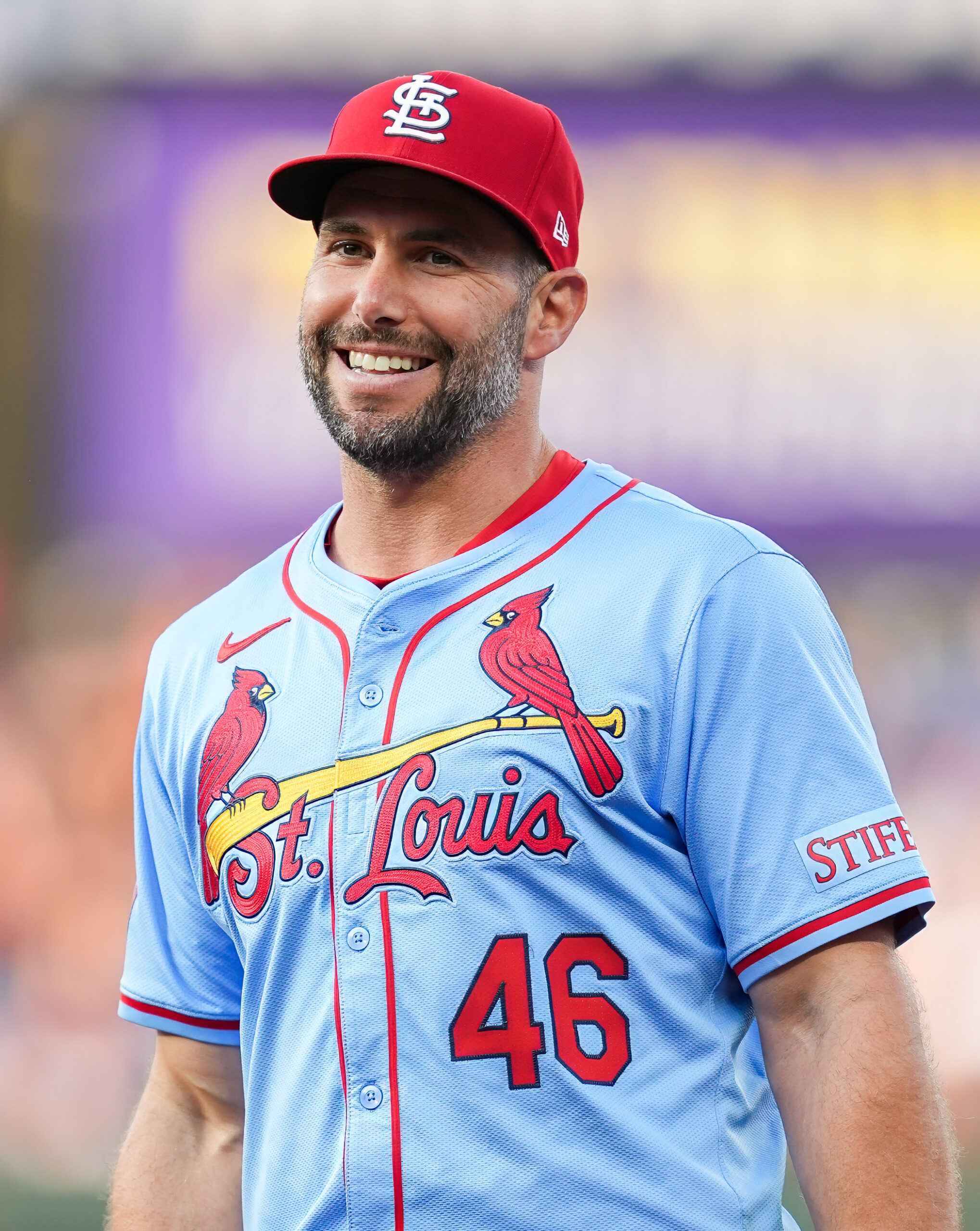
Nightengale describes the Yankees’ pursuit of Goldschmidt this week as aggressive, though he notes they were also in talks with Christian Walker before he signed with the Astros. Carlos Santana was another first baseman New York reportedly considered. The Yankees had also been linked to Pete Alonso earlier in the offseason, but Ken Rosenthal of The Athletic reported that they were “increasingly likely” to opt for a less expensive first base signing.
Indeed, Goldschmidt’s $12.5MM salary is well below the three-year, $60MM guarantee Walker received from Houston and the five-year, $125MM deal MLBTR predicted for Alonso. It’s also below the one-year, $15MM pact we predicted for Goldschmidt when we ranked him at no. 35 on our Top 50 Free Agents list.
Goldschmidt, 37, was a free agent for the first time in his career. Drafted by the Diamondbacks in 2009, he made his big league debut with Arizona in 2011. After a strong start to his MLB career, he signed an extension with the D-backs that kept him under team control through the 2019 season. Upon being traded to the Cardinals in 2019, he signed another extension that ran through 2024. Through those years with Arizona and St. Louis, Goldschmidt was one of the best players in baseball. He made seven All-Star teams, won five Silver Sluggers, and earned NL MVP honors in 2022. Over 1928 career games, he has slashed .289/.381/.510 with 362 home runs and a 139 wRC+.
Since his MVP season in 2022, Goldschmidt has taken a few steps back. His .810 OPS and 122 wRC+ in 2023 were more good than great, while his .716 OPS and 100 wRC+ in 2024 were merely league average. That’s not an encouraging trend for a first baseman entering his late thirties. However, Goldschmidt’s underlying numbers in 2024 offer a little more promise. His .308 batting average on balls in play was well below his career average of .343. Similarly, his .310 wOBA was noticeably worse than his .329 xwOBA. A .329 wOBA still would have been the worst of his career, but it also would have been significantly better than league average. Finally, Goldschmidt’s second-half performance was vastly superior to his first-half effort. Through the All-Star break, he was slashing .230/.291/.373 with an 87 wRC+. From the break onward, he hit .271/.319/.480 with a 120 wRC+.
The Yankees are surely hoping Goldschmidt looks like his second-half self throughout the 2025 season. However, even his mediocre full-season numbers would be a big upgrade over what the Yankees got from their first basemen in 2024. Yankees first basemen ranked last in MLB in OPS (.619), second-to-last in wRC+ (76), and 26th in FanGraphs WAR (-1.1). If Goldschmidt can simply repeat his 2024 campaign, the Yankees would get a big boost over the combination of Anthony Rizzo, Ben Rice, and DJ LeMahieu. That will be especially true against left-handed pitching. Goldschmidt slashed .295/.366/.473 with a 134 wRC+ against lefties this past season. Meanwhile, New York’s offense was significantly worse against lefties than righties. Goldschmidt should be a big help in that department.
On the defensive side, Goldschmidt, a four-time Gold Glove winner, will undoubtedly play first base for the Yankees. That will push recent trade acquisition Cody Bellinger into the outfield. It always seemed likely that Bellinger would play the outfield in New York, but manager Aaron Boone suggested earlier this week that first base was still an option. It’s safe to say that option is now off the table.
If the Yankees are still looking to add another bat, third base could be the next avenue they turn to for improvement. Jazz Chisholm Jr. took over at the hot corner after the trade deadline in 2024, but second base is his natural position. By sliding back to second, he could give the Yankees more flexibility to seek an upgrade in the infield. Some intriguing options at third base include free agent Alex Bregman and trade candidate Nolan Arenado. The Yankees have already expressed interest in both players.
Adding either Bregman or Arenado would likely push the team’s payroll above last year’s final estimate of $303MM (per RosterResource). It would also put them above the highest tier of the luxury tax once again. Although it wouldn’t be surprising to see the Yankees run such a high payroll in 2025, it’s worth keeping in mind that even the Steinbrenner’s have their spending limits. Chairman Hal Steinbrenner said earlier this year that the team’s current payroll is “simply not sustainable for us financially.” The fact that the Yankees were outbid for Juan Soto and that they were seeking a less expensive first baseman like Goldschmidt further suggests that GM Brian Cashman is working under payroll constraints. Those constraints could impact how the team operates for the rest of the offseason.
Jack Curry of the YES Network first reported the Yankees and Goldschmidt had agreed to a one-year deal. Bob Nightengale of USA Today was first on the salary.
Image courtesy of Imagn.
Yankees Sign Brennen Davis To Minor League Deal
The Yankees have signed outfielder Brennen Davis to a minor league deal, as reported by Aram Leighton of Just Baseball. It’s not clear whether or not the deal includes an invite to big league Spring Training.
Davis, 25, has not yet made his big league debut but was a consensus top-100 prospect for many years. A second-round pick by the Cubs in 2018, Davis broke out at the age of 19 in 2019 with a with a .305/.381/.525 slash line in 50 games at the Single-A level. Following the cancelled minor league season in 2020, Davis got the bump to High-A to start the 2021 season but lasted just eight games at the level before being promoted to Double-A. After hitting a solid .252/.367/.474 for the Cubs’ Tennessee affiliate in 76 games, Davis got his second promotion of the year with a late-season cup of coffee at Triple-A, where he impressed with a .268/.397/.536 slash line in 16 games.
After dominating at every level of the minors during his age-21 season, Davis became a consensus top-20 prospect in the sport and appeared to be on the verge of a Wrigley Field debut. Unfortunately, 2022 was not kind to the youngster as he struggled badly in 22 games at the Triple-A level before undergoing back surgery in May. He made it back to the club’s Iowa affiliate in September for the stretch run and managed a .361 on-base percentage down the stretch but hit just .188 and struggled to hit for power. Even after that disastrous 2022 campaign, Davis was still a consensus top-100 prospect in the sport and appeared poised for a rebound in 2023.
Unfortunately, that rebound never came. Davis’s 2023 and 2024 seasons have been just as injury plagued as 2022 as he contended first with core surgery and then a fractured ankle. The outfielder’s brutal 2023 numbers (.187/.296/.279 in 62 games at Triple-A) were enough to knock him off every top-100 prospect list, but he did manage to post strong numbers at Triple-A when healthy this season. In 47 games at Triple-A this year, Davis slashed .214/.359/.469 with 11 home runs in just 145 trips to the plate and a 12.7% walk rate, though his batting average was held down by a paltry .213 BABIP.
After years of injury struggles and given the club’s incredibly crowded outfield mix, the Cubs decided last month that they could no longer afford to use a 40-man roster spot on Davis and non-tendered him. That led to him hitting minor league free agency, and he’s now caught on with the Yankees. For New York, the youngster represents a low-risk, high-reward flier who if healthy could potentially contribute to the club’s big league outfield as soon as this year. Aaron Judge and Cody Bellinger are currently locked into two of the club’s three outfield spots, but if Davis can stay healthy and prove his strong power and discipline numbers from 2024 were a return to form it’s not hard to imagine him vying for playing time alongside fellow youngsters Jasson Dominguez and Everson Pereira, the latter of whom is currently rehabbing from elbow surgery he underwent last summer.
Yankees Did Not Make Offer To Gleyber Torres In Free Agency
Second baseman Gleyber Torres saw his first foray into free agency come to a close yesterday when he landed a one-year, $15MM contract with the Tigers. According to a report from Chris McCosky of The Detroit News, however, Torres had multi-year offers on the table that he turned down in favor of signing with Detroit. McCosky goes on to note that Torres highlighted the Nationals and Angels as teams who made offers to him before he signed with the Tigers, while the incumbent Yankees did not make him an offer.
“I’ve got great friends there, great communication with the entire organization,” Torres said of his longtime club. “I feel proud of myself for being with the Yankees for seven years, but now I’m with Detroit and just really happy they gave me the opportunity to play next year. I think they have other priorities and I’m not on the list. I’m good.”
It’s not necessarily a major shock that the Yankees opted not to make an attempt to bring back Torres. The 28-year-old joined the club prior to his MLB debut as part of the trade that sent Aroldis Chapman to the Cubs at the 2016 trade deadline and debuted with the club back in 2018. After back-to-back All-Star seasons in 2018 and ’19, Torres’s production took a step backwards. He’s slashed just .261/.332/.411 (109 wRC+) while playing average to below average defense at second base. It’s solid enough production for a big league regular but a far cry from the numbers the Yankees surely hoped they were getting when their consensus top-5 prospect in baseball posted a 123 wRC+ in the first two seasons of his big league career.
Torres actually began to look something more like his early-career self in 2023, when he slashed a strong .273/.347/.453 (120 wRC+) and put up 3.6 fWAR. Unfortunately, though, he followed that up with a lackluster 2024 season that saw his wRC+ drop down to just 104, the second-lowest figure of his career. That weak overall number is thanks in large part to a slow start to the season, as Torres hit just .215/.289/.248 in his first 32 games of the season. From May 2 onward, however, he slashed a much more respectable .268/.341/.412 (115 wRC+), including an excellent .292/.361/.419 (124 wRC+) after the All-Star break.
That strong finish wasn’t enough to save his role with the Yankees, however, as the club had already traded for Jazz Chisholm Jr. at the trade deadline over the summer. While Chisholm shifted to third base in deference to Torres down the stretch, the Yankees have eyed potential third base additions such as Alex Bregman and Nolan Arenado rather than a reunion with Torres as they consider moving Chisholm back to his natural position. Even so, Torres’s excellent numbers late in the season grabbed the attention of a few clubs aside from the Tigers, with Torres himself highlighting the Nationals and Angels as teams who showed interest in him this winter.
Both clubs were previously reported to have interest in Torres this winter, so it’s hardly a shock that either club made him an offer. With that being said, Torres’s ability to remain at his natural position of second base with the Tigers may have made them a more attractive option than either D.C. or Anaheim. The Nationals were explicitly interested in Torres as a third baseman given the presence of Luis García Jr. at the keystone, while the Angels currently have Luis Rengifo penciled in as their everyday second baseman. It’s unclear whether Angels brass were hoping to move Torres to third base as well or if they’d have instead had Rengifo take up the super-utility role he’s handled often throughout his career, but the Tigers moving Colt Keith to first base in deference to Torres surely made it easy for the 28-year-old to feel comfortable that he would be able to put his best foot forward with the club this year before returning to free agency next winter.
With Torres now off the board, the Angels and Nationals will have to look elsewhere if they hope to upgrade their infield mix this winter. Washington already landed first baseman Nathaniel Lowe in trade with the Rangers earlier this week but could also stand to make an upgrade at the hot corner. The Angels, meanwhile, have been connected to several third base options ranging from known trade candidates like Nolan Arenado and Alec Bohm to more surprising options like Diamondbacks third baseman Eugenio Suarez. Aside from those trade market possibilities, the third base market in free agency is led by Bregman but also includes lower-tier options like Yoan Moncada and Josh Rojas.
Third Base Rumors: Bregman, Arenado, Yankees, Tigers, Astros
With the Yankees in need of infield help, both Alex Bregman and Nolan Arenado have been linked to the club this offseason, with the idea being that one would become New York’s new third baseman and Jazz Chisholm Jr. would become the full-time second baseman. However, during an edition of the YES Network’s “Yankees Hot Stove” show earlier this week, Jack Curry said that the Bronx Bombers weren’t in on either Bregman or Arenado, and pushed back on the idea that the Yankees ever had interest in trading for Arenado.
This runs counter to last week’s report (from MLB.com’s Mark Feinsand, John Denton, and Bryan Hoch) that the Yankees offered Marcus Stroman to the Cardinals as part of a trade package for Arenado, though St. Louis rejected the deal. As always with seemingly contradictory offseason reports, the truth could lie somewhere in the middle. Hypothetically, it could be that New York’s interest in Arenado was limited to this scenario that would’ve seen Stroman’s salary moved off the team’s books.
Whatever the depth of the Yankees’ interest in Arenado might be, it could be a moot point if Arenado himself isn’t interested in joining the team. The Yankees aren’t one of the six clubs (the Angels, Dodgers, Padres, Phillies, Mets, Red Sox) Arenado is reportedly willing to waive his no-trade protection to join, and Arenado has already vetoed a proposed deal to the Astros. There was speculation that New York’s deal with Paul Goldschmidt was made in part to entice Arenado to accept a trade to the Bronx to join his old teammate, yet Curry’s report seems to close the door on that possibility.
In addition to signing Goldschmidt and Max Fried, the Yankees have also traded for Cody Bellinger, Devin Williams, and Fernando Cruz, as GM Brian Cashman has aggressively reloaded the roster after Juan Soto left to sign with the Mets. Even with some holes left to be addressed, New York is projected (by RosterResource) for a luxury tax number of $303.2MM, and thus the team is already over the maximum penalty threshold of $301MM.
The Yankees could reduce their tax bill by trying to move Stroman or another unfavorable contract, yet the payroll situation might hint at why Arenado or Bregman aren’t (or no longer are) on the radar. Signing Bregman would require a far higher investment than taking most or all of Arenado’s contract in a trade, plus since Bregman rejected Houston’s qualifying offer, the Yankees would need to give up two draft picks and $1MM in international bonus pool money. Since the Bombers already paid that extra penalty to sign another qualified free agent in Fried, the club would very likely prefer to avoid further depleting its draft pool and bonus pool by adding Bregman.
If the Yankees are indeed out on Bregman, that leaves the Phillies, Blue Jays, Red Sox, Mets, and Tigers as teams known to have some level of interest in Bregman’s services this winter. Evan Petzold of the Detroit Free Press shed a little more light on the Tigers’ link in the latest edition of the Days of Roar podcast, noting that “there has been an increase in the Tigers’ prioritization of Bregman” as the offseason has developed, with “more dialogue, more conversation” between the club and Bregman’s camp.
Heading into the offseason, Detroit was viewed as a logical landing spot for Bregman for multiple reasons — his past history with manager A.J. Hinch, the lack of long-term money on the Tigers’ books, and the perception that the Tigers were going to be aggressive in the wake of their Cinderella run to the ALDS last season. The latter point hasn’t played out to date, as Alex Cobb‘s one-year, $15MM deal represents the Motown team’s only major investment of the winter.
Bregman’s reported asking price of at least $200MM appears to be the hold-up, as the Tigers aren’t willing to spend to that level. What remains unclear is if Detroit is willing to at least approach Bregman’s demands, or if the team is aiming lower overall. Most of the free agents or trade targets publicly linked to the Tigers in rumors this winter (i.e. Goldschmidt, Carlos Santana, Walker Buehler, Kirby Yates, Erick Fedde, Steven Matz, Andrew Heaney, Kyle Gibson) are either already under contract on short-term deals, or would likely require only one- or two-year investments. Apart from Bregman, Jack Flaherty and Ha-Seong Kim are the other free agents on the Tigers’ list of targets that would require bigger contracts, and even Kim’s situation is fluid due to the lingering uncertainty surrounding his shoulder surgery.
Bregman already turned down a reported six-year, $156MM offer from the Astros earlier this winter, which was the first step towards what now looks like the end of a reunion possibility between the third baseman and his longtime team. Acquiring corner infielder Isaac Paredes in the Kyle Tucker trade left open the possibility that Bregman could still be re-signed and Paredes could play first base in Houston, but the Astros’ three-year, $60MM deal with first baseman Christian Walker has now addressed the team’s needs in the corner infield.
While not officially stating that the Astros were now out on Bregman, GM Dana Brown left things pretty clear by stating “Paredes is going to play third and Walker is going to play first” when speaking with reporters (including the Houston Chronicle’s Matt Kawahara) earlier this week. Brown felt “the negotiations stalled” with Bregman’s camp, leaving the Astros in search of an alternative.
“I thought we made a really competitive offer and showed that we wanted [Bregman] back,” Brown said. “But we had to pursue other options, we couldn’t just sit there. We locked in Paredes early in that trade knowing that he could play third or first. And then when the opportunity to add another bat [Walker] came up, we just jumped on it.”
Yankees Showing Interest In Andrew Chafin
The Yankees have interest in Andrew Chafin, reports Jon Heyman of the New York Post. New York is looking for a left-handed bullpen arm. Heyman reported earlier this week that a reunion with Tim Hill was also a possibility.
Both players are natural targets for a team that doesn’t have a single left-hander in its projected bullpen. The Yankees only have two left-handed pitchers on their 40-man roster: Max Fried and Carlos Rodón. New York has yet to add an experienced southpaw on a minor league contract either, so they’ll probably look for multiple lefties over the coming weeks.
Chafin, 34, has been a durable and generally reliable middle innings arm for a decade. He’s coming off another decent season, turning in a 3.51 earned run average across 56 1/3 innings between the Tigers and Rangers. Most of the positives came during his first few months in Detroit, however. Chafin carried a 3.16 ERA with a near-31% strikeout rate into late July. Things went downhill after a deadline deal sending him to Texas. He allowed a 4.19 ERA with the Rangers. His strikeout rate fell to 24% while his walk percentage nearly doubled to an untenable 17.9% clip.
While it wasn’t a great finish, Chafin has an extended track record. Despite middling velocity, he has fanned around 28% of batters faced in three straight years. He missed bats on a huge 15.4% of his pitches this year — the second-highest rate of his career. Chafin has walked more than 12% of opponents in consecutive seasons, reflecting command that comes and goes. He can handle hitters of either handedness, though, so he shouldn’t have an issue finding another big league contract. Chafin has been a bullpen workhorse, topping 50 innings in seven of the last eight full seasons. (He threw 49 1/3 frames in 2018.) His only injured list stint in the last four years was a two-week stay in April ’22 for a groin strain.
Chafin has signed one-year contracts — respectively valued at $6.25MM and $4.75MM — in the last two winters. Texas declined a $6.5MM club option at the beginning of the offseason. Chafin will be limited to one year and could land a base salary in the $3-5MM range.
Yankees Interested In Tim Hill
Starters Max Fried and Carlos Rodon are the only left-handed pitchers on the Yankees’ 40-man roster, leaving the Bronx Bombers in clear need of some southpaw depth for the bullpen. Jon Heyman of the New York Post reports that the team is considering a few left-handed relief options, including a possible reunion with Tim Hill.
After posting a 5.87 ERA in 23 innings with the White Sox, Hill was released by Chicago in June and quickly scooped up by the Yankees on a new contract. The change of scenery worked wonders for Hill in terms of bottom-line results, as he posted a 2.05 ERA in 44 frames with New York during the regular season and then a tiny 1.08 ERA over 10 appearances and 8 1/3 innings in the playoffs.
Hill’s status as an extreme groundball pitcher can lead to such big swings in performance, as one often needs to look behind just the ERA to fully gauge the veteran lefty’s effectiveness. Hill had an enormous .436 BABIP with the White Sox and then a .238 BABIP with the Yankees, perhaps explaining why the gap in SIERA (3.33 with New York, 4.04 with Chicago) isn’t quite as large as Hill’s ERAs would suggest. The biggest change was improved control, as Hill had an 8.5% walk rate with the Sox and then only a 5.2% walk rate in the Bronx.
Now entering his age-35 season, Hill has a 3.99 ERA over 322 1/3 career innings across seven MLB seasons, with a 61.8% grounder rate helping overcome only a 17.3% career strikeout rate. Those numbers naturally include a lot of success against left-handed batters, as Hill has held same-sided hitters to a .614 OPS (while right-handed hitters have a .788 OPS). The home run ball has been an issue for Hill in the past, though he allowed just two homers over his 75 1/3 total frames in the regular season and postseason in 2024.
It was almost exactly a year ago that Hill signed a one-year, $1.8MM contract with the White Sox, on the heels of being non-tendered by the Padres. His late-season success in the Yankees very likely means that Hill will land another guaranteed deal this winter, though his age and somewhat inconsistent track record will limit him to a one-year pact. This limited price tag is surely a plus for a Yankees team already projected to be over the highest level of luxury tax penalization. From Hill’s perspective, one would imagine he would also have interest in returning to the Yankees given his post-trade success, and getting another crack at winning a World Series ring.
Yankees Sign Jonathan Loáisiga
The Yankees reunited with Jonathan Loáisiga on a one-year deal with a 2026 club option. Loáisiga, an ISE Baseball client, is reportedly guaranteed $5MM. He’ll receive a $500K signing bonus and a $4.5MM salary with a $5MM club option for 2026. The deal contains bonuses that could push the value of the option to $5.5MM. Loáisiga is reportedly hoping to be back on the mound by late April after undergoing an internal brace surgery this past spring.
Loáisiga, 30, began his professional career with the Giants, signing as an international free agent in 2012. Unfortunately, he struggled with injuries, and the Giants released him partway through the 2015 season. The Yankees scooped him up in 2016, but it wasn’t long before his injury troubles came back. He suffered a torn UCL, and Tommy John surgery kept him off the field until June 2017. Yet, he was sensational upon his return, pitching to a 1.38 ERA and 2.17 FIP in 32.2 innings between Rookie Ball and Low-A. It was enough for MLB Pipeline, FanGraphs, and Baseball America to rank him among the top 25 prospects in New York’s farm system entering 2018. After another strong showing that year, he shot up to the no. 2 spot on all three lists.
Success eluded Loáisiga at the big league level over his first three seasons from 2018-20. It didn’t help that various injuries plagued him during that time, most notably a shoulder strain in 2019. However, things changed when the righty moved into a full-time relief role in 2021. He continued to deal with shoulder problems (he spent most of September on the IL), but when he was on the field, he was one of the best relievers in the sport. Loáisiga pitched to a 2.17 ERA and 3.01 SIERA over 70 2/3 innings. His sinker, which was suddenly touching triple-digits, became his new primary pitch, and he paired it with a new-look curveball that was practically unhittable. Meanwhile, his changeup was his strongest weapon against opposite-handed hitters, and it helped him post almost equally impressive numbers against righties and lefties alike.
Sadly, Loáisiga has yet to pitch a full season since his 2021 breakout. His shoulder gave him trouble once again in 2022, while his elbow problems returned the following season. He had surgery to address bone spurs in his elbow in April 2023 and internal brace surgery to repair a torn UCL in April 2024. He has only pitched 69 2/3 innings over the past three years, putting up a 3.62 ERA and 3.91 SIERA. Yet, he still has plenty of promise in his powerful right arm. He averaged 98 mph on his sinker over three appearances this past April, and the handful of curveballs he threw still looked filthy. That explains why several teams expressed interest in signing him this winter, including the Padres, Rangers, Mets, and Blue Jays.
It’s also a promising sign that the team that knows him (and his injury history) best is the team that ultimately re-signed him. Unlike some of Loáisiga’s other suitors (namely the Padres and Rangers), the Yankees don’t need to hunt for bargains or bet on buy-low free agent targets. They just signed Max Fried to a massive eight-year deal, and they’re not done looking for upgrades as they try to replace Juan Soto in the aggregate. They wouldn’t have signed Loáisiga if they didn’t think he could be a valuable contributor to their bullpen.
The Yankees lost several relievers to free agency this offseason, including Clay Holmes, Tommy Kahnle, and Tim Hill. Thus, Loáisiga will slot into a ‘pen that lacks high-leverage arms after Luke Weaver and Ian Hamilton. General manager Brian Cashman will presumably remain active in the market for relievers; the Yankees were linked to All-Star closer Carlos Estévez earlier this offseason, while reunions with Kahnle and Hill could also be in the cards.
Levi Luna first reported the Yankees and Loaisiga were nearing agreement. ESPN’s Jorge Castillo confirmed an agreement on a one-year deal with a club option. The New York Post’s Jon Heyman reported the finances.
Mariners Made Two-Year Offer To Carlos Santana
The Guardians made a splash over the weekend by signing first baseman Carlos Santana to a one-year deal worth $12MM, bringing the long-time Cleveland staple back into the fold for the third time in his career. With that being said, however, it wasn’t the only contract offer Santana received during his free agency. According to a report from Ken Rosenthal of The Athletic this morning, the Mariners extended an offer to Santana that came with more guaranteed money than the one he landed in Cleveland. Rosenthal also cited the Yankees, Mets, Tigers, Diamondbacks, and Rangers, and Padres among clubs that had interest in the switch-hitter before he ultimately landed in Cleveland.
Regarding Seattle’s offer, Rosenthal specifies that not only did the deal come with more guaranteed money, but it actually involved a player option for the 2026 season, allowing Santana to either opt out and return to free agency or remain with the club. It’s somewhat surprising to hear that a club was willing to guarantee a second guaranteed year to Santana, who will celebrate his 39th birthday in early April. Rosenthal describes the Mariners as Santana’s “initial priority” until the Guardians realized that they could trade Josh Naylor to another Santana suitor, the Diamondbacks. At that point, the Guardians offered Santana (who had coincidentally just sold his Cleveland area home) the one-year deal he went on to sign.
The Mariners briefly acquired Santana from the Phillies during the 2018-19 offseason but flipped him to Cleveland shortly thereafter, before he ever suited up for the club. He eventually returned to the organization in 2022 after being traded there by the Royals, and this time his stay lasted 79 games. In 294 trips to the plate for Seattle, Santana hit .192/.293/.400. Despite that sub-Mendoza Line batting average, Santana’s performance was actually good for an above-average 103 wRC+ thanks to a strong 11.9% walk rate and the 15 home runs he clobbered down the stretch for the club.
That half-season stint evidently made enough of an impression with the Mariners that they were interested in a reunion as they searched for first base help this winter. Earlier this winter, the Mariners were reportedly pursuing a reunion with either Carlos Santana or Justin Turner at first base. Turner is still available, though it’s unclear whether that interest on Seattle’s end has persisted as the first base market has shifted in recent days. Of the six teams besides Cleveland that Rosenthal noted had interest in Santana’s services, three of them have found solutions in the days since: the Rangers replaced Nathaniel Lowe with Joc Pederson, the Yankees signed Paul Goldschmidt, and of course the Diamondbacks traded for Naylor and opened the door for Santana to re-sign in Cleveland.
For the Mariners, Mets, and Padres, there’s still a number of interesting first base options available. Turner has been a reliably above average hitter 11 consecutive seasons now but celebrated his 40th birthday last month, a reality that could give some teams pause about committing to him as a regular option if they can’t offer significant time at DH as well. Pete Alonso is of course the top free agent available at first base, though barring a sudden change in plans by the Padres or Mariners it seems unlikely he would fit the budgets rumored to be in play for San Diego and Seattle. Anthony Rizzo, Mark Canha, Josh Bell, and Yuli Gurriel are among a number of veteran options at the position who could likely be had on a low-cost deal, and the trade market offers the possibility that the Giants could part ways with LaMonte Wade Jr. or perhaps even a deal with the Rays involving Yandy Diaz, who hasn’t been the subject of many trade rumors this winter but appeared to be available prior to this summer’s trade deadline.
Cardinals Reportedly Declined Offer Of Marcus Stroman For Nolan Arenado
Earlier this offseason, the Cardinals declined an offer from the Yankees that could’ve sent Marcus Stroman to St. Louis for Nolan Arenado, according to a report from Mark Feinsand, John Denton and Bryan Hoch of MLB.com. It’s unknown whether Arenado would have approved that trade. MLB.com reports that the Cardinals never brought it to the star third baseman because they were uninterested in acquiring Stroman.
That’s not to say that talks between the clubs on Arenado are finished. The Yankees still have needs at both corner infield positions. Feinsand, Denton and Hoch report that they’re showing increased interest in Paul Goldschmidt at first base. They write that signing Goldschmidt might make Arenado more likely to waive his no-trade clause to join his former teammate as a corner infield tandem in the Bronx.
Various reports have tied the Yankees to Goldschmidt throughout this week. It seems they’ll turn to one of the short-term free agent options to upgrade first base. Ken Rosenthal of the Athletic reported on Thursday that the Yankees were increasingly likely to pursue a more affordable first baseman than to spend at the top of the market for Pete Alonso or Christian Walker. Walker, whom the Yankees had reportedly preferred to Alonso, has subsequently come off the board on a $60MM deal to Houston.
Interestingly, Goldschmidt’s asking price could itself prove a sticking point. Most predictions, MLBTR’s included, assumed he’d sign a one-year deal as he enters his age-37 season. Feinsand, Denton and Hoch report that Goldschmidt is seeking multiple years. That doesn’t guarantee he’ll find a two-year deal, of course, which would be a lofty ask coming off a middling season.
Goldschmidt hit .245/.302/.414 with 22 homers during his final year in St. Louis. He posted career-worst strikeout and walk rates with overall offense that measured exactly league average. Goldschmidt had a better second half after a dismal start to the season, but the overall numbers are worrisome given his age. MLBTR felt he’d secure $15MM on a one-year deal.
Money is also a complicating factor on Arenado. Even if the Yankees signed Goldschmidt and Arenado were willing to play there, they’d still need to find an agreeable return with St. Louis. The Cardinals owe the eight-time All-Star $64MM over the next three seasons, while the Rockies are on the hook for another $10MM between 2025-26. (Colorado’s obligations would carry over in the event of a trade.) $12MM of the Cardinals’ $64MM is deferred. MLB.com writes that the net present value of what St. Louis owes is around $60MM.
The Cardinals are trying to shed at least the vast majority of that deal. Katie Woo and Chandler Rome of The Athletic reported that the Astros would’ve absorbed around $45MM had Arenado not vetoed the proposed trade to Houston earlier this week. ESPN’s Jeff Passan reported differently, writing that Houston would have taken $59MM. In either case, the Cardinals would have shed most of the money.
Derrick Goold of the St. Louis Post-Dispatch wrote this afternoon that the extent of the Yankees’ interest in Arenado depends on how much of the deal the Cardinals would cover. While it’s not known how much the Yankees want St. Louis to eat, their proposal of Stroman would’ve been a financial counterbalance. The righty will make $18MM next season and would trigger a matching player option for 2026 if he throws 140 innings. An Arenado/Stroman swap would’ve gotten the Cardinals off the hook for the former’s salaries in 2026-27, but it would not have represented a significant cut next season.
Arenado has a $32MM salary next year, $5MM of which is Colorado’s responsibility. Another $6MM is deferred, so the immediate savings for St. Louis would only have been $3MM. The Cardinals could have tried to flip Stroman themselves. The righty is coming off a 4.31 ERA over 154 2/3 innings. His salary is above market but not egregiously so, but it doesn’t seem the Cardinals had any interest in that sequence of moves.
A player’s competitive balance tax number resets if they’re traded. Assuming the NPV on Arenado’s contract is around three years and $60MM, he’d carry an approximate $20MM luxury tax hit for an acquiring team if the Cardinals did not eat any money. RosterResource calculates New York’s luxury tax number around $287MM. Signing Goldschmidt or taking most of Arenado’s contract would push them beyond the $301MM final tax tier. Doing both would vault them well beyond $301MM, which comes with a 110% tax on every dollar spent from that point.
Yankees, Reds Swap Jose Trevino For Fernando Cruz
The Yankees and Reds finalized a trade on Friday night that sends catcher Jose Trevino to Cincinnati for reliever Fernando Cruz and non-roster catcher Alex Jackson.
Trevino is on the move for the second time in his career. The Yankees landed him from the Rangers shortly after Opening Day 2022 in a deal that sent reliever Albert Abreu to Arlington. That was a win for the New York front office, as Trevino developed into a quality defensive catcher in the Bronx. Abreu, on the other hand, pitched seven times with the Rangers before they lost him on waivers.
The 2022 season has been Trevino’s best. He appeared in a career-high 115 games, hitting .248/.283/.388 through 353 plate appearances. Trevino led all catchers with 21 Defensive Runs Saved that season, earning an All-Star selection and a Gold Glove.
Trevino has opened each of the past two years as New York’s primary catcher. His playing time and offensive production have dropped, though he continues to grade very highly for his receiving skills. Trevino has only appeared in 129 games over the past two years. In 2023, that was largely the result of a ligament tear in his right wrist that necessitated season-ending surgery in July.
The 32-year-old stayed mostly heathy this past season. He missed a month between the All-Star Break and the middle of August because of a quad strain. Trevino was otherwise on the active roster but fell into a depth role. Rookie of the Year finalist Austin Wells is a superior offensive player who grades as an elite receiving catcher in his own right.
Trevino was limited to 62 starts behind the plate overall. He’d basically become a non-factor by the end of the year, as he appeared in just 14 games between his return from the injured list on August 15 and the end of the regular season. He only got two starts during the Yankees’ run to the World Series. He took 234 trips to the plate and hit .215/.288/.354 with eight home runs.
Part of the dip in playing time has been attributable to Trevino’s difficulty controlling the running game. According to Statcast, only Yasmani Grandal had a higher average pop time (throw time to second base on stolen base attempts) than Trevino’s 2.07 second mark. Opponents swiped 57 bases out of 70 attempts in his 544 1/3 innings. Trevino continues to grade exceptionally highly for his framing skills and blocking ability, so he remains a valuable defender, but the subpar arm strength has become an issue.
The Reds evidently placed a lot of value on those receiving skills. Trevino should back up Tyler Stephenson, who hit .258/.338/.444 with a career-high 19 homers this past season. Stephenson started 112 games and tallied a little more than 1000 innings. He didn’t play any first base in ’24 but has played there sporadically in prior seasons. Cincinnati could give Stephenson a few more modified rest days at first base or designated hitter if they’re comfortable with Trevino logging 70+ starts behind the dish.
Trevino has over five years of service time. MLTBR contributor Matt Swartz projects him for a $3.4MM salary during his last trip through the arbitration process. Taking that on pushes the team’s projected payroll to $104MM (courtesy of RosterResource). The Reds ended the ’23 campaign with a payroll around $100MM and have indicated they’re comfortable matching or exceeding that number.
Stephenson had been the only catcher on Cincinnati’s 40-man roster. They obviously needed to acquire a veteran backup, but it’s still surprising to see the Reds relinquish Cruz for one year of Trevino’s services. Cruz has been a fixture in Cincinnati’s bullpen for the last two years. He has scattershot command but elite bat-missing ability.
Cruz, a native of Puerto Rico, was drafted as an infielder back in 2007. He flamed out as a hitter and was out of affiliated ball entirely between 2016-21. Cruz converted to pitching in 2012 and continued to plug away, however, eventually catching the attention of Reds’ scouts in the independent ranks. He dominated Triple-A opponents in 2022 and earned his first major league call as a 32-year-old that September.
Typically, players who don’t reach the majors until they’re in their 30s are quickly dropped from the roster. Cruz pitched well in his late-season cameo, however, and the Reds kept him on their 40-man. He has topped 65 innings in each of the past two seasons, building from middle relief in 2023 to become one of David Bell’s more frequent leverage options in front of closer Alexis Díaz.
The bottom line results have not been great. Cruz has allowed nearly five earned runs per nine in both seasons. He owns a 4.52 ERA across 147 1/3 career innings. ERA estimators like FIP and SIERA find him significantly more interesting than the actual run prevention would suggest — a testament to his gaudy swing-and-miss numbers.
Cruz has fanned over 35% of opponents in each of the last two seasons. He carries a cumulative 36.5% strikeout rate over that stretch. Among pitchers with 100+ innings, only Josh Hader and Aroldis Chapman have posted a better mark. Spencer Strider, Kirby Yates, Garrett Crochet, Jeff Hoffman, Bryan Abreu, Paul Skenes and Tyler Glasnow round out the top 10. Cruz is similarly dominant on a per-pitch basis. His 16.7% swinging strike rate ranks fifth among that group — trailing Strider, Hader, Andrés Muñoz and Ryan Helsley.
Pitching isn’t solely about strikeouts, of course, but most pitchers who miss bats at those rates are impact arms. Cruz holds himself back to some extent by issuing too many free passes. He walked 12.2% of batters faced this year and has given out free passes to 11.4% of opponents in his career. That’s a concern, but it’s easy to see why the Yankees identified him as an upside play.
Cruz’s calling card is a low-80s splitter, which is one of the most effective pitches in the sport. Cruz used the offering a little more than 40% of the time this year. Opponents only made contact around 40% of the time they swung at it. Batters hit .116 against it. Cruz used it as the finishing pitch for 88 of his 109 strikeouts.
Exceptional as the splitter was, opponents teed off on his other two offerings — a 94 MPH four-seam fastball and a cutter that sits in the high 80s. Cruz has preferred to mix all three pitches rather than fully unleashing the splitter. Whether that’s because of his own comfort or the preference of Cincinnati’s coaching staff isn’t clear, though it wouldn’t be a surprise if the Yankees pushed him to lean more frequently on that pitch. New York allowed Tommy Kahnle to abandon his fastball and throw essentially all changeups for his entire playoff run, for instance.
Cruz has just over two years of big league service. He’s under club control for four seasons. The extended control window isn’t a huge factor for a pitcher who’ll turn 35 in March. It’s a boost in the short term, though, as the Yankees can plug him into the bullpen for around the league minimum salary in 2025.
Jackson, who turns 29 on Christmas, rounds out the return to backfill the catching depth. He signed a minor league contract with Cincinnati last month and will not occupy a 40-man roster spot. Jackson appeared in a career-high 58 games for the Rays last season, hitting .122 over 159 plate appearances. He’s a career .132/.224/.232 hitter over parts of five campaigns. Jackson should get a Spring Training invite, where he can compete with 29-year-old J.C. Escarra — who is on the 40-man roster but hasn’t appeared in the majors — for the backup job behind Wells.
Jon Heyman of the New York Post first reported that Trevino was being traded to Cincinnati. The Post’s Joel Sherman was first with the entire trade. Images courtesy of Imagn.