
Giants Sign Jung Hoo Lee To Six-Year Deal
December 14: The Giants have officially announced the deal and provided the full salary breakdown. Lee will get a $5MM signing bonus then salaries of $7MM in 2024 $16MM the year after, $22MM in 2026-27 and $20.5MM in each of the final two years if he doesn’t opt out after the fourth.
December 12: The Giants and outfielder Jung Hoo Lee are in agreement on a six-year, $113MM deal, per Jon Heyman of The New York Post. There is an opt-out after four years. In addition to that guarantee, the Giants will owe a posting fee of $18.825MM to the Kiwoom Heroes. Lee is a client of the Boras Corporation.
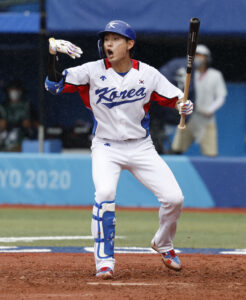
Lee, 25, has been a highly anticipated free agent for a long time now. It was reported in January that the Kiwoom Heroes of the Korea Baseball Organization would post him for MLB clubs after the 2023 campaign. At that point, Lee was coming off an excellent 2022 campaign.
He had always had strong plate discipline but took that part of his game to new heights last year, walking in 10.5% of his plate appearances while striking out in just 5.1% of them. He had never hit more than 15 home runs in a season but managed to tally 23 in that season. He finished with a batting line of .349/.421/.575 for a wRC+ of 175, indicating he was 75 percent better than league average. He also won a Golden Glove award for a fifth straight year and also earned MVP honors.
But his platform year didn’t go quite according to plan. He hit .318/.406/.455 with just six homers in his 86 games in 2023. He injured his left ankle in late July, necessitating season-ending surgery. Nonetheless, he garnered plenty of interest from clubs like the Giants, Padres, Yankees and Mets before being officially posted last week.
The profile was somewhat similar to Masataka Yoshida, who was another contact-over-power player coming from overseas. Yoshida played in Japan’s Nippon Professional Baseball until signing with the Red Sox for 2023 on a five-year, $90MM deal. Since the NPB is generally considered a notch above the KBO, that could perhaps lead an observer to preferring his track record to Lee’s.
But there are a couple of reasons why Lee might be preferable, one of which is age. The ability to sign an everyday player who is just 25 years of age doesn’t occur very often, and the widespread interest in both Lee and Yoshinobu Yamamoto shows that clubs place value on that youth. Yoshida, by contract, was coming over for his age-29 season. Lee’s opt-out gives him the chance to potentially return to the open market before his 30th birthday, after perhaps having proven himself capable as a major leaguer.
The other thing Lee appears to have over Yoshida is defensive acumen. Yoshida was considered a left-field-only player before signing and was graded poorly for his glovework with Boston, which could lead to him spending more time as a designated hitter over the years. Lee, however, is considered strong in the field. Evaluators are split on whether or not he can stick in center, where he spent most of his time with the Heroes. In Major League Baseball, he could be either a passable center fielder or better suited to a corner, depending on who you ask.
All of the questions make Lee difficult to project and it seems fair to categorize this as a high-risk, high-reward play. As recently pointed out by Eno Sarris of The Athletic, Lee’s batted ball metrics come in a bit below those of Ha-Seong Kim in his last KBO season. Kim struggled in his first MLB season, though eventually adjusted enough to be slightly above average at the plate in each of the past two seasons. MLBTR predicted that Lee would secure a five-year, $50MM deal, but the Giants have soared well past that, more than doubling it. Given their strong investment here, they likely have high confidence in Lee, both in his ability to hit major league pitching and perhaps stick in center field as well.
Just as the offseason was kicking off, president of baseball operations Farhan Zaidi stated that defensive upgrades in the outfield were a priority for this winter. “We’ll look to add a little bit more speed, a little bit more range to the outfield,” Zaidi said at that time. There were good reasons for such a target. The club’s outfielders posted a collective -13 Outs Above Average in 2023, with only the Cardinals and Rockies coming in below them. Their -7 Defensive Runs Saved and -12.4 Ultimate Zone Rating also fell in the bottom 10 league wide.
The Giants didn’t really have a full-time center fielder in 2023, as no player lined up there for more than 57 games. Each of Luis Matos, Mike Yastrzemski, Austin Slater, Bryce Johnson, Brett Wisely and Wade Meckler got into double digits, while Tyler Fitzgerald, Cal Stevenson, Heliot Ramos, LaMonte Wade Jr. and AJ Pollock had brief stints there. The club is likely hoping that Lee can solidify that position while pushing Yastrzemski into the corner outfield mix alongside guys like Mitch Haniger and Michael Conforto. Matos may wind up back in the minors after a mediocre MLB debut in 2023, or perhaps the club would consider putting him on the trading block.
In addition to the $113MM that Lee will receive, the Giants will also owe a posting fee to the Heroes. With any player posted for MLB clubs, the signing team owes a fee to the posting club, relative to the size of the contract. It’s 20% of the first $25MM, 17.5% of the next $25MM and 15% of any dollars thereafter. For this deal, the Giants will owe $18.825MM to the Heroes on this deal, meaning they are actually shelling out $131.825MM in order to add Lee to the roster.
In recent years, the Giants have tried to sign star players and have come up just short. They were in the running for Aaron Judge last year before he returned to the Yankees. They had a deal in place with Carlos Correa before they balked at his physical and walked away, leading to him returning to the Twins. They were in the running for Shohei Ohtani this offseason before he signed with the Dodgers.
Lee doesn’t quite match up to those players in terms of star power but this is easily the largest investment of Zaidi’s tenure. The club gave a $90MM extension to Logan Webb but the biggest free agent deals in recent years were $44MM to Carlos Rodón and $43.5MM to Haniger. The Rodón deal had an opt-out after the first year that was eventually triggered, so the club didn’t even pay out that full contract.
The specific contract breakdown hasn’t been reported but that won’t be relevant for the competitive balance tax, which goes by the average annual value of a deal. Roster Resource has already plugged in Lee’s AAV and has the Giants’ CBT number at $189MM. It’s unknown if they are willing to cross the $237MM base threshold next year, but even if not, they could still have around $45MM to pursue upgrades elsewhere on the roster.
For the clubs that missed out on Lee, free agency still features capable center fielders like Cody Bellinger, Harrison Bader, Kevin Kiermaier and Michael A. Taylor, while the trade market could feature players like Dylan Carlson or Manuel Margot.
Dodgers, Rays Discussing Deal Involving Tyler Glasnow, Manuel Margot
December 14: Jon Heyman of the New York Post reports today that the two sides are still discussing a trade. He says that “word is” the Dodgers “may also be” interested in an extension. It’s unclear what level of interest Glasnow has in an extension.
December 13, 1:00pm: No trade between the two parties is imminent, per Jack Harris of the L.A. Times. While Harris also hears this framework is being discussed, he further reports that the Dodgers aren’t the only team in “serious” trade talks with the Rays regarding Glasnow.
11:50am: While Rays outfielder Randy Arozarena has created some speculation by posting a picture of himself and Shohei Ohtani from the 2023 World Baseball Classic on Instagram, Marc Topkin of the Tampa Bay Times reports that Arozarena is not a part of the talks regarding Glasnow and Margot.
8:27am: The Dodgers and Rays are in talks on a trade that would send right-hander Tyler Glasnow and outfielder Manuel Margot from Tampa Bay to Los Angeles in exchange for Ryan Pepiot and outfielder Jonny Deluca, as first reported by Jack Azoulay-Haron of MLB Nerds and Bruce Kuntz of Dodgers Digest. Ken Rosenthal of The Athletic hears the same, cautioning that the deal is not complete and changes to the framework remain possible.
The 30-year-old Glasnow has been one of the most highly rumored trade candidates of the offseason, due both to his considerable $25MM salary for the upcoming season and his proximity to free agency. He’s entering the final year of his contract and will hit the open market next winter. MLBTR ranked Glasnow fifth on our early offseason list of the game’s Top 25 trade candidates.
Glasnow is a natural target for the deep-pocketed Dodgers, who have a pronounced need for starting pitching and who won’t bat an eye at the Tampa Bay ace’s salary. As it stands, the rotation in Los Angeles consists of Pepiot, Walker Buehler, Bobby Miller and Emmet Sheehan, with the fifth spot up in the air. (Ryan Yarbrough, Michael Grove and Gavin Stone are among the in-house options.) Buehler will be on an innings count in his first full season back from Tommy John surgery (the second TJS of his career). None of Pepiot, Miller or Sheehan have made more than 22 big league starts.
The Dodgers’ rotation has been ravaged by injuries in the past calendar year. Longtime ace and current free agent Clayton Kershaw may still re-sign with the club, but he had shoulder surgery after the 2023 season and is out until at least midsummer — if not longer. Tony Gonsolin had Tommy John surgery in August. Dustin May underwent a Tommy John revision and flexor surgery just after the All-Star break.
While Glasnow is far from a paragon of durability, he’s unquestionably a top-of-the-rotation arm when healthy. Last year’s 120 innings were actually a career-high for the 6’8″ righty, and the 2023 season was only his second in which he reached even 100 frames at the MLB level. Glasnow did make a full slate of starts during the shortened 2020 season, but last year’s 21 trips to the mound were still a career-high. He’s spent considerable time in his big league career on the injured list owing to Tommy John surgery, a separate forearm strain and a severe oblique strain, among other maladies.
Originally a fifth-round pick by the Pirates, Glasnow was a longtime top prospect in Pittsburgh but never quite put things together for the Bucs, struggling in an up-and-down tenure before ultimately being traded to the Rays alongside Austin Meadows and Shane Baz in the lopsided trade that sent Chris Archer from Tampa Bay to Pittsburgh. Like so many other pitchers, Glasnow broke out under the Rays’ pitching development and analytics program. In parts of six seasons with Tampa Bay, he’s pitched to a 3.20 ERA while punching out a whopping 34.1% of his opponents against a tidy 7.8% walk rate. He’s typically worked with above-average ground ball rates and turned in a career-best 51.2% grounder mark this past season.
Margot, too, can become a free agent following the 2024 season — though the Rays (or an acquiring team) also hold a $12MM club option with a $2MM buyout for the 2025 season. He’s set to earn $10MM in 2024, bringing the total guarantee remaining on his deal to $12MM.
The .264/.310/.376 batting line that the 29-year-old Margot posted in 336 plate appearances in 2023 was about seven percent below average, by measure of wRC+ (93), but it was also right in line with the larger .264/.317/.375 output he’s turned in during parts of four seasons with the Rays. Generally speaking, slightly below-average offense from Margot has been an acceptable trade-off for his sensational defense and solid value on the basepaths.
That wasn’t necessarily the case in 2023, however. Margot missed the majority of the 2022 season with a significant strain of the patellar tendon in his right knee, and his defensive grades in 2023 slipped closer to average. Statcast indicates that Margot’s range in the outfield and overall sprint speed both declined in ’23, which isn’t particularly surprising to hear for a player who was in his first season back from a major knee injury. If he’s closer to his pre-injury form, he could return to his status as a plus all-around contributor, but there’s no certainty of that happening.
A healthy Margot would be an excellent fit for the Dodgers’ roster. Los Angeles re-signed Jason Heyward to handle the bulk of the time in right field — Mookie Betts has already been announced as their primary second baseman next year — but Heyward will be strictly platooned. Margot’s right-handed bat has produced a career .281/.341/.420 output against left-handed pitching. He’s a strong fit at the plate, and if his defense can rebound to prior levels, the Dodgers probably feel they wouldn’t be losing much defensive value in swapping out Heyward for Margot against left-handed pitching. Margot could also be a late-game defensive replacement for Chris Taylor in left, and he’s good insurance in center field, should James Outman sustain an injury at any point.
As for the players reportedly being targeted by Tampa Bay, Pepiot is exactly what the Rays typically covet: an MLB-ready player with five seasons of club control who can step directly onto the roster in place of a star-caliber player being traded elsewhere. The 26-year-old righty has started 10 games and made seven relief appearances for the Dodgers since his MLB debut in 2022, pitching to a sharp 2.76 ERA in 78 1/3 innings — albeit with some more concerning underlying numbers.
Pepiot’s 25.1% strikeout rate is better than average, but his 10% walk rate is also higher than the league average and he’s been quite homer-prone (1.49 HR/9). He’s been fortunate that the majority of those long balls have come with the bases empty, but an extreme fly-ball pitcher who’s susceptible to homers inherently carries some risk. Fielding-independent metrics like FIP (4.76) and SIERA (4.15) are more bearish than Pepiot’s more rudimentary earned run average.
Pepiot works off a three-pitch mix — fastball, changeup, slider — sitting 94 mph with his heater and neutralizing lefties with a plus changeup. His slider has generated good results thus far in the big leagues, but scouting reports from his prospect days have characterized that offering as a bit below average, giving him the feel of a two-pitch righty who’s lacking a third solid offering. Pepiot doesn’t come with the same type of durability concerns as Glasnow, having pitched 128 1/3 innings in 2022 and never hitting the IL with a major arm injury. However, like Glasnow, he missed multiple months after opening the 2023 season on the shelf with a significant oblique strain.
Baseball America ranked Pepiot as high as the No. 55 prospect in the game earlier in 2023, noting that he’s improved upon that once below-average slider but done so at the expense of some of his changeup’s efficacy. Pepiot’s sub-par command also lends itself to deep counts and long innings, with BA’s scouting report noting that he often struggles to pitch beyond the fifth inning. That’s not a huge issue for either the Rays or the Dodgers; both clubs typically have deep bullpens and don’t shy away from five-and-dive starters who face a lineup only two times.
Pepiot is controllable for another five years and won’t even be arbitration-eligible until the 2025-26 offseason, which surely adds to his appeal for the Rays. Swapping him out for Glasnow is probably a step down in terms of per-inning quality, but Pepiot would give them an option in 2025 and beyond, when the Rays will have Jeffrey Springs, Drew Rasmussen and Shane McClanahan all returning from major arm surgeries.
At the same time, swapping out Glasnow for a league-minimum starter (and perhaps shedding some or all of Margot’s remaining money) would give the Rays the necessary financial room to add free-agent starter (or trade acquisition with a mid-range salary) for the upcoming 2024 season. As it stands, the Rays have Glasnow, Zach Eflin, Aaron Civale, former top prospect Taj Bradley (who struggled through his 2023 rookie showing) and reliever-turned-starter Zack Littell in the projected rotation.
Not to be forgotten in all of this, the 25-year-old Deluca is coming off a solid debut effort of his own. He’s controllable for another six seasons and would give the Rays a right-handed bat who can play all three outfield spots — similar to the more established Margot. Deluca tallied just 45 plate appearances in last season’s MLB debut but posted a respectable .262/.311/.429 batting line in that time. He also turned in a combined .294/.390/.566 slash between Double-A and Triple-A.
It’s gaudy production, though scouting reports at Baseball America and FanGraphs note that the former switch-hitter is still working to adjust to right-on-right scenarios and currently feels like more of a platoon option. FanGraphs’ Eric Longenhagen grades Deluca as a below-average center fielder but solid corner option. Deluca is a former baseball and track star with excellent athleticism who could at least profile as a matchup-based option across all three outfield spots, which is a skill set the Rays have utilized with great regularity in the past. He also has two minor league option years remaining, which only further enhances his appeal.
While it seems there are still some hurdles yet to be cleared, there’s some logic to the trade for both sides. The Dodgers would be swapping out a pair of controllable but unproven players for a high-end rotation upgrade and one or two years of an established right-handed platoon partner for Heyward — one who’s likely more capable of handling center field than the young outfielder with whom they’d be parting. Glasnow is an easy qualifying offer candidate next winter, so L.A. could receive some modest compensation if he departs. He’s also an L.A.-area native who’s signed one extension in the past, so the chance of a second multi-year deal to extend their control seems feasible.
The Rays, meanwhile, would turn two short-term assets into immediate MLB help that can be controlled all the way through 2028-29, freeing up money for short-term 2024 help and possibly adding Pepiot to a 2025 rotation group including McClanahan, Baz, Eflin, Civale and Bradley. It’s the type of swap that both teams have been frequently willing to make — typically with good success, which helps both achieve their status as perennial contenders (albeit via dramatically different methodologies).
Royals Sign Seth Lugo To Three-Year Deal
The Royals announced the signing of right-hander Seth Lugo to a three-year deal that allows him to opt out after the 2025 season. It’s reportedly a $45MM guarantee for the Ballengee Group client. He’ll receive equal salaries of $15MM in each season, meaning he’ll collect $30MM before making the opt-out decision.

Lugo, 34, came up as a starter with the Mets but wound up spending most of his time as a reliever for that club. He reached free agency for the first time a year ago and was able to secure a gig with the Padres that allowed him to try his hand at starting again. It was a two-year, $15MM pact that allowed him opt out after the first year if his return to a rotation went well.
The move could hardly have gone much better. Lugo’s arm held up under the new workload conditions, as he made just one trip to the injured list all year, missing about a month due to a left calf strain. He took the ball 26 times and logged 146 1/3 innings with an earned run average of 3.57. He struck out 23.2% of batters he faced, walked just 6% and kept 45.2% of balls in play on the ground. That made his opt-out decision an easy one, as he left $7.5MM on the table and returned to the open market, with MLBTR predicting he could secure a three-year, $42MM deal this offseason.
Starting pitching has reportedly been in high demand this winter but Lugo’s market was never going to go too crazy due to his age. But given that he would be limited to a relatively modest deal, he was a plausible fit with far more clubs than the top names. Last month, it was reported by Robert Murray of FanSided that “more than half the league” was interested. The Tigers, Dodgers and Red Sox were some of the specific clubs named with interest in his services, but so were the Royals.
Starting pitching has been an ongoing issue in Kansas City for a few years now, with their plans for a homegrown pitching staff largely falling short of expectations. In 2018, the club had five picks in the first 58 selections of the draft and used all of those on pitchers: Brady Singer, Jackson Kowar, Daniel Lynch IV, Kris Bubic and Jonathan Bowlan. None of those picks looks amazing at the moment.
Singer looked to break out in 2022 when he posted an ERA of 3.23 but that jumped to 5.52 this year. Kowar has been rocked for an ERA of 9.12 in his first 74 innings and was traded away this offseason. Lynch has a 5.18 ERA through his first 252 MLB innings. Bubic hasn’t been great for most of his career. He showed some encouraging signs of development at the start of 2023 before requiring Tommy John surgery after just three starts. Bowlan has just three major league innings but his minor league ERA has been just under 6.00 in the past two seasons.
The struggles of those drafted players, as well as from free agent signee Jordan Lyles, led to the club’s starters posting a collective ERA of 5.12 in 2023. Only the Reds, Athletics and Rockies were worse. General manager J.J. Picollo clearly stated that adding starting pitching was a goal this offseason and that the club should have about $30MM to spend on upgrading the 2024 club. This deal will accomplish the goal of adding to the rotation while using half of the available funds. For Lugo, he obviously made some wise decisions, both in returning to the rotation and returning to the open market this winter.
One bright spot in the club’s rotation last year was the breakout of Cole Ragans. After being acquired from the Rangers in the deadline deal that sent Aroldis Chapman the other way, Ragans posted a 2.64 ERA in 12 starts for his new club. He and Lugo should be atop the club’s rotation next year. Singer should be in there as well, looking to bounce back into something closer to his 2022 form. Lyles is in a comparable position, having registered a 4.42 ERA in 2022 but a 6.28 in the most recent season. He’s still owed $8.5MM and hasn’t been on the injured list since 2019 so he will probably get another opportunity to eat some innings. Pitchers like Lynch, Alec Marsh, Ángel Zerpa and others could be options for the back end but the club could also look for more external additions as the offseason continues.
As mentioned, Picollo used $30MM as a ballpark figure for available funds. The club also agreed to a deal with reliever Chris Stratton today, which comes with a $4MM guarantee, and a $5MM deal with Will Smith on the weekend. When combined with Lugo’s $15MM salary next year, that’s $24MM agreed to in the past few days.
Anne Rogers and Mark Feinsand of MLB.com first reported that the two sides were nearing agreement on a deal. Jon Morosi of MLB.com first reported the three-year term and Jon Heyman of The New York Post had the $45MM guarantee. Feinsand first reported on the opt-out while Robert Murray of FanSided relayed the even distribution of the money.
Check Out Our MLB Contract Tracker!
As the MLBTR team has been doing contract research this winter, we’ve been loving our MLB Contract Tracker tool. Below is a video showing off some of its capabilities.
[fvplayer id=”2″]
The MLB Contract Tracker is only available to Trade Rumors Front Office subscribers. Many MLBTR readers have signed up recently, so this post will serve as a brief explainer/tutorial on some of the Contract Tracker’s features.
What is the MLB Contract Tracker?
The MLB Contract Tracker is a database containing Major League free agent contracts, minor league free agent contracts, and multiyear extensions dating back to October 1, 2006. The Contract Tracker is updated daily with new contracts, and we’re also planning to add data prior to 10-1-06. Player names are linked to the MLBTR post, so it’s easy to follow up and read about the deal.
That’s a ton of data. How can I slice it up?
You can filter by player name, team, position, batting handedness, throwing handedness, contract type (MLB deal, minor league deal, extension), number of years, amount of total money, average annual value, type of option, age in the first year of the deal, age in the last year of the deal, service time for those who signed extensions, Super Two status, qualifying offer status, agency at the time of signing, GM at the time of the signing, and any date range from 10-1-06 to present.
What makes this tool unique?
Many aspects of the MLB Contract Tracker are unique. I have found the “age in first year” and “age in last year” filters to be valuable in learning, for example, how often a pitcher who will be 34 in Year 1 of a free agent contract has signed for at least four years. Or how many players have been signed through the age of 40 on a deal of four or more years.
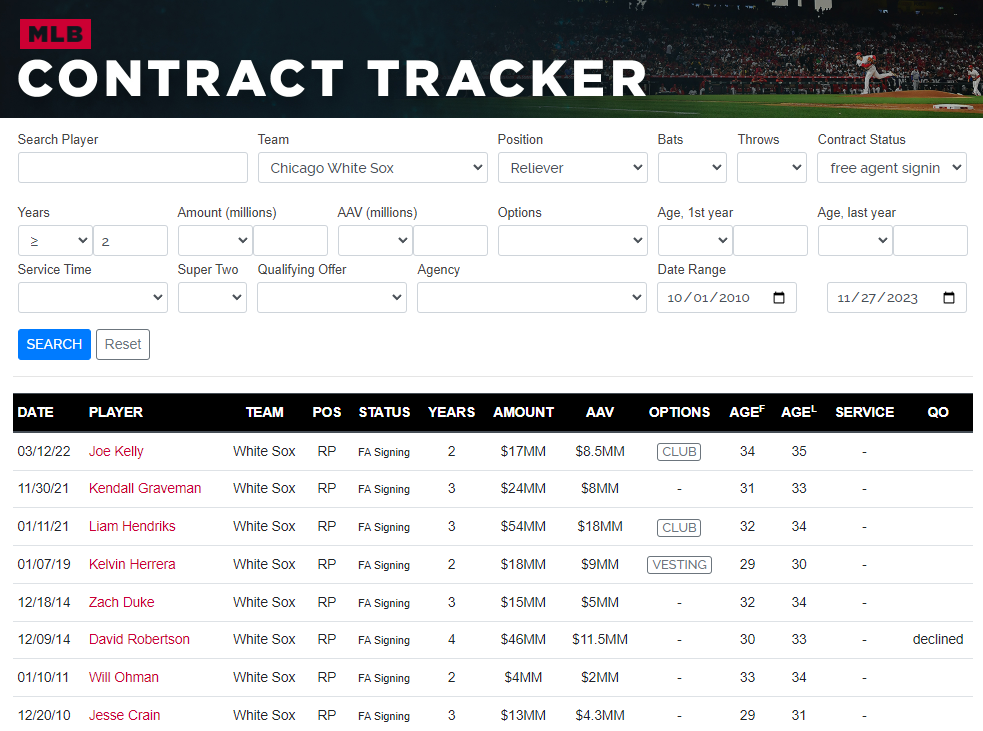
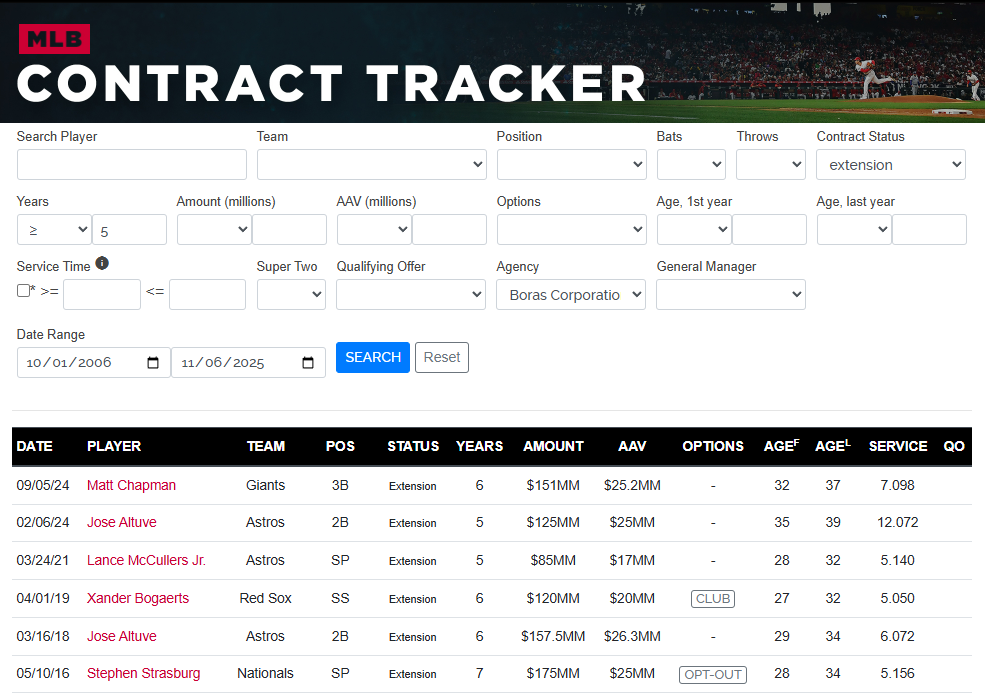
Other tools lack most of the above-listed data and accompanying filters. Our tool allows for endless combinations of filtering. You may want to know how many multiyear deals for relievers a certain team has done in the last ten years, which agencies have represented players who accepted qualifying offers, or the largest extensions for outfielders with less than four years of service. The only limit is your imagination!
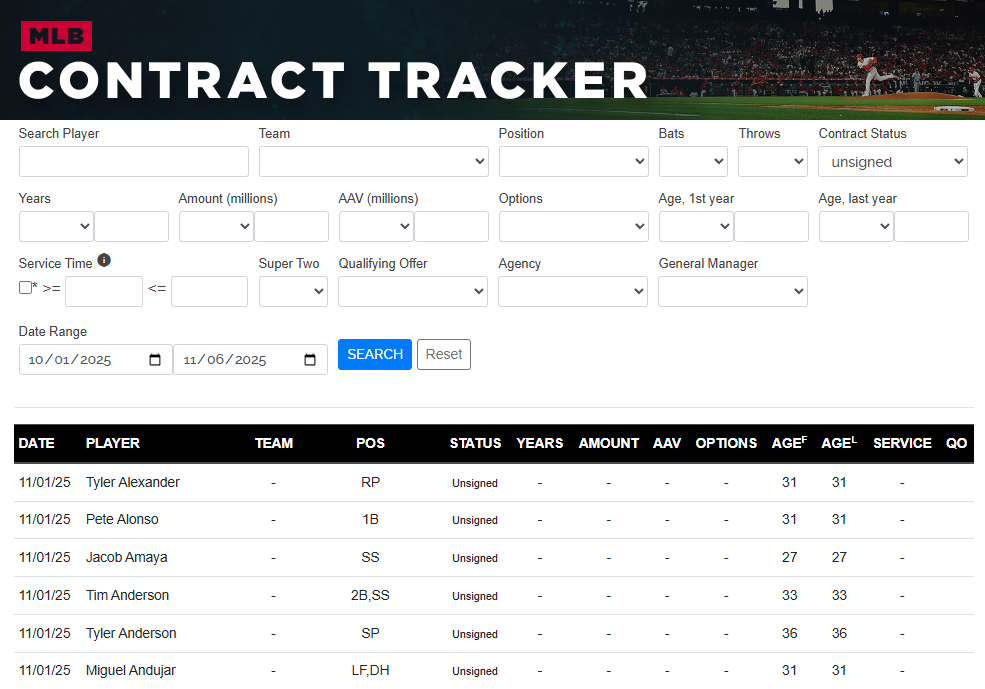
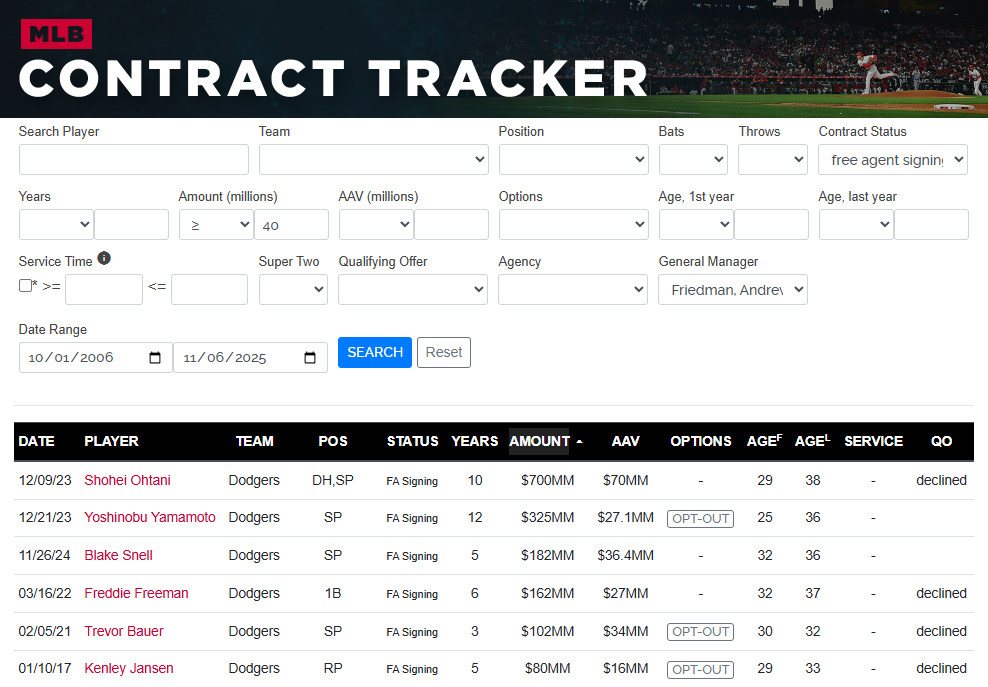
How about some screen shots demonstrating how to use the MLB Contract Tracker?
I thought you’d never ask! These might not show up if you’re in our app, so you’ll want to go to the actual website.
Ohtani Contract Contains Conditional Opt-Out Clause Based On Ownership, Front Office
Shohei Ohtani‘s landmark contract with the Dodgers has prompted endless discussion, debate and criticism due to the unprecedented scope of the deferrals it contains, but that’s far from the only fascinating wrinkle of the 10-year deal.
Sports Illustrated’s Tom Verducci reports that the contract contains language “that assures the club will make good on its promise to use the savings he created to build a competitive team around him.” Ohtani’s agent, Nez Balelo of CAA Sports, tells Verducci that Ohtani asked him early in the free-agent process about whether it was possible to defer the majority or entirety of his salary in order to give his club more present-day payroll flexibility.
As far as we at MLBTR can tell, that’s the first clause of its nature in any player contract. Further specifics of the clause and the manner in which it will be enforced remain unclear. The Dodgers’ reported pursuits of a trade involving Tyler Glasnow and Manuel Margot, plus their recent meeting with Yoshinobu Yamamoto, seem to signal that the team is indeed taking steps to satisfy that condition, though.
The luxury-tax hit associated with Ohtani’s contract is $46.06MM, according to Verducci, which sits roughly in line with expectations at the outset of his free agency. But, the manner in which the contract was announced has created substantial criticism. It’s fair to wonder if, had the contract been announced as 10 years and $460MM deferred with interest, it would have invited the same backlash as the initial announcement of a $700MM deal … which was later reported to be 97% deferred.
The initial $700MM figure looks good in a recruiting pitch for future CAA clients, but the league’s approximate $460MM valuation of the net present value is a different story entirely. The MLBPA’s valuations are a bit lower yet; Jon Heyman of the New York Post tweets that the union values the contract at $437,830,563, but the luxury-tax hit will be based upon the league’s calculations.
There’s been plenty of talk about the contract as a means of gaming the luxury tax system, although the $46.06MM CBT hit is in line with the league’s valuation of the deal. If anything, the contract is less about circumventing the luxury tax and more about artificially tamping down the team’s actual, bottom-line payrolls from 2024-33.
Unprecedented contractual language doesn’t stop with the competitive team clause. Ken Rosenthal of The Athletic reports that the contract states the following: “If specific change in Dodger personnel, player may opt out of contract at end of season the change occurs.”
The conditional opt-out is applicable to controlling owner Mark Walter and president of baseball operations Andrew Friedman, per a report from Beth Harris and Ronald Blum of the Associated Press. If either Walter or Friedman leave the organization, Ohtani would gain the opt-out possibility. Alden González of ESPN tweets that would go into effect at the end of any season in which Walter or Friedman departed, so there’s no possibility of Ohtani opting out midseason.
It’s nevertheless a noteworthy inclusion, particularly in the case of Friedman. While the front office leader isn’t in any immediate jeopardy based on the team’s excellence over the course of his decade-long run, tying his contractual status to that of the team’s best player for the next 10 years is a bold move by ownership. Friedman signed an extension of undisclosed length in November 2019. It isn’t clear if he has signed any subsequent deals, though it’s hard to envision him departing the organization any time soon.
Given the massive slate of deferred money — Ohtani will be paid just $2MM annually from 2024-33, with the remaining $680MM paid out from 2034-43 — it’s difficult to see Ohtani opting out at any juncture, unless there’s language that allows a portion of those deferrals to be paid out in conjunction with the opt-out.
It’s technically feasible that if Ohtani is able to return to the mound in 2025, he could reestablish himself as a viable top-of-the-rotation starter and have even greater earning power than the ~$460MM net present value of his current contract. However, if he’s only been paid out around 1-2% of the overall guarantee at the time of a theoretical opt-out opportunity, it’d still be difficult to walk away from the deal.
Then again, Ohtani showed with his original move to MLB (and to a lesser extent with the eye-popping nature of his current deferrals) that money is not necessarily his top priority in any contract. He’s also reportedly earning as much as $50MM annually in terms of endorsements and other marketing opportunities, so the notion that he’d leave a staggering portion of his record contract on the table in order to pursue a return to free agency isn’t as far-fetched as it would be for many other players.
News of the (as we know it) unprecedented out clause in Ohtani’s contract will invite ample speculation. Fans on social media have already wondered about ownership changes, front office changes, managerial changes or perhaps even trades of star teammates like Mookie Betts and Freddie Freeman. With the contract itself not plainly spelling out the nature of the change, there’s no way of knowing the specific nature of personnel change that would trigger this right for Ohtani, however. The clause is further proof of the lengths to which the Dodgers — and presumably other teams — were willing to go in order to secure the two-way star’s generational talents.
Giants president of baseball operations Farhan Zaidi has already indicated that the terms of Ohtani’s contract with the Dodgers were proposed by Ohtani and his agents, and that the Giants were comfortable effectively matching them. Presumably if Ohtani’s camp included the stipulations about investing the present-day savings and the conditional out clause in the terms with the Dodgers, those factors were also present in discussions with the Giants, Blue Jays and other finalists for his services.
One other note from the AP: while the Dodgers have already announced the contract, it has not yet gone to MLB for official approval. As of Wednesday evening, the deal still takes the form of a letter of agreement between Ohtani and the Dodgers.
Royals Finalizing Deal With Chris Stratton
The Royals are close to securing their second free-agent pitcher of the day, as they’re reported to be finalizing a two-year, $8MM deal with reliever Chris Stratton. The contract will pay the McKinnis Sports client $3.5MM in 2024 when finalized, and there’s a $500K buyout on a $4.5MM player option for the 2025 season. Kansas City also agreed to terms with righty Seth Lugo on a three-year contract in near simultaneous fashion.
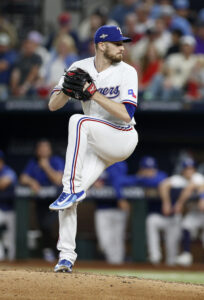
Stratton, 33, has been a quality middle-inning arm for the Pirates, Cardinals and Rangers over the past four seasons, tallying 255 1/3 innings of 3.91 ERA ball in that time. Along the way, he’s fanned 24.5% of his opponents against an 8.9% walk rate with a 42% ground-ball rate and 0.85 homers per nine frames. Of that trio, only the Pirates regularly used him in high-leverage spots, but Stratton still collected 11 saves and 27 holds in that time (mostly coming in Pittsburgh).
Stratton has regularly worked multiple innings, evidenced by the fact that those 255 1/3 frames came over the life of just 219 appearances. He averaged just shy of 1 1/3 innings per appearance in 2023, topping out with a three-inning appearance for Texas on Aug. 12. Overall, 36 of this past season’s 64 appearances saw Stratton record at least four outs.
It’s fairly surprising to see Stratton secure an opt-out provision in his contract. Middle relievers of this ilk typically haven’t been afforded that luxury, although the Reds did give Emilio Pagan an opt-out after his first season earlier this month. For Kansas City, perhaps that was a necessary bridge to cross in order to sway a reliever they were prioritizing to sign there rather than with a more clear-cut contender. Regardless, Stratton will now get the benefit of pitching the 2024 campaign in a pitcher-friendly home park — likely with more leverage opportunities than many contending clubs might’ve otherwise offered. If it all goes well, he could be set up nicely next winter, age notwithstanding.
Stratton is the second bullpen addition for the Royals this week. Kansas City also agreed to a one-year, $5MM deal with left-hander Will Smith over the weekend. That gives the Royals a pair of affordable veterans to pair with 27-year-old James McArthur, whose overall 4.63 ERA masks the dominant finish he enjoyed in 2023; from Sept. 2 onward, McArthur rattled off 16 1/3 shutout innings with 19 strikeouts (35.8% strikeout rate) and no walks. Small sample or not, he clearly thrust himself into the team’s late-inning mix with a performance like that. The Royals also picked up former Rays and Braves reliever Nick Anderson in a swap with Atlanta earlier in the winter; Anderson has been prone to injury but boasts a 2.93 ERA, 35.5% strikeout rate and 6.6% walk rate in 122 2/3 career innings when healthy.
The additions of Stratton and Smith tack about $9MM onto the 2024 payroll, and today’s agreement with Lugo adds another $15MM. Royals general manager J.J. Picollo said earlier in the month that he had at least $30MM to spend (for the 2024 season, not overall). That would leave the Royals with at least another $6MM or so to put toward improvements for the current roster, if not a bit more. Kansas City has also reportedly been active in the trade market, with names like MJ Melendez, Freddy Fermin and Michael Massey among those on which they’re said to be comfortable listening. Even if the budget is a bit tight for another notable free-agent move, it’s possible a deal for rotation and/or bullpen help could come together via the trade market.
Anne Rogers of MLB.com first reported that the two sides were finalizing a deal. MLB.com’s Mark Feinsand and the New York Post’s Jon Heyman added financial details.
Endy Rodriguez Undergoes UCL Surgery, Will Miss 2024 Season
Pirates catcher Endy Rodríguez underwent surgery to repair the UCL and flexor tendon in his throwing arm, the team announced. He won’t begin baseball activity for 10-12 months and will miss all of 2024.
Rodríguez had been the presumptive favorite to open the season as the Bucs’ primary catcher. Unfortunately, he suffered the freak injury on a swing while playing winter ball in the Dominican Republic last month. Next year will go down as a lost season for the switch-hitter.
Regarded as one of the sport’s most talented catching prospects, Rodríguez made his big league debut not long after the All-Star Break. He served as Pittsburgh’s starter down the stretch despite struggling in his first look at MLB pitching. Over 57 games, the 23-year-old hit .220/.284/.328 with a trio of home runs.
While Rodríguez doesn’t have a ton of power, he has shown excellent strike zone discipline in the minors. He walked at an 11.4% clip while keeping his strikeout rate south of 15% in 315 plate appearances for Triple-A Indianapolis, where he hit .268/.356/.415. He combines that with rare athleticism for a catcher and solid defensive reviews from scouts. Statcast graded him as an average receiver in his first 410 big league innings but credited him with better than average arm strength.
Between Rodríguez and 2021 first overall pick Henry Davis, Pittsburgh entered the season with two high-end catching prospects. The Pirates preferred Rodríguez defensively, keeping him behind the plate as a rookie while moving Davis almost full-time to right field. At last month’s GM Meetings, general manager Ben Cherington said the organization still planned to give Davis extended run behind the dish. Rodríguez’s unfortunate injury opens a path for the Louisville product to assume the #1 job.
Like Rodríguez, Davis made his MLB debut last summer but didn’t produce much at the plate. He hit .213/.302/.351 with seven longballs in his first 255 plate appearances. The 24-year-old also received well below-average defensive marks in right field. His MLB track record at catcher consists of two innings, but scouts have raised questions about his receiving skills in college and during his minor league tenure.
If the Pirates want Davis to continue developing defensively in Triple-A, their top in-house options are light-hitting defenders Ali Sánchez and Jason Delay. Veteran options available in free agency include Martín Maldonado, Tom Murphy, Austin Nola, Tucker Barnhart and old friend Jacob Stallings.
Ronny Mauricio Diagnosed With Torn ACL, Will Undergo Surgery
Mets infielder Ronny Mauricio has a torn ACL in his right knee and will require surgery, reports Andy Martino of SNY. A timeline for his recovery hasn’t been publicly reported but he’s likely to miss a notable amount of the upcoming campaign. Martino reported last night that Mauricio suffered the injury while playing winter ball in the Dominican Republic on Sunday.
Mauricio, 23 in April, made his major league debut as a September call-up a few months ago. He hit just .248/.296/.347 in his first taste of the big leagues, but in a small sample of just 26 games. He has been considered one of the top 100 prospects in the league for years, hitting 20 homers in the minors in each of the past three years. He also has some speed, stealing 24 bags in the minors this year and another seven in the majors.
He’s generally considered to be a passable shortstop but the Mets have moved him elsewhere due to their specific circumstances. Francisco Lindor is under contract through 2031 and is still considered one of the best defensive shortstops in the league, so the club has had Mauricio line up at second base, third base and left field.
Just last week, president of baseball operations David Stearns said that the club would stick with internal options for third base, with Mauricio set to compete with Brett Baty and Mark Vientos for playing time there. None of those three players have established themselves as viable big leaguers yet, but the club was seemingly content to go into 2024 hoping that one of them would pull away from the other two.
Now that calculation could change in light of this new development. It’s still unclear how long the club expects Mauricio to be out, but it will likely be the majority of the upcoming season. For reference, Rhys Hoskins tore his anterior cruciate ligament in Spring Training earlier this year and still wasn’t able to rejoin the Phillies by the time they were eliminated in the NLCS in late October. Mauricio will have a few extra months on Hoskins since his injury occurred in December, but he’s still probably looking at a late-season return in a best-case scenario.
That will leave the club with Baty and Vientos as their third base options in the short term. Baty was also a top 100 prospect on his way up to the majors but has underwhelmed in the majors thus far, having hit .210/.272/.325 in his first 431 plate appearances with subpar defense. Vientos is fairly similar, with a line of .205/.255/.354 in 274 plate appearances at the big league level.
The club has added some infield depth by signing Joey Wendle to a major league deal and claiming Zack Short off waivers from the Tigers. Martino suggests the club is likely to add some extra insurance at the hot corner and floats Justin Turner as a speculative fit. It may be a bit of a tricky calculus as they won’t want to completely cut off Baty, Vientos or Mauricio from playing time throughout the year. Each has performed extremely well in the minors and the club is planning a sort of transition year in 2024, making it the perfect time to give some rope to such players. The injury to Mauricio will obviously lessen his ability to take advantage of those circumstances in the coming campaign but the Mets might still want to see if either Baty or Vientos can run with the third base job.
That makes this the second straight offseason wherein the Mets are potentially losing a player for the entirety of the upcoming campaign due to a knee injury. Closer Edwin Díaz required surgery on his patellar tendon back in the spring after injuring himself during the World Baseball Classic. He attempted to rehab throughout 2023 but pumped the brakes on that when the club fell out of contention, eventually sitting out the entire season.
Why Shohei Ohtani’s Contract Structure Is Not A Luxury Tax Dodge
Earlier today, we learned that Shohei Ohtani‘s $700MM contract with the Dodgers has a stunning deferral structure: he’ll earn a mere $2MM in each of the ten seasons he’s agreed to play baseball for the club, and then $68MM per year from 2034-43.
Based on what I’ve seen on social media tonight, a lot of baseball fans think the purpose of these deferrals is for the Dodgers to “dodge” the competitive balance tax (yes, t-shirts are already being drawn up). Here’s why that’s wrong.
The collective bargaining agreement has a section for calculating the CBT hit for a contract that includes deferred money. According to reports, that calculation works out to a $46MM average annual value and accompanying CBT hit for the Dodgers and Ohtani. As you can see here, $46MM tops Max Scherzer‘s previous AAV record of $43,333,333.33. It’s $6MM beyond Aaron Judge‘s $40MM AAV, which was the highest for a player on a deal of more than three years.
Not only is $46MM a record AAV, but it’s entirely in line with expectations. MLBTR predicted a $44MM AAV for Ohtani. Most other prognosticators were in that range. In fact, the median Ohtani AAV prediction of the other six outlets we’re tracking was $45,984,849. It would be almost impossible for Ohtani’s luxury tax AAV to have met expectations any harder.
The problem is the initially reported $70MM AAV. That was the first number people saw, and it gets ingrained for fans after being seen in thousands of headlines. The agent certainly didn’t mind. Though news of significant deferred money quickly followed and ESPN’s Jeff Passan narrowed it down to $40-50MM yesterday, more precise numbers weren’t known until today.
There was enough time for the shocking $700MM and $70MM figures to take hold. So it’s logical for some fans to say the Dodgers are paying Ohtani $70MM a year but “getting away with” just a $46MM CBT hit. However, I’d argue that the $70MM figure was never “real,” in that it dwarfs expectations and there’s no current indication that any team offered anything close to that AAV without huge deferrals. The $46MM AAV is what matters. Ohtani moved the AAV record forward as expected, but only by about six percent rather than an insane 62%.
MLB does have the power to stop teams from circumventing the CBT, but this doesn’t qualify. In fact, it is explicitly allowed. As Passan explained tonight, the CBA specifically says, “There shall be no limitations on either the amount of deferred compensation or the percentage of total compensation attributable to deferred compensation for which a Uniform Player’s Contract may provide.” This is just my opinion, but perhaps if the deferrals led to a luxury tax AAV below $35MM or so on Ohtani, MLB might have considered it a tax dodge, but not for a record $46MM.
Ah, but what about Jon Heyman’s report a year ago about how the Padres “were contemplating” a 14-year offer for Aaron Judge that would’ve taken him through age 44? About that, Heyman noted, “sources say they would not have been allowed, as MLB would have seen the additional years as only an attempt to lower their official payroll to lessen the tax.”
MLB would’ve been right – there would be no other reason to pay Judge through age 44. Teams are loathe to pay players that far into their careers, and of course the vast majority of players do not have MLB careers at age 44. Our MLB contract tracker goes back to 10-1-10, and the only contracts of three or move years that even went through age 41 were for Albert Pujols and Yu Darvish. So there’s simply no precedent for paying Judge three years longer than that. Furthermore, even based on Heyman’s reporting, none of this actually happened: Heyman did not report that the Padres made a 14-year offer or that MLB actually tried to stop something. Just that they would (I’d say “might”) have stopped it. As I was contemplating how long Ohtani’s contract might go, I think you could at least make a case to go through age 42.
All that said, Ohtani’s contract structure does present a big advantage to the Dodgers. I mean, they’re actually paying him $2MM a year. Many arbitration eligible utility players or relievers make more. Paying Ohtani so little seems ludicrous in that sense, even if it is within the rules. A team’s CBT payroll uses the average annual value of each contract, and that determines their luxury taxes. But teams also operate off real payrolls, where a player on a two-year, $20MM deal might actually be paid $5MM in the first year and $15MM in the second despite his $10MM CBT hit.
The Dodgers have a certain budget or target with that real payroll, and instead of paying Ohtani $46MM on that payroll, they’re actually paying him less than Austin Barnes. That means, in theory, the Dodgers can more easily afford to add more quality players, such as Yoshinobu Yamamoto.
So, is this a problem? Does deferring 97.1% of a huge contract mean baseball is broken, and does it represent a major point of contention when the CBA expires after the 2026 season? Lindsey Adler of the Wall Street Journal wrote tonight, “According to league and union sources, MLB has proposed limiting deferrals in prior CBA negotiations, but the MLBPA has declined those limits because deferrals allow a player flexibility that allows a contract to be worth, let’s say, $700 million instead of $460 million.”
When this came up previously in CBA talks, it was probably more of a “nice to have” for MLB, but not something for which they’d actually make a concession to the MLBPA. The MLBPA won’t want to give this up, for the handful of players who actually want their payment deferred 20 years into the future. As you know, money is worth more now than it is in the future, so players have not exactly been clamoring to wait until retirement age to receive 97.1% of their contract. I’m sure deferred money will come up in the next CBA talks, and may even be eliminated, but one player doing it does not translate to a hot button issue or something where billions of dollars hang in the balance. They’ll find more consequential things to fight about.
Ohtani can do this because he is not a normal MLB player, and he rakes in significant endorsement money every year. And as The Athletic’s Fabian Ardaya and Evan Drellich explain, Ohtani’s choice on deferrals gives the Dodgers payroll flexibility to add other players and may give him a tax benefit if he isn’t living in California when the $68MM salaries start rolling in.
As Jack Harris of the L.A. Times notes, Ohtani “took this approach…with all the teams he negotiated with.” Given that Ohtani’s contract roughly equates to a 10-year, $460MM deal, I’d argue that he’s chasing rings a lot more than he’s chasing every last dollar. Any team could have done this deal, but Ohtani wanted to play for the Dodgers.
The combination of Friday’s shaky reporting suggesting Ohtani was heading to the Blue Jays, plus an unprecedented contract structure, seems to be leading some fans to villainize him. I think that’s a shame, because he has been squeaky-clean off the field and remains a generational and thrilling player.
Shohei Ohtani’s Contract Will Defer $68MM Per Year
The Dodgers and Shohei Ohtani agreed to massive a ten-year, $700MM deal over the weekend, but it was reported that there were significant deferrals. The deal still isn’t official but Fabian Ardaya of The Athletic relays some of the particulars today, most notably that $68MM of Ohtani’s $70MM annual salary will be deferred, leaving him making just $2MM per year in the short term. The deferred money is to be paid out without interest from 2034 to 2043. This will reportedly reduce the CBT hit of the contract to around $46MM per year.
When reporting on Ohtani’s deal was initially coming out over the weekend, Jeff Passan of ESPN relayed “most of” the salary would be deferred. It now appears that wording was putting it mildly, with this framing coming as quite a shock. Deferring money is not new but this scale is clearly unprecedented. Most baseball fans are familiar with Bobby Bonilla’s unusual contract structure, with many of them celebrating “Bobby Bonilla Day” every July 1. In late 1999, the Mets released Bonilla but still owed him $5.9MM. In order to save money in the short term, the club kicked the payments down the road, agreeing to pay him $1.19MM on July 1 every year from 2011 to 2035.
But deferring $68MM annually is clearly uncharted waters, since no MLB player has ever even had a salary of $45MM or higher. Ohtani is set to almost double that, in a sense, but he will only be banking $2MM per year during his time playing for the Dodgers.
From Ohtani’s point of view, the gambit makes a lot of sense and Passan reported over the weekend it was Ohtani’s idea. By taking less money now, he will leave the club with more money to build a competitive team around him. For competitive balance tax purposes, a contract is measured in net present value as opposed to pure guarantee, so this works for luxury tax purposes also. As mentioned up top, this will lead to a CBT hit of about $46MM, instead of the $70MM that would apply if going just by average annual value. As Ardaya mentions in today’s report, Ohtani makes about $50MM per year in terms of endorsements and off-the-field revenue streams, meaning he won’t be hurting for cash by taking this path. He’ll then be able to collect $68MM per year after he has played out the 10-year term of the agreement.
For the Dodgers, this will obviously be great for their competitive chances in the short term. They get an elite player the likes of which the world has never seen for a mere $2MM per year. That’s obviously still a huge amount of money for the average person but chump change in the baseball world, with the MLB minimum is set to be $740K next year. They also cut their CBT hit way down, significantly limiting the taxes they eventually have to pay at any point over the next decade. The long-term downside is that, from 2034 to 2043, they will be spending $68MM on a player that is no longer on the club. As pointed out by Brandon Wile of The Score, there are also heavy deferrals in the Mookie Betts deal, meaning the Dodgers will be paying a combined $79MM to Ohtani and Betts in 2043 when Betts will be 50 years old and Ohtani 48.
That could come back to bite them down the road, but they clearly see the present as a unique opportunity to strike while having a unique combination of talents with players like Ohtani, Freddie Freeman and Betts all on the roster. Due to inflation, by the time those payments roll around, the value of $68MM will be less than it is today.
Some fans of other clubs may not like the way this is playing out but it doesn’t seem like there’s any hope of the league stepping in to put a stop to it. As relayed by Passan, the collective bargaining agreement clearly states that there is no limit to the amount of money than can be deferred in a contract.
Both Ohtani and the club had to agree to this deal, so it’s obviously fine with the parties involved. But it’s not great for any rival clubs or their fans. The Dodgers have already been one of the most successful clubs in recent history, running up big payrolls and having currently made the playoffs in 11 straight seasons. Now they are adding an unprecedented talent with unprecedented financial machinations that will appear to many as unfair, regardless of whether or not they are actually against the rules.
The Dodgers still have a lot of work to do this offseason, particularly in the rotation. They are currently slated to rely upon Walker Buehler, who missed all of 2023 recovering from Tommy John surgery, and then a batch of fairly unproven youngsters such as Bobby Miller, Ryan Pepiot, Emmet Sheehan, Gavin Stone and Michael Grove. With the huge amount of money they committed to Ohtani, it was fair to wonder how much powder they would have dry for bolstering that staff. With Ohtani agreeing to this deal, it makes it far more likely that they throw some money around at free agents like Yoshinobu Yamamoto, Blake Snell, Jordan Montgomery or others.
Both Jack Harris of the L.A. Times and Jeff Fletcher of the Orange County Register report that Ohtani explored these kinds of contract structures with every team he negotiated with, so this wasn’t just a Dodgers-exclusive thing. It seems that Ohtani wants to win and has agreed to structure his deal so that his chances of doing so are as high as possible. He’ll take home far less money now in order to make the team stronger during the course of his playing career.