
Latest On Cubs’ Interest In Carlos Correa
There’s no more impactful player remaining on the open market than Carlos Correa. MLBTR’s top free agent entering the offseason, Correa was content to sit out the pre-lockout frenzy. The star shortstop is in position to land easily the biggest deal of the post-lockout period whenever the transactions freeze comes to an end. It stands to reason he and his representatives will try to top the ten-year, $325MM deal Corey Seager landed with the Rangers last month.
Reports have linked Correa to a few teams this winter, with some perhaps unexpected suitors hopping into the mix. The incumbent Astros, Cubs, Braves, Tigers, Red Sox, Dodgers and Yankees were all linked to the two-time All-Star in some capacity. To what extent those clubs will reengage with Correa coming out of the lockout remains to be seen. The Tigers have already landed Javier Báez on a nine-figure deal. The Astros might be reluctant to go beyond six guaranteed years, and multiple reports have indicated the Yankees are content to rely on a stopgap pick-up at shortstop with a pair of well-regarded prospects (Oswald Peraza and Anthony Volpe) not far away from MLB readiness.
The Cubs’ reported entrance into the Correa bidding also registered as something of a surprise, given their recent spending habits. Chicago has kicked off an organizational reboot over the past few months, dropping player payroll from 2019’s franchise-record $203MM outlay (estimate via Cot’s Baseball Contracts). Early in the offseason, president of baseball operations Jed Hoyer cautioned against the possibility of “winning” the offseason and expressed a desire to spend opportunistically. None of that portended an earnest pursuit of the market’s top free agent.
To their credit, the Cubs’ early offseason approach has already been fairly active. Chicago claimed Wade Miley off waivers from the Reds, taking on a $10MM salary in the process. They signed Yan Gomes to a two-year, $13MM guarantee. And in their biggest splash of the offseason to date, Chicago landed Marcus Stroman on a three-year, $71MM deal that contains an opt-out possibility after the 2023 campaign.
The Cubs’ first couple months of activity at least suggests it’s not a full rebuild, a sentiment Hoyer has expressed on a few occasions. The major league roster still looks short of immediate contention, but it also doesn’t seem the Cubs are hoping to idle near the bottom of the National League for the next few years in hopes of collecting high draft choices. Even if 2022 proves to be a down year, the front office could have their sights set on being competitive within the season or two thereafter.
There’s a case to be made for the Cubs to make a strong run at Correa, who just turned 27 in September. He’ll still be in his prime whenever the team is better prepared to contend, and one need look no further than the Rangers’ signing of Seager as an example of a current non-contender jumping early to sign an impact player to a long-term deal. A Correa mega-deal would be in a different financial stratosphere than any of the Cubs’ moves this winter, though, and it remains to be seen if the organization’s willing to make that level of commitment.
The Cubs apparently continue to have some amount of interest in that possibility. Bruce Levine of 670 The Score hears the organization may be willing to meet the $30MM+ in annual salary that Correa’s likely to command. However, he hears that the Cubs could balk at an especially long-term commitment, writing that “they’d rather not go 10 years in length.” Whether the reluctance to offer a decade’s worth of guarantees is a matter of preference or a firm organizational mandate isn’t clear, nor is the length of a proposal the front office would be more comfortable putting forth.
If the Cubs prove completely unwilling to go to ten years, it’d be difficult for Correa to top Seager’s $325MM guarantee in Chicago. Even over a nine-year term, getting to $325MM would require a $36.11MM average annual salary that’d be a record for a position player. It’s not clear whether Correa would be willing to sacrifice a year or two at the back of a deal in order to land a record-breaking AAV, although he’s reportedly already passed on offers of $160MM over five years (from the Astros) and $275MM over ten years (from the Tigers).
There’s no question he’ll have myriad options from which to choose once the sport’s business resumes. Correa is coming off a fifth-place finish in AL MVP balloting on the heels of a .279/.366/.485 line (134 wRC+) paired with Gold Glove defense. Of equal importance, he avoided the injured list (aside from a brief stay related to COVID-19) en route to 640 plate appearances over 148 games. That marked Correa’s heaviest workload since 2016, helping to assuage concerns clubs may have had after he was limited to 294 games between 2017-19 (98 per season) by thumb, back and rib issues.
Details On Luxury Tax Payments For Dodgers/Padres
As expected, the Dodgers and Padres are the two teams that exceeded the luxury tax threshold this past season. The Associated Press reports that Los Angeles will pay $32.65MM in fees, while the Padres’ tax penalty lands at a more modest $1.29MM. No other teams exceeded the threshold in 2021.
Neither the Dodgers nor the Padres exceeded the threshold in 2020. Under the terms of the 2016-21 collective bargaining agreement, teams were only subject to escalating penalties for exceeding in consecutive years. Thus, both teams will be treated as first-time payors this offseason.
Teams are only subject to penalties on the dollars they spend above the threshold. The 2021 penalties for first-time payors checked in at 20% on every dollar between $210MM and $230MM, 32% on overages between $230MM and $250MM and 62.5% on each dollar spent above $250MM. CBT figures are calculated by summing the average annual values of all of a team’s player contracts (plus benefits), not by looking at a team’s actual payrolls in a given season.
As their hefty tax suggests, the Dodgers were by far the game’s biggest spender in 2021. Los Angeles’ final luxury tax number checked in at $285.6MM. (Their tax payment is calculated as the sum of $4MM on their overages between $210MM – $230MM, $6.4MM on their overages between $230MM – $250MM and $22.25MM on their overages above $250MM). The Dodgers flexed that financial might to build a star-studded roster that went to the NL Championship Series.
By exceeding $250MM, the Dodgers also accepted a minor hit in next year’s amateur draft. Teams that exceeded the highest tax threshold in the previous CBA saw their top choice moved back ten spots in the ensuing Rule 4 draft. Instead of picking 30th overall next season as originally scheduled, they’ll first select at pick No. 40.
While the Dodgers shattered the luxury mark, the Padres very narrowly exceeded the first threshold. Their final ledger checked in at $216.5MM, the highest mark in franchise history. San Diego’s financial cost for doing so is minuscule, but surpassing the threshold would be of more import were they to sign a free agent who has been tagged with a qualifying offer. Teams that pay any CBT penalties are subject to the highest levels of draft pick and international signing bonus forfeiture for signing qualified free agents. Exceeding the tax also reduces the compensation teams receive when one of their own qualified free agents signs elsewhere; this winter, the Dodgers received the lowest possible compensation (a pick after the fourth round) for watching Corey Seager depart.
As mentioned, the previous CBA contained escalating penalties for teams that exceeded the threshold in multiple consecutive years. It’s not clear whether that process will continue with the next CBA (or where the thresholds will land in the next CBA) but most high-revenue teams have occasionally determined to dip back under the threshold to “reset” their tax bracket and dodge escalating penalties.
That makes the Padres’ decision to narrowly exceed the threshold and potentially shoulder escalating penalties in future years a bit atypical. A handful of teams settled their spending limits just below the $210MM mark. According to the AP, each of the Phillies, Yankees, Mets, Red Sox and Astros ended with payrolls less than $5MM below the first tax threshold. They’ll each be first-time payors if they exceed that mark in 2022, with the Yankees and Astros resetting after exceeding the threshold in 2020. (The Cubs also exceeded the threshold in 2020 but didn’t come especially close to $210MM in 2021).
The AP also reports that overall spending on players took a step back. The combined tally of all thirty teams’ luxury tax payrolls this past season tallied $4.52 billion, down from the $4.71 billion teams spent in 2019. That’s not entirely surprising on the heels of a 2020 campaign with essentially no gate revenues, although it’s the lowest overall expenditures on players since 2016’s $4.51 billion.
A’s Name Mark Kotsay Manager
Dec. 21: The A’s have formally announced Kotsay as their new manager. He signed a three-year deal with a club option for a fourth season, per the team.
Dec. 20: The Athletics are hiring Mark Kotsay as their next manager, reports Jon Heyman of the MLB Network (Twitter link). The news comes as little surprise, as Heyman had reported over the weekend that Oakland was zeroing in on Kotsay for the position.
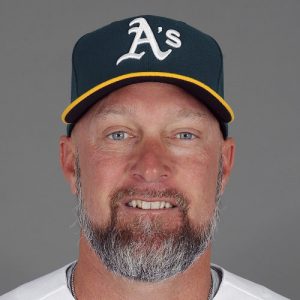
It’ll be the first managerial stint for the 46-year-old, who spent the 2021 campaign as the A’s third base coach. While he’d only served in that capacity for one season, the longtime MLB outfielder has been on the Oakland staff for a while. Kotsay originally signed on as bench coach over the 2015-16 offseason. After two years in that capacity, he bounced to quality control coach for a few seasons before taking over third base coaching duties last winter.
Now, Kotsay’s in position to oversee a dugout for the first time. His taking over the managerial chair in Oakland this winter would’ve seemed completely improbable just a few months ago. Longtime A’s skipper Bob Melvin — generally regarded as one of the better managers around the league — remained under contract after the team exercised a 2022 option on his services in June. Yet Oakland brass eventually granted Melvin permission to explore opportunities elsewhere, and the three-time Manager of the Year fielded inquiries from the Padres. San Diego and Melvin finalized a three-year deal in early November, leaving Oakland on the hunt for a new dugout leader for the first time in over a decade.
Melvin’s departure was nothing short of shocking. Once the dust was settled, however, it became clear that Kotsay was as strong a candidate as anyone to succeed him. Not only has the latter spent the past six seasons taking on various roles in Oakland, he spent the 2014 campaign as a special assistant in the Padres’ front office and logged the following year as the Friars’ hitting coach.
That’s a wide array of experience, particularly considering Kotsay’s not that far removed from hanging up his spikes. The ninth overall pick in 1996 coming out of Cal State Fullerton, Kotsay made his big league debut with the Marlins a little more than a year after his draft day. He’d appear in the majors in each of the next sixteen seasons, continuing his playing career all the way through 2013.
Kotsay appeared with seven different organizations during his MLB career, including two separate stints in San Diego and four years (2004-07) with the A’s. That stretch included a .314/.370/.459 showing in his first year in the Bay Area that stands out as one of the better seasons of his career. Oakland’s current top two front office decision-makers — executive vice president Billy Beane and general manager David Forst — were already in key positions with the A’s during that time, so Kotsay’s original stint in the organization likely laid the foundation for the key post-playing roles he’d eventually assume.
While Kotsay has yet to manage at any level professionally, he’s long been viewed as a viable candidate. By 2015, he’d been mentioned as a possibility to lead the Padres’ clubhouse on an interim basis after the firing of Bud Black, although that role eventually went to Pat Murphy. By the 2019-20 offseason, he was garnering consideration from clubs to land a managerial role on a permanent basis. He reportedly sat down with each of the Giants, Pirates, Astros and Red Sox that winter but didn’t ultimately land a gig. Last year, he interviewed with the Tigers for the position that eventually went to A.J. Hinch, but he’ll now get his opportunity with the franchise he arguably knows as well as any.
Aside from Kotsay, the A’s reportedly considered bullpen coach Marcus Jensen and hitting coach Darren Bush as possible internal options. Oakland also looked into Rays’ bench coach Matt Quatraro, Red Sox’s bench coach Will Venable and Astros’ bench coach Joe Espada. With the A’s the last team of the offseason to finalize their managerial situation, each of that group will have to wait at least one more year in the pursuit of their own first managerial nods.
Kotsay’s first order of business figures to be nailing down the coaching staff, which he and the front office can embark upon during the lockout. Once the transactions freeze is lifted, the A’s appear to be in for a rather significant roster overhaul. The front office is always operating under a tight budget due to payroll restraints, and reports have suggested for months that the A’s could trade key players (i.e. Matt Olson, Matt Chapman, Chris Bassitt, Sean Manaea, Frankie Montas) in an effort to reduce costs. Indeed, reports suggested Melvin’s $4MM salary may have been part of the reason the A’s allowed him to head to San Diego in the first place, although it’s likely the organization’s affinity for their longtime skipper was also a factor.
The specific form the restructure takes won’t be known until there’s a new CBA in place. Yet it’s likely Kotsay and his staff will be tasked with leading a club that looks very different, both from last year’s 86-win squad and the roster as currently constructed. That could make for a tough challenge for a first-year skipper, but the front office clearly believes in Kotsay’s ability to lead the franchise through that transition.
Image courtesy of USA Today Sports.
Mets Hire Buck Showalter As Manager
After weeks of speculation, the Mets have hired their new manager. New York announced on Monday that they’ve hired veteran skipper Buck Showalter. It’s reportedly a three-year contract that’ll go down as the largest investment in a manger in franchise history, topping the $9.4MM earned by Art Howe.
“Buck has been one of the best baseball minds for the last two decades and he makes teams better,” owner Steve Cohen said in the team’s statement. “We have a lot of talent on this team and Buck is the right manager to take us to the next level and lead us to sustained success. I am excited he is our new manager.”
It had already been reported that Showalter had advanced past the initial pool of candidates and moved onto the second round of interviews for the managerial opening. This represents another close call at helming a dugout for the other two finalists, Tampa Bay’s Matt Quatraro and Houston’s Joe Espada. Despite reverence around the league for the latter two coaches, industry insiders quickly tabbed Showalter as the frontrunner for the Mets position.
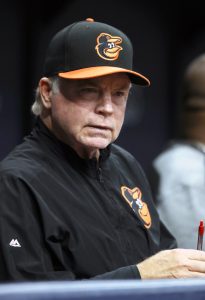
The veteran skipper will now take over a Mets dugout that has been something of a revolving door since Terry Collins’ seven-year run as manager ended after the 2017 season. Mickey Callaway was fired after two seasons, and following the short-lived hiring of Carlos Beltran, bench coach Luis Rojas took over the manager’s mantle heading into 2020.
The past two seasons saw Rojas sport a 103-119 record, a disappointing sum for a team with so much star power. While Rojas can hardly be pinned as the sole reason for the team’s struggles (the cross-town Yankees promptly hired Rojas as a coach following his dismissal, speaking to his abilities), he did oversee a collapse this past season. After spending 114 days in first place, the Mets were no longer able to weather injuries and under-performance, ultimately limping to a third place finish in their division.
While Rojas, Beltran, and Callaway were first-time MLB managers, Showalter is a known commodity. Over the course of 20 seasons and 3069 games, Showalter sports a .506% winning percentage and has taken home Manager of the Year hardware with three different clubs (1994 Yankees, 2004 Rangers, 2014 Orioles).
While Showalter has never won a World Series as a manager, many around the league have cited his leadership skills as a reason teams become postseason contenders. Most recently, during his 2010-2018 run with Baltimore, Showalter helped turn a rebuilding club into one of the American League’s winningest teams. After a 69-win inaugural full season with the club, Showalter quickly saw the team post non-losing records in the next 5 seasons. The Orioles made the playoffs three times during that stretch, including once as a first place team— no small feat considering the financial powerhouses that reside in the AL East.
It’s been some time since Showalter managed one of those very powerhouses, last managing the Yankees in 1995. Improbably, he’ll now helm a team with even greater resources at its disposal. In a series of win-now moves, the Mets have launched their 2022 payroll to new heights. RosterResource pegs the Mets to open next season with a franchise-high $263MM payroll, a number that is handily the highest in all of baseball, and was more astonishingly reached with months (and plenty of free agents) left in the offseason.
With the likes of Max Scherzer, Starling Marte, Mark Canha, and Eduardo Escobar already joining the Mets this offseason it’s become imminently clear the NL’s New York club isn’t content to idle under .500. Pair these additions with star holdovers Jacob deGrom, Brandon Nimmo, Francisco Lindor, and Pete Alonso and the Mets are teeming with top-shelf talent. That collection of players, plus all of the other bounce-back talent on the roster, will give the team’s new manager plenty of firepower to claim a division that has belonged to Atlanta the past four years.
In the ensuing weeks Showalter will round out his coaching staff, while the Mets may still add players to their club after the lockout is lifted. Whatever changes are made before the 2022 season starts however, many pundits and fans will point to this hiring as the team’s key move of the offseason. Hiring a widely-respected stabilizer may be just what the Mets need to capitalize on their potential and get to the postseason for the first time since 2016.
Jon Heyman of the MLB Network reported Showalter’s deal was a three-year contract. Mike Puma of the New York Post reported the deal was the largest for a manager in franchise history.
Photo courtesy of USA Today Sports Images
David Blitzer To Acquire Significant Minority Stake In Guardians
David Blitzer, partial owner of the NBA’s Philadelphia 76ers and the NHL’s New Jersey Devils, is acquiring a large minority stake in the Cleveland Guardians, tweets Jon Heyman of the MLB Network. Perhaps of more interest, Heyman further reports that the deal gives Blitzer an option to become the majority owner around five to six years from now.
Eben Novy-Williams and Scott Soshnick of Sportico reported this morning that Blitzer was in talks with the Guardians about acquiring a significant minority stake. Those reports come on the same day that Zack Meisel of The Athletic published his own report indicating that Guardians majority owner Paul Dolan has enlisted investment banking firm Allen & Co. to assist him in finding a buyer for a share of the team that could be as large as 30 to 40 percent. In a statement to reporters (Twitter link via Mandy Bell of MLB.com), Dolan confirmed that he and Blitzer have held “meaningful” discussions but chose not to comment any further on the negotiations.
Dolan’s search for a new investment partner comes in the wake of John Sherman’s departure from the ownership group back in 2019. Sherman held a significant minority stake himself when with the club, but he divested his interest in order to purchase a majority stake of the Kansas City Royals from then-owner David Glass. Sherman paid more than $1 billion in his purchase of the Royals, and his former shares of the Indians/Guardians franchise have been sitting in escrow since his departure, per Meisel.
Forbes’ most recent franchise valuation estimates (back in March) pegged Cleveland at $1.16 billion. Sportico’s most recent valuation was a $1.375 billion sum. Meisel, meanwhile, suggests that Dolan has placed a slightly more aggressive $1.4 billion valuation on the team. It’s not clear how amenable Blitzer has been to that $1.4 billion sum, but Sportico’s report indicates that he’s currently negotiating over what would be a 35 percent stake. That’d mean something in the vicinity of a $490MM investment (based on that $1.4 billion figure) from Blitzer, who’d be buying up Sherman’s former shares as well as some of Dolan’s stake.
This isn’t the first time that Blitzer has sought to expand his portfolio into the baseball world. Many fans may recall that Blitzer and Sixers/Devils majority owner Josh Harris were at one point seeking to purchase the Mets from the Wilpon family before being outbid by current owner Steve Cohen. At present, there’s no indication that Harris is a part of the negotiations that have taken place between Dolan and Blitzer, however.
Any sale and/or ownership change can bring about relocation concerns among the fanbase, but it seems quite unlikely any such plans would be in the works even were Blitzer to eventually take control of the club. The Guardians recently inked a 15-year lease extension at Progressive Field, guaranteeing that to be their home site through the 2036 season. The extension also came with the “potential for 10 additional years” to be added onto the agreement, per the team’s announcement at the time. That agreement called for $435MM worth of renovations and upgrades to the stadium, which has been the team’s home since the 1994 season.
The other pressing thought for Guardians fans in the wake of the report would be one of potentially increased payroll capacity, though it should be stressed that a five-year transfer of majority ownership would in no way guarantee a sudden payroll spike. Cleveland’s payroll has plummeted to among the lowest in MLB as they’ve traded away various recognizable names, including Mike Clevinger and Corey Kluber, while simultaneously eschewing any notable spending in free agency. The result is a payroll where Jose Ramirez‘s $11MM salary is now the only guaranteed money on the books for Cleveland in 2022, though subsequent arbitration agreements and a smattering of free-agent pickups and/or trade acquisitions will surely boost that figure a bit.
An eventual ownership change could, of course, bring about new spending habits for an organization that has typically been one of the league’s lowest-payroll clubs. That said, the primary drivers of payroll upticks for any team will always be increased revenues through television/streaming rights, gate revenue and/or real estate holdings surrounding the park. It’s unlikely that transitioning to Blitzer or another majority owner would catapult the Guardians into the top third of Major League payrolls at any point, but a new majority owner/control person could certainly impact various organizational spending philosophies (e.g. willingness to spend on rare extensions for key players).
MLB, MLBPA Not Expected To Discuss Core Economics Until January
TODAY: Thursday’s discussions involved such topics as PED policies, the joint domestic violence/sexual assault/child abuse policy, special events, procedures for filing grievances, and scheduling, ESPN.com’s Jesse Rogers writes.
DEC. 15: Since Major League Baseball instituted a lockout in the early morning hours of December 2, there’s been little known back-and-forth between the league and the MLB Players Association. Evan Drellich of the Athletic reports this evening that the sides aren’t expected to discuss the game’s core economic structure until sometime in January. The parties have, however, been in contact about other issues and are expected to meet in-person tomorrow to discuss issues outside of core economics.
Disagreements related to core economics figure to be the most important, contentious issues to hammer out. Such topics as the service time structure, playoff expansion and the competitive balance tax are among the areas of import for both sides that could be difficult to iron out. Agreeing on the core economics structure figures to take ample bargaining time, and that the sides won’t even address the issues again until January is the latest confirmation that the lockout figures to drag on for quite some time.
In the aftermath of the lockout, both Commissioner Rob Manfred and MLBPA lead negotiator Bruce Meyer publicly expressed a willingness to continue negotiating. Yet Drellich hears that neither side has initiated talks regarding core economics in the nearly two weeks since then, even as they’ve engaged on less contentious matters.
There doesn’t seem to be much belief that meetings regarding core economics before January would serve much of a purpose, though. Drellich hears from individuals on both sides of talks who suggest that a sit-down within the coming days or weeks would likely have only resulted in negotiators “saying the same things to each other over and over.”
As Drellich points out, there doesn’t seem to be a ton of urgency for either side to move off their initial demands at this point on the calendar. During the winter months, owners aren’t losing gate revenues while players aren’t forfeiting game checks. Major league transactions are frozen, but that alone doesn’t seem to be enough of a motivator for either side to alter their bargaining positions.
The league’s owners are clearly content to wait through a transactions freeze, having voted to lock the players out unanimously as the previous collective bargaining agreement expired. MLBPA executive director Tony Clark, meanwhile, suggested to reporters on December 2 that the freeze wouldn’t affect the players’ negotiating resolve. “Players consider (the lockout) unnecessary and provocative,” Clark said at the time. “The lockout won’t pressure or intimidate players into a deal they don’t believe is fair.”
It’s possible both sides will begin to feel more pressure to move closer to an agreement as the scheduled start of Spring Training nears. As things currently stand, the first exhibition games are scheduled to begin on February 26, 2022. Of course, there’ll need to be some time for players to report and to get into game shape before jumping right into game play. In the immediate aftermath of the lockout, Bob Nightengale of USA Today suggested the sides viewed February 1 as a “soft deadline” for a deal getting done to avoid interruptions to Spring Training.
Latest On Carlos Correa’s Market
Carlos Correa entered the offseason as the top name on most free-agent rankings — including here at MLBTR — and remains unsigned as MLB and the MLBPA navigate a lockout that certainly doesn’t look anywhere near a resolution. There’s been plenty of discussion and speculation as to where he’ll ultimately land, but ESPN’s Buster Olney sheds some light on interest that Correa has already received, reporting that the Tigers put forth a 10-year, $275MM offer at one point this winter.
Presumably, that offer came before Detroit signed Javier Baez at six years and $140MM, although it’s at least possible to see how Detroit could make room for both players on the roster and payroll alike. It’s a notable offer, to be sure, but it’s also $66MM shy of what Francisco Lindor received from the Mets, $50MM shy of Corey Seager‘s deal with the Rangers and a ways south of the range many pundits projected heading into free agency.
The reported Detroit offer also further underlines that the Astros’ recent offers to Correa are well shy of meeting the mark. Houston was said to have put forth an offer of five years and $160MM just prior to free agency, but that seemed like a nonstarter from the jump. Olney writes that Astros owner Jim Crane has told colleagues that he won’t make an offer of more than six years in length, which only reinforces the expectation that Correa is likely to sign with a new team for the 2022 season.
Of course, the burning question for most MLB fans and onlookers is a simple one: “where?” The Rangers nabbing a pair of high-end shortstops (Seager and Marcus Semien), on the surface, should have strengthened Correa’s market. Two of his top competitors signing with the same team should have kept another spot open elsewhere. However, the Tigers have signed Baez to that aforementioned six-year deal, and the Yankees — at least according to multiple pre-lockout reports — weren’t interested in the top-of-the-market shortstops, instead preferring shorter-term options to serve as a bridge to prospects Anthony Volpe and Oswald Peraza.
It remains plausible that the Yankees and several other big-market teams will more aggressively jump into the market post-lockout, once a (presumably) new luxury-tax threshold is set in stone. Olney hears from some agents who believe the Yankees and Dodgers could engage in the market for stars like Correa or Trevor Story once the forthcoming luxury tax structure is known. Those players’ representatives are surely hoping that will be the case, although even if the Yankees, Dodgers, etc. choose to eschew a mega-deal, that shouldn’t necessarily leave Correa out in the cold.
Houston’s interest will remain in place, barring a signing of Story or the acquisition of another notable infielder. Mark Berman of Fox 26 reported earlier this month that each of the Red Sox, Cubs and Braves have also been in contact with Correa’s representatives at some point during the offseason. When those clubs reached out and the extent of each respective team’s interest isn’t clear, but it stands to reason at least some of that group will reengage with Correa’s reps whenever the transaction freeze ends.
That’s a nice “safety net” (for lack of a better term), and as the Braves’ and Cubs’ reported interest reflects, unexpected suitors tend to emerge for players at the top of the market. Few gave the Padres legitimate consideration when Manny Machado hit the market following the 2018 season, for instance. Broadly speaking, the top free agent each winter tends to get paid, particularly when said player is atypically young to reach the market — as is the case with the 27-year-old Correa. It’d be entirely unsurprising for other unexpected teams to join the bidding, viewing Correa as a rather unique opportunity to add an All-Star-caliber player who remains squarely in his prime.
Correa is coming off one of the best seasons of his career, having hit .279/.366/.485 with 26 home runs across 640 plate appearances. That offensive production was 34 points above the league average, by measure of wRC+, and it came over Correa’s biggest workload since 2016. Advanced defensive metrics were also particularly high on his work on the other side of the ball, for which he received his first Gold Glove award en route to a fifth-place finish in AL MVP voting.
Blue Jays Pursued Corey Seager Prior To His Deal With Rangers
Corey Seager‘s 10-year, $325MM deal with the Rangers prior to the MLB lockout shocked baseball — both because it was the Rangers winning the bidding and because Texas had already signed Marcus Semien for a surprising seven years and $175MM. As one would expect with any bidding war that reaches a decade and more than $300MM, Texas had some competition as they sought to lure Seager to Arlington. However, ESPN’s Jeff Passan reports this morning that a perhaps-unexpected suitor was one of the primary competitors in that Seager market: the Blue Jays.
The Dodgers also had strong interest in re-signing Seager, per Passan, though that much was largely known to this point. Toronto’s involvement in the process, however, is a newer revelation. The Jays were known to be attempting to re-sign Semien, but Seager’s contract was in an entirely different financial stratosphere. Ultimately, Toronto simply wasn’t willing to match Texas’ 10-year, $325MM terms, but Passan suggests that the team was “very much” in on Seager prior to his deal with Texas.
That’s of some anecdotal note and makes for a fine “what-if” moment for Jays fans down the line, but it’s also informative of the team’s current mindset and simultaneously instructive of how the Jays will be able to operate post-transaction freeze. The Blue Jays have just shy of $97MM committed to the septet of George Springer, Kevin Gausman, Hyun Jin Ryu, Jose Berrios, Randal Grichuk, Lourdes Gurriel Jr. and Yimi Garcia. Add in a steep arbitration class headlined by burgeoning star Vladimir Guerrero Jr., and the Jays have another $31MM or so in projected payroll, according to MLBTR contributor Matt Swartz.
That brings the Jays to nearly $128MM in 2022 projections — plus another nine pre-arbitration salaries (generally in the vicinity of the league minimum). For a team that opened the 2021 season with about $135MM in guaranteed salary and has previously pushed payroll to $163MM, it’s not really a shock to see that there’s more room in the 2022 budget. However, signing Seager would’ve been about far more than 2022 dollars.
For Toronto, signing Seager would’ve meant had four sizable, fully guaranteed contracts on the books as far out into the future as 2026, when Springer, Gausman and Berrios are all still under contract. (Berrios is signed through 2028, though his contract contains an opt-out after that ’26 campaign.) Any Seager signing would’ve figured to include a salary north of $30MM being added onto that 2026 ledger, meaning the Jays were essentially comfortable with the idea of committing $93MM or more to four players in 2026 — about a half-decade in advance.
With Toronto also surely keen on extending both Guerrero and Bo Bichette at some point, any serious level of interest in Seager is all the more notable. The 2026 season is the first would-be free-agent year for both Guerrero and Bichette, so throwing a Seager contract onto the pile indicates a willingness to spend well above nine figures on 2026 payroll if there’s to be any hope of realistically extending either young star.
It’s all an exercise in hindsight, to an extent, as Seager is of course set to spend the next decade as a Ranger. But the Jays’ apparent willingness to jump into the Seager market also provides some useful context when looking at how they’ll operate once transactions resume under a new collective bargaining agreement.
Perhaps Toronto simply viewed Seager as an exception and was comfortable spending that type of money singularly on Seager and Seager alone. However, the market has several high-end free agents who remain unsigned and will be in position to command sizable long-term deals. Carlos Correa could well land a deal in the same range as Seager commanded. Trevor Story figures to be eyeing a nine-figure commitment, perhaps over a shorter term that caps off around that same 2026 point the Jays’ current commitments come to an end. The Jays have already been tied to star NPB outfielder Seiya Suzuki, and the outfield market also includes higher-profile names like Kris Bryant, Nick Castellanos and Kyle Schwarber.
Toronto certainly isn’t under any obligation to tack another nine-figure deal onto the books, but the mere fact that they were a player of any real note in the Seager bidding shows that they can’t be squarely ruled out from doing so. Another major free-agent expenditure would make for enormous major payrolls down the road when Guerrero and Bichette are in their final couple years of arbitration (and/or into the free-agent portions of theoretical extensions), but the Jays are committed to winning right now. Even with three long-term deals on the books and a pair of high-profile young stars they’ll hope to extend, we shouldn’t assume Toronto will shy away from another major long-term deal.
Free Agent Danny Duffy Targeting June Return Following Flexor Surgery
Although veteran left-hander Danny Duffy was a fairly notable deadline pickup by the Dodgers back in July, the soon-to-be 33-year-old didn’t throw a pitch in Los Angeles following the trade. Acquired while on the injured list due to a forearm strain, Duffy suffered a setback while rehabbing with L.A. and never made it back to a big league mound.
The Dodgers and Duffy were both rather quiet on his outlook. The left-hander now reveals to Andy McCullough of The Athletic that after initially fearing what would’ve been his second career Tommy John surgery, he instead required surgery to repair the flexor tendon in his left arm. That procedure, performed in October, comes with a months-long rehabilitation process. Duffy is targeting June for a return to a big league mound and expects to pitch out of the bullpen in 2022 before hopefully moving back into a rotation thereafter.
Of course, the team for which Duffy will throw remains entirely uncertain. The left-hander hit free agency for the first time in his career at season’s end and did not agree to terms with a club prior to the expiration of the 2016-21 collective bargaining agreement. It stands to reason that either the Dodgers, who traded for him, or the Royals, who drafted and developed him, would have interest in bringing him back.
Then again, Duffy has a lengthy track record of big league success and ought to be of interest to a variety of contenders and non-contenders alike on a short-term deal. Most clubs figure to be interested on a one-year deal, though as we saw with Kirby Yates earlier in the offseason, its feasible that a team could try to lure Duffy on a heavily backloaded two-year arrangement.
Duffy appeared in 13 games for the Royals this past season, all but one of them as a starting pitcher. In 61 frames he notched a tidy 2.51 ERA, albeit with less-favorable reviews from fielding-independent marks like FIP (3.40) and SIERA (4.14). This season’s 93.8 mph average heater was his best mark since 2016, while his 25.8% strikeout rate was a narrow career-high mark over 2016’s rate of 25.7%.
KBO’s Kiwoom Heroes Sign Yasiel Puig
Free agent outfielder Yasiel Puig is in agreement with the Kiwoom Heroes of the Korea Baseball Organization, reports Yonhap News (h/t to Yonhap’s Jeeho Yoo). It’ll be a one-year, $1MM contract, the maximum amount allowed under KBO rules for first-year foreign players. (Francys Romero of Las Mayores reported yesterday that Puig was nearing agreement with a KBO team).
Puig, who turned 31 years old yesterday, hasn’t appeared in the majors since 2019. After a league average offensive showing between the Reds and Indians that year, he lingered on the free agent market for the entire offseason. Puig looked as if he’d lined up a deal with the Braves coming out of the pandemic-driven transactions freeze last July, but his potential agreement with Atlanta was scuttled after he tested positive for COVID-19.
Puig didn’t wind up playing in 2020. During the ensuing offseason, a woman filed a civil action against him, alleging that he had sexually assaulted her in 2018. In March, John Barr of ESPN detailed the allegations, which Puig and his representatives denied. Criminal charges were never filed, and the parties settled the civil case out of court this past October.
While Puig continued to express interest in a return to Major League Baseball, he spent the 2021 season in the Mexican League. The right-handed hitter signed with El Águila de Veracruz. He hit .312/.409/.517 across 247 plate appearances and 62 games. He’ll now reportedly head to South Korea for his first career action outside of North America.
Puig has appeared in seven big league seasons, including star-level showings in each of his first two years with the Dodgers. He appeared on MVP balloting in both 2013 and 2014, earning an All-Star selection in the latter of those seasons. From 2015 onwards, Puig settled in as a solid but not elite offensive player, posting slightly above-average marks until his average 2019 showing. For his career, he’s a .277/.348/.475 hitter.