
Molina: 2022 “Will Be My Final Season”
If there was any doubt after yesterday’s one-year contract extension, Cardinals catcher Yadier Molina confirmed in a press conference today that he plans to retire after the 2022 season. “Yes, yes it will be my final season,” Molina plainly stated (Twitter link via Derrick Goold of the St. Louis Post-Dispatch).
That was the expectation the moment the deal was finalized, as president of baseball operations John Mozeliak even called the 2022 campaign Molina’s final season in the team’s press release announcing the extension. Still, it’s notable to hear the player himself publicly confirm as much.
Molina, 39, is well past his peak production but is still delivering offense that falls roughly in line with that of a league-average catcher. He’s batting .259/.304/.375 with eight homers and 16 doubles so far in 2021, walking at a 5.7 percent clip and still striking out at a 15.7 percent rate that is well south of the league average. His 43 percent caught-stealing rate behind the dish is among the best in the game.
It was strange this past offseason to consider the possibility of Molina playing somewhere other than St. Louis, but he reached the free-agent market for the first time in his illustrious career and unsurprisingly drew interest from several clubs. He’ll avoid any speculation of playing for a new club this time around, cementing himself as a lifelong Cardinal with the extension and today’s announcement.
Notably, as Cardinals fans now turn their attention to Adam Wainwright, Molina touched on the subject of his longtime teammate’s future (Twitter link via Zachary Silver of MLB.com). Molina noted that Wainwright lobbied heavily for him to return to St. Louis last offseason. “Now, it’s my turn,” Molina said in reference to Wainwright, adding that he’d “love to finish my career with him.”
Wainwright is also playing the 2021 season on a one-year contract, and he’s said in the past that he’ll need to discuss the matter with his family before determining whether he’ll continue his own career into the 2022 campaign. Through 162 2/3 innings, Wainwright has a 3.10 ERA, three complete games and a shutout. He’ll turn 40 next Monday.
Cardinals Place Jack Flaherty On Injured List
10:38am: The Cardinals have formally placed Flaherty on the 10-day injured list and recalled right-handed reliever Junior Fernandez from Triple-A Memphis in a corresponding move.
10:12am: The Cardinals are placing right-hander Jack Flaherty back on the 10-day injured list, manager Mike Shildt announced to reporters during today’s pregame session (Twitter link via Jeff Jones of the Belleville News-Democrat). Flaherty, who only just returned from a two-month absence due to a severe oblique strain, has now been diagnosed with a strain in his right shoulder. Shildt indicated that imaging was “mostly negative,” suggesting that there’s no major structural issue in the shoulder.
There’s no timeline on Flaherty’s return just yet, but Shildt indicated that the club can’t firmly rule out the possibility that the talented young right-hander’s season is over. There are just under six weeks remaining on the regular-season calendar, and Flaherty will need some form of down period to allow the strain to heal before he can resume throwing and build back up.
Flaherty made just three starts between IL stints, and his velocity was down noticeably last night before departing the game. He told reporters after the contest that he began feeling “less comfortable as the game went on” and voiced frustration over having another start shortened by a physical ailment (link via Derrick Goold of the St. Louis Post-Dispatch).
With Flaherty now back on the shelf for a yet-to-be-determined period of time, the Cards are again operating at less than full strength in the rotation — just as they have throughout the entire summer. Kwang Hyun Kim recently returned from the injured list but was slated to work out of the bullpen; it’s at least possible that they’ll shift him back into a starting role now that Flaherty is out. Elsewhere in the rotation, the Cards have Adam Wainwright, Miles Mikolas, J.A. Happ and Jon Lester. For now, that group will lead the charge as the Cards attempt to close a 4.5-game deficit in the NL Wild Card standings. The division is effectively out of reach, as Milwaukee has a commanding 13-game advantage over St. Louis (and an 8.5-game lead over second-place Cincinnati).
Flaherty has been excellent when healthy this season, as one would expect. The 25-year-old carries a 3.08 ERA, a 26.1 percent strikeout rate, a 7.7 percent walk rate and a 38.6 percent ground-ball rate through 76 innings thus far.
Cardinals Sign Yadier Molina To One-Year Extension
The Cardinals announced they’ve agreed to a one-year contract extension with Yadier Molina. The ten-time All-Star will remain in St. Louis for the 2022 season on a $10MM salary. Molina is a client of MDR Sports Management.
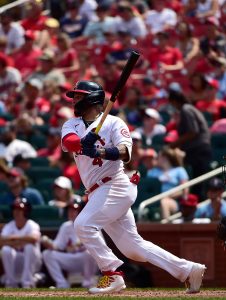
It’s not surprising the two sides were able to line up on terms, as they were known to be in extension discussions last week. Molina was believed to be seeking a one-year deal that matches or tops the $9MM salary on which he’s playing out the 2021 campaign, and he’s succeeded in landing exactly that. Molina didn’t sign that deal until this past January, and he’d been vocal about wanting to avoid lingering on the free agent market again this time around.
Molina’s no longer the MVP-caliber player he was at his peak, but he’s still a productive regular catcher even at age-39. This season, he’s hitting .259/.304/.376 with eight homers across 365 plate appearances, not far off the .268/.310/.388 slash line he compiled between 2019-20. That’s below-average offensive production overall, but it’s still fine work when considering the toll catching takes on players. Backstops have compiled just a .228/.307/.391 mark around the league. Molina’s offensive output is around par with the league average at the position.
That’s without considering his contributions on the other side of the ball. Molina is regarded as perhaps the best defensive catcher of his generation. As is the case with his bat, Molina’s glove has fallen off somewhat with age, but he’s still unquestionably a plus behind the dish. Molina has cut down seventeen of forty attempted base-stealers this season, a 42.5% rate that’s far better than the 24.4% league average.
In addition to neutralizing the running game, Molina has a reputation as one of the game’s best at the aspects of catching that are difficult or impossible to quantify. His once-elite framing metrics have fallen to around league average, but he still checks in as a viable receiver. And the Cardinals no doubt believe Molina brings intangible value from a leadership perspective to the pitching staff and clubhouse.
While Molina should still bring quite a bit to the table next season, it’s apparent his legacy as one of the best players in franchise history plays into the front office’s eagerness to keep him off the open market. No active player in MLB has been with their current team longer than Molina, who debuted with St. Louis in June 2004. The nine-time Gold Glove award winner was an integral part of the Cardinals’ 2006 and 2011 World Series teams. There’s plenty of reason for the club not wanting to risk a repeat of last offseason’s stalemate.
Molina recently hinted that next year could be the last of his illustrious career, and president of baseball operations John Mozeliak referred to 2022 as Molina’s “final season” in the press release accompanying the announcement of today’s extension. Jon Heyman of the MLB Network (Twitter link) notes that the current expectation for both Molina and the Cardinals is that 2022 will indeed be his final year as a player. If that ultimately proves to be the case, he would retire as the rare one-franchise star.
With Molina wrapped up, the Cardinals figure to turn to Adam Wainwright, another impending free agent who has been in St. Louis for ages. Wainwright made his debut in 2005 and has led the St. Louis rotation for a good portion of the past fifteen years. Despite turning 40 years old this month, Wainwright has been one of the better pitchers in the National League this season. Assuming he wants to keep playing beyond this year, the Cardinals would have every reason to look to hammer out an extension with Wainwright as well.
The Molina extension will push the Cardinals’ estimated 2022 player payroll just north of $90MM, according to Cot’s Baseball Contracts. Nolan Arenado ($35MM if he doesn’t opt out), Paul Goldschmidt ($25.33MM), Miles Mikolas ($17MM) and Paul DeJong ($6.17MM) join Molina as players with notable guaranteed contracts on the books. St. Louis will also have to cover arbitration raises for Jack Flaherty, Harrison Bader, Alex Reyes, Dakota Hudson, and Tyler O’Neill, among others. The Cardinals opened the 2021 season with an estimated $163MM payroll.
St. Louis could look to address the rotation and middle infield this winter. Catcher, where Andrew Knizner has struggled in limited action as Molina’s understudy, would’ve been a question mark in the unlikely event Molina went elsewhere. It seems the Cardinals are prepared to roll with a Molina-Knizner pairing again next season, and top prospect Iván Herrera could be worked into the mix midseason with an eye towards 2023. The lion’s share of playing time behind the plate at Busch Stadium will fall to Molina, as it has for the past sixteen years.
Katie Woo of the Athletic first reported the agreement and its terms.
2021-22 MLB Free Agent Power Rankings
Much has changed since our last installment of these rankings back on June 10th. Six players signed extensions in lieu of free agency, none beyond Lance Lynn‘s two-year, $38MM deal with the White Sox. Trevor Bauer has been removed from the rankings, as he remains on paid administrative leave after being accused of sexual assault.
Four players who might have been considered for qualifying offers were traded in July: Kris Bryant, Javier Baez, Anthony Rizzo, and Starling Marte. Those players are now ineligible for qualifying offers. Kevin Gausman, Marcus Stroman, Max Scherzer, Zack Greinke, and AJ Pollock are among those who are ineligible on account of having received one previously. The Rockies inexplicably retained Trevor Story at the trade deadline, so he will be subject to a qualifying offer.
As a reminder, these power rankings are based on my projection of the players’ earning power. Keep in mind that the current collective bargaining agreement expires on December 1, though that doesn’t necessarily mean free agency will be frozen.
1. Carlos Correa. Prior to this year, Correa had played 110+ games in a season with a 120 wRC+ exactly once, back in 2016. This year, Correa has avoided the regular injured list and is fourth among qualified shortstops with a 136 wRC+. Correa did go on the COVID-19 IL in July, but he missed only a week.
Just 27 years old in December, Correa also has youth on his side, and appears headed toward a monster free agent contract. The $340MM deals of fellow shortstops Fernando Tatis Jr. and Francisco Lindor will surely be a target.
2. Corey Seager. After getting hit by a pitch and suffering a broken right hand in mid-May, Seager missed two and a half months. Upon his return July 30th, the Dodgers had acquired another of the game’s top shortstops in Trea Turner. Turner has switched to second base as a member of the Dodgers, but serves as a strong option at shortstop for 2022 for L.A. Seager didn’t have much to say on the topic, but clearly his negotiating leverage took a hit with the Turner acquisition.
As for what Seager can control, he’s shown no ill effects from the broken hand. He’s got a stellar 134 wRC+ in 87 plate appearances since returning from the injury. Seager is only about five months older than Correa, so he too will be seeking a very long contract in excess of $300MM.
3. Kris Bryant. 19 games into his Giants career, Bryant’s solid season has continued. The Giants have enjoyed his versatility, playing Bryant at third base as well as all three outfield positions. He’s saying all the right things about the possibility of staying in San Francisco long-term, telling Alex Pavlovic of NBC Sports Bay Area, “It’s definitely enticing.” Even with a new deal for Brandon Crawford, the Giants have less than $36MM on the books for 2022, so they could certainly afford Bryant.
4. Trevor Story. Though Story expressed confusion at the Rockies’ decision not to trade him, he hasn’t let it affect him on the field. Since the trade deadline, Story sports a 147 wRC+ in 81 plate appearances. 29 in November, Story isn’t quite as young as Correa and Seager, but he’s still in good shape for a contract well beyond $100MM. There’s still a case to be made for Story above Bryant, and the Rockies’ shortstop has outplayed Bryant since June.
5. Freddie Freeman. Freeman has turned it on since June, posting a 151 wRC+ in 324 plate appearances. 32 in September, Freeman remains one of the best hitters in baseball. The Braves wisely held onto the 2020 NL MVP despite a 12% chance at the playoffs at the trade deadline, and now the club has a 77% chance according to FanGraphs. Braves fans continue to wonder why the club hasn’t hammered out a deal with their perennial All-Star.
6. Kevin Gausman. Gausman has scuffled as of late, with a 5.17 ERA and 10.6% walk rate in his last seven starts. However, he remains the prize pitcher of the free agent class, and he has seven regular season starts plus the playoffs to cement his free agent bona fides. Dating back to 2020, Gausman has a 2.94 ERA and and 30.4% strikeout rate in 205 2/3 innings for the Giants.
7. Marcus Semien. Semien joins this list for the first time, as he’s putting together his second MVP-caliber season within three years. Maybe his 53-game 2020 season was the fluke, and Semien really is one of the best players in the game. 31 in September, he’s a candidate for at least a strong five-year deal in free agency. Semien has played mostly second base this year in deference to Bo Bichette, but as a free agent he’ll be a consideration at both middle infield positions. Semien’s 5.2 WAR is only bested among position players by the incomparable Shohei Ohtani.
8. Marcus Stroman. Stroman, 30, ranks seventh among qualified NL starters with a 2.84 ERA in 145 1/3 innings. He succeeds on the strength of his home run prevention and solid control and is a candidate for a five-year deal. Stroman has shown no rust after opting out of the 2020 season.
9. Robbie Ray. Ray, with an identical WAR to Stroman at the moment, presents an interesting contrast. Ray’s 30.7% strikeout rate ranks second in the AL, coupled with a career-best 6.4 BB%. It’s truly shocking to see Ray with such a low walk rate, as he had baseball’s worst walk rate – by far – last year among those with at least 50 innings. He ranked the second-worst in that regard in 2019. While Toronto’s $8MM deal for Ray has turned into a masterstroke, the lefty will be very difficult to value as a 30-year-old free agent.
10. Nick Castellanos. With a 146 wRC+, Castellanos has been the seventh-best hitter in the NL this year. He sports a solid 121 mark since returning from a microfracture in his right wrist on August 5th. Castellanos, 30 in March, has the ability to opt out of the remaining two years and $34MM on his contract with the Reds after the season. He’ll almost certainly do that, and reject a qualifying offer from the Reds as well.
Honorable mentions
Max Scherzer, Carlos Rodon, Chris Taylor, Javier Baez, Michael Conforto, Starling Marte
Scherzer and Rodon in particular just missed making my top 10. Even at age 37, Scherzer could land a three-year deal in the $100MM range. But he could also seek something just above two years and $72MM, which would result in a new record for average annual value. Rodon is having a season for the ages after being non-tendered by the White Sox and then returning on a $3MM deal. However, he’s currently on the IL for shoulder fatigue, and even at age 29 he’ll be hard-pressed to find a five-year deal given his health history. Taylor, the Dodgers’ super-utility man, has a 133 wRC+ since the start of 2020 and will likely surprise many with the size of his next contract. Still, it figures to fall short of $100MM.
Mets To Activate Francisco Lindor From Injured List
The Mets are activating star shortstop Francisco Lindor from the 10-day injured list before tonight’s game against the Giants, Anthony DiComo of MLB.com was among those to relay. He’ll be making his first appearance since mid-July after missing five weeks with a right oblique strain.
Things were looking up for the Mets before Lindor hit the IL on July 17. New York had been leading the National League East for the prior couple months and looked to have a good chance at snapping a four-year playoff drought. That’s no longer the case, as the Mets have fallen flat in August and dipped below .500 in recent days. New York enters play tonight sporting a 61-63 record, sitting in third place in the division. They’re six and a half games back of the Braves and two games behind the Phillies, giving them very little margin for error if they’re to make a playoff push over the season’s final five-plus weeks.
For the first time, Lindor will pair with trade deadline acquisition Javier Báez in the middle infield. The Mets acquired Báez from the Cubs in the hope that he could hold down shortstop for a few weeks before sliding to second base upon Lindor’s return. Unfortunately, Báez missed ten days himself due to back spasms, but he made his return to the lineup over the weekend.
Lindor started the season very slowly, but he’d begun to find some rhythm offensively before the injury. Overall, he’s carrying a .228/.326/.376 line over his first 364 plate appearances. That’s career-worst production — no doubt a disappointing start to his time in Queens — but Lindor has continued to offer Gold Glove caliber defense and should see an improvement in his hitting numbers, since he’s been plagued by a .248 batting average on balls in play.
Gregory Polanco Goes Unclaimed On Waivers
Aug. 24: Polanco went unclaimed on waivers and has been returned to the active roster, Mike Persak of the Pittsburgh Post-Gazette reports (via Twitter). He’s not in today’s lineup but remains with the club.
Aug. 22, 8:14pm: Jason Mackey of the Pittsburgh Post-Gazette says that, if Polanco goes unclaimed, he will remain with the Pirates. (Twitter link 1, 2 and 3.) This seems to imply that, if Polanco clears waivers, the team will choose not to outright him off the roster. According to Mackey, placing Polanco on waivers was about giving him the chance to play for a contender, if any are interested. Although, speculatively speaking, the notoriously thrifty Pirates would also be delighted to get the $2.4MM off their books, as well as the $3MM buyout on his 2022 option.
7:16pm: The Pirates have placed Gregory Polanco on outright waivers, according to Rob Biertempfel of The Athletic. Polanco is playing on a salary of $11.6MM this year, with about $2.4MM of that still to be paid out. Any team claiming him would be responsible for that remaining salary. But if he goes unclaimed, Polanco would be able to elect free agency. At that point, any club could sign him and just pay him the prorated league minimum, with the Pirates being on the hook for the remainder.
Whether he is claimed or not, this seems to be the end of Polanco’s time as a Pirate, an unceremonious conclusion to a relationship that once had such promise for both parties. Originally signed by Pittsburgh in 2009 as a 17-year-old, Polanco debuted in 2014 and, after two solid seasons, showed enough promise that the club agreed to give him a five-year extension, which guaranteed him $35MM, in April of 2016. At the time, Polanco’s line of .249/.316/.369 was nothing outstanding, but it was expected that the 24-year-old would grow into more power and provide more offensive production to pair with his excellent defense and speed. With the team having already extended Starling Marte and Andrew McCutchen, it was thought that Polanco could be the third piece of a superb outfield that they could build on for years to come.
For the remainder of the 2016 season and the first two years of the deal, everything seemed to be going in the right direction. Over those three seasons, Polanco hit 56 home runs and stole 37 bases, producing an overall line of .255/.324/.455. That was good enough for a wRC of 105 and 5.3 fWAR. Thanks in no small part to Polanco, the Pirates qualified for the National League Wild Card Game three years in a row, from 2013 to 2015. Unfortunately for both he and the team, it’s been mostly downhill since then. In September of 2018, Polanco underwent surgery for a dislocated shoulder and hasn’t been able to play at anything approaching that level since.
In 2019, Polanco was only able to get into 42 games and, even when on the field, had his line slide to .242/.301/.425, a wRC+ of 87. With the shoulder issues still ailing him, Polanco went on the IL June 22nd and didn’t make it back on the field for the rest of the year. Polanco returned in 2020 but saw his numbers slip even farther, to a dismal line of .153/.214/.325 during the COVID-shortened season. That amounted to a wRC+ of 41.
This year, Polanco has bounced back from that nadir, but only slightly. In 101 games, he has put up a line of .198/.277/.343, which adds up to a wRC+ of 67. With the Pirates sitting on a record of 44-80 and firmly into rebuild mode, it seems they wanted to allocate Polanco’s playing time over the season’s final weeks to players who will be auditioning to be part of the club’s future plans.
Polanco now seems destined to move on from the only organization he’s ever known. Despite three straight disappointing seasons, he won’t be turning 30 until next month, meaning there’s potentially plenty of time for him to turn things around and re-energize his career. However, it may be hard for him to get a lengthy opportunity to do so this year. Competing teams will be giving playing time to players with a more recent track record of success, whereas rebuilding team will want to use that time to showcase younger building blocks, as the Pirates are doing now.
Padres Fire Pitching Coach Larry Rothschild
The Padres announced Monday that they’ve fired pitching coach Larry Rothschild. Bullpen coach Ben Fritz will step up as the pitching coach for the remainder of the 2021 season.
“Larry has been a tremendous asset for our organization over the last two seasons, and we appreciate the experience, hard work and dedication that he brought to the position,” Padres manager Jayce Tingler said in a statement within today’s press release. “We wish him nothing but the best in the future.”
Rothschild’s ouster comes after a weekend in which the Padres were overtaken by the Reds for the second Wild Card spot in the National League. San Diego has been in a freefall in the standings, losing nine of the past 11 games due in no small part to woeful performances from a pitching staff that has not lived up to expectations in 2021. The Padres have yielded an average of 5.91 runs per contest across that 11-game swoon.
Even beyond their recent slide, the Padres’ pitching staff simply hasn’t been as dominant as many would’ve hoped on the heels of an active winter. Joe Musgrove has taken his game to new heights and Yu Darvish has performed well, but San Diego starters rank 17th overall with a 4.37 ERA this season.
Left-hander Blake Snell, a marquee offseason acquisition, has had the roughest season of his career, recording career-worst marks in ERA (4.82), expected ERA (5.62) and walk rate (13.7 percent). Rookie Ryan Weathers has been hit extremely hard of late and is sitting on a 5.83 ERA. Young Chris Paddack, meanwhile, had a brilliant debut in 2019 but has struggled since Rothschild’s hiring prior to the 2020 season. Paddack posted a 3.33 ERA in 140 2/3 innings as a rookie but has a 4.97 mark in 152 innings since. That certainly can’t all be pinned on Rothschild alone, but the timing couldn’t have helped Rothschild’s cause.
Fritz will hold things down for the remainder of the season, but Rothschild’s dismissal means there will be a search for at least one spot on the coaching staff this winter. The fate of others on the field staff could well be tied to how the team performs in the coming weeks. It’s unlikely that there will be major turnover at the top of the baseball operations department, however — not after A.J. Preller was promoted to president of baseball operations and extended through the 2026 season back in February.
Marlins To Promote Edward Cabrera
The Marlins are promoting top pitching prospect Edward Cabrera to make his Major League debut Wednesday against the Nationals, per a club announcement (Twitter link, with video of Cabrera being informed he’s being called up to the Majors). Cabrera is already on the 40-man roster, so Miami will only need to make a corresponding 26-man roster move.
It’s been a monster season between Class-A Advanced, Double-A and Triple-A for the highly touted Cabrera, as evidenced by a combined 2.93 ERA and 36.9 percent strikeout rate in 61 1/3 innings. Cabrera was out earlier in the season due to an inflamed nerve in his right biceps — an injury that cost him the first two months of the season. He looks quite healthy now, having punched out 11 or more batters in three of his past four starts at the Triple-A level.
Cabrera, 23, is featured on virtually any ranking of the game’s top prospects one could find. He’s No. 30 on the midseason Top 100 over at MLB.com, No. 36 at The Athletic, No. 43 at FanGraphs and No. 74 at Baseball America. ESPN’s Kiley McDaniel didn’t rank Cabrera in his Top 50 but listed him as one of “20 others who were considered.” Specific rankings aside, the broad-reaching consensus is that Cabrera is one of the most promising young arms in the sport.
Cabrera draws praise for a heater that sits in the 93-97 mph range but has scraped triple digits as well. He generates more grounders than whiffs with the fastball but complements it with a potentially plus slider and an improving changeup. Listed at 6’5″ and 217 pounds, he has the prototypical size and frame that many look for in ideal pitching prospects.
Based on the timing of his promotion, Cabrera will be controlled by the Marlins through at least the 2027 season. He’s being promoted late enough in the year that Super Two status is long since a consideration, although with any prospect promotion, it’s also key to note that future optional assignments could alter one or both of those trajectories. If Cabrera is in the Majors for the rest of the season, he’d accumulate 40 days of MLB service time, meaning he’d need just 132 days in the Majors in 2022 to reach a full year of service and remain on that post-2027 course for free agency.
Cabrera is the latest in a growing line of promising young Marlins starters to reach the Majors. While Miami is dealing with a handful of injuries at present, it’s hard for other clubs not to envy their collection of formidable arms. Cabrera joins Sandy Alcantara, Pablo Lopez, 2021 Rookie of the Year candidate Trevor Rogers, deadline acquisition Jesus Luzardo, Elieser Hernandez and currently injured top prospect Sixto Sanchez among the team’s current core of rotation options, and there are several others behind them. Most notably, last year’s No. 3 overall pick, right-hander Max Meyer, has been nothing short of dominant in Double-A this season.
The Marlins’ system is deeper in arms than in high-end bats, so it remains possible that GM Kim Ng and her staff will look to capitalize on that group of arms and turn some of it into controllable young bats via the offseason trade market. Catcher and center field, in particular, are areas where the Marlins find themselves with a long-term need.
2021-22 Qualifying Offer Candidates
With the trade deadline in the rearview mirror and a little more than six weeks remaining in the regular season, plenty of front offices are turning their attention towards the upcoming offseason. The first notable decision for many clubs will be to decide whether to tag one or more of their top impending free agents with a qualifying offer.
As a reminder, the qualifying offer is a one-year contract offer teams can make to certain impending free agents. The precise value of the QO has yet to be calculated, but it’s determined as the average salary of the game’s 125 highest-paid players. Last season, the QO value was set at $18.9MM. If the player accepts the offer, he returns to his current team on that one-year deal. If he rejects, his previous team would receive draft pick compensation should he sign elsewhere.
Last season, six players (George Springer, Trevor Bauer, J.T. Realmuto, DJ LeMahieu, Kevin Gausman and Marcus Stroman) received qualifying offers. Gausman and Stroman accepted the QO, while Realmuto and LeMahieu re-signed with their current clubs as free agents. The Reds and Astros received compensatory picks (used on Jay Allen and Chayce McDermott, respectively) when Bauer and Springer departed.
The collective bargaining agreement prohibits a player from being tagged with a qualifying offer multiple times in his career. (A list of every active big leaguer who has previously received a QO is available here). Similarly, in order to be eligible, the player must have spent the entire preceding season on the same team. Players traded midseason cannot be tagged with a QO.
With the majority of the 2021 season in the books, we can take a look at the upcoming free agent class to predict which players might wind up receiving qualifying offer this winter.
Locks
- Carlos Correa, Freddie Freeman, Clayton Kershaw, Robbie Ray, Carlos Rodón, Corey Seager, Marcus Semien, Trevor Story
This group is fairly straightforward, as there’s very little chance any of these players would accept a qualifying offer. Correa, Seager and Freeman all have MVP-caliber upside and are locks to pull in long-term deals this winter. Semien didn’t receive a QO from the A’s after a down year in 2020, took a pillow contract with the Jays for almost the value of the QO ($18MM), and has essentially replicated his 2019 form that earned him a third place finish in AL MVP voting. He should find a big multi-year deal this time around.
Story is having a bit of a down year, but there’s no doubt the Rockies will make him a qualifying offer after not trading him at the deadline. Nick Groke of the Athletic wrote this week that Colorado hasn’t given up hope of convincing him to sign a long-term extension, but that seems unlikely given Story’s own bewilderment he wasn’t moved to a contender this summer. Whether Story is willing to return to Denver or not, he’ll receive a QO.
Kershaw, Ray and Rodón will be among the top pitchers on the market. Kershaw has spent the past couple months on the injured list due to forearm soreness, but he’s expected back in September and is in the midst of another fantastic season. So long as he’s healthy, he’s a lock for a QO. Ray and Rodón both had to settle for one-year deals after poor 2020 seasons, but they’ve each been among the best pitchers in the American League this year.
Likely
- Michael Conforto, Jon Gray, Yusei Kikuchi, Eduardo Rodríguez, Noah Syndergaard, Chris Taylor, Justin Verlander
Over the past two seasons, Taylor has somewhat quietly been one of the game’s top 25 qualified hitters by measure of wRC+ and he’s versatile enough to cover any non-catcher position on the diamond. He’s not a true everyday player at any one spot and he’s making contact at a career-worst rate this season, so he falls just short of being an absolute lock for a QO. But the Dodgers would be as willing as any team to shoulder a significant one-year salary were Taylor to accept, and his body of work should be sufficient to warrant a multi-year deal regardless.
The Mets’ players in this group are two of the more interesting free agents in the class. Conforto entered the season looking like a lock for a QO and seemingly having a chance at landing nine figures with a strong platform year. He missed a month with injury, though, and hasn’t made anywhere near his typical level of impact at the plate. He’s shown some life over the past few weeks, and between his track record and age (28), Conforto still seems a good bet to land a long-term deal.
Syndergaard was a top-of-the-rotation starter at his peak, but he hasn’t pitched since 2019 because of Tommy John surgery. He’s eyeing a September return — likely in relief, given his dwindling time to build up arm strength — and his late-season form will obviously be critical to his market. The Mets should run one of the higher payrolls in the league, and Syndergaard has the upside to be an ace if healthy, so New York still seems more likely than not to make the offer.
Similarly, Verlander has essentially missed two full seasons because of his own Tommy John procedure. That’s a scary development for a pitcher who’ll be 39 on Opening Day 2022, but he was still every bit an ace when we last saw him in 2018-19. The Astros are a win-now club that runs high payrolls, so Verlander accepting a QO wouldn’t be the worst thing in the world. If he declines and signs elsewhere, Houston would recoup some much-needed draft compensation after losing their past two first-round picks as punishment for the sign-stealing scandal.
Colorado reportedly showed even less interest in trading Gray than they did with Story at the deadline. There’s apparently mutual interest about working out a multi-year extension, and the QO could serve as a temporary measure to keep Gray in Denver while the Rockies and Gray’s representatives work on a long-term deal.
Rodríguez has bounced back to take the ball every fifth day this year after a scary bout with myocarditis cost him all of 2020. His ERA’s pushing 5.00, but his peripherals are far better than that bottom line run prevention and the southpaw has an established track record of mid-rotation production.
The Mariners are facing a difficult decision regarding Kikuchi, as MLBTR’s Steve Adams explored last month. Seattle must decide whether to exercise a package deal of four successive club options at $16.5MM apiece (essentially a four-year, $66MM extension) this winter. If the Mariners don’t exercise their four-year option, Kikuchi has a $13MM player option to return to Seattle for 2022. If both parties decline their ends, the 30-year-old would hit free agency this offseason, although the M’s could then tag Kikuchi with a qualifying offer.
Given that Kikuchi will only be a free agent if he passes on a $13MM player option, the Mariners would likely make him a QO worth a few million dollars more if it comes to that — either with the expectation he’ll decline in search of a longer-term deal, or with the hope he accepts and Seattle can keep him in the fold next season without committing themselves to the additional three years of guaranteed money.
Possible
The Giants have plenty of payroll space this offseason and seem likely to try to keep most of this season’s core together. Belt has been one of the sport’s most productive offensive players on a rate basis over the past two years. But he’s also 33 years old, has a long injury history and is striking out at the highest rate of his career.
San Francisco bought low on DeSclafani over the winter after he had a tough 2020 season with the Reds. He’s bounced back to post a very strong 3.26 ERA, although his peripherals are closer to average and he’s benefitted from opponents’ .257 batting average on balls in play. The Giants will likely see 4/5 of their starting rotation hit free agency this winter, so they could be eager to bring DeSclafani back, even if that comes via a lofty 2022 salary.
Morton has had another productive season in his first year as a Brave, but his previous two teams (the Astros in 2018 and the Rays in 2020) let him reach free agency without making a qualifying offer despite his consistently strong track record. That’s presumably due to concerns about his past injury history and age. He’ll turn 38 this winter and might check his potential earning power by limiting himself to teams in the Southeastern part of the country — as he reportedly did last offseason. That could inspire the Braves to pass on a QO, but Morton continually reels off above-average performances, and this is an Atlanta front office that has been eager to dole out hefty single-year salaries for key veteran upgrades in recent years.
Iglesias looks like the top impending free agent reliever (assuming the White Sox exercise their option over Craig Kimbrel). He’s sporting an ERA under 3.00 for the fifth time in his six seasons since moving to the bullpen, and he’s never had a single-season SIERA above 3.55. Home runs have been an issue, but Iglesias gets above-average results year in and year out and has some of the best strikeout and walk numbers in the game in 2021.
Long Shots
The Giants hold a $22MM club option (with a $3MM buyout) over Posey’s services for next season. If the front office is willing to commit him a significant salary, they’ll just exercise the option rather than going the QO route. Indeed, they’re reportedly planning to do exactly that (or to potentially pursue a multi-year extension with the franchise icon). Either way, there’s no real reason to involve the qualifying offer here.
Canha would be a very plausible qualifying offer candidate on many teams. He’s been a well above-average hitter and overall performer three years running and is generally one of the game’s more underrated players. The A’s, though, didn’t make a QO to either of Semien or Liam Hendriks last season. Canha’s a Bay Area native, and his age (33 in February) will cap the length of offers he receives from other clubs. Given that, it’s not hard to envision him accepting a QO if offered. The A’s, who perennially run low payrolls and will have a loaded class of arbitration-eligible players this winter, don’t seem likely to take that risk.
Wainwright has had a fantastic 2021 season, and the Cardinals figure to be motivated to keep the franchise icon in St. Louis in some capacity. But that also looked to be true after his strong 2020 campaign, and Wainwright only wound up landing a one-year, $8MM deal. He’d be well-deserved in demanding a raise over that sum to return next season, but it remains to be seen if the Cardinals would be willing to chance more than doubling his salary — particularly if they feel Wainwright’s motivated to remain in St. Louis rather than pursue the highest possible offers in free agency.
Kluber signed an $11MM deal with the Yankees last offseason after back-to-back seasons wrecked by injury. He pitched well through ten starts but has been out since late May with a shoulder strain. Kluber’s nearing a return to action, but his missing nearly three months only adds to prior concerns about his ability to handle a significant workload at this stage of his career.
Kim, García and Wood are all having strong 2021 seasons and could plausibly land solid multi-year deals this winter. Each has enough question marks that their teams don’t seem especially likely to offer a salary in the range of the qualifying offer, though. Kim doesn’t miss many bats; García has had extreme highs and lows throughout his career; Wood has a checkered injury history. García’s contract contains a $12MM club option that vests into a mutual option if he reaches 492 plate appearances this season. If that option doesn’t vest, the Brewers would obviously have no incentive to decline the option only to make a qualifying offer at a higher price point.
Opt-Out Clauses
Each of Arenado (six years, $179MM), Castellanos (two years, $34MM) and Martinez (one year, $19.35MM) has significant guaranteed money remaining on their contracts but can opt out of those deals this winter. Arenado and Castellanos would be locks to reject qualifying offers if they trigger their opt-out provisions, since they’d be foregoing bigger guarantees to test the market.
Martinez’s player option is of similar enough value to the projected value of the qualifying offer that he could plausibly trigger the opt-out but then accept a QO. Even if that proved to be the case, the Red Sox would probably be happy to keep him in the middle of the lineup for another season.
Ineligible
- Javier Báez (midseason trade), Kris Bryant (midseason trade), Alex Cobb (previous QO), Nelson Cruz (previous QO/midseason trade), Danny Duffy (midseason trade), Eduardo Escobar (midseason trade), Kevin Gausman (previous QO), Kendall Graveman (midseason trade), Zack Greinke (previous QO), Kenley Jansen (previous QO), Starling Marte (midseason trade), Anthony Rizzo (midseason trade), Max Scherzer (previous QO/midseason trade), Kyle Schwarber (midseason trade), Marcus Stroman (previous QO)
Braves Extend Travis d’Arnaud
The Braves announced Friday that they’ve signed catcher Travis d’Arnaud to a new two-year contract that guarantees him $16MM. The Wasserman client will earn $8MM in 2022 and in 2023, and there’s an $8MM club option for the 2024 season that does not have a buyout.
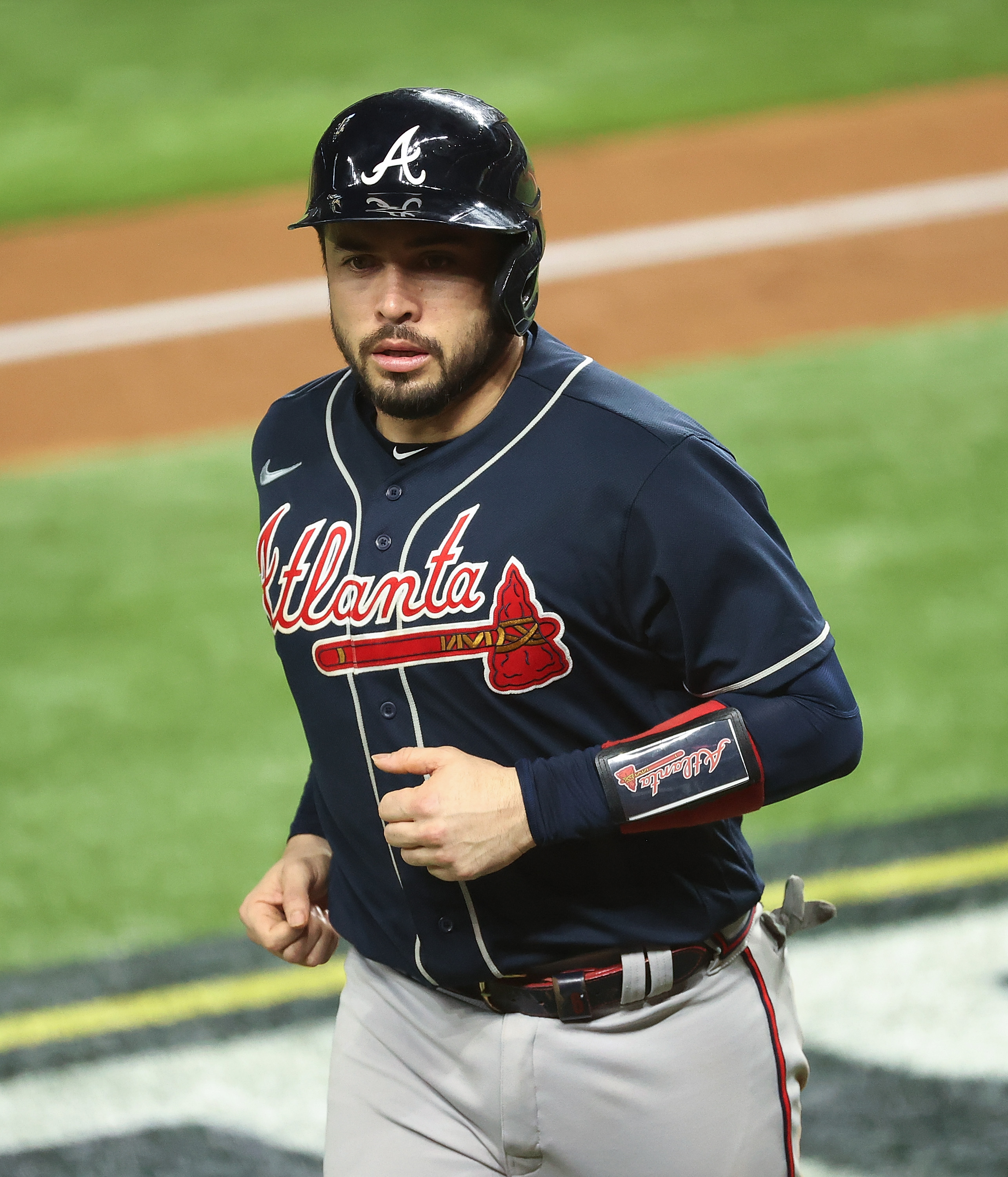
That $16MM guarantee matches the guarantee on the current two-year deal that d’Arnaud is playing out in Atlanta. He’d been slated to return to the free-agent market at season’s end, but the new contract now locks him in as the organization’s top catcher for at least another two seasons.
Selected by the Phillies with the No. 37 overall pick back in 2007, d’Arnaud quickly became a top prospect who was involved in a pair of trades involving Cy Young winners — the first sending Roy Halladay from Toronto to Philadelphia and the second sending R.A. Dickey from the Mets to the Blue Jays.
After debuting as a 24-year-old in 2013, d’Arnaud would go on to spend parts of seven seasons playing with the Mets. He showed the promise that made him one of the game’s most highly regarded minor leaguers at times, particularly in 2016 when he batted .268/.340/.485. However, d’Arnaud’s time with the Mets was marred by repeated injuries. In addition to undergoing Tommy John surgery in 2018, d’Arnaud also spent time on the injured list with a concussion, a broken finger, a strained rotator cuff and an elbow sprain (a separate one from the sprain that led to his Tommy John surgery).
Despite playing in parts of seven seasons as a Met, d’Arnaud only topped 100 games twice. The Mets released d’Arnaud in May 2019, and after signing with the Dodgers and making a lone plate appearance there, he was traded to the Rays in exchange for cash. Tampa Bay needed catching help with several backstops on the injured list, and what looked to be a short-term depth addition instead turned into a breakout showing that set the stage for d’Arnaud to eventually be paid $32MM from 2020-23.
With the Rays, d’Arnaud stepped up as the primary catcher and enjoyed one of his best and most productive seasons. He appeared in 92 games and tallied 365 plate appearances with Tampa Bay, batting .263/.323/.459 with 16 long balls. He parlayed that strong showing into what is now the first of a pair of two-year, $16MM deals in Atlanta.
D’Arnaud’s first season in Atlanta, while shortened due to the pandemic, was the most productive of his career. He played 44 of the Braves’ 60 games at catcher and turned in a huge .321/.386/.533 with nine homers and eight doubles in 184 plate appearances. He went on to bat .286/.380/.476 in 50 postseason plate appearances.
Things haven’t gone as well in 2021, though that’s again due to injury. After a lackluster start to the season, d’Arnaud went on the injured list in early May with a torn ligament in his thumb that required surgical repair. He returned just nine days ago and has gone 5-for-21 with a home run and four walks in that brief time. Overall, he’s batting .223/.277/.369 through 112 plate appearances this year.
The d’Arnaud extension solidifies the team’s catching spot for the next two seasons, though it also serves as something of a roadblock for 23-year-old William Contreras, who is tearing the cover off the ball in Triple-A this season. Contreras was originally promoted to the big league roster in the wake of d’Arnaud’s injury and got out to a strong start before fading badly. He batted just .204/.278/.387 in 158 Major League plate appearances this year but has posted a massive .313/.368/.583 slash (150 wRC+) with eight home runs in 125 plate appearances with Triple-A Gwinnett.
Extending d’Arnaud gives the Braves the luxury of breaking Contreras in as a backup or part-time option, but it’s certainly possible that he’ll find himself in a larger role over the next two seasons. He’d likely be the first option in the event of an injury to d’Arnaud, and he could simply hit his way into a larger share of the workload behind the plate. The National League could very well have the designated hitter in place next season, which would give the Braves the option of getting both into the lineup at times.
Behind Contreras, the Braves have 23-year-old Shea Langeliers rising through the system. The No. 9 overall pick in the 2019 draft, Langeliers is regarded as one of the top game’s top all-around prospects and is enjoying a strong season in Double-A, where he’s batted .267/.346/.524 (136 wRC+). Langeliers likely wouldn’t be an option until midway through the 2022 season or even into 23, so the d’Arnaud extension isn’t necessarily a sizable deterrent to his ascension through the ranks.
Of course, locking d’Arnaud up for the foreseeable future also frees the Braves to explore the possibility of including one of Contreras or Langeliers as part of an offseason trade package to address other areas of need. A relatively modest two-year for d’Arnaud certainly doesn’t make a trade of one of the promising young backstops a fait accompli, but it’s easier to part with some of that upside if the Braves feel confident that there’s a steady veteran in house.
By signing d’Arnaud now, the Braves sidestep the issue of searching for a catcher on the offseason market. A win-now club in their shoes wasn’t likely to just hand over the starting job to Contreras in 2022 without a contingency plan in place, and the market for catching help looks fairly light. Yan Gomes and d’Arnaud were likely to be the only two starting-caliber options in free agency, assuming the Cardinals do indeed finalize the Yadier Molina extension they’re reportedly discussing at the moment. Gomes might ultimately command a comparable price, though, and the Braves have already established a relationship with d’Arnaud. They clearly value both his on- and off-field contributions to the club, so it’s sensible to keep him around at a price point that won’t significantly impede their offseason dealings.
Even with d’Arnaud now on the books at $8MM next year, the Braves have just shy of $64MM on the books in 2022. They’ll owe arbitration raises to several key players (Dansby Swanson, Max Fried, Mike Soroka, Richard Rodriguez, Austin Riley) and still need to work out an extension for franchise cornerstone Freddie Freeman at some point. Even when factoring for a theoretical Freeman extension and arbitration raises, the Braves should still have more than $20MM — potentially quite a bit more, if a Freeman deal were to be backloaded — separating them from this year’s payroll level.