
Dodgers Place Andrew Heaney On Injured List, Recall Zach McKinstry
The Dodgers have announced that Andrew Heaney has been placed on the injured list with left shoulder discomfort. Utility player Zach McKinstry has been recalled to take his place on the roster. No timetable was given for Heaney’s return.
It’s a bit of a surprising move as Heaney had made two excellent starts on the season so far, with no signs of distress. Through 10 1/3 innings on the campaign, he’s racked up 16 strikeouts against three walks, without allowing an earned run. In his MLB time thus far, mostly with the Angels, Heaney has shown tantalizing potential with tremendous strikeout numbers but continually being hampered by the long ball. In the six seasons from 2016 to 2021, he had a strikeout rate of 24% or above in each of them. However, his lowest ERA in that time was 4.15. Despite those inconsistent results, the Dodgers took a chance on him, signing him to a one-year, $8.5MM deal for this season. The early results were clearly excellent, with Heaney adding a slider that has helped him have two great starts to begin his Dodgers tenure. However, he and the club will now have to wait at least ten days to continue the experiment.
The Dodgers have an off-day tomorrow and another one a week later on the 28th, which will help them weather Heaney’s absence. It’s possible that Tyler Anderson will make the jump from long relief into the rotation for the time being.
As for McKinstry, the 26-year-old (27 next week) has appeared in games for the Dodgers in each of the past two seasons. In 179 career plate appearances, he has a slash line of .218/.264/.406, while playing second base, third base and both corner outfield spots.
Tigers Place Matt Manning On Injured List, Recall Angel De Jesus
The Tigers announced this afternoon that right-hander Matt Manning has been placed on the injured list, retroactive to April 17th, with right shoulder inflammation. Fellow right-hander Angel De Jesus was recalled in a corresponding move.
Manning had been pulled from his most recent start with discomfort in this throwing shoulder. A few days later, manager AJ Hinch provided an encouraging update, saying that the news from further testing was “as positive as it could be” and that there was no structural damage. Despite that good news, the club is going to let Manning sit for a few days and rest his arm.
The club had an off-day on the 18th and has another coming up on the 25th, meaning that it’s possible Manning will only miss one start. After two starts this year, he has a 2.25 ERA in eight innings. He only has four strikeouts in that time but hasn’t allowed a single walk yet. The 24-year-old is looking to build off of a rookie campaign last year where he threw 85 1/3 innings of 5.80 ERA ball.
As for De Jesus, he was selected to the 40-man roster in November to protect him from the Rule 5 draft, which was later canceled after the lockout. As soon as he gets into a game, he will be making his MLB debut. The 25-year-old has already thrown four innings in Triple-A this year, allowing three earned runs, with five strikeouts against no walks.
Reds To Place Tyler Stephenson On Concussion List
1:25pm: The Reds have announced the move, with Kolozsvary being recalled to take Stephenson’s placed on the roster.
8:35am: The Reds will place catcher Tyler Stephenson on the 7-day concussion injured list this morning, tweets Bobby Nightengale of the Cincinnati Enquirer. Stephenson suffered a concussion in a collision play at the plate with Padres first baseman/designated hitter Luke Voit last night (video link via MLB.com)
The play itself has become a source of some controversy in the aftermath, with Reds fans and several Reds players feeling there was ill intent behind Voit’s slide. Padres fans, players and manager Bob Melvin, naturally, have opined that Voit didn’t have much of an alternative.
“The ball takes him right into Luke,” Melvin told reporters after the game (video link via Bally Sports San Diego). “There’s nowhere to go, and I think Luke was just trying to protect himself, putting his hands up. I think they got it right.” Voit, of course, insists that he “wasn’t trying to take [Stephenson] out or anything” and added that he hopes Stephenson will be all right.
Reds skipper David Bell said after the game that he “didn’t have a problem with the slide” but called it a “scary” and “helpless” feeling when a manager sees one of his players laid out and injured in that manner (link via Mark Sheldon of MLB.com).
Reds left fielder Tommy Pham, meanwhile, told reporters that the slide was “dirty as [expletive].” Reds shortstop Kyle Farmer, a former catcher, said after the game that he’s “not too happy about the slide,” adding that it’s “not too often you a runner slide and grab someone’s head … you’re usually trying to reach for the bag, and maybe that’s what he was trying to do, but after looking at the replay, it looked like a wrestling move to Tyler’s head and snapped it down” (video link via Bally Sports Cincinnati). “I’ve never really seen someone’s hands go to a catcher’s head on a slide,” Farmer continued.
Regardless of where your thoughts land on the slide by Voit, the relay throw, and the postgame comments from both teams, the end result is the same. Stephenson will be away from the Reds for at least a week. The hope is that he’ll quickly clear concussion protocol and be able to return in short order, though concussions of course are tricky injuries that often have lingering effects.
The 25-year-old Stephenson, selected with the No. 11 overall draft pick back in 2015, has gone from top prospect to Cincinnati’s clear everyday catcher. His performance in 2020-21 was strong enough that the Reds had zero hesitation in trading stalwart catcher Tucker Barnhart to the Tigers early in the 2021-22 offseason, and Stephenson has picked up right where he left off at the plate. In 37 plate appearances this year, he’s batted .267/.378/.467 with a pair of homers, raising his career batting line to a stout .285/.368/.443 with 14 home runs in 459 plate appearances. That’s well above-average production for any player (116 wRC+), but it’s among the best in the league, on a rate basis, among catchers.
Defensively, Stephenson has been sound. He’s 4-for-9 in throwing out base thieves this season (44%), bringing his career rate to 25% (just a percentage point below league average). He’s drawn above-average framing marks from each of Baseball Prospectus and FanGraphs, with Prospectus adding that he’s been about average in terms of blocking pitches in the dirt.
With Stephenson sidelined for the time being, the Reds seem likely to turn to Aramis Garcia as their top option behind the dish. Who will back him up remains an open question. Double-A catcher Mark Kolozsvary, a member of last year’s Team USA Olympic club, is on the 40-man roster but has gotten out to a slow start in Chattanooga. The Reds recently signed veteran Sandy Leon to a minor league contract as well, and if the team’s preference is for Kolozsvary to continue getting everyday at-bats rather than playing sparingly on the big league bench, it could be that Leon is quickly called to the MLB roster.
Whatever route the team takes, Stephenson’s loss is a huge blow to a team that has struggled immensely to score runs in 2022. Cincinnati ranks 25th in the Majors in runs scored, and they have more combined plate appearances than all five of the teams behind them (some of whom have had multiple postponements on the year). From a rate standpoint, the Reds’ offense has been far and away the worst in the league. Reds batters have combined for a gruesome .178/.250/.286 batting line, and the resulting 52 wRC+ is a full nine points lower than the second-worst club (Arizona). Stephenson has been one of the team’s only productive hitters, but he’ll now likely be replaced in the lineup by Garcia, a career .218/.255/.371 hitter in 214 Major League plate appearances.
Tigers Outright Bryan Garcia
Tigers right-hander Bryan Garcia went unclaimed on waivers and has been assigned to Triple-A Toledo, per a team announcement. He’ll remain with the organization but will no longer occupy a place on the 40-man roster.
Garcia will be sticking with the only organization he’s ever known, as the 27-year-old was drafted by Detroit back in 2016. He showed enough potential as he climbed up the minor league ranks to be deemed one of the club’s best prospects. Baseball America ranked Garcia between #16 and #22 in Detroit’s system for four straight years, from 2017 to 2020.
After getting a cup of coffee in 2019, he seemed to be delivering on his promise in 2020. During that shortened season, he threw 21 2/3 innings out of the Tigers’ bullpen with a 1.66 ERA. That was a largely unsustainable ERA, however, as evidenced by his 12.9% strikeout rate and 10.8% walk rate. In 2021, the wheel of fortune spun him around the other way, as his strikeout rate ticked up to 16.7%, but his walk rate climbed to 13% and his ERA jumped to 7.55.
Garcia will now try to work his way back into the team’s plans with a good showing in Triple-A. He’s off to a good start, having thrown 3 2/3 scoreless innings so far this year, but with a troublesome 20% walk rate in that small sample. If he can get his roster spot back, he still has two option years and a service time count of 1.148, meaning he’d still need over a year of time in the big leagues to earn a raise through arbitration.
Giants Place Alex Cobb On Injured List
Between the two games of last night’s doubleheader, the Giants made a roster move, announcing that right-hander Alex Cobb had been placed on the 10-day IL with a right adductor strain. Fellow righty Yunior Marte was recalled to take his place on the roster.
Cobb had started the opening match of the doubleheader, but was pulled after throwing 60 pitches over 4 1/3 innings, escorted by the club’s trainer. Cobb himself didn’t seem especially worried about the injury, as relayed by Andrew Baggarly of The Athletic and Alex Pavlovic of NBC Sports Bay Area. That suggests that Cobb could stay on the IL for the 10-day minimum or something close to it. Signed to a two-year, $20MM deal (plus a club option) just before the lockout, the 34-year-old has made two starts on the season thus far, logging 9 1/3 innings with a 4.82 ERA, 35% strikeout rate and 5% walk rate.
Even if he isn’t out for long, the timing of the injury is a bit awkward for the club. They are in the middle of a stretch where they play 14 games in 13 days, thanks to yesterday’s twin bill. They don’t have an off day until next Thursday, April 28th. Logan Webb started the second game yesterday and is lined up to throw on regular rest on the 24th. The next three days will see Carlos Rodon, Anthony DeSclafani and Alex Wood take the hill, with a starter needed to pitch on the 23rd and likely one more start beyond that.
As for Marte, the 27-year-old made his MLB debut earlier this year and now has two scoreless innings on his big league résumé.
Guardians Announce Several Roster Moves
11:20am: Mandy Bell of MLB.com relays word from manager Terry Francona, who confirms that Quantrill, Miller and Castro are on the Covid-IL. Zack Meisel of The Athletic provides a quote from Francona, who says “I don’t know that we’re out of the woods yet. I hope we are, but I don’t know that that’s going to be the case. We’ll see.”
10:45am: The Guardians announced a series of transactions prior to today’s doubleheader against the White Sox, placing right-hander Cal Quantrill, infielder Owen Miller and righty Anthony Castro on the injured list. No designation was provided, likely indicating that all three are being placed on the Covid-related IL. In their place, Cleveland has selected the contracts of right-hander Enyel De Los Santos and lefties Kirk McCarty and Tanner Tully. Additionally, top shortstop prospect Gabriel Arias is up as the 29th man for today’s twin bill — as first reported last night by Andrea Alejandra Gil of Brujula Deportiva 106.3 FM in Maracay, Venezuela (Twitter link).
It’s not clear whether any of the players placed on the injured list today tested positive or have been deemed close contacts and thus require testing that leaves them unavailable for today’s games. The 2022 health and safety protocols jointly agreed upon by MLB and the MLBPA technically call for a 10-day absence for players who test positive, but players are able to return more quickly than that — provided they receive a pair of negative PCR tests, show no signs of fever and are then subsequently approved by a team medical staffer and a joint committee of one MLB-appointed and one MLBPA-appointed medical expert. Mets outfielder Brandon Nimmo, for instance, returned to the team in less than half that 10-day window.
Of the players added to the big league roster today, only De Los Santos has prior MLB experience. A well-regarded prospect during his time with the Padres and the Phillies, De Los Santos debuted with Philadelphia in 2018 but has yet to carry his strong Triple-A production over to the big league level. He’s seen action in parts of three MLB seasons but carries a 6.06 ERA in 65 1/3 innings. De Los Santos has fanned 24% of his opponents against a 10% walk rate, but he’s also yielded an average of 1.9 homers per nine frames — far too many to succeed over any lengthy sample. He’s fared vastly better in Triple-A, where he sports a career 3.37 ERA in 237 2/3 innings and just 1.1 HR/9.
The 27-year-old Tully, meanwhile, was a 26th-rounder back in 2015 who posted a 3.50 ERA in 113 innings between Double-A and Triple-A last year. He’s never posted particularly high strikeout or ground-ball rates, but Tully has walked only 4.5% of the hitters he’s faced in his pro career.
McCarty, 26, was Cleveland’s seventh-rounder back in 2017 and has gotten out to a fast start in Triple-A Columbus, holding opponents to one run on seven hits and five walks with a dozen punchouts through 11 1/3 innings. He was knocked around for a 5.01 ERA in 124 Triple-A frames a year ago.
As for Arias, the 22-year-old infielder is regarded as a potential key piece down the line for the Guardians. Acquired from the Padres (alongside Miller and Quantrill) in the trade that sent Mike Clevinger to San Diego, Arias entered the season ranked among the game’s top 100 prospects at Baseball America (No. 100), MLB.com (No. 73), Baseball Prospectus (No. 57), FanGraphs (No. 95) and ESPN (No. 73).
Arias hit .284/.348/.454 with 13 home runs, 29 doubles, three triples and five steals in 483 trips to the plate last season, and he’s out to a near-identical start in 2022, hitting .278/.350/.472 in 40 plate appearances. He’s starting at second base in Game 1 of today’s doubleheader.
In all likelihood, it’ll be a one-day look for the highly touted Arias, but he’ll give Cleveland fans a brief glimpse of the future. The fact that he’s both on the 40-man roster and being considered for roles like this speak to his general proximity to MLB readiness, and it wouldn’t be a surprise at all if he were to get a lengthier audition at some point in 2022. Amed Rosario and Andres Gimenez are getting a good portion of the middle-infield time early in the season, but Rosario has at least some outfield experience and, of course, injuries are inevitable over the course of a 162-game schedule. Arias is one of many high-end middle infield prospects in the upper levels of the Cleveland system; Brayan Rocchio, Tyler Freeman and Jose Tena, among others, have all received a good bit of fanfare.
Rockies Sign Kyle Freeland To Extension
The Rockies have hammered out another extension, announcing agreement with Kyle Freeland on a five-year contract. The deal reportedly guarantees the MSM Sports Management client $64.5MM and comes with a vesting player option for the 2027 campaign. If Freeland tosses 170 innings in 2026, he’ll trigger a $17MM player option for a sixth season.
Freeland had been controllable via arbitration through 2023, so the deal buys out at least three free agent seasons. The southpaw will earn $7MM this year, $10.5MM in 2023, $15MM in 2024, then $16MM in both 2025 and ’26. Were Freeland to finish in the top five in Cy Young award balloting in either of the next two years, he’d earn the right to opt out after the 2024 campaign.
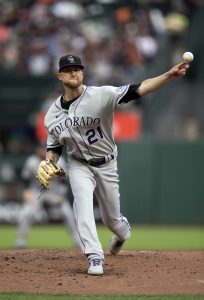
The deal evidently came together quickly, as Freeland told Nick Groke of the Athletic just last week there’d been “no movement” on an extension and that the club hadn’t put forth an offer. Within a few days, he and the team agreed to a long-term deal that figures to keep him around for at least an additional three seasons. It’s a particularly nice development for Freeland, a Denver native and career-long member of the organization.
Colorado selected Freeland with the eighth overall pick of the 2014 draft out of the University of Evansville. He was regarded at the time as a possible mid-rotation starter who could move through the minors quickly based on his polished strike-throwing ability. That projection more or less proved to be the case, as he was in the majors two and a half years later after performing well in the minors.
Freeland stepped immediately into the Colorado rotation, starting 28 of his 33 appearances as a rookie. He posted a 4.10 ERA in 156 innings that season, overcoming a mediocre 15.6% strikeout rate with an excellent 53.9% ground-ball percentage. The southpaw followed that up with a stellar sophomore campaign that has been the best season of his career to date. He made 33 starts and tossed 202 1/3 innings in 2017, posting a 2.85 ERA despite starting 15 games at the most hitter-friendly ballpark in the league. That mark still stands as the lowest single-season ERA for a qualified starter in Rockies’ history, offering plenty of evidence that Freeland could thrive despite the environmental challenges inherent for a Colorado pitcher.
Four years later, the Rox are presumably still placing a lot of emphasis on that showing. Freeland struggled mightily in 2019, allowing a 6.73 ERA. Colorado even optioned him to Triple-A Albuquerque for a month and a half that year. Over the past two seasons, he’s been solid but unspectacular, posting a matching 4.33 ERA in both 2020 and 2021.
Freeland’s general profile — few strikeouts or whiffs offset by plenty of grounders and plus control — hasn’t much changed throughout his time in the majors. Yet since his excellent 2018 showing, he owns a 5.32 ERA in 304 2/3 innings (including two starts thus far in 2022). Colorado surely considers the 2019 season an outlier, but even going back to the start of 2020, Freeland’s 200 1/3 innings of 4.58 ERA/4.65 FIP ball are more fine than exceptional.
The Rockies clearly believe the 28-year-old (29 next month) is capable of a return to something more closely approximating his early-career form. It’s the continuation of a pattern for general manager Bill Schmidt and his staff, who have worked diligently to keep many of the team’s veterans around for the long haul. Within the past eight months, Colorado has worked out multi-year extensions with Antonio Senzatela, Elias Díaz, C.J. Cron, Ryan McMahon and now Freeland. Those players join marquee free agent pickup Kris Bryant and staff ace Germán Márquez as the long-term core in Denver.
Márquez, Senzatela and Freeland are each under club control through at least 2024, leading a rotation the Rox envision as the backbone of the club. Senzatela’s October extension — a five-year, $50.5MM guarantee that contains a 2027 club option — is the most recent deal for a starter with between four and five years of service time. Freeland’s contract tops that of his teammate even though he’s nearly two years older and has been less effective over the past couple seasons. Freeland and Senzatela are similar pitchers stylistically, but the former has been a bit more home run prone and had an ERA about two tenths of a run higher (4.33 for Freeland, 4.11 for Senzatela) between 2020-21.
That’s not to say Senzatela fared poorly. His deal was generally regarded as a player-friendly pact at the time it was signed. Setting aside Jacob deGrom, the previous pitcher to sign an extension in that bucket was Cubs righty Kyle Hendricks. He signed a four-year, $55.5MM pact in March 2019. Like Freeland, Hendricks was headed into his age-29 season and thrived on his control and ground-ball propensity. The Cubs’ starter had posted five straight sub-4.00 ERA campaigns to open his big league career, though, making him a safer long-term bet than either of Colorado’s pitchers.
The Hendricks comparison makes the Rockies’ decision to commit $64.5MM to Freeland puzzling, although it’s not especially surprising. Colorado brass has shown repeatedly they value their own players more than many outside the organization might. While it has been some time since Freeland’s excellent first two seasons, he has shown himself capable of thriving despite the unique challenges the Rockies face at Coors Field. That’s no doubt of appeal to team brass, and the extension comes with the ancillary benefit of avoiding the hassle of an arbitration hearing.
Prior to today’s agreement, the team and player were set for a hearing next month to determine his 2022 salary. Freeland had filed at $7.8MM; the Rockies had countered at $6.425MM. They’ll settle a bit shy of the midpoint for this season and price in a raise for what would’ve been his final year of arbitration-eligibility before paying $15-16MM annually for what would’ve been his three free agent seasons.
The Rockies’ 2022 payroll isn’t much affected by today’s extension, but they’ll add another notable salary to the books for next season and beyond. Colorado’s 2023 player tab now checks in around $110MM, per Jason Martinez of Roster Resource, while Freeland ($15MM), Bryant ($28MM), McMahon ($12MM) and Senzatela ($12MM) all have notable 2024 salaries. Márquez has a $16MM club option that year. The Rockies have never eclipsed $150MM in Opening Day payroll, but they might be headed towards that mark in the next couple seasons. They’ll hope to build around the core in which they’ve invested in an ever-competitive NL West.
Jeff Passan of ESPN first reported the Rockies and Freeland had agreed to a five-year, $64.5MM deal, as well as the sixth-year option. Jon Heyman of the New York Post reported it was a $17MM vesting option, which Danielle Allentuck of the Colorado Springs Gazette reported Freeland needs 170 innings pitched in 2026 to trigger. Ken Rosenthal of the Athletic reported Freeland could opt out after 2024 with a top-five Cy Young finish in either of the next two seasons. Thomas Harding of MLB.com was first with the full breakdown of terms.
Image courtesy of USA Today Sports.
Trade Rumors Front Office Survey
As you probably know, in July 2020 we launched a paid subscription serviced called Trade Rumors Front Office. Today, I’m looking to gather some information and opinions from both subscribers and non-subscribers. If you can spare a few minutes, please take the survey below. Click here for a direct link to the survey. Thanks!
Braves Outright Chadwick Tromp
The Braves announced this afternoon that catcher Chadwick Tromp has cleared waivers and been sent outright to Triple-A Gwinnett. Atlanta had designated him for assignment last week.
Atlanta claimed Tromp off waivers from the Giants last September. He spent the offseason on the 40-man roster but lost his spot when the Braves brought up Bryce Elder for his major league debut. Tromp has appeared in nine games with Gwinnett over the past two years but hasn’t suited up at the MLB level with the Braves. The righty-hitting backstop did appear in 33 games with the Giants between 2020-21, picking up 82 plate appearances. He has managed just a .215/.220/.418 line in that limited time, but the Aruba native is a .253/.314/.412 hitter in parts of five Triple-A seasons.
The 27-year-old Tromp doesn’t have the requisite service time to refuse an outright assignment, so he’ll remain in the upper levels of the system. He no longer occupies a spot on the 40-man roster but will try to play his way back into that mix. Travis d’Arnaud, Manny Piña and William Contreras are the remaining backstops on the Atlanta 40-man.
Offseason In Review: Milwaukee Brewers
The Brewers went into the offseason with a strong team, but on the pitching heavy side. They spent their offseason trying to add more pop to the lineup without spending much money.
Major League Signings
- Andrew McCutchen, OF: one year, $8.5MM
- Brad Boxberger, RP: one year, $2.5MM (deal also contains 2023 club option)
- Pedro Severino, C: one year, $1.9MM
- Trevor Gott, RP: split deal
- Brett Sullivan, C/OF: one year deal; later traded to Padres
2022 spending: $12.9MM
Total spending: $12.9MM
Options Exercised
- OF Jackie Bradley Jr. exercised $9.5MM player option; later traded to Red Sox
- OF Avisail Garcia declined his end of $12MM mutual option in favor of $2MM buyout
Trades and Claims
- Acquired IF/OF Mike Brosseau from Rays for RP Evan Reifert
- Acquired SP/RP J.C. Mejia from Guardians for C David Fry (originally announced as PTBNL or cash)
- Acquired OF Hunter Renfroe from Red Sox for OF Jackie Bradley Jr., IF David Hamilton and IF Alex Binelas
- Acquired C Victor Caratini and cash considerations from Padres for C/OF Brett Sullivan and OF Korry Howell
- Acquired C Alex Jackson from Marlins for IF Hayden Cantrelle and SP Alexis Ramirez
- Traded IF/OF Jamie Westbrook to Tigers for cash.
- Traded OF Dustin Peterson to Phillies for cash.
Notable Minor League Signings
- Jason Alexander, Trevor Kelley, Jonathan Davis, Rex Brothers, Abraham Almonte, David Dahl, Jonathan Singleton, Tyler White, Moises Gomez, Garrett Whitley, Jakson Reetz, Jose Urena (later selected to 40-man roster)
Extensions
- None
Notable Losses
- Avisail Garcia, Eduardo Escobar, Manny Pina, Jackie Bradley Jr., Brett Anderson, Hunter Strickland, Luke Maile, Daniel Vogelbach, Daniel Norris, Daniel Robertson, Colin Rea, John Axford
The Brewers had an excellent regular season in 2021, going 95-67, winning the NL Central and making the postseason for a fourth straight year. However, they did it in a very slanted way, dominating on the hill but not hitting much. The pitching staff had an ERA of 3.50, third best in the majors, trailing only the Dodgers and Giants. The rotation had a dominant front three of Corbin Burnes, Brandon Woodruff and Freddy Peralta, along with solid contributions at the back end from Eric Lauer, Adrian Houser and Brett Anderson. The bullpen featured excellent hurlers like Josh Hader, Devin Williams and Brad Boxberger.
However, the offense wasn’t nearly as impressive. The team’s overall batting line was .233/.317/.396, producing a wRC+ of 91, or 9% below average, 23rd out of the 30 teams. This uneven attack was on display in the playoffs, when the Brewers faced off against the Braves. Milwaukee eked out the first game with a 2-1 victory, thanks to six shutout innings from Corbin Burnes. But they lost the next three games by scores of 3-0, 3-0 and 5-4. It’s tough for a dominant pitching staff to carry a team with six runs of support over four games. With Avisail Garcia, Eduardo Escobar, and Manny Pina heading into free agency at season’s end, there would be work to do in the offseason just to break even.
Of course, there wasn’t going to be a mountain of money to work with, as the Brewers have never been a high payroll team. Up until a few years ago, their highest Opening Day payroll was $104MM. They shot up to $123MM in 2019 but then back down to $99MM for 2021. (Figures from Cot’s Baseball Contracts.) The club’s president of baseball operations David Stearns has still managed to field competitive teams despite these limitations, which is why he’s attracted the attention of rival teams.
Early in the offseason, Stearns seemed to be a popular target of the Mets, as they looked to hire a new general manager or president. It was thought that there would be a chance the Brewers would let Stearns, a New York native, pursue the opportunity due to the fact that 2022 is the last year of his current contract. However, reports emerged in October that Stearns may have a vesting option for 2023. Whether that was a factor or not, the Brewers denied the Mets permission to interview Stearns for the job that eventually went to Billy Eppler. Further clarity on the contract situation came in February, when it was reported that Stearns is actually under control through 2023 but can opt out after this year if the Brewers win the National League pennant.
As the offseason began and business kicked off, the Brewers signed Trevor Gott to a split deal to bolster their relief corps. Jackie Bradley Jr. exercised his player option. Avisail Garcia declined his $12MM mutual option, taking the $2MM buyout and hitting free agency. The Brewers had a chance to issue a qualifying offer to Garcia but ultimately decided against it. He would later sign with the Marlins on a four-year, $53MM contract, with the Brewers getting nothing in return.
In mid-November, the Brewers swung a trade, acquiring Mike Brosseau from the Rays in exchange for minor-league pitcher Evan Reifert. The utilityman had shown some potential in his first couple of seasons, hitting .284/.343/.500 over 240 plate appearances in 2019-20 while playing all over the diamond. He slid from that level in 2021, ending up with a line of .187/.266/.347, 73 wRC+. Still, the prospect cost was minimal and Brosseau hasn’t yet reached arbitration. If he can bounce back to anywhere near his earlier production, he could be a bargain. With a projected infield of Willy Adames, Luis Urias (who wound opening the season in the injured list), Kolten Wong and Rowdy Tellez, along with a projected outfield of Christian Yelich, Lorenzo Cain, Jackie Bradley Jr. and Tyrone Taylor, Brosseau would slot into the bench/utility mix with Jace Peterson.
After Manny Pina signed with the Braves, the Brew Crew needed to find a new catcher to pair with Omar Narvaez. They settled on Pedro Severino but he was suspended for 80 games after testing positive for the performance-enhancing substance Clomiphene. With just days until Opening Day, the club quickly pivoted and acquired both Victor Caratini and Alex Jackson to improve the depth behind the plate. Caratini showed some potential with the bat when he popped 11 homers in 2019 but fell off in the following two campaigns. With a $2MM arbitration salary and an additional year of team control, he’s another low-cost flier for the club.
Just before the lockout was set to kick in, the Brewers traded Bradley and a couple of prospects to the Red Sox for Hunter Renfroe. This served Milwaukee’s needs in a couple of ways. First, Bradley is making $9.5MM in 2022 and had a dismal season at the plate the year before. In 2021, he hit .163/.236/.261, with his 35 wRC+ being easily the worst in baseball among hitters with at least 400 plate appearances. (Kevin Newman‘s 54 was next on the list). Renfroe was arbitration-eligible and eventually settled with the Brewers at $7.65MM, meaning he’ll be cheaper than Bradley and more productive with the bat. He hit .259/.315/.501 for the Red Sox last year, putting up a wRC+ of 114.
After the lockout, the club’s first move was to re-sign Brad Boxberger, returning him to a high-leverage role in the bullpen with Hader and Williams. The righty threw 64 2/3 innings in 2021, with a 3.34 ERA and 31.2% strikeout rate. Milwaukee also added veteran righty Jose Urena on a minor league deal and selected him to the big league club the next day. Urena, who can’t be optioned to the minor leagues, is on hand as a multi-inning relief option.
They then made their biggest signing of the offseason, adding 35-year-old Andrew McCutchen on a one-year, $8.5MM deal. McCutchen’s days of elite outfield defense are behind him, but he can still hit. Over the past two seasons, his slash line is .232/.331/.441, 106 wRC+. But he was especially effective against lefties, with a line of .290/.402/.603 in 2020-21, producing a wRC+ of 164.
While McCutchen is still a fine player, there were plenty of younger and more productive outfield options available in free agency this winter. Kris Bryant, Nick Castellanos, Kyle Schwarber, Starling Marte, Seiya Suzuki, Jorge Soler, Mark Canha, Michael Conforto (still unsigned), Eddie Rosario and others were all available. In the end, the Brewers avoided any big or lengthy commitments, settling on an Opening Day payroll of $132MM, a new franchise record but still in the bottom half of the league.
Milwaukee didn’t need to do much on the pitching side of things. Burnes, Woodruff, Peralta, Lauer and Houser all remained under club control. Top prospect Aaron Ashby is ready to replace Anderson — who hit free agency — as the top depth option for the starting staff. Milwaukee brought Boxberger back and never seemed to seriously consider dealing Hader even as his arbitration price continued to rise. The Brew Crew’s elite arms are back.
On the other side of the ball, Garcia, Escobar, Pina, Daniel Vogelbach (whom the club non-tendered) and Jackie Bradley Jr. have been replaced by Renfroe, McCutchen, Brosseau and Caratini. Whether those moves have improved the offense enough can be debated. What would certainly help is if some of the holdovers could have better results. Christian Yelich was mediocre in the past two seasons, when compared to his 2018-19 peak. Lorenzo Cain had three mostly lost years from 2019-21. Keston Hiura has failed to deliver since his exciting 2019 debut. The Brewers enter 2022 as a pitching-oriented team, but their chances of making a deep playoff run would be greatly enhanced if they can coax returns to form from some of those players.