
The 14 Likeliest Trade Candidates After The Lockout
We saw robust free agent activity prior to the December 1st lockout, with 30 of our top 50 free agents signing contracts. Over $2 billion was committed to 62 players on Major League contracts, by our count.
With all the focus on free agency, the trade market was relatively quiet. Position players Tucker Barnhart, Adam Frazier, Jacob Stallings, Joey Wendle, Jorge Alfaro, Hunter Renfroe, and Jackie Bradley Jr. were the biggest names on the move.
Though the lockout does not appear close to an end, we can assume it will conclude at some point. Once that happens, a scramble roughly four-to-six weeks in length seems likely to commence, in which both Spring Training and all remaining offseason transactions will take place. Aside from the expected free agent frenzy for the top remaining names, the trade market figures to kick heavily into gear.
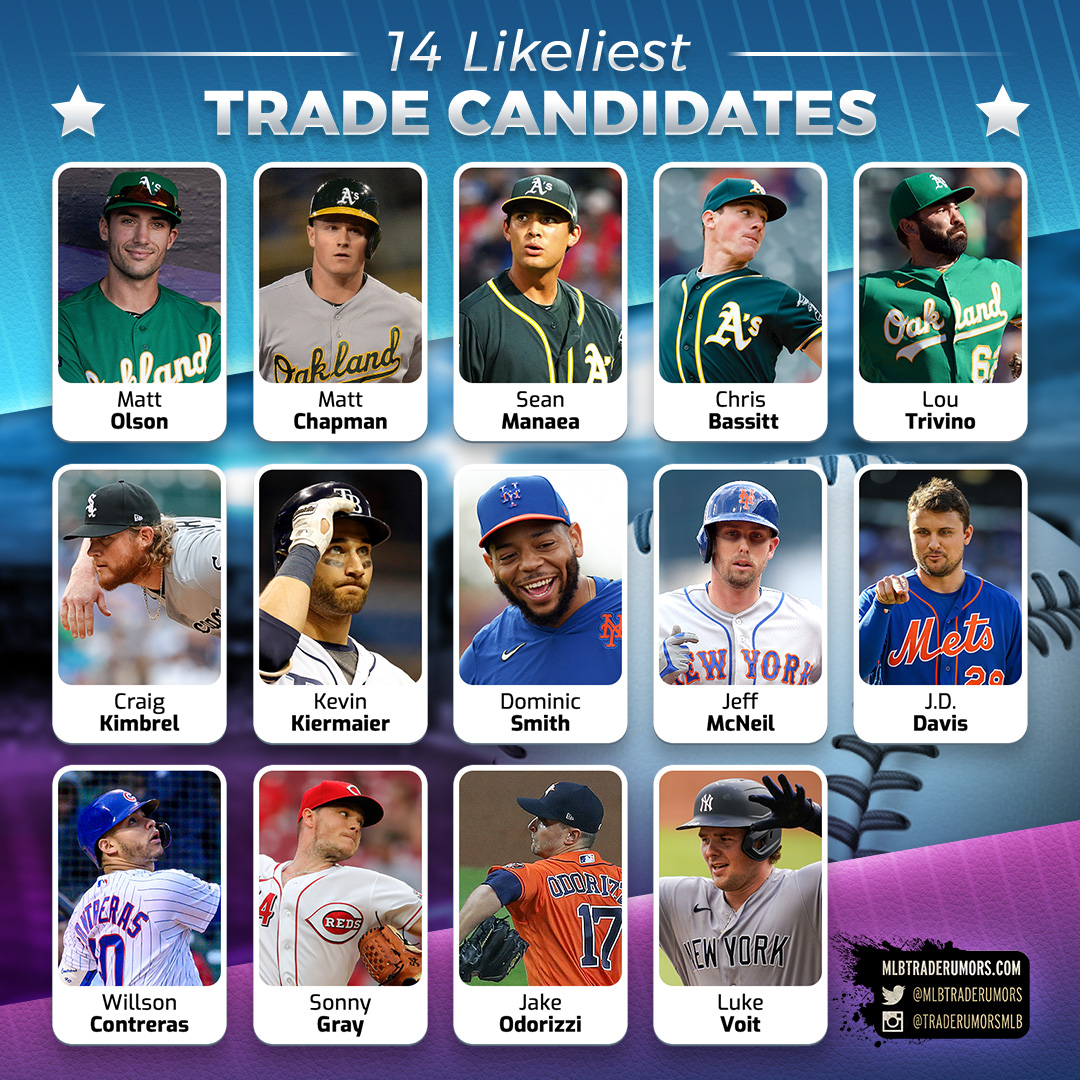
Recently, I got together with Steve Adams and Anthony Franco to assess the potential trade market. We wound up putting trade candidates into several buckets. The first bucket, covered in this post, is simply players we feel are likely to be traded, whether stars or regulars. One caveat: many of these trade candidates are interconnected. For example, the A’s are almost certain to trade at least one of Sean Manaea, Chris Bassitt, and Frankie Montas, but we don’t expect them to trade all three. Without further ado, we present MLBTR’s 14 Likeliest Trade Candidates:
1. Matt Olson / 1B / Athletics
The A’s are widely expected to hold a fire sale as a means of reducing their payroll. Olson, who we project to earn $12MM in 2022 through arbitration, seems highly likely to be dealt. Olson is controlled for two more years through arbitration. He provides huge power from the left side and is set to turn 28 in March. Olson’s 39 home runs were tied for fifth in the AL last year, as was his 146 wRC+. Olson is not only known for his bat; his defense at first base ranked second in the game in the 2021 Fielding Bible Awards. It’s simply quite rare to find a 5-WAR player with two years of control like Olson available on the trade market; the last decent offseason comparable we can find is when the Marlins traded J.T. Realmuto to the Phillies three years ago.
There aren’t too many teams that couldn’t find a spot for Olson. He’s probably the one reasonable replacement for Freddie Freeman that Braves fans might find palatable. The Yankees, Dodgers, Rays, Rockies, Marlins, Brewers, Phillies, Padres, and Giants are other speculative fits, especially if the DH comes to the NL as expected. The Realmuto trade was led by Sixto Sanchez, considered a 65-grade prospect by Baseball America at the time of the deal. Teams these days are extremely reluctant to part with prospects of that caliber, who generally fall within the top 30 in the game. The A’s are in the driver’s seat as they look for the best overall offer.
2. Matt Chapman / 3B / Athletics
The Matts have been teaming up at the infield corners for the A’s since 2018. It’s quite possible both could be traded once the lockout ends. Chapman has consistently been an above average hitter in every year of his MLB career, though in 2021 he was only a tick above average with a 101 wRC+. In the three seasons prior, Chapman posted a 130 mark, hitting a career-best 36 home runs in 2019. Combine that level of offense with Chapman’s Gold Glove defense at the hot corner, and he was an MVP candidate in 2018-19. He’ll turn 29 in April.
Chapman’s stellar defense – ranked second in the game at third base in the ’21 Fielding Bible Awards – gives him a high floor even if his bat slips like it did in 2021. Chapman is so good defensively at third base that ESPN’s Buster Olney has reported that the Yankees talked internally about the possibility of acquiring him to play shortstop, which he has done for all of ten innings in the Majors. The result is a player who is worth more than 3 WAR with an average bat, and 6+ when he’s mashing. A new team would look to solve Chapman’s recent slide in contact and line drives at the plate, but the A’s aren’t selling Chapman quite at his peak.
Like Olson, Chapman is an arbitration eligible player with two more years of control remaining. We project him to earn $9.5MM in 2022. The Mariners, Blue Jays, Phillies, Yankees, Rays, Rockies, and Dodgers could be possible landing spots.
3. Sean Manaea / SP / Athletics
The A’s also have multiple strong trade candidates in their starting rotation. We’ll start with Manaea, who has only one year of control remaining and is projected to earn $10.2MM through arbitration. Manaea, a southpaw who recently celebrated his 30th birthday, made 32 starts in 2021 with a 3.91 ERA. While Manaea has a mid-rotation profile, he did show career-best velocity and his best swinging strike rate in ’21, with his customary excellent control.
After a July 28th gem in San Diego, Manaea had his ERA down at 3.01. He then posted a brutal 9.90 ERA in August before returning to form in September. Manaea’s Statcast indicators are not particularly impressive, whether you’re looking at exit velocity or spin rate.
Aside from Carlos Rodon and Clayton Kershaw, Manaea is still better than just about every starting pitcher still available in free agency. He’d benefit many teams’ rotations, including the Tigers, Angels, Twins, Orioles, Yankees, Mariners, Rangers, Braves, Cubs, Rockies, Dodgers, Mets, Giants, and Nationals.
4. Chris Bassitt / SP / Athletics
Bassitt, projected to earn $8.8MM in 2022, is yet another A’s trade candidate. It’s unclear whether the A’s would deal multiple starting pitchers, but again, we wouldn’t rule it out. Manaea and Bassitt make particular sense because both are headed for free agency after the ’22 season.
Bassitt, a righty, is approaching his 33rd birthday. Since 2020, he sports a 2.90 ERA in 220 1/3 innings – seventh in all of baseball for those with at least 200 innings in that time. In 2021, Bassitt’s 18.8 K-BB% was a career best. Unlike Manaea, Bassitt also boasts above average Statcast indicators, especially an 88th percentile hard-hit percentage. Whether that’s enough for Bassitt to continue outpitching his SIERA as he has is unknown, but you can’t argue with the results so far.
Bassitt suffered a scary injury in August when a Brian Goodwin line drive struck his face, but fortunately he was able to return for a pair of outings in September. He should command a higher price on the trade market than Manaea, although the two pitchers are not that far apart in projections for 2022.
Wondering about Frankie Montas? He’s a trade candidate as well, but we’ve put him into more of a “plausible” bucket than “likely,” and he’ll be covered in an upcoming post by Steve Adams.
5. Lou Trivino / RP / Athletics
Trivino makes it a quintet of A’s to lead off this post. The 30-year-old righty is a decent reliever projected to earn $2.9MM in 2022. He still has three years of control remaining and he’s not making a lot of money yet, but there’s also not a compelling reason for the A’s to hang on to him this offseason.
Trivino posted a 3.18 ERA in 2021, along with a 95.8 mile per hour average fastball velocity and 85th percentile hard-hit rate. Still, his K-BB% was only 10.6. After picking up his 21st save against the Giants on August 20th, Trivino’s ERA stood at 1.72. Then he went through a rough five-outing patch in which he allowed 13 earned runs in only 3 2/3 innings. After that, Trivino recovered and pitched well in his final 11 outings.
Trivino doesn’t have great control, and he hasn’t always been a strikeout artist either. So it’s not an amazing profile, but he’s had success at times and is affordable and controllable. He can fit in somewhere as a seventh or eighth inning reliever.
6. Craig Kimbrel / RP / White Sox
The Cubs’ June 2019 signing of Kimbrel was going poorly until the 2021 season, when he put up a dominant 0.49 ERA and 46.7 K% in 36 2/3 innings. The Cubs sold high and shipped Kimbrel across town to the White Sox for Nick Madrigal and Codi Heuer. Kimbrel struggled with the Sox, posting a 5.09 ERA while being done in by the longball. The White Sox still chose to pick up Kimbrel’s hefty $16MM club option instead of taking a $1MM buyout. They’ve already got Liam Hendriks in the closer role, and signed Kendall Graveman to a $24MM contract.
As I wrote in December, White Sox GM Rick Hahn spoke openly about trading Kimbrel, saying, “We’ve had conversations with other clubs and have a sense of what is potentially available.” Hahn added, “It’s easy to make the assessment that if you put him back in the closer’s role, it’s what he’s accustomed to and he’s more likely to have success.” I don’t find that to be a particularly reliable assessment: put Kimbrel back in a closer role, and he’ll be good again. That didn’t prove true for the Cubs in 2019 or 2020.
I think the White Sox would very much like to trade Kimbrel, but they may have overestimated his popularity in the market at his salary. Perhaps they’ll need to kick in a few million or take a decent-sized contract back to make it more palatable. I’m not sure if an intra-division trade could be worked out, but the Royals have spoken of trying to upgrade their bullpen. The Rays, Rangers, Blue Jays, Marlins, Mets, and Phillies could make some sense, but only if the money can be worked out and if the White Sox finds a team that actually believes Kimbrel will succeed in ’22.
7. Kevin Kiermaier / CF / Rays
Kiermaier, 32 in April, has been the Rays’ primary center fielder for the past seven seasons. He’s picked up three Gold Gloves in that time, and ranked third in the game in the ’21 Fielding Bible Awards. With the bat, a league average season is generally the best case scenario. Kiermaier signed a six-year deal with the Rays back in 2017. He’s owed $12MM this year plus a $2.5MM buyout on a $13MM club option for ’23.
Kiermaier has been involved in trade rumors for years, but this may be the point where the Rays finally pull the trigger. Baseball America ranks Rays prospect Josh Lowe 44th overall in the game, noting that he plays a plus center field. Lowe also posted a 142 wRC+ at Triple-A, so he appears ready to take over. The club can also give center field innings to Manuel Margot, Brett Phillips, and Vidal Brujan.
Teams like the Phillies, Yankees, Braves, Cubs, Rockies, Marlins, Giants, and Nationals could be potential fits for Kiermaier.
8. Dominic Smith / LF-1B-DH / Mets
And now we enter the Mets portion of the list. Smith was the Mets’ primary left fielder in 2021, but they added Mark Canha in free agency. They’ve also got Pete Alonso locked in at first base and Robinson Cano set to DH. A Smith-Canha platoon isn’t in the cards, since the Mets aren’t paying Canha $12MM this year to be the short side of one and Smith oddly hit lefties better than righties this year anyway.
There are certainly scenarios where Smith stays put, especially if the club decides they’d rather give him a good share of DH at-bats than Cano. But, Smith doesn’t really have a spot right now and he posted an 86 wRC+ in 2021. It’s possible the Mets are ready to move on.
Why would anyone be interested? Keep in mind that Smith was drafted 11th overall out of high school back in 2013, and prior to the ’17 season was considered a top-70 prospect in the game. After struggling early in his career, he posted a 150 wRC+ over 396 plate appearances from 2019-20 and crushed both lefties and righties. He seemed primed for a 30 home run season in ’21. Instead, Smith spent about three months as a regular in 2021 – May through July. He had a 111 wRC+ in that time, but around August began sitting against lefties in favor of Kevin Pillar.
Smith is still only 26 years old. He’s projected to earn $4MM this year and has three years of control remaining. I think many teams will be interested in giving him regular playing time at left field, first base, or DH. The Guardians, Rays, Rangers, Cubs, Rockies, Phillies, Pirates, and Padres are a few that come to mind.
9. J.D. Davis / 3B-LF / Mets
Davis is another Mets player who doesn’t seem to have a spot in 2022. He split time between left field and third base in 2019 and served as the club’s primary third baseman in 2020. This year, Davis began as the Mets’ Opening Day third baseman, but spent significant time on the DL for a hand contusion and sprain, which ultimately led to surgery in October. By August, Davis had fallen behind Jonathan Villar on the team’s third base depth chart. While Villar is now a free agent, the Mets brought Eduardo Escobar in and he’s penciled in at the hot corner for ’22. As we mentioned before, the team also imported Canha for left field and may choose to give a lot of DH time to Robinson Cano.
Since Davis came to the Mets in a January 2019 trade with the Astros, all he’s done is hit. Davis has a 130 wRC+ in 893 plate appearances from 2019-21. A right-handed hitter, he’s gotten to face lefties a disproportionate amount in that time (34% of his plate appearances), but Davis has handled both lefties and righties well. It’s worth pointing out that since 2019, Davis’ wRC+ ranks fifth among third basemen, and his work is only a hair behind Vladimir Guerrero Jr. and Jose Ramirez.
Aside from health, however, Davis’ defense at both third base and left field has been below-average. It’s possible he shouldn’t be logging 1,000 innings per year at either position. On the other hand, we’re likely headed toward a game with 30 DH jobs. While it’s true that teams generally prefer to use that spot to rotate players these days, the NL DH is undeniably of benefit to a player like Davis. I’m not sure a contender would install him as a regular third baseman, but the bat certainly plays.
Davis, 29 in April, is projected to earn $2.7MM this year and has three years of control remaining.
10. Jeff McNeil / 2B-LF-3B-RF / Mets
As the only one who has played second base or right field, McNeil is the most versatile of the three Mets trade candidates listed here. As such, he’s the least likely to be traded. In fact, McNeil may end up as the team’s primary starter at second base in 2022.
Still, the Mets felt the need to trade for Javy Baez and play him at second base last summer, and Cano got most of their second base innings in 2019 and ’20. Escobar is also capable of playing second base. McNeil could serve in a utility role, but the club does have Luis Guillorme on the roster as well. It’s not too difficult to picture McNeil being traded, nor would it be surprising if he stays. Since there is overlap in positions, all three Mets listed here are interconnected. A trade of one may mean the others are safe.
McNeil started off his Mets career on fire, with a 140 wRC+ in 1,024 plate appearances over 2018-20. Though that didn’t constitute everyday playing time, he did rank 13th in all of baseball in wRC+ during that period. A left-handed hitter, McNeil has always beat up on right-handed pitching, but he’s plenty good against southpaws as well. McNeil is a high-contact hitter, with the game’s tenth-lowest strikeout rate from 2019-21.
Similar to Dominic Smith, McNeil’s bat dropped off late in 2021. McNeil was placed on the IL in May with a hamstring strain, knocking him out over a month. He raked in July with a 155 wRC+, but fell to a 68 mark in the season’s final two months.
McNeil doesn’t have a ton of defensive innings at any one position, but his work at second base has been solid and there’s a lot of value in his versatility and bat. 30 in April, McNeil is projected to earn $2.8MM this year and has three years of control remaining.
11. Willson Contreras / C / Cubs
Contreras wasn’t a heralded prospect until 2016, when he generated buzz before the season and took over the Cubs’ starting catching job. As a rookie, he was athletic enough to log 180 2/3 innings in left field as well. Contreras has been an above-average hitter in each of his six seasons, which is especially impressive for a catcher. Over the last three seasons, his 115 wRC+ ranks second in baseball among all catchers, even ahead of J.T. Realmuto.
Contreras ranked eighth among catchers in the 2021 Fielding Bible Awards, and his pitch framing has improved from earlier in his career. WAR is always tricky with catchers. FanGraphs sees Contreras more in the 2-3 WAR range per year, while Baseball-Reference has more 3-4 WAR type seasons on his ledger.
The 29-year-old Contreras is one of the last remaining players from the Cubs’ 2016 championship club, along with Kyle Hendricks, Jason Heyward, and manager David Ross. The Cubs have been unable or unwilling to extend Contreras, who is set to make around $8.7MM this year before hitting free agency. Before the lockout, the Cubs signed Yan Gomes to a two-year, $13MM deal, giving the club insurance in the event they decide to trade Contreras. At least, Contreras seemed to take it that way.
On the other hand, the Cubs struggled last year to find a decent backup catcher, and Gomes could help reduce Contreras’ workload. The Cubs have also supplemented the 2021 club with the pickups of Marcus Stroman and Wade Miley, so the team has at least some aim on contending. A Contreras trade is not guaranteed, although it will be a seller’s market for catchers when the lockout ends. A midseason trade is a possibility as well. The Yankees, Guardians, Mariners, Rangers, and Giants could be potential suitors.
12. Sonny Gray / SP / Reds
Gray, 32, was able to increase his strikeout rate significantly after coming over to the Reds from the Yankees in a January 2019 trade. He made the All-Star team and finished seventh in the NL Cy Young voting in ’19. His underlying skills haven’t changed a ton since then, but his batting average on balls in play returned to normal and in 2021, more home runs left the yard.
Gray tossed 135 1/3 innings in 2021, spending time on the IL for back spasms, a groin strain, and a rib cage strain. Still, after a fine July 7th start in Kansas City, Gray had his ERA down to 3.19. He put up a 5.03 ERA in his final 14 starts to finish the season at 4.19, his worst mark in a Reds uniform.
Gray is under contract for $10MM this year, with a $12MM club option for 2023 that will likely merit consideration. He seems to represent the clearest path for the Reds to cut payroll; we’ll be addressing rotation-mates Luis Castillo and Tyler Mahle in a separate post.
The Reds have shown recently with the Raisel Iglesias trade and Wade Miley waiver claim that under pressure to slash salary, they can give up good players for little to no return. Quite a few teams are likely eyeing up Gray with this in mind.
13. Jake Odorizzi / SP / Astros
Last March, with Framber Valdez fracturing a finger on his throwing hand, the Astros made a late deal for Odorizzi. After signing late, Odorizzi made his Astros debut on April 13th. Weeks later, he hit the IL with a right pronator muscle strain that knocked him out for over a month. In September, Odorizzi expressed frustration after being pulled from a start after only 66 pitches. In the following start, he exited early with a foot injury. Though he did return in the regular season, Odorizzi was left off the Astros’ ALDS roster.
Heading into 2022, the Astros have seven healthy starting pitchers, and Odorizzi probably ranks last on that depth chart. 32 in March, Odorizzi is owed only $5MM this year. He has a $6.5MM player option for 2023 with a $3.25MM buyout.
Odorizzi has significant contract incentives for 2022: $500K for 100 innings pitched, and then $1MM each at the 110, 120, 130, 140, and 150 inning marks plus $1.25MM at 160 innings. You can imagine he won’t be excited to serve as the Astros’ long man to open the season. The Astros might need to kick in some money or take back a contract, but Odorizzi can still help quite a few teams in the middle or back of their rotation.
14. Luke Voit / 1B-DH / Yankees
Voit is currently projected to start at first base for the Yankees. However, there’s a decent chance they’ll seek an upgrade, whether that’s bringing Anthony Rizzo back, trading for Matt Olson, or even signing Freddie Freeman.
Though Voit hasn’t been able to maintain the dizzying heights of 2018 (188 wRC+ in 161 PA) or 2020 (153 wRC+ in 234 PA), the problem has been more health than production. This year, Voit appeared in only 68 games due to knee surgery, an oblique strain, and a bone bruise and inflammation in his knee. He had four separate IL stints, but he’s expected to be ready for spring training.
With Giancarlo Stanton signed through 2027, the Yankees might not be a good home for Voit, who might have an easier time staying healthy with regular DH time. We project Voit to earn $5.4MM this year. He fits with Dominic Smith and J.D. Davis on the trade market: an interesting bat without an ideal defensive home.
If you’re wondering where a certain player was on this list, don’t worry! We’ve got all sorts of additional trade candidate posts on the way.
MLBTR Poll: Predicting Anthony Rizzo’s Contract
Anthony Rizzo is one of the higher-profile remaining unsigned free agents. The 32-year-old is a three-time All-Star and a four-time Gold Glove winner. Rizzo also claimed a Silver Slugger award during a 2016 season where he was a key member of the Cubs’ World Series winning squad, and he appeared on MVP balloting every year during his 2014-19 peak.
Yet Rizzo’s numbers have slipped from that middle-off-the-order form over the past two seasons. Since the start of 2020, he’s a .240/.343/.432 hitter. That offensive output is nine percentage points above the overall league average, by measure of wRC+, but it’s a bit below the leaguewide .254/.335/.455 line compiled by first basemen.
Coupled with his age (32), that recent dip in production at the plate makes Rizzo a particularly challenging free agent to value. Teams could view his downturn as a sign that his days as an impact bat are now behind him. Yet he still brings an enviable combination of bat-to-ball skills, impressive exit velocities and well-regarded defense. That’s before considering the intangible value teams might attribute to Rizzo, who was generally viewed as a key clubhouse leader on the Cubs’ playoff rosters.
Rizzo’s two most recent teams — the Cubs and Yankees — have each been mentioned as possible post-lockout suitors for a reunion. The Braves have considered him as a possible alternative if Freddie Freeman signs elsewhere. There haven’t been any other teams with substantive ties to the lefty hitter this offseason, but clubs like the Brewers, Guardians and Marlins could be speculative fits for a first base addition.
The free agent and trade markets for first basemen didn’t move much before the lockout. In addition to the unsigned Freeman and Rizzo, top trade possibilities like Matt Olson and Luke Voit could find themselves on the move. That supply of potentially available star first basemen complicates the situation further, particularly given the rapid transactions frenzy that’s expected to take place once the lockout wraps up.
There haven’t been any firm reports about what kind of deal Rizzo might be targeting this winter. He rejected a five-year, $70MM extension offer from the Cubs during Spring Training. Yet topping that number now — even with the prospect of all 30 teams pursuing him — seems unlikely given his fine but unspectacular 2021 performance. At the start of the winter, MLBTR projected Rizzo to receive a three-year, $45MM guarantee.
What does the MLBTR readership think? For how much will Rizzo sign after the transactions freeze?
(poll links for app users)
For How Many Years Will Anthony Rizzo Sign?
-
Three 49% (3,077)
-
Two 28% (1,789)
-
Four 13% (824)
-
One 7% (437)
-
Five or more 3% (187)
Total votes: 6,314
In What Range Will Anthony Rizzo's Guarantee Fall?
-
Between $40MM and $50MM 24% (1,328)
-
Between $30MM and $40MM 20% (1,083)
-
Between $20MM and $30MM 19% (1,028)
-
Under $20MM 15% (835)
-
Between $50MM and $60MM 13% (707)
-
Between $60MM and $70MM 5% (286)
-
Over $70MM 3% (160)
Total votes: 5,427
2022 Should Be A Key Season For Pair Of Pirates’ Former Top Prospects
Amidst another rebuilding year, the Pirates have ample uncertainty in the starting rotation. Free agent signee José Quintana is going to get one spot, with the Bucs hoping he performs well enough to be flipped midseason for younger talent. JT Brubaker had solid enough strikeout and walk numbers over 24 starts last year to get another opportunity, while Zach Thompson — acquired from the Marlins in the Jacob Stallings deal — is likely to be in the mix.
Among those likely under consideration for spots at the back of the rotation are two former top prospects: right-handers Mitch Keller and Bryse Wilson. Both pitchers are in their mid-20s, and they were each among Baseball America’s top 100 overall farmhands as recently as three years ago. At the peak of their prospect status, both pitchers were viewed as potential long-term members of a starting rotation. Yet neither has yet established himself as such, and one could argue that 2022 will function as a make-or-break sort of season for both.
Keller has been a familiar name for Pirates fans for some time. A second-round pick out of high school in 2014, he emerged as one of the sport’s most promising pitching prospects after a dominating showing in Low-A in 2016. Entering the 2017 campaign, BA considered him the game’s #22 overall farmhand. He’d remain among the top 60 prospects in each of the following three seasons, pairing a mid-90s fastball with a plus curveball that led many to project him as a future mid-rotation arm.
The Iowa native made his big league debut in 2019. While he allowed a 7.13 ERA over his first 48 MLB innings, Keller was plagued by an astounding .475 batting average on balls in play. His 28.6% strikeout rate, 7% walk percentage and 11.8% swinging strike rate all looked like indicators he could indeed be a mid-rotation or better arm in the making. Keller was limited to just five starts in the shortened 2020 campaign, ironically posting a very good ERA (2.91) but dreadful peripherals. Still, as he entered his age-25 season last year, Keller looked to be a key piece of the Bucs’ long-term plans.
That’s perhaps more of a question now, though. He started 23 games and worked 100 2/3 innings, but he managed just a 6.17 ERA. As with 2019, some horrible ball in play results (.388 opponents’ BABIP) played a role in his struggles keeping runs off the board. But Keller’s fielding-independent numbers weren’t nearly as impressive last year as they’d been during his debut campaign. His 19.6% strikeout rate and 10.4% walk percentage were each a few points worse than the respective league averages. Among the 129 hurlers with 100+ frames, Keller placed 121st in swinging strikes (8.2%).
Keller’s fastball velocity has ticked down a bit since his prospect peak, but a 93.9 MPH average fastball is still more than sufficient. Arguably more concerning is that none of his offspeed pitches was particularly effective. Only his slider was in the realm of average in terms of generating whiffs, and each of his slider, curve and changeup were hit hard. Finding a consistently reliable secondary pitch figures to be a focus for Keller and pitching coach Oscar Marin. If he doesn’t show promise in that regard, the front office could be faced with a tough decision. Keller’s on track to reach arbitration eligibility next offseason, and he could be a non-tender candidate if he posts another season like his 2021 campaign.
The urgency might be even greater for Wilson. While he’s not set to reach arbitration until after the 2023 season (unless the union succeeds in its efforts to expand eligibility for players in the 2-3 year service bucket during CBA talks), Wilson is facing roster pressure of a different sort. He’s out of minor league option years, meaning the Pirates would need to make him available to the rest of the league if they decide to bump him off the active roster.
An overslot fourth-round selection out of high school by the Braves in 2016, Wilson posted absurd numbers in the low minors over his first two years in pro ball. By 2018, the North Carolina native was traversing four levels. He began that season in High-A but pitched his way to the majors by August. Wilson only made three MLB appearances down the stretch, but that he was in the big leagues by age 20 was itself a remarkable accomplishment.
Wilson headed into 2019 as a consensus top 100 prospect, albeit at the back half of most lists. While he wasn’t viewed as a future top-of-the-rotation arm, most expected Wilson could cement himself within the Atlanta rotation in short order. He spent the bulk of 2019 in Triple-A, though, and he was shuttled between MLB and the alternate training site throughout 2020. Wilson started only six big league games between those two years.
Last year, Wilson got his first extended MLB opportunity. He made eight starts apiece with the Braves and Pirates, who acquired him at the trade deadline as part of the Richard Rodríguez swap. Unfortunately, he didn’t find much success at either stop. Between the two clubs, he combined for a 5.35 ERA across 74 innings.
Wilson showed strong control (6.8% walk rate) but struggled with home runs and only fanned 14.3% of opponents on a meager 8.7% swinging strike rate. Wilson, like Keller, suffered from an inability to find a reliable swing-and-miss secondary pitch. He used his fastball nearly as much as any starter around the league, likely playing a part in both his lack of whiffs and home run issues.
For both Keller and Wilson, the 2022 campaign looks likely to be a key developmental season. Wilson will need to pitch well enough to stick on the active roster; Keller can be sent back to the minors, but he’s likely to be in his final pre-arbitration year. As they rebuild, the Pirates can afford to give the former top prospects another opportunity. Yet if Keller and/or Wilson are to establish themselves as rotation cogs, as many anticipated they would a few years ago, they’ll have to find more success against big league hitters than they have in recent seasons.
MLB Planning, Subject To Union Approval, To Reopen Clubhouse Access For Credentialed Media
Major League Baseball has informed the Baseball Writers Association of America that it is planning to reopen pre-game and post-game clubhouse access to credentialed media, reports Patrick Saunders of the Denver Post (Twitter link). Notably, that course of action still remains subject to approval by the MLB Players Association.
MLB hasn’t afforded clubhouse access to credentialed media in either of the past two seasons on account of COVID-19 concerns. Clubhouse access was suspended in March 2020, with reporters generally limited to conducting interviews via phone or video chat that year. Fully-vaccinated members of the BBWAA were permitted to again meet with players and coaches on the field midway through the 2021 season, but they were not allowed entrance into the clubhouse. Tom Haudricourt tweets that clubhouse access in 2022 and beyond, if approved by the union, is likely to again encompass vaccination and masking requirements.
If the MLBPA signs off, the return of clubhouse access figures to be a welcome development for reporters. Expanding individual access to players and avoiding possible technological difficulties associated with speaking over video chat are among the potential benefits for reporters speaking with players and staff for stories. Shortly after MLB first suspended clubhouse access, Ken Rosenthal of The Athletic wrote about the advantages he felt clubhouse access afforded reporters, which he opined has a trickle-down benefit for fans consuming their stories.
Follow The NBA Trade Deadline At Hoops Rumors
Tired of the MLB lockout? The NBA trade deadline is less than 48 hours away, and our sister site Hoops Rumors (@HoopsRumors on Twitter) has all the latest news and rumors for each of the league’s 30 teams!
We’ve already seen two major trades today, with CJ McCollum reportedly heading to the Pelicans in a seven-player trade, and the Kings shocking the basketball world by sending rising star Tyrese Haliburton to the Pacers for two-time All-Star Domantas Sabonis in a six-player swap.
Amid an eight-game losing streak, former MVP James Harden has reportedly grown increasingly frustrated with the Nets – will he be traded for disgruntled Sixers star Ben Simmons? Could a trade between the defending champion Bucks and the Celtics be brewing? Will the Pacers continue to reshape their roster by dealing the league’s leader in blocked shots per game, Myles Turner? Will the Lakers be able to make moves to assist aging superstar LeBron James?
For the latest updates on those stories and more, check out Hoops Rumors today! Last season saw a total of 24 in-season trades, including 16 on deadline day alone, and this season could be just as action-packed! Follow us on Facebook and Twitter – @HoopsRumors.
L.A. County District Attorney Will Not File Criminal Charges Against Trevor Bauer
The Los Angeles County District Attorney’s Office is not filing criminal charges against Dodgers starter Trevor Bauer, TMZ Sports reports. Bauer had been under investigation after a Southern California woman accused him of assaulting her during a sexual encounter last year.
Bauer’s accuser later initiated a civil proceeding for a restraining order against him. Around the same time, the Pasadena Police Department began a criminal investigation. While Bauer’s accuser was granted a temporary ex parte restraining order in June, a trial court denied her request for a permanent restraining order two months later following a week-long hearing. Not long thereafter, Pasadena PD turned the results of their criminal investigation over to the L.A. County District Attorney’s Office to determine whether criminal charges were warranted.
A bit more than five months after taking over the criminal investigation, the DA’s Office has chosen not to pursue criminal charges. Britt Ghiroli of the Athletic relays an excerpt of the DA’s Office’s formal decision (on Twitter): “After a thorough review of the available evidence, including the civil restraining order proceedings, witness statements and the physical evidence, the People are unable to prove the relevant charges beyond a reasonable doubt.”
Bauer was placed on paid administrative leave when the pending investigation was first made public late last June. He remained on administrative leave — a process designed to afford Major League Baseball time to investigate allegations of this nature, not to reflect any finding of fact on the league’s part — for the remainder of the 2021 season.
The absence of criminal charges does not bring an end to the MLB investigation. The MLB – MLB Players Association Joint Domestic Violence, Sexual Assault and Child Abuse Policy permits MLB to impose discipline even in the absence of criminal charges. While Bauer was on administrative leave, it was reported that an Ohio woman had received an ex parte civil stalking protection order against him in June 2020 after also alleging he assaulted her during sex.
After hearing news of the DA’s Office’s declination to file charges, MLB released a brief statement (via Ghiroli): “MLB’s investigation is ongoing and we will comment further at the appropriate time.” After the District Attorney’s Office announced their decision, Bauer released a video (on Twitter) denying that he assaulted his accuser and asserting the entirety of their sexual encounter was consensual.
MLBTR Chat Transcript
Click here to read a transcript of Tuesday’s chat with MLBTR’s Steve Adams.
Rockies Extend Bud Black Through 2023
2:01pm: The Rockies have formally announced the extension.
11:22am: The Rockies have signed manager Bud Black to a one-year contract extension, reports Patrick Saunders of the Denver Post. Black had previously been set to enter the final year of his deal, but he’s now signed through the conclusion of the 2023 campaign.
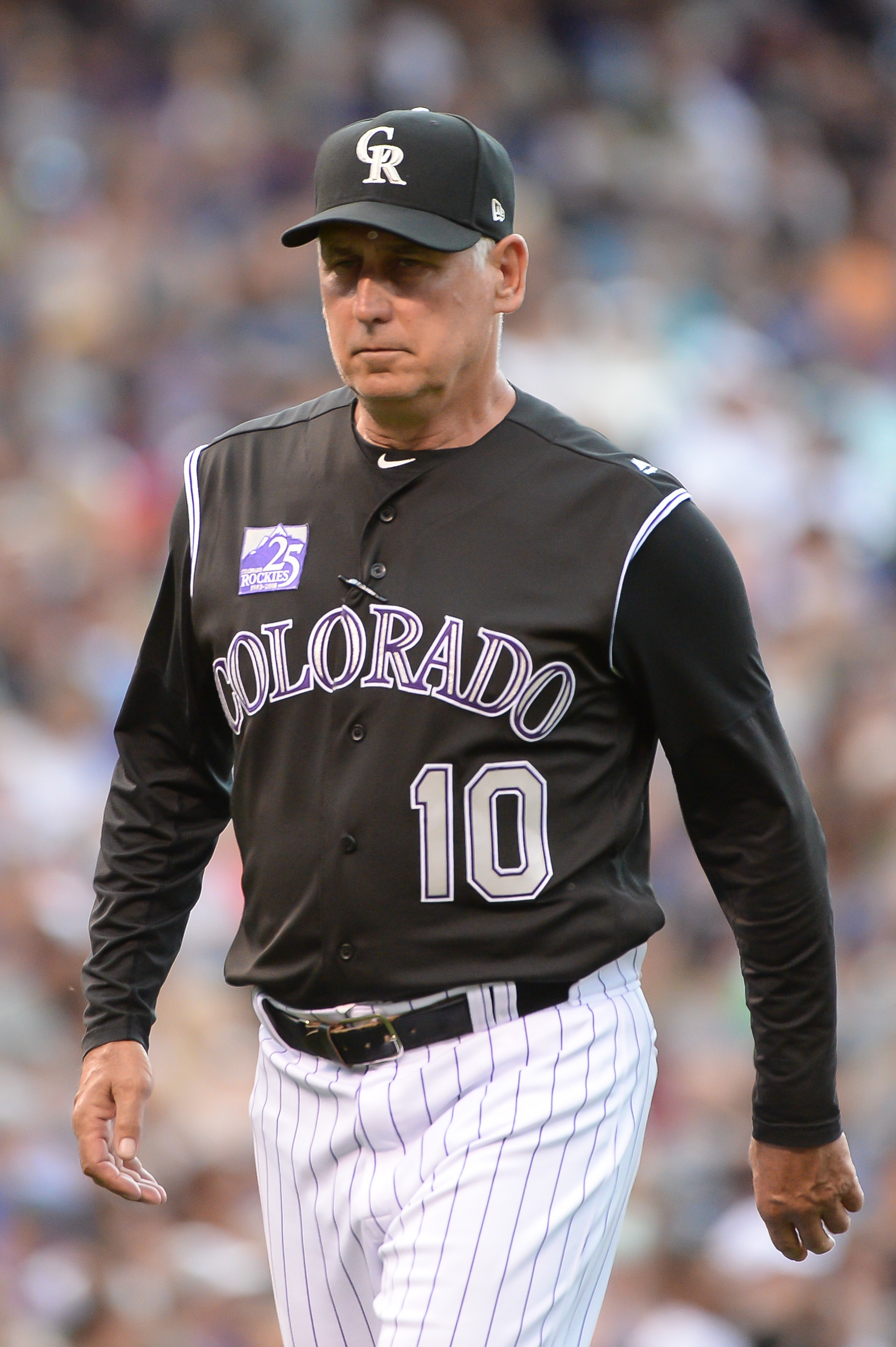
The 2022 season will be Black’s sixth with the Rockies and 15th managing at the big league level. The 2010 National League Manager of the Year in San Diego, Black was hired by now-former general manager Jeff Bridich heading into the 2017 season. His first two years on the job resulted in Wild Card berths, with Black’s Rockies going 1-1 in those one-game postseason showdowns. The division-rival D-backs toppled Colorado in 2017, but Black and the Rockies took down the Cubs in 2018 — albeit before falling to the Brewers in a three-game NLDS sweep.
Since their last postseason appearance, the Rockies have posted three straight losing seasons. With a 171-212 record in that time (.446 winning percentage) and a change at the top of the baseball operations staff, there’d been at least some speculation as to whether Black would remain with the Rockies beyond the current season. Owner Dick Monfort is generally regarded as one of the most loyal executives in the sport (often to a fault), and new GM Bill Schmidt was a prominent figure in the front office even at the time of Black’s original hiring by Bridich and Monfort. In spite of the losing ways in recent year, it appears Black will receive the opportunity to turn the ship around.
Frankly, that’s a defensible stance for the Rockies to take. Black’s rosters haven’t exactly been set up for success, after all, as the Rockies didn’t spend anything in free agency in either of the past two offseasons. Perhaps Monfort and the front office were still reeling from an ill-fated series of free-agent foibles that saw Ian Desmond, Wade Davis, Bryan Shaw and Jake McGee sign for a combined $176MM with very little in terms of a return on investment. Perhaps Monfort truly believed that the 2020-21 Rockies were capable of producing 90-plus wins as constructed and needed little to no augmentation, as he previously implied.
Beyond the lack of roster upgrades, of course, was the organizational turmoil that eventually led to Nolan Arenado‘s departure. Signed to an extension that ostensibly set him up as the face of the franchise moving forward, Arenado quickly grew frustrated with the front office’s lack of additional moves. Rockies brass had reportedly promised that his contract would be the first in a series of moves aimed at putting a perennial contender on the field, but the team instead repeatedly stood pat. A rift between Arenado and the front office/ownership grew, with Arenado famously going on record to state that he felt “disrespected” by the Rockies — Bridich in particular.
Whatever the reasoning, the lack of upgrades and the eventual trade of their clear best player makes it difficult to have set much in the way of expectations for Black. Managers are evaluated on far more than their wins and losses in today’s age of aggressive tanking and rebuilds anyhow, and there’s no indication Black has ever lost his grip on the clubhouse. He’s also known as a manager who specializes in helping young pitchers — Black himself is a former Major League pitcher — and Monfort and Schmidt surely have to be pleased with the manner in which Colorado’s rotation performed in 2021.
Coors Field will always prove problematic for the home pitching staff, but the Rockies’ rotation was generally durable and dependable. The quintet of Jon Gray, German Marquez, Kyle Freeland, Antonio Senzatela and Austin Gomber combined to start 135 of the Rockies’ games (83.3%), and each posted an ERA in the mid-4.00s with an average or better ground-ball rate. The Rockies weren’t necessarily a powerhouse rotation, but for a team that often ranks at the bottom of the league in terms of pitching performance, it was encouraging to get such volume and fairly consistent results from the top five arms.
The Rockies face an uphill battle if they hope to return to contending in a deep NL West that is currently headed up by the No. 1 and No. 2 win totals in all of baseball from 2021 (Giants and Dodgers). The Padres remain squarely in win-now mode as well, and the Rockies will be tasked with improving the club despite a bottom-tier farm system and the likely loss of two more top players (the aforementioned Gray and shortstop Trevor Story). Whether they have a Cinderella run in them can’t be known, but Black will now have another pair of chances to coax that out of this group.
Gerald Williams Passes Away
Former Yankees, Mets, Devil Rays, Braves, Brewers and Marlins outfielder Gerald Williams passed away today at 55 years of age, former teammate and close friend Derek Jeter announced (via the Players’ Tribune).
“Gerald Williams passed away this morning after a battle with cancer,” Jeter said in his statement announcing the saddening news. “To my teammate and one of my best friends in the world, rest in peace, my brother. My thoughts and prayers are with his wife, Liliana, and their whole family.”
Williams, originally a 14th-round pick by the Yankees back in 1987, debuted as a 25-year-old during the 1992 season — the first step in what would become a 14-year career at the MLB level. That journey took him to six different organizations and spanned 1168 games. Williams, nicknamed “Ice,” posted a career .255/.301/.410 batting line with 85 home runs, 183 doubles, 18 triples, 106 stolen bases, 474 runs scored and another 365 runs driven in. Yankee fans may fondly remember an impressive first-inning grab by Williams back in May or 1996, which seemed innocuous at the time but wound up proving a pivotal play in what would eventually become a Doc Gooden no-hitter (YouTube link).
Williams and Jeter were teammates for the Yankees’ postseason appearance in 1995, and he returned to the playoffs with Atlanta in both 1998 and 1999. He played a huge role in the Braves’ 3-1 National League Division Series win over the Astros in ’99, going 7-for-18 (.389) with a double, a pair of runs scored, three RBIs and a stolen base in that four-game set. A member of both the 1996 Yankees and 2003 Marlins, Williams received a pair of World Series rings (even though the Yankees traded him to the Brewers in August of ’96).
Williams’ two best seasons came with the ’98 Braves, when he hit .305/352/.504 with 10 homers in a part-time role, and in 2000 with Tampa Bay, when he saw regular action in the outfield. Williams logged a career-high 682 plate appearances in his first of two seasons with the then-Devil Rays, adding in a career-best 21 home runs, 30 doubles, a pair of triples and 12 steals.
Most pro ball players can only dream of a 14-year run at the game’s top level — and that’s particularly true among players selected well down the draft board, as was the case with Williams. We at MLBTR offer our condolences to Williams’ family, his friends, his former teammates and the thousands of fans who took joy in rooting him on over the course of his decade-plus in the Majors.
Let’s Find A Shortstop For The Twins
The utter dearth of starting pitching for the Twins has been well-documented by now. Out of the 2022 equation are longtime top starter Jose Berrios and 2020 AL Cy Young runner-up Kenta Maeda; Berrios was flipped to Toronto in exchange for a pair of touted prospects at last summer’s deadline, while Maeda underwent Tommy John surgery late last year and hopes for a September return — in a best-case scenario. Also out the door is righty Michael Pineda, a free agent who could yet return but remains unsigned. Thus far, the extent of the Twins’ offseason shopping was a roll of the dice on Dylan Bundy. He’ll join rookie/top prospect Joe Ryan and sophomore Bailey Ober in a thin Twins rotation mix.
For all the focus on the team’s starting pitching, however, Minnesota also lacks an obvious starter at shortstop. Andrelton Simmons‘ one-year stint proved largely underwhelming. By measure of wRC+, Simmons ranked second-worst among hitters with at least 450 plate appearances last season (56). His .223/.287/.274 batting line negated much of his defensive wizardry and was one of many reasons the Twins’ 2021 season went south so quickly. Simmons was never brought in to be an offensive force, but he’d at least been competent (and occasionally above average) in the five preceding seasons, posting a combined .281/.328/.394 slash.
In a perfect world, 2017 No. 1 overall pick Royce Lewis might’ve been ready for a run at shortstop this year. An immensely gifted athlete who’s been ranked among the sport’s top 100 prospects since the moment he was drafted — peaking in the top ten, heading into 2019 — Lewis is seen as a major building block for the organization. Unfortunately for both the Twins and Lewis, he sustained a torn ACL while ramping up for Spring Training last year and wasn’t able to make it back to the field in 2021. Couple that with a 2020 season spent at the Twins’ alternate site during the canceled minor league campaign, and Lewis has missed some crucial development time.
By all accounts, the future is still bright — Lewis clocks in at No. 82 on Baseball America’s latest Top 100 ranking — but the lack of recent playing time and a major surgery have both added some extra risk to his profile and slowed his timeline to the Majors. There was always some question as to whether Lewis would settle in at shortstop or wind up playing third base, center field or second base, anyhow, and even if shortstop is still his future home, he’s not ready just yet.
There are similar defensive questions about fellow top prospect Austin Martin, the headliner of the Berrios trade. Martin, the No. 5 overall pick in 2020 who was viewed as a candidate to be drafted first overall himself, is a gifted hitter and on-base machine whose defensive home is less certain. The Twins will continue getting him work at shortstop, though some scouting reports believe he’ll end up at second base or in the outfield. Martin is considered among the 50 or so best prospects in MLB, but he’s had just one pro season and did not advance beyond Double-A last year. Perhaps he’ll be an option this summer if he mashes out of the gate in Triple-A and looks sound at shortstop, but like Lewis, he needs more time.
Up on the big league roster, the Twins have one well-known option who could slide back to the position. Jorge Polanco spent four years as Minnesota’s primary shortstop, hitting a combined .277/.335/.435 in 418 games from 2017-20. However, Polanco was never a good defender there, hence the move to second base and the subsequent signing of Simmons.
The 28-year-old Polanco turned in the best season of his career following the move to the other side of the bag, so the Twins may not want to tinker with a decision that yielded one of 2021’s few bright spots. Polanco erupted with a 33-homer campaign, hitting .269/.323/.503 through 644 plate appearances. He also turned in a positive showing in Defensive Runs Saved (3) and was only slightly below par in Statcast’s Outs Above Average.
[Related: Jorge Polanco’s Bounceback Season]
One could argue that the Twins should focus on pitching, move Polanco to back to shortstop and play Luis Arraez everyday at second base. However, doing so would weaken the defense (thus diminishing the returns on some of the pitchers they do inevitably add). And, whether it was correlation or causation, Polanco seemed more comfortable once freed from shortstop — a position where his -39 Defensive Runs Saved from 2016-20 ranked second-worst in Major League Baseball.
The Twins made some depth additions recently, picking up former No. 1 pick Tim Beckham and former Rays/Brewers utilityman Daniel Robertson on minor league deals. Neither is on the 40-man roster and neither should be seen as a candidate to step up as their primary shortstop. Either could vie for a bench spot, competing against Nick Gordon — a former top-10 draft pick who made his big league debut with Minnesota last season. However, Gordon mustered just a .240/.292/.355 output in 216 plate appearances and was used all around the diamond. A full-time run at shortstop isn’t likely for any of this trio.
Whoever suits up at shortstop on Opening Day for the Twins probably isn’t in the organization yet, so let’s look at some options.
The Big Free Agents
There’s probably not much point in pondering whether the Twins could or will sign Carlos Correa. Minnesota currently projects to about a $91MM payroll next season (per Roster Resource’s Jason Martinez). That drops to $61MM in 2023 and $27MM in 2024. Technically, they have the payroll space to sign Correa to a mega-deal. However, starting pitching is likely a bigger focus, and the Twins have never gone anywhere near the Correa stratosphere on a contract. Joe Mauer‘s $184MM extension is the largest deal in franchise history, and Josh Donaldson‘s $92MM pact is the biggest free-agent splash they’ve made. Signing Correa for north of $300MM would be a legitimate shock.
Trevor Story is more plausible, financially speaking, but it’s likely he’s seeking a nine-figure deal of his own. A salary in the $20-25MM range isn’t the dealbreaker it once was for the Twins, and Story would give them quality defense with far more offensive output than Simmons. Story seems more likely as a fit here if his market just doesn’t come together as hoped. There are teams who might swoop on a one-year deal in that scenario (e.g. Yankees), but if Story isn’t able to secure a five- or six-year deal and still wants to max out, a Donaldson-esque, four-year offer at least seems feasible. A lot of pieces need to fall into place in this scenario, though.
The Remaining Free Agents
The Simmons deal didn’t work out, but the dismal nature of his 2021 season reduces his 2022 price tag substantially. If the Twins simply want to sign the best glove available and focus on pitching, a cheap Simmons reunion makes sense. There have also been rumors connecting Simmons to the Yankees, who looked into the possibility of acquiring Simmons last summer.
Once upon a time, Jose Iglesias would’ve been viewed in a similar capacity to Simmons. Some may still see him in that light. However, Iglesias’ 2021 season was punctuated by a rather shocking downturn with the glove. Defensive Runs Saved pegged him at a staggering -22, and he posted the first negative Ultimate Zone Rating (-6.1) of his career. Outs Above Average was the most forgiving metric, but even OAA only pegged him as an average defender. Iglesias’ .271/.309/.391 output in 2021 confirmed that his outrageous 2020 season (.373/.400/.556 in 150 plate appearances) was more small-sample fluke than late-blooming breakout. He could be had on an affordable one-year deal himself, but there’s no guarantee the glove bounces back.
Switch-hitting Jonathan Villar remains unsigned, and he’d probably offer the best hope of offensive production from this group. The 32-year-old carries a .259/.327/.408 slash with 58 homers and 104 steals through 497 games over the past four seasons, but Villar isn’t regarded as a strong defender at shortstop. He’s also hit well in two of the past three seasons — 2020’s small sample being the exception — so he could justifiably seek a two-year deal.
There are a handful of other free agents with recent shortstop experience — Josh Harrison, Phil Gosselin, Matt Duffy, old friend Ehire Adrianza — but they profile as bench options (or, perhaps in Harrison’s case, as a starter at second or third base, where the Twins aren’t looking for solutions).
The Trade Market
There are a handful of interesting names to consider if, as seems to be the case with their pitching needs, the Twins deem the trade market a more palatable path to finding a shortstop. The Rangers, for instance, have already inked two of the “big five” shortstops this winter, pushing Isiah Kiner-Falefa to third base — at least until top third base prospect Josh Jung debuts in 2022. Minnesota GM Thad Levine was an assistant GM in Texas when Kiner-Falefa was selected in the fourth round of the 2013 draft. There’s no urgency for the Rangers to move Kiner-Falefa, who’s controlled through 2023, but it’d probably behoove the Twins to inquire. Kiner-Falefa owns a .273/.316/.361 batting line with elite defensive contributions over the past two seasons.
The Twins are a natural trade partner for the Reds, who’ll have several starting pitchers available. Minnesota could conceivably look to double dip, adding a shortstop as well as a pitcher. In Cincinnati, that could be utilityman-turned-starter Kyle Farmer, who figures to cede playing time to top prospect Jose Barrero before long. Farmer, 31, hit .263/.316/.416 with solid glovework in a career-high 529 plate appearances in 2021. He’s controlled through 2024.
Some might argue there’s a similar approach to be taken with Oakland, as the Twins could offer to take back some of Elvis Andrus‘ contract to help grease the wheels on a trade for a starter. However, as I explored back in December, there are plenty of obstacles in a potential Andrus deal (namely a no-trade clause and a problematic vesting option). He also just hasn’t hit since 2017, and his defensive ratings have cratered. It’d be more sensible to just sign Simmons or Iglesias and focus solely on a starting pitcher in trade talks with the A’s.
Over in Arizona, the D-backs have a well-regarded defender in Nick Ahmed, but the 31-year-old limped through a career-worst year at the plate. The glove still plays, and outside of 2021, he’s “only” been a below-average hitter (.248/.307/.421, 89 wRC+ from 2018-20). The Snakes owe Ahmed $17.5MM combined from 2022-23, and they’ll want to open a spot for top prospect Geraldo Perdomo before too long. If you want to consider two-for-one possibilities here, as with the Reds, perhaps the Twins could try to pry Merrill Kelly away. He’ll be a free agent next winter.
If the Twins and Guardians are both comfortable dealing within the division, Cleveland has a bevy of middle infielders while the Twins are deep in outfield options. Both have a deep supply at an area the other is lacking. Amed Rosario is two years from free agency, while Andres Gimenez is more controllable but less proven offensively. Cleveland has so many middle-infield prospects bubbling up toward the Majors behind that pair, that there’s a natural on-paper fit here. (The Guardians are also deeper in starting pitching than the Twins, setting up additional possibilities.) It’s always tougher to envision division rivals dealing with one another, but Twins president of baseball operations Derek Falvey was hired out of the Cleveland front office back in 2016.
As with any offseason need, there are boundless possibilities to consider even beyond this list. The Twins could try to buy low on KBO star Ha-Seong Kim — a square peg in a round hole with the Padres — or look into defensive standout Kevin Newman over in Pittsburgh (though he was the only shortstop who was less-productive at the plate than Simmons last season). You can mix-and-match the possibilities to your liking — what else is there to do with no end to the lockout in sight? — but it’s likely the Twins’ next starting shortstop hasn’t yet been acquired.