
Shortstop Notes: Simmons, Story, Polanco
The Phillies, Reds, and Jays (among others) are those taking a look at Andrelton Simmons, per MLB Insider Jon Heyman (via Twitter). The Phillies and Reds are natural fits for the former Angel, given their openings at shortstop. The Blue Jays have notably explored many avenues for improvement. In the case of Simmons, it would mean raising their defensive efficiency in the infield, presumably by installing Simmons at short and letting Bo Bichette slide to third, where he would no doubt be a plus defender. At present, it would be surprising if the Phillies and Reds aren’t able to nab a shortstop apiece from the group of Simmons, Marcus Semien, and Didi Gregorius, given their clear need compared to other teams around the league. Considering the group of shortstops that could become free agents next year, teams could be trying to limit their long-term commitments at the position, though that’s not as likely as negotiations simply hanging up because of total dollars as teams hunt value deals.
- Speaking of free agents to be, the Rockies‘ Trevor Story may be the one of the bunch most likely to hit free agency next summer. At present, Colorado remains unmoved in their position to neither trade nor extend their star shortstop, per ESPN’s Buster Olney (via Twitter). At times this winter, they have been open to the idea of moving Story, but the most likely outcome still appears to be Story playing out the 2021 season in Coors Field and then hitting the open market.
- The Twins may be one of the mystery teams taking a look at Simmons. When asked by Darren Wolfson of SKOR North (video link) if Jorge Polanco would be their opening day shortstop, Twins GM Thad Levin said, “I think we look at our team and say Byron Buxton‘s our opening day centerfielder, and Josh Donaldson‘s our opening day third baseman – almost everyone else on our team has defensive flexibility. We view that as a huge boon to our team.” Wolfson notes that the Twins know the asking prices for free agent shortstops Simmons and Marcus Semien are keeping an eye on it.
- To be clear, Levine in no way implied that Polanco would not be a big part of their team in 2021, only that they consider the defensive malleability of the current roster as one of their advantages – both in the market and on the ball field. By DRS, OAA, and UZR, Polanco has measured as a subpar defender at shortstop throughout his career, and the Twins may see value in moving him to second in order to upgrade the infield defense on the whole. More broadly, the Twins appear keen on making the “best” free agent deal they can find, regardless of position. If flexibility really is central to the Twins’ philosophy, that could help explain any reticence they might have about locking Nelson Cruz into the designated hitter spot . That said, it’s hard to imagine finding any player better at their position than Cruz was as their DH the last two seasons (163 wRC+).
Astros Re-Sign Michael Brantley
JAN 25: The Astros have announced the deal, per Chandler Rome of the Houston Chronicle (via Twitter).
JAN 21: The Astros have reached a two-year, $32MM agreement with free-agent outfielder Michael Brantley, Mark Berman of Fox 26 reports. Brantley is a client of Excel Sports Management. It’s a done deal, Bob Nightengale of USA Today tweets.
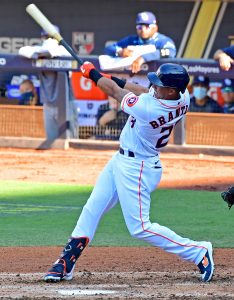
That Brantley is returning to Houston is stunning, as just hours ago it appeared he would join friend and former Astros outfielder George Springer in Toronto. However, in the wake of reports suggesting Brantley would head north, a Toronto official shot down the notion that the club had a deal with him. The Blue Jays did indeed have interest in the 33-year-old Brantley, but they couldn’t close the deal for reasons that aren’t yet known. As a result, it appears Brantley will spend a third consecutive season with the Astros.
This is the second straight two-year, $32MM contract Brantley, formerly with Cleveland, has inked with Houston. The previous deal worked out for both sides, as Brantley earned his fourth All-Star nod in 2019 and has combined for a stellar .309/.370/.497 line with 27 home runs over 824 plate appearances during his run with the Astros. Thanks to his continued success, MLBTR ranked Brantley as the game’s 13th-best free agent at the beginning of the offseason and predicted he would land a two-year, $28MM pact.
With Brantley staying in Houston, the team has addressed a key need in its outfield, where it opened the offseason with major questions. The Astros were at risk of losing all of Brantley, Springer and Josh Reddick on the open market (Reddick is still a free agent). Now, though, they have two corner spots spoken for with Brantley and Kyle Tucker. It’s not yet clear who will replace Springer in center, and it’s certainly worth noting that Brantley may not be an optimal solution as an everyday outfielder anymore. Brantley has dealt with serious injuries in the past, and he missed time last year with a quad issue. When healthy, Brantley appeared in left field in just 19 of 46 games, spending the rest of his season at designated hitter. That spot won’t be available to Brantley on a regular basis in 2021 if offensive standout Yordan Alvarez returns to health after undergoing surgeries on both knees last August.
Losing out on Brantley may be a significant disappointment for the Blue Jays, but they’re not devoid of talent in the outfield and at DH. Springer, Teoscar Hernandez, Lourdes Gurriel Jr. and Randal Grichuk give the team a strong outfield quartet on paper, though adding Brantley obviously would have made the Jays even more formidable after they earned a playoff berth in 2020.
Photo courtesy of USA Today Sports Images.
Red Sox Notes: Ottavino, Luxury Tax, Bradley Jr.
Red Sox’ Chief Baseball Officer Chaim Bloom addressed a number of questions about the offseason moves they have (and haven’t) made so far this winter, per the reporters present, including Chris Cotillo of MassLive.com, Alex Speier of the Boston Globe, and the Athletic’s Jen McCaffrey. The call was prompted by the club’s recent (and rare) transaction with their chief rival. Bloom noted that they looked “under the hood” at Adam Ottavino‘s 2020 numbers and believe the assumption of his poor performance in 2020 may be misguided. In particular, he notes one particularly poor outing against the Blue Jays in which he surrendered six earned runs without recording an out. Take out that September 7th appearance, and Ottavino’s ERA drops from 5.89 to 2.95. Of course, that outing did happen. Even so, there’s a positive read in Ottavino’s 2020 stat line: 3.52 FIP, 3.62 SIERA, 29.4 percent strikeout rate, and 10.6 percent walk rate suggest the right-hander was close to the same guy he ‘d been in 2019, when he formed an important part of the Yankees’ bullpen. Ottavino figures to play a heavy role in the back-end of Boston’s bullpen, though the dispersal of responsibilities between Ottavino and incumbent closer Matt Barnes is TBD. More from Bloom…
- The Yankees moved Ottavino to trim enough salary to duck the $210MM luxury tax line, but according to Bloom, it’s not a foregone conclusion that the Red Sox will do the same. With Ottavino in the fold, the Red Sox luxury tax payroll appears to be around $206MM, which certainly doesn’t leave very much room to spare. While the plan is to avoid the tax, that’s not a firm mandate, Bloom notes.
- Even taking Bloom at his word, it’s hard to imagine the Red Sox going over the luxury tax when so many teams these days work so diligently to avoid it – especially in a season where the Red Sox are largely projected to be an afterthought to the Rays, Yankees, and Blue Jays in the AL East. The Red Sox aren’t probably quite as quick to write off their 2021 season, of course. Still, it’s fair to wonder if they have the funds remaining to bring back Jackie Bradley Jr. The team remains in contact with Bradley, however, and plans to do so “until his free agency resolves.” Though your read may differ, Bloom’s passive word choice doesn’t project the picture of an aggressive forthcoming attempt to woo Bradley back to Fenway, despite his point here being that a reunion remains possible.
Cactus League Informs MLB Of Desire To Delay Start Of Spring Training
Less than a month before players are set to report to Spring Training, Arizona’s Cactus League has submitted a formal request to commissioner Rob Manfred asking that the start of Spring Training be delayed due to the Covid-19 infection rate in Maricopa County (Twitter link via Brahm Resnick of 12 News in Arizona). The Cactus League itself does not have the authority to delay the start of Spring Training, but its formal request figures to elicit a response from the commissioner’s office.
“Amid the ongoing Covid-19 pandemic, the Cactus League has formed a task force to ensure that our 10 spring training facilities are prepared to host the 2021 spring training season in a manner that is safe for all involved,” executive director Bridget Binsbacher wrote in a letter co-signed by nine other key members of the Cactus League. “We stand ready to work with you on the final preparation and outcome to begin the season. … But in the view of the current state of the pandemic in Maricopa County — with one of the nation’s highest infection rates — we believe it wise to delay the start of spring training to allow for the Covid-19 situation to improve here.”
The county’s appeal, however, doesn’t figure to have an effect on policy unless the players change their position – and on this issue they have been clear. In response to the letter from the Cactus League, the MLBPA released its own statement, reiterating their desire (and insistence) to start on time. “Although we have not received any communication directly, the MLBPA is aware of a letter that has been distributed today by the Cactus League Association,” the letter begins. It goes on to say, “The letter correctly notes that MLB does not have the ability to unilaterally make this decision.”
In negotiating the rules and conditions for the 2021 season, the MLBPA has been staunch in their desire to play a full season, which logistically necessitates a regularly-scheduled spring session under most if not all scenarios under consideration. For there to be any movement on the players’ part, owners and the league would have to account for the money that players would lose by delaying and truncating the season. This may be the players’ greatest point of leverage, and it’s not one they appear willing to compromise without considerable concessions on the league’s part. For what it’s worth, the NHL is currently active in Glendale with fans in the stands, notes Susan Slusser of the San Francisco Chronicle. Glendale was one of the cities to sign the letter sent to the league.
There are basically two scenarios that could result in a delayed Spring Training. The first would be the local health crisis growing dire enough such that health officials mandate restrictions that conflict with the league’s ability to open camps. Considering the already-dire nature of the crisis at present, this isn’t considered a particularly likely outcome. The other possibility is the MLB and the MLBPA deciding together that a delay of camp is the proper course of action.
Pirates Sign Joe Hudson To Minor League Deal
The Pirates announced Monday that they’ve signed catcher Joe Hudson to a minor league contract and invited him to Major League Spring Training.
Hudson, 29, spent the 2020 season with the Mariners and appeared in nine big league games, going 3-for-17 with a pair of walks and five strikeouts in 20 trips to the plate. That marked Hudson’s third straight season with at least a taste of the Major Leagues, although both the nine games and 20 plate appearances were career-highs for the journeyman backstop. Overall, he’s a .167/.219/.200 hitter in a minuscule sample of 33 plate appearances.
Beyond his limited big league time, Hudson has logged 102 games at the Triple-A level, batting .249/.323/.411 with 13 homers, 14 doubles and a triple in 383 plate appearances. He’s thwarted a whopping 43 percent of the 505 stolen base attempts against him in the minors since being drafted by the Reds in the sixth round back in 2012, and Baseball Prospectus gives him generally strong marks both in terms of pitch framing and pitch blocking.
Jacob Stallings and Michael Perez are the only two catchers on Pittsburgh’s 40-man roster at the moment, and they lack an MLB-ready prospect behind the dish. Hudson joins fellow non-roster invitee Andrew Susac and 2017 fourth-rounder Jason Delay as depth options for the Bucs who could see action in Triple-A. Delay hasn’t played above Double-A yet and struggled there in 2019, hitting .234/.286/.398 in 67 games.
Latest On Universal DH, Expanded Playoffs
The Major League Baseball Players Association rejected the league’s most recent proposal to implement a universal designated hitter, The Athletic’s Ken Rosenthal reported this morning in a larger, broad-reaching look at the issues facing the two parties. MLB offered up a universal DH and a willingness to rule in favor of two players on a pair of service time grievances, per Rosenthal, but in exchange they sought an agreement on expanded playoffs, the implementation of a pitch clock and a Spring Training trial run with electronic strike zones, among other elements.
The lack of clarity on whether there will be a DH in the National League next season continues to serve as a major impediment for teams and for some free agents alike. Nelson Cruz and Marcell Ozuna, in particular, can’t fully get a grasp on their markets until they know whether the NL will carry a DH. Meanwhile, NL teams are left to build a lineup and a roster without knowing whether they’ll have a spot for an extra hitter.
The MLBPA clearly doesn’t view the addition of a designated hitter in the National League to be as advantageous to its side as the expansion of playoffs is to the league. That’s plenty understandable, given that most clubs no longer employ expensive, dedicated designated hitters and that the expansion of playoff teams would create far more revenue for the league than for its players.
Rosenthal notes that MLB’s latest offer included an extra $30MM or so to be divided up among players — up from $50MM in 2020’s expanded field — but team-side revenues would increase on a much greater basis. Under the traditional structure (i.e. pre-2020), players’ postseason shares are tied to gate revenue, while teams collect 100 percent of television revenues. Last year, in the absence of fans, players agreed to an expanded, 16-team playoff field that saw $50MM of television revenues divided among players.
From the players’ vantage point, postseason expansion is a double-edged sword. A greater chance to play in October could very well be appealing, but there are likely some who (like many fans) worry about “watering down” the field. Of greater concern is the manner in which postseason expansion could also impact free agency. The league would surely argue that increasing the field will motivate borderline clubs to spend more on the open market, thus making it a win for the players.
However, the opposite effect could also play out as well; if the bar to reach the postseason is lowered, some clubs won’t feel as compelled to spend for an extra couple of wins to push themselves over the top. The margin for error is much greater when nearly half (or even more than half) of the teams in the game qualify for postseason play than it is when only a third of clubs do. That’s especially true when at any given point, there are a handful of teams tanking and actively doing everything they can not to win games.
At the end of the day, there’s a substantial disconnect between the extent to which the league and the union feel the universal DH will benefit players. The MLBPA knows that playoff expansion, and the associated revenues, is a massive bargaining chip to leverage in current talks and in the looming talks for a new CBA. That seems too large a concession to make in exchange for the universal DH — particularly because the commissioner’s office also wants a DH implemented in the National League.
Rob Manfred has continually sought to increase in-game action, and considering the fact that pitchers posted a combined .128/.160/.162 batting line with a 44 percent strikeout rate in 2019, swapping them out for a competent hitter would help with that goal. Of course, many traditionalists abhor the very notion of the designated hitter and are overwhelmingly against its implementation in the National League, but at this point it feels like an inevitability — whether that implementation comes in 2021 or in 2022.
As labor lawyer Eugene Freedman (who recently chatted with MLBTR’s Tim Dierkes about the CBA) points out on Twitter, the very framing of this scenario as a negotiation is somewhat misleading. The two sides already have an agreement in place in the form of the 2016-21 CBA, and the union is under no obligation to renegotiate that agreement simply because the league is now making a push for an expanded postseason format.
The MLBPA’s latest rejection doesn’t mean that the two sides won’t eventually agree to something, of course. The league is obviously very motivated to expand the upcoming postseason field and grow its postseason revenues, so perhaps they’ll put together a more enticing offer. We saw in 2020 that the two sides are willing to come back to the table at the last minute, as 2020’s expanded postseason format was agreed upon about three hours prior to the first pitch being thrown on Opening Day.
Yankees Trade Adam Ottavino To Red Sox
1:15pm: The teams have announced the trade.
11:45am: In an ultra-rare swap between AL East rivals, the Yankees have reportedly traded right-hander Adam Ottavino to the Red Sox in exchange for cash or a player to be named later. Boston will receive Ottavino and minor league right-hander Frank German from the Yankees in a move that amounts to a salary dump for the Yanks and the purchase of pitching prospect and a bullpen rebound candidate for the Red Sox.
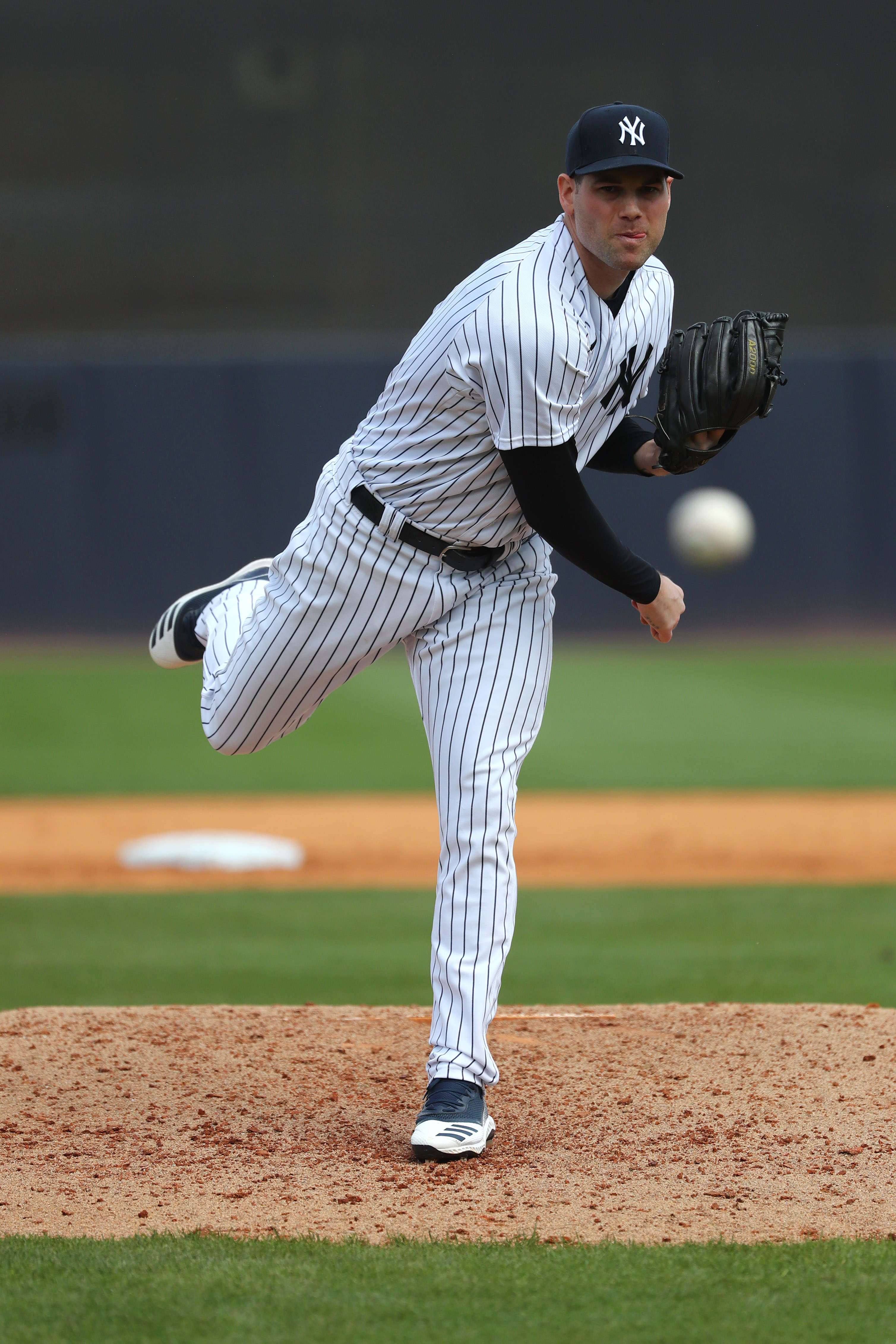
After acquiring Jameson Taillon from the Pirates and agreeing to terms with DJ LeMahieu and Corey Kluber, the Yankees found themselves with roughly one million dollars separating them from the tax threshold, per Roster Resource’s Jason Martinez. Ottavino came with a $9MM luxury hit by virtue of the three-year, $27MM free-agent deal he signed two years ago, and the Yankees will now shave the bulk of that sum from their luxury obligations. ESPN’s Buster Olney reports that they’re sending $850K to the Red Sox as part of the deal, so the Yankees are freeing up $8.15MM of luxury breathing room.
That space will prove vital, given ownership’s apparent mandate that the front office stay under the tax threshold. The Yankees have recently spoken to Brett Gardner‘s camp about a reunion, and the club could yet be in the hunt for affordable rotation depth even after adding Kluber and Taillon. Both are coming off injury-ruined 2020 seasons, after all, and the rest of the team’s rotation comes with similar workload concerns.
The trade between the two teams is the first in six and a half years, when they swapped Stephen Drew and Kelly Johnson in 2014. MLB.com’s Mark Feinsand points out that this is only the second trade that Yankees GM Brian Cashman has ever made with his organization’s top rival.
While finances are the clear driving factor in this trade, it’s unlikely the Yankees would’ve made the move had Ottavino not struggled through a dismal showing in last year’s shortened season. The 35-year-old appeared in 24 games but totaled just 18 1/3 innings of work, yielding a dozen runs on 20 hits and nine walks with 25 punchouts in that time. Ottavino’s 5.89 ERA was his highest since debuting as a rookie with the Cardinals back in 2010, although fielding-independent metrics were more bullish on his work (3.52 FIP, 3.62 SIERA).
Control has never been a strong point for Ottavino, but he dropped his walk rate from 13.8 percent in 2017-19 to 10.6 percent last year. It’s easy to call his ERA a result of a sky-high .375 average on ball in play, but Ottavino’s struggles appeared to be more than a function of simple bad luck. In spite of his improved control, the right-hander’s strikeout rate dipped a bit (31.5 percent to 29.4 percent), and Ottavino yielded hard contact at a career-high rate (90.6 mph average exit velocity; 50 percent hard-hit rate). Ottavino was a high-quality reliever as recently as 2018-19 between the Rockies and Yankees, however, when he logged a combined 2.19 ERA and 33.8 percent strikeout rate through 144 innings of work.
Boston surely hopes that Ottavino will return to form, but the Sox are also using available payroll flexibility to add a pitcher who isn’t viewed as being too far from MLB-ready. The 23-year-old German was a fourth-round pick out of college and a late riser on draft boards in 2018, as Eric Longenhagen wrote last year at FanGraphs. German added muscle to a projectable frame between his junior and senior years of college and saw his velocity spike late in the 2018 NCAA season. He’s continued to add velocity in pro ball, per Longenhagen, though there are concerns about his secondary offerings. MLB.com previously ranked German 24th among Yankees prospects, so he’ll settle somewhere into the middle tiers of the Red Sox’ rankings now.
In many ways underscores, this unexpected trade speaks to how both clubs view Boston’s chances of competing in 2021. If the Red Sox genuinely expected to compete for a division title, would they help the Yankees by giving them further payroll space to operate underneath the tax threshold? And if the Yankees viewed the Red Sox as a threat, would they risk sending a talented reliever — albeit one in need of a rebound — to their nemesis? The optics of a revitalized Ottavino playing a key role in a Red Sox bullpen that marches to the postseason would be brutal for the Yankees.
That’s not to write off the Red Sox entirely, of course. There’s still a very talented core group of players in Boston, but the team’s chances of contending in 2021 are largely dependent on a number of unknown elements breaking their way. The Sox don’t yet know how Chris Sale will look in his return from Tommy John surgery, for instance, nor are they certain what they can expect from Eduardo Rodriguez after he missed the 2020 season due to Covid-19 and a subsequent myocarditis diagnosis. Key lineup pieces like J.D. Martinez and Andrew Benintendi are in search of their own rebounds after downturns in 2020, and the Sox lack proven options at first base, in the back of the rotation and the back of the bullpen. Ottavino merely adds another question mark to that lengthy list.
Lindsey Adler of The Athletic first reported (via Twitter) that Ottavino had been traded to Boston. The New York Post’s Joel Sherman added details on the other elements of the swap.
Yankees Have Resumed Discussions With Brett Gardner
The Yankees recently “rekindled” their discussions about a reunion with outfielder Brett Gardner, per Jack Curry of the YES Network (Twitter link), who adds that he expects a deal to eventually be reached. ESPN’s Buster Olney noted last week that the Yankees still hoped to bring Gardner back.
New York still hasn’t formally announced DJ LeMahieu‘s reported six-year, $90MM contract, but between that signing, Corey Kluber‘s $11MM agreement (also not yet formally announced) and this weekend’s acquisition of right-hander Jameson Taillon, the Yanks are quite close to the $210MM luxury tax barrier. A reunion with Gardner probably wouldn’t cost more than a few million dollars, however, and the club seems likely to be able to find a way to stay south of the threshold if that indeed remains an ownership goal.
The 37-year-old Gardner has spent his entire 13-year Major League career with the Yankees. In 2020, he put together a .223/.354/.392 batting line. That .223 mark was a career-low batting average, due in part to a career-high 22.2 percent strikeout rate, but Gardner’s results in last year’s short sample weren’t all bad. His 16.5 percent walk rate was a career-high by a wide margin, and Statcast also credited Gardner with career-best marks in hard-hit rate (36.5 percent), average exit velocity (89.2 mph) and barreled balls (5.2 percent). Gardner’s 76 percent contact rate was the lowest of his career, but he also chased pitches outside the strike zone at his lowest rate since 2010 and, as a result, made better contact when he did put the the bat on the ball.
The Yankees’ outfield figures to be filled on a regular basis by Aaron Judge, Aaron Hicks and Clint Frazier, with primary designated hitter Giancarlo Stanton cycling into the corners at times as well. New York has lefty-hitting Mike Tauchman on the 40-man roster as well, and he’s out of minor league options, so he’ll need to break the Opening Day roster or else be designated for assignment or traded elsewhere. Taucman, though, hit .242/.342/.305 in 111 plate appearances last year, showing none of the pop he displayed in a breakout 2019 campaign.
Yankees Acquire Jameson Taillon
12:49PM: The trade has been officially announced by both teams.
11:35AM: The Yankees have worked out a deal to acquire right-hander Jameson Taillon, Jason Mackey of the Pittsburgh Post-Gazette reports. The Pirates will receive four prospects in return. ESPN.com’s Jeff Passan (Twitter link) reports that the minor leaguers in question are right-handers Miguel Yajure and Roansy Contreras, infielder Maikol Escotto and outfielder Canaan Smith.
Multiple reports broke yesterday that a Taillon trade was nearing completion, with the Yankees emerging as the favorites to land the 29-year-old. According to Mackey, “at least three clubs” submitted offers for Taillon, but it was indeed New York who eventually landed the right-hander.
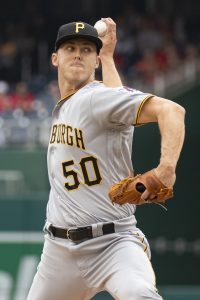 Taillon joins a Yankees rotation that is headlined by Gerrit Cole, and otherwise has a lot of upside but an equal number of question marks. Corey Kluber has two AL Cy Young Awards on his resume but also has barely pitched in two seasons due to injuries, Luis Severino won’t return from Tommy John surgery rehab until midseason, Domingo German didn’t pitch in 2020 due to a domestic violence suspension, and the likes of Jordan Montgomery, Deivi Garcia, Clarke Schmidt or Michael King are lacking in MLB experience.
Taillon is himself not exactly a sure thing, as he didn’t pitch in 2020 (and threw only 37 1/3 innings in 2019) due to Tommy John surgery. This was the second TJ procedure of Taillon’s career, following an earlier surgery during his days as a star prospect in Pittsburgh’s farm system. While there is risk involved in the acquisition, the Yankees are betting that Taillon is healthy and can match or surpass the form he has showed over his 466 career innings.
Drafted second overall in 2010, Taillon has posted a 3.67 ERA, 21.5K%, and 15.5K-BB% over his Major League career. While not a big strikeout pitcher, Taillon has a mid-90’s fastball, strong control, the ability to keep the ball on the ground (career 48.2% grounder rate) and does a good job of limiting hard contact.
The other important numbers from the Yankees’ perspective were two (as in the number of years of team control remaining over Taillon) and $2.25MM, which is what Taillon is set to earn in 2021. The Yankees are known to be looking to stay under the $210MM luxury tax threshold and reset their tax penalties to zero, so there is added value for the team in acquiring a potential No. 3 or even a No. 2 starter at such a low financial cost. According to Roster Resource‘s projection, the Yankees are now less than a million dollars under the $210MM mark, so some creativity will be required if the team is going to make any more additions.
Contreras and Yajure were also both on the 40-man roster, so the Yankees have now opened spots up for Taillon and for one of Kluber or DJ LeMahieu, whose signings have yet to be officially announced by the team.
For the Pirates, this is the latest big move of a rebuild that has already seen Joe Musgrove and Josh Bell dealt in respective trades with the Padres and Nationals this winter. There was no pressing payroll concern surrounding Taillon, but since the Bucs look to be more than two years away from contending, it made sense for the team to shop the righty now rather than risk an injury setback or poor performance from Taillon during the season.
For Musgrove, Bell, and now Taillon, the Pirates have added 11 young players to their organization via the three trades. Similar to the Musgrove deal with San Diego, Pittsburgh received a larger package of prospects rather than a singular blue-chip talent, but it would be incorrect to say that the Pirates opted for quantity over quality. Yajure (#15), Contreras (#19) and Smith (#21) were all ranked on MLB.com’s list of the top 30 prospects in the New York farm system.
Yajure made his Major League debut in 2020, posting a 1.29 ERA over seven relief innings while recording eight strikeouts and five walks. Control wasn’t really a problem for Yajure over his minor league career, with only a 5.9BB% to go along with a 2.47 ERA and 20.8K% over 291 2/3 innings. The 22-year-old also had a knack for keeping the ball in the park, with only 10 homers allowed during his minor league career.
Yajure started 54 of 61 minor league outings, and MLB Pipeline’s scouting report says he “has a high floor as a likely No. 4 or 5 starter.” He could be a candidate for action in the Pirates’ rotation this season, but since he has yet to pitch at the Triple-A level, Yajure will probably begin the year in the minors.
Contreras, 21, was a product of the 2016 international draft class and has yet to pitch beyond the A-ball level, but he has a 3.25 ERA over 249 1/3 innings, starting 47 of 50 games. There is some doubt as to whether or not Contreras will stick as a starter or be moved to the bullpen, according to MLB Pipeline, since he doesn’t record many strikeouts (20.1K%) and is “a flyball pitcher without much life on his fastball.” Both his fastball and changeup receive a 55 on the 20-80 scouting scale, however, and his fastball averages in the 92-95mph range with some quality spin rate.
Smith was a fourth-round pick in the 2017 draft, and the 21-year-old has already shown an aptitude for getting on base. Smith has hit .280/.389/.426 over 936 plate appearances in his young career, reaching as high as the A-ball level in 2019. His left-handed swing doesn’t have much loft, as per Pipeline, but his slugging percentage did jump upwards to .465 in 2019. Smith has played mostly left field and is an average defender overall, and he has shown good skill as a baserunner in stealing 21 bases in 28 chances despite average speed.
An international signing out of the Dominican Republic, the 18-year-old Escotto hit .315/.429/.552 over 218 PA in Dominican Summer League action in 2019. Baseball America ranked Escotto 27th on their list of Yankees prospects, citing his “compact swing” and “solid plate discipline” and also describing him as a plus runner and plus defender. Escotto played mostly second base in the DSL but also saw action as a third baseman and shortstop.
Photo courtesy of USA Today Sports Images
Latest On Yasiel Puig And The Outfield Market
JANUARY 24: Jon Heyman of MLB Network casts doubt on the Yankees as a potential fit for Puig, tweeting that there’s “no evidence” New York has interest in adding another right-handed hitting outfielder.
JANUARY 23: The Marlins have been tied to a number of outfielders lately, including Anthony Santander of the Orioles and Andrew Benintendi of the Red Sox. Limited financial resources will curb their willingness to bid on free agent options like Adam Duvall and Eddie Rosario, tweets Jon Heyman. They do, however, have some prospect capital that they’re willing to spend on the right player. At present, Corey Dickerson returns to left, Starling Marte to center, and Garrett Cooper to right, with Brian Anderson occasionally shifting from third base to right, and Lewis Brinson, Harold Ramirez, and Magneuris Sierra filling as speed and defensive replacements. If the Marlins go the free agent route, however, they may explore a union with Yasiel Puig. Not having played in the Majors since 2019, Puig is a candidate to sign a value or incentive-laden deal, should if he land a contract this winter.
The Yankees and Royals are also possible destinations for Puig, per Jim Bowden of MLB Network (via Twitter). For the Royals‘ part, they have been looking for another bat to join a largely-unproven group in the grass made up of Franchy Cordero, Michael A. Taylor, and a number of options who could end up elsewhere on the diamond, such as Whit Merrifield, Ryan McBroom, Hunter Dozier, and likely DH Jorge Soler. In looking to add to that group, they’ve generally zeroed in on left-handed hitters. Even with the group they have in-house, the Royals could possibly still add a couple of outfielders, if the price were right.
As for the Yankees, they would be a surprising destination for Puig, if there were no corresponding moves. They are, after all, pretty well-stocked in the outfield with Aaron Hicks, Clint Frazier, Aaron Judge, and Mike Tauchman on the roster, Greg Allen on the 40-man roster, and Brett Gardner hanging out in free agency. Puig’s colorful personality would also be an interesting fit on the Yankees, who for literal and metaphorical reasons are generally regarded as a clean-cut organization. Still, that doesn’t preclude Puig from heading to the Bronx. After all, it’s not as if an interesting character or two haven’t donned pinstripes in the past.