
Mitch Garver’s Quietly Great Season
The Twins entered play Friday with the majors’ most home runs, second-best wRC+ and third-most runs, all of which helps explain their 62-40 record and two-game lead in the American League Central. The likes of Nelson Cruz (who swatted three homers Thursday), Jorge Polanco and Max Kepler are among Twins position players who get the lion’s share of attention, but there’s a case that a little-known catcher has been their premier offensive contributor on a per-plate appearance basis this season. That backstop didn’t join the Twins as a high draft pick, nor was he an elite prospect coming through their system.

The Twins selected Mitch Garver out of the University of New Mexico in the ninth round of the 2013 draft. At his best, Garver rose to a 17th-place rating in Minnesota’s farm, according to Baseball America, which placed him there after the 2016 season. Back then, BA described Garver as a “steady offensive player” with questionable (albeit improving) defense.
Garver debuted in the majors in 2017, though he only collected 52 plate appearances, before turning into a regular option last year. He was a fine offensive performer then, slashing .268/.335/.414 (102 wRC+) with seven home runs in 335 trips to the plate, but Garver was simultaneously among the worst defensive backstops in baseball. One year later, though, Garver has quietly evolved into one of the sport’s top all-around catchers.
Sharing time with fellow 2019 standout Jason Castro, the 28-year-old Garver has batted a phenomenal .291/.378/.646 with a prodigious 19 homers in just 217 PA. Among hitters who have amassed 200 or more PA this season, Garver ranks fourth in wRC+ (162). Who’s ahead of him? The MVP-caliber group of Mike Trout, Christian Yelich and Cody Bellinger. Meanwhile, Garver has totaled 2.6 fWAR, which ranks fourth at his position behind Yasmani Grandal, J.T. Realmuto and Christian Vazquez.
There are ways to somewhat pooh-pooh Garver’s superlative production at the dish. He’s not going to maintain a .354 ISO, for instance, and despite owning one of the majors’ highest fly ball rates (47.8 percent), Garver’s 29.2 percent HR-to-FB rate isn’t going to last. Moreover, Statcast indicates his .422 weighted on-base average is bound to fall. Other than that, however, negatives are few and far between when it comes to Garver’s offensive game.
The righty-swinging Garver has crushed same- and left-handed pitchers alike. His 10.6 percent walk rate is above average, and even though he has been a tremendous power hitter in 2019, Garver hasn’t struck out at an untenable rate. His 24.9 percent strikeout rate is below average, though it’s not awful, and his chase, swing, in-zone contact and swinging-strike percentages are all either a bit better than most players’ or vastly superior. Likewise, Garver’s exit velocity, hard-hit rate, expected slugging percentage and expected wOBA are all near the top of the league, per Statcast, which credits him with a .365 xwOBA. Garver’s just below Alex Bregman in that category. Not bad, especially for a catcher. Garver’s excellence has largely stemmed from an ability to pulverize fastballs – FanGraphs ranks him among the game’s most effective hitters versus heaters, while Statcast indicates he has posted a .533 wOBA/.446 xwOBA against them.
Of course, one of the key elements to catching is playing defense, which had been a sore spot for Garver in the past. That hasn’t been the case this year. Not only has Garver thrown out a solid 6 of 18 would-be base stealers, but he has enjoyed a turnaround in the all-important pitch-framing department. Just 15 catchers have outdone Garver in that regard, says StatCorner.
When it comes to underrated players who have significantly impacted the standings thus far, Garver no doubt ranks near the apex of the league. And with Castro set to hit free agency after the season, perhaps Garver is close to assuming the reins as the Twins’ full-time catcher. With four years left of control remaining after 2019, Garver will have plenty more time to continue putting his name on the map in Minnesota. So far, he’s doing a pretty good job.
Photo courtesy of USA Today Sports Images.
Orioles Designate Nate Karns, Promote Dillon Tate, Place John Means On IL
The Orioles announced multiple pitching moves this evening. One player is now likely headed out of the organization, as righty Nate Karns was reinstated from the 60-day injured list and designated for assignment.
Young hurler Dillon Tate, the former fourth overall pick, was promoted for his first attempt at the majors. Righty Evan Phillips will accompany Tate onto the active roster.
Unfortunately, the O’s also announced that southpaw starter and rookie All-Star John Means was placed on the 10-day injured list with a biceps strain. Lefty Tanner Scott was optioned down to create the other necessary roster opening.
Karns landed with the Baltimore organization over the winter. He threw 5 1/3 scoreless frames to open his tenure but hit the shelf early with a forearm strain. The 31-year-old struggled mightily on his rehab assignment, dishing out ten walks and recording only five strikeouts in 10 1/3 innings.
It’s also unwelcome news as concerns Means. It had already been a bit of a rough month, as his ERA has moved north from 2.50 to 3.12, but it’s never preferable to hear of any issues in the arm of a young pitcher. There’s no indication as of yet regarding the severity, but the club will surely hope it’s only a minor blip for the 26-year-old.
As he prepares to debut at 25 years of age, Tate won’t face the massive expectations he once did. Arm issues and inconsistencies have changed the trajectory of the twice-traded righty. He has been solid at Double-A, working to a 3.48 ERA with 8.0 K/9 and 2.4 BB/9 over 33 2/3 innings in 15 relief appearances and a pair of starts.
Angels Recall Nick Tropeano, Designate Adalberto Mejia
The Angels announced that they have recalled righty Nick Tropeano from Triple-A to start tonight’s game. Maria Torres of the Los Angeles Times first reported that decision on Twitter.
To create roster space, the club designated southpaw Adalberto Mejia for assignment. Mejia was recently claimed off waivers from the Twins.
The Halos will hope that Mejia clears waivers and can be stashed at Triple-A. He’d be a nice depth piece to have on hand, particularly for an organization that needs both rotation and bullpen options. Mejia had endured a brutal stretch in Minnesota to open the year but gave his new club four good outings (one earned run, 6:1 K/BB in 4 1/3 innings) to open his tenure.
As for Tropeano, this’ll be his latest attempt to reestablish himself in the majors. He was ambushed in two prior MLB starts this year. And things haven’t gone well at Triple-A, either. Through 49 1/3 frames, he’s carrying a 7.66 ERA on 64 base knocks with 10.4 K/9 and 3.1 BB/9.
Max Scherzer Dealing With Renewed Upper Back Issues
After coming off of the injured list to start yesterday, Nationals ace Max Scherzer woke up with renewed stiffness in his back, Mark Zuckerman of MASNsports.com reports. It is not clear at this point whether he’ll skip his next scheduled start and/or require a return trip to the 10-day IL.
An MRI taken this morning revealed a mild rhomboid strain. That’s a different issue in the same area of the upper back/shoulder. Scherzer had previously been dealing with an inflamed bursa sac in the vicinity of his shoulder blade. To treat the new problem, Scherzer has undergone a stem-cell injection. His response to that will be assessed in a few days.
While the Nats need every single Scherzer outing they can get, the team is also walking a bit of a tightrope. Allowing the fiery veteran to push himself too hard could easily backfire. And Scherzer wasn’t quite at his best in his return start, though he was still effective and did emphasize that he felt at full health going into and during the outing.
The uncertainty surrounding Scherzer comes at an interesting time for the Nationals. There was already a case to be made that this team could use a starting pitcher. There’s all the more reason to do so now, if only to buy some time to give Scherzer ample rest.
One route would be to grab a fill-in rotation piece that can check down to a relief role. Derek Holland might’ve made sense in that capacity, particularly since the Nats could use a southpaw and he has been so nasty against opposing lefties. But the team didn’t jump on the opportunity, with Holland landing today with the Cubs. Similar hurlers could yet make sense. The tough thing for the D.C. organization will be to balance the imperative to buttress the rotation with a still-glaring need for multiple, quality relief arms.
Detroit’s Underrated Trade Chip
Owners of a major league-worst 30-68 record, the Tigers figure to be one of baseball’s most active sellers prior to next Wednesday’s trade deadline. Three of their players – starter Matthew Boyd, reliever Shane Greene and right fielder Nicholas Castellanos – stand among the most discussed trade chips in baseball. But they’re likely not the only Tigers who are on other teams’ radars as the deadline approaches. The club also has an underrated reliever, right-hander Buck Farmer, it could market.
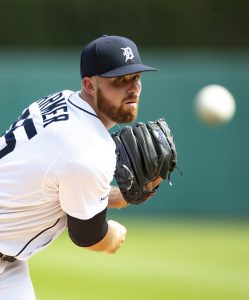
As is the case with Boyd, who’s under control for the next few years, there isn’t necessarily any urgency to deal Farmer. He’s earning a minimal salary right now and won’t make his first of three potential trips through the arbitration process until the offseason. That said, Farmer’s a soon-to-be 29-year-old on a team that’s not contending now and won’t in the immediate future, which makes him a sensible piece for Detroit to consider parting with in the next few days.
Farmer has been a member of the Tigers since they chose the ex-Georgia Tech Yellow Jacket in the fifth round of the 2013 draft. Although he wasn’t a particularly high selection, Farmer climbed up the team’s system to become the Tigers’ second-ranked prospect at Baseball America after the 2014 season, during which he briefly debuted in the bigs. At the time, BA contended Farmer could become a useful back-of-the-rotation starter, though it noted the Tigers may decide he’s better off in the bullpen.
Five years later, Farmer has indeed found his niche in Detroit’s relief corps. After a few seasons of posting mediocre to worse numbers as a starter and reliever, Farmer has morphed into a pleasant surprise this year. Farmer has logged a 3.70 ERA across 41 1/3 innings (45 appearances, one start) thus far. That’s not going to blow anyone away, but Farmer’s strikeout and walk rates (10.67 K/9, 2.83 BB/9) are impressive, as is his 13.3 percent swinging-strike rate, while his 3.20 FIP, 3.36 SIERA and 3.37 xFIP all suggest he has deserved better in the run prevention department. He’s generating groundballs at a 51.4 percent clip, which is exactly 11 percent higher than the GB rate he recorded over a full season of relief work last year. Along with inducing grounders at a below-average rate over 69 1/3 frames then, Farmer put up just 7.4 K/9 against 5.32 BB/9, helping lead to an unspectacular 4.15 ERA/4.46 FIP.
Like last year, Farmer has continued to fire four-seam fastballs at around 95 mph. However, Farmer has somewhat changed his pitch mix since then, per Statcast. He utilized his four-seamer approximately 57 percent of the time in 2018, but it’s down to just over 48 percent now. Meantime, Farmer’s slider usage has climbed significantly – from 17 percent to 27 – while his changeup reliance has continued to hover around the mid-20 percent range. The adjustment to Farmer’s repertoire has worked out. While batters have destroyed his fastball (.436 weighted on-base average, .422 xwOBA), they’ve done next to nothing against his slider (.240/.148) and change (.224/.271). Thanks largely to his hittable heater, Farmer ranks in the basement of the league (its sixth percentile) in hard-hit rate against. Still, his quality offspeed offerings have enabled Farmer to limit hitters to a respectable .320 wOBA/.313 xwOBA overall.
In Farmer, an acquiring team wouldn’t exactly be landing the most exciting option prior to the deadline. Nevertheless, Farmer’s an effective, cheap, controllable reliever who has helped the Tigers this year and would likely aid a contender. It would make sense for Detroit to consider selling high on Farmer in the coming days, and it would be logical for better teams to come calling.
Photo courtesy of USA Today Sports Images.
Angels Looking For Starting Pitching
The Angels have no hope of making a charge in the AL West and face a tough path to the Wild Card, but the club doesn’t appear to be ready to wave the white flag. To the contrary, the Halos are looking at a wide variety of potentially available starters, according to Jon Heyman of MLB Network (via Twitter).
Though they have battled into a plausible contending position, the Angels’ starting pitching situation remains quite problematic. The unfathomable loss of Tyler Skaggs has left an enormous hole in the organization and on the roster. With Andrew Heaney heading to the IL and JC Ramirez turning in messy rehab results, the rotation is full of inexperienced, less-than-ideal options.
Given the long odds of even reaching the postseason, it’s hard to imagine the Halos chasing the top rental arms. But the club does have good cause to consider controllable hurlers that will not only contribute now but help to fill out the rotation in the near future. Last winter’s signings of Matt Harvey and Trevor Cahill have been complete duds — which is always a risk, but especially so when you’re focused on short-term free agents. Repeating that approach probably won’t have a ton of appeal. But the Angels will surely also remain reticent to make a big commitment to a better veteran starter in free agency.
Trade talks make sense, then, particularly now that the L.A. organization has a greater abundance of prospects to work with. Of course, the team will also need to protect those assets as much or more as its future payroll capacity. An anemic talent pipeline has been a big problem in recent campaigns. The team is already enjoying the fruits of a more productive farm and will surely want to exercise caution lest it compromise its future talent base.
It’ll be interesting to see just how aggressively the Angels approach the starting pitching market. The preferred targets of GM Billy Eppler aren’t really clear. Heyman mentions Noah Syndergaard and Trevor Bauer — two of the best hurlers that could be moved this summer — but seemingly only by way of example. The report suggests the Angels have been looking at any and all possible arms. With value a paramount consideration for a team in this particular situation, a broad market exploration makes good sense.
Latest On Nationals’ Bullpen Pursuits
4:10pm: The Nats are also in touch with the Blue Jays regarding their relief arms, per Jon Morosi of MLB Network (via Twitter). Both Ken Giles and Daniel Hudson are said to be of interest to D.C.
11:40am: The Nationals are known to be on the lookout for multiple relievers following their meteoric rise back up the standings, and ESPN’s Buster Olney writes that the team’s preference is to add a left-handed reliever. General manager Mike Rizzo won’t limit himself to only southpaws, though, and to that end, MLB.com’s Jon Morosi tweets that the Nationals are in active pursuit of White Sox righty Alex Colome and Tigers righty Shane Greene.
Washington’s interest in Greene isn’t new; it’s been reported on multiple times in the past and is also a relatively obvious match simply from a common sense standpoint. The Nationals figure to have checked in on virtually every reliever’s asking price by now, and MLB.com’s Jamal Collier recently reported that the Tigers made the sky-high ask of top shortstop prospect Carter Kieboom in initial talks with the Nationals. One can hardly blame the Tigers for aiming high, but that price point indeed seems rather lofty. Still, the fact that Washington is still showing interest suggests that the two sides could come to terms on a deal just yet.
Whether the White Sox were keen on moving Colome earlier this month wasn’t clear, but the South Siders’ poor play of late has dropped them to 10 games under .500. The club is making efforts to move beyond its rebuild and plans to make a push in 2020, so perhaps the preference is to retain Colome. Still, he’ll likely top $10MM in arbitration earnings next season, so it’d also be reasonable for Chicago to cash in if GM Rick Hahn can find a trade partner willing to make a decent offer.
Both Greene and Colome are controlled through the 2020 season, with Greene’s $4MM salary checking in considerably lower than Colome’s $7.325MM rate. As such, even though Greene is having a better season, his salary next year will likely be more affordable.
In 37 innings, Greene has posted a pristine 1.22 ERA with 10.0 K/9, 2.7 BB/9, 1.22 HR/9 and a 54.3 percent ground-ball rate. Colome, meanwhile, has a rather pedestrian 7.0 K/9 mark against 2.8 BB/9 and 0.93 HR/9. Both closers have benefited tremendously from unsustainable averages on balls in play (.180 for Greene and .153 for Colome) and strand rates near 83 percent. Greene’s lower salary and superior strikeout and ground-ball rates make him to more appealing of the pair but also mean that he’ll probably come with a higher asking price. And even with some degree of regression likely for both pitchers, each is still a quality arm who’d give the Nats a much-needed upgrade to a setup corps that has been problematic all season long.
Mariners Select Ryan Court
The Mariners have selected the contract of infielder Ryan Court, per a club announcement. He’ll take the active roster spot of fellow infielder Tim Lopes, who has gone on the 7-day concussion injured list after being struck in the head by a pitch last night. Ryon Healy was shifted to the 60-day IL to free a 40-man spot.
It’s a nice reward for the 31-year-old Court, whose first trip to the plate will be his first at the MLB level. A former 23rd-round draft pick, Court has seen action at Triple-A in parts of four seasons but seemed unlikely ever to touch the majors when he opened the present season in the indy ball ranks.
As it turns out, Court has been a nice find for the M’s top affiliate. In 154 plate appearances, he carries a .279/.377/.581 slash with nine home runs — that’s just two shy of his single-season career high. Court has appeared all over the diamond but has mostly been utilized as a corner infielder in recent seasons.
Royals Designate Brian Flynn
The Royals announced today that they have designated southpaw Brian Flynn for assignment. His roster spot was needed for a variety of other pitching moves.
Also departing the active roster is righty Jake Newberry, who was optioned. The Kansas City org has activated starter Jakob Junis and recalled southpaw Richard Lovelady.
Flynn, 29, has appeared at the major-league level with the Royals in each of the past four seasons. He was a multi-inning mainstay in the pen last year but has scuffled in 2019. Through 29 1/3 innings over ten relief appearances and one start, Flynn carries a 5.22 ERA with 6.8 K/9 and 5.2 BB/9.
Phillies Showing Interest In Tanner Roark
The Phillies are showing some interest in Reds righty Tanner Roark, according to Jon Heyman of MLB Network (Twitter link). It sounds as if a few other organizations are also looking into the veteran starter, whose trade availability is not really clear.
It wasn’t long ago that the Reds were putting out word that they intended to function as a buyer at the trade deadline. But the club’s position is increasingly grim, with eight games and three teams separating it from the NL Central lead.
If the Cincinnati organization does decide to sell a few players, Roark would be one of the clear pieces to move. He’s among the pending free agents who’d be of interest to contenders. Other rental candidates include Alex Wood, David Hernandez, Jared Hughes, Yasiel Puig, Scooter Gennett, and Jose Iglesias.
As for the Phillies, we’ve continued to see them connected to most of the available arms. The club is obviously looking far and wide for possible arms to buttress its rotation and pen. While the preference remains to acquire with control, as Heyman notes and the front office has made clear, there’s surely also room for rental pieces at the right price.
[RELATED: Trade Candidate: Tanner Roark]
Roark has been as solid as the Reds could have hoped for when they acquired him from the Nationals over the winter. He’s through 107 innings of 3.95 ERA pitching over twenty starts, with 8.9 K/9 and 2.9 BB/9. In terms of peripherals and pitch quality, it has been much of the same sturdy work that Roark has provided over the past several campaigns. He’s hardly an ace, but is about as dependable as any back-of-the-rotation starter and would surely represent a nice upgrade for the right contender.