
Quick Hits: International, Org Rankings, GMs On Strategy, Buehrle, Bard, Ankiel
International prospects are among the most mysterious — but potentially impactful — elements of the baseball transactional world. If you’re interested in learning more about this year’s class, and have a Baseball America subscription (as we’d heartily recommend), then be sure to check out Ben Badler’s round-up of the latest array of young talent. Per Badler, the Rays and Twins are expected to land two of the top players in this year’s class: switch-hitting shortstops Wander Franco and Jelfrey Marte. The new CBA rules will be in effect as of the new July 2 signing period, and you can find details of those here.
Here are a few more stray notes from around the game:
- The BA staff has also released its spring organizational prospect rankings, with the Braves, Yankees, and Astros receiving the three highest grades. The Dodgers and White Sox round out the top five, while the Diamondbacks, Angels, and Marlins received the lowest overall ratings for pre-MLB talent.
- Over at Fangraphs, David Laurila spoke with several general managers about strategic decisionmaking. You’ll want to read the piece in its entirety, of course, but it’s interesting to note the subtle variations in thinking. Indians president of baseball operations Chris Antonetti emphasizes that every market imposes different limitations on a team’s front office. Jerry Dipoto of the Mariners says that his front office has worked to acquire and develop certain types of players. Several execs noted the difficulty of committing to a rebuild, while also emphasizing the need to avoid being stuck in a middle-ground. For White Sox GM Rick Hahn, who has launched a rebuilding effort, “staying the course is essential once you pick a direction.”
- Speaking of the White Sox, former lefty Mark Buehrle discussed the team’s just-announced decision to retire his number. As Daryl Van Schouwen of the Chicago Sun-Times reports, the veteran hurler says he’s “blown away and floored” at the honor — though he’s also apprehensive of the public-speaking duties that will come with it. Buehrle says he more or less decided he’d retire not long after signing his last contract, a free-agent deal that took him away from the Chicago organization for the first time as a professional. “The reason I didn’t say anything, I didn’t want all the attention,” he said of his quiet exit from the sport, which had left many wondering whether he’d pitch again. “I’ve always told people I was a young guy that came into the big leagues unknown. Kind of snuck into the big leagues and I wanted to kind of sneak my way out.”
- Whereas Buehrle entered the game quietly and steadily flourished, righty Daniel Bard flashed great promise before washing out of the majors with sudden control problems and injuries. Now, he’s back in camp with the Cardinals, and as GammonsDaily.com reports (with a video), Bard hasn’t lost any of his arm strength even as he works on a new delivery.
- Bard’s career path mirrored somewhat that of former Cardinals hurler Rick Ankiel — who later reinvented himself as an outfielder. As Derrick Good of the St. Louis Post-Dispatch writes, Ankiel has decided to tell his story of dealing with the sudden inability to command the baseball. That’ll be available in full on April 18th, when Ankiel and Yahoo Sports’ Tim Brown will release a book titled “The Phenomenon: Pressure, the Yips, and the Pitch That Changed My Life.” For now, you can check out that article and a recent podcast with Goold’s interview of the former phenom.
Cardinals Sign Jose Adolis Garcia
The Cardinals have announced the signing of Cuban free agent Jose Adolis Garcia. The outfielder will receive an invitation to MLB camp on the minor-league deal. He’ll receive a $2.5MM bonus, per MLB.com’s Jesse Sanchez (via Twitter).
Garcia is the younger brother of Braves third baseman Adonis Garcia. He was listed at 24 years of age as of last August, when Ben Badler of Baseball America reported that he had left Cuba in search of a MLB opportunity. Garcia, a right-handed hitter, received clearance to sign in early December.
While Garcia is expected to be ready for an assignment in the upper minors, he’s not viewed as being quite ready for the majors. Despite excellent numbers in Cuba — he hit .315/.395/.517 over his 380 most recent plate appearances — he wasn’t exactly productive in his brief run with a second-level Japanese club.
Badler says there’s still some polishing left to be done before Garcia is ready for prime time. But he also emphasizes the impressive tools that Garcia brings to the table. He’s said to carry well-above-average speed, an outstanding arm, the ability to play center, and good bat speed. There are some offensive worries, though, per Badler’s latest write-up; namely: “his long swing, free-swinging approach and struggles to recognize offspeed pitches.”
There won’t be any impact on the rest of the Cards’ international maneuverings, as Garcia was able to sign free of international limitations given his age and experience. St. Louis will hope to strike once again on a slightly older Cuban prospect who signs for a substantial, but hardly massive bonus. The team hit it big in 2016, when Aledmys Diaz posted an outstanding rookie season after originally signing for $8MM in March of 2014.
NL West: Padres, Ryu, Desmond
Here’s the latest out of the National League West:
- The Padres are “open-minded” to quite a bit of experimentation in the way they deploy their roster in 2017, as manager Andy Green explains and Bryce Miller of the San Diego Union-Tribune reports. Beyond the quirk of carrying Christian Bethancourt as a catcher, outfielder, and relief pitcher, San Diego will look for other ways of taking advantage of creativity. “I think a lot of teams come in with more established options at different spots,” Green explains. “We’re going to be open-minded to see who rises up and wins the respective jobs and be opportunistic to put guys in positions to succeed that might run different than what other clubs would do.” Just how far the Pads go in tweaking baseball convention remains to be seen; while it won’t likely make much of a difference in their postseason outlook, some new approaches could conceivably pave the way for future change in San Diego as well as other organizations.
- The Dodgers are seeing signs of life from lefty Hyun-Jin Ryu, with pitching coach Rick Honeycutt telling reporters — including Bill Plunkett of the Orange County Register (links to Twitter) — that the Korean hurler is ready to throw in a game situation. It’s unclear whether that’ll be a sim game or a Cactus League contest, but it seems the former is more likely. “No negatives to me,” Honeycutt said of Ryu’s showing thus far. “It’s been impressive.” The 29-year-old is looking to return to the excellent form he showed during his first two years with the Dodgers. He has missed all of the past two seasons (except for one ill-fated outing last year) due to persistent shoulder problems.
- While many have panned the Rockies‘ large expenditure on Ian Desmond, in large part due to the fact that he’s slated to shift from being an up-the-middle defender to a first baseman, Ken Rosenthal of FOX Sports identifies some reasons to support the move. Manager Bud Black says the team was focused less on position than it was the desire to “go get a baseball player who is good.” While Desmond was targeted as a first baseman from the get-go, per the report, GM Jeff Bridich notes that “there is absolutely the potential” he’ll change positions in the future. And Desmond himself is embracing the challenge of yet another new position much as he did his move to the outfield last year, saying he likes the Rockies’ “creativity to use my athleticism.” Of course, those statements don’t necessarily counteract the core criticisms of the deal, though they do suggest that the team is looking to be creative and flexible in building out a roster — now and in the future.
Camp Battles: Minnesota Twins
Despite their rebuilding status, the Twins had a mostly uneventful offseason. The signing of Jason Castro and the two month barrage of Brian Dozier rumors headlined an otherwise quiet winter for new chief baseball officer Derek Falvey and new general manager Thad Levine, due in part to the fact that the Twins have a number of young, MLB-ready position players that they hope will cement themselves as core pieces in 2017.
Here’s a rundown of some of the spots that are up for grabs in the Twin Cities…
Starting Rotation (Fifth Spot)
Jose Berrios
Age: 22
Throws: R
Contract Status: Pre-arbitration; cannot become free agent until at least the 2022-23 offseason
Options Remaining: 2
Trevor May
Age: 27
Throws: R
Contract Status: Pre-arbitration; cannot become a free agent until at least the 2020-21 offseason.
Options Remaining: 1
Tyler Duffey
Age: 26
Throws: R
Contract Status: Pre-arbitration; cannot become a free agent until at least the 2021-22 offseason.
Options Remaining: 2
Adalberto Mejia
Age: 23
Throws: L
Contract Status: Pre-arbitration; cannot become a free agent until at least the 2022-23 offseason.
Options Remaining: 2
Ryan Vogelsong
Age: 39
Throws: R
Contract Status: Signed minor league deal in January; $1MM base + $2.5MM of incentives; can opt out near end of Spring Training.
Options Remaining: Can’t be optioned without consent.
Nick Tepesch
Age: 28
Throws: R
Contract Status: Signed minor league deal in January; $1MM base salary
Options Remaining: 1
The Twins’ front four in the rotation won’t wow anyone on paper. But, barring injury, the quartet of Ervin Santana (their likely Opening Day starter), Hector Santiago, Phil Hughes and Kyle Gibson figure to be assured spots.
Berrios is the sexy pick for the fifth spot in the rotation. The former No. 32 overall pick was long heralded as a top 50 prospect and reached the Majors with huge expectations in 2016. However, he was bombed for an astounding 52 runs in 58 1/3 innings. A rookie struggling is hardly uncommon, but Berrios’ excellent command and minor league dominance led many to project a high floor for him. He’ll look to right the ship in 2017 and prove that he belongs at the game’s top level.
Duffey and May have both had success as starters, but each struggled greatly in recent years. Duffey’s brilliant 2015 debut was followed up with a 6.43 ERA in 133 innings as a sophomore. ERA alternatives like xFIP and SIERA don’t feel there was a drastic downturn in his skill-based performance, but an enormous spike in his homer-to-flyball ratio caused his ERA to soar. May went from an intriguing starter to dominant reliever in 2015 when the Twins saw Glen Perkins go down with an injury. He’ll look to prove that he can hack it as a starter this year. If either or both of these arms miss out on the rotation gig, I can envision both in a relief role. May’s been a reliever since July 2015, and Duffey was a reliever in college.
Acquired in last year’s Eduardo Nunez trade with the Giants, Mejia has previously been billed as a top 100 prospect with a strong likeliehood of becoming a back-of-the-rotation arm. While prospect watchers have been less bullish on his ceiling, which may work against him, Mejia tossed 132 innings of 3.00 ERA ball between Double-A and Triple-A last season.
Vogelsong and Tepesch are decided long shots to make the roster, let alone the rotation. The depth is nice to have, but both seem far likelier to open the season as a swingman if they’re on the 25-man roster at all.
Prediction: The Twins’ hope is almost certainly that Berrios makes the decision an easy one. He brings the highest ceiling of the bunch and has dominated Triple-A (2.79 ERA, 10.0 K/9, 2.5 BB/9 in 190 innings). I expect him to claim the job.
Shortstop
Jorge Polanco
Age: 23
Bats: B
Contract Status: Pre-arbitration; cannot become a free agent until at least the 2022-23 offseason.
Options Remaining: None
Eduardo Escobar
Age: 28
Bats: S
Contract Status: Signed one-year, $2.6MM deal to avoid arbitration; controllable through 2018.
Options Remaining: None
Ehire Adrianza
Age: 27
Throws: B
Contract Status: Signed one-year, $600K deal to avoid arbitration; controllable through 2020.
Options Remaining: None
Danny Santana
Age: 26
Bats: B
Contract Status: Pre-arbitration; cannot become free agent until at least the 2020-21 offseason.
Options Remaining: None
The Twins are hoping that the switch-hitting Polanco, who hit .282/.332/.424 with four homers in 270 plate appearances last year, is a long-term piece in their infield. The former top 100 prospect has hit at every stop in his minor league career, and the only question surrounding him is his defensive home. Shortstop isn’t Polanco’s best position, but Miguel Sano is at third base and Brian Dozier remains entrenched at second base. The Twins could bounce Polanco around the diamond, but regular at-bats will be a priority.
The veteran Escobar, like Santana, is former Opening Day shortstop for the Twins but is coming off his worst season in the Majors. He’s well-versed at short, third, and second and has even mixed in a bit of outfield time, so he’s all but assured of a fairly healthy utility role even if he doesn’t win the regular shortstop job.
Adrianza, claimed off waivers earlier in February, might offer the best defensive option of the bunch but has yet to show any offensive potency in the Majors. His ability to handle multiple infield spots could make him a nice utility option, though the Twins could deem it redundant to carry Adrianza and Escobar if neither wins the starting role.
While the out-of-options Santana could certainly win a bench role and see time in both the infield and outfield, he’d likely only be looked at as a shortstop option with a huge spring and an injury to one of his competitors. The 26-year-old had a monster rookie season three years ago (.319/.353/.472), but that was buoyed by a .405 BABIP and never looked sustainable.
Prediction: Polanco is part of the Twins’ future, whether it’s at shortstop, second base or third base. Getting him everyday at-bats and regular exposure to big league pitching should be a priority. He’ll be the Opening Day starter barring a truly disastrous Spring Training.*
Designated Hitter
Kennys Vargas
Age: 26
Bats: B
Contract Status: Pre-arbitration; cannot become a free agent until at least the 2021-22 offseason.
Options Remaining: 1
Byung Ho Park
Age: 30
Bats: R
Contract Status: Owed $9.25MM through 2019 season (including buyout of 2020 team option); has already been outrighted off 40-man roster
Options Remaining: 3
Robbie Grossman
Age: 27
Bats: B
Contract Status: Pre-arbitration; cannot become a free agent until at least the 2020-21 offseason.
Options Remaining: None
Park raked for the first six weeks of the 2016 season but showed a troubling strikeout tendency all the while. Whether his rapid decline was due to the wrist injury that ultimately required surgical repair or due to Major League pitchers exploiting holes in his swing, the results were poor enough that Park went unclaimed on waivers after being surprisingly designated for assignment this winter.
Vargas has shown glimpses of promise at the Major League level but hasn’t replicated his prodigious Triple-A numbers. The switch-hitter has been significantly better from the right side of the dish in his short career. There’s huge power in Vargas’ swing — 10 homers, .270 ISO in 177 MLB plate appearances last season — but he’s also fanned in more than 29 percent of his plate appearances and been ineffective against right-handed pitching.
Grossman will make the team in some capacity after hitting an impressive .280/.386/.443 in 389 plate appearances upon signing a minor league deal with the Twins last May. His production was bolstered by a likely unsustainable .364 BABIP, but he walked at a 14 percent clip and should be a solid on-base option. Grossman’s glovework in left field drew abysmal ratings from UZR and DRS, but the switch-hitter could still serve as a right-handed complement to corner outfielders Eddie Rosario and/or Max Kepler. And, if both Park and Vargas tank in Spring Training, there could be more regular at-bats for Grossman at the DH slot as well.
Prediction: Park could win the job back with an eye-opening March performance, but the pick here is that Vargas, who is already on the 40-man, opens the year with the job. (Bonus prediction: Park forces his way back into the picture by early summer.)
Bullpen (Two to three spots)
J.T. Chargois
Age: 26
Throws: R
Contract Status: Pre-arbitration; cannot become a free agent until at least the 2022-23 offseason.
Options Remaining: 2
Michael Tonkin
Age: 27
Throws: R
Contract Status: Pre-arbitration; cannot become a free agent until at least the 2020-21 offseason.
Options Remaining: None
Justin Haley
Age: 25
Throws: R
Contract Status: Rule 5 pick; must remain on 25-man roster to remain with organization (barring a trade)
Options Remaining: 3
Taylor Rogers
Age: 26
Throws: L
Contract Status: Pre-arbitration; cannot become a free agent until at least the 2022-23 offseason.
Options Remaining: 2
Craig Breslow
Age: 36
Throws: L
Contract Status: Signed minor league deal with $1MM base salary.
Options Remaining: If added to 40-man roster, cannot be optioned without consent.
Mason Melotakis
Age: 25
Throws: L
Contract Status: Pre-arbitration; cannot become a free agent until at least the 2022-23 offseason.
Options Remaining: 2
Buddy Boshers
Age: 28
Throws: L
Contract Status: Pre-arbitration; cannot become a free agent until at least the 2021-22 offseason.
Options Remaining: 2
Ryan O’Rourke
Age: 28
Throws: L
Contract Status: Pre-arbitration; cannot become a free agent until at least the 2021-22 offseason.
Options Remaining: 3
Other Candidates: May, Duffey, Vogelsong, Tepesch (depending on the outcome of the rotation battle)
The number of spots that are open for competition depends on the health of closer Glen Perkins, who missed nearly all of 2016 due to shoulder surgery, as well as the outcome of the rotation battle. If Perkins is able to start the season, he’ll join Brandon Kintzler, Ryan Pressly and Matt Belisle as virtual locks in the Minnesota relief corps. And if May and/or Duffey miss out on the fifth spot in the rotation, either could join the relief corps. Even Vogelsong and Tepesch could be considered for long relief work.
Chargois’ outstanding numbers in Triple-A (1.80 ERA, 41-to-8 K/BB ratio in 35 innings) and near-100-mph fastball should give him a legitimate chance. He was shelled in his MLB debut (five runs in two-thirds of an inning) but logged a 2.82 ERA in 22 1/3 innings from that point forth. Tonkin is out of minor league options and punched out better than 10 hitters per nine innings last year, though an extreme penchant for surrendering long balls tanked his ERA.
Rogers, Breslow, Melotakis, Boshers and O’Rourke represent options to serve as southpaws in Paul Molitor’s bullpen. Rogers is probably the front-runner, coming off a 3.96 ERA, 9.4 K/9 and 2.3 BB/9 in 61 innings as a rookie last season. Breslow’s revamped delivery got a bit of hype this winter, but the results will dictate whether he’s added to the 40-man roster.
Boshers posted a 2.84 FIP in 36 innings with Minnesota last year and an even more impressive 37-to-7 K/BB ratio in 36 innings. He struggled with men on base, though, leading to a 56.7 percent strand rate and a 4.24 ERA. O’Rourke was outrighted last year but fought his way back to the 40-man roster. He’s held lefties to a putrid .134/.244/.239 batting line in 80 career PAs. Righties have been more of an issue, though he’s held his own. Melotakis has yet to crack the big leagues, but he logged a strong 2.97 ERA with 11.3 K/9 against 3.2 BB/9 in Double-A last season.
As a Rule 5 pick, Haley faces an uphill battle. The Twins surely like the idea of hiding him in a long relief role, as they did with Pressly several years ago. However, the number of MLB ready arms — this write-up hasn’t even factored in names like Trevor Hildenberger, Nick Burdi and Jake Reed, who could emerge later in 2017 — is problematic for him.
Prediction: May returns to the ‘pen. The Twins’ new front office will want to get one more look at Tonkin, giving him the edge over the remaining right-handed candidates. (Chargois will be waiting to take his spot should he falter and will be the next in line if Perkins isn’t ready for Opening Day.) Among the lefties, Breslow and Rogers will open the year as Molitor’s primary setup options. The Twins can afford to open the year with an eight-man bullpen to delay the decision a bit, as teams often don’t need a fifth starter in the earlygoing, and Berrios can be optioned to start the season.
Closer prediction: Perkins gets the job back if he can demonstrate his health. Otherwise, Kintzler opens the year in the ninth inning.
Backup Catcher
Chris Gimenez
Age: 34
Bats: R
Contract Status: Signed minor league contract in January.
Options Remaining: None
John Ryan Murphy
Age: 25
Bats: R
Contract Status: Pre-arbitration; cannot become a free agent until at least the 2020-21 offseason.
Options Remaining: 1
Mitch Garver
Age: 26
Bats: R
Contract Status: Pre-arbitration; cannot become a free agent until at least the 2022-23 offseason.
Options Remaining: 3
Three solid defenders that hit from the right side of the dish will give the Twins a number of options. Garver has just 22 games in Triple-A, though, and could use some more seasoning despite a strong minor league performance in 2016. Murphy frames well but didn’t hit in the Majors or in the minors last season. Gimenez is known and well-liked by both Falvey and Levine. And, as a plus defender who hits lefties well, he makes a logical pairing with Castro.
Prediction: Gimenez wins the job.
*Correction: The original version of this post incorrectly stated that Polanco had an option remaining.
MLBTR Chat Transcript
Click here to read a transcript of today’s live chat with MLBTR’s Steve Adams.
Cubs Extend Pedro Strop
The Cubs have agreed to a contract extension with right-hander Pedro Strop, per ESPN Chicago’s Jesse Rogers. The new deal will run through the 2018 campaign and comes with a club option for the 2019 season. That buys out one year of free agency for Strop, who was set to hit the open market next winter, and gives Chicago an option over what would’ve been his second free-agent season.
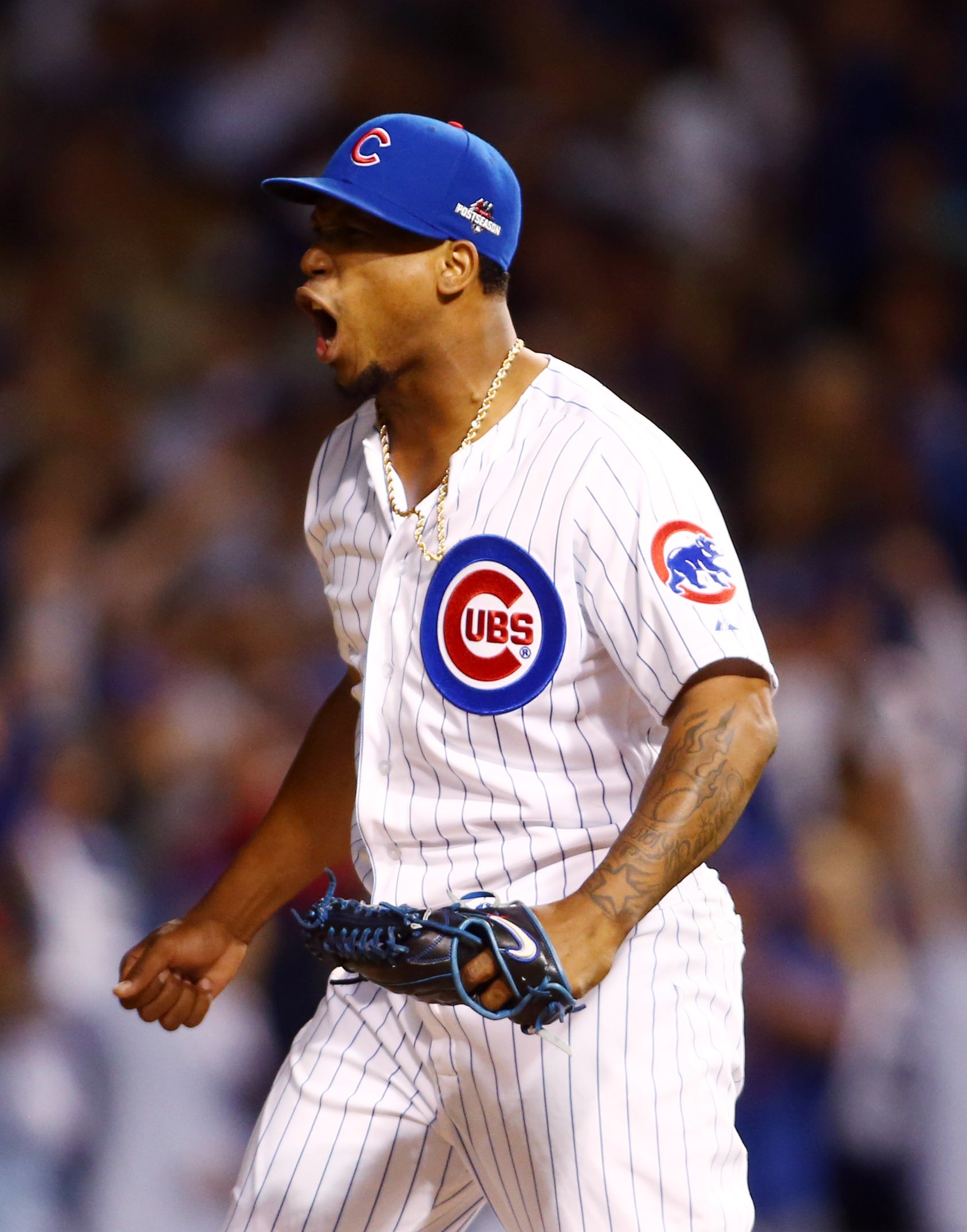
Mark Gonzales of the Chicago Tribune tweets that Strop will be guaranteed $5.85MM in 2018, and the option season is valued at $6.25MM (with a $500K buyout). Paired with Strop’s $5.5MM salary for the upcoming 2017 campaign, the right-hander is now playing on a two-year, $11.85MM deal with a reasonable option for the 2019 campaign. Strop is represented by the Legacy Agency.
The 31-year-old Strop is the oft-unheralded second piece the Cubs received in the 2013 Jake Arrieta heist. But while he doesn’t generate the headlines and fanfare of his Cy Young teammate, Strop has nonetheless been an outstanding bullpen piece for the Cubs since being acquired from Baltimore.
Strop has never posted an ERA north of 3.00 in any of his four years with the Cubs, and he’s worked to an overall ERA of 2.68 in 211 1/3 innings in Chicago. Along the way, he’s averaged 10.8 strikeouts against 3.4 walks per nine innings pitched to go along with a 53.6 percent ground-ball rate and a fastball that has averaged 95.2 mph.
Given that level of excellence, it’s at least somewhat of a surprise to see Strop take a short-term extension when free agency was just around the corner. He’d have landed on the open market in advance of his age-33 season (he’ll turn 32 this June) and hasn’t worked extensively as a closer, so he wouldn’t have been in line for any of the record-setting mega-deals we saw earlier this offseason. However, the market for top-level relief help has become more robust in recent years, and Strop still could’ve had a chance at cashing in on a fairly significant multi-year deal in free agency.
There’s something to be said, of course, for taking a risk-averse approach to financial security, and Strop had earned fewer than $10MM in his career prior to this deal. He did also miss nearly six weeks with a torn meniscus in his left knee last season, and any lingering effects from that injury could have negatively impacted his earning capacity. By signing the new contract, Strop assures himself of an additional $6.35MM while also remaining in an environment where he’s comfortable and knows he has a chance to win over the life of the deal. That last part seems to have been a key factor for the righty, who told reporters that he recognizes he could’ve potentially been viewed as a closer in free agency (Twitter links via Rogers and via Gordon Wittenmyer of the Chicago Sun Times). “I like to win better than roles,” Strop told the media.
Photo courtesy of USA Today Sports Images.
NL East Notes: Wieters, Braves, Locke, Marlins, Tazawa
Matt Wieters‘ deal with the Nationals became official this morning, and the veteran catcher provided some more details on the non-baseball injury that agent Scott Boras alluded to in recent weeks (Twitter links via Chelsea Janes of the Washington Post). Boras noted that Wieters suffered a laceration on his non-throwing arm that required stitches, and Wieters elaborated on the matter, explaining that he dropped a glass water jug on his left forearm/wrist area in early November. The injury held him out of any baseball activity for a sizable 10-week time frame, but it doesn’t seem as though there are any lingering effects.
A few more items pertaining to the NL East…
- Braves general manager John Coppolella sat down with Mark Bowman of MLB.com to discuss the team’s offseason and the GM’s early impressions from the first week of Spring Training. Coppolella noted that he feels the team has better bullpen depth than it’s had at any point in the past four to five years. He noted that if there’s one area that the Braves could still look to make a late addition, it’d be in the form of a bench bat. “That could be a trade or it could end up being somebody in camp right now,” said Coppolella. Notably, Atlanta has been connected to former Braves bench pieces Jeff Francoeur and Kelly Johnson in the past month, both of whom remain available.
- Clark Spencer of the Miami Herald reports that Marlins left-hander Jeff Locke underwent an MRI to examine his left shoulder, though the team is optimistic that there’s nothing seriously wrong with the southpaw. Manager Don Mattingly noted that Locke has been feeling better of late but “was still feeling something” when he played catch yesterday. Outfielder Marcell Ozuna is also nursing some shoulder discomfort, though his situation sounds less concerning; Mattingly said Ozuna is getting “an extra day” before jumping into Grapefruit League play.
- Spencer also notes that the Marlins are still keeping an eye on the market for unsigned starting pitchers, including Henderson Alvarez, Jake Peavy, Colby Lewis and Doug Fister. However, they’re doing so on an “in case of need” basis, suggesting that they won’t add a notable name without an injury or unforeseen issue with a current member of the starting rotation.
- Tim Healey of the South Florida Sun Sentinel writes that Marlins offseason signee Junichi Tazawa is happy to be reunited with Juan Nieves, his former Red Sox pitching coach who now occupies the same role in Miami. As Healey notes, Nieves was Tazawa’s pitching coach for the best two seasons of his career — the 2013 and 2014 seasons. During that time, the righty turned in a 3.02 ERA with 9.3 K/9 against 2.0 BB/9 over the life of 131 1/3 innings. Nieves observed that Tazawa’s arm angle has risen since the two worked together, which could have had an adverse effect on his performance.
Braves Agree To Minors Deal With Former NFL Cornerback Sanders Commings
FEB. 24: Commings received the same $100K signing bonus that Tebow did upon signing his minor league pact with the Mets, tweets Rosenthal.
FEB. 23: The Braves have agreed to sign former NFL defensive back Sanders Commings to a minor league contract, reports Ken Rosenthal of FOX Sports (on Twitter). Rosenthal wrote earlier this month that the former Kansas City Chiefs and University of Georgia corner had interest in pursuing a baseball career as an outfielder.
Commings, who will turn 27 in early March, was a fifth-round pick by the Chiefs back in 2013, though he appeared in just two games with Kansas City in his brief NFL career. He’s no stranger to baseball, having played high school ball in Augusta, Ga., as Rosenthal noted. The Diamondbacks actually drafted Commings in the 37th round back in 2008, but he opted instead to attend Georgia and ultimately pursued a career in football.
Commings is being represented by agent Charles Hairston, the cousin of former Major Leaguers Jerry Hairston Jr. and Scott Hairston. Jerry Hairston lauded Commings’ athleticism and natural baseball acumen when speaking to Rosenthal, telling him that he believes Commings would already be in the Majors had he stuck with baseball for his whole career. Certainly, that’s a bold statement and one that should be taken with a grain of salt from someone who clearly has a vested interest in selling the abilities of the player in question — the Starling Marte comp used by Hairston seems particularly egregious — but it’s also unlikely that Hairston would’ve taken the time to work with a talent that he did not believe had a potential future in the game.
Jerry Hairston and Commings have been working out together five times per week, Rosenthal noted in his column, and Hairston enlisted Class-A Rangers right-hander Collin Wiles to throw to him this winter. Wiles, the former No. 53 pick in the draft (2012), said that he’s been impressed by Commings’ work at the plate as well.
It’s not yet clear exactly where Commings will begin his minor league career. While the odds are certainly stacked against him, and he’ll inevitably draw comparisons to former NFL quarterback Tim Tebow, who is pursuing a baseball career with the Mets, there’s little harm in the big picture for the Braves to roll the dice on Commings’ athleticism.
Nationals Sign Matt Wieters
Matt Wieters‘ lengthy stay on the free-agent market has formally come to a close, as the Nationals announced on Friday that they’ve signed the four-time American League All-Star. Wieters, a client of the Boras Corporation, receives a two-year guarantee that allows him to opt out of the contract after the first season. He’ll reportedly be guaranteed a total of $21MM, with $10.5MM coming in each year of the deal (though $5MM of that sum is reportedly deferred to 2021). To make room for Wieters on the 40-man roster, the Nationals placed minor league first baseman Jose Marmolejos on the 60-day disabled list with a left forearm strain.
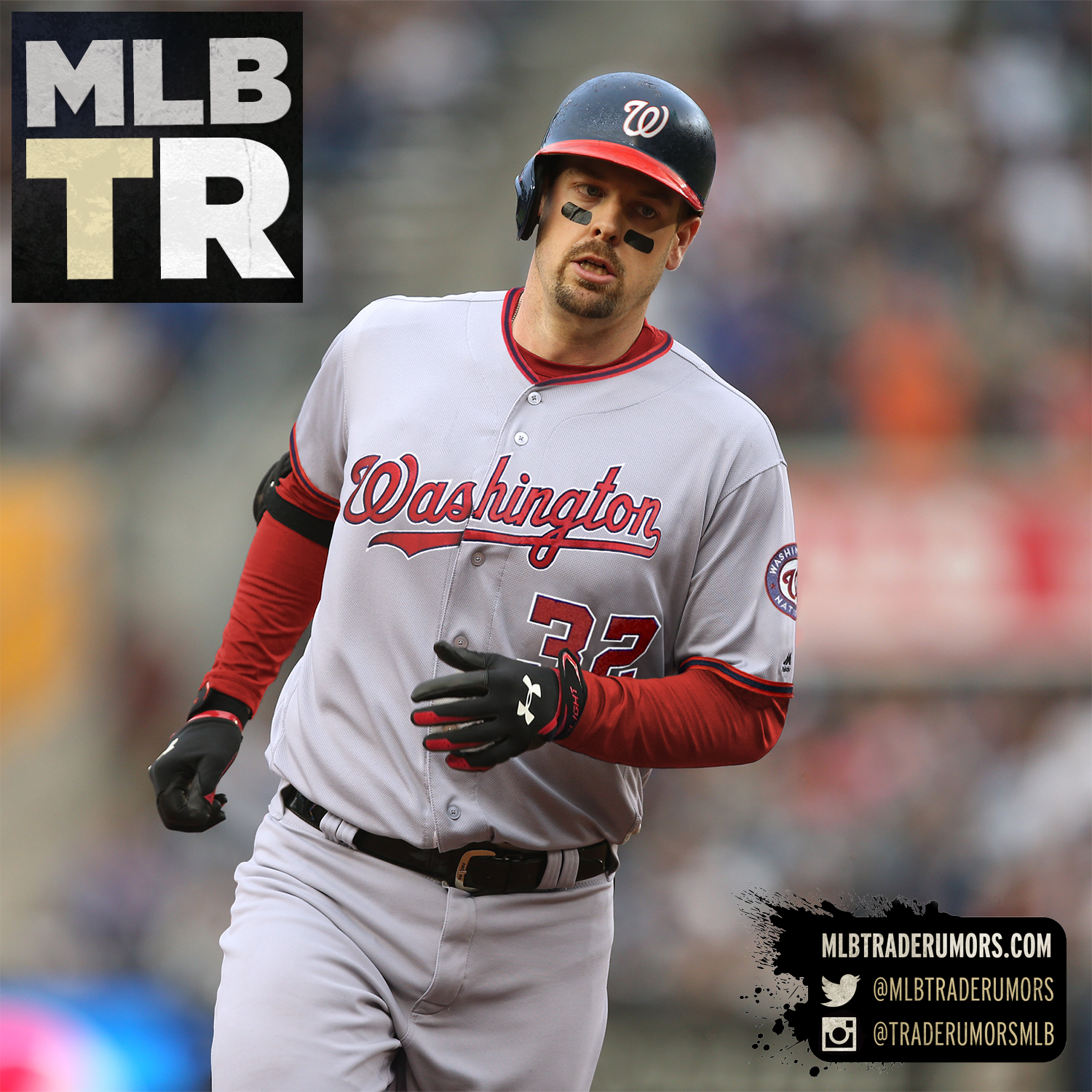
Wieters is the top remaining player on MLBTR’s pre-offseason top fifty list; he checked in at 16th. Though the Nats are already well-stocked with catching options, the switch-hitting Wieters now stands to receive the bulk of the duties behind the dish. He joins Derek Norris — acquired earlier in the offseason — along with holdovers Jose Lobaton and Pedro Severino as catching options in a suddenly crowded mix.
It’s unclear exactly how things could play out for the Nats, but adding Wieters would hold out the promise of upgrading the catching situation while also opening some room for further transactions. Norris and Lobaton are both playing on non-guaranteed arbitration contracts, with the former set to earn $4.2MM in his second-to-last season of control and the latter entering his walk year with a $1.575MM salary. Conceivably, either of those catchers could be moved now that Wieters is on board, though multiple reports have indicated that Norris is the one the Nationals are looking to trade.
[RELATED: Updated Nationals Depth Chart]
The Nats could also consider dealing the younger Severino to address its needs at the back of the bullpen, though it’s far from clear how long Wieters will remain in place and the organization still faces long-term questions at the position. That said, the Nationals do have several other possibilities in the pipeline, including 40-man members Spencer Kieboom and Raudy Read as well as two other top-thirty organizational prospects in Tres Barrera and Jakson Reetz.
The White Sox are clearly willing to trade reliever David Robertson, of course, and could well be interested in a controllable backstop; per ESPN.com’s Jayson Stark, via Twitter, the Chicago organization has been waiting to see if the Nats would land Wieters to “rekindle” talks on Robertson. In addition to Severino, it’s also possible that the White Sox could have interest in Norris, though presumably they’d also be looking for young talent in such a scenario.
ESPN.com’s Jim Bowden tweeted not long before word of the deal broke that Wieters’s agent, Scott Boras, was “meeting with both GMs and owners” and making progress on a deal. The veteran agent has long had a strong connection with the Nats’ ownership and front office group, with the sides working out significant contracts over recent years for players including Max Scherzer, Stephen Strasburg, and Jayson Werth. Young stars Bryce Harper and Anthony Rendon are also repped by Boras, as are lefty Gio Gonzalez as well as recent signees Oliver Perez and Stephen Drew.
Soon to turn 31, Wieters finally returned to regular duties last year with the Orioles after two consecutive injury-plagued seasons highlighted by Tommy John surgery. But after receiving and accepting a qualifying offer last winter, Wieters was allowed to hit the open market following a disappointing season. Over 464 plate appearances, he slashed just .243/.302/.409, though he did swat 17 home runs. Though he has posted stronger offensive campaigns in the past, the veteran owns a league-average lifetime batting mark and has never quite developed into the top-level performer he once promised to be.
There are also some questions on the defensive side of the spectrum. While Boras has sought to push back against Wieters’s poor ratings in the eyes of pitch-framing metrics, his explanation isn’t entirely compelling on its face. That said, Wieters was able to cut down 35% of the runners that tried to swipe bags against him last year, helping to ease concerns over his elbow. And Baseball Prospectus credited him as a strong pitch blocker (subscription link), as it has in years past.
Of course, a fair bit of a catcher’s value lies in the nebulous world of handling a staff and calling pitches, and Wieters has drawn his share of praise in that department. (See, e.g., here.) He does face long-term questions with his sizable frame, though those risks are lessened on a short-term deal such as this. And whether he can return to being at least an average hitter remains to be seen.
All said, then, there’s some risk here, but also the promise of a steady veteran in a key position. None of the Nats’ in-house options, certainly, hold out quite as much hope. Norris has profiled alternatively as a quality hitter who isn’t polished behind the plate, and (more recently) as a power threat that can’t get on base but frames well. Lobaton, clearly, is best suited to reserve duties. And while Severino impressed in brief MLB action last year, and comes with a highly regarded defensive profile, he has yet to reach the .700 OPS barrier in a professional season.
Jon Heyman of FanRag Sports first reported that the two sides were nearing a deal (via Twitter). Joel Sherman of the New York Post (Twitter links) and Heyman (via Twitter) added that Wieters would receive a two-year guarantee with a player option/opt-out clause. Ken Rosenthal of FOX Sports first reported the guaranteed money (via Twitter). Chelsea Janes of the Washington Post first reported the agreement and the deferred money (Twitter links). Jim Bowden of ESPN and MLB Network Radio on SiriusXM added the annual breakdown (via Twitter).
Photo courtesy of USA Today Sports Images.
Carlos Villanueva Signs With KBO’s Hanwha Eagles
The Hanwha Eagles of the Korea Baseball Organization announced on Friday that they’ve signed veteran Major League right-hander Carlos Villanueva to a one-year contract (h/t: Dan Kurtz of MyKBO.net and Jee-ho Yoo of South Korea’s Yonhap News Agency). The ISE Baseball client will earn $1.5MM in his first venture into pro ball overseas. He’ll join former big leaguers Alexi Ogando and Wilin Rosario on the Eagles’ roster for the 2017 campaign.
Villanueva, who turned 33 this offseason, spent the 2016 campaign with the Padres and struggled to a 5.96 ERA in in 74 innings of relief. The veteran swingman did display some more encouraging peripherals, including a 7.4 K/9 rate, 1.7 BB/9 and an 11 percent swinging-strike rate, but interest in the soft-tossing righty (88.1 mph average fastball in ’16) never picked up much steam this winter. In fact, today’s signing marks the first time that Villanueva’s name has been tagged here at MLBTR since inking his one-year deal with San Diego in Jan. 2016.
Prior to his ugly 2016 season, Villanueva enjoyed a terrific year with the Cardinals, during which he logged 61 innings with a 2.95 ERA, 8.1 K/9, 3.1 BB/9 and a 42.4 percent ground-ball rate. That year served as an exclamation point on a nice five-year run that saw Villanueva toss 499 2/3 innings of 4.03 ERA ball while pitching for the Blue Jays, Cubs and Cards. Next year’s crop of free-agent pitchers is superior to the group that hit the open market this year, but a rebound campaign in the hitters’ paradise that is the KBO could either create renewed Major League interest in Villanueva or earn him a more substantial payday overseas in 2018 and beyond.