
Orioles Expect To Increase Payroll
Orioles executive vice president Dan Duquette says the team plans to increase its payroll next season, Eduardo A. Encina of the Baltimore Sun reports. Duquette notes that he still needs to meet with team ownership to discuss the payroll, but he expresses confidence that it will rise.
“The important thing for our fans to know is that we’ve increased our payroll over the last couple years,” says Duquette. “I expect that we’ll be able to increase our payroll because the fans have responded to our team the last couple of years.”
The Orioles will have to deal with arbitration raises for a number of key players, as well as options for Wei-Yin Chen and Darren O’Day. They are likely to buy out their end of Nick Markakis‘ $17MM mutual option, but they’d like to retain him, Encina writes.
Nelson Cruz, Andrew Miller and Delmon Young will be free agents. The Orioles will likely extend Cruz a qualifying offer, and Cruz has said he would like to stay in Baltimore, but Duquette cautions that it will be tricky to keep him. “You can tell just by watching him, he’s the leader of the ballclub,” says Duquette. “Having said that, he came here to have a platform year to get himself re-established to get him a long-term deal and that’s something we will have to consider.”
As Encina points out, the Orioles had an Opening Day payroll of over $107MM last year, then increased it in-season by adding Miller, Alejandro De Aza, Nick Hundley (whose 2015 option they’ll likely decline) and others. Keeping most of their existing talent (including Markakis) will likely force them to go higher than that $107MM figure. They’ve already agreed to an extension with shortstop J.J. Hardy that will pay him $11.5MM in 2015, and Adam Jones and Ubaldo Jimenez will make even more. Chris Davis, who made $10.35MM in 2014, will top the Orioles’ long list of arbitration-eligible players, which also includes Matt Wieters, Bud Norris, Steve Pearce, Tommy Hunter, Brian Matusz, Chris Tillman, Miguel Gonzalez, Zach Britton and De Aza.
West Notes: Daniels, Lewis, Astros, Padres
The Rangers would like to finish an extension with president of baseball operations and GM Jon Daniels by the start of spring training, ESPN Dallas’ Calvin Watkins writes. Daniels is entering the last year of a four-year deal. His contract had been on the back burner as the Rangers looked for a new manager, but with Jeff Banister now in the fold, the Rangers should have more time. “We’ve been consumed for the last month on this, so [Daniels’ extension] will fall in place,” says team co-chairman Ray Davis. Daniels’ teams have played in two World Series and had four 90-plus-win seasons since he was hired in 2005. Here are more notes from the West divisions.
- The Rangers are interested in retaining pitcher Colby Lewis, and Daniels says he’s talked to Lewis’ agent, Anthony Andro of FOX Sports Southwest tweets. The Rangers are the only team allowed to negotiate with Lewis until five days after the World Series. The impending free agent pitched 170 1/3 innings in 2014, and his 7.0 K/9 and 2.5 BB/9 indicated he was somewhat better than his 5.18 ERA suggested.
- The Astros have announced new manager A.J. Hinch’s 2015 coaching staff, as noted by Mark Berman of FOX 26 (on Twitter). Former Mets hitting coach Dave Hudgens will take the same role with the Astros. Rich Dauer, previously the manager of the Double-A San Antonio Missions in the Padres organization, will be Houston’s first base coach. The team also officially announced that Gary Pettis will be their third base coach and Trey Hillman their bench coach.
- The Padres announced a variety of changes in their player development area Friday, Dennis Lin of the San Diego Union-Tribune reports. Randy Smith, who had been vice president for player development, will become a senior advisor for baseball operations, and will focus on scouting. The team will not retain field coordinator Randy Johnson (not the former star pitcher), hitting coordinator Sean Berry or outfield and baserunning coordinator Glen Barker. The Padres could consider Rangers field coordinator Jayce Tingler for their farm director position, Lin notes.
Week In Review: 10/11/14 – 10/17/14
Here’s a look back at this week at MLBTR.
Key Moves
- The Rangers hired Pirates bench coach Jeff Banister as their next manager.
- The Diamondbacks hired Athletics bench coach Chip Hale as their next manager.
- The Rangers informed OF Alex Rios that they will decline his option.
- Infielder Brian Roberts announced his retirement.
Signed
- Rays – P Michael Kohn (link)
Outrighted
- Phillies – INF Andres Blanco (link)
- Twins – INF Doug Bernier, P Yohan Pino (link)
- Dodgers – P Stephen Fife (link)
- Brewers – INF Jeff Bianchi, C Matt Pagnozzi (link)
- Diamondbacks – INF Ronny Cedeno, C Bobby Wilson (link)
Phillies Outright Andres Blanco
Here are the day’s minor moves:
- The Phillies have outrighted Andres Blanco off the team’s 40-man roster, Philadelphia announced. Blanco, a 30-year-old utility infielder, saw just 53 plate appearances on the year in his first MLB action since 2011. He has seen time in seven big league seasons, but never made more than 185 plate appearances in one year. Blanco owns a composite .257/.301/.342 slash across 707 plate appearances.
Offseason Outlook: Atlanta Braves
Last year’s offseason was dedicated in large part to the future, with a series of extensions and key financial moves, but the Braves were well-stocked with talent at the major league level and looked promising to start the 2014 season. After weathering significant pitching injuries early on, however, Atlanta faded badly down the stretch and is now staring at front office changes, a tight budget, difficult decisions, and rising competition in the division.
Guaranteed Contracts
- Freddie Freeman, 1B: $127MM through 2021
- Andrelton Simmons, SS: $56MM through 2020
- B.J. Upton, OF: $46.35MM through 2017
- Craig Kimbrel, RP: $34MM through 2017 (including buyout of 2018 option)
- Julio Teheran, SP: $30.6MM through 2019 (including buyout of 2020 option)
- Chris Johnson, 3B: $23.5MM through 2017 (including buyout of 2018 option)
- Justin Upton, OF: $14.5MM through 2015
- Jason Heyward, OF: $8.3MM through 2015
Arbitration Eligible Players (service time in parentheses; projections via Matt Swartz)
- Kris Medlen, SP (5.137): $5.8MM projected salary
- Jonny Venters, RP (5.000): $1.63MM
- James Russell, RP (5.000): $2.4MM
- Ramiro Pena, UT (4.089): $900K
- Jordan Walden, RP (4.043): $3.0MM
- Brandon Beachy, SP (4.014):$1.45MM
- Mike Minor, SP (3.138): $5.1MM
- David Carpenter, RP (3.016): $1.1MM
- Non-tender candidates: Venters
Free Agents
Other Obligations
- Dan Uggla: $13.2MM
Every organization responds differently when it feels that change is needed, and for the Braves, the sense seems to be that a restoration is in order. John Schuerholz and Bobby Cox are still the most powerful figures in the organization, and Frank Wren’s departure will apparently not be met with a broad search for fresh blood in the GM seat. Interim GM John Hart was offered the post full-time, but it still remains unclear whether that is in the cards. Otherwise, the Braves will seemingly look first (and possibly only) at familiar faces such as assistant GM John Coppolella and former assistant GM (and current Royals GM) Dayton Moore. (Recently-resigned Rockies GM Dan O’Dowd, Hart’s former AGM with the Indians, has also been mentioned as a possibility, though MLB.com’s Mark Bowman tweets that he does not see O’Dowd as a candidate.) The organization has already set out to get the band back together in the scouting arena, bringing back figures such as Roy Clark and Dave Trembley.
The bottom line: Atlanta’s leadership does not believe that its player intake and development system is producing, and that determination seems to be the chief driver at this point. But with the organization ramping up for a critical new ballpark opening in 2017, what does it all mean for the big league club?
The key issue at the MLB level is, as ever, resource constraints. While Atlanta’s talent level remains high, the team has needs. And while last year’s run of extensions look like good investments overall, the Chris Johnson deal aside, they do not leave a ton of payroll flexibility moving forward. (Of course, the alternative would have been to pay bigger arbitration dollars while possibly losing key pieces to free agency down the line.) Last year’s franchise-record $112MM Opening Day payroll, which resulted in the team’s first losing season since 2008, seems unlikely to be repeated. How much spending capacity will remain? The club already has just under $80MM on the books for 2015, and could dedicate as much as $21MM+ if it tenders arbitration contracts to all of its eligible players.
Non-tenders and trades could free some dollars, but that means difficult choices are fast approaching. Qualifying offers must be made within five days of the end of the World Series, while decisions on arb-eligible players are due December 2nd.
A new GM will surely have a key role in determining the path forward, but given the timeline, the organization may well largely know already what it will do with players in those contractual situations. Indeed, as Hart has indicated, the general strategy appears to be in place. “We don’t need an overhaul,” said Hart. “It’s not a disaster. But there are certainly some things we need to take a look [at].” Acknowledging the “economic challenges” facing the team in building out its roster, Hart added that larger moves are likelier to come via trade than signing.
Regardless of how the decisions are made, a key set of issues involves the rotation, where several important pieces require action. To begin, Ervin Santana, Aaron Harang, and Gavin Floyd will be free agents, subject to the qualifying offer process. The former seems a good bet to receive a $15.3MM QO, though that is hardly a clear case given the Braves’ financial limitations. It seems unlikely he would accept, since his downside scenario might be another one-year deal at that level of pay, and Atlanta will surely be tempted by the chance of obtaining draft compensation. The likeliest scenario appears to be that he will receive and reject an offer, and find a new club. Harang, meanwhile, could make sense, but barring a late effort at a new deal he’ll have a chance to test the market. And while another attempt at rehabbing Floyd could in theory take place again in Atlanta, he seems unlikely to open the year in any club’s starting five.
If those three arms move on, the rotation will have just three clear members: Julio Teheran, Alex Wood, and Mike Minor. (In spite of his struggles, Minor has too much ability and makes too much financial sense not to have a clear shot at a role.) David Hale is perhaps the likeliest younger player to be a promotion candidate, though Cody Martin may also get a shot after two solid runs at Triple-A.
Otherwise, the Braves will have to decide how to proceed with the two players whose season-ending injuries led to Santana’s signing last year: Kris Medlen and Brandon Beachy. Both are working back from their second Tommy John procedures, which generally come with longer rehab periods and a lower incidence of successful recovery. Given their 2014 arbitration salaries ($5.8MM and $1.45MM, respectively), a non-tender of the former must at least be considered, though Medlen’s established performance baseline is probably too good to pass up. The team could look to work out a less financially onerous arrangement, possibly including a future option in the manner of the D’backs’ deal with Daniel Hudson. (Note that Medlen would be set to reach free agency after the year.)
Even if Medlen and Beachy have successful rehabs, an Opening Day return seems highly unlikely given that the pair was operated on in mid-March. The team could look at the free agent market for further depth. A Floyd-like bid for Brett Anderson would deliver upside, but may not suit the team’s needs. The likelier outcome, perhaps, would be to bring back Harang (though that could well require a two-year deal) or someone in his mold to bridge the gap and provide depth. Innings-eaters on the market include names like Ryan Vogelsong, Colby Lewis, and Kyle Kendrick.
All said, targeting a starter via trade could make sense for the Braves, as Hart suggested. The club is not without options for dealing from its big league roster. I recently explored the possibility of dealing backstop Evan Gattis, with youngster Christian Bethancourt taking over the regular role. Moving the pre-arb Gattis, however, would not deliver any immediate cost savings – indeed, finding a new backup (or re-signing Gerald Laird) would probably add payroll. While Gattis is probably not enough of an asset to bring back a starter who is both cost-controlled and an established producer, the Braves might find enough of those attributes to make a deal attractive.
If Atlanta really wants to add an arm with significant current and future value, it will likely need to consider parting with one of its quality corner outfielders. Both Jason Heyward and Justin Upton are entering their final year of control, but are young enough that an acquiring team could place significant value on exclusive rights to negotiate an extension. Of course, that pair accounted for a significant piece of the club’s production last year, so the return would have to be substantial. As others have suggested, it could make sense to explore a long-term deal with one or both while also gauging trade interest in a bid to address other areas of need and possibly add a player with more control. Extending one while dealing the other makes some sense, though the ability to pull off that feat will depend upon other actors (the players and prospective trade partners). One interesting possibility noted by MLBTR’s Tim Dierkes would be a swap with the Reds involving Heyward and Johnny Cueto; if both clubs cannot find something else to their liking, such a move might better align with their respective needs in 2015.
Of course, unlike the catching situation, there is no obvious corner outfielder ready to step into a regular role. Among the team’s near-MLB prospects, the best of whom are mostly pitchers, Todd Cunningham is a possibility to take over a slot. But while the 25-year-old improved upon his first go at Triple-A, and is said to be a good defender capable of playing center, he managed only a .287/.347/.406 line with 8 home runs and 19 steals last year at Gwinnett. Other possibilities include a trade of a pitching prospect for an affordable, younger outfielder, a dip into a free agent market that includes names like Norichika Aoki and Alex Rios, or a combination of the above in search of a productive platoon.
Then, there is the fact that the team already has questions in center, where a struggling and expensive B.J. Upton looks nearly immovable. Last we heard, the Braves and Cubs intended to revisit the possibility of a bad-contract swap also involving Edwin Jackson. Otherwise, unless someone like Cunningham delivers a big spring, Atlanta could be forced to put Upton back in the lineup and hope for a turnaround.
The infield, at least, is much more settled. First baseman Freddie Freeman and shortstop Andrelton Simmons are perhaps the only names sure to be written into the Opening Day lineup card, though the rest of the diamond will almost certainly be filled internally as well. Third baseman Chris Johnson is likely to have a chance to return to his 2013 levels, given that his extension does not even kick in until this year, though he may soon be challenged by prospect Kyle Kubitza. And at second, the Braves will wait out the tail end of the disappointing Dan Uggla contract — since he was released, there is no longer any hope of saving any cash — while fielding second-year player Tommy La Stella. Of course, the much-hyped 20-year-old Jose Peraza could become a factor if he continues to impress, though he has taken only 195 plate appearances at the Double-A level.
The bullpen, likewise, seems destined to continue in much the same form as last year. Craig Kimbrel, David Carpenter, Jordan Walden, and James Russell make up a strong back end. And a series of other arms – Anthony Varvaro, Shae Simmons, Chasen Shreve, and Luis Avilan among them – deliver ample depth. Though none of these arms (Kimbrel excepted) will make a large mark on the balance sheet, it is possible to imagine Atlanta dealing from depth to sweeten the pot in a larger trade while potentially freeing up a little bit of extra spending capacity. The team will likely need to try to work something out to keep Jonny Venters; the outstanding 29-year-old lefty is attempting a rare return from a third Tommy John procedure, and his arb price tag looks steep given that he did not even receive his latest UCL replacement until the end of August.
In the end, the Braves continue to be a team with plenty of talent, and it would not be surprising to see a rebound year. But given the financial constraints, the front office’s own seemingly negative take on the talent pipeline, and the looming free agency of Heyward and Upton, Atlanta will need to balance carefully the present with the future. Though dealing away expiring contracts for prospects holds some facial appeal, and the 2017 ballpark opening looms large from a business perspective, Atlanta has not been known to take that tack in the past. Creativity, then, will be the key; but first the front office situation will need to be decided.
Free Agent Profile: Michael Cuddyer
Despite an injury plagued 2014, Michael Cuddyer figures to be amongst the more heavily pursued free agent position players of the winter. The 35-year-old (36 by Opening Day) played in just 49 games in 2014, but his offensive numbers are more in less in line with his 2013 output and there’s always a market for effective bats with some pop. His last trip through free agency netted a three-year, $31.5MM contract and he’s now in position to land yet another lucrative deal.
Strengths/Pros
Over the last three seasons in Colorado (280 games), Cuddyer owns a .307/.362/.525 batting line with 46 homers. His best work in Colorado came in the sandwich year of 2013 when he was NL batting champion with a .331 average at the plate. And, while Coors Field is the most hitter-friendly park in the majors, it wasn’t just the home altitude that helped Cuddyer knock 20 homers and post the NL’s fourth-highest slugging percentage (.530) in that season. The veteran hit eleven homers at Coors and nine dingers on the road in 2013. Meanwhile, his wRC+ (Weighted Runs Created Plus, explained masterfully by Fangraphs here) of 138 was the best showing of his career at the time, putting him well ahead of the league average and 14 percentage points above his previous watermark from Minnesota in 2009. In a smaller sample, he topped that with a wRC+ of 151 this past season.
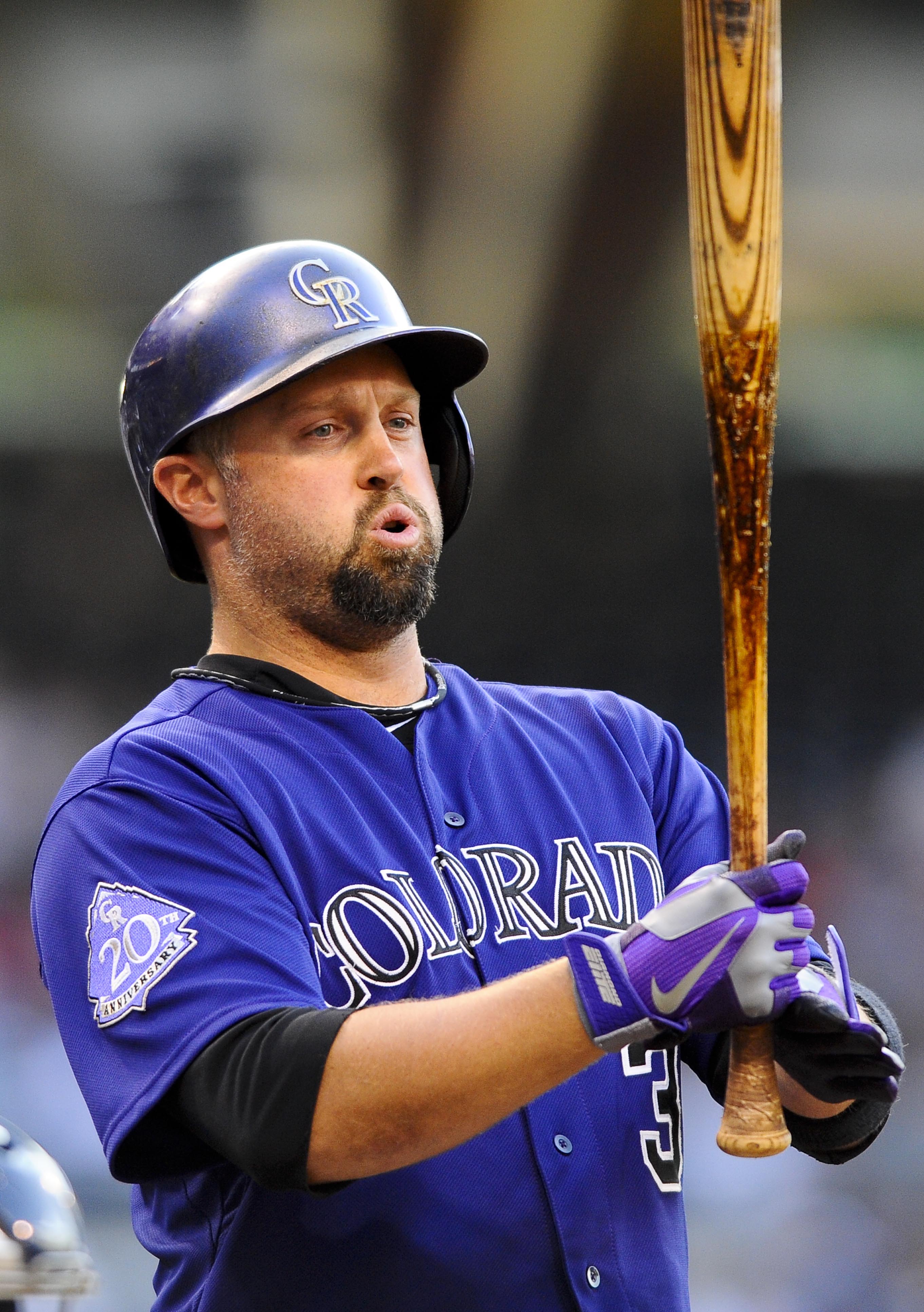 Somewhat surprisingly, Cuddyer consistently posts average or better marks in baserunning value, according to Fangraphs. Cuddyer has a strong career BsR of 8.3 and his recent marks of 0.0, 1.1, and 1.3 in the last three seasons would indicate that he has been at least an average runner. At this point in his career, he’s probably not the fastest guy out there, but the numbers would suggest that he’s smart on the basepaths.
Cuddyer offers some versatility as he could be slotted in as a first baseman or an outfielder. He also won’t have a qualifying offer attached to him and won’t require the forfeiture of draft picks.
Weaknesses/Cons
Cuddyer averaged roughly 150 games per year in his final three seasons with the Twins, which helped lead to his big payday in Colorado. Unfortunately, he’s averaged ~93 games per season since and saw time in just 49 games in 2014. In 2012, an oblique injury cost him the majority of August and all of September. He played 130 games in 2013, but a neck injury shelved him for two weeks in May. Last season, a painful shoulder fracture and a pair of strained hamstrings led to Cuddyer being mostly out of commission. Teams are sure to be wary about that as he approached his age-36 season.
Cuddyer has experience at multiple positions but he’s not Gold Glove material at any of them. For his career, Cuddyer has a -8.0 UZR/150 rating in right field and his -4.4 rating at first base also leaves much to be desired. Unfortunately, Cuddyer’s shaky defense has watered down his significant offensive contributions, especially in recent years. In 2013, despite his strong performance at the plate, he registered a rather pedestrian WAR of 2.4.
Personal
Michael and his wife, Claudia, have three children. When he’s not on the diamond, Cuddyer likes to indulge in his own favorite childhood pastime: magic. In 2012, Jerry Crasnick of ESPN.com asked an audience member for his take on Cuddyer’s skills.
“He’s blowing guys’ minds here,” Jason Giambi said of Cuddyer. “[The tricks] are as good as any I’ve ever seen, and trust me, I live in Vegas and I get to see a lot of those shows. They’re pretty incredible.”
As Cuddyer told Crasnick, he used the tricks as an icebreaker with his teammates when he arrived in Colorado. Then-GM Dan O’Dowd spoke highly of Cuddyer as a positive figure in the locker room.
“Not only is he a good player — and will be for a significantly long period of time — but if you talk to anybody in the game, he innately just ‘gets it.’ He challenges people in his own way to be all about the team,” O’Dowd said.
Market
Cuddyer loves being in Colorado, owner Dick Monfort wants to keep him, and manager Walt Weiss hopes that he’ll return since he “means so much to [the] club, in ways that go beyond the stat sheet.” Unfortunately, monetary constraints will probably get in the way of a reunion. Patrick Saunders of The Denver Post recently wrote that it’d be hard to see the Rockies paying even $4-6MM for Cuddyer next season. You never know for sure how the market will break, but that probably won’t get it done.
The Pirates, Brewers, and Marlins are among the teams that are expected to shop for a first baseman and the Padres could be added to that list if they don’t have confidence in Yonder Alonso‘s abilities. Meanwhile, the Astros and Mets will be shopping for a corner outfielder and Cuddyer could fit within their budgets. Cuddyer also holds appeal as a DH so we could see a return to the American League in that role.
Expected Contract
If Cuddyer was coming off of something resembling a full season, his contract outlook would be quite different. Given his age and health issues, a one or two-year deal seems likely but another three-year deal probably isn’t in the cards.
Still, there will be plenty of teams willing to give Cuddyer a substantial sum of money and it could even rival the average annual value of his three-year, $31.5MM Rockies contract. I predict Cuddyer will land a two-year, $22MM deal this winter. If he stays healthy, it may not be his last big payday either.
Brian Roberts To Retire
Longtime Orioles second baseman Brian Roberts, who spent last season with the Yankees, will retire after a productive 14-year career. Roberts himself broke the news in an appearance on the Steve Gorman sports show on FOX Sports Radio (audio link; h/t to the BaltimoreSportsReport.com). Roch Kubatko of MASNsports.com reports on Twitter that Roberts confirmed his intentions to hang up the spikes.
Roberts, who just turned 37, will always be known for his time in Baltimore. After two years as a solid regular, Roberts broke out with a stellar 2005 season in which he posted 7.2 rWAR and 6.6 fWAR on the back of excellent all-around play. Though he never again reached quite those levels, Roberts was an above-average to excellent performer over each of the next four years.
That track record of consistent production led Baltimore to award Roberts with a four-year, $40MM extension that covered the 2010-13 campaigns. Unfortunately, things turned south the moment the contract began to pay out, as a cascade of injuries conspired to wipe out large swaths of each of his next four campaigns. And Roberts never really regained his form when he was on the field, slashing a meager .246/.310/.359 over just 809 plate appearances during that four-year term.
The ending was not, perhaps, quite what Roberts envisioned when he made the difficult decision to join the Yankees on a one-year deal after spending his entire career in one (rival) organization. He logged 348 plate appearances in New York — somewhat remarkably, the highest annual tally he had managed since 2009 — but slashed just .237/.300/.360 with five home runs and seven stolen bases. He was ultimately released to make room for the acquisition of Stephen Drew.
While it is easy to be distracted by his inability to stay on the field after his age-31 season, Roberts was one of the better players in the game at his peak levels of performance. He logged nearly two-thirds of his career 30.3 rWAR and 28.4 fWAR during that 2005-09 run.
Free Agent Faceoff: Ervin Santana vs. Brandon McCarthy
MLB Trade Rumors is firing up this year’s version of the Free Agent Faceoff series, in which comparable free agents are analyzed side by side. Each post will conclude with a reader vote on the value of the players involved. The first faceoff featured three shortstops. In the second, we’ll look at a pair of starters:
It’s a common consensus this year that the free agent class for starting pitchers has a great deal of separation between the top three starters — Max Scherzer, Jon Lester and James Shields — and the rest of the class. While opinions on the ranking of those three vary (perhaps a topic for another installment in this series!), there’s a cloudier picture when it comes to the second tier of free agents. Most of the pitchers in the second tier come with some form of blemish on their record, be it a checkered injury history, the possibility of a qualifying offer, inconsistent year-to-year results or some combination of the above. Today we’ll take a look at a pair of 31-year-old starters who can each try to make a case that he’s the best among the second tier: Ervin Santana and Brandon McCarthy. (This is, of course, not to say that the “best among the second tier” is specifically limited to these two.)
McCarthy vs. Santana is somewhat of a case of tantalizing upside versus steady and reliable. McCarthy totaled an even 200 innings in 2014 — the first time in his career he’s reached that mark and just the second time in which he’s topped 180 frames. Santana, on the other hand, threw 196 innings and has topped the 200 mark on five occasions in his career. He’s averaged 207 innings per season over the past five years — durability to which McCarthy cannot lay claim.
In four of the aforementioned seasons, Santana has posted an ERA south of 4.00 — bottoming out at 3.24 last season in Kansas City. McCarthy’s best seasons came in 2011-12 with Oakland when he posted a combined 3.29 ERA in 281 1/3 innings. However, those two seasons are the only in which he’s successfully kept his ERA under 4.00.
To this point, the argument seems skewed heavily in Santana’s favor, but McCarthy’s case is certainly not without merit. When looking at the two through a sabermetric lens, McCarthy can be seen as not only the better pitcher, but arguably one of the better pitchers in the league. McCarthy’s 2.86 FIP in 2011 led the league, and a comparison of their marks in ERA (3.81 vs. 3.87), FIP (3.44 vs. 4.19), xFIP (3.43 vs. 3.88) and SIERA (3.60 vs. 3.93) all favor McCarthy. The Yankees were likely drawn to McCarthy’s sabermetric profile this July when trading for him, and that investment paid off handsomely, as McCarthy pitched to a stellar 2.89 ERA with 8.2 K/9 and 1.3 BB/9 in 90 1/3 innings down the stretch.
McCarthy has generated more ground-balls than Santana since buying into sabermetric principles back in 2009, but he took his ground-ball rate to a new level in 2014 (52.6 percent) while Santana regressed in the same area (42.7 percent). Both pitchers possess strong command and can miss bats, but McCarthy has shown better control over the past four seasons while Santana has bested McCarthy in strikeout rate each year. McCarthy’s strikeout rate did jump in 2014, along with his velocity (career-best 92.9 mph average fastball), but Santana’s strikeout rate rose as well (even against non-pitchers in the NL).
Other factors to consider: Santana will pitch all of next season at age 32, while McCarthy won’t be 32 until July. Additionally, Santana is eligible to receive a qualifying offer, meaning he could again come with draft pick compensation attached to his name; McCarthy is ineligible to receive a QO after being traded midseason.
Each player has been on the receiving end of a Free Agent Profile at MLBTR (McCarthy’s penned by me, Santana’s by Tim Dierkes), which provide even more in-depth looks at the pros and cons of each. Use those as you wish to help formulate an opinion before voting…
Which right-hander would you rather sign?
-
Brandon McCarthy 58% (6,767)
-
Ervin Santana 42% (4,933)
Total votes: 11,700
Josh Byrnes A “Leading Candidate” For Dodgers Role
4:55pm: Friedman has spoken with Byrnes about the position, ESPNLosAngeles.com’s Mark Saxon reports. For his part, Friedman declined to address the matter.
As Saxon further notes, Friedman indicated that finding a new farm director to take over for De Jon Watson was the first priority. It remains to be seen, says Saxon, whether longtime scouting director Logan White will stay in place.
12:56pm: Former Padres GM Josh Byrnes is a “leading candidate” to land an executive role that would effectively make him second in command under new Dodgers president of baseball operations Andrew Friedman, reports Jon Heyman of CBS Sports.
Heyman’s sources indicate that Byrnes’ experience is viewed as a plus by Dodgers ownership, and Byrnes’ philosophical view on the game is similar to that of Friedman. They’re also fairly close friends, according to Heyman, though little has been made of that connection in the past.
Former Nationals AGM Bryan Minniti and current Yankees AGM Billy Eppler have been previously considered as candidates but are now far less likely to get the job, Heyman hears.
With the Padres, Byrnes had his share of misses, particularly in terms of contract extensions. Multi-year pacts for Cameron Maybin, Cory Luebke, Nick Hundley, Carlos Quentin and Will Venable certainly haven’t gone as planned, and the first year of Jedd Gyorko‘s extension was a disappointment as well. On the other hand, Byrnes has pulled off several excellent pitching acquisitions. He acquired Tyson Ross from Oakland in exchange for Andy Parrino and Andrew Werner, and this past offseason the trade package he received for Logan Forsythe and Brad Boxberger included Jesse Hahn and Alex Torres. He also picked up Ian Kennedy from the D’Backs in exchange for Joe Thatcher, relief prospect Matt Stites and a Round B competitive balance draft pick.
Rays Name Neander, Bloom VPs Of Baseball Ops
The Rays have promoted executives Erik Neander and Chaim Bloom to the title of vice president of baseball operations. Each longtime member of the Tampa Bay front office had previously served as a director of baseball operations. The team has officially announced the move via press release, though Fangraphs’ Kiley McDaniel tweeted the news earlier today after noting the change on their web site.
In a prepared statement, new Rays president of baseball operations Matthew Silverman had this to say of his two lieutenants:
“Erik and Chaim’s promotions are well deserved as they have been essential contributors to our operation for years. I look forward to working with them in all facets of baseball operations, and I know they will continue to be great leaders of our deeply talented and dedicated department.”
Neander first joined the Rays’ baseball ops department in 2007. The 31-year-old Virginia Tech grad brings an emphasis on player personnel, research and development, per the Rays’ press release. Bloom, also 31, has been with the club since 2005. The Yale grad’s focus is on player development, contract negotiation, international scouting and management of the Major League roster, per the team. In response to McDaniel’s earlier tweet, Jonah Keri of Grantland opined that each of the two rising executives would one day be general manager (Twitter link).
The promotions of Bloom and Neander is the latest shuffle in the Rays’ front office following the departure of GM Andrew Friedman, now president of baseball operations with the Dodgers. The promotion of Bloom and Neander seems to rule out any chance that either would follow Friedman to Los Angeles.