
2022-23 MLB Free Agent Power Rankings: August Edition
A lot has changed since the last edition of MLBTR’s Free Agent Power Rankings. Joe Musgrove, formerly the No. 5 entrant on the list, has since signed a five-year extension with his hometown Padres, keeping him from reaching the market. Willson Contreras, the No. 9 entrant on that edition of the list, was somewhat stunningly not traded at the deadline, meaning he’ll be subject to draft-pick compensation. Jacob deGrom had yet to pitch at that point in the season but has now made a dominant pair of outings in his 2022 debut. More broadly, several players on the list or on the “honorable mention” portion of the list have altered their stock with strong play or faded.
Here’s a look at where things stand, with a reminder that this list is based on what the MLBTR team believes to be each player’s earning power in free agency — not necessarily a ranking of the “best” free agents or who’ll hold up the best over the life of a major free-agent contract.
1. Aaron Judge, OF, Yankees (Last ranked: 1): While plenty has changed since the May 25 version of these rankings, it’s business as usual for Judge, who boldly turned down a seven-year, $213.5MM extension offer back in Spring Training and now looks prescient for doing so. Judge was hitting .314/.386/.692 at the time of our last rankings and has followed that with a remarkably consistent .292/.390/.654 line in 64 games since. Judge is on pace to top Roger Maris’ 61 home runs from the 1961 season, leading the Majors not only in long balls (44) but also runs scored (93), RBIs (98), slugging percentage (.677), OPS (1.068) and wRC+ (196). He’s leading the AL with 122 hits and has even stolen a career-high 11 bases (without being caught).
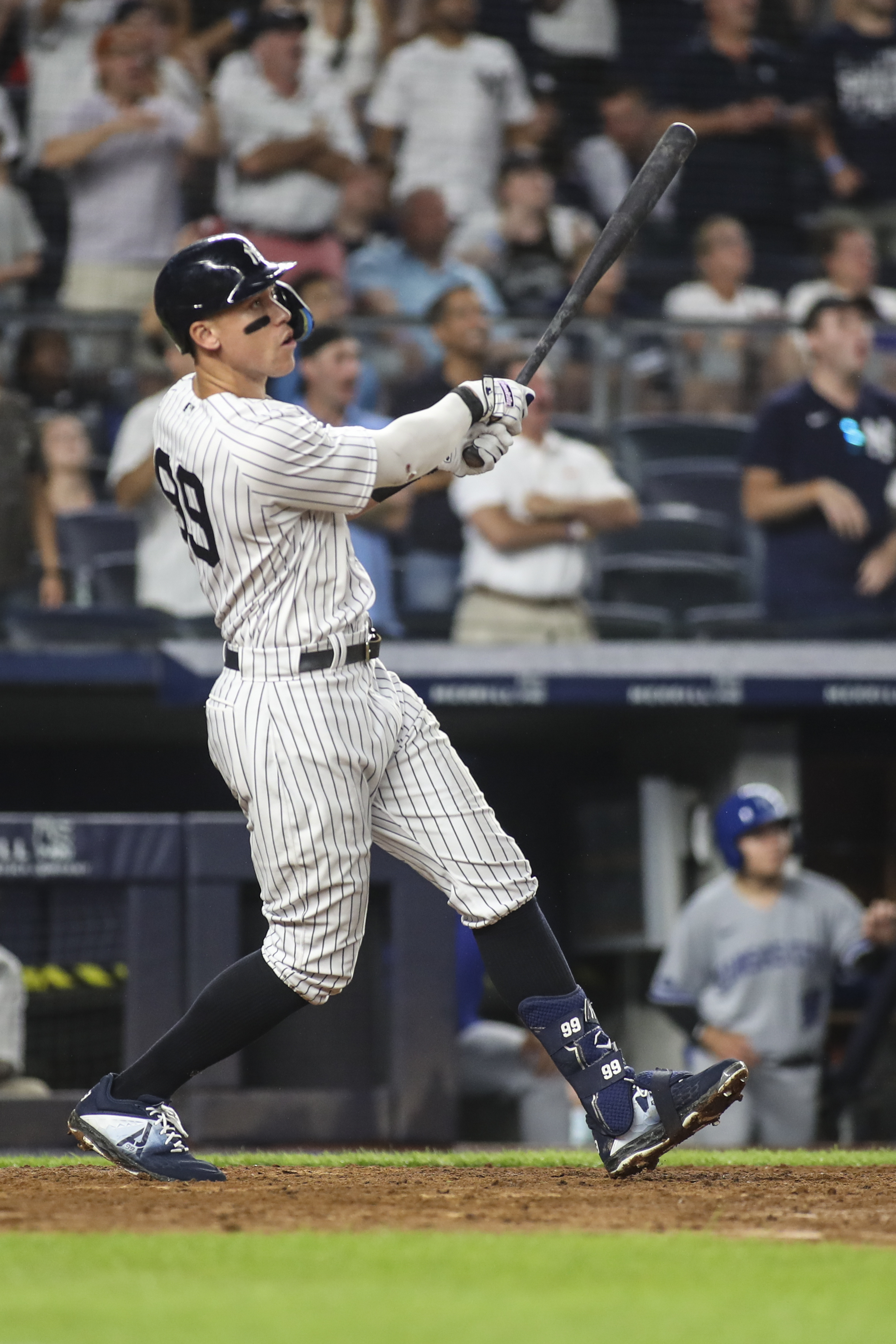
Judge has been the best hitter on the planet since Opening Day, and as things currently stand, the only person who could conceivably stand in his way of winning his first AL MVP trophy would be Angels sensation Shohei Ohtani. However, great as Ohtani has been again in 2022, his offense isn’t quite what it was last year (and isn’t anywhere close to Judge’s league-leading dominance). From a pure WAR perspective, Judge has been so good this year that his value with the bat has eclipsed Ohtani’s combined value at the plate and on the mound.
Regardless, Judge is now poised to reach free agency on the heels of the finest season of his already brilliant big league career. He’ll play the 2023 season at age 31, which is about the only strike against him in free agency. Judge will receive and reject a qualifying offer from the Yankees, and even though he’d be 38 by the end of an eight-year deal, that seems plenty plausible. He could very well command the largest annual salary any position player has ever received, too, and a $300MM overall contract doesn’t seem out of the question. This is what it looks like to bet on yourself and win — in resounding, overwhelming fashion, no less.
2. Trea Turner, SS, Dodgers (LR: 3): There’s not much on the baseball field that Turner doesn’t do well. The 29-year-old is the sport’s fastest player, by measure of Statcast’s Average Sprint Speed, and he’s hitting .305/.345/.499 as of this writing. The 28 home runs he popped in 2021 might very well go down as a career-high, but Turner should finish this year around 25 dingers and has twice in the past hit 19 long balls (including in a 2019 season where he played in just 122 games).
That injury shortened ’19 campaign was the only one in the past half decade in which Turner spent significant time on the shelf. Over the past five years, he’s a .303/.358/.493 hitter who’s made a pair of All-Star teams, won a batting title and taken home a World Series ring.
By the end of a long-term deal, Turner will probably move off shortstop, but he’s a solid option there for now who’d be plenty capable of sliding over to second base at some point. Over the past three seasons, he’s been 43% better than league-average with the bat, by measure of wRC+, and this will be his fourth season of at least four wins above replacement in the past five years — with the 60-game 2020 season, when he boasted 2.8 fWAR and bWAR alike, being the lone exception.
If Turner had been born a day later, next year would technically be considered his age-29 season, but he’ll be 30 on June 30, and the July 1 cutoff is (for whatever reason) generally seen as the arbitrary turning point for a player’s age in a given year. A seven-year deal for Turner would run through age-37, and an eight-year deal through age-38. He’ll have to contend with a qualifying offer and another deep class of shortstops, but Turner is one of baseball’s most well-rounded players and figures to be compensated in line with the game’s 10 to 20 best position players.
3. Nolan Arenado, 3B, Cardinals (LR: 6): It’s difficult to directly compare Arenado’s 2022 season and the 2019 season that propelled Anthony Rendon to a seven-year, $245MM contract, given that Rendon’s Herculean ’19 effort came during the juiced-ball season. Offense is down league-wide now, yet Arenado stacks up favorably in terms of batting average, on-base percentage and slugging percentage. Metrics like wRC+ and OPS+, which weight for both home park and league environment, feel that Arenado’s 2022 production at the plate has actually been slightly better.
Defensively, Arenado is nearly peerless at his position. Since making his MLB debut in 2013, Arenado ranks second among all players, regardless of position, with 151 Defensive Runs Saved, trailing only Andrelton Simmons. He’s third to Francisco Lindor and Nick Ahmed in Statcast’s Outs Above Average, which tracks defensive data dating back to 2016. Arenado’s numbers aren’t inflated by early-career marks, either. He remains elite this season, ranking third in all of MLB in DRS and second in OAA. Defensive metrics and the eye test agree, as Arenado has been a human highlight reel at the hot corner for his decade-long career.
The age gap between 2022 Arenado (31) and 2019 Rendon (29) can’t be ignored. However, that should be more reflected in the length of a theoretical Arenado contract than in the annual value. It’s also, of course, worth noting that Arenado is technically under contract through 2027. He’s guaranteed $144MM in that time but has the right to opt out of the contract after the current season. Arenado forwent an opt-out clause after the 2021 season, but his 2022 campaign is the best of his career.
Even if he’s capped at a five-year deal in free agency, he should be able to trounce the current $28.8MM annual value remaining on his deal by as much as $5-7MM — and a six-year deal doesn’t seem impossible to imagine coming off such a brilliant effort. (Freddie Freeman scored a six-year deal beginning with his age-32 season, so there’s recent precedent.) Perhaps Arenado and the Cardinals will work out a compromise, and it’s always possible he decides he’s happy in St. Louis and just passes on the opt-out entirely. If he does want to test the market again, however, there could be another $20-60MM in earning power for him on top of his current deal.
4. Carlos Correa, SS, Twins (LR: 2): The 2022 season might not have gone quite as well as either Correa or the Twins hoped, but he’s still enjoying a sound all-around year, hitting .265/.343/.433 (22% better than league average, by measure of wRC+). He got out to a slow start in April and has slumped following the All-Star break, but for a three-month stretch from late April to late July, Correa hit .308/.375/.509. Provided the current slump doesn’t last too long, Correa stands a decent chance to be around 30% better than average at the plate for the second straight season and third time in four years.
Last year’s all-world defensive ratings have taken a dip thus far in 2022 — surprising for a player who has generally been a consistent source of elite glovework. He’s made five throwing errors this season, tied for his most since 2016, but Correa has been plenty sure-handed, booting just two balls hit to him. He’s spent the year throwing to Miguel Sano and a pair of makeshift first baseman who’ve converted from other positions (Luis Arraez, Jose Miranda), so perhaps some of the throwing miscues can be forgiven by a team with a better defensive outlook at first base.
If those first couple paragraphs feel like they’re filled with caveats — well, they are. The simple fact is that Correa hasn’t had as strong a season as he did in 2021 and probably shouldn’t be expected to command the type of contract many (MLBTR included) thought to be possible last offseason. That said, Correa still hasn’t even turned 28 — the age at which he’ll play nearly all of the 2023 season. His youth alone gives him the chance to command the longest contract of any free agent this winter; even a 10-year deal would run through age-37.
That type of contract may not be on the table without a huge finish, but Correa is still a plus defender and well above-average hitter with age on his side. It’s perhaps narrowly more plausible that he could opt into a second year with the Twins, take another $35.1MM salary and hope to hit free agency on the heels of a stronger platform in 2023, but his current earning power is still among the best in this year’s free-agent class.
5. Xander Bogaerts, SS, Red Sox (LR: 4): When the last version of our list was published, Bogaerts had homered just four times in 174 plate appearances while posting a below-average .135 ISO (slugging minus batting average). It was easy enough to overlook as little more than small-sample noise at the time, but Bogaerts has hit just five home runs in 267 plate appearances since that time and now has nine long balls and a tepid .141 ISO in 441 trips to the plate. That’s the worst power output we’ve seen from Bogaerts since 2017 by an overwhelming margin. From 2018-21, he belted 90 homers in 2106 plate appearances while turning in a stout .224 ISO.
Bogaerts is still hitting .311/.383/.452 on the season, but he’s also sporting a career-high .382 average on balls in play that he’s not going to sustain — particularly not when his average exit velocity, barrel rate and hard-hit rate are at their lowest or near-lowest levels since 2017.
There’s still no doubt that Bogaerts will opt out of the remaining three years and $60MM on his contract, but he’d be higher on this list if not for his power stroke going MIA. Couple that with ongoing questions about his defense — some teams are surely going to see Bogaerts as a player who needs to move off shortstop, perhaps as soon as 2023 — and the current free-agent outlook is a bit murkier than expected.
Nevertheless, Bogaerts has a long track record of excellent offense and well above-average power output. With a strong finish to the season, particularly in the power department, he should have no problem commanding a notable nine-figure deal — and something in excess of $200MM can’t be ruled out.
6. Jacob deGrom, RHP, Mets (LR: 7): The No. 6 ranking here for deGrom factors in something of a best-case scenario, but this list is based on earning power, after all. If deGrom gets hurt again or struggles down the stretch, it’s possible he’ll drop off the list entirely. The latter of those two scenarios seems unlikely, though, as deGrom hasn’t “struggled” since 2017. He’s been dominant through his first two starts of the 2022 season, averaging 99.2 mph with his fastball and holding opponents to three runs on four hits and a walk with 18 punchouts through 10 2/3 innings.
Dating back to 2018, deGrom has a comical 1.95 ERA in 591 2/3 innings with a 34.9% strikeout rate against a 5.3% walk rate. When healthy, deGrom is simply unmatched in terms of starting pitching dominance over that period. He ranks second among all Major League pitchers with 24 wins above replacement dating back to 2018, per FanGraphs, despite the fact that he’s made only 93 starts in that time. Max Scherzer tops the list but has started 24 more games and logged 143 2/3 more innings — about an extra 75% of a season’s worth of work.
If deGrom finishes the season with no red flags, the bidding should be furious. He’ll turn 35 next June, making him nearly three full years younger than Scherzer was when he secured his record-setting three-year, $130MM deal from the Mets. DeGrom could justifiably look to top that AAV on a multi-year deal, and he’s too good for the bidding to stop at two years. The biggest question surrounding deGrom is just how many years someone will be willing to guarantee. A three-year pact in excess of Scherzer’s seems doable, and a fourth year ought to be on the table as well.
7. Dansby Swanson, SS, Braves (LR: Not Ranked): Long a plus defender at shortstop, Swanson is having another strong year with the glove and a career year with the bat. He’s followed up a career-high 27 home runs in 2021 with a .292/.348/.461 showing through 463 trips to the plate. He’s been the beneficiary of a .375 average on balls in play that he surely won’t sustain over a larger sample, but Swanson is also making hard contact at a career-best 44.7% clip and elevating the ball more than he has in years past.
A greater walk rate than his current 7.3% clip or lower strikeout rate than his 26.3% mark would raise Swanson’s floor, but his glove alone will make him an above-average regular and he’s well on his way to his second straight 25-homer season. Add in that Swanson will play all of next season at 29 years old, and a nine-figure deal seems likely. Both Trevor Story and Javier Baez landed six-year, $140MM pacts last winter at the same age. Swanson will have to contend with a qualifying offer and with some more decorated shortstop options ahead of him on the market, but he’ll be in high demand all the same.
8. Carlos Rodon, LHP, Giants (LR: 8): Rodon was the best pitcher in baseball through late July in 2021, but he was capped to five innings per appearance (at most) down the stretch as he battled shoulder fatigue and diminished velocity. For a pitcher with Rodon’s injury history, that limited interest in him to the point that he took a two-year, $44MM deal with a chance to opt out following the 2022 season — provided he reached 110 frames.
Rodon has not only reached 110 innings — he’s shot past it with career-best velocity (95.8 mph average fastball) and another sub-3.00 ERA (2.95 through 128 1/3 frames thus far). Rodon is averaging just shy of six innings per outing and boasts a 31.2% strikeout rate against a 7.6% walk rate. He’s reached double-digit strikeouts in six of his 22 starts and held opponents to three or fewer runs in 18 of 22 tries.
Rodon’s fastball in his past eight starts is down about one mile per hour over his average from his first 14 starts, but it’s still been a healthy 95.1 mph in that stretch. That said, he threw a complete game on July 9, worked seven shutout innings on July 31, and averaged a resurgent 96 mph with his heater in his most recent outing. At least so far, Rodon doesn’t appear to be fading at all. If he can avoid the type of late swoon he experienced in 2021, he ought to find four- and five-year offers at superior annual values to this contract’s $22MM AAV. He’ll receive a qualifying offer and surely reject it, which isn’t ideal, but he has the best combination of age (30 all of next season) and 2022 performance of any starter on this year’s market.
9. Justin Verlander, RHP, Astros (LR: Not Ranked): Simply returning to make a full season’s worth of starts would’ve been a feat for a 39-year-old who had pitched just six innings since the end of the 2019 season due to Tommy John surgery. Verlander, of course, is no ordinary 39-year-old, and he’s not only returned but positioned himself as a front-runner for the AL Cy Young Award.
It’s a jaw-dropping feat, even for one of this generation’s best. Verlander has a 1.73 ERA with a 25.5% strikeout rate against a minuscule 4.6% walk rate. He’s averaging nearly 6 2/3 innings per start, sitting 95.1 mph with his heater — his second-best mark since way back in 2011 — and has thrown a quality start in 16 of his 20 appearances this year. Verlander hasn’t yielded more than one earned run in a start since June 18 and has held opponents to one or zero earned runs in a stunning 15 of 20 starts.
He’ll turn 40 in February, but Verlander has a legitimate case to break Max Scherzer’s $43.33MM AAV, particularly if he’s looking at a two-year deal. He’s said he wants to pitch into his mid-40s and looks as good as ever, though, so we shouldn’t discount the possibility that a team shrugs and goes to three guaranteed years for this generation’s most prolific workhorse. Verlander unlocked a $25MM player option when he reached 130 innings pitched, but he should be able to crush that in free agency even if he prefers to work out an extension with Houston.
10. Edwin Diaz, RHP, Mets (LR: Not Ranked): It’s been six years since Mark Melancon (four years, $62MM), Kenley Jansen (five years, $80MM) and Aroldis Chapman (five years, $85MM) each set new records for relief contracts in the same offseason. Diaz, the most dominant reliever in baseball this season, will have a chance to topple that Chapman record when he heads into free agency in advance of his age-29 season.
After a nightmarish first season in Queens, Diaz has righted the ship and become a spectacle in the best kind of way. He’s averaging 99.1 mph on his heater this season, has punched out 52.9% of his opponents and has an entrance more befitting of a professional wrestler than a Major League closer.
Diaz’s Baseball Savant profile looks like a video game cheat code. He’s leading the Majors in expected ERA, expected wOBA, expected batting average, expected slugging percentage, strikeout rate, whiff rate and ranks in the 99th percentile in average exit velocity, opponents’ chase rate, opponents’ barrel rate and fastball velocity. Diaz last allowed an earned run on June 18, and in 18 innings since that time he’s posted a 38-to-1 K/BB ratio while yielding just seven hits.
The 2022 version of Edwin Diaz might be the best reliever we’ve seen since Mariano Rivera. He’ll be hit with a qualifying offer, but it’s doubtful the teams pursuing him are going to even care about that. It’d be a surprise if Diaz doesn’t set a new contract record for relief pitchers this winter, and he could be baseball’s first nine-figure reliever.
Honorable Mentions: Brandon Nimmo, Willson Contreras, Jose Abreu, Josh Bell, Chris Bassitt, Nathan Eovaldi, Andrew Benintendi
Twins Reinstate Carlos Correa, Select Jharel Cotton
The Twins announced they’ve reinstated Carlos Correa from the injured list, a bit more than a week after the star shortstop tested positive for COVID-19. Jermaine Palacios, who was selected to the majors as a designated “substitute” once Correa went on the IL, has been returned to Triple-A St. Paul in a corresponding move. Minnesota also selected reliever Jharel Cotton back to the big league club, filling the spot vacated when they designated Juan Minaya for assignment last night.
Correa is back in the lineup tonight against the Yankees, although manager Rocco Baldelli will ease him in with a start at designated hitter. Minnesota’s marquee offseason pickup has overcome a slow start to carry a quality .279/.344/.407 season line into play tonight. He’s only hit three home runs, but the 27-year-old has collected nine doubles and a batting average and on-base percentage well better than the respective .240 and .311 league marks.
The virus absence was the second of the season for Correa, who also landed on the shelf with a bruised finger. That proved a brief stay, one that was welcome after initial x-rays suggested he’d potentially suffered a fracture. Correa has only appeared in 35 of the Twins’ 57 games as a result, but the club has nevertheless built a four-game lead in the American League Central. They’ll hope the two-time All-Star — who can opt out of the final two years and $70.2MM on his deal next offseason — remains in the lineup for good through the summer months.
Palacios picked up eight starts at shortstop in Correa’s absence, struggling in his first look at big league pitching. He heads back to St. Paul, where he’s posted a .262/.325/.376 line through 163 trips to the plate. Palacios will no longer occupy a spot on the 40-man roster, and the Twins weren’t required to run him through waivers because he’d been specifically brought to the big leagues as a virus substitute. He’ll look to earn a more lasting promotion with the Saints.
Cotton followed that path, getting called up just two days after being returned to the minors. The right-hander was selected as a substitute for the players who went on the restricted list for the team’s weekend series in Toronto, but he was taken back off the roster when that group was reinstated on Monday.
This time around, Cotton is earning a more typical promotion to the majors. He’s now longer a substitute, so Minnesota would have to designate him for assignment and try to run him through waivers were they to again look to remove him from the 40-man roster. They’ve already done so once this year, as Cotton was outrighted off the roster last month but accepted an assignment to Triple-A and has worked his way back.
The 30-year-old has appeared in six games for the MLB club this year, tossing 9 2/3 innings of two-run ball with ten strikeouts but six walks. Cotton has had a strong showing in ten outings with St. Paul, allowing four runs in 11 2/3 frames while punching out a third of the batters he’s faced. He rejoins the big league bullpen as a result, taking the place of the struggling Minaya. Cotton is out of minor league option years, so he has to stick on the MLB roster or again be exposed to waivers now that he’s reclaimed a 40-man spot.
Cubs, Phillies Expected To Pursue Marquee Shortstops This Offseason
The most recent offseason featured a huge crop of star free agents, with the five top-tier shortstops being one of the most exciting elements, as Corey Seager, Carlos Correa, Marcus Semien, Javier Baez and Trevor Story all reached the open market at the same time. In about five months’ time, another offseason will begin, and though the crop of available shortstops won’t be quite as strong, it still has the potential to be noteworthy.
MLBTR recently released its first Free Agent Power Rankings for the upcoming winter, and although red-hot outfielder Aaron Judge nabbed the top spot, he was followed by three shortstops in the 2, 3 and 4 slots: Carlos Correa, Trea Turner and Xander Bogaerts. (Correa and Bogaerts both have opt-outs that they are expected to trigger.) In today’s column from Bob Nightengale of USA Today, he reports that the Cubs could be big spenders this winter, naming those three shortstops as their primary targets. “I guarantee you they’re going to get one of them,” an unnamed veteran general manager tells Nightengale, who also says that several executives are predicting the Phillies to be sitting at this table as well.
Cubs manager David Ross recently spoke about letting Nico Hoerner serve as the team’s primary shortstop for the remainder of the year, though he’s also spent a decent amount of time at second base, as well as occasionally lining up at third base and in the outfield. It seems the club may be leaning towards a big addition at shortstop and bumping Hoerner over to second base next year.
After a big trade deadline fire sale in 2021, the Cubs were expected to have a fairly quiet offseason this past winter. However, they surprised many people by making a few somewhat aggressive moves. They didn’t land any of the big five shortstops, though they did give out multi-year deals to Seiya Suzuki, Marcus Stroman and Yan Gomes.
The club is currently sporting a record of 23-31, six games back of the final playoff spot. There’s still time for them to gain some ground, though it’s also possible they go into the trade deadline as sellers this year. But regardless of how they fare for the remainder of this season, they should have spending power this winter. Suzuki is the only player currently under contract for the 2025 season, although the Cubs also have a $7MM club option for David Bote that year. Stroman’s contract runs through 2024, though he can opt out after the 2023 season. Kyle Hendricks and Yan Gomes could also be free agents after 2023, as they have options for 2024.
In short, there’s not a lot preventing the club from making a big splash this winter if they want to. According to Cot’s Baseball Contracts, the team ran out Opening Day payrolls in the vicinity of $200MM from 2016 to 2019, but got that number below $150MM last year and this year. Jason Martinez of Roster Resource pegs their 2023 payroll at $94MM at the moment, then just $50MM in 2024 and $20MM in 2025. Arbitration-eligible players will add to those numbers, but not by a lot. If they want to be aggressive in getting out of this rebuild/retool/whatever period, the opportunity is there.
The Phillies, however, are in a very different situation. They had a very aggressive offseason, giving out big contracts to both Nick Castellanos and Kyle Schwarber, pushing the club beyond the luxury tax line for the first time. Despite that aggressiveness, they’ve struggled over the first third of the season, going into today’s action with a record of 24-29, 4 1/2 games behind the Giants for the final NL Wild Card spot.
There was some speculation that they would dive into the shortstop sweepstakes this past winter, though they ultimately decided to stick with the in-house options of Didi Gregorius and prospect Bryson Stott. Gregorius is currently on the IL due to a sprained knee, but was performing okay before that. His .288/.338/.356 line amounts to a 97 wRC+, slightly below league average but much better than the 68 wRC+ he had last year. Regardless, he’s a free agent after this year, giving the club an opening next year. Stott could theoretically fill that void, though he’s struggled in his first taste of MLB action. Through 27 games, he’s hitting just .157/.222/.217 for a wRC+ of just 26. If the Phils were to go out and nab a big fish in free agency, Stott could spend more time in the minors or perhaps shift over to another infield position to try and force his way into the lineup, having played some second and third base as well.
Despite getting into luxury tax territory this year, the club should be able to be aggressive again next winter with many contracts coming off the books. Martinez puts their 2023 payroll at $129MM, well shy of this year’s $232MM, though that doesn’t include a $17MM option for Jean Segura, the $16MM option for Aaron Nola or salaries for arbitration-eligible players, including Rhys Hoskins. Regardless of whether they can turn their 2022 season around, it seems they may keep their foot on the gas pedal going forward, as they look to snap a postseason drought that goes back to 2011.
Twins Place Carlos Correa On Covid IL
May 31: The Twins announced that Correa has been placed on the Covid-related injured list. Shortstop Jermaine Palacios has been selected to the roster as a substitute player in his stead and will make his Major League debut in Game 1 of today’s doubleheader in Detroit. Minnesota also tabbed righty Cole Sands as the 27th man for that twin bill, and he’ll make the first start of his big league career in Game 2 today.
Palacios, 25, was signed by Minnesota out of his native Venezuela as an amateur free agent back in 2013. The Twins eventually flipped him to the Rays in the 2018 Jake Odorizzi trade with Tampa Bay, but Palacios struggled throughout the bulk of his two-plus years in the Rays organization. Upon being released in the 2020-21 offseason, Palacios returned to the Twins on a minor league deal and placed himself back on the prospect map with a solid 2021 showing. MLB.com currently ranks him 29th among Twins farmhands, while Baseball America tabs him as the best defensive infielder in Minnesota’s system. Palacios hit .259/.340/.439 in Triple-A last year and is off to a .262/.325/.379 start in 2022.
Sands, 24, was the Twins’ fifth-rounder in 2018 and made his MLB debut with a pair of relief outings earlier this season. The Florida State product has had a rough showing in Triple-A so far, albeit in just five starts. He’s widely considered to be among the Twins’ 15 best prospects, thanks largely to a 2.46 ERA and 28.7% strikeout rate in 80 1/3 innings of Double-A ball last year. Sands hasn’t pitched more than five innings in an appearance since April 13, so he may be in for a relatively short outing today. He did toss three scoreless frames in his last Triple-A appearance a week ago.
May 30: Carlos Correa didn’t play in the Twins’ 7-5 loss to the Tigers today, and after the game, Minnesota manager Rocco Baldelli told reporters that it was learned mid-game that the shortstop had tested positive for COVID-19. Correa will be placed on the COVID-related injury list at some point prior to the Twins’ doubleheader tomorrow in Detroit.
There have already been quite a few ups and downs over Correa’s first two months with the Twins, as he also spent 10 days on the regular IL due to a contusion on his right middle finger. Correa also got off to a pretty slow at the plate, but is now hitting a lot more like his usual self, with an overall slash line of .279/.344/.407 with three homers in 154 plate appearances. This works out to a 122 wRC+/123 OPS+, only a little below Correa’s career average.
However, Correa is now sidelined for a minimum of 10 days following a positive COVID-19 test. As per league rules, Correa can make an earlier return if he goes 24 hours without a fever, tests negative twice, and gets approval from three physicians (the Twins team doctor, a league-appointed doctor, and an MLBPA-appointed doctor).
Correa joins Joe Ryan and Gilberto Celestino on Minnesota’s COVID list, one sub-section of an overall injured list that is worryingly long for the Twins. Once Correa is officially added, he’ll be the 13th player on the Minnesota IL, and the club will also be short a few more non-vaccinated players for a series in Toronto on June 3-5.
Former first overall pick Royce Lewis had filled in at shortstop during Correa’s previous IL stint, but Lewis himself was just placed on the injured list today after suffering a bone bruise on his right knee after a collision with the center field wall in yesterday’s game. This leaves utilityman Nick Gordon or regular second baseman Jorge Polanco as the likeliest candidates to cover shortstop in Correa’s absence, and third baseman Gio Urshela also has experience as a shortstop.
Astros Notes: Tucker, McCullers, Pena
Astros outfielder Kyle Tucker has quickly rebounded after a rocky couple weeks to begin the year, hitting .310/.402/.530 over the past month after getting out to a brutal .087/.192/.217 start through his first 13 games. That production only serves as a reminder that the 25-year-old is viewed as a building block in Houston. That fact is also backed up by the team’s apparent efforts to sign Tucker to a long-term extension. Mark Feinsand and Brian McTaggart of MLB.com reported recently that the ‘Stros approached Tucker’s camp about an extension this year but talks proved unsuccessful and are not active at this time (Twitter link).
Tucker confirmed the report when speaking with Chandler Rome of the Houston Chronicle. Tucker tells Rome that he’s open to continued negotiations, whether they take place during the current season or in future offseasons. The former No. 5 overall draft pick noted that he’s controlled through the 2025 season regardless, leaving plenty of time for a deal to come together, though he did voice a preference to “get it out of the way if something does happen, just to not prolong [talks] over a long period of time.” Tucker looked overmatched as a 21-year-old rookie in 2018 but has batted .278/.345/.526 in 1036 plate appearances from 2019-22. He’ll be arbitration-eligible for the first time this winter.
More out of Houston…
- Lance McCullers Jr. hit a milestone in his rehab from a flexor tendon strain in his right forearm, telling reporters that he threw off a mound for the first time yesterday (Twitter link, with video, via FOX 26’s Mark Berman). McCullers prepped for the mound session by throwing from 90 feet on flat ground and then tossed “about ten” pitches off the mound. The righty still didn’t offer a concrete timetable for his return, replying that his next step is to “just continue to build” as restores arm strength and works toward a minor league rehab assignment. McCullers, 28, pitched to a 3.16 ERA with a 27% strikeout rate and 11.1% walk rate in 162 1/3 innings last season in what would’ve been his final year of club control prior to reaching free agency. However, he inked a five-year, $85MM extension to remain in Houston last spring, and the 2022 season is the first year of that new pact. He’s eligible to come off the 60-day injured list in early June, but considering the fact that he hasn’t pitched yet this season and is only just getting on a mound, he won’t be activated when first eligible.
- General manager James Click spoke with Alex Speier of the Boston Globe about his team’s decision to move on from Carlos Correa and entrust the shortstop job to rookie and top prospect Jeremy Pena — a decision he knew might not be universally accepted, given Correa’s popularity in Houston. “[The fans] loved Correa and they wanted to keep him,” said Click. “But we have tried to make it clear to our fans here that our priority is winning. We would love to win and keep everybody together. But sometimes you have to make a difficult decision to move on in order to try to keep that championship window open as long as you possibly can.” Pena has softened the blow by outproducing his predecessor for the time being and slashing .287/.343/.504 with seven homers and quality defense at short.
Twins Option Royce Lewis
Royce Lewis homered and doubled in last night’s loss to the A’s, boosting his slash line through his first 11 big league games to .308/.325/.564 — but the Twins nevertheless optioned him to Triple-A St. Paul last night in order to pave the way for Carlos Correa‘s activation from the 10-day injured list, manager Rocco Baldelli announced after the game (link via Dan Hayes of The Athletic). Baldelli naturally acknowledged that Lewis had made the decision “difficult” with his play and suggested that the Twins will use this run in Triple-A to “move [Lewis] around the field” and “get him a little bit of exposure at some different spots.”
Lewis’ glovework at shortstop has long been a question among scouts, with some viewing a move to the outfield as an eventual necessity. The 22-year-old made a pair of errors in his 99 innings at shortstop but also made several highlight-reel plays in his tiny sample of work. The Twins very likely still view him as a shortstop in the long run, but Correa is arguably the game’s best defender at the position, so Lewis will use a potentially brief run through Triple-A to get his feet wet at other positions while also further honing his skills at short.
Lewis does have some limited experience at other positions but has played exclusively at shortstop in 2022 — his first season of game action since way back in 2019. The 2020 season was lost for all minor leaguers, and Lewis missed the 2021 campaign due to a torn ACL. He logged a dozen games at third base, five in center field and four at second base during the 2019 Arizona Fall League, but he’s never played a position other than shortstop outside that AFL run. That Lewis was able to hit the ground running both in Triple-A and in the Majors after what amounts to more than two years away from game activity is a testament to the upside and talent that prompted Minnesota to select him with the No. 1 overall pick back in 2017.
It’s still undoubtedly a deflating move for Lewis and for Twins fans, even if the move is short-term in nature. Correa, however, will return to the lineup and give the club a premier defensive player and overall MVP-caliber talent whose bat had begun to heat up just prior to the hit-by-pitch that ultimately landed him on the 10-day IL. The 27-year-old is hitting .255/.320/.372 overall but raked at a .412/.444/.588 pace in the nine games preceding his injury.
As for where Lewis will slot in when he does return, the Twins will have multiple options. First base has been the biggest hole in their lineup, with both Miguel Sano and prospect Jose Miranda floundering at the plate. Utilityman Luis Arraez has begun to slot in at first base with more regularity, however, and the Twins surely still have hope that outfielder/first baseman Alex Kirilloff — like Lewis, a longtime top prospect both in the system and in the league as a whole — will right the ship in Triple-A and be able to play a larger role there.
Across the diamond, third base could be a more viable fit. Gio Urshela has made some strong defensive plays but ranks about average with the glove according to most public metrics. He’s also hitting just .226/.280/.330 in 118 trips to the plate — production (or lack thereof) that would eventually jeopardize his place in the lineup even if he were producing outstanding numbers on the defensive side of the coin. Minnesota left fielders, meanwhile, are hitting .236/.294/.341 on the season, due in large part to Kirilloff’s struggles prior to his wrist injury and to Nick Gordon‘s tepid .250/.292/.309 output (most of which has come while playing left field).
Being uncertain where they’ll ultimately slot Lewis back into the mix is the quintessential “good problem to have” for a team. It’ll be worth keeping a keen eye on just where Lewis is lining up across the river in St. Paul, as that could foreshadow some other decisions pertaining to the big league roster. Lewis will technically need to remain with the Saints for at least 10 days now that he’s been optioned, although the Twins can easily get around that minimum by recalling Lewis as the corresponding move for an injury if they see fit.
Twins Place Carlos Correa, Chris Paddack On 10-Day IL; Select Mark Contreras, Jharel Cotton
The Twins announced that shortstop Carlos Correa and right-hander Chris Paddack have been placed on the 10-day injured list today. Correa’s placement (due to a right middle finger contusion) is retroactive to May 6, while Paddack’s placement with right elbow inflammation is retroactive to May 9. Minnesota has selected the contracts of outfielder Mark Contreras and righty Jharel Cotton to replace Correa and Paddack on the active roster.
As reported earlier today, Correa needed more time to recover from the deep bruise suffered in Thursday’s game, and the shortstop hasn’t played since. While Correa may have avoided serious injury, things seem more ominous for Paddack, who has a history of elbow problems. Paddack is still considering his next step, and another surgery hasn’t been ruled out.
Royce Lewis will take over for Correa at shortstop, and Sonny Gray‘s return from the injured list over the weekend means the Twins still have a full five-man rotation (plus Dylan Bundy on the COVID-related IL). Minnesota is still missing a lot of key personnel on the injured list, so to improve that depth, Contreras and Cotton are joining the roster.
Cotton already appeared in two games with the Twins earlier this season, tossing two innings before being outrighted off the 40-man roster. The former top-100 prospect is trying to revive his career after a number of injuries, and after posting a 3.52 ERA over 30 2/3 innings with the Rangers last season, Cotton was acquired by the Twins on a waiver claim back in November.
Contreras was a ninth-round pick for the Twins in the 2017 draft, and the UC Riverside product is now set to make his Major League debut. The 27-year-old didn’t hit much in his first three pro seasons, but after not playing in 2020 due to the canceled minor league campaign, Contreras returned to action with a flourish, hitting well at Double-A and earning a promotion to Triple-A Rochester. Over 497 plate appearances at Rochester over the last two seasons, Contreras has hit .246/.338/.492 with 23 homers, and 17 steals in 23 chances.
Both Contreras and Gilberto Celestino can play all three outfield positions, and Contreras is a left-handed hitting complement to Celestino’s righty bat. Minnesota now has some flexibility with their outfield bench depth behind starters Max Kepler, Nick Gordon, and Byron Buxton, though with Buxton still day-to-day with a minor hip strain, the Twins can’t afford to lose yet another regular (especially a star like Buxton) when they’re already stretched thin.
Twins Expected To Place Carlos Correa On 10-Day IL
With Carlos Correa still hampered by a bruised finger, the Twins are likely to put Correa on the 10-day injured list prior to today’s game against the Astros, The Athletic’s Dan Hayes writes. Correa has missed Minnesota’s last three games, and told Hayes and other reporters on Sunday that returning for today’s game wasn’t a “realistic” scenario.
Since Minnesota didn’t play yesterday, the hope was that Correa would make enough improvement on the off-day to line up a return for later in the week, but it seems like the Twins have just decided to be cautious and send the shortstop to the IL. All things considered, a 10-day IL stint may be the best-case scenario, as there was initial concern that Correa had suffered a fracture.
Former first overall pick Royce Lewis has been handling shortstop duties in Correa’s absence, and will now get to bank more playing time in his first taste of Major League action. While Lewis is more than just a stopgap option, the Twins likely wouldn’t have called him up this soon had the team not been hit with such a swath of injuries. Correa will be the 11th Twins player on the injured list, and Byron Buxton is also day-to-day with a minor hip strain.
Minnesota does have a 40-man roster opening, so the club could fill Correa’s roster spot by selecting the contract of a player in the organization on a minor league contract. Daniel Robertson, Curtis Terry, Elliot Soto, and Jake Cave are some of the names at Triple-A with MLB experience who would need to be added to the 40-man.
Carlos Correa Diagnosed With Bruised Finger, May Avoid Injured List
3:57pm: In excellent news for the Twins, president of baseball operations Derek Falvey revealed to reporters (including Dan Hayes of the Athletic) that the CT scan revealed no fracture in Correa’s hand. He has been diagnosed with a bruise and is day-to-day. Falvey suggested Correa might even avoid the injured list altogether (via Do-Hyoung Park of MLB.com), although he’s dealing with continued soreness and inflammation.
The team is still promoting former first overall pick Royce Lewis to make his major league debut, Falvey said (via Betsy Helfand of the St. Paul Pioneer-Press). Minnesota was planning to promote Lewis in anticipation of an IL stint for Correa. They’ll follow through on the call-up even as Correa remains on the active roster for now.
8:47am: Preliminary X-rays reveal what appears to be a non-displaced fracture in Carlos Correa‘s right middle finger, the Twins announced following the team’s 5-3 loss to the Orioles on Thursday. The star shortstop, who the Twins signed to a shock 3-year, $105.3MM contract this offseason, will undergo a CT scan today to confirm the nature of the injury.
Correa appears to have sustained the injury in the seventh inning while attempting to check his swing against a Bryan Baker change-up. He had also been hit by a pitch in his previous plate appearance (a Spenser Watkins fastball glanced off his left wrist), but the pitch that appears to have caused the injury actually resulted in a ground-out after trickling into fair territory.
If the CT scan confirms the initial diagnosis, Correa shouldn’t require surgery, though it isn’t yet clear how much time he’ll miss. Utility-man Nick Gordon took over for Correa following the injury, but manager Rocco Baldelli (or, while Baldelli is away from the team after testing positive for COVID, bench coach Jayce Tingler) could also turn to Jorge Polanco, which would likely place Luis Arraez in an everyday role at second base. Third baseman Gio Urshela has also logged some time at short in his big-league career, though it’s unlikely he’d be considered more than a short-term option.
Should Correa miss any significant time, the Twins could also turn to top prospect (and top overall pick in the 2017 draft) Royce Lewis, who’s off to a blistering .310/.427/.560 start at Triple-A St. Paul across 103 plate appearances to open the season. The club may not wish to rush Lewis, though, particularly given that until April he hadn’t seen game action — or played above Double-A — since 2019 after tearing his ACL ahead of the 2021 season.
While the Twins will obviously hope to have Correa back as quickly as possible, he has gotten off to something of a slow start in his new uniform. Even after roaring out of the gate in May (1.036 OPS in a four-game sample), Correa’s 2022 .264/.323/.385 batting line falls well short of his career triple-slash of .276/.355/.478, particularly in the power department. Given the likelihood that he’ll opt out of the final two years of his deal at the end of the season (even after signaling that he’s open to a long-term deal in the Twin Cities), the first-place Twins will hope to see him return to the field — and revert to form — sooner than later.
Correa Open To Long-Term Deal With Twins
The common consensus when Carlos Correa signed a surprising three-year, $105.3MM contract with the Twins was that he’d take his opt-out clause at the end of this season and re-enter the market. However, Correa recently spoke with Ken Rosenthal of The Athletic and revealed that he’s already expressed to Twins president of baseball operations Derek Falvey, general manager Thad Levine and manager Rocco Baldelli that he would “love” to sign a longer-term deal.
“I told ‘em, ‘Hey guys, I know I have the opt-outs in the contract. But I really like it here,'” Correa tells Rosenthal. “I love the people here. I love the way I’m treated here. … I would love to have a long-term relationship here if that’s what you guys would like.” Correa adds that his wife already feels “right at home” in Minnesota and that he’s been energized by his teammates, specifically lauding the scalding-hot Byron Buxton as well as the overall win-now temperament throughout the clubhouse.
On the one hand, it’s hardly a surprise to see Correa express a willingness to sign a lengthy contract. He hit the open market this past offseason seeking a contract of at least 10 years in length and only pivoted to the three-year, opt-out-laden deal with the Twins after he did not find a longer-term deal to his liking. Any player would surely “love” to sign a long-term deal of the magnitude Correa sought in free agency. (The Tigers reportedly offered Correa a 10-year deal worth $275MM with multiple opt-out opportunities, but he was said to be seeking a deal north of $330MM.)
On the other hand, it’s also common for players to decline to discuss contractual matters during the season. We regularly see players who are on the cusp of free agency set Opening Day deadlines for a new contract because they prefer not to negotiate during the season. As a newly signed free agent, Correa is in a different boat than, say, Aaron Judge, who did not agree to terms on a long-term deal with the Yankees before his own Opening Day deadline, but it’s nevertheless of at least some note that Correa is publicly expressing a desire to stay put. He’d hardly have been the first player to simply decline to discuss the matter when asked and instead say he’ll think about that after the season.
From the Twins’ side of things, Falvey declined to delve into specifics but said that even when signing Correa to his three-year deal, the organization’s hope was that the shortstop would find Minnesota to his liking and hope to stay long-term. “I certainly expect we’ll maintain open lines of communication with both Carlos and [agent Scott Boras],” Falvey added.
There’s no getting around the fact that Correa is out to a poor start. It’s only 59 plate appearances, but Correa is hitting .192/.288/.288 with a homer and a pair of doubles. Statcast feels he’s been unlucky based on his huge 92.4 mph average exit velocity and a sky-high 58.8% hard-hit rate, but that “bad luck” only applies when Correa actually puts the ball in play. He’s doing that less often than ever, with a 30.5% strikeout rate that’s nearly 10 percentage points higher than his career 20.7% mark. Statcast credits him for an “expected” .230 average and .394 slugging percentage, but he’ll need to curb the strikeouts if he’s to return to his prior levels of production.
For his part, Correa made clear that he’s not concerned. The former Rookie of the Year, All-Star and 2021 Platinum Glove winner said he’s struggled to find his swing in April in the past, and a look at his career splits does reflect, to an extent, that he’s been more productive in subsequent months. That said, Correa has a career 123 wRC+ in March/April that towers over his current 77. Baldelli noted that Correa received fewer than half the spring plate appearances he might’ve in a normal year — a reflection both of the truncated Spring Training schedule and Correa’s own late signing.
Assuming Correa eventually rounds into form at the plate and that the Twins indeed have a desire to keep him longer-term — Baldelli raved to Rosenthal about Correa’s presence in the clubhouse and leadership traits — the question becomes one of whether they can comfortably make such a commitment. Signing Correa would likely require an unprecedented commitment for the franchise, given that the largest contract ever issued by the Twins was Joe Mauer‘s eight-year, $184MM pact. That contract came with a unique set of circumstances, as Mauer was a former No. 1 overall pick and St. Paul native who’d just been named American League MVP in 2009 — the final season at the Metrodome before the Twins moved into a new, largely publicly funded stadium, Target Field. The public relations impact of letting Mauer walk as a free agent after the 2010 season would’ve been overwhelming; that’s not the case with Correa, whom many fans expect to opt out and sign elsewhere next winter.
Still, you’d be hard-pressed to claim the Twins “can’t afford” to keep Correa, if the front office and Boras can agree on a structure. Minnesota’s payroll this season is a franchise-record $138MM, per Roster Resource’s Jason Martinez, and the Twins only have $76MM in guarantees on next year’s books. Correa’s $35.1MM salary accounts for nearly half that sum. By 2024, the Twins have just $54.5MM on the books — again, with Correa representing a major portion of that figure. Beginning in 2025, the Twins only have a bit more than $18MM on the books.
Over the long-term, Buxton’s seven-year, $100MM contract is the only major commitment the Twins have. He’ll earn a $15MM base salary on that deal from 2023-28, though that figure can jump by as much as $10.5MM annually based on total plate appearances and MVP voting. Still, even in a year where Buxton were to max out that figure, he’d only do so by staying healthy and winning an MVP Award. The Twins would happily pay $25.5MM in that scenario, and even pairing that with a hefty annual salary for Correa, the combined $55-60MM would be a fraction of the team’s overall spending. It doesn’t seem likely that the Twins will be running $200MM payrolls anytime soon, but it’s also reasonable to project some modest increases over this year’s $138MM mark.
The Twins would need to fill out the roster beyond those two players, of course, but they’re bullish on a crop of young pitching headlined by Opening Day starter Joe Ryan, to say nothing of young arms like Bailey Ober, Josh Winder and Jhoan Duran, all of whom are already in the big leagues. Prospects Jordan Balazovic, Simeon Woods Richardson, Louie Varland, Cole Sands and others aren’t expected to be far behind, and slugging infielder Jose Miranda ought to make his MLB debut at some point in 2022 as well. Signing Correa would perhaps block top infield prospects Royce Lewis and Austin Martin, but both have experience playing multiple positions. Not all of those players will emerge as contributors, but it’s easier to stomach a long-term, near-market-value deal when expecting an influx of cost-controlled young talent to help fill out the roster.
It’s still difficult to imagine the Twins ponying up with this kind of commitment, if only for the simple reason that they’ve just never spent at this level in the past. There’s a strong likelihood Correa will be back on the market after the season. That said, it was also difficult to imagine the Twins handing out a $35.1MM annual salary to Correa in the first place, and that contract at least changed some expectations and made a larger deal seem slightly more plausible. It’d still register as a surprise, but it’s easier to take the “never say never” tack now that the Twins have already pulled off one Correa stunner.
Fans intrigued by the situation will want to check out Rosenthal’s column in full, as it’s rife with detailed quotes from each of Correa, Falvey, Baldelli and Boras regarding the possibility of Correa extending his stay in Minnesota. There’s no indication that talks will happen anytime soon, but the Twins were active on the in-season extension front last year when trying to hammer out Buxton’s long-term deal prior to the trade deadline. A larger deal for Correa could be even more complicated, but all parties seem open to the idea.