
Julio Rodríguez Tops 2023 Pre-Arb Bonus Pool
Mariners center fielder Julio Rodríguez will receive $1,865,349 from the $50MM bonus pool for pre-arbitration players, the highest of the 2023 recipients, per a report from Ronald Blum of the Associated Press. The AP later released a full list of bonus recipients.
A notable new element of the current collective bargaining agreement is that $50MM is to be taken from central revenues annually and distributed to players that have not yet qualified for arbitration. Certain portions of the money are to be based on awards voting:
- Rookie of the Year: $750K for first place, $500K for second place
- MVP and Cy Young: $2.5MM for first place, $1.75MM for second place, $1.5MM for third place, $1MM for fourth or fifth place
- All-MLB: $1MM for being named “First Team,” $500K for being named “Second Team”
As Blum highlights today, a player is eligible to receive the bonus for one of those achievements per year, earning only the highest amount. Rodríguez finished fourth in American League MVP voting, meaning he got $1MM for that, which accounted for the majority of his payout. After the bonuses, the remainder of the pool is divided on a percentage basis among the top 100 players based on the joint MLB/MLBPA-created version of WAR.
Players are still eligible even if they have signed extensions, as long as they would have been pre-arb without signing such a deal. Rodríguez and the Mariners signed a convoluted extension towards the end of his rookie season in 2022 but he’s only at two years of service time now. Since he would have been pre-arb without that extension, he was able to top this year’s pool.
The following 10 players got more than $1MM:
- Rodríguez: $1,865,349
- Corbin Carroll: $1,812,337
- Adley Rutschman: $1,798,439
- Spencer Strider: $1,692,833
- Justin Steele: $1,673,331
- Kyle Bradish: $1,666,786
- Félix Bautista: $1,467,094
- Gunnar Henderson: $1,428,001
- Jonah Heim: $1,060,306
- Tanner Bibee: $1,016,931
Last year, Dylan Cease got the biggest slice of the 2022 pie, taking home $2,457,426.
Corbin Carroll Wins National League Rookie Of The Year Award
Diamondbacks outfielder Corbin Carroll has won the National League Rookie of the Year award, the Baseball Writers Association of America announced. Mets right-hander Kodai Senga came in second while Dodgers outfielder James Outman placed third.
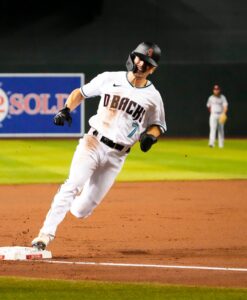 Carroll was selected to Arizona’s roster in late August of last year, allowing him to get a taste of the majors but without exhausting his rookie status. He fared extremely well in that audition, hitting .260/.330/.500 in his first 115 plate appearances for a wRC+ of 131, indicating he was 31% better than the league average hitter in that time. The D’Backs felt confident enough in Carroll based on that showing, and his work as a minor leaguer, to give him an eight-year extension with a guarantee of $111MM.
They were hoping he would be an integral part of the club and help them make the postseason for the first time since 2017. He went on to have an incredible showing in his first full season in the majors, hitting 25 home runs and stealing 54 bases. His .285/.362/.506 line led to a 131 wRC+ and he also got strong grades for his outfield defense. He produced 6.0 wins above replacement in the eyes of FanGraphs while Baseball Reference had him at 5.4. The club did indeed break their postseason drought, snagging a Wild Card spot and eventually going all the way to the World Series.
While the award is surely thrilling for Carroll and the Snakes on its own, there are other implications of Carroll taking the trophy. The new collective bargaining agreement contains measures designed to combat service time manipulation through the prospect promotion incentive, or PPI. Top-two Rookie of the Year finishers who were Top 100 prospects on at least two preseason lists at Baseball America, ESPN and MLB Pipeline are automatically credited with a full service year. That won’t apply to Carroll, who was up all year and earned a full service year regardless, though he was the #2 prospect on all three of those lists. Gunnar Henderson, who got the AL trophy today, was #1.
But players with PPI status can also earn extra draft picks for their clubs if they have less than 60 days of service time to start the season and earn a full service year the traditional way, as Carroll did, while also appearing on those preseason prospect lists. Players in that camp who finish in the top two in Rookie of the Year voting or top three in Cy Young or Most Valuable Player voting during their pre-arbitration seasons earn a bonus pick after the first round for their club. That means the Diamondbacks, who are already loaded with young talent, will get a valuable extra pick in next year’s draft.
Senga also had a strong season, his first after coming over from Japan. He made 29 starts for the Mets with a 2.98 earned run average, 29.1% strikeout rate, 11.1% walk rate and 44.7% ground ball rate. Players considered by MLB to be foreign professionals, as Senga is, aren’t eligible to earn PPI picks for their clubs. Outman also had a solid campaign, hitting 23 home runs and stealing 16 bases. He struck out in 31.9% of his plate appearances but offset that somewhat by walking at a 12% clip. His .248/.353/.437 batting line led to a wRC+ of 118 and he also graded out well in the field. He wasn’t considered a top 100 prospect coming into the year and wouldn’t have qualified for a PPI pick even if he surpassed Senga for second place.
The voting was unanimous, per the vote tally at BBWAA, with Carroll getting all 30 first-place votes. Senga got 22 second-place votes and Outman got five. Other players getting votes were Nolan Jones of the Rockies, Eury Pérez of the Marlins, Patrick Bailey of the Giants and three Reds: Matt McLain, Spencer Steer and Elly De La Cruz.
Image courtesy of USA Today Sports.
NL West Notes: Freeland, Jameson, Corbin, Ohtani, Dodgers
Rockies southpaw Kyle Freeland suffered a dislocated right shoulder while making a diving attempt at a Brett Wisely bunt in today’s 1-0 loss to the Giants. Freeland was in obvious pain on the field, and told reporters (including Patrick Saunders of the Denver Post) afterwards that “that was one of the worst feelings I’ve had, pitching-injury-wise.” An MRI tomorrow will check for any further damage, but perhaps the one plus is that the dislocated shoulder quickly went back into the socket, as Freeland said x-rays were taken to examine the shoulder and rule out any broken bones.
A trip to the 15-day injured list is certainly coming for Freeland following the All-Star break, and it remains to be seen how long he’ll be sidelined, though it at least helps that his pitching arm wasn’t injured. Freeland has a 4.72 ERA and the Statcast numbers aren’t fond of his work, but perhaps his the most important statistic for the season is a team-leading 103 innings. With so many Colorado pitchers already being lost to injuries this season, Freeland’s durability had been a positive for the club, but now the left-hander is himself looking at a substantial stint on the IL.
More from around the NL West…
- Diamondbacks right-hander Drey Jameson is receiving second opinions about the elbow problem that saw him moved to the 60-day IL yesterday, manager Torey Lovullo told reporters (including the Arizona Republic’s Theo Mackie). Lovullo said that “something’s going on” with Jameson’s UCL, and “there’s stuff there that needs to be thoroughly looked at before we can start to make a firm judgment” on a next course of action. The worst-case scenario of a Tommy John surgery would keep Jameson out of action for at least 12 months and could threaten his availability for any of the 2024 season. The 25-year-old Jameson is one of Arizona’s more intriguing young arms, and he has a 2.63 ERA working as both a starter and a reliever over 65 career MLB innings in 2022-23.
- Sticking with the Diamondbacks, Corbin Carroll‘s quick emergence as a star has made the club look brilliant for taking him 16th overall in the 2019 draft, and Nick Piecoro of the Arizona Republic writes about some of the factors that went into both the Snakes’ selection and why Carroll was still available in the middle of the first round. Carroll’s relatively small size (5’10”, 165 pounds) and doubts about his ability to hit for power turned off some teams, and since Carroll was playing high school ball in the Pacific Northwest, there were some questions about the quality of competition he was dominating. D’Backs assistant GM Amiel Sawdaye admitted that he didn’t think Carroll had the kind of power potential he’s shown in the majors, but “we’re not afraid to take shorter players. [Good players] come in different sizes. There is a difference between being short and being small. Short and strong is good. It’s great to be a hitter if you’re short and strong.”
- Shohei Ohtani has long been on the Dodgers‘ radar, both when he was a high school player and when he first make the jump from NPB to the majors. Jorge Castillo of the Los Angeles Times writes about the Dodgers’ interest in Ohtani, which was first hampered when the Nippon-Ham Fighters convinced him to stay in Japan by letting him be a two-way player. When Ohtani came to the majors, the Dodgers missed out again because the National League didn’t have the DH available, whereas the Angels could offer Ohtani a two-way opportunity via the designated hitter role. With Ohtani set for free agency this winter, there is a widespread belief among many in the game (including several anonymous agents and rival executives) that the Dodgers will end up landing Ohtani to what is expected to be a record-setting contract.
MLB Announces 2023 All-Star Rosters
The starters for the 2023 All-Star Game were already announced earlier this week, and today the league revealed the reserve selections and the pitching staffs for the National League and American League teams. Fan balloting determined the game’s starters, while the reserves and pitchers were picked by a combination of the player ballot and selections from the league office.
This won’t be the final list of players involved, as some more substitutions will be announced later for players who are injured or who have opted not to participate. Every team must have at least one player represented at the Midsummer Classic, and the starting pitchers for the game will be announced on July 10.
Of note, Shohei Ohtani will be in the game as both a DH and as a pitcher for the third consecutive season. The Braves led all teams with eight All-Stars, while the Rangers weren’t far behind with six players chosen. This year’s All-Star Game takes place in Seattle on July 11.
National League
- Catcher: Sean Murphy, Braves
- First Base: Freddie Freeman, Dodgers
- Second Base: Luis Arraez, Marlins
- Third Base: Nolan Arenado, Cardinals
- Shortstop: Orlando Arcia, Braves
- Outfield: Ronald Acuña Jr., Braves
- Outfield: Corbin Carroll, Diamondbacks
- Outfield: Mookie Betts, Dodgers
- Designated Hitter: J.D. Martinez, Dodgers
- Pitchers: Alexis Diaz/Reds, Camilo Doval/Giants, Bryce Elder/Braves, Zac Gallen/Diamondbacks, Josiah Gray/Nationals, Josh Hader/Padres, Mitch Keller/Pirates, Clayton Kershaw/Dodgers, Justin Steele/Cubs, Spencer Strider/Braves, Marcus Stroman/Cubs, Devin Williams/Brewers
- Position Players: Ozzie Albies/Braves, Pete Alonso/Mets, Nick Castellanos/Phillies, Elias Diaz/Rockies, Lourdes Gurriel Jr./Diamondbacks, Matt Olson/Braves, Austin Riley/Braves, Will Smith/Dodgers, Jorge Soler/Marlins, Juan Soto/Padres, Dansby Swanson/Cubs
American League
- Catcher: Jonah Heim, Rangers
- First Base: Yandy Díaz, Rays
- Second Base: Marcus Semien, Rangers
- Third Base: Josh Jung, Rangers
- Shortstop: Corey Seager, Rangers
- Outfield: Randy Arozarena, Rays
- Outfield: Mike Trout, Angels
- Outfield: Aaron Judge, Yankees
- Designated Hitter: Shohei Ohtani, Angels
- Pitchers: Felix Bautista/Orioles, Yennier Cano/Orioles, Emmanuel Clase/Guardians, Luis Castillo/Mariners, Gerrit Cole/Yankees, Nathan Eovaldi/Rangers, Kevin Gausman/Blue Jays, Sonny Gray/Twins, Kenley Jansen/Red Sox, Michael Lorenzen/Tigers, Shane McClanahan/Rays, Shohei Ohtani/Angels, Framber Valdez/Astros
- Position Players: Yordan Alvarez/Astros, Bo Bichette/Blue Jays, Adolis Garcia/Rangers, Vladimir Guerrero Jr./Blue Jays, Austin Hays/Orioles, Whit Merrifield/Blue Jays, Salvador Perez/Royals, Jose Ramirez/Guardians, Luis Robert Jr./White Sox, Brent Rooker/Athletics, Adley Rutschman/Orioles
MLB Announces 2023 All-Star Starters
Major League Baseball announced the starting lineups for the 2023 All-Star Game this evening. This year’s All-Star Game will take place at Seattle’s T-Mobile Park on July 11. The starting pitchers and reserves will be announced at a later date.
American League
- Catcher: Jonah Heim, Rangers (1st selection)
- First Base: Yandy Díaz, Rays (1st selection)
- Second Base: Marcus Semien, Rangers (2nd selection)
- Third Base: Josh Jung, Rangers (1st selection)
- Shortstop: Corey Seager, Rangers (4th selection, 2nd consecutive)
- Outfield: Randy Arozarena, Rays (1st selection)
- Outfield: Mike Trout, Angels (11th selection, 11th consecutive)
- Outfield: Aaron Judge, Yankees (5th selection, 3rd consecutive)*
- Designated Hitter: Shohei Ohtani, Angels (3rd selection, 3rd consecutive)
National League
- Catcher: Sean Murphy, Braves (1st selection)
- First Base: Freddie Freeman, Dodgers (7th selection, 5th consecutive)
- Second Base: Luis Arraez, Marlins (2nd selection, 2nd consecutive)
- Third Base: Nolan Arenado, Cardinals (8th selection, 8th consecutive)
- Shortstop: Orlando Arcia, Braves (1st selection)
- Outfield: Ronald Acuña Jr., Braves (4th selection, 4th consecutive)
- Outfield: Corbin Carroll, Diamondbacks (1st selection)
- Outfield: Mookie Betts, Dodgers (7th selection, 7th consecutive)
- Designated Hitter: J.D. Martinez, Dodgers (6th selection, 5th consecutive)
* Currently on injured list with sprained toe
Corbin Carroll Leaves Game With Left Knee Contusion
Corbin Carroll suffered a left knee contusion while colliding with the wall during a catch attempt in tonight’s 11-4 Diamondbacks victory over the Rockies. In the sixth inning, Carroll leapt to try and catch a Ryan McMahon fly ball, but both jumped and landed at an awkward angle, as McMahon’s hit ricocheted off the wall for what ended up as an RBI double. Carroll was visited by team trainers and left the field under his own power, though looked to be in obvious discomfort.
After the game, D’Backs manager Torey Lovullo told reporters (including Bally Sports Arizona) that Carroll’s knee hit only the padded area of the wall. “All the tests have come back very very positive, and he’s day to day….we dodged a bullet,” Lovullo said. This is certainly good news for Carroll, and the Diamondbacks also have off-days on both Monday and Thursday, so he might miss only three games if he does need a bit of extra time to deal with any lingering soreness.
Entering the season as a favorite for NL Rookie Of The Year honors, Carroll has been living up to those expectations, hitting .309/.374/.536 with four homers and 10 steals (from 12 chances) over 107 plate appearances. Mostly splitting time between left field and right field, defensive metric are a little mixed on Carroll’s glovework, but there is no doubt about his overall value. Carroll has already generated 1.1 fWAR over his first 27 games of 2023, a total topped by only 15 other players in the majors at this early stage of the season.
Carroll was the 16th overall pick of the 2019 draft, and quickly shot up prospect ranking boards despite the canceled 2020 minor league season and a shoulder injury that cost him all but seven games of the 2021 season. Returning in prime form in 2022, Carroll hit .307/.425/.611 with 24 home runs and 31 stolen bases (in 36 chances) over 442 combined PA over three of Arizona’s minor league affiliates, and then made a quick impact in his first exposure to Major League pitching. Called up for his MLB debut late last August, Carroll hit .260/.330/.500 over his first 115 PA in the Show.
Even prior to Carroll’s great start to the 2023 campaign, the D’Backs had already seen enough to make a long-term commitment to the outfielder, agreeing in March to an eight-year contract extension worth at least $111MM. That deal is already looking like a wise investment, as Carroll is both playing well and leading the Diamondbacks to a 16-12 record and first place in the NL West. Filling in for Carroll won’t be difficult for Arizona if it’s only for a couple of games, as Lourdes Gurriel Jr. or Pavin Smith can handle corner outfield duty in the interim.
Diamondbacks, Corbin Carroll Agree To Eight-Year Deal
The Diamondbacks and outfielder Corbin Carroll are in agreement on an eight-year extension worth at least $111MM in guaranteed money. The deal also contains a $28MM club option for the 2031 season, and an additional $20MM is available in escalators covering the 2029-31 seasons. Carroll is represented by CAA Sports.
The deal begins with a $5MM signing bonus for Carroll and a $1MM salary this season. Carroll will then earn $3MM in 2024, $5MM in 2025, $10MM in 2026, $12MM in 2027, $14MM in 2028, and then $28MM in each of the 2029 and 2030 seasons. The $28MM club option for 2031 contains a $5MM buyout. The $20MM in escalator clauses are mostly related to Carroll’s finishes in awards voting during the course of the deal.
The extension will buy out the remainder of Carroll’s club-controlled years, as well as at least two of Carroll’s free agent years, depending on whether or not the option is exercised. Since Carroll is only 22 years old, he’ll still be able to hit free agency at age 31 even if the D’Backs to pick up that option year.
It’s an aggressive move from Arizona to lock up the future face of their franchise, as Carroll is the centerpiece of what the D’backs hope is a new wave of young talent to their big league roster. The team has also made history with this deal, as this is the largest contract ever signed for a player with fewer than 100 days of Major League service time (and no experience in foreign leagues), comfortably eclipsing the $70MM Atlanta gave Michael Harris last year.
Carroll debuted for the Diamondbacks last season and hit .260/.330/.500 with four home runs over 115 plate appearances. He also provided plenty of value in the field, earning five Outs Above Average in his small amount of work in the outfield. Crucially, Carroll fell 15 plate appearances short of reaching 130 last season, which means he’ll still be eligible for Rookie of the Year honors in 2023.
The 16th overall pick, Carroll quickly made a name for himself as an exciting young prospect coming through the Diamondbacks’ system. He hit .299/.409/.487 in his first year of pro ball as a 19-year-old in 2019, then missed the 2020 minor league season due to the pandemic. A dislocated shoulder saw him miss significant time in 2021, but he made up for it in 2022, belting 24 home runs and hitting .307/.425/.611 across three minor league levels to earn his first call up to the big leagues.
The Athletic’s Keith Law ranked Carroll as his top overall prospect in the sport recently, citing his “plus power” and “advanced plate discipline” while labeling him a “true center fielder”. There’s no question Carroll is one of the game’s brightest stars, and the type of player teams dream of building a roster around.
Carroll’s name did come up in trade chatter earlier this winter as the Diamondbacks looked to ease a bit of an outfield logjam, but it always seemed he was off-limits and the team ultimately wound up sending Daulton Varsho to Toronto for Gabriel Moreno and Lourdes Gurriel Jr.
Law ranked the Diamondbacks as having the fourth best farm system in the game, and indeed the team is well setup to contend in the future with a bevy of young talent on the way. Carroll is the big name there, but Moreno, Jordan Lawlar, Druw Jones and co will mean the team has plenty of talent arriving over the next few seasons.
As far as the financials go, the D’Backs have placed a big bet on a player with only 32 MLB games under his belt. However, if Carroll comes anywhere close to living up to the hype, the extension will become a very good piece of business from GM Mike Hazen. It’s unclear yet how the contract will be distributed, but it comes with a $13.875MM AAV. Arizona has a lot of money coming off the books this year, and with only $32MM in guaranteed payroll for 2025 (Carroll accounts for almost half of that). While the Diamondbacks have traditionally been a mid-range spender at best, they still have a good deal of payroll flexibility for the team to make external additions, or perhaps to sign other extensions with members of their young core.
Steve Gilbert of MLB.com was the first to report that the two sides had reached an agreement. Nick Piecoro of the Arizona Republic reported earlier in the day that Carroll and the Diamondbacks were “making progress” on an extension, and Piecoro also had (Twitter links) details on the escalator clauses and the year-to-year salary breakdown.
Photo courtesy of USA Today Sports Images
Diamondbacks Have Opened Extension Conversations With Corbin Carroll
The D-Backs have opened discussions with rookie outfielder Corbin Carroll about a potential long-term extension, reports Nick Piecoro of the Arizona Republic. Neither the numbers under consideration nor likelihood of a deal coming together are known, though Piecoro cautions no agreement appears imminent.
It’s no surprise to hear Arizona would like to keep Carroll around for even longer than their allotted six seasons of club control. The Snakes selected the 22-year-old in the first round of the 2019 draft and quickly saw him blossom into one of the sport’s most touted young players. Carroll combined for a .307/.425/.611 line in the minors last season, earning his first major league call in late August. He made it into 32 big league games, starting off with a .260/.330/.500 showing with four home runs through his first 115 plate appearances.
Carroll is now cemented on the major league roster. Arizona dealt Daulton Varsho to Toronto for young catcher Gabriel Moreno, thanks in large part to their surplus of left-handed hitting outfielders. Piecoro writes that Carroll is ticketed for left field work during the upcoming season, presumably leaving center field to Alek Thomas and right field to some combination of Jake McCarthy, Lourdes Gurriel Jr. and Kyle Lewis.
Among that group, none is more highly-regarded than Carroll. Each of Baseball America, ESPN and The Athletic slotted him among the game’s top three prospects this offseason, with The Athletic’s Keith Law naming him the sport’s best rookie talent. Carroll is regarded as a potential face-of-the-franchise player, with evaluators effusive in their praise for his contact skills, power and athleticism.
The D-Backs already control the Seattle native at least through the 2028 season. He won’t qualify for arbitration until after the 2025 campaign at the earliest. Arizona surely doesn’t envision sending Carroll back to the minors, though if he struggles and winds up demoted at any point, his path to arbitration and/or free agency could be delayed further.
Even if Carroll is in the majors to stay, the six-year control window means the Snakes aren’t facing any urgency to keep him off the market. That said, the chances of pushing back his path to free agency would only figure to decrease over time if Carroll performs at the level the organization expects.
It’s not uncommon for teams to try to hammer out early-career deals with young players of this caliber. A handful of players have signed extensions even before making their MLB debuts, with Luis Robert securing the largest guarantee among that subset of players. Robert — regarded by Baseball America as the game’s #2 prospect at the time — signed a six-year, $50MM guarantee that included a pair of club options over the 2019-20 offseason to extend Chicago’s window of control by two seasons. Carroll already has a bit of MLB success under his belt and is assured of a major league roster spot heading into next season. It stands to reason his camp would aim higher than the Robert deal, particularly since the extension market has advanced over the past couple years.
Rays shortstop Wander Franco and Mariners center fielder Julio Rodríguez have signed massive extensions within the last 14 months. Franco’s deal guaranteed $182MM over 11 years and included a club option for a 12th season. Rodríguez’s deal was more complex, guaranteeing $210MM over 12 years and including a number of club/player options that could keep him in Seattle for an eye-popping 18 seasons.
The Franco extension more closely aligns with where Carroll is at in his career. Rodríguez had already made Seattle’s Opening Day roster before signing his extension midway through last season. He was well on his way to the Rookie of the Year award and was certain to accrue a full year of service time, essentially putting him in the 1-2 year service bucket at signing.
Franco, on the other hand, signed his deal over an offseason when he had some MLB time but less than a full year of service. That makes Carroll an apples-to-apples comparison from a service perspective, although the Tampa Bay shortstop arguably had a stronger negotiating platform than the Arizona outfielder does now. Franco had played in a little more than twice as many MLB games as Carroll has, suiting up 70 times for the Rays during his debut season. He’d hit .288/.347/.463 with seven homers and a minuscule 12% strikeout rate over 308 regular season plate appearances and posted an OPS north of 1.100 in four playoff games.
That’s a more robust MLB résumé than Carroll has yet been able to accrue. Franco was also a year younger last winter than Carroll is now and arguably an even more highly-regarded prospect. Franco had ranked as the sport’s #1 prospect at Baseball America in both 2020 and ’21. He’d also played in 82 more minor league games than Carroll has. That’s attributable to a 2021 labrum tear for the Diamondback, one which required season-ending surgery after just seven High-A games.
Clearly, Carroll showed no ill effects of that procedure in 2022. He rebounded with an excellent season and is now universally regarded as one of the league’s top young talents. Yet Franco was probably a slightly safer long-term bet at the time of his contract — thanks both to the absence of any serious injuries on his history and his lengthier big league track record.
The Braves worked out a long-term deal with the eventual National League Rookie of the Year last summer as well. Michael Harris II signed for eight years and $72MM with a pair of club options in August. Harris had less than a year of service at the time of his deal but his eventual award win would earn him a full service year at season’s end. He’d already established himself as a Gold Glove caliber center fielder at the time of his contract, though his offensive projection is perhaps a bit more uncertain than Carroll’s. Harris carried an excellent .287/.325/.500 line in 268 MLB plate appearances at the time of his contract, albeit with some questions about the sustainability of his .345 average on balls in play.
Arizona’s long-term payroll outlook is wide open. The D-Backs have just $42MM in estimated commitments on the books by the 2024 season, according to Roster Resource. Only Ketel Marte has a guaranteed deal that runs beyond ’24, with respective salaries of $16MM, $16MM and $14MM between 2025-27. Arizona will open this season with a player payroll around $119MM, so there’s certainly room on the books for an extension for a player whom the organization views as a cornerstone.
That might all prove a moot point if Carroll and his camp aren’t anxious to negotiate a longer-term agreement. It’s possible he’d prefer to bet on himself to establish more of a track record before discussing an extension, particularly since he received a signing bonus worth just under $3.75MM out of high school. Whether negotiations progress will make for an interesting subplot to D-Backs’ camp over the coming weeks.
D-Backs’ Outfielders Drawing Widespread Trade Interest
The Diamondbacks have an interesting stockpile of upper level outfielders from which they’re largely expected to deal. General manager Mike Hazen and his staff have long signaled a willingness to field offers to upgrade other areas of the roster and they’re unsurprisingly drawing attention from a host of teams.
Nick Piecoro of the Arizona Republic reports roughly 10 clubs have been in touch with Hazen and company regarding at least one of the team’s outfielders. Piecoro lists the Yankees, Brewers, Blue Jays, A’s, Marlins, White Sox and Reds as clubs with interest, while both Piecoro and Chandler Rome of the Houston Chronicle report the Astros are in the mix.
Arizona has a number of players that could draw interest, and it stands to reason different teams have varied preferences on the group. Corbin Carroll is arguably the top prospect in baseball, and both Piecoro and Ken Rosenthal of the Athletic have suggested recently he’s off the table in trade discussions. Carroll’s presence gives the Snakes a potential franchise center fielder, though, freeing them up to listen to offers on their other outfielders.
Daulton Varsho is the most established of the group, and he’d be the toughest to pry from the desert. The 26-year-old got off to a slow start offensively in the majors, but he broke through in his third season. Varsho connected on 27 home runs with a .235/.302/.443 line across 592 plate appearances in 2022. That’s slightly better than average production at the plate, and he offers immense value in other areas. Varsho stole 16 bases (albeit with six failed attempts as well), and he has emerged as one of the game’s best defensive outfielders.
Also an intermittent catcher at times in his career, he’s acclimated to outfield work incredibly well. Varsho’s an above-average runner, and Statcast credits him with elite reads off the bat. By its Outs Above Average metric, Varsho made an estimated 18 more plays than expected in his 920 1/3 innings between center and right field this year. Defensive Runs Saved pegged him a combined 19 runs above par, with both metrics grading him highly in both center and the corner outfield. Varsho doesn’t have a great throwing arm — part of the reason he’s increasingly moved off catcher in the first place — but he’s an athletic, rangy defender who can cover anywhere in the outfield and occasionally factor in at catcher if needed.
Varsho qualified for early arbitration as a Super Two player this winter. MLBTR contributor Matt Swartz projects him for an affordable $2.8MM salary, and he comes with four remaining seasons of club control. Between the all-around production and affordable window of control, the trade appeal with Varsho is immense.
That’s not true to the same extent for the Snakes’ other outfielders, but there’s still a fair amount of appeal. Jake McCarthy is a former supplemental first-round draftee, but most prospect evaluators believed he’d be better suited for fourth outfield duty. While that may wind up being the case, the 25-year-old outperformed that projection in 354 plate appearances this past season. McCarthy hit .283/.342/.427 with eight home runs and stole 23 bases on just 26 tries. His average exit velocity and hard contact percentage are a bit below-average, and the offensive profile was propped up by a .349 batting average on balls in play. The Virginia product is an excellent baserunner who’s athletic enough to cover all three outfield spots, though, and he generally has a solid offensive track record in the minors. McCarthy still hasn’t reached a full year of service time and is controllable through 2028.
Alek Thomas offers a similar profile but is a different story, in that he’s been a top prospect who has yet to find much MLB success. The sport’s #32 prospect heading into 2022 according to Baseball America, Thomas debuted in May. He spent most of the year as their primary center fielder but struggled, hitting .231/.275/.344 through 411 plate appearances. He didn’t draw many walks or drive the ball with much authority, and the tough line led to a demotion back to Triple-A at the end of the season. Thomas won’t turn 23 until next April and is a career .313/.389/.499 hitter in the minor leagues, though. He’s regarded as a potential plus defensive center fielder with strong contact skills. Like McCarthy, he has yet to reach even one year of MLB service.
The trio of Varsho, McCarthy and Thomas is certain to draw the most trade interest, but Arizona also has Pavin Smith and Dominic Fletcher as depth options on the 40-man roster. Smith hasn’t done much at the MLB level but is a former top ten pick. Fletcher is a .296/.358/.467 hitter in the minors and was added to the 40-man at the end of the season to keep him out of the Rule 5 draft. A trade involving either player wouldn’t be as significant as a move involving their top trio, but it’s possible the Snakes find some interest in both.
The extended windows of club control for each of McCarthy, Varsho and Thomas could make them of interest to teams at varying levels of the competitive cycle. That’s highlighted in the wide array of clubs that have checked in with Arizona. Milwaukee, Houston, Toronto, the White Sox and the Yankees are all win-now teams known to be looking for ways to plug a gap in center and/or a corner outfield spot. Houston is known to be in search of a left-handed bat, in particular.
Miami is behind that quintet from a competitive perspective. Still, the Fish are hoping to improve their offense to take a step forward in 2023, likely by subtracting from their enviable rotation depth. The Marlins are without an obvious center fielder on their MLB roster at present, with players like Jesús Sánchez, Bryan De La Cruz and JJ Bleday stretched there defensively. Miami and the D-Backs have linked up on a swap of young players before with the Jazz Chisholm/Zac Gallen deal, although that was orchestrated by the previous Marlins front office.
Oakland and Cincinnati are firmly amidst rebuilds, making them somewhat surprising fits at first glance. Yet the opportunity to acquire a pre-arbitration key piece at least opens the door for teams that are more traditionally “sellers” to gauge the market. A’s GM David Forst told reporters this week that acquiring players at or near the majors is “at the top of our to-do list” (via Melissa Lockard of the Athletic). Reds GM Nick Krall similarly indicated at the GM Meetings the team was considering trade possibilities involving prospects or “lower cost, more controllable players in the big leagues” (link via Bobby Nightengale of the Cincinnati Enquirer).
There are a number of ways the discussions could go, but it seems clear Arizona would want MLB-ready talent in return. Hazen flatly rejected the notion of trading any of their outfielders solely for prospects last month, and Piecoro writes they could look for infield or catching help in discussions — with particular emphasis on adding some right-handed punch to the lineup.
Red Sox Rumors: Reynolds, Senga, Murphy, Diamondbacks
The Red Sox are the latest club to show interest in Pirates outfielder Bryan Reynolds, The Boston Globe’s Alex Speier writes. Reynolds is one of a few names on the trade radar for the Sox early in the offseason, as Speier reports that the Red Sox have looked into the Diamondbacks’ group of left-handed hitting outfielders, and Boston is also expected to again check in with the Athletics about catcher Sean Murphy.
Public defensive metrics were down (-3.2 UZR/150, -7 Outs Above Average, -14 Defensive Runs Saved) on Reynolds’ work in center field in 2022, yet with Enrique Hernandez perhaps lined up anyway as Boston’s top center field choice, the Sox could have an eye on moving Reynolds into a corner outfield spot at Fenway. His bat should play anywhere, as Reynolds hit .262/.345/.461 with 27 homers over 614 plate appearances with the Pirates last season. With the exception of the shortened 2020 season, Reynolds has been a decidedly above-average bat in his four years in the majors, even if his center field defense has been more of a mixed bag.
Adding Reynolds would be an ideal solution for a Red Sox team looking for more power in general, and with a specific need in the outfield. Hernandez, Alex Verdugo, and journeyman Rob Refsnyder line up as the current starting outfield, with unproven prospect Jarren Duran and a few utility options as depth. If Reynolds was obtained for a corner outfield spot, Refsnyder would likely be pushed to a bench spot; if Reynolds still played center field, the versatile Hernandez might be see more work at second base. Since Verdugo has also been floated as a potential trade candidate, however, a bigger outfield shake-up could be a possibility.
Corbin Carroll, Daulton Varsho, Alek Thomas, and Jake McCarthy are all left-handed bats primed for regular duty in Arizona, creating a bit of a surplus the D’Backs could use to fill other roster needs. Thomas and McCarthy are seen as the likeliest to be moved, though it isn’t known which names the Sox might have directly asked about. None of the quartet are as established as Reynolds, yet all have shown intriguing potential either as prospects or early in their Major League careers.
D’Backs general manager Mike Hazen has stated that his team would want MLB-ready talent for any of the outfielders, yet the asking price for an Arizona outfielder wouldn’t be as cumbersome as the Pirates’ demands for Reynolds, which are known to be enormous. It would only take one big offer to perhaps change the mind of Pirates GM Ben Cherington (who formerly ran Boston’s front office), and yet roughly half the teams in baseball have been linked to Reynolds over the last year-plus, with no movement on the trade front. By this point, several pundits have opined that Reynolds won’t be dealt, as the Pirates hope to return to contention before Reynolds hits free agency following the 2025 season.
Murphy is in something of a similar situation, as he is also arb-controlled through the 2025 campaign. While the A’s are in an earlier point in their latest rebuild and catching prospect Shea Langeliers is waiting in the wings, Oakland is under no direct pressure to move Murphy for anything less than a major trade package. Speier cites Brayan Bello as the type of top-tier, MLB-ready younger player the Athletics want as the headliner in a Murphy trade, though it isn’t clear if the A’s wanted Bello specifically in any earlier talks between the Red Sox and A’s prior to the trade deadline. If this was the case, that deal might be a no-go, as Speier writes that “Bello borders on untradeable” from Boston’s perspective.
Speaking of untouchable players, the Red Sox also inquired about Zac Gallen, but the Diamondbacks have told clubs that Gallen isn’t available. Pitching is another need on Boston’s winter shopping list, and Speier figures the Sox to be among the many suitors for Kodai Senga since they “were among many teams to scout him heavily” in Japan. The Mariners, Rangers, Blue Jays, Dodgers, Padres, Cubs, and Angels have already been linked to Senga’s market, with MLB Network’s Jon Morosi tweeting earlier today about the Angels’ interest. Senga is free of his NPB commitments, so an interested Major League team can negotiate with him like any free agent, without the obstacle of the posting system.