
Check out all the published entries in our Offseason in Review series here.
The Cubs added tons of veteran talent to an already-strong team, mostly through free agency.
Major League Signings
- Jason Heyward, RF: eight years, $184MM. Heyward can opt out after 2018 season or after 2019 season with 550 plate appearances in 2019. Includes deferred money.
- Ben Zobrist, 2B: four years, $56MM
- John Lackey, SP: two years, $32MM
- Dexter Fowler, CF: one year, $13MM. Includes $9MM mutual option for 2017 with a $5MM buyout.
- Trevor Cahill, RP: one year, $4.25MM
- Andury Acevedo, RP: one year, $700K. Split contract, worth $200K in minors.
- Total spend: $289.95MM.
Notable Minor League Signings
- Aaron Crow, Stephen Fife, Brandon Gomes, Jean Machi, Edgar Olmos, Jack Leathersich, Manny Parra, Jonathan Pettibone, Tim Federowicz, Jesus Guzman, Munenori Kawasaki, Kristopher Negron, Matt Murton, Juan Perez, Shane Victorino
Trades And Claims
- Claimed RP Ryan Cook off waivers from Red Sox (Cubs non-tendered Cook on December 2nd)
- Claimed RP Jack Leathersich off waivers from Mets (Leathersich elected free agency and was signed to a minor league deal by the Cubs in December)
- Acquired RP Spencer Patton from Rangers for 2B Frandy De La Rosa
- Claimed RP Edgar Olmos off waivers from Mariners (Olmos claimed by Orioles from Cubs on December 10th, (claimed back by Cubs on December 23rd, outrighted by Cubs in February)
- Acquired RP Rex Brothers from Rockies for P Wander Cabrera (Cubs released Brothers on March 10th)
- Acquired P Adam Warren and IF Brendan Ryan from Yankees for 2B Starlin Castro (Cubs released Ryan on December 23rd)
- Claimed RP C.J. Riefenhauser off waivers from Orioles
- Acquired P Aaron Brooks from Athletics for OF/2B Chris Coghlan
Notable Losses
- Starlin Castro, Chris Coghlan, Frandy De La Rosa, Wander Cabrera, Chris Denorfia, Jonathan Herrera, Dan Haren, Jason Motte, James Russell, Tsuyoshi Wada, Tommy Hunter, Fernando Rodney
Needs Addressed
Entering the offseason, it was no secret that the Cubs had a middle infield surplus with Addison Russell, Javier Baez, and Starlin Castro. With four years and $38MM remaining on his contract, Castro was the most likely to go. The Yankees were a natural match, having shown interest in Castro during the summer. As Yankees GM Brian Cashman told John Harper of the New York Daily News, the Cubs initially asked for outfielder Brett Gardner and were rebuffed. Then, after a month of the Cubs pestering Cashman for swingman Adam Warren, the Yankees gave in and the trade agreement was reached. Still, the Castro trade was delayed for a few days, as the Cubs were simultaneously attempting to sign Ben Zobrist as a free agent.
The Cubs achieved Theo Epstein’s “multiple-bank shot,” moving on from Castro after six big league seasons. I was surprised by the Cubs’ plan to move Castro to make room for a second baseman from outside the organization. Instead of plugging Baez in at second base, the Cubs went with veteran Ben Zobrist, who turns 35 in May. Zobrist served as Joe Maddon‘s Swiss Army knife for six seasons after establishing himself in the Majors with the Rays. While Zobrist may not be the defensive asset he once was, he’s still an excellent high-contact hitter and potential three-win player. The Cubs should get good value with Zobrist at $14MM a year, despite the riskiness of signing a player through age 38. He’s a clear improvement over Castro, and with the Yankees taking on Castro’s contract, two-thirds of Zobrist’s deal is covered. The Cubs can rest assured that competition was stiff for Zobrist, with the Mets and Giants willing to go to $60MM and the Nationals making a play.
With the addition of Warren, the Cubs proved that Castro did indeed have mild positive trade value despite the middle infielder’s contract and up-and-down career. In Warren, the Cubs received a useful pitcher who is under club control for three years. The 28-year-old can serve as an effective reliever or credible fifth starter depending on the Cubs’ needs.
The Cubs’ primary offseason need was to add an impact starting pitcher. Though Epstein later told WEEI the Cubs were “very interested” in the best available option, free agent David Price, the Cubs’ president also admitted, “We ended up a distant third” in the bidding. Shortly after Price’s agreement with the Red Sox, the Cubs reached an agreement 37-year-old veteran starter John Lackey on a two-year deal. Epstein had previously signed Lackey as Red Sox GM six years prior. As Epstein explained in that same WEEI interview, “There’s risk inherent in longer pitching contracts, and having a pitcher the caliber of John Lackey on a two-year deal was a no-brainer for us.” I thought Lackey would command a three-year deal even at his advanced age and with a qualifying offer attached, so plucking him from the Cardinals on a two-year term was a big win.
By the Winter Meetings, the Cubs had made significant improvements to an already-strong club, without surrendering prospects or adding a major financial burden (at least for a big-market team). Soon, it became apparent the Cubs’ biggest move was yet to come. They were again tangling with the Cardinals and Nationals for a free agent: Jason Heyward. We’ll have more on the Heyward signing in the Deal Of Note section.
With the Cubs adding Zobrist, Lackey, and Heyward, the rich got richer. Heyward was penciled in at a new position, center field, since Dexter Fowler was expected to sign elsewhere as a free agent and the Cubs already had Jorge Soler as the right field incumbent. It appears that the Cubs kicked around a lot of trade possibilities, likely involving Soler and Baez. Meanwhile, the team quietly re-added Trevor Cahill on a one-year deal. Cahill turned down a more definitive rotation offer from the Pirates to stay with the Cubs, even though he seems likely to begin the year in the bullpen. Cahill’s contract calls for incentives both for starts and relief appearances. The 28-year-old first joined the Cubs in August on a minor league deal. He pitched for the big league club in September and after a dominant month out of the pen became a key late-inning reliever in the playoffs. The signing gives the Cubs four potential swingmen, along with Warren, Clayton Richard, and Travis Wood.
As February came to a close, the Cubs’ offseason seemed to have reached a successful conclusion, as they were down to tinkering with free agents on minor league deals. Then, in the course of a few hours, Epstein stunningly completed another multiple-bank shot. First, news broke that outfielder Chris Coghlan, whose presence on the Cubs’ roster was already somewhat redundant, had been traded to Oakland for Aaron Brooks. This trade seemed mostly about clearing Coghlan’s $4.8MM salary. Coghlan, a free agent after 2016, raked right-handed pitching with a .277/.354/.478 line from 2014-15. Brooks, meanwhile, will soon turn 26 and has yet to experience big league success. He’s got an interesting change-up and could develop into a useful pitcher, but it was a light return for Coghlan.
Shortly after the Coghlan trade, the Cubs announced that center fielder Dexter Fowler had re-signed on a one-year deal. Although media reports suggested Fowler had a multiyear agreement in place with the Orioles, Fowler, his agent, and Orioles executive vice president of baseball operations Dan Duquette later said that was never the case. Instead, Fowler’s talks with the Orioles fell apart when they wouldn’t give him an opt-out clause, and the Cubs swooped in with a low-risk one-year deal. While it’s true the Cubs sacrificed another potential draft pick, Fowler basically fell into their laps. Heyward is now penciled in at his natural right field position, Fowler returns in center, and the Cubs have a pair of highly-regarded young players in Soler and Kyle Schwarber in left field.
Continued analysis after the break …
Questions Remaining
In Soler and Baez, the Cubs have a pair of big league ready, highly-regarded early-20s players without starting roles. This is generally a good problem to have. Still, each player would ideally be getting regular playing time, and the Cubs’ acquisitions at least imply uncertainty in the pair. So far, the Cubs have taken the safe route with Soler and Baez, holding onto them and hoping their value either increases or stays the same. Without knowing the trade offers that came in this winter, it’s difficult to assess that decision. Most likely, the depth will be necessary, as the Cubs can mitigate the damage of injuries to their starters better than most teams. Of course, Soler and Baez may still be traded anytime between now and August 1st.
By the playoffs, the Cubs had assembled a strong bullpen, which included resurgent veterans like Cahill and Richard. The club could have issues if those resurgences don’t carry over, as Warren was the only real offseason addition. Though the Cubs have Wood and Richard from the left side, it seems that left-handed relief was an area of focus for them given the minor additions of Rex Brothers (since released), C.J. Riefenhauser, Edgar Olmos, Jack Leathersich, and Manny Parra.
Did the Cubs do enough to improve their rotation? Jake Arrieta, Jon Lester, Jason Hammel, and Kyle Hendricks remain in place, and on paper Lackey definitely makes the rotation better. The biggest concern is regression or injury for Arrieta, who tallied nearly 250 innings in 2015. The Cubs have a slew of swingmen to step in if someone gets hurt, but it’s still true that the front office chose to allocate most of their free agent budget to add to a strength, position players. Given the Cubs’ trade chips and this offseason’s unprecedented free agent starting pitching, it was surprising to see the Cubs only come away with Lackey.
The Cubs were unable to reach a long-term agreement with Arrieta, instead avoiding arbitration with a one-year, $10.7MM deal. Arrieta is due another potentially large raise for the 2017 season, after which he’ll be eligible for free agency. I think the fact that the Cubs did not add a $20MM+ starting pitcher leaves the door open for an Arrieta extension, even if agent Scott Boras strongly prefers to take his clients to the open market. In October, I suggested Arrieta’s salary expectations covering his free agent years would likely match that of Zack Greinke, and then Greinke signed an unprecedented six-year, $206.5MM deal with the Diamondbacks. That would be on top of Arrieta’s 2017 salary. Arrieta just won the Cy Young award with a season for the ages. Can his price really get any higher if the Cubs wait another year, or even two? In general, do the Cubs want a Greinke-like contract on the books? Arrieta’s contract status will be an ongoing question mark for Epstein and company.
Speaking of Epstein, the Cubs’ chief architect is signed only through 2016. Based on public comments from Epstein and Cubs owner Tom Ricketts, a new contract seems inevitable. Comments Ricketts made to Bruce Levine of CBSChicago.com indicate that a new deal for Epstein is likely to once again make him baseball’s highest-paid executive. With Andrew Friedman earning $7MM a year with the Dodgers, I wonder if Epstein’s new contract will push a $10MM salary.
Deal Of Note
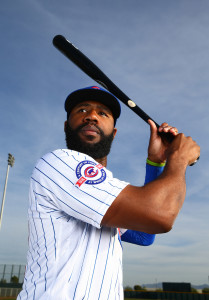
I was surprised to see the Cubs aggressively pursuing Jason Heyward, because right field didn’t seem like a primary need for the club. Nonetheless, they signed the offseason’s best position player to an eight-year deal guaranteeing $184MM. The Cubs also stoked a longtime rivalry, as the Cardinals tried to retain Heyward. Crucially, Heyward can opt out of his deal with the Cubs after three years. If he doesn’t opt out after that 2018 season, and then picks up 550 plate appearances in 2019, he has another chance to opt out. As Matt Swartz explained in a January article for MLBTR, it’s not likely Heyward opts out after 2019 if he doesn’t after 2018. Swartz values Heyward’s opt-out clauses at about $25MM, so the Cubs were able to reduce the guarantee to Heyward by about 12% by taking on downside risk.
Including an opt-out clause was a prerequisite to signing Heyward, who was an unusually young free agent at 26 years old. Now that the Cubs have Heyward and this contract, they have to hope he does opt out after 2018, making this a three-year, $78MM deal. If Heyward’s 2018 season is good enough to compel him to opt out (to which Swartz assigns a 50% likelihood), then it likely means the Cubs got more than their money’s worth. If the momentum does begin to swing clearly toward Heyward opting out after 2018, the Cubs will be presented with another Arrieta-like situation. They’ll have already gotten surplus value and will have to decide whether to re-up with the player at market price.
Overview
This is the Cubs team fans expected Epstein to eventually build, when he was hired in the fall of 2011. The team is overflowing with controllable position player talent for the long-term, supplemented by big-market style free agent signings. Though they didn’t reach the World Series, the 2015 Cubs had the Cy Young winner, Rookie of the Year winner, and Manager of the Year. Based on FanGraphs’ projected standings, the Cubs are the preseason favorite, and no other team is close. On paper, the Cubs are a popular World Series pick.
The problem with such high expectations for any team is that “the field” still has much better odds of having the World Series winner. Mostly, preseason favorites that fall short are done in by injuries, and the Cubs are just as susceptible as any team. After four years, the Theo Epstein front office has stacked the odds nearly as far in the Cubs’ favor as possible, but it won’t mean anything until the franchise gets the championship monkey off its back.
So, how would you grade the Cubs’ winter moves? (Poll link for app users … )
How would you grade the Cubs' offseason?
-
A 77% (3,421)
-
B 18% (821)
-
C 2% (91)
-
F 2% (82)
-
D 1% (24)
Total votes: 4,439
Cubs off season review could have been much shorter: Cubs spent a lot of money and everyone thinks they will win but this is baseball and they are the Cubs so who knows!
I only give the Cubs a “C” because I grade based on how effectively the money was spent. Of course, when you have pressing needs and spend no money at all, that also has to get a low grade. Here, I think the Cubs overpaid for Heyward. They could have acquired Price, Greinke or Cueto instead. And still had an outfield of Fowler, Schwarber, Soler, and maybe Zobrist or Austin Jackson (no longer available). Yes, the Cubs are better. Maybe better than the Cardinals for now. Maybe better than the Mets, Dodgers and Giants. But pitching is key in the post-season, so I question the big bucks for Heyward, who is a great defensive outfielder, but maybe only on par with Schwarber and Soler at the plate.
I whole heartily disagree. Heyward does everything well that the Cubs have trouble with. He plays outstanding defense, gets on base, and is fundamentally sound. The money was market value for him. They did get pitching, in fact they underpaid for Lackey. All the pitchers you listed are overpaid as well. They also have positional depth in the farm system to trade for whatever they need at the trade deadline.
Fully disagree @MannyBeingMVP. The Cubs had so many different ways to go this winter. Everything fell into place the way it was ment to be. First off I would never sign Cueto. You be lucky if he wins 12 to 14 games this year and doesn’t have an injury. They never even thought about it. Now I would ahve gone after Zimmer, the only thing I wish the Cubs would have done. Lackey good and BIG improvemnt over Harden but not sure yet. The age does scare me a bit but it was a steal of a deal. Price lol – Cubs tried to get him cheap. Hey can’t blame Theo for trying he pulled off all the others. TBH Price was never going to the Cubs and I never would pay 217 Mil for him. Price be lucky to hit 18 game wins watch. For 217 Million he better hit 22 – 25 wins. Greinke is way way over paid. He used LA perfect. Think he didn’t know how to play his orginal contract. He knew he would Opt. Then posted CY Young numbers and knew he get a sucker to bite aka ARZ. Yes hes good. But their stuck with him for 6 years no outs. HMMM he post a good 2.00 – 2.10 this year. Every year it go up 2.30 – 2.50 then maybe high 2’s or even 3. STILL PAYING 33.5 Million a year. So ARZ wants to trade him in 3 years who is going to pay 100 Million to a 36 year old pitcher in the low 3’s? Maybe higher – OK Try trading him in 4 years now your at 65 Million for two years at 37..OK 38 years of age still 33.4 Million at 38. He sure played them by then he be through 3.60 – 3.40 range ERA that is IF he still great For 38 and Im not paying 33.5 million. He gets hurt he gets paid anyway. KEEP HIM! Hayward over paid LMAO it was a steal. St.L & Wash offered him over 200 Million LOL We got him the cheapest.. We didn’t give up anyone from the farm. Zorb was a steal concidering NY and Wash offered him 60 Million. It cost us Castro BIG DEAL LOL what we paying for him after Castro 13 Million LOL. Flower LMAO was a gift from the Gods. Now people can stop worrying about Hayward in center Huh. WE still going into the season with Baz and Jorge. We still have trade material for a pitcher if need be. Watch White ox, Clev, A’s, Miami, TB, SD as the season goes on if they are out of contention watch for a trade. Want hear something wild. Watch WASHINGTON If they are out of contention, and dropping fast as last year watch for them to trade Strad. The Cubs will be waiting. (Don’t laugh) Heard it hear first. But only if their not in contention. He is a FA after this year and wont resign with Wash LOL. Trust me.. The piece fell – Cubs would have not turned down Price had he signed for $163 Million. That was the Cubs offer BTW. You be stupid too. Flower was never in the picture, it just happened. Hayward and Zorb were taken for OBP – BA and Defence. The Cubs tried to get SP. But as time went on no one was doing anything. That change as the season goes on, but right now, everyone is 0 – 0. THE END!
Upon reflection, I agree regarding Cueto. I still rate the Cubs off-season as a C+. Where we do agree, I rate the Cobs as one of the top two teams in baseball, along with the Mets, right now. We will see who is able to deliver. My only two “A” ratings go to the Braves and Yankees. The Yankees obtained two cheap physically talented players with character issues, but the Yankees will still miss the playoffs and be in a better position to do a rebuild when AROD and CC are off the books. And the Braves have made some masterful trades, but they will be lucky to win 65 games in 2016, fighting with the Phillies and Brewers for the worst rotation in baseball. Cubs looks great! However, I stand by my view that Heyward was not needed and is an overpay, even though you are absolutely correct that others were ready to pay more. I just think that Shwarber, Soler, La Stella, Montero, Zobrist can all hit at a level close to Heyward, and while the defensive talent is a plus, the money could be saved and used on greater needs. But, regardless, this is a potentially great year for the Cubs! One hundred wins is a realistic goal even with tough Cards and Bucs teams.
A+
AA
Cubs made me fly high this winter. Of course, that doesn’t mean anything if they don’t make the postseason.
If the Cubs don’t make the postseason even as a wild card team, it would be an unmitigated disaster.
A for sure… Cubs are set up to be a top team in the NL for a long time. Theo is a friggin genius, my Sox should have never let him go, though we are in pretty good shape ourselves.
Guy, this is what people are talking about. I get that you’re a huge Sox fan, I am too. But seriously every single comment relates back to the Red Sox. You don’t have to do that. I’m glad you’re passionate and want to speak your mind, but they aren’t required in every comment. That’s why people jab at you, not other reasons.
I find myself looking through the comments just expecting to see some comment from you about the Red Sox on every single post now. Enough is enough dude. Didn’t Steve tell you to stop?
I actually go to threads and look for what he has to say, too. Kinda funny. I’m actually trying to look out for him so he doesn’t get cyber bullied by others.
I’m here for the bigpapi4ever comments
Feel free to ignore my posts if you don’t like them. Not breaking any MLBTR rules.
Your comment was perfectly fine, Theo bought the Red Sox titles, why wouldn’t any RS fan want him back? It’s logical. He’s probably going to get the Cubs one too, I’m hoping he goes to Oakland after he gets the Cubs a title and teams up with Beane to help him finally get one.
The main problem I had with his post was when he said “we are in pretty good shape ourselves”. The rest of the comment was okay I suppose but it seems like he always is able to sneak in the fact that ‘his’ Red Sox are a good team, or so he says.
Oakland can’t afford him
The fact that this bothers you guys means that he’s winning. He’s trolling all of you. And you’re taking the bait. Lol how can you not see it
Oakland can afford anyone.
Why do you care? Homers speak in “we” and “us” all the time. It’s moderately annoying but so many do it (and in Hawk Harrleson’s case get paid for it) it’s not something to ding one specific person on.
I’m not a fan of talking like that, if you aren’t paid by the team then the team doesnt know you, but it’s too commonplace to call it out. Just my two cents.
ok I’m going to help bigpapi4ever I’m a Cubs fan, well Chicago being from Chicago. But I help him out. Be nice to see Cubs vs Red Sox in the WS.
Predictions –
Most watched WS ever in the history of baseball.
Cubs have HF advantage but lose the first game 2 to 1 – Price wins his first play off game.
Maddon says don’t panic were fine. Hires Areo Smith to play at the morning workout. Steve Tyler signs “DREAM ON” and breaks 68 bulbs in the lights.
Seeing his team for the first time since leaving Boston Lester pitches a no hitter but not a perfect game as he makes an error.
Cubs win the next 2 games 7-0 / 5 -2 at Boston
Boston returns to Chicago and wins game 6 3 – 2 on a 3 run bomb in the top of the 9th. People are starting to worry.
Areitta pitches the 7th game and strikes out 14 walks 1 and pitches a no hitter – in a 6 – 0 win and the CURSE IS OVER! CUBS 2016 WORLD CHAMPIONS! Hear it hear first..
THEN YELLS HOW DO YOU LIKE ME NOW?
THEN YELLS HOW DO YOU LIKE ME NOW? LMAO LOL
I am sorry to say but people on this post are right. You scroll all post and compare something to your SOX. So let me ask you a question. The other day you said what the White Sox did to Adam was classless and that you only expect the Yankees for doing that. You then went on to say that “you classy and family oriented organization Red Sox would put family first”. So what do you say now that the Red Sox have implemented the same exact rule in there club house and that player will not be allowed to have there children there all the time much like what the White Sox have said. Surly this must be a mistake right cause your “Classy Re Sox” would never do such a thing? Why not just keep to threads about “Your Classy Red Sox” have and stop rambling on all the other topics about your Red Sox.
I gave them a B, for not bolstering the rotation more, but choosing instead to add position players. It seems like there’s a lot of risk, with Arrieta having thrown all those innings in 2015, Lackey’s age, and relying on the underwhelming Hendricks, Cahill or Hammel.. What happens if any injuries incurred happen to the SPs, but not the position guys? They’ll have depth sitting on the bench, where they don’t need it..They did have a good off-season, hence the B grade, and if they’re lucky with injuries, should be there in the end, but I think pitching is what wins, and not doing more in that respect may cost them.
Not bolstering the rotation more? They have 9 guys that can start. They have a top 5 pitcher in baseball. Sure injuries could happen and ruin everything, but can’t the same be said about any team?
Warren may be the go-to guy if any injuries. He’s pitched pretty well for the Yanks
Few teams have the ammunition to bolster their rotation (if needed) by the trade deadline than the Cubs. Adding additional depth this offseason to their infield and outfield, on top of all their premium prospects, has the Cubs set up to acquire virtually any pitcher who might become available including young aces like Jose Fernandez, Sonny Gray or even Chris Sale. Anybody who didn’t give the Cubs an “A” grade is delusional and/or a bitter Cardinal or White Sox fan.
…or believed that they should have spent $184M on pitching not another OF?
I’m not delusional and I hate the Cardinals and White Sox but I don’t think the Cubs get an A grade because their current rotation and bullpen has sub-par players in it because that’s the truth.
I am neither delusional nor am I a White Sox or a Cardinal’s fan. People giving the Cubs an ‘A’ are deluded Cubs fans. Having quantity of guys who CAN start isn’t the same as having quality starters. After Lester, Lackey, and Arrieta there is a big drop in talent. An injury to one of those 3, or an under-performing Lackey, a distinct possibility, would be a problem. Don’t believe that the Cahill you saw after he was acquired is the Cahill you will see in 2016. Those 17 innings are so far off from his mean production, chances are he’ll never repeat that kind of performance.. Warren was a nice acquisition, but the jury is still out on him. Pitching still wins WS titles. The Cubs pitching is good, but not great, and a little thin on talent, thus a ‘B’ grade.
tad2b13 I don’t know? The Cubs starting pitching all 5 is ranked #1. #1 by all 5 major sports agencies. #1 – Instead of thinking about Arrieta which is not a concern, even if he got hurt – God forbid. But he don’t need to repeat 1.77 and 22 wins. 17-18 is fine at 2.00 – 2.35 X factor is Lester this year he won 12 last year or 13 anyway if he in the 15 -16 range it is bonus. After 16 is a God gift. Lackey only needs 12 wins and were happy anything after that is a bonus. We had Ham and KH last year and platooned our 5th starter. You think Ham and KH are a big drop there really not. They will be the BIG X factor this year. I bet both win 14 to 15 games..No less than 12 – 13 each… Plus if need be we can trade for anyone. You guys are .delusional. Think other teams fans posting on here, haters and well who ever are the only ones worried or they wouldn’t be talking BS. Were not worried. Cubs not worried, and Theo not worried. So go off our Cubs board go worry about how your team going to counter with the Cubs line up and pitching, then when it happens come back talk smack you have a right. Tilll then, PISS OFF~~~
I’m a Cub fan. I am not delusional, and I gave them a B. First, I think they paid too much for Zobrist… and actually believe that was an acquisition the team did not need. The fact that the best SP they brought in was a 36 year-old John Lackey was a low spot for me as well. They could have added someone like Cueto for just a little bit more per season. Also, by signing both Heyward and Lackey, they ensured that their arch rivals would have 2 additional 1st round picks while losing their 1st and 2nd rounders. With re-signing Fowler, they will not get the comp pick for him either. Also, now that they have a logjam in the OF at multiple levels (Heyward, Fowler, Soler, Schwarber, Baez… and 3 OF spots), they did not make a move with either Baez or Soler to pick up another strong SP to bolster the rotation.
Also, the team has a number of strong pitching depth pieces who will head to Iowa after ST. However, they do not have much depth at all for positional players other than Baez. While this may seem like nitpicking, the reason the Cubs made it to the playoffs last year was due to a miraculous season by Arrieta which no one should expect a repeat of… and an incredible lack of injuries. If the injury bug hits, the Cubs could be in serious trouble.
Bascally, they made some very pretty signings… but two of them may end up representing less effectiveness than what they had to begin with. The only real upgrade found was that with Heyward. The weakness they showed in the NLCS was inexperience… which should be lessened this year… and a lack of adequate starting pitching. They did virtually nothing to help with the latter… and the experience they brought in may be too old and in decline by the time the postseason comes around.
Very well stated. The Cubs had the best off season in the Central, but I agree still a B.
I don’t think we’ll have a logjam in the outfield. Baez will be the primary backup at shortstop, where (depending on how exactly the 25-man shakes out) we have no other options. He’ll probably be the primary backup at second and first as well.
As far as the outfield, there are probably 60 starts for Soler just giving a periodic day off to one of the other guys. He can easily fit in on the left-handed end of a platoon in left field (he doesn’t have significant platoon splits, but Schwarber did in a limited sample size), and if the Cubs want to get Schwarber some starts behind the dish (or Joe wants to move him there as part of some substitution), there’s more ABs for Soler there as well. He can probably get 300 ABs pretty easily, and considering he has literally never had a full, healthy season in his career I think that works out fine. It may even keep him healthy all year. And if it turns out that a trade comes knocking or an outfielder goes down with an injury, we’re in good position for that as well.
Adding Zobrist reunites manager Joe Maddon with one of his favorite players and fills a need on the team…a winning veteran in place of the enigmatic Starlin Castro. Zobrist was a key addition to the World Champion Royals last season, not only solidifying the second base position but also the top of their batting order. He should do likewise with the Cubs.
The Cubs may have given the Cardinals 2 supplemental draft choices but they did so by signing two key veterans from their arch-rivals, RF Jason Heyward and starting pitcher John Lackey. I’d make that trade-off, especially with designs on winning a World Series beginning in 2016.
I don’t find the Cubs signings “pretty” and I don’t believe the Cardinals felt that way either. There’s nothing “pretty” about sticking a dagger through the heart. of your biggest rival.
Getting Dexter Fowler was the icing on the cake for the Cubs this offseason, giving them a well deserved “A” grade.
Why do you even need a “primary backup at shortstop”? Russell’s penciled in there as an everyday guy and will play most the games if he doesn’t get hurt. Even if he does, Baez is too good a talent to be on the bench – he knows it too. Same with Soler.
The only upgrade was Heyward? You’re free to have whatever opinion you want, but unless you believe that Castro can maintain that August/September production, then Zobrist is a huge upgrade at 2B. Additionally, if you don’t think John Lackey is an improvement over Dan Haren – the pitcher he’s actually replacing in the rotation – then you’re outright crazy.
I’m not entirely sure how you come to the conclusion that the Cubs lack depth beyond Javier Baez. Forget the fact that Baez would start on EVERY other NL team, whether it be at SS, 2B, or 3B, but Soler would start on most every team as well. That’s two starting options on their bench, and given that no NL team ever carries more than 13 position players (9 of which includes the 8 regulars and a backup catcher), the Cubs, at most, only have 4 spots! And 2 of those are taken up by Baez and Soler! Of the other 2 spots, one is guaranteed for Tommy LaStella, and the 4th (if they go with 13 position players) is likely between Kawasaki or Andreoli (who is in the conversation based on an insane ST) But to think the Cubs need much more past that is ludicrous and completely ignores how many position players actually sit on a big league bench.
The fact remains, the Cubs have the deepest set of position players in baseball, and it’s not even close. Adding to their depth is how flexible the players in terms of the positions they can play. This allows them to cover injury possibilities fairly easily on the field…
1B- Rizzo, Baez, Bryant
2B- Zobrist, Baez, LaStella
SS- Russell, Baez, Zobrist
3B- Bryant, Baez, LaStella
LF- Schwarber, Soler, Bryant, Zobrist, Baez
CF-Fowler, Heyward, Baez
RF-Heyward, Soler, Zobrist
C-Montero, Ross, Schwarber
Of course, if the team gets too beat up during the season, they’ll have to find in-house replacements throughout the organization. Fortunately for them, they have three big-time prospects that will be big league ready by mid-season: Almora, Candelario, Contreras. If an OF gets injured, then Almora will get a call. If a corner IF gets hurt, they can call up Candelario. If a catcher gets hurt, they can call up Contreras. And if a middle infielder gets hurt, they can easily call up Alcantara, who has looked good this spring after floundering in his first big league stint.
Now, if a pitcher gets hurt, we’ll see. It depends on what pitcher we’re talking about. A guy like Hammel or Hendricks can easily be replaced by Warren, Cahill or even Wood. An injury to Arietta, Lester or Lackey could be more devastating – depending on the length – but the same could be said of any team that loses one of its top-3 starters. Even the Mets staff would be worse off if they lost Harvey, Syndergaard or deGrom and replaced one of those three with Colon. But where the Cubs benefit is that their minor league system is still so deep with highly regarded prospects completely blocked by young talent that they can trade from severe strength to fill a weakness while not feeling much loss at the big league level. Even trading Soler wouldn’t harm the team as Almora should be ready by mid-season, and thus trading Soler would simply open a spot for Almora to fill a huge defensive void in LF (a late-inning OF of Fowler in LF, Almora in CF and Heyward in RF might be the best defensive unit in baseball.)
But let’s just ignore all that. Not getting David Price or Zack Greinke for $32-36 million per year immediately devalues everything they did.
justinept: “Forget the fact that Baez would start on EVERY other NL team, whether it be at SS, 2B, or 3B,…”
I agree with most of what you say in your post except for the exaggeration about Baez. The first team that jumped to my mind was the Giants.. No way he starts for them. I doubt that he would start for the Dodgers either. Baez had a very good 2015, but that was only 28 games, and jt was aided greatly by his unsustainable .412 BABIP. In his 52 games in 2014 he performed poorly, striking out in 41.5% of his ABs . Over his 80 game career he has a 64 OPS+.
justinept, you are free to your own opinion, but I think it;s pretty ludicrous.
There is depth beyond Baez and Soler? Where? The Cubs seem to like keeping 12 pitchers on the roster. I personally believe this is one too many, but it has been their MO for over a decade. This leaves 13 positional players on the active roster, and thus 5 on the bench. That bench (other than Baez and Soler) will most likely consist of a pretty bad group of LaStella, Ross (great defensive player, one of the worst offensive players in the game), and one of Victorino, Negron, Kawasaki, Andreoli, or Guzman. Yippy yay, how great is that! The MLB-capable depth pieces which are likely to be in Iowa include the one-dimensional Matt Murton, Alcantara, Juan Perez, and the 4 guys in the list above whom do not make the team out of ST. Yippity Yay! There is no positional depth here beyond Javier Baez and Jorge Soler.
You also speak of Baez being the primary SS backup. This may be true, but he also appears to be the only real backup option for CF. Soler makes for a fine (and highly wasted) corner OF backup. The fact that you believe he will find a way to pick up 60 starts in this OF without Schwarber making at least 50 starts behind the plate is baffling. As long as Heyward and Fowler remain healthy, each will make no fewer than 150 starts in CF and RF. The odds are that the 12 remaining starts in CF will go to Baez. This leaves 12 starts in RF for Soler. If Schwarber remains strictly in LF, he will make no fewer than 130 starts. This assumes he will sit against most strong southpaw starters. This leaves 32 starts. Which means that…. in total… Soler may get 40-45 starts in the OF with how the roster stands right now.
I also believe you greatly overestimate Baez’s current ability. That said, I find it rather confusing that you state I am wrong in thinking that there is no depth beyond Baez and Soler…. then make the very argument which proves my point. I thank you for that.
As for Lackey being an upgrade over Haren… I’m actually hoping that Lackey performs even close to as well as Haren did for the Cubs last year, but I have my doubts. Perhaps you are unaware of the fact that Haren was extremely sound in all but 3 of his starts with the Cubs. Haren, over the past 4 years, put up numbers and performances that are actually slightly better than Lackey’s overall. You also seem to assume that Lackey will pitch as he did last year…. which I believe is utter nonsense. There is virtually no chance at all that he will repeat a career year at the age of 36. Basically, this rotation has two potential aces in Arrieta and Lester…. and three #4 types with Lackey, Hammel, and Hendricks. Woo hoo! This is the #3 rotation in their own division…. nonetheless the NL in which the Mets, Nationals, DBacks, Giants, and possibly the Dodgers all have better rotations.
As for Zobrist… do you seriously expect a 34 year-old, injury-plagued and declining veteran who was rated as one of the worst defensive players in the game last year…. is an absolute upgrade over a highly talented, much younger, and superior fielding (last year at least) player who came alive after being punished for lackidasical play for the first time in his career? I do actually believe that Castro could continue his perfomance of the final six weeks of last season. Why? He’s done it before, and he has the talent and ability to do it again. But hey, we have to keep that Maddon-Zobrist connection in tact… even if that’s an incredibly lame reason to pay a player in decline like one of the top players in the game…. while trading off a potentially superior player in the process.
Wait…. did I mention signing Greinke or Price as a solution? No… not at all. So, you’re talking out of your behind now? I’m ignoring all of the great depth pieces and upgrades….. which you have not pointed out. Oh, that’s right, you are looking at Tommy LaStella as a real option. That alone pretty much makes your entire post a joke. The sad thing is, he’s better than everyone else you mention. But, I’m the one ignoring all that has been done. I’m sorry, but Almora is not an option this year. Candelario might be, but we’re talking about a guy who only plays 3B… though I believe the team should have been training him at 1B, LF, and RF for the past two years.
I’m sorry, but relying upon prospects who are not developed is a terrible idea. Contreras? That’s laughable. The guy is a worse defensive C than Schwarber is, and so far looks like a 1-year wonder with the bat. If Alcantara is the answer, then the question must be a pretty low-brow one. Yeah, he looked good this spring, against pitchers who have already been designated back to their AA teams. Almora? Seriously?
Thank you for proving my point.
At least on the pitching side, as you point out and I mentioned previously, that they have guys like Warren, Wood, Cahill, Richard, Grimm, and even possibly Ramirez who could step in for an injury to one of the back 3 in the rotation. There are also pieces such as Edwards, Acevedo, and Rosscup (once healthy) who could easily come up and fill the relief roles left open due to injuries.
One good thing is that the team does have a number of strong trading chips to pursue upgrades for the rotation in June and July.
A “B” sounds about right, but I think the starting pitching thing is overblown. The reason Hammel and Hendricks seem underwhelming is because they are #4 and #5 starters. There aren’t many teams in MLB where you look at their #4 and #5 starters and go “wow, those guys are good!” Lackey, even with regression, strikes me as a good #3, and Cahill, Richard, Travis Wood, Warren and anything we care to pluck out of the minor leagues is decent depth. Of course we’re in a lot of trouble if Arrieta goes down, but most teams in baseball are in trouble if they lose their ace.
I would have liked to acquire Zimmermann (especially for what he ended up costing), but that’s about the only starter/contract I would have been interested in with the possible exception of Mike Leake. Heck no to Samardzija at that price, not interested in Cueto, and Grienke and Price were too expensive.
I would agree that Hendricks and Hammel are decent enough #4-5 guys. I actually believe that we could see both of them perform better overall this year than they did last year. That said, Lackey will most likely regress to a similar performance as those two. Overall, that would make for around an average #3-4 type…. but having a merely average #3 is not good enough. Not when you’re looking at potentially facing either the Nationals, Mets, Cardinals, Pirates, Giants, DBacks or Dodgers in the playoffs.
I was hoping for Cueto, to be honest. Zimmerman would have been nice. I do think that Leake would have been an improvement over Lackey. Greinke and Price were too expensive. Agreed on Samardzija.
I think they should have bitten the bullet on a trade for Carlos Carrasco. Yes, it would have been very expensive and probably would have cost the team Jorge Soler. You adjust at that point, and make Castro your starting CF… prior to signing Fowler. You even give up some of the remaining prospect depth in the minors to get the deal done.
My issue is everyone bestowing greatness upon a team that hasn’t won yet. Let’s not call them a dynasty until their proof it is sustainable. Theo should know on paper doesn’t make a World Series champion.
Who called them a dynasty? Did Theo say they were a dynasty? Of course on paper doesn’t mean anything, but I’d rather head into a season with the best team on paper than the worst, wouldn’t you?
Exactly what are you suggesting they need to prove is sustainable? They haven’t won anything yet. They know that Their manager knows that. And their President has been saying for 2 months now that the team is “the defending 3rd place team in the NL Central.” Believe me, no one thinks the Cubs won anything more than the off-season. They look great on paper. Cubs fans are excited to see how that translates to the field. Hopes are high for sure, but no one has anointed them by any stretch
My only issues with their offseason is the Ben Zobrist signing and the Coghlan trade. Way too much for Zobrist, honestly. The guy was so good because of his versatility and his high WAR. His WAR took a hit, and he is being brought in to play everyday 2B. I’d personally rather them have gone with a Baez gamble with Coghlan as the plan B.
Nothing really stands out about Aaron Brooks other than his knack for not walking anyone. Coghlan was a perfectly fine everyday player. Nothing too special, but better than nothing. I thought they could get more for him than a backend starter
Not really. He’s a platoon outfielder, a below average defender, even in left field, (and infield), cannot hit left handed pitching, and is a free agent at the end of the year. Cubs just wanted to clear his salary for Fowler and got a starter for AAA in the process.
Zobrist is only costing the Cubs about $18 million more over four years if you factor in that they traded Starlin Castro in order to sign him. It’ll be interesting to see if Starlin can handle the extra pressure in the Bronx and to see which player will provide the most value.
but they also added a cheap, solid rotation/swingman piece in that trade.
I’d rather have Zobrist and Warren over Castro, but I’d rather have Coghlan/Baez, Warren and extra cash to spend else where over both of the former options.
Coghlan had to go. People forget that this guy was complaining down the stretch last year as Schwarber was taking all the ab-bats in LF, Soler was taking the at-bats in RF and Castro’s hot streak made him impossible to bench. It was a minor issue last year, but it would’ve gotten a lot louder this year if Coghlan entered a contract year as the team’s 5th OF behind Heyward, Schwarber, Fowler and Soler.
Coghlan isn’t much of a loss. Also, he was whining about possible loss of playing time on Twitter the night before he was traded. Maddon has been big on team chemistry since he arrived last year, and I’m pretty sure Coghlan’s attitude is what cost him his spot with the Cubs.
Of course Cubs get an A, they made a lot of moves to improve their ballclub, something I wish the Cardinals did. Should be a fun race to the end
A for offense, but C for pitching. They had a huge chance to get Greinke or Price and really put themselves head and shoulders above everyone else. Heyward’s nice but they already had OF options, even with Zobrist, so I actually dislike that move. They really needed to acquire another frontline SP and another big relief arm, they could have easily had Giles or Chapman along with one of the big SP names. Instead they still have Jason Hammel in the rotation and not that much SP depth overall.
That’s just my view of their offseason, of course they now have Baez, Soler and a stack of trade-able assets they can move for a frontline SP, but paying Heyward instead of Greinke or Price or even Zimmermann was the wrong move for the team IMO.
I like Lackey at 2/32M over Price or Greinke at their price tags.
You like a guy who might fall off a cliff at any second over 2 guys who will have multiple top 5 Cy Young seasons? Not a fan of winning, huh?
You can’t ignore the price tag of those two guys, both of whom will probably fall off the cliff themselves long before their contracts expire. The Cubs would’ve handicapped themselves with either of those players. Their rotation as it is is plenty good enough to win a championship, I don’t get all the complaints.
They should check back in with teams that have young pitching Marlins, Indians ,A’s , Padres, mets and offer soler and Baez and see what they could get the don’t really need either of them as having a starting spot for them.
The Cubs headed into the offseason with a solid core, a core that should be a very competitive core for the next 3-6 years. The Cubs front office could have sat on their hands, signed Austin Jackson to play CF, signed Cahill to come back and kept every other player and been primed to make another deep run in 2016. However, not only were they the most active team (by total dollars spent), they went out and landed probably the best RF in the game (defensively) who’s also a day younger than Rizzo, a stud playoff pitcher (Lackey), and a utility knife of a player (Zobrist). Shored up a question of depth at the 5 in the rotation and brought back a guy who scored 100 runs last year as a table setter. Will Baez and Soler get the playing time they would have? No. But this is a contending team, who’s going for it, and Baez and Soler haven’t even proven themselves at the MLB level yet. This team didn’t trade anything from the still deep prospect depth they have and are primed to make a move or two whenever a need arises. Would a shut down closer have been nice? Sure, but how many of those are there? 5? How many were available? 2? One is being suspended and the other it took a kings ransom to pry out of San Diego. This was an A of an offseason, if someone filled their holes on their rosters better I’d like to know which team that was.
1. Grades aren’t dependent on “who did the best”.
2. Clayton Richard, Aaron Brooks. That is the extent of the Cubs SP depth if anyone gets hurt. They fell over last year due to the Mets having better pitching, and they did not bolster their rotation enough. The fact that they could have passed over Heyward and just used Soler+Zobrist+Coghlan in RF and had a rotation of Price-Arrieta-Lester-Lackey-Hammel/Hendricks is perhaps the biggest failure of the offseason. Does anyone on earth think that Hammel+Hendricks are going to beat Colon+Matz+Wheeler? Nope. I get that they can trade from their offense surplus, but as of now they aren’t head and shoulders above everyone, when they very easily could have been. That’s why they aren’t an A. I’m still scratching my head as to why they didn’t go after Price, reuniting him with his BFF Maddon.
I also don’t like their bullpen, lots of big xFIPs in there. Luckily they don’t have to be good because the defense is very good but still, homers are homers.
Why are you calling their #9 and #10 starters “the extent of the Cubs SP depth if anyone gets hurt.”? Y0u’re really overthinking this, the Cubs basically had the perfect offseason. Not that that means that they’re a lock for the World Series or something, but saying that they’re not an A is insane
Travis Wood? Adam Warren? Teddy Cahill? Yeah, those guys aren’t on the team or anything.
“lots of big xFIPs in there” Yeah they were SO big that they had the 6th best bullpen by that measure last year.
Almost feels like it is incomplete, with a move still pending.
I like the Lackey fit for the Cubs, as well as the Zobrist signing.
I am in the minority, but I don’t think the Heyward signing is impactful in the standings.
Is 95 wins and bounced early from the playoffs a fail?
The off-season moves are made to bolster the team for the regular season. Once you get to the playoffs, it’s a crap shoot. A team gets hot over a 2-week stretch, a team goes cold over a 5-day stretch… Random occurrences happen when you have small sample sizes. So if we’re being fair, you can only judge the GM’s moves by what happens during the season. BUT overall, yes, anything short of a WS for the Cubs would be a failure.
As for Heyward, he brings two incredibly important dimensions to this team. The ability to cut off balls in the gap, essentially turning doubles into singles, is a big deal. Adding to his defense is a plus arm that can keep doubles from turning to triples, prevent a runner on 1st from going to 3rd on a groundball to RF, and also makes teams think twice about sending runners home. These are all huge for run prevention purposes.
Offensively, we’re talking about a guy who has always had the potential to hit for power – but as he’s yet to really showcase it outside his rookie year, we can’t count on it. But what we can count on is a guy that makes a lot of contact. That’s a big dimension for this team when you consider that Bryant, Russell, Fowler and the combo of Soler/Schwarber will all produce at least 150 strikeouts on the year (and that’s not including Baez’s huge k-rate that will occur off the bench.). The Cubs proficient k-rate is a big reason they led the league in stranding runners at 3rd base with less than 2 outs. In situations, when all you need is to make contact, having a guy like Heyward at the plate is a much safer proposition than having Schwarber swinging for the fence. This same bit of logic is why the Cubs went after Zobrist in the off-season. The FO saw a big-time need to add a couple players who pride their approach on making contact.
“Zobrist served as Joe Maddon’s Swiss Army knife”
is probably the greatest line in the history of MLBTR.
Anybody that says the Cubs failed by not handcuffing themselves with the overpay of Price and Grienke is crazy. The Cubs added a solid #3 starter that excels in the post season. They have Warren, Wood, Cahill, Richard, Brooks and Edwards(if he is stretched out) that can spot start in case of injury. The outfield defense which was the biggest question mark before Fowler signed was hugely improved because the best defensive right fielder moved back to his natural position. Players all over this roster can fill other positions so depth isn’t a problem and they have some good guys in the upper minors that can be stop gaps during injuries. They also have trade chips for a deadline deal. To say they did anything less than an A this offseason would force to to ask the question who’s roster is better. Right now I don’t see a roster better top to bottom. Could their pitching be better yes but they were a top 5 staff in baseball last year without Lackey. No reason to think they won’t be better even with some regression from Arrieta. The Mets have defensive question marks at Center and left and injury fears at catcher, short and third. If the Mets lose a single starter they won’t have Wheeler until late June at the earliest. The Giants have 2 pitchers with high contracts and big risk, the have an offensive hole in left, who know what Peavy and Cain have left, if Pence can stay healthy and if all those innings MadBaum has pitched will catch up to with him. Every team has questions marks but find a team that has fewer than the Cubs.
As I’ve said before, with Joe the Genius at the helm the Cubs are a lock for 116 wins and yet another WS championship!
justinept thanks you saved me a giant post. Well said. Everyone can say whatever they feel. But you hit it on the head – justinept. Well said. Also Russle can play 2nd base. The Cubs are covered from top to bottom – left to right even with injuries. Also people for get or they don’t know, the Cubs were after 3 things this Winter – OBP/BA/Defence – They solved that with Hayward and Zorb couldn’t have done any better. They did not over pay for either. Zorb costing us 13 Million a year again Mets /Wash and someone forgot the Dodgers all offered him over 60 Million, Dodger are said to offer him over 65 all turned down to go to the Cubs.
Center Fielder – That got solved 3 ways Signing Hayward, having Baez work center in Winter and the gift from the Gods in Fowler to shut up all haters lol and last pitching or SP – They got Lack, but the Cubs ranking number 3 last year and #1 going into this year it can wait, all good things come to those who wait. They have till Aug 1st they may not need one, but probably will get one. They wont be some scrub. LOL Watch Wash, Sox, SD, TB, Miami, Clev and the A’s lol
Hayward same thing – Just cause St.L didn’t get him now he is over paid. Hayward had a awesome spring – The Cubs did this all cheap instead of buying a Ferrari in Price or Grienke way over paid deal that Arz be paying 35 million for a 38 year old or 70 Million for 37 year old in 5/6 years you think 15 Million is an over pay for Lacky. Ummm maybe take a step back and see what you posting before you post it. I’m not reposting what justinept said on the dept except he missed that Russle also can play 2nd. The Cubs are covered left to right – Top to bottom. The Bull Pen is fine – Even with injuries were covered. Theo did ALL this with out breaking the bank – Theo did all this with out losing anyone from the Farm – Theo did all this with out Losing Baez or Soler which everyone was so worried about trading away. Cubs resigned a Pitcher for less than Pitt offered. Theo did that. Cubs got a gift from the Gods in Fowler who also turned down more money, that solves the centre field issue that everyone was so worried that Hayward couldn’t play. Although hes a pro player he could play centre with no issues he probably better centre fielder than Fowler. IF IF their an injury out their were covered anyway. We didn’t need no non hitting Jackson, or that guy the Giants got, boy that a sure blessed out field. Theo did that. The Farm perfect and since were pretty much log jammed as people say now we back ups, We have back ups to back ups, untouched farm. How that working for Arz on the Shelby Miller deal. Pitching – we ranked #3 last year over all – Look it up. Adding Lack over Harden, I can pitch better than Harden, ok I can’t lol. Cubs are ranked #1 going into the season yes #1 that over the Mets, St. L and Clev #1 by all 5 Major sport agencies. #1 – IF I say IF we need an ace or pitcher by Aug we have all the means in the world to add one or even 2. Theo did that. So with all that you don’t think the Cubs deserve an A you are nuts and crazy. I like to hear one of you haters just one tell me who deserves an A then in the 30 teams in MLB. I like to hear that. Talk the the talk now walk the walk. Teams can’t carry 40 – 50 players their will always be something that may be a bit weak but you can’t do no better than the Cubs did to cover the board. That is the truth and reality. You can talk about the past 108 years, the goat, last year, the playoffs whatever makes you happy and sleep at night, and time will tell, nothing is 100% in any Sport – but as of today, this is as best as you can get so get over it, and start realizing reality. Cubs get an A you couldn’t have done any better. All good things come to those who wait. If need be don’t worry will get a pitcher but right now we don’t need one so why blow a trade or money. That is why THEO MAKES BIG BUCKS. Can I get an AMEN. As Jim Carry would say, turns , shoots and that is the GAME! LOL!
Just Another Fan your not very educated are you? The Cubs did go after Price they just weren’t paying 217 Million for him like the Boston did. They did go after him and one thing Theo couldn’t pull off signing him for about 165 Million. So they did. But why buy a Ferrari when you can buy a Harley, Viper and Speed Boat. Cubs would have taken him at 165 – 170. Also your back up to our SP are dead wrong we can go 7 – 8 deep that without the two you named. Cubs have 13 pitchers on the roster for opening day. Cubs starting 5 is ranked #1 in MLB going into opening day – Don’t beleive me look it up – by all 5 major sporting agencies. #1 Yes even over NYM, StL LA and Clev which round the top 5 – #1 = =)~ – They ranked #3 last year with Harden. Like do you guys ever do your homework instead of talking rubbish, and judging your feelings and your hatred before the real facts. You only make yourself look more dumb and stupid. LMAO
I just saw another dumb post – By Just Another Fan – Stop being a little kid who you probably are. Your that braves fan lol who kept posting a 10 player trade 7 to Braves including Soler in a multi 3 team trade. LOL Never mind. No I don’t want no Cy Young guy at 38 and pay 35 Million for or 37 and pay 70 million for. Good thing you don’t own a MLB team. Price you can keep at at 217 Million – For that he better win some playoff games and do better than 18 – 19 wins guess will see. LMAO – Trades no one trading right now people don’t get it. SD/Miami/Clev/A’s aren’t trading it the season- Cubs tried were not giving away people for nothing. But watch buy Summer and Aug 1st another block buster lol. All good things come to those who wait. Hammels and KH watch them this year they will be the X factor both had a better spring than Ar, Lester and Lackey – LOL Don’t be a wimp and cry baby Just Another Fan – grow up take it like a man! LMAO BTW who is your team since your an expert on the Cubs lol – I like to know that. I’m sure all the posters here would too – lol
Just Another Fan
FOUND HIM YEP HE IS THE GUY WHO KEPT WANTING SOLER in a 3 way trade with Huston and give the Cubs Gonz the Braves got like 7 player lol..SAD BRAVES FAN – On the Braves board lol – Braves aren’t going nowhere lol. Mets and Wash will always give them fits. Watch out for Miami lol – Maddox and the boys aren’t coming back lmao.
The Braves get an A so says Just Another Fan – LMAO Braves aren’t doign anything in 2016, 17, 18, 19, 20, lol Stop Trolling our board! Just Another Dumb Braves Fan
Just Another Fan 2 weeks ago
I didn’t think anyone could write about the Braves offseason without mentioning they got the #1 pick of last years draft for basically a mid-rotation SP but here we are.
They won pretty much every trade they made and only spent $18M in FA getting a bunch of guys who might have value to someone at the deadline – this is how you rebuild, folks.
The Braves went from looking at 2019 as regaining relevance, to 2017. Braves are about to be really, really good again really really soon.
Paragraph breaks are almost as underrated as middle relievers.
Well Said – MannyBeingMVP hope Boston and Cubs meet in the WS it will be the most watched in MLB history I’m sure.
On a brighter note how about those Cards. Old Rusted Wrainwright starting out good…
Cinn and Milw have a better record than St.L haha lol It is like a nightmare for St.L. It just keeps getting worse and worse lol. JK – Only opening day. I won’t talk we could lose tommorow lol