
Phillies Outright Cedric Hunter
The Phillies have outrighted outfielder Cedric Hunter off of the 40-man roster after he cleared waivers, the club announced. Hunter had already been optioned to Triple-A after opening the season with the big league team.
Hunter, 28, came to the Phillies on a minor league deal over the winter, earning his first chance at the majors out of camp. But he struggled to a .088/.139/.176 slash in 36 plate appearances, leading to his demotion. Hunter has recorded six hits in his 21 turns at the plate since going back to Triple-A. He’ll remain under Philadelphia’s control after the rest of the teams in the league passed on a chance to add him to their own 40-man rosters.
David Murphy Opts Out Of Twins Deal
4:42pm: Murphy exercised an opt-out clause and has already formally been released, MLB.com’s Rhett Bollinger tweets. His future intentions remain unclear.
3:42pm: Outfielder David Murphy has requested his release from the Twins, according to Mike Berardino of the St. Paul Pioneer-Press (via Twitter). He has already left the club’s Triple-A affiliate, Rochester, to return to his home.
Murphy, who spent camp with the Red Sox and joined Minnesota on a minor league deal, reportedly has an opt-out date of May 1st built into his contract. Obviously, we’re not there yet, but it seems that he could be considering retirement rather than seeking an opportunity with another club.
The Twins could conceivably have used him at the major league level, with Byron Buxton and Max Kepler both going down to Triple-A. But he’d have required a 40-man spot, and if he wasn’t the choice, the move would’ve put a big dent in his playing time at Rochester.
Murphy is off to a slow start, hitting .194/.256/.306 over 39 plate appearances at the Triple-A level in his first taste of the minors since 2007. The 34-year-old had long been a sturdy option against right-handed pitching, but hasn’t met with much interest since reaching the open market this winter.
Indians To Place Carlos Carrasco On DL
TODAY: Carrasco is expected to be out for four to six weeks, the club has announced. Obviously, that’s just an estimate for an injury that will require quite a bit of careful monitoring, but it seems relatively promising news.
Cleveland has also activated outfielder Michael Brantley, who had opened the year on the DL.
YESTERDAY: Indians right-hander Carlos Carrasco exited his start in Detroit on Sunday with a left hamstring injury and will be placed on the disabled list as a result, manager Terry Francona said (Twitter link via Zack Meisel of cleveland.com). Carrasco will return to Cleveland for an MRI to determine the severity of the injury.
Carrasco suffered the injury while running to cover first base on a ground ball during the third inning of the Indians’ 6-3 victory. He pulled up in pain before reaching the bag and grabbed the back of his leg, and had to be helped off the field, according to Jordan Bastian of MLB.com. Trevor Bauer then replaced Carrasco, and Bauer figures to take the now-vacant spot in Cleveland’s rotation. The former top prospect threw 329 frames of 4.38 ERA ball as a starter for the Indians from 2014-15 before shifting to the bullpen prior to this season. He tossed 3 1/3 innings and yielded two earned runs Sunday.
Regardless of how long he’s out, the loss of Carrasco represents a significant blow to the Indians’ pitching staff. Carrasco has emerged as one of baseball’s top starters over the last two-plus years, having put up a 3.15 ERA/2.79 FIP/2.70 xFIP with an outstanding 51.5 percent ground-ball rate in 337 innings since 2014. Carrasco ranks sixth among all starters in K/9 during that time frame (9.99) and has shown great control with a 2.06 BB/9. Along with Corey Kluber and Danny Salazar, he has given the Indians a premier triumvirate of starters.
Carrasco was off to another strong start this season with a 2.45 ERA in 22 innings prior to the injury, though FIP wasn’t as bullish on him as usual (4.31) and his 8.18 K/9 is lower than it has been in recent years. However, the 29-year-old has thus far posted a stellar 3.31 xFIP while continuing to limit walks (2.05 BB/9).
Twins Option Buxton, Kepler; Recall Alex Meyer
The Twins have made several roster moves involving notable young players, per a club announcement (via MLB.com’s Rhett Bollinger, on Twitter). Outfielders Byron Buxton and Max Kepler have been optioned back to Triple-A, while righty Alex Meyer has been brought back onto the active roster.
Buxton, still just 22, entered the year once again rated as one of the very best prospects in all of baseball. He struggled in his debut stint in 2015, but hopes were that his bat would catch up to his glove and speed at the major league level. Instead, Buxton has fallen off even further, and owns a .156/.208/.289 slash and 24 strikeouts (with just two walks) over 49 plate appearances.
By sending Buxton down now, Minnesota will give him a chance to regain his footing at Triple-A, where he was successful last year. It also leaves the door open to holding Buxton below one full year of MLB service at the end of 2016. He entered the season with 113 days on his clock, and obviously hasn’t yet accumulated the 59 more days needed to push himself up to 172 days. Needless to say, it’s certainly still possible that Buxton will cross that threshold at some point this year, but that’s no longer a given.
Kepler, meanwhile, was only expected to perform fill-in duty. He skipped the Triple-A level last year, and will head back down to continue his development. Danny Santana has been activated from the 15-day DL, which created the need for another roster spot.
As the Twins temporarily bid adieu to two important young assets, they’ll welcome back another to the big leagues. Meyer, a 26-year-old righty, lost much of his prospect sheen in a rough 2015. But he’s off to a nice start at the highest level of the minors in 2016, having allowed just two earned runs on 11 hits and four walks over 17 1/3 innings, while racking up a healthy 19 strikeouts.
It’s not immediately clear what role Meyer will take when he arrives. He had returned to the rotation this spring, but could certainly be utilized in a setup role for a club that is in need of live arms in the pen. Regardless, it’s time for Meyer to show the organization that he is capable of performing at the major league level. It’s worth noting, too, that despite entering the year with eight days of MLB service, Meyer won’t be able to tally 172 for the present season even if he stays up the rest of the way.
Orioles Claim David Hale
The Orioles have claimed righty David Hale off waivers from the Rockies, Baltimore announced. Hale was exposed to waivers after being designated for assignment recently.
With the move, the O’s have added yet another piece of pitching depth. Hale will head right to Triple-A on optional assignment, and will provide an option if a need arises in the rotation or the bullpen.
Hale, 28, had a solid run with the Braves in 2014, but hasn’t been very effective in Colorado. Over the last two seasons, he’s carrying a 6.27 ERA with 6.9 K/9 against 2.5 BB/9 over 80 1/3 innings. That’s not terribly promising, but some advanced metrics put a more positive spin on Hale’s work last season, as he carried a 4.04 SIERA and 4.02 xFIP in 2015.
Randal Grichuk Switches Agencies
Cardinals outfielder Randal Grichuk has changed agencies and is now represented by Casey Close of Excel Sports Management, ESPN’s Jerry Crasnick reports (on Twitter).
Grichuk, 24, came to the Cardinals alongside Peter Bourjos in the 2013 trade that sent David Freese and Fernando Salas to the Angels. Grichuk was one of two first-round picks by the Angels in the 2009 draft, going 24th overall as compensation for the loss of Francisco Rodriguez to the Mets. (The Angels took Mike Trout with the following selection.) While he never cemented himself as a consensus top prospect around the league, Grichuk had a very strong rookie campaign with St. Louis last year (after a so-so MLB debut in 2014) when he slashed .276/.329/.548 with 17 home runs in 350 plate appearances. That production was aided by an inflated .365 batting average on balls in play, and Grichuk has come back to Earth in that regard early in 2016. However, he’s also made significant strides in his walk rate (6.3 percent in 2015, 13.6 percent in 2016) and strikeout rate (31.4 percent in ’15, 25.8 percent in ’16), so there’s reason to believe that he can improve on this year’s .228/.333/.439 line if he can sustain some of those gains.
With a year and 61 days of service time, Grichuk is controllable through the 2020 season and won’t reach arbitration eligibility until the conclusion of the 2017 campaign. He’ll fall a good bit shy of Super Two designation assuming he’s in the Majors to stay, so he’ll be arb-eligible the standard three times. While it’s impossible to say exactly what type of impact an agency change will have on a player’s long-term status with an organization, Cardinals fans may be interested to see that Excel Sports has brokered its fair share of extensions over the years, negotiating long-term pacts for the likes of Alex Gordon, Freddie Freeman, Chris Johnson and, most recently, Brandon Belt (MLBTR Extension Tracker link). Grichuk’s own teammate and fellow Each of those deals came when the player had already reached arbitration eligibility.
In addition to the players listed above, Excel represents a wide swath of players, including Zack Greinke, Jason Heyward, Dexter Fowler and Masahiro Tanaka, among others. All of that info can be found in the MLBTR Agency Database, which contains information on more than 2,500 Major League and Minor League players. If you see any notable omissions or errors within the database, please let us know via email: mlbtrdatabase@gmail.com.
Rangers Release Burke Badenhop
The Rangers have released right-hander Burke Badenhop, Baseball America’s Matt Eddy reports. The 33-year-old ACES client had signed a minor league deal with Texas early in the season after missing out on a spot in the Nationals’ bullpen as a non-roster invitee in Spring Training.
Badenhop pitched 4 2/3 innings with the Rangers’ Triple-A affiliate this year, allowing five runs on eight hits and a walk with three strikeouts in that small sample of work. While not a household name, Badenhop has carved out a role as a steadily productive middle reliever over the past seven seasons in the Majors. In that time, he’s averaged 58 games/66 innings per year to go along with a 3.50 ERA, 6.1 K/9, 2.6 BB/9 and a 54.4 percent ground-ball rate. Badenhop hasn’t been on the disabled list since 2009, so a club looking for some durable bullpen depth could certainly give the righty a look on a new minor league deal. Last year, Badenhop posted a 3.93 ERA in 66 1/3 innings as a member of the Reds’ bullpen.
Rob Antony Discusses University Of Minnesota: MLBTR College Series
MLBTR continues a series where we interview top baseball executives about their college years. We’ll ask about why those chose their school, memorable moments, their favorite professor, important connections made, college learnings they still use today, their path to a big league front office and more.
Thus far, we’ve already chatted with Tigers GM Al Avila, Cubs GM Jed Hoyer, Phillies GM Matt Klentak and Reds GM Dick Williams. Next up in our question-and-answer series is Minnesota Twins Vice President and Assistant General Manager Rob Antony – a graduate of the University of Minnesota.
* * * * *
Hi Rob! Thanks for talking to MLBTR. Just like me, you began your baseball career in media relations before moving into baseball operations. Tell me about your start.
“I grew up in Minneapolis, about 15 minutes from the Metrodome. I went to high school in Minneapolis. When I graduated, I was all set to go play baseball at Minnesota Morris, which was 2 ½ hours away – and I was excited. I wasn’t a Division I player by any stretch of the imagination, but I was looking forward to being able to keep playing while getting a good education. Of course, the summer before I went there, I got a call from the head coach – and he told me he just got fired, and a new guy was taking over and that he’d be in touch. Well, he did get in touch, and he let me know he was going to recruit his own people. It was understandable, but at the time, it was disheartening. Now, as you get into the business and you see everything, you understand how that goes. I just opted to stay home and go to the University of Minnesota. I was done playing. I didn’t play college ball. I focused my sights on becoming a sports journalist. I just wanted a career in sports, whether it be writing about hockey or baseball – which were my two preferences. When I went to the University, I started on the journalism path. After about a year, when they started telling me I needed to take magazine layout and editorial classes and all these different things, I started thinking to myself – ‘I just want to write.’ I wanted to cover the Twins or the North Stars. So I shifted gears into speech communications and broadcasting. And that was a good move for me. The journalism classes have helped me throughout my career. But I just felt more comfortable in communications. It ended up leading to an internship with an NBC affiliate here in Minneapolis – KARE TV – in the sports department.”
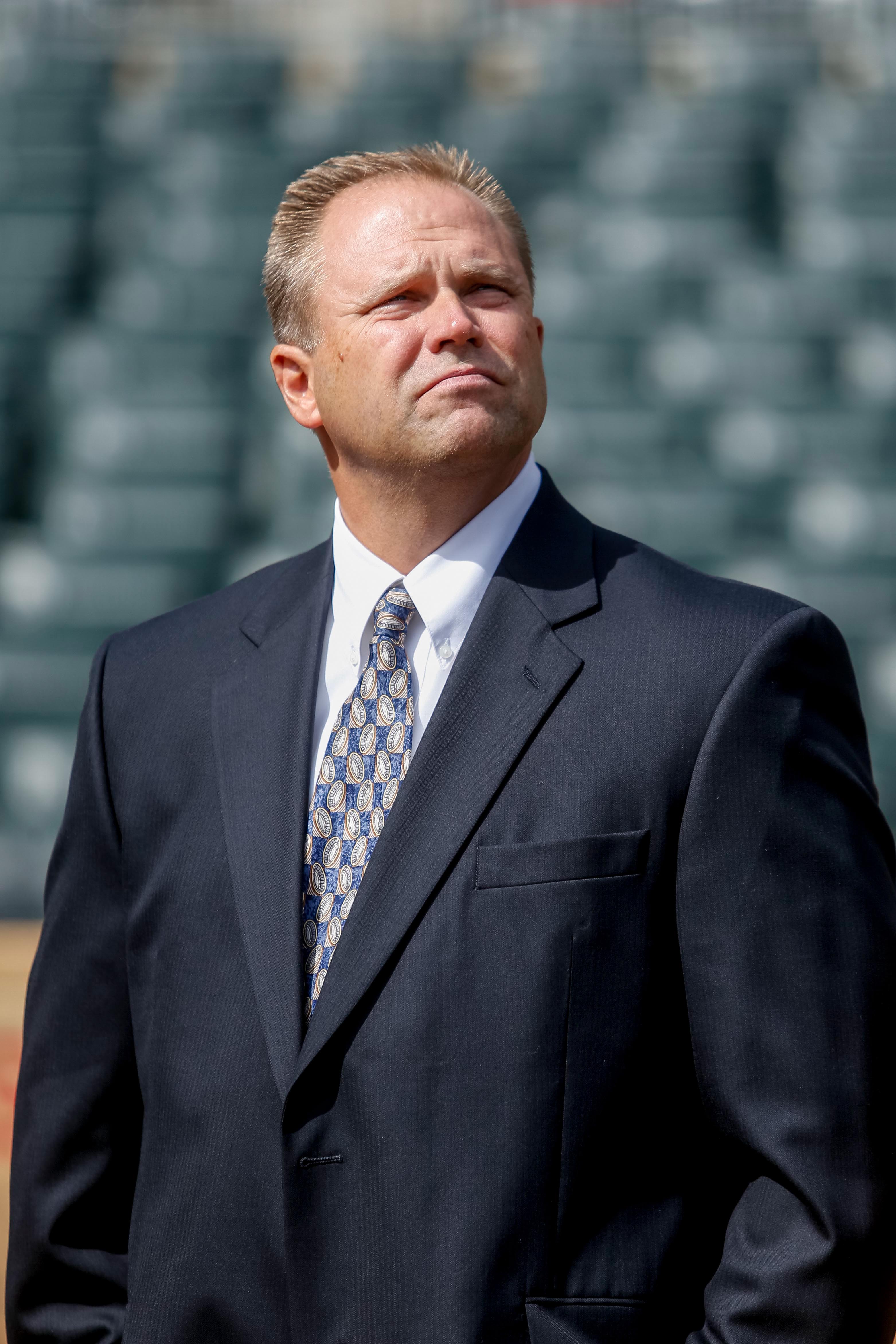
And that led you to the Twins, correct?
“I got a large break in 1987. They recommended me to the Twins; they needed somebody in the media relations department. The guy who was their intern in the summer had to go back to school in August. At the U. of M., we were on a trimester system and didn’t start until the end of September. I was available to come in and work all day every day. And the Twins of ’87 were marching their way towards the playoffs – which was an unbelievable experience. I was then fortunate enough to intern in media relations all of 1988. There was some movement, and I was hired after I graduated … My time in media relations was great. Some of the things I learned were the continued development of communications – which is so important in our business. I think that’s the case in any business. And the ability to write, and to speak to people, and in front of people has been invaluable as my career has progressed.”
Let’s talk about your time at the University of Minnesota, which is a big commuter school. Did you live at home, or were you able to live on campus?
‘“I lived at home, and I did not have that ‘great’ college experience. A lot of my friends from high school went there as well and lived at home, too. It was an economic thing as much as anything. We could drive 20 minutes. We carpooled together. But we didn’t have a lot of money and we couldn’t afford to just live on campus. I have two kids now that are in college, and one of the things I told them was, ‘You pick where you want to go. You decide what you want to do. But whatever you do, you’re going to go and live on campus and get the entire college experience. That’s something I wish I could have had that I wasn’t able to do, and I want you guys to have that.’ For me, it was a different deal. It was about getting the degree and learning as much as I could – and then moving on to a professional life.”
But there must have been college learnings that have become part of your day-to-day work life, correct?
“Most definitely. Some of that just comes from going to a major university the size of the University of Minnesota. There were 60,000 students. When you had to register for classes, you’d get up there and say you’d want this class, and you’d get ‘Sorry, full.’ You’re now at the front of the line, so you’d get ‘What’s your next choice?’ and you’d have to react on the fly. You needed to know exactly what you needed to take and everything else to make adjustments. Some of the logistics of dealing with those things … I had to learn how to study. I had to learn how to organize and manage my time – especially when I was interning, when I was working 30-4o hours as well as going to class, trying to get my homework done. As it turned out, it probably couldn’t have worked out better with me staying home. I probably wouldn’t have had the opportunity with KARE TV, which wouldn’t have led to my opportunity here. So it’s funny how things can work out for you. I met a lot of good people at school. You do some things with them, but it’s altogether different when people can live on campus. That’s just a whole different lifestyle.”
Did you have favorite professors or influential classes that really helped prepare you?
“Even though I moved out of journalism, I think some of the introductory journalism classes really set the tone for me to know that communication is an important part of things. It became a strength because, during the rest of my college career, I really leaned toward writing-intensive classes. In your article on Jed (Hoyer), he mentioned that he got his degree in American History. I guess if I had to do it all over again, I would have taken more statistics classes and some other things that might have helped me out. I know I would have focused on Spanish; I would have taken Spanish for four years and done everything I could to become well-spoken and bilingual. In this game, it would be such an advantage – and it is for those people who are.”
That sounds like something you tell students who are seeking college advice.
“I give advice to a lot of kids who call and write letters – asking for advice how to get into the game. What are the best ways to get into the game? It’s not an easy thing to do. But there are so many different avenues. My recommendation is – go to college and get your degree in what you have the most interest in. If you put all your eggs in one basket and you go for sports management, there’s a chance that will work out quite well for you. For some clubs, that’s a big separator – and you might get the nod over somebody else.”
On your transcript, what does it say? Bachelor of …
“Speech communication, with a minor in English.
Growing up, were you a Twins fan?
“Absolutely. And I’ve always been a Gopher fan. I continue to cheer for them.”
If you had the choice to do it all over again, would you have stayed at home and gone to the University of Minnesota – or would you have left the area?
“I don’t have any regrets about staying in the area. Minnesota is home for me. Not a lot of people get to grow up cheering for a team and then work for that team. So many people in baseball work where they can – because there’s an opportunity. I was just fortunate to have the opportunity here. If I wouldn’t have stayed at home, I don’t think it would have all fallen in line the way that it did. I don’t know anything other than Minnesota. I don’t know anything other than the Twins. I’ve been fortunate enough to be with them since 1987. I like talking with people from other organizations to see how they do things and get other ideas. I don’t regret staying at home; I’m a Minnesota guy. I’m very appreciative of everything I’ve gotten from the Twins – and I’ve been able to stay home and be where I want to be and do what I want to do. And with this organization, we’ve had so much continuity. There’s always been a definite structure in the hierarchy. Everybody gets their voice heard.”
* * * * *
Chuck Wasserstrom spent 25 years in the Chicago Cubs’ front office – 16 in Media Relations and nine in Baseball Operations. Now a freelance writer, his behind-the-scenes stories of his time in a big league front office can be found on www.chuckblogerstrom.com.
Photo courtesy of USA Today Sports Images.
Braves Have Tried To Trade Hector Olivera
The Braves have tried to trade Hector Olivera since the outfielder’s arrest earlier this month on a charge of misdemeanor assault and battery, Yahoo Sports’ Jeff Passan reports. Olivera is currently on paid administrative leave while Major League Baseball investigates the alleged incident under the league’s domestic violence policy, and a suspension is widely believed to be in his future.
With this disturbing charge hanging over Olivera, it’s no shock that Atlanta would be looking to move on from the 31-year-old outfielder, and it’s as equally unsurprising that rival teams aren’t jumping to make a deal. Olivera’s trade value is so low that one executive whose club was approached by the Braves told Passan that he “can’t believe they even asked.”
Aroldis Chapman, of course, was traded from the Reds to the Yankees while facing a domestic violence investigation last winter, though obviously Chapman is a far more proven talent on the Major League stage. Olivera has only 108 MLB plate appearances to his name and he’s produced just a .245/.296/.378 slash line. Furthermore, Olivera is owed roughly $3.4MM remaining this season and $28.5MM from 2017-2020. While a suspension under the domestic violence policy would erase any salary commitments owed under that timeframe of games, the Braves or any other team would still likely owe a significant chunk of money to a player with big question marks both on and off the field.
It was just over a year ago that Olivera was one of the most sought-after players on the international market, as at least nine teams were reportedly interested in signing the Cuban star before the Dodgers landed him with a six-year, $62.5MM contract. A signing bonus accounted for $28MM of the deal, and Los Angeles already paid that entire amount as part of the very complex three-team, 13-player trade that sent Olivera to the Braves last July. The fact that the Dodgers parted ways with Olivera just months after signing him to a rich deal raised eyebrows in the first place, as Olivera had battled injuries in the minors and only showed flashes of his hitting potential. Once Olivera joined the Braves, he faced another change over the winter as the Braves moved him into a primary left field role after he’d spent most of his career in Cuba at either second or third base.
Quick Hits: Gallardo, Gomez, Murphy, Arrieta
Steven Souza celebrated his 27th birthday in spectacular fashion today, hitting two home runs during the Rays’ 8-1 win over the Yankees. It was the second two-homer game of Souza’s career and his second in just a few weeks, as he also hit two long balls on April 6 against the Blue Jays. Here’s some news from around baseball as we kick off a new week…
- An MRI on Yovani Gallardo‘s shoulder revealed no changes from his previous MRI in February, Eduardo A. Encina of the Baltimore Sun reports (Twitter links). Gallardo received a cortisone shot in his shoulder and is expected to be sidelined for roughly four weeks. The Orioles righty was placed on the DL yesterday due to tendinitis in his bicep and right shoulder, the first time in Gallardo’s 10-year career that he has ever hit the DL due to an arm-related injury.
- An AL scout tells John Perrotto of TodaysKnuckleball.com that Carlos Gomez‘s slow start (and overall lackluster stint with the Astros) could indicate a decline rather than just a slump. “He’s had a lot of leg injuries and I think it’s started to catch up with him,” the scout said. “He doesn’t steal many bases anymore and he doesn’t move as well as he used to in the outfield. I’m not ready to totally write him off but he definitely slipped last year and he’s been worse this year.” Gomez entered today’s play with only a .197/.222/.262 slash line through his first 63 plate appearances, and he’s still looking for his first homer of the season. A down year could cost Gomez a fortune — MLBTR’s Tim Dierkes’ initial 2017 free agent power rankings tabbed Gomez as having the most earning potential of any position player hitting the open market.
- David Murphy is hoping for another stint in the majors both this season and beyond, though the veteran outfielder tells Jeff Wilson of the Fort Worth Star-Telegram that his longer-than-expected stint in free agency this winter has made him confront the idea of retiring. “I realistically thought that it could be over. I guess I’m to the point where I know that any day could be my last. I need to enjoy every day,” Murphy said. After settling for a minor league deal with the Red Sox during the offseason and then getting released, Murphy signed another minors deal with the Twins that contains a May 1 opt-out clause.
- Orioles fans may want to avert their eyes for this one, as Paul Sullivan of the Chicago Tribune recaps how the Cubs targeted and acquired Jake Arrieta from Baltimore as part of a four-player trade in July 2013. Arrieta was disagreeing with Orioles coaches and struggling to harness his stuff, yet a trio of Cubs scouts convinced Theo Epstein and Jed Hoyer that Arrieta was well worth the risk. The rest has been history, as that trade (Arrieta and Pedro Strop for Scott Feldman and Steve Clevenger) is looking like one of the most one-sided trades in recent memory.