
Although substantial time has passed since the last installment in this series, only the reliever market has moved in a significant way. As such, we move on to the 12th piece while the biggest fish remain unhooked. Below find the links to the earlier posts in this series.
Philadelphia Phillies
Los Angeles Dodgers
Los Angeles Angels
Atlanta Braves
New York Yankees
Chicago White Sox
Boston Red Sox
Minnesota Twins
Milwaukee Brewers
San Francisco Giants
St. Louis Cardinals
If you have questions about financial information made available to the public and the assumptions used in this series, please refer to the Phillies piece linked above.
Today, we look into a club coming off of its best four-year stretch in franchise history and flush with cash, yet one who also appears to be fully intent to sit out free agency this winter: the Chicago Cubs.
Team Leadership
Concluding 65 years of ownership by the Wrigley family, the Tribune Company purchased the Cubs in 1981. The franchise had, incredibly, missed the playoffs for 35 straight seasons prior to the transaction. The team went on to make the postseason six times under Tribune ownership, including three times from 2003-08. The final two years of Tribune ownership were executed under the direction of Sam Zell, a real estate mogul who purchased the Tribune in late 2007. Then, in October 2009, the Ricketts family famously acquired the Cubs for $845 million. Ownership of the franchise is managed by team chairman Tom Ricketts, who authorized an aggressive tank followed by the most successful time period in Cubs history.
While the Ricketts family initially kept general manager Jim Hendry in place running the baseball operations department, they made the splashiest of splashy moves in 2011, relieving Hendry of his duties and replacing him with new President of Baseball Operations and renowned curse breaker Theo Epstein. Epstein got his band back together, bringing in former proteges Jed Hoyer and Jason McLeod to be his general manager and vice president of scouting and player development, respectively, both after two years in San Diego. The results have been undeniable: the club averaged a putrid 67 wins per year during the first three years of the Epstein regime and flipped the switch in 2015, averaging 97 per year over the next four years.
Historical Payrolls
Before hitting the numbers, please recall that we use data from Cot’s Baseball Contracts, we’ll use average annual value (“AAV”) on historical deals but actual cash for 2019 and beyond, and deferrals will be reflected where appropriate. And, of course, the value of examining historical payrolls is twofold: they show us either what type of payroll a team’s market can support or how significantly a given ownership group is willing to spend. In the most useful cases, they show us both. We’ll focus on a 15-year span for the Cubs, covering 2005-18 for historical data as a means to understanding year 15: 2019. This period covers two competitive windows and two ownership groups for the Cubs, and it’s not terribly difficult to see where the Ricketts-authorized tank began. We’ll also use Opening Day payrolls as those better approximate expected spending by ownership.

Payroll spiked from 2008-10 as the Cubs paid to keep their 2007-08 winners together. Publicly available reported revenue increases climbed to fuel the spending, growing from $179 million in 2005 all the way to $239 million in 2008. Of course, take all publicly available revenue figures with a significant grain of salt as only ownership and the front office truly know the finances. However, revenue largely stagnated in the following half decade, reaching only $266 million in 2013 during the tank.
What followed is difficult to describe as I’ve never seen anything like it. Revenue climbed to $302 million in 2014, $340 million in 2015, $434 million in 2016 (!), and $457 million in 2017. While 2018 revenue hasn’t yet been reported, it is entirely possible that revenue has increased more than $200 million over just five years. Striking. Seen in that light, the 2016-18 payrolls are hardly surprising.
Ricketts ownership and the Epstein-led front office have been keen to stay under the luxury tax threshold during their time in charge, exceeding the threshold only in 2016, incurring a tax of just under $3 million before staying under the threshold in each of the next two years. The Cubs have simultaneously been major players in the international market, throwing a $30 million guarantee at outfielder Jorge Soler in 2012 and following with a boisterous international class in 2013 that included young stars Gleyber Torres and Eloy Jimenez and a massive 2015 class that yielded just under $19 million in signing bonuses. Major League spending captures a significant portion of Cubs spending, but international amateur spending has been a key facet of Cubs expenditures in recent years.
Future Liabilities
Cubs spending in 2019 will surely hit a new franchise high.
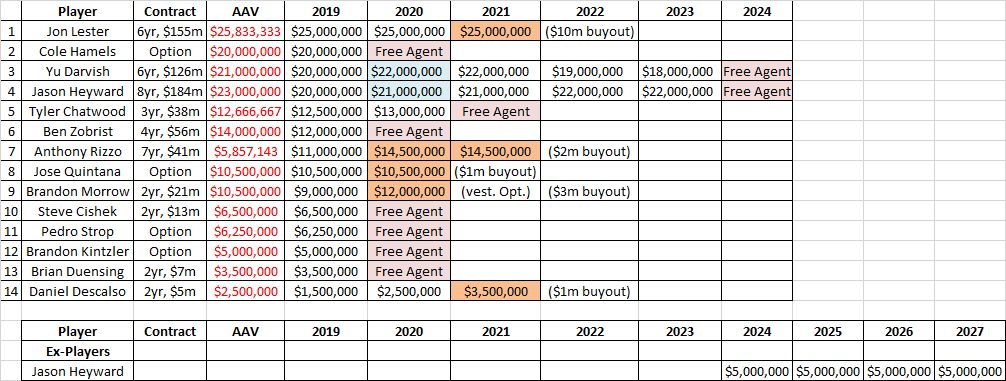
That is a lot of guaranteed money.
The 2019 Cubs are spending $88 million guaranteed on starting pitching, led by $20 million-plus salaries for Lester, Hamels, and Darvish. To say that these commitments are risky is a massive understatement.
- Lester has been a paragon of stability, but he has seen his FIP rise each year as a Cub, from 2.92 in 2015 to 4.39 in 2018. He’ll enter 2019 with 2,520 combined regular season and playoff innings on his odometer. He just turned 35.
- Hamels pitched a year and a half to the tune of a 4.87 FIP prior to joining the Cubs at the trade deadline in 2018. He was rejuvenated with the Cubs, but he’ll enter 2019 with 2,653 combined regular season and playoff innings on his own odometer, also having just turned 35.
- Darvish largely enjoyed success since arriving from Japan before a disastrous debut season with the Cubs that ended in May due to an elbow injury.
- Tyler Chatwood bombed in his first year as a Cub, losing his rotation job and throwing fewer than 10 innings for the club after the trade deadline.
- Jose Quintana posted a career-worst FIP of 4.43, fueled in large part by a career-worst home run rate.
Projection systems expect the Cubs rotation to be wildly successful in 2019, especially when the arbitration-eligible Kyle Hendricks is added to the fold. Still, Cubs fans are at least a bit anxious after the across-the-board struggles from 2018.
A trio of lefty hitters figure prominently on the balance sheet, two of whom will be around for years to come. Rizzo and Heyward have been lineup mainstays for years, though Rizzo has obviously been substantially more productive on the field. Unlike Rizzo and Heyward, Zobrist finds himself in a walk year in a season in which he turns 38.
The remaining notable deals are all for relief pitchers, at least four of which find themselves staring down free agency come November. In a highly competitive 2019 National League Central division, the team will need strong production from multiple arms in the group of Morrow, Cishek, Strop, Kintzler, and Duensing.
Finally, Heyward’s signing bonus stands out as the only deferred money for the franchise. But it’s a big number: $20 million payable after his contract expires. Presumably franchise revenue will be so astronomical in the mid-2020s so as to see this amount as largely rounding error, but $5 million is still $5 million.
As a result of stellar drafting in the early part of this decade and a trio of impact trades, the Cubs feature significant talent in the arbitration ranks, including multiple Most Valuable Player candidates and Cy Young contender.
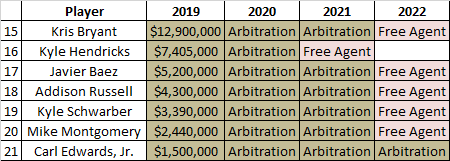
All seven players listed above figure to play key roles for the team in 2019, though Russell finds himself mired in a mess of his own making. As the arbitration chart shows, each player is controllable for at least one year beyond 2019 as well with offensive stars Bryant, Baez, and Schwarber each controllable through 2021.
What Does Team Leadership Have to Say?
So, so, so much.
While ownership, the front office, and manager Joe Maddon have spoken at great length about the budget this offseason, comments from Tom Ricketts in recent days likely shed the most light on the spending plans. In response to questions about expected payroll, Ricketts suggested that “when you make any free-agent signing — not to pick on Darvish, but any of them — you know that you can’t spend that dollar twice and you have to budget that into the future, so that’s going to limit what you can do in the following year. And one of the things this year that we knew going into the offseason was that we weren’t going to have as much flexibility as years past.” When Ricketts moved on to discussing the team’s local tax burden, it seemed that the budget has very little, if any, room.
As we will detail below, it’s close to inevitable that the Cubs will incur a luxury tax in 2019. However, Ricketts more or less stated that the budget is tapped out, jiving with what the front office has said for months now.
In the face of big moves by the rival Cardinals and Brewers, the Cubs appear content to have their offseason largely dictated by their budget.
Are the Cubs a Player for Bryce Harper or Manny Machado?
Ummmm…honestly, I don’t know. Almost certainly not. But crazier things have happened.
The Cubs haven’t been connected to Machado at all this offseason, and given their impressive collection of infield talent, this doesn’t come as a huge surprise.
But Harper? The Cubs have been connected to Harper for years. This article humorously chronicles some of the 2017 nuggets that suggested Harper would — or wouldn’t — join the Cubs. These rumors have become par for the course. Many of the rumors have centered around the close relationship between Bryant and Harper, both Las Vegas natives.
After the Cubs surprisingly bowed out of the playoffs in quick fashion, Epstein lamented that “the offense broke,” leading to significant speculation that the Cubs would seek to add a significant bat.
Nevertheless, budgetary constraints combined with Maddon clearly stating that a Harper signing is “not going to happen” seemingly slammed the door shut on any pursuit.
Despite all of the above, Chicago Sun-Times writer Gordon Wittenmyer commented in December that sources indicated that the Cubs front office requested that Harper and his agent, Scott Boras, come back to the team before Harper decides to sign elsewhere in order to give the Cubs a chance to make a final play for the young star.
What Will the 2019 Payroll Be?
Well, it’ll be a new team record, that’s for sure. But just how high will it go?
Currently, team payroll comes in at $202.1 million before accounting for the luxury tax. If spending sticks approximately where it currently stands, the team figures to incur a luxury tax of approximately $4.4 million based on a luxury tax payroll figure of just under $228 million and a 20 percent tax on the overage.
So how much room is there for additional expenditures? I suspect that ownership would push total spending up around $220 million given the need for an in-season acquisition or two. Given that, don’t expect to see additional expenditures prior to the start of the season save for a possible minimal commitment to a backup catcher or a reliever.
Projected 2019 Payroll: $210 million
Projected 2019 Payroll Space: $2.9 million
If you’d like to go even further down the rabbit hole of Cubs payrolls, I refer you to my series of articles that have appeared on The Athletic going into tremendous detail on team spending.
Nah didnt you hear cub fans on here? Theyre gonna sign Harper with that 2.9 mill cap space. Money isnt an issue cause of that sweet new tv deal. Theyre gonna sign Harper and extend Baez Bryant before 2021. Go out and sign elite bullpen pieces to replace Knitzler Strop Morrow Duensing Cishek (all free agents after 2019) and sign elite TOR pitchers to replace Hamels (2019) Lester (2020) and Quintana (2020) all while keep payroll at 200 mill or less.
Your asking for a lot. And the Phillies, Dodgers, and Nationals are the finalists for Harper. Even Bryant said Harper isnt signing with Chicago. Your also asking for a complete revamp of the cubs bullpen.
Fools think that the Cubs are serious contenders for either of those two. It would take ownership deciding to blow the budget up to get either one, and it would screw them over in the future. Stay away please Cubs
Cubs will wait 2 years for trout. Sale or mad bum next year with 80 mil off books
Baseball doesnt have a salary cap. Are you 5?
Does have luxury tax penalties. Which cost not only the owner more money but hurt teams in the draft.
Mlb should take off 10% of the overage from teams IFA and/or draft pool allowance instead of taking money from owners for going over the luxury tax line. But that’s a different conversation.
Penalties that the Cubs only had to pay 1.2 mil in fees. They have yet to do it again. They have money off the books next winter. They could make a run at another pitcher. It would make chatwood either expendable or sent down to Iowa. Which will happen this year if he doesnt get his mechanics in order. Personally I’d take the hit and let him go. Some poor sap team can pay him the minimum. Probably the Marlins.
any cubs related article has somebody complaining about how cheap the cubs are. its embarrassing
The cubs have handcuffed themselves with unmovable albatrosses in darvish and heyward. Chatwood was also a stupid move as they took his road numbers as if that’s what he really is. They could trade zobrist but that only hurts them
I believe you’ve just summarized every article or comment written about the Cubs in the last 6 weeks.
Basically
@Smell: if it’s a repeat of the last six weeks, by golly it’s a good one!
Captain Hindsight to save the day
quality dig. upvote!
Darvish has pitched one single year and got injured. It seems he was trying to pitch through the injury, calling his contract an albatross is ridiculous. Heyward is massively overpaid. They could eat some of that salary though and possibly find a trading partner if they wanted to get rid of him.
They need to have Chatwood on a real short leash for next year. Better just to have him eating up innings when the game is out of reach. Or just cut loses and dump him. Any number of minor leaguers would do a better job.
Yes. I agree.
Dumping is the best option, but they won’t. I can see him as a decent reliever, if used sparingly.
They owe him too much money to dump him. Hoping for a turnaround is the best option imo. Players bounce back all the time
They should have sent him to Iowa when his struggles started. There was no reason not do it. Give Duane Underwood a chance.
A player can’t just be sent to Iowa. He has to have option seasons left which Chatwood does not.
Idgaf. He can be released for all I care. He has 3 options left. He was never sent down in Colorado.
He can very well be sent down for a rehab assignment.. put him on the 10 day DL. Doesnt matter what made him injury he has. That’s one way to send him down
Chatwood doesn’t need options.. all that means is that he has to be made available to other teams before going down to Iowa. Do you think someone is going to take him? By all means, send him down.
But but but the cubs print money!!!
Turns out the smartest man in the world never heard of cable cutting…until recently…
Broken record. Time to add something new.
Well, they do. Ricketts just doesn’t want to spend it.
How come Roster Resource has different 2019 salaries for quite a few players. Who’s accurate?
You are 100% correct. Roster resource has their 2019 payroll at $225mm. Link below…
rosterresource.com/mlb-chicago-cubs-info/
This is a new guy, so I’ll go with Roster Resource as well.
I think this says a lot about the Cubs future TV deal. It’s probably not as lucrative as they thought it was going to be when it first brought up 3-5 years ago. I think it’s also important to note that no team is really blowing the gasket on payroll of late. Even the Phillies who claimed to be willing to spend “stupid money,” haven’t been all that wild. In a market where no one is ponying up with the crazy amounts of $, they are sitting it out – and worst comes to worst, they won 95 games with an underperforming team. The one caveat here is that your 19 games against the Cardinals and Reds will likely be more difficult, and the Brewers are a year older and more developed as well. I think it’ll be a battle for the NL Central – as of now if everyone is truly healthy (that’s a big if) I like the Cardinals and Cubs more than the Brewers.
Nah, the tv deal isn’t the problem. It’s the business operations side of the ledger (debt), and their reluctance to a pay luxury tax.
Telling us Heyward and Chatwalk can’t be moved in crap yeah bad seasons on top of bad contracts make things tuff but get creative with picks/international money etc eat some money and upgrade the worst outfield in the NL Central
Probably worst OF in baseball.
@chisoxcity, that’s a stretch. I’m interested to see how Happ and Almora play. Maybe Heyward wakes up? *Sigh* Won’t hold my breath though.
Wow. Just wow. Please google 2018 outfield WAR Chicago White Sox. How many teams are there in MLB? What a coincidence! Same number!
Aw son of a gun I apologize. I really need to check my facts first ChiSoxCity I’m sorry. I forgot about the Phillies my bad. Sox were in 29th place not 30th. Sorry about that. Cubs 16th but whatever.
Ok, let’s all get on the same page here. The Cubs OF is easily the worst OFFENSIBLY in the MLB. Defense is irrelevant if you can’t produce at the plate. I’d rather have an average corner outfielder who gives me 80+ RBI, 80+ Runs scored,25+ HRs, snd at least 15 SB. I can live with a guy like Almora in CF, since he’s a decent contact hitter w/ above average defense as long as he’s leading off and stealing bases to get in run scoring position. IMO, the Cubs should trade Schwarber for some relief pitching, and make Happ the everyday LF.
Forget the plus defense. The 2018 OPS OF rankings w/ at least 300 plate appearances: Happ is 6th, Schwarber 7th,Heyward 12th and Zobrist would be 4th in right field. Can Happ and Schwarber improve still YES. Last in MLB is a stupid comment.
So the fan of the actual worst outfield is saying this? Even the Indians are better than yours. Jon Jay, Adam Engel, and Daniel Palka as your projected opening day starters is absolutely pathetic. That would be bad for a minor league team. Even the Cubs 6th best OF option is better than your entire outfield. I mean even Heyward is an upgrade to those guys, and most teams would love to have an outfield Schwarber, Almora, and Happ. Not to mention Bryant and Zobrist who also play out there quite a bit.
Most wins in baseball the last 4 years and a championship flag flying at Wrigley. Things really aren’t that bad.
With a few exceptions, every team in the league has a “championship flag flying.” And no one cares about “the most regular season wins.”
“Nothing matters” – the White Sox guy
“Young Core” that’s debatable.
Nothing matters to White Sox fans, unless it relates to them.
Monday Conversation –
Sox Fan: “You guys (Cubs) suck!!
Cubs Fan: “Well, we did just win the Championship not too long ago.”
Sox Fan: “No one cares….yesterday’s news. Doesn’t matter!!!”
Tuesday Conversation –
Different Cubs Fan: “Sox won a long time ago.”
Same Sox Fan: “DOESN’T MATTER!! 2005 BABY!!! PODSEDNIK!! ROWAND!! 2005 BABY!!!!!
If seen this hypocrisy more times than I can count.
Did I miss something? Did Chisoxcity say something derogatory? I think his point is that any season that doesn’t end in a WS should be looked at as a failure (to an extent). A WS win is the ultimate goal, right? Can you honestly say you were happy with last years results?
Precisely thurman.
They’ll extend strop,rizzo and maybe Zobrist before they are free agents. Zo would have to be this offseason.
Heyward also has an opt out after 2019. Which likely he wont do.
They need to trade kinzler chatwood and morrow. All three are just really bad.
I disagree with everything that you said except that Heyward will not opt out. Strop is going to turn 35 in 2020 (when he’s a free agent). I don’t know if I would want the Cubs paying decent money for his late 30s. And Zob turns 39 next year, want nothing to do with extending him unless it is for dirt cheap to be a bench bat. Rizzo is signed for 3 more years so I think it’s best to leave that contract alone for a few years.
The cubs need bullpen help, trading away kinzler and morrow isn’t going to help. Kinzler has been good but struggled in a short stint with the cubs, his value is quite low at the moment, better off waiting for a rebound. Same with Chatwood, though I’m not super optimistic about his rebound. morrow is a very good pitcher and just struggles with injuries, trading him is not what the cubs need right now
I love Rizzo (reminds me of Paulie), but at the rate he’s aging, I would let him play out his contract and move on from there.
At the rate he’s aging, lol. Tell us, wise sir, how’s he aging, getting a day older everyday, like everyone else? Or you’re looking at his stats which have been pretty consistent for 3 years now.
Time for a stretch
Unlike you, sir, I watch the games. The back injury clearly took a toll on him, and it’s not something that ever truly goes away. Rizzo had a bounce back late in the season, but he’s not the same hitter. The same can be said for Bryant.
You know brandon Kinzler is the reason they lost game 163. Besides the offense not hitting.. it would be best to trade him. Wish they never picked up his option. It was a bad move. Their best move was giving hamels his 20m option .. I was hoping the Cubs would have traded for him after he no hit them in 2015.
I wish Rickets would have imposed this spending freeze last year before Theo spent all that stupid money last off season! Cubs would be in a lot better position now!
‘The most successful time period in Cubs history’ was led by Tom Ricketts!? You’re forgetting about B2B World Series wins in 1907 – 1908!!!
No I’m not forgetting anything. I’m just say last off season expenditures were mistakes and that we could have used last years money on better options this year. I wouldn’t want Harper or Machado but there have been other good options!
A zebra can shed it’s stripes no better than Epstein can his inadequacies. His tenure in Chicago is to be absolutley celebrated for the WS but the time has long passed for his exit. He has lived far too long to die anything but the villian, just the same as Boston. Chicago is heading for disaster and the accelerator has been broken off.
This is very dramatic lol
Wait until chicago sports radio weighs in when this becomes obvious…
Stop talking, please.
As a Pirates fan, after seeing the Cubs spent 88 million just on starting pitching while the Pirates have an entire payroll of about 70 million, I threw up in my mouth.
Had they spent it on elite young pitching, there’d be much cause for concern. As it stands, most of the Cubs staff is declining, and very hittable.
2nd best team ERA in 2018 behind Dodgers without Darvish and Hamels for most of year and 95 wins. They lack top tier aces true but that you did not say. Another stupid rant by you.
Glass half empty, Theo’s hand is being slapped for three bad signings last year, and Heyward. NEED healthy bounce backs and youngsters to step up or chaos could ensue.
Glass half full, more than enough talent to win, considering they won 95 last year w/o their closer, their MVP and a SP 1/2, not to mention horrible second halves from all but 3 hitters.
With plenty of money off the books next year Theo will have his chance to rebuild/retool while still competing for playoffs year-in, year-our.
If their players can simply play to projections they should win the Central. Plenty of upside as well.
And a reminder, Ricketts bought the team for $845m and it’s valued at $3b, with money (not LA money, but plenty) to come next year from the new TV deal, as well as marketing/real estate/amenity revenue that keeps increasing.
Cubs are fine. Expectations are high, as they should be, but that makes their job harder.
Mark Cuban offered over 150mil more than they bought them for. 1.2 billion was his offer but the owners voted against it. Tom Ricketts borrowed 845mil dollars from his father. Everyone knows tom Ricketts is a moron. He became a fan of the Cubs in 1984 because he 1. Met his wife in the bleachers and 2. He thought he was a bleachers bum.
If you’re not going to every game possible when you go to school in chicago. Then your not a true fan.
The window to win now is still very much open. They have 6 or 7 years left with their core players. Bryant Rizzo baez Schwarber contreas.. when healthy those guys in one lineup is very scary. That’s 175 home runs between the 5 of them. Plus 15-20 from happ. 10-15 from almora 8-14 from Heyward. Apparently jon lester can hit too. It’s not very often you see a pitcher not only get a curtain call after a home run but hits a 3 run homer to give his team the lead. (Julyt 1st last season vs the twins)
Interesting world you live in.
Once again I offer my thanks to the Cubs for convincing Heyward that St Louis is a horrible place to play. That 8 yr/184 mil contract is a real albatross for the Cubbies. What really shocked me is that the Cubbies have to pay him $5 mil per year from 2024-2027! How sweet it is to get that kind of deal and who would ever opt out of a deal like that. St Louis has 3 players on a similar deals – Edmonds 300K in 2019; Holliday and Pujols – over 1 mil per year from 2020-2029. Why do we never hear of those kind of payments?