
Details On Yuki Matsui’s Contract With Padres
The Padres finalized a five-year deal with NPB reliever Yuki Matsui at the end of December. ESPN’s Jeff Passan reported that the $28MM pact contained a pair of opt-out chances, as well as a conditional option for the 2028 campaign depending on Matsui’s elbow health.
A report from The Associated Press lays out the specifics of the 28-year-old’s deal. Matsui’s ability to opt out after the 2026 season is conditional on avoiding a Tommy John surgery or any other elbow injury that requires an injured list stint of 130+ days between 2024-25. The salary breaks down as follows:
- $3.25MM in 2024
- $5.5MM in 2025
- $5.75MM in 2026
- $6.5MM in 2027
- $7MM in 2028
If Matsui suffers a significant elbow injury, the 2028 salary becomes a conditional team/player option. He also receives full no-trade protection and can bump the value of future years’ payments by up to $1.4MM annually based on the number of games he finishes.
The first opt-out decision comes with two years and $13.5MM in guarantees remaining. Passan reported that Matsui would also have the right to opt out after the ’27 campaign. If he plays out the full contract, he’ll be a free agent after 2028 despite not reaching six years of MLB service, according to the AP. That’s a common provision for players who sign guaranteed deals after a stint in the KBO or NPB.
D-Backs, Tucker Barnhart Agree To Minor League Deal
The Diamondbacks are in agreement with catcher Tucker Barnhart on a minor league contract, reports Robert Murray of FanSided (X link). He’ll be in camp as a non-roster invitee.
Arizona adds a defense-first catcher to their Spring Training group. Barnhart won a pair of Gold Gloves during his eight-year run with the Reds. Statcast has still graded him as a slightly above-average pitch framer over the past two seasons, but those numbers are down from his 2019-21 peak. It’s a similar story from a throwing perspective. Barnhart threw out a middling seven of 37 basestealers in 312 2/3 innings with the Cubs.
With nearly a decade of MLB experience, the 32-year-old has a strong reputation for his work with a pitching staff. That has always been his selling point. Barnhart has never provided league average production at the dish. His offensive numbers have been particularly poor over the past two years. In 431 plate appearances since the start of 2022, the left-handed hitter owns a .215/.286/.264 line.
Last winter, the Cubs signed Barnhart to a two-year, $6.5MM guarantee. He appeared in only 47 games before being released. Chicago turned to 24-year-old Miguel Amaya to pair with veteran Yan Gomes in August. Barnhart caught on with the Dodgers on a non-roster deal for the stretch run. He appeared in seven Triple-A games and never received a big league call.
Chicago is still responsible for Barnhart’s $3.25MM salary for the 2024 season. If he cracks Arizona’s roster, the Snakes would only owe him the prorated portion of the $740K league minimum for whatever time he spends in the majors. He’d be an inexpensive veteran option to back up Gabriel Moreno, who has clearly established himself as the organization’s #1 catcher.
Aside from Moreno, José Herrera stands as the only catcher on the 40-man roster. Herrera is a .198/.272/.231 hitter in 88 MLB games over the past two seasons. That gives Barnhart a solid chance to make the club out of camp. Former Rays and Red Sox prospect Ronaldo Hernández will also be in Spring Training as a non-roster invitee.
Yamamoto’s Opt-Out Dates Are Conditional On Elbow Health
The Dodgers signed NPB star Yoshinobu Yamamoto to a 12-year, $325MM deal that set the record for the largest pitching guarantee. That included a pair of opt-out chances for the 25-year-old righty. He could be in line for an even loftier deal a few years down the line if he continues to perform like a top-of-the-rotation starter against MLB competition.
Ken Rosenthal of the Athletic first reported that Yamamoto would be able to opt out of the contract after the 2029 and ’31 seasons. According to the Associated Press, that’s in part conditional on the pitcher’s arm health in the first six years of the deal. If Yamamoto undergoes Tommy John surgery or spends 134+ consecutive days on the injured list with a right elbow concern between 2024-29, his opt-out chances would be delayed until following the 2031 and ’33 seasons. In the absence of that significant of an elbow injury, he’d be able to opt out after 2029 and ’31 as initially reported.
Interestingly, the contract also includes an opt-out provision designed to keep him from being traded. The AP reports that if the Dodgers trade Yamamoto, that would vest an opt-out clause that’d allow him to become a free agent at the end of that season. While it’s not true no-trade protection, it makes it very difficult to deal him. Any acquiring team would have to account for the possibility that Yamamoto leaves the following winter.
Of course, the Dodgers didn’t sign Yamamoto with any intention of trading him in the foreseeable future. They’re going to be all-in for years to come, likely for the entire duration of Shohei Ohtani’s decade-long contract. Ohtani’s willingness to defer $68MM of his $70MM annual salaries afforded the organization more short-term leeway to acquire and extend Tyler Glasnow and to sign Yamamoto.
Yamamoto’s contract contains a massive $50MM signing bonus. The AP reports that he’ll be paid $20MM by the start of February and the other $30MM by July 1. His annual salary structure breaks down as follows:
- $5MM in 2024
- $10MM in 2025
- $12MM in 2026
- $26MM annually from 2027-29
- $29MM annually from 2030-31
- $28MM annually from 2032-35
He’ll thus be paid $155MM over the next six seasons. If he doesn’t incur a serious elbow injury, he’d be weighing whether to opt out of six years and $170MM once the 2029-30 offseason arrives. Were Yamamoto to suffer an elbow injury within the first six years and opt in after the 2031 and ’33 seasons, the Dodgers receive a $10MM option (no buyout) covering the 2036 season, the AP reports.
The salary breakdown does not affect the contract’s average annual value. The deal counts for approximately $27.08MM each year from a luxury tax perspective. The Dodgers also owe a $50.625MM posting fee to Yamamoto’s former team, the Orix Buffaloes, though that is separate from the CBT calculation.
This Date In Transaction History: Luis Robert Extension
Today marks the four-year anniversary of one of the White Sox’s better moves in recent memory. On January 2, 2020, the Sox finalized a $50MM extension with Luis Robert. The right-handed hitting center fielder had yet to make his MLB debut but was a consensus top prospect.
As shown on MLBTR’s Contract Tracker, the deal was then the largest ever signed by a player with no big league reps. It marked the second straight year in which the Sox inked a record-setting contract with a player before his debut. Their 2019 deal with Eloy Jiménez, which guaranteed him $43MM over six seasons, hasn’t necessarily gone as the club envisioned. They had far more success with the Robert extension.
The contract ensured Robert would open the 2020 campaign as Chicago’s center fielder. While that might have happened regardless on the heels of a monster showing in the high minors, there was a possibility of the Sox keeping Robert in Triple-A long enough to secure an additional year of club control. (Under the previous collective bargaining agreement, there were fewer incentives for teams to carry top prospects on the Opening Day roster.) The extension bought out their six-year control window while tacking on two team options to add two high-upside seasons for the organization.
Robert had a solid but not overwhelming debut showing, hitting .233/.302/.436 as a 22-year-old during the shortened season. A hip flexor strain interrupted what looked like a breakout showing in his second season. Robert was out of action between May 4 and August 9. Around the injury, he put up spectacular numbers. He raked at a .338/.378/.567 clip with above-average defense in center field. His power numbers took a step back in 2022 but rebounded last season, when Robert turned in the best performance of his career.
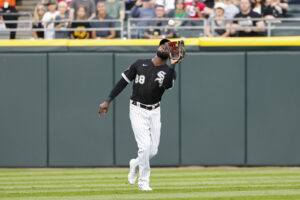
The 26-year-old finished ninth in the majors with 38 home runs. He hit .264/.315/.542 overall, more than compensating for a middling strikeout and walk profile with huge power. Robert also put his excellent athleticism to use on the bases and defensively. He went 20-24 in stolen base attempts and received strong grades for his 1207 2/3 innings in center field. Defensive Runs Saved pegged Robert as six runs better than average, while Statcast rated him 11 runs above par.
In what was a disastrous season for the Sox overall, Robert was a rare bright spot. He earned his first All-Star nod and a Silver Slugger at year’s end. He finished 12th in AL MVP balloting, the first time in his career he received down-ballot recognition for that award.
That stellar showing led to a bit of chatter about Robert’s potential availability in trade. White Sox general manager Chris Getz stoked those flames early in the offseason when he said there were no untouchables on a top-heavy roster. While Getz has never entirely walked those comments back, he clarified at the Winter Meetings the Sox would set such a high bar in talks that he had “a tough time seeing him wearing another uniform next year.”
Even as the White Sox entertain trade possibilities on the likes of Jiménez and starter Dylan Cease, there’s reason for Chicago to more or less take Robert off the table. He’s the team’s best player, for one. Yet a trade would have been easier to envision if not for the extension. Robert has four years of MLB service. If Chicago hadn’t signed him to an extension (or kept him in the minors to delay his service clock in 2020), he’d be two years from the open market.
Instead, they have him under control for another four seasons. Robert will make $12.5MM next season and $15MM the year after. Chicago holds affordable $20MM options on his services for the 2026-27 campaigns. His combination of star upside and extended control window makes him one of the most valuable trade assets in the sport. Moving Robert would signify a full teardown. Trading Cease, who is controllable via arbitration for two seasons, is more in line with a shorter-term “retool.”
Image courtesy of USA Today Sports.
Krall: Reds Likely Done With “Major Moves” For The Offseason
The Reds have had a fairly busy offseason to this point, headlined by the surprise addition of switch-hitting infielder Jeimer Candelario on a three-year, $45MM deal. Beyond that, the club has addressed its pitching staff by picking up Frankie Montas and Nick Martinez as potential rotation options while shoring up the bullpen with Emilio Pagan. GM Nick Krall suggested to reporters, including C. Trent Rosencrans of The Athletic, today that the club is unlikely to make any more “major moves” this winter, though it’s possible they’ll look to bolster their bench or bullpen depth before Spring Training begins.
It’s not necessarily a surprise that the Reds don’t expect to make any other significant additions in free agency, as the club has made more than $100MM in salary commitments this offseason after much smaller offseasons in recent years. On the other hand, RosterResource projects the club for a payroll of just $101MM next season even after all of that spending. That still leaves a healthy amount of room relative to the club’s all-time high of $126MM back in 2019 (per Cot’s Baseball Contracts), though it does represent a significant step up from the club’s $87MM payroll in 2023 and roughly in he same ballpark as 2022’s $107MM figure.
Somewhat more surprising than the idea the Reds may not look to sign additional free agents of significance is the fact that Krall seemed to indicate the club doesn’t expect to swing a significant trade throughout the remainder of the offseason. The club’s infield depth is the envy of the rest of the league, and Cincinnati appears to have more position players ready for an everyday role in the majors than they can afford such an opportunity to. That’s caused Reds infielders such as Jonathan India to generate plenty of buzz on the offseason rumor mill, with India even landing at #11 on MLBTR’s list of the Top 25 Offseason Trade Candidates.
Of course, an unexpected opportunity cropping up on the trade market or even via free agency is always possible, but it seems as though the club will now shift its focus to fine-tuning the roster with minor moves. Giving the aforementioned deep positional group the club has at its disposal, the bullpen seems like a more likely place for additions at the margins than the bench, though it’s at least conceivable the club could look to add a right-handed hitting outfielder to its bench mix to help balance the trio of Jake Fraley, TJ Friedl, and Will Benson alongside Spencer Steer and Stuart Fairchild.
As for the bullpen, Alexis Diaz looked like a capable late-inning arm last season and a supporting cast of Pagan, Lucas Sims, and Sam Moll should help the Reds field a competitive relief corps next season. With that being said, the club’s bullpen ranked in the bottom half of the league in terms of ERA (16th), FIP (23rd), and xFIP (29th). While the addition of Pagan and a healthier starting rotation could take some of the load off a relief corps that threw 652 1/3 innings last year, it’s easy to see where the group could benefit from further reinforcements. The Reds seem unlikely to play at the top of the relief market with players like Josh Hader, Jordan Hicks, and Robert Stephenson, though lower-level arms with late-inning experience such as Brad Hand or Adam Ottavino could make sense to add a veteran arm to the late-inning mix.
Cubs To Sign Colten Brewer
The Cubs are apparently in agreement with Colten Brewer on a contract for 2024, per a post from Brewer’s own Instagram page. It’s not yet clear if the arrangement is a major or minor league pact.
Brewer, 31, was a fourth-round pick by the Pirates in the 2011 draft. After several years in the Pirates and Yankees farm systems, Brewer made his big league debut with the Padres in 2018 though the right-hander struggled to a 5.59 ERA across 11 appearance that first season. From there the right-hander joined the Red Sox, the club with whom he spent most of his time in the majors. In parts of three seasons with Boston, Brewer posted a 4.98 ERA and 5.20 FIP across 81 1/3 innings of work. While he struck out a respectable 20.3% of batters faced during that time while generating a solid 50.4% groundball rate, Brewer walked a whopping 13.3% of batters faced during his time with the Red Sox.
Those control issues led the club to designate Brewer for assignment back in June 2021. He was eventually outrighted to Triple-A and spent the remainder of the season in the minor leagues before signing a minor league deal with the Royals the following offseason but was confined to the minor leagues for the entire 2022 season. During his 18-month stint at the Triple-A level, Brewer put up a relatively pedestrian 4.53 ERA over 57 2/3 innings of work as his walk rate remained over 10%.
That didn’t stop Brewer from landing with the Rays on a minor league deal during the 2022-23 offseason, though he ultimately wouldn’t make it to Opening Day as a member of the organization. The Rays instead got together with the Yankees on a minor trade before the start of the season that shipped Brewer to the Bronx, where he joined the club’s 40-man roster. He put up decent enough results in 8 1/3 innings of work for the big league club with a 4.32 ERA, but was nonetheless designated for assignment in mid-April.
Brewer accepted an outright assignment with the Yankees and pitched exceptionally well in 20 innings with the club’s Triple-A affiliate, posting a 1.35 ERA with a whopping 29.9% strikeout rate. That brief flash of dominance earned Brewer attention from Nippon Professional Baseball’s Hanshin Tigers, and he signed with the club for the remainder of the 2023 season. Though he managed just 12 1/3 innings down the stretch in Japan, the strong numbers continued. Brewer allowed an ERA of just 2.19 across 14 appearances overseas, striking out 30.2% of batters faced while walking 11.3%.
Brewer’s stretch of dominance in the upper minors and abroad last season has seemingly caught the attention of the Cubs. Chicago is among a handful of clubs known to be looking for relief help this winter along with the Cardinals, Rangers, and Astros. Brewer could conceivably bolster the depth of a club that saw the likes of Michael Fulmer and Brad Boxberger depart for free agency. With that being said, the addition of Brewer seems unlikely to take the Cubs out of the relief market given their reported interest in some higher-level arms like former Rays righty Robert Stephenson and veteran closer Liam Hendriks. For now, Brewer figures to enter Spring Training with a shot at a role in the club’s bullpen competing alongside the likes of Daniel Palencia and Jose Cuas.
Reds Designate Austin Wynns For Assignment
The Reds officially announced their signing of right-hander Frankie Montas, with catcher Austin Wynns designated for assignment in a corresponding move.
Wynns, 33, was just signed by the Reds to a split deal a couple of weeks ago. He was added to the roster on a deal that will pay him a $950K salary for time spent in the majors and $300K in the minors. Given the nature of that deal and this quick transaction, it seems the club is hoping that Wynns will pass through waivers unclaimed and stick in the minors.
As a player with more than three years of MLB service time, Wynns has the right to reject an outright assignment and elect free agency. But since he has less than five years of service, exercising that right would mean leaving the remaining money on the table. Since he is set to get paid decent amount even in Triple-A, he may decide to stay. For reference, the recent collective bargaining agreement signed for minors leaguers included a minimum salary of $35,800 for Triple-A players, well south of what Wynns is set to make.
If all this comes to fruition, the Reds will have an experienced backstop providing them with depth in a non-roster capacity. Wynns has played 232 major league games, having hit .226/.273/.324 in 653 plate appearances. That translates to a wRC+ of just 61, but he’s generally regarded as a solid framer and defender, though stronger with his throwing than his blocking.
The Reds now have just two catchers on their 40-man roster in Tyler Stephenson and Luke Maile. If an injury should occur, perhaps Wynns will be first in line to step up and fill in, though the club also signed P.J. Higgins to a minor league deal.
It’s not a guarantee that Wynns will go unclaimed, however. Last year, the Orioles agreed to a split deal with outfielder Jake Cave and similarly tried to pass him through waivers, though the Phillies interrupted those plans by claiming him. If some other club likes the idea of Wynns at a salary barely above the league minimum, perhaps they will grab him. Wynns is out of options and can’t be sent to the minors without occupying a roster spot.
Red Sox Claim Max Castillo From Royals
The Red Sox announced that they have claimed right-hander Max Castillo off waivers from the Royals. The righty was designated for assignment before the holidays but lingered in DFA limbo for a while since the normal seven-day window is paused between Christmas and New Year’s. Boston’s 40-man roster is now at 40, though their deal with Lucas Giolito has not yet been made official.
Castillo, 25 in May, has 59 2/3 innings of major league experience to this point in his career. He has a 5.43 earned run average in that time, having stuck out 18.1% of batters faced, walked 9.3% and kept 44.7% of balls in play on the ground.
Acquired from the Blue Jays alongside Samad Taylor in the Whit Merrifield trade, Castillo spent most of 2023 in Triple-A Omaha. He threw 116 innings at that level with a 4.58 ERA, 19.2% strikeout rate, 5.7% walk rate and 38.8% ground ball rate.
Castillo still has an option year left, so he’ll give the Sox some extra rotation depth for now. The Boston rotation currently projects to feature some combination of Giolito, Brayan Bello, Nick Pivetta, Kutter Crawford, Tanner Houck and Garrett Whitlock but Castillo will give them another arm and can be kept in Worcester. Pivetta is an impending free agent and Giolito can opt out of his deal after 2024 as well. That creates some long-term uncertainty though the Sox have been connected to free agents like Blake Snell and Jordan Montgomery. Perhaps the club will convert Castillo to relief at some point to see if that unlocks another gear. Castillo still has less than a year of service time, giving him the club plenty of cheap control if he takes a step forward.
Reds Sign Frankie Montas
The Reds announced that they have signed righty Frankie Montas, to a one-year deal with a mutual option for 2025. It’s reportedly a $16MM deal for Montas, who is represented by the Boras Corporation. He’ll make $14MM this year with a $2MM buyout on a $20MM mutual option.
With Nick Martinez signed to a two-year, $26MM deal last month, Montas is the second Boras client to join Cincinnati’s rotation mix. While Martinez might still factor into the Reds’ bullpen plans, Montas is more of a clear-cut starter, assuming that he is back to full health after a lost 2023 season.
The Reds’ projected rotation of Hunter Greene, Andrew Abbott, Graham Ashcraft, and Nick Lodolo have a lot of potential but also a lot of injury questions and not a lot of big league experience. As a result, the Reds were known to be looking for starting pitching help this winter, and have been linked to a wide array of names on both the free agent and trade fronts. A trade has always seemed to be the likeliest route for pitching help given Cincinnati’s wealth of minor league depth, yet the Reds have also been linked to such free agents as Seth Lugo, Yariel Rodriguez, and old friend Sonny Gray.
Gray’s name might linger in the background of today’s signing, as the Reds would surely love to see Montas replicate Gray as a starter who got back on track in Cincinnati after struggling in the Bronx. After finishing sixth in AL Cy Young Award voting with the A’s in 2021, Montas continued to pitch well in 2022 and was one of the more sought-after pitchers at the trade deadline. Oakland ultimately moved Montas to the Yankees as part of a six-player trade, yet things went haywire for Montas almost as soon as the deal was completed.
Montas struggled to a 6.35 ERA over eight starts and 39 2/3 innings for the Yankees, as he tried to pitch through some shoulder problems that bothered him prior to the trade. He spent some time on the injured list due to shoulder inflammation, which unfortunately set the stage for his nightmare of a 2023 campaign. The right-hander ended up undergoing labrum cleanup surgery in February and pitched in just one game (1 1/3 innings on September 30) last year, at least giving himself some peace of mind health-wise as he entered the offseason.
The Yankees felt good enough about Montas’ shoulder that they had some interest in re-signing him this winter, yet Montas will now head to Cincinnati for a fresh start. His deal almost exactly matched the one-year, $15MM pact that MLB Trade Rumors projected for Montas in our top 50 free agents list, with Montas sitting 44th in the ranking. If $16MM seems high for a pitcher who basically missed an entire season, the price tag speaks to the high cost of pitching, and the possible upside Montas brings if he is back to his old self.
Montas showed flashes of his quality in posting a 3.13 ERA over 161 innings for Oakland during the 2018-19 seasons, yet the latter season was cut short by an 80-game PED suspension. He also struggled during the pandemic-shortened 2020 campaign before delivering his first full top-tier season in 2021, with a 3.37 ERA and solidly above-average strikeout and walk rates over 187 innings.
Naturally there’s some risk for the Reds in this deal, as $16MM is a big expenditure for a team with a mid-level payroll and Montas isn’t a sure thing. However, the risk is at least somewhat reduced as just a one-year splurge, plus Montas might have some extra value if he does return to his old form. Should Montas pitch well, the Reds could issue him a qualifying offer next winter, and thus net a compensatory draft pick if Montas signed elsewhere. Or, of course, Montas and the Reds might end up working out a longer-term contract themselves depending on how things play out in 2024.
Cincinnati’s payroll sits just under the $103MM mark after this signing, according to Roster Resource. Considering that the Reds topped the $126MM payroll mark as recently as 2021 before their brief rebuild period, president of baseball operations Nick Krall might have a bit of extra spending capacity in what has already been a busy winter. In addition to Montas and Martinez, the Reds also signed Jeimer Candelario to a three-year, $45MM deal, and reliever Emilio Pagan for two years and $16MM. Cincinnati already emerged from its rebuild with an 82-win season in 2023 and now looks to challenge for the NL Central title, with these veteran signings buoying the club’s exciting core of young talent.
Jon Heyman of the New York Post (links to X) first reported the deal and that Montas would receive somewhere in the range of $15MM-$16MM on the one-year deal. USA Today’s Bob Nightengale added that the salary was indeed $16MM. Mark Sheldon of MLB.com relayed the full financial breakdown.
Where Can The Marlins Look For Shortstop Help?
Shortly after it was reported that the Blue Jays had a two-year, $15MM deal in place with Isiah Kiner-Falefa, Craig Mish of the Miami Herald relayed that the Marlins were “down the road with IKF but not at 2/15.” He added that the club may have to use Jon Berti and other internal options to cover the shortstop position, with the club not strongly linked to any big free agent, though a trade is still possible.
The reality is that there is no big free agent shortstop this winter for them to be linked to. There are some guys out there, though each with obvious shortcomings. The trade market is somewhat similar. But with their internal options headlines by Berti, Vidal Bruján and Jacob Amaya, it makes sense for the Marlins to still be casting out their net. Let’s take a look at where the Fish can go from here, with just six weeks to go until Spring Training kicks off.
Free Agents
It’s well-known that Anderson is coming off a dreadful season. He hit just one home run in 123 games and produced a line of .245/.286/.296. His wRC+ of 60 was dead last among qualified hitters last year. His defensive metrics also took a tumble, leading to a negative WAR tally at both FanGraphs and Baseball Reference. Taking a shot on Anderson would be a bet that he was held back by a knee injury in 2023 and will bounce back to his previous form. From 2019 to 2022, he hit .318/.347/.473 for a wRC+ of 123 with some passable glovework in there as well.
Rosario is somewhat similar to Anderson, as he is coming off a down year but looks better with a wider view. From 2019 to 2022, he hit .282/.315/.412 for a wRC+ of 101, though his defense wasn’t terribly well regarded in that time. His bat dropped off in 2023, though not as far as Anderson’s. He ultimately hit .263/.305/.378 between the Guardians and Dodgers for a wRC+ of 88. The latter club utilized him at second base and he seemed to post better results there, so perhaps he’ll be viewed as more of a second baseman going forward.
Outside of a blip in 2022, Andrus has been subpar at the plate for quite a while but his defense continues to be strong. He got into 112 games for the White Sox last year, spending more time at second base but 404 innings at short, producing four Outs Above Average in that time. Though he hit just .251/.304/.358 for a wRC+ of 81, he was still worth 1.1 fWAR on the year thanks to his speed and defense. Having signed for just $3MM last winter, he should be fairly cheap again this offseason.
Urshela is decent at the plate, having hit .281/.323/.415 over the past three seasons for a wRC+ of 106. He’s also a solid defender but has never been more than a part-time option at shortstop. He had just 359 career innings at the position, with subpar grades for that small sample of work.
Others
There are plenty of other free agents who can play shortstop, but it’s hard to envision any of them getting an everyday job there. Each of Brandon Crawford, Kevin Newman, Nick Ahmed, Ehire Adrianza, Luis Guillorme, Enrique Hernández, Adalberto Mondesí, Yu Chang and Kevin Smith are available, but each is either coming off a poor season or is best served as a utility/bench option.
Trade Market
Adames is perhaps the best player listed in this post, regularly combining 25-homer power with strong defense, but it’s hard to imagine the Marlins prying him loose from Milwaukee. He’s an impending free agent and is projected by MLBTR contributor Matt Swartz for a salary of $12.4MM. That makes it speculatively possible that the Brewers are open to moving him, but then they would be left with a shortstop vacancy of their own, which would put them in the same tricky spot the Marlins are in now. For a low-spending club like the Marlins that needs a strong prospect pipeline to succeed, it’s unlikely they would part with significant prospects for a rental.
Kim is somewhat similar to Adames, as he’s a good player but a rental. He’s hit .256/.338/.391 over the past two seasons and has been great in the field, allowing him to produce 8.1 fWAR in that span. The Padres are running a tight budget but Kim has a CBT hit of just $7MM and they have infield questions. Manny Machado had elbow surgery in October and may need to miss some of the start of the season or at least slot into a DH role for a while. That could leave Kim covering third with Jake Cronenworth at second until Machado comes back, moving Kim back to second and Cronenworth to first.
Farmer is a glove-first utility guy that generally grades out well at shortstop. He’s hit .258/.316/.402 over the past three years for a wRC+ of 94. He has over 2,000 innings at shortstop in his career, with a -1 DRS, 0.7 UZR and +3 OAA. The Twins tended him a contract for 2024 with a projected salary of $6.6MM, but they are looking to cut payroll this year due to their broadcast situation. Their infield is loaded with Carlos Correa, Royce Lewis, Edouard Julien, Jorge Polanco and Alex Kirilloff set for regular roles and prospect Brooks Lee charging hard from the minors. Without Farmer, they would still have Willi Castro and Nick Gordon for bench/utility roles and José Miranda in the minors as depth. Like Adames and Kim, he’s a rental, but should be more attainable.
Espinal seems somewhat redundant as a depth/utility player now that the Jays have IKF on the roster. Espinal hit .282/.340/.382 over 2021 and 2022 for a wRC+ of 105 and received strong grades at the three infield positions to the left of first base. He hasn’t played too much shortstop but that’s mostly because the Jays have had Bo Bichette locked in there. Espinal is coming off a down year at the plate, however, having hit .248/.310/.335 in 2023 for a wRC+ of 80. He’s projected for an arbitration salary of $2.5MM and has two extra years of control beyond this one.
The Orioles are loaded with infield talent, with 2024 likely to see a left side of Gunnar Henderson and Jackson Holliday, which will squeeze out Mateo. He has hit just .223/.270/.363 in his career for a wRC+ of 77 but has stolen 30-plus bases in each of the past two years. He’s also considered a great defender at short, having grades of 15 DRS, 8 OAA and 9.1 UZR in his career. He will make $2.7MM this year and can be retained for one more arbitration season after that.
Guardians
The Guardians have a high number of shortstop-capable players on their roster, including Brayan Rocchio, Gabriel Arias, Juan Brito, Tyler Freeman, Angel Martínez and José Tena all in the mix. Andrés Giménez could also be on that list, though he’s likely to be the everyday second baseman. They may be willing to part with someone from that group, depending on who they believe will eventually take the job in Cleveland.