
Kolby Allard Out With Grade 2 Oblique Strain
Braves lefty Kolby Allard has been shut down after being diagnosed with a Grade 2 oblique strain, per Justin Toscano of the Atlanta Journal-Constitution (Twitter link). He’ll begin the season on the injured list.
There’s no specific timetable for Allard to return just yet, but even Grade 1 strains can lead to a month-long absence at times. Every injury is different, of course, but for some recent context, Rays righty Tyler Glasnow was diagnosed with a Grade 2 oblique strain earlier this month and received a timetable of six to eight weeks.
Allard wasn’t expected to open the season in the Atlanta rotation, but he’s on the 40-man roster and has been sharp in limited spring innings thus far, allowing a run on three hits and a walk with four strikeouts through five innings.
The 25-year-old Allard was the No. 14 overall pick by the Braves back in 2015 but was traded to the Rangers in a 2019 deadline swap that brought righty Chris Martin to Atlanta. The Braves reacquired him in the offseason trade that sent veteran right-hander Jake Odorizzi back to Texas (with Atlanta covering $10MM of Odorizzi’s $12.5MM salary). Allard has a career 3.73 ERA in 316 1/3 innings of Triple-A ball, but he’s been hit hard in parts of five MLB seasons, recording a 6.07 ERA in 232 2/3 frames.
The Braves’ rotation again looks quite strong, led by Cy Young runner-up Max Fried. He’s followed by Charlie Morton, Kyle Wright and Rookie of the Year runner-up Spencer Strider. Candidates for the fifth spot include righties Ian Anderson, Bryce Elder and Mike Soroka. Two of those three will likely join Allard (once healthy) in serving as rotation depth with Triple-A Gwinnett.
Liberty Media Releases Braves’ Financials For 2022
Liberty Media, the corporation which owns the Braves, is a publicly traded company. As a result, they’re one of two teams (the Blue Jays being the other) whose books are opened to the public. This morning, Liberty Media released 2022 financials. The full report is available courtesy of Investors Observer and chronicled by Doug Roberson of the Atlanta Journal-Constitution.
According to the report, Liberty Media collected a franchise-record $588MM in Braves-related revenue last year. That’s a $20MM jump over 2021’s previous franchise-record figure, which the corporation attributed to increased ticket demand and additional retail on the heels of Atlanta’s World Series championship.
The franchise’s operating income before debt and amortization (OIBDA), on the other hand, was down relative to last season. Its $71MM OIBDA was down from last year’s $104MM figure. The corporation reported an operating loss of $15MM after reporting $20MM in operating income during the prior season. However, those figures do not include revenue from the Battery Atlanta, a mixed-use development complex adjacent to Truist Park and owned by Liberty Media. Liberty Media reported $28MM in additional net operating income and $53MM in total revenues related to that project.
Regarding the related figures to the Braves franchise specifically, Liberty Media attributed the comparatively lower OIBDA and operating income to loftier revenue sharing expenses and a higher player payroll. Indeed, Atlanta’s Opening Day payroll checked in around a franchise-record $178MM in 2022 after sitting at approximately $131MM in 2021, according to Cot’s Baseball Contracts.
However, another significant change for the organization between 2021 and ’22 was the club’s postseason fortune. The Braves, of course, won the championship in the former season and benefited from eight playoff home games. Their defeat in last year’s NL Division Series kept them to two postseason home contests. As a result, Liberty Media reported significantly lower fourth quarter revenues in 2022 than they had the prior season. Barring a repeat World Series run, the franchise’s playoff-related income always seemed likely to regress.
The Braves are coming off a very quiet offseason, at least from a free agent perspective. Atlanta acquired catcher Sean Murphy and promptly signed him to a six-year, $73MM extension. That was their only notable investment of the offseason. The club’s only other major league acquisitions were relievers Joe Jiménez and Lucas Luetge (combined $4.315MM in arbitration salaries), low-cost free agent deals for outfielder Jordan Luplow ($1.4MM) and reliever Nick Anderson ($875K if in the majors) and trades for pre-arbitration players like Eli White and Sam Hilliard.
Atlanta saw a top free agent depart for the second consecutive offseason, watching Dansby Swanson sign with the Cubs a year after Freddie Freeman went to the Dodgers. Despite the fairly quiet winter, they’re easily on track to again set a franchise high in player spending. The Braves will go into 2023 with a payroll in the $199MM range, as calculated by Roster Resource. Their projected luxury tax number sits a little under $240MM, which will exceed this year’s $233MM base threshold. The franchise looks set to pay the luxury tax for the first time in Liberty Media’s ownership tenure.
That’s a reflection of the staggering number of contracts already on the books, many of them early-career extensions. No other organization has had the same kind of success signing key players to long-term deals shortly after their MLB debuts. Those kinds of pacts tend to be backloaded to roughly mirror how a player’s earnings would have progressed via arbitration. Not coincidentally, Atlanta already has upwards of $90MM on the books through the 2028 campaign.
The Braves’ Fifth Starter Competition
Coming off a 101-win campaign, the Braves again look like one of the top teams in the National League. There aren’t many areas of concern on the roster. On the position player side, all but shortstop and left field have established solutions who should play at somewhere between an above-average and star level if healthy. The bullpen is one of the sport’s best, and the top four starters of Max Fried, Spencer Strider, Kyle Wright and Charlie Morton is elite.
There is a little bit of uncertainty as to who’ll round out the starting staff, however. Atlanta has a handful of pitchers vying for the final rotation spot in Spring Training. A couple have had some big league success but struggled with underperformance or injury recently. Another is a less proven, younger talent.
At this time a year ago, it’d have seemed foolish to picture Anderson fighting for a rotation spot at any point in the near future. Heading into 2022, the former third overall pick carried a 3.25 ERA with a 24.5% strikeout rate in 30 career regular season starts. He’d twice excelled on the postseason stage. Anderson looked like an upper mid-rotation arm, a key starter both in the present and over the coming seasons.
The 2022 campaign was the first in which the righty ran into trouble. He made 22 big league starts but allowed five earned runs per nine innings across 111 2/3 frames. Anderson’s strikeout rate fell to a personal-low 19.7% clip, although he still picked up swinging strikes on an above-average 12.3% of his total offerings. While he did a solid job keeping the ball on the ground, he surrendered a little more hard contact than he had in prior seasons. Anderson also walked a career-high 11% of opposing hitters.
With Atlanta in the thick of a division race, they optioned the struggling Anderson to Triple-A Gwinnett in early August. He started four games there, posting similar numbers as he had in the majors. His season was cut short when he strained his left oblique in the middle of September.
Anderson is just 24 years old and certainly capable of bouncing back from the down year. His average fastball velocity was down marginally last year but still checked in at a solid 94 MPH. He owns one of the game’s better changeups. Anderson’s curveball was a little less effective, with the lack of an impact breaking ball contributing to a disappointing .313/.375/.511 line in 253 plate appearances against same-handed hitters last season. Anderson told reporters last week he’s working on a new slider to try to add a weapon to deal with righty batters (link via David O’Brien of the Athletic).
A fifth-round pick out of Texas in 2020, Elder flew through the minor leagues. He was in the majors by April of his second full professional season. The 6’2″ righty started nine of his first ten MLB contests, posting a 3.17 ERA through 54 innings. That came with strikeout and walk numbers each a bit worse than league average (20.7% and 10.1%, respectively) but a quality 49.3% ground-ball percentage.
He had a longer run in Gwinnett, starting 17 of 18 games. Elder’s 4.46 ERA in 105 Triple-A innings wasn’t as impressive as his MLB run prevention mark, but his peripherals were stronger across the board. He punched out 22.2% of opponents, kept walks to a 7.3% clip and racked up grounders at a 55.9% rate.
The 23-year-old isn’t overpowering, averaging only 90.7 MPH on his sinker during his MLB action. He consistently kept the ball down in the minor leagues, though, posting grounder numbers on over half the batted balls he allowed at every stop. Elder almost carried that over against big league competition in his first crack and should some aptitude for avoiding hard contact — thanks in large part to a cutter and slider he was comfortable deploying against lefties and righties alike.
Soroka, another ground-ball specialist, was one of the sport’s top young pitchers not too long ago. An All-Star at 21, he finished sixth in NL Cy Young balloting after posting a 2.68 ERA through 28 starts as a rookie in 2019. That came on the strength of an excellent 51.2% grounder percentage and tiny 5.8% walk rate, with Soroka demonstrating rare polish for a pitcher his age.
Unfortunately, a brutal series of injuries has limited him to three big league outings since then. Those came in the abbreviated 2020 season before he blew out his right Achilles. After a year of rehab, the same thing happened again shortly before he could make his return to a mound. He lost all of 2021 and almost all of ’22 recovering. Soroka returned from the injured list to start five Triple-A games late last year but felt some soreness in his elbow — not unexpected for a pitcher coming off such a long layoff — and was shut down for precautionary reasons.
While the Achilles and elbow concerns are hopefully behind him, Soroka has again been slowed up by his body this spring. He experienced some hamstring soreness that’ll delay his getting into Spring Training games for a few weeks. It’s not believed to be a major concern, but the righty candidly called it “a kick in the groin” given how much work he’s put in rehabbing from other injuries the past few seasons. It remains to be seen whether he’ll be able to fully build up for Opening Day.
Other Possibilities
It looks as if the early battle for the fifth starter job comes down to one of the three pitchers above (with Soroka perhaps behind the others given his hamstring issue). However, a few others could find themselves in position to vie for reps at some point during the season, particularly if one or two of Atlanta’s top four starters suffers an injury.
Kolby Allard, a former Braves first-round pick, was acquired back from the Rangers at the start of the winter for Jake Odorizzi. He has a 6.07 ERA in 65 big league contests but occupies a 40-man roster spot. The same is true of Darius Vines, whose contract was selected at the start of the offseason to keep him from the Rule 5 draft. He’s never pitched in the majors but posted a 3.95 ERA with a 28.5% strikeout rate over 20 Double-A starts to earn a late-season bump to Gwinnett.
Former Cubs righty Matt Swarmer signed a minor league deal over the weekend and is in camp as a non-roster invitee. 2020 first-rounder Jared Shuster had an impressive start at Double-A before a more average performance in Gwinnett last season. He’s not yet on the 40-man roster and one of the better prospects in a now-thin Atlanta farm system.
Braves Sign Matt Swarmer To Minor League Deal
The Braves signed righty Matt Swarmer to a minor league contract over the weekend. The team didn’t formally make an announcement, but the transaction log at MiLB.com indicates he signed a couple days back. Swarmer actually already made his spring debut with the Braves in yesterday’s Grapefruit League contest, tossing one-third of an inning in relief of righty Bryce Elder.
Swarmer, 29, made his big league debut with the Cubs in 2022 when he tossed 34 innings of 5.03 ERA ball over the life of 11 appearances (five starts, six relief outings). He fanned a solid 23.5% of his opponents but issued far too many walks (13.1%) during that brief MLB sample. Swarmer’s big league tenure started with a flourish, as he tossed consecutive quality starts and held the Brewers and Cardinals to a combined two earned runs on seven hits and three walks with 11 punchouts in 12 innings. Over his next 22 frames, however, he was tagged for a 6.95 ERA. The Cubs outrighted him off the roster back in July, and he became a minor league free agent after the season.
A 19th-round pick by the Cubs back in 2016, Swarmer pitched across three levels — High-A, Double-A and Triple-A — in his first full professional season back in 2017, although the results were generally shaky, as one might expect for a pitcher rising so quickly through the system. He had a nice season between High-A and Double-A in 2018 before being hit hard in 2019 and 2021 at the Triple-A level. (There were no minor league games in 2020, of course.)
The 2022 season was the first in which Swarmer found some success in Triple-A. He tossed 81 1/3 frames with the Cubs’ Iowa affiliate, notching a 3.87 ERA with a 24.9% strikeout rate and a 9.5% walk rate. Swarmer doesn’t throw hard (90.6 mph average fastball in last year’s debut season) but has typically posted average or better strikeout and walk rates throughout his minor league career.
Given the manner in which the Braves have thinned out their system on the trade market over the past calendar year — Kyle Muller, Tucker Davidson and Freddy Tarnok are among the upper-minors arms they’ve moved — it’s sensible to see them add some depth in the form of a minor league veteran who had Triple-A success and made his big league debut in 2022.
Read The Transcript Of Our Live Chat With Former MLB Outfielder Billy Sample
Of our ever-growing list of current and former MLB players to hold live chats here, Billy Sample is the first to have played in the 1970s.
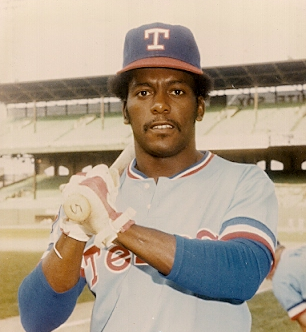
The Texas Rangers came to be in 1972, and the following year they drafted Sample, a three-sport star, out of Virginia’s Andrew Lewis high school. He did not sign at that point, instead attending Madison College (now James Madison University). Sample boosted his stock and became a 10th round pick of the Rangers in 1976.
Billy was a September call-up for the Rangers in 1978, leading off a game against the Brewers and singling to right field on his first Major League pitch. In 1979, Sample served as the Rangers’ primary left fielder. He posted a fine .292/.365/.415 line at the plate, striking out only 7.4% of the time.
In 1981, Sample enjoyed a 19-game hitting streak, and in 1983 he ranked fifth in the American League with 44 stolen bases. He had an excellent 84.6% success rate on swipes that year.
In February of 1985, the Rangers traded Sample to the Yankees with a player to be named later for Toby Harrah. After one season in New York, Sample was traded again to the Braves.
Though more of a speedster than a home run hitter, Sample left the yard 46 times in his nine-year MLB career. The list of pitchers he took deep include Hall of Famer Dennis Eckersley, Mark Langston, Dennis Martinez, and Cy Young winners Vida Blue, Mike Flanagan, Mike Scott, and LaMarr Hoyt. One of Sample’s many memorable moments included a walk-off home run against the Angels’ Don Aase in 1982.
Sample played during an interesting time in MLB history, being drafted months after free agency came to the sport. He was part of the 1981 strike, in which 713 games were cancelled, and can count many legendary players as former teammates.
According to his Wikipedia entry, which Billy suggested I reference for his post-playing career, “Sample has broadcast for the Braves, Seattle Mariners, and California Angels, as well as contributing to NPR, CBS Radio, ESPN, and MLB.com. As a writer, Sample has been published in Sports Illustrated and The New York Times, and was one of the columnists at the inception of USA Today’s Baseball Weekly (now Sports Weekly).” Billy has also written and produced a movie and self-published a book.
Billy graciously lent his time to chat with MLBTR readers today, spending over four hours discussing his career on the field, what life was like for players off the field in his time, the collusion of the ’80s, broadcasting and so much more! Click here to read the transcript!
Are you a current or former MLB player? We’d love to have you on for a one-hour chat. Click here to contact us.
Braves Sign Joe Harvey To Minors Contract
The Braves have signed Joe Harvey to a minor league deal earlier this week, according to the right-hander’s MLB.com profile page. Harvey has been assigned to the team’s Triple-A camp.
The 31-year-old Harvey has amassed a 3.32 ERA and a 29.75% strikeout rate over 105 2/3 Triple-A innings (all in relief) during his career, spending time with the top affiliates of the Yankees, Rockies, and Twins since the start of the 2018 season. Those missed bats came at a price, however, as Harvey has battled his control and also had to deal with some injury concerns. Harvey’s 2020 and 2021 seasons were both cut short by forearm strains, and he didn’t pitch at all in 2022.
Harvey’s MLB resume consists of 21 1/3 total innings, 18 of which came with the Yankees and Rockies in 2019. He’ll look for a path back to the big leagues (or perhaps just some healthy innings whatsoever), with a Braves team that has had some luck with veteran reclamation projects in recent years. If he can keep his walks down, Harvey might have some potential as an under-the-radar depth reliever for Atlanta’s bullpen.
NL East Notes: Hoskins, Rosario, Mauricio, Vientos
Rhys Hoskins underwent a meniscectomy on his right knee in December, Phillies manager Rob Thomson told Alex Coffey of The Philadelphia Inquirer and other reporters. The relatively minor procedure corrected some “wear and tear,” Thomson said, and Hoskins is expected to make his in-game spring debut sometime this week.
Now entering his age-30 season, Hoskins has been a quality hitter pretty much from day one in Philadelphia, hitting .242/.353/.492 with 148 home runs and producing a 125 wRC+ over 2877 career plate appearances in six MLB seasons. Hoskins would naturally love to keep that production going in order to help the Phillies’ chances at returning to the World Series, but a big 2023 campaign would also help Hoskins as he enters free agency next winter. The Phils already have a lot of long-term money on the books and might soon add another pricey deal if they reach an extension with Aaron Nola (another pending free agent), but it stands to reason that the club would also have some interest in locking Hoskins up to an extension. That said, Boras Corporation clients like Hoskins usually end up testing the open market, and the Phillies might have some reservations about committing a long-term deal to a first base-only player.
More from around the NL East…
- Eddie Rosario followed up his 2021 NLCS MVP performance with a dismal 2022 season, as the outfielder hit only .212/.259/.328 over 270 plate appearances with the Braves. Vision problems were the root cause of Rosario’s struggles, as Rosario started to have trouble seeing the ball during last year’s Spring Training, and he still needed some adjustment time even after undergoing laser surgery and missing over two months of the season. Fortunately, “everything is good now. I feel really good and I see really well,” Rosario told MLB.com’s Mark Bowman, and both manager Brian Snitker and hitting coach Kevin Seitzer have been impressed by Rosario’s seeming return to his old form early in camp. A revived Rosario would instantly solve the Braves’ question mark in left field, and provide a nice boost to an Atlanta team that is hoping to compete for another world championship. 2023 is the final guaranteed season of Rosario’s two-year, $18MM deal with Atlanta, though the Braves hold a $9MM club option on the veteran for the 2024 campaign.
- The Mets will use Ronny Mauricio at shortstop and Mark Vientos as a corner infielder this spring, rather than continue to audition the prospects at different positions. MLB.com’s Anthony DiComo writes that plans might change in the future, and some obvious roadblocks (i.e. Francisco Lindor, Pete Alonso, Eduardo Escobar, and fellow prospect Brett Baty) seem to be preventing Mauricio or Vientos from playing their regular positions at the big league level. Of course, it is always possible that the win-now Mets might look to move either Mauricio or Vientos for a proven Major Leaguer, though New York has thus far been pretty resistant about moving too many top-tier prospects for immediate help.
Twins Claim Dennis Santana
The Twins have claimed right-hander Dennis Santana off waivers from the Braves, Phil Miller of the Star Tribune reports. In a corresponding move, Twins shortstop Royce Lewis will be transferred to the 60-day IL. Atlanta had acquired Santana from the Rangers earlier this offseason in exchange for cash considerations. The Braves have announced the waiver claim. There had been no previous indication Santana was removed from Atlanta’s roster but they evidently tried to pass him through waivers in recent days.
Following brief stints in the majors with the Dodgers in 2018 and 2019, Santana got his first extended run of playing time in the shortened 2020 season, where he pitched out of the Dodgers bullpen in twelve games. Santana struggled in those appearances, racking up a 5.29 ERA and 5.72 FIP throughout the season. He stuck with the Dodgers into the first half of the 2021 season, though his struggles in LA continued until he was traded to the Rangers in June of that year. While Santana never found his footing in LA, struggling to a 6.48 ERA, 32% worse than league average, across his 40 2/3 innings as a Dodger, he was able to turn a corner upon arriving in Texas.
As member of the Rangers, Santana pitched to a well above average 3.63 ERA (123 ERA+) in 2021, a figure that was largely backed up by his solid 4.15 FIP. These improved results stood as Santana was catching up to his own talents as a flamethrower. His fastball had always been impressive, with his 96 mph 4-seamer ranking in the league’s 81st percentile in terms of velocity. Still, red flags were present, as Santana continued to struggle with his control. He walked a whopping 13.5% of batters in 2021 while striking out just 19.4%.
Unfortunately for Santana, 2022 proved to be a difficult season. Despite an uptick in velocity raising his fastball to an average of 97.7 mph and improved barrel and whiff rates, the right-hander’s strikeout and walk improvements, to 21.2% and 11% respectively, still left him below league average in those regards. When those below average rates are combined with an extremely low 54.3% of Santana’s runners being left on base, it’s easy to see how his ERA ballooned up to 5.22 in 2022, 24% below league average. Still, that fluky lack of stranded runners kept his FIP at a much more palatable 3.35 for the year, leaving reason for optimism headed into the 2023 season.
Santana now joins a Twins bullpen mix that includes the likes of Emilio Pagan and Jorge Alcala set to work the middle innings to bridge the gap between the starting rotation and back-end options Jhoan Duran, Jorge Lopez, and Caleb Thielbar. The acquisition of Santana also helps Minnesota build up a depth of relievers who can go multiple innings. This would help the club keep players like Josh Winder and Cole Sands in starting role at Triple-A, which the organization has previously stated as its preference. Santana is out of minor league options, meaning that if the Twins wish to retain him in the organization without putting him on the Opening Day roster, they’ll have to attempt to pass him through waivers at some point this spring.
As for Lewis, he had the misfortune of tearing the anterior cruciate ligament in his right knee in June of last year. That was the same ligament he tore the previous year, leading to two straight seasons ended by ACL surgery. At the time of that injury diagnosis, his estimated timeline was given as 12 months, meaning he likely won’t be able to rejoin the club until June and making this IL placement an expected result.
Ozzie Albies Underwent Offseason Shoulder Surgery
11:22am: Albies will serve as a designated hitter in tomorrow’s spring opener, tweets David O’Brien of The Athletic. Manager Brian Snitker indicated, however, that Albies could be playing second base in Grapefruit League games as soon as next week.
10:18am: Second baseman Ozzie Albies revealed at Braves camp this week that he underwent surgery back in October to address an impingement in his right shoulder, reports Justin Toscano of the Atlanta Journal-Constitution. Albies’ buildup this spring is slightly behind schedule as a result of the operation, but he tells Toscano he “100 percent” expects to be ready for Opening Day.
It’s been a tough year, health-wise, for Albies, who played in just 64 games this past season due to a fractured left foot and a fractured right pinkie. He tallied only 269 plate appearances with Atlanta in 2022, turning in the first below-average offensive season of his career: .247/.294/.409 (93 wRC+).
Albies, who adds that he’s been playing through shoulder pain for multiple years, hit .259/.310/.488 with 30 home runs as recently as 2021 and is a lifetime .271/.322/.470 hitter with 98 homers, 63 steals, a 6.8% walk rate and 17.7% strikeout rate in 2709 trips to the plate. He’s won a pair of Silver Sluggers and made two All-Star teams along the way.
Certainly, it’ll be worth keeping an eye on Albies as he progresses through spring, but there’s no indication from the player or the team that he’ll be sidelined to begin the season. If he does incur any kind of setback, the Braves would likely deploy both Vaughn Grissom and Orlando Arcia in the middle infield, while veterans Yolmer Sanchez, Adeiny Hechavarria and Ehire Adrianza provide further depth as non-roster invitees in spring training.
Though Albies is entering his seventh Major League season, he only just turned 26 years old last month. The 2023 campaign will be the fifth year of a seven-year, $35MM contract extension he inked back in April of 2019. He’s set to earn $7MM this season and in each of the next two campaigns as well. The Braves also hold a pair of $7MM options on Albies for the 2026 and 2027 seasons.
NL East Notes: Scherzer, Soroka, Song, Phillies
Max Scherzer‘s three-year deal with the Mets is now one-third of the way complete and will afford him the ability to opt out at the end of the upcoming season. Andy Martino of SNY asked Scherzer about that forthcoming choice and the pitcher was fairly noncommittal about it, complimenting the direction of the organization but also acknowledging the business aspect of things.
“You have to understand the context of why I negotiated that in, and the context of where we’re at now,” Scherzer said, before elaborating that he didn’t know what to expect from the club if Jacob deGrom triggered his own opt-out at the end of 2022. “It was, if Jake opts out, you didn’t know what was going to happen. You didn’t know where the Mets would be as an organization. A big draw for me to come to New York was to get the chance to pitch with him, and here he has an opt out in year one. If he did take it and go somewhere else, what is the organization going to do?” After a chuckle, he said, “I got an answer.” Of course, he now knows that owner Steve Cohen was willing to spend lavishly on free agents, ramping the club’s payroll to the top of the league in order to field a competitive team for 2023.
That response from Scherzer stands in contrast to that of deGrom, who was quite clear at this time last year that his plan was to trigger his opt-out. It’s been a similar story lately with Padres third baseman Manny Machado, who’s openly declared his intention to opt out of his deal this fall. The fact that Scherzer isn’t quite so emphatic is perhaps somewhat hopeful for Mets fans, but it could also come down to a business decision, something Scherzer acknowledged as well. “If it becomes a business situation, we will cross that bridge at a different time,” he added. “At the end of the year, that will get taken care of … I’m not thinking about it. Obviously, you go through six months of the baseball season, anything can change. So it’s not even worth it to comment on whether I’m going to use it or not.”
If Scherzer has another typical ace season, he would be facing an interesting decision from a business perspective. He will turn 39 years old in July and be deciding whether or not to leave $43.33MM on the table and become a free agent again. That’s a lot of money to turn down for a player that age, but his now-teammate Justin Verlander secured himself a two-year, $86.66MM guarantee going into his age-40 season, the same average annual value. With that in mind, Scherzer might actually leave more money on the table by not triggering his opt-out. If he were to decide to depart, the Mets would be losing two members of its current rotation, as Carlos Carrasco is in the final year of his contract.
Some other notes from around the National League East…
- Braves right-hander Michael Soroka is dealing with a sore hamstring that will prevent him from taking the mound for about a week and from appearing in spring games for a few weeks. “It’s a kick in the groin,” Soroka said to David O’Brien of The Athletic about the setback. “Pretty frustrating, especially given the early offseason for me, just to be able to get ready for this spring training. Then coming down with that was not fun. But that’s how it goes, and we’ll be moving forward here pretty shortly.” Soroka has been significantly impeded by injuries in recent years, with his 2020 cut short after three starts due to a torn right Achilles. The recovery has been quite arduous, involving three surgeries as he missed the past two seasons entirely. This latest issue doesn’t seem to be huge, but it’s understandably frustrating that there’s yet another hurdle to clear. In 2019, Soroka made 29 starts with a 2.68 ERA over 174 2/3 innings. He figured to compete with Ian Anderson for the club’s fifth starter spot this year but he might have to play a bit of catch-up whenever he’s healthy. He does still have an option year remaining, should he need more time in the minors to get stretched out after this delay.
- The Phillies informed reporters, including Alex Coffey of the Philadelphia Inquirer, that right-hander Noah Song has been discharged from the Navy and is expected to be in camp tomorrow. (EDIT: The club later clarified Song has not been discharged, but was transferred from active duty to selective reserves, which allows him to play baseball. Twitter link from Matt Gelb of The Athletic.) Song, 26 in May, was drafted by the Red Sox in 2019 but his baseball career was put on hold when the Department of Defense ordered the United States Naval Academy graduate to report to flight school. He was left unprotected in the most recent Rule 5 draft and was selected by the Phillies, whose president of baseball operations Dave Dombrowski was with the Red Sox at the time Song was first drafted. Some considered him a first-round talent back then, though he lingered until the fourth round due to concerns around that military commitment. This will now be an interesting and unusual experiment, as Song still hasn’t pitched professionally since a stint at Low-A in 2019. He was quite good at that time, posting a 1.06 ERA over seven starts but will now be jumping straight to the majors. As a Rule 5 draftee, he will have to stick on the active roster all season or put on waivers and then offered back to the Sox if he clears. The Phils could also pursue trades, though any acquiring team would face the same roster restrictions as the Phils themselves currently face. Song is currently on the military list and isn’t taking up a spot on the 40-man roster, with Gelb relaying that he will have to be added by Opening Day.
- Sticking with the Phillies, they will be navigating an open designated hitter slot until Bryce Harper returns from Tommy John surgery. The most recent estimate on that timeline has Harper returning around the All-Star break in July, giving the club a span of over three months to navigate. It seems the plan is to not have any single player entrenched in the spot and spread those opportunities around. “At this point, I think it’s a rotation,” manager Rob Thomson tells Gelb. “Getting people off their feet. Giving them a half day, so to speak.” In order to shuffle different players through there, positional versatility will be key. It was previously reported that infielder Edmundo Sosa will be getting some work in center field in order to increase his chances of getting playing time. Thomson also highlighted Josh Harrison as someone who could also see extensive action, given his ability to play all multiple positions. He’s played every position except catcher in his career, though he’s spent more time at second and third base than anywhere else. Thomson also mentioned the bat of Darick Hall, who hit nine home runs in his first 42 major league games last year. He’s been almost exclusively a first baseman in his professional career but the club is considering getting him some outfield work to help his bat into the lineup. “If he swings the bat the way he did last year,” Thomson said, “it’s going to be tough to keep him off the club.”