
Cubs Designate Brian Serven For Assignment
The Cubs announced they’ve designated catcher Brian Serven for assignment. The move clears the necessary opening on the 40-man roster for the two players acquired in this afternoon’s trade with the Dodgers: Michael Busch and Yency Almonte.
Serven is a newcomer to the Chicago organization in his own right. The Cubs claimed him off waivers from Colorado six days ago. They’ll now trade him or, more likely, put him back on waivers within the next week.
Until that claim, Serven had spent his whole career with the Rockies. Colorado selected him in the fifth round of the 2016 draft out of Arizona State. He reached the majors six years later and worked as their backup catcher for a good portion of the ’22 campaign. The right-handed hitter posted a .203/.261/.332 batting line over 62 contests as a rookie.
Colorado went with a catching tandem of Elias Díaz and Austin Wynns for the bulk of last season. Serven only appeared at the MLB level 11 times. He got into 38 contests with their Triple-A team in Albuquerque. Despite an extremely favorable environment for hitters, he managed only a .199/.241/.331 slash over 162 plate appearances.
Serven had turned in better offensive results earlier in his minor league career. He’s a .240/.310/.418 hitter in a little under 1500 minor league plate appearances. That’s still fairly tepid work at the dish, but the Cubs placed a claim a week ago on the strength of his defensive reputation. Serven received solid marks for his pitch framing in 2022 and has strong caught stealing numbers throughout his minor league tenure.
Cubs Acquire Michael Busch, Yency Almonte
The Dodgers and Cubs announced a trade sending rookie infielder Michael Busch and reliever Yency Almonte from Los Angeles to Chicago for prospects Jackson Ferris and Zyhir Hope. The deal clears a pair of 40-man roster spots for L.A. — one of which will go Teoscar Hernández once his free agent pact is finalized. The Cubs designated catcher Brian Serven for assignment in a corresponding move.
Busch has the more significant value of the players headed to Chicago. Los Angeles selected the UNC product with the 31st overall pick in the 2019 draft. Regarded as a bat-first prospect with questions about his defensive fit, Busch has mostly lived up to that billing during his time in the minors.
Over parts of four seasons, the left-handed hitter owns a .283/.390/.529 line. That includes a robust .293/.385/.544 showing in just under 1000 plate appearances at Triple-A. Busch has connected on 48 home runs and 58 doubles with an excellent 11.8% walk rate at the top minor league level. His 22.5% strikeout rate is closer to league average, but Busch has shown a strong combination of power and patience.
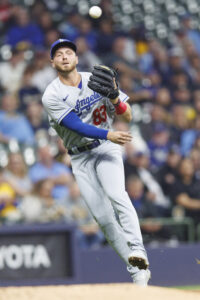
Despite his excellent Triple-A production, the 26-year-old hasn’t gotten much of an MLB opportunity. He didn’t reach the majors until last April. He appeared in 27 games scattered over the course of the season. Through his first 81 plate appearances, he hit only .167/.247/.292 with a pair of home runs. He struck out in a third of his trips.
There’s not much to be gleaned from such a small sample of MLB work. At the same time, that the Dodgers haven’t given Busch extended run is indicative of a few factors. The Dodgers have had strong position player groups in recent years. That’s an impediment to a young hitter, but L.A. had some questions at second base and left field last season. Were Busch regarded as a better defensive player, perhaps he’d have forced his way into the discussion at one or both of those spots.
L.A. has given Busch opportunities at a few positions in the minors. While he has played primarily second base, he’s also gotten work at both corner infield spots and in left field. Prospect evaluators have graded him as a below-average defender at every spot, raising questions about his athleticism and arm strength. Baseball America nevertheless ranked him as the top prospect in the Dodgers system this offseason on the strength of his offensive ceiling.
In some respects, the Cubs will face the same question on Busch as they do on Christopher Morel — where to find at-bats for a promising hitter who hasn’t defended well at any position. That’d most likely come at a corner infield spot or at DH. Morel projects for a starting role at either first base or DH. Some combination of Patrick Wisdom and Nick Madrigal are the top options at the hot corner. The Cubs could still pursue a free agent target at either spot — they’ve been tied to Rhys Hoskins and Matt Chapman this winter — but Busch adds an affordable, high-upside lefty bat to the mix.
Busch still has a pair of minor league option years, so he’s not a lock to open the season on the MLB roster. He’s at least three years from arbitration and won’t be eligible for free agency for at least six seasons. Future minor league assignments could push that back even further.
A secondary part of the return, Almonte steps into the middle relief corps. The 29-year-old righty pitched in 49 games a year ago, working to a 5.06 ERA across 48 innings. He struck hitters out at a solid 23.6% clip but issued free passes to more than 11% of opponents. That continues an up-and-down career for Almonte, who has three seasons with a sub-3.00 ERA and a trio of campaigns allowing more than five earned runs per nine.
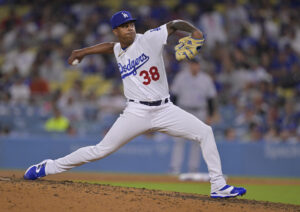
Almonte and the Dodgers already agreed to a $1.9MM arbitration salary back in November. The Cubs will take on that near-$2MM sum to add a pitcher with a mid-90s fastball and a low-80s sweeper that has generated a strong number of whiffs throughout his career. He’s out of options, so he’ll very likely have a spot in the Opening Day bullpen. The Cubs could control him via arbitration for the 2025 season as well.
To add immediate MLB help, Chicago parts with two promising lower-level players. Ferris, who turns 20 next week, was a second-round pick in the 2022 draft. A 6’4″ left-hander, he signed for a well overslot $3MM bonus as a high school prospect. Ferris made his professional debut last season, turning in a 3.38 ERA over 18 starts for Low-A Myrtle Beach. He punched out nearly a third of his opponents while walking almost 14% of batters faced.
As a young, lanky pitching prospect, it’s not particularly surprising that Ferris has yet to dial in his control. Baseball America praised a 93-95 MPH fastball and a pair of potential above-average or plus breaking balls this offseason, slotting him as the #10 prospect in the Chicago system. He’s a high-upside development play whose future will largely be determined by how well his command develops.
Hope was an overslot signee for $400K in the 11th round last summer. A left-handed hitting outfielder from a Virginia high school, he played in 11 rookie ball games after the draft. In a pre-draft report, BA wrote that Hope was among the fastest players in last year’s class. He’s regarded as a viable fit in center field with a line drive approach, although BA expressed trepidation about his aggressiveness at the dish.
Juan Toribio of MLB.com first reported the Dodgers were discussing Almonte and Busch in trades with the Cubs. Jon Heyman of the New York Post confirmed an Almonte deal was agreed upon. Ken Rosenthal of the Athletic reported the Dodgers were receiving two players not on the 40-man roster, which Toribio specified included a highly-regarded pitching prospect. Ari Alexander of KPRC 2 was first to report L.A. would receive Ferris and Hope.
Images courtesy of USA Today Sports.
Braves, Max Fried Avoid Arbitration
The Braves and Max Fried agreed to a $15MM contract to avoid arbitration, reports Robert Murray of FanSided (X link). That’ll avoid a hearing in his final year going through the process. Fried is represented by CAA Sports.
Fried, who turns 30 next week, put up a 2.55 ERA in 2023. He made 14 starts spanning 77 2/3 innings, enduring a three-month absence for a forearm strain. The abbreviated season resulted in a $1.5MM raise for the lefty.
This represents Fried’s fourth and final time through arbitration, as he achieved Super Two status after the 2020 season. He reached an agreement with the Braves for ’21, won a hearing against them for ’22, and lost a hearing against the club for ’23. Fried had submitted a $15MM figure at his hearing nearly a year ago, but the arbitration panel instead chose the team’s $13.5MM figure. So now in 2024, he will earn the amount he was hoping to earn in ’23.
Justin Toscano of the Atlanta Journal-Constitution reported in December that the Braves discussed an extension with Fried’s agency prior to the ’23 season. Braves president of baseball operations and general manager Alex Anthopoulos has given out 18 extensions since being hired in November 2017, according to our MLB Contract Tracker. His longest deal for a pitcher was Spencer Strider‘s six-year pact, though Strider had one year of MLB service at the time. Otherwise he hasn’t given a multiyear deal to any starting pitcher, if you don’t count Reynaldo Lopez as one. Though they’ve signed many players to extensions, the Braves did ultimately let Freddie Freeman and Dansby Swanson leave as free agents, as noted by Toscano.
Fried is a special case, given a run of success for the Braves that has included Cy Young votes in the 2020 and ’22 seasons as well as the clinching win in Game 6 of the 2021 World Series. Starting pitchers who signed deals worth $100MM+ with five years of service in the last decade include Clayton Kershaw, Homer Bailey, Stephen Strasburg, Jose Berrios, Joe Musgrove, and Luis Castillo. After back to back years of arbitration hearings, perhaps Fried reaching an agreement for ’24 can be viewed as a mild positive in his relationship with the team.
If he reaches the open market, Fried would be one of many interesting starting pitchers in the 2024-25 class. You can check that out here.
Astros Outright Joel Kuhnel
Right-hander Joel Kuhnel has cleared outright waivers, the Astros informed reporters (including Chandler Rome of the Athletic). He has the right to elect free agency since this is his second career outright assignment; the team didn’t announce whether he’ll do so. Houston had designated him for assignment last week as the corresponding move for their waiver claim of Declan Cronin from the White Sox.
Houston acquired Kuhnel in a cash transaction with the Reds in June. He spent most of his tenure in Triple-A, appearing in 17 games for Triple-A Sugar Land. Over 19 2/3 innings there, he posted a 5.03 ERA. Kuhnel pitched seven times with the Astros, allowing five runs with three strikeouts and walks apiece through 9 2/3 frames.
An 11th-round pick in 2016, Kuhnel has appeared at the MLB level in four of the past five years. His only extended work came in 2022. He soaked up 58 innings for Cincinnati that season, pitching to a 6.36 ERA in mostly low-leverage relief. For his career, he has allowed 6.02 earned runs per nine across 83 2/3 frames. Kuhnel’s 19.3% strikeout rate is below average, but he has kept the ball on the ground on a lofty 52.5% of batted balls.
The grounder rate and a fastball that lands around 95 MPH on average should allow Kuhnel to find a minor league deal elsewhere if he chooses free agency. If he accepts the outright assignment, he’d likely receive an invite to Houston’s Spring Training camp as non-roster relief depth.
Bud Harrelson Passes Away
The Mets announced the passing of longtime infielder Bud Harrelson last night at age 79. He had battled Alzheimer’s for an extended period, according to the team.
“We were saddened to learn of Mets Hall of Famer Buddy Harrelson’s passing. He was a skilled defender and spark plug on the 1969 Miracle Mets,” owners Steve and Alex Cohen said in a statement. “The Gold Glove shortstop played 13 years in Queens, appearing in more games at short than anyone else in team history. Buddy was the third base coach on the 1986 World Champs, becoming the only person to be in uniform on both World Series winning teams. We extend our deepest condolences to his entire family.”
Harrelson was a Bay Area native who played in college at San Francisco State. He signed with the Mets as a 19-year-old. The switch-hitting infielder got to the majors two years later, debuting with 19 games in 1965. Harrelson spent most of the 1966 campaign in Triple-A before emerging as a regular on the ’67 club.
He was an excellent defensive presence at shortstop for the next decade. Harrelson was the starter for the ’69 team that surprisingly secured the first World Series in franchise history. He made a pair of All-Star Games in 1970 and ’71, securing down-ballot MVP support in both years. Harrelson won the National League’s Gold Glove at shortstop in 1971. He finished among the top five NL shortstops in fielding percentage each year from 1969-72 and twice ranked among the top five at the position in assists.
Harrelson helped the Mets back to the Fall Classic in 1973, an eventual defeat at the hands of the A’s. While he had a solid showing in the World Series, he’s perhaps better known for his role in a bench-clearing brawl with the Reds in that’s year NLCS. After the Mets shut out Cincinnati in Game 2, Harrelson quipped that New York starter Jon Matlack had made Cincinnati’s vaunted offense “look like me hitting.” The following game, Harrelson took exception to a hard slide from Pete Rose on a double play turn, leading to the fracas.
As he self-deprecatingly noted, Harrelson wasn’t much of an offensive threat. He never hit more than one home run in a season — he had seven over his 16-year MLB career — and didn’t top a .659 OPS in any season in which he reached 250 plate appearances. That the Mets nevertheless stuck with him as their primary shortstop for over a decade speaks to how highly the team valued him as a defender. Harrelson remained in Queens through the 1977 campaign.
New York dealt him to the Phillies on the eve of the ’78 season. He played two years in Philadelphia and logged 87 contests with the 1980 Rangers to conclude his playing career. Harrelson appeared in more than 1500 games. He was a .236/.327/.288 hitter in over 5500 trips to the plate. He appeared on MVP ballots in three seasons and helped the Mets to two pennants.
He returned to the Mets in his post-playing days, managing in the farm system before taking on a role on the coaching staff. He was inducted into the team Hall of Fame in 1986 and, as the Cohens mentioned, was on staff for the franchise’s second championship. Harrelson got a brief look as manager, replacing Davey Johnson midseason in 1990. He led the team to a 70-49 record down the stretch but was fired the following season after a second half collapse put the club at 74-80.
MLBTR sends our condolences to Harrelson’s family, friends, loved ones and former teammates.
Cubs Sign Shota Imanaga To Four-Year Deal
The Cubs officially announced the signing of left-hander Shota Imanaga to a four-year contract. It’s reportedly a $53MM guarantee. The deal contains a fifth-year team option and could reach $80MM. The Cubs will need to decide after the 2025 and potentially ’26 seasons whether to exercise the option for 2028. If the club declines the option at either point, Imanaga would have the ability to opt out and become a free agent. He receives limited no-trade rights and would earn a full no-trade clause if the Cubs exercise either of their options.
On top of what they’ll pay Imanaga, the Cubs owe a posting fee to the Yokohama BayStars of Nippon Professional Baseball. That’ll initially be a $9.825MM sum and would increase if the team exercises the option and/or Imanaga unlocks more money via escalators. The Cubs would owe the BayStars an additional 15% of whatever money the southpaw earns beyond the initial guarantee.
It’s the first MLB free agent pickup of the offseason for the Cubs. It’s a big acquisition, as the southpaw is one of the more intriguing pitchers in this year’s class. That makes the financial terms unexpected. At the beginning of the offseason, MLBTR predicted a five-year, $85MM contract. Reporting in recent weeks had suggested he could top $100MM. Even with the conditional opt-out possibilities, a $53MM guarantee and an $80MM maximum value comes in below general expectations.
Imanaga has spent the past eight seasons with the BayStars in his home country. He owns a career 3.18 ERA in a league generally regarded as the second-best level in the world. Imanaga has turned in a 3.08 or better in each of the past three seasons, including a sub-3.00 figure for the last two years.
During the 2023 campaign, he allowed 2.80 earned runs per nine through 148 innings. He led all NPB hurlers with 174 strikeouts, narrowly topping Dodgers’ $325MM signee Yoshinobu Yamamoto in that regard. That’s an impressive 29.2% clip that’s well above the 22.1% MLB average. He paired that with a tidy 4% walk rate, ranking him among NPB’s best pitchers at dominating the strike zone.
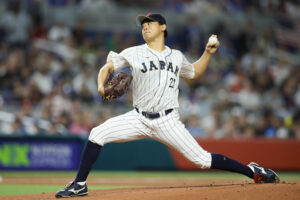
Despite the strong strikeout and walk profile, Imanaga doesn’t come with the kind of excitement generated by Yamamoto. That’s in part due to age. Having turned 30 last September, Imanaga is a typical age for a first-time free agent starter. More importantly, his repertoire points more toward a projection as a solid mid-rotation arm than a potential ace.
Evaluators with whom MLBTR spoke before the offseason suggested Imanaga profiles as a #3/4 pitcher in a big league rotation. Baseball America’s Kyle Glaser pegged him as a #4/5 type in a scouting report from early December. The 5’10” hurler typically sits in the low-90s with his fastball, touching the 94-95 MPH range in shorter stints.
Evaluators have credited him with above-average life on the pitch, allowing it to play for whiffs at the top of the strike zone despite the pedestrian velocity. Glaser writes that Imanaga backs that up with an above-average split but suggests his MLB upside may be capped by middling breaking stuff.
The main concern in Imanaga’s statistical profile has been the longball. He surrendered 17 homers last season, the second-most of any NPB pitcher. While some of that is attributable to workload — he was 15th in innings pitched — it hints at a fly-ball profile that could give some evaluators pause. The Yankees reportedly stayed on the periphery of the bidding in part because of concerns that Imanaga wouldn’t profile well in a very hitter-friendly home park. Statcast’s Park Factors rate Wrigley Field as slightly favorable to home runs, but it’s not among the top handful of hitting venues in MLB.
Imanaga’s stellar strikeout/walk profile and consistently strong results generated a decent amount of reported interest. The Red Sox, Giants and Angels were all reported to be in the bidding of late. He’ll bypass those teams to step into a Chicago rotation that seems likely to lose Marcus Stroman to free agency.
Imanaga joins Justin Steele, Kyle Hendricks and Jameson Taillon as locks for the Opening Day rotation. The likes of Jordan Wicks, Javier Assad, Hayden Wesneski and prospect Ben Brown could battle for the #5 job. There’s still plenty of time for president of baseball operations Jed Hoyer and his front office to add another starter if they want to solidify the final spot and push all their younger, unproven arms into depth roles.
The fee to the BayStars is proportional to the contract value: 20% of the deal’s first $25MM ($5MM), 17.5% of the next $25MM ($4.375MM) and 15% of further spending ($450K). The 15% rate also applies to whatever future earnings Imanaga secures.
A posting fee is on top of the sum to the player but not included in the deal’s competitive balance tax calculation. The average annual value checks in at $13.25MM. According to Roster Resource, that’ll push the team’s CBT number north of $198MM. That’s nowhere near next year’s $237MM tax threshold. Evenly distributing the salaries would move the team’s 2024 payroll commitments to roughly $191MM — slightly beyond last year’s approximate $184MM Opening Day mark.
Bob Nightengale of USA Today first reported the Cubs had an agreement with Imanaga. Jon Heyman of the New York Post reported the presence of various escalators and option provisions and the deal’s $80MM maximum value. ESPN’s Jesse Rogers reported the four-year, $53MM agreement, as well as the club option/opt-out possibilities after years two and three. Patrick Mooney of the Athletic reported the no-trade provisions.
Image courtesy of USA Today Sports.
David Stearns Discusses Alonso, Outfield, Bullpen
Mets president of baseball operations David Stearns addressed a few topics. In an appearance on The New York Post’s podcast with Joel Sherman and Jon Heyman, he touched on the future of first baseman Pete Alonso as well as the club’s outfield and relief groups.
Stearns reaffirmed the Mets have no desire to trade Alonso this offseason. The new baseball operations leader said he’s “pretty darn confident (Alonso) is going to be our first baseman on Opening Day.” He wasn’t committal on the three-time All-Star’s longer-term future in Queens. While Stearns predictably indicated they’d love to keep Alonso beyond the 2024 season, he spoke generally about the challenges of extending players who are deep into their club control window.
“We also understand that as players approach free agency, there’s often a desire to test free agency,” Stearns said. “It‘s really tough to line up on these types of deals in the last year of a player’s team control, the last year of arbitration.” The baseball operations president declined to go into detail about Alonso’s status specifically.
That said, Stearns’ broad reference to the difficulty of extending a player one year from the open market aligns with recent reporting on Alonso. Newsday’s Tim Healey indicated in early December there’d been no extension talks this offseason. As part of a reader mailbag yesterday, The Athletic’s Tim Britton wrote there is “little expectation that there will be substantive negotiations about a contract extension” at any point before the end of 2024.
MLBTR contributor Matt Swartz projects Alonso for a $22MM salary in his final arbitration season. The sides will either agree upon a ’24 salary or exchange filing figures for a potential hearing by tomorrow’s deadline. If the slugger turns in a typical season, he’d likely look for a contract in excess of $200MM when he hits the open market. There might be renewed chatter about Alonso’s trade availability around the deadline if the Mets fall from contention, but the current organizational hope is seemingly that he’ll re-sign after testing the free agent waters.
That was the approach taken by Brandon Nimmo last offseason. Nimmo turned in a strong first season of his eight-year, $162MM deal. He hit .274/.363/.466 with 24 homers in a career-high 682 trips to the plate. That’s more than enough offense to profile in a corner outfield spot. That seems likely after the Mets brought in glove-first center fielder Harrison Bader on a one-year, $10.5MM deal last week.
Stearns indicated the specific outfield alignment is yet to be determined, but he noted that Nimmo has shown a willingness to do whatever the team feels is best. Plugging Bader in center would kick Nimmo to left field on most days. Starling Marte is still the presumptive starter in right as he looks to rebound from an injury-plagued, disappointing season. That could push DJ Stewart — who hit well in 58 games late in the year — to the designated hitter mix.
The Mets have been linked to more substantive additions (i.e. J.D. Martinez, Justin Turner) at the DH spot. While Stearns indicated he wouldn’t “close the door on anything” on the position player side, he cautioned they’re reluctant to take too many at-bats from young players. Brett Baty and Mark Vientos are in the mix at third base and DH, although the Mets lost Ronny Mauricio for most or all of the season when he tore his ACL in winter ball.
One area where another acquisition seems likely: the bullpen. Stearns confirmed reports they’re still looking to add to the relief corps. In a subsequent video call with various reporters (including Anthony DiComo of MLB.com), he indicated they’ll look for pitchers who offer a different repertoire or approach to some of the in-house options.
New York has a heavily right-handed bridge to star closer Edwin Díaz. The only southpaw who is guaranteed to start the year in the bullpen is Brooks Raley. Low-cost free agent pickups Michael Tonkin, Jorge López and Austin Adams join Drew Smith and Phil Bickford in the projected middle relief group.
Arbitration Exchange Deadline Moved Up To Tomorrow Afternoon
10:33pm: Jeff Passan of ESPN reports that the deadline for teams and players to come to agreements is set for 1:00 pm EST. Salary figures will be officially exchanged at 8:00 pm.
7:19pm: The deadline for teams to exchange salary figures with arbitration-eligible players is set for Thursday, according to Ronald Blum of the Associated Press. Rich Dubroff of Baltimore Baseball reports (on X) that the deadline is 8:00 pm EST.
Initially, that had been set for Friday afternoon. Andy Kostka of the Baltimore Banner notes (X link) that the league and Players Association agreed last month to move it up a day. It’s unclear why that decision was made. In any event, it’ll spur some activity a day earlier than anticipated.
The salary exchange date is not necessarily a deadline for teams to negotiate with their arbitration-eligible players. Teams and players are free to continue talks right up until a hearing (which generally run from mid-February into the beginning of March). It serves as an anchoring point in negotiations, though, and many teams treat it as an unofficial deadline to avoid a hearing. It’ll therefore spur a large number of salary agreements — Cal Quantrill, JT Brubaker and Hoby Milner all agreed to deals this afternoon — and could be the catalyst for a trade or two.
MLBTR contributor Matt Swartz projected salaries for all arbitration-eligible players at the start of the offseason. Juan Soto could top Shohei Ohtani’s record-setting $30MM mark in his final year of eligibility. Pete Alonso, Vladimir Guerrero Jr., Gleyber Torres and trade candidates like Shane Bieber and Dylan Cease are all in line for notable sums in their own right.
NPB’s Orix Buffaloes Sign Cody Thomas
The Orix Buffaloes of Japan’s Nippon Professional Baseball announced the signing of outfielder Cody Thomas this week. The Octagon client became a minor league free agent at the end of the 2023 season.
An Oklahoma product, Thomas joined the professional ranks in 2016 as a Dodger draftee. Los Angeles traded him to the A’s shortly before Spring Training in 2021. Oakland added him to the 40-man roster after that season to keep him out of the Rule 5 draft. Thomas reached the big leagues the following September.
The A’s gave Thomas brief MLB looks in each of the past two years. He made 10 appearances in 2022. Oakland designated the left-handed hitter for assignment but kept him in the organization after he cleared outright waivers. He made it back to the big leagues in July and got into 19 more games. Between the two seasons, he hit .250/.308/.333 with one homer over 78 plate appearances.
Oakland again waived Thomas in late August, sending him to the open market at year’s end. Rather than take a minor league contract, the 29-year-old heads to Japan. The Buffaloes are surely intrigued by the .292/.356/.585 batting line which Thomas has managed in parts of three Triple-A campaigns. Even in a very favorable Pacific Coast League hitting environment, that’s an impressive showing against minor league arms. He’ll look to carry that over against NPB pitching and could reemerge on the MLB radar a year or two from now.
Anthony Kay To Sign With NPB’s Yokohama BayStars
Left-hander Anthony Kay is signing with the Yokohama BayStars of Japan’s Nippon Professional Baseball, reports Robert Murray of FanSided (X link). It’ll be the first overseas stint for the CAA client.
Kay, 29 in March, is a former first-round pick of the Mets. Traded to the Blue Jays as a prospect in the Marcus Stroman deal, he debuted with Toronto in 2019. That kicked off a stretch of five seasons with some amount of MLB action. His largest workload came in 2021, when he logged 33 2/3 innings of 5.61 ERA ball.
The UCONN product remained with the Jays through the 2022 season. He bounced around the league last year, going to three different teams on waivers. Kay opened the season with the Cubs and briefly landed with the Mets at year’s end. During the postseason, the A’s claimed him. Oakland cut him loose a couple weeks later without any game action, sending him to the open market.
Kay has yet to find much MLB success. He owns a 5.59 ERA through 85 1/3 innings, working mostly in a long relief capacity. Middling control has been the primary culprit. Kay has walked upwards of 12% of batters faced in his MLB career. He handed out free passes at a 13.6% clip during his big league work last season and walked a nearly identical 13.7% of opponents over 37 1/3 innings in Triple-A.
Strike-throwing issues notwithstanding, Kay represents an intriguing flier for an NPB team. His fastball has averaged just under 95 MPH during his time in the majors. He has a reasonable 22.4% strikeout percentage in his big league career and fanned more than 31% of opposing hitters in Triple-A a year ago.
That ability to miss bats would’ve enabled Kay to find a minor league contract if he wanted to remain in affiliated ball. The opportunity in Japan allows him to lock in a salary that is surely above what he’d have made in Triple-A. He’ll take that avenue instead. If he pitches well in NPB, he could reemerge as a target for major league teams a year or two from now.