
Orioles Have Shown Interest In Josh Hader, Jordan Hicks
At the GM Meetings earlier this month, Baltimore general manager Mike Elias told reporters the team was seeking a late-game reliever. They’re considering plugging that vacancy in free agency.
Jon Heyman of the New York Post reports that the O’s have been in contact with each of Josh Hader, Jordan Hicks, Craig Kimbrel and Aroldis Chapman. All four hurlers fit the general profile of a late-inning arm, although they’re clearly in different tiers of free agency.
Hader is the best reliever in the class (and arguably the top bullpen arm in the majors). He worked to a 1.28 ERA over 56 1/3 innings during his platform season. The lanky southpaw punched out 36.8% of batters faced. That’s actually Hader’s lowest strikeout percentage since his rookie year, yet it still ranked fifth in MLB among relievers with 50+ innings. Only Chris Martin and Brusdar Graterol had a lower earned run average.
After frequently working multiple innings earlier in his career, Hader has expressed a preference for a traditional one-inning role over the past couple years. The Padres deployed him as a closer. He picked up 33 saves in 38 attempts.
The year marked an emphatic bounce back from a 2022 season in which he’d posted an uncharacteristic 5.22 ERA. Hader has posted an ERA under 1.30 in two of the last three years and has five sub-3.00 showings over his seven MLB seasons. While he’s a year older than Edwin Díaz was last offseason, Hader figures to take aim at topping Diaz’s $102MM guarantee with the Mets — the largest relief contract in MLB history.
Committing a nine-figure deal would be far bolder than any free agent decision that the Elias front office has made. The O’s have remarkably yet to sign a single multi-year free agent deal in his five years as GM. Much of that came during a rebuild, of course, but the O’s remained cautious even as they’d begun to turn a corner last winter. Baltimore signed a trio of veterans (Kyle Gibson, Adam Frazier and Mychal Givens) for a combined $23MM on one-year guarantees.
After a breakout season that saw the O’s win 101 games to take the top seed in the American League, the front office should be more aggressive than ever. Bringing in Hader would represent a very significant shift in operating procedure. In addition to the huge financial commitment, Baltimore would have to relinquish their third-highest pick in next summer’s draft. Hader declined a qualifying offer from the Padres, so he’s attached to signing compensation.
If the O’s are willing to meet those costs, Hader is a sensible target. He’s one of the few relievers who can approach the kind of production the O’s lost when Félix Bautista underwent Tommy John surgery that’ll cost him the entire 2024 season. Hader is also a Maryland native who began his professional career as a 19th-round pick by the Orioles in 2012. While that selection was made by a previous front office, Elias was a high-ranking scouting official with the Astros when Houston acquired Hader as a prospect at the 2013 deadline.
Hader is in his own tier as a free agent relief target. Hicks finds himself in the next group, arguably the #2 option on the open market. One of the hardest throwers in the sport, he averages around 100 MPH on his sinker. Hicks has wobbly control but consistently runs huge ground-ball numbers. He’s coming off arguably the best season of his career, turning in 65 2/3 innings of 3.29 ERA ball between the Cardinals and Blue Jays. The righty struck out a solid 28.4% of batters faced, the highest rate of his career.
Injuries (most notably a June ’19 Tommy John procedure) dogged Hicks between 2019-21. He has mostly stayed healthy over the past two seasons, topping 60 frames in each. He’s also the youngest free agent reliever of note, having turned 27 in September. Hicks should secure at least three years and has a solid case for a four-year pact at an average annual value in the $8-10MM range.
Chapman and Kimbrel would be shorter-term plays. Two of the best closers of their generation, they’re each entering their age-36 campaign. Both pitchers have battled some inconsistency in recent seasons, but they’re coming off solid 2023 performances. Chapman worked to a 3.09 ERA with an eye-popping 41.4% strikeout percentage over 58 1/3 frames between the Royals and Rangers. Kimbrel posted a 3.26 ERA while fanning a little over a third of his opponents in 69 regular season innings with Philadelphia, although he struggled over six innings in the playoffs.
Pirates Release Thomas Hatch To Pursue Overseas Opportunity
The Pirates have released right-hander Thomas Hatch, as reflected on the MLB.com transaction log. A Korean-language report from IS Plus suggested Hatch had received interest from teams in both NPB and the KBO and is likely to sign with the Nippon-Ham Fighters in Japan. Hatch had occupied a spot on Pittsburgh’s 40-man roster. His release will drop that tally to 36.
Pittsburgh snagged Hatch off waivers from the Blue Jays in early August. The 29-year-old occupied a depth role down the stretch, logging 22 2/3 innings over 12 appearances. He posted a 4.03 ERA despite a modest 17% strikeout rate. Paired with six MLB appearances for the Jays earlier in the season, Hatch tossed 28 2/3 innings of 4.26 ERA ball — his largest big league workload to date.
Originally a third-round pick of the Cubs in 2016, Hatch landed with the Jays at the ’19 deadline in a trade that sent veteran reliever David Phelps to Chicago. The Oklahoma State product debuted in the majors the following year and saw some big league action in each of the past four seasons. He has allowed 4.96 earned runs per nine in 69 career innings.
Hatch would have been out of minor league option years going into 2024. He’d likely have had a tenuous hold on a bullpen spot in Pittsburgh and could well have found himself on outright waivers at some point over the offseason. Instead, he should lock in a guaranteed salary — quite likely one north of the $740K MLB minimum — and could position himself for other major league opportunities in future offseasons. Hatch throws in the mid 90s and owns a reasonable 4.49 ERA over parts of three Triple-A campaigns, making him an attractive target for evaluators in Japan and Korea.
Mets Continuing To Explore Rotation Market
The Mets are soon to add Luis Severino to their rotation, as they’re in the process of finalizing a $13MM contract with the longtime Yankee. That’s one of what’ll surely be multiple additions to the starting staff, as New York entered the offseason with only Kodai Senga and José Quintana locked into rotation spots.
There’s no secret about their interest in NPB superstar Yoshinobu Yamamoto, the three-time winner of the Sawamura Award (Japan’s Cy Young equivalent). Upwards of a dozen teams are in the mix for the 25-year-old righty, who seems likely to command the largest contract of any pure pitcher in this year’s class. Jon Heyman of the New York Post wrote this afternoon that some rival clubs consider the Mets the favorite on Yamamoto, but there’ll be no shortage of competition.
Unsurprisingly, the front office has its eye on multiple options on the open market. Michael Marino of Fantrax tweeted this week that the club was showing interest in left-hander Jordan Montgomery. Andy Martino of SNY echoes that sentiment, calling Montgomery “a more likely target” than fellow free agent southpaws Blake Snell and Eduardo Rodriguez.
Montgomery has been a popular name. He is also known to have drawn attention from the Red Sox, Yankees and incumbent Rangers. It stands to reason there are numerous additional suitors for the soon to be 31-year-old, who is coming off a 3.20 ERA across 188 2/3 innings. That’s a career-best mark, but he has allowed fewer than four earned runs per nine while reaching 30+ starts in each of the past three seasons.
In addition to their Yamamoto pursuit, the Mets apparently also have some level of interest in Shota Imanaga. Martino adds that they’ll “explore” the market on the left-hander, the second-best pitcher coming over from Japan this offseason. Imanaga was officially posted by the Yokohama BayStars this week, opening a 45-day window for him to sign with a major league team.
While Imanaga isn’t the same caliber of pitcher as Yamamoto, he has a chance to beat the five-year, $75MM pact which the Mets gave Senga last offseason. Imanaga turned 30 in September, so he’s one of the younger free agent arms available (albeit nowhere near as young as Yamamoto). He’s coming off a 2.80 ERA showing over 148 innings in NPB. Imanaga struck out 174 hitters, fanning a little over 29% of batters faced. Evaluators with whom MLBTR spoke projected him as a potential mid-rotation arm. Brandon Tew of Spots Info Solutions took a look at Imanaga’s repertoire yesterday, praising his command and the carry he generates on his low-90s four-seam fastball.
Each of Montgomery and Imanaga could land five or more years. A pact of that length would align with the Mets’ general competitive timeline. Team officials have made clear they won’t punt on the upcoming season but are targeting 2025 and beyond as a more realistic contention window.
To that end, Martino suggests they’re unlikely to be actively involved in trade discussions for a star player whose contract expires at the end of next season. He reports that the Mets are not in discussions with the Rays on Tyler Glasnow at present. (While Martino doesn’t specifically mention Corbin Burnes or Shane Bieber, it’d be similarly logical for the team to mostly sit out those discussions as well.) They’re seemingly reluctant to relinquish significant future value for a rental on the heels of a fourth-place finish in a competitive NL East.
Mets Sign Joey Wendle To Major League Deal
November 30: Wendle passed his physical and the deal is now official, per Andy Martino of SNY. Wendle can also earn an extra $500K in bonuses, per Joel Sherman of The New York Post, with $100K for getting to 250, 300, 350, 400 and 450 plate appearances.
November 29: A few hours after agreeing to terms with Luis Severino, the Mets have added infield depth. New York is reportedly in agreement with Joey Wendle on a one-year, $2MM guarantee. The deal also contains performance bonuses for the Excel Sports Management client.
Wendle, 34 next April, has spent the last two years in the NL East as a member of the Marlins. His tenure with the Fish didn’t go as planned. Miami acquired the left-handed hitter from the Rays over the 2021-22 offseason. He’d had a solid four-year run in Tampa Bay, hitting .274/.330/.414 and earning an All-Star nod in his final season. Miami installed him as their primary third baseman for the ’22 season.
His offensive numbers took a sharp downward turn. Wendle hit .259/.297/.360 with only three home runs through 371 trips to the plate. Miami brought in Jean Segura to play third base last offseason but kept Wendle in the Opening Day lineup, kicking him up the defensive spectrum. After trading Miguel Rojas to the Dodgers, the Marlins turned to Wendle as their primary shortstop.
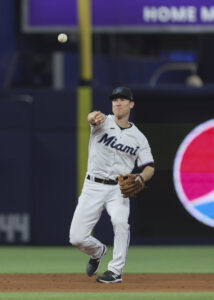
Wendle had an even tougher year. He hit .212/.248/.306 over 318 plate appearances. He connected on only two homers while his strikeout rate jumped from 13.5% to a nearly average 21.1% clip. Of the 293 hitters with 300+ trips to the plate, none had a lower on-base percentage than Wendle. His slugging mark was ninth-lowest among that group. The Fish stuck by Wendle as their primary shortstop, although he struggled significantly down the stretch. He hit .142/.176/.201 in the season’s second half.
To his credit, Wendle handled his more demanding defensive responsibilities. He logged a career-high 754 1/3 innings at shortstop, no small feat for a player in his age-33 season. Defensive Runs Saved rated him highly, estimating he was six runs above average at the position. Statcast’s Outs Above Average metric was more bearish, grading him three runs below par.
Barring injury, Francisco Lindor will take almost every shortstop inning next season. Wendle can handle a utility role off the bench. Public defensive metrics have always graded Wendle highly at second base and pegged him as a solid defender at the hot corner. As a defense-first lefty hitter with the ability to handle multiple infield spots, he’s more or less a direct replacement for Luis Guillorme. The Mets non-tendered the latter two weeks ago.
A $2MM guarantee brings the Mets’ payroll projection around $276MM, as calculated by Roster Resource. Their competitive balance tax number jumps a little north of $289MM. New York is within the third tier of luxury penalization, roughly $8MM below the $297MM mark that represents the fourth and final tier. Given remaining needs on the pitching staff and in the corner outfield, they seem likely to surpass that threshold by the time the offseason concludes.
Since they’re presently in the third tier and have paid the luxury tax in each of the past two seasons, the Mets are charged a 95% rate on their expenditures. Adding Wendle comes with $1.9MM in taxes, bringing the total cost to $3.9MM. If/when they pass the $297MM figure, they’d be taxed at a staggering 110% rate on each additional dollar spent.
Andy Martino of SNY first reported the Mets were in discussions with Wendle. Robert Murray of FanSided was first to report an agreement had been reached. Mark Feinsand of MLB.com reported the approximate $2MM base salary and the presence of unspecified performance bonuses. Joel Sherman of the New York Post pegged the guarantee at exactly $2MM.
Image courtesy of USA Today Sports.
Latest On Dylan Cease
Nov. 30: The Athletic’s Ken Rosenthal suggests a very different scenario regarding Cease, writing that Getz & Co. prefer to wait to move him until after the top starters on the market have signed. Clubs with current interest (e.g. Cincinnati, Baltimore), aren’t likely to play for the top names in free agency anyhow and will thus remain in play even if the Sox take their time trading Cease. And, by waiting until the top of the free agent market thins out, the Sox could potentially attract more bidders in the form of those who miss out on the likes of Yoshinobu Yamamoto, Blake Snell, Jordan Montgomery, etc.
Nov. 29: The White Sox have discussed Dylan Cease trades with teams since the offseason got underway. It seems they’ve gained some amount of traction, as Jon Morosi of MLB.com tweets that talks have “intensified” this week. Morosi suggests the ChiSox may pull the trigger on a deal prior to the Winter Meetings, which begin Sunday evening.
USA Today’s Bob Nightengale has linked the Dodgers and Braves to the hard-throwing righty in recent weeks. There are surely plenty of other teams that have been in touch with first-year general manager Chris Getz. Morosi calls the Braves one of the “finalists” for Cease’s services. That implies the Sox have narrowed down the field of suitors, although there’s no clarity as to how many clubs are still in the running.
Cease has been a popular trade target going back to the deadline. The Sox elected not to move him over the summer. A few weeks after the deadline, owner Jerry Reinsdorf dismissed front office leaders Rick Hahn and Ken Williams. He bumped Getz from assistant GM to the top role not long thereafter. Getz has rather bluntly discussed the lack of depth on the MLB roster. He has made clear there aren’t any players who are categorically off the table in trade discussions.
While Luis Robert Jr. probably has the most appeal of anyone on the team, Cease is the more likely of their high-value targets to change uniforms. The Sox have their franchise center fielder signed to a contract with club options running through the 2027 season. Cease is under team control for two years. MLBTR contributor Matt Swartz projects him for an $8.8MM salary in his second-to-last season of arbitration eligibility.
Cease, who turns 28 next month, is coming off a relative down season. His ERA jumped from 2.20 during his Cy Young runner-up campaign in 2022 to 4.58 this year. Cease lost a couple points off his strikeout rate but still fanned a quality 27.3% of opposing hitters while taking the ball for a full slate of 33 starts.
Despite the relative down season, he remains the clear best pitcher on the roster. While Getz has expressed a willingness to make significant changes, he hasn’t characterized the situation as a rebuild. It stands to reason they’d look for major league and/or upper minors talent in a Cease trade. They took a volume approach to their first major trade of the offseason, acquiring five players (four of whom are MLB-ready depth types) from the Braves for reliever Aaron Bummer two weeks ago.
Braves Sign Penn Murfee, Jackson Stephens To Major League Deals
The Braves announced the signings of relievers Penn Murfee and Jackson Stephens to one-year split deals. A split contract means the player would be paid at differing rates for time spent in the majors versus Triple-A. Both pitchers rejoin Atlanta’s 40-man roster. The team still has seven openings on the 40-man on the heels of an active non-tender deadline.
Murfee and Stephens were each dropped from the roster within the past couple weeks. Atlanta had cut Murfee loose at the non-tender deadline. Stephens hit the open market not long before that after going unclaimed on outright waivers.
The Braves had just snagged Murfee off waivers a few days before cutting him loose. The 29-year-old righty has 80 games of major league experience, all of which have come with the Mariners over the past two seasons. Leaning heavily on a sweeping slider, Murfee has posted strong results. He owns a 2.70 ERA in 83 1/3 innings, striking out nearly 28% of batters faced. He has found success against hitters of either handedness.
Murfee’s season was unfortunately cut short in June. The 29-year-old underwent surgery to repair a UCL tear in his elbow. He’ll miss a good portion of next season as a result. There’s no injured list during the offseason, explaining Seattle’s decision to move on despite his strong body of work. The Braves have enough roster space to give Murfee a spot, at least for the time being. If he sticks on the roster for the rest of the offseason, they could place him on the 60-day injured list whenever they need a 40-man spot from the start of Spring Training onward.
Stephens, 29, has spent the past two seasons in the Atlanta organization. The righty logged more big league action in 2022, when he turned in a 3.69 ERA through 53 2/3 frames. He didn’t see as much time this past season, tallying only 12 MLB innings over five appearances in September. Stephens worked to a 3.28 ERA with a strong 26% strikeout rate across 24 2/3 innings with Triple-A Gwinnett.
Since he is out of minor league options, he’d have to open next season on the active roster or again be exposed to waivers. Stephens would have the right to elect free agency if the Braves successfully passed him through waivers unclaimed. Since he has less than five years of service time, he’d have to forfeit his guaranteed salary to become a free agent. By signing him to a split deal that locks in an undisclosed amount of money for whatever time he spends in Triple-A, the Braves increase their chance of retaining Stephens as non-roster depth in the event they try to run him through waivers at some point.
Jeff Passan of ESPN reported that Murfee was returning to the Braves on a major league deal shortly before the club announcement.
Guardians, Jaime Barria Agree To Minor League Deal
The Guardians are in agreement with right-hander Jaime Barria on a minor league contract, reports Ken Rosenthal of the Athletic (on X). The former Angels hurler elected free agency after clearing outright waivers last month.
Until that point, Barria had spent his entire career with the Halos. He signed out of Panama in 2013 and reached the big leagues five seasons later. Barria debuted as a 21-year-old and turned in a strong rookie season, working to a 3.41 ERA over 26 starts.
While he hasn’t recaptured that level of success, Barria has shouldered a decent number of innings in a swing role over the past few seasons. The results have been inconsistent. He allowed an ERA of 4.61 or worse in each of 2019, ’21 and this year. Barria fared better in a limited sample during the shortened season and had a strong 2.61 mark over 79 1/3 relief innings in 2022.
The Halos have mostly deployed him in lower-leverage situations. Barria doesn’t throw especially hard or miss many bats. He has struck out a below-average 17.1% of batters faced in each of the past two seasons. A spike in home runs dramatically flipped the script on his run prevention this year. Barria was tagged for 5.68 earned runs per nine in 82 1/3 frames spanning 34 appearances (including six starts).
The 27-year-old owns a 4.75 ERA in 333 1/3 big league innings over the last five years. He has a modest 17.8% strikeout percentage but has kept his walks to a solid 7.2% clip. He’ll presumably get a look in big league Spring Training and can compete for a long relief role with the ability to step into the rotation as needed. Barria is out of minor league options, so if he cracks the MLB roster at any point, he’d need to remain with the big league club or be designated for assignment. He has a little over four years of MLB service. If he carves out a role on the major league staff, Cleveland could retain him via arbitration for at least one additional season.
Dodgers Showing Interest In Seth Lugo
The Dodgers are among numerous teams that have shown interest in free agent hurler Seth Lugo, reports Ari Alexander of KPRC 2 (on X). Alexander indicates that upwards of two-thirds of the league has checked in with Lugo’s camp, aligning with a recent report from FanSided’s Robert Murray that more than half the teams were involved.
Los Angeles is a suitable fit for every free agent starter. The Dodgers have less certainty in their rotation than they’ve had at any point in the past few seasons. Of the four pitchers who topped 100 innings, only Bobby Miller is going to open next year in the rotation. Julio Urías is unlikely to return after being arrested on domestic violence allegations. Tony Gonsolin will probably miss the entire season after undergoing Tommy John surgery in August. Clayton Kershaw is a free agent and will be out of action into the 2024 campaign due to a postseason shoulder procedure.
Walker Buehler returns from his second Tommy John surgery to join Miller in the starting five. Los Angeles could bring in as many as three additional starters. Emmet Sheehan, Michael Grove and Gavin Stone struggled to varying degrees. Dustin May won’t be ready for the start of the season as he works back from July flexor surgery. Ryan Pepiot only managed 42 MLB innings in a swing capacity this year thanks to an oblique strain sustained at the tail end of Spring Training. Ryan Yarbrough worked mostly in long relief upon being acquired from the Royals in a midseason trade.
There’s a clear need for both high-end talent and bulk innings. Lugo could provide some combination of the two. The Padres gave the right-hander his first extended rotation opportunity in six years. He responded with a 3.57 ERA across 26 starts. Lugo missed a month in the first half with a calf strain but otherwise stayed healthy and logged a personal-high 146 1/3 innings. He supported the solid run prevention with an above-average 23.2% strikeout percentage while only walking 6% of opponents.
That made it an easy call for Lugo to decline a $7.5MM player option. He’ll surely beat that salary and figures to secure a multi-year contract. Lugo turned 34 a couple weeks ago, so it won’t be a particularly long-term commitment. Evan Petzold of the Detroit Free-Press reported last week that Lugo was seeking three years.
MLBTR predicted Lugo to receive a three-year term at $14MM annually, ranking him 19th among free agents in expected earning power. As shown on MLBTR’s Contract Tracker, a three-year term beginning in a starting pitcher’s age-34 campaign is rare but not unprecedented. There has been one such deal in each of the past two offseasons. Chris Bassitt secured a $63MM guarantee from the Blue Jays last winter; Sonny Gray landed $75MM from the Cardinals on Monday. Lugo doesn’t have the multi-year track record of starting as those pitchers do, but that could be reflected in a lesser annual salary.
The Dodgers have shied away from long-term pitching investments under president of baseball operations Andrew Friedman. L.A. signed Kenta Maeda to an eight-year pact when he came over from Japan, but that was an incentive-laden deal with a modest $25MM guarantee. Otherwise, they haven’t gone past three years for a free agent starting pitcher — doing so for Rich Hill ($48MM), Kershaw ($93MM) and Trevor Bauer ($102MM).
That could change this offseason, given both the pitcher-heavy nature of the free agent class and the roster’s rotation issues. The Dodgers should have plenty of payroll room to add multiple starters on the open market. Roster Resource estimates their 2024 luxury tax commitments in the $168MM range, around $69MM below next year’s base threshold.
The Best Fits For A Juan Soto Trade
There’s no bigger name on the trade front than Juan Soto. The superstar outfielder topped MLBTR’s list of the Top 25 offseason trade candidates a few weeks ago. He’s one season from free agency on a Padres team that is reportedly planning to cut payroll. MLBTR contributor Matt Swartz projects Soto for a record $33MM salary for his final season of arbitration, which would make him the highest-paid player on the roster.
President of baseball operations A.J. Preller has made clear the organizational preference would be to sign Soto to an extension. That seems extremely unlikely. Soto declined a $440MM offer from the Nationals in the summer of 2022. The price tag should only be higher now that he’s a year and a half nearer to free agency. Neither San Diego nor anyone else should expect to keep Soto from the open market.
Ken Rosenthal of the Athletic wrote yesterday that a trade seems likely based on the Friars’ payroll and roster outlook. San Diego is down to Joe Musgrove and Yu Darvish as locks for a spot in the rotation. They could use a little more depth on the position player side. No move would create more short-term payroll room than a Soto trade.
It’s hard to envision the Padres dealing him within the NL West. San Diego isn’t rebuilding. A trade may be financially motivated but would also open room for reinvestment. The Friars aren’t likely to deal Soto to the Dodgers, Diamondbacks or Giants. The Rockies aren’t acquiring a star for one season.
What about the other 25 teams? Which ones make the most sense?
Note: All payroll projections courtesy of Roster Resource. Teams are listed alphabetically within each tier.
Best Fits
- Blue Jays: GM Ross Atkins has spoken of a desire to add multiple hitters. They’re in the mix on Shohei Ohtani but could turn to the trade market if the two-way star signs elsewhere. The Jays could slide Daulton Varsho to center field to plug Soto into left. They’re around $24MM shy of next year’s base luxury tax threshold. Acquiring Soto would push them into CBT territory, which they were willing to do this past season.
- Cubs: The Cubs are also in on Ohtani. Signing the defending AL MVP would take them out of the mix for Soto. If they don’t get Ohtani, taking a swing for Soto to rotate through the corner outfield and DH spots alongside Seiya Suzuki and Ian Happ makes sense. Chicago is a borderline playoff team as things stand. They project $50MM below the tax threshold. They’re within $7MM of this year’s Opening Day payroll but around $25MM south of their franchise-high mark from 2019.
- Mariners: Seattle doesn’t seem as involved on Ohtani as some of the other teams in this tier. Perhaps that’s an indicator they’re not interested in any player on a massive salary, as they project around $4MM below this year’s season-opening spending level. They’re around $25MM away from their franchise-record Opening Day payroll, though, and one season of Soto wouldn’t come with the kind of long-term downside from which Seattle has shied away in free agency. The Mariners need offense to push them over the top and could upgrade in either corner outfield spot, where Jarred Kelenic and Dominic Canzone project as the top internal options.
- Rangers: The defending World Series winners have a strong starting outfield of Evan Carter, Leody Taveras and Adolis García. Primary DH Mitch Garver reached free agency, opening a spot in the middle of the lineup. It’s probably too soon to count on last year’s #4 overall pick Wyatt Langford, who only has 17 games of upper minors experience. Adding Soto to an already stellar offense for a season as they go for a repeat makes plenty of sense. They already project above this year’s Opening Day payroll but figure to push spending higher on the heels of a championship. Texas projects around $18MM south of the lowest luxury tax threshold; they could add Soto without paying especially onerous penalties.
- Red Sox: DH Justin Turner hit free agency. Right fielder Alex Verdugo is an annual offseason trade candidate. A corner outfield tandem of Verdugo and Masataka Yoshida isn’t disastrous, but it’s certainly not going to stand in the way of a player like Soto. Coming off consecutive 78-84 seasons, perhaps the Sox don’t feel they’re perfectly positioned to strike for this kind of rental player. They’re around $52MM shy of the base luxury threshold, though, and acquiring Soto would put them right back in the hunt in the AL East.
- Yankees: GM Brian Cashman is openly seeking multiple outfielders, ideally ones who hit from the left side. The Yankees project for a payroll that sits around $40MM south of their 2023 mark. A Soto acquisition would bring them to the border of the third tier of luxury tax penalization. That’d be a concern for many teams but is a line the Yankees shouldn’t have any qualms about passing. As long as New York considers itself a legitimate contender in 2024 — adding Soto would make that a lot more realistic — there aren’t many cleaner fits.
Longer Shots
- Angels: The Halos have made clear they’re not going to rebuild even if Ohtani walks. They have been aggressive in trading for players deep into their arbitration seasons and would have the payroll capacity to accommodate Soto’s salary if they don’t retain Ohtani. They have stripped down the farm system in ill-fated moves to increase their odds of competing in the short term, however. Even if owner Arte Moreno wants to add a big name to compensate for a potential Ohtani departure, acquiring Soto seems too short-sighted.
- Braves: Atlanta has an opening in left field after declining their option on Eddie Rosario. The Braves already project for a franchise-record payroll and have an elite lineup despite the left field question. Bringing in a starting pitcher feels like the safer bet.
- Mets: Few teams have as bleak a corner outfield picture as the Mets. Starling Marte had a terrible season. DJ Stewart played well down the stretch, but he’s a 30-year-old who wasn’t on a 40-man roster as recently as this past July. They’re going to bring in some kind of outfield help. Trading for Soto would be a bold play for a team that has hinted at 2025 as its more realistic contention window coming off a 75-87 season. They could look for more of a stopgap acquisition and make a bigger run at Soto when he hits free agency next November.
- Orioles: Pitching is the bigger concern for Baltimore, who have Austin Hays, Anthony Santander and Ryan Mountcastle in the corner outfield/DH mix. The O’s still have an elite farm system that ostensibly opens the possibility for a luxury buy, particularly if they offloaded Santander’s $12.7MM projected salary (either as a lesser piece of a Soto return or in a separate trade). This isn’t the kind of move the O’s have made under GM Mike Elias, however.
- Phillies: Philadelphia has Kyle Schwarber, Nick Castellanos and Bryce Harper handling the combination of first base, the corner outfield and designated hitter. They could kick Schwarber to a full-time DH role and install Soto in the corner opposite Castellanos to flank Brandon Marsh in center field. The offense isn’t necessarily a need for the Phils, but president of baseball operations Dave Dombrowski has never shied away from the chance to bring in a star. This might be an easier fit if the Phils could first offload Castellanos in a separate trade (although he wouldn’t hold any appeal to San Diego as part of a return for Soto).
Payroll Questions
- Astros
- Brewers
- Guardians
- Marlins
- Pirates
- Rays
- Twins
While a $33MM salary is still well below the market value for one year of Soto’s services, none of these teams is likely to take it on. Milwaukee, Cleveland, Miami, Pittsburgh and Tampa Bay are among the lower spenders in MLB. Houston arguably has a need in left field, but GM Dana Brown has downplayed their desire for outfield help and suggested they’re operating without a ton of payroll room. Minnesota is scaling back payroll and already right around their reported target area.
Other Priorities
- Cardinals
- Reds
- Tigers
Soto would obviously make any team better. Yet no one in this group has the kind of urgent need for corner outfield help that make them likely to offer enough young talent to beat what more desperate teams could put on the table.
The Cardinals could ostensibly trade Tyler O’Neill and target Soto to play the corner outfield alongside Jordan Walker. They’re already at last year’s spending level, though, and it’s debatable whether they’re good enough to push in to this extent for a rental. Cincinnati is focused on starting pitching and seems unlikely to meet the kind of asking price for Soto, whom they’d have no hope of re-signing next offseason. Detroit brought in Mark Canha this offseason to join Riley Greene and Kerry Carpenter in the corner outfield/DH mix. They’re too fringy of a contender to make this kind of play.
Wrong Competitive Timeline
- A’s
- Nationals
- Royals
- White Sox
The A’s might be the only of these teams that is openly going into 2024 without any hope of competing. No one in this tier has a good enough roster to consider themselves one player away from contention, however. Parting with multiple high-end prospects for a rental doesn’t make sense, even if each of Washington, Kansas City and Chicago will probably make smaller moves of the “win-now” variety this winter.
Details On Sonny Gray, Kyle Gibson Contracts
The Cardinals finalized their three-year, $75MM contract with Sonny Gray yesterday. It came with a club option for the 2027 season which reports had pegged at $30MM with a $5MM buyout.
That deal is heavily backloaded. As reported by the Associated Press, Gray is set for a modest $10MM salary in 2024. He’ll make $25MM in ’25 and $35MM in the final guaranteed season, with the buyout bringing the guarantee to $75MM.
The ’27 option is not strictly a team provision; if the Cardinals exercise the option, Gray would have the right to opt out. If either side declines the option, the buyout would be paid in $1MM installments between 2027-31. Gray also receives full no-trade protection, per the AP.
In the short term, the backloaded nature of the deal might be most meaningful for the organization. Had the contract been paid out fairly evenly, the team’s 2024 commitments would have jumped into the $190MM+ range. With the relatively low sum for 2024, Roster Resource projects the Cards’ player spending for next season around $180MM.
St. Louis opened the ’23 season with a payroll around $177MM, as calculated by Cot’s Baseball Contracts. President of baseball operations John Mozeliak indicated at the beginning of the offseason that the club figured to remain in that general area for next season. There still might not be a ton of remaining spending room, although the signings of Gray, Kyle Gibson and Lance Lynn have checked off the team’s primary goal of adding three starting pitchers.
They’re also looking to add to the bullpen but could accomplish that via trade and/or free some payroll capacity by trading a veteran player. Tyler O’Neill (projected by MLBTR contributor Matt Swartz for a $5.5MM salary) and Dylan Carlson (projected at $1.8MM) are each into arbitration. Steven Matz, due successive $12.5MM salaries for the next two seasons, was pushed into the #5 spot in the rotation and could potentially be a trade candidate if St. Louis felt confident in any of their younger arms to take a step forward.
The AP also provides specifics on Gibson’s contract. Initially reported as a $12MM guarantee, it’s actually a $13MM deal. Gibson will make a $12MM salary next season and is ensured at least a $1MM buyout on a $12MM team option for 2025. The righty would receive a $1MM assignment bonus if traded and would lock in a $500K incentive for reaching 175 innings in either year of the contract.