
Latest On Athletics’ Catchers
Injured Athletics catcher Nick Hundley is within 10 days of a rehab assignment as he recovers from back and knee issues, according to Susan Slusser of the San Francisco Chronicle. Once Hundley comes back in August, though, the team could jettison him or one of the other three catchers on its 40-man roster, per Slusser. Indeed, when Hundley’s healthy enough to return, the Athletics “seem likely” to designate him, Chris Herrmann, Josh Phegley or Beau Taylor for assignment, Slusser observes. With the exception of Taylor, all of those backstops are out of minor league options.
The A’s goal entering the season was to roll with Hundley and Herrmann – both free-agent signings – as their two catchers, Slusser writes, but that plan changed when the latter underwent right knee surgery March 6. Herrmann sat out the first couple months of the season recovering from the procedure, only just coming off the IL on Tuesday. The 31-year-old emphatically introduced himself to Oakland that night, smashing a grand slam in a win over Minnesota (one of his ex-teams), and added a 4-for-4 performance in another victory against the Twins on Thursday.
While the lefty-swinging Herrmann’s off to a propitious start as an Athletic, he didn’t bring much of a big league track record to his new team. Also a former Diamondback and Mariner, Herrmann has hit just .206/.283/.354 (69 wRC+) in 903 major league plate appearances. He also hasn’t been a tower of strength behind the plate.
Hundley’s much more of an established commodity in the majors, where the well-traveled 35-year-old has typically provided solid offense for his position. That hasn’t been the case in 2019, though. Before Hundley headed to the IL with back spasms June 8 and then underwent arthroscopic left knee surgery on the 18th, the righty batted an unappealing .200/.233/.357 (54 wRC+) with 18 strikeouts against two walks in 73 PA. At the same time, Hundley threw out a mere 5 of 23 would-be base stealers and earned poor pitch-framing marks.
Herrmann’s absence helped reopen the door for Phegley, an Athletic since 2015 who entered this season off three straight low-impact years in the majors. Phegley’s now enjoying what could go down as a career offensive season, however, with a .259/.303/.463 line (102 wRC+) and nine home runs in 219 attempts. The righty-hitting Phegley has been particularly tough on lefties, whom he has teed off on for a .939 OPS, though his overall offensive production has nosedived since the start of June. Like Hundley, Phegley has not garnered rave reviews as a framer this year. Worsening matters, the 31-year-old rates as Baseball Prospectus’ second-worst blocker.
Taylor, 29, hasn’t gotten much of a chance in the majors since the A’s chose him in the fifth round of the 2011 draft. Dating back to his brief MLB debut last year, Taylor has collected 30 plate appearances at the game’s highest level. The lefty’s now at Triple-A Las Vegas, where he has slashed an excellent .306/.463/.524 (149 wRC+) across 160 tries this season. Despite that production, the A’s may not regard Taylor as a major league-caliber option, in which case his time on their 40-man could soon end.
Progress Report: The Eric Hosmer Contract
In February 2018, with the Padres amid a rebuild and attempting to move closer to relevance, the club made the polarizing decision to sign free-agent first baseman Eric Hosmer to a franchise-record contract. Although there seemingly wasn’t a wide market for the longtime Royal’s services, the Padres gave Hosmer an eight-year deal worth $144MM.
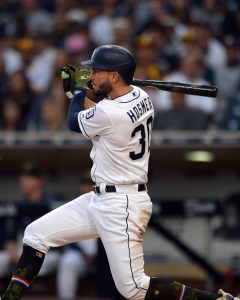
Hosmer stood out at times in Kansas City, including during a World Series-winning campaign in 2015, but fell on his face in other seasons. As a result of Hosmer’s inconsistency as a Royal, there were plenty who either loved or hated the Padres’ choice to hand him a headline-stealing payday. Those who opposed it gained the upper hand in its first year, in which Hosmer hit a meek .253/.322/.398 in 677 plate appearances. He was a below-average offensive player by wRC+ (95) and less than a replacement-level performer by fWAR (minus-0.1).
Considering the beginning of a long-term contract is when a player is supposed to be providing the most value, Hosmer’s woeful 2018 production was downright alarming. The Padres needed a rebound from Hosmer coming into this season, and while he has gotten better, the respected veteran still hasn’t given the Friars much bang for their buck on the field.
The best thing you can say about Hosmer the Padre is that he has been available more than most players. He piled up 157 appearances a year ago and has participated in 86 of the Padres’ 87 games in 2019. Along the way this season, Hosmer has slashed .293/.343/.45 with 13 home runs – just five fewer than last year – over 364 trips to the plate. He has also upped his weighted on-base average/expected wOBA from matching .310s last season to .341/.334 this year. Likewise, the 29-year-old’s 111 wRC+ and 0.7 fWAR count as vast improvements over what he offered in those categories in 2018. They’re still far from great, however. In fact, the average major league first baseman has posted a 110 wRC+ this season. Of course, the average major league first baseman isn’t on a $20MM salary this year or locked into a big-money deal into his 30s.
While FanGraphs credits Hosmer with making more hard contact and less soft contact than he did last season, he continues to amass too many ground balls and too few fly balls. The typical batter hits grounders at an approximately 43 percent rate and flies 36 percent of the time. Hosmer’s at 57.3 and 21.0 in those areas in 2019. It’s hard to muster much in the power department with that combination, as Hosmer’s lifetime ISO (.155) and current ISO (.164) help prove. And Hosmer’s one of the majors’ slowest runners, making his grounder-heavy skill set even less conducive to success. The ongoing grounder overload hasn’t enabled Hosmer to take advantage of a 2019 hard-hit rate which Statcast places in the majors’ 87th percentile or an exit velocity that betters 71 percent of his peers.
Because Hosmer’s also still not walking much (6.9 percent this year, 8.2 lifetime), he continues to rely on a high batting average on balls in play to help buoy his numbers. That has paid off at times – including this season to an extent, as Hosmer’s .337 BABIP represents a 35-point increase over 2018’s. However, during seasons in which Hosmer’s BABIP has sat around average or worse, his production has typically fallen well short of expectations.
In further inauspicious news, the lefty-hitting Hosmer’s amid his second straight abysmal season against same-handed pitchers. Southpaws limited him to an unsightly .179/.240/.287 line in his first year as a Padre. Hosmer has bumped that slash to .250/.320/.324 this season, yet wRC+ indicates it’s still 24 percent worse than average. Struggles versus lefties aren’t anything new for Hosmer, who has stumbled to a .668 OPS and an 81 wRC+ against them over the course of his career.
A season and a half into his contract, the Padres’ choice to pay a premium for an inconsistent platoon first baseman continues to look like a head-scratcher. That’s all the more true when considering they already had well-compensated first baseman Wil Myers on the roster. Myers is now limited to the outfield, where he hasn’t garnered consistent playing time of late because he’s an ill fit in center and the Padres have superior hitters Hunter Renfroe and Franmil Reyes manning the corners.
This has been a positive overall season for long-suffering San Diego, which is hovering around .500 and finds itself in playoff contention. The team still hasn’t benefited as hoped from the Hosmer signing, though, and there aren’t clear signs that’s going to change.
Photo courtesy of USA Today Sports Images.
Cool Papa Bell
No, this isn’t a piece about baseball legend Cool Papa Bell. Try as I might, I couldn’t come up with a catchier title in regards to Pirates first baseman Josh Bell, who has evolved into one of baseball’s premier offensive players in 2019. It’s been something of an unexpected development considering the unspectacular start Bell’s career got off to during his first couple years in the majors.
A second-round pick in 2011, Bell soared up prospect lists in his days in the Pirates’ farm system, ranking as Baseball America’s 38th-best farmhand when the club promoted him to the bigs. Bell first got the call on July 8, 2016, almost exactly three years ago, and has been a mainstay in Pittsburgh since then. Through 2018, though, Bell looked like somewhat of a light hitter relative to his position, not the franchise-caliber masher he has become. While Bell did smack 26 home runs in 2017, he nonetheless entered this year a career .260/.348/.436 batter over 1,355 plate appearances, giving him a 110 wRC+ and a 1.4 fWAR which made him more closely resemble, say, James Loney than Freddie Freeman.
This season has been a completely different story for Bell, who, with 26 homers across 374 PA, has already tied his career high en route to his first All-Star nod. With a .306/.377/.654 line, Bell ranks fourth in the game in wRC+ (158), trailing a decent trio of Cody Bellinger, Mike Trout and Christian Yelich. The 26-year-old Bell has already racked up 2.7 fWAR, almost doubling the mark he posted during his entire career before 2019. Plus, while Bell recorded a mediocre .177 ISO from 2016-18, that number has soared to .349 this year, putting him fourth in the league.
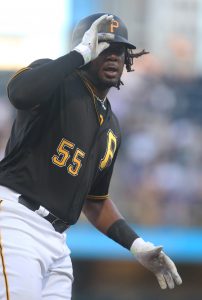
So why the sudden epiphany? For starters, Bell’s pulling the ball more than ever and going opposite field less than at any previous point, all while hitting more fly balls and fewer grounders. That’s an easy recipe for more pop, as is his decrease in infield fly balls. Bell’s pop-up rate stood at upward of 9 percent in each of his prior seasons, but it has plummeted to just over 2 percent this season.
Unsurprisingly, Bell has hit the ball much harder in general. His hard-contact rate has risen by an eye-popping 15 percent since last season, while his soft-hit rate has fallen by almost 10 percent, according to FanGraphs. Only 11 players have outdone Bell in hard-hit percentage. With that in mind, it’s not exactly stunning he ranks near the top of the majors in weighted-on base average (.421) and expected wOBA (.404), per Statcast, which places the switch hitter in elite company in most of its offensive metrics. Bell’s expected batting average (91st percentile), barrel percentage (95th), xwOBA (96th), expected slugging percentage (96th), hard-contact rate (97th) and exit velocity (98th) are all magnificent.
Unlike 2018, when Bell logged a .284 wOBA/.257 xwOBA against breaking pitches, those offerings haven’t fooled him this year. If you’re going to throw a breaking pitch to Bell nowadays, there’s a good chance you’re going to pay. He has hit a ridiculous .455/.460 off them this season, having shown power against them in several quadrants of the strike zone, which the drastic change in FanGraphs’ heatmaps shows between 2018 and ’19.
It’s clear Bell has benefited from a more aggressive approach. He’s swinging at way more pitches, including out of the zone, which has led to less contact, an all-time worst swinging-strike percentage and more strikeouts. But when you’re producing like this, it doesn’t matter. He’s still walking and striking out at better clips than most hitters, evidenced by a K/BB ratio which ranks 50th among 158 qualified batters.
The Pirates have been waiting for a new face of the franchise to rise up since they traded away organizational icon Andrew McCutchen prior to the 2018 campaign. It appears they’ve found his successor in Bell, though the newly established slugger’s days of playing for a relative pittance are nearing an end. Now in his last season on a league-minimum salary, Bell’s on the verge of cashing in during the arbitration process. Considering his 2019 breakout, though, that’s a high-class problem for Pittsburgh.
Photo courtesy of USA Today Sports Images.
Better Rental: Madison Bumgarner Or Zack Wheeler?
It’s fair to say Giants left-hander Madison Bumgarner and Mets right-hander Zack Wheeler are the two best soon-to-be free-agent starters who could realistically change teams before the July 31 trade deadline. Neither the Giants nor Mets are in contention, and there haven’t been any rumors about extension talks between the teams and the hurlers. Furthermore, both clubs’ farm systems are lacking, so trading Bumgarner and Wheeler could help the organizations better themselves in that area. The question is: Who’s the more desirable of the pair?
The more impressive track record belongs to Bumgarner, who will turn 30 the day after the deadline. He’s a three-time World Series champion and one of the most successful postseason pitchers in recent memory, which could matter to starter-needy clubs that have their sights set on fall baseball. Bumgarner owns a phenomenal 2.11 ERA with 7.7 K/9 and 1.6 BB/9 in 102 1/3 playoff innings, though he hasn’t pitched that deep into the season since 2016. More recently, Bumgarner has morphed into a mid-rotation starter, no longer the front-line stalwart he was when he was helping the Giants to championships.
This season, Bumgarner has pitched to a 4.02 ERA/3.96 FIP with a 35.8 percent groundball rate over 109 2/3 innings, and has seen hitters put up a .332 expected weighted on-base average against his offerings versus a .311 real wOBA. Those are respectable numbers, but they’re not those of a rotation savior. At the same time, though, Bumgarner has produced a K/BB ratio befitting of an ace. With 9.27 K/9 against 1.97 BB/9, he stands 17th in the majors in K/BB ratio (4.71). The fact that Bumgarner has recorded career-best chase and first-pitch strike rates has helped him in that regard.
Wheeler’s also 29, yet he doesn’t have a single inning of playoff experience. Still, there’s a case to be made that he’s a better asset than Bumgarner. This much is clear: On a $5.975MM salary against Bumgarner’s $12MM, Wheeler is noticeably less expensive. And while Bumgarner’s not going to intimidate anyone with his low-90s velocity, Wheeler attacks hitters with one of the hardest fastballs in the game – a pitch that averages upward of 97.2 mph. Wheeler has used his velo to register 9.71 K/9 versus 2.53 BB/9 this year, yet he hasn’t had an easy time preventing runs. Wheeler’s ERA is at a lofty 4.42 through 114 frames, but his FIP’s a much more encouraging 3.63, and he has induced grounders at roughly a 45 percent clip. He’s also outdoing Bumgarner in the wOBA/xwOBA department (.295/.302).
Undoubtedly, Bumgarner or Wheeler is a question playoff-caliber teams seeking starters have asked themselves in recent weeks, and it’s one they’ll continue debating leading up to the deadline. With both pitchers likely on the move in the next four weeks, they may end up having a large amount of say in this year’s playoff race and perhaps the postseason itself. Which of the two would you rather have?
(Poll link for app users)
Which starter would you rather acquire?
-
Madison Bumgarner 61% (5,151)
-
Zack Wheeler 39% (3,317)
Total votes: 8,468
Injury Notes: Lowrie, Manaea, D-backs, Scooter, Tigers
Stop us if you’ve heard this one before: Mets infielder Jed Lowrie still isn’t close to making his 2019 debut, manager Mickey Callaway told Tim Healey of Newsday and other reporters Wednesday. Lower body injuries have kept Lowrie from playing this season after he joined the Mets on a two-year, $20MM contract over the winter. With the season now at the halfway point, Callaway doesn’t even seem willing to commit to Lowrie taking the field at all in 2019. Asked if he expects to see Lowrie this year, Callaway said: “That’s hard to say. There’s so much of the season left. We’ll just have to play that by ear.”
Theo Epstein On Cubs’ Slide: “Not Acceptable”
Little has gone right in recent weeks for the Cubs, who fell to 22-28 in their past 50 games with yet another defeat Wednesday. Chicago dropped its fourth straight game overall and third in a row against the Pirates, though the stage was set for a Cubs victory. Leading 5-4 entering the bottom of the ninth, the Cubs had newly signed closer Craig Kimbrel in line to slam the door. Instead, Kimbrel allowed two earned runs on a walk and a double en route to a 6-5 defeat. It was the second straight less-than-ideal showing for Kimbrel, who hasn’t turned in a clean performance in any of his three appearances since the Cubs activated him June 27.
Signing Kimbrel to a three-year, $43MM contract was a bold strike by president of baseball operations Theo Epstein, an attempt to inject some much-needed life into the club. The move hasn’t done the trick to this point, though. Neither have multiple team meetings in recent days, as Jesse Rogers of ESPNChicago.com detailed after its 18-5 loss in Pittsburgh on Tuesday.
With the Cubs having floundered since May, their front office is running out of patience as the July 31 trade deadline approaches. Epstein took to WSCR-AM 670 on Wednesday and stated there could be a “ton” of changes, even threatening to sell this month, Gordon Wittenmyer of the Chicago Sun-Times and Mark Gonzales of the Chicago Tribune were among those to cover. Epstein called the Cubs’ recent skid “not acceptable,” adding, “There have been too many words about it and not enough action.”
Epstein didn’t excuse manager Joe Maddon from blame, saying “all of us haven’t done the job.” On the field, Epstein pointed to “sloppy” base running and defense as reasons for the team’s slump. Epstein must have been apoplectic Wednesday night when a pair of defensive miscues with one out in the ninth helped sink the Cubs. Catcher Willson Contreras, who was playing right field, failed to come up with a bloop fly ball. Then, with Pirates catcher Elias Diaz on third, Cubs second baseman Addison Russell fielded a grounder and fired home instead of taking the easy out at first. Diaz beat the throw, tying the game, and the Pirates later triumphed on a Corey Dickerson sacrifice fly.
The Cubs sit a lukewarm 45-42 on the heels of their latest loss, yet they’re still in wild-card position and a mere game back of the NL Central-leading Brewers. The fact that the NL features far more middling teams than juggernauts has been a saving grace for the Cubs. However, that’s not going to cut it for Epstein, who has important choices to make in the coming weeks.
As things stand, the Cubs still seem far more likely to buy than sell, especially after having signed Kimbrel. The team could reasonably look to make upgrades throughout its roster. Even with Kimbrel in the fold, the Cubs’ relief corps has done little to inspire confidence aside from Steve Cishek, Brandon Kintzler and Kyle Ryan. The Cubs’ rotation took a significant hit when Cole Hamels went on the injured list with a left oblique strain last weekend, though there’s optimism he won’t miss a ton of time. Regardless, the club’s starting staff has been shaky beyond Hamels, Kyle Hendricks and Jon Lester. Fellow established starters Yu Darvish and Jose Quintana haven’t come close to meeting expectations this season.
Statistically, the Cubs’ position players rank sixth in the majors in fWAR, but that doesn’t mean the group is devoid of issues. Among regulars, Contreras, third baseman/outfielder Kris Bryant, shortstop Javier Baez, first baseman Anthony Rizzo, outfielder Jason Heyward and utilityman David Bote have all ranged from fine to excellent this year. On the other hand, when the Cubs haven’t used Bote at second, they’ve gotten little at the position from Russell, Daniel Descalso and Ben Zobrist. They promoted 26-year-old rookie Robel Garcia on Wednesday as a result. Center fielder Albert Almora has joined Descalso and Zobrist in struggling at the plate (especially against lefties). Adding to the disappointment, left fielder Kyle Schwarber hasn’t hit like the offensive cornerstone Epstein & Co. have regarded him as throughout his career.
Second base and the outfield may end up as areas the Cubs try to bolster this month, but Zobrist’s potential return complicates matters. Although Zobrist has been on the restricted list since May 7 as he deals with a divorce, Epstein indicated Wednesday he expects the 38-year-old infielder/outfielder to rejoin the team at some point. The Cubs have saved approximately $1MM per month during the absence of Zobrist, who’s on a $12.5MM salary in the last year of his contract. Zobrist’s disappearance helped the Cubs gather up the funds for Kimbrel, though they’ve largely shied away from spending since last offseason. Epstein has said the Cubs usually have “significant” money saved for in-season pickups, though, which implies a Zobrist comeback wouldn’t hinder their deadline plans from a financial standpoint. Even if it doesn’t, the Cubs will need vintage Zobrist to return – not the version who showed absolutely no power over 99 plate appearances before he took his leave.
Just as Epstein is optimistic Zobrist will put on a Cubs uniform again this season, he expects injured reliever Brandon Morrow to factor into their bullpen. Morrow was a highly valuable member of the Cubs’ relief corps in 2018, but elbow problems put an end to his season in mid-July. While the oft-injured 34-year-old has been throwing in Arizona lately as he tries to work back, per Gonzales, there’s still no clear timetable for a return.
Jesus Luzardo Suffers Lat Strain
Prized Athletics left-hander Jesus Luzardo had been nearing his major league debut, but that’s now off the table for the time being. Luzardo, out all season with a left rotator cuff strain, suffered a Grade 2 left lat strain in a Triple-A rehab start Tuesday, the team announced. There’s no timetable for Luzardo’s return from his newest injury.
This is a brutal development for the playoff-contending Athletics, who were banking on Luzardo helping to stabilize their rotation down the stretch. Luzardo, widely regarded as an elite pitching prospect, had been expected to slot into their staff after the All-Star break. The 21-year-old’s forthcoming debut would have been all the more timely with the A’s having lost their ace, Frankie Montas, to an 80-game suspension for performance-enhancing drugs on June 21.
Oakland will now have to continue waiting for Luzardo, whose ongoing absence could impact its trade deadline plans. Despite Montas’ loss, general manager David Forst suggested last week the A’s would focus more on upgrading their bullpen than their rotation around the deadline. The team may now have to reverse course in the wake of Luzardo’s setback, though. The A’s rode an underwhelming rotation to a playoff berth in 2018, but expecting it to happen again with this year’s mediocre bunch might be unrealistic.
Todd Frazier Discusses Potential Trade
As a soon-to-be free agent on a team that appears to be going nowhere in the standings, third baseman Todd Frazier looks like a potential trade chip for the Mets. With the July 31 deadline exactly four weeks out, Frazier addressed his future Wednesday, telling Mike Puma of the New York Post: “If I get traded, OK. If not, I am glad to be here as a Met. I am doing something, so it’s always good to be wanted.”
Trades aren’t anything new to Frazier, who has been part of two deals since he started his career in Cincinnati in 2011. The Reds sent Frazier to the White Sox in December 2015, and just under two calendar years later, the Pale Hose dealt him to the Yankees around the 2017 trade deadline. Frazier then joined the Yankees’ crosstown rivals the ensuing offseason on his current deal – a two-year, $17MM guarantee which Mets general manager Brodie Van Wagenen negotiated on his behalf.
Van Wagenen was Frazier’s agent when the veteran changed New York franchises, but now BVW is in the unique position of potentially trading away a player whose payday he secured. Frazier’s still owed about $4.31MM on his deal, a pact which has been a mixed bag for the Mets. While Frazier endured a down, injury-shortened initial campaign with the Mets, the 33-year-old has rebounded in 2019 to slash .256/.335/.450 (111 wRC+) with 11 home runs in 236 plate appearances. Frazier has aided his cause with career-best strikeout, swinging-strike and contact rates.
Everyday third basemen could be difficult to find around the deadline, which may work in the Mets’ favor if they try to trade Frazier. Considering their upward trajectory, the Nationals don’t seem likely to deal Anthony Rendon. Otherwise, aside from Frazier, there’s a wide selection of trade possibilities who profile more as part-time players or utility infielders than full-time third basemen. Pablo Sandoval, Derek Dietrich, Jonathan Villar, Neil Walker, Eric Sogard and Tim Beckham are among them.
Garrett Richards Could Return In September
Although the Padres sit below .500 (42-43) as the season nears the All-Star break, they’re still just two games back of a wild-card spot in the National League. If the team hangs in the race until late in the year, it could get back a key reinforcement in right-hander Garrett Richards. The Padres are hopeful the recovering Tommy John surgery patient will join their staff in September, Kevin Acee of the San Diego Union-Tribune reports.
Richards went under the knife last July, effectively ending his Angels tenure, but that didn’t stop the Padres from making a strong commitment to him in free agency. The club guaranteed $15.5MM over two years to Richards, thus making him their second-biggest offseason signing behind Manny Machado.
The 31-year-old Richards earned his deal as a result of a promising stint with the Angels, a 744 2/3-inning stretch from 2011-18 in which he logged a 3.54 ERA/3.62 FIP with 7.8 K/9, 3.24 BB/9 and a 52.5 percent groundball rate. However, injuries – not just Richards’ damaged ulnar collateral ligament – undermined him toward the end of his Angels tenure. Richards concluded his run in Los Angeles with 76 1/3 or fewer innings in each of his final three seasons with the franchise.
When Richards has been healthy enough to take the mound, he has produced like someone capable of slotting in near the top of a team’s rotation. That explains why the starter-needy Padres took a gamble on him for a somewhat expensive amount of money. The team’s current rotation could certainly use a recovered Richards, having managed only mediocre numbers overall. Chris Paddack, Joey Lucchesi and Eric Lauer have been good or better, as has Logan Allen across a mere three appearances. But no one from a trio consisting of Matt Strahm, Nick Margevicius and Cal Quantrill has offered a solution over a combined 33 starts.
As they continue to wait for Richards, the Padres will welcome righty Dinelson Lamet back to their rotation Thursday. The 26-year-old Lamet, like Richards, has recently seen Tommy John surgery stall his career. Lamet impressed as a rookie in 2017 before hitting the operating table in April 2018.
Trade Candidate: Tanner Roark
Giants left-hander Madison Bumgarner and Mets right-hander Zack Wheeler will garner most of the headlines when it comes to rental starters who could move by the July 31 trade deadline. But for teams that aren’t able to win the bidding for either of them, Reds righty Tanner Roark is seemingly shaping up as a decent consolation price. That is, if the Reds – just 4 1/2 games out of a playoff spot despite being five games under .500 – decide to sell Roark. Even if they keep the 32-year-old through the season, he’ll land on several teams’ radars in free agency during the winter.
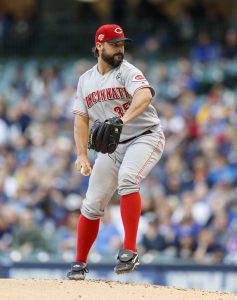
Roark has been a mostly solid starting option since his career began in 2013 with the Nationals. He made 141 starts in D.C. from 2013-18, during which he posted a 3.61 ERA/3.94 FIP with 7.06 K/9, 2.55 BB/9 and a 45.1 percent groundball rate. Although Roark was a quality complement to front-end starters Max Scherzer and Stephen Strasburg in recent years, the Nationals moved on from him last offseason in favor of new acquisitions Patrick Corbin and Anibal Sanchez.
The Reds, seeking to revamp their rotation and make a playoff push in 2019, sent reliever Tanner Rainey to the Nationals for a year of control over Roark. Since then, Roark has held up his end of the bargain for a Cincinnati team whose rotation has indeed taken enormous steps ahead this season. Roark has pitched to a 3.51 ERA/3.86 FIP in 92 1/3 innings and 17 starts, putting him on the cusp of his fourth consecutive season with at least 2.0 fWAR.
An increase in strikeouts has played an important role in Roark’s above-average run prevention in 2019. While he has never been a huge strikeout pitcher, Roark has impressively fanned just under a batter per inning this year. At the same time, he has walked a bit fewer than three per nine, giving him a 3.07 K/BB ratio which sits well above the league mean of 2.65.
Even though Roark has transferred to a home park which is more conducive to HRs, he hasn’t felt the sting thus far. Roark’s groundball percentage has decreased 5 percent since last year and sits at a paltry 35.7 percent, yet his home run-to-fly ball rate has actually dropped a little since 2018 (from 11.7 to 10.8). That has enabled Roark to manage decent numbers at home and on the road. It helps that Roark has generated more infield fly balls, aka automatic outs. At 12.9 percent, he ranks 14th among starters in that category.
Roark has also experienced somewhat of an uptick in velocity since last year. He’s still not going to blow anyone away with his average fastball (92.3 mph), slider (86.2), changeup (84.3) and curveball (76.1), but each pitch has risen around 1 mph compared to 2018. Roark has also mixed those pitches differently than he did a year ago. His sinker’s still his primary offering, but usage of it has plummeted 10 percent, per Statcast, which indicates Roark has turned to his slider about 10 percent more and his fastball at a 5 percent greater rate. According to FanGraphs’ linear weights, Roark’s fastball has been one of the best among starters in 2019.
Now for the bad news: FanGraphs shows the rest of Roark’s offerings all rate in the negatives this year. Although Roark has stifled righty batters, he flat-out hasn’t had an answer for lefties, who have slashed .290/.388/.531 against him. In essence, Roark has turned the typical lefty into Rafael Devers in 2019, in part because he’s yielding more damaging contact than he did in prior years. Roark’s hard-hit rate against is up more than 11 percent relative to his career, while he has surrendered soft contact about 4 percent less, according to FanGraphs. Statcast doesn’t provide any hope in that regard either, noting Roark ranks in the league’s 26th percentile in hard-hit percentage. He’s also far below average in terms of expected batting average (28th percentile), exit velocity (29th), expected weighted on-base average (34th) and expected slugging percentage (39th).
Teams with interest in Roark are no doubt aware of his blemishes, though those issues shouldn’t deter the Reds from finding a taker for him if they try to before the deadline. Roark’s near the top of the league when it comes to curve spin rate (80th percentile), so he could land with an organization which encourages him to utilize that pitch more. Regardless, for clubs that aren’t in position to win bidding wars for more hyped trade candidates such as Bumgarner, Wheeler, Matthew Boyd and Marcus Stroman, among others, Roark will hold appeal. Whether he finishes the season in Cincinnati or elsewhere, Roark will continue attempting to make a case for a raise over his $10MM salary as he prepares for an upcoming trip to free agency.
Photo courtesy of USA Today Sports Images.