
Bo Bichette’s Earning Power Spectrum
Last month, MLB Trade Rumors published an early Power Rankings looking ahead to the upcoming free agent class. Kyle Tucker was an obvious choice for the top spot and Dylan Cease ended up pretty comfortably in second. The next few entrants were tougher to separate, but Bo Bichette ended up third.
Bichette’s free agency was and is tough to peg. He has a strong track record of success, but his 2024 season was awful. His bat has been strong on the whole, though with a swing-happy profile that lacks walks. His defense has been passable enough to stick at short, but he’s not great there.
Of the potential top free agents this coming winter, he seemingly has some of the widest error bars. This post will take a look at the spectrum, using MLBTR’s Contract Tracker as a guide.

As you can see in that screenshot (link for app users), I’ve used the dropdown bars to search for free agent deals for shortstops over the past five years. I’ve then ranked them by the total guarantee on the contract. There are some pretty clear tiers in earning power, so let’s see where Bichette could fit in.
From 2019 through 2023, his production was quite consistent. He splashed onto the scene with a 143 wRC+ in 46 games in his debut season but then his wRC+ finished in the 120 to 130 range in each of the next four seasons. His home run total in the three full seasons from 2021 to 2023 fell between 20 and 29. His walk rate was on the low side in each of those campaigns, falling between 4.5% and 5.9%, but he also struck out less than average and ran batting averages near .300.
The defensive reviews have been mixed. Defensive Runs Saved has him at -11 for his whole career, though a big chunk of that is a -16 in 2022 alone, which looks like a clear outlier. Apart from that, he’s generally been near average, give or take a few runs on either side. Outs Above Average, however, doesn’t like his glovework at all. Bichette has -22 OAA for his career and has been below average in almost every season. The only campaigns in which he’s finished with a positive OAA were the shortened 2020 season and his injury-marred 2024 campaign.
Still, the bat was enough to produce plenty of value. FanGraphs had him between 3.9 and 4.9 wins above replacement in each season from 2021 to 2023. Baseball Reference pegged him between 3.7 and 5.9.
Things went off the rails last year. Bichette seemingly battled leg injuries all year, twice going on the IL due to right calf strains. He got into just 81 games, hit only four home runs and produced an ugly .225/.277/.322 batting line, 71 wRC+.
Turning to 2025, Bichette seems to have bounced back to his old self. Through 211 plate appearances, he has a .292/.341/.431 and 121 wRC+. That’s despite a slow start. Through the end of April, he still hadn’t hit a home run, leading to a decent but powerless .295/.328/.364 line and 97 wRC+. Since the calendar has flipped to May, he has finally gone over the fence four times, helping him hit .288/.365/.561 for a wRC+ of 163 this month.
Turning to the Contract Tracker list, at the top is a level that Bichette shouldn’t be able to get to, with Corey Seager at $325MM followed by Trea Turner at $300MM. Seager got his deal going into his age-28 season, the same age Bichette will be next year. However, Seager was simply better. His power output was fairly close to Bichette’s but with far more walks, leading to a 142 wRC+. His defense was also graded higher.
Seager had 19.8 fWAR at the time he signed with the Rangers. Bichette could actually go past that since he’s at 17.2 fWAR right now, but that’s mostly due to Seager’s injuries (most notably, Tommy John surgery). Seager produced that WAR total in just 514 regular season games as a Dodger, whereas Bichette already has 655 games under his belt. There was some injury risk with Seager but he was far better on a rate basis and that’s what the Rangers paid for.
Turner was a bit older, going into his age-30 season, but his combination of offense, defense and speed gave him a massive ceiling Bichette can’t match. In his final two seasons before free agency, he produced 7.1 and 6.4 fWAR. As mentioned, Bichette has topped out at 4.9.
The next two names on the list are a bit unusual. Xander Bogaerts getting $280MM registered as a huge surprise at the time and the deal hasn’t worked out for the Padres so far. In the industry, that one is chalked up to the Friars going a bit wild. Owner Peter Seidler was in poor health and was allowing the front office to spend like never before, seemingly throwing caution to the wind with the knowledge that he didn’t have much time left.
Carlos Correa‘s deal is also an unusual data point. His earning power was initially far higher. He had agreed to a 13-year, $350MM deal with the Giants before they got scared by his physical and walked away. The Mets agreed to a 12-year $315MM deal with Correa before they, too, balked at his medicals. The $200MM deal with the Twins was therefore the product of a fairly unprecedented situation. The unique quartet of vesting options in the deal reflect the odd circumstances and could add millions more to Correa’s bank account.
There’s a case for Bichette to be in the next tier. I’ll circle back to Marcus Semien in a second and focus first on Willy Adames, Dansby Swanson, Javier Báez and Trevor Story. Each signed his contract going into his age-29 season and earned between $23.3MM and $26MM annually. Adames and Swanson got a seventh year, pushing their total guarantees to $182MM and $177MM respectively. Báez and Story were each capped at six years and $140MM total.
Bichette will be one year younger than everyone in that group, theoretically giving him a bit more earning power. The question will be whether he’s ranked as highly apart from that. Adames is a better defender, with 11 OAA and -3 DRS in his career. That latter figure is a bit odd, as he was clearly in positive range before posting -16 DRS 2024 and -7 so far as a Giant.
Offensively, he had often been similar to Bichette. He had a 126 wRC+ in 2020 and a 120 in 2021, with 25 home runs in the latter season. His power remained in 2022 and 2023 but low batting averages dropped his wRC+ to 109 and 94 in those seasons. He bounced back in 2024 with 32 home runs and a 119 wRC+. His fWAR totals have generally been in the Bichette range of three to five per season.
Swanson was always a glove-first shortstop with questions about the bat. Through 2021, he still had a career 88 wRC+. But in 2022, his walk year, he hit 25 home runs and produced a 117 wRC+. Thanks to his excellent defense and 18 stolen bases, he was able to produce a 6.6 fWAR season. That was a tier above anything Bichette has done, but he had only done it once. Still, it was enough for the Cubs to buy in.
Báez and Story were more erratic. Báez was a subpar hitter in his first few seasons but provided enough on defense and the basepaths to be useful. His offense improved as he neared free agency but wasn’t consistent. His wRC+ spiked to 131 in 2018 and dropped to 112 the year after. The shortened 2020 season was a disaster, with a wRC+ of 57, before he bounced back to 117 in 2021. At his heights, he was almost a six-win player, getting to 5.8 and 5.6 fWAR in 2018 and 2019. Those were higher than any Bichette season, but he was also well below at times.
Somewhat similarly, Story hit a higher peak than Bichette by producing 6.0 fWAR in 2019. He hit 35 home runs, though playing in Denver during the juiced ball season surely helped him a bit in that regard. Still, the 122 wRC+, 23 steals and strong defense led to a six-win season. He also had 2.0 fWAR in the shortened 2020 campaign with similar production. But in his walk year, 2021, his wRC+ dropped to 98 and he only produced 2.2 fWAR. That tepid platform season and some concerns about his elbow health knocked him down a bit.
Here is the fWAR total for each in the six seasons leading to free agency, including the shortened 2020 season for all in the name of fairness:
Baez: 21.9 in 782 games
Story: 20.3 in 745 games
Adames: 20.1 in 795 games
Bichette: 15.8 in 609 games
Swanson: 15.1 in 789 games
Bichette is right in the thick there. As mentioned, Swanson bloomed in his walk year, so it makes sense he would be at the bottom of this six-year list. If Bichette has a typical year for him, he could add another three or four wins and get fairly close to the other shorstops on the list. Factor in some inflation and that he’s a year younger than everyone in that pack and he has a case to earn something around $200MM.
What will also work in his favor is that he’ll be the clear top shortstop this winter, as Adames was in the most recent offseason. Alongside Bichette, the only other potential everyday shortstop this winter would be Ha-Seong Kim. He is still recovering from last year’s shoulder surgery and needs to both recover and play well enough to opt out of the second season of his two-year deal with the Rays. Even in a best-case scenario where that all happens, his earning power would be below a healthy and productive Bichette.
This is all still somewhat hypothetical. As mentioned, Bichette seems to be getting back to his 2021-23 pace this year, but in a fairly small sample. There’s still lots of time for the season to turn on him. If he ends up having more 2024-style struggles, he could certainly fall. Let’s turn to the Contract Tracker again.
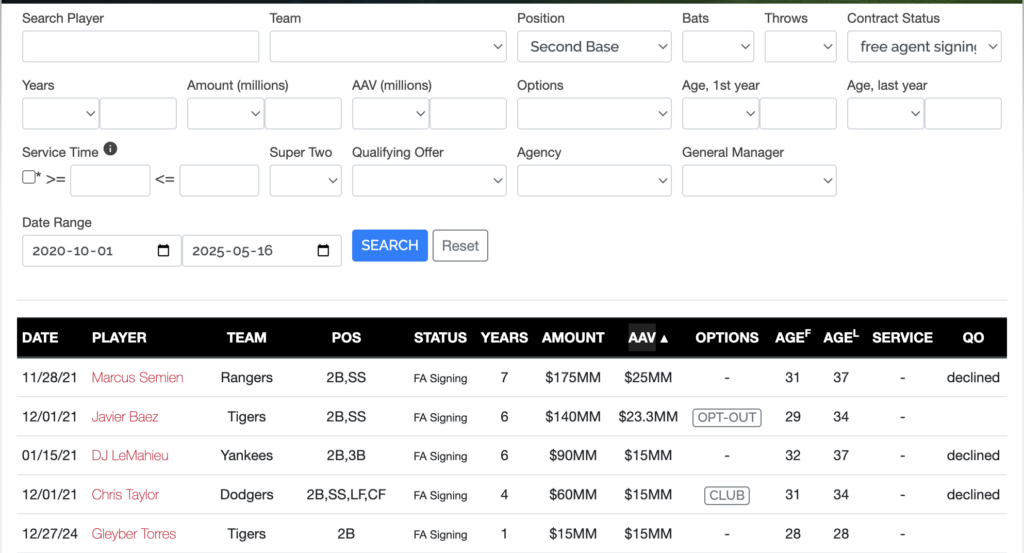
These are the top deals for second basemen by average annual value in the past five years (link for app users). This perhaps paints a picture of Bichette’s floor. Given his questionable defense, it’s possible that clubs may view him as someone who’s likely to move to second base fairly soon. And the earning power of second basemen is clearly lesser than that of shortstops. Semien did get $175MM from the Rangers, though that’s an outlier. At the time, the Rangers were five years into a deep rebuild and were eager to speed up the process with aggressive spending.
Gleyber Torres is an interesting comp for Bichette, as there are some parallels. Torres was once a highly-touted shortstop prospect, but with a better bat than glove. Unlike Bichette, he couldn’t stick at short. The Yankees moved him to second base for good in 2022, his age-25 season.
His offensive production has been somewhat comparable to Bichette’s on the whole. He went into free agency with a .265/.334/.441 line and 113 wRC+, a bit below Bichette’s typical range. He also had a tepid platform year, slashing .257/.330/.378 for a 104 wRC+ in 2024. He settled for a one-year, $15MM “prove it” deal with the Tigers.
It currently seems unlikely that Bichette would fall quite that far. His career wRC+ of 120 is a few ticks above what Torres brought to the open market last fall. Bichette also has a leg up defensively, as he will be going into free agency as a viable shortstop, at least for the short term.
But a soft finish in 2025 could hamper Bichette. In that scenario, he’d be going into free agency on the heels of two fairly disappointing seasons in a row. That was the situation Cody Bellinger was in going into 2023. After two injury-marred seasons with the Dodgers, he was non-tendered and settled for a one-year, $17.5MM pact with the Cubs for his age-27 season. He bounced back that year and went into the open market ahead of his age-28 campaign.
But there were enough question marks from his inconsistency, health and defense that he settled for a three-year, $80MM deal to return to the Cubs, well below initial expectations. He earned opt-out chances after each season in that deal but declined the first chance after a good-not-great 2024 season.
Time will tell where Bichette ultimately puts himself on this earning spectrum, but it appears to be quite wide. Anything from $20MM to $200MM seems somewhat plausible, depending on his performance over the four-plus months, which will make him a fascinating player to track.
A qualifying offer would be something of a footnote when talking about a $200MM deal but would certainly become noteworthy if Bichette finds himself on the other end. The QO was $21.05MM in the most recent offseason and will surely go up for the coming winter, after a number of recent mega deals. The QO is calculated by averaging the salaries of the 125 top-paid players. Each of Juan Soto, Alex Bregman, Blake Snell, Vladimir Guerrero Jr. and Corbin Burnes earned AAVs of $35MM or higher recently. Though there are some deferrals in those deals, the QO value is sure to rise.
Bichette would only be eligible to receive a QO if he sticks with the Jays until the end of the season. Players traded midseason are not eligible to receive one. If the Jays fall out of the race and trade Bichette at the deadline, the QO won’t be a factor for him — yet another detail that could sway a volatile free agent case with many factors at play.
Photo of Bichette courtesy of Dan Hamilton, Imagn Images
Alan Trejo Elects Free Agency
The Rockies sent infielder Alan Trejo outright to Triple-A Albuquerque but he has exercised his right to elect free agency, according to his transactions tracker at MLB.com. That indicates he cleared waivers after being designated for assignment last week. The log also indicates that infielder Owen Miller was outrighted after last week’s DFA. He also has the right to free agency, but there’s no indication he has done so.
Trejo, 29 this month, got a brief run on Colorado’s roster. The Rockies acquired him from the Rangers in a cash deal at the end of April. He was sent to the plate 43 times but produced a dismal line of .175/.190/.225.
That’s an extreme low in a small sample but it continues his glove-first trajectory. He now has a .224/.269/.325 batting line and 49 wRC+ in 512 big league plate appearances. He has played the three infield positions to the left of first base, with at least 183 innings at each of those spots. His work at shortstop has been subpar but passable, while he’s been above average at both second and third base.
The Rockies acquired Trejo and selected Miller to fill in during a time when infielders Ezequiel Tovar, Tyler Freeman and Aaron Schunk were all on the IL, though all three were reinstated last week. Trejo and Miller are both out of options, leaving the Rockies little choice but to cut them from the 40-man entirely. As players with previous career outrights, they have the right to reject further outright assignments in favor of free agency.
Trejo’s entire big league career has been with the Rockies, though he has signed minor league deals with the Dodgers and Rangers. Perhaps he and the Rockies will reunite on a fresh minor league deal in the coming days but he will have the chance to talk to the other 29 clubs as well.
Miller was acquired from Milwaukee in a minor trade over the offseason. Colorado called him up despite a modest .244/.322/.372 slash line in Triple-A. He didn’t play much in the big leagues, going 2-14 while starting four games at second base. Assuming he doesn’t elect free agency, he’ll remain in the system as non-roster infield depth.
Photo courtesy of Eakin Howard, Imagn Images
Giants Designate David Villar For Assignment
The Giants have reinstated infielder Casey Schmitt from the 10-day injured list. As a corresponding move, fellow infielder David Villar has been designated for assignment. The club’s 40-man roster count drops from 39 to 38. Alex Pavlovic of NBC Sports Bay Area was among those to pass along the transaction.
It’s the second DFA of the year for Villar. The first one came just prior to Opening Day. He came into the year out of options and without a firm hold on a roster spot. That got him bumped onto the waiver wire, but he passed through unclaimed and stuck in the Giants’ organization. About three weeks into the season, he was called back up when Schmitt landed on the IL with an oblique strain.
Villar hasn’t gotten much playing time since returning to the big leagues. In the one month since his contract was selected, he received just 26 plate appearances over nine games. He put up a .200/.360/.250 line in that time.
Now that Schmitt is back, Villar is likely destined for the waiver wire once again. He has shown some pop at the plate at times but has often been a strikeout victim, which likely led to him clearing waivers a couple of months ago. He has hit 15 home runs in 383 career big league plate appearances but has gone down on strikes at a 31.6% clip.
Given that he cleared waivers last time, there’s a decent chance he will do so again. If that comes to pass, he would be able to elect free agency this time around, as players with a previous career outright have that right.
It’s also possible that some team that passed on him last time will take a flier on him now, perhaps due to injuries changing their roster outlook. Villar has played the three non-shortstop infield positions, meaning he can provide a bit of defensive versatility.
He has shown some home run power in the majors, as mentioned, and has tremendous minor league numbers. He has taken 1,248 trips to the plate at the Triple-A level since the start of 2022. His 25.6% strikeout rate in that time is still a bit high but far more tolerable than his big league rate. He’s also drawn walks at a 13.4% clip and hit 61 home runs, helping him produce a .273/.381/.507 line and 130 wRC+.
Photo courtesy of D. Ross Cameron, Imagn Images
Rangers Claim Michael Helman, Designate Jonathan Ornelas
The Rangers announced that they have claimed infielder Michael Helman off waivers from the Pirates and optioned him to Triple-A Round Rock. The Bucs designated him for assignment last week. To open a roster spot for Helman, the Rangers designated infielder Jonathan Ornelas for assignment.
It’s the second waiver claim in a week for Helman. The Pirates claimed him from the Cardinals on May 14th but designated him for assignment two days later when they called up Nick Solak. Perhaps the Bucs were hoping to pass Helman through waivers and keep him as non-roster depth, but the Rangers have swooped in to prevent that from happening.
Helman, who turns 29 on Friday, has a very limited big league track record. It consists of ten plate appearances with the Twins last year. He got three hits but also struck out three times. The Twins traded him to the Cardinals for cash in February.
The Rangers are presumably more interested in his minor league work, which naturally provides a larger data sample. Over 2023 and 2024, Helman stepped to the plate 480 times in the minors. He hit 21 home runs and hit a combined .282/.356/.507 for a 121 wRC+. In addition to that offense, Helman has played every position outside of the battery in his minor league career, meaning he provides lots of defensive versatility.
His 2025 hasn’t gone well so far. He produced a .185/.260/.292 line over 73 Triple-A plate appearances. Perhaps that’s why the Cards and Pirates each took a chance at trying to run him through waivers, but without success. The Rangers will send him to Round Rock and see if his bat can bounce back. He has a full slate of options, so they can theoretically afford to be patient with him if he continues hanging onto his 40-man spot.
Ornelas, who turns 25 next Monday, is in a different position. Though he’s far younger than Helman, he is in his final option year. The Rangers added him to their 40-man roster in November of 2022 to keep him out of the Rule 5 draft.
He had put up some decent numbers in the lower levels of the minors but hasn’t done much at the upper levels or in the majors. He has 54 big league plate appearances so far with a 37% strikeout rate, 5.6% walk rate and .184/.245/.224 batting line in those. Since the start of 2023, he has 1,006 Triple-A plate appearances with a .247/.348/.333 line and 78 wRC+.
Given that performance and the fact that he’ll be out of options next year, it was going to be hard for him to cling to a roster spot going forward, so the Rangers have swapped him out now for Helman. Ornelas will be in DFA limbo for a week at most. The waiver process takes 48 hours, so the Rangers could spend five days trying to trade him. He has stolen a few bases in the minors and bounced around the diamond. He has played the three infield positions to the left of first base and all three outfield spots.
Photo courtesy of Reinhold Matay, Imagn Images
Cubs Designate Nicky Lopez For Assignment
Infielder Nicky Lopez has been designated for assignment by the Cubs, reports Maddie Lee of the Chicago Sun-Times. That was the expected corresponding move when it was reported earlier that Matt Shaw was coming back up to the big leagues. The Cubs’ 40-man roster count drops to 39.
Lopez, 30, has been bouncing in and out of the Cubs’ plans this year. He signed a minor league deal with them in the winter but opted out of that deal when he didn’t make the Opening Day roster. He then signed a big league deal with the Angels but was released by that club after a bit less than a month on the roster. At that time, Shaw had just been optioned to the minors after a sluggish start to the season, so the Cubs brought Lopez back and gave him a big league deal.
He didn’t get too much out of the opportunity, mostly getting plugged in as a defensive specialist. In almost a month with the Cubs, he got into 19 games but stepped to the plate just 28 times. He only hit .042/.179/.042 in those.
That’s a bit of an extreme microcosm of his whole career, as he has generally been a glove-first infielder. In 2,374 plate appearances, he has a .245/.310/.311 batting line and 72 wRC+. But he has generally received strong grades for his infield defense. He has spent most of his time at the middle infield positions but also has logged some work in the corners and in left field.
With Shaw coming back up, Lopez has been nudged from rarely-used bench piece into DFA limbo. He is likely to end up on waivers in the coming days. He has enough service time to reject an outright assignment and elect free agency, so he might be on the open market soon. He could perhaps garner interest from clubs looking for a bench infielder who’s good with the leather.
Photo courtesy of Benny Sieu, Imagn Images
Diamondbacks Release Garrett Hampson
Infielder/outfielder Garrett Hampson has been released by the Diamondbacks, according to his transactions tracker at MLB.com. He had been designated for assignment by the Snakes a week ago. He’ll be a free agent once he clears release waivers, if he hasn’t already.
Hampson, 30, signed a minor league deal with Arizona in the offseason. They selected him to the Opening Day roster, preventing him from triggering an opt-out chance. That locked Hampson into a $1.5MM salary for this year. Hampson is a veteran with more than enough service time to reject an outright assignment and elect free agency while keeping that salary in place. It seems the Snakes have decided to skip that formality and send Hampson more directly to free agency.
As a free agent, any club could sign Hampson and would only have to pay him a prorated version of the $760K league minimum salary for any time spent on the roster. That amount would be subtracted from what the Diamondbacks are paying him.
It’s possible that some club may be interested in that arrangement. Hampson has never been a huge threat at the plate but has provided value in the field and on the basepaths. He has a career .239/.302/.358 batting line, production which translates to a wRC+ of 69. That indicates he’s been 31% worse than league average overall. His production with the D’Backs this year was shaped differently but worked out to be roughly the same value. In 41 plate appearances, he had nine walks but just five hits, leading to a humpbacked .167/.359/.167 line and 71 wRC+ in that small sample.
But Hampson has 66 steals in 82 attempts during his career. He has also played every position on the diamond except catcher. Most of that has been at second base and center field but the ability to bounce around is attractive in a bench player. Given the low cost, it’s possible some club brings Hampson aboard as a guy who can serve as a defensive replacement and/or a pinch runner.
Photo courtesy of Reggie Hildred, Imagn Images
Submit Your Questions For This Week’s Episode Of The MLBTR Podcast
On the MLB Trade Rumors podcast, we regularly answer questions from our readers and listeners. With the next episode set for Wednesday, we’re looking for MLBTR’s audience to submit their questions and we’ll pick a few to answer.
The 2025 season is chugging along. If you have a question about the campaign, a look ahead to the deadline or anything else baseball-related, we’d love to hear from you! You can email your questions to mlbtrpod@gmail.com.
Also, if you want to hear your voice on the podcast, send us your question in audio form and we might play it. iPhone users can find instructions on how to do so here.
In the meantime, don’t forget to subscribe to the podcast on Spotify and Apple Podcasts.
Twins Place Carlos Correa On Concussion IL
The Twins have placed shortstop Carlos Correa on the seven-day concussion injured list. He and outfielder Byron Buxton collided while attempting to make a catch yesterday and both players entered concussion protocol. Per Bobby Nightengale of the Star Tribune, Buxton is still in the protocol and there won’t be an update before tonight’s game starts. Infielder/outfielder Ryan Fitzgerald has been selected to take Correa’s place on the roster. To open a 40-man spot, right-hander Michael Tonkin has been transferred to the 60-day injured list. Dan Hayes of The Athletic was among those to relay the moves.
In yesterday’s game, Cedric Mullins lofted a pop-up to shallow center field, as seen in this video from MLB.com. Correa drifted out to get it while Buxton charged in. Buxton tried to call off Correa at the last second but Correa wasn’t able to get out of the way. The two collided with both appearing to take a knock on the head. Both were removed from the game and placed in concussion protocol.
It’s unclear how long Correa is expected to be out but his health obviously take priority in a situation like this. The Twins have Brooks Lee at shortstop tonight and he could see regular time there for now. Willi Castro is also an option but he’s in left field tonight, helping to cover on the grass while Buxton and Harrison Bader are both banged up.
Though it’s not under the most pleasant of circumstances, Fitzgerald gets to the majors for the first time, just ahead of his 31st birthday. He has been grinding in the minors for a while, making his professional debut back in 2018.
He’s never really been on the prospect radar but is having a great season. He has taken 148 Triple-A appearances so far this year, drawing a walk in 12.8% of those while only striking out 19.6% of the time. He has four home runs and a .328/.426/.528 line, which translates to a 154 wRC+.
What also probably appeals to this Twins is his defensively versatility. In his minor league career, he has played every position outside of the battery. In addition to Correa and Buxton, the Twins are also working around minor injuries to Bader and Ty France, though the latter is in the lineup tonight. Whatever happens, Fitzgerald should be able to help them out.
As for Tonkin, this doesn’t change much about his status. He has been on the 15-day injured list since the start of the season due to a rotator cuff strain and his 60-day count can be backdated to that initial placement. That means he can technically be reinstated as soon as late May. He started a rehab assignment in the middle of April but that was recently shut down, per Hayes. As of that May 11th update, Tonkin had just experienced a setback due to tendinitis in his right bicep and was set to receive an anti-inflammatory injection.
Photo courtesy of Mitch Stringer, Imagn Images
Diamondbacks Place Eduardo Rodríguez On IL With Shoulder Inflammation
The Diamondbacks announced today that left-hander Eduardo Rodríguez has been placed on the 15-day injured list, retroactive to May 15th, with left shoulder inflammation. Lefty Joe Mantiply has also been optioned to Triple-A Reno. To take those two spots, the club has recalled right-hander Scott McGough and selected the contract of righty Christian Montes De Oca. The 40-man roster had two vacancies due to Garrett Hampson and José Castillo being designated for assignment earlier this week. Per John Gambadoro of Arizona Sports 98.7 FM Phoenix, righty Ryne Nelson will take E-Rod’s rotation spot, taking the ball on Tuesday.
There haven’t been a lot of publicly reported details about Rodríguez or his injury, but it’s possible he was feeling it last time out. He started on Wednesday against the Giants but wasn’t very effective. He allowed four earned runs in four innings and was pulled after throwing just 76 pitches. The velocity on most of his offerings was down about one mile per hour relative to his previous start. Perhaps the club will provide more information but it seems the lefty will need to miss at least a couple of starts.
That will give Nelson a chance to retake a rotation spot, at least for now. He logged 150 2/3 innings for the Snakes last year, mostly as a starter. He had a 4.24 earned run average, 20% strikeout rate and 5.4% walk rate.
Despite those strong numbers, he got pushed down the depth chart when the Snakes signed Corbin Burnes in the offseason. Burnes joined a rotation group next to Zac Gallen, Merrill Kelly, Brandon Pfaadt, Jordan Montgomery and Rodríguez. Montgomery required Tommy John surgery in March, but Nelson was still unable to get a rotation job.
He opened the year in a long relief role and has thrown 26 1/3 innings with a 5.13 ERA, but better peripherals. He has struck out 25% of batters faced while giving out walks at an 8.9% clip. A low 62.5% strand rate is not doing him favors, perhaps why his FIP is 3.71 and his SIERA at 3.45.
Kelly, Gallen and Montgomery are all free agents at the end of this year, while Burnes has an opt-out after 2026. Nelson is under club control through 2028 and could perhaps earn a long-term rotation spot with some strong results this year. Though if Rodríguez returns in relatively short order, it’s possible Nelson finds himself back in the bullpen again.
Montes De Oca, 25, gets the call to the big leagues for the first time. An international amateur signing out of the Dominican Republic, he has 181 1/3 minor league innings under his belt to this point in his career. In that time, he has a 4.17 ERA, 25.2% strikeout rate and 8.2% walk rate. He’s out to a good start this year, despite pitching in the hitter-friendly Pacific Coast League. In 19 Triple-A innings, he has a 2.37 ERA, 23.3% strikeout rate, 5.5% walk rate and 57.7% ground ball rate.
Photo courtesy of D. Ross Cameron, Imagn Images
Rockies Select Carson Palmquist
The Rockies announced that they have selected left-hander Carson Palmquist to their roster. Thomas Harding of MLB.com reported yesterday that Palmquist was likely to be promoted and to make his major league debut starting tonight’s game. They also reinstated infielders Ezequiel Tovar, Tyler Freeman and Aaron Schunk from the 10-day injured list. To make room for those four, outfielder Sean Bouchard and right-hander Anthony Molina have been optioned to Triple-A Albuquerque while infielders Owen Miller and Alan Trejo have been designated for assignment.
Palmquist, now 24, was selected by the Rockies in the third round of the 2022 draft. Since then, he has been climbing the minor league ladder, putting up some good strikeout numbers but also giving out a fairly high number of free passes.
Overall, he has 246 1/3 minor league innings under his belt with a 3.91 earned run average. He has punched out 31.1% of opponents but also given out a walk 117 times, an 11.2% clip. He has also plunked 21 batters, only adding to the number of free bases he’s given out.
That includes 70 2/3 Triple-A innings, starting in August of last year and continuing through the present. For the Isotopes, who play in the hitter-friendly Pacific Coast League, Palmquist has a 4.84 ERA, 24.1% strikeout rate and 14.3% walk rate.
Coming into 2025, Baseball America ranked Palmquist as the #8 prospect in the Rockies’ system. They note that the sidearming lefty doesn’t have overpowering stuff, with his fastball generally sitting in the low-90s, but with his angle and extension helping him get results from it. He’s been able to generate a lot of whiffs with his slider while also mixing in a cutter and a changeup. FanGraphs ranked him #6 in the system with a fairly similar report.
Both outlets feel Palmquist has a shot to be a serviceable back-end starter. There’s not much stopping the Rockies from letting him begin that journey now. The team has a dreadful 7-36 record, easily the worst in the majors. Since Ryan Feltner landed on the injured list a couple of weeks ago, they have had a four-man rotation core of Germán Márquez, Kyle Freeland, Antonio Senzatela and Chase Dollander, while also giving spot starts to Bradley Blalock and Tanner Gordon.
Both Blalock and Gordon are currently on optional assignment in the minors. Each of Márquez, Freeland, Senzatela and Dollander has an ERA above 6.00. The Rockies are about to play 13 straight games, starting tonight. Perhaps this will just be a spot start for Palmquist, though he could also get three turns if he stays up for the rest of this 13-game stretch.
Even if Palmquist doesn’t get an extended rotation look right away, there’s a long-term path. Márquez is an impending free agent, as is Austin Gomber, who is currently on the IL. Senzatela and Freeland are both only signed through 2026. Senzatela’s pact has a $14MM club option for 2027 though it’s hard to see that being picked up right now. Freeland can unlock a $17MM player option for 2027 by pitching 170 innings in 2026, though he has only hit that number twice in his career. Even if he’s trending towards hitting it next season, the Rockies would probably be wise to reduce his workload and not allow him to, unless he is having far better results between now and then. In that scenario, he might turn down his option and head to free agency.
Regardless of how those options play out, there should be room for young guys like Dollander, Palmquist and Blalock to take over rotation jobs in the long run, though the difficulties of pitching at Coors Field make that a tricky task even for the most talented pitching prospects.
On the position player side, Tovar, Freeman and Schunk are all back in the infield mix. That squeezes out Trejo and Miller, each of whom are out of minor league options. Trejo returned to the organization last month in a trade with Texas. He hit .175 in 14 games. Miller, acquired in a minor league deal with Milwaukee over the offseason, was promoted around the same time. He went 2-14 over nine contests. Both players figure to land on waivers in the next few days.