
White Sox Place Munetaka Murakami On Injured List
TODAY: Murakawmi has a Grade 2 hamstring strain and will miss 4-6 weeks, Venable told SoxMachine’s James Fegan and other reporters. Chicago officially placed Murakami on the 10-day IL today, and selected infielder Jordan Gonzalez (as reported yesterday) to take his spot on the active roster.
MAY 29: The White Sox’s dramatic win tonight over the Tigers didn’t come without a cost. Munetaka Murakami left the game with right hamstring tightness. Manager Will Venable said postgame that while the team was still awaiting testing results, the rookie slugger could miss a couple weeks (relayed by Scott Merkin of MLB.com).
Murakami tweaked his hamstring in the third inning. He hustled to beat out a potential double play ball and favored his leg after getting through the bag. Venable said postgame they believe there’s a strain and will know more about the severity after tomorrow’s imaging. Miguel Vargas kicked over to first base to finish the game. Colson Montgomery slid from shortstop to third base, while Luisangel Acuña handled short.
It halts a phenomenal start to Murakami’s big league career. He easily leads rookies with 20 home runs, tying him with Yordan Alvarez for second in MLB behind Kyle Schwarber. The strikeout concerns that were oft-mentioned haven’t stopped him from being one of baseball’s most feared sluggers. Murakami is hitting .240/.378/.560 over his first 246 plate appearances.
Vargas hit a two-run, walk-off shot against Drew Anderson with two outs in the tenth inning. That pushed the Sox to a season-high three games above .500. They’re only three games back of the Guardians in the AL Central and currently occupy the second Wild Card spot.
The Sox will reportedly bring up infield prospect Jacob Gonzalez tomorrow as the corresponding move. Vargas seems likely to handle everyday first base duties for a few weeks. Gonzalez and Montgomery would get the majority of the playing time on the left side of the infield. Acuña can pick up occasional middle infield work, while second baseman Chase Meidroth is also able to slide to the other side of the bag.
White Sox Select Jacob Gonzalez
TODAY: The Sox officially announced the selection of Gonzalez’s contract to the active roster. In the corresponding moves, Murakami was placed on the 10-day IL due to a right hamstring strain, and Leasure was moved from the 15-day IL to the 60-day IL.
MAY 29: The White Sox will select Jacob Gonzalez onto the MLB roster, reports Jeff Passan of ESPN. James Fegan of Sox Machine reported this evening that Gonzalez would likely get the call if Munetaka Murakami went on the injured list. Manager Will Venable told reporters postgame that Murakami would likely be down for a couple weeks with a right hamstring issue.
Chicago will need to open a spot on the 40-man roster. Reliever Jordan Leasure, who just went on the 15-day injured list today with a flexor strain, is a candidate for a move to the 60-day IL. The righty said Friday that he’ll be shut down entirely for four weeks after pitching through some discomfort for more than a month (via Fegan). Leasure indicated there’s a lot of inflammation but nothing structurally amiss with his elbow.
Chicago selected Gonzalez with the #15 pick in the 2023 draft. The Ole Miss product posted below-average offensive numbers over his first couple minor league seasons. He has completely turned that around in 2026, slugging 18 home runs over 54 games with Triple-A Charlotte. That’s already more than the 17 longballs he hit over his first two and a half seasons in the minors.
Gonzalez, who’ll make his MLB debut on his 24th birthday if he’s in the lineup tomorrow, leads all Triple-A players and is third in affiliated ball in home runs. He’s hitting .308/.414/.646 across 234 plate appearances, the second-best OPS among minor leaguers with 200+ trips. The power has come with a slight uptick in swing and miss, as he’s fanning at a career-high 20.5% rate. That’s obviously a tradeoff worth making for this kind of impact.
A 90 mph average exit velocity and 42% hard contact rate don’t quite align with Gonzalez’s monster production. Those would be above-average marks at the MLB level but aren’t top of the scale. Gonzalez had been viewed as more of an OBP-focused hitter entering the season, so even average power would be a major step forward.
Gonzalez was drafted as a shortstop and has continued to play there more than any other position. He has experience at all four infield spots and will likely play alongside Colson Montgomery on the left side of the dirt. Miguel Vargas can move to first base while Murakami is out of action.
The White Sox’ Infield Is Mashing
The White Sox have been one of the pleasant surprises of the 2026 season. Last night's ninth-inning comeback in Seattle pushed them back to two games above .500 at 25-23. They're not far behind the Guardians in the AL Central and one of only four American League teams (the Rays and Yankees being the others) taking a winning record into Wednesday's games.
It's the best stretch of play by the White Sox since the first half of 2023. They're still not a great team overall, but it's the most exciting time for the fanbase in a while. Almost no one would've picked the White Sox as a live playoff threat after one of the worst three-year stretches in MLB history. Even if getting to October still feels like a long shot, they're putting together a legitimate offense.
The Sox are middle of the pack in scoring but land in the top 10 in both OPS and wRC+. Only the Yankees have hit more home runs than Chicago's 67, which is tied with Atlanta for second. They're sixth in slugging percentage and third in ISO (slugging minus average) after the Yankees and Braves. They've hit at this level despite zero at-bats from catcher Kyle Teel, one of their two best hitters in 2025 who hasn't played this season because of hamstring and knee issues. This is suddenly one of the better power-hitting teams in the league. Most of that comes from an infield that has a claim for best in baseball.

Unlock Subscriber-Exclusive Articles Like This One With a Trade Rumors Front Office Subscription
- Access weekly subscriber-only articles by Tim Dierkes, Steve Adams, and Anthony Franco.
- Join exclusive weekly live chats with Anthony.
- Remove ads and support our writers.
- Access GM-caliber tools like our MLB Contract Tracker
The White Sox Have Decisions To Make With Munetaka Murakami
Slugger Munetaka Murakami had to settle for a two-year “prove-it” deal with the White Sox this past offseason. It’s still early in the major league career but he is quickly proving it, which means the Sox have to decide on the path forward.
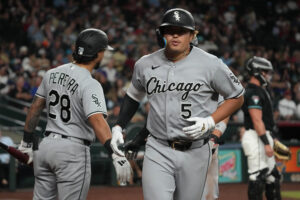
Murakami’s power was never in doubt. His time in Japan had yielded dozens of massive moonshots. The strikeouts were more concerning. He struck out almost 30% of the time in his final NPB seasons. Coming over to North America to face a greater caliber of pitching would probably lead to even more strikeouts. There were particular concerns around his lack of success against high velocity, which he would certainly see more of in MLB.
It’s hard to be a valuable hitter with that many punchouts, though it can be done. In 2025, Mike Trout and James Wood were good hitters despite striking out at least 32% of the time. Ryan McMahon and Oneil Cruz were also in that range and produced below-average results.
Many evaluators thought some team would bite the bullet and invest in Murakami regardless. It’s very rare to have a chance to sign this level of hitter for his age-26 season. There’s risk he could be like Joey Gallo but the upside play is that he resembles Kyle Schwarber. MLBTR predicted he would secure an eight-year deal worth $180MM. Other outlets were not far behind. FanGraphs predicted $154MM over seven years. The Athletic was at $158.5MM over eight years.
Murakami did not get anything close to that. Whether it was due to the strikeouts or his lack of defensive value, teams didn’t want to make a long-term commitment. He signed a two-year, $34MM deal with the White Sox.
We don’t know what other offers Murakami got. Maybe some teams floated three- or four-year arrangements. But from his perspective, if he didn’t get the real long-term offer, going short makes sense. As mentioned, he is still quite young. This deal gives him a chance to spend two years proving himself against big league pitching. He’ll be 26 and 27 in those seasons and will have another chance to seek a long-term deal ahead of his age-28 campaign.
It was thought that maybe there would be an adjustment period for Murakami, but so far he’s doing just fine. The strikeouts are certainly high, as he’s at 32.1% through 109 plate appearances. But he also has ten home runs and a massive 19.3% walk rate. He has a .253/.394/.598 line and a 170 wRC+.
The production is not exactly Schwarber-esque but is pretty close. Schwarber has a 28.5% strikeout rate in his career and hasn’t finished a full season above 31%. He has drawn walks at a 14.2% clip and has been in that range for most of his career. He used to be good for 30ish homers annually but it’s been more like 50ish in recent years. It’s still really early, but Murakami is striking out more often while showing even more power and greater on-base abilities.
Time will tell how it plays out over a larger sample. It’s possible that pitchers find a way to attack him and reduce his effectiveness. Despite the concerns about velocity, he’s doing most of his damage against fastballs. Statcast gives him a .286 batting average and .786 slugging percentage on fastballs, compared to .200 and .400 against breaking pitches and .267 and .467 against offspeed stuff. It’s also possible he continues to get more acclimated to MLB pitching and shaves off some punchouts.
If he continues to be an effective hitter for another few months, it will put the White Sox in an interesting position. It doesn’t feel like Murakami is going to be part of their long-term plans. They are currently rebuilding and aren’t expected to contend this year. The Sox are getting better relative to recent years but are 10-15 and should be on the outside of the playoff race this summer. 2027 could be more viable, but contending next year is no guarantee.
The White Sox could try to sign Murakami to an extension, giving him the nine-figure deal he didn’t get in free agency, but it would be out of character for them to do so. The Sox are one of just two teams, along with the Athletics, who have never given out a nine-figure contract. The largest contract in White Sox franchise history is the five-year, $75MM deal they gave to Andrew Benintendi. If he continues performing anywhere close to this level, he could reasonably ask for twice that much (if not more) on a new long-term deal.
If the Sox are going to break precedent, it should probably be for someone safer, an elite shortstop or center fielder perhaps. A strikeout-prone first baseman is a risky bet, even if it’s someone as exciting as Murakami. If the deal turned into an albatross, it would handcuff the team just as they are looking to put this latest rebuild in the rearview mirror.
This situation would lead to an obvious solution in most cases. If you’re a rebuilding club and you have an attractive player with a short window of club control, you trade him for prospects or other younger players who can contribute to the next competitive window. Trading Murakami this summer would yield a greater trade return than next year. The acquiring club would get Murakami for two playoff races instead of one, which adds to the appeal and the price they would be willing to pay.
But Murakami’s situation is a bit more complex than that. For a team signing a star Japanese player, part of the appeal is on the business side. In addition to whatever Murakami is providing on the field, he is presumably adding to the club’s ratings and merchandise sales in Japan. Given his strong start, he might be adding to those revenue streams on this side of the Pacific Ocean as well.
That could make the calculus more complicated. Trading Murakami this summer would be the best time to maximize his value in terms of a trade return, but it would also surely lead to a reduction in those revenue streams and frustrate the fan base. It’s also possible it could complicate discussions with Japanese free agents in the future, who may not love the prospect of a likely sign-and-trade scenario.
If the Sox decide to hold Murakami, they can keep those revenues flowing for longer. They could then see if contention in 2027 looks more viable. If not, they could still trade him that summer for a notable return, even if it’s less than trading him now. Should they contend and hold him all the way through 2027, they could give him a qualifying offer, which would net them a draft pick if he ends up signing elsewhere. That pick would be nice, but the Sox should be able to get something more attractive via trade. There’s also the risk of Murakami tanking his value by next summer, either due to injury or a decline in production.
It’s an interesting position for the Sox, who are in a transitional phase. In addition to rebuilding, they are on an unusual road to an ownership change. Jerry Reinsdorf has agreed to a succession plan with minority owner Justin Ishbia. For now, Ishbia is investing in the club and has a somewhat open-ended path to majority ownership. From 2029 to 2033, Reinsdorf can decide to finalize the sale of a majority stake to Ishbia. If not within that window, Ishbia gains the right to purchase the majority stake beginning in 2034.
As mentioned, the possibility of a Murakami extension doesn’t seem likely, based on the club’s past spending patterns. While the club is in flux, does that make them even less likely to sign a big deal? It’s also possible the next collective bargaining agreement features some sort of salary floor beginning in 2027, so the Sox may need to spend more money regardless. Perhaps they would want some clarity on that before committing to Murakami or anyone else.
Put it all together and Murakami could be one of the more intriguing players to watch in the coming months. The Sox can make various different choices about how to proceed. They could try to lock him down with a long-term deal but would likely have to shatter their franchise record to do so. A trade this summer would net a big return but would hurt them on the business side. Holding him for a trade in the winter or at next year’s deadline, or even all the way through 2027, could be a better short-term business decision but perhaps worse long-term baseball decision.
Photos courtesy of Ed Szczepanski, Rick Scuteri, Imagn Images
Poll: Will Munetaka Murakami Or Tatsuya Imai Have The Better Rookie Year?
All around the baseball world, the offseason started with a great deal of hype for the two top talents coming over from Japan to play in MLB: slugger Munetaka Murakami and starter Tatsuya Imai. Both players seemed likely to follow in the footsteps of other recent stars to make the jump from NPB to the majors, including Yoshinobu Yamamoto and Seiya Suzuki, and be among the most coveted free agents on the market. Things did not pan out that way, however, as both players found surprisingly soft markets and wound up taking short-term deals with the hope of returning to the open market after establishing themselves as quality big leaguers.
As they prepare for their respective rookie seasons, Murakami as a member of the White Sox and Imai with the Astros, who is better positioned to do just that? When looking at the contracts the pair got, it’s easy to argue that Imai’s more lucrative deal indicates a greater level of confidence in his ability to succeed. He landed a three-year, $54MM contract with Houston back in January that provides him the opportunity to opt out after either the 2026 or ’27 season. That’s an extra year and $20MM relative to Murakami’s deal in Chicago, not to mention that Murakami doesn’t have an opt-out clause in his deal.
It’s easy to see why teams would’ve had a bit more confidence in Imai than Murakami. Murakami comes with multiple unique questions, including whether his defense will hold up in the majors at either first or third base and whether there’s room for improvement on his extremely low contact rates from his time overseas. Imai doesn’t really come with comparable concerns; his mid-90s velocity and four-pitch mix are strong bets to play in the majors in terms of floor, leaving the Astros less likely to come up completely empty on their investment than the White Sox.
What Murakami lacks in terms of floor, however, it can be argued that he makes up for with exceptional upside. Murakami’s contact rates might be among the lowest in the majors if translated over, but players like Shohei Ohtani, Aaron Judge, Kyle Schwarber, and Nick Kurtz are among the most productive hitters in the entire sport despite high strikeout rates and a proclivity for racking up whiffs. It’s easy to see why Murakami’s sensational exit velocities could allow him to compare to those elite sluggers, particularly given that he only just celebrated his 26th birthday.
It’s fair to wonder if Imai has that sort of elite upside to offer. While his velocity is impressive, scouts have suggested that his fastball lacks the movement necessary to be a high-end pitch. That in conjunction with the control issues he’s flashed at various points in his MLB career might cap his ceiling at something closer to the middle of a big league rotation. Murakami, by contrast, could find himself battling with the likes of Judge and Cal Raleigh at the top of the home run leaderboards if he manages to make enough contact to be productive and continues to grow as a player.
If Murakami breaks out the way some both in Japan and the United States have believed he’s capable of doing, it’s hard to imagine Imai being able to hold a candle to that production no matter how close to his own ceiling he gets. With that said, it could be difficult for either to make much noise in Rookie of the Year conversations. The AL figures to feature a stacked class including players like Kevin McGonigle, Samuel Basallo, Dylan Beavers, Trey Yesavage, and Carter Jensen. Even if Murakami or Imai outproduces those players, their status as foreign professionals already in their mid-20s could still hurt them in Rookie of the Year voting, especially against younger players like McGonigle and Basallo.
How to MLBTR readers view the pair headed into their rookie seasons? Who will have the more productive year? Will either one manage to force themselves into conversations for the AL Rookie of the Year award? Have your say in the polls below:
Who will have the better 2026 season?
-
Tatsuya Imai 51% (557)
-
Munetaka Murakami 49% (538)
Total votes: 1,095
Will Murakami and/or Imai receive Rookie of the Year votes?
-
Both will receive Rookie of the Year votes. 57% (641)
-
Neither will receive Rookie of the Year votes. 17% (193)
-
Only Imai will receive Rookie of the Year votes. 16% (176)
-
Only Murakami will receive Rookie of the Year votes. 10% (116)
Total votes: 1,126
White Sox Notes: Acquisitions, Acuña, Murakami
The White Sox finalized their two-year, $20MM free agent contract with Seranthony Domínguez this afternoon. The hard-throwing righty is expected to step into the ninth inning for skipper Will Venable. That deal came on the heels of the Sox trading Luis Robert Jr. to the Mets, a move which dropped the center fielder’s $20MM salary from the books.
General manager Chris Getz said after the Robert trade that the Sox would be “very active” in using that payroll space. Domínguez will make $8MM in the first season of his slightly backloaded deal. Even if the White Sox don’t intend to reallocate all $20MM into this year’s roster, there should be room in the budget for another addition.
Getz acknowledged as much, saying on Thursday that the front office remains involved on both free agent and trade targets. “We’re still fairly active in free agency and also talking to other clubs,” Getz said in a TV appearance (video via CHSN). He made similar comments in a fan event before this weekend’s SoxFest Live event. “I believe that there are going to be more adds. To what level, (I’m) unsure,” the GM said (link via Scott Merkin of MLB.com). “What we can provide is opportunity and a runway, and some of these players we’ve acquired just haven’t gotten that runway in other places for various reasons.”
This remains a rebuild even if the White Sox have had a bigger offseason than anticipated. Domínguez is an established reliever, but the rest of Chicago’s pickups have been upside shots on young players or those whose roles might change. They jumped on the opportunity to add Munetaka Murakami on a two-year, $34MM contract when the Japanese slugger’s market didn’t develop. The Sox signed NPB returnee Anthony Kay to a two-year deal that likely includes a rotation spot. Sean Newcomb worked mostly out of the bullpen last year but could battle for a starting job in camp. On the position player side, they’ve taken fliers on former highly-regarded prospects Luisangel Acuña and Everson Pereira in trades.
Acuña came over from the Mets in the Robert deal. He’s a .248/.299/.341 hitter in 233 MLB plate appearances but never had consistent playing time in New York. Acuña has primarily been a middle infielder in his career, but he’s also playing a good amount of center field in the Venezuelan Winter League. He has plus-plus speed that could be an asset in the outfield. Jon Heyman of The New York Post writes that Acuña is likely to get an opportunity to step directly into Robert’s role as Chicago’s primary center fielder.
The versatility means Acuña will probably still see some infield work. Chicago’s middle infield tandem of Colson Montgomery and Chase Meidroth is more exciting than their post-Robert outfield, which may be the worst in MLB. Andrew Benintendi is back in left field. Pereira, Brooks Baldwin, Derek Hill and Tristan Peters — along with minor league signees Jarred Kelenic and Dustin Harris — make for an unimposing right field mix. There’s a decent chance they’ll make another outfield move or two before Opening Day. There’s also ample opportunity in a rotation that is led by Shane Smith, Sean Burke, Davis Martin and the free agent signees Kay and Newcomb.
While there are a lot of moving pieces, Murakami should be a staple as the everyday first baseman. Major league clubs clearly had big reservations about the rate at which he swung and missed in Japan. Murakami may have as much raw power as any hitter on the planet, though, and the Sox will no doubt have a long leash as he tries to acclimate to MLB pitching. It’s the kind of upside play that virtually no one saw coming at the beginning of the offseason, when Murakami was widely expected to command a nine-figure deal.
That skepticism extended to the White Sox themselves. Getz spoke with Scott Merkin of MLB.com about the signing and acknowledged that the NPB superstar was not a player they expected to add. “Candidly, I didn’t think it was going to be a realistic target for us. I didn’t. The speculation was big, whether it be years, and dollars. … We did our due diligence. But I still didn’t feel like it was going to be realistic, even into when free agency opened up.”
It carried well into the offseason, as Getz said he still didn’t view Murakami as a viable addition into the Winter Meetings in early December. Talks didn’t accelerate until a few days before the close of the player’s 45-day posting window, which expired on December 22. Once it became apparent that Murakami wasn’t going to find a long-term deal he desired, the Sox made their move.
“We just view this as truly upside,” Getz said of adding a marquee player from Japan. “The baseball side, the business side. There’s a big impact and it’s leading to things that perhaps we didn’t even anticipate, quite honestly.” Sox fans will want to read Merkin’s full column, which includes more specifics from Getz and Venable on the process leading up to the agreement.
NL West Notes: Murakami, Hwang, Closers
Munetaka Murakami came into the offseason as one of the more intriguing names on the free agent market. He slotted in at No. 4 on our annual Top 50 MLB Free Agents list. Despite Murakami’s prolific power in NPB, the reported interest around the young slugger was minimal as the winter progressed. The White Sox and Red Sox were among the only known suitors. Murakami ultimately went to Chicago on a modest two-year, $34MM deal.
The Diamondbacks were among the teams interested in Murakami, reports John Gambadoro of 98.7 Arizona Sports. Gambadoro added that the former Japanese star was “one of a few of the Asian players” the Diamondbacks were considering. He didn’t mention any other names, but the free agent market includes several notable players making the jump stateside, including Tatsuya Imai and Kazuma Okamoto. MLBTR’s Anthony Franco predicted Okamoto would sign with Arizona in the aforementioned Top 50 FAs piece.
Arizona’s connection to Murakami makes sense given the state of the club’s corner infield spots. First baseman Josh Naylor and third baseman Eugenio Suarez were dealt to Seattle in separate deals at the trade deadline. That left Pavin Smith and Tyler Locklear (who came over in the Suarez trade) to handle the majority of the first base reps. Blaze Alexander stepped in as the primary third baseman.
Top prospect Jordan Lawlar is slated to step in at the hot corner in 2026, but first base is a question mark. Locklear had surgery on both his left elbow and shoulder in October. He’s a candidate to begin the season on the injured list. That leaves Smith and utilityman Tim Tawa as the current options at first base. Arizona finished with the 5th-lowest OPS at the position last season. With Murakami off the board, the club could look to pursue at least a right-handed complement to Smith, and perhaps an upgrade altogether.
On the pitching side, Gambadoro mentioned he expects the team to look into the closer market. Arizona will be without top closers Justin Martinez and A.J. Puk for the majority of the season. Both relievers had Tommy John surgery in June. The current closer mix is an uninspiring group that includes Andrew Saalfrank, Ryan Thompson, and Kevin Ginkel.
Arizona’s bullpen ranked 25th in xFIP and 28th in SIERA last season. The club had a whopping 17 pitchers record saves in 2025. Shelby Miller led the way with 10 saves. He was dealt to Milwaukee at the trade deadline. The Diamondbacks had four saves in the final month of the season, and they went to four different pitchers (Jake Woodford, Taylor Rashi, Kyle Backhus, John Curtiss).
Martinez and Puk won’t be out forever, so Arizona doesn’t need a long-term solution. The reliever market is beginning to thin out, but there are still a handful of options with closing experience available. Seranthony Dominguez, Ryan Pressly, or Chad Green could make sense as short-term closers who have been setup men in the past. Arizona’s Opening Day closer will likely slot in behind Martinez and Puk once they return, so experience in the 7th and 8th innings would be useful.
Elsewhere in the NL West, former Giants infielder Jae-gyun Hwang announced his retirement (h/t to J.P. Hoornstra of The Big Lead). Hwang had spent the last eight seasons with the KT Wiz of KBO. He’d been in professional baseball since 2007.
Hwang made the jump to MLB in 2017 after a decade in KBO. He signed a split contract with the Giants in January that year. Hwang posted decent results in Triple-A, hitting .285 with 10 home runs and seven steals across 98 games. He was up and down a couple of times with the big-league club, with unimpressive results. Hwang went 8-for-52 in 18 games with the Giants. He did launch a home run for his first MLB hit, taking Kyle Freeland deep in his third career at-bat.
Hwang was outrighted off the 40-man roster in September 2017. After his lone season with the Giants, the Wiz lured him back to KBO with a four-year, $7.9MM deal. He was a well-above-average hitter for the duration of the agreement and remained productive at the plate for the rest of his career, including a 94 wRC+ as a 37-year-old in his final season.
We at MLBTR wish Hwang the best in his future endeavours beyond baseball.
Photo courtesy of Matt Marton, Imagn Images
MLBTR Podcast: Three-Way Trade, Murakami’s Short-Term Deal, And Willson Contreras To Boston
The latest episode of the MLB Trade Rumors Podcast is now live on Spotify, Apple Podcasts, and wherever you get your podcasts! Make sure you subscribe as well! You can also use the player at this link to listen, if you don’t use Spotify or Apple for podcasts.
This week, host Darragh McDonald is joined by Anthony Franco of MLB Trade Rumors to discuss…
- The Pirates getting Brandon Lowe, Jake Mangum and Mason Montgomery for Mike Burrows in a three-team trade with the Astros and Rays (Recorded prior to the news of the Pirates agreeing to a deal with Ryan O’Hearn) (1:10)
- The Astros trading away Jacob Melton and Anderson Brito to get Burrows (10:10)
- The Rays trading away Lowe, Mangum and Montgomery for Melton and Brito, in addition to trading Shane Baz to the Orioles for four prospects and a draft pick (13:30)
- The Orioles giving up four prospects and a draft pick to get Baz (19:05)
- The White Sox signing Munetaka Murakami (25:40)
- The Red Sox acquiring Willson Contreras from the Cardinals (45:40)
- The Padres re-signing Michael King (54:35)
- The Athletics acquiring Jeff McNeil from the Mets (58:55)
Check out our past episodes!
- The Mets Sign Jorge Polanco, And The Braves, Blue Jays And Royals Make Moves – listen here
- Winter Meetings Recap – listen here
- An Agent’s Perspective with B.B. Abbott – Also, Cease, Williams, Helsley, And Gray – listen here
The podcast intro and outro song “So Long” is provided courtesy of the band Showoff. Check out their Facebook page here!
Photo courtesy of Wendell Cruz, Imagn Images
White Sox To Sign Munetaka Murakami
The White Sox have officially announced their signing of infielder Munetaka Murakami to a two-year deal worth $34MM. ESPN’s Jeff Passan was the first to break the news. Murakami, a client of Excel Sports Management, will be officially introduced as a member of the Sox roster during a press conference tomorrow.
Beyond the $34MM in salary, the White Sox will also owe a $6.575MM posting fee to the Yakult Swallows, as per the rules of the MLB/NPB posting system. The fee is determined by the size of the player’s eventual Major League contract, so the $6.575MM figure is determined by 20% of the contract’s first $25MM, and then 17.5% of anything between $25MM and $50MM.
Murakami, 26 in February, arrives in the majors as perhaps the most anticipated NPB hitter to move stateside since Shohei Ohtani. The slugger set an NPB record with 56 home runs in a single season at 22 years old, and he continued to make an international name for himself with Team Japan during the 2023 World Baseball Classic. A career .270/.394/.557 hitter across 892 Central League games for the Swallows, Murakami boasts true 80-grade power that could completely change an up-and-coming White Sox lineup that already includes highly regarded youngsters like Colson Montgomery and Kyle Teel.
That combination of power and unusual youth for a free agent led many to believe that Murakami would be able to secure one of the most lucrative contracts of the offseason. On MLBTR’s annual Top 50 MLB Free Agents list published at the outset of the offseason, Murakami landed as the #4 free agent available with a predicted contract of $180MM over eight years. It was easy to imagine at least one team being willing to roll the dice on Murakami’s tantalizing upside in order to lock him up for his entire prime, but teams were more hesitant to commit to Murakami than expected. Few teams were publicly connected to the slugger, and reports from all corners of the baseball world indicated that teams were feeling gun-shy about his contact rate in NPB, which would’ve been the lowest in baseball in the majors last year if carried over.
While teams weren’t willing to go to the high levels expected when Murakami was first posted, it does appear that he may have left some guaranteed money on the table in taking this deal. Passan reports that some teams did try to get involved in Murakami’s market by offering long-term deals with lower annual salaries. That sort of deal would have guaranteed Murakami a longer runway to work things out at the big league level, but would have limited the financial upside available to him. Instead, he took a short-term deal that will offer him a healthy annual guarantee that’s on par with the AAV of the five-year deal Murakami’s countryman Seiya Suzuki signed with the Cubs across town five years ago.
That comes with just two guaranteed years in the majors, but if Murakami is able to establish himself he’ll head into free agency ahead of his age-28 season. That should leave him in line for a far more substantial payday during the 2027-28 offseason, should he prove himself capable as the sort of middle-of-the-order power bat he has the potential to be. For a player looking to adjust to the majors, it’s hard to imagine a more forgiving environment than the south side of Chicago. The White Sox have average 108 losses per season over the last three years and posted arguably the worst season in MLB history back in 2024. While young players like Montgomery and Teel have begun to impact the major league roster, expectations for the club could hardly be lower at this point.
While any dreams Murakami may have had of hoisting a World Series trophy in his rookie season as a big leaguer are likely to be dashed by his decision to sign with the White Sox, playing on a team with low expectations for this year should allow him a low-pressure environment to make any adjustments to his game that might be necessary in order to maximize his success without the risk of losing his spot in the lineup to another player in the midst of a pennant race.
The White Sox seem to want Murakami to be able to focus on maximizing his offense as much as possible, as the longtime NPB third baseman will be moving to first base in Chicago. Scouts nearly universally expressed skepticism about is ability to handle the hot corner at the big league level, so a move to first base should put less pressure on Murakami to prove himself as a defender and allow him to focus more fully on his work at the plate.
Should Murakami successfully prove himself in the majors, he would help anchor a budding core of young hitters for the White Sox. Montgomery and Teel both enjoyed excited seasons at up-the-middle positions last year, and they’ll be joined in the lineup by players like third baseman Miguel Vargas, second baseman Chase Meidroth, and catcher/DH Edgar Quero who enjoyed seasons last year that made them look like solid complementary pieces for the future. Luis Robert Jr. also figures to offer the Sox some star power alongside Murakami if he’s healthy enough to handle something close to a full slate of games in center field and remains on the team amid persistent trade rumors.
Taken together, it’s easy to see Murakami as the centerpiece of an offseason that has seen the White Sox take small steps towards a return to competitiveness at the big league level. The NPB star isn’t the only player the White Sox have deigned to add to the roster this winter; lefty Anthony Kay signed a two-year deal worth $12MM after his own successful stint in Japan, and the club is reportedly among the teams interested in former Rays closer Pete Fairbanks, as well. Those moves are unlikely to vault Chicago into a playoff spot by themselves, especially in a competitive AL Central where the Tigers and Guardians made it to October with Kansas City putting together a very aggressive offseason in their own right.
Immediate playoff contention, however, isn’t likely to be the expectation. Instead, these additions should allow the White Sox to foster a more competitive environment for their young core as they reach the majors and build towards playoff contention in 2027 and beyond. There’s also the plus of reinvigorating fans who have been left wanting by the team’s latest rebuild, which saw the club part with beloved players like Lucas Giolito and Garrett Crochet.
These steps forward allow the White Sox to pull their payroll out of the league’s basement. Following the Murakami signing, RosterResource projects the club for an $84MM payroll in 2026, a figure that jumps up to nearly $102MM for luxury tax purposes. That’s more or less in line with last year’s $85MM payroll and pulls the White Sox just out of the bottom five in the majors at this point. Of course, that figure is still extremely modest and leaves plenty of room for a team in a large market like Chicago to add additional salary, whether that’s a late-inning arm like Fairbanks or perhaps a veteran starting pitcher who can help anchor the club’s rotation.
White Sox, Red Sox Among Teams With Interest In Munetaka Murakami
NPB slugger Munetaka Murakami‘s posting window closes at 4pm CT time on December 22. With just over a day left for Murakami to sign with an MLB club, Mark Feinsand of MLB.com reports that the White Sox are among the teams that are presently engaged in talks with the slugger’s camp. Chris Cotillo of MassLive adds that the Red Sox have “kicked the tires” on Murakami, as well as fellow NPB infielder Kazuma Okamoto. Okamoto’s posting window closes on January 4.
Murakami’s time on the market has been unusually quiet for a player of his status. These reports of interest on the part of Chicago and Boston are the first significant reports tying Murakami to any of MLB’s 30 teams, as his representation has seemingly played things very close to the vest regarding his market. The 25-year-old has surely received interest from other clubs as well that has simply gone unreported, of course, but Murakami’s market doesn’t seem to be quite as strong as expected even when factoring in that reality.
Geoff Pontes of Baseball America suggested in an appearance on Foul Territory this past week that the slugger’s market has been “softer” than he and his representation were expecting entering the offseason. MLBTR ranked Murakami as the #4 free agent on the market this winter, predicting an eight-year, $180MM contract for the young slugger as part of our Top 50 MLB Free Agents list. That ranking accounts for Murakami’s top-of-the-scale power and extreme youth heading into free agency; Yoshinobu Yamamoto was just six months younger than Murakami when he landed a $325MM contract from the Dodgers, while the fact that Juan Soto was headed into his age-26 season was a key factor in him landing a record-shattering $765MM deal last winter.
With that said, Murakami’s low contact rates have raised some eyebrows around the baseball world since his posting, and it’s not hard to see why. The Athletic’s Eno Sarris illustrated the concerns with Murakami’s lack of contact in NPB by sharing a list of players with comparable contact rates and exit velocities in the majors in recent years. The resulting group includes some stars like Nick Kurtz (and Shohei Ohtani if the parameters adjusted to be somewhat more favorable to Murakami), but it includes a far larger group of middling players, ranging from decent regulars like Matt Wallner to early-career flame-outs like Aristides Aquino. There’s certainly reasons to believe Murakami will be a great deal better than those players, of course; his raw production in NPB is nothing short of otherworldly. Even so, the risk in the young slugger’s profile is real, and it’s not necessarily a shock that teams might shy away from giving him a massive contract until and unless he can prove his style of play works at the big league level.
Turning to the clubs with reported interest in Murakami, the White Sox are a very interesting fit. The slugger is certainly young enough to be part of the next competitive team on the south side; he’s just two years older than star rookies Colson Montgomery and Kyle Teel. That makes him an intriguing fit for the Sox, especially if he signs with the club on a long-term deal. Miguel Vargas and Lenyn Sosa are the club’s projected starters at the infield corners at the moment, but neither player is locked in strongly enough to prevent the addition of Murakami.
A short-term deal could also be possible, as well; the White Sox signed Erick Fedde to a two-year deal two winters ago and rode a strong first half to secure a three-way trade involving Fedde that brought back Vargas. A similar approach could be employed here as well, at least in theory. Chicago might be a particularly appealing destination for the young slugger given their lack of competitive expectations this year; it could allow him the opportunity to make necessary adjustments at the big league level without the pressure of a pennant race, and perhaps the White Sox would be more comfortable than most clubs trying Murakami at third base despite widespread concerns about his ability at the position.
As for the Red Sox, Murakami could provide the sort of elite slugger than the Red Sox lost when they traded away Rafael Devers over the summer. That makes the fit between the sides plausible, but there are certainly questions and obstacles as well. For one, the Red Sox are entering a clear win-now window after making the playoffs last year, and might not be willing to play Murakami through any struggles that could come with his adjustment to the majors. For another, the Red Sox are already extremely left-handed and have Triston Casas in-house as a first base/DH option with plenty of upside in his own right. Boston would need to be confident that Murakami would be a substantial upgrade over Casas in order to commit significant dollars to him for the same role.
While a pursuit of Murakami from Boston can’t be ruled out, the quote from Cotillo about Boston “kicking the tires” on the slugger suggests more of a reserved approach to his market. That’s an understandable path to take, particularly given that Okamoto could be a better fit. Okamoto is older than Murakami and lacks his countryman’s elite power, but he’s enjoyed a much more steady career in NPB without contact rate concerns, offers more playable defensive skills at third base, and is a right-handed hitter who more effectively complements the Red Sox lineup. That solid fit is part of why the Red Sox have been linked to Okamoto on occasion throughout the winter, even as they pursue a reunion with third baseman Alex Bregman.