
MLBTR Poll: Grading The Chris Archer Trade
If it seems that Chris Archer has been in trade rumors for years, that’s because he has. We’ve seen his name presented for quite some time as a top potential target for teams seeking young, affordable starting pitching. That happened again this summer, though it was far from clear in the run-up to yesterday’s deadline whether he’d be traded.
When the dust settled, Archer was finally on the move — and to something of a surprise destination. He’s heading to the Pirates in a deal that sends outfield prospect Austin Meadows, righty Tyler Glasnow, and a still-unknown player to be named later. Until we know the final piece of the deal, it’s a bit difficult to assess it fully, but indications are that it’s another asset of significant value.
For the Rays, it’s a familiar type of swap, though they’ve typically waited until free agency was a bit closer to ship out pitching assets. They’ll get three highly controllable assets in return; Glasnow entered the season with less than a full year of MLB service and Meadows just debuted.
There’s risk in the new Tampa Bay talent, of course. Glasnow has shown a big arm but still hasn’t harnessed it. The Bucs have utilized him as a reliever this year and he’s still issuing 5.5 walks per nine. The upside remains tremendous, though. Meanwhile, Meadows can boast of a top-prospect pedigree and a .292/.327/.468 slash line in his first 49 MLB contests. But he hasn’t hit all that much in the upper minors since the start of the 2017 season and had slid down prospect rankings entering the current campaign.
From an organizational perspective, the Rays are increasingly utilizing hybrid hurlers over 200-inning starters. They could see Glasnow as a great fit for a more flexible role. And Meadows could be a long-term asset in the outfield. Plus, there’s still a bonus piece we don’t know about. And with Archer’s commitment off the books, the budget-conscious Rays have plenty of wiggle room financially.
How do you grade this move for the Rays? (Link for app users.)
How do you grade the Rays' side of the Chris Archer deal?
-
B 41% (6,038)
-
A 38% (5,597)
-
C 15% (2,178)
-
D 3% (495)
-
F 2% (317)
Total votes: 14,625
Meanwhile, Archer has his own risks. He is plenty affordable, but increasingly expensive ($6.25MM this year, $7.5MM next, with $20MM in options to follow for 2020 and 2021). It has been some time now since his bottom-line results have matched up with the shiny peripherals, and Archer is now closing in on his 30th birthday.
At the same time, the righty is a quality performer even if he’s not a front-line starter. Archer has averaged over 200 innings annually from 2014 through 2017. He’s posting career-best 13.6% swinging-strike rate on the year and seems a good bet at least to improve upon his current 4.31 ERA.
Perhaps Archer isn’t an ace and won’t be enough to help the Bucs complete a drive to the postseason (the odds of which still seem long). Still, there’s an argument to be made that this is a sensible baseball swap for a team that knows well the players it is parting with.
How do you see it? (Link for app users.)
How do you grade the Pirates' side of the Chris Archer deal?
-
B 34% (4,368)
-
C 27% (3,421)
-
A 24% (3,078)
-
D 11% (1,341)
-
F 4% (529)
Total votes: 12,737
How August Trades Work
Now that the July 31st non-waiver trade deadline has passed, teams can still make trades, only with more restrictions than before. The full list of rules surrounding post-deadline trades have, of course, been shared elsewhere, most notably in an article by Jayson Stark (then with ESPN.com) from all the way back in 2004, and in greater detail at Cub Reporter. Since the rules surrounding August deals are confusing, though, they’re worth reviewing here.
- After the trade deadline, a big-league player must pass through revocable waivers before his team can trade him without restriction. These waivers last 47 hours. If no one claims him in that period, his team can trade him anywhere.
- If a player is claimed, his team can do one of three things. It can trade the player to the claiming team, revoke the waiver request (in which case the player will remain with his original team), or simply allow the claiming team to take the player and his salary (although a player with no-trade rights can block this from happening).
- A recent example of an August trade that developed from a waiver claim was the Mariners’ acquisition of Arquimedes Caminero from the Pirates in 2016. The Mariners claimed Caminero and then worked out a deal with the Bucs to bring the right-hander to Seattle for two players to be named later. An example of a claim that didn’t result in a trade occurred in 2015, when an unknown team claimed Brewers reliever Francisco Rodriguez. The two sides couldn’t strike a deal, so the Brewers revoked their waiver request, and K-Rod remained in Milwaukee. Examples of teams simply letting players go via revocable waivers are more rare, particularly with big-contract players. That being said, it is always possible; in 2009, the White Sox claimed Alex Rios from the Blue Jays, who simply let him go to Chicago without a trade. The White Sox were thus responsible for all of the approximately $62MM remaining on Rios’ contract.
- A team has 48.5 hours to trade a claimed player, and can only negotiate with the team awarded the claim on him.
- It’s common for teams to place players on revocable waivers, and their having done so does not necessarily mean they have serious plans to trade them. As Stark points out, teams commonly use waivers of certain players purely as smokescreens to disguise which players they really are interested in trading. In fact, sometimes teams place their entire rosters on waivers.
- If more than one team claims a player, priority is determined by worst record to best record in the league of the waiving team, followed by worst record to best record in the other league. For example, if an NL team places a player on revocable waivers, the team with the NL’s worst record will get first priority on claims, followed by every other team in the NL from worst to best, followed by AL teams from worst to best.
- If a team pulls a player back from waivers once, it cannot do so again in August. So if a team places a player on waivers for a second time, those waivers will be non-revocable.
- Players not on 40-man rosters are eligible to be traded at any time without passing through waivers.
- A player on the disabled list can only pass through waivers if his minimum period of inactivity has passed and he is healthy and able to play at his accustomed level.
- Teams can still make trades in September, but players acquired after August 31st can’t play in the postseason.
Due to the number of restrictions in place, it has long been relatively rare to see trades of real significance go down in August. But that all changed last year in a wild month of action. A variety of notable players were moved during August of 2017, most famously including Justin Verlander, who ultimately helped lead the Astros to a World Series victory. Justin Upton, Mike Leake, Neil Walker, Jay Bruce, Yonder Alonso, Brandon Phillips, Rajai Davis, Curtis Granderson, Tyler Clippard, and Sean Rodriguez were among the others that were swapped.
While that easily represented the most notable August trade season we’ve yet encountered at MLBTR, in terms of both quality and quantity of action, it didn’t contain the single most monumental transaction in the run-up to a waiver deadline. Rather, the biggest August trade in recent memory remains the nine-player swap between the Dodgers and Red Sox in 2012 that saw Adrian Gonzalez, Carl Crawford and Josh Beckett head to L.A. That ground-shifting deal not only launched a Dodgers resurgence, but also allowed the Red Sox to clear tens of millions in salary commitments off their books, paving the way for the team to reload in the offseason and go on to win the 2013 World Series.
Nationals Designate Shawn Kelley, Select Jimmy Cordero
The Nationals announced today that they have designated veteran righty Shawn Kelley for assignment. The club selected the contract of reliever Jimmy Cordero in a corresponding move.
This stunner of a move comes on the heels of a rollicking post-deadline victory that ended on a bit of a sour note. Kelley admitted that he “acted like a baby” in slamming his glove after giving up a home run in mop-up duty last night, but it was his evident glare into the dugout that seems to have caught the ire of the Nats’ brass.
Kelley, 34, had come up in some talks in the run-up to the trade deadline, though it seemed that the Nationals were more interested in moving salary than parting with the veteran reliever. Now, unless he’s traded or claimed, Kelley will collect the remainder of his $5.5MM salary (less any portion of the league-minimum if he clears waivers and signs elsewhere) and will be removed from a relief unit that also just parted ways with Brandon Kintzler.
There has been some chatter of late about supposed internal turmoil in D.C., though as ever it’s hard to know whether that’s mostly just reflective of frustrations with a season that has fallen shy of expectations. Still, this move certainly sends a message. After deciding to roll the dice on a turnaround, ownership and upper management obviously isn’t interested in further public displays of discord.
Of course, Kelley’s work on the hill is also a factor. He’s carrying a 3.34 ERA through 32 1/3 innings on the year, a vast improvement over his disastrous 2017 season, but is still surrendering nearly two home runs per nine innings. And though Kelley has a quality combination of 8.9 K/9 and 1.4 BB/9, his swinging-strike rate has plummeted to a 11.2% figure that sits well below his recent levels.
It’s still tough to imagine that the Nationals prefer to part with relief depth at this stage of the season, but Cordero had been forcing his way into the picture. As J.J. Cooper of Baseball America recently tweeted, the former Phillies prospect — originally added in a swap with the division rivals in the fall of 2016 — has shown impressive stuff this year at Triple-A. He’ll now head up for his MLB debut after throwing 43 innings of 1.67 ERA ball at Syracuse, where he posted 9.8 K/9 and 4.4 BB/9 along with a 52.6% groundball rate.
Jake Lamb Considering Rotator Cuff Surgery
The Diamondbacks revealed last night that third baseman Jake Lamb is dealing with “fraying” in his left rotator cuff, as Nick Piecoro of the Arizona Republic reports. The 27-year-old is currently weighing surgery that would end his season.
As Piecoro documents, recent signals have suggested there was some real concern with the joint, as Lamb’s case has been assessed by some of the game’s foremost surgeons. Still, the hope remains that Lamb will not have to go under the knife. If he chooses to attempt a rehabilitation approach, it’s still possible he could be back this year, though surely there are other risks and drawbacks also being weighed.
It seems the organization’s quick strike for Eduardo Escobar days before the trade deadline was motivated in no small part by the uncertainty that sprung up regarding Lamb. Though manager Torey Lovullo says there was no indication at the time the injury was this significant, GM Mike Hazen acknowledged last night that he went after Escobar before word of uncertainty on the team’s regular third baseman got out. (Via Henry Schulman of the San Francisco Chronicle, on Twitter.)
While the presence of Escobar leaves the team in good shape at the hot corner, the roster would look much stronger with both him and a healthy and productive Lamb available. Of course, Lamb hasn’t been at his best thus far in 2018 prior to today’s news. Over 238 plate appearances, he’s slashing just .222/.307/.348 with six home runs. With a .126 isolated slugging mark that’s about half the ISO he produced over the past two seasons, it could well be that the shoulder problem has been a factor all along.
Looking ahead, the D-Backs will have to hope that Lamb can get back to full health over the winter, regardless of which approach he takes to addressing the injury. After all, Escobar is heading to free agency. The Snakes control Lamb for the next two seasons via arbitration. Given his struggles this year, he’ll be in line for only a light raise on his $4,275,000 salary.
Pirates Acquire Chris Archer
The Pirates have officially struck a trade to acquire starter Chris Archer from the Rays, as Stephen Nesbitt of the Pittsburgh Post-Gazette first reported (via Twitter). Talented young players Austin Meadows and Tyler Glasnow will both go to Tampa Bay, as Jim Bowden of The Athletic tweeted.
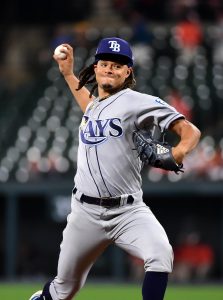
There’s also a third player in the deal, as first noted by Marc Topkin of the Tampa Bay Times (Twitter link). The identity is still not known — the announcement cites a player to be named later — but it’s said to be an asset “of real value,” per Jon Heyman of Fancred (Twitter link).
Today’s news brings an end to a long-running trade saga involving Archer. The talented right-hander has been viewed as a target for years, with rival organizations intrigued not only by his big innings and strikeout totals, but also his extremely valuable contract. He now becomes the latest quality starter to be traded away by the Rays organization.
Archer inked a six-year, $25.5MM swap early in 2014. The agreement includes two option seasons at the end. While the very cheapest years have already gone into the books, there are some affordable campaigns remaining. Archer is earning just $6.25MM this year and $7.5MM next, followed by $9MM and $11MM club options that have a combined $2MM in buyouts.
Those dollar amounts surely appealed to a Pirates organization that is always seeking value. But the team was motivated most by the chance to improve in the near-term. Archer will represent a significant new addition to the rotation. The 29-year-old has only a 4.31 ERA on the year, the third-straight season in which he has allowed more than four earned per nine, but continues to carry peripherals that suggest he’s significantly better.
Of course, at some point the results will need to catch up to the metrics, and the Bucs are betting that’ll happen sooner than later. Archer is a quality asset regardless, but this deal was surely made based on the premise that he still can return to the higher standard he carried earlier in his career.
Otherwise, it’s hard to imagine the Bucs parting with this haul of talent in return. Meadows is the headlining piece at this point, as the 23-year-old top prospect has now shown an ability to hit in the big leagues. While his numbers at Triple-A haven’t been quite as impressive of late, and he’s benefiting from a .345 BABIP, Meadows carries a .292/.327/.468 slash in his first 165 plate appearances at the game’s highest level.
Glasnow, meanwhile, is soon to turn 25. He’s a big talent who has yet to fully harness his abilities. This year, Glasnow has functioned in a relief capacity, turning in 56 innings of 4.34 ERA ball with 11.6 K/9 against 5.5 BB/9 and a 56.0% groundball rate. While there’s still hope he’ll round into a MLB starter, perhaps that distinction won’t matter too much for a Rays team that no longer really seems to have a true starter on its roster at all.
Photo courtesy of USA Today Sports Images.
Dodgers To Acquire John Axford
The Dodgers have struck a deal to acquire righty John Axford from the Blue Jays, according to Ben Nicholson-Smith of Sportsnet.ca (via Twitter). Righty Corey Copping will go to Toronto in return, per MLB.com’s Mark Feinsand (via Twitter).

Axford, 35, has a 4.41 ERA, 8.8 K/9, 3.5 BB/9, 1.06 HR/9, and 53.3% groundball rate in 51 innings this year for the Blue Jays. Axford had signed a minor league deal with the Blue Jays in February after a rough final season in Oakland that included over a month on the shelf with a shoulder strain. He reinforces a Dodgers pen that has been relying on Kenley Jansen, Scott Alexander, and Daniel Hudson in the late innings, with Pedro Baez coming off the DL about a week ago. Josh Fields and Tony Cingrani are among those still on the DL. The Dodgers made their biggest July splashes in the middle infield, with the earlier acquisition of Manny Machado as well as the pickup of Brian Dozier today.
As for the Blue Jays, they’ve shipped off Roberto Osuna, J.A. Happ, Aaron Loup, and Seunghwan Oh in addition to Axford as part of a month-long dismantling. Copping, the return for Axford, is a 24-year-old righty who recently earned a promotion to Triple-A.
Photo courtesy of USA Today Sports Images.
Cubs Acquire Brandon Kintzler
2:26pm: This deal is in the books. Righty Jhon Romero is heading to D.C. in return.
2:00pm: The Cubs are nearing an agreement with the Nationals that would bring veteran reliever Brandon Kintzler to Chicago, according to Ken Rosenthal and Sahadev Sharma of The Athletic (Twitter link). The return is not yet known.
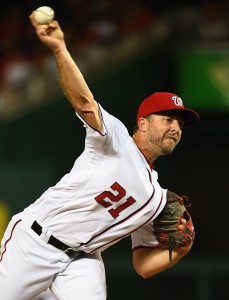
There have been varying reports of late on the Nats’ deadline plans, and it seems they have elected to make at least one sell-side move. It’s hardly clear, though, that this portends further departures. The Nats are reputedly interesting in shaving some money, even if they don’t go for a full teardown, and have replacement options at Triple-A (including Koda Glover and Jimmy Cordero).
Kintzler landed in D.C. this time last year and re-signed with the club over the winter. His contract promises him $5MM this year — around $1.7MM of which remains — and comes with either a $5MM player option or $10MM club option for 2019.
On the eve of his 34th birthday, it seems Kintzler will pack up and join a club he faced in last year’s NLDS clash. The Cubbies have made a few pitching additions already; presumably, this is the last arm to be brought into the organization at the deadline, though there’s still a bit of time left.
Typically a strong groundball hurler, Kintzler has drawn worm burners at a 48.0% rate this year — well shy of his career average. He is, however, generating more strikeouts than usual (6.5 per nine) and carries a sturdy 3.59 ERA over 42 2/3 innings.
Photo courtesy of USA Today Sports Images.
Mariners Acquire Cameron Maybin
The Marlins and Mariners have announce a deal that sends veteran outfielder Cameron Maybin to Seattle, Ryan Divish of the Seattle Times tweets. Prospect Bryson Brigman and $250K of international pool money are heading to Miami in the deal, per reports from Divish, Jon Heyman of Fancred (via Twitter), and MLB.com’s Jesse Sanchez (via Twitter).
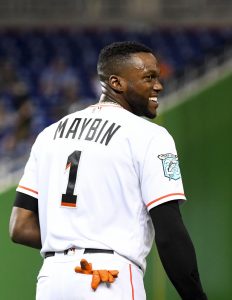
Maybin, 31, is earning just $3.25MM on the season under the one-year deal he inked over the winter. That makes him an affordable addition to the Seattle organization.
Though he struggled for much of the early portion of the season at the plate, Maybin has turned things on recently. Over the month of July, Maybin owns a .309/.427/.456 batting line with three home runs and five steals through 68 plate appearances. On the year, he’s producing at about 10% below the league-average rate, much as he did last year.
Of course, much of Maybin’s value is tied up in his legs and glove. He’s grading poorly on the basepaths this year, but that’s likely a blip for a player who was once an elite baserunner and has been quite good in the recent past. Maybin has performed well at all three outfield spots this year in Miami.
For the Mariners, this move adds another versatile piece to the outfield mix. The club added Denard Span a few months back, and he has performed quite well. Mitch Haniger has proven worthy of regular time and Ben Gamel has knocked around opposing righties. Maybin could ultimately displace Guillermo Heredia, who has stalled out at the plate, or join him to form a pair of right-handed options to go with the lefty-hitting Span and Gamel.
Clark Spencer of the Miami Herald (via Twitter) and Craig Mish of MLB Network Radio (via Twitter) reported that the Fish were about to make another swap.
Photo courtesy of USA Today Sports Images.
Indians Acquire Leonys Martin
The Indians struck a trade with the Tigers that will bring center fielder Leonys Martin to Cleveland for shortstop prospect Willi Castro as well as minor league righty Kyle Dowdy. The deal is now official.
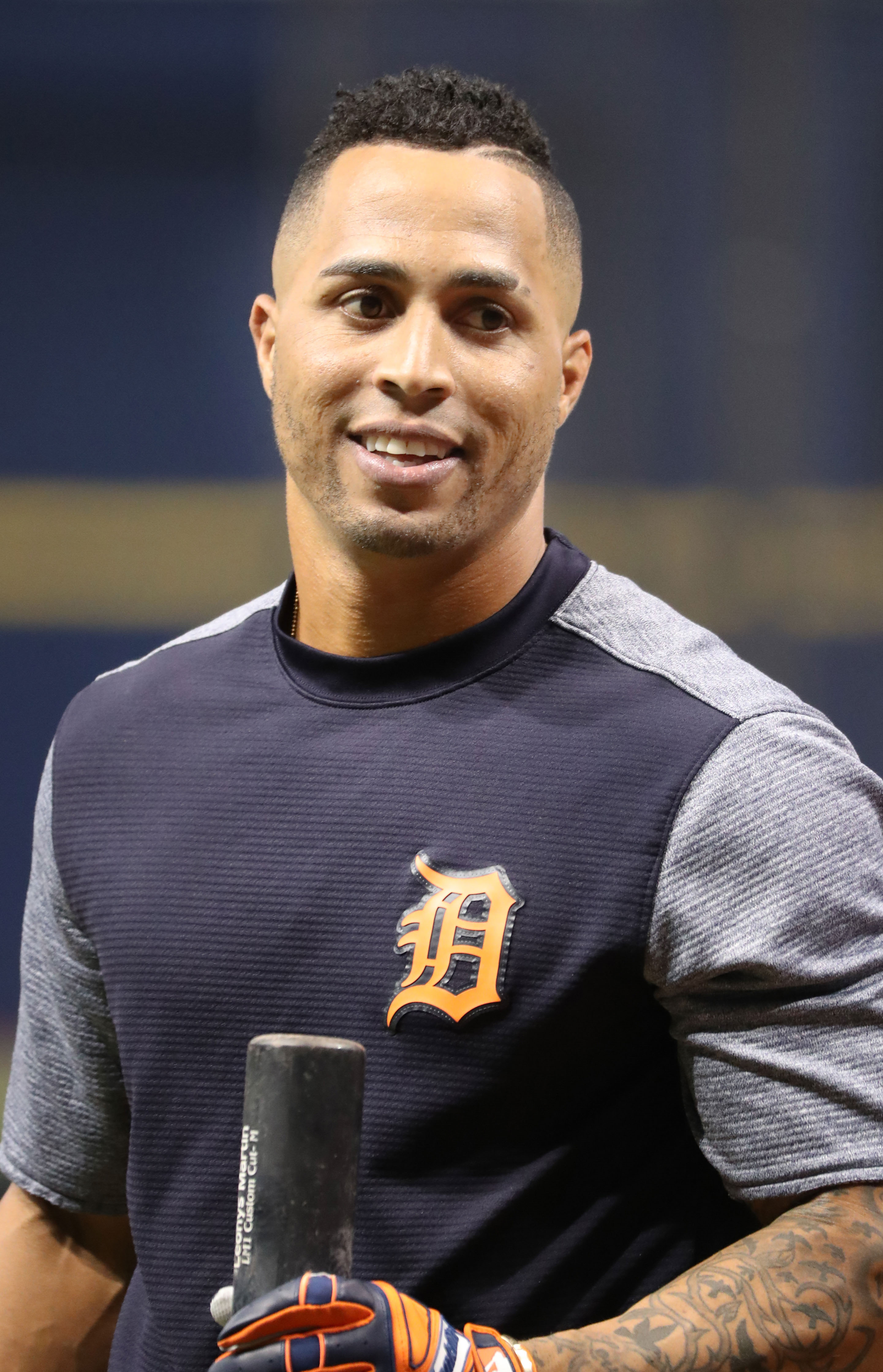
This match makes quite a lot of sense on paper. The Indians, after all, are running away with things in the AL Central but had a clear need in the outfield. In particular, the team was missing a left-handed-hitting outfielder capable of playing center after watching Bradley Zimmer struggle and ultimately go down for the year with an injury. Martin will likely share time up the middle with veteran Rajai Davis, who hits from the right side. There’s not much left on Martin’s tab for the present season, as he’s earning just $1.75MM. He’ll also be controllable for 2019 via arbitration, so could represent a piece of the puzzle next year as well.
Though Martin’s .251/.321/.409 batting line is below average, it’s still the best work of his career to date. A left-handed batter, Martin is an ideal candidate for a platoon. He’s long been a defensive asset in center field, with strong metrics dating back to 2013.
On the other side of this swap, the Tigers had every reason to get what they could for Martin. While he could certainly have been retained, cashing him in now better fits the team’s priorities. Castro, a shortstop signed five years ago out of Puerto Rico, earned a 50 overall grade from MLB Pipeline. Currently at Double-A, Castro is a switch-hitter with an above average bat and a good chance to stick at shortstop, according to MLB Pipeline and Baseball America. The Tigers did well to sign Martin affordably in December, and then spin him into Castro several months later. Dowdy, a 25-year-old righty, began the year as a Double-A reliever, then jumped into the Triple-A rotation for the Toledo Mud Hens before a move back to Double-A.
Robert Murray of The Athletic broke the trade, with Anthony Fenech of the Detroit Free-Press adding the Dowdy detail. Photo courtesy of USA Today Sports Images.
Marlins Notes: Bour, Dietrich, Realmuto
The Marlins have struck a deal (still unofficial) to ship out one reliever, and could still have more bullpen moves left to make. But the organization is also engaged on some position players. Here’s the latest …
- While they haven’t seen loads of chatter in recent weeks, left-handed hitters Justin Bour and Derek Dietrich are both the subject of negotiations today, per Jon Heyman of Fancred (via Twitter). MLB.com’s Joe Frisaro has also cited (on Twitter) those two names, along with Starlin Castro and Cameron Maybin, as still-possible trade candidates as the deadline draws nigh. It’s worth noting that the latter two players (especially Castro) could perhaps still be moved in August if they aren’t dealt today.
- The Athletics could be a team to watch on Dietrich, MLB.com’s Joe Frisaro notes on Twitter. The Oakland organization has scouted Dietrich, per the report, and learned recently that Matt Joyce is going to be out a while longer with back issues, perhaps boosting the need for a lefty corner outfield bat. Dietrich, of course, can be controlled for two more seasons beyond the present.
- There doesn’t appear to be any momentum toward a deal involving the Marlins’ most interesting potential trade candidate. In fact, there has been no chatter at all today on backstop J.T. Realmuto, Heyman tweets. Of course, we’ve heard plenty of indication in recent months that several clubs have engaged with the Fish on the star catcher, who can be offered arbitration through 2020. Perhaps, then, it’s still possible something could come together — if a contender decides at the last minute to meet Miami’s understandably lofty asking price.