
East Notes: ERod, Mallex, Wieters, Barrett, Marlins
Red Sox lefty Eduardo Rodriguez suffered a seemingly minor right knee injury during his winter ball appearance last night, as Nick Cafardo of the Boston Globe reports. President of baseball operations Dave Dombrowski says that Rodriguez merely “tweaked” the joint, explaining that “it doesn’t appear to be anything serious.” Still, it’s of greater concern in this case given that the young hurler missed significant time with an injury to the same knee last year, which delayed his start to the 2016 season. Rodriguez ultimately settled in and performed well for much of the season, but certainly the organization will hope to avoid any such complications this time around. The 23-year-old is expected to be an important part of Boston’s rotation plans, likely competing for a starting role in camp with Drew Pomeranz and Steven Wright.
Here’s more from the east coast:
- Braves outfielder Mallex Smith has also suffered what’s hoped to be a minor injury in winter-ball action, as David O’Brien of the Atlanta Journal-Constitution reports. The 23-year-old had previously been limited by an oblique injury, and aggravated that problem while playing in Puerto Rico. Atlanta decided to pull him out of action, cutting short his offseason work for the time being. Smith appears likely to open the 2017 season in the upper minors after making his MLB debut in 2016. He ended the year with a .238/.316/.365 batting line and 16 steals (against eight times being caught) over 215 plate appearances. Smith is largely blocked at the major-league level in the near term, and the organization is said to be interested in ensuring that he continues to develop by receiving plenty of plate appearances after a thumb injury limited him in 2016. (Aside from the above-noted MLB time, Smith played in just eight games.)
- While some still believe there’s a possibility the Nationals will pursue free-agent catcher Matt Wieters, Pete Kerzel of MASNsports.com argues that it’s not a sensible fit. In particular, the Nats have shown a predilection for high-quality pitch framers of late, and Wieters doesn’t rate well in that area. With at least three viable options already on hand, says Kerzel, the Nats likely won’t tie up payroll to add the veteran.
- One player that the Nationals do have ongoing interest in is right-handed reliever, Aaron Barrett, Kerzel further writes. That dovetails with other recent reports, and certainly makes sense given the organization’s ongoing need to bolster its depth in the bullpen. Kerzel says that the Nats “have always liked Barrett’s power arm and competitive nature,” and surely also appreciate the fact that he’d remain controllable into the future via arbitration if he’s able to return to health after successive elbow surgeries.
- The Marlins have given signals that they believe the bulk of their offseason work is already complete, as Tim Healey of the Miami Sun-Sentinel recently reported. Miami doesn’t feel that it must have a southpaw in its bullpen, as the organization believes its existing righties can succeed against opposing lefties, and already feels that there’s plenty of pen competition in the existing mix. While it seemingly makes sense for the team to pursue a righty bench bat to pair with Justin Bour at first, meanwhile, president of baseball operations Mike Hill says that’s “not a priority.” It seems that the organization is interested in giving Bour greater opportunity against left-handed pitching in 2017. He has taken just 110 plate appearances against southpaws in his career, producing an anemic .223/.273/.291 batting line. With catcher J.T. Realmuto potentially available to spend some time at first, presumably reducing his wear and tear while opening some chances for reserve backstop A.J. Ellis, the Marlins do not appear inclined to dedicate a roster spot to a defensively limited hitter, though Hill said the team will continue to “monitor” the market.
10 Bounceback Pitcher Candidates Still Available In Free Agency
By this point, the free agent market has thinned considerably, especially at its upper reaches. But there remain plenty of interesting players still available.
Looking through the list of unsigned players, one finds a number of recently high-performing pitchers who can likely be had on relatively (or very) modest deals. Achieving truly adequate pitching depth remains one of the game’s elusive pursuits, so there’s always opportunity for arms.
Here are some of the most intriguing names still available, featuring five starters and five relievers:
Tyson Ross: It came as a surprise when the Padres elected to non-tender Ross rather than paying him a repeat of his $9.6MM arbitration salary in his final season of eligibility, but that move leaves the 29-year-old available for other teams to take a risk. While organizations may prefer to attempt to secure multiple years of control if they roll the dice on the health of his ailing shoulder, Ross will no doubt prefer a single-season commitment. He carried a 3.07 ERA over 516 2/3 innings from 2013-15, so the upside is evident, and it’s no surprise that most of the league has some degree of interest.
Brett Anderson: Soon to turn 29, Anderson did not show well in his brief return from back surgery last year. But he turned in 180 1/3 frames of 3.69 ERA ball in 2015, and has generally been rather good when healthy, so there could still be something left in the tank. While Anderson’s extensive injury history is a major deterrent, organizations could reasonably hope that he can at least provide some useful innings during whatever stretch he is able to contribute.
Doug Fister: Entering his age-33 season after two straight duds, it’s tough to view Fister in quite the same light that one could have a year ago, when he seemed like a solid bounceback bet. That being said, he isn’t far removed from being a quality mid-rotation starter, and was at least able to turn in 32 starts in a healthy 2016 season. Unlike the other pitchers on this list, there isn’t an immediate injury to blame for the diminished value, though perhaps that also means he comes with a greater expectation of near-term contribution. If Fister can restore some of his lost groundball luster, perhaps he’d again rate as a useful rotation piece.
Nathan Eovaldi: Teams won’t be able to expect anything out of Eovaldi in 2017, as he’s expected to miss the entire year after Tommy John surgery. But he hasn’t even turned 27 and did show a personal-best 97.0 mph average fastball and 9.3% swinging-strike rate in 2016, so he remains an intriguing candidate to receive a rehab-and-return contract.
Henderson Alvarez: The long-term health outlook is perhaps even cloudier in the case of Alvarez, who couldn’t make it back to the majors in 2016 from shoulder issues. But he, too, has yet to reach his 27th birthday and he was able to provide 187 innings of 2.65 ERA ball as recently as 2014. And Alvarez did make 11 minor-league appearances last year, so there’s at least some reason to hope that he can contribute in the season to come.
Greg Holland: An obvious candidate for this list, Holland is perhaps the most fascinating relief arm still left unsigned. Once one of the game’s most dominant pitchers, the 31-year-old figures to sign with expectations of a full 2017 campaign after finishing up his TJ rehab. Like Ross, Holland has drawn wide interest and ought to be able to generate a variety of interesting and relatively lucrative opportunities.
Luke Hochevar: Now far removed from an impressive 2013 season in which he successfully transitioned from struggling starter to late-inning pen arm, Hochevar will be attempting to return from thoracic outlet surgery (after missing 2014 due to a Tommy John procedure). There’s plenty of uncertainty in the outlook for the 33-year-old, but he did put up 9.6 K/9 against just 2.2 BB/9 while working to a 3.86 ERA over 37 1/3 innings in 2016, and could be expected to return early in 2017.
Drew Storen: Still just 29, Storen was an electric reliever as recently as 2015, when he posted 11.0 K/9 and 2.6 BB/9 across 55 innings while working to a 3.44 ERA that metrics viewed as somewhat unfortunate. Though he struggled last year and showed a worrying drop in his average fastball velocity (from 94.1 mph in the season prior to 92.3 mph in 2016), Storen still put up a 10.5% swinging-strike rate that landed right at his career average. He also closed out the year by yielding just three runs in his final 17 innings while posting a 15-to-2 K/BB ratio.
Aaron Barrett: After TJ surgery derailed his sophomore 2015 season, Barret’s return was cut short with an elbow fracture. On the other hand, Storen’s former pen mate in D.C. owns a 3.47 ERA with 10.8 K/9 and 3.47 BB/9 over his 70 career MLB frames, with a 13.1% lifetime swinging-strike rate driven by his 93 to 94 mph heater and wipeout slider. Whatever team takes a shot on his future can also pick up plenty of affordable future control over Barrett, who’ll soon turn 29.
Charlie Furbush: Rotator cuff surgery is never good news for a pitcher, and returning from that procedure presents a major hurdle for the 30-year-old. But quality southpaws are always in high demand, so there’s much to be gained in the event that he can get back on track. Over his last 175 1/3 MLB frames, compiled over 2012 through 2015, Furbush provided the Mariners with a 3.23 ERA and 10.3 K/9 versus 3.0 BB/9.
Extension Candidate: Jake Arrieta
The Cubs reportedly plan to discuss a new, long-term contract with star righty Jake Arrieta early in 2017. Prior talks failed to produce much apparent traction, but there’s new urgency if a deal is to be found. Arrieta, after all, will reach the open market after the season.
If nothing else, Chicago will need to sort out Arrieta’s final arbitration salary with agent Scott Boras. After a huge raise following his monster 2015 season, Arrieta took down $10.7MM last year. And though he wasn’t as good in 2016, there’s another hefty boost coming; MLBTR projects to earn a $16.8MM payday.
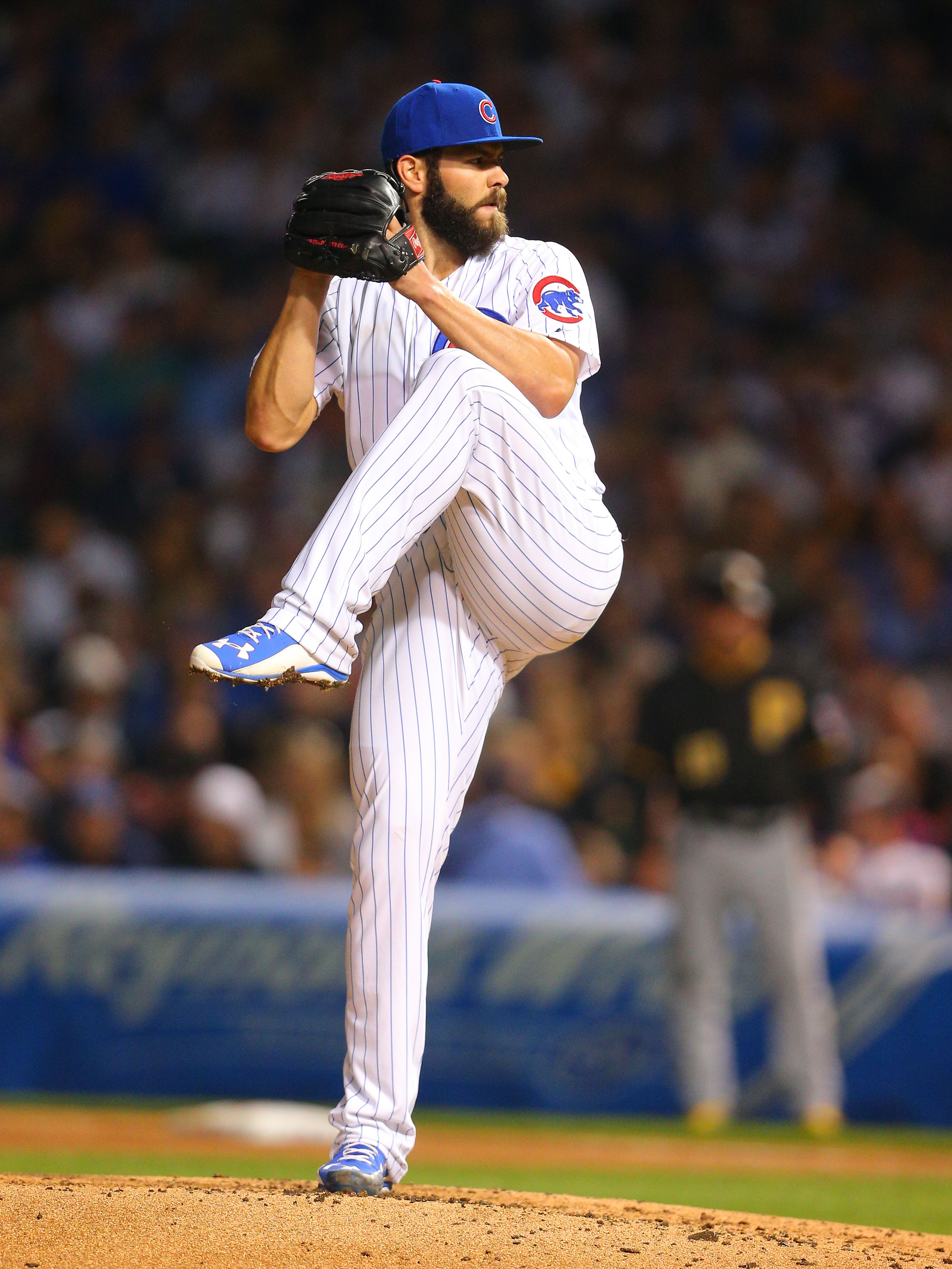
So, aside from nailing down that number, just what might the sides talk about when they sit down in the coming weeks? Expectations, perhaps, represent the most important ingredients in this particular extension scenario, because valuing Arrieta’s post-2017 seasons without the knowledge of his 2017 output is particularly difficult.
Arrieta’s story is well known, and need not be repeated in full here. Suffice to say, his career renaissance in Chicago has been spectacular and complete. Over 2014-15, the righty provided 358 2/3 innings of 2.08 ERA pitching over 58 starts. He was dominant, especially, in the latter of those two seasons, when he posted 9.3 K/9 against just 1.9 BB/9 and allowed a league-low 5.9 hits per nine while spinning four complete games. After filling up 229 innings and taking home the National League Cy Young award, a course was set for a huge free-agent contract.
The early portion of 2016 largely represented a continuation; though his walk rate was up, the results remained dominant. By early June, though, the earned runs began to catch up as Arrieta’s typically excellent suppression of walks and home runs began faltering. Ultimately, he fell just shy of 200 innings and ended the year with a 3.10 ERA to go with 8.7 K/9 and 3.5 BB/9. Beyond the jump in walk rate, Arrieta also paced the league with 16 wild pitches.
To be sure, all the signs weren’t concerning. Arrieta continued to induce grounders on about half of the balls put in play against him, didn’t show any worrying changes in velocity, mostly maintained his swinging-strike rate (10.5%, down from a personal best 11.1%), and continued to suppress BABIP in a consistent manner suggestive of skill, not merely good fortune. But hitters chased out of the zone slightly less frequently and made somewhat more hard contact in 2016, while also managing a few more home runs (16).
In the aggregate, Arrieta is still exceedingly difficult to square up and seems to be about as good a bet as anyone to deliver 200 or more innings from a health perspective. Even the less-dominant version is still a high-quality pitcher. Heck, he even managed to add real value with the bat last year (.262/.304/.415). And Arrieta showed up in the postseason — the World Series, especially, where he allowed just three earned runs on five hits over 11 1/3 innings in two starts.
Still, it’s hard to say that Arrieta’s current standing matches his status at this time last year. If Arrieta isn’t a true ace — which, at least, is in doubt — then the conversation is somewhat different. Valuing his future is more about projections and comps than it is a question of just how much a team can really spend on a single pitcher. And reaching agreement on an extension poses questions such as: Will the team will ascribe added value to the possibility of a return to full dominance? Will the player forego perhaps greater potential earnings to sell away the risk of another less-than-excellent (or worse) season?
If Arrieta isn’t a true ace, then pedestrian considerations such as age — he turns 31 in March of 2017, and will turn 32 before the start of the 2018 season — rise in importance. That means Arrieta will hit the market at nearly the same age (just a few months younger) as Zack Greinke did last winter. Greinke’s massive contract (six years, $206.5MM) isn’t exactly a bad sign for Arrieta, but it’s tough to see Chicago valuing the latter’s free-agent years as highly as the D-Backs did the former’s (over $34MM). That contract always seemed a reach, and came on the heels of Greinke’s historic 2015 season.
Perhaps a more reasonable current comp is pitching alongside Arrieta in the Cubs’ rotation. Jon Lester, who was a younger free agent than will be Arrieta, got $155MM over six years. But even that could be rich. Johnny Cueto, one of the game’s most accomplished hurlers, landed shy of Lester (six years, $130MM, albeit with an opt-out) heading into his age-30 season. His late-2015 scuffles — which weren’t, perhaps, all that dissimilar from Arrieta’s — seemed to put a real dent in his value.
The most direct comparables, of course, are drawn to players who sign extensions just before hitting the market. Stephen Strasburg got seven years and $175MM from the Nationals in the middle of the 2016 season. Before him, Homer Bailey took home $105MM over six seasons (including his arb year) from the Reds. Neither pitcher is a clean comp — Strasburg, due to age; Bailey, due to performance — but those deals are still illustrative. Strasburg’s signing, in particular, shows that an extension can’t be ruled out, even for a market-leading starter repped by Boras. Both contracts show the need for compromise as well as the inherent risk in a late-arb pitching extension. Injuries slowed both Strasburg and Bailey not long after their new deals were inked. In both of those cases, they wisely (in hindsight) sold away the chance at perhaps even greater earnings to lock in contracts with their existing organizations.
It is ultimately difficult to know whether there’s a realistic chance of the Cubs and Arrieta reaching a deal. The relative lack of upper-level, high-quality starting pitching prospects in the Chicago system suggests an ongoing need. And the Lester signing shows that the team will sign a long-term deal with a starter in the right circumstances. But it seems likely there’ll be some cap to the team’s willingness to add guaranteed years and boost the AAV in Arrieta’s case. Just where those lines will be drawn by both the team and its once (and future?) staff ace remain to be seen. Is Strasburg’s $25MM AAV a fair market point, perhaps over a shorter term? Does Cueto’s combination of a lower AAV and opt-out provide a guide? Or will Arrieta hold out for a chance to chase Greinke?
Just for kicks … let’s see how likely a deal is, in the estimation of MLBTR’s readers:
Will The Cubs Extend Jake Arrieta?
-
No 52% (5,835)
-
Yes 48% (5,483)
Total votes: 11,318
Photo courtesy of USA Today Sports Images.
Extension Faceoff: Odubel Herrera vs. Ender Inciarte
The Phillies and Braves have been on remarkably similar paths this winter, seeking to boost near-term performance without jeopardizing their long-term rebuilding plans. Most notably, that has involved collecting veteran pieces (especially starters) on expensive, one-year deals.
While neither of the N.L. East rivals appear to be ready to add truly significant, long-term pieces via free agency, both were willing to make targeted investments to enhance their control over their own players this winter. Specifically, Philadelphia and Atlanta found common ground with their young center fielders, Odubel Herrera, who turns 25 on Thursday, and Ender Inciarte, who just turned 26.
It’s probably not entirely coincidental that the two pacts — struck within about a week of one another — were structured so similarly. Both players are in the 2+ service class, meaning they each already had four years of team control to go, though Inciarte had qualified as a Super Two. Instead, each player committed at least one would-be free-agent year to his team, in exchange for nearly identical guarantees: Herrera gets $30.5MM, Inciarte $30.525MM. The only meaningful difference came on the option front. The Phils can control Herrera for two more seasons (at $11.5MM and $12.5MM), while the Braves only get one additional year of control over Inciarte, but need pay him only $9MM to utilize it.
Of course, the two are hardly identical players. Herrera possesses a bigger bat, having produced at a 111 wRC+ rate over his first two MLB seasons, while Inciarte is more of a league-average hitter. Though both add value with their legs and gloves, the latter is the more accomplished in both regards. All things considered, both have established themselves as solidly above-average regulars and appear set to provide plenty of value to their respective employers over the duration of their new contracts.
Herrera arguably comes with greater upside, given the increasing power (and improved walk rate) he demonstrated last year. But you could also reasonably suggest that Inciarte’s superior value in other aspects of the game makes him a surer bet to remain a quality center fielder into his early thirties. So, just for fun, which player’s contract looks like the better bet? (Those using the Trade Rumors mobile app can weigh in here.)
Which Extension Represents The Better Value?
-
Ender Inciarte, Braves 58% (6,837)
-
Odubel Herrera, Phillies 42% (5,021)
Total votes: 11,858
Latest On Jose Quintana, David Robertson
11:22am: Nightengale cites the Yankees and Pirates as the two most aggressive teams on Quintana, via Twitter, even noting that there have been some discussions of a three-team arrangement of some kind (as has been rumored elsewhere of late). But it’s still far from clear whether there’s any real reason to believe there is anything approaching a serious negotiation at this stage. In fact, sources tell Joel Sherman of the New York Post (Twitter link) that the Yankees aren’t currently working on any deal to land Quintana and Robertson.
8:38am: As the Yankees and White Sox continue to explore trade arrangements involving highly valued southpaw Jose Quintana, the organizations have now also “expanded” their discussions to include Chicago closer David Robertson, according to Bob Nightengale of USA Today (via Twitter). The Sox would keep part of the remaining $25MM left on Robertson’s contract in any agreement.
We’ve heard varying suggestions recently as to just how serious New York’s interest in Quintana really is. Certainly, there’s a need on paper for the Yanks, who might at least be somewhat more willing to part with some of their newly acquired farm depth to add a youthful, affordable, controllable starter such as Quintana.
The insertion of Robertson into the mix adds some intrigue, though it still isn’t apparent how likely the sides are to line up on a deal. It’s possible to imagine the 31-year-old righty making a return to New York, where he spent seven strong years, to form another three-headed bullpen monster with Aroldis Chapman and Dellin Betances. But wrapping Robertson into a deal could also set up a variety of other alternatives for the Yanks, who could conceivably go on to flip Robertson or even move Betances to offset the presumably lofty cost it would take to pry Quintana loose.
From the White Sox’ perspective, there’s still no urgent need to deal their best remaining rotation piece, or even to part ways with Robertson except to help facilitate an appealing return of talent. But after already sending out ace Chris Sale, along with quality outfielder Adam Eaton, there’s certainly an argument to be made that the organization ought to make every effort to cash in Quintana this winter rather than rolling the dice on his continued health and effectiveness.
If there’s something of a game of chicken ongoing between the South Siders and the Bronx Bombers, there are also plenty of other forces at play. The Pirates have reportedly pushed hard to land Quintana, and a pair of AL West rivals are still competitive, too. We heard recently that the Rangers have interest, and the Astros have already kicked around some potential packages for the 27-year-old lefty.
Ross Ohlendorf Signs With Japan’s Yakult Swallows
Righty Ross Ohlendorf is bringing his old-school windup and mid-nineties fastball to Japan, according to multiple reports. Yahoo Japan recently reported the arrangement (in Japanese), with the Japan Times providing the club’s announcement today. Ohlendorf will earn $1.6MM and can add up to $400K via incentives, per Jerry Crasnick of ESPN.com (via Twitter).
It has been a winding path for the veteran hurler, who most recently worked out of the Reds bullpen. Over his 65 2/3 innings in 2016, the 34-year-old compiled a 4.66 ERA with 9.3 K/9 and 4.4 BB/9. He continued to show a strong, 93.8 mph average fastball, and again posted a swinging-strike rate of over 10%, though he also demonstrated an ongoing susceptibility to the long ball (17.1% HR/FB, 1.92 HR/9).
Ohlendorf, a starter with the Pirates earlier in his career, reestablished himself with the Nationals in 2013. But ensuing injuries forced him to work his way back to big-league relevance once again. Ohlendorf made it back to the majors in 2015 with the Rangers, taking the ball 21 times and working to a 3.72 ERA over the course of the year, before joining the Royals for the spring of 2016.
After opting out of his minors pact with Kansas City, Ohlendorf scored a MLB roster spot with the Reds just before the start of the 2016 season. He ultimately earned $800K on that contract, and will now at least double that in his first foray into Japan’s Nippon Professional Baseball.
It seems that Ohlendorf will also have a new shot at working from the rotation with Yakult. The team’s international scouting director said that it signed Ohlendorf to provide the organization with “a power pitcher in the rotation” to replace Kyle Davies, who will not return to the Swallows after wrapping up a 15-start stint.
Xavier Scruggs Signs With Korea’s NC Dinos
The NC Dinos of the Korea Baseball Organization have announced the signing of first baseman/outfielder Xavier Scruggs, as Dan Kurtz of MyKBO.net shares on Twitter. Scruggs will earn $1MM in the new arrangement.
Though Scruggs, 29, has reached the majors in each of the past three seasons, with the Cardinals and Marlins, the right-handed hitter has failed to gain much traction at the game’s highest level. All told, he has received just 130 plate appearances and slashed a meager .227/.292/.303 in the big leagues.
That being said, there’s also a lengthy backdrop of success throughout the minors on Scruggs’s resume. Most recently, in 2016, he posted an excellent .290/.408/.565 batting line and swatted 21 home runs over 382 plate appearances at Triple-A. While he has been plenty productive in the past, Scruggs had never hit at quite those levels. He has also delivered increasingly impressive plate discipline numbers in the upper minors, culminating in a promising distribution of 58 walks against ninety strikeouts in his latest campaign.
Scruggs will have some big shoes to fill in his first stint in Asian ball, as he’ll effectively be replacing perennial MVP candidate Eric Thames on the Dinos’ roster. Thames emerged as a superstar in the KBO over his three years in that league before testing free agency and latching back on in MLB by signing a three-year, $15MM deal with the Brewers.
Candidates For The Reds’ First MLB Deal Of The Offseason
The Reds have been busy on the waiver wire, but quiet elsewhere. Beyond picking which young players upon which to make dice rolls, GM Dick Williams has largely held his hand thus far. That’s not terribly surprising, for a variety of reasons.
The club’s most obvious potential trade chips come with no-trade protection (Joey Votto, Brandon Phillips) or play positions that aren’t in huge demand (Phillips, Zack Cozart). There was never a strong prerogative to deal from among the Reds’ other controllable assets, such as righty Anthony DeSclafani and center fielder Billy Hamilton. At the same time, after spending about two years compiling prospects, the organization has plenty of young players who are ready to compete for major league opportunities in 2017, so there aren’t a lot of needs.
Still, it would be surprising if the team makes it through the winter without striking at least one major-league contract. Cincinnati nearly did so a winter ago, giving MLB deals only to Blake Wood and (in mid-March) Alfredo Simon. While the Yankees actually did manage to avoid handing out a 40-man spot to a free agent in 2015-16, it’s a rarity.
And it isn’t as if the Reds are fully loaded for 2017, particularly if they hope to have an outside chance at turning into a contender. In particular, the bullpen appears ripe for an addition. That’s especially true of the open closer role; while Raisel Iglesias, Michael Lorenzen, or even Tony Cingrani would represent internal options, giving any of those youngsters the opportunity would also mean boosting their expected arbitration earnings. Cincinnati might as well make the investment to add another arm, while utilizing them in set-up roles. Alternatively, or additionally, the Reds could look to add some veteran arms — either swingman types or pure relievers — to provide depth.
So, what are the options should Cincinnati decide to open up one of its prized 40-man roster spots? Let’s run down a few of the remaining bullpen arms that could make sense…
- Joe Blanton: After a pair of resurgent seasons split between the Royals, Pirates and Dodgers, it’s very possible that Blanton will be too expensive for Cincinnati’s tastes. He’s posted a 2.65 ERA across his past 165 MLB innings with good control and better than a strikeout per inning. He could find a high-leverage spot on a contending club, though Cincinnati could entice him by offering a ninth-inning role.
- Santiago Casilla: If Casilla wants to continue closing, his age and his September meltdown in 2016 might limit his opportunities. However, Cincinnati could offer him that type of opportunity with an eye toward flipping him in July if he performs well. His poor finish aside, Casilla has a 2.42 ERA in 394 2/3 regular-season innings dating back to 2010 and has whiffed better than a batter per inning in each of the past two seasons.
- Neftali Feliz: The former AL Rookie of the Year had a resurgent season in the Pirates’ bullpen this past season and could command a high-leverage role with Cincinnati (or another club) if his medicals check out. Feliz ended the season on the shelf but there’s been no word of any arm issues lingering into the offseason. He posted a 3.52 ERA with 61 strikeouts against 20 unintentional walks in 53 2/3 innings this past season.
- David Hernandez: Hernandez crashed and burned when given a short leash as Philadelphia’s closer early last season, but he rebounded to pitch quite well over the remainder of the season. The 31-year-old posted a 3.53 ERA and punched out 69 hitters against 28 walks in his final 66 1/3 innings of the 2016 campaign. As a presumably low-cost veteran arm with closing experience, he’d be a nice add to a Cincinnati bullpen that could develop into a trade chip down the line with a good full season.
- Greg Holland: Perhaps the highest-upside arm left on the market, Holland could potentially be lured to the Reds with a guarantee of pitching in the ninth inning from day one. Contending clubs may be wary to make such a commitment, but a rebuilding team like the Reds has little to lose. And while Holland may prefer to sign with a contender, he could also sign in Cincinnati with the guarantee of save opportunities and with the understanding that he’d be likely to be flipped to a contender come July if he rediscovered the form he showed from 2011-15 prior to Tommy John surgery (2.15 ERA, 12.2 K/9, 3.5 BB/9 in 301 innings).
- Yusmeiro Petit: The Reds don’t have anyone locked into a multi-inning role, but Petit could be had on an affordable one-year deal and fill that role while also serving as a safety net for an inexperienced rotation. The Nationals didn’t use him much down the stretch in 2016, and he struggled when he did take the hill, but he’s worked to a very solid 3.83 ERA with 8.5 K/9 against 2.0 BB/9 between the rotation and bullpen across the past five seasons (307 2/3 innings).
- Sergio Romo: The former Giants closer lost his ninth-inning role to the aforementioned Casilla late in his San Francisco tenure, but he’s been rock solid in terms of bottom-line results virtually every year in the Majors since debuting in 2008. The 33-year-old has only posted an ERA north of 3.00 in two MLB seasons and has a lifetime 2.58 ERA with 10.2 K/9 against 1.8 BB/9 in the Majors. He doesn’t throw hard, but Romo would bring loads of late-inning experience to a Reds team that is lacking in that area.
- Joe Smith: Like so many others on this list, Smith comes with some closing experience but has also worked in a setup capacity for a number of years. Set to turn 33 in March, Smith is a ground-ball specialist with a history of limiting the long ball — a trait that’d be appealing to the Reds, who play in a homer-happy home park. A 2.64 ERA over his past 389 MLB innings only adds to the appeal.
- Drew Storen: It’s been a stark downward spiral for Storen since the Nationals acquired Jonathan Papelbon in July 2015. Storen was demoted to a setup role, performed poorly, and found himself flipped to the Blue Jays, where his results weren’t any better. A midseason trade to the Mariners in 2016 didn’t improve his results, either. Rough stretch aside, the former No. 10 overall pick has a career 3.31 ERA and posted a 2.91 ERA with solid control and nearly a strikeout per inning from 2011-15. On a short-term deal, the upside for the Reds would be tantalizing.
- Shawn Tolleson: In 2015, Tolleson emerged as a surprise closer for the Rangers, saving 35 games and logging a 2.99 ERA in 72 1/3 innings — his second straight year with 70-plus innings and a sub-3.00 ERA. Tolleson imploded in 2016 and saw his strikeout rate plummet while his home-run rate skyrocketed. There are a number of reasons for interested suitors to have skepticism, but the Reds could offer a low-base one-year deal with the promise of a high-leverage role. If Tolleson returns to form, he’d be a summer trade chip at the very least. However, he’s also controllable through 2018, so the Reds could simply enjoy his services for a full year and reassess next winter if he rebounds in 2017.
Transaction Retrospection: The Daniel Murphy Signing
It has been one year and one day since the Nationals inked Daniel Murphy to a three-year, $37.5MM contract. Murphy wasn’t exactly a hotly pursued target for D.C., which had previously pushed hard for free-agent Ben Zobrist, chatted with Howie Kendrick about a deal, and nearly consummated a swap with the Reds to acquire Brandon Phillips.

Having explored those other avenues, but found none availing, the Nats struck a Christmas Eve pact that seemed at the time to represent a solid price tag (even with the sacrifice of a draft pick) for a quality player. But expectations were relatively restrained. While Murphy’s torrid late-2015 work had certainly raised his profile, it perhaps hadn’t fundamentally changed his perception around the league. His own former team, the Mets, were content pocketing a draft selection and dealing for a replacement in Neil Walker, and obviously there wasn’t sufficient interest for him to garner even a fourth guaranteed season entering his age-31 campaign.
Needless to say, the arrangement worked out much better than anyone thought possible. In retrospect, Murphy’s unbelievable postseason performance — including a ridiculous 1.462 OPS and seven home runs over 39 plate appearances in the NLDS and NLCS — was a harbinger of things to come.
In 2016, Murphy went from a solid hitter on a hot streak to one of the game’s most productive batsmen. Across 582 plate appearances, he slashed .347/.390/.595 and struck 25 home runs to go with a league-leading 47 doubles. While he still graded poorly in the field, Murphy rated well as a baserunner (though he doesn’t try to steal nearly as often as he used to) and managed to rack up 5.5 fWAR while landing second in the N.L. M.V.P. voting. And though he wasn’t quite as spectacular in his five postseason games for the Nats as he had been for the Mets, Murphy still recorded seven hits, five walks, and six RBI in his 22 postseason plate appearances in 2016.
The remaining two years left on Murphy’s deal now appear to represent quite a valuable asset for Washington. Though the backloaded structure means that there’s still $29.5MM to go, there’s little question that Murphy could command a much greater sum were he back on the open market — which might well have happened had he taken the qualifying offer issued to him by the Mets. That’s all gravy for the Nats, who have already received equivalent value for the entire commitment out of Murphy’s first year.
Things worked out well enough for New York, too. Walker turned in a productive year, though he did ultimately require back surgery that put a premature end to his 2016 season. And unlike Murphy, Walker stuck around; he remains a member of the organization after accepting the QO earlier this offseason. It certainly wouldn’t rate as a huge surprise if he ends up out-producing the man he replaced in 2017.
There’s no direct takeaway from the Murphy signing, but there are a few broader points that it supports. For one thing, notions of upside and floor may well be overstated; Murphy was signed for his steady consistency at the plate, but ended up showing that his apparent late-2015 hot streak was really a reflection of a change in hitting capacity. Whether it’s sustainable, of course, is anyone’s guess; as Murphy’s big season also shows, baseball remains full of surprises even in an age of advanced statistics. And for the free agents who remain unsigned this time around, along with the teams that will ultimately sign them? Well, there’s probably still some money left to be found, and some diamonds still lying in the rough.
Photo courtesy of USA Today Sports Images.
Jose Bautista Willing To Consider One-Year Deal
Veteran slugger Jose Bautista is willing to take a one-year contract, according to Jeff Passan of Yahoo Sports. There’s something of a catch, though: per the report, “he wants it to be at a higher value than the qualifying offer.”
It seems, then, that Bautista would need to see something greater than $17.2MM on an offer sheet for the 2017 season before he’s willing to give up his pursuit of a lengthier pact — at least at this stage. Notably, the report does not suggest that the organization has shown any movement on its part; at last check, Toronto had yet to indicate a willingness to exceed the value of the QO that it previously extended, and Bautista declined. As Passan puts it, “the next move is the Blue Jays’.”
Passan explores in great detail why a reunion with Toronto makes sense, particularly in a single-season scenario; you’ll want to give his breakdown a full read for that reasoning. Indeed, with former teammate Edwin Encarnacion now off the market, the path is perhaps cleared for Bautista (and other defensively limited power bats) to find their own landing spots. And the Jays’ lineup surely is still in need of some pop, especially in the outfield, as the team’s current depth chart shows. Bautista wants to return to the place where he finally found his stride as a ballplayer, too, a source informs Passan.
It’ll be interesting to see whether this new bargaining position for Bautista changes the calculus for Toronto (or other organizations). Much of the risk in his profile lies in his age (36); though he took a step back in the power department last year, he also dealt with some injuries and still maintained his top-of-class plate discipline. All told, Bautista still generated a strong .234/.366/.452 batting line with 22 home runs in 517 plate appearances. In that regard, the demand for a salary in excess of the QO does not seem startling; coming into the winter, after all, expectations were that he could find a multi-year contract with an AAV in that ballpark.
Other market markers seem relevant here, too. Carlos Beltran landed $16MM from the Astros on a one-year term, while Matt Holliday got $13MM from the Yankees. It’s certainly arguable that Bautista is a bigger prize than either of those players, though neither required draft compensation. (For Toronto, the club wouldn’t punt one of its existing picks, but re-signing Bautista would mean surrendering its rights to a compensatory choice.)
At the same time, teams eyeing power bats no longer have quite as many names to choose from, particularly if they prefer an outfield-capable player. The younger but less-accomplished Mark Trumbo is perhaps the biggest remaining competition on the free-agent market, which still includes other options such as Mike Napoli (who is limited to first base) and Brandon Moss (who hits from the left side). On the trade side of the equation, J.D. Martinez can presumably still be had, though we haven’t heard much indication that anything will come together on the Tigers star. There are a variety of other free-agent outfielders, including recent Toronto teammate Michael Saunders, though none feature anything approaching Bautista’s offensive track record.
From the demand side, plenty of hypothetical suitors remain for Bautista and his market competition. We ticked through some of them recently in this post. As the recent bidding for Encarnacion shows, there could still be an appetite on the market for multi-year pacts with significant value, as well as creative, shorter-term deals at high average annual values. But just how much demand exists for the older Bautista — whose platform season wasn’t as promising as that of his long-time teammate — remains unclear.
In prior years, we’ve seen players settle for one-year deals after turning down qualifying offers, though in most instances they took less than the value of the offer itself. (This was the case for players such as Ian Desmond, Dexter Fowler, Kendrys Morales, and Stephen Drew.) Ervin Santana agreed to a $14.1MM deal with the Braves in advance of the 2014 season, matching that year’s QO value, though he had to wait for spring injuries to land that contract. Only Hiroki Kuroda was able to beat the qualifying offer on a single-season pact; in November of 2012, he inked a $15MM contract after turning down what was then a $13.3MM QO. Unlike those situations, however, the new rule preventing multiple qualifying offers from being extended to a single player would prevent the Blue Jays or another team from lining up possible draft compensation after the 2017 campaign.