
Joe Kelly Hoping To Re-Sign With Dodgers
The Dodgers declined a $12MM option on right-hander Joe Kelly in favor of a $4MM buyout after the right-hander suffered a biceps strain during the Dodgers’ NLCS showdown against the eventual World Series-champion Braves. Kelly hit the free agent market for the second time in his career and did not sign prior to the league’s implementation of a lockout on Dec. 2. He’s since been rumored to be a post-lockout target of the Cardinals, Kelly said today in a radio appearance on 570 LA Sports that he hopes to remain in Los Angeles (Twitter link, with audio).
“As with the whole lockout, once it’s over… teams are going to be signing,” Kelly said to host David Vassegh. “The signing period’s going to be like basketball. People are going to be signing at 4:00 in the morning. But obviously, I want to come back and be a Dodger — and the interest is mutual, so we’ve got to make something happen.”
Kelly’s mention of mutual interest — presumably in reference to interest shown by the Dodgers prior to the lockout — is the most concrete indicator to date of a possible reunion between the two parties. Interest on L.A.’s behalf is only natural, as the Dodgers are currently facing the potential of losing not only Kelly but also Kenley Jansen, Corey Knebel (who already signed in Philadelphia) and Jimmy Nelson to free agency. That quartet combined for 167 2/3 innings of strong relief work out of Dave Roberts’ bullpen.
The 33-year-old Kelly, in particular, enjoyed a nice rebound campaign in 2021 after being limited to 10 innings in 2020. Although he missed the first five weeks of the 2021 season due to a shoulder injury, Kelly returned with one of the finest showings of his decade-long big league career. In 44 innings, he pitched to a 2.86 ERA (3.08 FIP, 3.o9 SIERA) with a strong 27.5% strikeout rate, an 8.2% walk rate and a huge 58.9% ground-ball rate. His average heater was down a tick from its 99.1 mph peak, but Kelly’s 98.1 average fastball velocity represented a bump from his 2019-20 levels.
Generally speaking, Kelly is one of baseball’s hardest-throwing relievers. He has, at various points throughout his career, flashed huge strikeout capabilities, strong command and high-end ground-ball tendencies — but rarely all at the same time. Those three traits coalesced in 2021 more than at any point throughout his career, after the Dodgers helped take Kelly’s grounder rate from above-average (49.9% from 2012-18) to outstanding during his time in blue (59.9%).
A pair of IL stints due to shoulder troubles kept Kelly off the mound more than he or the team would’ve liked during his three-year stint as a Dodger, but the overall body of work was sound. In 105 1/3 innings, Kelly posted a 3.59 ERA with a 121-to-44 K/BB ratio (26.9 K%, 9.8 BB%), 21 holds and three saves. Many of this offseason’s top relievers — e.g. Raisel Iglesias, Knebel, Kendall Graveman — are already off the market, so Kelly should be among the more desirable options still left in free agency whenever the lockout lifts.
As for his current health, Kelly noted that he’s already throwing multiple times per week, albeit not off a mound. He’s playing catch and long toss right now but stated that his arm is “definitely going to be ready for the season” — whenever the season begins.
D-backs Notes: Straily, Carroll, Lawlar, Barfield
Newly signed Diamondbacks righty Dan Straily chatted with The Athletic’s Zach Buchanan at length about his decision to sign with Arizona and his goals of reestablishing himself as a quality big league starter after a strong two-year run in the Korea Baseball Organization. Straily indicated that he had multiple offers but chose to sign with the D-backs for several reasons, including a good opportunity to earn a roster spot out of the gate and relative proximity (a two-hour flight) to his family’s home in Oregon. He candidly acknowledged that he went to South Korea in need of major improvement — “I didn’t end up in Korea because I was ready to be in the major leagues at the time” — and discussed changes he’s made to his repertoire, including pitch grips, pitch shapes, and an entirely new pitch.
More broadly, fans will want to check out the whole Q&A to get a sense of Straily’s experiences pitching in a foreign league (and of being in the midst of KBO Spring Training when the pandemic broke out), his relationship with incoming pitching coach Brent Strom and the finer details of the work he’s put in to rebuild his career. Notably, Straily added that he considered waiting until the lockout ended to pursue a Major League contract but ultimately chose a minor league opportunity that allowed him to get rolling as quickly as possible. “We felt like it was time for me to get to work,” said Straily.
For those who missed it, Straily also chatted with MLBTR readers back in December. Within, Straily discussed the difference between pitching in the KBO and in MLB, recalled come key early-career advice from notable teammates, and shared plenty of memories from his time in the Majors and in South Korea.
A few more notes on the D-backs…
- Buchanan also passes along a pair of updates on some of the system’s top prospects (Twitter link). Outfielder Corbin Carroll is back to 100 percent after last year’s season-ending shoulder surgery. The 21-year-old was the No. 16 overall pick in 2019 and is widely regarded as one of the sport’s top 50 overall prospects, even after his 2021 injury. Carroll sustained the injury on a swing that resulted in a home run in one of the just seven games he played with the Snakes’ High-A affiliate last season. He hasn’t had much of a look in the pros thanks to that surgery and the wiped-out 2020 minor league season, but Carroll owns a .316/.428/.542 batting line with four home runs, ten doubles, nine triples and 21 stolen bases (in 23 tries) through his first 215 professional plate appearances, dating back to 2019. He’s viewed as a possible long-term option in center field for the D-backs, though he has a good bit of development left after effectively missing two full years’ worth of reps in 2020-21.
- Also on the mend from shoulder surgery is 2021 top draft selection Jordan Lawlar. The touted young shortstop and No. 6 overall pick sustained a torn labrum in his non-throwing shoulder not long after signing, limiting his professional debut to just two games with the D-backs’ Rookie-level affiliate. Lawlar, 19, is about a month behind Carroll in his rehab process, per Buchanan, and has not yet been cleared for batting practice. Like Carroll, Lawlar is a consensus top prospect, albeit one who has a bit more variance in terms of scouting reports on his future (which is perhaps to be expected given his lack of pro experience). Keith Law ranked Lawlar No. 31 among MLB prospects, noting that he had the “best package of tools” in the 2021 draft and adding that with Lawlar’s athleticism, speed, arm strength and power potential, he could be in the mix for the sport’s top overall prospect next year.
- Josh Barfield spoke with Bill Ladson of MLB.com to discuss his journey from big league infielder, to scout, to his current role as Diamondbacks director of player development. Barfield “never saw [himself] getting into this side of the game” but now relishes his player development role and the challenges it presents. Citing mentors like former D-backs GM Dave Stewart, current GM Mike Hazen and his own predecessor Mike Bell, who tragically passed away last spring after a battle with kidney cancer, Barfield discussed how his love for player development and baseball operations has grown. His ultimate goal has now shifted from his early days as a scout, as he told Ladson he has his sights set on eventually becoming a general manager. While Barfield acknowledged that “there’s not too many of those jobs,” his interactions with Hazen and Stewart, as well as his “ultra-competitive” nature are now driving that ambition.
Rangers Top Prospect Josh Jung Undergoes Shoulder Surgery
Rangers top prospect Josh Jung underwent surgery to repair a torn labrum in his left shoulder this morning, the team told reporters (Twitter link via Evan Grant of the Dallas Morning News). It’s expected to be about six months before he’s cleared to even begin serving as a designated hitter in games. Jung sustained the injury recently while lifting weights as part of his offseason training regimen. Texas had already shut him down, but the hope was that he could avoid surgery. After receiving additional medical opinions this week, however, surgery was deemed the necessary course of treatment.
It’s a brutal blow for the Rangers, who hoped last year could serve as the final full year of development for Jung. A big league debut at some point in 2022 was widely expected after the 2019 No. 8 overall pick laid waste to Double-A and Triple-A pitching in 2021. In 342 plate appearances between those two levels, Jung slashed a combined .326/.398/.592 with 19 home runs, 22 doubles, a triple, a 22.2% strikeout rate and a 9.1% walk rate.
There was some thought that with a big enough spring showing, Jung could even position himself as a candidate to break camp with the Rangers. Texas is clearly shifting from its prior rebuilding mode into a win-now mindset, as evidenced by their offseason signings of Corey Seager, Marcus Semien and Jon Gray. Jung is the overwhelming favorite to eventually slot in as the team’s everyday third baseman, and most scouting reports on the promising former Texas Tech star expect him to do just that. He ranked as the No. 26 prospect in MLB at Baseball America this winter, No. 31 at Baseball Prospectus and No. 19 at ESPN. The team at FanGraphs was most bullish on Jung, placing a 60 grade on him overall (on the 20-80 scale) and ranking him inside the sport’s 15 best farmhands.
Any coronation of Jung as the team’s everyday third baseman is now on hold for the majority of the 2022 season — if not until the 2023 campaign. With Jung now out of the picture for the foreseeable future, versatile defensive star Isiah Kiner-Falefa finds himself shifting from a super-utility role (and interesting trade candidate) to the team’s primary option at the hot corner.
The 26-year-old Kiner-Falefa is well equipped to handle such a role, as he proved in 2020 when he won a Gold Glove Award at third base. He moved to shortstop for the 2021 campaign and turned in another strong defensive showing, although the potential drop-off from Jung to Kiner-Falefa from an offensive standpoint is likely to be steep. Talented as he is with the glove, Kiner-Falefa is primarily a singles hitter who rarely walks. He’s posted a .273/.316/.361 batting line over the past two seasons, which is productive enough to provide value when combined with his defensive prowess, but Jung has quite a bit more power and is widely expected to be an impact performer on offense.
Offensive gap between the two notwithstanding, Kiner-Falefa is a solid option to have on hand. He had reportedly been of interest to the Yankees as a possible trade candidate prior to the lockout, but Jung’s injury surely dampens the possibility that the Rangers would consider parting with Kiner-Falefa. While they could, speculatively speaking, still move Kiner-Falefa if a compelling enough offer presents itself and follow that trade with a short-term free agent signing, the likelier scenario is that Kiner-Falefa will be manning the hot corner at Globe Life Field for the vast majority of the 2022 season. Should Seager or Semien find themselves out of the lineup, Kiner-Falefa could step in for either player, with 28-year-old Andy Ibanez providing some additional cover at second base and third base.
Nationals Sign Reed Garrett To Minor League Deal
The Nationals have signed right-hander Reed Garrett to a minor league contract, reports Jesse Dougherty of the Washington Post (Twitter link). He’s already at the team’s spring facility in West Palm Beach.
Garrett, 29, was the Tigers’ selection in the 2018 Rule 5 Draft. Coming over from the Rangers organization, he made Detroit’s Opening Day roster and held a spot through mid-May before ultimately clearing waivers and being returned to Texas. Garrett started the 2019 season with 8 2/3 innings of one-run ball out of the bullpen, but the eight hits and seven walks he yielded during that gave reason for skepticism. Indeed, he regressed quickly as those command struggles continued and the hits piled up; Garrett yielded runs in each of his next six appearances — a total of 13 in just 6 2/3 frames.
Although his struggles continued with the Rangers’ Triple-A club that season, Garrett’s raw stuff drew some attention overseas. He’s spent the past two seasons with the Seibu Lions of Japan’s Nippon Professional Baseball, where he’s worked to a 3.46 ERA with a 21.8% strikeout rate and an 11.1% walk rate through 106 2/3 innings of relief.
Garrett carries just a 4.48 ERA in 64 1/3 Triple-A frames and a similar 4.65 mark throughout his minor league career as a whole. However, as Eric Longenhagen of FanGraphs noted following that Rule 5 selection back in 2018, Garrett’s velocity spiked following a move from the rotation to the bullpen in 2017, and he has a pair of above-average breaking pitchers. Time will tell whether he earns a second big league look with the Nationals, but he’ll give them some depth with plenty of experience, at the very least.
At present, there appears to be plenty of opportunity in the Washington bullpen. There’s no set closer in place, although 30-year-old Kyle Finnegan notched 11 saves last year following Daniel Hudson‘s trade to San Diego. Hard-throwing righty Tanner Rainey was one of manager Dave Martinez‘s go-to options in 2019-20, but he was clobbered for a 7.39 ERA in 31 2/3 innings last year. Veteran Will Harris missed nearly all of the 2021 season after a pair of operations — the first to remove a blood clot in Spring Training, and the second to alleviate thoracic outlet syndrome in late May. Right-handers Erick Fedde, Austin Voth and Patrick Murphy could all have the inside track on bullpen spots by virtue of the fact that they’re out of minor league options, but none pitched particularly well in 2021.
Suffice it to say, Garrett should have his chances to impact the big league roster if he can find some early success — be it in Spring Training (whenever games start) or early in the Triple-A season. The lack of established relievers in the Nats’ bullpen also likely portends some future acquisitions when the lockout lifts, whether they’re guaranteed big league deals, trade/waiver claims, or some additional non-roster invitees.
Julio Cruz Passes Away
Former Mariners and White Sox second baseman Julio Cruz passed away this week, per an announcement from the Mariners. Cruz, who followed a 10-year playing career with a lengthy career as a Spanish-language broadcaster for the Mariners, was 67 years of age. His family said via a statement that he “passed away peacefully” at home yesterday while “surrounded by his loving family.”
“The Seattle Mariners were saddened to learn of the passing of former Mariners second baseman and current broadcaster Julio Cruz,” the team said in its own statement announcing Cruz’s passing. “Our thoughts and sympathies are with his loved ones, including his wife, Mojgan, three sons, Austin, Alexander and Jourdan, and their families.”
A member of the Mariners’ inaugural roster in 1977, Cruz hit .256/.336/.296 as a rookie that season before stepping up and solidifying himself as a regular in 1978. While power was never his calling card, Cruz averaged 50 stolen bases per year from 1978-83, swiping bags at an outstanding 83.5% success rate along the way. He was the Mariners’ all-time leader in steals prior to being overtaken by future Hall of Famer Ichiro Suzuki, and Cruz still ranks second all-time in franchise history in that regard.
Traded to the White Sox in a 1983 deal that sent fellow second baseman Tony Bernazard back to Seattle, Cruz went on to spend parts of four seasons with the South Siders, for whom he swiped another 53 bags in 72 tries. All told, Cruz logged 1156 games in the Majors over a decade-long career and batted .237/.321/.299 with 23 home runs, 113 doubles, 27 triples, 343 stolen bases, 557 runs scored and 279 runs knocked in. He went 4-for-12 with a pair of steals for the ChiSox in their 1983 ALCS loss to the Orioles — his only postseason experience over that ten-year stretch in the big leagues.
“The ‘Cruzer’ was the catalyst of that 1983 Western Division championship team,” White Sox owner Jerry Reinsdorf said in a statement today. “When Roland Hemond acquired him that summer, the team just took off. Julio became our igniter, and his positive energy was contagious in the clubhouse, in the dugout and on the field. Sox fans will always remember him dashing across home plate with the division-clinching run. The White Sox organization sends its heartfelt condolences to Julio’s family and many friends.”
Cruz’s final pro season came back in 1988, but he ultimately returned to the Mariners in 2003, joining their Spanish-language broadcast team — a role he held up through the 2021 season. He also took pride in charitable work in Seattle, as the Mariners further noted in their statement on his passing:
“Cruz remained deeply involved in youth baseball and other community causes, including Toys for Kids, and breast & prostate cancer awareness. In 2016, he was recognized as the Mariners’ first-ever SEAT 21 honoree. SEAT 21 was created by Major League Baseball to recognize community members who embody Roberto Clemente’s humanitarian spirit.”
We at MLB Trade Rumors offer condolences to the friends, family, loved ones and fans of Cruz, as well as to both the Mariners and White Sox organizations as they mourn his loss.
An Overlooked Lefty Slugger In Free Agency
Much of fans’ time during the lockout is spent playing armchair general manager and looking at ways to address their teams’ perceived needs — whether it be blockbuster trades, free-agent mega-deals, or under-the-radar value plays. There’s probably more focus on those first two, but we’ve already taken pretty lengthy looks at the top free agents and the top trade candidates who could change hands throughout the offseason here at MLBTR. As such, my own focus has turned to some of the lesser-heralded free agents who probably deserve a bit more love than they’ve gotten to this point in the winter. In the case of Brad Miller, his lack of appreciation probably pre-dates the current offseason.
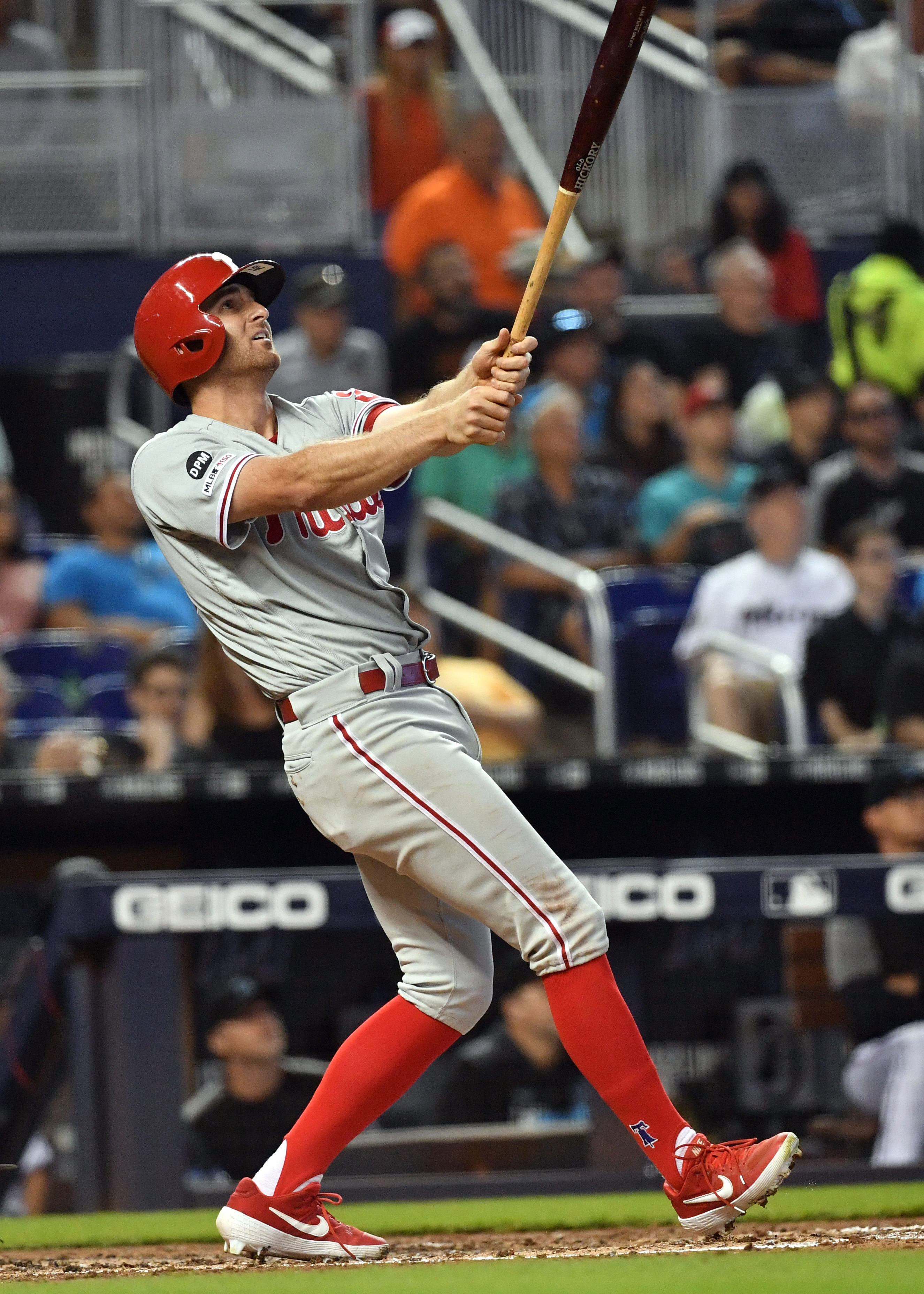
Over the past three years, Miller has played on a one-year, $1MM deal in Cleveland, a one-year, $2.5MM deal in St. Louis and a one-year, $3.5MM deal in Philadelphia. Those three teams have guaranteed a combined $7MM to Miller and received 40 home runs through 718 plate appearances, with an overall batting line of .236/.331/.480. Obviously, the batting average isn’t ideal, but the leaguewide average during that time is .248 (or .251 excluding pitchers). Miller hasn’t been that much below par in terms of his batting average, and he’s above average in terms of on-base percentage and, particularly, in his power output.
This isn’t to say Miller should be lumped into the mix of most appealing free-agent bats available. He’ll play the coming season at age 32, making him older than the market’s high-profile names, and his skill set has obvious flaws. We’ll get those out of the way first.
Miller’s lefty bat has been a nonfactor against southpaw pitchers, evidenced by a .168/.230/.336 output over the past three seasons. He’s punched out in nearly 38% of his plate appearances when facing same-handed opponents. It’s not a new phenomenon, as Miller’s career numbers indicate, but his struggles against lefties have increased in recent years, even as his output against righties has improved.
Defensively, Miller is something of a man without a position. His days as a shortstop early in his big league career never yielded strong ratings from metrics like Defensive Runs Saved and Ultimate Zone Rating. More rudimentary marks like fielding percentage and his error totals agreed that Miller probably wasn’t well-suited as an everyday shortstop. That’s all the more true as he trends toward his mid-30s. Miller has seen plenty of action at first base, second base, third base and in the outfield corners over the past few seasons; his best statistical showings in those relatively small samples have come at second base and in left field. He’s not a premium defender anywhere, but Miller can capably handle those two spots and fill in as needed around the diamond.
Setting aside those noted deficiencies, there’s one thing thing Miller also does quite well: mash right-handed pitching. Over the past three years, Miller has hit .251/.352/.512 against right-handed pitchers — good for a 127 wRC+ that ranks 47th among the 321 hitters who’ve tallied at least 400 plate appearances (that is to say, he’s been about 27% better than the league-average hitter). At least against right-handed pitching, that wRC+ puts him alongside heavy-hitting names like Jose Ramirez (126), Carlos Correa (126) and Marcus Semien (129). Miller obviously isn’t as good overall as anyone in that trio, and it’s not realistic to shield him from left-handed opponents entirely over the course of a season. Nevertheless, the damage he offers against right-handed pitching is real.
The productivity when holding the platoon advantage doesn’t appear fluky in nature, either. Miller has walked in 12.9% of his plate appearances against a more defensible 26.3% strikeout rate. His .293 average on balls in play doesn’t scream for regression. A quarter of his fly-balls against righties have left the yard, which is a strong mark — 19th among that previous subset of 321 hitters, right alongside George Springer and Nelson Cruz — but not so lofty that one should expect it to come crashing back down in a major way.
Moreover, the general quality of Miller’s contact is excellent. His 2021 percentile ranks in average exit velocity (91st), max exit velocity (91st), hard-hit rate (84th) and barrel rate (80th) all stand out. He’s also above average in terms of sprint speed (62nd percentile) and in his ability to lay off pitches outside the strike zone (71st percentile both in 2021 and in 2020). Miller’s contact rate on pitches in the zone is a good bit shy of the league average (about five percentage points), but he’s not going to get himself out too often by flailing at pitches off the plate.
Miller’s flaws are easy to see, and again, the point of this certainly isn’t to suggest he will or should be paid along the same lines as Kyle Schwarber, who just put up a fireworks display for the ages when healthy in 2021. But Miller’s .251/.352/.512 slash against righties over the past three seasons is a whole lot closer to Schwarber’s .247/.348/.555 slash against righties in that same time than their eventual price tags will suggest, and Miller has actually been a much better hitter against righties than free agents like Joc Pederson and Eddie Rosario in recent seasons. Fans looking for left-handed bats might not have Miller high on their wishlist, but when used properly, his production is closer to some of the bigger names than most would expect. Whether the market will treat him as such this time around is yet to be determined, but the forthcoming addition of a universal designated hitter won’t hurt his stock.
Yankees Notes: O’Neill, Infield, Beck
The Yankees announced yesterday that they’ll retire Paul O’Neill‘s No. 21 this season on Aug. 21. “The Warrior” won four World Series rings in the Bronx, manning right field and serving as a formidable force in the heart of many stacked Yankees lineups throughout their most recent run of dominance in the American League. O’Neill spent nine seasons as a Yankee, spanning 1993 to 2001, batting a combined .303/.373/.492 with 185 home runs. A four-time Yankees All-Star who garnered MVP votes in each of those four seasons, O’Neill also thrived in the postseason with the Yankees — evidenced by a .282/.355/.459 output and 26 extra-base hits in 304 plate appearances.
A couple more notes out of the Bronx…
- Kristie Ackert of the New York Daily News takes a look at the Yankees’ unsettled infield mix, noting that Gleyber Torres‘ regression both at shortstop and with the bat leave the team with a good bit of uncertainty. DJ LeMahieu tells Ackert he’s comfortable playing at any of first base, second base or third base, but his bat best fits at second if LeMahieu’s own regression at the dish cannot be fully recovered from. Torres did post a .300/.372/.443 line in 19 games after the Yankees finally cut the cord on his time at shortstop late last season, though opinions surely vary on whether that was correlation or causation. Regardless, the downturns at the plate for both Torres and LeMahieu are troubling for a team that still needs to address its need at shortstop and is also trying to figure out who’ll man first base for the 2022 season.
- Right-hander Brendan Beck, the Yankees’ second-round pick from the 2021 draft, will miss most (if not all) of the 2022 season after quietly undergoing Tommy John surgery last summer, ESPN’s Kiley McDaniel reports (Twitter link). The Stanford product had been gearing up for his pro debut in A-ball when he incurred the injury. Beck, 23, notched a 3.15 ERA with a 32.6% strikeout rate and 5.9% walk rate in 108 2/3 frames in his final season with Stanford. Baseball America ranked him 12th among Yankees farmhands on their midseason prospect rankings last summer, but his pro debut will now likely be on hold until the 2023 season, at which point he’ll be 24 years old. While that hardly makes it too late for him to develop as expected, it’s a considerably older starting point than most prospects get on their pro careers.
Padres Among Teams Interested In Matt Olson
Whenever transactions are again permitted to take place, A’s first baseman Matt Olson is among the most prominent names who’ll be discussed on the trade market. The 2021 All-Star and two-time Gold Glover has already been linked to the Yankees, Rangers and Braves, among others, and Dennis Lin of The Athletic suggests in his latest mailbag column that the Padres figure to be “in the mix” on Olson as well. President of baseball operations A.J. Preller has already at least touched base with the Oakland front office as part of a broader sweep of exploratory trade talks throughout the league, per Lin.
Interest notwithstanding, the Padres seem like a long shot to actually pull off a deal involving Olson for myriad reasons. San Diego already has Eric Hosmer installed at first base and signed for another four seasons at a total of $59MM. The Friars have reportedly pursued various trade scenarios involving Hosmer in an attempt to create payroll flexibility and reduce their luxury-tax ledger, but those efforts have unsurprisingly come up short.
Hosmer’s eight-year, $144MM deal with the Padres was widely panned from the start, and the first baseman’s tepid .264/.323/.415 batting line (99 wRC+) since signing hasn’t made the final four years of the contract any more appealing (though it should be noted that the contract is frontloaded, with Hosmer earning $20MM in 2022 and $13MM annually from 2023-25).
The universal designated hitter is viewed as something of a foregone conclusion by now, so one can imagine a scenario where Hosmer spends more time at DH and Olson plays first base. However, that’d still move the Padres’ payroll north by a good margin. Olson is projected by MLBTR contributor Matt Swartz to earn $12MM in 2022 before commanding one more raise in his final arbitration season in 2023. San Diego already has about $199MM on the books for the 2022 season, per Roster Resource’s Jason Martinez, in addition to about $215MM worth of luxury-tax obligations. The Padres narrowly exceeded the luxury tax in 2021, but it’s unclear whether they’d be willing to do so again in 2022 — particularly if it’s by a larger margin. Lin notes that owner Peter Seidler has “steadfastly declined” to discuss payroll and luxury tax to this point.
That $215MM figure is a substantial factor in the Padres’ reported efforts to move Hosmer and/or right fielder Wil Myers (who’s owed $21MM in the final season of a six-year, $83MM extension himself). Perhaps if the Padres could find a way to shed one or both salaries, the subsequent luxury breathing room could then be make a potential Olson acquisition more feasible. That, however, would require time to be on the Padres’ side — which is not the case. Post-lockout transactions are expected to be frenetic, and it doesn’t figure to be easy for Preller & Co. to find a trade involving Hosmer or Myers. The San Diego front office has been investigating trades involving the pair for at least the past year, after all — and longer than that with regard to Myers. If an Olson acquisition is predicated on moving Hosmer and/or Myers, it’s hard to imagine there’d be time to complete that deal then circle back to the A’s.
Some might suggest that the Padres simply try to send Hosmer back to Oakland as part of a deal, offering better prospects in return to push a deal across the finish line. That scenario appears decidedly unlikely, though. The cost on Olson figures to be sky-high in the first place, and the driving factor behind Oakland’s ostensibly looming sell-off is a desire to pare payroll. Taking on Hosmer’s deal runs counter to that. Lin speculates that the Padres could try to engineer a three-team swap that places Hosmer with a third team and Olson in San Diego, but that’s obviously an even more ambitious undertaking than simply finding a taker for Olson in a more straightforward two-team deal.
One wild card in all of this is the uncertainty surrounding the status of the luxury tax/competitive balance tax itself. The tax thresholds are a key talking point in collective bargaining talks between the league and the Players Association. The MLBPA is seeking major increases to the tax thresholds, beginning with a jump all the way to $245MM this coming season and cresting with a $273MM threshold in 2026. The league, meanwhile, has only been willing to offer far more marginal increases: $214MM in 2022-23 and incremental increases up to $222MM in 2026. MLB is also seeking to greatly increase the penalties for crossing the threshold, which the MLBPA considers a nonstarter.
[Related: Latest Collective Bargaining Positions For MLB, MLBPA]
It’s possible that whatever middle ground is reached will come with enough of an uptick in the first threshold that the Padres could technically squeeze Olson into the fray without needing to pay the tax. However, the Padres are also facing needs elsewhere on the roster — namely in one corner outfield spot. If the hope is to add an outfielder and/or deepen the pitching staff or bench at all, then San Diego would be looking at shoehorning more than just Olson’s salary into the puzzle.
All of that is based on a theoretical stance that Padres ownership is deterred by the luxury tax alone, but we can’t know that for certain. Last year’s bottom-line payroll of nearly $174MM shattered the former franchise-record payroll by more than $60MM. The current $199MM projection further trounces that number, and adding Olson and any others to the mix would bring the Padres well north of $200MM in actual 2022 salaries (and quite a bit higher in terms of AAV-based luxury calculations). It would require an unprecedented level of spending for the Padres, and we can’t know at what point ownership will simply be uncomfortable with further expenditures. It’s possible they’ve already reached that juncture.
To sum up a bit, there’s good reason to expect the Padres will indeed try to make something happen on the Olson front. Preller has shown time and again that he’ll always explore creative options when marquee talents are available. San Diego hired manager Bob Melvin away from the A’s earlier this offseason, and Melvin would surely love to have his former franchise first baseman follow him down I-5. If the Padres were to somehow move Hosmer, they’d have an opening at first base. It all makes sense on paper, and various permutations of Olson-to-San Diego deals or three-team blockbusters involving Olson, Hosmer, Myers and top prospects make for fun hypotheticals with Major League transactions approaching a three-month standstill.
At the end of the day, however, there are so many moving parts involved even in these theoretical exercises that it’s hard to see the Padres finding a way to make the pieces work. Still, even a tangential Padres involvement in the Olson market is of some note. Their lurking presence could carry implications on the asking price Oakland can put forth to other clubs, and if trade talks with other suitors drag on long enough post-lockout, it’d only give the Padres more time to pull off their latest trade-market stunner.
MLBTR Chat Transcript
Click here to read a transcript of Tuesday’s chat with MLBTR’s Steve Adams.
White Sox, Dwight Smith Jr. Agree To Minor League Deal
The White Sox have signed outfielder Dwight Smith Jr. to a minor league contract, reports Chris Hilburn-Trenkle of Baseball America. They’ll be the fourth Major League organization for Smith, who’s repped by Wasserman.
The son of former big league outfielder and 1995 World Series champion Dwight Smith, the younger Smith was the No. 53 overall draft choice by Toronto back in 2011. He ranked between 14th and 28th among Jays farmhands each season from 2012-16, per Baseball America, and Smith hit the ground running in his first few big league looks. In a small sample of 104 plate appearances from 2017-18, he batted .294/.365/.467 and earned his way into the team’s outfield mix. That showing helped prompt the Orioles to trade for Smith in a deal that sent international bonus allotments back to Toronto.
In 2019, Smith’s first season with the O’s, he saw a career-high 392 plate appearances over the course of 101 games. He got out to another hot start in Baltimore, beginning the year on an eight-game hitting streak and carrying a hearty .286/.333/.510 batting line with eight home runs, nine doubles and four stolen bases through his first 159 trips to the plate. Smith looked to be a pretty sound low-cost pickup at the time, but his bat wilted as the season wore on. From May 15 through season’s end, he hit just .210/.273/.343 through 233 plate appearances, and his .222/.306/.365 slash in 72 plate appearances in 2020 wasn’t much better.
Smith was designated for assignment by Baltimore in Aug. 2020 and went unclaimed on waivers. He was outrighted to the team’s alternate site in the pandemic-shortened season and became a minor league free agent at season’s end. Smith inked a minor league deal with Cincinnati last winter, but he scuffled with a .221/.327/.284 slash in 147 plate appearances with their Triple-A affiliate before being released.
Now 29 years old, Smith has had some big league success but has yet to find much in the way of consistency. He’s a lifetime .248/.310/.316 hitter in 568 big league plate appearances and a .266/.351/.392 hitter in 1006 Triple-A plate appearances. It’s unlikely that the Sox view him as a primary candidate to factor into their right field mix this coming season, but he’ll be a depth option who’ll join a corner-outfield mix already featuring Eloy Jimenez, Andrew Vaughn, Adam Engel, Gavin Sheets and out-of-options prospect Micker Adolfo. The South Siders are expected to pursue further corner options once the league lifts the current transaction freeze, which would push Smith further down the depth chart.