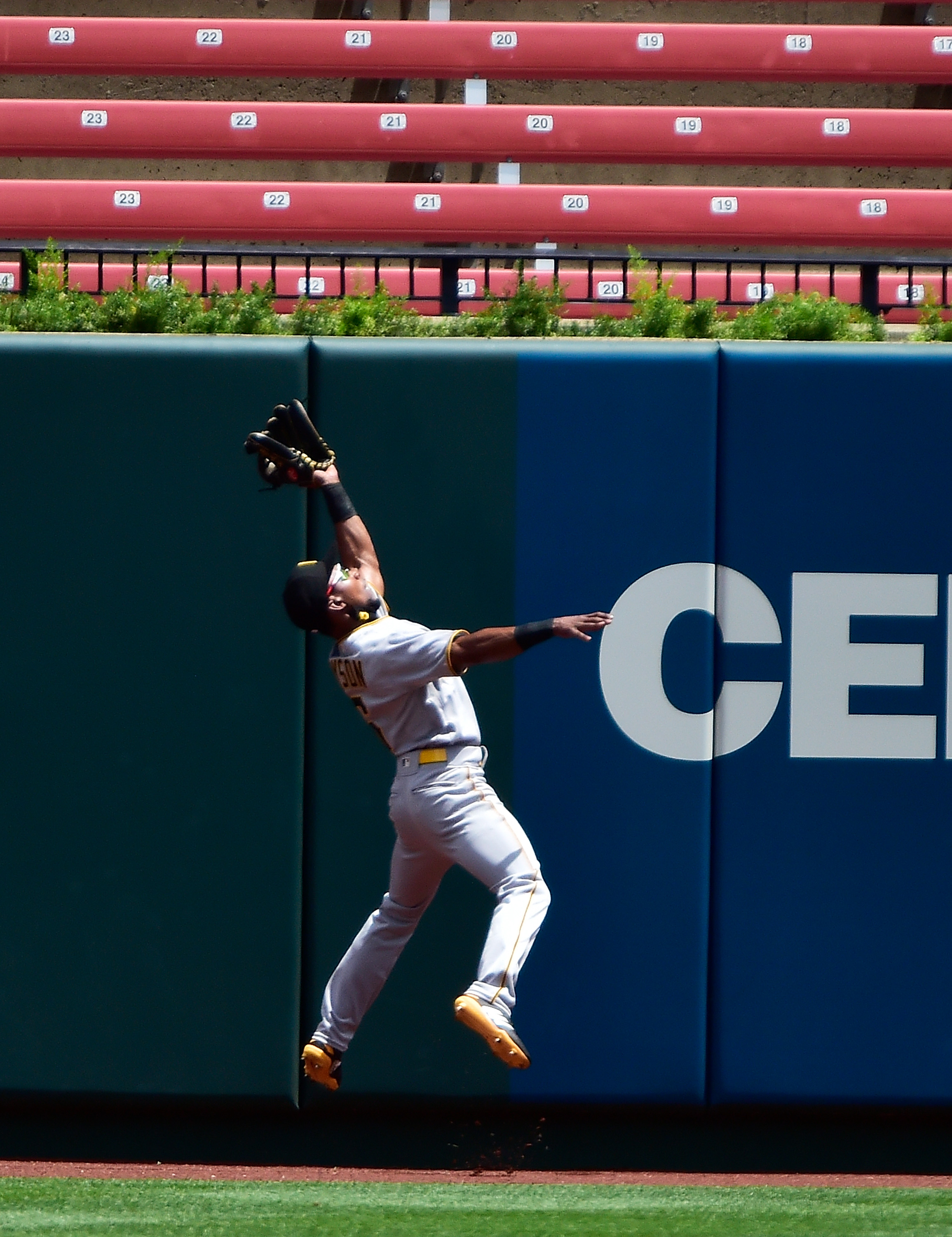
Multiple Teams Now Showing Interest In Eduardo Escobar

July 2: While a deal sending Escobar to the ChiSox was in the works recently, Heyman tweets that multiple other clubs jumped into the mix this week and began showing interest, which has slowed the process. An eventual Escobar trade still feels inevitable, given his status as a pending free agent on MLB’s worst club.

June 28: The White Sox and Diamondbacks have been discussing a potential Eduardo Escobar deal for the past week, and it seems as though talks could be accelerating. USA Today’s Bob Nightengale, who initially reported the talks between the two sides, suggests in his latest notes column that the D-backs are “on the verge” of starting a sell-off that will begin with an Escobar trade. MLB Network’s Jon Heyman tweets this morning that the two sides have made “progress” in a trade that would send Escobar from the D-backs to the ChiSox — the organization that originally signed Escobar out of Venezuela back in 2006.

Escobar is a sensible target for a Sox club that has lost Nick Madrigal for the season and now faces a notable hole at second base. The 32-year-old Escobar has spent more time at third base in recent years but has logged 227 innings at second base in 2021 and carries 849 career innings at the position. He’s also emerged as a reliable source of power and, over the past six weeks, been on a tear at the plate.

The switch-hitting Escobar fell into a considerable slump in early May, with his OPS bottoming out at .655 on May 14. In 152 plate appearances since that time, he’s mashed at a .306/.342/.563 clip with 10 homers, five doubles and a triple. That hot streak has boosted his season batting line to a respectable .253/.298/.481 and bumped his 2021 home run total up to 17. Escobar’s walk rate is down to 6.1 percent — a drop of some note from its 8.2 percent peak in 2018 — and he’s striking out at a career-high 22 percent clip. That’s still below the league average in today’s brand of strikeout-centric baseball, however.

Escobar is earning $7.5MM in 2021 — the final season of a three-year, $21MM contract extension he signed with Arizona in lieu of his first trip to the free agent market back in 2018. There’s still about $3.9MM yet to be paid out on that salary between now and season’s end. While rental players aren’t always ideal for contending clubs, it’s a rather sensible route for the Sox to take with regard to their infield needs. Yoan Moncada is locked in as the long-term answer at third base in Chicago, and the White Sox expect Madrigal back in 2022.

If a deal does ultimately get pushed across the finish line, Escobar would figure to be the first of multiple additions for a White Sox team that is in first place despite several injuries to key contributors. Eloy Jimenez hasn’t played in a game this season after suffering a ruptured pectoral tendon during a Spring Training game, and Luis Robert has been out since early May with a Grade 3 hip flexor strain. Fellow outfielders Adam Eaton and Adam Engel, meanwhile, are on the shelf owing to hamstring strains — the second of the season in Engel’s case.

As for the D-backs, Escobar is one of many veteran pieces who could change hands between now and the July 30 trade deadline. Asdrubal Cabrera, another pending free agent, seems all but assured to move. Outfielder David Peralta and right-hander Merrill Kelly are both affordably signed through the 2022 season. Backup catcher Stephen Vogt and reliever Joakim Soria aren’t having their best seasons, but they’re both impending free agents with solid track records and reasonable $3.5MM salaries. Ketel Marte, of course, is the Diamondbacks’ premier trade chip, as he’s controlled all the way through the 2024 season. That said, he’s also dealing with a hamstring issue and is undergoing additional imaging today as the team continues to evaluate that injury.

Indians, Wilson Ramos Agree To Minor League Contract

The Indians and Wilson Ramos are in agreement on a minor league contract, Daniel Alvarez Montes of El Extra Base reports (via Twitter). Presumably, the Octagon client will head to Triple-A Columbus once the deal is formally announced.

Ramos, 34, inked a one-year deal worth $2MM with the Tigers over the winter and opened the season as their primary catcher, but his production crumbled after a hot start to the year. The former All-Star homered in six of his first nine games with the Tigers, batting .281/.343/.875 through his first 37 plate appearances with the club. He wasn’t able to sustain anywhere near that level of offensive output, however, and over his next 91 plate appearances the veteran slugger managed only a .170/.198/.216 batting line.

Ramos made two trips to the injured list due to back strains during his short time with the Tigers organization. He was designated for assignment upon being reinstated from his second IL stint, and he was released five days later after clearing waivers.

For several years, Ramos was regarded as one of the better-hitting catchers in the game. His peak performance, from 2016-18, saw him post a combined .298/.343/.483 slash in 1163 plate appearances. That offensive ability helped to balance out a dwindling defensive reputation, but in recent years, the downturn in his glovework has become more glaring as his offense has also begun to deteriorate. Ramos was a roughly league-average hitter in two seasons with the Mets but began to lose playing time to the defensively superior Tomas Nido. Over the past three seasons, Ramos carries just a 16 percent caught-stealing rate, sub-par framing metrics and an overall -16 mark in Defensive Runs Saved.

Ramos’ early surge in 2021 offered a glimpse of life in his bat, and he’s only a couple years removed from a .288/.351/.416 showing as the Mets’ primary catcher. The Indians are currently relying on the defensively strong but offensively challenged combination of Austin Hedges and Rene Rivera behind the plate; Ramos brings something of the opposite skill set to their depth chart, although it’s been a couple years since we’ve seen sustained production from him at the plate. Roberto Perez, the Indians’ starter behind the dish, has been out since early May after undergoing surgery to repair a broken finger, but he’s been working through a minor league rehab assignment and could return in the coming days.

Diamondbacks Trade Tim Locastro To Yankees

The Yankees and Diamondbacks announced an agreement on a trade sending outfielder Tim Locastro from Arizona to New York in exchange for minor league right-hander Keegan Curtis.

Tim Locastro | Mark J. Rebilas-USA TODAY Sports

Locastro, 28, is one of the fastest players in the Majors and gives the Yankees a potential outfield option, though he’s in the midst of a rough year at the plate. After slashing .290/.395/.464 in 82 plate appearances with the D-backs in 2020, Locastro is hitting just .178/.271/.220 in 133 trips to the plate so far in 2021.

Overall, the fleet-footed Locastro a career .234/.339/.324 hitter who has gone 31-for-34 in stolen base attempts. Locastro strikes out at a below-average clip but doesn’t walk as much as one might expect; rather, the source of his OBP is a penchant for getting plunked (as explored at length and in entertaining fashion in one of the many indispensable videos at Foolish Baseball). For a player with Locastro’s speed, getting to first base by any means necessary is particularly valuable, as he’s always a threat to swipe a base.

It’s not the impact move most Yankees fans would hope to see with the their first move of deadline season, but Locastro gives the club a strong glove and some needed depth. Aaron Hicks has already been lost for the season, and fellow outfielder Clint Frazier is now undergoing testing after exiting last night’s game due to dizziness. Locastro can still be optioned for the remainder of the 2021 season and is controllable through the 2024 campaign via arbitration.

For the D-backs, Locastro figures to be the first of several players traded between now and July 30. They’ve been MLB’s worst club by a wide margin and are generally expected to be willing to listen on veteran players as they look to restock the farm system.

The 25-year-old Curtis, while not regarded as one of the Yankees’ top prospects, does give the Snakes an interesting arm to add to the upper levels of their system. Since being selected in the 22nd round of the 2018 draft, Curtis has tallied 65 2/3 innings out of the bullpen and pitched to a 3.29 ERA across three levels in the Yankees’ minor league ranks. He’s currently at the Double-A level, where he’s posted a 3.94 ERA while punching out 27 of the 69 batters he’s faced (39.1 percent) against seven walks (10.1 percent).

Lindsey Adler of The Athletic (Twitter link) first reported the terms of the agreement.

Steinbrenner: Yankees “Not Contemplating” Selling At Deadline

The Yankees’ season of underwhelming reached a crescendo with a stunning loss last night that saw them blow a four-run lead by yielding seven runs in the ninth inning. New York currently sits at 41-39 with a -3 run differential, an 8.5-game deficit in the AL East and a 5.5-game deficit in the AL Wild Card race. There’s been plenty of speculation about the team selling off some veteran pieces prior to the July 30 trade deadline, but Hal Steinbrenner made clear today when addressing reporters that he has no such plans.

“That’s not a direction I’m contemplating,” Steinbrenner said when asked whether the Yankees might be deadline sellers (Twitter links via Newsday’s Erik Boland). To the contrary, it seems rather that Steinbrenner expects his team will work to improve. The Yankees have taken plenty of flak for being the game’s most valuable franchise but staunchly refusing to exceed the luxury tax for a third straight season. Steinbrenner now, however, says he’ll consider crossing that line at the deadline if it gets his team over the edge.

The Yankees currently sit just under $4MM shy of the $210MM luxury barrier, per Roster Resource’s Jason Martinez, and it’s no coincidence that they so narrowly managed to limbo under that bar. The vast majority of the Yankees’ offseason moves made ownership’s desire to avoid that line transparent. The club targeted Jameson Taillon and his $2.55MM salary as its second rotation piece after inking Corey Kluber for a year and $11MM. The Yanks also traded right-hander Adam Ottavino to the archrival Red Sox in a trade that lopped around $8MM off their luxury obligations. (Ottavino, conversely, has pitched quite well for the first-place Red Sox.)

Late signings of Justin Wilson, Darren O’Day and Brett Gardner were all structured to include player options which were unlikely to be exercised but nevertheless lowered the luxury commitment on those additions because player options count as “guaranteed” money and thus drop a contract’s average annual value. From the jump this past offseason, nearly every decision the Yankees made was colored by a desire to drop under the luxury barrier.

If the Yankees do indeed end up crossing the line, the question will naturally be one of whether it’s too little or too late. Exceeding the barrier will come with the maximum dollar-for-dollar tax rate possible on any overages: 50 percent for the first $20MM, 62 percent for the next $20MM and 95 percent for any spending thereafter. It’s unlikely at this point that they’d spend to reach the top level of penalization, of course, but exceeding the tax this year would again subject the Yankees to luxury penalization in 2022 — assuming some iteration of the current system remains in place after the expiration of the 2016-21 collective bargaining agreement. Were they to remain under the tax, they’d “reset” their penalty level and only be subject to the first tier of luxury payments in 2022.

Steinbrenner also voiced confidence in general manager Brian Cashman, manager Aaron Boone, and the team’s coaching staff (Twitter links via Kristie Ackert of the New York Daily News and MLB.com’s Bryan Hoch). Steinbrenner noted that his GM has “done a good job” assembling the roster and praised his communication skills, scouting acumen and knowledge of analytics while suggesting that a clearly talented roster simply hasn’t performed up to standards. As for Boone and the coaches, Steinbrenner called them “absolutely” the right people to lead the team.

Yankee fans who’ve followed the team since Hal’s father, George, was running the ship are no doubt aware of the likelihood that the elder Steinbrenner would’ve cleaned house in the front office and the dugout by now. But Steinbrenner emphasized that he’s his own person while pointing out that oftentimes, his father’s more rash personnel decisions didn’t actually pay dividends.

On the whole, Steinbrenner’s comments are something of a mixed bag for Yankee fans. While many are surely relieved to hear that the club will finally consider exceeding the tax line, there’s no doubt frustration that said point wasn’t arrived upon back in the offseason. As with any struggling team, fans have become increasingly frustrated with the front office and field staff alike, so the vote of confidence in Cashman and Boone may not be as popular as it once would’ve been.

Nevertheless, Steinbrenner’s comments are telling of the Yankees’ direction not only over the next 30 days but perhaps in the coming offseason and beyond. A prolonged losing streak could ultimately change the organization’s calculus, but for the time being it seems we should expect today’s pickup of outfielder Tim Locastro in a small trade with the Diamondbacks to be the first of multiple acquisitions as the Yankees look to change their fortunes in what has been a challenging 2021 campaign.

Twins Designate Matt Shoemaker For Assignment

The Twins announced this morning that they’ve designated veteran right-hander Matt Shoemaker for assignment and selected the contract of righty Derek Law from Triple-A St. Paul in a corresponding move.

Shoemaker, 34, tossed a quality start in his Twins debut earlier this year, but it’s been all downhill from there for the most part. The former Angels and Blue Jays righty has been shelled for 53 earned runs in his past 54 1/3 innings and is sitting on an overall 8.06 ERA and 5.38 SIERA with just a 14.1 percent strikeout rate against a 9.5 percent walk rate. The Twins may have had some hope after a move to the bullpen produced moderately better results, but Shoemaker served up eight runs in 2 2/3 frames of mop-up work in last night’s loss.

Signed to a one-year, $2MM deal late in the offseason, Shoemaker was viewed as the likely fifth starter to open the season and a necessary depth addition in a season where workloads were expected to be monitored leaguewide. But his struggles, paired with those of fellow veteran J.A. Happ and fellow back-of-the-rotation option Randy Dobnak, have helped to dig the Twins into a sizable hole. Many of the organization’s top pitching prospects have been hit by injuries in 2021 as well, which pushed the team to continue trying to coax something out of Shoemaker rather than make a move earlier in the year.

The Twins will have a week to trade Shoemaker, pass him through outright waivers or release him. Given his struggles, it’s not reasonable to expect another club having interest in a trade or waiver claim. In all likelihood, today’s DFA will lead to a release. However, given his track record prior to the 2020 season, it’s possible another organization will take a no-risk look at the veteran righty on a minor league deal in hopes that a change of scenery can right the ship. Shoemaker has had myriad injury issues in his career, but he had a nice run with the Halos earlier in his career and, prior to signing in Minnesota, had pitched to a 4.12 ERA in his most recent 166 MLB frames.

As for the 30-year-old Law, he’ll return for a second Twins stint in 2021 in hopes of better results than he produced in his first go-around. Law appeared in five games for the Twins already, yielding six runs on 11 hits and six walks with nine strikeouts in 6 1/3 innings. He’s been a bit better in Triple-A, where he has a 4.61 ERA and 12-to-4 K/BB ratio in 13 2/3 innings. It could be another quick stint for Law, as the Twins called him up in part to get a fresh arm in the ‘pen, but he’ll at least have another opportunity to show he can stick on the roster.

Law posted a 2.55 ERA in 55 innings as a rookie with the Giants back in 2016 but has never replicated that success. In 117 2/3 frames since that time, he’s been tagged for a 5.43 ERA with a passable 22.2 percent strikeout rate but an untenable 12.3 percent walk rate.

The Twins Are One Of The Keys To The Trade Deadline

The Twins have looked like sellers for much of the season, but as we’ve seen in recent years, most clubs prefer to wait until closer to the deadline to chart a course. As noted here recently, Minnesota faces almost exclusively AL Central clubs leading up to the July 30 trade deadline. If there was a 2019 Nationals-esque surge in this group, now would be the time to set it in motion.

The Twins started off taking two of three against an Indians club whose rotation is in tatters, but they’ve dropped their first two against the White Sox to fall 13.5 games out of first place in the division. For a team that needs to be nearly flawless over this pivotal stretch of divisional opponents — particularly versus Cleveland and Chicago — dropping three of the first five games isn’t a great start.

Given that this was a team most expected to contend for the Central, at the very least, it’s not at all surprising that there are several players who’d interest contenders. In fact, ESPN’s Jeff Passan wrote in yesterday’s 20 Questions column that the Twins are “the team almost every contender is waiting on.” Minnesota still plays the White Sox eight times, the Tigers a whopping 11 times and the Royals three times before the trade deadline, so maybe they can pull off the macro version of last night’s staggering Angels comeback, but it’s becoming increasingly likely that this goes the direction most onlookers have expected for awhile now.

With that in mind, let’s take a look at what the Twins could do as the deadline draws nearer…

The Rentals

Michael Pineda, RHP ($10MM salary): Pineda is currently on the shelf with inflammation in his right elbow. He’s been out since June 14, but he’s slated for a rehab start in Triple-A today. Assuming there are no setbacks, Pineda would be one of the most attractive options on the rental market. He’s an established mid-rotation arm who has performed well with the Twins when he’s been able to take the mound (3.86 ERA, 3.92 FIP in 228 2/3 innings over 42 starts). Pineda did get hit with a PED suspension in 2019, although it was one of the rare instances where the league seems to have believed some of his plea of innocence, as MLB reduced his ban from 80 to 60 games. Many undoubtedly recall Pineda’s pine tar-covered hat in his Yankees days and will wonder about him in connection to the current crackdown on foreign substances. On that note, it’s worth pointing out that his spin rates were below-average in the first place and had actually decreased since signing with the Twins. We can’t know anything for sure, of course, but on paper he doesn’t look like your typical “Spider Tack” case.

Nelson Cruz, DH ($13MM): Happy 41st birthday, Nelson! The Boomstick is still swinging it as well as ever, slashing .307/.378/.585 with 18 home runs, 11 doubles and his first triple since 2018. Cruz has been 57 percent better than a league-average hitter, per wRC+, and he’s cut his strikeout rate from 25.7 percent in his first two years with Minnesota down to 19.1 percent in 2021. His market will be limited to AL clubs unless some NL GM really, really wants an interleague/World Series DH and an occasional pinch-hitter. (We’ve all learned never to rule anything out with A.J. Preller by now.) AL contenders who could use an upgrade at DH include the A’s, Blue Jays, Rays and White Sox. Of course, Cruz’s salary may be steep for the A’s and Rays, and it’s hard to imagine the Twins shipping Cruz to their top division rival.

Andrelton Simmons, SS ($10MM): Simmons hasn’t been great with the bat in Minnesota — .245/.316/.328, 81 wRC+ — but the defense looks sharp. Simmons’ defensive metrics took a tumble in both 2019 and 2020 after he suffered a Grade 3 ankle sprain and then re-sprained that ankle a second time. In 2021, he’s third among all players, regardless of position, with 12 Outs Above Average, per Statcast. He’s also notched a plus-2 mark in Defensive Runs Saved after registering minus-2 in that regard in just 265 innings last summer. The ankle appears healthy, and his range has seemingly improved as a result. If you want to upgrade your infield defense, they don’t come much better than this.

Alex Colome, RHP ($6.25MM): Colome was the Twins’ biggest offseason pickup in the bullpen, but the outstanding fortune he had on balls in play with the White Sox went up in smoke in 2021. Teams were surely wary of Colome’s .211 average on balls in play over the past two seasons with the ChiSox, which quite likely why the Twins were able to wait him out and get him for just a year and $6.25MM. Colome immediately stumbled out of the gates in Minnesota, blowing a game in his first appearance and floundering through a poor overall showing in April. He’s posted a respectable 3.60 ERA with a huge 58.1 percent grounder rate in 20 innings since, but he doesn’t look anywhere near as impressive as he did for the South Siders. Presumably, the asking price here wouldn’t be too high.

Hansel Robles, RHP ($2MM): Robles’ numbers would’ve looked better had this breakdown been written before his past two appearances, when he’s been tagged for four runs in two innings. But the right-hander is still sporting a 3.63 ERA and 48.3 percent ground-ball rate — albeit with a slightly below-average strikeout rate and a bloated 13.6 percent walk rate. He’s also experienced a rebound in fastball velocity after a dip in 2020, and he’s on a cheap enough contract that a contending club with luxury tax concerns might be particularly intrigued.

J.A. Happ, LHP ($8MM): Happ got out to a decent start in 2021, but he’s been shelled for most of his past nine appearances. His best performance in that stretch was his most recent, when he held Cleveland to a pair of runs on six hits and no walks with seven punchouts in six innings. If he can string together a few more nice outings like that, maybe some club would pick him up for a negligible return (i.e. partial salary relief) to try to stabilize the back of its rotation.

More Controllable Possibilities

Jose Berrios, RHP ($6.1MM, controllable through 2022): If the Twins were to make Berrios available, he might be the most coveted name on the market. Derrick Goold of the St. Louis Post-Dispatch reported recently that the Cardinals have inquired and, unsurprisingly, found the asking price to be quite high. Still, Passan writes that a growing number of executives around the game expect the Twins to be willing to seriously consider a trade. That’s likely indicative of the level of interest in Berrios, as the Twins don’t seem likely to embark on a total rebuild even if they do sell. They’d likely seek young controllable, big-league ready talent in a trade of Berrios, who boasts a 3.41 ERA and matching 3.40 FIP with a career-best 26.5 percent strikeout rate and a 6.4 percent walk rate (the second-lowest of his career). His current salary is eminently affordable, and even with an aggressive raise in arbitration, he’d still be a bargain next year. Any contending club would love to have Berrios — it’s just a matter of how strong the offers are and whether the Twins are willing to compromise their 2022 roster by trading the best pitcher they’ve developed in the past decade.

Taylor Rogers, LHP ($6MM, controllable through 2022): Rogers has put a shaky (by his standards) 2020 season behind him. Through his first 32 innings, he’s sitting on a 2.53 ERA that’s actually higher than his FIP, xFIP and SIERA. Rogers’ 32.6 percent strikeout rate is back in line with his 2019 level, and this year’s 3.9 percent walk rate is the best of his career. He has the fifth-best chase rate of any qualified reliever in MLB. As with Berrios, Rogers could play a key role for the 2022 Twins, so the offer would need to  be strong. But relievers with this combination of swing-and-miss ability and command — particularly lefties — are tough to come by, so the demand will be sizable. This is also a Twins front office that generally hasn’t been keen on committing too much to any individual reliever, and Rogers’ final arbitration raise will push his salary into the $8-9MM range. A trade to a contender is very plausible. (As an aside, it’d be quite the fun story to see twin brothers co-closing games for a contending club. We’re all looking at you, Giants.)

Tyler Duffey, RHP ($2.2MM, controllable through 2022): Duffey hasn’t been the dominant setup man he was in 2019-20, but he’s controlled another season on a cheap salary and has still been effective in 2021. There’s no sugar-coating that his strikeout and walk rates from 2019-20 have dropped from 34.2 percent and 6.1 percent, respectively, to 22 percent and 12.6 percent in 2021. He’s improved both a bit over his past 15 outings, though, and only allowed two runs in that time. Overall, he has a 3.52 ERA and 3.84 FIP in 30 2/3 innings. As with Robles, if you’re a contending team with luxury tax concerns, taking a chance on a cheap reliever with a bigger track record probably has some appeal.

Caleb Thielbar, LHP ($700K, controllable through 2024): A Minnesota native and feel-good comeback story from 2020, Thielbar can be controlled another three years beyond the current campaign. That might make dealing him counterintuitive should the Twins be looking for a quick turnaround after a theoretical summer sale, but Thielbar will turn 35 this offseason and relievers are volatile in the first place. The Twins brought him back from indie ball last year, so there’s a “playing with house money” element to marketing him. He’s pitched 50 1/3 innings of 2.86 ERA ball with a 30.1 percent strikeout rate and an 8.1 percent walk rate since returning last summer. Fielding-independent metrics largely support the ERA. With multiple contenders sitting right on the luxury-tax precipice, Thielbar could be an under-the-radar but highly attractive chip for the Twins.

Longer Shots

Like Berrios, Rogers and Duffey, Byron Buxton is controlled only through the 2022 season. However, Buxton is on the injured list after an errant fastball fractured his left hand in a recent at-bat, and it’s nearly impossible to envision the Twins moving their most talented player at such a low point. The durability concerns with Buxton are understandable, and his repeated absences in 2021 have been a major factor in the Twins’ current predicament, but trading him doesn’t feel realistic.

It’s a similar story with righty Kenta Maeda, who has been hit hard this season and spent time on the injured list with an adductor strain. The Twins control him into 2023, and even if his struggles as a starter continue, his $3.25MM base salary is plenty reasonable if he’s in a bullpen or hybrid role. He doesn’t need to be the ace-caliber arm he was in 2020 to justify his contract, and the flexibility he provides the Twins moving forward carries more value than what they’d receive by selling low in a trade.

Right fielder Max Kepler and second baseman Jorge Polanco would no doubt attract interest thanks to their long-term deals, but Kepler is in the midst of his own down season and controlled affordably all the way through 2024. Polanco had a dismal three-week slump to open the year but has hit quite well (.275/.345/.483) since that time. He’s signed through 2025, so there’s little reason for the Twins to consider anything there.

Josh Donaldson is hitting .299/.382/.662 over the past month and has homered in three straight games, but he’s also 35 years old and only in the second season of a four-year, $92MM contract that affords him limited no-trade protection. It’s tough to see something coming together with all the money still owed to him.

The Twins might welcome a taker for strikeout-plagued slugger Miguel Sano, who is hitting .195/.280/.435 this season with a 37 percent punchout rate. But Sano is making $11MM this year, $9.25MM in 2022, and is also owed a $2.75MM buyout on a $14MM option for the 2023 season.

With a deep reserve of enticing position prospects, headlined by current big leaguers Alex Kirilloff and Trevor Larnach, plus several key pieces under long-term control and plenty of payroll space this winter, the Twins shouldn’t be expected to completely tear the roster down. It’d make sense to target some controllable arms, however, as they’ve dealt with injuries to several of their top pitching prospects in 2021 (Jhoan Duran, Jordan Balazovic and Matt Canterino among them).

At the end of the day, the Twins might prefer to hold out a bit longer before waving the proverbial white flag, but they’d need a historic rally to overcome a 13.5-game deficit in the division or a 12.5-game deficit in the Wild Card race at this point in the season. It increasingly feels like a matter of time before they start moving some short-term veterans, with the greater question being how aggressively they’ll sell rather than whether they’ll sell at all.

Blue Jays Acquire Adam Cimber, Corey Dickerson

In one of the first deals of the summer trade season, the Blue Jays announced they’ve right-handed reliever Adam Cimber and left-handed-hitting outfielder Corey Dickerson from the Marlins in exchange for infielder Joe Panik and minor league righty Andrew McInvale. The swap comes barely a week after Toronto GM Ross Atkins acknowledged a desire to add bullpen help (and after the team was reported to be seeking left-handed bats on the trade market).

It’s a bit of a surprise move on a number of levels. Dickerson is presently on the 10-day IL with a foot injury, and it’s unclear when he’ll return to the field (although he’s eligible at any time having already spent more than 10 days on the shelf). Sportsnet’s Ben Nicholson-Smith tweets that Dickerson is still in a walking boot but feeling good as he progresses through rehab. Meanwhile, it’s a bit unexpected to see the Fish taking back a struggling veteran infielder such as Panik, but Miami does have a pair of infielders (Brian Anderson, Jose Devers) on the injured list at the moment.

Corey Dickerson

What’s not surprising, from a broader perspective, is that the Marlins would be seeking a trade partner for Dickerson. The 32-year-old has been a roughly league-average bat since signing a two-year, $17.5MM deal with Miami in the 2019-20 offseason and is hitting .263/.324/.380 through 225 trips to the plate in 2021. But the Marlins have multiple young outfielders they’d like the chance to evaluate for the remainder of the 2021 season, including Jesus Sanchez, who now figures to get the bulk of the time in left field. The 23-year-old decimated Triple-A pitching, slashing .349/.400/.643 with nine homers, five doubles and three triples through 140 plate appearances prior to his promotion. He now has a clearer path to everyday at-bats in Miami than he would’ve with a healthy Dickerson eventually returning from the injured list.

For the Blue Jays, Dickerson figures to slide into a part-time outfield role. Toronto currently has Lourdes Gurriel Jr., George Springer, Teoscar Hernandez and Randal Grichuk in the mix for outfield and DH at-bats, but all four bat right-handed. Dickerson’s left-handed bat makes for a nice fit, particularly given his longstanding platoon splits. He’s held his own against lefties in his career, hitting .268/.305/.408, but has thrived against right-handers with a .287/.333/.514 output.

While Dickerson is the more recognizable name of the two going back to the Jays in this deal, Cimber is perhaps the key piece of this trade for the Blue Jays. The 30-year-old sidearmer has pitched in 34 1/3 innings so far with the Marlins and notched a 2.88 ERA — albeit primarily in low-leverage situations.

Adam Cimber

Cimber doesn’t miss many bats, but that’s often the case with sidearm and submarine pitchers. He’s posted just a 15.9 percent strikeout rate so far in 2021 — about nine percent lower than league-average — but also sports better-than-average walk and ground-ball percentages (7.9 and 49.5, respectively). He rarely gives up premium contact, sitting in the 81st percentile of MLB pitchers in terms of opponents’ average exit velocity and the 96th percentile in terms of opponents’ barrel rate, per Statcast.

For his career, Cimber has been far more effective against righties than lefties, but he’s been an absolute nightmare for left-handed opponents so far in 2021. It’s a sample of just 55 plate appearances, so the small-sample caveat certainly applies, but left-handed opponents have posted just a .196/.327/.283 slash against him. Right-handers, meanwhile, are slashing .269/.329/.333 against him.

Dickerson is a free agent at season’s end, so he’s a pure rental for the Blue Jays whenever he’s able to return to the field. Cimber, on the other hand, is controllable via arbitration through the 2024 season. He’s playing the current year on a $925K salary after avoiding arbitration as a Super Two player over the winter and will have three more trips through the arb process before he qualifies as a free agent. His inclusion in the deal gives the Jays a reliever with a career 3.69 ERA and 4.01 SIERA both for the remainder of the 2021 season and perhaps for multiple years to come.

Looking at the Marlins’ end of the swap, Panik will give them an experienced bench option and help provide some cover for those injuries and any others that may arise. (Both Miguel Rojas and Jazz Chisholm have already spent time on the IL in 2021.) He could also see increased time at third base, freeing versatile Jon Berti up to bounce around the diamond as he has in seasons past. Panik was productive in the first couple years of his career with the Giants, but he’s settled in as something of a journeyman utility player. Dating back to 2018, the former first-round pick is batting .246/.313/.332 — including a .246/.293/.351 hitter in 123 plate appearances so far in 2021.

Panik’s inclusion in the deal also serves as something of a financial counterweight to the Blue Jays’ additions of Dickerson and Cimber. The Marlins are also sending the Jays about $2.65MM as part of the trade. Overall, the Jays are adding about $4.4MM of Dickerson’s remaining salary and $482K of Cimber’s remaining salary, but shedding the remaining $982K on Panik’s deal and getting this $2.65MM in cash considerations. That leaves about a $1.3MM sum remaining to be added to the Toronto payroll.

As for the 24-year-old McInvale, he’ll add another arm to the upper levels of the Miami system. Although he was one of the Blue Jays’ final picks in 2019 (37th round and No. 1107 overall), McInvale has risen to Double-A and fared quite well this season. He’s pitched 20 2/3 innings out of the bullpen an impressive 31.8 percent strikeout rate and a massive 63.6 percent ground-ball rate. Command has been an issue, however, as McInvale has walked 13 batters (14.8 BB%), hit another pair and tossed three wild pitches.

McInvale didn’t rank among the Jays’ best prospects, as one would expect for a recent 37th-rounder who didn’t pitch in 2020. However, the Marlins are parting with an outfielder they’ve deemed superfluous and a right-hander they acquired from the Indians this past winter in exchange for cash ($100K, to be exact). Saving some of Dickerson’s salary and adding a pitcher who’s performed well at the Double-A level seems like a solid outcome to the whole gambit for them. As for the Jays, they’re effectively purchasing an experienced righty and rolling the dice on a veteran hitter with a strong track record against right-handed pitching. It’s not the flashiest of trades we’ll see this summer, but it’s one that ultimately feels fairly sensible for both clubs — even if it looks a little odd at first glance.

Craig Mish of the Miami Herald first reported that Dickerson was being traded to the Blue Jays and that the Marlins were sending some cash (all Twitter links). MLB Network’s Jon Heyman then added that Cimber, Panik and a Jays minor league pitcher were in the swap. The Athletic’s Kaitlyn McGrath first reported McInvale’s inclusion. Shi Davidi of Sportsnet reported (via Twitter) the Marlins’ inclusion of salary.

Minor MLB Transactions: 6/29/21

Some minor moves from around the game…

  • The Twins have signed lefty reliever Sean Gilmartin to a minor league contract, per his MLB.com transactions log. He had been pitching for the Long Island Ducks of the independent Atlantic League. Gilmartin has seen big league action in each of the past six seasons, although he’s only made three appearances over the past two years combined. Gilmartin had a strong rookie campaign with the Mets, pitching to a 2.67 ERA/3.44 SIERA over 57 1/3 innings in 2015. He’s never managed to follow up on that success, though. In 54 2/3 frames since the start of 2016, the 31-year-old has a 6.09 ERA/6.71 FIP.
  • Catcher Ryan Lavarnway went unclaimed on outright waivers and has been assigned to Triple-A Columbus, per the Indians’ transactions log at MLB.com. Lavarnway has bounced all over the league for the past decade, logging big league time with eight different teams (primarily the Red Sox). He’s a career .216/.274/.344 hitter in 468 MLB plate appearances and a .271/.361/.432 hitter in parts of 10 different Triple-A seasons. Lavarnway has previously been outrighted (and also has the requisite three-plus years of service), so he can reject this assignment in favor of free agency if he chooses.

MLB Suspends Hector Santiago 10 Games For Foreign Substance

3:10pm: The league actually did not further inspect Santiago’s glove, ESPN’s Jesse Rogers reports (Twitter link). The ejection and suspension are based solely on the umpire’s discretion. That’s a rather surprising development and one that, speculatively speaking, could prompt some union pushback.

2:20pm: Major League Baseball announced Tuesday that Mariners lefty Hector Santiago has been suspended 10 games and been fined an undisclosed amount for possessing a foreign substance on his glove in the fifth inning of Sunday’s game against the White Sox. Santiago is appealing the decision.

Mariners manager Scott Servais said after the game that umpire Phil Cuzzi was mistaken and that there was no illegal substance on Santiago’s glove — only rosin (which is permissible under MLB rules) and sweat. The league, after conducting an analysis of Santiago’s glove, clearly does not agree and has elected to punish the veteran lefty. Santiago’s suspension will be held in abeyance until the appeal process is complete. As ESPN’s Jeff Passan tweets, Santiago’s case will now be heard by an arbiter  who works for Major League Baseball, which all but eliminates the possibility of the suspension being overturned. It could potentially be reduced, Passan suggests.

The 33-year-old Santiago has been quite effective with the Mariners thus far in 2021 after not pitching in the big leagues last season. He’s worked to a 2.65 ERA with a 23-to-7 K/BB ratio in 17 innings of work. This year’s 32.4 percent strikeout rate is easily a career-high, which will raise some eyebrows in light of the suspension, but it should be noted that Santiago hasn’t seen any appreciable uptick in spin rate this year. The spin on his four-seam fastball, in fact, has dropped from its previous levels, while the spin on his slider is right in line with his career marks.

Under the league’s new enforcement policy for foreign substances, the Mariners won’t be able to replace Santiago on the roster if his suspension is indeed upheld. They’ll have to play a man down while he serves his punishment.