
Offseason Outlook: Minnesota Twins
The Twins’ unfathomable postseason losing streak stretched to 18 games when they fell to the Astros during a Wild Card sweep. It’s back to the drawing board for chief baseball officer Derek Falvey and GM Thad Levine as they look to secure a third straight division title and finally dispel the postseason curse.
Guaranteed Contracts
- Josh Donaldson, 3B: $71MM through 2023 (includes buyout of 2024 option)
- Miguel Sano, 1B: $23MM through 2022 (includes buyout of 2023 option)
- Max Kepler, OF: $22.75MM through 2023 (includes buyout of 2024 option)
- Jorge Polanco, SS: $17.833MM through 2023 (includes buyout of 2024 option; contract also contains 2025 option)
- Michael Pineda, RHP: $10MM through 2021
- Kenta Maeda, RHP: $9MM through 2023 (contract contains $3MM annual base with up to $10.15MM of annual incentives)
Arbitration-Eligible Players
This year’s arbitration projections are more volatile than ever, given the unprecedented revenue losses felt by clubs and the shortened 2020 schedule. MLBTR contributor Matt Swartz, who developed our arbitration projection model, used three different methods to calculate different projection numbers. You can see the full projections and an explanation of each if you click here, but for the purposes of our Outlook series, we’ll be using Matt’s 37-percent method — extrapolating what degree of raise a player’s 2020 rate of play would have earned him in a full 162-game slate and then awarding him 37 percent of that raise.
- Jose Berrios – $5.3MM
- Byron Buxton – $4.1MM
- Tyler Duffey – $1.7MM
- Mitch Garver – $1.8MM
- Taylor Rogers – $5.3MM
- Eddie Rosario – $9.6MM
- Matt Wisler – $1.1MM
- Non-tender candidate: Rosario
Option Decisions
- Declined $5MM club option on RHP Sergio Romo (paid $250K buyout)
Free Agents
- Sergio Romo, Nelson Cruz, Trevor May, Jake Odorizzi, Marwin Gonzalez, Homer Bailey, Rich Hill, Alex Avila, Tyler Clippard, Ehire Adrianza
The Twins put together more-than-competitive rosters in 2019-20, shining in the regular season before continuing their inexplicable postseason drought. The good news for Minnesota fans is that the core group remains largely in place beyond the 2020 season.
Nelson Cruz is the most notable exception, as the 40-year-old slugger will head back to the open market this winter — reportedly in search of a two-year deal. It’s hard to blame Cruz for seeking that guarantee if he’s intent on playing through his 42nd birthday; he’s been an absolute monster in his two years with the Twins, slashing a combined .308/.394/.626 with 57 home runs in 173 games.
If the Twins were willing to meet that two-year term, I imagine this deal would’ve already come together. That’s not to say the two sides won’t eventually get there, but it might require some market pressure to move the team’s urgency. Absent the implementation of a permanent designated hitter in the National League, it’s not clear such pressure will exist. Most contending clubs throughout the American League have their DH at-bats largely spoken for.
Cruz seems willing to wait until there’s clarity on an NL DH (or lack thereof); the Twins could wait along with him or more proactively pursue a replacement. Marcell Ozuna could slide right into that DH spot and see occasional time in the outfield corners. The same is true of Michael Brantley, who has an obvious connection to the Twins in the form of Falvey, who was a former assistant GM with the Indians when Brantley played in Cleveland. Ditto Carlos Santana, who could start at first base and push Miguel Sano to DH, giving the Twins a defensive upgrade.
After Cruz, the biggest question is what to do with left fielder Eddie Rosario. The 29-year-old upped his walk rate to a career-high 8.2 percent in 2020 after years of criticism over his free-swinging approach, and he did so while maintaining above-average power (.219 ISO) and a low strikeout rate (14.7 percent).
One year of Rosario at somewhere in the $9-11MM vicinity is a perfectly reasonable price, but the Twins have a pair of near-MLB-ready top 100 prospects who happen to call the corner outfield their home: Alex Kirilloff and Trevor Larnach. Left field/first base prospect Brent Rooker also made his MLB debut in 2020 and hit quite well before a broken forearm ended his season. The Twins thought so highly of Kirilloff that they not only carried him on the postseason roster but allowed him to make his MLB debut as the starting right fielder in an elimination game. Kirilloff has at times ranked inside baseball’s 10 best overall prospects and is still widely considered in the top 25 to 50.
Given leaguewide revenue losses and the fact that Rosario will earn about 17 times as much as Kirilloff in 2021, it’s not a surprise that Rosario has been mentioned both as a trade candidate and a non-tender candidate. He’d be among the better players we’ve seen non-tendered in recent years, but it’s fair to wonder whether another club would take on his salary and surrender anything in return in a climate that saw Indians closer Brad Hand go unclaimed on waivers when he could’ve been claimed at $10MM. I wrote about Rosario’s trade candidacy back in April and again more recently for Trade Rumors Front Office subscribers, noting that there are some on-paper fits who could at least be intrigued by Rosario on a short-term commitment — the Nationals and Astros chief among them.
Outside of Cruz and Rosario/Kirilloff, the lineup is largely set — although there’s still room to be creative. Byron Buxton and Max Kepler should reprise their roles as center fielder and right fielder, barring a surprise trade of Kepler and his team-friendly contract. Who will seize the bulk of the time behind the plate isn’t certain, but both Mitch Garver (2019) and the younger Ryan Jeffers (2020) have turned in impressive seasons at the plate recently. Catcher isn’t likely to be a top priority outside of a potential depth add on a minor league deal. One could argue that the club should pursue J.T. Realmuto and make Jeffers/Garver available in trade, but that’s a reach.
So where’s the best spot to great “creative,” then? The middle infield — shortstop in particular — seems to present an opportunity. The Indians aren’t going to ship Francisco Lindor to their top division rival, but the free-agent market still has some quality options available. Polanco is a fine incumbent when healthy, but he’s undergone two ankle surgeries since signing his extension and was never a great defensive shortstop in the first place.
A pursuit of Marcus Semien, Didi Gregorius or Andrelton Simmons could allow the Twins to shift one of Polanco or Luis Arraez into the super-utility role that has been vacated by Marwin Gonzalez’s free-agent departure. The other could get regular reps as the everyday second baseman. If the plan is to keep Polanco at shortstop, the Twins could pursue Kolten Wong and install a marked defensive upgrade while still deploying Arraez in that heavily used utility role.
Middle infield isn’t a “need” for this Twins team, but that was also true of third base last year when the club nevertheless won the bidding on Josh Donaldson, recognizing an opportunity to add a potent bat and upgrade the defense in one fell swoop. The shortstop market this winter looks somewhat similar to last year’s third base market in that there are a few clubs with notable holes — Reds, Phillies, Angels — but still a limited enough number that the Twins could jump the market if they strongly feel Semien or Gregorius would be an upgrade. At minimum, the Twins will likely add a shortstop-capable utilityman with backup options Gonzalez and Ehire Adrianza now free agents.
As for the pitching staff, the rotation doesn’t look to be as glaring a need as it did this time last year. The Twins will return Cy Young finalist Kenta Maeda as well as righties Jose Berrios and Michael Pineda. In-house options Randy Dobnak and Devin Smeltzer create options at the fourth and fifth spots, and the club has top 100 prospects Jhoan Duran and Jordan Balazovic not far from the Majors.
It still seems likely the Twins will add at least one veteran to this mix, and you could argue that anyone from Trevor Bauer all the way to a steady fourth/fifth starter like Mike Fiers would make sense. Bauer is another player connected to Falvey from his time with the Indians, and Twins bench coach Mike Bell was the D-backs’ farm director when Arizona drafted Bauer with the No. 3 pick.
It doesn’t seem likely that the Twins would outbid the field to sign Bauer, but they could technically have the payroll space to do it — especially if Rosario departs. Subtracting Rosario would put 2021 payroll at about $90MM — a hefty $43MM shy of 2020’s pre-pandemic $133MM payroll. The Twins can at best be characterized as a dark horse in the Bauer market, but they’re a data- and tech-focused contender that has been willing to take on some risk, so they check plenty of Bauer’s boxes.
The Twins’ playoff rotation would look pretty suspect right now if one of Maeda, Berrios or Pineda went down, so it seems more sensible to add a fourth starter with a playoff-rotation ceiling than a run-of-the-mill innings eater. We put the Twins down as our pick for Corey Kluber on our Top 50 free agent list, but they’d make sense for anyone in that high-caliber reclamation bucket (e.g. James Paxton). A more straightforward Jake Odorizzi reunion would also work, and the trade market could again create some opportunities; Yu Darvish, Sonny Gray and Blake Snell are all already seeing their names circulate on the rumor mill. The Twins reportedly offered Darvish $100MM as a free agent, and they were interested in Gray when the Yankees initially shopped him two years ago.
The Twins’ current slate of losses in the bullpen are tough to overlook. Trevor May has quietly been a lights-out power arm for them, and the potential departures of Romo and Clippard eliminate two more quality setup men. Clippard proved vital in 2020, as the Twins used the changeup specialist as a big weapon against left-handed batters early in the year when they were still absent a lefty setup complement to southpaw Taylor Rogers.
Speaking of Rogers, he’s coming off something of a down season and will likely see his arbitration price tick north of $5MM, though it’s tough to imagine a non-tender of the 29-year-old. Rogers, breakout righty Tyler Duffey and slider-spamming waiver gem Matt Wisler figure to handle plenty of high-leverage spots moving forward, but it’d be a surprise if the Twins didn’t bring in a veteran or two.
Reunions with any of May, Romo or Clippard seem plausible, but with regard to May, it’s important to note that the most expensive free-agent contract the Twins have promised to a reliever was Addison Reed‘s two-year, $16.75MM deal. The club spent big to keep incumbent closers Joe Nathan and Glen Perkins at one point, but this is not an organization that has been willing to commit high-dollar contracts to free-agent relievers. If May’s elite velocity and strikeout rates make him one of the market’s buzzier relievers, as we expect at MLBTR, he could price himself past a point at which we’ve seen this team spend for a reliever in an open-market setting.
The extent to which any club will spend this winter can’t be known, but owner Jim Pohlad’s comments have been less grim than some of his ownership counterparts around the game. The Twins were one of the few organizations in MLB not to make an aggressive wave of layoffs and were among the first to commit to paying minor leaguers the weekly $400 stipend through season’s end.
“The pandemic is hard on everybody, and we have to have some degree of compassion and empathy in that regard as how difficult it is on individuals,” Pohlad told the Minneapolis Star Tribune’s La Velle E. Neal III after the season. “If we are able to continue to pay people, we want to do that. It is a cultural philosophy.”
Pohlad also acknowledged to Neal that he has not yet gotten over another early playoff exit, and Falvey gave a similar stance while talking of taking the team to the next level. Asked about a potential major free-agent splash, Pohlad was guarded but not completely dismissive:
We could, but we don’t know what the market for such a player is going to be. In a sense there has been, in my view — and I’m not speaking for the players or the union — there has to be some degree of risk sharing here.
Perhaps Pohlad saying the Twins “could” make a splash was purely lip service. Certainly, pushing the notion of players sharing the risk doesn’t seem like a portent for a fast-and-loose spending spree. But the Twins might have a bit of wiggle room if they move on from Rosario, and it’s hard to imagine that yet another pair of playoff losses hasn’t enhanced the urgency to break that streak.
The Twins will need to determine what to do with the veritable engine of the “Bomba Squad” (Cruz) and look for some supporting characters on the pitching staff. As is the case with so many clubs following this year’s absence of fans, the primary unknown for the Twins is the extent to which ownership will spend to bring about those changes. Their payroll picture is in good enough shape that it’s reasonable to expect the Twins to be in on some mid-tier free agents and affordable trade targets regardless. And if Pohlad is willing to surprise again a year after spending on Donaldson, they could emerge as a dark horse for some bigger names.
Reds Open To Offers For Sonny Gray
Just as the Rays are reportedly listening to trade offers on Blake Snell to see if someone will bowl them over, the Reds are performing their own due diligence and at least listening to offers on right-hander Sonny Gray, Ken Rosenthal of The Athletic reports. It’s important to note that there’s no indication Cincinnati is actively shopping Gray. However, Rosenthal adds that the Reds are seeking to pare back payroll in 2021, and it’s possible that a Gray trade could fill other needs on the big league roster while simultaneously lowering overall expenditures.
Gray, who just turned 31 earlier this month, would immediately stand out as one of most coveted arms in the game, although the price to acquire him would likely be reflective of that reality. He’s thrived since being traded to Cincinnati, posting a 3.07 ERA and 3.33 FIP with a 50.9 percent grounder rate and averages of 10.8 strikeouts, 3.7 walks and 0.82 home runs per nine innings pitched.
On top of that excellent performance, Gray is owed an eminently affordable $10MM in each of the next two seasons before the Reds (or another club) make the decision on a $12MM club option for the 2023 campaign. In a market that has remained strong for starting pitchers, at least early on, the appeal of Gray’s contract is all the more apparent. Already, we’ve seen Robbie Ray ($8MM with the Blue Jays), Drew Smyly ($11MM, Braves) and Charlie Morton ($15MM, Braves) command sizable one-year pacts.
Any package for Gray would surely need to be focused on MLB-ready talent. The Reds only just emerged from a years-long rebuilding effort and aren’t looking to tear things down by any account. That said, even with Trevor Bauer coming off the books, payroll could be tight. The Reds are looking at salary hikes for first-time arbitration players like Luis Castillo, Jesse Winker, Tyler Mahle and Amir Garrett. Others due raises in arbitration include catcher Curt Casali, righty Michael Lorenzen and trade deadline pickups Brian Goodwin and Archie Bradley.
The Reds also already have $101.375MM guaranteed to Joey Votto, Nick Castellanos, Mike Moustakas, Eugenio Suarez, Wade Miley, Raisel Iglesias, Tucker Barnhart and Gray. The projected salaries of their arbitration class could push that sum north by another $24MM or so, depending on non-tenders, and they’ll have to round out the roster with pre-arbitration players.
All in all, the Reds are likely looking at a payroll north of $130MM for the second straight season. Considering last year’s roughly $134MM Opening Day payroll (prior to prorated salaries) was already a franchise record, it’s not a shock that ownership is looking for ways to reduce spending without completely punting on competing in what should be a rather wide-open, four-team division race.
Remaining competitive would be the tricky part. Castillo gives the Reds a legitimate top-of-the-rotation presence even without Gray or Bauer present, and Miley has long been a durable source of innings. Lorenzen hopes to move into next year’s rotation, and Mahle had a solid 2020 showing. Still, it’d be a precipitous drop to go from a playoff rotation of Bauer, Gray and Castillo to a top three of Castillo, Miley and Mahle. The Reds could always add rotation help either as part of the return package for Gray or via the free-agent market, but arms of his caliber aren’t going to be available at a $10MM annual rate.
As for Gray’s potential market, he’d draw widespread interest, and history can provide a guide for a few potential fits. The Padres, Brewers and Twins were linked to Gray when the Yankees made it clear they were shopping him after the 2018 season — much different circumstances than at present. The Rangers were reported to have interest as well, although they’re unlikely to be in the mix now that they’re focusing on a youth movement.
Giants president of baseball operations Farhan Zaidi, meanwhile, was a member of the Athletics front office when Gray was drafted 18th overall and developed there, and we know San Francisco is looking for rotation help. The Blue Jays have also been in the hunt for rotation help and aren’t facing the type of payroll constraints felt by many of their rivals. The Angels seem to be perennially searching for starting pitching upgrades. Others would undoubtedly enter the fray.
It bears repeating that this appears to be a far different scenario than when Yankees general manager Brian Cashman said in 2018 that he was “open-minded to relocation” for Gray and conceded it was “probably best [for Gray] to try somewhere else.” Gray’s stock has skyrocketed since that time, and without some combination of MLB-ready young talent (ideally at shortstop and in the rotation), it’s hard to imagine a trade actually coming together. Even then, this would be a difficult trade to make for a Reds team intent on contending, but other clubs will be motivated to try to make them consider the possibility.
Braves Sign Charlie Morton
The Braves have signed their second veteran starter in as many weeks, announcing on Tuesday that they’ve agreed to a one-year pact with right-hander Charlie Morton. The contract will pay Morton, a client of Jet Sports Management, a guaranteed $15MM for the 2021 season. (The Braves are one of the few clubs who divulge contract details in their press releases.) There are no incentives or no-trade clauses in the deal, tweets ESPN’s Buster Olney. Mark Feinsand of MLB.com reports that the Rays were the other finalist in Morton’s market.
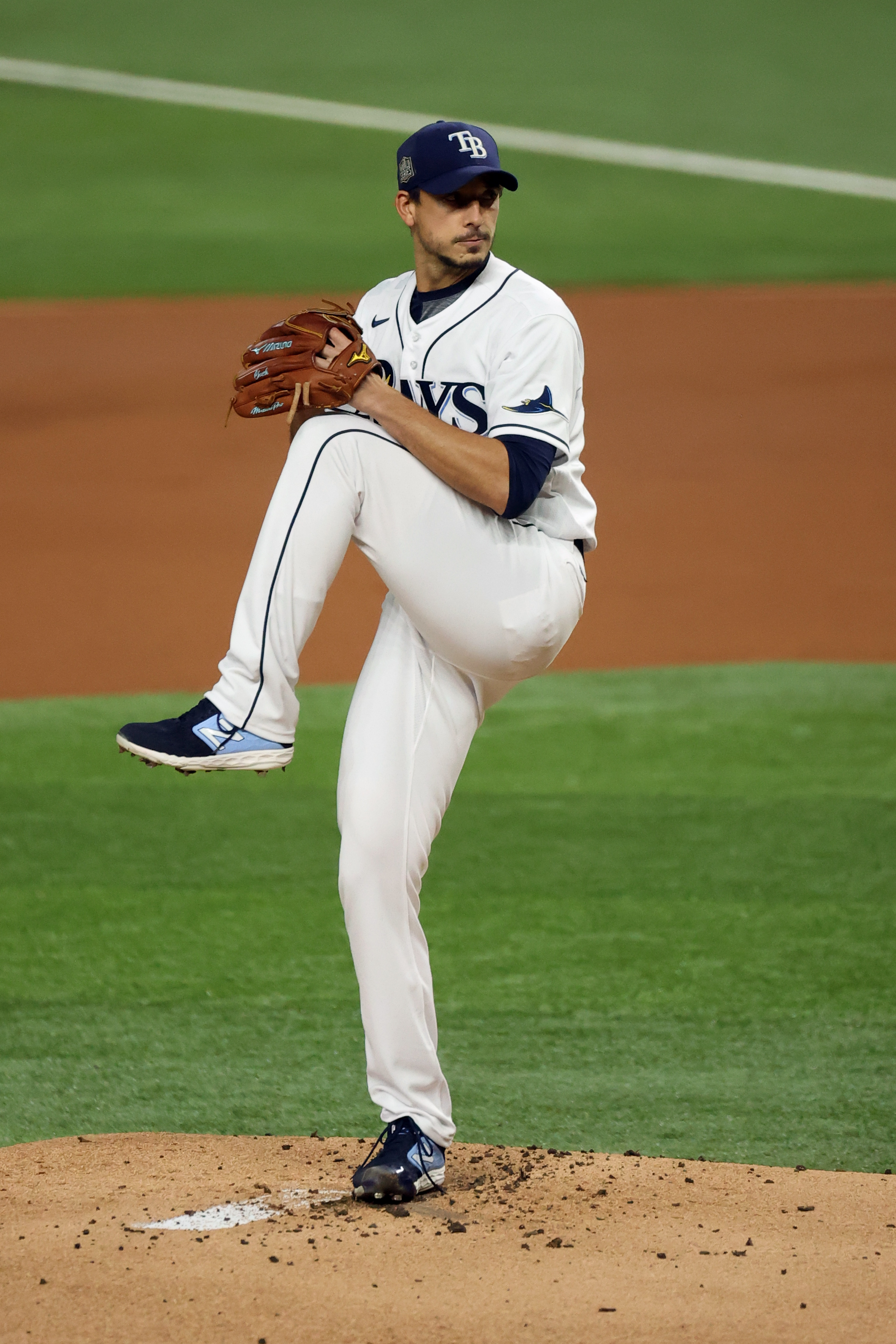
The loss of Morton surely stings for Rays fans, particularly given that his $15MM guarantee matches the sum for which the Rays could’ve retained him had they simply exercised a club option for the upcoming season. It seems that Tampa Bay had hoped to keep Morton at a lesser rate for the upcoming season, perhaps seeking to leverage their proximity to his family’s home in Bradenton, but the market for Morton proved strong. He’ll remain reasonably close to his family — it’s a 75-minute flight from Atlanta to Tampa — and now return to the organization that originally drafted him back in 2002.
Morton, 37, battled some shoulder fatigue and was limited to nine starts and 38 innings in 2020, pitching to a 4.74 ERA in that short time. The down time on the IL after his first two starts clearly did him some good, however, as the veteran righty returned with improved velocity and a 3.72 ERA in seven starts before going on to post a 2.70 ERA through 20 postseason innings. And of course, Morton is just one year removed from a third-place Cy Young finish with the Rays in 2019, when he worked to a 3.05 ERA and 2.81 FIP with 11.1 K/9 against 2.6 BB/9 through 194 2/3 regular-season frames.
As has been general manager Alex Anthopoulos’ modus operandi since assuming his post in Atlanta, the Braves have acted quickly to address a clear need — and done so with the addition of short-term contracts for veterans. Morton joins southpaw Drew Smyly, who inked a one-year deal worth $11MM last week, as two new faces who’ll round out the Braves’ rotation behind Mike Soroka, Max Fried and Ian Anderson. The addition of Morton and Smyly likely pushes Kyle Wright out of the Atlanta rotation, although he has minor league options remaining and could head to Triple-A Gwinnett as a depth piece in the event of injury.
The Braves’ signings of both Morton and Smyly will at least allow them to entertain the idea of dealing from their pitching depth to address other needs and strengthen other areas this winter, though. Not only is Wright displaced from the rotation, but each of Sean Newcomb, Bryse Wilson, Touki Toussaint, Huascar Ynoa, Tucker Davidson, Patrick Weigel and Jasseel De La Cruz is now without a clear path to big league innings — at least in the rotation.
Soroka may require some extra time to recover from an Achilles tear that ended his 2020 season, though an exact timeline on his return is still unclear. Wright is the likeliest option to stand in for him early in the year. Some of the names on that alternate arms be used as relievers and others in minor league rotations, but the Atlanta organization clearly has some young pitchers to peddle if they’re interested in virtually any trade asset on the market this winter.
As for the Braves’ payroll, the addition of Morton gives the team $93.7MM guaranteed to 10 players. Adding in an arbitration class projected to be worth roughly $20MM would push the payroll north of $113MM, although the Braves have some non-tender candidates among their ranks (e.g. Luke Jackson, Johan Camargo, Adam Duvall). The club could also look to move the final guaranteed year of center fielder Ender Inciarte‘s contract in the coming months.
All of that is crucial to bear in mind as the team looks to retain free-agent left fielder Marcell Ozuna — or possibly to replace him if he lands elsewhere. We’ve not seen Anthopoulos spend at the levels it’d take to sign Ozuna since he took over the GM post in Atlanta, though it’s at least possible he’ll break that trend for Ozuna. To this point, Will Smith‘s three-year, $40MM contract is the largest free-agent deal issued under this front office regime. It’s not known what extent the Liberty Media-owned Braves can further spend, but they’re a ways shy of the more than $150MM payroll they stood to carry on Opening Day 2020 (prior to the league shutdown and subsequent prorating of salaries).
ESPN’s Jeff Passan first reported that the two sides were close to a deal. Mark Feinsand of MLB.com reported the agreement and the contract’s value (via Twitter).
Hoyer On Cubs’ GM Search, Roster Construction, Coaching Staff
The Cubs formally introduced longtime general manager Jed Hoyer as their president of baseball operations via press conference on Monday, not long after announcing that he’d signed a five-year deal through the 2025 season. (Fans can re-watch the entire press conference on Twitter.) Hoyer’s promotion maintained some continuity among the club’s decision-makers, but it also created a hole in the front office infrastructure, as the team did not promote a replacement GM to take on his former duties.
While Hoyer’s very promotion speaks to trusting the in-house group, however, he revealed that his expectation is to hire a general manager from outside the organization rather than to promote from within. The 46-year-old spoke of valuing new ideas, new input and new ways of thinking to help keep things fresh. The timing of any such hire, however, remains unclear. Hoyer acknowledged that there’d likely be an announcement in the coming days of some in-house promotions, but he merely said he planned to conduct a search for his new GM and wouldn’t further delve into specifics as to when the process would commence or draw to a close.
Unsurprisingly, Hoyer was asked frequently about the status of the team’s arbitration-eligible players and the payroll flexibility (or lack thereof) that he expects to have as he looks to put together next year’s roster. Asked specifically about the possibility of non-tendering or trading Kris Bryant, Hoyer declined to answer, instead speaking more broadly about the service-time-driven realities that he and the rest of the front office will have to face this winter.
While the newly minted president of baseball ops didn’t mention specific names, the obvious inference is that each of Bryant, Javier Baez and Kyle Schwarber possesses five-plus years of service time, thus placing them on track to become free agents next winter. Bryant ($18.6MM), Baez ($10.7MM and Schwarber ($7.9MM) all possess rather sizable projected arbitration salaries — a particularly tricky scenario for Hoyer & Co. to navigate given Bryant’s poor showing at the plate in 2020. There’s already been plenty of rumors surrounding a possible trade of Bryant — as has has been the case for the better part of two years — and the fact that Hoyer was even asked about the idea of non-tendering the former NL MVP speaks to the difficulty of the team’s looming decision.
Of course, for as much talk as there’s been of trading Bryant, there’s been as much or more talk about extending Baez. Any efforts on that front — or with regard to Bryant, Schwarber, Willson Contreras or any other Cubs player — seem to be on hold for the time being. Hoyer plainly acknowledge that there are no ongoing extension talks at this time, although he did add that there are “players on this roster that we’d love to have here for a long time.”
All of the uncertainty surrounding not only the Cubs arb-eligible regulars but even some of the team’s pitching — Yu Darvish and Kyle Hendricks have both been speculated upon as trade candidates — will lead onlookers to wonder about the possibility of a rebuild, but owner Tom Ricketts suggested otherwise. “I don’t think anyone is tearing anything down,” he said.
Hoyer, however, conceded that given the service time of some Cubs stalwarts, he might have one eye on the future a bit more than in other offseasons. He also indicated that he believes the Cubs should be able to field a playoff-caliber roster on a yearly basis, citing a goal of winning the division in 2021. Clearly, the upcoming offseason will be a bit of a balancing act, although that’s been apparent for some time now.
Just as predecessor Theo Epstein did prior to stepping down, Hoyer suggested that “the offense will look different next year.” The paths that the Cubs can take to realize that change are of course countless, and there are elements that are out of their control that still need to be factored into the equation. Notably, the Cubs and other National League teams are still uncertain as to whether there will be a designated hitter in the National League for the 2021 season. To this point, Hoyer said, it’s not clear when a firm resolution on that potential change will be in place.
As for just what sort of resources he’ll have at his disposal while striving to meet that goal in 2021, it’s not yet clear. Ricketts acknowledged that uncertainty regarding what levels of fan attendance would be permissible in 2021 have clouded the team’s budgetary outlook. Wrigley Field was recently granted National Historic Landmark status, as covered by Fran Spielman of the Chicago Sun-Times, but Ricketts indicated that the associated federal tax credits won’t have an impact on player payroll.
It’s worth highlighting, too, that the Cubs have work to beyond the roster and the front office. Will Venable‘s hiring as the Red Sox’ new bench coach leaves a gap on the Chicago coaching staff. Hoyer said he’ll begin a search in the near future to fill Venable’s role as a base coach and outfield instructor. The organization’s decision to part ways with assistant hitting coach Terrmel Sledge left another vacancy, but they’ll stay in house to fill that void. Former big league infielder Chris Valaika, who has spent the past couple seasons as the Cubs’ minor league hitting coordinator, will join the Major League staff and take over Sledge’s prior role.
Indians Name DeMarlo Hale Bench Coach
The Indians announced Monday that they’ve hired DeMarlo Hale as their new bench coach.
A veteran of 15 seasons as a member of a Major League coaching staff, the 56-year-old Hale goes way back with Cleveland skipper Terry Francona. Hale served as both a base coach and bench coach under Francona while serving as a member of the Boston staff from 2006-11. He was the Red Sox’ third base coach for their World Series win in 2007.
Hale spent this past season as the Braves’ first base coach, taking over that post when Eric Young Sr. opted out of the 2020 season. Hale had initially been hired as a special assistant by general manager Alex Anthopoulos, whom he knew well from his days as a bench coach in Toronto during Anthopoulos’ tenure there.
The Indians announced on Oct. 31 that longtime bench coach Brad Mills wouldn’t return to that role in 2021. Mills, who opted out of the 2020 season, is being reassigned to a yet-undetermined role elsewhere in the organization. He’d been Cleveland’s bench coach since 2014 and had been a member of the coaching staff dating back to 2012.
Cubs, Jed Hoyer Agree To Five-Year Contract
The Cubs have signed new president of baseball operations Jed Hoyer to a five-year contract that runs through the 2025 season, per a team announcement. Hoyer, the team’s longtime general manager, was promoted to his new post last week when Theo Epstein stepped away from the role.
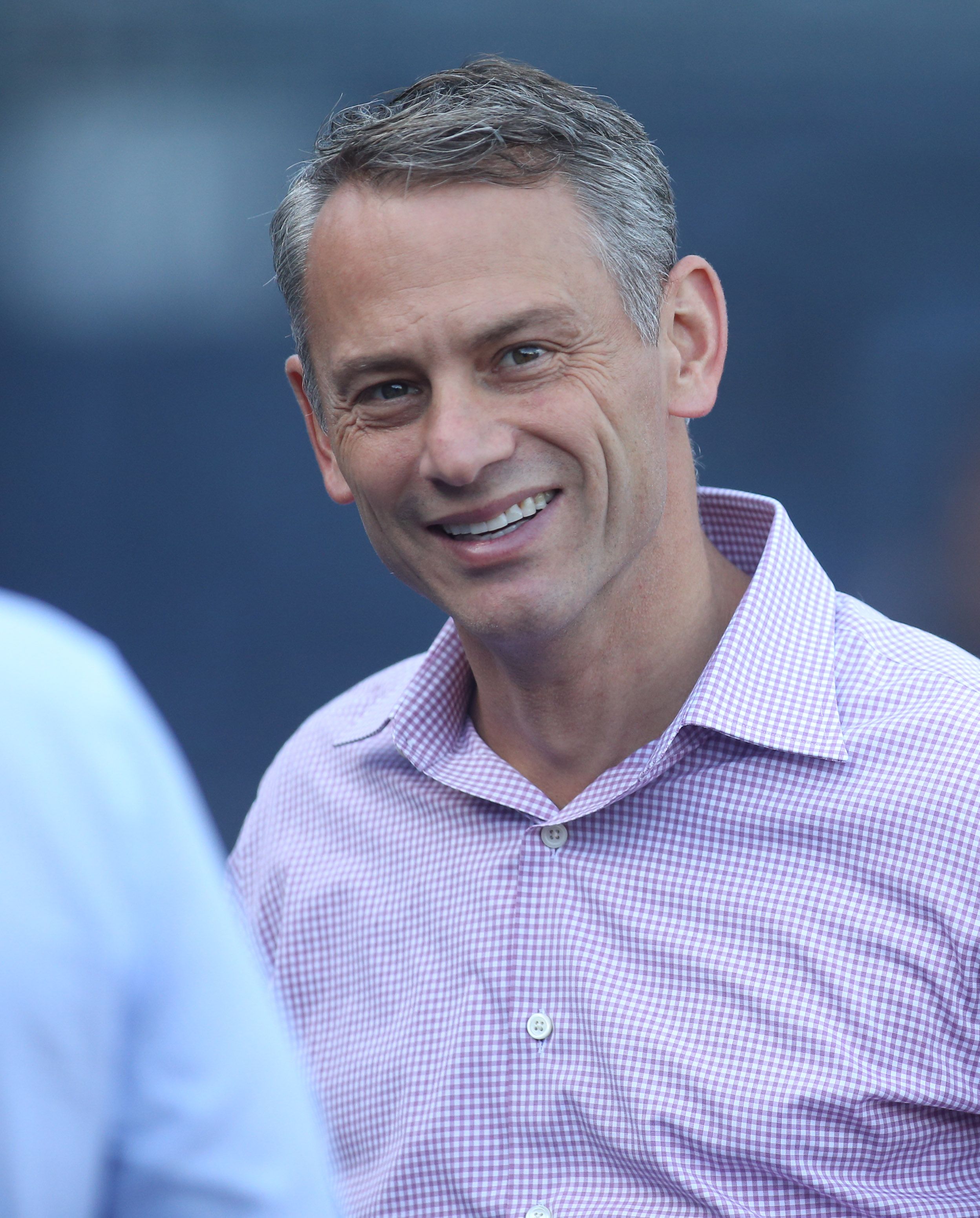
A new contract for Hoyer doesn’t register as much of a surprise. While he was only promoted to this new post last week, he was entering the final season of a five-year contract as the team’s general manager. There’d be little sense in promoting Hoyer to the top of the baseball operations food chain but leaving him on a one-year deal and having him enter the 2021 season under lame-duck status.
Promoting Hoyer, as owner Tom Ricketts put it last week, offered the organization a “combination of continuity and a fresh perspective that will serve us well as we look forward to another period of sustained success.” That comment certainly indicated that the club planned for Hoyer to be at the helm for the long term, and today’s contract extension solidifies the matter.
“Jed was a key baseball operations leader as we built a team that made the playoffs five of the last six years and won the World Series,” Ricketts said Monday in a new statement announcing the extension. “My family and I believe he is going to be an incredible baseball operations president, and Cubs fans have one of the best in the business leading the team to continue our commitment to sustained success.”
Notably, this won’t be Hoyer’s first time heading up a baseball operations department. He served as the Padres’ general manager from 2009-11 before being hired by Epstein, his former colleague with the Red Sox, to hold that same post within the Cubs organization. Epstein, Hoyer and current Cubs senior vice president of player personnel Jason McLeod all came up through the ranks together in Boston and have all played integral roles in the Cubs’ rise to a perennial playoff contender in recent years.
Michael Wacha Generating Interest Despite Down Year
Michael Wacha‘s time with the Mets didn’t go at all as the team had hoped when signing him to a one-year, $3MM deal last winter, but ESPN’s Buster Olney reports that despite a season of lackluster results, Wacha is “among the most popular” free-agent starters on the market at the moment. The vast majority of clubs in the league are looking to cut back costs, and Wacha’s track record with the Cardinals, age and likely one-year price point all seemingly work in his favor.
The 29-year-old righty appeared in eight games (seven starts) for the Mets in 2020 and was rocked for a 6.52 ERA with an alarming nine long balls served up in that time. That marked a second straight rough season for Wacha, who logged a 4.76 ERA in 2019 and finished out that season with shoulder troubles — a problem that he’d also battled in the past.
Many will look at a pitcher with a 5.15 ERA over his past two seasons/160 frames and wonder why he’d generate interest, although today’s front offices place dwindling levels of stock in the game’s conventional and more rudimentary means of evaluating performance. Olney notes that an uptick in velocity has contributed to the interest. The Athletic’s Ken Rosenthal, who also suggests interest in Wacha is strong, writes that increased usage of his cutter has piqued the interest of teams around the league (15.5 percent in 2019; 27.1 percent in 2020, per Statcast).
Those seemingly encouraging trends should be accompanied by some caveats, though. Wacha’s velocity jump wasn’t particularly substantial, as he averaged 93 mph on his four-seamer in 2019, per Statcast, and 93.6 mph in 2020. That 93.6 mph mark still falls well shy of the 95.1 mph Wacha averaged in 2017 (his peak velocity season) and the 94.8 mph he averaged in 2015 (arguably the best season of his career). His increased cutter usage came at the expense of a curveball which was a woefully ineffective pitch for him in 2019. However, the cutter was still hit hard by opponents and the curveball was a very effective offering as recently as 2017 (and to a lesser extent in 2018).
None of that is to say that there’s no reason to expect improvement from Wacha moving forward. Last year’s 19.2 K-BB% was the best of his career, and Wacha has never induced swinging-strikes and generated chases outside the strike zone at a higher rate than in 2020. He gave up too much hard contact in the air — hence the nine homers — but the right-hander was among the game’s best at inducing weak contact on the ground (81.9 mph average exit velocity).
Properly evaluating a pitcher is always a tall order — and that’s particularly true when looking at an eight-game sample from a pandemic-shortened season. Wacha won’t turn 30 until next July. That, paired with some of the trend lines he demonstrated in 2020, could land him a decent guarantee from a club seeking a bargain rotation play with some upside. If all goes well for him in ’21, Wacha could hit the market again as a 30-year-old free agent in a much better position than he currently finds himself.
Looking For A Match In A Nolan Arenado Trade
Nolan Arenado‘s future in Colorado — or perhaps the lack thereof — will be one of the main storylines throughout the 2020-21 offseason. The 29-year-old has publicly voiced dissatisfaction with the organization in the past, and another poor season followed comments from owner Dick Monfort that foreshadow a tight-budgeted winter don’t figure to improve the relationship.
In this week’s Offseason Outlook for the Rockies, I laid out the reasons that trading Arenado isn’t as simple as some might think. On the surface, a five-time All-Star who has won eight Gold Gloves in eight MLB seasons while hitting .293/.349/.541 and averaging nearly five WAR per season seems like a player who’d be highly in demand. As with any player, however, Arenado’s trade value is inextricably linked to his contractual status, and the franchise-record extension he signed in 2019 muddies the water.
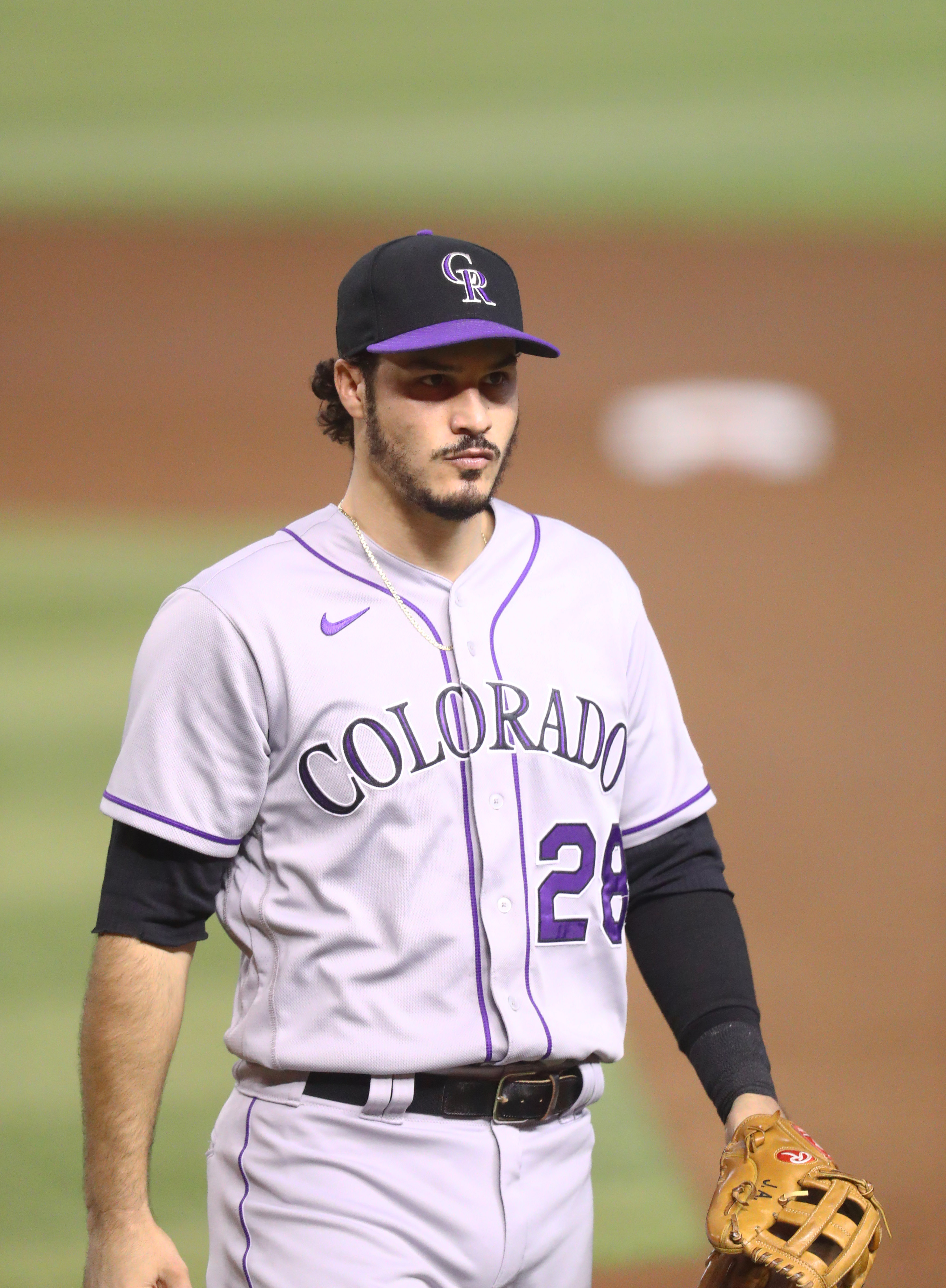
Arenado is still owed a hefty six years and $199MM between now and the 2026 season. He’s due $35MM in 2021, and his contract allows him to opt out of the remaining five years and $164MM at season’s end. Any club that acquires Arenado recognizes there’s a chance he’ll only be around for one season. If Arenado plays at the level an acquiring team would hope for upon making the trade, that team knows there’s a chance he’ll opt out. The Covid-19 pandemic has obviously changed the financial outlook for many clubs and altered the sports economy, but Arenado would surely look at Anthony Rendon‘s seven-year, $245MM contract and wonder whether he could approach that level with a big 2021 showing.
On the other hand, Arenado had his worst season ever at the plate in 2020 and finished the year on the IL due to shoulder soreness. That’s enough to already make some clubs wary, particularly because if that proves to be the start of a trend, they’d be stuck paying more than $33MM annually to a player on the decline. There’s no way Arenado opts out if he repeats this past season’s .253/.303/.454 output, so there’s inherent risk of being stuck with an albatross contract here.
A trade is further complicated by the fact that the Rockies would of course want to receive quality young talent in return. The optics of dumping Arenado simply to be rid of his salary would be extraordinarily poor for Monfort and general manager Jeff Bridich. Given the risk associated with the contract and Arenado’s shaky 2020 campaign, it’s frankly difficult to imagine a team taking on Arenado’s contract and parting with considerable prospect capital. The Rockies might have to pay down some of the deal and/or take another sizable salary on in return if they hope to find a palatable trade.
As if that context doesn’t complicate matters enough, also consider that Arenado has a full no-trade clause baked into the deal. He may welcome the the opportunity for a fresh start, but it’s possible he’ll need to be incentivized to waive that clause as well. Topping things off is that he’s not even the only All-Star third baseman who could be moved this winter. The Cubs figure to seriously entertain the possibility of trading Kris Bryant. A former Rookie of the Year and NL MVP, Bryant is coming off a down season of his own but has a similar ceiling with none of Arenado’s long-term risk. Bryant is in his final year of arbitration and is a free agent next winter. Only one team can get Bryant, of course, so interested teams that miss out could turn to Arenado. It’s also possible that some clubs prefer the Arenado gamble — long-term risk and all. Regardless, Bryant’s presence on the market plays a factor in any potential Arenado talks.
Suffice it to say, trading Arenado is a daunting task for the Rockies. Based on name value alone, one might think nearly every team would be inclined to look, but the majority of clubs around the game can be written off almost immediately. We can rule out low-spending clubs like the Indians, Pirates, Rays, Athletics and Marlins, as Arenado’s contract would be considered too extravagant for their budgets. The D-backs are still paying Zack Greinke to play for someone else and traded Paul Goldschmidt away rather than meeting his $130MM extension price — far less than the $199MM owed to Arenado.
The Brewers already gave a mega-deal to Christian Yelich and wouldn’t risk a second one. The Angels signed Rendon to the aforementioned $245MM deal last winter, and the Twins are very likely out after inking Josh Donaldson for $92MM. Cincinnati has Eugenio Suarez at third base and probably couldn’t stomach paying a combined $60MM to Arenado and Joey Votto anyhow, as phonetically pleasing as that pairing might otherwise be. The Astros have Alex Bregman at third base and could conceivably move him to another position, but that’s a reach with Carlos Correa locked in at shortstop. The Phillies look set at the corners with Alec Bohm and Rhys Hoskins.
We can also eliminate any clubs that are in the midst of a rebuild. The Rangers appear to be just starting down that road, and the Orioles aren’t far enough along in the process to consider a splash of this magnitude. The Tigers and Royals are hoping to soon emerge from rebuilding efforts, but this doesn’t seem likely for either unless it’s part of a sudden and unexpected all-in push. Elsewhere in the AL Central, the White Sox have a strong infield as is and would probably prefer to allocate resources to the rotation and/or right field. Maybe they could try Yoan Moncada in right, but Arenado is something of a square peg in a round hole for the South Siders.
Over in St. Louis, the Cardinals have been connected to a heavy-hitting third baseman for years, be it Arenado or Donaldson. It hasn’t come to pass yet, and while the need very arguably still exists after Matt Carpenter floundered through a tough 2020 season, it’s hard to imagine the Cardinals adding a contract of this magnitude. This is the same team that just declined Kolten Wong‘s $12.5MM option in the name of financial flexibility, and the same club that seems to be grappling with whether it can afford to re-sign franchise icons Yadier Molina and Adam Wainwright. Owner Bill DeWitt Jr. brazenly lamented the baseball industry’s lack of profitability earlier this spring and more recently offered a very reserved assessment of his club’s payroll outlook.
That’s a whole lot of teams that don’t seem likely to jump in on Arenado, so let’s turn to run through some clubs that might not be immediately ruled out.
Mets: Now backed by baseball’s richest owner and suddenly spared the $20.25MM they previously owed to Robinson Cano in 2021, the Mets are seemingly connected to every big fish on the free-agent and trade markets alike. Arenado would add an all-world defender to a club whose defense has been miserable for several years running. Incumbents J.D. Davis and Jeff McNeil are solid options, but McNeil can play second with Cano suspended and Arenado should be a big upgrade over Davis. The Mets could conceivably even put Davis in a package to acquire Arenado, as he’d give the Rox a controllable, quality alternative with a nice bat.
Nationals: The loss of Rendon was clearly felt throughout the Nationals’ lineup in 2020, as Carter Kieboom wasn’t able to step up and fill the void. The Nats have Max Scherzer‘s contract off the books after the 2021 season and could reallocate those long-term dollars to Arenado while entrusting Stephen Strasburg and Patrick Corbin to front the rotation. Washington’s payroll ranks toward the top of the league on a yearly basis, and GM Mike Rizzo isn’t afraid to make high-priced splashes. Adding Arenado would block Kieboom at third base, perhaps pushing him to second base or making him expendable in a trade — be it this hypothetical deal or another swap.
Braves: The Braves don’t have a clear third baseman in light of Austin Riley‘s struggles, making this a solid on-paper fit. However, this is the exact type of move general manager Alex Anthopoulos has avoided since coming to Atlanta. He eschewed a long-term commitment to Josh Donaldson despite considerable fan backlash and has yet to acquire any player on more than a three-year deal (Will Smith). The seven- and eight-year deals for Ozzie Albies and Ronald Acuna Jr. were pre-arbitration bargains — the polar opposite of paying top-of-the-market value for a superstar already approaching his 30th birthday. Additionally, the club will likely still need to set aside some money to extend Freddie Freeman. This will be a frequently suggested landing spot for Arenado, but contextually, it doesn’t feel as strong as it looks at first glance.
Blue Jays: General manager Ross Atkins has already talked about acquiring “elite” players this winter, as the Jays have watched a strong young core emerge at the MLB level. Incumbent third baseman Travis Shaw is an obvious non-tender candidate, and while the Jays have some appealing youngsters down on the farm, a healthy Arenado is better than the ceiling of virtually any third base prospect. The Blue Jays quietly have quite a bit of financial flexibility, and if they could try to send Randal Grichuk back to Colorado as one of the pieces to offset a portion of the weight of Arenado’s contract (and fill a need for the Rockies at the same time).
Dodgers: A team with pockets as deep as the Dodgers and a farm system to match is of course going to be mentioned in connection to any high-profile trade target. They’ve been linked to Arenado in the past, and this morning while I was finishing this very piece, MLB.com’s Jon Morosi wrote about their continued interest. Adding Arenado would effectively displace free agent Justin Turner, who is revered in the L.A. clubhouse, but at least for the moment, there’s a vacancy at the hot corner at Dodger Stadium. Of course, the Dodgers just locked up Mookie Betts on his own mega-deal and may not be keen on issuing another. And it’s anyone’s guess whether the Rockies would actually consider trading one of the best players in franchise history to a division nemesis.
Giants: Speaking of division rivals — the Giants look to be coming out of their own rebuilding effort and have the money to take on Arenado’s contract. Brandon Belt, Brandon Crawford and Johnny Cueto will all be off the books after the 2021 season, leaving the long-term payroll outlook wide open. Veteran Evan Longoria is a roadblock at third base for the moment, but the Giants could send him back to Colorado as a means of both giving the Rockies a ready-made replacement and also offsetting some of the considerable cost they’d be taking on with Arenado’s contract. Younger talent would surely need to be added to make this appealing for the Rockies, of course. President of baseball ops Farhan Zaidi has spoken of a focus on the pitching staff and only looking at “complementary” position players, but he’s also said he hopes to return to the playoffs as soon as 2021.
Padres: We might as well get a little weird and round out the division-rival trifecta with an off-the-wall Padres suggestion. The Friars already have Manny Machado and his $300MM contract at third base and young superstar Fernando Tatis Jr. at shortstop. There were at least rumblings of potentially moving Tatis to the outfield in the event of a Francisco Lindor acquisition by the Padres, however. Adding Arenado would require an even more elaborate position shuffle, with Machado going back to shortstop and Tatis moving to the outfield grass. It’s a long shot that would likely require the Rockies taking a bad contract back — e.g. Wil Myers, Eric Hosmer — with the Padres chipping in some notable young talent. We’ve all learned by now not to count San Diego general manager A.J. Preller out of any scenario, but there’d be a whole lot of moving parts to get Arenado down to the Gaslamp Quarter.
Yankees: Like the Dodgers, the Yankees are almost an obligatory entrant in these types of exercises. They’re looking to pare back payroll this winter after spending at record levels in 2020, and their primary focus appears to be on retaining DJ LeMahieu. Arenado would be a luxury rather than a necessity — and a risky one at that — but the Yankees aren’t short on MLB-ready talent they could send back. Either of Gio Urshela or Miguel Andujar could appeal to the Rockies, and the team has some young pitching to work in as well. Arenado would be a tough fit with both Gerrit Cole and Giancarlo Stanton both on the books long-term, of course.
Cubs: It seems unlikely that the Cubs would take on a major contract after consecutive offseasons of effectively sitting out free agency. Owner Tom Ricketts has spent two years claiming not to have additional resources to allocate to the roster and earlier this summer proclaimed that ownership losses during the pandemic have been “biblical” in nature. The Cubs just laid off 100-some employees, per The Athletic. But they’re also expected to be active in reshaping the roster under new president of baseball ops Jed Hoyer, and they could jettison enough salary that cramming Arenado onto the books doesn’t seem impossible. Some combination of Bryant, Kyle Schwarber, Yu Darvish and Willson Contreras could be moved this winter. Fitting Arenado into the picture still could be a stretch, though.
Red Sox: Boston already has Rafael Devers at the hot corner, but there’s been some speculation about him sliding across the diamond due to defensive struggles at third base. It’s admittedly tough to see the Red Sox taking on a contract like this less than one year after trading Mookie Betts and dumping David Price‘s contract in order to limbo under the luxury tax line, but they’re a big-market team with huge payroll capabilities and probably don’t want to be a division afterthought for too long.
Mariners: Saving the most fun suggestion for last, let’s not overlook Jerry Dipoto’s ability to surprise the baseball world. “Trader Jerry” has rebuilt this organization’s farm system in a matter of two years and brought a number of interesting young players to Seattle — many of whom have now reached the Majors. Adding Arenado to an infield that already has two young Gold Glove winners in J.P. Crawford and Evan White would give the club a defense for the ages, and before anyone questions whether Seattle can afford to pay Arenado $33MM per year, consider that as of 2022, the only players on the books for the M’s are Marco Gonzales ($5.75MM) and White ($1.4MM). Bringing Arenado into the mix likely pushes Kyle Seager to designated hitter for the final year of his contract, which might be for the best given his declining defensive metrics.
—
That’s a whole lot of words on trading Arenado, but it’s important to remember that a deal coming together shouldn’t be considered a given. Arenado is not a Francisco Lindor-esque guarantee to be traded prior to Opening Day due to the complexity of his contract and the difficulty the Rockies will have getting what they’d deem fair value in return. Any of the highlighted teams at the end of this exercise could emerge as a rumored trade partner, though some are obvious reaches. In my view, the best clubs for the Rockies to work with are the Mets, Nationals, Dodgers, Blue Jays and, yes, the Mariners. That’s not to say any of those clubs are in talks or are likely to acquire him, however.
Of course, any trade depends on the extent to which those clubs believe Arenado can rebound from a mediocre year at the plate and the extent to which they’re willing to gamble on the glaring downside that is inherently woven into his contract. Trading Arenado isn’t as simple as some will make it out to be this winter, but it’s a reality the Rockies will have to explore.
Mike Chernoff Not A Candidate For Mets Job
Indians general manager Mike Chernoff will not interview for the Mets’ front office vacancy, SNY’s Andy Martino reports. The team had reportedly asked for permission to interview him, and MLB.com’s Jon Morosi even wrote yesterday that Chernoff was a “leading candidate” for the job and would sit down with the organization. New owner Steve Cohen, however, quashed that report himself when he tweeted that it was incorrect to suggest Chernoff would interview to become their president of baseball operations. Martino adds that Oakland GM David Forst is also seen as “unlikely” to interview for the Mets job.
It’s not clear yet whether the Indians denied the Mets permission to speak to Chernoff or whether Chernoff declined their reported interest. It wouldn’t be the first time the 39-year-old has rebuffed overtures from another club; Chernoff reportedly drew interest from the Mariners and Phillies before being promoted to his current post in the Indians organization. The Princeton alum has spent the better part of two decades in the Cleveland front office. Chernoff has worked as Chris Antonetti’s chief lieutenant since October 2015, a role in which he’s apparently quite happy.
The Mets’ search for a revamped front office is still in its early stages. In addition to missing out on Chernoff and (likely) Forst, New York’s request to speak with Brewers president of baseball operations David Stearns was denied by Milwaukee. To date, only former Marlins GM Michael Hill is known to have chatted with Mets’ brass about the president of baseball operations position. Former Mets pitcher Chris Young, now Major League Baseball’s senior vice president, might also be an option for the front office in some capacity, Martino adds. To this point, however, it’s not clear if Young has even spoke with the club.
Red Sox Add 7 Players To 40-Man Roster; Weber, Hall Designated For Assignment
The Red Sox designated lefty Matt Hall and righty Ryan Weber for assignment Friday afternoon, per a club announcement. Additionally, southpaw Kyle Hart cleared waivers and was outrighted to Triple-A Pawtucket.
Those three moves helped clear space for the team to select seven players to the MLB roster: catcher/infielder Connor Wong, right-hander Eduard Bazardo, third baseman Hudson Potts, righty Bryan Mata, righty Connor Seabold, outfielder Jeisson Rosario and lefty Jay Groome. All seven are now shielded from being selected in next month’s Rule 5 Draft.
It’s something of an indictment on Boston’s 2020 pitching staff that Weber, who ranked third on the team in innings pitched, was immediately cut loose. Both Hart and Hall started games for the Sox in 2020 as well. The team’s leader in innings pitched, Martin Perez, had his option bought out at season’s end.
Ownership might not have wanted to publicly acknowledge that the team punted the 2020 season, but the nature of the moves involving the team’s 2020 pitching staff speak for themselves. This club was always a long shot to contend in a deep AL East, although certainly the injury to Chris Sale and Eduardo Rodriguez‘s unsettling bout with myocarditis after a Covid-19 battle didn’t help their cause. A lack of depth was always plain to see, however, and this club long looked ill-prepared to deal with inevitable injury troubles that virtually all teams encounter.
Mata, 21, has climbed as high as Double-A and has long been considered one of the organization’s better young arms. Groome probably needs some development time after injuries have slowed the former first-rounder’s career.
Several of today’s names have been added to the system via high-profile trades across the past 12 months. The 24-year-old Wong has also played in Double-A, and as one of the pieces received in the Mookie Betts/David Price blockbuster, is someone the team has high hopes for in the future. Potts is a 2016 first-rounder of the Padres who came over in the Mitch Moreland swap and has also reached the Double-A level. Rosario also landed in Boston via that swap, though he’s further from the Majors having not yet played beyond Class-A Advanced. Seabold could get a look in the rotation as soon as 2021 after coming over from the Phillies in the Brandon Workman/Heath Hembree trade.