
Pujols To Cover Salaries Of Angels’ Furloughed Employees In Dominican Republic
The Angels have been panned for implementing some of the industry’s most aggressive cuts throughout their scouting and player development staffs, and first baseman/designated hitter Albert Pujols is offering a helping hand to some of his countrymen who’ve been impacted. According to Maria Torres of the L.A. Times, Pujols will pay the salaries of the Angels’ furloughed employees at their academy in the Dominican Republic for the next five months.
Pujols becomes the latest established veteran to make a gesture along these lines, joining Dodgers lefty David Price and Rangers outfielder/DH Shin-Soo Choo — each of whom donated $1,000 to every minor leaguer in his respective organization to help cover lost wages. Pujols’ gesture will cost him roughly $180K, per Torres. Cynics and critics will surely point out that it’s a relatively minimal sum for Pujols, but that doesn’t detract from the fact that he was under no obligation to step up in this manner. And, those on the receiving end of his generosity are undoubtedly moved by his unexpected decision.
Meanwhile, Jeff Fletcher of the Orange County Register reports that the Halos have at least slightly scaled back some of their planned budgetary cuts. Nine of the team’s scouts will return to work in light of MLB recently lifting some of the restrictions it had placed on in-person amateur scouting. Some of those scouts are working this week’s Perfect Game Showcase in Alabama, which began on Wednesday.
Rangers Sign Top Two Draft Picks
The Rangers this morning will formally announce the signing of their top two picks, Mississippi State second baseman Justin Foscue and Elizabethton High School (Tenn.) outfielder Evan Carter, according to executive vice president of communications John Blake. MLB Network’s Jon Heyman reports that Foscue signed for a $3.25MM bonus, which checks in south of the No. 14 overall selection’s $4.037MM slot value. Carter will get a $1.25MM bonus, Evan Grant of the Dallas Morning News tweets. His No. 50 slot carried a $1.47MM value.
Foscue, 21, batted .331/.395/.564 as a sophomore and was out to a .321/.464/.509 start as a junior prior to the college season’s shutdown. Dating back to the beginning of his sophomore season, Foscue has drawn 45 walks against 35 strikeouts through a combined 378 plate appearances. Scouting reports on Foscue paint him as a bat-first second baseman with particularly intriguing exit velocities at the plate, but he’s not regarded as a strong defensive prospect or a plus runner.
Foscue ranked as high as 19th on the draft rankings from Kiley McDaniel at ESPN. FanGraphs’ Eric Longenhagen pegged him 26th in this year’s class, and Foscue also checked in at No. 32 at MLB.com, No. 36 at Baseball America and No. 63 at The Athletic.
As for Carter, his selection was somewhat of a surprise. The Duke commit didn’t appear on any pre-draft rankings — even BA’s Top 500 — although that hardly means he’s not a prospect of note or that another club wasn’t similarly intrigued in his abilities. Texas scouting director Kip Fagg told Evan Grant of the Dallas Morning News after the draft that Carter and other lesser-heralded Rangers pick “would have really popped” had they been able to play out the 2020 season. It’s commonplace for a breakout senior season to send a prospect skyrocketing up rankings, and the Rangers believe they “beat teams to these guys,” Fagg tells Grant. In the aforementioned tweet from Grant, he reports that the Royals were eyeing Carter in the third round.
MLBPA Makes 70-Game Counter-Proposal To MLB
2:10pm: The MLBPA has issued the following statement:
We delivered to Major League Baseball today a counterproposal based on a 70-game season, which among a number of issues, includes expanded playoffs for both 2020 and 2021. We believe this offer represents the basis for an agreement on resumption of play.
Notably, Clark looks to be throwing Manfred’s exact wording — “the basis for an agreement” — back at the league. The subtext, of course, is that the 60-game framework was viewed no more an agreement by the union than this 70-game proposal will be viewed as such by ownership.
1:35pm: The union’s proposal would see the regular season run July 19 through Sept. 30, Passan tweets. It also includes $50MM in playoff revenue, a share of postseason TV revenue in 2021, the aforementioned forgiveness of the salary advance for the league’s lower-compensated players, a universal DH (presumably in 2020-21) and both sides waiving the right to a grievance.
The Athletic’s Ken Rosenthal tweets that the union also proposed a neutral site framework for the postseason, if needed. They also agreed to advertising patches on uniforms over the next two seasons.
1:20pm: SNY’s Andy Martino reports that there’s frustration among some owners that they’re receiving a counter to what they didn’t believe was a proposal (Twitter thread). Ownership believed a deal/framework was in place at 60 games earlier in the week. Martino adds that Manfred had to “really twist” the arm of some owners to get to that 60-game mark, so it seems a straightforward “meet in the middle,” 65-game concept isn’t popular among ownership.
The MLBPA, however, saw the 60-game prorated framework as a proposal — not an agreement. Of note, even commissioner Rob Manfred himself said this week that his meeting with union chief Tony Clark produced a “a jointly developed framework that we agreed could form the basis of an agreement.” That quote in and of itself falls short of indicating that an agreement was firmly reached.
1:00pm: The Major League Baseball Players Association has finalized yet another counter-proposal for the league, according to Jeff Passan and Jesse Rogers of ESPN.com (Twitter thread). The union’s latest proposal is for 70 games and includes a “split of playoff revenues,” per Passan and Rogers. The league will likely make another counter before any terms are agreed upon.
Earlier this week, ownership proposed a 60-game season with prorated salaries, while the MLBPA reportedly continued to hold out hope for a longer season. The MLBPA’s last formal proposal to the league called for 89 games, so this latest proposal marks a notable drop from that point. Other factors have begun to surface in the back-and-forth, such as a universal DH in 2020 and 2021, expanded 16-team playoffs in each of the next two seasons, a joint fund for social justice initiatives and the partial forgiveness of the $170MM advance that was already paid out to players as a compromise to receive service time in the event of a canceled season.
It seems as though talks are reaching their apex, although that sense has existed at various points in the past. We’re already well past the June 10 target date for a relaunched training camp, and the once-hoped-for July 4 start date is clearly out of the question at this juncture. But the two sides still remain hopeful that a mid-July start date can be realized, with expanded postseason play running through late October. A middle ground in the mid-60s seems like it should be plausible at this point, although it’s best to temper any expectations for straightforward compromise between these two parties at this point.
As ESPN’s Buster Olney observes on Twitter, though, the difference between a 60-game and 70-game season checks in at roughly $245-250MM in total revenue — or $8.33MM per team. When we’ve reached the point where the gap between the two sides is comparable to what multiple individual free agents were promised this winter (think Stephen Strasburg, Anthony Rendon or, on a larger scale, Gerrit Cole) — it seems things should be able to come together quickly. Still, USA Today’s Bob Nightengale tweets that there’s little indication a resolution will be reached “quickly.” Still, it’s nearly unfathomable to think that the two sides could be as few as 10 games apart in their proposals and not eventually strike some kind of agreement.
Gorkys Hernandez, Christian Friedrich Among White Sox Releases
Former big leaguers Gorkys Hernandez and Christian Friedrich were among the White Sox’ wave of minor league releases, per Chris Hilburn-Trenkle of Baseball America. Both had signed minor league deals with the South Siders over the winter.
Hernandez, 32, has logged time in the big leagues in each of the past five season — mostly with the Giants. He’s appeared at all three outfield spots and generally been a solid defender, but he’s mustered only a .237/.296/.361 batting line in 918 plate appearances during that time. Hernandez’s deal didn’t include a Major League Spring Training invite, so he’d been signed purely for depth purposes.
Friedrich, also 32, joined the Sox in hopes of returning to the Majors for the first time since 2016. The former first-round pick (No. 25 to the Rockies in ’08) was once considered to be among baseball’s very best pitching prospects but never found any success with the Rockies (5.81 ERA in 167 1/3 innings) before being released in 2016.
Friedrich latched on with the Padres and tossed 123 1/3 frames with a career-best 4.80 ERA that season. Lat injuries wiped out his 2017-18 seasons, though, and he split the 2019 season between the independent Atlantic League’s New Britain Bees and the Korea Baseball Organization’s NC Dinos. Friedrich actually threw quite well for both teams (3.00 ERA in 11 starts with the Bees and 2.75 in 12 starts with the Dinos).
Tigers Sign Second-Rounder Dillon Dingler
11:34am: Dingler signed for the full slot value of $1,925,300, tweets Jim Callis of MLB.com.
11:24am: The Tigers announced Thursday that they’ve agreed to terms with second-round pick Dillon Dingler. As one would expect, bonus terms weren’t formally disclosed by the team, but Dingler’s slot value checks in at $1.95MM.
A catcher out of Ohio State, Dingler was regarded as a top 30 draft talent by each of ESPN’s Kiley McDaniel (No. 17), The Athletic’s Keith Law (No. 20), FanGraphs’ Eric Longenhagen (No. 29) and the teams over at Baseball America (No. 27) and MLB.com (No. 24). The 21-year-old, however, was still on the board for the Tigers with the top pick in the second round (No. 38 overall), and the Detroit org was surely thrilled to add another highly touted college position player to its already impressive stable of pitching prospects.
Dingler hit .340/.404/.760 with five homers, four doubles and a triple in just 13 games with the Buckeyes in 2020 before the season ground to a halt. After a pedestrian freshman season, he put himself on the map with a .291/.392/.424 slash in 2019 — a sign that he was perhaps tapping into the above-average raw power for which scouting reports credit him. Law calls Dingler the best defender among this year’s crop of catchers, and he even draws roughly average marks for his speed (45 at FanGraphs, 55 at MLB.com); Dingler swiped nine bags in a dozen tries in 62 games between 2019-20.
With Dingler on board, the Tigers have agreed to terms with three of their six picks. Third-rounder Trei Cruz and fifth-rounder Colt Keith agreed to deals that were a combined $116K over slot. Detroit still has to work out deals with No. 1 overall pick Spencer Torkelson, Competitive Balance (Round B) pick Daniel Cabrera and fourth-round pick Gage Workman. Of that bunch, Workman has already acknowledged that he intends to sign, although there’s no deal in place just yet (at least not one that has been announced or reported).
Amateur Draft Signings: 6/18/20
We’ll track today’s slate of signings from the 2020 amateur draft here…
- The Braves agreed to a full-slot deal with fourth-round pick Spencer Strider, tweets MLB.com’s Jim Callis. The Clemson righty, who returned from Tommy John surgery early this spring, will receive $451,800. The 6’0″, 195-pound Strider posted a 19-to-3 K/BB ratio in 12 innings before the NCAA season was halted, and Callis notes that he hit 95 mph multiple times in his first few showings. Strider didn’t rank inside MLB.com’s Top 200 or Baseball America’s Top 500, although that’s perhaps not much of a surprise given that he missed the entire 2019 season recovering from surgery. The Atlanta organization clearly liked what it saw in his brief return this spring — brief as it may have been.
- Astros third-rounder Tyler Brown announced on Twitter that he’s officially signed with the team. Callis reports that Brown received his full $577K slot value. Listed at 6’4″ and 242 pounds, the now-former Vanderbilt right-hander notched a 14-to-4 K/BB ratio with three earned runs allowed in 10 2/3 innings this spring, which seemed to be setting the stage for a strong followup to a nice sophomore season. In 2019, Brown tossed 41 2/3 frames out of the Commodores’ bullpen and logged 14 saves with a 2.59 ERA and an impressive 58-to-8 K/BB ratio. Brown ranked 99th on Baseball America’s Top 500 list and 133rd over at MLB.com. Both outlet’s scouting reports suggest that his size and four-pitch mix could make at least give him a chance to start, despite working as a reliever for most of his collegiate career. If Houston opts to leave him in the ‘pen, though, his path the the Majors would likely be quicker.
Poll: Biggest First-Round Surprise
The No. 1 pick in this year’s Major League Baseball Rule 4 Draft went as expected: The Tigers took Arizona State slugger Spencer Torkelson. Otherwise, though, there were some eye-openers in Wednesday’s first round, as Jim Callis of MLB.com and Keith Law of The Athletic were among those to cover. Let’s take a look at some of those moves and then you can vote on the biggest surprise from the opening round.
- Vanderbilt 3B/OF Austin Martin “falls” to Blue Jays at No. 5: It’s a bit hyperbolic to suggest that someone who went fifth overall actually “fell” down. Martin was regarded by some as the best all-around prospect in the draft and was expected by many to go in the top two picks. Once the Orioles passed on him, though, both the Marlins and Royals opted to do the same, dropping yet another premium position player prospect into the Blue Jays’ laps. Martin will now join a future core that includes Bo Bichette, Vladimir Guerrero Jr., Cavan Biggio and Nate Pearson, among others.
- Orioles select Arkansas OF Heston Kjerstad at No. 2: Everyone anticipated that Kjerstad would be a first-rounder, but closer to the middle of the round. Kjerstad is regarded as having some of the best left-handed pop in the class — if not the best left-handed pop. But the Orioles are likely going to look to cut a deal here, thus allowing them to double up on a more balanced pair of high-end prospects.
- Minnesota RHP Max Meyer goes No. 3 to the Marlins: Meyer was projected as a Top 10 pick, but southpaw Asa Lacy was generally expected to be the top pitcher off the board, with most mock drafts projecting him to go to the Marlins. Miami clearly liked Meyer better, despite concerns about his height (6’0″). The Gopher ace runs his heater up into triple digits and will give the Fish a power arm to pair with an already-impressive crop of young pitching talent.
- Giants grab another college catcher: Two years after grabbing Joey Bart at No. 2 in the 2018 draft, the Giants used yet another top pick on a backstop. This time, with the 13th choice, San Francisco went with North Carolina State’s Patrick Bailey. Between Bart and Bailey, perhaps the Giants will be able to find at least one successor to franchise great Buster Posey. Regardless, president of baseball Farhan Zaidi simply believes Bailey was too good to pass on in that spot. “You don’t draft for need and you can never have too much catching,” Zaidi said (via Alex Pavlovic of NBC Sports Bay Area, on Twitter).
- A Red Sox reach? In a move that J.J. Cooper of Baseball America regards as “the shock of the first round,” Boston used the 17th pick on Nick Yorke, a high school middle infielder from California. Yorke was not regarded by prospect gurus as a first-rounder entering the draft; however, because the Red Sox don’t have a second-rounder this year, they felt it was worthwhile to pick up Yorke when they still could.
(Poll link for app users)
Biggest surprise of Round 1?
-
Red Sox select Nick Yorke 42% (4,926)
-
Heston Kjerstad at No. 2 22% (2,587)
-
Austin Martin at No. 5 22% (2,519)
-
Giants take Patrick Bailey 8% (880)
-
Other 4% (460)
-
Max Meyer at No. 3 3% (341)
Total votes: 11,713
Tigers Select Spencer Torkelson With No. 1 Pick
The Tigers have made official what so many have expected to be the case over the past several months: Arizona State first baseman Spencer Torkelson has been selected by Detroit with the No. 1 overall pick in the 2020 MLB Draft. Interestingly, the team announced him as a third baseman — where he played in high school but has not appeared in college. The slot value for the top pick checks in at $8.415MM.
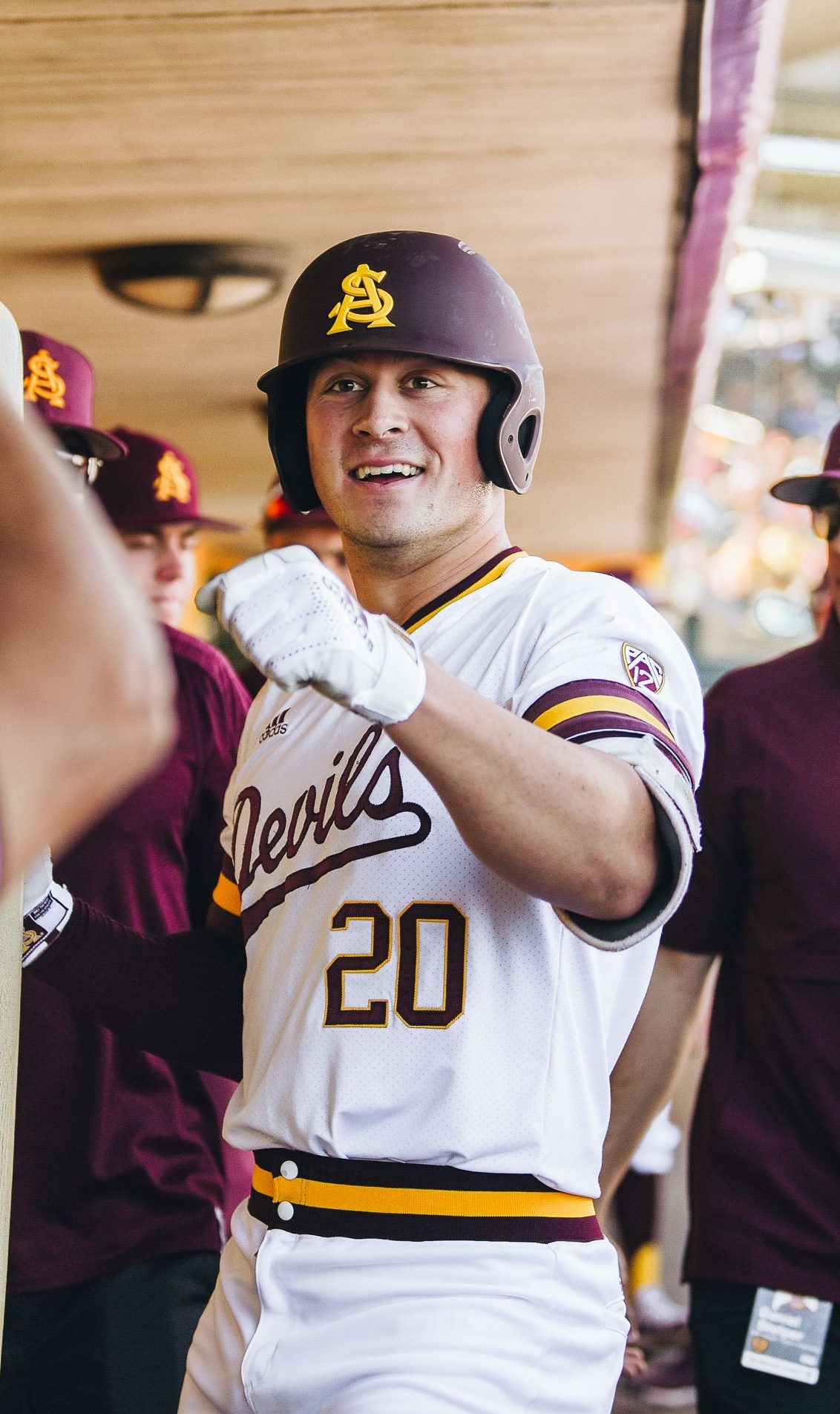
Torkelson, still just 20 years of age, has wowed scouts with his power, plate discipline and feel for hitting throughout his career with the Sun Devils. A career .337/.463/.729 hitter with 54 home runs, 33 doubles and a 110-to-104 BB/K ratio in 628 college plate appearances, Torkelson was off to his best start yet when the NCAA halted play due to the COVID-19 pandemic. Through 17 games and 82 plate appearances in 2020, Torkelson had posted a ridiculous .340/.598/.780 slash with six homers and 31 walks against 15 punchouts.
Pre-draft rankings were in agreement that Torkelson and Vanderbilt third baseman/outfielder Austin Martin were the top two talents in this year’s draft. Most gave Torkelson the slight edge — he topped the rankings at Baseball America, ESPN, FanGraphs and MLB.com — although some peg Martin as the slightly better all-around prospect due to his superior defensive value.
There’s little arguing that the Tigers made any sort of misstep, though. Torkelson is widely regarded as a potentially fast-moving bat with off-the-charts power who could hit in the middle of a big league lineup for years to come. That’d be music to the ears for the Tigers and their fans, as the organization’s lengthy rebuild has resulted in a farm system that is deep in high-end pitching talent but has fewer bats on the fast track to the Majors. Right-handers Casey Mize (the No. 1 pick in 2018) and Matt Manning, coupled with southpaw Tarik Skubal, give the Tigers a trio of arms upon which to dream. That trio is backed by several other potential rotation pieces, including Alex Faedo, Beau Burrows and Franklin Perez.
Torkelson should immediately become the Tigers’ top position prospect — and one of the top position prospects in all of baseball for that matter. FanGraphs’ Eric Longenhagen writes that the 20-year-old Torkelson possesses “sublime hitter’s timing, plus bat speed, and above-average barrel control and ball/strike recognition,” ultimately tabbing him as a future “thumping, heart of the order hitter.” ESPN’s Kiley McDaniel calls him the safest pick in the draft, pointing to his previous success with a wood bat in summer league play and calling Torkelson a potentially “above-average hitter with an above-average walk rate and 30+ homers.”
Torkelson is being advised by the Boras Corporation, but there’s no indication that a deal will be difficult to reach. In fact, Lynn Henning of the Detroit News suggested yesterday that the two sides are expected to come to terms on a deal in the vicinity of Torkelson’s slot value without a long, drawn-out negotiation process. Assuming that indeed pans out, the Tigers will suddenly find themselves with five of the top 60 prospects in baseball according to each of MLB.com, FanGraphs, Baseball America and The Athletic (joining the aforementioned pitchers and 2019 first-round outfielder Riley Greene).
It’s been an excruciating rebuild process for Tigers fans, but the team’s next core is coming into focus, and Torkelson should be squarely in the middle of the team’s resurgence.
Photo courtesy of Arizona State University Media Relations.
Manfred: “We’re Going To Play Baseball In 2020”
Major League Baseball is preparing yet another counter-offer to the Players Association after the MLBPA proposed an 89-game season with prorated salaries yesterday, commissioner Rob Manfred said minutes ago in an appearance on MLB Network (hat tip: Bill Shaikin of the L.A. Times, on Twitter). More encouragingly, Manfred emphatically stated: “We’re going to play baseball in 2020 — 100 percent.” The commissioner’s preference remains for a negotiated agreement between the league and union, but Manfred does have the ability to implement a shorter season (at fully prorated salaries) under the standing March agreement.
The details of the forthcoming proposal will be telling. Manfred acknowledged that it’ll be in the “players’ direction” but also suggested that he hopes the union will back down from its insistence on prorated pay. That has been the crux of the players’ entire argument to this point, and it has not seemed likely at all that they’ll be swayed. If anything, recent brazen comments from Cardinals owner Bill DeWitt Jr., Cubs owner Tom Ricketts and D-backs owner Ken Kendrick about the lack of profitability in baseball and the need for revenue sharing have only caused the players to further dig in. Many big leaguers — Justin Turner, Jameson Taillon, Randal Grichuk among them — met DeWitt’s comment that the baseball industry “isn’t very profitable, to be honest,” with bewilderment and disbelief.
USA Today’s Bob Nightengale reported earlier today, citing three MLB executives, that a counter-proposal was indeed in the works. Yesterday’s union proposal did contain some concessions that should appeal to ownership, but the MLBPA has steadfastly insisted that the prorated salaries which they feel were agreed upon back in March remain in place. That and the 89-game length of the proposal remain too costly in the eyes of ownership.
Nightengale suggests that Manfred will implement a season length of around 50 games if an agreement isn’t in place by next week. Of course, we’ve seen both sides negotiate through the media with a series of strategically leaked bluffs and half-truths, so it’s anyone’s guess whether ownership actually plans to wield that hammer or if this, paired with Manfred’s strong comments, is yet another leverage play. Remember, after all, that the league sent a counter-proposal to the MLBPA on Monday — just days after putting out the message that no counter was coming.
Regardless, it’s true that the clock is ticking for some kind of decision to be made. Ken Rosenthal and Evan Drellich of The Athletic wrote this morning that the time for “best and final” offers from both parties is nigh. Separately, Rosenthal suggests that the league should propose a 72-game season with prorated salaries and several of the new elements put forth by the union yesterday (e.g. two years of expanded 16-team playoffs, increased instances of players being mic’d up during broadcasts, an offseason All-Star Game/Home Run Derby this winter, etc.). To this point, neither side has made a proposal that has even moved the needle for the other.
Charlie Tilson, Jake Elmore, Luis Escobar Among Pirates’ Minor League Releases
The Pirates released 39 minor league players this week, as first reported by John Dreker of PiratesProspects.com. Outfielder Charlie Tilson, utilityman Jake Elmore, right-hander Luis Escobar and infielder Sherman Johnson stand out as players with prior big league experience.
Tilson, 27, joined the Bucs on a minor league deal this winter after spending the past four seasons in the White Sox organization. Acquired by Chicago in the 2016 swap that sent lefty Zach Duke to the Cardinals, Tilson made his MLB debut shortly after that trade. However, a torn hamstring suffered in his debut game required surgery, and he’s been plagued by a series of leg and ankle injuries ever since. In 280 Major League plate appearances, the former second-round pick carries just a .246/.310/.290 batting line. Tilson was known for his speed early in his career, but the 46 stolen bases he recorded in 134 games back in 2015 dwarf the eight bags he swiped in a combined 115 games between Triple-A and the Majors last year.
The 32-year-old Elmore has the most MLB experience of the group, having appeared in 217 games and logged 527 plate appearances. Elmore is just a .215/.292/.275 hitter in that time, but he’s demonstrated substantial versatility; in 2013, the Astros used him at every position on the diamond — including catcher and pitcher. Elmore has at least 106 innings at all four infield spots, 234 innings in the outfield (including 14 in center) and has also caught 4 1/3 innings and pitched two frames (one run allowed) in the Majors.
Escobar, 24, made his big league debut last year and received 60 grades on his fastball while coming up through the minors. He averaged 95.1 mph on that heater in his 5 2/3-inning cup of coffee last year, although he also walked four batters, hit another and threw a wild pitch in that short time. Escobar’s 2019 results in Triple-A were solid, particularly considering how hitter-friendly that league was last year: 4.09 ERA, 9.3 K/9, 5.2 BB/9, 1.15 HR/9 and a 46.6 percent grounder rate. That said, it’s not exactly a huge surprise that he was cut loose; Escobar did go unclaimed on waivers back in November.
As for the 29-year-old Johnson, he’s an eight-year minor league veteran who received the briefest of looks with the Angels back in 2018, appearing in 10 games but going hitless in 11 plate appearances. He has at least 450 innings at all four infield positions and, while he’s never shown much power, has been a consistent on-base threat with fairly low strikeout rates in his minor league career.