
Braves GM Alex Anthopoulos On Hamels, Third Base, Bullpen
As part of the team’s “Opener At Home” special on Friday evening, Braves general manager Alex Anthopoulos spent nearly 20 minutes chatting with broadcaster Chip Caray about the current state of baseball, the Braves’ roster and some of his offseason dealings (YouTube link).
First and foremost, the GM made clear that southpaw Cole Hamels, signed to a one-year, $18MM contract this winter but slowed by shoulder troubles, is now pain-free. “Under normal circumstances, he would’ve been going right now to get ready to start to prepare,” Anthopoulos said of the 36-year-old, implying that Hamels could’ve been embarking on a rehab assignment. Given that update, it seems reasonable to expect that Hamels will be a full strength if play is indeed able to resume this season.
Of course, that also have a domino effect on the rest of the pitching staff. Per Anthopoulos, two of Kyle Wright, Sean Newcomb and Felix Hernandez would’ve opened the season in the rotation. All three were throwing well in Spring Training, and a decision on those rotation spots was coming “down to the wire,” with the final couple of weeks set to prove pivotal in making that decision. Prior to the spring shutdown, here’s how each of the three had fared:
- Hernandez: 13 2/3 IP, 13 H, 3 ER, 5 BB, 14 K (1.98 ERA)
- Wright: 13 1/3 IP, 7 H, 3 ER, 3 BB, 15 K (2.03 ERA)
- Newcomb: 9 IP, 8 H, 2 ER, 2BB, 11 K (2.00 ERA)
A healthy Hamels would likely take one of the rotation spots for which that trio is vying, although depending on how a new schedule is constructed — frequent doubleheaders and fewer off-days have been oft-speculated upon — it’s possible that a sixth starter could be needed. At the very least, one would imagine that with expanded rosters early in the season, it’s possible there could be a place for all three.
Also discussed was the Braves’ third base battle: a competition known to be comprised of slugger Austin Riley and the versatile Johan Camargo. Neither player was going to fill the Josh Donaldson-sized void in the lineup, but both had their share of promise. Riley was a consensus top 100 prospect entering the 2019 season and had a strong debut before tailing off over the final few months. Camargo enjoyed an excellent season in 2018 before a step back last year. But while the debate had long centered around which of the two would make the Opening Day roster, Anthopoulos indicated that it was no longer an either-or-scenario:
Camargo and Riley were playing unbelievably well. We hadn’t made a decision yet. We had started to talk — the fact that with the minor league season scheduled to start on April 9, and we were going to start the 26th of March — we had started to talk about just carrying both. There was no reason, really, to leave them down in Florida. They both had been playing well enough to make the team. If it got to a point where we thought one of them needed to play each day, that would’ve been a conversation we could’ve had right when Gwinnett was going to open the season around [April 9], we could’ve sent a player down at that point.
It still seems likely that one of the two would’ve been tabbed for the lion’s share of playing time, but the fact that both were possibly in line for an Opening Day gig is of note. That’s particularly true given not only the likelihood of expanded rosters but also because it’s not yet certain just how (or if) the minor league season will be able to come together. With minor league play even more uncertain than big league play, it’s all the likelier that the Braves would carry both players on the roster to ensure they could get both could get in-game reps — even if it’s on less than an everyday basis.
Asked about his aggressive bullpen makeover — the Braves acquired Shane Greene, Chris Martin and Mark Melancon last July before re-signing Martin and Darren O’Day and signing Will Smith — Anthopoulos was candid about how his moves were shaped by his relievers’ struggles early in 2019.
I think a lot of it was just not having to live through the experience that we had in 2019. Obviously we had a great year — we won more games than we did in 2018, we had a great team — but our bullpen was up and down the entire year. … Having to give up a ton of young assets at the trade deadline is not something we want to have to go through again.
The Braves, Anthopoulos explained, had sought to make upgrades in the previous offseason but didn’t find deals to their liking either in free agency or on the trade market. But the poor first half and the postseason struggles — the GM pointed out that the Braves blew late leads in two of their first four NLDS losses prior to the Game 5 blowout — pushed the Braves to take an “aggressive” approach to the bullpen. Atlanta indeed spent a combined $56.25MM on Smith, Martin and O’Day this winter — plus the $14MM of the Melancon deal they took on at the deadline and a $6.25MM arbitration salary for Greene — in hopes of creating a deeper bullpen that could be called on to hold leads late in games but also in the middle innings.
Assuming the season is able to resume, the Braves will be considered clear postseason favorites, and the depth to which Anthopoulos makes frequent reference in his chat with Caray will be all the more vital if a condensed schedule is to be played. If nothing else, it’s a welcome distraction to hear a top-ranking executive talk about roster construction, offseason maneuverings and challenges/advantages that’ll be relevant the next time his team takes the field.
AL East Notes: Darwinzon, Cone, Armstrong
Although he enjoyed a strong finish to the 2019 season in the bullpen, Red Sox lefty Darwinzon Hernandez tells Peter Abraham of the Boston Globe that he still prefers to work as a starter in the long run. The 23-year-old emphasized that being on the team, whether as a starter or reliever, is still his top priority and voiced a willingness to pitch in any role the club fits. Notably, though, Abraham suggests that while former skipper Alex Cora believed Hernandez is best-suited for a short relief role, new manager Ron Roenicke agrees with Hernandez that he should be in the mix for a starting job. “You have to consider it,” Roenicke told Abraham. “He’s still a young pitcher, and there’s a lot to work with.”
Hernandez punched out nearly 39 percent of the hitters he faced in the Majors last year (57 in 30 1/3 innings) but also issued 16 walks in that time. Control has been a longstanding issue for the big lefty, evidenced by a career 5.5 BB/9 mark in the minors. Still, the Red Sox’ rotation is anything but settled at the moment, with Eduardo Rodriguez, Nathan Eovaldi, reclamation project Martin Perez and journeyman Ryan Weber occupying the top four spots. Certainly, there’s room to take a look to see if Hernandez can finally rein in his control and work as an effective big league starter.
More from the AL East to kick off the week…
- It’s already known that the Yankees interviewed former Cy Young winner and current YES Network Analyst David Cone for their pitching coach vacancy before hiring Matt Blake last November, but Cone talked more about the interview process and another potential role that was discussed in an interview with the New Jersey Star-Ledger’s Bob Klapisch. The pitching coach talks were “more exploratory” in nature, per Cone, but the two sides discussed a role in which he’d serve as a liaison between the club’s pitchers and the analytics department — utilizing his experience as a pitcher to help bridge the gap between data from the front office and implementation in a game setting. That role didn’t come together, clearly, but it’s nevertheless interesting both in a “what might’ve been” lens in addition to looking down the line at what could yet be in store if the two sides rekindle talks.
- Orioles righty Shawn Armstrong was considered a “sure thing” to make the bullpen heading into camp, writes Roch Kubatko of MASNsports.com, and he did nothing to change that thinking with six shutout frames and 11 punchouts. Expanded rosters early in a potentially delayed season would only make it easier for the club to hang onto the right-hander. The 29-year-old Armstrong went from Cleveland to Seattle to Baltimore over the past couple of seasons but only this past year got a full look in the Majors. He struggled to an ERA just north of 5.00 in Baltimore but also averaged 9.9 K/9 with an overall 24.2 percent strikeout rate and elite spin on his four-seamer. His 2018 work with Seattle — 14 2/3 innings, 1.23 ERA, 15-to-3 K/BB ratio — lends some reason for optimism as well. Armstrong is out of minor league options, so the Orioles would have to run him through waivers if they wanted to send him down to Triple-A Norfolk.
Rangers Executives Take Temporary Pay Cuts
As clubs brace for the possibility of layoffs or staff reduction while revenue is halted, Evan Grant of the Dallas Morning News reports that several top-ranking Rangers executives have taken temporary ~20% pay cuts. The hope is to protect lower-level employees from being laid off or furloughed.
The salary reduction will hit the “top executive staff,” per Grant. That includes president of baseball operations Jon Daniels but not principal owners Ray Davis and Neil Leibman, neither of whom draws a salary. Further details aren’t known.
Whether and when the team will explore further cost-cutting efforts isn’t evident. We have yet to hear much from other teams around the league on this front. The situation is perhaps a bit different in Texas, as the club had been anticipating a massive revenue boost even as it pays (part of) the cost of its still-unused new ballpark.
By leaguewide agreement, all teams already decided to retain their usual salaried employees through the end of April. Players, of course, have been handled separately. And the slate of salaried employees generally does not include a large number of people you’d encounter during a typical trip to the ballpark. Teams each promised $1MM to hourly employees. But that left unaddressed the employees of third-party vendors. At least some teams have expanded their efforts to ensure some money flows to those workers.
The Mariners Might’ve Struck DFA Gold
Over the past couple of seasons, the Padres have struck gold on a pair of bullpen waiver claims, parlaying essentially free pickups of Brad Hand and Kirby Yates into utterly dominant performances at the MLB level over the life of multiple seasons. We see relievers whom we believe to be more or less fungible make the rounds on the waiver, DFA and minor trade circuit with great regularity, as clubs hope to acquire their own Yates or Hand. No one has had that level of success in recent years.
Enter Austin Adams. No, not that Austin Adams from Detroit/Minnesota. The one who pitched with Washington/Seattle in 2019. (Who can forget the hope we had for an Austin Adams vs. Austin Adams showdown when Minnesota and Seattle met over the summer?) With all due respect to Minnesota/Detroit Austin Adams, it’s the Seattle version that particularly intrigues to this onlooker. And yes, technically he wasn’t a waiver claim — but being acquired in a DFA limbo trade in exchange for a 23-year-old lefty with a career 5.00-plus ERA who has yet to reach Double-A isn’t much different.

There’s a good chance that casual MLBTR readers are wholly unaware that even one Austin Adams exists in MLB — let alone two. Some, meanwhile, may think it’s just one guy who’s bounced all over the league. More dedicated fans might be keenly aware of both! To this point, the career of each has been rather unremarkable. So why did I spend what I freely admit to be far, far too much time researching and writing this post? Here’s why!
In mulling potential names to profile as breakout candidates, I made a list of players who came to mind easily, then did some rudimentary perusals of various leaderboards for names that surprised me. Jeff Todd and I have spoken about how Adams had looked like a steal for the Mariners in his half season there, but I was nevertheless a bit stunned when browsing FanGraphs and seeing Adams’ name land eighth among 259 MLB relievers (min. 30 IP) in K-BB% at 30.6. His 2.71 SIERA tied him with Will Smith for 12th-best in that same subset and put him alongside top relievers like Ryan Pressly, Taylor Rogers, Ken Giles, Emilio Pagan and Seth Lugo. Not bad company! But we’re talking about a sample of 32 innings. I remained skeptical, although admittedly intrigued. Absent of actual baseball news on which to focus — why not dig in?
First up, his primary offering! Adams’ four-seam– wait, no. He throws his slider twice as much as his four-seamer. Only two pitchers threw sliders at a higher clip than Adams’ whopping 64.6 percent, and the pitch was filthy (just ask Christian Yelich). Opponents posted a pitiful .133/.217/.229 slash against it and swung through the offering at a gaudy 22 percent clip. Twenty-two percent isn’t quite Josh Hader/Nick Anderson territory — that’s nearly 25 percent — but it’s pretty darn close. Among 450 pitchers who threw 50 or more sliders in 2019, Adams ranked 25th in terms of spin rate (94th percentile). Not too shabby.
A look at Adams’ fastball initially proved similarly encouraging. He throws the pitch hard (average 95.3 mph) and spins it even better than his slider. There were 598 pitchers in the Majors who threw at least 50 four-seam fastballs in 2019. Only eleven of them had a higher spin rate. Surely, hitters struggled with Adams’ four-seamer just as much as with his slider! Or so I thought. In reality, they hit .263/.464/.632 against it. That… is bad.
However, that’s also a small sample of pitches within an already small sample of innings. Those numbers look terrible, granted, but the reality is that Adams threw his fastball infrequently enough that hitters were all of 5-for-19 against it. Two of those five hits were dingers, and another was a double. A four-seamer was also called for ball four on eight of the 16 walks he issued in 2019. That’s one way to inflate a slash line real quickly.
Adams is interesting in that his slider is so good, he uses the pitch at extraordinary levels when he’s ahead in the count. It’s part of the reason he’s averaged better than 14 strikeouts per nine innings in his minor league career and nearly 15 per nine in the Majors last season. But his fastball, despite its spin and velocity, hasn’t been effective. He throws it almost exclusively when he’s behind in the count or on the first pitch — such situations accounted for a whopping 131 of his 176 four-seamers in 2019 — and he doesn’t command that heater especially well. Only 90 of his 176 four-seam fastballs were thrown in the strike zone, and Adams tossed a first-pitch strike at just a 54.6 percent rate. The league average was 60.9 percent.
Unsurprisingly, Adams has battled walk issues throughout his career. He walked 16 hitters in his 32 frames last year, and that was actually an improvement over his career marks in the minors (5.8 BB/9 overall — 5.0 in Triple-A). Adams has also plunked two hitters in the Majors, hit 2.2 percent of the batters he’s faced in his minor league career and uncorked a combined 71 wild pitches in 384 2/3 innings. He’s no Rick Vaughn, but the “Wild Thing” moniker wouldn’t be a total stretch, either.
The contrast between Adams’ slider and fastball isn’t the only set of contradictory components to his skill set. A look at Adams’ .263 expected weighted on-base average (xwOBA) indicates that based on his K-BB numbers and the quality of contact he allows, hitters should be overwhelmed by him. Only 34 of the 631 pitchers who allowed at least 50 balls in play last year had a lower xwOBA. And yet, it’s clear that Adams’ strikeout prowess weighs heaviest of all in that evaluation. He tied for 461st in terms of opponents’ exit velocity within that same subset and was right in the middle of the pack with 8.3 percent of the balls put into play against him being considered “barreled” by Statcast.
Adams’ power slider, his ability to miss bats and his ability to keep the ball on the ground (50 percent) are a tantalizing combination that give him the makings of a potentially dominant reliever. His lack of fastball command and his propensity for surrendering hard contact have held him back to this point.
So — what to make of Adams? He’ll be 29 years old by the time the season begins — if it does at all — and will be on his way back from surgery to repair a torn ACL. That’s not as worrisome as an arm injury but certainly an issue that can have lingering effects. But the Mariners were clearly encouraged enough to keep him on the 40-man roster all winter despite undergoing that rehab-intensive surgery in September. It’s true that the bullpen-starved Nationals (for several years now) never even gave Adams a real look, but I’d wager they’d like a mulligan on parting with him after watching him pitch with the Mariners.
I’m by no means proclaiming that Adams is going to go full Yates this season and post a 1.19 ERA while leading the league in saves — although I will obviously delete this sentence demand retroactive credit if he does! — but he’s shown the tools to be the type of late-blooming breakout reliever that few saw coming, much like Yates and Hand were down in San Diego. It’s far easier to write “with better control of his fastball…” than it is for Adams to actual improve that skill, but the foundation for a knockout reliever is clearly in place here.
And if there’s a team that can afford to give Adams a lengthy look, it’s one like Seattle. The Mariners are in what they hope will be the final stages of an accelerated rebuild, and a healthy Adams could potentially play a notable role in that. The Seattle bullpen is a hodgepodge of fliers and young MLB hopefuls, with no set closer of which to speak. It’s entirely possible that a Adams could find himself holding down a high-leverage role and at last carving out a spot for himself in the big leagues. Of course, he’s also out of minor league options and coming off a major knee surgery, so this isn’t some surefire breakout candidate. But few relievers acquired at this low of a price have this dominant of a pitch and demonstrate as much potential as Adams did in 2019.
Photo courtesy of USA Today Sports Images.
MLBPA Approves Assistance Program For Non-Roster Players With Prior MLB Service
The Major League Baseball Players Association on Friday approved a program intended to provide supplemental income to non-roster players with prior Major League service time, per Ken Rosenthal of The Athletic (Twitter links) and Tim Brown of Yahoo Sports (Twitter links).
Under the newly implemented program, players with at least a day of MLB service time who were in Major League camp on a non-roster deal as of March 13 will be eligible to receive anywhere from $5,000 (less than one year of service) to $50,000 (six-plus years) depending on their level of prior experience. The program, entitled the MLBPA Financial Assistance Program, is aimed at previous big leaguers who were not covered under last week’s $170MM settlement that would be paid out in the event of a canceled season because they’re not currently on a 40-man roster. It’s an optional program, per both Rosenthal and Brown, meaning that those with ample financial security may choose not to opt in.
ESPN’s Jeff Passan adds a more detailed breakdown of the payout structure, reporting that players with at least one day of service time but less than a full year are eligible for the minimum $5K supplement. Players between one and two years of service could accrue $7500, while players with two to three years could earn $15K. Those with three-plus years of service but fewer than six are eligible for a $25K payout, and players with six-plus years of MLB service can claim the full $50K.
The new program is likely of particular import to players in the lowest bracket — e.g. Pittsburgh’s James Marvel (22 days of MLB service), Texas’ Ian Gibaut (41 days), etc. — but may not be utilized by more veteran players who’ve earned tens of millions of dollars in their careers. It does not replace the $400 weekly stipend that was afforded to minor leaguers through the end of May, the majority of whom won’t benefit from this new program by virtue of the fact that they’ve never been on a 40-man roster and thus never been under the union’s umbrella. As the New York Post’s Joel Sherman tweets, however, the MLBPA wanted to provide some extra cover for those who’ve previously paid union dues while spending time on a 40-man roster.
Prospect Faceoff: Bart vs. Rutschman
The parallels between the Giants’ Joey Bart and the Orioles’ Adley Rutschman are plentiful. Both were standout catchers at reputable Division-I schools –Bart at Georgia Tech and Rutschman at Oregon State. Bart was in the running for the No. 1 overall pick in 2018 but went second overall to San Francisco. A year later, in 2019, Rutschman went No. 1 overall to Baltimore. Both draw significant praise for their defensive skills — each received a 60-grade on the 20-80 scale at both FanGraphs and MLB.com — as well as their raw power (again, both 60s). They’re widely considered to be the top two catching prospects in the game.
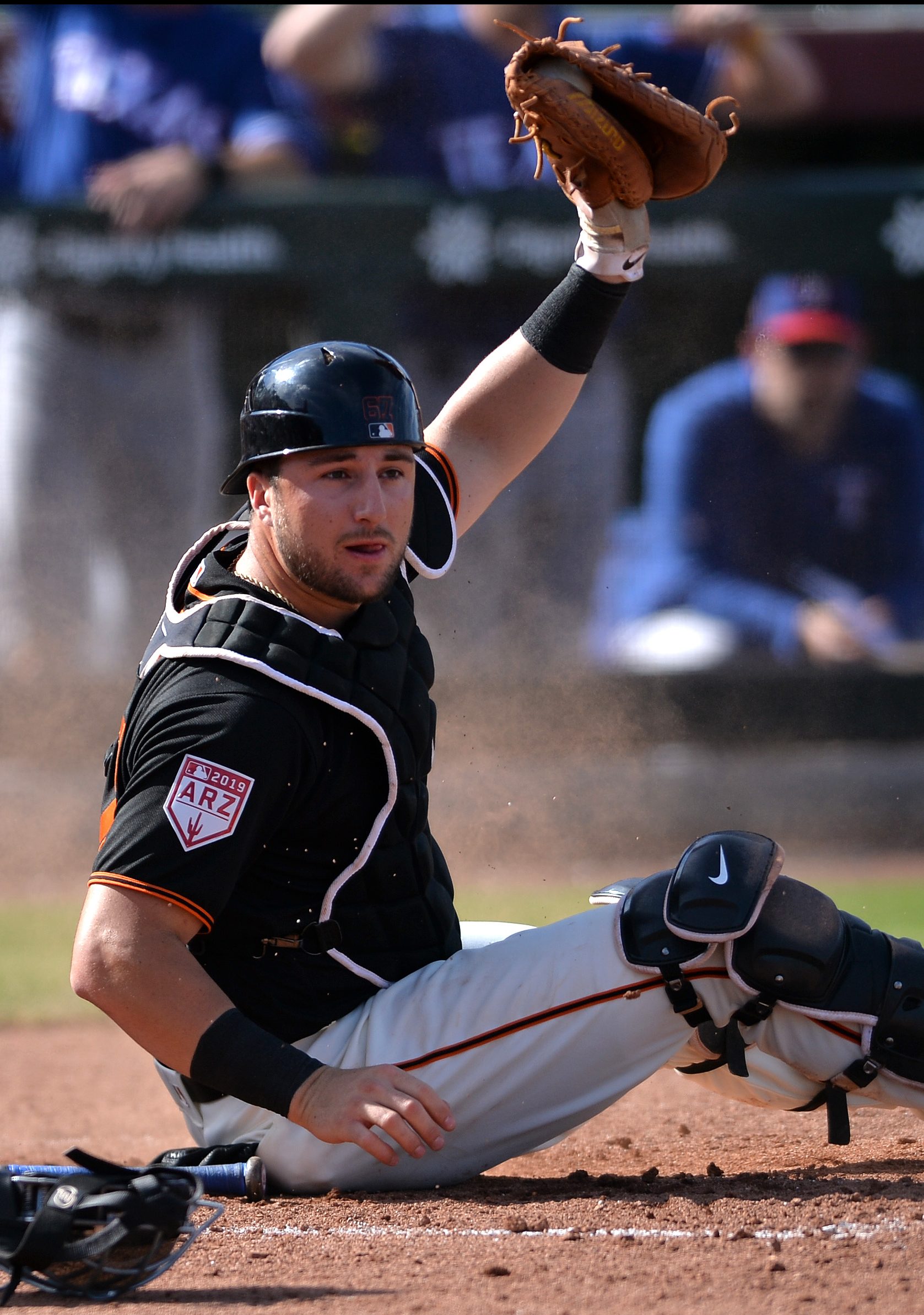
Bart 23, is about 14 months older than Rutschman and has already climbed as high as Double-A on the minor league ladder. He spent most of the 2019 season in Class-A Advanced, hitting .265/.315/.479 (116 wRC+) before a 22-game stint in Double-A where he finished on a tear: .316/.368/.544 (163 wRC+). Bart went on to the Arizona Fall League and hit .333/.524/.767 with four homers in 42 plate appearances before a broken thumb cut his AFL stint short. He could stand to improve his plate discipline (6.2 percent walk rate), but Bart also didn’t strike out at a particularly alarming rate (21 percent).
Behind the plate, Bart posted a rather pedestrian 27 percent caught-stealing rate across those two minor league levels before absolutely owning the run game in the AFL, where he caught nine of the 13 runners who attempted to take a base against him. Scouting reports praise his receiving and framing abilities as well as his ability to block pitches in the dirt — all things you’d expect for a catcher who was named ACC Defensive Player of the Year prior to being drafted in 2018. With Buster Posey‘s contract winding down and his production waning, it’s not out of the question to think that Bart could debut in 2020 if the season is able to get underway at some point. If not, a 2021 debut should be considered likely, barring some major injury.
The 22-year-old Rutschman, meanwhile, is obviously further from the Majors but offers many of the same skills. He’s touted as a high-end defensive catcher with a strong arm behind the plate and plenty of pop with the bat. Rutschman hit .254/.351/.423 with a hearty 13 percent walk rate through 154 plate appearances in his pro debut, topping out with Class-A Delmarva. He struck out in just 17.5 percent of those plate appearances, although it’s worth pointing out that he really hasn’t faced any pitching that’s older and more experienced than he is just yet.
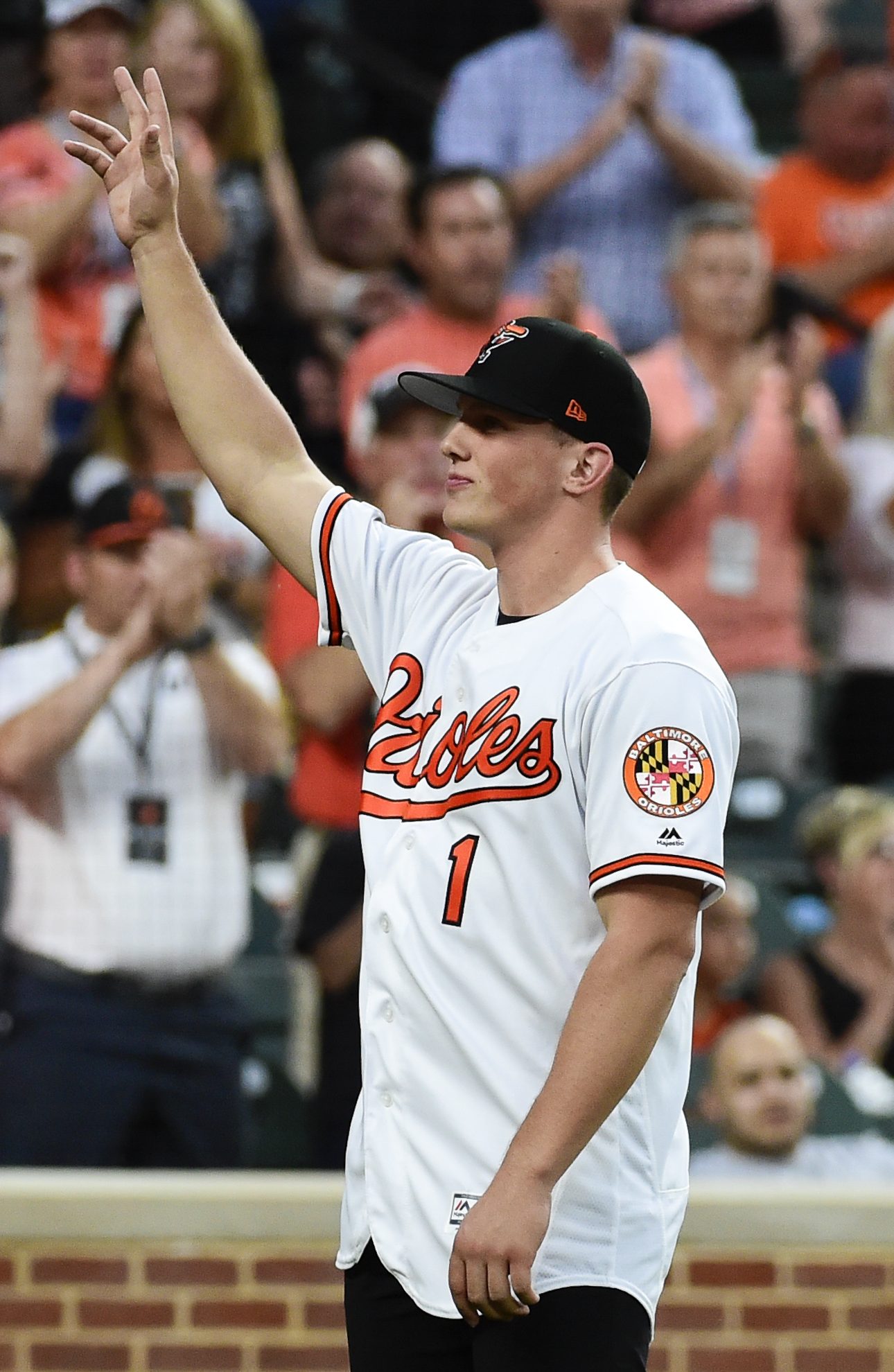
Unlike Bart, Rutschman is a switch-hitter. He has power from both sides of the dish even if most reports agree that his left-handed swing is superior to his right-handed swing. He threw out seven of the 11 hitters who tried to steal against him in his limited pro debut and, by all accounts, should be adept at controlling runners, calling a game, blocking pitches in the dirt and framing. It’s reasonable to expect that he’ll be in the Majors by 2022 — and a 2021 debut isn’t all that far-fetched (depending on any service time games the Orioles do or don’t feel like playing).
Given that Bart and Rutschman were elite college catchers who went within the first two picks of a draft class in consecutive seasons, this likely isn’t the only place you’ll see the two of them compared in the coming years. Rutschman is generally ranked more highly on prospect lists, although not by much in some cases. He’s No. 4 to Bart’s 14 at MLB.com and No. 5 against Bart’s 10 at FanGraphs. Other publications have a bit more distance between them, including Baseball America (Rutschman at 5, Bart at 32), Baseball Prospectus (Rutschman at 4, Bart at 25) and The Athletic (Rutschman at 10, Bart at 44). Prospect rankings are in a constant state of flux, though, and the pair is close enough that the consensus opinion could easily change in a few months’ time.
It’s clear that both are expected to become high-end catchers with All-Star potential, but let’s open up the debate (link to poll for Trade Rumors mobile app users)…
Which prospect would you rather have?
-
Adley Rutschman 61% (2,844)
-
Joey Bart 39% (1,811)
Total votes: 4,655
How The Delayed Season Impacts The Twins
All 30 big league clubs are waiting to see whether a 2020 season will be played at all, but assuming a season is able to take place in some capacity, the prolonged delay will impact some clubs more than others. We’ve already run through the Yankees, Angels, Phillies and Athletics in this regard.
Turning to the Twins, who’ll be looking to defend their first division crown since 2010, they’ll suddenly have the opportunity to get nearly a full season out of one of their most important pitching pickups of the winter: left-hander Rich Hill.
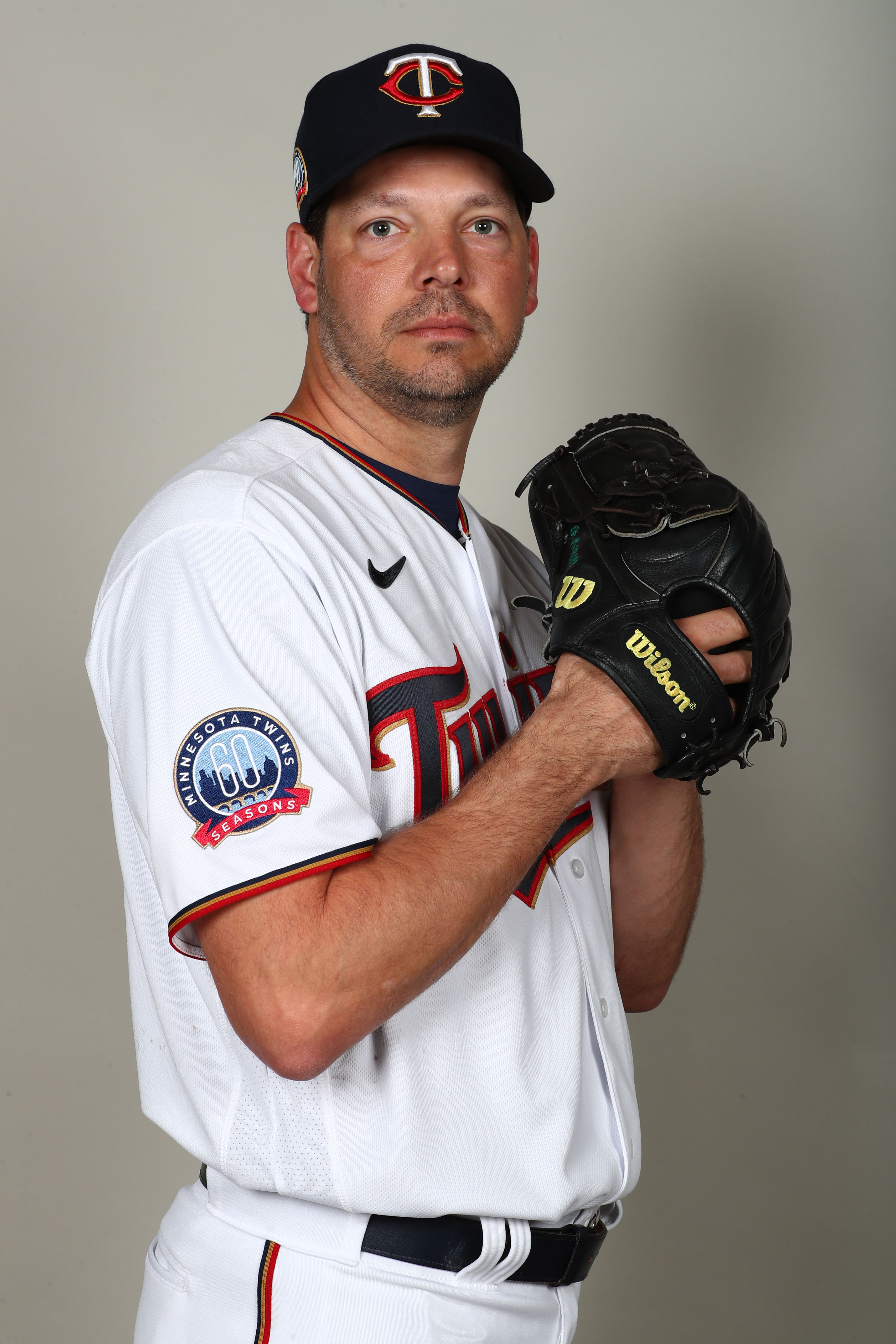
The 40-year-old Hill underwent “primary repair” surgery on his left ulnar collateral ligament over the winter and inked a one-year, $3MM deal with Minnesota (plus $9.5MM of available incentives), knowing that he’d miss the first few months of the season. Primary repair is a less invasive alternative to Tommy John surgery that can be pursued depending on the extent of the tear and its location within the ligament; Hill’s injury met the requisite criteria, and he was targeting a June or July return to the mound. It’s now possible he’ll be ready to join the Twins’ rotation early in a truncated season — if not from the very outset.
Manager Rocco Baldelli gave an update on Hill’s status in a recent interview with Steve Phillips and Eduardo Perez on MLB Network Radio on SiriusXM, suggesting that Hill is rehabbing and throwing and has “done very well — about as well as you could ask for.” To this point, there’s no reason to think his initial rehab timetable needs adjustment.
Hill wasn’t the ace that many Twins fans hoped to see the front office add this winter, but on a per-inning basis he remains highly effective. The durability concerns with the veteran southpaw are very real even if his recovery from offseason surgery goes as planned, but there’s no denying how good Hill has been recently when able to take the mound. In 58 2/3 innings last season, the lefty pitched to a 2.45 ERA with 11.0 K/9 against 2.8 BB/9 — despite pitching part of the season with the ligament damage that necessitated his surgery. Hill only managed 327 regular-season innings over the past three years, but he logged a 3.30 ERA with just under 11 punchouts per nine frames in that time and also chipped in 37 innings of 2.43 ERA ball in the playoffs.
The postponement of Opening Day not only gives Hill more time to get up to speed — it also should allow the Twins to more easily manage his innings. It’s likely that rosters will be expanded at least early on, which should give Baldelli some extra relievers if the club wants to limit Hill to three to five innings per outing to begin the season. One of the Twins’ previously projected fifth starter candidates — Randy Dobnak, Devin Smeltzer, Lewis Thorpe or non-roster invitee Jhoulys Chacin — could potentially be paired with Hill in a tandem or piggyback type of arrangement.
Additional downtime will also allow the Twins to ensure that several key players are at full strength to begin the year. None of Byron Buxton, Jorge Polanco or Marwin Gonzalez was expected to open the 2020 campaign on the injured list, but each is recovering from surgery. Buxton went under the knife last September to repair a torn labrum and was only just about to get into Grapefruit League games when Spring Training was suspended. Baldelli has said Buxton would’ve been ready for Opening Day, but there shouldn’t be any doubt about his shoulder’s well-being now.
Polanco, meanwhile, underwent surgery to repair an ankle injury that dogged him throughout the 2019 season. He appeared fine at the plate, hitting .295/.356/.485 with 22 long balls, 40 doubles and seven triples, but it’s possible that the nagging ankle issue contributed to Polanco’s lackluster defensive ratings and his lack of stolen bases (just four). Gonzalez, meanwhile, underwent a debridement of the patellar tendon in his right knee over the winter and was a bit behind schedule in camp. He should be fully up to speed once play resumes.
There are also possible implications for suspended right-hander Michael Pineda, who still has 39 games remaining on a reduced 60-game ban issued late last year. That suspension will still be in effect if the 2020 season is able to be played, and there’s been no indication that it’d be shortened or prorated to reflect the reduction of games on this year’s schedule. If the season is canceled entirely, however, ESPN’s Jeff Passan has previously reported that drug suspension wouldn’t carry into the 2021 campaign. Pineda would seemingly be able to join the rotation from day one.
The hope in Minnesota is that by the end of whatever season we get, Jose Berrios, Jake Odorizzi, Kenta Maeda, Homer Bailey, Hill and Pineda will combine to make the bulk of the starts. With six starters, plus the trio of Dobnak, Smeltzer and Thorpe on hand as depth options (and perhaps Chacin as well), the Twins should be well-equipped to handle regular doubleheaders and fewer off-days in the accelerated regular-season schedule.
In a worst-case scenario that sees the season postponed entirely, the Twins could see holdovers Odorizzi, Gonzalez, Nelson Cruz and Trevor May all reach free agency. Meanwhile, Hill, Bailey, Tyler Clippard and Alex Avila could depart without ever formally suiting up in a game that counts.
NL West Notes: Martin, Giants, Ubaldo
Right-hander Corbin Martin, one of four players the Astros sent to Arizona in the Zack Greinke blockbuster, had been on the Diamondbacks‘ radar for awhile, writes Zach Buchanan of The Athletic (subscription required). They’d first targeted him in the 2017 draft and again in trade talks with the ‘Stros centered around Paul Goldschmidt — but Houston wasn’t keen on including him in such a deal. At the time, Martin was 22 and fresh off 122 innings of 2.51 ERA ball between Class-A Advanced and Double-A, while Goldschmidt only had a year of control left.
Martin made his MLB debut in 2019 but underwent Tommy John surgery in July and was suddenly on the shelf for a win-now Astros club. Thus, D-backs GM Mike Hazen inquired again, and the Astros were more willing to listen the second time around. A package of Martin, J.B. Bukauskas, Seth Beer and Josh Rojas (plus plenty of cash to help offset Greinke’s salary) got the job done. Martin may not be an option for the Snakes until 2021, but he’s a second-rounder with a career 2.58 ERA in the minors who has ranked on Top 100 lists in both of the past two offseasons, making him an intriguing piece down the road. D-backs and Astros fans alike will want to check out the piece for thoughts from Hazen and assistant GM Amiel Sawdaye on the club’s longstanding interest in Martin.
Some more out of the NL West…
- The Giants‘ release of veteran lefty Jerry Blevins only increased the odds of southpaws Jarlin Garcia and Wandy Peralta making the club, notes Alex Pavlovic of NBC Sports Bay Area. Both pitchers hurled five shutout innings when exhibition games were still being played — Garcia with an 8-to-1 K/BB ratio and Peralta with a 10-to-4 mark. Given that Garcia is out of minor league options, he’d appear a particularly likely candidate to secure a spot in the ‘pen, although there’s certainly room for both. The Giants claimed both lefties off waivers, with Peralta coming over from the Reds in September and Garcia coming over from the Marlins over the winter. Each has had some success in the Majors and is controllable all the way through the 2023 season should things pan out in the Bay Area.
- Baseball’s shutdown put Ubaldo Jimenez‘s comeback attempt with the Rockies on hold, but the right-hander is open to pitching in the minors if play is able to resume, writes Nick Groke of The Athletic in an excellent column on Jimenez’s unexpected bid to revive his career (subscription required). As Groke details, Jimenez received a “fringy” Major League offer in the 2017-18 offseason but opted to stay home in the Dominican with his pregnant wife and soon-to-be-born child. This offseason, wanting to take one last shot, he called Rockies VP of international scouting Rolando Fernandez about using the team’s complex in the Dominican to refine his mechanics. That eventually turned into a solid Dominican Winter League stint, a minor league deal with the Rox and several weeks serving playing the role of wise old sage to younger Rockies pitchers like German Marquez. Manager Bud Black tells Groke that Jimenez was sitting around 91 mph with his heater early in camp. A comeback at age 36 is a long shot but would make for one heck of an in-season storyline to root for.
Phillies Notes: Harper, Dominguez, Realmuto
There’s plenty of negativity on which to dwell in times such as these, but many of the game’s top players continue to their efforts to help those in need and inspire hope. To that end, Bryce Harper announced Thursday (via Twitter) that he and his family are donating $500,000 in partnership with Direct Relief, Three Square Las Vegas and Philabundance to “those in most immediate need” of aid against the spreading COVID-19 virus.
“Now is the time to come together and adhere to the guidelines of medical professionals!” wrote Harper. “We are wishing the best to all with our prayers during this time.” Harper joins Dexter Fowler, Freddie Freeman, Adam Wainwright, Shin-Soo Choo and dozens upon dozens of other big leaguers who have been active in their communities and made charitable contributions in the fight against the pandemic.
A couple more notes out of Philadelphia…
- A decision on right-hander Seranthony Dominguez‘s right elbow is on “pause” for now, general manager Matt Klentak told reporters Thursday (link via Matt Breen of the Philadelphia Inquirer). The Phillies’ medical staff recommended Tommy John surgery after an MRI, and Dominguez was slated to receive a second opinion shortly thereafter. However, that recommendation coincided with the implementation of travel restrictions in Dominguez’s native Dominican Republic, and the righty quickly traveled back home to be with family while he was still able. Now, Dominguez’s second opinion and potential surgery are both on hold. Klentak acknowledged that Tommy John is still a definite possibility but stressed that the situation is not black-and-white. “For a lot of players, surgery is the last option they want to consider,” said Klentak. “…Before we go down that road we just want to make sure that everybody’s in agreement that [Tommy John surgery] is the right course of action.”
- Also on hold for the time being are the team’s extension talks with star catcher J.T. Realmuto. The league mandated that extension talks be halted during MLB’s league-wide roster freeze, so the two sides can’t even talk about a potential long-term deal. Klentak emphasized today, though, that he hopes to eventually rekindle talks with Realmuto’s camp. “I think you all know that we love J.T., and he’s a player that we would love to have with us for the long haul,” said the GM. Realmuto was reportedly seeking to top Buster Posey‘s $159MM guarantee and set a new average annual value precedent for catchers — which could’ve meant an asking price upwards of $26-27MM annually over a six-year term. He’s slated to become a free agent in the 2020-21 offseason.
Giants Release Jerry Blevins, Brandon Guyer
The Giants released left-hander Jerry Blevins and outfielder Brandon Guyer shortly before the league-wide roster freeze was implemented, per Baseball America’s Chris Hilburn-Trenkle. Both veterans had been in Major League camp as non-roster invitees this spring.
It was a rough spring for the 36-year-old Blevins, who was tagged for nine runs on 10 hits and a pair of walks with three strikeouts in just 3 2/3 innings of work. In all, the southpaw allowed 12 of the 23 hitters he faced to reach base.
That said, Blevins also had a quality showing for the Braves in 2019, tossing 32 1/3 innings of 3.90 ERA ball. He punched out 37 hitters against 16 walks in that time and held opposing lefties to a miserable .180/.261/.279 slash. Righties handled him much better, slashing .233/.347/.483, however. It’s been a similar story for Blevins throughout his career — .583 OPS from opposing lefties; .743 from righties — and it stands to reason that he’s the type of player whose skill set is largely undercut by MLB’s new three-batter minimum. If the season is able to be played out, it’s likely he’d need to latch on elsewhere on another nonguaranteed deal.
As for Guyer, the 34-year-old appeared in only five spring games with the Giants and went 1-for-7 in nine total plate appearances. (Yes, he was hit by a pitch in one of them.) Guyer hasn’t played in the Majors since 2018 after spending the bulk of the 2019 season on the injured list with the White Sox’ top minor league affiliate in Charlotte. He’s a career .250/.339/.388 hitter but is best used as a platoon piece, as evidenced by a lifetime .274/.376/.449 batting line against left-handed pitchers.