
2026-27 Player Option/Opt-Out Preview: April Edition
At the end of each season, certain players will have to decide whether to stick with their current contracts or become free agents. These contract provisions are sometimes referred to as opt-outs and sometimes as player options. Despite the different terminology, they are effectively the same, with the player being the one making the call.
Naturally, the player’s health and performance leading up to the decision will impact which way the player leans. Which players have that decision looming after the 2026 campaign? MLBTR takes a look, in alphabetical order. Player ages in parentheses are for the 2027 season.
- José Berríos (33): can opt out of remaining two years, $48MM
The Blue Jays and Berríos agreed to a seven-year, $131MM extension back in November of 2021. The Jays had just acquired Berríos from the Twins a few months earlier, when he had a year and a half of club control remaining. A few months later, with that control window down to one year, they locked him up to keep him around. He could opt out of the final two seasons of the deal, giving him a chance to hit the open market after his age-31 season, when another long-term deal would still be theoretically possible.
Back then, Berríos was a front-of-rotation workhorse who could be banked on for 3-5 WAR per year. He hasn’t been getting as many strikeouts lately, making him feel more like a veteran innings-eater type. From 2022 to 2025, he posted a 4.14 ERA with a 20.7% strikeout rate, 6.9% walk rate and 41.7% ground ball rate.
Even that has been undercut by some injury concerns in recent months. He finished 2025 on the injured list due to elbow inflammation and has started this year on the IL as well, again due to elbow inflammation. The issue doesn’t appear to be major and he could be back with the Jays in the near future. He would have to come back healthy and pitch really well in the next few months for this opt-out to even be a consideration.
- Bo Bichette (29): can opt out of remaining two years, $84MM, taking a $5MM buyout
Bichette’s recent trip to the open market was an interesting case. He wasn’t the first notable free agent to settle for a short-term deal, but we do know that he could have taken a more traditional long-term pact. The Phillies reportedly offered him a seven-year deal worth around $200MM. That was pretty close to the eight-year, $208MM deal that MLBTR predicted at the beginning of the offseason.
Instead, Bichette went another way. The Mets offered a much higher average annual value on a short-term deal with opt-outs after each season. Bichette can collect $42MM from the Mets for his age-28 season. If he decides to return to free agency, he can take a $5MM buyout on his way out the door, going into his age-29 season.
He would be walking away from a big salary but another $200MM deal might be out there for him if he has another typical Bichette season. Perhaps he would look to lock that in but we have already seen him opt for the bigger salary once. Maybe he would do so again. On the other hand, it’s theoretically possible he can garner better long-term offers this coming offseason. Last time, he had question marks due to his knee injury and uncertain future position. This time, it’s possible he’ll be healthy and have some proof of concept as a third baseman.
Bichette will need to turn things around to even make this a discussion, as he’s off to a .228/.262/.263 start as a Met, but that’s in a small sample size of 61 plate appearances. He has lots of time to heat up.
- Corbin Burnes (32): can opt out of remaining four years and $140MM ($44MM deferred)
Burnes was a free agent after the 2024 season and few expected him to land in Arizona, but the Diamondbacks signed him to a six-year, $210MM deal, with $64MM deferred. The deal gave Burnes the chance to opt out after two seasons, which would be his age-30 and age-31 seasons.
The deal has not worked out as hoped so far. Burnes did give the club 11 good starts last year, posting a 2.66 ERA, but then required Tommy John surgery in June. He will be on the shelf for at least half of the 2026 season, if not more.
It is theoretically possible for Burnes to beat the remaining money on his deal. Blake Snell was going into his age-32 season in 2025 when the Dodgers gave him a five-year deal worth $182MM. A couple of years prior, Jacob deGrom did better at an even older age. He was going into his age-35 season when he got a five-year, $185MM deal from the Rangers.
For Burnes to make this a conversation, he’ll probably need to come back and shove for at least a few weeks. One or two starts in September won’t do it. It’s also worth considering that Burnes seemingly turned down larger offers from other clubs because he and his family live in Scottsdale. Even if he thinks there’s a chance of slightly more money out there, he might be happy where he is.
- Kyle Freeland (34) – $17MM player option for 2027 if 170 innings pitched in 2026
Freeland and the Rockies signed a five-year, $64.5MM extension back in April of 2022. The deal runs through 2026 but Freeland can unlock a $17MM player option by getting to 170 innings pitched this year. He hasn’t done that in a while, with 2022 being the last time he hit that mark. Even a minor injury that puts Freeland on the IL for a few weeks would quickly take this off the table.
Presumably, the Rockies don’t want him to trigger this. The deal was signed under the previous front office regime. Even at the time, it was a bit of a head-scratcher. Since it has been signed Freeland’s ERA has mostly been hovering around 5.00. That’s not so bad for a pitcher who plays his home games at Coors Field but the Rockies are now rebuilding and don’t seem likely to be in contention next year.
On the other hand, even without a real eye on contention, they have considered it worthwhile to invest in making the rotation more respectable. After losing 119 games last year, the new front office invested almost $20MM to sign Michael Lorenzen, Jose Quintana and Tomoyuki Sugano. Each of those guys got $8MM or less. Deals like that are probably preferable to spending twice as much on Freeland but it’s not as though that would be back breaking. Freeland is making $16MM this year, so it would be a modest raise.
- Ryan Helsley (32) – $14MM player option
Helsley became a free agent after last year and a pillow deal seemed likely. He had been so dominant at his best but was coming off a poor platform. From 2022 to 2024, he posted a 1.83 ERA with a 34.6% strikeout rate. But in 2025, his ERA jumped up to 4.50. It was an even worse 7.20 for the Mets, who had acquired him from the Cardinals at the deadline. He only struck out 23.2% of batters faced after the deal. There was some talk that he may have been tipping his pitches, as his stuff seemed the same.
The Orioles gave him a two-year, $28MM deal, with even $14MM salaries in each season. Ideally, Helsley would return to form. That would give the O’s a lock-down closer without a lengthy commitment, while Helsley could return to free agency and get a bigger payday.
The early results are mixed. Helsley has thrown 4 1/3 innings for the O’s. His 30.4% strikeout rate is a nice uptick but he has also walked 17.4% of batters faced in that small sample. He still has lots of time but the sooner he locks in, the more it will help him in the coming offseason.
- Clay Holmes (34) – $12MM player option
Holmes spent most of his career as a reliever until he hit free agency, when he drew interest as a starter. The Mets gave him a three-year, $38MM deal and stretched him out. That deal contained an opt-out after two years. That would give Holmes a chance to return to free agency with some proof of concept as a starter, while the Mets would hope to at least get a couple of decent seasons from him.
So far, so good. Holmes is striking out fewer batters as a starter but is still getting plenty of ground balls, leading to good results on the whole. He has thrown 178 1/3 innings as a Met with a 3.38 ERA. His 18.2% strikeout rate is well below his work as a reliever, when he was usually above 25%, but Holmes has induced grounders at a 56.4% clip. He has had a bit of luck from a .273 batting average on balls in play and 75% strand rate, but his 4.09 FIP and 4.39 SIERA suggest he would be a competent back-end starter even with more neutral luck.
A decent starting pitcher can beat $12MM these days, even one in his mid-30s. In the most recent offseason, Nick Martinez got $13MM from the Rays for his age-35 season. Chris Bassitt got $18.5MM from the Orioles for his age-37 season. Merrill Kelly got two years and $40MM from the Diamondbacks starting at age-37. Adrian Houser got two years and $22MM from the Giants beginning with his age-33 campaign, even though he had to settle for a minor league deal a year prior.
Holmes hasn’t been getting as many strikeouts as Kelly or Bassitt but he was comparable to Martinez and Houser last year, with far more grounders than anyone in that group. He’s not an ace but there could be a path to something better than what will be left on his deal.
- Tatsuya Imai (29) – can opt out of remaining two years, $36MM
Imai is just making his major league debut. Coming from Japan at the end of last season, there seemed to be big divisions in how he was viewed by major league teams. Some saw him as a viable mid-rotation guy but others felt his future would be as a leverage reliever.
Some, including us, thought that a team would bet on the upside. MLBTR predicted Imai to land a six-year deal worth $150MM. It seems no club was willing to go to that length, at least not yet. Imai signed a three-year, $54MM deal with the Astros. Opt-outs after each season give him a chance to return to free agency, ideally with a track record of success as a major league starter. He is still relatively young, turning 28 in May, so he should still be able to secure a long-term deal in the future if the results are there.
It has only been two starts but the numbers have been mixed. Imai has a huge 35.1% strikeout rate but a massive 18.9% walk rate. That lack of control is one of the worries with Imai. He got his walk rate down to 7% in his final NPB season but was above 11% from 2019 to 2023. Beating two years and $36MM would be easy if he’s a 29-year-old mid-rotation starter but he will probably stay if he doesn’t quite cement himself or gets pushed to the bullpen.
- Michael King (32) – can opt out of remaining two years, $58MM for a $5MM buyout
Not too long ago, King looked to be on his way to a nine-figure deal. He got a rotation chance with the Yankees late in 2023 and made the most of it. The Padres acquired him and put him into their starting group. King responded with an excellent 2024. He kept that going into 2025 until some injury issues popped up. From August 24th of 2023 until May 18th of 2025, King tossed 267 2/3 innings with a 2.72 ERA, 28.4% strikeout rate and 8.1% walk rate. FanGraphs credits him with 6.7 WAR for that span. The only six pitchers ahead of him on that leaderboard are Tarik Skubal, Chris Sale, Zack Wheeler, Logan Webb, Cole Ragans and Dylan Cease.
But King wasn’t able to carry that all the way into free agency. A pinched nerve in his shoulder sent him to the IL for a while. He returned but then quickly went back on the IL with left knee inflammation. He made a few starts in September but wasn’t as dominant as before.
Due to that unimpressive finish, he seemed likely to get a short-term deal with opt-outs, and that indeed came to pass. The Friars brought him back with a three-year deal worth $75MM. It’s a bit backloaded, a team preference since the Padres have been working with some payroll restrictions. King gets a $12MM signing bonus, $4MM annually, but he’ll get all of that even if he opts out. It’s a $5MM salary in the first season and then a $5MM buyout if he walks. Then there’s a $28MM salary in 2027 and $30MM for the final season.
He can easily beat that if he’s back in top form. As mentioned, he was pitching like an ace a year ago and was on a path to something well over $100MM. Even with the injuries, he almost got to nine figures. Through three starts, he has a 3.24 ERA. His 22.1% strikeout rate and 11.8% walk rate aren’t amazing but it’s a very small sample size.
- Yuki Matsui (31) – can opt out of remaining two years, $13.5MM
After years working as a closer in Japan, Matsui came over to North America ahead of the 2024 season. The Padres signed him to a five-year, $28MM deal. That pact allowed him to opt out after three years, as long as he didn’t have a major injury in the first two.
Matsui stayed healthy and has generally given the Padres solid relief work. He made more than 60 appearances and logged more than 60 innings in both 2024 and 2025. On the whole, he has a 3.86 ERA in 126 innings thus far. However, his 11.3% walk rate is high and his 24.6% strikeout rate is only about two ticks above average for a reliever. He hasn’t really been in a leverage role, with just one save and 12 holds. He began the 2026 season on the IL with a groin strain.
Two years and $13.5MM isn’t a massive amount of money in baseball terms but Matsui won’t beat that if he’s a low-leverage reliever. Those types of guys usually get one-year deals worth a few million. He would have another chance to opt out after 2027.
- Emilio Pagán (36) – $10MM player option
Pagán’s profile is well known at this point. He gets a lot of strikeouts but also allows lots of home runs. That leads to big swings in his ERA, depending on how many fly balls are leaving the yard. He had a 4.43 ERA with the Twins in 2022, then dropped that to 2.99 in 2023. The Reds signed him to a two-year deal with an opt-out. His ERA spiked to 4.50 in the first season and he decided to stay. He then had a 2.88 ERA in 2025.
He returned to free agency and the Reds re-signed him to basically the same deal as before. The first was $16MM over two years. The second deal gave him a slight bump to $20MM. Pagán has already allowed two home runs through 7 1/3 innings this year, leading to a 6.14 ERA. This one literally depends on which way the winds will be blowing this summer.
- Wandy Peralta (35) – $4.45MM player option
Peralta got a four-year, $16.5MM deal from the Padres going into 2024, with the final three seasons all being player options. That was a surprise at the time but the Friars like deals like this, seemingly because of their financial situation. The extra years lower the average annual value and therefore the hit to the competitive balance tax. If the player has a good season and opts out, that’s a loss to the roster but the Padres get him off the books.
With Peralta, he has mostly been a ground ball specialist in his career, getting opponents to pound the ball into the dirt at a 53.8% clip. His 19.1% strikeout rate is below average but he’s still been able to have some good seasons. His first two campaigns in San Diego were fine but weren’t enough for him to trigger either of his first two opt-out chances. He had a 3.99 ERA in 2024 and a 3.14 ERA last year. He has a 3.60 ERA in the early going in 2026.
$4.45MM isn’t a ton of money but veteran relievers can sometimes get squeezed. Andrew Chafin keeps having to settle for minor league deals, for instance. Peralta should probably just stick with San Diego for 2027 unless he has a surprisingly dominant season.
- Nick Pivetta (34) – can opt out of remaining two years and $32MM
The Padres signed Pivetta to a four-year, $55MM deal ahead of the 2025 season. Due to San Diego’s aforementioned payroll crunch, they backloaded the money. Pivetta got a $3MM signing bonus and $1MM salary in 2025. He is making $19MM this year, followed by two player options worth $14MM and $18MM. The 2027 option becomes a club option if Pivetta misses 130 days for a major injury.
The first season of the deal was the best of Pivetta’s career. He took the ball 31 times and posted a 2.87 ERA, though that may have been a bit fluky. His strikeout and walk rates held fairly steady compared to prior seasons. He went into 2025 with a 15.5% home run to fly ball rate but only 9.7% of his fly balls went over the fence last year. If his home run rates revert back to previous levels, his ERA would likely jump back to his usual range of the low 4.00s.
Two years and $32MM is beatable as a decent 34-year-old. Sonny Gray and Nathan Eovaldi both got three-year deals worth $75MM in recent years. Eovaldi was actually one year older, going into his age-35 campaign. Bassitt got three years and $63MM from the Blue Jays a few years back. Yusei Kikuchi got the same deal from the Angels. As previously mentioned, Kelly got $40MM over two years going into his age-37 season.
- Luis Severino (33) – $22MM player option
Severino signed a three-year, $67MM deal with the Athletics ahead of 2025. The A’s were desperate for pitching. Luring big leaguers there was going to be tough since they were going to be playing in a minor league park from 2025 to 2027. They also needed to spend a bit more to avoid putting their status as a revenue sharing recipient at risk. The Severino deal surpassed expectations and the industry consensus is that the A’s realized they had to overpay someone.
Though Severino accepted that job and has 67 million reasons to feel good about it, he also has a few reasons to feel annoyed and went public with those. It’s possible he’s eager to move on and maybe the opt-out was put into the contract so that he would have the ability to do so.
Last year’s results weren’t amazing, as he posted a 4.54 ERA. The minor league park played as hitter-friendly and may have hurt him, as he had a 6.01 ERA there compared to a 3.02 ERA on the road. However, that road ERA was helped by a tiny .249 BABIP. He only struck out 17% of batters faced in away games, so it’s not as though he was dominating. His 4.34 home FIP and 3.87 road FIP were much closer than the ERA splits.
Unless he really dominates in 2026, sticking with the A’s may be best financial decision. In the most recent offseason, decent starters got less than the $22MM Severino would be turning down. Zac Gallen got $22.025MM but with deferrals that knocked the net present value below $19MM. As mentioned, Houser got $22MM on a two-year deal. Steven Matz got $15MM over two. Bassitt got $18.5MM, Martinez got $13MM and Dustin May got $12.5MM via one-year deals. His 2026 results will play a role but his desire to get out of that minor league park may also be a factor.
Photo courtesy of D. Ross Cameron, Imagn Images
Latest On Padres’ Bullpen Outlook
Padres right-hander Jason Adam has been targeting the Opening Day roster as he finished off his rehab from last year’s torn tendon in his quadriceps. The right-hander said three weeks back that team doctors hadn’t told him “no” on the possibility yet, and Annie Heilbrunn of the San Diego Union-Tribune reports that Adam could get back into games soon. He’s been ahead of schedule in camp and is slated for one final simulated game this week before a likely Cactus League debut on the weekend.
The 34-year-old Adam is a major piece of a deep San Diego bullpen. Over the past four seasons, he’s worked to a 2.07 ERA with 92 holds, 24 saves, a 29.2% strikeout rate and an 8.4% walk rate across 256 2/3 innings between the Rays and Padres. If healthy, he’d join Adrian Morejon and Jeremiah Estrada as one of closer Mason Miller‘s top setup options.
A healthy Adam also leads to a relatively crowded bullpen that could force the Friars into some tough decisions. Miller, Estrada, Morejon and Adam would be locks for bullpen spots. That’s presumably true of righty David Morgan (2.64 ERA, 47 1/3 innings in 2025) as well. Lefties Wandy Peralta and Yuki Matsui are pitching on multi-year contracts and can’t be optioned.
That group accounts for seven of the Padres’ eight bullpen spots. Right-hander Ron Marinaccio is out of minor league options. Right-hander Bradgley Rodriguez has multiple option years left but has excelled in camp after impressing in a brief look last year. Righty Matt Waldron might start the season on the injured list, but he’s out of minor league options as well and would need to be added to the big league roster or designated for assignment. Bryan Hoeing is shut down with an elbow issue right now.
Having more talented relievers than bullpen spots available is obviously a nice problem to have, all things considered, and depending on the injury timetables of Adam and a couple teammates, the Friars might be able to kick any 40-man decisions down the road a bit for the early portion of the season. At some point, something will have to give on one of the players who can’t be sent down (whether due to contract or lack of minor league options.
That’s especially true if the Padres want to consider breaking camp with any non-roster invitees on the big league club. Veterans Walker Buehler, Marco Gonzales and Triston McKenzie are among that group, but manager Craig Stammen has been talking up the chances of a different former big leaguer for a potential bullpen job: right-hander Logan Gillaspie.
“He just goes out there, competes his tail off, lot of energy and enthusiasm, throws a ton of strikes and gets a lot of outs,” manager Craig Stammen told MLB.com’s AJ Cassavell when asked about Gillaspie. He noted that Gillaspie could be used in a multi-inning role, providing some length early in games if necessary.
The 28-year-old Gillaspie has pitched in each of the past four major league seasons, including 18 innings for San Diego across the 2024-25 campaigns. He’s had pedestrian results overall, but Gillaspie is a familiar hand for many Padres coaches and is in the midst of a strong spring training (7 2/3 shutout frames, 8-to-2 K/BB ratio). Cassavell suggests that Gillaspie is viewed as having a real chance to make the club, particularly if the Padres open the season with multiple veterans on the injured list.
Wandy Peralta Will Not Opt Out Of Padres Deal
Veteran reliever Wandy Peralta will forgo the opt-out in his contract, reports Annie Heilbrunn of the San Diego Union-Tribune. Peralta’s four-year, $16.5MM contract contained opt-out opportunities after each season. He’s exercising a $4.45MM player option for the 2026 season and will have one final player option for the same amount next offseason.
Peralta effectively has two years and $8.9MM remaining on his contract, with an opt-out at the midway point. He might’ve had a chance to beat that in free agency on the back of a 3.14 ERA in a career-high 71 2/3 innings, but it’s far from a sure thing. The 34-year-old doesn’t exactly have age on his side, and this year’s 20.1% strikeout rate and 9.6% walk rate were both a fair bit worse than the league average.
Peralta still throws hard, sitting 95-96 mph with his sinker, and piles up grounders at a near-60% clip, but he’s worked primarily in low- and medium-leverage spot since signing with San Diego. He’ll stay put and once again be a heavily used piece of the Friars’ bullpen picture.
The Padres boast a deep bullpen, headlined by deadline acquisition Mason Miller. Closer Robert Suarez opted out of the remaining two years on his contract earlier today. Assuming they keep Miller in the ‘pen — they’ve reportedly at least considered moving him into the rotation — he’ll be supported by Peralta, Adrian Morejon, Jeremiah Estrada and standout rookie David Morgan. The Padres will have a notable decision to make on excellent setup man Jason Adam, who is projected for a $6.8MM salary in arbitration but suffered a ruptured quadriceps tendon in September, which required season-ending surgery.
Player Option/Opt-Out Update: April Edition
The increasing popularity of opt-outs/player options as a means to close the gap in free agent signings and extensions has changed the face of free agency entirely. Not long ago, opt-outs were perks reserved for the game’s truly elite stars — a benefit to help differentiate nine-figure offers and secure the game’s top stars.
In 2025, they’re downright commonplace. Opt-out laden short-term deals have become a common alternative to the more conventional one-year pillow contract that a player in search of a rebound campaign might pursue. They’ll also provide a soft landing for a veteran whose market didn’t materialize as expected, even coming off a productive season. Some teams simply use them as a means of sweetening the pot even when negotiating with mid- and lower-tier free agents. The Royals gave opt-outs/player options to both Chris Stratton and Hunter Renfroe two offseasons ago. The Reds did the same with Emilio Pagan and Nick Martinez. Tucker Barnhart, Trey Mancini and Ross Stripling are just a few of the other recent examples of solid but non-star veterans to land such clauses in their free agent contracts.
At their core, opt-out provisions aren’t particularly different from club options that have been widely accepted as commonplace for decades. Teams guarantee a certain number of dollars over a certain number of years, and if the player continues performing at a high enough level, they’ll exercise a club option that’s typically locked in at a below-market price. If not, the player will be bought out and sent back to free agency. Player options and opt-outs are merely the inverse; the player/agent negotiate a certain length and annual value but reserve the right to opt back into the market if the player continues to perform at a high level. It’s two sides of the same coin, one favoring the team and the other favoring the player.
There are 16 players around the league this year who’ll have the right to opt into free agency at season’s end, depending on their performance. (Conversely, there are 27 players with club options.) We’ll periodically take a look at this group over the course of the season, as their performances will have a major impact on the 2025-26 market. For more context, you can check out our full list of 2025-26 MLB free agents as well as the first installment of our recent 2025-26 MLB Free Agent Power Rankings, wherein we rank the top 10 free agents in terms of earning power. Darragh McDonald, Anthony Franco and I recently discussed the decision process behind those rankings in the latest episode of the MLB Trade Rumors Podcast.
Onto this year’s group!
Pete Alonso, 1B, Mets | One year, $24MM remaining
Alonso looked like a good bet to opt out from the moment he agreed to terms on his front-loaded two-year, $54MM contract. That he’s been one of the best hitters on the planet in the season’s first three weeks only improves that likelihood. The 30-year-old slugger is slashing a comical .365/.474/.730 with five homers, eight doubles and more walks (12) than strikeouts (10) through his first 78 turns at the plate. Alonso is chasing pitches off the plate at a career-low 19.1% rate and is sporting the best contact rate of his career at 82.8%. He’s doing all of that with career-best marks in average exit velocity (96.3 mph), barrel rate (24.1%) and hard-hit rate (61.1%). Alonso has been an absolute monster, and the fact that he can’t receive a qualifying offer — players can only receive one in their career, and he rejected one last November — is a cherry on top of his dominant output.
Cody Bellinger, OF/1B, Yankees | One year, $25MM remaining (Bellinger receives $5MM buyout if he opts out)
Bellinger posted All-Star numbers with the 2023 Cubs, signed back for three years with a pair of opt-outs and hit well in 2024 — just not to his 2023 standard. Traded to the Yankees this past offseason, many thought he was primed for a rebound because of the favorable dimensions at Yankee Stadium. It hasn’t played out that way. Through his first 62 plate appearances, Bellinger looks more like the lost version of himself from 2021-22 than the strong performer we saw in ’23-’24. He’s hitting .185/.242/.296 with what would be career-worst strikeout and swinging-strike rates of 29% and 15.2%, respectively. When he’s made contact, it’s been loud (90.8 mph average exit velocity, 53.5% hard-hit rate) — and there’s still plenty of time to turn things around. It’s not the start he or the Yankees hoped for, however.
Shane Bieber, RHP, Guardians | One year, $16MM remaining (Bieber receives $4MM buyout if he opts out)
Bieber has yet to pitch this season as he rehabs from last year’s Tommy John surgery. Cleveland has yet to place him on the 60-day injured list, which could offer some optimism regarding his timetable for a return, but he’s not on a minor league rehab assignment yet. At last check, he was targeting a return around the All-Star break.
Alex Bregman, 3B, Red Sox | Two years, $80MM remaining (Bregman can opt out again after 2026)
Bregman has started his Boston tenure on a tear, hitting .321/.365/.564 with four big flies in 85 plate appearances. He’s been 62% better than average, by measure of wRC+, but there are still some of the same red flags he displayed early in the 2024 season. During his peak, Bregman was one of the sport’s toughest strikeouts and showed outstanding plate discipline. From 2018-23, he walked in 13.8% of his plate appearances against a puny 12.3% strikeout rate. Bregman’s walk rate fell off a cliff last season, and it hasn’t recovered so far in 2024. He’s drawn only four free passes (4.7%). More concerning, he’s fanned 18 times, leading to what would be a career-worst 21.2% strikeout rate. Bregman’s chase rate is down, and he’s still making elite contact within the strike zone, but he’s making contact on a career-low 56.5% of his swings on balls off the plate. If he keeps hitting like this, it probably won’t matter, but it’s something to watch as the season continues.
Edwin Diaz, RHP, Mets | Two years, $37MM remaining (Diaz can opt out again after 2026)
Diaz had a nice return from a 2023 season lost to a knee injury in 2024, pitching to a 3.52 ERA with a 38.9% strikeout rate against a 9.3% walk rate. It wasn’t quite his usual level of dominance, but most relievers would happily take a 39% punchout rate in a “down” season. Things aren’t going as well in 2025. Diaz’s four-seamer is sitting at a career-low 96.4 mph, per Statcast. That’s down 1.1 mph from last year’s mark and 2.5 mph from his 99.1 mph peak in 2022. If he were still overpowering opponents, it wouldn’t matter much, but Diaz has been tagged for five runs on six hits and five walks in 6 2/3 frames. That’s a 16% walk rate, and he’s already tossed four wild pitches — more than he did in 53 2/3 innings a year ago. The caveat with everyone on this list is that we’re all of 11-12% through the season, but the early trendlines aren’t good for Diaz.
Jack Flaherty, RHP, Tigers | One year, $10MM remaining (increases to $20MM once Flaherty makes 15 starts)
Flaherty’s heater is down nearly a mile per hour, and his walk rate is up from 5.9% to 10.3% … but that’s in a span of 21 1/3 innings. He’s still getting strikeouts at a plus level (28.7%), and the bottom-line results are good: 2.53 ERA. Flaherty seems healthy, which will be a big factor for him — both in terms of boosting his stock ahead of a potential return to free agency and in boosting his 2026 salary if he winds up forgoing the opt-out opportunity. If he can deliver a third straight season of 27-plus starts and a second straight year with a plus strikeout rate and low-3.00s (or even mid-3.00s) ERA, the market will likely reward him with the long-term deal that eluded him this past winter. Flaherty doesn’t turn 30 until October. He’ll have a chance at a deal ranging from four to six years in length if he comes close to replicating his 2024 performance. One potential downside: he was traded last summer and thus ineligible to receive a qualifying offer. If the Tigers contend all season, as expected, they’ll be able to make Flaherty a QO if he opts out.
Lourdes Gurriel Jr., OF, D-backs | One year, $18MM remaining
Though he’s one of the most consistent hitters in the sport, Gurriel is out to a woeful start in 2025. His D-backs are red-hot, but their current win streak comes in spite of an anemic .145/.176/.304 start from their everyday left fielder. Gurriel has some of the best contact skills in MLB, fanning in only 17.3% of his plate appearances and making contact on just shy of 90% of his swings in the zone dating back to 2022. He’s punched out in what would be a career-low 13.5% of his plate appearances this year, but he’s staring down a .121 average on balls in play. He should be due for a course correction, but it’s worth noting that he’s hitting more fly-balls and fewer line-drives than ever, which is going to naturally suppress his BABIP a bit (although certainly not to this extent). Gurriel is owed $13MM in 2026 and has a $5MM buyout on a $14MM club option for 2027. He’d need to be confident he could top not just $18MM but probably that he’d top two years and $27MM; the hefty nature of that buyout makes him a net $9MM decision for the D-backs in 2027, which seems like a price they’ll be willing to pay.
Ha-Seong Kim, SS, Rays | One year, $16MM remaining
Kim is still finishing up the rehab from last October’s shoulder surgery. He’s expected back mid-to-late May, which would give him about four months to prove he’s back to form. A healthy Kim would’ve been a coveted free agent who could’ve commanded four or more years in free agency. A plus defender at three positions and a plus runner with enough power to pop 10 to 20 homers annually, Kim will be in high demand next offseason if the shoulder injury doesn’t prove a major drain on his offensive capabilities.
Seth Lugo, RHP, Royals | One year, $15MM remaining
Lugo’s rise from reliever to starter to Cy Young finalist has been remarkable. He’s gotten decent results in 2025, with a 3.86 ERA in his first 23 1/3 innings, but his strikeout and walk rates are nowhere near last year’s marks. After fanning 21.7% of his opponents against a pristine 5.7% mark last year, the 35-year-old Lugo currently sports respective rates of 17% and 9.6%. His velocity is below par (92.2 mph average fastball) but right in line with last year’s levels. A year and $15MM should be the floor for a healthy Lugo, even if he doesn’t repeat his brilliant 2024 season. That’s the same mark that older starters like Charlie Morton, Justin Verlander, Alex Cobb and Max Scherzer (well, $15.5MM) received this past offseason. The Royals could tag him with a qualifying offer if he opts out, which would give him a tougher call on a one-year deal that should be worth more than $21MM. That said, if Lugo comes anywhere close to last year’s results, he’d turn that down in pursuit of a multi-year deal.
A.J. Minter, LHP, Mets | One year, $11MM remaining
Minter’s 94.3 mph average fastball is a career-low, but it’s only narrowly shy of his 2024 mark (94.5 mph). It’s feasible that as he further distances himself from last year’s hip surgery, that number could tick up, too. He’s pitched 8 1/3 innings, allowed a pair of runs on five hits and a walk, and punched out a dozen hitters. That’s a whopping 38.7% strikeout rate. So far, Minter is missing more bats within the strike zone than ever before; opponents have an awful 73% contact rate on his pitches in the zone (compared to the 85% league average). Minter landed two years and $22MM with an opt-out when he was coming off hip surgery. He should be able to top a year and $11MM so long as he’s healthy and pitches to his typical levels. So far, so good.
Frankie Montas, RHP, Mets | One year, $17MM remaining
Montas has yet to pitch in 2025 after suffering a lat strain during spring training. He’s yet to begin a minor league rehab stint but, like Bieber, also has not been placed on the 60-day injured list yet. The size of the Mets’ commitment to Montas this winter registered as a bit of a surprise even when he was thought to be healthy. He’ll need a strong few months to walk away from $17MM guaranteed.
Tyler O’Neill, OF, Orioles | Two years, $33MM remaining
The biggest question with O’Neill is whether he can stay healthy enough to position himself for an opt-out. He’s mashing with a .265/.339/.490 slash and two homers through 56 plate appearances. (One of those big flies extended his ludicrous MLB record of six straight Opening Days with a long ball.) He’s also missed the past couple games due to neck discomfort. O’Neill has never played in more than 138 games in a season, and he’s only twice reached 100 games in a year. (He did play 50 of 60 games in the shortened 2020 season.) O’Neill’s 21.4% strikeout rate would be a career-low, but his actual contact rate and swinging-strike rate aren’t career-best marks. It’s hard to see him sustaining that career-low strikeout rate as a result, but O’Neill’s power is substantial enough that he can be a productive hitter even running strikeout rates approaching/exceeding 30%.
Joc Pederson, DH/OF, Rangers | One year, $18.5MM remaining (Rangers can counter opt-out by exercising 2027 club option for $18.5MM)
Signed to help the Rangers remedy their 2024 ineptitude against fastballs, Pederson has instead turned in a career-worst performance against heaters (and every other offering). It’s only 16 games, but Pederson has collected just one hit against fastballs in 2025 — a single. It’s an alarming development for a hitter who carries a lifetime .244 average and .521 slugging percentage against four-seamers. Pederson has compiled an unfathomable .060/.161/.080 slash in 57 plate appearances. He’s still making a fair bit of hard contact, but most of it is resulting in grounders. His 55.6% ground-ball rate and 2.8% (!) line-drive rates are career-worst marks. There’s no earthly way he can continue to struggle this much, but he’ll need quite the turnaround for that opt-out provision to come into play.
Wandy Peralta, LHP, Padres | Two years, $8.9MM remaining (Peralta can opt out again after 2026)
Peralta posted a career-worst 13.6% strikeout rate in year one of his four-year pact with San Diego in 2024. He passed on his first opt-out opportunity, and understandably so. It’s early, but the veteran lefty has more than doubled last year’s awful 8.3% swinging-strike rate, which now sits at 16.8% through 8 1/3 innings. Peralta is generating chases on an eye-popping 40% of his pitches off the plate, and his opponents’ 44.4% contact rate on those swings is the second-best mark of his career. He’s all but shelved his four-seamer, is barely using his slider, and is leaning hard into a sinker/changeup combo. He won’t sustain a 1.08 ERA, of course, but if he keeps piling up grounders and whiffs, he’ll have a good case to opt out, even at age 34.
Trevor Story, SS, Red Sox | Two years, $55MM remaining
It’s hard to believe we’re already in year four of Story’s six-year deal with Boston — in part because we simply haven’t seen him in a Red Sox uniform all that often. The former Rockies All-Star played in only one-third of the team’s games through the first three years of the contract. Injuries have decimated Story in recent years, and he produced a middling .232/.296/.397 line when healthy enough to play from 2022-24. He’s out to a much better start in 2025, playing in 20 games (already just six shy of last year’s total) and recording a .299/.325/.442 line with three homers. A 3.8% walk rate, 30% strikeout rate and .400 BABIP through 80 plate appearances don’t bode especially well, but to his credit, Story is torching the ball; he’s averaging 90.3 mph off the bat and has even better marks in barrel rate (11.3%) and hard-hit rate (54.7%). It’s hard to see him turning down the two years and $55MM after he’s been injured so much in Boston, but he’s enjoying a fine start to the year.
Robert Suarez, RHP, Padres | Two years, $16MM remaining
Suarez’s name popped up late in the offseason rumor mill, but he was always going to be a tough trade candidate because of this two-year player option. If he performed well, he’d opt out, and if he struggled and/or got hurt, the acquiring team would be saddled with two unwanted years. Such is the nature of trading anyone with a player option/opt-out. Suarez stayed put, and the Padres have to be thrilled. He’s 8-for-8 in save opportunities, hasn’t allowed a run in nine innings, and is boasting a 31.3% strikeout rate against a 6.3% walk rate. That strikeout rate is supported by a huge 16% swinging-strike rate. Suarez looks unhittable right now, just as he has in the past when at his best. There’s a lot of season left, and things can go south in a hurry for relievers in particular, but a player couldn’t ask for a better start to a platform season.
Ha-Seong Kim Declines Mutual Option With Padres; Wandy Peralta Declines Opt-Out
Padres shortstop Ha-Seong Kim declined his end of an $8MM mutual option for the 2025 season, and he’ll now take a $2MM buyout and enter free agency, The Athletic’s Dennis Lin reports (X link). Left-hander Wandy Peralta will be staying in San Diego for at least one more season, as Peralta will pass on his opt-out clause and remain in the four-year, $16.5MM deal he signed with the Padres last winter.
Neither decision registers as a surprise. Kim has hit .250/.336/.385 over the past three years for a wRC+ of 106, indicating he has been 6% above league average at the plate in that time. He also stole 72 bases in that stretch and provided above-average defense at shortstop, second base and third base.
His situation is a bit complicated by the fact that he underwent right labrum surgery not too long ago. His return timetable is a bit unclear but it has been suggested he is likely to miss at least part of the start of the 2025 season.
Even with that injury situation, it’s understandable that he would walk away from his mutual option at a net $6MM price point. Players coming back from injury can often still have notable earning power. Michael Conforto secured a two-year, $36MM deal from the Giants after missing an entire season. Rhys Hoskins got two years and $34MM from the Brewers after his own missed campaign. Both players had the ability to opt out after one season, though neither eventually did so.
The situations aren’t entirely analogous. Both Conforto and Hoskins were expected to be healthy in the first seasons of their deals, which won’t be the case with Kim. Perhaps that puts his earning power a bit below those two, but it still makes it sensible for him to turn down his option today. Whether he can get a two-year deal with an opt-out or a more straightforward one-year pillow deal, he should be able to get past the $6MM he’s leaving on the table today.
For the Padres, they will now have to figure out what to do at shortstop. When Kim was hurt late in the year, they moved Xander Bogaerts from second to short. It’s unclear whether they would want to do that for the long term as they just decided a year ago to have Bogaerts take on the less-demanding second base spot. Jackson Merrill came up as a shortstop before getting moved to center field for 2024. He could switch back but performed so well in center that the club might decide to keep him there.
The free agent market is headlined by Willy Adames but the Padres have some payroll limitations and probably aren’t the most logical landing spot for him. The trade market could feature Bo Bichette but it’s unclear if the Blue Jays will make him available.
As for Peralta, he signed with the Padres last winter on a four-year deal with a $16.5MM guarantee and opt-outs after each season. He went on to have a pretty mediocre season, despite a respectable 3.99 earned run average. His 52.9% ground ball rate was still above league average but his worst in a full season since 2019. His strikeout rate fell to 13.6% this year after being in the 18-23% range in the previous five years.
It it weren’t for a fairly low .233 batting average on balls in play, he would have allowed more runs to score. His 5.46 FIP and 4.57 SIERA disagree on how bad things were under the hood but both suggest the ERA is misleading. After that performance, he’ll stick with the Padres and hope for a better season, with the chance of returning to free agency again a year from now.
Padres To Select Elias Diaz
The Padres are set to select the contract of catcher Elias Diaz tomorrow, according to a report from Kevin Acee of the San Diego Union-Tribune. Acee writes that Diaz will take the active roster spot created for a position player by tomorrow’s roster expansion, while left-hander Wandy Peralta will be activated from the 15-day Injured List to take the spot created for a pitcher. Lefty Tom Cosgrove will also be recalled from the minor leagues, though a corresponding move will be necessary to add him to the active roster. A corresponding move to make room on the 40-man roster will be necessary to accommodate Diaz.
Diaz, 33, joined the Padres on a minor league deal earlier this week after being released by the Rockies earlier this month. That release brought to an end a five-season stretch in Colorado that saw Diaz slash a solid .253/.305/.403 in 462 games with the club. That slash line was good for a wRC+ of just 80 due to the inflated offensive environment at Coors Field, but even that diminished figure is still well within the acceptable range for a glove-first catcher. Diaz proved to be a solid if unspectacular regular for the club behind the plate, even earning an All-Star appearance last year.
After a solid start to the 2024 campaign, the Rockies reportedly entertained trade offers for Diaz’s services, but the club’s plans to deal the veteran in his final year before free agency were thrown off course when he suffered a calf strain that caused him to miss three weeks in June. After returning, Diaz’s offense took a nosedive with a .194/.239/.239 slash line in 18 games in the run-up to the deadline. That seemingly scared off suitors to the point where the Rockies weren’t able to get a deal done, and it left them to try placing Diaz on waivers in mid-August in an attempt to find a suitor willing to absorb what remained of his salary. His offensive production had only improved marginally when the calendar flipped to August, however, and the club eventually released Diaz to allow him the opportunity to try and catch on with a contender elsewhere.
He’s now done just that with the Padres, and will have the opportunity to share catching duties with the club’s existing tandem of Luis Campusano and Kyle Higashioka down the stretch. Higashioka is in the midst of a career year at the plate with an excellent .230/.276/.520 slash line and 16 homers in just 215 trips to the plate, while Campusano has endured a bit of a down season with a slash line of just .233/.283/.372 in 87 games. Diaz should offer the club a solid defensive option behind the plate who, if he can regain his early season form, could offer an on-base ability that both of their current catchers lack.
As for Peralta, the veteran lefty has pitched to somewhat middling results in the first year of a complex four-year deal he signed with the Padres this winter. In 34 innings, the 32-year-old hurler has posted a 4.50 ERA despite a 5.70 FIP and a strikeout rate of just 13.6%. He’ll join fellow lefties Tanner Scott, Yuki Matsui, and Adrian Morejon in the club’s bullpen down the stretch, where the club will surely hope for Peralta to recapture the form that allowed him to post a 3.01 ERA in 200 appearances with the Giants and Yankees over the past four seasons.
Padres Activate Xander Bogaerts
The Padres reinstated Xander Bogaerts from the 10-day injured list for tonight’s series opener against the Braves. San Diego also recalled Sean Reynolds for his MLB debut, a move that was first reported this afternoon. In corresponding moves, the Padres placed reliever Wandy Peralta on the 15-day IL (retroactive to July 10) with an adductor strain and optioned catcher Brett Sullivan.
Getting Bogaerts back is the most notable of tonight’s slate of moves. He has been out since late May after breaking his left shoulder. There was initially some thought that the four-time All-Star could be out of action into August. He made a fairly quick recovery, getting back to the big leagues in around seven weeks. Bogaerts made two rehab appearances in Low-A and appeared in four contests with Triple-A El Paso.
Skipper Mike Shildt penciled Bogaerts back in at second base and in the fifth spot in the batting order. The Padres will hope for much better production than he managed over the first six weeks of the season. Bogaerts was out to a .219/.265/.316 start in an even 200 plate appearances. That’d easily be the worst year of his career if he kept on that pace, but he’s only a year removed from a robust .285/.350/.440 showing.
After the Bogaerts injury, Jake Cronenworth slid over to second base. He’s back at first base tonight and figures to spend most of his time there moving forward. That’ll bump Luis Arraez back to designated hitter on most nights and chip into the playing time available to Donovan Solano. That’s not any reflection on his performance. Since the Friars selected Solano’s minor league deal on May 5, he’s hitting .286/.345/.398 through 177 plate appearances. The Colombia native has been an average or better hitter on a rate basis over the past six seasons with the Giants, Reds, Twins and Padres.
As for Peralta, he’ll miss at least the next couple weeks. The recipient of a surprising four-year guarantee last offseason, he owns a 4.50 ERA over 41 appearances. Peralta has a customarily strong 53.2% grounder percentage but has run into trouble when opponents managed to elevate the ball. He’s giving up home runs at a lofty 1.59 clip per nine innings.
2024-25 Player Option/Opt-Out Preview: June Edition
We’re two months into the 2024 season, meaning more than a third of the schedule has already elapsed. While there are still plenty of games remaining, there are enough in the books to affect the market of the upcoming free agent class.
That’s particularly true for players who can opt out of their current contracts. Player ages are for the 2025 season.
- Cody Bellinger (29): Can opt out of final two years and $52.5MM on three-year guarantee
Bellinger didn’t find the $200MM+ offer he was seeking last winter. As with a few other high-profile Boras Corporation clients (more on them in a minute), he pivoted to a short-term deal that allowed him to return to free agency next winter. Bellinger is arguably out to the best start of the bunch and seems on track to head back to the open market. He can earn a salary of $27.5MM in 2025 or take a $2.5MM buyout. If he decides to stay with the Cubs, he’ll then get to choose between a $25MM salary for 2026 or a $5MM buyout.
The lefty-hitting center fielder has a .265/.325/.459 line with eight homers over 203 plate appearances. His 15.8% strikeout rate and 7.9% walk percentage are on par with last year’s levels. Bellinger is again succeeding despite a below-average 33.8% hard contact rate. He’s not performing at quite the same pace he did in 2023, but the overall profile remains the same: good contact skills with the ability to play center field and mediocre batted ball metrics.
It could set up another winter where Bellinger’s exit velocities are the subject of plenty of debate. Perhaps his camp will need to lower their asking price in the early stages of his free agency, but the initial decision to opt out would be a straightforward one if he continues at this pace. He’d still be fairly young for a free agent at 29. Now two seasons removed from his dismal 2021-22 production, he also wouldn’t be saddled with a qualifying offer. Bellinger received the QO last winter, so he cannot receive another in his career.
- Matt Chapman (32): Can opt out of final two years and $36MM on three-year guarantee
Chapman also settled for a short-term deal after a tough finish to the 2023 season. The defensive stalwart inked a three-year, $54MM contract with the Giants early in Spring Training. He has a $17MM player option for next season and an $18MM player option for the ’26 campaign if he doesn’t take the first opt-out. There’s a $1MM buyout on a mutual option for 2027 as well.
Over 60 games in San Francisco, he’s hitting .238/.307/.411 with eight home runs. That’s slightly better than average production in this season’s diminished run environment. By measure of wRC+, Chapman has been nine percentage points better than average at the plate — right in line with his usual level. He’s putting the ball in play more than he ever had before, but he’s sacrificing a few walks and some of his typically huge exit velocities to do so. While this would probably be enough for Chapman to head back to free agency in search of a three- or four-year deal, it’s not likely to result in the nine-figure contract that seemingly wasn’t on the table last offseason.
- Gerrit Cole (34): Can opt out of final four years and $144MM on nine-year guarantee; team can override by exercising a $36MM option for 2029 if Cole declines his end
As recently as a few months ago, this decision looked preordained. Cole, coming off a Cy Young win and probably the best pitcher in baseball, would trigger the opt-out — only for the Yankees to override it by exercising a $36MM option for 2029. Boras suggested as much in a chat with USA Today’s Bob Nightengale in December.
His status has at least been somewhat complicated by elbow inflammation that arose during Spring Training. Cole has spent the entire season on the 60-day injured list; he’ll begin a minor league rehab stint tonight. If he looks like his typical self in the second half, this’ll probably be an easy call for Cole and the Yankees alike. If he struggles or, more worryingly, battles any other elbow concerns, he’d need to more seriously consider hanging onto the final four years and $144MM on his record free agent deal.
- Nathan Eovaldi (35): Conditional $20MM option if Eovaldi reaches 156 innings pitched or based on Cy Young/All-Star results
Eovaldi’s $34MM deal with the Rangers contained a conditional option for 2025 that went into effect if he threw at least 300 innings in the first two seasons. He logged 144 frames a year ago, meaning he needed 156 this season. Eovaldi lost three weeks to a groin strain. He has made nine starts and thrown 50 innings so far, leaving him 106 shy of the vesting threshold. With another 18-20 turns through the rotation, it’s still doable, but any other injuries would essentially rule it out.
He could also kick in the option with a top-five finish in Cy Young balloting or a top seven Cy Young finish and an All-Star selection. While he’s pitching very well, the Cy Young provision only comes into play if he falls short of 156 innings. Placing that high without reaching 156 frames is a tall task.
Even if he were to vest the option, Eovaldi may well prefer to head back to free agency in search of a multi-year deal. While he’ll be 35, he still looks the part of an upper mid-rotation starter. Eovaldi has followed up a 3.63 ERA during his first season in Arlington with a 2.70 mark to this point. His fastball is sitting around 96 MPH and he has punched out more than 26% of opposing hitters with a ground-ball rate north of 50%. There’ll always be lingering durability questions given his age and two previous Tommy John surgeries, yet on talent, Eovaldi is one of the better pitchers who could be available.
- Wilmer Flores (33): $3.5MM player option; team can override by exercising an $8.5MM option if Flores declines his end
In September 2022, the Giants signed Flores to a $16.5MM extension. He has a $3.5MM option for next season; if he declines, the Giants could keep him around by picking up an $8.5MM salary. Flores had arguably the best year of his career in 2023, drilling a personal-high 23 homers with a .284/.355/.509 slash line. The pendulum has swung in the opposite direction this season. He has only one longball with a .207/.276/.283 mark in 163 trips to the plate. Flores’ strikeout and walk profile haven’t changed, but his contact quality has plummeted.
A full season of replacement level production would make it likely that Flores takes the $3.5MM salary. There’s still time for him to find his power stroke, though.
- Lucas Giolito (30): $19MM player option
Giolito is likely to take a $19MM salary from the Red Sox next year. The typically durable right-hander suffered a UCL injury during his second Spring Training appearance with Boston. He underwent an internal brace procedure and will miss the entire season. While he could be ready for the start of next season, he’d be hard-pressed to match a $19MM salary coming off the elbow procedure.
Opting in would trigger a conditional team/mutual option for the 2026 season, though. If Giolito doesn’t top 140 innings next year, the Sox would have a $14MM option (with a $1.5MM buyout) for ’26. Giolito would convert that to a $19MM mutual option by reaching the 140-inning plateau.
- Mitch Haniger (34): Can opt out of final year and $15.5MM on three-year guarantee
The Giants signed Haniger to a three-year, $43.5MM free agent deal two winters back. That allowed him to opt out of the final season’s $15.5MM salary. Haniger’s time in the Bay Area was a disappointment. A broken arm limited him to 61 games and he didn’t hit well when healthy. San Francisco dealt him back to the Mariners last offseason in a change-of-scenery swap involving Robbie Ray and Anthony DeSclafani.
Haniger is the only member of that trio who has played in 2024. (Ray is still recovering from Tommy John surgery, while DeSclafani was flipped to the Twins and ultimately required elbow surgery himself.) The veteran outfielder hasn’t hit in his return to the Pacific Northwest. He carries a .221/.282/.349 line with six homers and a strikeout rate approaching 28% in 213 plate appearances. He’s trending towards sticking around.
- Rhys Hoskins (32): Can opt out of final year and $18MM on two-year guarantee
Hoskins inked a two-year, $34MM deal with the Brewers after losing all of 2023 to an ACL tear. He landed in a favorable hitting environment in Milwaukee with a chance to prove he was back to his typical offensive form. Hoskins has done just that over the season’s first two months, connecting on 10 homers with a .243/.345/.486 line through 168 trips. He’s well on his way to opting out and would be one of the top offensive players in next year’s free agent class. The Brewers could make him a qualifying offer.
- Clayton Kershaw (37): $5MM+ player option
The Dodgers brought back the future Hall of Famer, who is rehabbing from an offseason shoulder procedure. His deal contains a 2025 player option with a $5MM base value and significant escalators. It’d jump to $7MM if he makes six starts this season, $3MM apiece for each of his seventh through ninth start, and another $4MM if he starts 10 games. Performance bonuses could push his 2025 salary as high as $25MM.
It’s likely Kershaw will exercise the option regardless of where the specific value winds up. He has been throwing but has yet to begin a rehab stint. A return relatively early in the season’s second half — which would give him a chance to get to 10 starts — is still in play.
- Sean Manaea (33): $13.5MM player option
Manaea opted out of a $12.5MM salary last winter and landed a two-year, $28MM pact from the Mets. He’s been a rare bright spot in a dismal season in Queens. Over 11 starts, the southpaw has tossed 57 innings of 3.63 ERA ball. He has a solid 23.2% strikeout rate behind an 11.2% swinging strike percentage. Manaea’s 9.9% walk rate is a personal high, but he’s looked the part of a decent mid-rotation starter.
If he continues at this pace, he’d likely forego next year’s $13.5MM salary and hit the market for a third straight winter. Manaea will be heading into his age-33 campaign and could look for a two- or three-year pact (potentially the final multi-year deal of his career). Even if wouldn’t dramatically improve on his annual salary, pitchers like Seth Lugo and Michael Wacha have gotten multi-year deals in their mid-30s for mid-rotation work.
- Nick Martinez (34): $12MM player option
Cincinnati guaranteed Martinez $26MM over two seasons — $14MM this year with a $12MM option for 2025. That investment made it appear the Reds would give him an extended look in the rotation. They’ve instead kept him in the swing role which he played for most of his time with the Padres. Martinez has started five of 13 games, posting a 4.20 ERA across 49 1/3 innings. He has a microscopic 0.76 ERA from the bullpen but has been rocked for a 7.36 mark out of the rotation.
On the surface, Martinez’s production doesn’t seem all that eye-catching. It’s not too dissimilar to Manaea’s work in a swing role with the Giants in 2023, though. Manaea turned in a 4.44 ERA while starting 10 of 37 games with San Francisco. He declined a $12.5MM player option and found a multi-year deal with a team willing to give him a rotation spot. Martinez (like Manaea, a Boras Corp. client) has opted out of multi-year commitments from San Diego in each of the last two offseasons. He’d probably do the same next winter if his performance doesn’t dramatically turn.
- Jordan Montgomery (32): Conditional $20MM option if Montgomery reaches 10 starts
Montgomery agreed to terms with the Diamondbacks just days before the start of the regular season. He landed a $25MM salary for this year and a conditional player option for 2025. The condition — making 10 MLB starts — would only not come into play if the southpaw suffered a significant injury. Montgomery is already two starts away from vesting the option. Its value would escalate to $25MM if he gets to 23 starts.
The 31-year-old certainly anticipated declining that option and trying his hand again in free agency. He’s been hit hard through his first eight starts in the desert, though. Montgomery has been tagged for a 5.48 earned run average across 44 1/3 innings. While he’s still showing good control, his strikeout rate has plummeted seven points to a poor 14.4% rate. His four-seam and sinker are each averaging less than 92 MPH after sitting around 93.5 MPH last season. Perhaps Montgomery is still shaking off rust related to his delayed start to the year, yet his early performance could make the option decision tougher than he expected.
- Emilio Pagán (34): $8MM player option ($250K buyout)
The Reds signed Pagán to a two-year, $16MM contract with the ability to collect a $250K buyout in lieu of an $8MM salary next season. It was an odd fit considering Cincinnati’s hitter-friendly home park and Pagán’s longstanding trouble with the longball. His first 21 appearances as a Red have been fine. He owns a 4.19 ERA across 19 1/3 innings. The righty has a customarily strong 30.5% strikeout rate against an 8.5% walk percentage. He has surrendered four homers.
Pagán, who is currently on the 15-day injured list with triceps tightness, has performed about as the Reds probably anticipated. This one can still go either way, but an $8MM salary for his age-34 season feels about right for his market value.
- Wandy Peralta (33): Can opt out of final three years and $12.65MM on four-year guarantee
The Padres surprisingly signed Peralta to a four-year deal as a means of reducing the contract’s luxury tax hit. The veteran southpaw has been effective, turning in a 2.66 ERA across 23 2/3 innings. Peralta doesn’t miss many bats, but he’s an excellent ground-ball specialist (55.6% this season, 53.1% for his career). Even though he’s pitching well, it’d be somewhat surprising to see him walk away from another three years and almost $13MM covering his age 33-35 seasons.
- Robbie Ray (33): Can opt out of final two years and $50MM on five-year guarantee
Ray’s five-year, $115MM contract with the Mariners allowed him to bypass the final two seasons valued at $25MM annually. Ray had a solid, if not overwhelming, first season in Seattle. His elbow gave out after one start in year two. Ray underwent Tommy John surgery in May 2023. The Mariners offloaded the final three years of his contract in the Haniger trade with the Giants.
The former AL Cy Young winner is targeting a return around the All-Star Break. He has been throwing from a mound and could head on a rehab stint in the coming days. Odds are against an opt-out right now, but a dominant second half could change the calculus.
- Hunter Renfroe (33): $7.5MM player option ($1MM buyout)
The Royals signed Renfroe to a surprisingly strong two-year, $13MM deal. The righty-hitting outfielder was coming off a middling .233/.297/.416 showing between the Angels and Reds a year ago. He has had a very rough start to his Kansas City tenure, hitting .178/.256/.309 with only four homers in 168 plate appearances. It’d take a major reversal in the season’s final few months for him to forego a $7.5MM salary.
- Blake Snell (32): $30MM player option
The Giants jumped in late on Chapman and even later to grab the defending NL Cy Young winner. Snell signed a two-year, $62MM guarantee two weeks before Opening Day. The hope for everyone involved was that he’d collect the first $32MM and pitch well enough to pass on next season’s $30MM option.
Snell’s first two months in the Bay Area couldn’t have gone much worse. He has battled groin issues throughout the season. Snell lost around a month with an adductor (groin) strain between April and May. He went back on the 15-day IL last night. He has taken the ball six times and been rocked for a 9.51 ERA over 23 2/3 innings. Needless to say, he’ll need a much better final four months to go back to free agency.
- Chris Stratton (34): $4.5MM player option ($500K buyout)
The Renfroe deal wasn’t the only surprising two-year pact with an opt-out that the Royals signed last winter. They signed Stratton, a generally solid middle reliever, to an $8MM deal containing a $4.5MM option for next season. The right-hander was coming off a 3.92 ERA performance across 82 2/3 innings out of the St. Louis and Texas bullpens.
He hasn’t been as effective for the Royals, allowing 5.76 earned runs per nine through 25 frames. Stratton’s strikeout rate is down a few points to 21.7%, but the much bigger issue is an uncharacteristic inability to find the zone. He has walked almost 16% of batters faced, more than doubling last season’s rate.
- Justin Verlander (42): Conditional $35MM option if Verlander reaches 140 innings pitched
Verlander would unlock a $35MM player option if he throws 140 innings this season. While he was delayed to start the year by shoulder discomfort, he has logged 52 innings in nine starts since his return. Barring another injury, he’ll throw more than 88 innings over the season’s final four months.
At 41, Verlander is still pitching well — a 3.63 ERA with a 22.2% strikeout rate — but he’s not operating at Cy Young form. If he continues at this pace all season, matching a $35MM salary on the open market is unlikely. Verlander seems comfortable in Houston and would probably prefer to stick with the Astros, though that may depend on whether the team plays better before the deadline. Verlander approved a trade from the Mets back to Houston last summer when it became clear that New York wasn’t going to be a legitimate World Series contender during his contract. At 27-34, the Astros need to turn things around quickly to put themselves in position for an eighth straight trip to the ALCS.
- Michael Wacha (33): $16MM player option
Wacha landed in Kansas City on a two-year commitment with matching $16MM salaries and the opportunity to head back to free agency after year one. The veteran righty is pitching well enough to make that a consideration. He owns a 4.24 ERA across 12 starts and 68 innings. That’s a run higher than his ERA of the past two seasons, but the general profile remains the same.
He throws strikes with slightly below-average whiff rates. He has thrown between 120-140 innings in each of the last three seasons and looks on his way to matching or surpassing that in 2024. Opting out in search of another two-year deal in the $30MM range is plausible.
NL West Notes: Kershaw, Peralta, Baker
Longtime face of the franchise Clayton Kershaw reunited with the Dodgers earlier this week on a two-year deal, ending the uncertainty that lingered surrounding the southpaw’s future throughout the offseason. Kershaw recently spoke to reporters, including Juan Toribio of MLB.com, regarding the difficult decisions he had to make this offseason regarding surgery and his future as a player.
As relayed by Toribio, Kershaw noted that thoughts of retirement weighed heavily on him for the first time in his career, and that he took his time deciding whether or not to undergo shoulder surgery, which he indicated was necessary to continue his career but wouldn’t have been required from him to partake in day-to-day activities such as catch with his children. Toribio added that Kershaw’s difficult start against the Diamondbacks during Game 1 of the NLDS, where he surrendered six runs while recording just one out, played a role in the southpaw’s decision to return to the Dodgers for a 17th season in the majors.
Toribio indicates that potentially parting ways with the only club he’s pitched for as a professional and pitching for his hometown Rangers held some appeal for Kershaw, but that ultimately the Dodgers’ flurry of activity this offseason played a role in convincing the veteran lefty to remain in L.A. for the 2024 campaign.
“This offseason has been pretty amazing to watch, honestly. There’s definitely a part of me that wanted to be a part of that,” Kershaw told reporters, as relayed by Toribio.
Kershaw isn’t expected to return to a big league mound until the late summer, with Toribio noting that “sometime in July” is the earliest he could pitch for L.A. in 2024. The left-hander is currently slated to ramp his throwing progression up sometime next month and will join the team on homestands during his rehab. The club’s offseason overhaul of their pitching staff leaves them with plenty of options to hold down the fort in the starting rotation during Kershaw’s absence. Though right-hander Walker Buehler is expected to start the season on the injured list, offseason additions Yoshinobu Yamamoto, Tyler Glasnow, and James Paxton are currently slated to pitch in the rotation alongside sophomore righty Bobby Miller and an addition young arm such as Emmet Sheehan or Gavin Stone come the start of the regular season.
More from around the NL West…
- The Padres brought in left-hander Wandy Peralta on a four-year deal earlier this week, but The Athletic’s Dennis Lin reports that this is hardly the first time the club has pursued the veteran southpaw. According to Lin, San Diego’s interest in Peralta dates back to the 2023 trade deadline. At the time, the lefty was subject to some trade speculation as the Yankees toyed with dealing pending free agents due to them sitting at fifth place in the AL East at the time of the trade deadline despite a decent 55-51 record. Ultimately, of course, no deal came together for the lefty, who went on to struggle to a 4.30 ERA and 6.46 FIP down the stretch last year. Looking ahead to 2024, Peralta figures to be part of San Diego’s late inning mix alongside the likes of Yuki Matsui and Robert Suarez as the bullpen looks to bounce back from the loss of Josh Hader earlier this winter.
- The Giants hired recently-retired Astros manager Dusty Baker in a special assistant role last month, and the longtime skipper spoke to reporters (including MLB.com’s Brian McTaggart) in Houston recently about his move to San Francisco. Baker indicated that while Houston remains a “second home” to him, a key factor in his decision to join the Giants is the club’s proximity to Sacramento, his hometown. “Getting older, you start thinking about enjoying your life, enjoying your grandchildren,” Baker said, as relayed by McTaggart. “But I still have something, you know, to give to the game and make a living in a part-time capacity.” Baker’s hiring in San Francisco is a homecoming in more ways than one, as he served as manager of the Giants for ten seasons, from 1993 to 2002. He won three NL Manager of the Year awards throughout his tenure with the Giants and led the team to a World Series appearance in his final year with the club.
Padres Sign Wandy Peralta
The Padres finalized the signing of reliever Wandy Peralta on a four-year free agent contract. The MAS+ Agency client has the right to opt out after each of the first three seasons. He is reportedly guaranteed $16.5MM. Peralta will make $3.35MM this year, followed by a $4.25MM player option for 2025, and $4.45MM player options for the following two years. San Diego had five open spots on the 40-man roster, so they didn’t make a corresponding transaction.
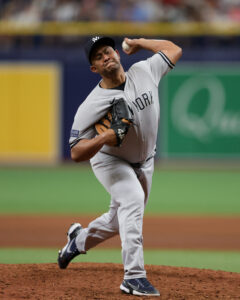
Peralta, 32, has been one of the steadiest relievers in the Yankees’ bullpen for the past several seasons. From 2021-23, the southpaw logged 153 innings and turned in a 2.82 ERA with a 21% strikeout rate, 10.2% walk rate and excellent 56.5% ground-ball rate. He’s also limited hard contact quite nicely, sitting in the 88th percentile (or better) of MLB pitchers in opponents’ average exit velocity during each of the past four seasons.
In 2023, Peralta had some uncharacteristic command struggles, as his walk rate jumped from 7.6% to 13.6%. He also plunked a career-high six batters — as many as he’d hit over the four previous years combined. Still, the track record is good, he kept his ERA below 3.00 even with the shaky command, and at 32 he’s younger than most of the other southpaws available. The Yankees reportedly had interest in retaining him, and the Mets were known to have some interest as well. Instead, he’ll head clear across the country and join a revamped Padres bullpen that has lost closer Josh Hader to the Astros but has added several interesting arms.
Peralta joins star NPB left-hander Yuki Matsui and star KBO righty Woo Suk Go as free-agent pickups for San Diego president of baseball operations A.J. Preller. The Friars also acquired Enyel De Los Santos in a trade sending Scott Barlow to Cleveland. That quartet will join right-hander Robert Suarez as he seeks a bounceback after a difficult 2023 campaign. Righty Steven Wilson is also locked into a middle relief role.
It’s almost unheard of for a reliever to sign a deal with three opt-out provisions, but Preller has shown a willingness to utilize opt-out clauses more than any executive in the sport as a means of luring free agents to San Diego. Both Matsui and Suarez have opt-outs in their five-year contracts (which is an extremely rare length for relief contracts as well). Recent offseasons have also seen the Friars grant opt-out clauses to Michael Wacha, Nick Martinez, Seth Lugo, Matt Carpenter, Manny Machado and Eric Hosmer (multiple opt-outs, in the case of Wacha and Martinez).
The frequent opt-out provisions are clearly a successful tactic in terms of reeling in free agents, but they’re also one of the main factors behind the Padres’ perennial roster churn. Moreover, the risk is rather clear from the team vantage point; if Peralta pitches well in 2024, he’ll likely opt back into free agency next season and turn the contract into a one-year deal. If he’s injured or performs poorly, the Padres will remain on the hook for what could quickly look like an undesirable contract. And, even if Peralta is pitching well this summer but the Padres fall from contention, the trio of opt-outs will sap much of Peralta’s trade value. Any potential trade partner will be wary of acquiring a player who’ll bolt for free agency at season’s end if things go well but is still guaranteed additional seasons if the trade pans out poorly.
The uncommon structure of the contract also succeeds in lowering the luxury tax hit for the Padres, who’d surely like to dip beneath the $237MM threshold and reset their penalty after soaring past last year’s tax barriers. The Friars have trimmed back much of their actual, bottom-line payroll but are still only about $22MM shy of that first-tier tax level after signing Peralta, per Roster Resource. That’s due largely to backloaded contracts for Machado, Matsui, Fernando Tatis Jr. and Jake Cronenworth.
Peralta’s addition provides a solid veteran arm to what looks like a volatile Padres bullpen. While all of Suarez, Matsui and Go are clearly talented, there’s a broad range of outcomes on each of the three as Suarez looks to put last year’s injuries behind him while Matsui and Go transition to North American ball after starring in their respective leagues across the Pacific. That’s key for the Padres, as is getting Peralta on an affordable yearly rate. While there’s ample downside because of the opt-outs, as previously discussed, the contract also creates the possibility of getting one year of Peralta at a highly affordable rate that wouldn’t have been otherwise feasible.
The lower salaries on the contract also leave Preller & Co. some additional wiggle room as they look to round out a top-heavy roster. The Padres have clear needs in the outfield and rotation, and they could also use another bat to bolster the corner/designated hitter mix. The Padres, though, were also looking to reduce payroll by as much as $50MM from last year’s $255MM mark. They’re currently at a projected $160MM. On the surface, that seems to leave ample room for further additions, but as already noted, the team is only a notable addition or two away from being right back up against the luxury threshold, which could prove instructive in forecasting the remainder of their offseason dealings.
Ken Rosenthal and Dennis Lin of the Athletic first reported the Padres and Peralta were in agreement on a four-year, $16.5MM contract with three opt-out clauses. FanSided’s Robert Murray reported the salary breakdown.