
Soto Bidding Could Approach $700MM
As the Juan Soto decision nears, the expected contract seemingly continues to climb. Jon Heyman of the New York Post writes that the price could push to $700MM. Heyman suggests that the Mets, Yankees, Red Sox and Blue Jays may all be near that mark. The Dodgers are also a finalist, but various reports have put them as the least likely of the quintet to land him.
On Tuesday, The Athletic reported that multiple teams had made offers at or above $600MM. Agent Scott Boras said at the time that Soto had begun to narrow the field, though he didn’t specify a timetable for his decision. Most reports indicate he’s likely to sign by the end of next week’s Winter Meetings, perhaps as soon as this weekend.
According to Heyman, teams have continued to adjust their offers in recent days. Alex Speier of the Boston Globe reported last night that the Red Sox were hoping for a final meeting with Soto’s camp to get the outfielder to name the specific price at which he’d put pen to paper. It’s not clear if Soto would grant any team that sit-down.
Shohei Ohtani’s deal was initially reported as a 10-year, $700MM contract. The extreme nature of the deferrals in the Ohtani deal, which were reported a few days after he announced he was signing with the Dodgers, dramatically reduced the net present value. MLB valued the contract around $461MM for luxury tax purposes. That’s still an all-time record. Soto was unquestionably going to beat $461MM and widely expected to go well beyond $500MM. (MLBTR predicted a 13-year, $600MM contract at the beginning of the offseason.) Getting to $700MM without deferrals would shatter prior contractual precedents.
Ohtani’s $46.06MM annual salary — again adjusting for deferrals — is the record for average annual value. Bryce Harper’s 13-year contract is the longest free agent deal in history. Soto would likely need to break both records to get to $700MM — potentially on a 14-year deal at $50MM annually. It shouldn’t be much longer before we learn if the market will go to those heights.
Red Sox Hoping For Additional Meeting With Soto
By this time next week, there’s a good chance Juan Soto will have picked his destination. As the star outfielder weighs multiple offers at or above $600MM, the top of the market waits.
At least one team is hoping for another sit-down with Soto and agent Scott Boras. Alex Speier of the Boston Globe reports that Red Sox’s brass has expressed interest in another meeting at which Soto’s camp would name the price necessary to get a deal done. That’s an effort to avoid being unknowingly outbid at the end.
It seems the Sox are worried about the Mets in particular. Speier writes that Sox’s brass has heard rumors that Mets’ owner Steve Cohen has promised Boras that he’d beat the best offer made by any other team by $50MM. To be clear, Speier is not reporting on the veracity of that rumor itself. Speier is neither confirming nor denying that Cohen made such offer. The Globe’s report only mentions that the Sox are concerned enough that the rumor might be true that they’re hopeful of getting Soto and Boras to name a specific price.
It’s not clear if Boras and Soto have any interest in doing so. There’s value for Soto in playing teams’ uncertainties against each other. Relaying the specifics of every offer to each team in the race would eventually result in a highest bidder, but it’d also limit the possibility that one club goes well beyond whatever is on the table from the others.
There have seemingly been five legitimate suitors for Soto: the Mets, Yankees, Blue Jays, Red Sox and Dodgers. Various reports have cast the Dodgers as a long shot. The general view is that Los Angeles entered the mix mostly to gauge whether Soto’s market might not materialize quite the way he’d envisioned. With multiple teams putting $600MM+ offers out there, that hasn’t been the case. MLB.com’s Mark Feinsand wrote last night that the Dodgers were unlikely to land him.
Speier confirms that the Red Sox recently upped their offer to $600MM. The Athletic reported on Tuesday that every team that still had a chance at Soto had hit or topped that mark. (That’s not necessarily a declaration that all five teams mentioned above had offered $600MM+, as it’s possible he has privately narrowed the field to exclude one or more of them.) Most observers still expect it to come down to one of the New York franchises, though the Sox and Jays have seemingly made full-fledged pushes to get themselves in the conversation.
One big spender that made little effort on Soto: the Phillies. Matt Gelb of the Athletic reports that Philadelphia brass never met with his camp. While the Phils haven’t shied away from big-ticket free agent pursuits, it seems they never believed they had a realistic chance to land Soto. Philadelphia owner John Middleton said a month ago that he felt they’d merely be used to drive up the bidding for Soto to sign with one of the New York teams (link via Scott Lauber of the Philadelphia Inquirer). Whether or not that would’ve been the case, Gelb writes that the Phillies felt it best to prioritize other avenues they found more realistic.
MLBTR Podcast: Blake Snell, Dodger Fatigue, And The Simmering Hot Stove
The latest episode of the MLB Trade Rumors Podcast is now live on Spotify, Apple Podcasts, and wherever you get your podcasts! Make sure you subscribe as well! You can also use the player at this link to listen, if you don’t use Spotify or Apple for podcasts.
This week, host Darragh McDonald is joined by Steve Adams of MLB Trade Rumors to discuss…
- The Dodgers signing Blake Snell (2:00)
- Baseball fans having Dodger fatigue and deferral fatigue (9:05)
- Are the Dodgers going to make more rotation additions? (14:30)
- The Dodgers extending Tommy Edman (16:25)
- The news of the Red Sox signing Aroldis Chapman breaks during recording (21:30)
- The Mets signing Frankie Montas (26:30)
- The Cubs signing Matthew Boyd (35:55)
- The Rangers signing Kyle Higashioka (43:15)
Plus, we answer your questions, including…
- What would the Pirates have to give to the Red Sox to get Triston Casas? (48:20)
- Why is Cody Bellinger‘s deal so tough for the Cubs to trade? (54:15)
Check out our past episodes!
- Yusei Kikuchi, The Aggressive Angels, And The Brady Singer/Jonathan India Trade – listen here
- The Rays’ Stadium Plans, Diamond Sports, And Some Offseason Rumors – listen here
- Roki Sasaki, Gerrit Cole’s Non-Opt-Out, And Cardinals Rumors – listen here
The podcast intro and outro song “So Long” is provided courtesy of the band Showoff. Check out their Facebook page here!
Bidding For Juan Soto Has Reached At Least $600MM
The floor for Juan Soto’s contract appears to be $600MM. Ken Rosenthal, Evan Drellich and Brendan Kuty of the Athletic report that every team that remains in the Soto bidding has made a formal offer at or above that number.
With multiple $600MM+ offers in hand, there’s not much chance of Soto pivoting to a short-term deal. Jon Heyman of the New York Post wrote last week that the four-time All-Star wasn’t interested in taking a shorter term to prioritize his annual earnings. Heyman suggested Soto was seeking a 15-year contract. It’s not clear whether that’ll be on the table, though tonight’s report from The Athletic indicates he’s likely to sign for at least 12 years. That’ll presumably come with one or more opt-out chances as well.
Agent Scott Boras did not comment publicly about contract terms. However, he told reporters this evening that Soto has begun to narrow the field. “We’ve had meetings with a number of franchises. He’s begun the process of eliminating teams and doing things. Juan is a very methodical thinker, so we’ll see, but I don’t think anything is imminent in the near future,” Boras said at today’s introductory presser for another of his clients, Blake Snell.
While Soto reportedly fielded interest from 11 teams at the beginning of the offseason, it seems a clear five suitors have emerged: the Yankees, Mets, Blue Jays, Red Sox and Dodgers. Most speculation throughout the industry is that he’ll land with one of the New York franchises. To that end, Rosenthal, Drellich and Kuty write that many people around the game expect that Mets’ owner Steve Cohen will refuse to be outbid.
That said, there’s been chatter in recent weeks that the Red Sox are making a serious push. Meanwhile, SNY’s Andy Martino and Jim Duquette of MLB Network Radio on SiriusXM (X link) each suggested last night that the Blue Jays might come in with the highest bid at the end of the day. Reporting has generally cast the Dodgers as something of a long shot, but it’s impossible to count them out on any top-tier free agent.
In any case, Soto seems mere days away from establishing a record for the top net present value in MLB history. That’s currently held by Shohei Ohtani, whose deal is valued by MLB just shy of $461MM after accounting for deferrals. There was never much doubt that Soto would beat that, though it was fair to wonder whether the bidding would stop somewhere between $500MM and $600MM.
At the start of the offseason, MLBTR predicted Soto would receive exactly $600MM over 13 years — a number that looks as if it’ll be light. While it doesn’t seem that decision will come within the next 24 hours, there’s a widespread belief that Soto will make his call by the end of next week’s Winter Meetings.
Red Sox Sign Aroldis Chapman
The Red Sox announced the signing of Aroldis Chapman to a one-year contract. The deal reportedly guarantees the Wasserman client $10.75MM.
Boston becomes the left-hander’s fifth different team since 2022. Chapman is no longer the elite closer he was during his peak with the Reds and Yankees. He’s still an effective, if somewhat volatile, reliever despite scattershot command. He turned in a 3.79 ERA over 61 2/3 innings for the Pirates this year. Signed as a setup option in front of David Bednar, Chapman recorded 22 holds before taking over as closer for the struggling Bednar late in the season. He picked up 14 saves, his highest total in three years, and only surrendered five leads.
Even as he enters his age-37 season, Chapman is one of the league’s hardest-throwing relievers. He averaged 97.8 MPH on his four-seam fastball and 99.8 MPH on his sinker. While Chapman is no longer in a league of his own in terms of velocity, that’s rare arm speed from the left side. Among southpaws with at least five innings pitched, only Jose A. Ferrer and Gregory Soto threw their four-seamers harder on average. Chapman’s sinker velocity led all southpaws and ranked fourth in MLB overall, trailing Emmanuel Clase, Justin Martinez and Seth Halvorsen.
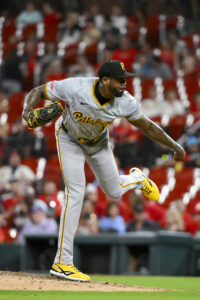
That high-octane stuff continues to lead to plenty of strikeouts. Chapman fanned 37% of batters faced with Pittsburgh. Among relievers with 20+ innings, Chapman ranked eighth in strikeout rate. His 14.7% walk percentage was the ninth-highest mark among that group. Fewer than half of his plate appearances ended with a ball in play. There’ll be a lot of free passes, but Chapman’s stuff is good enough that he still manages to work out of trouble more often than not.
This is the second bullpen pickup of the offseason for chief baseball officer Craig Breslow and the Boston front office. They also brought in Justin Wilson last month to work in the middle innings. There could be room for one more addition with four Sox relievers hitting free agency. They’re expected to let Kenley Jansen walk and could also lose Chris Martin, Luis García and Lucas Sims. Liam Hendriks should be back from Tommy John surgery and is the favorite to replace Jansen as Alex Cora’s closer. Rule 5 pick Justin Slaten should be their top setup option from the right side. Cam Booser and Brennan Bernardino, who had been their top internal lefties, profile as middle relievers rather than high-leverage arms.
Chapman did not place among MLBTR’s Top 50 free agents. That said, he was one of the best available lefties for teams that didn’t want to play at the top of the market for Tanner Scott. He earns a very slight raise relative to last winter, when he signed with Pittsburgh for $10.5MM.
The move brings the Red Sox’s estimated payroll, including arbitration projections, to roughly $148MM (courtesy of RosterResource). Boston is up to approximately $181MM in luxury tax obligations. They’re $60MM shy of the base tax threshold. CEO Sam Kennedy indicated the Sox could exceed the threshold, one of myriad comments from team brass signaling a big offseason. There’ll be a lot more to come from Breslow and company, who are one of five teams known to be involved on Juan Soto and have been tied to every top-end free agent starting pitcher.
Chris Cotillo of MassLive first reported the Red Sox and Chapman had made progress on a deal. Mike Rodriguez confirmed there was a deal in place. Jeff Passan of ESPN reported the contract terms. Image courtesy of USA Today Sports.
Latest On Juan Soto
While we’ve started to see some movement in the pitching market, with Blake Snell and Yusei Kikuchi both coming off the board this week, we’ve yet to see a prominent bat come off the board. Some of that is just the naturally slow pace of MLB’s free agency structure, but there’s also surely an element of Juan Soto holding things up to an extent. Fortunately, it doesn’t appear as though this will be a protracted free agent saga that lingers well into the new year.
Randy Miller of NJ Advance Media reported earlier this week that five clubs had made offers to Soto: the Yankees, Mets, Blue Jays, Red Sox and Dodgers. There’s been some back-and-forth reporting as to whether offers from each have been formally submitted, but semantics aside, that quintet appears to be the top set of bidders for Soto at the moment.
Ronald Blum of the Associated Press reports that Soto and agent Scott Boras asked for initial offers to be submitted by Thanksgiving, so even if one of those clubs hasn’t yet submitted a formal offer just yet, it’s likely only a matter of hours before said offer is presented. Per Blum, there’s a growing belief that Soto could make a decision at or even before this year’s Winter Meetings, which take place from Dec. 8-11 in Dallas.
It should be noted that the current wave of offers being submitted is not a collection of “best and final” offers. With any free agent of this magnitude, there will be plenty of back-and-forth negotiations. Brendan Kuty of The Athletic tweets that this initial wave of offers is considered “preliminary,” with an additional round of offers likely coming in next week. Talks will intensify as teams are weeded out in the run-up to the Winter Meetings. Kuty, like Blum, suggests that landmark offseason event as a likely endpoint to Soto’s free agency.
Of the five known suitors, the Dodgers are perhaps the least likely. That might’ve been true even before Los Angeles struck their five-year deal with Snelll last night — one that guarantees him $182MM (with some deferred salary but also a huge up-front $52MM signing bonus). ESPN’s Jeff Passan reported several weeks back that while the Dodgers will be in the mix they’re not expected to chase Soto at all costs. Ken Rosenthal of The Athletic offered a similar thinking last night in his breakdown of the Snell deal, suggesting that while the Dodgers will of course remain apprised of where Soto’s bidding lands, they could also be simply trying to drive up the price for more serious bidders in New York, Boston and Toronto.
To that end, Jon Heyman of the New York Post wrote last night that the Red Sox are indeed quite serious in their pursuit of Soto. They’ve sought to sell Soto on the organization’s history of prominent left-handed hitters who’ve taken advantage of Fenway Park’s Green Monster and also enlisted franchise icons Pedro Martinez and David Ortiz to pitch the free agent slugger on the team’s history of touted stars from Soto’s native Dominican Republic.
Meanwhile, Alex Speier of the Boston Globe adds that the Sox don’t view Soto and adding a top-of-the-rotation arm as an either-or scenario. Even if they succeeded in landing Soto, the Sox would do so in simultaneous pursuit of a top-end starter. Red Sox president Sam Kennedy already signaled a willingness to exceed the luxury tax, and Speier notes that the Sox don’t view the $241MM tax threshold as any sort of hard cap. They’re currently $70MM shy of that level, per RosterResource’s estimates.
It’s not yet clear whether any other clubs could jump into the mix late in the bidding process. Phillies owner John Middleton stated earlier in the winter that he didn’t mind being a “stalking horse” on Soto, and there were reports that the Phils planned to meet with him at some point, but USA Today’s Bob Nightengale reported Monday that the Phillies have yet to even speak to Boras about Soto specifically. The Giants were an oft-speculated suitor heading into the winter, but they’ve not yet met with Soto and reports have since indicated they may actually scale back payroll rather than spend as aggressively as some anticipated.
Latest On Red Sox’ Rotation Plans
The Red Sox are looking to improve their rotation this winter but it remains to be seen how exactly that will play out. They have previously been connected to top free agents such as Corbin Burnes, Max Fried and Blake Snell, as well as trade candidate Garrett Crochet.
This week, Bob Nightengale of USA Today reports that the Sox actually want to of those top free agents. Sean McAdam of MassLive reports that the Sox are continuing to keep tabs on the pitching market while engaging with Juan Soto. They did have some interest in lefty Yusei Kikuchi, though it’s unclear how strong that interest was and he now has an agreement with the Angels. As for Crochet, McAdam reports that the Sox have pulled off the gas a bit there, with some unknown club getting “very aggressive” recently.
Very early in the offseason, chief baseball officer Craig Breslow said the club would be looking to the “raise the ceiling” in the rotation and these pursuits all align with that goal. Burnes, Fried and Snell all have long track records of major league success, with Burnes having a Cy Young award and Snell having two of them. Fried doesn’t have the hardware but does have a 3.07 earned run average in just under 900 career innings. Crochet only just transitioned to the rotation in 2024 but did so with aplomb, posting a 3.58 ERA, 35.1% strikeout rate, 5.5% walk rate and 45.1% ground ball rate in 146 innings.
Any one of those pitchers would be a nice upgrade for Boston or any other club, though that will also make them very popular. In addition to the Sox, those pitchers have been connected to clubs like the Blue Jays, Orioles, Yankees, Dodgers and Padres. There are plenty of other clubs that also make sense, even if they haven’t been explicitly tied to those pitchers in rumors.
For the Sox to come away with two of those pitchers would make for quite an aggressive offseason, but that’s exactly what the club has been signaling. Both Breslow and CEO Sam Kennedy have made comments suggesting the club is planning to act boldly this winter, with Kennedy recently saying that paying the competitive balance tax is on the table. Many fans of the club will bring up last year’s “full throttle” comments from chairman Tom Werner and how those didn’t precede much action last winter, but the club is being more specific this year. Kennedy has repeatedly said the goal is to field a club capable of winning 90 to 95 games and taking the division.
Spending money on free agents is one way they could go about accomplishing that. RosterResource projects the 2025 club for a payroll of $138MM, well below their $184MM spending from 2024, which was itself a drop from what they spent in the previous decade. RR pegs the club’s CBT number at $171MM, which is $70MM below the lowest threshold.
There’s plenty of room in there for two notable contracts, though successfully signing Soto would obviously completely change the calculus, given the expectation that he’ll sign a record-setting contract. Leaving that aside for now, big contracts for two of the big free agent starters is a feasible outcome. As part of MLBTR’s Top 50 Free Agents post, each of Burnes, Fried and Snell were projected for contracts with average annual values between $26MM and $32MM. Putting two of those onto Boston’s payroll still wouldn’t even get them to the CBT line. They will presumably also make additions to the bullpen and maybe the position player group as well, but with a willingness to cross the line, all sorts of possibilities could be on the table for them.
Crochet would be far cheaper from a financial perspective, with the biggest cost coming in the form of prospect capital. Since he has spent so much of his career either working in relief or injured, he is down to two years of club control but hasn’t been able to raise his salary very high through the arbitration process. He made just $800K in 2024 and MLBTR contributor Matt Swartz projects him for a raise to just $2.9MM in 2025. He would be due another raise in 2026 before he’s slated to become a free agent.
Two years of an ace-caliber pitcher for that kind of money is tremendous value, which is why Crochet figures to be very popular in trade talks. The Red Sox have a strong farm system and could certainly get a deal done if they wanted to, though it seems some mystery club has pulled ahead of them, per McAdam’s reporting.
For now, the Boston rotation projects to be fronted by Tanner Houck, Brayan Bello and Kutter Crawford. Houck had a breakout season in 2024 but may have run out of gas, as he had a 2.54 ERA in the first half and a 4.23 mark in the second. Bello and Crawford are each coming off decent but not outstanding seasons, each finishing with an ERA in the 4.35-4.50 range. Lucas Giolito and Garrett Whitlock could be in the mix in 2025 but they are fairly unknown quantities right now as each underwent internal brace surgery in 2024.
Adding to that group would improve Boston’s chances in 2025 while bumping guys like Cooper Criswell, Richard Fitts and Quinn Priester to depth roles, either in the minors or in the big league bullpen.
The interest in Kikuchi suggests that the Sox are also open to some of mid-market options. With Kikuchi now gone, some of the other names that could be in line for somewhat similar deals include Jack Flaherty, Sean Manaea, Nathan Eovaldi, Luis Severino and old friend Nick Pivetta.
The qualifying offer will likely be a factor, depending on who the Sox ultimately sign. Snell, Eovaldi and Flaherty were ineligible to receive a QO, Snell and Eovaldi because they had already received one and Flaherty because he was traded midseason. Burnes, Fried, Manaea and Severino rejected QOs, meaning the Sox would have to forfeit their second-best pick in next year’s draft and $500K of international bonus pool space to sign them. Pivetta rejected a QO from the Red Sox, meaning they stand to receive a compensation pick just ahead of the third round if he signs elsewhere, though they would not receive that pick if they ultimately re-sign him.
Teams Expected To Make Offers To Juan Soto This Week
The sweepstakes to land superstar free agent Juan Soto is set to enter its next phase, as ESPN’s Buster Olney reported this afternoon that teams are expected to begin sending offers to the outfielder’s camp this week. Olney adds that to this point in the process, Soto has been meeting with teams and allowing Soto and the officials of interested clubs to get to know each other. The Yankees, Mets, Blue Jays, Red Sox, and Dodgers are all known to have met with Soto at this point. The Phillies have also been reported to be planning a meeting with Soto, while the Giants, Rays, and Royals are all known to be among the teams to have reached out to Soto as well, though no meetings between Soto and any of those clubs are publicly known to have occurred and the Royals already reportedly view the offseason’s top free agent as outside of their comfort zone.
Of course, that aforementioned list of teams is surely not exhaustive. As-of-yet unreported clubs have surely contacted and perhaps even met with Soto as he prepares to sign what figures to be the largest contract in MLB history in terms of net present value this winter. As a two-time MVP finalist and career .285/.421/.532 hitter who’s hitting the market ahead of his age-26 season, Soto stands as the rare free agent who would make sense for virtually any contention timeline and stand as an upgrade to all 30 ball clubs, leaving his market to be limited more by teams’ willingness to spend enough to land him rather than positional or competitive fit.
The general consensus around the game seems to be that the Yankees and Mets are the favorites for Soto’s services, as both deep-pocketed New York teams appear motivated as the Yankees look to retain their key addition from last offseason who helped take the club from missing the playoffs in 2023 to an AL pennant this past season while the Mets hope to build on a 2024 campaign that saw them reach the NLCS for the first time since 2015. Soto naturally has a place in the Yankees lineup as their incumbent right fielder, though he might make even more sense for a Mets club that could push Starling Marte to DH in order to accommodate the addition of Soto given the fact that the acquisition of Soto forced the Yankees to use Aaron Judge as their everyday center fielder last year.
That doesn’t mean the other teams in the mix should be counted out, however. The Phillies and Dodgers both already need outfield help this winter and could further bolster the already-excellent lineups that made them the class of the NL this year by landing Soto. The Blue Jays figure to be especially motivated after falling just short in last winter’s Ohtani sweepstakes and subsequently missing the playoffs in 2024, while the Red Sox appear ready to resume spending in accordance with their market size this winter after spending the past several winters on the periphery of free agency. MLBTR’s Steve Adams recently took a look at all 30 clubs in the context of the Soto sweepstakes of Trade Rumors Front Office subscribers.
While Soto has emphasized the importance of team competitiveness in his decision-making and there have been questions about whether he may prefer a team on the east coast given his offseason homes in Fort Lauderdale, Florida and the Dominican Republic, the ultimate factor that figures to separate Soto’s suitors is money. With offers expected to be made over the course of the next week, it’s possible that previously-unknown suitors emerge as contenders for the star’s services or currently reported upon suitors fall behind in the bidding process. It’s also possible that the process begins to move quickly once offers begin to roll in; MLB.com’s Mark Feinsand reported earlier this week that the belief around the game is that Soto could sign during or even before the Winter Meetings, which run from December 9-12 in Dallas next month.
Red Sox Interested In Corbin Burnes
The Red Sox have already been linked to a wide range of big-name free agents this winter, including most of the top available pitchers. It comes as no surprise that Corbin Burnes also appears to be on Boston’s radar, as Jon Heyman of the New York Post writes that the Sox are “in on” Burnes.
Chief baseball officer Craig Breslow said earlier this month at the GM Meetings that the Red Sox “need to raise the ceiling of the rotation” by adding a front-of-the-rotation No. 1 starter type. Tanner Houck, Kutter Crawford, and Brayan Bello project as the top three members of Boston’s current pitching staff, Lucas Giolito is expected to be back from an internal brace surgery relatively close to the start of the season, and the likes of Cooper Criswell, Richard Fitts, or Quinn Priester are the top candidates for the fifth’s starter role.
Adding a pitcher like Burnes naturally makes that group much stronger, as suddenly the Red Sox would have an ace to push everyone down one slot in the rotation, and the younger starters become key depth options if Giolito has any setbacks (or if any of the starters run into injury problems). In theory, the Sox could even look to turn one of the younger starters into a trade chip, even if it’s probably likelier that Boston just retains all of its pitchers just for the sake of having as much depth as possible.
The Red Sox to have interest in Garrett Crochet‘s market, so it is possible the Sox will address their rotation needs via trade rather than via free agency. Boston’s relatively limited free agent spending in recent years has been well-documented, as Trevor Story‘s six-year, $140MM contract is the only nine-figure free agent deal the Red Sox have finalized in the last six offseasons. That said, the Sox have explored so many premium free agents this winter that it appears the team is again willing to shop on the top shelf of the market — four non-winning records in the last five seasons has undoubtedly spurred some extra aggressiveness.
Burnes is ranked behind only Juan Soto on MLBTR’s list of the top 50 free agents in this year’s class, and the right-hander is projected for a seven-year, $200MM pact. Just a month removed from his 30th birthday, Burnes hits the open market on the heels of four straight All-Star appearances, and five straight top-eight finishes in the NL and AL Cy Young races. Burnes took the Cy home in 2021 when he posted a Major League-leading 2.43 ERA in 167 innings with the Brewers.
That innings total was actually the lowest of Burnes’ last four seasons, as he has averaged 197 frames over the 2022-24 seasons. Beyond the durability, Burnes has a 3.08 ERA, 26.4% strikeout rate, and seven percent walk rate over the last three seasons, as he remained productive in a new environment after the Brewers traded him to the Orioles last offseason. Burnes’ 23.1% strikeout rate this season was only a tick above league average, but the rest of his Statcast metrics were impressive, and he added a 48.2% grounder rate to boot.
Because Burnes rejected the Orioles’ qualifying offer, any team that signs him would have to face some type of penalty. In Boston’s case, they would have to surrender $500K in international signing pool money, as well as their second-highest pick in the 2025 draft. This might be a relatively acceptable loss for the Red Sox, especially since they’d be getting a compensatory pick of their own just before the start of the third round if Nick Pivetta (their own qualified free agent) signed elsewhere.
Red Sox Reportedly Considering Moving Rafael Devers Off Third Base
The Red Sox have held internal discussions regarding the possibility of moving longtime third baseman Rafael Devers off the position, per a report from MassLive’s Sean McAdam. McAdam goes on to suggest that the club views a trade for third baseman Nolan Arenado with the Cardinals as a potential option to fill their vacancy at the hot corner in the event Devers changes positions, whether that be a move to first base or DH.
The idea of Devers moving to first base has previously been floated by The Athletic’s Ken Rosenthal and The New York Post’s Jon Heyman throughout the offseason so far, though McAdam’s report stands as the first confirmation that a position change for Devers is under internal consideration within the organization. Previously, chief baseball officer Craig Breslow has declined to comment on the possibility of moving Devers off third beyond saying that the club wouldn’t seriously entertain the idea without first discussing it with Devers himself. That could be a complicating factor in a position change, as Devers’s agent, Nelson Montes de Oca, recently told Alex Speier of The Boston Globe that Devers has no plans to move off the hot corner.
“He is a third baseman,” Montes de Oca told Speier, “and he will continue to play third base and work hard to get better at it. That’s his position, that’s what he likes to play, and that’s what he will be playing.”
Resistance to a position change from Devers’s camp isn’t the only potential obstacle to a move. After all, the Red Sox have an extremely talented incumbent first baseman in Triston Casas, who at just 24 years old remains under team control for four more seasons and has previously expressed interest in signing with Boston on a long-term extension. The youngster missed much of the 2024 season due to injury but is a career .250/.357/.473 (125 wRC+) hitter since making his big league debut late in the 2022 season. There’s been speculation at times this winter that the Red Sox could consider moving on from Casas to land starting pitching, but Breslow was quick to shoot down those rumors earlier this month. Given that, a move to first base for Devers would require the front office to either reverse their stance on dealing Casas or else park him at DH on a regular basis, pushing Masataka Yoshida (and the three years and $55.6MM remaining on his contract) either to the bench or off the roster entirely.
Complicated as a position change for Devers would be, the potential benefits for the club could be substantial. Devers is among the worst fielding third basemen in the sport by most metrics, and a move across the diamond would surely improve the club’s infield defense dramatically. In 2024, Devers was worth -9 Defensive Runs Saved and posted a -5 in Statcast’s Fielding Run Value metric. That’s the lowest DRS and tied for the lowest FRV among all qualified (min. 750 innings) third basemen this year. Replacing Devers with an average or even slightly below average glove at third would improve the club’s infield defense considerably, but a position change for Devers would likely be just as motivated by it creating an avenue to improving the club’s offense.
If third base were to be opened by Devers moving to first, that would create an easy place for the Red Sox to add a right-handed bat to the lineup. Adding some thump from the right side has been a priority for Boston dating back to the trade deadline, and the club’s need for a right-handed hitter to add to their offense only grew more pronounced when outfielder Tyler O’Neill hit the open market earlier this month. Most attention on this need has been focused on the outfield at this point in the offseason given the club’s reported interest in either a reunion with O’Neill or pivoting to a deal with Teoscar Hernandez, but the club’s outfield remains crowded with Jarren Duran, Wilyer Abreu, and Ceddanne Rafaela all in the mix for playing time already before considering top prospect Roman Anthony (or veterans Yoshida and Rob Refsnyder), who should be ready to take on a regular role at some point in 2025.
Complicated as that outfield picture already is, it’s easy to see why adding a right-handed bat to the infield could be a preferable, more straightforward option than adding another player to the club’s logjam on the grass. Given that, it’s perhaps no surprise that the club has been connected to both longtime Astros third baseman Alex Bregman and former Brewers shortstop Willy Adames in free agency. Both players have expressed an openness to moving to second base (as well as third, in the case of Adames) if their new club so desires, meaning the addition of either player wouldn’t necessarily require Devers to change positions. With highly-regarded second base prospect Kristian Campbell seemingly in the mix for starts in Boston as soon as Opening Day, however, it’s easy to see why the Red Sox may prefer to install Bregman or Adames at the hot corner and move Devers to first.
While the club’s interest in Bregman and Adames has been reported semi-frequently to this point in the winter, McAdam’s suggestion that Arenado could be a consideration for the Red Sox is the first connection between Boston and the veteran star. Unlike Bregman and Adames, it’s all but unfathomable that a ten-time Gold Glove award winner like Arenado would change positions in deference to Devers, meaning a deal for the 33-year-old would certainly require a position change for the younger star. Arenado is also coming off his second consecutive down season offensively. While he was a finalist for the NL MVP award back in 2022, he’s hit just .269/.320/.426 (104 wRC+) in two seasons since then.
That said, Arenado’s defense has remained well above average even if it’s no longer quite as elite as it was during his peak, and that’s allowed him to be a roughly three-win player in each of the past two seasons. While he may no longer offer the same level of impact as Bregman or Adames, the three years and $74MM remaining on the veteran’s contract pales in comparison to the nine-figure sums both free agents are expected to land and would likely do little to impede Boston’s pursuit of other top-of-the-market names like Juan Soto, Corbin Burnes, and Blake Snell, especially if a deal involved the Cardinals either retaining some money or taking on a sizable portion of Yoshida’s contract in return. Any deal involving Arenado, of course, would require the veteran’s approval given his full no-trade clause. While the 33-year-old hasn’t requested a trade to this point, both he and the Cardinals appear to be open to parting ways if the right deal comes along given the club’s plans to retool and focus on youth in 2025.