
Korea’s Kiwoom Heroes To Sign Addison Russell
In a surprise move, longtime Cubs infielder Addison Russell has found a landing spot in Korea’s top league. He’s joining the Kiwoom Heroes on a $530K contract, per Jeeho Yoo of Yonhap News (via Twitter).
Once a top prospect and promising young big leaguer, Russell is best known now for off-field malfeasance. Russell was suspended under the league’s domestic violence policy after his ex-wife detailed serious allegations of abuse.
The Cubs still gave Russell another shot, keeping him through arbitration in 2019 and bringing him back to the majors after the suspension was served. But Russell was not able to take advantage of the second chance, as he continued to produce middling offensive numbers.
All told, since the start of the 2017 season, Russell carries only a .243/.310/.379 batting line. While he’s a quality defensive performer, that wasn’t enough output to merit another trip through arbitration this past offseason.
Though the Cubs had already absorbed the public relations hit of retaining Russell, other organizations declined to bring him aboard this past winter. He was waiting for an opportunity even while Spring Training neared completion.
The lack of a big league deal may ultimately have helped Russell secure his next chance. Unlike most players of his ability levels, the 26-year-old was not under contract when the Heroes went looking for another foreign player. Russell will have a chance to get his career back on track in the KBO, which is playing at full tile (albeit still sans fans) while MLB tries to get its own season underway.
Undrafted Free Agent Signings: 6/16/20
This year’s five-round draft left a lot of deserving players looking for deals on the open market. Here’s a roundup of some of the many recent undrafted players who have reached agreements with MLB organizations:
- White Sox (link)
- Ty Madrigal, LHP, St. Mary’s
- Rangers (link)
- Fernando Amaro, C, HS (PR)
- Nick Krauth, RHP, Connecticut
- DJ McCarty, RHP, HS (CA)
- Connor Sechler, RHP, Drury
- Brady Smith, C, Florida
- Colton Snyder, RHP, Concordia
- Josh Stephan, RHP, South Grand Prairie
- Mets (link)
- Austin Faith, RHP, Lamar
- Dylan Hall, RHP, Central Oklahoma
- Brandon McIlwain, OF, California
- Drake Nightengale, RHP, South Alabama
- Joe Suozzi, OF, Boston College
- Nationals (link)
- Jackson Coutts, 1B/OF, Rhode Island
- Gio Diaz, INF, Saint Mary’s
- Raymond Torres Jr., C, San Jacinto JC
- Astros (link)
- Peter Zimmermann, Missouri
- Cesar Gomez, Texas
- Jimmy Endersby, RHP, Concordia
- Justin Dirden, OF, Southeast Missouri State
- Kyle Gruller, RHP, Houston Baptist
- Jonathan Sprinkle, RHP, Central Missouri
- Zack Matthews, RHP, Oklahoma
- Cody Orr, OF, Tiffin
- Yankees (link)
- Carson Coleman, RHP, Kentucky
- Ocean Gabonia, RHP, Everett Community College
- Trevor Holloway, RHP, Central Florida
- Jarod Lessar, RHP, BYU
- Phillies (team announcement)
- Chase Antle, RHP, Coastal Carolina
- Jordan Fowler, LHP Central Missouri
- Jonathan Hughes, RHP, Georgia Tech
- Sam Jacobsak, RHP, Northeastern
- Jake McKenna, LHP, Ocean City HS (NJ)
- Noah Skirrow, RHP, Liberty University
- Billy Sullivan, RHP, Delaware
- JP Woodward, LHP, Lafayette College
- Orioles (link 1; link 2)
- Ryan Watson, RHP, Auburn
- JD Mundy, 1B, Radford
- Brandon Young, RHP, UL-Lafayette
- Thomas Girard, RHP, Duke
- Isaiah Kearns, RHP, Pitt-Johnstown
- Cubs (link)
- Matt Mervis, 1B/RHP, Duke
- Marlins (link)
- Antonio Velez, RHP, Florida State
- Cardinals (link)
- Jacob Buchberger, RHP, Davenport
- Matt Chamberlain, OF, New Haven HS (CT)
- Gianluca Dalatri, RHP, North Carolina
- Matt Koperniak, 3B/OF, Trinity
- Mac Lardner, LHP, Gonzaga
- Nick Raposo, C, Wheaton
- Omar Sanchez, LHP, B-You Prospects Academy (PR)
- Nick Trogrlic-Iverson, RHP, Gonzaga
- Indians (link)
- Joe Donovan, C, Michigan
- Twins (link)
- Lucas Sweany, LHP, University of the Pacific
- Allante Hall, C, Pensacola State JuCo
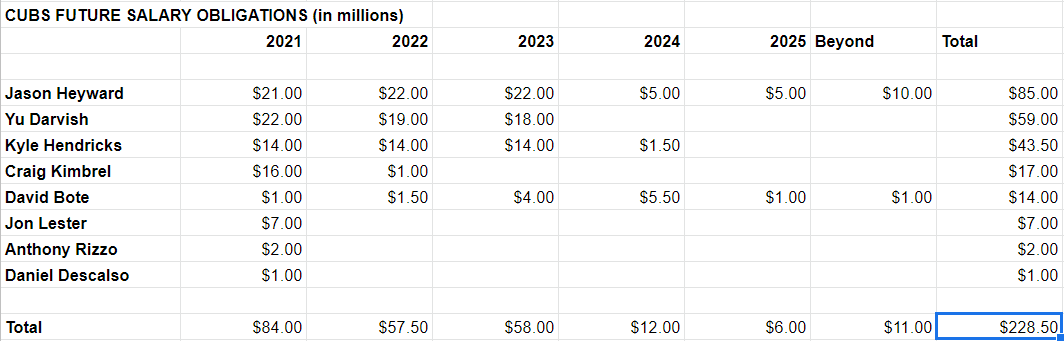
What Do The Cubs Owe Players After 2020?
2020 salary terms still need to be hammered out. But what about what’s owed to players beyond that point? The near-term economic picture remains questionable at best. That’ll make teams all the more cautious with guaranteed future salaries.
Every organization has some amount of future cash committed to players, all of it done before the coronavirus pandemic swept the globe. There are several different ways to look at salaries; for instance, for purposes of calculating the luxury tax, the average annual value is the touchstone, with up-front bonuses spread over the life of the deal. For this exercise, we’ll focus on actual cash outlays that still have yet to be paid.
We’ll run through every team, with a big assist from the Cot’s Baseball Contracts database. Prior entries can be found here. Next up is the Cubs:
*Includes remaining bonus payments owed to Jason Heyward
*Includes buyout on club options in Kyle Hendricks, Craig Kimbrel, David Bote, Anthony Rizzo, and Daniel Descalso contracts
*Includes buyout on mutual option in Jon Lester contract
(click to expand/view detail list)
Each NL Team’s Top Recent Draft Class
With the MLB draft scheduled for next week, let’s take a look at each National League team’s most successful draft class in recent memory. Using Baseball Reference’s draft tracker, we can sum the combined career bWAR of each player selected by each team in a given year. It’s a simple shorthand, not a perfect measure, but it’ll give some insight into which teams have really hit on their picks in certain years.
First, a quick note on the methodology. For simplicity, we’re limiting this search to the 2006-2015 classes. A player’s value is only included if he signed with the club, although he needn’t have actually played for his drafting team in the majors. (So, the 2008 Yankees don’t get credit for drafting but failing to sign Gerrit Cole, while the 2007 Red Sox do get credit for drafting and signing Anthony Rizzo, even though he was traded before ever playing an MLB game for Boston). Of course, a player drafted in 2006 has had more time to rack up value than one drafted in 2015, so we’ll note in each team’s capsule if a more recent class is on the verge of taking over from an older class. On to the results…
- Braves: 2007 (76.6 bWAR) – Hitting on Jason Heyward and Freddie Freeman in the first two rounds goes a long way. Heyward has been a disappointment with the Cubs but had some electrifying seasons in his early days in Atlanta (and his year in St. Louis), while Freeman has emerged as a fixture in the Braves’ lineup as one of the best hitters in baseball over the past decade.
- Brewers: 2009 (30.7 bWAR) – This was period of some underwhelming draft returns for Milwaukee. The 2009 class tops the list thanks to Khris Davis, Mike Fiers and Scooter Gennett, all of whom are better known for their play (or whistleblowing, in Fiers’ case) elsewhere.
- Cardinals: 2006 (56.3 bWAR) – By virtue of putting up baseball’s best record in 2005, the Cardinals sat at the back of every round in 2006. No matter, as they managed to find a handful of highly productive big leaguers. First-rounder Adam Ottavino didn’t work out in St. Louis but went on to a strong career as a reliever in Colorado. Tommy Pham (16th round) and Jon Jay (2nd round) have each carved out strong careers, while Allen Craig (8th round) had a brief but productive peak.
- Cubs: 2007 (54.4 bWAR) – Unfortunately for the Cubs, this class is almost all about Josh Donaldson, who did none of his damage in a Chicago uniform. Perhaps Javier Báez (2012 draft) or Kris Bryant (2013 draft) will match or exceed Donaldson’s stellar career in time.
- Diamondbacks: 2009 (73.1 bWAR) – Paul Goldschmidt (8th round) went on to become the top position player in franchise history. First-rounder AJ Pollock had a couple star-level seasons of his own before injuries knocked him off track, while Chase Anderson (9th round) has emerged as a solid back-of-the-rotation starter.
- Dodgers: 2006 (70.6 bWAR) – The Dodgers only signed two big leaguers from the 2006 class. When one of them goes on to become arguably the best pitcher of his generation, you can more than get away with it. Clayton Kershaw’s Hall of Fame plaque will boast at least three Cy Young Awards and an NL MVP.
- Giants: 2008 (65.6 bWAR) – The late-2000’s draft classes set up the crux of the Giants’ three World Series titles the first half of the next decade. None was more impactful than 2008, when SF grabbed Buster Posey and Brandon Crawford in the first and fourth rounds, respectively.
- Marlins: 2010 (56.1 bWAR) – Christian Yelich and J.T. Realmuto have matured into two of the best players in baseball, so the Marlins’ 2010 class (which also boasted late-blooming A’s slugger Mark Canha) has a chance to be really special. Of course, none of those players are still in Miami.
- Mets: 2010 (50.5 bWAR) – Seventh overall pick Matt Harvey was briefly the ace the Mets hoped they were adding in 2010. As it turns out, Jacob deGrom (9th round) had a lot more staying power atop their rotation.
- Nationals: 2009 (44.9 bWAR) – First overall pick Stephen Strasburg has more than made good on that selection, culminating in a World Series MVP effort in 2019. The 2009 class also brought in a handful of role players, including Drew Storen and Michael Taylor.
- Padres: 2007 (38.9 bWAR) – Another team for whom the top player simply got away, the crown jewel of the Padres’ 2007 class was Corey Kluber (4th round). Obviously, even San Diego didn’t him expect him to go on to win a pair of Cy Young Awards.
- Phillies: 2014 (24.2 bWAR) – There were some tough results for the Phillies on draft day in recent seasons, but 2014 looks to be a notable exception. Aaron Nola went seventh overall and has emerged as a high-level starter, while Rhys Hoskins (fifth round) looks like the Phils’ long-term answer at first base.
- Pirates: 2011 (29.7 bWAR) – The Pirates’ 2011 class is almost exclusively about the contributions of first overall pick Gerrit Cole, but he obviously reached his peak after being traded to Houston. Josh Bell (2nd round) looked to have turned the corner at the plate in the first half of 2019.
- Reds: 2007 (43.1 bWAR) – The Reds found three future everyday players in the 2007 class. Todd Frazier (supplemental first-round), Zack Cozart (2nd round) and Devin Mesoraco (1st round) all went on to become productive players in Cincinnati.
- Rockies: 2009 (47.4 bWAR) – The Rockies graduated six players from the 2009 class to the big leagues, although only one proved a smashing success. Finding a player of Nolan Arenado’s caliber in the second round makes for a great draft even if the rest of the players taken underwhelm.
The Other Chris Archer Trades
Pirates right-hander Chris Archer has been among the most prominent major leaguers in the news this week. Archer just underwent thoracic outlet syndrome surgery, meaning he won’t pitch until at least 2021. It also means his tenure could be done in Pittsburgh, which will have to decide between an $11MM club option and a $250K buyout next winter.
Archer’s surgery came as the latest disastrous development during his time with the Pirates, who made an ill-fated trade with the Rays to acquire him in July 2018. For the sake of Pirates fans, who have witnessed Archer struggle mightily in their favorite team’s uniform and have seen two of the players their club gave up flourish as Rays, we’re not going to recap that trade for the umpteenth time. But we are going to look back at other trades involving Archer. Long before he became a Pirate, Archer was part of a couple other notable deals.
First off, Archer entered the pros as a 17-year-old and a fifth-round pick of the Indians in 2006. Archer struggled to prevent runs as part of the Indians’ system through 2008, and after that season, the club traded him, righty Jeff Stevens and lefty John Gaub to the Cubs for infielder/outfielder Mark DeRosa. Cleveland didn’t get a full season out of DeRosa, whom the team flipped to the Cardinals in June 2009 after he batted a solid .270/.342/.457 in 314 plate appearances and 71 games as an Indian.
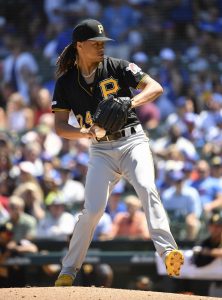
What of the Cubs’ return for DeRosa? Stevens combined for 37 1/3 innings of 6.27 ERA ball as a Cub from 2009-11. Gaub made even less of an impact in Chicago, with which he threw the only 2 2/3 innings of his career in 2011. Archer never appeared in the majors with the organization, but he turned around his fortunes as a Cubs minor leaguer and began cracking top 100 prospects lists as a member of the franchise. Still, that wasn’t enough for the Cubs to keep him.
After the 2010 season, when Archer topped out as Baseball America’s 27th-best prospect, the Cubs dealt him to the Rays in a blockbuster. Along with Archer, the Cubs surrendered shortstop prospect Hak-Ju Lee, catcher Robinson Chirinos, and outfielders Sam Fuld and Brandon Guyer for righty Matt Garza, outfielder Fernando Perez and lefty Zac Rosscup.
The Cubs got nothing from Perez, who never appeared in the majors with them, and very little from Rosscup (he posted a 5.32 ERA over 47 1/3 frames and parts of four seasons in their uniform). On the other hand, Garza was effective in Chicago from 2011-13. Though the team failed to push for the playoffs during that stretch, Garza turned in 372 2/3 innings of 3.45 ERA pitching with 8.6 K/9 and 2.8 BB/9. However, as a non-contender in July 2013, Chicago sent Garza – a soon-to-be free agent – to Texas for third baseman Mike Olt and the righty trio of Carl Edwards Jr., Justin Grimm and Neil Ramirez.
As for the Rays’ return, Lee never made it to MLB, even though he was a highly regarded prospect in his younger days. He’s now playing with the Samsung Lions of the Korea Baseball Organization. Chirinos has evolved into a fine offensive catcher, though he only took 60 plate appearances with the Rays in 2011 before they traded him to the Rangers two years later. Fuld played from 2011-13 in Tampa Bay, where he batted .230/.301/.326 in 653 attempts. Guyer appeared with the Rays in parts of four seasons from ’11-15 and slashed .255/.341/.396 over 978 PA.
While none of Lee, Chirinos, Fuld or Guyer offered especially valuable production as Rays, Archer thrived. He piled up 177 starts and amassed 1,063 innings of 3.69 ERA/3.48 FIP ball with 9.7 K/9 and 2.94 BB/9 as part of the team from 2011-18, during which he earned two All-Star nods and signed the six-year, $25.5MM extension he’s still playing under.
Many have been tough on Archer on account of what has been a rough run in Pittsburgh, but he’s the same player who once made the Rays look like geniuses for adding him. That makes his recent fall from grace all the more surprising, and it’s anyone’s guess whether a rebound will be in store in the wake of TOS surgery.
Photo courtesy of USA Today Sports Images.
Replacing Lester And Quintana
At present, the Cubs have only two starting pitchers under contract for the 2021 season: Yu Darvish and Kyle Hendricks. The Cubs actually control Darvish through 2023 and Hendricks through ’24, so they’ll continue as rotation mainstays into their mid-30s. The pair combined for 355 2/3 innings of 3.72 ball in 2019, and they’ll earn a total of $36MM in 2021. It’s a good starting point, but the Cubs have to address 60% of their rotation before the 2021 season.
The Cubs’ Three Free Agents
Jon Lester‘s time with the Cubs has been a clear success no matter what else happens, and he’ll never have to buy his own drink in Chicago. The lefty will turn 37 prior to the ’21 season. Is there a way he continues with the Cubs? The easiest path would be through his current contract, which guarantees his $25MM mutual option for 2021 with 200 innings pitched in 2020. Obviously Lester can’t reach that number in a shortened season, but such benchmarks would become prorated. Meaning if MLB teams play an 81-game season, Lester’s goal would become 100 innings.
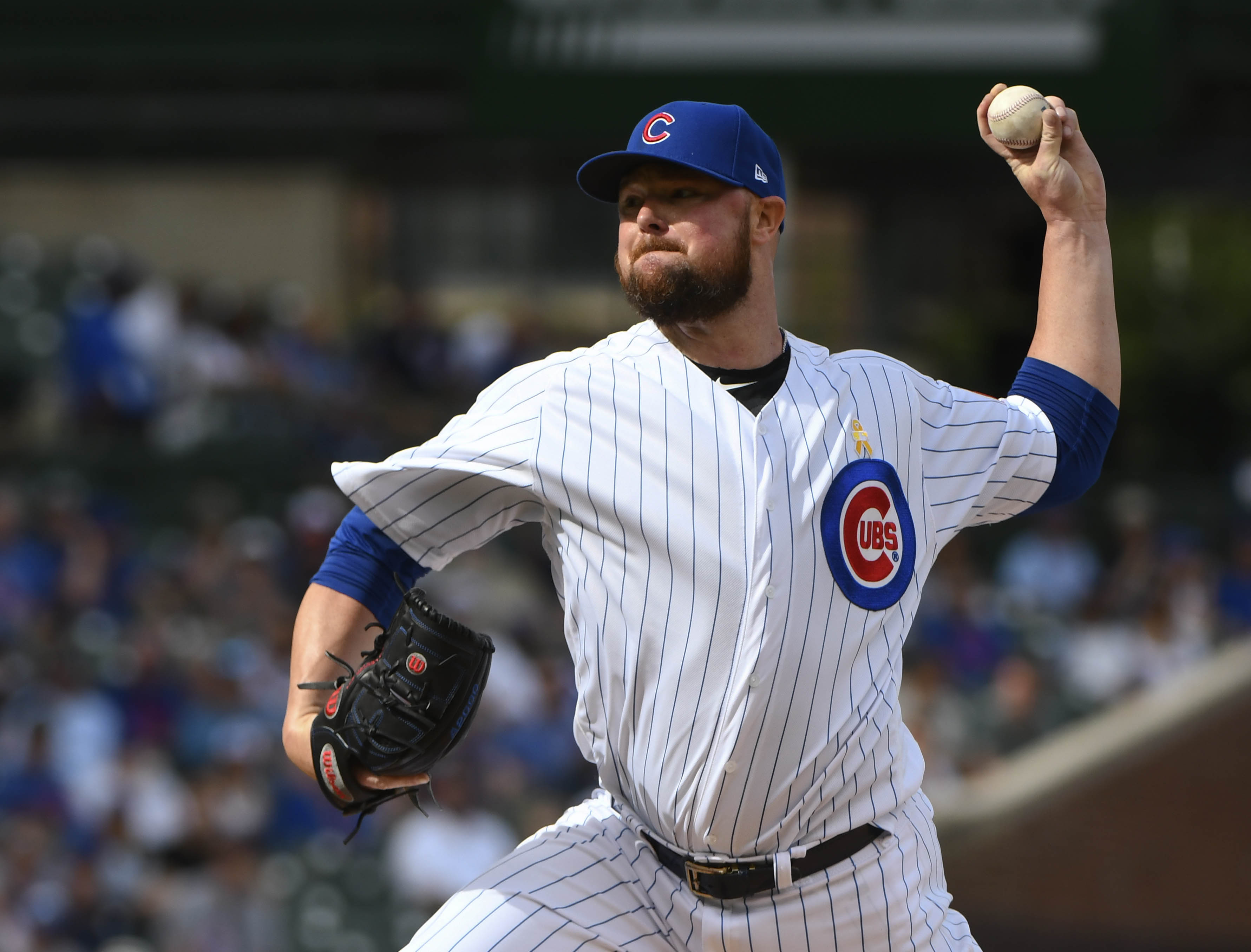
Lester has averaged 5.62 innings per start over the past three years, so in a half-season he’d either need to go deeper into games or make 18 starts to reach 100 innings. In a recent chat with WEEI’s Rob Bradford, Lester talked about the need for pitchers to ramp up carefully to avoid injury, and it’s doubtful he’d push himself well past six innings per start just to get his option to vest. I suppose in the most extreme example, MLB could follow through on its 50-game schedule threat, dropping Lester’s benchmark to about 62 innings. He could theoretically pull that off in 10 starts, but it still seems physically risky to push to a level he hasn’t reached in years.
On the Cubs’ end, they likely prefer the $10MM buyout to locking Lester in for $25MM. So new manager and former Lester battery-mate David Ross could encounter a delicate situation, where if Lester somehow kicks off a 2020 season going deeper into games, Ross’ bosses might push for earlier hooks. Ultimately, though, I don’t expect Lester’s option to vest, in which case it’s a mutual one. It’s rare that both sides exercise such an option, meaning Lester would become a free agent. Working out a new short-term deal could be tricky, with the Cubs already on the hook for a significant $10MM buyout.
The Cubs also stand to lose Jose Quintana to free agency. Quintana, who will turn 32 prior to next season, hasn’t quite gotten the results the Cubs hoped for after giving up Eloy Jimenez and Dylan Cease for him in July 2017. In his time with the Cubs, Q has posted a 4.23 ERA over 429 2/3 innings. His impressive durability has remained intact, but the southpaw has dropped to about 5.4 innings per start since 2018. By a results-based measure, Baseball Reference WAR, Quintana was at just 1.4 in 2019. FanGraphs WAR, rooted in the Fielding Independent Pitching (FIP) stat, puts him at a healthy 3.5 – rewarding respectable strikeout, walk, and home run numbers but ignoring his allowing 10.1 hits per nine innings.
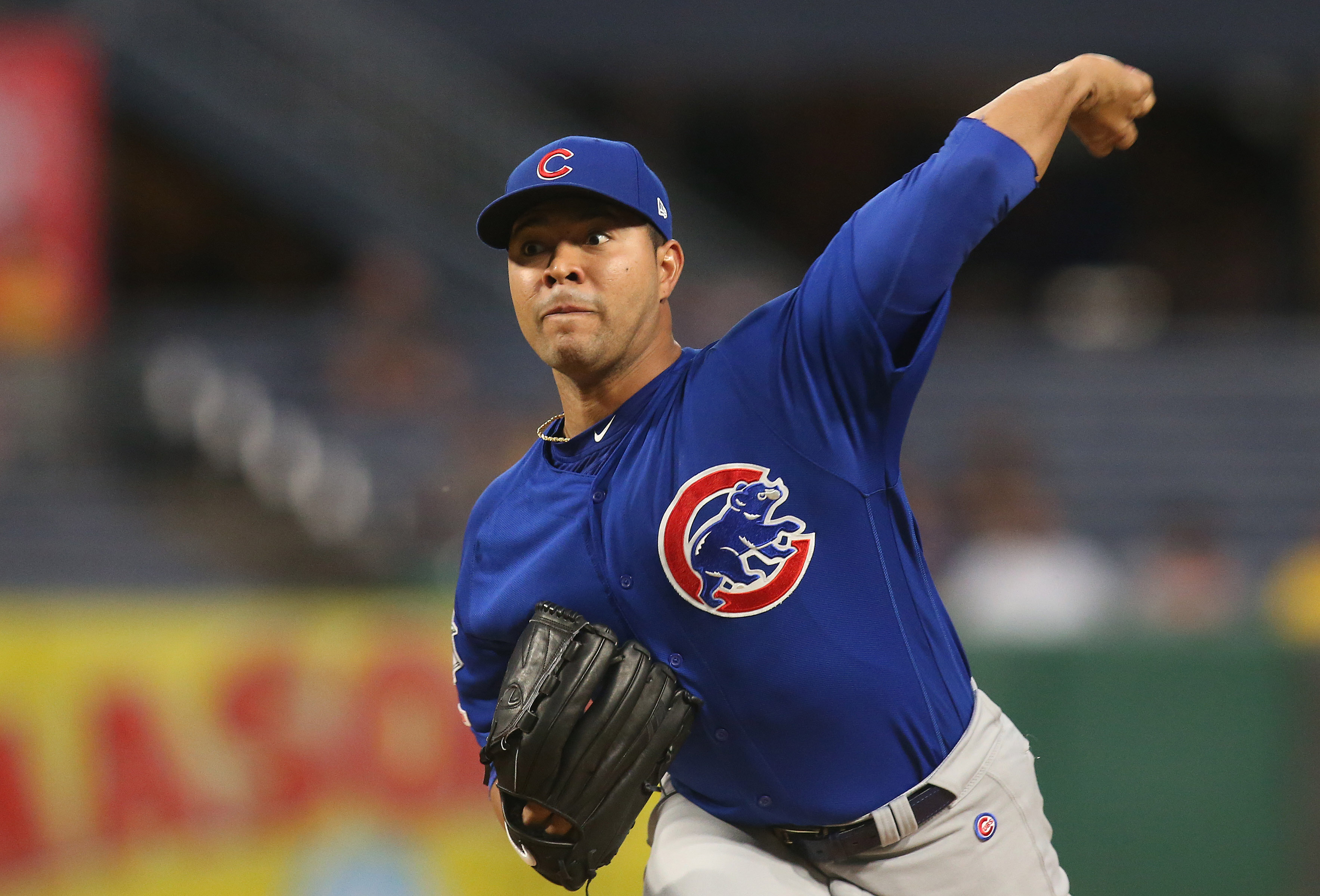
Wherever you land on WAR, it’s fair to say Quintana projects to be better than 2019’s 4.68 ERA. 170 solid innings of 4.30 ball might be a reasonable expectation moving forward. It’s not clear yet on what the qualifying offer may look like if teams play a shortened 2020 season, so it’s impossible to say whether the Cubs would offer one. My guess is that they would not make the offer, instead maintaining their financial flexibility. That’s what they did with Cole Hamels last winter.
Though he’s penciled in as the Cubs’ fifth starter for 2020, Tyler Chatwood‘s contract has been a bust for the Cubs, and he’ll surely be allowed to leave via free agency.
Internal Options
What options do the Cubs have to fill a rotation spot internally? There’s Alec Mills, the soft-tossing righty who turns 29 in November. Mills was a candidate for the Cubs’ fifth starter job this spring, so he’ll likely be in the mix next year as well. Adbert Alzolay, 26 next March, would be in the running again as well. Alzolay pitched 109 innings in total over the past two seasons, and Mills hasn’t been particularly successful even at Triple-A. Both pitchers are depth options, and if they’re favorites for a 2021 rotation job, it will be because they’re affordable.
Lefty Brailyn Marquez is the crown jewel of the Cubs’ farm system, but he’s yet to pitch above High A and projects for a 2022 ETA. Even that goal could be pushed back given the lack of a minor league season this year. The Cubs do have a few starters with experience at Double-A or above in Cory Abbott, Tyson Miller, and Justin Steele, all of whom have ceilings at as back-end starters according to Baseball America. The bottom line? The Cubs need to add at least two starters from outside before next season, and possibly three.
Free Agency
After paying a $7.6MM luxury tax bill for 2019, the Cubs were looking to stay under the $208MM payroll mark in 2020 as a means of resetting the escalating penalties. The Cubs won’t get a free reset if the 2020 season is canceled, but if games are played the club will likely maintain their goal of staying below the base tax threshold. It’s also possible that the luxury tax will be temporarily reduced in some way as part of the current negotiation between MLB and the players’ union, to grease offseason spending. If the Cubs don’t spend money during the 2020-21 offseason, I don’t expect the luxury tax to be the reason again.
Cubs owner Tom Ricketts recently claimed that “about 70 percent of the revenue that comes into our organization comes in on day of game.” He also said, “We’ve already lost half that season, so in a best-case scenario, we’re looking at recovering maybe 20 percent of our total income.” We’ll never know the real financial picture, but obviously the Cubs won’t make nearly as much money as they expected to in 2020. It’s easy to see this being the justification for modest free agent spending. Still, there almost has to be some money to spend if the salaries of Lester, Quintana, and Chatwood come off the books.
While some of the savings could be offset by arbitration raises for players like Kris Bryant, Javier Baez, Kyle Schwarber, and Willson Contreras, it’s impossible to project what those arbitration raises will look like after a shortened season. I imagine we’d be subjected to a fundamental disagreement across baseball on whether a half-season should result in a half-raise, but at least there’s already a mechanism in place to settle that with arbitration hearings.
The free agent market will feature roughly 30 credible options, many of whom the Cubs have already tried. Aside from the trio mentioned above, there’s recent former Cubs Cole Hamels, Jeff Samardzija, Jake Arrieta, Brett Anderson, and Drew Smyly. If the Cubs seek innings, they could make a run at Trevor Bauer, who famously seeks a one-year deal with a team that will let him pitch every fourth day. With three vacancies, getting significant innings out of someone like Bauer could fit the Cubs better than an arguably better pitcher with a poor track record of durability, like James Paxton.
Though the market lacks a true ace, options abound with a solid group including Marcus Stroman, Mike Minor, Jake Odorizzi, Masahiro Tanaka, Robbie Ray, and Anthony DeSclafani. Feel free to explore next winter’s starting pitcher market further with this FanGraphs leaderboard I created. Even on a budget, the Cubs could plausibly target any of these guys.
The Trade Market
I’ve yet to see any concepts floated regarding in-season trading during a shortened 2020 campaign. At the least we can assume players will be traded in the offseason and starting pitchers will be available. The Cubs’ farm system is far from robust, but they do have minor league assets to consider trading. There’s also a good chance of the team trading Kris Bryant, who becomes eligible for free agency after 2021.
Even the teams that were clearly rebuilding for 2020 could adjust course if they somehow make a fluke run in a shortened season with expanded playoffs. Names like Matthew Boyd, Daniel Norris, Joe Musgrove, Jon Gray, Danny Duffy, Chris Archer, Jose Urena, and Nick Pivetta could reasonably be available, though we may be in for an unpredictable offseason.
Whatever path they choose, the Cubs seem likely to remake their rotation in a significant way for 2021. What do you expect them to do? Let us know in the comments.
D-backs, Cubs Owners On Schedule Proposals, Revenue Losses
As MLB’s 30 owners and the Players Association clash over the length of a potential 2020 season — the MLBPA recently proposed a 114-game length, while ownership recently suggested as few as 50 to 60 games — Diamondbacks owner Ken Kendrick offered some strong objection to the notion of pushing the regular-season schedule into November. Appearing on the Burns & Gambo Show on 98.7 FM Arizona Sports, Kendrick rebuked the notion of November play (hat tip to ESPN’s Jeff Passan, on Twitter):
We don’t want to take the risk of putting our players at jeopardy and our game in peril to be playing games beyond the end of October. So our model is and will never be changed that we will not be playing baseball in the month of November or later.
It’s never been likely that the league would accept the union’s 114-game proposal, but Kendrick’s strong words are of particular note given that the union’s plan called for the regular season to conclude on Halloween. Kendrick ostensibly strives to put the well-being of players at the forefront of the issue. However, it’s been reported for weeks that the league has concerns that additional spikes in COVID-19 cases could jeopardize the postseason, where they’d stand to make considerable revenue from national television broadcasts (particularly with an expanded playoff field).
Meanwhile, Cubs owner Tom Ricketts again bemoaned a lack of revenue to ESPN’s Jesse Rogers, claiming that most owners don’t profit much from their teams:
[Owners] raise all the revenue they can from tickets and media rights, and they take out their expenses, and they give all the money left to their GM to spend. The league itself does not make a lot of cash. I think there is a perception that we hoard cash and we take money out and it’s all sitting in a pile we’ve collected over the years. Well, it isn’t.
Ricketts contends that the Cubs derive 70 percent of their revenue from gamedays (ticket sales, concessions, parking, etc.) and that his team is hoping to salvage 20 percent of its would-be revenue in 2020. Of course, that’s the very type claim that has caused the MLBPA to bristle not only throughout negotiations to resume play but for decades prior. The union has repeatedly requested that ownership provide transparent documentation of the potential losses they’re claiming in 2020, but owners don’t appear likely to ever acquiesce on that issue.
Asked about agent Scott Boras recently using Ricketts and the Cubs as an example of suspect claims regarding their revenue, Ricketts merely replied that Boras “doesn’t have any insight into our balance sheet.” He also called the losses facing owners throughout the league “biblical” and spoke at length on his belief that revenue sharing between MLB and the MLBPA is a worthwhile concept to explore in the next CBA. The notion of revenue-sharing has been a total nonstarter for the union.
Cubs Release Brock Stewart, Carlos Asuaje
FRIDAY: J.J. Cooper of Baseball America tweets the full list of players the Cubs have released.
THURSDAY, 10:11pm: The Cubs have let go of 30 minor leaguers, according to Maddie Lee and Gordon Wittenmyer of NBC Sports Chicago. However, aside from Stewart and Asuaje, the identities of the players aren’t yet known.
7:16pm: There are minor league cuts happening across baseball, and though the Cubs’ full list isn’t out yet, right-hander Brock Stewart and utilityman Carlos Asuaje are among the players they have released. Stewart announced his fate on Twitter, while Sahadev Sharma of The Athletic reported on Asuaje’s exit (via Patrick Mooney of The Athletic). Those two and the rest of the minor leaguers the Cubs have parted with will be paid through the end of June.
Stewart, 28, is an Illinois native who attended Illinois State and was then a sixth-round pick of the Dodgers in the 2014 amateur draft. He went on to pitch for the Dodgers from 2016-19, but the club lost him on waivers to the Blue Jays last July. Stewart didn’t last long with the Jays, who lost him to the Cubs as a Rule 5 pick last winter. Between Los Angeles and Toronto, Stewart has pitched to a 6.05 ERA/6.25 FIP with 7.41 K/9 and 4.09 BB/9 during his 105 2/3-inning major league career.
Success at the game’s highest level has also been hard to come by for Asuaje. The 28-year-old amassed 586 plate appearances as a Padre from 2016-18, but he only managed a .240/.312/.329 line with six home runs with San Diego. Asuaje joined the Lotte Giants of the Korea Baseball Organization last year, and he hit .252/.356/.368 with a pair of homers in 194 PA before the club released him. He finished 2019 with the Diamondbacks’ Triple-A affiliate.
Which 15 Players Should The Cubs Protect In An Expansion Draft?
In a few weeks, we’ll be running a two-team mock expansion draft here at MLBTR – just for the fun of it! Currently, we’re creating 15-player protected lists for each of the existing 30 teams. You can catch up on the rules for player eligibility here.
So far, we’ve covered the Diamondbacks, Rockies, Dodgers, Padres, Giants, Rangers, Mariners, Athletics, Angels, Astros, Twins, Royals, Tigers, Indians, White Sox, Rays, Yankees, Red Sox, Blue Jays and Orioles. The Cubs are up next.
First, we’ll remove free agents Jon Lester, Daniel Descalso, Tyler Chatwood, Jose Quintana, Jeremy Jeffress, and Steven Souza from consideration. I’ll assume Anthony Rizzo‘s $16.5MM club option is exercised and the Cubs use a protected spot on him. I’ll lock in Jason Heyward, Craig Kimbrel, and Yu Darvish due to their no-trade clauses. We’ll protect these 11 players out of the gate:
Anthony Rizzo
Jason Heyward
Craig Kimbrel
Yu Darvish
Nico Hoerner
Kyle Hendricks
Kris Bryant
Javier Baez
Willson Contreras
Ian Happ
Kyle Schwarber
That leaves four spots for 17 remaining players:
Albert Almora Jr.
Adbert Alzolay
David Bote
Victor Caratini
Jharel Cotton
Robel Garcia
Dillon Maples
Alec Mills
James Norwood
Colin Rea
Kyle Ryan
Casey Sadler
Ryan Tepera
Duane Underwood Jr.
Rowan Wick
Brad Wieck
Dan Winkler
With that, we turn it over to the MLBTR readership! In the poll below (direct link here), select exactly four players you think the Cubs should protect in our upcoming mock expansion draft. Click here to view the results.
Latest On MLB Teams’ Plans For Employees
A variety of MLB teams have already revealed plans for the year for non-player employees. Some have instituted furloughs and/or pay cuts while others have committed to carry employees through the fall. Still other teams are taking things on a month-to-month basis, with several revealing their latest plans in recent days.
At least three teams have decided to continue paying employees in full through at least the end of June. The Cardinals are one such team, Derrick Goold of the St. Louis Post-Dispatch reports on Twitter. The Twins are also in that camp, Jeff Passan of ESPN.com tweets. And the White Sox are adjusting work hours but not take-home pay, per Ken Rosenthal of The Athletic (via Twitter).
Elsewhere in the central divisions, there were some cuts. The Cubs are keeping their full slate of employees at full-time capacity, but are instituting some salary reductions, Jeff Passan of ESPN.com reported on Twitter. And though the Pirates will not draw down their baseball operations staff, they will reduce pay in that arena while furloughing some business employees, as Jason Mackey of the Pittsburgh Post-Gazette reports.
Out west, the Giants will retain their entire full-time staff but will be trimming pay for those earning over $75K, Henry Schulman of the San Francisco Chronicle reports. Part-timers have been furloughed.
The Astros have committed to maintaining full pay and benefits for full-time employees, but only through June 5th, Chandler Rome of the Houston Chronicle reports. Whether some action could occur beyond that point remains to be seen. The Orioles are also still in flux, but the organization appears to be leaning towards keeping staff as usual through June, per Dan Connolly of The Athletic (via Twitter).