
Hunter Greene To Undergo MRI On Right Elbow
Reds ace Hunter Greene is heading for an MRI after experiencing stiffness in his right elbow, manager Terry Francona tells reporters at Reds camp this morning. Greene himself says the injury dates back to late last season (link via Charlie Goldsmith). He was recommended for an injection and had a normal offseason but tells the Reds beat that the discomfort has crept back up recently. Greene will be examined by longtime team physician Timothy Kremchek and have a second opinion from Dr. Neal ElAttrache. He says his ulnar collateral ligament was intact at a recent check, but news of a new round of imaging will inherently lead to some concern until the results are known.
Greene acknowledged in his comments that, like many big league pitchers, he’s aware of some bone spurs in his elbow. He’s navigated that issue in the past, it seems, and surgery has not been recommended as an option to this point. The right-hander wouldn’t commit to whether he’ll be able to make his first start of the season.
“If something has to be done, it’s early and we’ll get it out of the way quick and can have the big chunk of the season,” Greene said this morning. “If we have a playoff push, I’ll be ready to go.”
Even a brief absence for Greene is a bitter pill for the Reds to swallow. The former No. 2 overall draft pick has been one of the game’s best pitchers on a rate basis over the past two seasons but has missed considerable time due to a pair of groin strains in 2025 and some elbow discomfort in 2024. He’s started 45 games across the past two seasons and worked to a 2.76 ERA with a 29.2% strikeout rate, 8.1% walk rate and 33.5% ground-ball rate. Last season’s 15.4% swinging-strike rate was fourth-best in MLB (min. 100 innings pitched), trailing only Tarik Skubal, Dylan Cease and Logan Gilbert.
Greene is entering the fourth season of a six-year, $53MM extension. The 26-year-old is being paid $8MM this season before making $15MM and $16MM in 2027-28. The Reds hold a $21MM club option (with a $2MM buyout) over his 2029 season.
With Greene’s status up in the air, one of the stronger-looking rotations in the sport takes a big hit. Cincinnati can still trot out Andrew Abbott, Nick Lodolo, Brady Singer and top prospects Chase Burns (the No. 2 pick in 2024) and Rhett Lowder (the No. 7 pick in 2023), but neither Burns nor Lowder has fully established himself in the majors yet. Lowder pitched only 9 1/3 minor league frames last year due to forearm, oblique and shoulder issues.
Depth options on Cincinnati’s 40-man roster include another former first-rounder, Chase Petty, and a pair of formerly touted prospects returning from injury: righty Julian Aguiar and lefty Brandon Williamson. The Reds also selected righty Jose Franco to the 40-man roster this past November to protect him from the 2025 Rule 5 Draft; he tossed 110 innings of 3.11 ERA ball between Double-A (2.76 ERA) and Triple-A (3.51 ERA) last season.
There are, of course, some notable starters remaining in free agency. Lucas Giolito and fellow righty Zack Littell — the latter of whom finished the 2026 season with Cincinnati — remain unsigned. Veterans like Tyler Anderson, Patrick Corbin and old friend Anthony DeSclafani would be more affordable depth pursuits.
However, president of baseball operations Nick Krall told Goldsmith that even if Greene misses time, he doesn’t anticipate engaging with any free agents to fill that void. That perhaps leaves the door cracked for waiver and trade activity to replenish some depth, but the Reds’ 2026 payroll is already expected to be higher than in 2025, so the team may not have much budget space with which to tinker after spending more than $47MM in free agency already.
Offseason In Review: Cincinnati Reds
Eugenio Suarez‘s power bat is returning to the Queen City, but is that enough to bolster an inconsistent lineup?
Major League Signings
- Emilio Pagan, RHP: Two years, $20MM (Pagan can opt out after 2026 season)
- Eugenio Suarez, 1B/3B: One year, $15MM (plus $16MM mutual option for 2027)
- Pierce Johnson, RHP: One year, $6.5MM (plus mutual option for 2027)
- Caleb Ferguson, LHP: One year, $4.5MM
- JJ Bleday, OF: One year, $1.4MM
2026 spending: $37.4MM
Total spending: $47.4MM
Trades And Claims
- Acquired LHP Brock Burke from Angels as part of three-team trade (Rays acquired IF Gavin Lux from Reds and minor league RHP Chris Clark from Angels; Angels acquired OF Josh Lowe from Rays)
- Acquired OF Dane Myers from Marlins for minor league OF Ethan O’Donnell
- Acquired cash considerations from Rays for OF Ryan Vilade
- Acquired minor league RHP Dusty Revis from Mariners for RHP Yosver Zulueta
- Claimed C Ben Rortvedt off waivers from Dodgers (Rortvedt was claimed back by Dodgers in February)
- Claimed RHP Roddery Munoz off waivers from Cardinals (Munoz later non-tendered and selected by Astros in the Rule 5 Draft)
Option Decisions
- Austin Hays, OF: Reds declined $12MM club option for 2026, paid $1MM buyout
- Scott Barlow, RHP: Reds declined $6.5MM club option for 2026, paid $1MM buyout
- Brent Suter, LHP: Reds declined $3MM club option for 2026, paid $350K buyout
Notable Minor League Signings
- Nathaniel Lowe, Garrett Hampson, Josh Staumont, Michael Toglia, Michael Chavis, Anthony Misiewicz, Yunior Marte, Tejay Antone, Carson Spiers, Davis Daniel, Darren McCaughan, Will Banfield, Hagen Danner, P.J. Higgins, Brandon Leibrandt
Extensions
- None to date
Notable Losses
- Hays, Barlow, Suter, Lux, Vilade, Zulueta, Nick Martinez, Santiago Espinal, Miguel Andujar, Reiver Sanmartin, Zack Littell (still unsigned), Wade Miley (still unsigned)
Kyle Schwarber grew up in Middletown, an Ohio city just a short drive away from Cincinnati. The idea of adding both a local product and a top-tier bat in Schwarber inspired the Reds to go beyond their usual financial zone in free agency, as the team reportedly made Schwarber an offer in the range of five years and $125MM. As was widely expected going into the offseason, however, Schwarber ended up re-signing with the Phillies (for five years and $150MM), leaving the Reds and Schwarber’s many other suitors looking for a backup plan.
Instead of adding a 56-homer slugger in Schwarber, the Reds brought in a 49-homer slugger who also had some ties to Cincinnati, as Suarez returned for his second stint with the organization. After bashing 189 homers for the Reds from 2015-21, Suarez went yard 132 more times in four subsequent seasons with the Mariners and Diamondbacks, including 49 home runs in 2025.
Though there were plenty of similarities between Schwarber and Suarez’s 2025 campaigns, there’s a reason Suarez was available at the relative bargain price of one year and $15MM. Schwarber is entering his age-33 seasons while Suarez turns 35 in July, Suarez’s walk rates over the last two seasons have been below average while Schwarber’s have been elite, and Suarez’s overall production has been inconsistent.
From the start of July 2024 to the end of July 2025, Suarez was arguably the hottest hitter in baseball in batting .276/.336/.593 with 60 homers over 766 PA with Arizona. He struggled badly in the first half of the 2024 season, however, and then his bat drastically cooled again this past summer after the D-Backs sent Suarez to the Mariners at the trade deadline.
Between the up-and-down numbers, Suarez’s age, and his defensive drop at third base, it seemed like Suarez wasn’t getting the types of offers he was expecting after a 49-homer campaign. Suarez’s alternate strategy was a one-year deal in a familiar (and hitter-friendly) environment at Great American Ball Park, with the idea that he’ll have a better chance of landing a pricey multi-year deal after another big platform year. It’s not out of the question that the Reds could again reunite with Suarez next winter if the price is right, but for now, the club is happy to add some much-needed power to the lineup for at least 2026.
Hitting was the Reds’ chief need this winter, as Cincinnati’s run to a wild card berth came despite middling offensive numbers almost across the board. Bringing Suarez into the lineup (primarily as a DH, since Ke’Bryan Hayes has third base covered) should alone provide a lot of pop, though the Reds will again be relying on a lot of the same faces from 2025.
While the Reds were willing to go above and beyond spending-wise for a special case like Schwarber, their free agent spending was (as usual) limited for much of the winter. President of baseball operations Nick Krall said in early November that the team’s payroll would be largely unchanged from 2025, and that has proven to be the case. As per RosterResource‘s calculations, Cincinnati finished 2025 with a payroll of roughly $118.7MM, and they currently have around $126MM on the books for the coming season.
Uncertainty over the Reds’ broadcast contract with Main Street Sports contributed to the team’s modest spending. The Reds were one of the nine teams who walked away from their deals with MSS due to the company’s continued financial issues, and Cincinnati then joined five of those teams in signing on with Major League Baseball to handle its broadcasts for at least 2026. Staying with MLB will bring some short-term stability to the situation, though the lesser broadcast rights represents a significant hit to the Reds’ revenues.
With money at a premium, it isn’t surprising that most of the Reds’ offseason pursuits (particularly on the batting front) came on the trade market. Schwarber and old friend Miguel Andujar drew the team’s interest in free agency, but the Reds were linked to such names as Ketel Marte, Luis Robert Jr., Brandon Lowe, and Jake Meyers. Robert has long been on Cincinnati’s radar, but the White Sox ended up dealing the outfielder to the Mets. Lowe, meanwhile, landed on an NL Central rival, as the Rays dealt their longtime infielder to the Pirates.
Only Krall and his front office lieutenants know exactly why any of these trade pursuits didn’t materialize, but it is fair to guess that the roadblock might’ve been the Reds’ reluctance to deal from their rotation depth. There was plenty of speculation that the Reds could dangle one of their starters for a prominent bat, except there was never much chance that any of Hunter Greene, Nick Lodolo, Andrew Abbott, or Chase Burns were heading anywhere. If teams kept asking about that group (and not more palatable trade chips like Brady Singer, or maybe Chase Petty or Rhett Lowder), it isn’t surprising that the Reds couldn’t line up on a trade fit.
Since the rotation powered the Reds’ playoff chase, it is understandable that Krall wasn’t keen on moving any arms from his club’s biggest strength. Both the team’s rotation (and bullpen) took a hit via a free agent departure, when swingman Nick Martinez left to sign with the Rays. Deadline acquisition Zack Littell is also a free agent, and while he remains unsigned at the time of this post, Cincinnati is probably deep enough in starters that a reunion isn’t likely.
Between Martinez leaving, and the Reds’ decision to decline their club options on Brent Suter and Scott Barlow, some big holes needed to be filled in the relief corps. The Reds’ biggest free agent expenditure addressed the bullpen, as Emilio Pagan was brought back on a two-year, $20MM deal.
This new contract is pretty similar to the two-year, $16MM pact he signed with Cincinnati back in November 2023, as this new deal also allows the right-hander to opt out after the first season. Pagan passed on his previous opt-out chance in the wake of an injury-marred down year in 2024, but he rebounded in very impressive fashion to post a 2.88 ERA, 30% strikeout rate, and 8.1% walk rate across 68 2/3 innings last season, while converting 32 of 38 save opportunities.
Pagan’s extreme fly-ball tendencies always run the risk of variance in his performance, depending on how many of those fly balls stay in the park or sail over the outfield wall. He is also entering his age-35 season, so a decline simply based on age isn’t out of the question. Still, in somewhat similar fashion to the Suarez deal, the Reds were willing to invest on a player they already know and like, and who has a track record of success in the organization.
Barlow and Suter could’ve been retained for a total of $9.5MM via their club options. The Reds instead spent a bit more on another righty and lefty relief duo in Pierce Johnson (one year, $6.5MM) and Caleb Ferguson (one year, $4.5MM). The four pitchers are pretty comparable overall, though the newcomers perhaps bring a bit more upside and a bit more postseason experience to the pen.
Cincinnati’s most prominent swap of the winter saw the team part ways with a bat in order to land some more bullpen help. Gavin Lux delivered barely replacement-level production in his only season in southwest Ohio, so the Reds sent him to the Rays as part of a three-team trade with the Angels that brought Brock Burke into the relief corps. Burke is a solid left-hander who doesn’t miss many bats, but he has developed a knack for inducing grounders.
The Reds had some interest in re-signing Austin Hays after declining their club option, but Hays went to the White Sox in part because Chicago could offer him the type of regular playing time that wasn’t available in Cincinnati’s outfield mix. With Hays and Lux gone, a Reds outfield that was already something of a question mark heading into the offseason needed some more reinforcement, though the acquisitions of JJ Bleday and Dane Myers don’t really provide a clear answer to the outfield questions.
Bleday (the fourth overall pick of the 2019 draft) had a strong year with the A’s in 2024, but has posted exactly 0.0 fWAR over his other three Major League seasons. After Bleday followed up his seeming breakout year with more struggles in 2025, the A’s parted ways with the outfielder at the non-tender deadline. Myers is more of a glove-first fourth outfielder type, as he has batted only .245/.299/.354 over 511 career PA with the Marlins. The righty-hitting Myers has hit well with the platoon advantage and should get a decent amount of run against lefty pitching. Bleday wasn’t a huge expenditure at the cost of $1.4MM, and he is arbitration-controlled through 2028 while Myers is controlled through 2029.
Cincinnati’s most regular outfield alignment on paper will probably be Bleday in left, TJ Friedl in center field, and Noelvi Marte in right, with Spencer Steer or Myers likely starting over Bleday when a southpaw is on the mound. Will Benson provides added depth off the bench or in Triple-A.
How exactly the Reds will juggle their position players remains a topic of debate, though Terry Francona is as good as any manager at finding at-bats for everyone and riding the hot hand. The situation underlines the curious dichotomy about the Reds heading into 2026 — this is a team aiming to return to the playoffs and make a deeper run, yet the club is also not exactly sure of what it has with the majority of its position players.
Assuming Suarez is more like the version of himself who tore up pitching for the bulk of his D-Backs tenure, he’ll be a source of stability. Elly De La Cruz is already an All-Star with an even higher ceiling of greater potential. Hayes is a mediocre hitter but also perhaps the sport’s best defensive third baseman, so he at least brings huge value with his glove. Friedl is a decent hitter who is probably better suited as a platoon corner outfielder, rather than as a defensively-challenged center fielder slated to get the majority of the work up the middle.
Those players are, at it stands, the surer things. Marte’s midseason move to right field seemed to work just fine from a defensive perspective, but can he take the next step as a hitter to truly establish himself as a big league regular? Can Sal Stewart be a Rookie of the Year contender after his very promising numbers over 58 PA in 2025? Can any or all of Steer, Matt McLain, and Tyler Stephenson return to the form they showed at the plate earlier in their careers? In Steer’s case, can he also adjust in what might be a utility role, as Cincinnati intends to toggle Steer around between first and second base, the corner outfield slots, and the DH position?
Obtaining another true everyday player to insert into the lineup might’ve solved at least one of these questions, but Suarez was the one splash permitted for a front office working under budget constraints. The Reds’ swath of minor league signings provides some interesting depth possibilities, with Nathaniel Lowe standing out as the most intriguing bounce-back candidate, even if he’d add to an already crowded first-base picture.
Francona, Krall and company would happily welcome a problem of having multiple productive hitters for too few positions, given how the 2025 Reds often had trouble providing their excellent starters with suitable run support. The wild card berth represented great progress, and it’s easy to see how the Reds can contend again in 2026 since they still project to have one of the game’s better rotations. With the NL Central (let alone the NL wild card picture as a whole) becoming more competitive, the Reds are counting on Suarez and at least a couple of internal breakouts to allow the team to take another step forward.
How would you grade the Reds' offseason?
-
C 41% (831)
-
B 40% (804)
-
D 10% (193)
-
A 6% (113)
-
F 3% (69)
Total votes: 2,010
Wayne Granger Passes Away
Former MLB reliever Wayne Granger passed away on Wednesday at 81. The National Baseball Hall of Fame announced the news this evening.
Granger, a 6’4″ right-handed pitcher, was a native of Springfield, Massachusetts. He signed with the Cardinals as an amateur free agent and debuted with St. Louis during the 1968 season. Granger tossed 44 innings of 2.25 ERA ball as a rookie. He made one mop-up appearance in that year’s World Series, getting through two scoreless innings in a blowout loss in Game 6 against the Tigers. Detroit would win the decider the next night, coming back from a 3-1 series deficit.
That wound up being Granger’s final appearance of his first stint in a St. Louis uniform. The Cardinals traded him to Cincinnati alongside 23-year-old outfielder Bobby Tolan for Vada Pinson, a star center fielder who was by that point in the decline phase of his career.
It turned out to be a win for the Reds. Pinson played one season with the Cardinals, hitting .255 with 10 homers, and was traded to Cleveland a year later. Tolan had a brief peak but had three excellent seasons as a table-setter in front of the bigger bats as the Big Red Machine dynasty developed.
Granger was a bullpen workhorse over his three seasons in Cincinnati. He led the majors in appearances (90) and games finished (55) during his first year with the Reds. Granger threw 144 2/3 innings — a huge amount out of the bullpen even at a time when most relievers went multiple innings — and worked to a 2.80 ERA. The ’69 season was the first in which MLB officially recognized the save statistic. Granger picked up 27, tying him for third-most in the majors.
He had a similar showing the following year. Granger again posted a sub-3.00 ERA while logging 84 2/3 innings during the regular season. He led the majors with a career-high 35 saves, which was at the time the most in a season in MLB history (including retroactive tallies from before it was officially recognized as a stat).
That was mostly a reflection of the changing way in which teams used their relievers. It certainly didn’t hurt that a 102-win Cincinnati team gave Granger plenty of opportunities to shut the door. He pitched quite well in his own right, however, although that unfortunately didn’t extend to the postseason. Granger gave up five runs in two innings over a pair of appearances in the 1970 World Series. The Reds dropped a five-game set to the Orioles.
Granger played one more season in Cincinnati, again leading the National League in appearances in 1971. The Reds traded him to the Twins after that season. Granger pitched one year in Minnesota before kicking around to a handful of clubs (Yankees, a second stint in St. Louis, White Sox, Astros and Expos).
He retired after the 1976 season and was inducted into the Reds’ team Hall of Fame six years later. Granger finished his career with a 3.14 ERA across 638 2/3 innings. He recorded 108 saves and struck out 303 opponents. MLBTR sends condolences to his family, friends, former teammates and loved ones.
Poll: Who Will Be The Odd Man Out In The Reds’ Lineup?
The Reds were perhaps the most surprising playoff club of the 2025 season, as they managed to squeak into the third NL Wild Card spot with an 83-79 record. That return to the postseason came to an abrupt end when they were dispatched by the eventual World Champion Dodgers in the Wild Card round, but that didn’t stop them from making some upgrades to the team this winter. The return of veteran slugger Eugenio Suarez is surely the most impactful addition of the team’s offseason, but it also creates a bit of a logjam within the roster for their existing players. While Suarez is an impactful offensive addition coming off a 49-homer campaign, he’ll surely cut into the playing time of one of the club’s other regulars. That’s especially true given the addition of JJ Bleday to the club’s outfield mix, which effectively replaced the traded Gavin Lux on the roster.
While a reduction in playing time for the rest of the roster is inevitable, the Reds have enough positional flexibility on their roster that exactly how playing time will be divvied up remains an open question. With so many potential lineup configurations, who will end up getting the short end of the stick? There’s a few obvious players who won’t be losing playing time this year. Tyler Stephenson and Jose Trevino are more or less locked in as the club’s catching tandem. Shortstop Elly De La Cruz is a star and will surely be in the lineup every day as long as he’s healthy. TJ Friedl projects as the regular center fielder, and Suarez himself is sure to play everyday as long as he’s healthy.
For virtually every other player on the roster, however, it’s not impossible to imagine them getting squeezed out. Spencer Steer is perhaps the most established player among the rest of the roster, but even he doesn’t seem to be guaranteed everyday at-bats. That’s in part because he’s without a position. While he was a strong defensive first baseman for the Reds last year, his 97 wRC+ isn’t exactly the sort of impact one expects from that spot in the lineup. That could leave Steer handling any number of positions, as he’s at least passable when playing each of second base, third base, and the outfield corners in addition to first base and DH. That leaves the players at each of those positions (aside from Suarez) with a capable, if unspectacular player breathing down their necks in the hunt for playing time.
At first base, the Reds currently figure to utilize Sal Stewart. A consensus top prospect entering 2026, the rookie got an 18-game cup of coffee in the majors down the stretch last year and did everything one could’ve hoped for with the opportunity. He slashed .255/.293/.545 with five homers and a double in just 58 trips to the plate while managing to keep his strikeout rate at a reasonable 25.9%. He also succeeded when the lights were brightest, going 2-for-4 with a walk and four RBI against Los Angeles in the playoffs while the rest of the team struggled to produce. That’s enough that it should earn him a starting job, and he’s spent plenty of time at third and even second base in addition to first, offering some potential flexibility regarding where he’ll play. With that, said, if the rookie struggles at some point this year it wouldn’t be a shock to see him sent down to Triple-A, where the Reds could garner another year of team control over Stewart if he stays in the minors long enough.
While Stewart’s service time considerations could make Cincinnati a bit more willing to pull him out of the lineup than the rest of their players, that doesn’t mean the others are safe in their playing time. Ke’Bryan Hayes was the team’s most notable deadline addition last year, and his elite glove should mean that the Reds’ pitchers are consistently rooting for him to be in the lineup at third base on a regular basis. With that being said, Hayes is undoubtedly the weakest offensive player on the roster. While he flashed upside earlier in his career with the Pirates, he also hit just .235/.290/.306 (65 wRC+) last year after posting a 60 wRC+ the year prior. If Hayes can’t get his offensive production back into the 90 wRC+ range it sat in from 2021-2023, then it could be hard for the team to justify playing him regularly unless the rest of the lineup is mashing.
Hayes’s offensive woes also apply, at least to some extent, to Matt McLain. McLain appeared in 147 games last year after missing the entire 2024 season due to injury, and his results left a lot to be desired. He hit just .220/.300/.343 with a wRC+ of 77. While he turned in a solid 9.5% walk rate to save his overall slash line somewhat, the combination of a 28.5% strikeout rate and a .124 ISO simply isn’t going to cut it if he wants to be even an average big league hitter. McLain is a former top prospect who showed substantial upside in 2023 with a 129 wRC+ in 89 games, but his leash could wind up being somewhat short if he struggles, given that several other players on the team are capable of handling the keystone.
One such player is Noelvi Marte, who spent last season in right field but has been an infielder for most of his career. Marte had a disastrous 2024 season where he hit just .210/.248/.301 after returning from an 80-game PED suspension, but 2025 saw him take a step in the right direction as he posted a 101 wRC+ in 90 games despite losing two months to an oblique strain. Prior to that injury, Marte looked to be in the midst of a breakout, and while a brutal month of September put a damper on his overall season numbers, it’s not hard to see the 24-year-old taking another step forward this year. With that being said, a slump or two like the ones he suffered in 2024 and the second half of 2025 could conceivably leave Marte as the odd man out if the rest of the lineup is hitting.
One wild card with regards to playing time for the rest of the roster is Bleday. He’s more or less locked into the outfield corners defensively, and therefore can’t offer the sort of versatility virtually every other player here can. He’s also a questionable fit to be in the lineup against lefties, which inherently gives him a lower ceiling in terms of playing time than the rest of the roster. That might make him seem like the obvious pick to get the least playing time on the roster, but his lefty bat on a predominantly right-handed roster could prove extremely valuable. Additionally, Bleday is just one year removed from a solid season for the A’s where he posted a 120 wRC+ and 3.2 fWAR. Last year was tougher on him as he hit just .212/.294/.404, but if he can rediscover his 2024 form he could be one of the top hitters in the Reds’ entire lineup and earn a larger share of playing time than many of these players who have mostly shown league average or lower ability in recent years.
Who do you expect to ultimately draw the short end of the stick when it comes to playing time in Cincinnati this year? Will a young player like Stewart be sent down, or could someone like McLain or Marte struggle despite their former prospect pedigree? Will Hayes’s offense be too weak to justify his excellent defense, or will Bleday not hit enough to justify his middling outfield defense? Or, could the rest of the lineup work out so well that Steer finds himself in a utility role? Have your say in the poll below:
Which Reds player will get the fewest plate appearances in 2026?
Reds, Nathaniel Lowe Agree To Minor League Deal
TODAY: The Reds officially announced Lowe’s contract. Sheldon reports that Lowe will earn $1.75MM if he makes Cincinnati’s active roster, with another $250K available in contract incentives.
FEBRUARY 13: The Reds and first baseman Nathaniel Lowe are in agreement on a minor league deal, per Mark Feinsand and Mark Sheldon of MLB.com. The SportsMeter client will be in big league camp as a non-roster invitee.
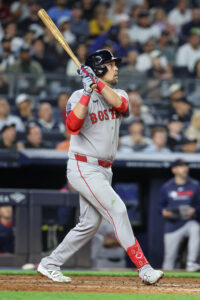
A year ago, the notion of Lowe settling for a non-roster deal would’ve seemed far-fetched. From 2021-24, the now-30-year-old Lowe was the Rangers’ everyday first baseman — and a good one, at that. He slashed a combined .274/.359/.432 (124 wRC+) with 78 home runs, 104 doubles, 10 triples, 13 steals, a strong 11.3% walk rate and a 23.3% strikeout rate that was only a bit north of average. Defensive metrics were bearish on his glove early in his MLB run, but he posted quality marks in both Defensive Runs Saved (4) and Outs Above Average (10) in 2023-24.
As the Rangers began the process of paring down their payroll, they traded Lowe and his $10.3MM salary to the Nationals for left-hander Robert Garcia. The change of scenery didn’t work out whatsoever for Lowe. He appeared in 119 games and tallied 490 plate appearances with a .216/.292/.373 batting line (86 wRC+) before being designated for assignment and released in August. Lowe’s walk rate in D.C. dipped to 9.6%, and his strikeout rate climbed to 26.5%. He was also a bit more prone to pop-ups and hit fewer line drives than he had during his Texas stint.
The Red Sox, needing help at first base, quickly scooped Lowe up and got better production out of the veteran’s left-handed bat. In a smaller sample of 119 plate appearances with Boston, Lowe turned in a .280/.370/.420 slash that pretty closely resembled the production from his time in Arlington. His production was buoyed by a .361 average on balls in play that he’s highly unlikely to sustain, but Lowe was also dogged by a .267 BABIP with the Nationals — a whopping 72 points south of the .339 mark he carried into the season.
With the Reds, Lowe will have a chance to win a prominent role in the lineup. Top prospect Sal Stewart is the presumptive front-runner at first base, but he has all of 18 big league games under his belt. The 2022 No. 32 overall pick belted five homers in that time and had a big year in Triple-A as well (.309/.383/.524, 152 wRC+) but some veteran competition for him won’t hurt. Also in the mix at first base are Christian Encarnacion-Strand and Spencer Steer. The former hasn’t hit in the majors since 2023 and has minor league options remaining, while the latter can play all over the diamond.
There could be occasional DH at-bats available, although the returning Eugenio Suárez will likely take the bulk of those reps in 2026. Suárez could also see time at the hot corner if the oft-injured Ke’Bryan Hayes hits the injured list, which would open up additional avenues to get both Stewart and Lowe into the lineup — assuming Lowe performs well enough to make the roster, of course.
Tyler Stephenson Wins Arbitration Hearing
Reds catcher Tyler Stephenson won his arbitration hearing against the team, reports Gordon Wittenmyer of the Cincinnati Enquirer. He’ll earn the $6.8MM figure submitted by his reps at ACES rather than the $6.55MM figure submitted by the team. Stephenson is heading into his final season of club control and will be a free agent next winter.
Stephenson pulls in a 38.1% raise on last year’s $4.925MM salary on the heels of a season in which he slashed .231/.316/.421 with 13 homers and 18 doubles in 342 plate appearances. A broken left thumb and an oblique strain limited him to just 88 games in 2025, but he had another generally productive stretch while healthy. Since debuting in 2019, Stephenson has taken just shy of 2000 plate appearances and logged a combined .261/.338/.426 slash with 63 homers and 94 doubles.
Last year’s 33.9% strikeout rate was a career-worst by a wide margin, but his career-high 10.8% walk rate at least helped to mitigate that uptick in punchouts a bit. He actually chased balls off the plate less than the average hitter, but Stephenson’s contact rate on those chases was just 49.4% — well shy off the 55.6% league average. His contact rate on balls within the zone dropped by a concerning six percentage points.
Some of that could be due to his broken thumb, of course. Hand injuries can linger and impact a player’s swing even after he’s cleared to return to action, and it’s worth noting that Stephenson’s bat speed dropped by nearly a mile per hour over the prior season. It’s not unreasonable to think that with better health, he could regain some of that contact. Either way, his quality of contact remained strong; Stephenson averaged 90.5 mph off the bat with an excellent 49.2% hard-hit rate and an even better 14.4% barrel rate.
Heading into the 2026 season, Stephenson will again be the Reds’ primary catcher, teaming with defensive-minded Jose Trevino to handle the majority of Cincinnati’s catching duties. He could also mix in at first base and designated hitter. A healthy platform season should put Stephenson in line for a nice multi-year deal as he heads to the open market ahead of his age-30 campaign next winter.
Following Stephenson’s victory, players have gone 6-1 against teams in this offseason’s slate of arbitration hearings.
Dodgers Claim Ben Rortvedt
The Reds announced that catcher Ben Rortvedt has been claimed off waivers by the Dodgers. Cincinnati designated him for assignment when they signed Eugenio Suárez earlier this week. The Dodgers have a full 40-man roster and will need to open a spot for Rortvedt.
The Dodgers clearly like Rortvedt as a depth catcher. They acquired him at last year’s deadline and he got some playing time down the stretch when Will Smith was hurt. After the season, he and the Dodgers avoided arbitration by agreeing to a $1.25MM salary for 2026.
They then tried to sneak him through waivers, hoping that the salary would be enough to make other clubs pass, therefore allowing Rortvedt be in the minors as non-roster depth. They tried a similar move with infielder Andy Ibáñez, signing him to a $1.2MM deal and then putting him on the wire. It didn’t work in either case. The Reds claimed Rortvedt in November and the Athletics claimed Ibáñez today.
The Dodgers are taking this chance to bring Rortvedt back again. For now, he appears to be the clear #3 catcher behind Smith and Dalton Rushing. They could option Rushing to the minors but seemingly don’t think he has anything left to prove there, which is why they called him up last year and moved on from Austin Barnes.
Assuming Rortvedt is indeed third on the chart, he could be bound for the waiver wire again in the future. He is out of options and would have to be nudged off the 40-man if he’s not going to be on the active roster.
Time will tell how that plays out. For now, he’s back with the champs. His performance has been up and down in recent years. With the Rays in 2024, he posted a .228/.317/.303 line in 328 plate appearances. His 87 wRC+ indicated he was 13% below league average but that’s not bad for a part-time catcher. Thanks to some solid defense, FanGraphs credited him with 1.4 wins above replacement in that role.
Things turned sour in 2025. He slashed .095/.186/.111 and got outrighted to the minors. As mentioned, he was traded to the Dodgers and got some time filling in for Smith. In his 58 plate appearances, he hit .224/.309/.327, somewhat similar to his 2024 production. Teams clearly view him as a useful depth catcher but what remains to be seen is if he can hold onto a roster spot or if he can be passed through waivers.
Photo courtesy of Jayne Kamin-Oncea, Imagn Images
Graham Ashcraft Wins Arbitration Hearing
Reds right-hander Graham Ashcraft won his arbitration hearing against the team, ESPN’s Jeff Passan reports. He and his reps at the Bledsoe Agency filed for a $1.75MM salary, while the team filed at $1.25MM. Ashcraft will receive the larger of those two figures in 2026. Players have won all five arbitration hearings that have been decided thus far in 2026.
Ashcraft, 28 next week, had a breakout season in the bullpen for Cincinnati. The former starter took to his new relief role, logging 65 1/3 innings with a 3.99 ERA. A forearm strain late in the season may have helped beef that ERA up a bit; he missed two weeks in late August/early September and was immediately tagged for five runs in his first two innings back on the mound, though he righted the ship thereafter, rattling off 5 1/3 shutout innings to end the year.
The 6’2″, 245-pound Ashcraft already threw hard as a starter, but his heater jumped to an average of 97.1 mph in relief. He paired that offering with a slider sitting 89.8 mph and showed more bat-missing ability than his 22.5% strikeout rate would otherwise indicate. That mark is right in line with league average, but Ashcraft’s 13.2% swinging-strike rate is more than two percentage points north of par. He also posted a solid 8.8% walk rate and a huge 55.9% ground-ball rate.
Ashcraft began the season working in lower-leverage spots but was one of manager Terry Francona’s top options in tight situations by season’s end. By measure of leverage index, Tony Santillan worked in the most pressure-packed spots, but Ashcraft was only a bit behind him, ranking slightly ahead of closer Emilio Pagan, who was more typically reserved for more traditional ninth-inning work.
The Reds re-signed Pagan to a two-year deal this winter, the second season of which is a player option. Ashcraft, alongside Santillan, will reprise his role as one of Pagan’s top setup men. If Pagan opts out after the season and signs elsewhere, Ashcraft could be in the mix for closing opportunities in 2027. This was his first trip through arbitration. Ashcraft is controllable through 2028 and is owed two more raises in arbitration over the next couple offseasons.
MLBTR Podcast: Twins Front Office Shake-Up, The Brendan Donovan Trade, Eugenio Suarez, And More!
The latest episode of the MLB Trade Rumors Podcast is now live on Spotify, Apple Podcasts, and wherever you get your podcasts! Make sure you subscribe as well! You can also use the player at this link to listen, if you don’t use Spotify or Apple for podcasts.
This week, host Darragh McDonald is joined by Steve Adams of MLB Trade Rumors to discuss…
- The Twins parting ways with president of baseball operations Derek Falvey (2:10)
- The Mariners getting Brendan Donovan in a three-team trade with the Cardinals and Rays (18:15)
- The Reds signing Eugenio Suárez (35:50)
- The Pirates reportedly just missing on Suárez and what they could still do at this late stage of the offseason (39:20)
- The Giants having an agreement Luis Arráez and also Harrison Bader (49:20)
- The White Sox acquiring Jordan Hicks from the Red Sox (58:35)
- The Athletics signing Jacob Wilson to an extension (1:12:20)
- Several players not being allowed to participate in the World Baseball Classic due to insurance issues (1:16:05)
Check out our past episodes!
- Examining MLB’s Parity Situation – Also, Bellinger, Peralta, Robert, And Gore – listen here
- What The Tucker And Bichette Contracts Mean For Baseball – Also, Nolan Arenado And Ranger Suarez – listen here
- The Cubs Land Cabrera And Bregman, Remaining Free Agents, And Skubal’s Arbitration Filing – listen here
The podcast intro and outro song “So Long” is provided courtesy of the band Showoff. Check out their Facebook page here!
Photo courtesy of Joe Puetz, Imagn Images
Reds Designate Ben Rortvedt For Assignment
The Reds announced that catcher Ben Rortvedt has been designated for assignment. That’s the corresponding move to open a 40-man spot for infielder Eugenio Suárez, whose signing is now official.
Rortvedt, 28, has never appeared in a game for the Reds. Cincinnati just claimed him off waivers from the Dodgers in November. At the time of that waiver claim, it was reported that Rortvedt and the Dodgers had already signed a deal for 2026 to avoid arbitration. The backstop will make $1.25MM this year.
The Dodgers were likely hoping that figure was high enough that no other club would claim him off waivers. Rortvedt is out of options and therefore can’t be sent to the minors while staying on the 40-man roster. Since he has at least three years of big league service time, Rortvedt has the right to reject outright assignments. But since his service clock is less than five years, he would have to forfeit his salary commitments in electing free agency. Had he cleared waivers, he likely would have stayed with the Dodgers as non-roster catching depth.
Instead, the Reds claimed him and have held him for the past few months. They might now be hoping that they get to keep Rortvedt as non-roster depth instead of the Dodgers. With this DFA, Cincinnati now has Jose Trevino and Tyler Stephenson as the only two catchers on the 40-man roster. Will Banfield is their most experienced non-roster guy at the moment, even though he has just seven big league games on his track record.
Rortvedt’s career has been up and down but he would be a solid depth option. He showed his potential by having a decent showing with the Rays in 2024. He stepped to the plate 328 times and put up a .228/.317/.303 line. That line led to an 87 wRC+, indicating he was 13% below league average. But since catchers are usually about ten points below the rest of the league, that’s not bad for a part-time backstop. Rortvedt’s glovework also got decent reviews, enough for FanGraphs to credit him with 1.4 wins above replacement for the year, even with that so-so offense.
Things backed up with Tampa last year. He hit .095/.186/.111 in his 70 plate appearances before getting outrighted off the roster. He was flipped to the Dodgers at the deadline as part of the three-team trade which saw the Reds gets Zack Littell. The Dodgers called him up in September when Will Smith was injured and Rortvedt bounced back somewhat, with a .224/.309/.327 line in a small sample of 58 plate appearances for the eventual World Series champs.
The Dodgers liked him enough that they seemingly hoped to keep him around as relatively expensive depth behind Smith and Dalton Rushing. The Reds will now have a maximum of one week of DFA limbo to work with. The waiver process takes 48 hours, so they could field trade interest but will likely place Rortvedt on waivers at some point in the next five days. If another team claims him, the Reds would likely need to add some veteran depth via minor league deals.
Photo courtesy of Jayne Kamin-Oncea, Imagn Images