
Angels Designate Michael Hermosillo
The Angels announced today that they have designated outfielder Michael Hermosillo for assignment. Meanwhile, left-hander Jose Quijada was reinstated from the injured list and will return to the Angels’ alternate training site.
The 25-year-old has been up and down with the Halos over the past three seasons, tallying a combined 118 plate appearances with a .188/.288/.287 slash in that time. A former 28th-round pick, Hermosillo does possess a much more solid .361/.344/.478 slash in parts of three seasons at the Triple-A level, but he’s yet to see any of that carry over to the big leagues.
The Angels will have a week to trade Hermosillo, release him or place him on outright waivers. He can be optioned for the remainder of this year but will be out of minor league options in 2021, which likely hurts his chances of being picked up by another club, though.
AL Injury Notes: Simmons, Yankees, S. Perez, Astros
The Angels reinstated Andrelton Simmons from the 10-day injured list and placed catcher Max Stassi (right quad strain, knee bruise) on the IL, the team announced. Simmons is back after a three-plus-week absence because of a sprained left ankle. It could be an interesting upcoming 10 days for Simmons, a soon-to-be free agent whom the non-contending Angels may choose to move before the Aug. 31 trade deadline. Regardless, the 30-year-old Simmons will spend the next month-plus trying to boost his stock before he reaches the open market for the first time in his career. He dealt with injury issues (including to his ankle) during a down season in 2019, and he has hit a mere .188/.188/.250 in 16 plate appearances this year.
- Yankees manager Aaron Boone issued updates Friday on a few of their key players who are on the IL, telling WFAN (via Marly Rivera of ESPN.com) that right fielder Aaron Judge is “likely” to be in the Yankees’ lineup for their next game (that won’t be this weekend, as their series with the Mets was postponed). Judge has been down for a week with a mild calf strain. Meanwhile, second baseman DJ LeMahieu is doing “significantly better” as he recovers from the left thumb sprain that sent him to the IL last weekend. And reliever Zack Britton, whom the Yankees shelved Thursday with a strained left hamstring, should recover “on the shorter side.”
- The Royals announced that they’ve placed catcher Salvador Perez on the IL, retroactive to Aug. 18, with left eye central serous chorioretinopathy and recalled left-hander Randy Rosario. Perez’s issue has bothered him since last weekend and hampered his vision, though it’s not believed to be a long-term problem. After missing all of last year because of Tommy John surgery, Perez was enjoying a strong return season with a .307/.326/.511 line, four home runs and a 25 percent caught-stealing percentage prior to going to the IL.
- Astros outfielder Michael Brantley is eligible for activation Saturday, but manager Dusty Baker told Chandler Rome of the Houston Chronicle and other reporters he’s “not real optimistic” that will happen. It seems Brantley will need a bit more time to recover from a right quad injury that has kept him out since Aug. 11. Baker also suggested (via Rome) that yet another Astro – right-hander Josh James – will probably go on the IL. James suffered a hip injury and had to be helped off the field in Colorado on Thursday. That continued a nightmare of a season for James, who has surrendered 13 earned runs on 12 hits and 14 walks (with 13 strikeouts) in 10 2/3 innings.
Angels Move Julio Teheran To Bullpen
Right-hander Julio Teheran was a key offseason acquisition for the Angels, but the right-hander has struggled out of their rotation so far. Manager Joe Maddon said Wednesday the Angels will move Teheran to their bullpen as a result, Maria Torres of the Los Angeles Times was among those to report. The Angels haven’t named a replacement, though Jeff Fletcher of the Orange County Register suggests it could be Jaime Barria or Matt Andriese.
The 29-year-old Teheran joined the Angels on a one-year, $9MM contract in free agency. At the time, he was coming off a long and respectable run as a workhorse in Atlanta, where he pitched from 2011-19. Teheran ended his Braves tenure with seven straight seasons of over 170 innings and a cumulative 3.67 ERA/4.23 FIP.
The production Teheran gave Atlanta would’ve been (and still would be) welcome for the Angels, who have struggled to find consistent rotation options in recent years. But Teheran, whose 2020 was delayed because of coronavirus concerns, has fallen flat in three starts, in which he combined for a mere eight innings. At the same time, he has already given up 11 earned runs on 13 hits, including six homers, with five walks against six strikeouts.
Of course, Teheran’s far from the only disappointment on an Angels club that hoped to contend this year but has instead gotten off to a dismal 8-16 start. They seem to be lining up as sellers heading into the Aug. 31 trade deadline, and with Teheran just a few months from another trip to free agency, the Angels could try to move him. That will be a tall order, though, unless he rebounds from their bullpen over a short period of time.
Outrighted: Phillies, Angels
Let’s check in on a few of the latest outrights…
- Phillies hurlers Enyel De Los Santos and Trevor Kelley cleared waivers and were outrighted to Triple-A Lehigh Valley on Friday, Todd Zolecki of MLB.com tweets. The Phillies designated both right-handers for assignment in recent days. De Los Santos joined the Phillies in a one-for-one swap with the Padres for infielder Freddy Galvis before 2018. While De Los Santos then had a strong first season in the Phillies’ system, his stock fell last year in a rough showing divided between Triple-A and the majors. Kelley, whom the Phillies claimed off waivers from the Red Sox last winter, allowed four earned runs on eight hits in 3 1/3 innings this year before Philly designated him.
- The Angels outrighted Jose Rodriguez to their alternate site after he cleared waivers. Rodriguez has thrown 21 1/3 innings of 2.53 ERA ball as an Angel since 2019, but he has allowed five home runs, struck out just 13 hitters while walking 12, and logged a 6.72 FIP/6.27 xFIP.
Taylor Cole Undergoes Shoulder Surgery
Angels right-hander Taylor Cole announced on Instagram that he underwent surgery on a bothersome shoulder Wednesday (hat tip to Maria Torres of the Los Angeles Times). It’s unclear how much time Cole will need to recover, but he wrote that there’s “a difficult road” ahead.
The 30-year-old Cole, an ex-Blue Jay, appeared in the majors in each of the two previous seasons with the Angels. He prevented runs at an impressive rate in 2018 (2.75 ERA), but not so much last year (5.92). In all, Cole has thrown 87 2/3 innings of 4.62 ERA/3.31 FIP ball with 9.14 K/9, 3.7 BB/9 and a 49.1 percent groundball rate since the Angels signed him to a minor league contract in 2018.
In the wake of his 2019 struggles, the Angels outrighed Cole in late March. He hasn’t rejoined their 40-man roster since then, but he was part of their 60-player pool.
Latest On Andrelton Simmons
Injured Angels shortstop Andrelton Simmons is closing in on a return, manager Joe Maddon said Monday (via Mike DiGiovanna of the Los Angeles Times). Simmons, who landed on the IL on July 28 with a left ankle sprain, has progressed to taking batting practice.
Ankle problems have slowed Simmons since last season, during which the 30-year-old totaled only 103 games played. Simmons’ well-known defensive wizardry continued then, but his offense dropped off a cliff compared to his respectable 2018-19 performance. Still, as Jeff Todd of MLBTR explained, Simmons entered this season as an especially interesting pending free agent. Thanks to the shortened campaign and the time he has already missed, though, Simmons doesn’t have much time to rebuild his stock before a potential trip to the open market.
Since Simmons went down in the first week of the season, the Angels have turned to David Fletcher at short. Fletcher has been highly productive so far, and the Angels surely want his bat in the lineup every day, but he’s versatile enough on the defensive side to move around the diamond. That will give Maddon the freedom to pencil the two in on a daily basis when Simmons is able to return.
Angels Designate Jose Rodriguez
The Angels have designated righty Jose Rodriguez for assignment, per a club announcement. His 40-man spot was needed for southpaw Jose Suarez, who was reinstated from the injured list and optioned to the team’s alternate training site.
Soon to turn 25, Rodriguez first reached the majors in 2019 as a swingman for the Halos. He has only allowed six earned runs in 21 1/3 MLB innings, but he has managed only a 13:12 K/BB ratio and has also coughed up five long balls. The Angels obviously don’t expect that high-wire act to continue succeeding.
If and when he earns his way back to the bigs, the 22-year-old Suarez will hope to improve upon a challenging debut season. He was tagged for 23 long balls and limped to a 7.11 ERA in 81 frames last year. The Los Angeles organization will certainly remain patient given Suarez’s history of high strikeout rates as a minor-league starter.
Angels Recall Patrick Sandoval For Start, Option Luke Bard
The Los Angeles Angels optioned Luke Bard to their alternate site today, recalling Patrick Sandoval in his place, per Jason Martinez of Roster Resource over at Fangraphs.
Sandoval made his major-league debut last season going 0-4 across 10 appearances (9 starts). His first start of the season came last week in a 10-2 Angels win over the Mariners. Sandoval didn’t get the win as he lasted only 4 innings, though he more than did his part in contributing to the win. Sandoval threw 62 pitches – 40 for strikes – notching 4 strikeouts, walking one, and giving up 2 runs (though only 1 was earned). The 23-year-old southpaw entered the year as the Angels’ #7-ranked prospect per MLB.com, #6 by Fangraphs. The Angels certainly hope/expect the lefty and his 55-grade curveball will establish himself as a rotation mainstay – a role they’ve struggled to consistently fill over the years.
Sandoval made his second start of the season tonight, going six strong innings while allowing two runs. He’s quickly becoming a favorite of manager Joe Maddon. While the plan was for Sandoval to throw between 70-80 pitches, Maddon allowed him to hang around for 94. Sandoval continues to develop nicely after the Angels acquired him from Houston for Martin Maldonado just before the 2018 trade deadline.
Bard, 29, is looking to establish himself as a righty out of Maddon’s pen. Across 32 appearances last season, Bard logged 49 innings with a 4.78 ERA/4.81 FIP, showing off his ability to hold the line for multiple innings at a time if need be. He has just one inning so far this season – it was scoreless. In all likelihood, he’ll find himself back in the Angels’ pen before too long.
Poll: Big-Budget Long-Term Payrolls
Looking at long-range payroll commitments, there’s a fairly sizable gap between the top-five spenders and the number six club (the Padres, at a total of $396MM). Here’s that top-five:
| Rank | Team | Total |
| 1 | Angels | $651.00 |
| 2 | Yankees | $612.00 |
| 3 | Dodgers | $533.36 |
| 4 | Nationals | $488.68 |
| 5 | Phillies | $488.50 |
That list isn’t remotely surprising. Some other deep-pocketed teams have pared back or simply not yet agreed to blockbuster extensions with existing stars. The handful of teams listed above have each recently agreed to monster contracts with one or more superstars.
Looking at a team’s future outlook involves quite a bit more than its contractual commitments. We’d want to consider controllable young talent, the prospect pool, and a wide variety of business factors in assessing which organization is best-situated for the long haul.
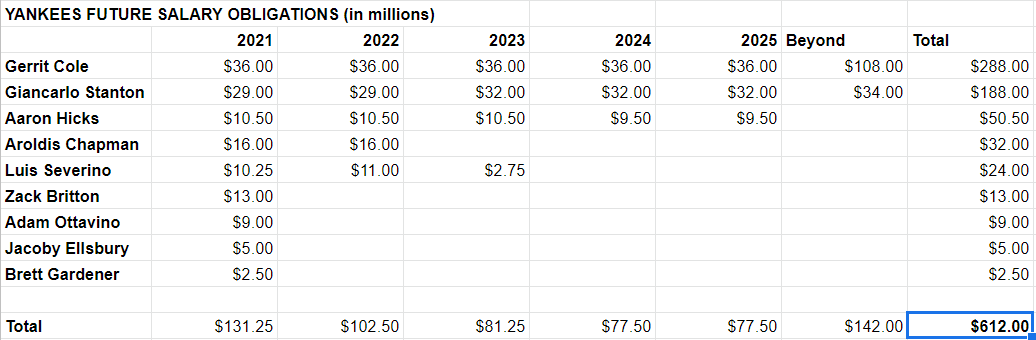
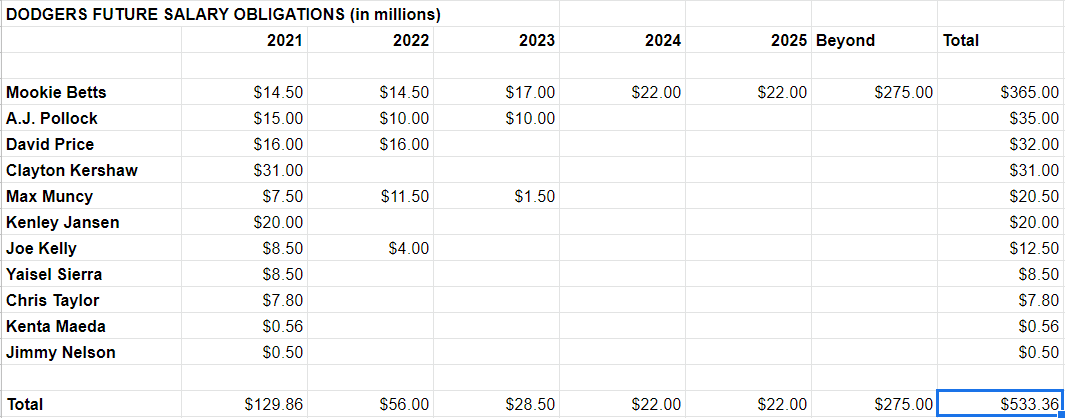
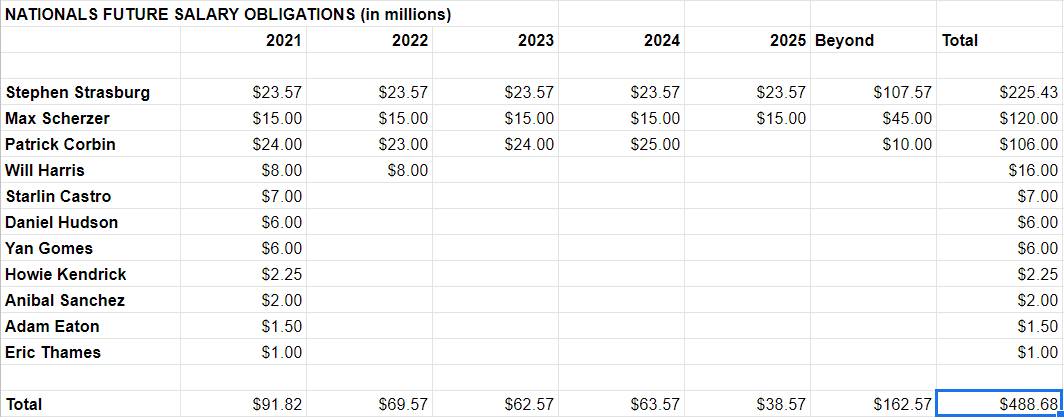
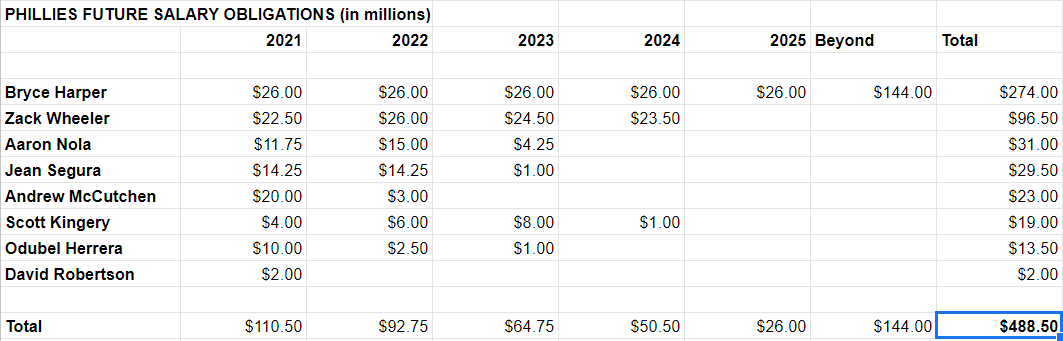
Here, though, we’ll just focus on the deals that are already locked in. First, I’ll re-list each of those five teams’ eexisting commitments. Then, you will vote for the one that you’d most prefer to have were you operating a large-budget franchise. (Click on the links to expand the image.)
The Angels feature two mid-prime superstars, including the greatest player of this generation.

The Yankees have an ace, a former MVP who could still return to his former glory, and a group of quality players.
The Dodgers had only limited future commitments until they struck a bold deal to keep one of the game’s best players.
The Nationals are all-in on high-grade rotation pieces.
The Phillies spent big to pluck high-end talent from division rivals.
Which is the best slate of contract commitments? (Poll link for app users; response order randomized.)
Which big-budget contract mix is best?
-
Dodgers 44% (2,067)
-
Yankees 21% (990)
-
Angels 16% (739)
-
Nationals 11% (541)
-
Phillies 8% (368)
Total votes: 4,705
Latest On Simmons, Ohtani
Angels skipper Joe Maddon provided an update on the injury situations of shortstop Andrelton Simmons and starter/DH Shohei Ohtani. Mike DiGiovanna of the Los Angeles Times was among those to cover the chat (Twitter links).
In the case of Simmons, who is nursing an ankle injury, he’s not going to be activated as soon as eligible. Fortunately, it isn’t as serious as the one he suffered last year, but there’s still some healing left to be done.
Simmons is “still pretty sore,” Maddon explains, and will likely not be back in the “real immediate future.” Maddon continued: “From what I read today, it’s progressing but not as quickly as it could.”
Meanwhile, tantalizing talent Shohei Ohtani is expected to be back in lineup tomorrow. That’s a consoling development after the recent news that he’ll be sidelined from mound work for the foreseeable future after suffering a forearm injury.
Ohtani, who didn’t pitch last year due to Tommy John surgery, spoke to media members including MLB.com’s Rhett Bollinger (Twitter link) this evening. The injury isn’t that severe, by Ohtani’s reckoning, which at least seems to indicate he’s not at risk of another procedure.
When asked about the possibility of ultimately focusing only on one side of the game, Ohtani said he’d rather keep trying to do both. At the same time, he indicated he’d be open to considering that possibility if the team made such a request. It seems unlikely at this point that the Halos would forgo a chance to see Ohtani reemerge on the mound.