
How The Delayed Season Impacts The Angels
As is the case with just about every team in the majors, the coronavirus-forced delay to the start of the season will have an effect on the Angels. It may be at least two or three months before we see any meaningful games, which isn’t necessarily horrible news for the Angels’ rotation. Last season, the organization’s fifth straight without a playoff berth and its fourth in a row with more losses than wins, the Halos’ starting staff was especially ineffective. The club’s starters ranked toward the bottom of the league in virtually every key statistic and didn’t have a single hurler amass 100 or more innings.
[RELATED: Angels Offseason In Review]
One important reason the Angels’ rotation had such difficulty in 2019? The absence of two-way star Shohei Ohtani, who could only DH – not pitch – after undergoing Tommy John surgery on his right elbow in October 2018. The hard-throwing Ohtani dazzled on the mound as a rookie that year, albeit over a mere 10 starts and 51 2/3 innings, with a 3.31 ERA/3.57 FIP and 10.97 K/9 and 3.83 BB/9. The Angels desperately needed that type of front-line production from someone last year, and perhaps Ohtani will be able to provide it over a larger sample of work this season. In a normal season, though, the Angels would have had to go at least several weeks before finding out whether Ohtani would be able to pick up where he left off as a pitcher two years ago.
At last check about a month and a half ago, the 25-year-old Ohtani wasn’t going to be ready to return to the Angels’ rotation until the middle of May. Now, with the season having been pushed back, the Angels might be in position to get a full year from Ohtani the pitcher. That’s welcome news for a team that, despite its best efforts, was not able to pull in a high-end starter during the offseason.
The Angels’ staff also could be more likely to get a whole season (or something close to it) from righty Griffin Canning. His status is less certain than Ohtani’s, though. The 23-year-old received “biological injections” in his balky right elbow March 11, at which point it was reported more would be known on Canning’s status in three to four weeks. But if Canning emerges with a clean bill of health and can take the hill in 2020, it would be yet another boon for the Angels. He enjoyed a respectable debut showing last year, after all, tossing 90 1/3 frames of 4.58 ERA/4.37 FIP ball with 9.56 K/9 against 2.99 BB/9.
If the season opened when it was supposed to on March 26, it’s unclear whom the Angels would have relied on after Andrew Heaney, Julio Teheran and Dylan Bundy. Patrick Sandoval, Matt Andriese, Jaime Barria and Dillon Peters are the other starting possibilities on their 40-man roster. It’s fair to say there isn’t a ton of upside in that group, but getting Ohtani and Canning back would change that and give the Angels a better chance to vie for a playoff berth.
Elsewhere, the Angels are anticipating the MLB debut of Jo Adell – a hard-charging outfield prospect who ranks as one of the sport’s elite farmhands. The soon-to-be 21-year-old seemed like a sure thing to come up sometime this season, but will that change with a shortened schedule? Will the Angels decide Adell needs a good deal more seasoning at the Triple-A level, where he accrued 132 homer-less plate appearances last season? And what about service-time considerations? That’s something every team keeps an eye on with respect to its top prospects, but we don’t know how baseball will sort that out in a truncated campaign. And, of course, whether Adell does premiere in 2020 will have an impact on the Angels’ current right field choices, Brian Goodwin and David Fletcher chief among them.
Up in the front office, the executive who drafted Adell – general manager Billy Eppler – is entering a contract year. One has to wonder if a season of fewer than 162 games will affect his status. For example, if the Angels struggle, will owner Arte Moreno be more inclined to give Eppler the benefit of the doubt because of these strange circumstances? That’s just one of the intriguing questions the Angels are facing heading into what will be an unusual season of baseball (if we get one at all).
Angels Select Ryan Buchter, Designate Taylor Cole
Today, the Angels announced that they’ve selected the contract of left-handed pitcher Ryan Buchter. Right-hander Taylor Cole was designated for assignment in order to clear a spot on the 40-man roster.
The news bodes well for Buchter, who now looks like a good bet to break camp with the Angels. The 33-year-old southpaw was inked to a minor league deal last month as a low-risk flier for the Halos bullpen. He’s been an effective relief option throughout his career, with an overall 4.01 FIP through 214 Major League innings.
Despite a pretty sharp 2.98 ERA, 2019 was probably Buchter’s worst year since becoming a full-time big-leaguer in 2016. He walked batters at a career-high rate and his effectiveness against right-handed batters waned. Still, for an Angels bullpen that previously lacked a left-handed option, Buchter is a sensible choice.
Cole’s stint on the Los Angeles 40-man will end after a frustrating 2019 season that saw the 30-year-old stumble to a 5.92 ERA. He was often deployed as a multi-inning reliever or opener, but has been squeezed out of that role with an abundance of righties in the Angels bullpen.
If Cole clears waivers, the Angels could assign him outright to the minor leagues, though in that case Cole could reject that assignment and opt for free agency because he has been outrighted before.
Quick Hits: Howard, International Prospects, Smith, Pirates
A shortened 2020 season would make Spencer Howard a larger factor in the Phillies‘ plans, according to Scott Lauber of the Philadelphia Inquirer. Since Howard threw only 71 minor league innings in 2019 due to shoulder problems and was shut down at midseason, the Phils were going to ease him back into action this year under an innings limit at both the minor league and (if all things progressed well) Major League levels. If the 2020 season ends up being something of an abbreviated sprint, however, the right-handed prospect could end up pitching for Philadelphia as early as the new Opening Day, working in a starting or relief role and still potentially not approaching an innings cap that Lauber estimates could be around 130 frames of work.
A few more items as we kick off Sunday…
- Baseball America’s Ben Badler (subscription required) looks at five prospects who are lined up to join Major League teams when the international signing window opens on July 2. The Padres, Brewers, Braves, Indians, and Rangers have already been respectively connected to each of the five youngsters, with Atlanta and Cleveland each prepared to give out bonuses in the $1MM range.
- Fraidel Liriano, another shortstop from the Dominican Republic, is expected to land the largest bonus of the quintet, as Badler writes that the Rangers will give Liriano around $1.5MM. Liriano could eventually wind up at third base or second base rather than shortstop, though some scouts were intrigued by his hitting potential, with Liriano’s “strong hands and quick wrists, producing whippy bat speed.”
- Twelve teams contacted Kevan Smith during the catcher’s free agent stint this winter, Smith tells John Perrotto of the Pittsburgh Tribune-Review, though he was surprised to be on the open market at all. The Angels non-tendered Smith rather than go through the arbitration process with him (MLBTR projected Smith to earn a $1.3MM salary in 2020), a decision that left Smith feeling “pretty stunned…I thought I was on solid footing there.” Smith ended up signing a minor league deal with the Rays after surveying his options, saying, “You start looking around and see what’s going to be your best opportunity and what team you’re most comfortable with. You pick and choose, and it comes down to who’s the most interested. I definitely felt the Rays wanted me to be here.” Playing in Tampa Bay also brings Smith to the East Coast and at least a bit closer to his home in Pennsylvania, though the Pittsburgh native said he didn’t hear from the Pirates this winter, despite the Bucs’ need for catching.
Offseason In Review: Los Angeles Angels
Expectations were that the Angels would make a splashy addition to their rotation during the offseason. That didn’t happen. They did, however, reel in premier position player Anthony Rendon and one of the game’s most respected managers in Joe Maddon. A decades-long Angels employee before he went on to manage the Rays and Cubs to great success, Maddon’s taking over for Brad Ausmus, who lasted just one season as the club’s skipper.
Major League Signings
- Anthony Rendon, 3B: Seven years, $245MM
- Julio Teheran, RHP: One year, $9MM
- Jason Castro, C: One year, $6.85MM
- Total spend: $260.85MM
Trades and Claims
- Acquired RHP Dylan Bundy from Orioles for RHPs Isaac Mattson, Zach Peek, Kyle Bradish and Kyle Brnovich
- Acquired LHP Garrett Williams and cash considerations from Giants for INF Zack Cozart and SS Will Wilson
- Acquired RHP Matt Andriese from Diamondbacks for RHP Jeremy Beasley
- Acquired RHP Kyle Keller from Marlins for C Jose Estrada
- Acquired RHP Parker Markel from Pirates for cash considerations
- Claimed RHP Mike Mayers from Cardinals
- Claimed LHP Jose Quijada from Marlins
Notable Minor League Signings
Notable Losses
- Cozart, Wilson, Kole Calhoun, Trevor Cahill, Justin Bour, Luis Garcia, Kevan Smith, Nick Tropeano, Adalberto Mejia, Kaleb Cowart, Miguel Del Pozo, Kean Wong, Jake Jewell, Luis Madero
Few teams possessed worse starting staffs than the Angels in 2019. They ranked dead last in fWAR (3.2) and second from the bottom in both ERA (5.64) and FIP (5.41). None of their starters even touched the 100-inning mark. The team endured an unthinkable tragedy when left-hander Tyler Skaggs passed away last July.
The Angels had no choice but to carry on without Skaggs, which meant trying to upgrade their rotation over the winter. They were connected to the top free-agent arms available (Gerrit Cole, Stephen Strasburg and Zack Wheeler) and high-end trade targets such as the Indians’ Corey Kluber and Carlos Carrasco. Ultimately, despite a reported $300MM offer to Cole, the Angels did not emerge with him or any of the other aforementioned starters. But they at least came away with a couple durable back-end types, trading for Dylan Bundy of the Orioles and signing ex-Brave Julio Teheran. They’re not flashy, but the two have shown an ability to competently chew up innings, which matters for a team that couldn’t find anyone to do that a season ago. Bundy has thrown 160-plus innings three seasons in a row, while Teheran has seven straight seasons of 170-plus frames under his belt.
Although Bundy and Teheran make for welcome additions, the Angels could still open the season with an underwhelming group of starters. Part of that depends on when the season actually begins, though, with the coronavirus perhaps delaying it until June or later. Had the year begun on time, the Angels would not have had either Shohei Ohtani or Griffin Canning among their starting options. As of early February, Ohtani – continuing to work back from the Tommy John surgery he underwent in October 2018 – was targeting a mid-May return to pitching. Canning received “biological injections” in his elbow two weeks ago, and his 2020 outlook isn’t clear at this point.
Even having just one of Ohtan or Canning (especially Ohtani) available when the season commences would change the complexion of the Angels’ rotation. Otherwise, they may not field a particularly appealing or deep unit after Bundy, Teheran and Andrew Heaney. The rest of their healthy 40-man possibilities include Matt Andriese, Jaime Barria, Patrick Sandoval, Dillon Peters and Jose Suarez. Andriese spent all of last season as a reliever in Arizona, where he struggled; Barria and Sandoval have promise, but neither had success in the majors in 2019; and Peters and Suarez posted brutal numbers.
Luckily for the Halos, their lineup has the potential to terrorize opposing pitchers. The floor was already reasonably high with the best player in the world, center fielder Mike Trout, as well as Ohtani leading the way. They’ll now be joined by Rendon, a superstar third baseman whom the Angels signed to a seven-year, $245MM contract after he helped the Nationals to a World Series title last season.
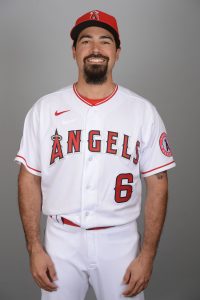
The Rendon acquisition came after the Angels rid themselves of pricey, oft-injured infielder Zack Cozart, whom they essentially had to bribe the Giants to take. Getting his $12MM-plus salary for this season off the books cost the Angels a quality prospect in shortstop Will Wilson, a first-round pick from last June whom the Halos had to send to San Francisco in order to convince the Giants to take Cozart.
The Cozart gamble didn’t work out for the Angels in the two years he was on the team, though there’s little reason to believe they won’t get at least some high-end seasons out of Rendon. The soon-to-be 30-year-old, by far the foremost position player on the winter’s open market, has consistently been among the elite performers in baseball since his first full season in 2014. Rendon’s the owner of four seasons of at least 6.0 fWAR, including a career-high 7.0 last year. He’ll now displace David Fletcher at third in Anaheim. While Fletcher held his own at the hot corner last season, he’s capable of playing all over the diamond (he can also handle second, short and both corner outfield positions). That versatility should continue to make Fletcher a valuable piece of the team’s roster.
The Angels received little value out of the catcher position last year, when Jonathan Lucroy, Kevan Smith, Dustin Garneau, Max Stassi and Anthony Bemboom combined for a dismal minus-0.6 fWAR. Stassi and Bemboom are still with the organization, but they’ll take a backseat to new starter Jason Castro. The $6.85MM deal the Angels handed Castro, a former Astro and Twin, looks eminently reasonable when you consider what he brings to the table. The 32-year-old Castro is an enormous asset in the pitch-framing department who, throughout his career, has thrown out a roughly average number of would-be base stealers and offered passable production for his position on the offensive side. Castro’s track record suggests that he’ll be a major upgrade over the backstops the Angels relied on a year ago.
Trout, Ohtani, Rendon, Fletcher and Castro make for over half of a promising core of regulars. There are some questions elsewhere, though. For instance, can normally big-hitting left fielder Justin Upton bounce back from an injury-marred season? The same applies to defensively brilliant shortstop Andrelton Simmons, who’s entering the last year of his contract. Meanwhile, it’s fair to wonder if first baseman Albert Pujols has anything at all left in the tank, and whether infielder Tommy La Stella and right fielder Brian Goodwin can follow up on their surprising showings from 2019. Goodwin may not be long for a starting job unless he absolutely tears it up, as the Angels have a stud prospect in soon-to-be 21-year-old Jo Adell breathing down his neck. The fact that Adell is charging toward the bigs is among the reasons the Angels bid goodbye to longtime starting right fielder Kole Calhoun over the winter, buying him out for $1MM in lieu of exercising a $14MM option. If the coronavirus doesn’t rob us of a 2020 season, Adell figures to make his much-anticipated debut this year.
Along with some iffiness in their position player cast, the Angels are facing a bit of uncertainty in their bullpen. Their relief corps last year was only a middle-of-the-pack bunch – albeit one with some intriguing choices in Hansel Robles, Ty Buttrey, Cam Bedrosian, Noe Ramirez and Keynan Middleton – and the team didn’t make any obvious improvements during the offseason. The Angels instead just made small moves such as claiming righty Mike Mayers from the Cardinals and grabbing lefty Ryan Buchter on a non-guaranteed deal. At the very least, Buchter could end up as a sneaky good signing. He has a history of strong run prevention, though the fact that he walked more hitters and yielded more home runs than ever last season forced him to settle for a minors pact.
2020 Season Outlook
On paper, it’s fair to say this is a better Angels roster than the 2019 version that spiraled to a 72-90 record and extended the franchise’s playoff drought to five years. Whether the Angels will turn into real playoff contenders this season is another matter, though, largely because it’s once again tough to bank on their rotation operating at a high level. Moreover, the Angels find themselves in a division with at least two likely playoff contenders (the Astros and Athletics) and a Rangers club that seemingly bettered itself over the winter. However, at a minimum, it would be a disappointment for the Angels not to surpass the .500 mark for the first time since 2015.
How would you grade the Angels’ offseason? (Poll link for app users)
Grade the Angels' offseason
-
B 55% (1,966)
-
C 26% (939)
-
A 12% (409)
-
D 4% (159)
-
F 2% (77)
Total votes: 3,550
Photo courtesy of USA Today Sports Images.
Butterfly Effects & The Jason Heyward Signing
‘Twas the winter of 2015-16. Jason Heyward wasn’t the best-available player in a well-stocked free agent class. But he was a high-quality performer and still tantalizingly young (26). While hardly a traditional corner outfield star due to his middling power, Heyward was well-established as a quality hitter and superlative defender and baserunner.
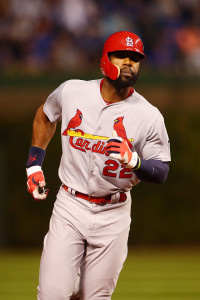
The debate raged long before the offseason arrived: how much can you really pay for a player like this? All agreed he was good. But the traditionalists howled at the notion of a right fielder who hadn’t even hit forty home runs over the prior three seasons landing a premium contract. The analytically minded countered that, well, runs are runs regardless of how they’re added or prevented. Heyward was a 6.9 rWAR / 5.6 fWAR performer in 2015. With exceptional glovework and a steady OBP, Heyward seemed to be a high-floor player who might have some ceiling as well.
[RELATED: Jason Heyward & Chris Davis Have Two Of The Worst Free Agent Contracts … In Different Ways]
We predicted that Heyward would earn $200MM over a full decade — second-most in a rather well-stocked free agent class. That didn’t quite happen, but the real deal was actually more favorable to Heyward than the one we had guessed. He landed $184MM over an eight-year term and also got two opt-out opportunities (which was worth something at the time the deal was struck, even if they weren’t exercised). The deal delivered a nice $23MM AAV over quite a lengthy term.
Now that we’re all reacquainted with the contract as it turned out … let’s try to remind ourselves of the state of play in the market when it was struck. At the time of the pact, there were hints that the Cubs may not have been the high bidder. The Nationals supposedly had the top offer on the table, though we may presume it’d have been deferred. The incumbent Cardinals were also known to be in pursuit. And the Angels and Giants were still involved in rumors right up until the end.
So … what would things have looked like if Heyward had landed elsewhere?
Nationals
Whoa … would the Nats have hoisted the commisioner’s trophy last fall had they signed Heyward? That’s obviously not something that can be assessed fairly given the innumerable butterfly effects potentially at play. But the counter-factual does actually present a pretty similar situation to what actually happened in 2019. In right field, the Nationals got solid but hardly otherworldly work out of Adam Eaton — another left-handed hitter whose skillset is rather similar to that of Heyward.
More interesting to consider is the fact that the Nats probably wouldn’t ever have dealt for Eaton had they already acquired Heyward. Eaton landed in D.C. after the team missed on its effort to acquire Chris Sale for the White Sox. The swap cost the Nationals pitchers Lucas Giolito (reimagine 2019 with him on the staff), Reynaldo Lopez, and Dane Dunning. Of course, Eaton has been much more affordable than Heyward this whole time. Who knows if the Nats would’ve inked Patrick Corbin last winter had Heyward been on the books.
Ultimately, the Washington organization has deep enough pockets that it would’ve been just fine with an underperforming $23MM salary on the books — not unlike the Cubs. At the same time, also not unlike the Cubs, the Nats have been focused on getting and staying just under the luxury tax line, so this deal would’ve been a constant nuisance that would’ve interfered with any number of lower-cost veteran signings and acquisitions over the past several seasons.
Cardinals
Much like the Nats, the Cards eventually made a big deal for a somewhat similar player. One winter after missing on Heyward (despite reportedly offering as much or more as the arch-rival Cubbies), the Redbirds reversed the talent flow by inking former Chicago center fielder Dexter Fowler. The switch-hitting Fowler wasn’t nearly as expensive as Heyward, but his own five-year, $82.5MM deal has worked out about as poorly. The Fowler contract probably wouldn’t have been signed had Heyward been around, but this is probably to the Cardinals’ benefit since the Heyward deal features a bigger and longer hit. Perhaps the Cubs would’ve ended up retaining Fowler had they missed on Heyward. You could argue over the details, but it’s probably not far from a wash.
Of course, the Cards went without either of those players in that 2016 campaign … which helped open the door to the memorable shooting star of Jeremy Hazelbaker. It’s tough to say whether there were significant long-term effects on the way the Cards’ outfield picture developed. Going without Heyward in 2016 opened more playing time for outfielders Randal Grichuk, Stephen Piscotty and, to a lesser extent, a pre-breakout Tommy Pham. Perhaps one or more would’ve been shipped out of town earlier had Heyward been retained. Maybe Pham’s breakout would’ve occurred elsewhere, thus eliminating his successive trades (to the Rays and then to the Padres), though it’s impossible to say that with any degree of confidence.
Angels
We don’t know whether the Halos were really strong pursuers of Heyward, but it’s worth considering what might’ve been. The club ended up foregoing any big free agent splashes that winter. (It had already acquired Andrelton Simmons.) Adding Heyward surely wouldn’t have forestalled the string of four-straight losing seasons, given the way he has played. But it might’ve prevented the Angels from eventually trading for and then extending Justin Upton. And it certainly could’ve gummed up this winter’s signing of Anthony Rendon.
Giants
Likewise, it’s not entirely clear that the Giants were heavily involved in bidding up Heyward’s price, but the team clearly had some real interest. The San Francisco org splashed a lot of regrettable cash that winter regardless. It had already inked Jeff Samardzija and ended up signing Johnny Cueto after Heyward landed with the Cubs. The Giants did find a rather direct alternative to Heyward, inking Denard Span to a three-year, $31MM pact. That didn’t quite go as hoped but was hardly a significant disaster. Suffice to say that having Heyward on the books would’ve further complicated an already difficult stretch for the organization.
Cubs
Ah, yes. The Cubs. Lauded at the time by some for landing Heyward for less than others would’ve paid — really, the deal was probably right at the market rate, give or take — the Cubbies have obviously not benefited from the signing.
Remember how we started this post? The debate over paying out a non-slugging right fielder. Consider these contemporaneous comments. On the one hand …

On the other …

To some degree, neither turned out to be right. And the lack of power was largely beside the point. Heyward did top twenty long balls in 2019, but he was still an average-or-worse hitter for the fourth-straight year. It was certainly his best offensive season for the Cubs … but also the team’s own worst effort in this four-year span. No, the Cubbies haven’t exactly dominated the National League over the span of this deal, but they did capture that elusive crown in 2016.
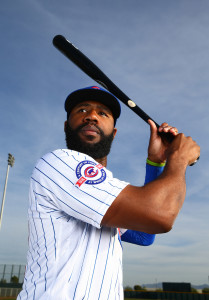
So does the World Series justify it? Eh … this isn’t as clean an analysis as the Gleyber Torres-for-Aroldis Chapman “you do what it takes!” situation. Heyward was terrible in 2016 and even worse in the postseason, when he contributed just five hits and a walk over fifty plate appearances.
There’s no two ways about it: the deal hasn’t worked out at all as hoped. Heyward has by all accounts worked hard and been a total class act, as ever. And he has trended back up with the bat, which is somewhat promising with regard to the final three seasons of the deal. But the net return to the Cubs — 7.1 rWAR and 6.0 fWAR — has not remotely justified the outlay.
Anybody that has watched the Chicago organization operate these past two winters can see the effects of this contractual miss. The Cubs have decided not to move past the luxury tax line, so every dollar going to Heyward has been another buck that couldn’t be allocated elsewhere. Of course, the Heyward whiff isn’t the only one that has stung in recent years, as MLBTR’s Tim Dierkes recently examined. And it’s worth emphasizing the he’s still just 30 years of age and still capable of contributing. It’s not outside the realm of possibility that he could even morph back into a quality regular. All things considered, this contract certainly didn’t single-handedly obstruct the Cubs’ dynasty-that-wasn’t … but it certainly played a leading role.
Photos courtesy of USA Today Sports Images.
Latest On Andrelton Simmons’ Future
Angels shortstop Andrelton Simmons is one of baseball’s most prominent players entering a contract year. It remains to be seen whether the Angels will stop him from reaching the open market, but they have held “internal discussions” regarding an extension for Simmons, Jeff Fletcher of the Orange County Register wrote a few weeks ago. However, as of then, they hadn’t reached out to Simmons or his representatives about a long-term deal, per Fletcher.
Simmons offered an uncontroversial statement in regards to his future, saying: “I’m not even thinking about it. The only time I think about it is when (the media) brings it up. It is what it is. All I can do is play. I’m going to try to get better in spring training and just play good and at the end of the day, we’ll be where we need to be.”
Acquired from the Braves entering the 2016 season, Simmons has been highly effective as an Angel, thanks in no small part to his well-known wizardry as a defender. His brilliance at short gives him a high floor, meaning he doesn’t have to star at the plate in order to provide significant value to his team. For example, Simmons totaled 5.0-plus fWAR in both 2017 and ’18 despite combining for a decent (hardly great) .285/.334/.419 line over those two seasons. But last season represented a step back for Simmons, who wasn’t himself because of an ankle injury. Simmons wound up with a .264/.309/.364 line and 1.7 fWAR across 424 plate appearances, though he did continue to amaze in the field, accounting for 12 Defensive Runs Saved and a 10.4 Ultimate Zone Rating.
Simmons is a historically marvelous defender, but as Fletcher explains in his piece, shortstops tend to wear down quickly once they reach their 30s. So, there would be plenty of risk on the Angels’ part in making a multiyear commitment to Simmons now, especially after he put up such a mediocre 2019 on the offensive side. A healthy Simmons may very well bounce back, though, and if that happens and if the Halos don’t extend him, he’ll enter what may be an interesting class of free agents at his position. The Athletics’ Marcus Semien and the Phillies’ Didi Gregorius are the other two headlining free agents-to-be whom shortstop-needy clubs could pursue.
Minor Signings: Barnes, Peterson, Stassi, Webster
Here are the latest minor signings of note from around the game, courtesy of Chris Hilburn-Trenkle of Baseball America …
- The Orioles inked righty Danny Barnes. He’s a 30-year-old reliever who has spent his entire career to date in the Blue Jays organization. Barnes saw only limited action last season but was in the majors for each of the three prior campaigns. In 120 2/3 career frames at the game’s highest level, he carries a 4.33 ERA with 8.5 K/9 and 3.8 BB/9.
- Outfielder Dustin Peterson has joined the Angels. Still just 25 years of age, Peterson has a bit of MLB experience but has spent most of his time in recent seasons in the upper minors. The former second-round pick carries a .267/.320/.389 batting line in 1,107 total plate appearances at Triple-A.
- The Athletics have signed first baseman/outfielder Brock Stassi. He got a shot in a reserve role with the Phillies in 2017 but wasn’t able to take advantage, slashing just .167/.278/.295 in ninety plate appearances. Stassi has kicked around the indy ranks, Mexican League, and upper minors since.
- Former MLB righty Allen Webster is on board with the Nationals. He’ll be looking to crack the majors for the third-straight season at 30 years of age. The former top prospect has never managed to carve out a steady role at the game’s highest level, but he has registered 134 1/3 total innings, working to a cumulative 6.03 ERA.
Angels, Kole Calhoun Never Got Close On New Contract
Kole Calhoun had spent his entire pro career in the Angels’ organization until the club bought him out for $1MM in lieu of a $14MM team option last November. The two sides had some discussions about a reunion over the offseason, reports Fabian Ardaya of the Athletic, but talks didn’t get particularly far.
“(There was) never really a moment I thought I’d be back,” Calhoun told Ardaya. Instead, the corner outfielder inked a two-year, $16MM contract (with a 2022 club option) to join his hometown Diamondbacks in December.
As Calhoun himself points out, it’s not particularly surprising the Angels didn’t ardently pursue a reunion. That’s not a knock on Calhoun, who was solid again in 2019. He hit .232/.325/.467 (108 wRC+) with his typical strong right field defense. All told, he was worth upwards of two fWAR in five of his six full seasons in Anaheim.
Rather, the organization’s reluctance merely reflects its comfort with the current outfield mix. Justin Upton was always certain to get an opportunity for a bounce-back season in left field. Brian Goodwin, meanwhile, looks to have established himself as a solid placeholder in right until top prospect Jo Adell reaches the majors, which will almost certainly be at some point in 2020. David Fletcher, having been displaced as the everyday third baseman by Anthony Rendon, is in line for some work in the outfield as a utility option, as well, Ardaya notes.
With the Angels shelling out $245MM for Rendon and making multiple additions to the starting rotation this offseason, it never seemed likely they would top the market to bring back Calhoun. There’s no animosity, as Calhoun called his time in Anaheim “a heck of a ride,” before telling Ardaya he’s turning his attention to Arizona, where he figures to be the Snakes’ top option in right field.
Quick Hits: Maeda, Dodgers, Angels, Cards, Royals
The Dodgers dealt Kenta Maeda to the Twins last month, after which the right-hander seemingly indicated that he asked for a trade out of the Los Angeles organization. However, that’s not what happened, according to Dodgers president of baseball operations Andrew Friedman (via Bill Plunkett of the Orange County Register). While Maeda did make it known to the Dodgers he prefers to start (they often used him as a reliever from 2018-19), Friedman insists there was no trade request when the two met last season. “I saw the headline and then we had someone actually listen to it. And he didn’t in that meeting demand anything and nor did he actually say he did in that interview,” Friedman stated. For their part, the Dodgers didn’t enter the offseason planning to move Maeda, per Friedman, but they pulled the trigger when the Twins offered a Brusdar Graterol-led package. Maeda, meanwhile, will now have an opportunity to return to being a full-time starter in Minnesota.
- The Angels fired visiting clubhouse manager Brian Harkins on Thursday amid allegations that he provided “illegal substances” to help opposing pitchers grip the ball better, Maria Torres of the Los Angeles Times reports. The news did not come as a surprise to the Angels, per Jeff Fletcher of the OC Register. “I think everybody knows that most guys are doing it,” left-hander Andrew Heaney said. “I don’t think it’s that surprising for anybody who knows baseball.” Pitching coach Mickey Callaway told Fletcher he expects Major League Baseball to ban hurlers from using pine tar and other such substances, but he believes it could have a detrimental effect because they help pitchers’ control – especially in cold conditions. “If I were a hitter, I’d be scared to dig into the box in Detroit on April 10,” he said. Manager Joe Maddon also weighed in, saying pitchers have been using substances to better their grip for “as long as I’ve been in baseball.” Maddon wonders whether MLB will eventually have to make changes to the ball, as the current one has become slicker.
- Cardinals righty Carlos Martinez has been a starter for most of his career, but shoulder issues helped force the hard-throwing 28-year-old to their bullpen last season. He’s now back in the Cardinals’ rotation, though, and is showing off his old form this spring, as Rick Hummel of the St. Louis Post-Dispatch observes. “Everything’s been really good,” manager Mike Shildt said after Martinez threw five scoreless innings against Washington on Thursday. “That was a pretty dramatic display of, ‘Hey, I’m a starter.’ He’s established himself, for sure.” Martinez has been quite successful in a starting role, having recorded a 3.38 ERA/3.61 FIP in 712 1/3 innings from the Cardinals’ rotation. The reigning NL Central champions would surely be pleased if he can offer similar production this season, especially with fellow righty Miles Mikolas set to miss the beginning of the year with an elbow injury.
- There is a growing likelihood that the Royals will use first basemen Ryan O’Hearn and Ryan McBroom in “a soft platoon” to open the season, Jeffrey Flanagan of MLB.com writes. As we touched on Friday, the left-handed O’Hearn is seeking a bounce-back year after logging horrid production in 2019. The right-handed McBroom was better with the Royals last year in his first season in the majors, hitting .293/.361/.350. However, it was only an 83-plate appearance sample, in which McBroom failed to hit a home run, struck out over 30 percent of the time and was the beneficiary of an unsustainable .440 batting average on balls in play. To his credit, though, McBroom thrived as a Yankees farmhand last season in Triple-A ball, where he slashed .315/.402/.574 and slugged 26 homers in 482 PA.
Griffin Canning To Receive “Biological Injections”
Angels righty Griffin Canning will receive “biological injections” to treat his ailing elbow, the team announced and MLB.com’s Rhett Bollinger was among those to cover on Twitter. The team says he’ll be “reassessed in three to four weeks.”
This news still leaves some mystery as to the underlying condition and to Canning’s outlook. But it confirms that he’ll be sidelined for a lengthy stretch, as had already become clear of late.
Clearly there’s still hope of avoiding an invasive procedure. But the Halos will assuredly need to bring Canning along cautiously even if these injections prove effective. It’ll be hard for the team to presume much of anything about his availability in 2020.
Canning had a strong debut showing in 2019 but ended the season earlier with elbow woes. Unfortunately, they followed him into camp.
While the Halos did add two notable arms to their rotation, trading for Dylan Bundy and signing Julio Teheran, the rotation remains an area of weakness on paper. The Angels do have some options on hand, but they’ll need a few hurlers to establish or reestablish themselves as quality big league starters. For what it’s worth, they’ve shown well collectively to this point in camp, as Jeff Fletcher of the Orange County Register notes on Twitter.