
Breaking Down The Brewers’ Interesting Slate Of Future Contracts
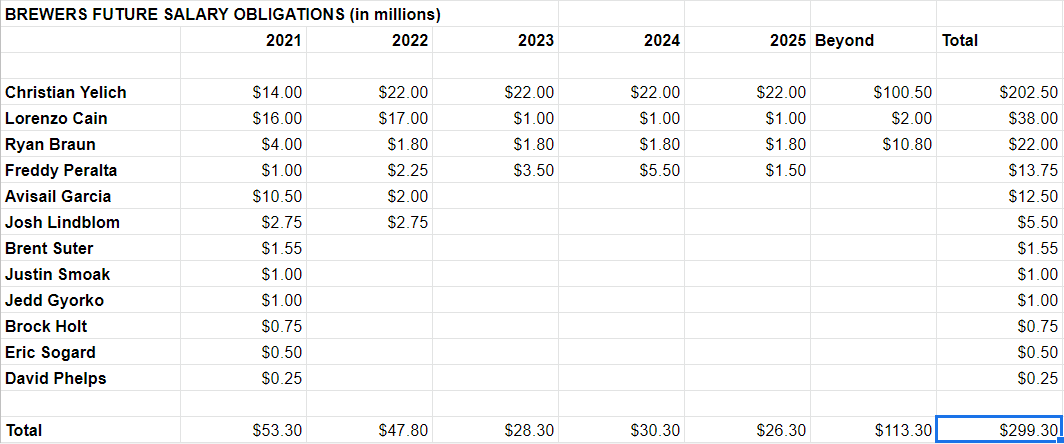
2020 salary terms still need to be hammered out. But what about what’s owed to players beyond that point? The near-term economic picture remains questionable at best. That’ll make teams all the more cautious with guaranteed future salaries.
Every organization has some amount of future cash committed to players, all of it done before the coronavirus pandemic swept the globe. There are several different ways to look at salaries; for instance, for purposes of calculating the luxury tax, the average annual value is the touchstone, with up-front bonuses spread over the life of the deal. For this exercise, we’ll focus on actual cash outlays that still have yet to be paid.
We’ll run through every team, with a big assist from the Cot’s Baseball Contracts database. Prior entries can be found here. Next up is the Brewers:
*Includes deferrals in Christian Yelich and Lorenzo Cain contracts
*Includes deferrals and buyout on mutual option in Ryan Braun contract
*Includes buyouts on club options over Freddy Peralta, Avisail Garcia, Justin Smoak, Jedd Gyorko, Brock Holt, Eric Sogard, and David Phelps
(click to expand/view detail list)
The Longest Flirtation In Baseball
For those who love the will-they-won’t-they back-and-forth of a classic rom-com, Major League Baseball has a story for you. The Chicago White Sox and lefty hurler Gio Gonzalez are drawn to each other. There’s no denying the connection. They’re the Ross and Rachel of the MLB (or Jim and Pam, or whatever reference is relevant these days). Though they’ve never stayed together long, these would-be soulmates are on the verge of finally making it work. Should baseball return in 2020, their long-standing flirtation should finally consummate with Gonzalez in black-and-white, taking the hill in front of the Southside faithful.
Gonzalez, 34, has long been a productive pitcher in the bigs, but he hasn’t gotten the respect he deserves of late. Though Gonzalez is aging, he certainly pitched well enough to prove himself a viable rotation candidate. And yet, following the 2018 season, Gonzalez languished on the free-agent market. He eventually accepted a minor league deal with the Yankees, but he never made an appearance for their big-league team. He found his way back to Milwaukee where he went 3-2 with a 3.50 ERA/4.04 FIP across 87 1/3 innings (17 starts). Again, solid numbers for Gonzalez, but again there wasn’t much buzz around him as he returned to free agency.
Fear not, for an old friend came to the rescue. The White Sox signed Gonzalez to a $5MM guarantee just before Christmas with plans of slotting him into the rotation. The White Sox are a team on the rise with a young rotation in need of guaranteed, quality innings. Lucas Giolito and Dallas Keuchel are set to front the rotation with less proven assets like Reynaldo Lopez and Dylan Cease likely to follow. Gonzalez should help the young arms take their time and weather the storm, should there be one.
Regardless of fit, we know the White Sox like Gonzalez. This was, after all, the third time they’d acquired him. The White Sox first drafted Gonzalez 38th overall in the 2004 June Draft. But he didn’t last long in their system, as the Sox traded Gonzalez to the Phillies after the 2005 season (with Aaron Rowand and Daniel Haigwood) for Jim Thome.
Just a year later, Gonzalez found himself headed back to Chicago. The White Sox and Phillies connected on a new deal wherein the Phils acquired Freddy Garcia for Gonzalez and Gavin Floyd. Garcia made just 11 starts for the Phillies before leaving as a free agent after 2007. Floyd found his sea legs in Chicago after struggling to make good on his top draft pick status in Philly. He ended up playing seven seasons with the White Sox, going 63-65 with a 4.22 ERA/4.20 FIP in that time, settling in as a decent rotation piece.
Gonzalez’s second stint with the White Sox lasted barely longer than the first. He did, however, begin to flourish. Upon his return, Gonzalez quickly became a top arm in their system, topping out of as their number one ranked prospect by Baseball America in 2008 (#26 overall in the majors).
Still, they traded him – again – this time to the Oakland Athletics (along with Fautino De Los Santos and Ryan Sweeney) in exchange for Nick Swisher. Swisher was a personality match with the White Sox, a spiritual successor to Rowand and other hard-nosed dirt dogs to play on the grass in Chicago – but he only lasted one season (.219/.332/.410 with 24 home runs).
Gonzalez became the gem of that deal for Oakland, making his debut in 2008 as a 22-year-old. It took Gonzalez a couple seasons to find his footing, but by the end of 2011, Gonzalez was an established pro. He put together back-to-back 200-inning seasons for the A’s, amassing 8.3 rWAR/6.5 fWAR across 2010 and 2011 before Oakland shipped him to Washington.
At this point, Gonzalez was entering his age-26 season with some runway to finally settle in after being traded four times already. Gonzalez became a rotation stalwart for the Nationals from 2012 to 2018, a two-time All-Star, and a 124-game winner.
His best season was his first in Washington. The 26-year-old Gonzalez led the league in wins going 21-8 with a 2.89 ERA/2.82 FIP across 199 1/3 innings. As the Nats’ nominal ace, Gonzalez led them to their first-ever postseason appearance. Of course, this was the season the Nationals famously withheld Stephen Strasburg from the playoffs to ensure his long-term health. An undercurrent of that story, however, was Gonzalez, whose dominance that year made such a bold move possible. Gio started games one and five of the NLDS, pitching well but lasting just five innings in both outings – a common thread for Gonzalez. The Nats went 1-1 in those games but ultimately lost the series to the Cardinals.
Gonzalez never put up another season quite like his 2012, but he nonetheless gave the Nats solid work for 6+ seasons. Regardless, there wasn’t a ton of interest when the Nats shopped him during the 2018 season. Gonzalez was eventually traded to the Brewers, for whom he pitched well in five late-season starts. He even got a pair of postseason starts, though he went just two innings in the first outing and left due to injury one inning into his second.
Eight seasons after arriving in Washington and 16 years after Chicago selected him in the first round, Gonzalez may finally have the opportunity to pitch for the White Sox. Of course, a lot stands in the way of Gonzalez making his debut in Chicago, but that’s nothing new. Now in his third stint in the organization, the White Sox hope Gonzalez will help lead this young team.
Of course, if they don’t make the leap many expect, Chicago could embark on one last selloff of veterans before making a run at contention again in 2021. If that happens, Gonzalez could find his name in the trade papers once again. But for now, as before, Gio Gonzalez is a member of the Chicago White Sox.
Each NL Team’s Top Recent Draft Class
With the MLB draft scheduled for next week, let’s take a look at each National League team’s most successful draft class in recent memory. Using Baseball Reference’s draft tracker, we can sum the combined career bWAR of each player selected by each team in a given year. It’s a simple shorthand, not a perfect measure, but it’ll give some insight into which teams have really hit on their picks in certain years.
First, a quick note on the methodology. For simplicity, we’re limiting this search to the 2006-2015 classes. A player’s value is only included if he signed with the club, although he needn’t have actually played for his drafting team in the majors. (So, the 2008 Yankees don’t get credit for drafting but failing to sign Gerrit Cole, while the 2007 Red Sox do get credit for drafting and signing Anthony Rizzo, even though he was traded before ever playing an MLB game for Boston). Of course, a player drafted in 2006 has had more time to rack up value than one drafted in 2015, so we’ll note in each team’s capsule if a more recent class is on the verge of taking over from an older class. On to the results…
- Braves: 2007 (76.6 bWAR) – Hitting on Jason Heyward and Freddie Freeman in the first two rounds goes a long way. Heyward has been a disappointment with the Cubs but had some electrifying seasons in his early days in Atlanta (and his year in St. Louis), while Freeman has emerged as a fixture in the Braves’ lineup as one of the best hitters in baseball over the past decade.
- Brewers: 2009 (30.7 bWAR) – This was period of some underwhelming draft returns for Milwaukee. The 2009 class tops the list thanks to Khris Davis, Mike Fiers and Scooter Gennett, all of whom are better known for their play (or whistleblowing, in Fiers’ case) elsewhere.
- Cardinals: 2006 (56.3 bWAR) – By virtue of putting up baseball’s best record in 2005, the Cardinals sat at the back of every round in 2006. No matter, as they managed to find a handful of highly productive big leaguers. First-rounder Adam Ottavino didn’t work out in St. Louis but went on to a strong career as a reliever in Colorado. Tommy Pham (16th round) and Jon Jay (2nd round) have each carved out strong careers, while Allen Craig (8th round) had a brief but productive peak.
- Cubs: 2007 (54.4 bWAR) – Unfortunately for the Cubs, this class is almost all about Josh Donaldson, who did none of his damage in a Chicago uniform. Perhaps Javier Báez (2012 draft) or Kris Bryant (2013 draft) will match or exceed Donaldson’s stellar career in time.
- Diamondbacks: 2009 (73.1 bWAR) – Paul Goldschmidt (8th round) went on to become the top position player in franchise history. First-rounder AJ Pollock had a couple star-level seasons of his own before injuries knocked him off track, while Chase Anderson (9th round) has emerged as a solid back-of-the-rotation starter.
- Dodgers: 2006 (70.6 bWAR) – The Dodgers only signed two big leaguers from the 2006 class. When one of them goes on to become arguably the best pitcher of his generation, you can more than get away with it. Clayton Kershaw’s Hall of Fame plaque will boast at least three Cy Young Awards and an NL MVP.
- Giants: 2008 (65.6 bWAR) – The late-2000’s draft classes set up the crux of the Giants’ three World Series titles the first half of the next decade. None was more impactful than 2008, when SF grabbed Buster Posey and Brandon Crawford in the first and fourth rounds, respectively.
- Marlins: 2010 (56.1 bWAR) – Christian Yelich and J.T. Realmuto have matured into two of the best players in baseball, so the Marlins’ 2010 class (which also boasted late-blooming A’s slugger Mark Canha) has a chance to be really special. Of course, none of those players are still in Miami.
- Mets: 2010 (50.5 bWAR) – Seventh overall pick Matt Harvey was briefly the ace the Mets hoped they were adding in 2010. As it turns out, Jacob deGrom (9th round) had a lot more staying power atop their rotation.
- Nationals: 2009 (44.9 bWAR) – First overall pick Stephen Strasburg has more than made good on that selection, culminating in a World Series MVP effort in 2019. The 2009 class also brought in a handful of role players, including Drew Storen and Michael Taylor.
- Padres: 2007 (38.9 bWAR) – Another team for whom the top player simply got away, the crown jewel of the Padres’ 2007 class was Corey Kluber (4th round). Obviously, even San Diego didn’t him expect him to go on to win a pair of Cy Young Awards.
- Phillies: 2014 (24.2 bWAR) – There were some tough results for the Phillies on draft day in recent seasons, but 2014 looks to be a notable exception. Aaron Nola went seventh overall and has emerged as a high-level starter, while Rhys Hoskins (fifth round) looks like the Phils’ long-term answer at first base.
- Pirates: 2011 (29.7 bWAR) – The Pirates’ 2011 class is almost exclusively about the contributions of first overall pick Gerrit Cole, but he obviously reached his peak after being traded to Houston. Josh Bell (2nd round) looked to have turned the corner at the plate in the first half of 2019.
- Reds: 2007 (43.1 bWAR) – The Reds found three future everyday players in the 2007 class. Todd Frazier (supplemental first-round), Zack Cozart (2nd round) and Devin Mesoraco (1st round) all went on to become productive players in Cincinnati.
- Rockies: 2009 (47.4 bWAR) – The Rockies graduated six players from the 2009 class to the big leagues, although only one proved a smashing success. Finding a player of Nolan Arenado’s caliber in the second round makes for a great draft even if the rest of the players taken underwhelm.
Brewers Provide Updates On Corey Knebel, Others
The Brewers had a wide slate of injured players during Spring Training — some expected to be key contributors in 2020 — and president of baseball operations David Stearns tells Tom Haudricourt of the Milwaukee-Journal Sentinel that most are progressing well through their rehab.
Former closer Corey Knebel, who underwent Tommy John surgery last spring, is “getting pretty close” to being able to join the bullpen mix, per Stearns. He’s been on a throwing program and seemingly hasn’t had any setbacks, though Stearns noted that the final test is always to see how players fare in competitive settings with adrenaline flowing, and that obviously hasn’t been possible during the COVID-19 shutdown.
It’s easy to forget just how important Knebel was to the Brewers’ bullpen prior to his injury. Josh Hader‘s breakout as MLB’s strikeout king has somewhat overshadowed Knebel, but the two form one of baseball’s best late-inning tandems when both are healthy. From 2017-18, Knebel gave the Brewers 151 1/3 frames of 2.54 ERA ball (2.74 FIP) with a ridiculous 14.7 K/9 and a 40.2 percent overall strikeout rate. He agreed to a $5.125MM salary this offseason — the same as in 2019 — and is under club control through the 2021 season.
Shortstop Luis Urias should be up to speed once play is able to resume, Haudricourt writes. Stearns notes that Urias was already close to getting into Spring Training games at the time of the league shutdown, and he’s of course now had nearly three additional months to mend from the fractured hamate bone he sustained during winter ball. Urias was acquired in the trade that sent Trent Grisham and Zach Davies to the Padres. And while lefty Eric Lauer, the other player the Brewers landed in that swap, was slowed by shoulder troubles this spring, he’s healed up and should be in the rotation competition again when Spring Training 2.0 kicks off (assuming an agreement is reached).
Both players could well hold important roles for the Brewers in 2020 and for years to come. Onetime top prospect Orlando Arcia has yet to seize the everyday role at shortstop, opening the door for Urias — a touted prospect in his own right but one who the Padres felt comfortable dealing to upgrade in other areas. The 22-year-old Urias hasn’t hit in the Major yet but did turn in a ridiculous .315/.398/.600 slash in 73 Triple-A games last year (137 wRC+).
As for Lauer, the 2016 first-rounder was a quick riser to the Major, debuting in 2018. Since that time he’s tossed 261 2/3 innings of 4.40 ERA ball with 8.2 K/9, 3.3 BB/9, 1.20 HR/9 and a 38.9 percent grounder rate. He’s likely more of a mid-rotation or back-of-the-rotation arm, but for a Brewers club that uses its pitching staff in less conventional manners than many other clubs, there could be some ideas to maximize his effectiveness through the use of openers, limiting times through the order, etc. He’s controllable all the way through 2024, so whatever games are able to be played in 2020 will serve as a proving ground of sorts for Lauer. With Brett Anderson lined up for free agency in the 2020-21 offseason, there’s a clear path to innings in future seasons if Lauer or another young Brewers hurler impresses when play resumes.
Latest News, Notes On Minor League Pay
The manner in which teams are — or, in some cases, aren’t — continuing to pay their minor league players has drawn increased attention as the end of the month draws near. Major League teams agreed back in March to pay minor league players $400 per week through the end of May, but most minor league players now face ongoing financial uncertainty. The Dodgers have already committed to continue that $400 weekly stipend through the end of June, but veteran left-hander David Price is stepping up to add a helping hand, pledging $1,000 to each non-40-man Dodgers minor leaguer, according to a report from Francys Romero (Twitter link). That includes more than 220 minor leaguers, per MassLive.com’s Chris Cotillo. It’s a similar gesture to the one Shin-Shoo Choo made with the Rangers back in April.
Of course, the very fact that veterans such as Choo and Price even feel it necessary to step up to help out minor leaguers speaks to the manner in which minor league players are under-compensated. While some clubs — the Marlins and Padres — are reportedly set to pay out that $400 weekly stipend through the end of the minor league season, the Athletics are cutting off the stipend at month’s end. Others have extended the stipend through June but have not committed further.
Here’s how a few other clubs are handling the matter…
- The Mets, Rays, Brewers, Cardinals, Giants and Indians are all extending the $400 weekly stipend through the month of June, per reports from MLB Network’s Jon Heyman (tweet), the Tampa Bay Times’ Marc Topkin, the Milwaukee Journal-Sentinel’s Todd Rosiak (tweet), the St. Louis Post-Dispatch’s Derrick Goold, Alex Pavlovic of NBC Sports Bay Area (tweet) and Kyle Glaser of Baseball America (tweet). “This money right now, especially for guys who aren’t as well off, this is a huge deal,” Rays minor league catcher Chris Betts tells Topkin. “…I’m beyond excited about it, and I’m honestly just more stoked and proud that the organization I play for took this route more than anything.”
- The Athletics have, unsurprisingly, drawn a wide array of harsh criticism for their wide-ranging furlough and the full cutoff of minor league payment, Susan Slusser of the San Francisco Chronicle writes. Slusser notes that owner John Fisher repeatedly used the word “family” in his letter to fans explaining the cutbacks, but many impacted by the cuts don’t feel the effects of that word. “It’s very hard to preach family and then not act like it when times are difficult,” Class-A pitcher Aiden McIntyre tells Slusser. Triple-A outfielder Jason Krizan added: “…[I]t hurts to see the Marlins continue to pay their players when they made the least in baseball last year,” though he noted he’d rather remain an Athletic and receive benefits than otherwise. Other players, past and present, voiced similar criticisms to Slusser, as did a big league agent and an executive with another club. Sports Illustrated’s Stephanie Apstein writes that termination of the stipend saves the Athletics an approximate $1.3MM.
Latest On Furloughs, Pay Cuts Among MLB Clubs
6:09pm: The Rangers have committed to $400 a week for their minor leaguers through at least June, Levi Weaver of The Athletic was among those to report. The same goes for the Braves, per David O’Brien of The Athletic, as well as the Diamondbacks, Nick Piecoro of the Arizona Republic adds.
12:59pm: The Padres will also pay their minor leaguers the $400 weekly stipend through the end of August, Dennis Lin of The Athletic tweets.
12:34pm: Most of MLB’s 30 organizations agreed a ways back to pay their employees through the end of May. There were instances of lengthier commitments, but May 31 was broadly used as an initial endpoint, at which time fiscal matters would be reassessed. Minor league players have been receiving $400 weekly stipends during this time, but that arrangement is also only promised through the end of May. As you’d expect, clubs have begun to inform employees (both on the business and baseball operations side) and minor leaguers of their next steps. And, as you’d expect, in some instances it’s not pretty.
Yesterday was a particularly dark day in the Athletics organization, as ESPN’s Jeff Passan reports that the team informed minor league players they will no longer be paid their stipend as of June 1. Robert Murray of The Score shares the email that was sent to Oakland minor leaguers — one which was signed by GM David Forst rather than managing partner John J. Fisher. (Forst, of course, is being asked to play the messenger in this instance and is not the one making the decisions.)
Minor league players are generally undercompensated as a whole, and the $400 weekly stipend they’ve received over the past two months will now seemingly go down as the only baseball-related compensation they’ll receive in the calendar year. Their contracts, which are in a state of suspension but not terminated, bar them from “perform[ing] services for any other Club” and also render them ineligible for unemployment benefits, per The Athletic’s Emily Waldon (Twitter link).
As for the operations side of the equation, Athletics front office personnel will be either furloughed or see their pay reduced effective June 1 and running through the end of October, The Athletic’s Alex Coffey reports (Twitter thread). She adds that the maximum cut is 33 percent, and those determinations are based on seniority. Scouts aren’t considered front-office personnel, but they’ll be hit hard as well; USA Today’s Bob Nightengale tweets that A’s amateur and pro scouts alike will be furloughed from June 16 through Oct. 31. Fisher did write a letter to the club’s fanbase confirming the dramatic cuts (Twitter link via the San Francisco Chronicle’s Susan Slusser), emphasizing the pain that went into the decisions and his “deep commitment to the long-term future of the A’s.”
Those cutbacks are similar to the substantial cuts the Angels put in place earlier this month, but other L.A. club isn’t taking such rash measures. The Dodgers have informed all employees earning more than $75K that they’ll be subject to pay reductions beginning June 1, Ramona Shelburne of ESPN (Twitter thread). The extent of the reductions is dependent on overall salary — larger salaries get larger percentage cuts — and will be capped at 35 percent for the most part, although that they could be greater for the team’s very top executives. Those measures are being taken in an effort to avoid the type of large-scale furloughs being put in place in Oakland and Anaheim.
Across the country, the Nationals have implemented a series of partial furloughs both in baseball ops and business ops, Jesse Dougherty of the Washington Post reports (Twitter thread). The Nats are still covering full benefits and haven’t made any layoffs, but they’re implementing a sequence of 10 to 30 percent reductions in pay and total hours. The Brewers, meanwhile aren’t making any baseball ops furloughs but are furloughing some business operation employees, Todd Rosiak of the Milwaukee Journal-Sentinel tweets.
It’s not yet clear how every organization plans to handle the minor league pay dilemma, but Baseball America’s Kyle Glaser has heard from at least three clubs that plan to continue varying levels of compensation. The Phillies will keep paying their minor leaguers through at least June, but likely at less than the current $400 stipend. The White Sox are paying $400 per week through the end of June, and the Marlins have committed to paying their minor leaguers the full $400 per week through August — the would-be conclusion of the 2020 minor league season. The Marlins already informed players earlier this month that about 40 percent of the baseball ops department will be furloughed on June 1.
Which 15 Players Should The Brewers Protect In An Expansion Draft?
In a few weeks, we’ll be running a two-team mock expansion draft here at MLBTR – just for the fun of it! Currently, we’re creating 15-player protected lists for each of the existing 30 teams. You can catch up on the rules for player eligibility here.
So far, we’ve covered the Reds, Cubs, Diamondbacks, Rockies, Dodgers, Padres, Giants, Rangers, Mariners, Athletics, Angels, Astros, Twins, Royals, Tigers, Indians, White Sox, Rays, Yankees, Red Sox, Blue Jays and Orioles. The Brewers are up next.
First, we’ll remove free agents Ryan Braun, Brett Anderson, Justin Smoak, David Phelps, Eric Sogard, Jedd Gyorko, and Brock Holt from consideration. Many of those players have club options for 2021, but we won’t make the Brewers use a protected spot on them. Christian Yelich and Lorenzo Cain will make the list by virtue of their no-trade clauses. In total, we’ll protect 11 players out of the gate:
Christian Yelich
Lorenzo Cain
Keston Hiura
Brandon Woodruff
Josh Hader
Omar Narvaez
Eric Lauer
Adrian Houser
Luis Urias
Freddy Peralta
Josh Lindblom
That leaves four spots for the following 17 players. Click here to review contract statuses and team control. Assume the expansion draft is taking place in November 2020.
Orlando Arcia
Ray Black
Corbin Burnes
Alex Claudio
David Freitas
Ben Gamel
Avisail Garcia
Ryon Healy
Corey Knebel
Jacob Nottingham
Manny Pina
Ronny Rodriguez
Brent Suter
Tyrone Taylor
Bobby Wahl
Devin Williams
Eric Yardley
With that, we turn it over to the MLBTR readership! In the poll below (direct link here), select exactly four players you think the Brewers should protect in our upcoming mock expansion draft. Click here to view the results.
Coronavirus Notes: Upcoming Negotiations, Furloughs, Angels, Brewers, KBO
It’s make-or-break time for MLB and the MLBPA on forging a path to baseball in 2020. With some significant negotiations looming this week, ESPN’s Jeff Passan runs through some of the biggest questions facing the league. The battle between players and owners is rife with potential roadblocks, and it’s not just the conditions of 2020 that are at stake. With the CBA renegotiation still in the (what-now-feels-like distant) future, both sides are aware of the impact any concession can make to the bigger picture. The way this week’s negotiations are handled could reveal the potential the two sides have of forging an effective working relationship moving forward. One would think now would be an ideal time for opposing sides to come together, and yet it’s just not as simple as that when billions of dollars are at stake. There are countless people and opinions to take into account on both sides of the aisle. While we await a loaded week of negotiations, let’s check in on how teams are handling their non-player-and-coach employees…
- Teams are taking a variety of approaches when it comes to their employees in the wake of COVID-19, but the Angels have come under fire for taking a more drastic approach than most, per The Athletic’s Ken Rosenthal. The Angels will be furloughing employees from nearly every department, including, in the words of Rosenthal, “weakening its amateur scouting department heading into the draft.” The optics aren’t great here for the large-market Angels, especially when clubs like the Brewers, Giants, and Phillies have made commitments to retaining their staff at least through October. The Blue Jays also recently made the decision to keep employees’ on their full-time salaries through October 1, tweets John Lott, a frequent contributor to The Athletic. The Brewers have been the most aggressively pro-employee, per Rosenthal, committing to keeping their staff on through the entirety of the baseball season. The pro-employee approach is laudable, though not necessarily all that shocking coming out of Milwaukee. The Brewers have increasingly stepped into the spotlight in recent years as a progressive organization, from the supportive atmosphere provided players to making special efforts to get Milwaukee residents in to see games to their very team-building approach. The Angels, meanwhile, might find tough sledding ahead when it comes to signing undrafted amateur players. Without their typical scouting infrastructure in place, those relationships will be harder to build in an open market, and it’s possible the decisions being made by ownership today will have far-reaching consequences for the organization’s future.
- The Rays, meanwhile, are readying to return to the field. Camp will re-open on Monday for a small collection of 15 to 20 players, per Marc Topkin of the Tampa Bay Times. Those players involved will still be keeping a separation of six feet from other players, and workouts will be limited. Still, it’s a positive sign to see players start to congregate again around a playing field. It’s also, no doubt, a risky proposition, but so long as safety precautions are followed and we don’t see a breakout of cases among these players, these workouts could be a harbinger of more baseball to come.
- Baseball is back already in some places of the world, of course. The KBO is about 17 games into their 2020 season, and they’re about to get a lot more popular. A new deal was announced for ESPN to become the English-language home of KBO games set to broadcast around the world, per ESPN’s Santa Brito. Play-by-play announcers will continue to provide commentary while social distancing. ESPN will soon be broadcasting KBO games “throughout Canada, Mexico, Central America, the Caribbean (including the Dominican Republic), Europe, Middle East, Africa, and parts of Asia.”
Scooter Gennett On Why He Didn’t Sign Anywhere This Winter
Former Reds, Brewers and Giants second baseman Scooter Gennett remains unsigned, and the 2018 All-Star chatted with Doug Fernandes of the Sarasota Herald-Tribune this week about his decision not to accept an offer over the winter. Gennett details that he did receive some offers, but they were either non-guaranteed or not to his liking from a financial standpoint. The top offer he received was a $1.5MM guarantee with incentives, but he’d been targeting a deal in the $5MM range. That offer also came from a club with an everyday second baseman, it seems, so he’d likely have been viewed as a bench piece.
Many fans will bristle at Gennett’s candid comments on free agency and compensation, particularly given the current economic crisis that has been brought about by the COVID-19 pandemic. Gennett, though, has earned more than $19MM in his career to date and has clearly set a personal valuation both on his abilities and the level of compensation he’d require to spend another season on the road and away from his wife and family, as any player would. “You’re 220 days away from your family,” says Gennett.
The 2019 season was a tough one for Gennett, who tore a muscle in his groin during Spring Training and now acknowledges that he came back before he was ready. That was his own decision, he emphasizes, and his results clearly suffered. After hitting a combined .303/.351/.508 with 50 home runs for the Reds in 2017-18, Gennett limped to a .226/.245/.323 slash in 139 plate appearances last year. The Reds traded him to the Giants just prior to the trade deadline, receiving only cash consideration in return. San Francisco released him less than a month later.
Over the winter, Gennett reportedly drew interest from as many as six teams, with the Cubs known to be one suitor. The Cubs, however, have avoided major free agent signings over the past two offseasons and were looking for more of a low-cost pickup. Not long after being linked to Gennett, they instead signed Jason Kipnis to the same type of minor league contract to which Gennett expresses aversion in his interview with Fernandes.
Gennett is still just 30, so there’s certainly time for him to stage a comeback if he chooses to play again. He’s still working out, but he’s also frank in telling Fernandes that he is “fine with not playing.” If salary is the sticking point, it’s hard to envision his earning power on his next contract being higher than it was over the winter. A club doesn’t seem likely to top that offer once play resumes, given the revenue losses throughout the league, and sitting out for a year would surely limit him to a minor league deal if he did decide he wanted to return to the game.
Zack Greinke’s Great Hot Stove Adventure
Every player that reaches the majors has a hot-stove tale to tell. They’re drafted or signed into the pro ranks to start out. Quite a few are traded or move via free agency even before reaching the bigs. You have to be selected or signed onto a 40-man roster before you can put on a uniform in a MLB contest. And then there’s the inevitable moment when it all goes away … whether through retirement at the end of a lengthy career or, in many cases, a trip into DFA limbo.
All of these stories are etched on the pages of MLBTR. Some are more interesting than others. A few of these transactional career arcs touch upon many major elements of the hot stove league — the front office game that shapes the underlying sport that we watch on TV.
The transactional saga of Zack Greinke, the venerable right-hander whose latest stop is the Houston Astros, is certainly among the most notable in recent memory …
Professional Entry
- The Royals took Greinke, an unusually polished high-school hurler, with the sixth overall pick of 2002 draft.
Prospect Status
- Greinke quickly emerged as one of the game’s top prospects.
- Baseball America rated Greinke 54th overall ahead of the 2003 season and 14th overall in advance of 2004.
Early Career
- At just 20 years of age, Greinke turned in in 24 starts of 3.97 ERA ball in his debut season of 2004. But he struggled badly in his sophomore season.
- Greinke battled mental health issues and was ultimately diagnosed with depression and social anxiety disorder. At the time, his outlook as a professional baseball player was of secondary concern. SI.com’s John Donovan wrote: “Greinke’s tortured story is, on the one end, a sad one, but on this side there is hope that it may yet turn out well.”
Extension
- Greinke reemerged in 2007, then turned in a breakout 2008 season.
- The Royals signed Greinke to a four-year, $38MM extension in advance of the 2009 season, adding two years of team control. He won the American League Cy Young Award in the ensuing campaign.
2010 Blockbuster
- The Royals decided to entertain trade offers on Greinke, by then regarded as one of the game’s best pitchers, in the 2010-11 offseason. Greinke later indicated his desire to be traded.
- A monumental set of Winter Meetings trade talks ensued. Royals Review has exhaustively documented the contemporaneous rumor mill. Greinke reportedly indicated he would exercise his no-trade rights to block a deal to the Nationals.
- The Brewers eventually acquired Greinke and Yuniesky Betancourt, and $2MM from the Royals for Lorenzo Cain, Alcides Escobar, Jeremy Jeffress, and Jake Odorizzi.
- Greinke ended his tenure with the Royals with a 3.82 ERA in 1,108 innings over seven seasons.
2012 Trade Deadline Swap
- Greinke continued to perform well in Milwaukee, but the Brewers stumbled.
- In July of 2012, the Angeles acquired Greinke for Jean Segura, Ariel Pena and John Hellweg.
- Greinke ended his tenure with the Brewers with a 3.67 ERA in 294 2/3 innings over two seasons.
2012-13 Free Agency
- Greinke entered the market as the top player available and drew interest from numerous big-market teams.
- During the Winter Meetings, the Dodgers signed Greinke to a six-year, $147MM contract.
- Greinke ended his tenure with the Angels with a 3.53 ERA in 89 1/3 innings over one season.
2015-16 Free Agency
- Greinke opted out of his contract after a 2015 season in which he led the National League with a 1.66 ERA.
- Expectations were that he would re-sign with the Dodgers, but the Diamondbacks suddenly entered the market with a massive offer.
- The Diamondbacks signed Greinke to a six-year, $206.5MM contract, setting a new record for average annual value ($34.42MM).
- Greinke ended his tenure with the Dodgers with a 2.30 ERA in 602 2/3 innings over three seasons.
2019 Trade Deadline Swap
- After a rough initial season in Arizona, Greinke continued to produce excellent results even as he entered his mid-thirties.
- In a last-minute agreement consummated just before the trade deadline, the Astros acquired Greinke for Corbin Martin, J.B. Bukauskas, Seth Beer, and Joshua Rojas.
- Greinke ended his tenure with the Diamondbacks with a 3.40 ERA in 714 2/3 innings over four seasons.
Future
- Greinke’s contract runs through 2021. The Astros took on $53MM of the remaining salary obligations.
- With the Astros, Greinke has a 3.02 ERA in 62 2/3 innings over one season.