
NL East Notes: Zimmerman, Karsay, Mets, Braves
The latest from the NL East…
- As of last Tuesday, the Nationals had yet to speak with Ryan Zimmerman or his agents, Jesse Dougherty of the Washington Post reports. Zimmerman is a free agent for the first time in his 15-year career, after the Nats spent $2MM to buy out their $18MM club option on the veteran first baseman for the 2020 season. Back in August, Zimmerman said that remaining in Washington was a priority, and he was willing to play on a series of less-pricey one-year contracts. Assuming he hasn’t changed that stance, Zimmerman could be viewed by the Nationals as something of a fallback, as the team may feel safe in first exploring other first base options.
- The Mets will interview Steve Karsay for their pitching coach opening, Joel Sherman of the New York Post reports. Karsay is currently the Brewers‘ bullpen coach, after spending 2012-18 as a pitching coach in the Indians’ minor league system. Of course, most fans know Karsay best from his 11 seasons and 603 1/3 career MLB innings with five different teams (most notably the A’s, Indians, and Yankees) from 1993-2006. Twins assistant pitching coach Jeremy Hefner and University Of Michigan pitching coach Chris Fetter are the only other known candidates linked to the Mets’ job.
- Between Will Smith, Mark Melancon, and Shane Greene, the Braves could be committing roughly $33.5MM in salary to three relievers next season, Tim Tucker of the Atlanta Journal-Constitution notes. Greene’s salary is still up in the air, as the Braves could potentially non-tender the righty rather than pay him $6.5MM in projected arbitration salary. A non-tender or trade could be possible if the Braves are wary of overspending on their bullpen, since $33.5MM is rather a hefty sum for a trio that only featured one member (Smith) who posted really outstanding numbers in 2019. Tucker observes that the Braves already have around $100MM (barring any more non-tenders) on the books for player payroll for next season, which leaves them with quite a bit of spending capacity if the team is willing or able to match its season-ending $144MM payroll figure from last year.
Brewers Claim Eric Yardley
The Brewers have claimed righty Eric Yardley off waivers from the Padres, per a club announcement. While the MLB.com transactions page indicates that Yardley was released, he evidently had not yet cleared release waivers.
With the move, the Milwaukee club will hand a 40-man spot over to an intriguing sidearmer who could compete for a bullpen job in camp. Yardley doesn’t have much MLB experience but was able to make it through 11 2/3 frames with just three earned runs in his 2019 debut.
Yardley’s low-velo offerings have proven effective over a longer run in the upper minors. He recorded 63 2/3 frames of 2.83 ERA pitching at Triple-A last year, racking up a 63.8% groundball rate while limiting the long ball (0.42 HR/9) and carrying 7.4 K/9 against 2.0 BB/9.
Offseason Outlook: Milwaukee Brewers
MLBTR is publishing Offseason Outlooks for all 30 teams. Click here to read the other entries in this series.
The Brewers lost MVP candidate Christian Yelich to a knee fracture in early September but nevertheless rode a torrid hot streak to an NL Wild Card berth. The Milwaukee Magic ran out earlier this season than last, however, as the Brewers couldn’t overcome the Nationals in that one-game showdown. It’ll be back to the drawing board again for president of baseball ops David Stearns and his staff, who’ll enter the offseason with question marks behind the plate, in the infield and on the pitching staff.
Guaranteed Contracts
- Lorenzo Cain, OF: $51MM through 2022
- Christian Yelich, OF: $27.75MM through 2021 (includes buyout of 2022 club option)
- Ryan Braun, OF: $20MM through 2020 (includes buyout of 2021 mutual option)
Arbitration-Eligible Players (salary projections via MLBTR contributor Matt Swartz)
- Jimmy Nelson – $3.7MM
- Corey Knebel – $5.125MM
- Alex Claudio – $2.2MM
- Travis Shaw – $4.7MM
- Zach Davies – $5.0MM
- Junior Guerra – $3.5MM
- Tyler Saladino – $1.0MM
- Orlando Arcia – $2.7MM
- Ben Gamel – $1.6MM
- Brent Suter – $900K
- Josh Hader – $4.6MM
- Non-tender candidates: Perez, Shaw, Guerra, Spangenberg, Saladino, Austin
Option Decisions
- Yasmani Grandal, C: Grandal declined $16MM mutual option, becoming a free agent (received $2.5MM buyout)
- Mike Moustakas, 3B/2B: Moustakas declined $11MM mutual option, becoming a free agent (received $3MM buyout)
- Eric Thames, 1B/OF: Brewers declined $7.5MM club option (Thames received $1MM buyout)
- Manny Pina, C: Brewers exercised $1.85MM option
Free Agents
- Grandal, Moustakas, Thames, Gio Gonzalez, Jordan Lyles, Drew Pomeranz, Matt Albers, Tyler Austin (outrighted, elected free agency), Cory Spangenberg (outrighted, elected free agency), Hernan Perez (outrighted, elected free agency)
For a team that just enjoyed its second postseason berth in two years, the Brewers have a surprising number of holes to fill. The rotation will be an obvious point of focus, but the lineup offers its share of uncertainty as well.
Both Yasmani Grandal and Mike Moustakas declined mutual options, as expected, removing two of the team’s better bats from the equation. First base will also be a possible point of focus after Milwaukee paid a $1MM buyout rather than exercising a $7.5MM option on slugger Eric Thames. Meanwhile, Travis Shaw struggled through the worst season of his career and isn’t a sure bet to be tendered a contract — let alone to be a major contributor in 2020. At shortstop, Orlando Arcia posted an anemic .223/.283/.350 batting line in 586 plate appearances.
In summary: the Brewers will be in the market for a catcher, at least one corner infielder and perhaps a shortstop. First base could be an area of need as well. That’s a lot of work to tackle even before looking at the pitching staff, so let’s begin with the lineup.
Grandal shocked onlookers, MLBTR included, when he spurned a reported four-year offer from the Mets last winter to sign a one-year pact with Milwaukee. After the agreement, Grandal spoke about the obligation he felt to prioritize a higher annual salary as a means of advancing the market for future catchers.
Perhaps that was a bit of PR spin or perhaps it was genuine; whatever it was, Grandal proved with a .246/.380/.468 batting line and his characteristic brand of strong defense that he should be Milwaukee’s priority this winter. There’s no doubt that retaining him would be expensive — particularly if Grandal’s preference is once again for a premium annual rate at the expense of length. But the Brewers would be within their means and within reason if they offered Grandal an annual salary in the $20MM range over a three-year term. If he’s willing to sign a four-year pact at a slightly lesser rate, that’d be well worth considering, too. As for the backup role, paying a net $1.7MM for Pina’s quality glove is perfectly sensible.
There’s also a strong argument in favor of re-signing Moustakas. It’s tough to pay Shaw a projected $4.7MM as a rebound candidate, but reallocating that money to a new pact for Moustakas would create needed stability in an infield mix where only breakout rookie Keston Hiura appears locked into a spot (second base). Despite a quality run that now includes four above-average seasons in five years, Moustakas simply hasn’t been valued all that highly in two trips to the open market. Retaining him on a two-year deal comparable to this season’s value would be a worthwhile avenue to explore.
Of course, offseason demand will dictate the price points for Grandal and Moustakas, and at a certain juncture the Brewers will be willing to move on. Should that happen, they’ll have a bevy of catching alternatives from which to choose, including a perhaps on-the-rise Travis d’Arnaud, a steady defender in Jason Castro and a quality veteran bat in Robinson Chirinos (among others). There are fewer reasonably priced free agents at the hot corner — Anthony Rendon is too lofty a target — but perhaps if Grandal spurns a robust three-year offer, the Brewers could look to the older-but-still-excellent Josh Donaldson in a similar price range.
Uncertainty at the infield corners notwithstanding, the biggest problem area in the infield is shortstop, where the aforementioned Arcia has yet to live up to the hype that surrounded him as a minor leaguer. Once ranked inside the game’s Top 10 overall prospects by both Baseball America and MLB.com, Arcia has mustered a miserable .243/.292/.360 batting line in nearly 1700 MLB plate appearances. The Brewers have entrusted primary shortstop duties to him for three straight seasons and come away with virtually nothing to show for it. If you’re looking for a clean fit for Didi Gregorius, Milwaukee is a good place to start.
Shifting focus to the pitching staff, it’s somewhat amazing that Milwaukee made it as far as it did with the staff in place. The Brewers, by Stearns’ own admission, “tend to blur the lines” between starters and relievers more than most clubs. You want see many Milwaukee starters even pitch six innings, but their success while relying on Chase Anderson, Zach Davies, Adrian Houser and IL returnees Brandon Woodruff, Brent Suter and Jimmy Nelson was remarkable. Both Nelson and Woodruff have high ceilings and have realized that potential for significant stretches of time, but both have battled recent injuries. Nelson missed most of 2019 while recovering from shoulder surgery, while a severe oblique strain sidelined Woodruff for two months.
That duo, if healthy, gives the Brewers a foundation for the starting staff in 2020. But Milwaukee has already moved on from Anderson, whom they didn’t trust for more than five innings at a time in 2019. With his $8.5MM option deemed more expensive than the organization was willing to spend, Anderson was flipped to the pitching-needy Blue Jays on the first day of the offseason. That move saved some money but also further thinned out the Brewers’ depth.
The Brewers may yet be hopeful that right-handers Corbin Burnes and Freddy Peralta can function as starters — or at least a multi-inning role of some sort — but the organization could still stand to bring in a source of stable innings. Similar arguments have been made in each of the past two offseasons, and the Brewers responded rather tepidly by adding Jhoulys Chacin, Wade Miley and Gio Gonzalez on low-risk deals. That history makes it hard to predict that the Brewers will step up in pursuit of any high-end starter, but they at least make sense for some reasonably priced upside plays. Jordan Lyles (again), Drew Smyly and Michael Wacha could fit the bill. Or, the Brewers could operate as they have most recently and wait to see who’s left without a seat at the end of this offseason’s game of musical chairs.
In the bullpen, the Brewers will likely be intrigued by any pitcher they believe capable of throwing more than an inning at a time. Drew Pomeranz morphed into a late-inning monster in Milwaukee and recorded four or more outs in nearly a third of his appearances down the stretch. Pomeranz’s unexpected dominance could make him a buzz reliever who generates multi-year interest, but if the Brewers plan to continue sticking to low-cost rotation options, spending more to retain a pitcher who looked like a potential high-end relief weapon would make sense.
Alternatively, Milwaukee wants to pursue some higher-end targets to pair with Josh Hader and a returning Corey Knebel next season, they could look into a Will Smith reunion or pursue Will Harris. This year’s market is generally lacking in top-flight setup options, though veterans like Joe Smith, Steve Cishek and Craig Stammen have generally solid track records. And, as always, the trade market will present limitless opportunities for Stearns & Co. to explore as they look to piece together what should once again be one of the game’s more unique assemblies of pitchers.
Depending on the moves the Brewers make on the position-player side of the coin, they’ll need that penchant for creative pitching staff construction to its fullest extent. Assuming some additional non-tenders (Shaw, Junior Guerra, and Tyler Saladino), the Brewers currently project to have about $73.5MM in 2020 commitments. That’s roughly $49MM shy of this year’s Opening Day mark, but the aforementioned needs at catcher, third base and shortstop could all be costly to fill — particularly if retaining Grandal is deemed a Lorenzo Cain-esque priority (that is to say — a relatively unique free agent worth deviating from the more value-based mindset with which the organization typically approaches the open market).
There’ll be a lot written about the Brewers’ need to add legitimate starting pitching help this winter, but that hasn’t been how this front office has operated. Milwaukee has persistently bucked conventional wisdom when putting together rosters that feature exceptional flexibility in the lineup, on the pitching staff and on the fringes of the 25-man roster itself. The addition of a 26th roster spot next season might allow other clubs to follow in those footsteps a bit, but Milwaukee’s knack for cultivating depth and leveraging versatility is among the best in the game.
The Brewers will need to employ that same creativity in the months to come as they look to reshape the infield and deepen their pitching staff in an effort to keep up with the division-champion Cardinals, the typically aggressive Cubs (last winter being a notable exception) and a Reds team that is more motivated to win than at any point in recent history.
Super Two Cutoff Set At 2.115 Years Of Service
NOV. 5: This year’s cutoff is set at precisely 2.115 days of service, MLBTR has learned.
OCT. 10: This year’s cutoff point to determine Super Two status will be unusually low, per Adam McCalvy of MLB.com (via Twitter). While an exact cutoff point is yet unclear, McCalvy reports that Josh Hader, who has two years and 115 days of MLB service time (abbreviated as 2.115) will be eligible for arbitration this winter. In essence, that means that Hader is about to become a very well-compensated reliever. That would’ve been the case in the 2020-21 offseason anyway, but he’ll now tap into that earning power a year early. It’s also worth noting that this cutoff point will place Miami’s JT Riddle, who finished the season at 2.118 years of service, into arbitration eligibility as well.
A 2.115 cutoff would already be the lowest Super Two threshold in the past decade. The previous lowpoints in that span came in 2010 and 2013, when the cutoff was 2.122. Last year, it settled at 2.134. If the threshold is any lower this season, others could also be impacted. Arizona’s Luke Weaver (2.112) and Oakland’s Matt Chapman (2.109) are the most notable names within reasonable distance of Hader’s 2.115.
Super Two designation is one of the innumerable quirks to the ever-confounding arbitration system. For the unfamiliar, Major League players earn “service time” for every day spent on an MLB roster. One year of MLB service is defined as 172 days — despite the fact that there are more days than that in the regular season. (This year’s season was 186 days; again — hooray for quirks!)
Upon reaching three years of service time, all players become eligible for salary arbitration. Prior to that point, teams are effectively able to set (most) player salaries at any rate they wish, so long as it is north of the league minimum. Many teams have formulas they use to determine pre-arbitration salaries, and it’s quite rare for pre-arb players to earn even $1MM (barring a long-term extension). Arbitration is the first point at which players and their agents can begin negotiating with teams regarding their salary, though arbitration prices still typically fall shy of open-market value.
The “Super Two” wrinkle further complicates matters. The top 22 percent of players (in terms of total service time) with between two and three years of service also are considered eligible for arbitration and termed “Super Two” players. Any player who falls into that service bucket and spent at least 86 days of the preceding season on a 25-man roster or the Major League injured list become eligible a year early and then go through the arbitration process four times.
In the case of Hader, he’s now in line for a fairly considerable salary. He has 37 more innings, eight more saves and a whopping 116 more strikeouts than his own teammate, Corey Knebel, had when reaching arbitration as a Super Two player last season. Knebel landed a $3.65MM salary, which Hader should handily top. Beyond that, Hader’s subsequent raises in 2021, 2022 and 2023 will be built off a higher base because of his early entry into the arbitration process.
Once the exact cutoff is determined, we’ll add projections for Hader, Riddle and any other newly minted arbitration-eligible players to our just-released annual list of arbitration projections.
Latest On Brewers’ First Base Plans
Although the Brewers declined first baseman/outfielder Eric Thames‘ 2020 option on Monday, that doesn’t necessarily mean his time with the franchise is up. General manager David Stearns stated after the decision that the team’s open to re-signing Thames for less than the $7.5MM salary he’d have made had it exercised his option, per Adam McCalvy of MLB.com.
“We’re certainly not closing the door on bringing Eric back. We’ll see if there’s a fit sometime later in the offseason,” said Stearns. “But at this point with the dollar value associated with the club option and the market we see developing out there at that position, we thought it was in the [team’s] best interests to decline the option.”
The Brewers ended up saving $6.5MM by cutting Thames, whose option came with a $1MM buyout. The former Korea Baseball Organization superstar spent three years in Milwaukee, where his tenure began with a flourish early in 2017 before his production settled in at solid but unspectacular levels. Thames, who will turn 33 next week, slashed .247/.346/.505 with 25 home runs in 459 plate appearances this season. His overall offensive output checked in at a respectable 16 percent above the league-average mark, per FanGraphs’ wRC+ metric, though the left-handed hitter was a platoon player who did just about all of his damage versus righty pitchers.
Considering Thames’ limitations and what the Brewers deemed too high a price tag, the small-market club now at least wants to sees if it can find similar or better production for less money. In Stearns’ estimation, it’s shaping up to be a “robust” offseason market for first basemen in terms of free agency and trades. Jose Abreu, Edwin Encarnacion, Howie Kendrick, Justin Smoak and Mitch Moreland look like the game’s best free-agent first basemen, though at least the first two names on that list could prove to be out of the price range of a Milwaukee team that may want to save money at the spot, re-sign one or both of Yasmani Grandal and/or Mike Moustakas and perhaps upgrade other areas of need.
Should the Brewers opt against adding any somewhat pricey first basemen in the coming months, they could turn to outfielder Ryan Braun at the position. Braun is indeed “on the table” as an in-house option, Stearns revealed. While Braun only has 18 games at first on his resume (all of which came in 2018), moving him there may help preserve the oft-injured soon-to-be 36-year-old and his keep his still-capable bat in the lineup on a more consistent basis. The Brewers would perhaps be in position to deploy Trent Grisham as their primary left fielder in that scenario.
Brewers Decline 2020 Option On Eric Thames
The Brewers announced Monday that they’ve declined their $7.5MM club option on first baseman/outfielder Eric Thames. He’ll be paid a $1MM buyout instead. While Thames doesn’t have the requisite six years of free agency to become a free agent, the three-year contract he signed upon returning to Major League Baseball from the Korea Baseball Organization stipulated that he become a free agent in the event that his 2020 option was bought out. As such, he’ll be added to the free-agent pool and is now free to sign with any club this winter.
It’s a somewhat surprising decision, as the 32-year-old Thames turned in a .247/.346/.505 batting line with 25 homers, 23 doubles and two triples in just 459 plate appearances. Thames did strike out at a 30.9 percent clip, but he also drew a walk in 11.1 percent of his plate appearances. Thames has been a pure platoon player for the Brewers of late, and the reasoning isn’t especially hard to discern; in 202 plate appearances against lefties since his return to the Majors, he’s batted .188/.287/.375. Against right-handed opponents, he’s hit .251/.354/.529 with 63 of his 72 home runs.
Thames spent the bulk of his time in 2019 at first base, though he’s no stranger to either outfield corner. Metrics like Defensive Runs Saved and Ultimate Zone Rating credited him as a solid defender at first in 2019 but less so in the outfield (-4 DRS, -1.3 UZR, -6 Outs Above Average in 490 2/3 innings since returning).
The free-agent market generally hasn’t been welcoming to bat-first corner-only options like Thames in recent seasons — particularly those on the wrong side of 30. His ability to log some innings in the outfield corners will give him a leg up on some other more limited sluggers, particularly with teams able to roster a 26th player in 2020. It’s possible that Milwaukee will look to bring him back on a lower-priced one-year deal, but other speculative fits for Thames on the open market will include the Twins, White Sox, Rangers and Nationals. Rebuilding clubs like the Marlins, Tigers and Royals could all conceivably take a look as well.
Blue Jays Acquire Chase Anderson
12:39pm: The Blue Jays and Brewers have formally announced the trade.
10:40am: The Blue Jays are sending minor league first baseman Chad Spanberger to Milwaukee to complete the deal, TSN’s Scott Mitchell tweets.
10:23am: The Blue Jays are set to acquire right-hander Chase Anderson from the Brewers, Robert Murray reports via Twitter. Anderson is under control through the 2021 season via a pair of club options, and the decision on that first option (valued at $8.5MM) is due today. The pitching-needy Blue Jays figure to pick that option up and plug Anderson into the rotation. Toronto will also have a $9.5MM option on Anderson in 2021 (with a $500K buyout).
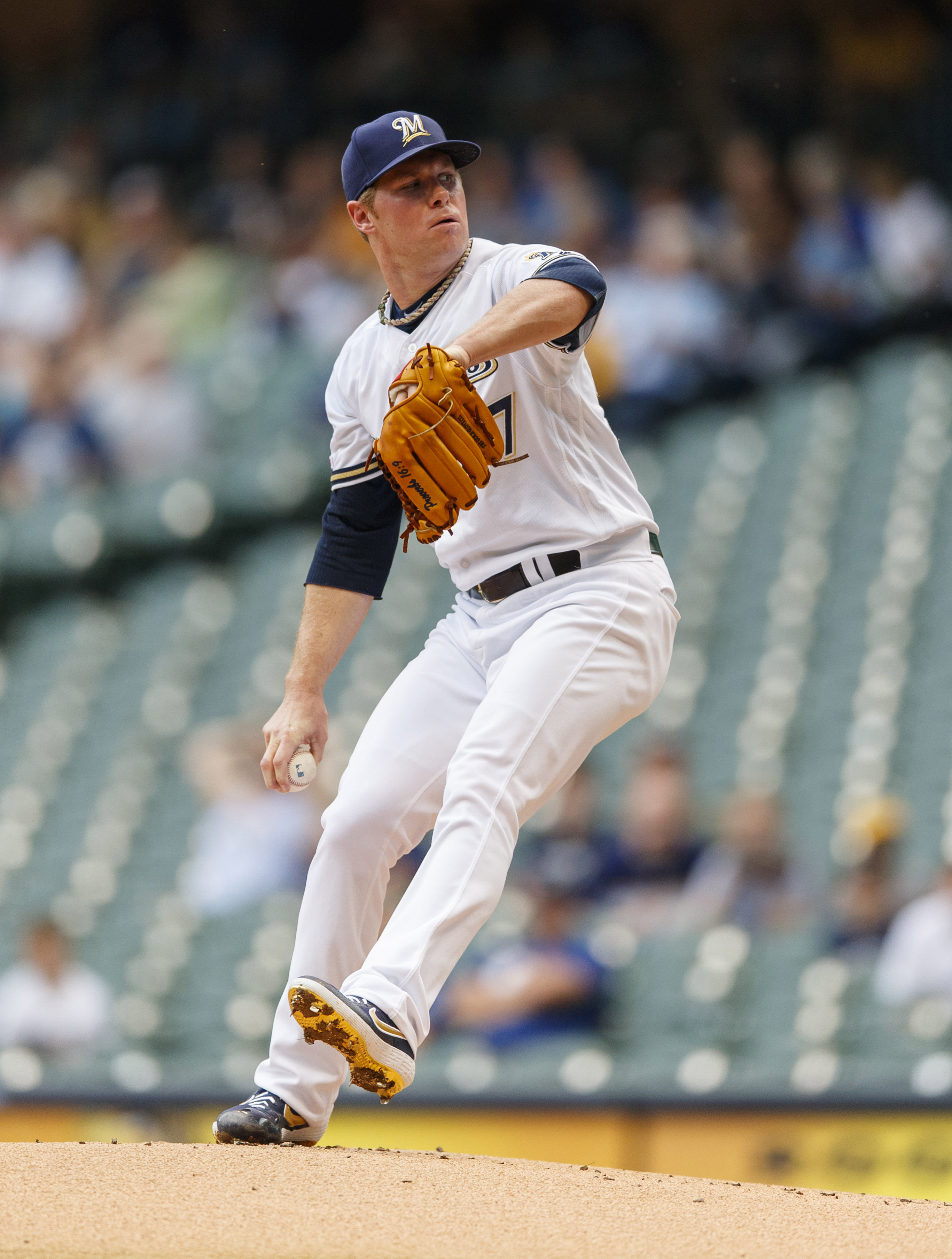
Anderson, who’ll turn 32 later this month, has been a staple on the Milwaukee staff for the past four seasons, averaging 30 appearances and 28 starts per season in that time. The Brewers have become increasingly aggressive in limiting their starters’ innings in recent seasons, which suppressed Anderson’s innings total in 2019 in particular. Five of Anderson’s 2019 appearances came in relief, but even in his 27 starts, he averaged just over 4 2/3 innings per outing (with a 4.29 ERA).
In all, over the past four seasons, Anderson has given the Brewers 590 innings of 3.83 ERA ball while averaging 7.7 K/9, 3.1 BB/9 and 1.45 HR/9 to go along with a 36.1 percent ground-ball rate. He doesn’t stand out in terms of spin rate on his fastball or curve, but Anderson’s 93.4 mph average heater in 2019 was a career-best. Anderson has also generally been well above-average in terms of limiting hard contact and opponents’ exit velocity, ranking in the 76th and 83rd percentiles, respectively, among pitchers in 2019.
Today’s trade surely signals that the Brewers weren’t sold on retaining Anderson at that $8.5MM rate. They could’ve bought him out and retained him via arbitration — Anderson has not yet reached six years of MLB service but will in 2020 — but MLBTR contributor Matt Swartz projected an even heftier salary in arbitration ($10.3MM) than he’d earn on this option. Anderson may not be given the green light to turn an opponent’s lineup over for a third time with too much frequency next year, but he’ll presumably have a longer leash on a start-to-start basis than he did with the Brewers.
The Blue Jays entered the offseason needing to add several pitchers to a beleaguered rotation that lacked even a modicum of clarity heading into 2020. Right-handers Trenth Thornton and Jacob Waguespack were the de facto members of the starting staff prior to today’s trade, but Thornton struggled to keep his ERA south of 5.00 while Waguespack threw just 65 1/3 Major League innings (4.13 ERA, 4.81 FIP). Toronto will also likely have veteran righty Matt Shoemaker back in 2020, but he’s a bit of an unknown coming off surgery to repair a torn ACL suffered early in the 2019 campaign. Righties T.J. Zeuch and Sean Reid-Foley also received auditions in 2019, as did southpaw Anthony Kay. That trio will be in the mix once again next season, as well.
Even with Anderson now on board, the Jays will surely be in the market for additional help on the starting staff — likely some higher-ed names than Anderson, who’ll be more of a back-of-the-rotation stabilizer. Toronto general manager Ross Atkins stressed at his end-of-season press conference that the Blue Jays need to find “pitching we can count on,” emphasizing that merely stockpiling depth wouldn’t be good enough. “We need to have guys that can contribute in significant ways,” he said at the time.
As for the Brewers, they’ll save themselves a $500K buyout on Anderson and turn the final two seasons of his contractual into the 24-year-old Spanberger, who was selected by the Rockies in the sixth round of the 2017 draft. Toronto had previously acquired him in the trade that sent reliever Seunghwan Oh to the Rockies. Spanberger drew praise for his 70-grade raw power over at FanGraphs prior to the season, although he didn’t post especially impressive numbers in the pitcher-friendly Eastern League, where he hit .237/.308/.399 with 13 homers and 29 doubles (108 wRC+). He spent more time in right field than at first base in 2019 and could eventually give the Brewers some bat-first corner depth.
Players Electing Free Agency: 11/4/19
With every team throughout MLB in roster maintenance mode now that the offseason is underway, there’s a steady stream of players being jettisoned from 40-man rosters via outright waivers. Players who’ve previously cleared waivers and been outrighted at least once before have the option to elect free agency upon clearing a second time, as does any player who has at least three years of MLB service. We’ll track today’s slate of players opting for the open market in light of previously announced outrights here…
- First baseman/outfielder Tyler Austin elected to become a free agent rather than accept an outright assignment from the Brewers, per the Pacific Coast League’s transactions log. Austin, who turned 28 in September, only took 27 plate appearances in his brief tenure with the Brewers. He split the 2019 season between Minnesota, San Francisco and Milwaukee, batting a combined .188/.296/.409 with nine long balls in 179 trips to the plate. Austin possesses significant power (career .232 ISO) but has struck out in 36.9 percent of his career plate appearances — leading to glaring on-base issues. He could, however, be a useful platoon option at first base, given the right-handed hitter’s career .253/.345/.539 batting line against left-handed opponents. Austin was outrighted last week and would’ve been eligible for arbitration had he remained with the club.
- Blue Jays lefty Buddy Boshers opted for free agency after clearing outright waivers, per the International League transactions page. Boshers, 31, pitched 20 innings out of the Toronto bullpen and logged a 4.05 ERA (4.21 FIP) with a 26-to-10 K/BB ratio. The southpaw has been solid but not overpowering against lefties in parts of four MLB seasons, holding same-handed opponents to a .247/.295/.371 batting line through 200 plate appearances. Right-handers have had an easier go against him, hitting at a .261/.335/.442 pace through 259 plate appearances.
Brewers Select Angel Perdomo
The Brewers have selected the contract of left-handed pitcher Angel Perdomo, according to an official club announcement. He’ll be added to the 40-man roster, which now sits at 32 players.
Perdomo, 25, was originally signed by the Blue Jays as an international amateur free agent in 2012, spending seven years toiling away in the lower minors before he inked a contract with the Brewers as a minor-league free agent. With the Milwaukee organization, he finally got his chance at the upper levels of the minors, splitting the 2019 season between Double-A and Triple-A in his first full year as a reliever—the Jays experimented with Perdomo as a starter for several years before pulling the plug midway through 2018.
At 6’6″ and 200 pounds, it’s easy to see Perdomo fitting into a Major League bullpen based on his physique alone. He’s showcased a penchant for strikeouts at every stop in his minor league career, notching 107 Ks in 69 1/3 innings last year, good for a 13.9 K/9 average. He saw his ERA balloon to 5.17 in 40 Triple-A games, but evidently Perdomo is viewed as a potential near-term contributor in Milwaukee’s fascinating bullpen mix.
Of course, he’ll need to compete for innings in a bullpen that already features stingy lefties Josh Hader and Brent Suter, with fellow southpaw Drew Pomeranz ticketed for free agency. Nonetheless, Perdomo seems a good bet to get a crack at the big leagues in 2020, especially if he can show early-season improvement in Triple-A.
Moustakas, Grandal Decline Mutual Options; Brewers Outright Austin, Spangenberg
The Brewers have announced some early-offseason roster moves. As anticipated, Mike Moustakas and Yasmani Grandal have each declined their side of mutual options and will become free agents. Meanwhile, the Milwaukee organization opened two additional 40-man spots by outrighting first baseman/outfielder Tyler Austin and utilityman Cory Spangenberg.
Those mutual options were never expected to be entertained seriously; they were included in the respective contracts as a mechanism of deferring salary. Moustakas receives $3MM on his way out the door and will forego an $11MM salary. He seems quite likely to surpass that $8MM gulf in free agent earnings, though it remains to be seen whether he’ll finally get a longer pact.
Grandal, meanwhile, will take a $2.25MM payout and another bite at the free agent apple rather than settling for a $16MM salary. He wagered heavily on his ability to turn in another high-quality campaign when he went to Milwaukee. That looks to have paid off both for Grandal and the Brewers, as he’s now in line to secure a large and lengthy pact in his return to the open market.
As for the other players involved in today’s moves, they’ll each have the right to elect free agency. Austin had only a brief stint in Milwaukee after a rough showing with the Giants. He’s a .219/.292/.451 hitter in 583 career plate appearances. The 28-year-old Spangenberg struggled badly in his brief MLB time this season but did hit .309/.378/.498 in 476 plate appearances at Triple-A.