
NL Notes: Epstein, Cubs, Broxton, Braves, Dodgers
The Cubs‘ reported lack of spending capacity has been the offseason’s main storyline out of Wrigley Field, though in a recent radio interview on 670 The Score (partial transcript here), president of baseball operations Theo Epstein dismissed the idea that the Competitive Balance Tax is “dictating any of our actions or inactions this winter at all.” In regards to the $206MM threshold, “there are times when strategically you want to make sure you’re under it or where you don’t mind going above it. This isn’t one of those offseasons where strategically it makes a heckuva lot of difference to us,” Epstein said. “It’s just sort of traditional budgeting. You spend what you have. You don’t spend what you don’t have….We have more than enough resources to win, and that’s the way we’re going to continue to approach it.”
It should be noted that the Cubs are already over the CBT threshold, as Roster Resource calculates a luxury tax figure of slightly under $228.5MM for the current 40-man roster. If crossing the $206MM line altogether isn’t a concern for Epstein and his front office, a bigger issue could be the $246MM threshold, which would trigger a larger tax payment for the Cubs and a ten-position drop in the first round of the 2020 draft. If this estimated $17.5MM of payroll space is what the team really has to work with, it still doesn’t leave room for a major addition like Bryce Harper, who has been rumored as a target if the Cubs can shave some more salaries off the books.
Here’s more from around the National League…
- The Brewers‘ deep outfield and Keon Broxton‘s out-of-options status made him a trade chip for the club, GM David Stearns told reporters (including the Milwaukee Journal Sentinel’s Tom Haudricourt) in the aftermath of the trade that sent Broxton to the Mets. “Teams are smart, so they looked at our outfield situation and saw we had a couple of out-of-option players who are talented,” Stearns said. “Teams have been poking around on Keon since the end of the season. We discussed scenarios with different teams and this is the one that finally went over the (finish) line.” In regards to any outfield additions, Stearns said the team will do its due diligence, but overall, “we are comfortable with the options we have at this point.”
- “There’s no timetable for a resolution” in the dispute between the Braves and first-round draft pick Carter Stewart, Gabriel Burns of the Atlanta Journal-Constitution writes. As detailed by The Athletic’s Ken Rosenthal (subscription required) in early October, the MLBPA filed a grievance claiming that Stewart failed to reach an agreement with the Braves after his physical turned up ligament damage in his wrist, and he’s now seeking to be declared a free agent by Major League Baseball. The grievance alleges that the Braves did not offer Stewart 40 percent of his slot value, which is the minimum offer that must be made to a player in order to receive a compensation pick in the following year’s draft. Stewart was the eighth overall pick in the 2018 draft, so Atlanta stands to be picking ninth overall in the 2019 draft unless Stewart’s grievance results in a favorable ruling for the young right-hander. Needless to say, it would be a big setback for the Braves if they missed out on such a high pick and received no compensation whatsoever, so this situation is certainly worth monitoring in the coming weeks or months until some decision is finally reached.
- “The degree to which the Dodgers pursue [Bryce] Harper will say a lot about where they are headed as a franchise,” Dylan Hernandez of the Los Angeles Times opines. The Dodgers have been rumored to be suitors for Harper all winter, particularly since the team created outfield space and luxury tax space in the Yasiel Puig/Matt Kemp trade with the Reds. Rather than a long-term mega-deal for Harper, however, the Dodgers have reportedly been more interested in offering shorter-term contracts with a higher average annual value, though Hernandez wonders why money is suddenly an object for a big-market franchise that spent freely for years. Hernandez argues that L.A. fans won’t be impressed by a sudden restraint in spending, particularly after a season that saw the Dodgers duck under the luxury tax threshold and thus perhaps leave themselves short-handed for the World Series.
Mets Acquire Keon Broxton
Per releases from both teams, the Mets have acquired OF Keon Broxton from the Brewers for righty Bobby Wahl and minor leaguers Adam Hill and Felix Valerio.
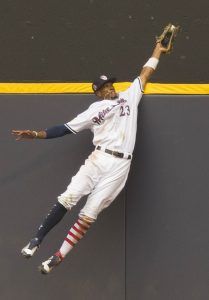
Broxton, who’s one of the league’s flashiest defenders in center field, has been a fixture on the rumor mill since the back half of last winter, when the Brewers traded for Christian Yelich and signed Lorenzo Cain in a matter of days. Plate appearances in Milwaukee were scarce last season for the 28-year-old, who returned to Triple-A for the fourth time, slashing a below-average .254/.323/.421 over 334 plate appearances in one of the minors’ most hitter-friendly yards. In 89 big-league trips to the plate, Broxton managed just a .179/.281/.410 line, though he did post a ridiculous 11 DRS in just 134 center-field innings, a total which bested all but four full-time players at the position.
The former Diamondback and Pirate farmhand, who remains under club control for four additional seasons, has long been beset by an alarming propensity for the swing and miss – in 2017, when he accumulated a robust 463 plate appearances for the Crew, Broxton’s 37.8 K% was the highest in baseball among all near-full-time players; in 2016, he struck out over 36 percent of the time. The totals, though, are somewhat offset by a willingness to work counts and an especially-discerning eye vs. left-handed pitching – in 252 career plate appearances against lefties, Broxton sports an excellent 15.5% BB rate, and should represent a quality weak-side platoon option for New York at any outfield position, should Brandon Nimmo or Michael Conforto sputter against same-side arms next season.
For the Mets, the move goes a long way toward addressing the team’s outfield depth, one of its few remaining offensive holes. Juan Lagares, who profiles almost identically to Broxton, as a late-twenties, right-handed, light-hitting quality defender in center, was the penciled-in starter at the position, but the longtime Met has found it almost impossible to stay healthy for a good portion of the season, appearing in just 203 combined games since the outset of the 2016 season. Yoenis Cespedes, who underwent a second heel surgery in October, has also been routinely shelf-ridden, and may miss the entirety of 2019. The other two spots are locked down by Nimmo and Conforto, but the club had precious little depth aside. Such a move likely removes A.J. Pollock from the team’s offseason table, though New York had lately seemed a fringe-at-best candidate for his services anyway.
The Brewers, as mentioned, were dealing from an outfield surplus: in addition to reigning All-Stars Cain and Yelich, the club also sports Ryan Braun and Eric Thames as corner options, and just moved one-time regular Domingo Santana for another, left-handed outfielder Ben Gamel. The 2019 outlook for Broxton didn’t figure to brighten, so dealing the soon-to-be 29-year-old seemed prudent indeed for the defending NL Central champs.
Wahl, 26, will bring his highly-touted fastball/slider mix to one of the league’s deepest bullpens. Acquired by New York in a midseason deal that sent righty Jeurys Familia to Oakland, Wahl spent most of his time at Triple-A Nashville last season, where he sported a prodigious 14.75 K/9 over 39 2/3 innings. The flamethrowing righty has struggled with an array of injury issues in the past, including a thoracic outlet procedure in 2017, but looked mostly healthy last season. Command has also been a problem – in short big-league stints with the A’s and Mets, Wahl has walked a troubling 5.54 men per nine, and Steamer projects the total at 4.36 for the upcoming campaign.
Hill, 21, was the Mets’ 4th-round selection in the 2018 draft. In 15 short-season A-ball innings, the 6’6 righty struck out a promising 26 batters in just 15 1/3 IP. Baseball America’s pre-draft scouting report lauds Hill’s “heavy” fastball and projects mid-rotation upside, with the caveat that his secondary offerings can be “inconsistent” and his command “at times erratic.” The South-Carolina born product checked in at #24 on FanGraphs’ latest ranking of the New York farm.
Valerio, 18, was signed in early 2018 as an international free agent from the Dominican Republic. The now-shortstop stands just 5’7 but showed well in his initial professional exposure, slashing .319/.409/.433 for the Mets’ Dominican Summer League affiliate.
Photo courtesy of USA Today Sports Images.
Quick Hits: Giants, Brewers, Spangenberg, Orioles
First-year Giants President of Baseball Ops Farhan Zaidi isn’t feeling the pressure of the offseason quite yet, in part because the offseason action has shifted later and later into the winter. Zaidi doesn’t care to comment publicly about any specific trade talks or which free agents the team might be targeting, but he knows the San Francisco fanbase is growing restless, per Henry Schulman of the San Francisco Chronicle. Madison Bumgarner remains their biggest trade chip, but assuming the World Series hero stays in the Bay, relievers Tony Watson and Will Smith have drawn the most interest around the league. Still, their new President is in no rush to jump the market. Despite coming to SF from LA, Zaidi is a small market strategist who spent his first ten years in the game with Oakland before working under long-time Rays’ GM Andrew Friedman. Large market teams like SF and LA have poached front office personnel from smaller markets in part to better avoid the exact type of splashy free agent signing that fans crave. All signs point to Zaidi bringing the Dodger model to the Bay – which isn’t huge payrolls and headline free agents – it’s creative, innovative “small market” thinking first, and dipping into the reserves of their large market second.
- The Milwaukee Brewers are fairly confident that offseason signee Cory Spangenberg has room to grow in a couple areas of his game, per Tom Haudricourt of the Milwaukee Journal Sentinel. GM David Stearns sees some unrealized power potential in the 6’0″ infielder, but the more actionable area of growth for Spangenberg is his versatility. He mostly played second base and third base as a Padre, with occasional spurts in the outfield (in 2017, he got 25 starts in left field). Stearns sees Spangenberg continuing with outfield work, as well as picking up some time at shortstop in the spring. Defensive metrics haven’t raved about Spangenberg’s work at any position, but even if he’s only a passably below-average defender, there’s something to be said for being passably below-average all over the diamond.
- The hallways at Orioles HQ aren’t exactly bustling with activity, but the analytics, coaching and front office teams are beginning to fill out. With less than six weeks before the opening of Spring Training, GM Mike Elias is comfortable being in the early stages of building, shaping and refining those departments. Nonetheless, Baltimore’s front office team is – in the fateful parlance of the Emperor – fully armed and operational, per Jon Meoli of the Baltimore Sun. After clearing out much of the staff both before and after the hiring of Elias, those remaining staffers have been given more responsibility until key vacancies are filled. Koby Perez takes over one of those key roles as the new senior director of international scouting, a position with greater import in Baltimore than perhaps any other organization in the league, as his responsibilities include the management of their robust international bonus pool money. Though they have until June 15th to spend that money, Elias and Perez recognize that the international scouting process is typically a years-long, not a months-long process, per MLB.com’s Joe Trezza, and they are in no rush to spend to the limit. Though they can spend close to $6MM in that area, they are by no means required to, and there are many areas internally where that sum of money could be put to use.
NL Notes: Cubs, Epstein, Brewers, D’Backs, Cotham
It continues to be a quiet offseason for the Cubs, though president of baseball operations Theo Epstein tells Paul Sullivan of the Chicago Tribune that the team remains active in exploring various options for upgrades. “There are times to be aggressive and times to be patient, and there are times when you can be aggressive and times where you have to be patient,” Epstein said. “Every offseason is unique. We’re working hard, and there are a lot of things we’re trying to do behind to the scenes to make sure we have a successful season next year. I know thus far we haven’t added the big names that get the fans excited. I understand that’s part of the expectations in the offseason.” Trades, moreso than free agents, have taken up much of Epstein’s time as of late, he said. This could potentially tie into the biggest recent item concerning the Cubs, namely the possibility that they could make a play for Bryce Harper if they can carve out enough payroll room.
More from around the Senior Circuit…
- Even with Cory Spangenberg now officially in the fold, the Brewers continue to be open for business in looking for infield help, general manager David Stearns told MLB.com’s Adam McCalvy and other reporters. A “wide variety” of free agent infielders are under consideration, as well as trade possibilities, and the option of acquiring a third baseman and then shifting Travis Shaw back to second base.
- MLB.com’s Steve Gilbert doesn’t see the Diamondbacks trading Archie Bradley or Jake Lamb this offseason, though in Lamb’s case, that could be due in part for his injury-shortened down year in 2018. Arizona’s trade of Paul Goldschmidt is the defining move of its offseason, and while the team may still be weighing trades of Zack Greinke, David Peralta, or others, the D’Backs have resisted going into a full rebuild. Bradley is only arbitration-eligible for the first time this winter, so he’s still a long-term piece for the D’Backs who could factor into the team’s plans when it again makes a full-on push for contention.
- The Reds announced a series of organizational hires yesterday, including a familiar name joining the coaching staff. Former Reds right-hander Caleb Cotham has been hired as assistant pitching coach, working under pitching coach (and Cotham’s former coach at Vanderbilt) Derek Johnson. Cotham pitched in parts of seven seasons as professional ballplayer, including 35 games and 34 innings for the Yankees and Reds in 2015-16, before retiring prior to the 2017 campaign.
Brewers Sign Cory Spangenberg
TODAY: The Brewers have officially announced the signing.
DEC.20: The Brewers are in agreement on a one-year, Major League contract with infielder Cory Spangenberg, pending a physical, tweets Ken Rosenthal of The Athletic. It appears to be a split contract for Spangeberg (who has a minor league option remaining), as Rosenthal notes that he would earn $1.2MM in the Majors and $250K in the minors. Spangenberg is represented by Jet Sports.
Milwaukee is known to be in the market for infield options, particularly after non-tendering Jonathan Schoop, though the split nature of Spangenberg’s deal underscores the fact that he’s viewed more as a depth option than a primary addition for general manager David Stearns and his staff. The Brewers figure to continue exploring the market for a higher-profile solution, though Spangenberg’s ability to play second base or third base could very well put him in the mix for a bench job this spring.
Spangenberg, 28 in March, was the 10th overall selection in the 2011 draft but has yet to cement himself as a regular contributor at the MLB level. While he showed promise in his first few looks at the Majors, hitting .274/.330/.408 through 410 plate appearances, Spangenberg’s bat has gone dormant since that time. From 2016-18, he managed just a .251/.312/.384 slash through 868 plate appearances for the Padres while seeing time at second base, third base and in left field.
NL Central Notes: Reds, Winker, Dozier, Martinez
As they ramp back up following some holiday downtime, the Reds are still looking at external center field candidates, president of baseball operations Dick Williams tells Mark Sheldon of MLB.com. However, Williams expresses confidence that in-house options like Scott Schebler and Phil Ervin can handle center field if needed, and he also lists top prospect Nick Senzel as a possibility there. “If this is the group we go into camp with, I think we’d be open-minded there,” said Williams of his current outfield mix. “But between now and Spring Training, we’ll continue to look at ways to address that area.” Cincinnati already has Matt Kemp, Yasiel Puig, Schebler, Ervin and Jesse Winker as options in the outfield.
Regarding Winker, who has posted a terrific .299/.397/.460 slash through his first 136 MLB games, Williams indicated that the Reds still view him as an everyday option or, at the very least, “a very consistent regular contributor.” Winker’s playing time could be cut into by the additions of veterans Kemp and Puig, though he’s coming off surgery in his non-throwing shoulder, so perhaps some additional rest would prove beneficial.
Here’s a bit more from the NL Central…
- The Brewers “like” free-agent second baseman Brian Dozier, writes Ken Rosenthal of The Athletic in his latest notes column (subscription required), though there’s no clear indication that the two sides have had any substantial talks to this point. Bringing Dozier into the fold would give Milwaukee a potential short-term bridge to prospects Keston Hiura and Mauricio Dubon while affording the longtime Twins slugger to rebuild some value in the wake of a poor 2018 season which was hindered by knee troubles. From 2014-17, Dozier hit .254/.338/.476 and averaged 32 homers per season, but he faceplanted with a .215/.305/.391 slash between Minnesota and Los Angeles last year.
- Rosenthal also writes that one executive from a rival club feels the Cardinals are becoming decreasingly likely to move Jose Martinez in a trade this winter. The late-blooming 30-year-old has hit .309/.372/.478 with 31 homers, 44 doubles and a triple through his first 915 MLB plate appearances since debuting in 2016, though his pronounced defensive shortcomings at first base and in the outfield have made him a potential trade candidate. That, of course, hardly precludes a trade, but it seems the Cards may be more keen on keeping Martinez as a bench bat now that they don’t need to rely on him for a full slate of games following the acquisition of Paul Goldschmidt. Martinez only has two years and 27 days of Major League service time, leaving him a year shy of arbitration eligibility and giving the Cardinals another four seasons of club control before he can become a free agent. Given that Martinez isn’t likely to earn much more than $600K in 2019, the Cardinals aren’t under any sort of pressure to move him unless they receive immediate MLB-ready help at a position of greater need.
Latest On Sonny Gray
Yankees right-hander Sonny Gray has been on the trade block all offseason, but the club hasn’t found an offer to its liking for the 29-year-old. There’s at least one serious suitor for Gray, though, as Jon Morosi of MLB.com tweets that the Brewers are still prominently in the mix for him. Meanwhile, the NL Central rival Reds are fading in the race, Morosi adds.
A slew of teams have kicked the tires on Gray this winter, but despite his difficulties in 2018, the Yankees reportedly want “high-end” big leaguers in exchange for him. They apparently haven’t been able to find that type of offer for Gray, who’s coming off a season to forget and only under control through 2019 (at a projected $9.1MM). Gray struggled to a 4.90 ERA with a career-worst 3.94 BB/9 in 130 1/3 innings last season, and even lost his place in the Yankees’ rotation. However, the former Athletic’s 2018 issues were essentially limited to the hitter-friendly Yankee Stadium, as evidenced by his 3.17 ERA/2.65 FIP in 71 innings away from the Bronx. Gray has historically been an effective starter, having logged a 3.66 ERA/3.74 FIP in 900 2/3 frames since debuting in the majors in 2013.
While Gray’s a candidate to bounce back in 2019, it doesn’t appear it’ll happen in New York. Since general manager Brian Cashman admitted in mid-October that Gray would likely be better off elsewhere, the executive has acquired left-hander James Paxton from the Mariners and re-signed fellow southpaws J.A. Happ and CC Sabathia in free agency. With those three set to join righties Luis Severino and Masahiro Tanaka, the Yankees already have a capable five-man rotation heading into 2019.
The Brewers, meanwhile, don’t look to be as fortunate as the Yankees when it comes to current starting options. Although Milwaukee came within a game of a World Series berth in 2018, its success came without a great-looking rotation, and the unit has since seen Wade Miley and Gio Gonzalez become free agents. It’s now down to Jhoulys Chacin, Chase Anderson, Zach Davies, Brandon Woodruff and the rehabbing Jimmy Nelson, among others, set to vie for starting roles. There’s an argument that Gray has a better overall track record than any of the Brewers’ starters, and it’s worth pointing out that GM David Stearns has been chasing him for a while. Before the A’s traded Gray to the Yankees in July 2017, the Brewers were among the teams with interest in him.
Like the Yankees, the Reds have already addressed their rotation in multiple ways this offseason. In separate trades this month, the club has acquired righty Tanner Roark from the Nationals and lefty Alex Wood from the Dodgers. As things stand, they’ll join righties Luis Castillo, Anthony DeSclafani and Tyler Mahle in the Reds’ 2019 rotation. But it does seem the Reds will pick up yet another starter before the offseason’s out, so perhaps it would be unwise to rule out a Gray acquisition. Notably, Gray and Reds pitching coach Derek Johnson have familiarity from their time together at Vanderbilt, where the former was a star hurler and the latter one of the Commodores’ coaches.
3 Remaining Needs: NL Central
Our 3 Remaining Needs series slides west to the NL Central, another lively offseason division with a surprise player moving to the fore. Though heavy lifting may have concluded in many of the NL’s charter cities, others still have piles of work at hand. Let’s get to the most pressing needs for each of the five teams in the NL’s staunchest division last season (teams listed in order of 2018 standings) . . .
[Previous installment: NL East]
Milwaukee Brewers
- Address second base. The keystone was a black hole for an otherwise prodigious lineup last year, with midseason acquisition Jonathan Schoop performing so badly at times that 6’4, 230 pound Travis Shaw was asked to learn the position. With the likely impending departure of 3B Mike Moustakas, Shaw will slide back across the diamond, leaving a gaping hole at second. Top prospect Keston Hiura is on the way, but may still be a year or so off, and the options at hand are, in the interim, woefully insufficient. The club has been connected to free agent Jed Lowrie, but may prefer a short-term stopgap to keep Hiura’s spot warm.
- Add a proven arm to the rotation. Milwaukee’s rotation consists, at current, of three number-five starters, three rookies vying for the fourth and fifth spots, and a rehabbing Jimmy Nelson set to make his return at some point early in the season. Ideally, the club would be a perfect fit for a top-end hurler, but seems to have neither the financial nor the prospect capital to make such a deal happen. Corbin Burnes, Brandon Woodruff, and Freddy Peralta all had promising debuts last season, but the Crew would do well to somehow slot a proven commodity into the mix.
- Find a legitimate backup shortstop. Former top prospect Orlando Arcia‘s 2018 season was, to put it mildly, not a good one. The purported defensive wiz was anything but magical on that side of the ball last season, to say nothing of his league-worst 54 wRC+. If he again slumps out of the gate, the club can’t exactly look to Tyler Saladino or Hernan Perez to hold down the fort, especially given its question marks at second. A veteran backup capable of handling the bat against both sides (and, perhaps, handling second-base duties in a pinch as well) would be a perfect fit for the reigning division champs.
Chicago Cubs
- Solidify the back end of the bullpen. An aging Cubs pen that struggled with the free pass last season faces further uncertainty at present, what with the loss of Jesse Chavez and the hazy future of closer Brandon Morrow, who’s found it nearly impossible to stay healthy for a full major-league season. Upper-minors reinforcements are scarce, so the club will likely have to dip into what little reserves it has or scour the fringes of the market for a bargain pickup.
- See if Jason Heyward‘s albatross can be moved (with cash incentive). This is speculative, at best, but the Cubs have as few holes as any team in baseball, and still lurk at the edges of the Bryce Harper market. Finding a team willing to take on at least some of the $118.5MM still owed to Heyward could be just enough to lift the free-spending Cubbies to the Harper Sweepstakes’ fore; the club, after all, would still boast a number of capable right-field options for the upcoming campaign even if they were to deal Heyward and miss on the 26-year-old superstar.
- Add depth in the upper minors. Star-caliber graduations from 2015-17 have decimated a farm that was once the jewel of the National League. At current, the system offers little in the way of high-impact talent, which could be a major impediment to a big mid-season acquisition, should the Cubs be hit by injuries and/or ineffectiveness. Both Ian Happ and Kyle Schwarber could be leveraged in this way – with multiple years of team control remaining for each, the prospect capital acquired could be, come July, the lone bullet(s) in the Cubbies’ gun.
St. Louis Cardinals
- Find a taker for Jose Martinez. Martinez has raked to the tune of a 130 wRC+ after years of uneven performance in the minors since debuting for the club in late 2016. The acquisition of Paul Goldschmidt, however, and the 30-year-old’s frightening defense in an outfield corner, make him a much better fit elsewhere, ideally on an AL club. Though the return might be insubstantial, even with his four years of team control remaining, it’ll likely add more value to the club than Martinez will as a part-time fill-in and occasional pinch-hitter.
- Continue to add to the bullpen. Despite possessing a hothouse of flame-throwers in the pen, the 2018 unit was arguably the NL’s worst (4.50 xFIP, 4.34 BB/9). The club took a major step to address the issue with last week’s signing of Andrew Miller, but it’s still a unit light on track record and heavy on control issues. The Giants’ Will Smith and Tony Watson, former Central stalwarts both, have each been linked with the Redbirds this month, and either could catapult the club to a place very near the projected top of the division.
- Add a lefty bat. In addition to the perennially-awesome Matt Carpenter, the Cards’ only other left-handed regulars are the mercurial Kolten Wong and the will-be 33-year-old Dexter Fowler, who often struggled to hit the ball out of the infield last season. The bench, too, is stacked mostly with solid right-handed hitters of all types – there is, it seems, scarcely a club out there in more dire need of left-handed infusion, and this one might need a couple.
Pittsburgh Pirates
- Add to the rotation. The unit, though possessing of four proven MLB arms, is arguably the division’s thinnest – after the 3-4 of Joe Musgrove and Trevor Williams, the latter of whom has posted consecutive shaky-peripheral (4.54 xFIP, 6.64 K/9 in ’18) seasons, the club has little on which it can depend. Chad Kuhl, dreadful anyway in ’18, had Tommy John in September, and youngsters Nick Kingham and Clay Holmes showed little in their scattered opportunities. Top prospect Mitch Keller is close, but the team would be well-served to add a couple proven, back-end arms (in addition to the newly-signed Jordan Lyles, who’s spent much of the last three seasons as a reliever) to cover their backs.
- Find a shortstop. Following the departure of longtime Pirate Jordy Mercer, the club is left with just a combination of Kevin Newman and newly-acquired Erik Gonzalez at the position, neither of whom inspire much confidence on the offensive side. The Buccos have long prized defense at the position, and may indeed be content with a combination of the two, but a sub-70 wRC+ anywhere on the diamond is a gaping hole, regardless of defensive prowess.
- Assemble more depth on the bench. Gregory Polanco will already miss the first two months of the season, at the very least. If Starling Marte or Corey Dickerson incurs an injury, the club’s outfield mix will look exceptionally weak. Positional versatility, a hallmark of the successful Pirate teams of the mid-decade, is in short supply on the current version, and the club will need to bolster its depth if it harbors any real hope of contending in an increasingly difficult division.
Cincinnati Reds
- Make another impact move. The club, which for years has been an absentee on the free-agent market, and hadn’t made an industry-shaking acquisition since 2011’s trade for Mat Latos, has already announced its intention to contend this offseason, jettisoning far-away talent for short-term impact in a pair of December trades to acquire Tanner Roark, Yasiel Puig, Alex Wood, and Matt Kemp. But, given the quality of the Central, the returns aren’t nearly enough; the Reds are still at least seven, and perhaps closer to ten or twelve, wins away from seriously challenging for a playoff spot. Landing an elite-level talent via trade – which the club, with a throng of upper-level projected regulars on the farm, is certainly capable of doing – could catapult them squarely into the mix.
- Shore up center field. Following last week’s procurement of Kemp and Puig, the Reds are flush with outfield thump from both sides, but are still left without a true center fielder in their midst. It’s true that Great American Ballpark has less space in the outfield than most, and that the club has been successful with a decaying Shin-Soo Choo manning the position for much of a season, but the rotation is a contact-heavy one that will undoubtedly suffer with a subpar defender left free to roam. Top prospect Nick Senzel could be an option, but the club will likely be best-served to pluck its feast from outside the organization.
- Add depth to the bench/pen. Both units here are severely undernourished – an infusion would require perhaps three 85 FIP- or lower bullpen arms, and bench bats capable of handling multiple positions and offering adequate output at the plate. It’ll be a tall task to imbue the club with this much reinforcement, but a necessary one if Dick Williams, Nick Krall, and Co. hope to contend next season.
Market Notes: Cruz, Harper, Kluber, Bauer, Ottavino, Harrison
Prior to this morning’s agreement with the Twins, slugger Nelson Cruz received “competitive” offers from both the Rays and Astros, according to Juan Toribio of The Athletic (Twitter link) and Fancred’s Jon Heyman (Twitter link). Specifics aren’t known, but it seems likely that the Twins would’ve had to outbid either by a fairly notable margin, given that the Rays won 90 games last season while the Astros won the 2017 World Series and appeared in a second consecutive American League Championship Series this past season. Minnesota ultimately secured Cruz with a $14.3MM bid that includes a $14MM salary for the 2019 season and a $12MM club option ($300K buyout) for the 2020 campaign. If Houston or Tampa Bay is still keen on adding a notable right-handed bat, there should be numerous options in play. The rebuilding Tigers, for instance, would likely be willing to move Nicholas Castellanos as he enters his final season of club control. The Cardinals, meanwhile, could move Jose Martinez to an American League club that’d be better suited to mask his defensive shortcomings at the DH spot.
Some more notes on the both the trade and free-agent markets…
- The Cardinals have been an oft-speculated landing spot for Bryce Harper but have not been rumored to have any meaningful interest in the market’s top free agent. Derrick Goold of the St. Louis Post-Dispatch explored the situation in his latest Q&A with readers, explaining the numerous reasons that the Cardinals feel a pursuit of Harper would differ from their prior pursuits of huge contracts for David Price, Jason Heyward and Giancarlo Stanton. Above all else, it seems that the sizable discrepancy between Harper’s asking price and even those other substantial contracts is a roadblock for the St. Louis front office. The Cards also don’t have the personal connection with Harper that they had after a year of having Heyward in the clubhouse, and they’re generally averse to the leverage that opt-out clauses provide players on lengthy free-agent deals.
- In an appearance on MLB Network’s Hot Stove this morning, Anthony Castrovince of MLB.com downplayed the possibility of the Indians trading a top starter (video link). “I don’t think it’s particularly likely they move either Corey Kluber or Trevor Bauer at this moment,” said Castrovince, citing sources with the Indians. While he cautioned that things can change with a single call or text, the roughly $21MM saved in trades of Yan Gomes, Edwin Encarnacion and Yonder Alonso has alleviated pressure to pare back payroll from its record levels in a 2018 season that saw the total attendance decline. That, of course, doesn’t mean rumors or conversations surrounding Kluber will cease — they assuredly will not — but it’s worth keeping in mind when parsing the inevitable continuation of Kluber rumblings. More than 18,000 readers voted in last night’s MLBTR poll asking whether Cleveland would actually trade Kluber, and the response was a near-even split (52-48 in favor of Kluber being moved).
- The White Sox, Red Sox and Rockies are all maintaining some level of interest in free-agent reliever Adam Ottavino, tweets Jon Morosi of MLB.com. As one of the top relievers on the market, the 33-year-old Ottavino should have no shortage of clubs inquiring about his services, though the asking price on top-end bullpen arms could prove prohibitive for some clubs. To this point, Jeurys Familia (three years, $30MM), Joe Kelly (three years, $25MM) and Andrew Miller (two years, $25MM) are among the relievers MLBTR ranked in Ottavino’s tier of free agency to have cashed in quite nicely. Given his 2.43 ERA, 2.74 FIP, 2.82 SIERA and 13.0 K/9 mark, Ottavino figures to have a fairly high ask, as well. The interest from each of the three teams listed by Morosi has been previously reported, and there are some issues with some of the fits. Adding Ottavino, for instance, could push the Red Sox back into the top tier of the luxury tax bracket. And the Rockies spent more than $100MM on their ‘pen last winter, which could make them reluctant to add a fourth reliever on the type of multi-year contract Ottavino should ultimately command.
- Heyman tweets that infielder/outfielder Josh Harrison has current interest from the Nationals, Reds, Rangers, Giants and Brewers, and he could ultimately generate interest from teams like the Yankees, Phillies and Dodgers — depending on how their pursuits of the market’s top free agents pans out. (Presumably, the Phillies or Yankees would have interest in the event that either failed to land Manny Machado.) Harrison would give the Nats a potential regular option at second base, while the Rangers are in need of a third baseman following the trade of Jurickson Profar. Joe Panik‘s stock is down in San Francisco, and the Brewers, too, are in need of an everyday option at either second or third (depending on where they play Travis Shaw in 2019). The fit for the Reds is a bit more muddied, as Harrison would appear to be more of a bench option there, though it’s worth noting that he is a Cincinnati native.
NL Central Notes: Goldschmidt, Graveman, Reds, Santana
Derrick Goold of the St. Louis Post-Dispatch writes that the Cardinals believe they have a sense of what it would take to extend recently acquired first baseman Paul Goldschmidt as well as the ability to make a “strong, market-right offer” to the slugger. A five-year extension offer from the team “would look something like five-years, $150 million,” per Goold, who suggests that it’s possible that the Cards could tweak an offer to technically be for six years and subsequently include a bump in Goldschmidt’s 2019 salary. All of that, of course, depends on how comfortable Goldschmidt is in betting on himself, how strongly he wants to test free agency and how he takes to his new environs in St. Louis. And, it should also be emphasized, it does not appear that any formal offer has been made at this point. The suggested terms would align closely with the $151MM extension signed by Jose Altuve in Houston last offseason, although Altuve’s new contract begins in his age-30 season, while any deal extending St. Louis’ control of the already 31-year-old Goldschmidt would begin in his age-32 campaign.
More from the division…
- Newly signed Cubs right-hander Kendall Graveman isn’t likely to pitch in 2019 as he recovers from Tommy John surgery, but as he explained in a recent appearance on MLB Network Radio on SiriusXM (Twitter link, with audio), he’s viewing the rehab process as an opportunity to learn from an experienced Cubs rotation and a progressive, young coaching staff. “That’s something I don’t take for granted,” said Graveman of being a teammate of pitchers like Cole Hamels, Jon Lester and Kyle Hendricks. “I’m going to be in an organization that has got a lot of experience at not only at the big league level but in playoffs, and I think that excites me. It’s something that, while I’m not performing on the mound, I can be a student of the game and learn under these guys. … What they’re going to be able to teach me during this process of not pitching, is something that, almost, you can’t get while you’re pitching.”
- The Reds have already added a pair of starters to their rotation, picking up a pair of one-year rentals in the form of Tanner Roark and Alex Wood, but MLB.com’s Mark Sheldon writes in his latest Inbox column that the team has “made it clear” that it hopes to continue making additions. However, while Cincinnati has been connected to Dallas Keuchel, the top remaining free-agent lefty on the market, Sheldon suggests that the Reds will be “very careful and likely hesitant” when it comes to taking a risk of that magnitude. Keuchel’s asking price has been reported to be as high as six years, and MLBTR predicted a four-year, $82MM contract for the former AL Cy Young winner at the outset of free agency.
- Last week’s trade of Domingo Santana to the Mariners was in part motivated by the fact that he’s out of minor league options, Brewers general manager David Stearns told reporters following the swap (link via Todd Rosiak and Tom Haudricourt of the Milwaukee Journal-Sentinel). Ben Gamel, acquired from Seattle in the deal, can still be optioned freely for another season. Milwaukee likely could’ve received more in return for Santana had he been traded last offseason, when he was coming off a stronger year and had more team control remaining. Stearns, however, didn’t express regret over not trading Santana last winter. “I don’t know if our evaluation of Domingo ever wavered from being a really talented player,” said the GM. “…[W]e brought in some really talented outfielders last year and Domingo got off to a slow start, and never really recovered to regain significant playing time at the major-league level. … We do think Domingo is a really talented player and a true professional. I think he’s going to do well in Seattle.”