
Freddy Peralta Has Tried To Get New Extension With Brewers
Right-hander Freddy Peralta is in the final guaranteed year of his deal, though the Brewers have a club option to keep him around for 2026. Jon Heyman of The New York Post reports that Peralta has tried to get an extension done to keep him in Milwaukee longer but hasn’t yet been successful.
Peralta and the Brewers have already signed one extension. In February of 2020, they agreed to a five-year deal that guaranteed him $15.5MM over the 2020-24 campaigns. That bought out his remaining pre-arbitration and arbitration seasons. The club added two extra years of potential control via affordable $8MM club options for 2025 and 2026. They already triggered the first of those options.
Another extension would cost far more. At the time of the first one, Peralta wasn’t even established as a bonafide major league starter. He had 163 1/3 innings under his belt, over 22 starts and 33 relief appearances. His 30% strikeout rate was high but he had walked 11% of batters faced and was sporting a 4.79 earned run average. He was still two years away from qualifying for arbitration.
Things have certainly changed since then. Peralta has not only established himself as a starter, but he’s proven himself to be a great one. He stayed primarily in a relief role in 2020 but has been almost exclusively in the rotation since then, with just one relief appearance in both 2021 and 2022. On the whole, from 2021 to 2025, he has thrown 638 2/3 innings for the Brewers with a 3.40 ERA, 29.3% strikeout rate and 9% walk rate. He hasn’t been on the injured list since 2022. FanGraphs has credited him with 12.6 wins above replacement for that span, putting him in the top 20 of all pitchers in the majors.
He is at a point where he could rightly ask for a nine-figure deal. In the past five years, six other pitchers have hit the century mark on extensions as they neared free agency, as shown on MLBTR’s Contract Tracker. Zack Wheeler‘s deal is a bit of an outlier in the group, since that was for his age 35- to -37 seasons. As for the other five, Garrett Crochet got $170MM over six years, José Berríos $131MM over seven, Tyler Glasnow $111.6MM over four, Luis Castillo $108MM over five and Joe Musgrove $100MM over five. In each case, the player was within two years of reaching free agency.
Crochet got to another level presumably because of his age, as he was slated to hit free agency just after his 27th birthday. Berríos also had youth on his side, as he was slated for free agency ahead of his age-29 season. Castillo and Musgrove were 30 in the first years of their respective pacts. Glasnow’s deal started with his age-31 season. Peralta is currently 29, so he’ll be 30 next year, the final club option on his current deal.
Peralta’s stats put him in a similar range to those guys. He doesn’t have Crochet’s youth but his major league track record is longer. Glasnow had a 3.03 ERA in the five years prior to signing his deal but obvious workload concerns. Berríos, Musgrove and Castillo were more reliable but had respective ERAs of 3.74, 3.61 and 3.64 in the five-year stretch leading up to their pacts, fairly close to Peralta’s 3.40 mark.
Assuming Peralta is looking for a similar guarantee to those players, it’s not surprising that the Brewers haven’t given it to him. They have only twice gone into nine-figure territory on a contract, doing so for position players both times. Ryan Braun got $105MM way back in 2011 and Christian Yelich got $188.5MM in 2020.
On the pitching side, they have been far more conservative. Matt Garza‘s $50MM deal in 2014 is still the franchise record. In the past decade, Peralta’s first deal is actually near the top of the list. Aaron Ashby also signed an early-career extension, getting to $20.5MM, which is the most the Brewers have spent on a pitcher in the past ten years.
The lack of a deal will naturally lead to speculation about a Peralta trade. It’s well known that the Brewers aren’t afraid to trade players who are nearing the open market. Josh Hader and Corbin Burnes are two of the most notable examples. Hader was traded at the 2022 deadline, when he was 15 months from free agency. Burnes was traded going into the 2024 season, his final year of club control.
The Brewers also suddenly have a loaded rotation, despite dealing with a number of injuries earlier in the season. The current logjam is such that Aaron Civale, a solid veteran starter, got bumped to the bullpen. He asked to be traded and that request was granted, as he was flipped to the White Sox earlier today.
Trading Peralta now would be a much different matter, however. Civale is more of a back-end guy and he may not have been on track for being part of a postseason rotation. Peralta, on the other hand, is the club’s ace the most surefire postseason starter they have. Jacob Misiorowski has exciting stuff but has just one major league start under his belt. Chad Patrick and Quinn Priester are also fairly inexperienced. Jose Quintana is a veteran soft tosser at this point in his career. Nestor Cortes and Brandon Woodruff are currently on the injured list.
The Brewers understandably felt they could survive without Civale. Woodruff could be back in the mix soon. They also have Logan Henderson, who pitched well in the majors earlier this year, on optional assignment. Tobias Myers, who had a good year in 2024, is in Triple-A as well.
But subtracting an ace would be much more of a white flag for the season. The Brewers are currently just 2.5 games out of a playoff spot and probably wouldn’t consider a Peralta trade unless they fell further back in the standings. Heyman writes that there is belief in the industry that the Brewers will hold Peralta and pick up his option for next year, though it’s always possible they are compelled to change their minds by an offer that is too good to pass up.
The Brewers did deal Hader when he was at this stage of his club control, though the short-term results on that deal were bad. It was reported that the move didn’t go over especially well in the clubhouse and the club faded down the stretch. In the long run, it worked out well, however. The Brewers got Robert Gasser and Esteury Ruiz in that deal, later using Ruiz to get catcher William Contreras.
Perhaps a Peralta trade becomes more likely in the offseason when he’s a year away from the open market, as that was when they flipped Burnes. By that time, perhaps they feel better about Misiorowski, Patrick or Gasser stepping up to replace Peralta at the front of the rotation.
There are many variables at play, but with a new contract unlikely, Peralta rumors are likely to swirl until he is traded.
Photo courtesy of Michael McLoone, Imagn Images
Brewers’ Aaron Civale Requests Trade
The Brewers moved right-hander Aaron Civale to the bullpen yesterday in order to accommodate the promotion of top prospect Jacob Misiorowski. At the time, skipper Pat Murphy openly acknowledged that Civale — an impending free agent who’s never made a relief appearance in the majors or minors — was “not happy” about the role change. Less than 24 hours later, Ken Rosenthal and Will Sammon of The Athletic report that Civale has requested a trade.
Civale’s agent, Jack Toffey, tells Rosenthal and Sammon that the conversation he had with the Brewers baseball operations staff was “very professional” and that Civale would prefer to continue his career as a starter, especially with free agency on the horizon. It’s an understandable position, particularly since Civale has generally been pitching well out of the rotation recently. The 30-year-old righty landed on the injured list due to a hamstring strain after one start this season but has returned with 19 innings of 3.32 ERA ball. He’s fanned 21.3% of his opponents against a 7.5% walk rate in that time and hasn’t allowed more than two runs in any of those four appearances.
The Brewers bought low on Civale in an early-July trade with the Rays last year. He’d gotten out to a rocky start to the 2024 campaign with Tampa Bay but righted the ship upon his trade to Milwaukee. In 14 starts over the season’s final three months, Civale logged a 3.53 ERA with a 20.9% strikeout rate and 8% walk rate. Coupled with this year’s five starts, he’s pitched 96 innings as a Brewer and turned in a 3.84 earned run average with a 20.7% strikeout rate and 7.9% walk rate — all solid numbers for any team’s fourth or fifth starter.
Civale has generally averaged five innings per start, but that’s due in large part to the Brewers’ own tendency to hook their pitchers quickly. Milwaukee lets pitchers face opponents a third time in a game less often than all but one other team in baseball (Miami), and Civale’s career splits the second and third trip through a batting order are nearly identical; opponents hit him at a .257/.307/.451 clip their second time facing him in a game and .255/.310/.451 the third time. He’s markedly better facing opponents the first time in a game, but that’s true of virtually any starting pitcher. During Civale’s four-plus seasons in Cleveland — the club that originally selected him in the third round of the 2016 draft — he averaged 5 2/3 frames per start and more regularly worked into or completed six innings.
Two months ago, the Brewers having a glut of starting pitching — so much so that one of their veterans requested a trade — would have seemed laughable. Milwaukee was hit hard enough by injuries early in the year that they swung an extremely rare early-April trade to bring in some rotation help, picking up righty Quinn Priester from the Red Sox.
In the nine-plus weeks since that time, Milwaukee has gotten healthier and has seen several young arms emerge — Priester among them. Righty Chad Patrick is one of the front-runners for NL Rookie of the Year honors. Logan Henderson was brilliant in his first four MLB starts but was already optioned back to Triple-A Nashville because of Milwaukee’s depth. Misiorowski’s production in Nashville (2.13 ERA, 31.6 K%) has forced his way into the big league picture. Meanwhile, veterans like Jose Quintana and Civale himself have gotten healthy. Young lefties DL Hall and Aaron Ashby are also back from the IL and are working in multi-inning relief roles. (Hall has also had a pair of three-inning “starts” as an opener ahead of Priester.)
I took a look at the Brewers’ surprising wealth of pitching two weeks ago, noting that some tough decisions were likely on the horizon. Moving Civale to the bullpen falls into that category, particularly since a shift like that can come with precisely this type of ramification. Many fans will find a public trade request off-putting, which is a fair stance to take — just as is the case with Civale’s trade request. As a 2016 draftee, he’s been working nearly a decade to get to free agency and understandably does not love the idea of pitching in a new role that could impact his efficacy on the mound and/or his earning power on the market.
Civale is earning $8MM in 2025, his final year before free agency. As of this writing, there’s about $4.645MM of that sum yet to be paid out. In 122 major league starts, he’s pitched 658 1/3 innings with a 4.06 ERA, a 21.8% strikeout rate, a 6.5% walk rate and a 39.8% ground-ball rate.
Brewers Promote Jacob Misiorowski
June 12: The Brewers announced today that they’ve formally selected Misiorowski’s contract. He’ll start tonight’s game. Righty Easton McGee was optioned to Triple-A in his place, while Woodruff was indeed moved to the 60-day IL to clear a 40-man spot.
June 10: The Brewers are calling up pitching prospect Jacob Misiorowski, reports Jeff Passan of ESPN. The righty will start Thursday’s game against the Cardinals. Milwaukee will need to make room for him on the active and 40-man rosters. The latter should be as easy as Brandon Woodruff being transferred to the 60-day injured list since he’s already been out longer than that.
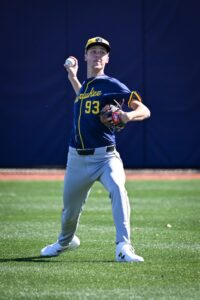
Misiorowski, 23, is one of the top prospects in baseball. The Brewers selected him with a second-round pick in the 2022 draft and signed him with a $2.35MM bonus, more than double the $1.1MM slot value for that pick.
Since then, he has been climbing the ladder with very exciting results. His fastball sits in the high-90s and can get into triple digits. He also has a curveball, slider and a lesser-used changeup. Those pitches have helped him strike out a lot of opponents though control is clearly still a work in progress.
He got a brief professional debut in 2022, making just two Single-A appearances. In 2023, he logged 71 1/3 innings while climbing as high as Double-A. He posted a 3.41 earned run average while punching out 35% of hitters, but he also gave out free passes at a high rate of 13.4%. Last year, he split his time between Double-A and Triple-A, logging 97 1/3 innings. The Brewers moved him to a relief role late in the year as a way of monitoring his workload. He had a 3.33 ERA, 30.5% strikeout rate and 14.4% walk rate.
The numbers have been similar this year. He has logged 63 1/3 Triple-A innings thus far with a 2.13 ERA and 31.6% strikeout rate. His 12.3% walk rate is an improvement for him but still about four ticks above typical major league average, which is 8% for starters this year.
Misiorowski still has some things to work on, particularly the control and the workload, but the arsenal is clearly exciting. Baseball America currently lists him as the #21 prospect in the league. FanGraphs has him at #27. ESPN‘s most recent update put him at #30. Baseball Prospectus had him at #65 in the offseason. MLB Pipeline currently has him further down at #68, with a bit more concern that the control issues will eventually push him to the bullpen. Keith of Law of The Athletic had similar concerns when giving Misiorowski the #87 slot coming into the year.
Time will tell if Misiorowski is destined for the bullpen or can stick in the rotation but it’s understandable that the Brewers will keep trying the starting path until they get some clarity. There’s simply far more value in an excellent starting pitcher compared to an excellent reliever. Even if it doesn’t work out, the bullpen path will still be available as a fallback. Even Law, the most bearish of those prospect evaluators, believes Misiorowski has a future as an elite closer.
For now, the Brewers will see if Misiorowski can evolve into a big league starter. The rotation has been constantly shifting for Milwaukee this year, mostly due to injuries. Woodruff was expected to start the season on the injured list, recovering from last year’s shoulder surgery, but his rehab has also hit a few snags. He battled some ankle tendinitis and also suffered an elbow contusion from a comebacker and is still likely a few weeks away. Robert Gasser had Tommy John surgery last summer and is another guy the club knew would be on the IL to start this year.
In addition to Woodruff and Gasser, several other pitchers have missed some time. Nestor Cortes is still on the shelf, having suffered a flexor strain back in April. Tobias Myers missed time due to an oblique strain. Aaron Civale had a hamstring strain, Jose Quintana a shoulder impingement and DL Hall a lat strain.
Around all those transactions, the club has been trying to find various solutions. Quintana was a spring signing. The Brewers traded for Quinn Priester a week into April. Several minor leaguers have been called up. As the club has been spinning those plates, 12 different pitchers have started for the team already this year. Some of those have been openers, but it’s clearly been a bit of a whirlwind.
As of this moment, the rotation consists of Freddy Peralta, Civale, Priester, Quintana and Chad Patrick, with Hall doing some starting but also some long relief work. It’s not totally clear what the club plans to shift with Misiorowski’s promotion. It could simply be a spot start. Perhaps they will go with a six-man rotation for a while. Priester and Patrick both have options and could be sent down, though Patrick’s numbers this year have been far better than Priester’s.
The Brewers are still in the playoff race. Their 35-32 record currently has them just three games back of the final National League Wild Card spot. Regardless of how they perform over the next few weeks, it’s possible to imagine them trading some starting pitching this summer. Woodruff, Quintana, Civale and Cortes are all impending free agents, which would make them logical trade chips. A bolder move would be Peralta, who can be controlled through 2026 via an $8MM club option.
Sending one or more of them out of town would theoretically downgrade this year’s rotation but the Brewers could perhaps provide replacements from within the system while bolstering another part of the roster or simply adding some prospect talent. Hall could be given a more proper rotation gig. Gasser could get back in the mix later in the year. Myers, Logan Henderson and other arms are in Triple-A and could be recalled.
The Brewers don’t have a lot of spending capacity, so this kind of tough balancing act is normal for them. Recent years have seen them trade away guys like Josh Hader and Corbin Burnes while still trying to field a competitive team. Those trades usually see them targeting a mix of MLB-ready talent and prospects or draft picks. Given the number of rotation options they have in the mix now, another move of that nature may be in the cards this summer.
That will be a situation for the next few weeks. For now, one of the most electric arms in the minor leagues is coming up to the show. As a consensus top prospect, Misiorowski is eligible for the prospect promotion incentives. The Brewers can’t earn an extra draft pick based on his performance in awards voting this year because they didn’t call him up early enough. Misiorowski can earn himself a full year of service time if he finishes in the top two in Rookie of the Year voting, though that will be a long shot. The race is still fairly wide open but Misiorowski is getting called up late and is already near his personal high in innings pitched in a season, so it’s possible the club eases off his workload at some point later in the year.
Photo courtesy of Dave Kallmann, Imagn Images
Brewers Move Aaron Civale To Bullpen
The Brewers plan to move right-hander Aaron Civale from the rotation to the bullpen now that top prospect Jacob Misiorowski has been promoted for his major league debut, manager Pat Murphy tells the team’s beat (link via Adam McCalvy of MLB.com).
It’s a tough shift for Civale, a pending free agent who’s been pitching well since returning from a seven-week stay on the injured list due to a hamstring strain. The 29-year-old righty — 30 tomorrow — has tossed 19 innings with a 3.32 ERA and 17-to-6 K/BB ratio since being reinstated on May 22. The results have been solid, though it bears mentioning that Civale hasn’t exactly been efficient. He’s yet to pitch more than 5 1/3 innings in a start and was lifted from his most recent appearance after 80 pitches in 4 2/3 frames.
Even still, Civale’s first appearance in relief with the Brewers will be the first relief outing of his entire professional career. Since being selected by Cleveland in the third round of the 2016 draft, he’s pitched in 86 minor league games and 122 major league contests. Every single one of them has been a start. Between that history as a starter, Civale’s broader track record of big league success and his run of solid results since returning from the injured list, the move surely comes as a surprise to the righty. Murphy conceded that Civale was “not happy” when informed of the decision.
Milwaukee bought low on Civale just under 11 months ago, sending minor league infielder Gregory Barrios to the Rays in an early July swap to acquire him. At the time of the trade, Civale had limped to an ERA north of 5.00, but he righted the ship with the Brewers and pitched to a 3.53 ERA in 14 starts with Milwaukee over the season’s final three months. Between that solid finish to his ’24 season and his first five starts in ’25, Civale touts a 3.84 earned run average with a 20.7% strikeout rate and 7.9% walk rate in 96 innings as a Brewer.
Civale has averaged only five innings per start, but Milwaukee tends to have quicker hooks on its starting pitchers than most organizations. Only the Marlins have allowed a pitcher to face hitters a third time less often than the Brewers in 2025 — and by a margin of only two batters (243 for Milwaukee to 241 for Miami). Dating back to last year, Milwaukee pitchers have the fourth-fewest instances of facing a batter for a third time within a game. Civale’s career splits the second and third trip through the order are virtually identical: opponents facing him a second time in a game have a .257/.307/.451 slash compared to .255/.310/.451 a third time. (In the Brewers’ and Rays’ defense, those splits were more pronounced in 2024.)
All of that is to say, some frustration from Civale is understandable. Starting games is all he’s known since being drafted, and he’s now being asked to change roles less than three months from free agency at a time when he’s not pitching poorly. However, as I noted when recently looking at Milwaukee’s sudden and surprising glut of starting pitching, some tough decisions were bound to be made.
This certainly falls under that category. The team surely does not take lightly the fact that a move to the bullpen could have real ramifications on Civale’s earning power on the open market, but the alternatives would have been burning Quinn Priester‘s final option year (at a time when he’s also pitching well) or optioning Chad Patrick — one of the NL Rookie of the Year frontrunners. Milwaukee could also have kept Misiorowski in Triple-A, but he’s pitched a 2.13 ERA there this season, including a 1.81 mark with a 33.5% strikeout rate over his past nine starts. Command is an issue — he’s walked 10.8% of opponents in that stretch, including nine in his past seven innings — but Misiorowski’s results and ability to miss bats generally seem worthy of a big league look.
Any mention of a veteran player being unhappy with a role change is going to prompt speculation about a trade — particularly when he’s affordable and playing on an expiring contract. Milwaukee would likely have gotten interest in Civale (and teammates Jose Quintana and Freddy Peralta) for those reasons anyhow, however, and there’s no indication that Civale has asked or will ask for a trade — frustration notwithstanding. Given the frequency of pitching injuries and the unconventional manner in which the Brewers tend to deploy their pitching staff, it wouldn’t be all that surprising if Civale found himself back in the rotation before long.
Today’s news and his manager’s willingness to concede some frustration on the player’s behalf do perhaps nominally increase the likelihood of an eventual trade. That said, one need only look at the Brewers’ deadline dealings over the years and the current state of their pitching staff to realize that a Civale trade was already a distinct possibility regardless.
Brewers Claim Drew Avans
The Brewers announced that outfielder Drew Avans has been claimed off waivers from the Athletics and assigned to Triple-A. The A’s designated Avans earlier this week.
A 33rd-round pick for the Dodgers in 2018, Avans had spent his entire career in the L.A. organization before he signed with the Athletics this past offseason. The move paved the way for Avans’ Major League debut, as he appeared in seven games for the A’s after his contract was selected to the active roster in late May. Avans had only two hits in his 15 trips to the plate, but filled in as a spare outfielder when Tyler Soderstrom was moved from left field to first base to fill in for the injured Nick Kurtz.
Avans has a .275/.374/.408 slash line over 2226 PA at the Triple-A level. All of Avans’ Triple-A experience has come in the Pacific Coast League, so those seemingly solid numbers are perhaps a little below average given the PCL’s hitter-friendly nature. It will be interesting to see how his bat translates to a more normalized hitting environment with Triple-A Nashville of the International League, but perhaps more importantly, Avans will also give the Brewers some depth at all three outfield positions. The Crew have been a little thin in the outfield with Blake Perkins and Garrett Mitchell on the IL, and Christian Yelich primarily being used as the everyday DH.
Tyler Alexander Elects Free Agency
Brewers left-hander Tyler Alexander passed through waivers unclaimed after being designated for assignment and rejected an outright assignment to Triple-A, per Curt Hogg of the Milwaukee Journal-Sentinel. He’s elected free agency instead and is now clear to explore opportunities with any team.
Alexander, 30, inked a one-year deal worth a guaranteed $1MM over the winter. He’s worked in a swingman role with Milwaukee, tallying 36 1/3 innings across 21 appearances (four of them “starts” as an opener) and pitched to an unsightly 6.19 ERA. He’s fanned a below-average 18.3% of opponents but posted a strong 7.8% walk rate.
Metrics like FIP (3.57) and SIERA (4.26) feel Alexander has pitched far better than that rudimentary ERA would suggest. Part of that stems from a .331 average on balls in play that’s about 40 points higher than league-average. Alexander has also uncharacteristically struggled to strand runners; he’s left just 47.2% of his runners on base this year — miles below his career 71.7% mark. That career mark sits right around the 72% mark that most pitchers tend to regress toward over larger samples.
Alexannder has pitched 485 1/3 big league innings dating back to his 2019 debut with the Tigers. In that time, he’s recorded a 4.67 earned run average with a 19% strikeout rate and 5.3% walk rate. The 2015 second-rounder is a pronounced fly-ball pitcher and doesn’t throw particularly hard, sitting 90.2 mph on his four-seamer in 2025, but he has good command and experience pitching in a variety of roles. The Brewers are also on the hook for the remainder of his salary, minus the prorated minimum for any time spent on another club’s big league roster, making Alexander an affordable depth play for any club in need of depth for the bullpen or rotation.
Brandon Woodruff Pulled Off Rehab Stint With Elbow Contusion
Brandon Woodruff’s attempt to return to the MLB rotation has hit another snag. The Brewers announced Thursday afternoon that the veteran starter suffered a right elbow contusion during yesterday’s rehab start at Triple-A Nashville. Adam McCalvy of MLB.com reports that the team expects the injury to sideline Woodruff for a few weeks. He has been pulled off his rehab assignment.
Last night’s start was supposed to be Woodruff’s final minor league tune-up. He was on track to be reinstated from the injured list next week. He was drilled on his throwing elbow by a comebacker that left the hitter’s bat at 108 MPH. X-rays didn’t reveal any fractures, but it’s a painful and frustrating setback when he was so close to getting back to American Family Field.
Woodruff has been out since the end of the 2023 campaign recovering from shoulder surgery. He missed the entire ’24 season and took things slowly in Spring Training this year. Milwaukee sent him on an initial rehab stint in the middle of April. He was pulled back a few weeks later due to minor ankle tendinitis. He began a new assignment 10 days later and was in his third start of the second stint yesterday. There’s at least nothing structurally at issue. Still, it’s going to keep him out for another few weeks and might necessitate another rehab start or two.
MLBTR’s Steve Adams wrote about the Milwaukee rotation last week, observing that it’s a stronger group than some might assume based on its early-season patchwork nature. That was based partially on Woodruff’s expected imminent return. They recently welcomed Jose Quintana back from injury. That rounds out a starting five that also includes Freddy Peralta, Quinn Priester, Aaron Civale and Chad Patrick. The 26-year-old Patrick has had an impressive rookie season but was a candidate to be optioned to Triple-A once Woodruff returned. (He and Priester are the only two of the five who can be sent down.) Barring injury, they’ll presumably stick with that rotation for the next couple weeks.
Brewers Designate Tyler Alexander For Assignment
The Brewers announced this morning that they’ve designated left-hander Tyler Alexander for assignment. The move makes room for southpaw Jose Quintana to be activated from the injured list.
Alexander, 31 next month, has pitched to an ugly 6.19 ERA in 36 1/3 innings of work to this point in the season. That’s 35% worse than league average by ERA+, but it must be noted that Alexander’s peripherals tell a different story. An elevated .331 BABIP and comically low 47.2% strand rate indicate poor fortune for the lefty when it comes to batted balls and sequencing, and that’s reflected in his 3.58 FIP and 4.27 SIERA.
Both of those are fairly solid figures, and it’s not hard to imagine Alexander bouncing back if offered the opportunity to do so by another club. Alexander’s career 4.67 ERA hardly jumps off the page, but his ability to handle multiple roles and eat innings should make him an attractive arm for teams in need of pitching help. The Brewers will have one week to either trade the lefty or place him on outright waivers. If he clears waivers, Alexander could be outrighted to the minor leagues but has the requisite service time to reject an assignment in favor of free agency.
Alexander’s departure makes room for the return of Quintana to the active roster. The lefty made six starts with an impressive 2.65 ERA despite a lackluster 4.56 FIP for Milwaukee earlier this year but went on the shelf with a shoulder impingement in early May. Quintana is set to rejoin the club’s rotation today, taking the ball against the Phillies at Citizens Bank Park, and will round out a staff that had previously been relying on just four pitchers: Rookie Quinn Priester and Chad Patrick as well as veterans Freddy Peralta and Aaron Civale. Tobias Myers, Elvin Rodriguez, and Logan Henderson have been called upon to fill in as necessary throughout the season but are all currently in the minor leagues.
Quintana’s return to action comes at a time when the Brewers are attempting to turn what had been a tough start to the season around. They’ve won their last six games in a row, putting them back up above .500 with a 31-28 record, and now sit just 2.5 games back in the Wild Card race. First baseman Rhys Hoskins has helped to carry a lineup that’s finally beginning to heat up, and Brandon Woodruff is expected to make his long-awaited return to the rotation in the not-too-distant future as well.
Brewers Outright Joel Payamps
Right-hander Joel Payamps passed through outright waivers unclaimed and has been assigned to Triple-A Nashville after his recent DFA, the Brewers announced Thursday. Payamps has enough service time to reject the outright assignment in favor of free agency, but doing so would require surrendering the rest of this year’s $2.995MM guarantee. As such, he’s overwhelmingly likely to accept the assignment and hope to pitch his way back to Milwaukee in short order.
Prior to the season, few would’ve predicted Payamps would be in a situation like this. The 31-year-old had a solid 2022 season and broke out as a quality, high-leverage reliever with the Brewers in 2023-24. Milwaukee acquired Payamps alongside William Contreras in the heist of a three-team trade sending Esteury Ruiz to the A’s and Sean Murphy to the Braves.
Contreras was the clear headliner there, but Payamps’ contributions in Milwaukee ought not to be overlooked. In his first two full seasons as a Brewer, he pitched 129 2/3 innings with a crisp 2.78 ERA, a 26.1% strikeout rate and a 6.7% walk rate. The right-hander picked up 48 holds and saved nine games along the way as well.
The 2025 season has been a struggle for Payamps. There’s no getting around that issue. He’s pitched 18 1/3 innings and been hammered for 17 runs (8.35 ERA) on 25 hits (three homers) and six walks against just 16 strikeouts. There’s been no velocity dip or radical change to his pitch selection, but Payamps is generating far fewer chases off the plate, far fewer whiffs and allowing a good bit more contact.
Any team could’ve claimed Payamps, who’s controllable through the 2026 season via arbitration, but doing so would’ve meant taking on the remaining $1.98MM in guaranteed money on his contract. Most clubs are pretty stingy about adding guaranteed money via waivers during the season, as they tend to only have a small amount of financial flexibility with regard to the trade deadline (relative to their typical slate of offseason resources, anyhow).
Were Payamps to reject his outright and be available on a minor league deal with a minimal base, he’d surely have a long line of interested teams vying for the right to take a flier on that track record. Instead, his salary pushed him through waivers. He’ll now head to Nashville and look to get back on track. Passing Payamps through waivers like this was the only way Milwaukee could send him to Nashville, since he’s out of minor league options. If he can start missing bats more in line with his past levels, he could return at any point this season.
Payamps is still under club control through 2026, at least. If he spends fewer than 82 more days on the big league roster but is selected back to the majors prior to season’s end, he’d fall shy of five years of service and see his path to free agency pushed back another year. That’s a moot point if he doesn’t pitch well enough to garner another big league look, though, and that’s where his focus will rest for the time being.
The Brewers’ Surprising Rotation Depth
Less than two months ago, conversations surrounding the Brewers’ rotation depth struck a wildly different tone than they do at present. Early in the 2025 campaign, Milwaukee’s injured list read more like a litany, and the team was so pressed for starting pitching that it swung a rare April trade of consequence, bringing in righty Quinn Priester from the Red Sox in exchange for a Competitive Balance draft pick and two prospects.
Fast forward six to seven weeks, and the Brewers have incurred some fan backlash for optioning righty Logan Henderson to Triple-A Nashville amid a brilliant start to his big league career. Fellow righty Chad Patrick might be the NL Rookie of the Year frontrunner at the moment — and he, too, could soon find himself optioned to Nashville. Manager Pat Murphy touched on the topic when asked by Curt Hogg of the Milwaukee Journal-Sentinel about how the Brewers plan to handle their rotation when Jose Quintana and Brandon Woodruff make their respective returns from the injured list within the next week or two.
Optioning Patrick wouldn’t be due to any concerns with his performance — far from it. The 26-year-old righty has never been a particularly touted prospect — he was acquired from the D-backs for journeyman infielder Jace Peterson and did not rank among Milwaukee’ top 30 prospects at Baseball America at any point — but has nevertheless emerged as a key piece of the pitching staff in 2025.
Patrick has pitched 57 2/3 innings and turned in a sterling 2.97 ERA with a slightly below-average 21.2% strikeout rate but a strong 7.5% walk rate. He’s probably going to have some regression in the home run department, based on his bottom-of-the-scale 26% ground-ball rate, a fair bit of hard contact allowed and a home park that’s quite conducive to the long ball, but that’s largely beside the point. Patrick’s production thus far has been nothing short of a godsend, and nothing in his performance would seem to dictate a demotion to the minor leagues.
As Murphy alluded to in his comments, however, such decisions aren’t always based on merit. The Brewers know all too well what it’s like to have a pitching staff stretched so thin that they need to go outside the organization for help. As already mentioned, they did just that within the first week of April. Teams try their best to avoid depleting depth and putting themselves in position to need to make that kind of move — which is how Patrick might well find himself in Nashville before long.
Milwaukee currently has Freddy Peralta, Aaron Civale, Patrick and Priester as starters on the active roster. Quintana and Woodruff are nearing returns. Both will be plugged into the rotation. Quintana was terrific for the Brewers before hitting the IL with a shoulder impingement. He tells Adam McCalvy of MLB.com that he expects to be activated to start this Sunday. Woodruff has in the past pitched like an ace when healthy and is in the second season of a two-year, $17.5MM deal. He’s going to get the opportunity to show he can again be a top-of-the-rotation presence.
When Quintana returns, the Brewers can go to a five-man staff. Woodruff’s return would present more questions. There aren’t enough starting spots for the number of generally competitive or established arms in Milwaukee’s rotation — a problem that seemed unfathomable in early April.
Priester has been the “weakest” performer of the group, carrying a 4.23 ERA in 44 2/3 innings. His paltry 16.6% strikeout rate and hefty 11.9% walk rate aren’t a great combination, prompting metrics like FIP (4.64) and SIERA (4.78) to cast a less favorable light on his performance. However, he’s also been doing his best work of late. Priester has a 2.76 ERA, 19.4% strikeout rate and 6.5% walk rate over his past three turns. He’s also down to only one minor league option year. Priester was optioned to Triple-A by the Red Sox at the end of camp but recalled by the Brewers following the early trade; since he spent fewer than 20 days in the minors, Priester didn’t actually burn through that option. Sending him down now for a period of 20 days or longer would exhaust that final option year.
That type of consideration typically doesn’t sit well with fans, but effective option management helps to preserve depth and avoid situations like the one the Brewers faced early in the season when they had more than an entire rotation’s worth of arms on the injured list — most of whom incurred their injuries in rapid succession. Preserving Priester’s final option beyond the current season carries some notable benefit, but the Brewers will obviously have to give some real thought to exhausting it anyhow.
Moving Priester to a swingman role is another option, but that would require either burning the final option year for Aaron Ashby or DL Hall or parting with Tyler Alexander entirely. Again, any of those scenarios will probably be considered, but come with a blend of short- and longer-term ramifications. Fans will surely bristle if the short-term considerations lead to Patrick following Henderson to Triple-A, but all MLB organizations are always toeing the line between maximizing short-term results and preserving long-term depth. That’s especially true of a cost-conscious Brewers club.
Whatever comes of the ostensible logjam, it’s also bearing in mind that it’s a short-term issue in and of itself. Injuries are inevitable, and if the Brewers somehow get to the trade deadline with the quintet of Peralta, Woodruff, Civale and Quintana healthy, there will probably be pitching-hungry teams inquiring about established, affordable veterans like Quintana and Civale, who’ll be free agents at season’s end.
Peralta, of course, will draw interest and present the Brewers with their latest decision on a cornerstone veteran whose club control is dwindling; they hold a club option over his 2026 season, after which he’ll be a free agent. In many regards, he’ll present the Brewers with similar decisions to the ones they’ve faced in the past on Josh Hader, Corbin Burnes, Devin Williams and Willy Adames. They’ll surely have compelling trade offers this summer, in the offseason and at the 2026 deadline — or they could go the route they did with Adames: hang onto Peralta through the end of his control window and make him a qualifying offer.
None of this even touches on the presence of top prospect Jacob Misiorowski — one of the top young arms in all of professional ball. The 2022 second-rounder, who turned 23 last month, boasts a 1.60 ERA in 56 1/3 Triple-A innings. He’s averaging 97.4 mph on a four-seamer that can climb into triple digits and has fanned 32.2% of his opponents against a 10% walk rate. At some point, this summer, he’ll likely make his MLB debut. Injured lefty Nestor Cortes is a piece in this spiraling puzzle as well. He went on the injured list after just two starts due to a flexor strain but resumed playing catch earlier this month. Once he’s healthy, he’ll also be a rotation option.
The presence of Patrick, Henderson, Misiorowski, Priester, the already-optioned Tobias Myers and lefty Robert Gasser — on the mend from last year’s Tommy John surgery — is of extra importance with each of Woodruff, Quintana, Civale and Cortes reaching free agency at season’s end. (Quintana and Woodruff have mutual options, but it’s been more than a decade since any mutual option in all of MLB was exercised by both team and player.) It also gives the Milwaukee front office plenty of paths to consider at this year’s trade deadline. They could deal from their collection of established veterans in an effort to bring in some infield help and potentially backfill the rotation via in-house arms.
In all likelihood, there will be innings available for the entire contingent of young arms over the final two-thirds of the season. Regardless, they’ll all be in consideration for full-fledged rotation spots come 2026. That likely reliance on this group of young arms only makes it more understandable if the Brewers want to avoid burning the final option years on pitchers like Priester, Ashby and Hall, as that flexibility might be of greater utility next year when working with a younger staff.