
10 Forgotten Free Agents
The long-running but less-than-dynamic market situations of Manny Machado (now resolved!) and Bryce Harper (not so much) have captured much of the public attention this winter. But the evolution of free agency has most notably impacted mid-level veterans. We’ll wait to see how things settle out before attempting to make any conclusive market observations. Still, it’s interesting to see how many prominent players have thus far remained off the radar entirely.
Here’s a list of the ten most notable free agents who have yet to be connected to specific teams on MLBTR’s pages this winter:
- Jose Iglesias, SS: It’s a bit stunning that Iglesias has yet to draw publicly reported interest. He’s still just 29 and is one of the game’s premium defensive players. He’s also coming off of a good-enough season at the plate (.269/.310/.389; 90 wRC+) for a player with his immense talents with the glove. Over the past four seasons, Iglesias has reliably produced about 2 WAR annually while serving as a semi-regular player (480 plate appearances per season).
- Ervin Santana, SP: While we have heard some discussion of the veteran righty, we’ve yet to see him connected via firm reporting to a single club. Sure, his 2018 season was a total disaster, as he struggled mightily after a nagging injury robbed him of much of the season. In the two prior campaigns, though, Santana spun 392 2/3 innings of 3.32 ERA ball. While his peripherals never suggested those sparkling results fully reflected his contributions, they still painted him as a quality rotation piece.
- Denard Span, OF: The glovework just isn’t there anymore, but Span can still hit and run the bases. He turned in a .261/.341/.419 slash last year, good for a 112 wRC+, while grading as an above-average baserunner. It’s hard to imagine he wouldn’t at least make for an upgrade as a fourth outfielder for quite a few teams.
- Logan Morrison, 1B: After settling for a one-year deal following his breakout 2017, Morrison’s injury-riddled 2018 effort represents Exhibit A as to why free agents generally seek to maximize contract length when they hit the open market. Now, Morrison is looking for a bounceback opportunity … and he seems like an interesting buy-low candidate. After all, his .196 BABIP is sure to rise, and he still managed a .182 isolated power mark and 15 home runs in his 359 plate appearances last year.
- Carlos Gomez, OF: The 33-year-old looked like a possible bargain last year, but turned in a dud of a season for the Rays. But he was a quality performer just one season prior, slashing .255/.340/.462 and contributing 17 long balls and 13 steals over 426 plate appearances with the Rangers.
- James Shields, SP: No, he’s not a very exciting pitcher anymore. But the 37-year-old is as durable as they come and would make for a respected member of any staff. He gutted out 204 2/3 innings of 4.53 ERA pitching last year, but might be somewhat more effective if utilized in a more limited capacity.
- Hanley Ramirez, 1B: We all know the story here. HanRam was unceremoniously dumped by the Red Sox early last season and was never picked up thereafter. The 35-year-old wasn’t great in the season prior, either, and hasn’t always had the smoothest relationships with his teams. Still, he was a highly productive hitter in 2016 and for years before that. Ramirez also just turned in a productive showing in the Dominican Winter League.
- Jose Bautista, OF/3B: While the power probably won’t fully return, Bautista still managed to walk at a 16.8% clip and turn in a .348 on-base percentage last year. He also popped 13 long balls in 399 plate appearances. Bautista is a limited player at this stage of his career, to be sure, but still does some worthwhile things on the ballfield.
- Matt Holliday, OF/1B: It’s even harder to know what to make of Holliday, who sat out most of 2018 but returned with a bit of a vengeance late in the year with the Rockies. In 65 total plate appearances, Holliday slashed .254/.415/.434 with a pair of dingers. It’s hard to know what he’d look like over a full season, but there surely aren’t many guys sitting around out there that could reach base at that kind of clip after joining a team in the middle of the season at 38 years of age.
- Tyler Clippard, RP: There are plenty of candidates for this last spot, but the 34-year-old Clippard takes it based upon his overall body of work in the majors. He has now topped sixty innings in ten-straight seasons, a remarkable run for any reliever, and was still capable of posting a 3.67 ERA with 11.1 K/9 against 3.0 BB/9 last year. Clippard has lost some zip on his heater but still generated swings and misses at a 14.3% rate. He also continues to draw loads of infield flies (16.3% last year). While he’s now much more susceptible to dingers than he was in his prime, Clippard has remained a durable and useful reliever. SIERA, at least, is a believer, crediting him with a 3.42 ERA equivalent mark in 2018.
MLBTR Chat Transcript: Padres To Sign Machado
The Padres reached a ten-year, $300MM deal with Manny Machado today, and MLBTR owner Tim Dierkes fielded many questions on that topic and others. Click here to read the transcript.
Projecting Payrolls: San Diego Padres
As we still continue to wait for the new homes of Bryce Harper and Manny Machado, let’s move on to the 14th team payroll projection. Below find the links to the earlier posts in this series.
Philadelphia Phillies
Los Angeles Dodgers
Los Angeles Angels
Atlanta Braves
New York Yankees
Chicago White Sox
Boston Red Sox
Minnesota Twins
Milwaukee Brewers
San Francisco Giants
St. Louis Cardinals
Chicago Cubs
New York Mets
If you have questions about financial information made available to the public and the assumptions used in this series, please refer to the Phillies piece linked above.
Today, we look into a club whose rebuild has yielded one of baseball’s top farm systems: the San Diego Padres.
Team Leadership
In the realm of sports franchise ownership, the Padres got off to a rough start. C. Arnholdt Smith founded the team in 1969, but when software executive John Moores bought the team in 1994, he became the fourth distinct owner in just a 25-year span, an unseemly rate of turnover for the club. Moores held the club as majority owner for a significant period of time, but it wasn’t without its own upheaval: in 2009, a group led by agent Jeff Moorad purchased a significant minority stake in the Padres with the intention of completing the remaining purchase of the team in the coming years. Instead, after years of trying by Moorad, the team was sold in 2012 to an ownership group led by Ron Fowler (who now serves as chairman) and Peter Seidler (presently titled the organization’s general partner).
Since August 2014, the baseball operations department has been headed by executive vice president and general manager A.J. Preller. Preller inherited a team that had won 75 games per year from 2011-14 and in the first four years under his leadership, the team went on to win just 70 per year. Nevertheless, Preller received an extension in October 2017 due in large part to his efforts building a successful farm system.
The team is yet to make a postseason run under Preller (or Fowler/Seidler, for that matter), but to be fair, they won just one playoff game in the 14 years prior to the 2012 sale.
Historical Payrolls
Before hitting the numbers, please recall that we use data from Cot’s Baseball Contracts, we’ll use average annual value (“AAV”) on historical deals but actual cash for 2019 and beyond, and deferrals will be reflected where appropriate. And, of course, the value of examining historical payrolls is twofold: they show us either what type of payroll a team’s market can support or how significantly a given ownership group is willing to spend. In the most useful cases, they show us both. We’ll focus on a 15-year span for the Padres, covering 2005-18 for historical data as a means to understanding year 15: 2019. This period covers the transition from Moores to Fowler and Seidler’s ownership and includes Preller’s first attempt to buy a winner, so this provides an excellent window into what to expect from the club as they rev up to contend again. We’ll also use Opening Day payrolls as those better approximate expected spending by ownership.
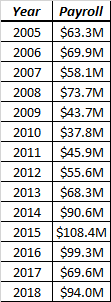
Although the Padres have never been a top spender among Major League clubs, payroll underwent a meteoric rise during the first few years under new ownership, nearly tripling from 2010 to 2015 before tumbling again when Preller’s first attempt at constructing a winner backfired.
The Padres have never come remotely close to incurring a luxury tax bill, oftentimes ending with a payroll $100 million under the tax line. However, the team became a major spender on international amateur talent prior to the new system clamping down on substantial expenditures in that space, giving out the following bonuses in the 2016 class alone: $11 million to Cuban lefty Adrian Morejon, $4 million to Dominican shortstop Luis Almanzar, $3 million to Cuban righty Michel Baez, and at least five other bonuses between $1 million and $2 million each. Despite the paltry annual Major League payrolls and the smaller media market when compared to the behemoths of baseball, the Padres under Preller approached the international amateur space like the Yankees, Red Sox, Dodgers, and Cubs until a new Collective Bargaining Agreement closed that door. A major chunk of franchise spending was embedded here.
Future Liabilities
The Padres sheet is really interesting. Let’s take a look and then examine the numbers.
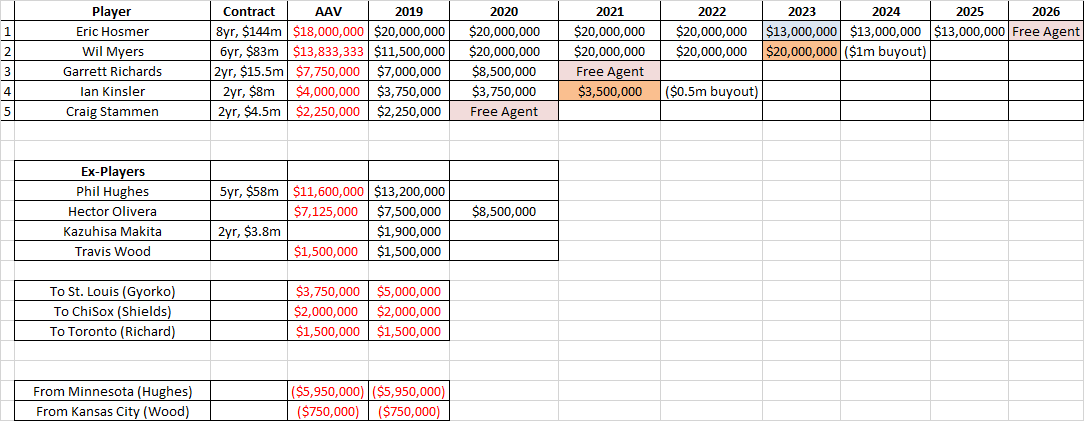
Let’s look at this one backward, from the bottom to the top.
The Padres have a significant chunk of their 2019 spending tied up in players who won’t be wearing Padres uniforms this year. Hughes appears to be the biggest number at first glance, but thanks to the contribution from the Twins, San Diego owes him just $7.25 million. More importantly, the purpose of that deal wasn’t Hughes: it was San Diego’s ability to draft and sign Texas Tech oufielder Grant Little with the 74th pick in the 2018 draft, acquired from the Twins alongside Hughes.
The largest commitment belongs to Hector Olivera at $16 million over the next two years. Signed by the Dodgers, Olivera was traded to the Braves, suspended for domestic violence, and then the Padres acquired his contract when offloading Matt Kemp‘s remaining deal to Atlanta.
Makita failed as a bullpen import last year, while Wood failed as a trade import in 2017, leaving 2018 dead money and the buyout of his 2019 option that was split with Kansas City. Neither amount is significant.
Finally, Gyorko, Shields, and Richard also won’t play for the Padres in 2019. For Gyorko and Shields, this year represents the final year of multi-year payouts of bad decisions. For Richard, San Diego caught a break when Toronto claimed him off of waivers and agreed to take on half of his $3 million guarantee for 2019.
Add it all up and the net dead money on the San Diego books is $25.9 million in 2019, $8.5 million in 2020, and nothing beyond. Keep this in mind.
Small, short-term commitments to Kinsler and Stammen don’t move the needle much, though both figure to get a chance to play meaningful roles for the team in 2019.
Richards, on the other hand, gets yet another chance to show that he can get and stay healthy over the course of a southern California season, this time with the Padres instead of the Angels. That chance, of course, will come in 2020 after Richards underwent Tommy John surgery in July 2018.
Finally, we hit the two big numbers: Myers and Hosmer. Myers showed tremendous promise early in his career with the Rays and he excelled with San Diego in 2016, totaling 28 homers and steals while getting on base well. Unfortunately, nagging wrist injuries an an inexplicable experiment at third base have hampered his overall value in recent years. Just 28, Myers still has time to re-emerge even if the early returns on his extension have been poor. Add it all up and he has $72.5 million remaining over the next four guaranteed years, including his 2023 buyout. Not good. But not crippling.
Hosmer, similarly, provided terrible early returns on his big deal. He comically has an average WAR in even-numbered years of -0.4 compared to 2.9 in odd-numbered years, including 3.6 over his non-rookie odd-numbered years. I’m not here to stump for the even-year/odd-year split, but Hosmer has shown a trend. The Padres will surely hope to see a massive rebound from their marquee investment in 2019. Like Myers, Hosmer is still in his 20s (29). Hosmer is due $80 million over the next four years before he decides whether to hit free agency in advance of his age-33 season or keep his three-year, $39 million golden parachute.
The Padres arbitration table is arguably the leanest one we’ve seen thus far in the series:
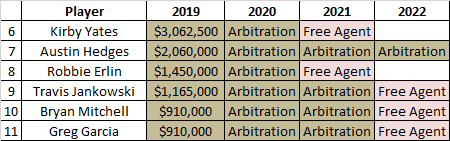
Despite being 5’10” and nearly 32 years old, Yates figures to occupy a key role in 2019 coming off of a stellar 2018 that saw peak production and a repeat of his 2017 velocity jump. Yates figures to play an important role for the team, either as the closer or as this year’s Brad Hand, fetching a sizable return in July.
Hedges is an excellent defensive catcher and provided offense around the league average for his position last year.
Erlin excelled in a swing role in 2018 returning from Tommy John surgery, coming in under one walk per nine innings while setting career highs in velocity on every pitch. He’s worth keeping an eye on in 2019.
The remaining names — Jankowski, Mitchell, and Garcia — simply don’t move the needle much (unless the needle is moved by pure speed, in which case Jankowski moves it a ton).
What Does Team Leadership Have to Say?
At a time when most franchises are talking about payroll efficiency and ducking the luxury tax, Preller’s end-of-season comments were a breath of fresh air. In looking to 2019, Preller stated that “I feel like we’re going to have some financial flexibility, because a lot of the players are younger players. And we’re at that point from a plan standpoint where we’re going to have to supplement from the outside — be it the free agent or trade route. We’ll look to do that in the next few months.”
Fowler and Seidler, on the other hand, made waves this offseason by opening the team’s books to the San Diego Union-Tribune and revealing that they are (i) primarily focused on reducing the team’s debt load, and (ii) still hung up on the inefficient use of cash from 2015. Fowler mentioned that 2015’s $40 million payroll bump yielded just $15 million in additional ticket/concession/merchandise revenue, continuing that “It really convicted me…We had a blip in terms of revenue…(and) we dug a big hole for ourselves.”
That does not sound like an ownership group interested in spending big dollars anytime soon.
Are the Padres a Player for Bryce Harper or Manny Machado?
Yes. Definitely. Or at least they definitely should be.
The Padres don’t immediately make oodles of sense as a player at the top of the market, but they check off every other box for being a team that pursues one of these elite talents.
First and foremost, ownership has shown the penchant to spend on a winner as Preller’s 2015 experiment showed.
Second, ownership has shown a penchant to spend on “the right player” as last year’s massive deal for Hosmer showed.
Third, the Padres have a window of contention that will blow open in the next year or two.
Fourth, thanks to shrewd trades and superb drafting and development, that contender will be fueled almost entirely by players making the league minimum. The Padres have assembled one of the truly great collections of farm talent in the modern history of the game. I could go into great detail here, but instead, I’ll let the introduction to the club’s top prospect list over at Baseball Prospectus do the talking: “their full-slot, top-ten first-round pick from this year’s draft is ranked 12th overall.” If you have any interest in prospect accumulation, take a look at the Padres system and how it was built.
Fifth, they have southern California geography on their side with both a pleasing climate and proximity to Harper’s home in Las Vegas.
Sixth, they have a desperate need for an impact bat (or two) and the two spots that make the most sense for housing this bat are (i) outfield, and (ii) shortstop or third base (wherever stud infielder Fernando Tatis Jr. isn’t playing).
Seventh, outside of Hosmer and Myers, the Padres don’t have any major salaries on the books and their current Major League players heading into arbitration in the next few years won’t receive substantial awards. There simply isn’t much in the way of earmarked money going forward, be it currently guaranteed or coming through arbitration.
Eighth, the immediate payoff could be significant as the Rockies stood pat this winter aside from Daniel Murphy, the Diamondbacks kicked off a rebuild, and the Giants have thus far made modest additions.
Considering the above factors and the glacial pace of the Harper/Machado market to date, it should come as no surprise that the Padres began openly poking around the market for the superstars last week.
What Will the 2019 Payroll Be?
At this stage in the offseason, payroll is quite low at $87.6 million. This would represent a 6.8 percent drop in payroll from 2018’s Opening Day payroll. As a reminder, 2018’s Opening Day payroll was 5.3 percent below 2016’s opening day payroll. And 2016’s Opening Day payroll was 8.4 percent below 2015’s. Add it all up and this year’s Opening Day payroll would be 19.2 percent below 2015’s high water mark. In the estimate of Forbes, the franchise’s value has increased over 29.9 percent during that time.
So is this it? Is this the new normal for the Padres, same as the old normal?
Something doesn’t add up to me. The Padres sported a payroll north of $100 million in 2015 and spent nearly $100 million in 2016 while spending about $25 million on international amateurs, all while saddled with a much more notable debt burden.
There’s a scenario in play where the organization truly doesn’t want to spend, thus keeping payroll at its current level below $90 million and saving cash for…well, I’m not sure exactly. But that doesn’t line up with recent practice. The club lacks major commitments going forward and needs a big boost with a front office and ownership group that has shown a willingness to make a splash. I bet Fowler and Seidler authorize another big swing.
Keep in mind that the numbers projected below would still be below 2015 and 2016 aggregate spending levels…and that the team sees more than $20 million in dead money drop off of its books next year.
Projected 2019 Payroll: $115 million
Projected 2019 Payroll Space: $27.4 million
MLBTR Chat Transcript: Harper, Machado, CBA
Click here to read a transcript of today’s chat with MLBTR owner Tim Dierkes.
Checking In On The Worst Rotations Of 2018
Last Sunday, we took a look at the improvements (or lack thereof) the worst bullpens of the 2018 major league season have made since the winter began. Today’s edition will focus on the sorriest rotations from 2018, when the starting staffs of the Orioles, Rangers, Blue Jays, Padres and White Sox posted ERAs upward of 5.00. Those teams also fared poorly in terms of fWAR, unsurprisingly, with the Orioles, Rangers, Padres and White Sox joining the Reds to make up the majors’ bottom five in that department. Even though spring training is set to open across the league, there are still some quality starters remaining in free agency, so it’s possible these teams aren’t done yet. For now, though, most of these staffs leave much to be desired heading into the new season.
White Sox (2018 fWAR: 30th; 2018 ERA: 26th; projected 2019 rotation via Roster Resource): Last year’s White Sox received 30-plus starts from each of James Shields, Reynaldo Lopez and Lucas Giolito, but only Lopez managed adequate production. He and Giolito, two former high-end prospects, will once again take up 40 percent of Chicago’s rotation this season, while Shields is currently without a job. Carlos Rodon is also back as one of the team’s most proven starters, albeit after disappointing over 20 appearances in 2018. At least one newcomer – righty Ivan Nova, acquired from the Pirates in December – will slot in near the top of their staff, and fellow offseason pickup Manny Banuelos could join him in the starting five. The 32-year-old Nova isn’t going to wow anyone, but he’s a perfectly cromulent major league starter, having recorded ERAs in the low-4.00s and thrown 160-plus frames in each of the past three seasons. The 27-year-old Banuelos – a trade pickup from the Dodgers – is a former big-time prospect, but the lefty hasn’t appeared in the majors since 2015, when he totaled the only six starts of his career as a member of the Braves.
Given the lack of major league success Giolito, Banuelos, and depth options Dylan Covey and Carson Fulmer have experienced, the White Sox would be well served to land more rotation possibilities before the season. Their situation would look a lot better if not for the Tommy John surgery prized prospect Michael Kopech underwent last September. He’ll miss the entire season as a result, though Chicago could get its first look at its No. 2 pitching prospect, Dylan Cease, this year.
Orioles (2018 fWAR: 29th; 2018 ERA: 30th; projected 2019 rotation): Thanks in part to a less-than-stellar rotation, this is going to be the second ugly season in a row for the rebuilding Orioles. Internal improvement is possible, though, as returning starters Dylan Bundy, Alex Cobb and Andrew Cashner have all shown themselves capable of providing much better numbers than the production they registered over a combined 87 starts in 2018. Inexpensive free-agent signing Nate Karns is also a bounce-back candidate after sitting out most of 2017 and all of ’18 as he recovered from the dreaded thoracic outlet syndrome surgery. Aside from those four – any of whom could end up on the block during the season – no starting option on the Orioles’ 40-man roster has achieved success in the majors. Moreover, their farm system isn’t teeming with hurlers who are in line to make MLB impacts this season. With that in mind, rookie general manager Mike Elias may still be scouring the free-agent market for another cheap stopgap(s) after inking Karns earlier this week.
Padres (2018 fWAR: 28th; 2018 ERA: 27th; projected 2019 rotation): The Padres shrewdly signed former Angel Garrett Richards, who’s recovering from Tommy John surgery, back in November. But Richards won’t return until later in the season, if he pitches at all in 2019. Other than Richards, the Padres haven’t picked up any starters of note this winter. It hasn’t been for lack of effort, though, as they’ve been connected to the likes of Noah Syndergaard, Corey Kluber, Dallas Keuchel, Marcus Stroman and Mike Leake, among others, in the rumor mill during recent months. Syndergaard and Kluber probably aren’t going anywhere, but Keuchel remains available in free agency and both Stroman and Leake could still be trade candidates. Having failed to secure anyone from that group, the Padres continue to possess an underwhelming rotation – one that received a combined 49 starts from the now-departed duo of Clayton Richard and Tyson Ross last season. However, Chris Paddack and Logan Allen, top-100 prospects and a couple of the many prizes in a San Diego system laden with talent, may debut sometime this year.
Rangers (2018 fWAR: 27th; 2018 ERA: 29th; projected 2019 rotation): Of the seven Rangers who accrued the most starts in 2018, only one – lefty Mike Minor – remains. Fortunately for Texas, Minor was easily the best member of the club’s subpar septet. He’s now part of a completely remade starting staff which has reeled in Lance Lynn (three years, $30MM) and Shelby Miller (one year, $2MM) in free agency and Drew Smyly via trade with the Cubs. The team also has 2018 signing Edinson Volquez returning after he missed all of last season while recovering from Tommy John surgery. In all, it’s not the most compelling quintet, and it’s anyone’s guess what Miller, Smyly and Volquez will offer after their recent injury-wrecked seasons, but all five have at least shown flashes in the majors.
The soon-to-be 32-year-old Lynn has been effective and durable for most of his career; Miller’s a former star prospect who prevented runs at an excellent clip from 2014-16; Smyly generally impressed as a starter over the same three-year span as Miller; and Volquez has five seasons of 170-plus frames under his belt. Meanwhile, other than newly added minor league signing Jason Hammel, the Rangers’ depth options have virtually no major league accomplishments. A few of their top-10 prospects – Jonathan Hernandez, Taylor Hearn and Joe Palumbo – are climbing up the minor league ladder and could be in Arlington soon, however.
Reds (2018 fWAR: 26th; 2018 ERA: 25th; projected 2019 rotation): The Reds boasted a mostly healthy rotation in 2018, as six pitchers each made at least 20 starts, but no one was particularly good. Consequently, the Reds have acquired three proven MLB starters in various trades this offseason, having picked up Sonny Gray from the Yankees, Alex Wood from the Dodgers and Tanner Roark from the Nationals. There isn’t an ace among the trio, but all three are credible major league starters – which the Reds desperately needed, especially considering Matt Harvey walked in free agency. High-potential holdovers Luis Castillo and Anthony DeSclafani, who have been inconsistent in the majors, will comprise the rest of Cincinnati’s upgraded rotation to begin the season. The Reds’ new additions will push 2018 regulars Sal Romano (25 starts of 5.48 ERA/5.10 FIP ball) and Tyler Mahle (23 starts, 4.98 ERA/5.25 FIP) into depth roles, which is a plus, as is the end of the Homer Bailey era. The Reds sent Bailey and the remains of his bloated contract to the Dodgers when they traded for Wood and outfielders Yasiel Puig and Matt Kemp in a blockbuster December deal. Bailey produced catastrophic results from 2017-18, a 38-start, 197 1/3-inning span in which he mustered a 6.25 ERA.
Blue Jays (2018 fWAR: 22nd; 2018 ERA: 28th; projected 2019 rotation): The Blue Jays’ rotation handily outdid the above teams’ by fWAR last year, yet the unit still compiled the majors’ third-worst ERA. Toronto has since made modest acquisitions by trading for Richard and signing Matt Shoemaker (one year, $3.5MM). They’ll serve as placeholders for a Jays team which is at least another full year away from vying for a playoff spot, and may listen to offers for its top two starters – Stroman and Aaron Sanchez – during the upcoming season. Both Stroman and Sanchez have been outstanding at times, but that wasn’t true of either in 2018, and the two are now entering their second-last seasons of team control. Stroman and Sanchez remain atop Toronto’s rotation for the time being, with all parties hoping the righties return to their past productive and healthy ways in 2019. Beyond those two, Richard, Shoemaker and Ryan Borucki, the Blue Jays don’t possess any starters who have done much in the majors, though Sam Gaviglio (37 starts), Sean Reid-Foley (seven) and Thomas Pannone (six) have at least gained some experience.
Poll: Grading The J.T. Realmuto Trade
After several months of nonstop rumors centering on J.T. Realmuto, the Marlins finally found an offer to their liking for the superstar catcher Thursday, when they dealt him to the NL East rival Phillies. Entering the offseason, it seemed inevitable the rebuilding Marlins would part with Realmuto, who made it clear on multiple occasions going back to last winter that he was uninterested in signing an extension with the club.
At times this offseason, Realmuto drew interest from nearly half the league (14 teams), and with such a vast market for his services, Miami spent the past few months holding out for a Godfather offer from one of those clubs. In the end, the Marlins accepted a three-player return consisting of major league catcher Jorge Alfaro, who will immediately replace Realmuto in their starting lineup, two pitching prospects (right-hander Sixto Sanchez and lefty Will Stewart) and $250K in international slot money.
For the Phillies, the Realmuto acquisition is the latest win-now move in an offseason packed with them. Coming off their seventh straight non-playoff season and sixth consecutive sub-.500 campaign, the Phillies are aiming to push for a playoff spot in 2019 with newcomers Realmuto, Jean Segura, Andrew McCutchen, David Robertson and possibly Bryce Harper or Manny Machado helping lead the way. And Realmuto – who was the undisputed premier catcher in the game last year – will help their cause beyond the upcoming campaign, as he’s controllable through 2020.
For the Marlins, the Realmuto trade is the latest win-later move dating back to last winter, when the low-budget club traded Giancarlo Stanton, Christian Yelich, Marcell Ozuna and Dee Gordon for futures. In Alfaro, they received a player who showed a penchant for striking out and little ability to walk from 2017-18, his first two seasons of extensive major league action. But Alfaro was nonetheless respectable at the plate during that span, and the cannon-armed 25-year-old is fresh off a season in which he earned raves from defensive metrics. To this point, then, Alfaro has been a satisfactory pro. However, whether Alfaro will continue to serve as an acceptable starter or fall backward could hinge on improving his high-strikeout, low-walk ways, especially considering he won’t keep running a career .405 batting average on balls in play.
While Alfaro’s the only current major leaguer Miami got for Realmuto, Sanchez looks like the biggest prize. Despite the 5-foot-10, 185-pounder’s diminutive stature, each of FanGraphs, Baseball America, MLB.com and ESPN’s Keith Law rank Sanchez between fifth and 35th on their list of the majors’ top prospects. All of those outlets and individuals agree the flamethrowing Sanchez has the upside of a front-line rotation piece, and at 20 years old, he’ll breathe new life into the Marlins’ farm system. Although Sanchez hasn’t pitched above the High-A level yet, once he gets to Miami, he could emerge as its best starter since the Jose Fernandez era came to a tragic conclusion in 2016.
Stewart, 21, is far less intriguing than Sanchez, with MLB.com ranking him as the Marlins’ No. 25 prospect. Whereas Sanchez is a potential No. 1 starter who possesses electrifying velocity, MLB.com regards Stewart as a possible back-end type whose velocity is “average.” To Stewart’s credit, though, he did post tremendous results last year at the Single-A level, where he logged a 2.06 ERA with 7.13 K/9, 1.66 BB/9 and a 62.1 percent groundball rate, mimicking the best version of Dallas Keuchel in that regard.
With Alfaro, Sanchez, Stewart and a bit more international spending room in tow, there’s plenty for Miami to dream on going forward. The Phillies, meanwhile, made a substantial near-term upgrade behind the plate, albeit one that cost them their previous No. 1 prospect and another promising hurler. In your estimation, how did the two teams fare in this swap? Cast your votes below…
(Phillies poll link for app users; Marlins poll link for app users)
Grade the Realmuto trade for the Phillies
-
A 41% (9,024)
-
B 40% (8,825)
-
C 14% (3,076)
-
D 4% (780)
-
F 2% (467)
Total votes: 22,172
Grade the Realmuto trade for the Marlins
-
B 35% (7,060)
-
A 27% (5,373)
-
C 26% (5,184)
-
D 8% (1,637)
-
F 4% (884)
Total votes: 20,138
10 Low-Cost Right-Handed Relief Options
As we wait for the final market moves to be revealed, we have been breaking out the remaining free agents in different ways to see just what is left to address various teams’ needs. Yesterday we looked at innings-fillers from the rotation and before that we ran through the power bats. Today, we’ll check in on the right-handed relief market.
As before, we’ll be skipping over those players who MLBTR predicted to secure multi-year deals entering the winter (in this case, Craig Kimbrel and Bud Norris). The most intriguing remaining righty pen arms, in order of innings pitched:
Tyler Clippard: While he did not make it back to his once-excellent levels of performance, Clippard showed in 2018 that he can still be a useful MLB reliever. He posted 11.1 K/9 against 3.0 BB/9 through a hefty workload of 68 2/3 frames. Home runs were a problem — one that likely won’t fully go away given Clippard’s incredibly flyball-heavy approach — but didn’t prevent him from carrying a 3.67 ERA.
Sergio Romo: Rumored to be nearing a deal, Romo’s chief appeal lies in the fact that he’s still capable of getting swings and misses at will. He was dinged by the longball last year but managed an appealing combination of 10.0 K/9 and 2.7 BB/9 in his 67 1/3 frames with the Rays.
Jim Johnson: His days as a late-inning arm are likely over, but the veteran hurler still draws grounders on about half of the balls put in play against him. Last year, he worked t a 3.84 ERA in 63 1/3 innings despite producing only 6.4 K/9 to go with 3.1 BB/9.
Alex Wilson: It’s a similar story for Wilson, who was a somewhat surprising non-tender victim this fall. He just topped Johnson in 2018 groundball rate (49.2%), helping him to post a 3.36 ERA in 61 2/3 innings despite a tepid combination of 6.4 K/9 and 2.2 BB/9.
Nick Vincent: Here’s another established hurler who lost his roster spot due in part to anticipated arbitration costs ($3.5MM). Vincent has yet to finish a season having allowed four or more earned runs per nine, with a cumulative 3.17 ERA in 332 innings as a major leaguer. He did allow a career-high 3.99 ERA in his 56 1/3 innings last year, but ERA estimators generally viewed him as a solid contributor (3.75 FIP, 4.51 xFIP, 3.72 SIERA).
John Axford: The veteran hurler still brings plenty of velocity and gets lots of groundballs with a fair number of whiffs. He also wrapped up the 2018 season with less walks than usual (3.6 BB/9). Despite generally positive ERA estimator grades (3.98 FIP, 3.86 xFIP, 3.67 SIERA), Axford managed only a 5.27 ERA in his 54 2/3 innings.
Ryan Madson: Replace the grounders with a more appealing K/BB ratio and it’s the same story for the hard-throwing Madson, who suffered from a .340 BABIP-against and like Axford failed to turn things around after a mid-season acquisition by the Dodgers. Madson finished 2018 with a 5.47 ERA but scored a 3.98 FIP, 3.97 xFIP, and 3.54 SIERA. His outstanding 2017 campaign is also a factor to consider.
Adam Warren: He’s coming off of a campaign in which he spun 51 2/3 innings of 3.14 ERA ball, his second-straight season with excellent bottom-line results. The 31-year-old hasn’t quite supported the outcomes with his peripherals, though his combination of 9.1 K/9, 3.5 BB/9, 1.05 HR/9 and a 37.6% groundball rate would nevertheless leave Warren looking like a solid relief asset.
Daniel Hudson: The outcomes still haven’t quite come around for Hudson, who has been targeted by teams that like the upside in his 96 mph heat. Last year with the Dodgers, he carried a 4.11 ERA in 46 frames despite benefiting from a .256 BABIP-against, with ERA estimators suggesting the results were largely deserved. Still, it’s hard not to like the velo and the 12.8% swinging-strike rate.
Erik Goeddel: Yet another recent Dodgers reliever rounds out our list. Goeddel had a nice bounceback in 2018, spinning 36 2/3 frames of 2.95 ERA ball, yet nevertheless was dropped at the end of the season. The problem? With his 10.8 K/9 came 4.9 BB/9. Walk issues have cropped up for Goeddel before, though never to an extreme degree. Other teams surely took note of the fact that Goeddel conned opposing hitters into offering at 37.4% of his pitches outside of the zone in 2018, leading them to make hard contact at a meager 23.3% rate while swinging and missing at 15.8% of his pitches.
8 Low-Cost Rotation Depth Options
We ran through some of the remaining sources of offensive power yesterday. Today, we’ll do the same for rotation pieces. There are not all that many established starters left on the market, but there are still a handful who stand out as plausible candidates to gobble up some frames without costing much for an acquiring team. (Jeremy Hellickson would’ve been included here had he not agreed to terms with the Nats this morning.) As before, we’ll be ignoring those players who MLBTR predicted to secure multi-year deals entering the winter (e.g. Dallas Keuchel, Gio Gonzalez).
Presented in order of 2018 innings pitched…
James Shields: He topped 200 frames for the tenth time in 2018, so teams looking for volume will have to place Shields on the top of their value list. True, the results (4.53 ERA) and peripherals (6.8 K/9, 3.4 BB/9, 1.5 HR/9, 35.2% GB rate) weren’t exciting, but Shields is also a respected staff member who’d be valued for his positive influence on teammates. For the right organization, he’s a viable innings eater.
Bartolo Colon: Yep, he’s back — or at least he hopes to be. Home runs were a big problem last year for Big Sexy, but he still racked up 146 1/3 frames on the year for the Rangers. As with Shields, there won’t likely be much interest from contenders, but other teams that are thin on upper-level pitching depth could look to Colon as a cheap source of innings.
Clay Buchholz: It’s quite a different story for the 34-year-old Buchholz, who had a nice turnaround campaign before it was cut short by yet another injury. Organizations that are interested in building waves of talented arms, whether or not they come with health concerns, will certainly be intrigued by Buchholz, even if his peripherals (7.4 K/9, 2.0 BB/9, 0.82 HR/9, 42.6% GB rate) didn’t quite support the sparkling 2.01 ERA he carried through 98 1/3 innings last year in Arizona.
Yovani Gallardo: Though he made it through 94 1/3 innings, the outcomes weren’t pretty for Gallardo. Memories of his days as a sturdy mid-rotation starter are long faded, though perhaps there’s reason to believe in at least some amount of positive regression. Gallardo’s 6.39 ERA in 2018 was caused in some part by a low 64.5% strand rate. Of course, ERA estimators still valued his contributions in the low-5.00 realm, so there’s not a ton of room for optimism.
Edwin Jackson: Jackson ran up a productive ERA in about a half-season of work as a key member of Oakland’s patchwork rotation. But the spread in this case between his ERA (3.33) and ERA estimators (4.65 FIP, 4.88 xFIP, 4.98 SIERA) is significant. Jackson is still averaging better than 93 mph on his heater, but he likely won’t benefit again from a .240 batting average on balls in play from opposing hitters.
Brett Anderson: Some will be surprised to learn that Anderson only celebrated his 31st birthday earlier this month. The lefty debuted as a 21-year-old and has had a tumultuous career, but he put forth a solid effort in 80 1/3 frames with the A’s in ’18. Anderson registered a 55.6 percent grounder rate and notched a career-best 1.46 BB/9. He doesn’t miss many bats and has a long injury history, but the southpaw’s knack for keeping the ball on the ground and his typically low walk rates could be appealing for a team seeking depth rather than a candidate to make 30 starts.
Doug Fister: A knee injury wrecked Fister’s 2018 season, but the righty displayed his typical penchant for keeping the ball on the ground (50.4 percent) and avoiding free passes (2.5 BB/9). Fister managed a 4.50 ERA in 66 innings — nearly half of which came at the launching pad that is Globe Life Park in Arlington. It’s an extraordinarily small sample, to be sure, but the righty did notch a 2.82 ERA and 4.14 FIP in 35 2/3 innings on the road. As far as depth options go, clubs could do far worse than the 35-year-old veteran.
Ervin Santana: Only 10 pitchers threw more innings than Santana between the 2016-17 seasons, but an injured tendon in his pitching hand that required surgery last offseason more or less wiped out his entire 2018 campaign. It’s perhaps heartening that the injury wasn’t specific to the his elbow or shoulder. Santana’s results in 24 2/3 innings were awful (22 runs on 31 hits and nine walks), though it’s unlikely that he was healthy when on the hill. He may be 36 now, but Santana posted a combined 3.52 ERA in 907 2/3 frames from 2013-17. If his hand is healed up, he could be the best bet for a productive season on this list.
10 Low-Cost Free Agent Power Options
With just two weeks to go until camp, even the ongoing lack of action at the top of the free agent market probably won’t stem the tide of smaller signings. Curtis Granderson just went off the board on a minor-league deal, taking one veteran power bat out of the picture. But there are other slugger types that remain available and who figure to command one-year or minor-league deals.
For purposes of this list, we’ll be ignoring those players who MLBTR predicted to secure multi-year deals entering the winter. We will be looking primarily at players who have shown double-digit home run power in recent seasons — even if their most recent campaigns featured less-than-fearsome power displays. That characterization also applies to a few who aren’t listed below, but these ten stood out.
Left-Handed Hitters
Carlos Gonzalez, OF: While he has produced only thirty long balls over the past two seasons, Gonzalez has turned in one 40-bomb campaign (in 2015) and still is at least an average overall offensive producer. It remains to be seen what kind of shot he’ll get on his next deal, but the former star could still make for an intriguing risk.
Derek Dietrich, INF/OF: It may sound odd to say it, but Dietrich has arguably been the most consistently productive offensive performer on this list over the past four seasons. He’s a .262/.344/.428 hitter (114 OPS+) in that stretch and popped a career-best 16 homers in 2018. Plus, he can at least fake it at second and third, in addition to the corner outfield and first base.
Lucas Duda, 1B: Things really haven’t gone well for Duda since he was dealt to the Ray sin the middle of the 2017 campaign, but he was quite an accomplished power bat before that. The first bagger did also manage to put up 14 home runs in 367 plate appearances last year, so the power is still there.
Logan Morrison, 1B: After a monster 2017 season in which he launched a career-high 38 home runs, LoMo suffered through an injury-addled 2018 campaign. He did swat another 15 balls out of the yard in 359 plate appearances, though, so the power is still there. Teams willing to take on some health risk could be rewarded.
Matt Joyce, OF: It has been a bit of a roller coaster in recent seasons for Joyce, but he’s still an interesting potential platoon outfielder. Last year was a wash, but he hit 25 bombs in 2017. Joyce owns a .240/.339/.431 lifetime batting line.
Right-Handed Hitters
Adam Jones, OF: The 33-year-old has pretty much been a perennial 20-plus homer center fielder ever since establishing himself in the majors. He dropped back to 15 last year, but seems a reasonable rebound candidate in the power department. Of course, Jones has never been much of an on-base threat and now seems slated to move into a corner outfield role, so those factors will limit his appeal even to teams that like his pop.
Evan Gattis, DH: Gattis popped 25 long balls last year, though his on-base numbers took a nosedive. It’s a similar story for Gattis’s six-year career, over which he carries a .476 slugging percentage but only a .300 OBP. Still, an American League team that wants righty power will have to take a close look at the 32-year-old.
Matt Holliday, OF: True, he’s already 39 years of age and sat out for almost all of the 2018 season. But Holliday did make a late-season return with the Rockies and showed that he can still get things done at the MLB level, with a .283/.415/.434 slash in 65 plate appearances. Holliday was such a good hitter and consistent power source over most of his prior 14 seasons that he could still be seen as an intriguing option.
Hanley Ramirez, 1B: Though Ramirez’s offensive struggles are well-documented, he was still consistently knocking the ball out of the park before being cut loose by the Red Sox. Ramirez was on pace to top twenty dingers for the third-straight season when the Boston organization let him go. Last we heard, HanRam intends to play in 2019. He has hit well in winter ball, though there haven’t been any rumors of specific interest.
Jose Bautista, OF: The homer tallies are down. The batting average is hovering just over the Mendoza line. And if there’s a notable skill remaining, it’s Bautista’s still-otherworldly ability to draw walks (16.8% in 2018). That being said, it takes more than a keen eye to post that kind of walk rate. Pitchers also have to respect a hitter. Bautista posted a .175 isolated power mark and still put the ball over the fence 13 times in 399 plate appearances last year, and reeled off eight-straight 20+ homer campaigns before that.
MLBTR Chat Transcript: Harper, Realmuto, Kimbrel
Click here to read the transcript of today’s chat with MLBTR owner Tim Dierkes.