
Offseason In Review: Kansas City Royals
This is the latest post of MLBTR’s annual Offseason in Review series, in which we take stock of every team’s winter dealings.
After one last, half-hearted gasp with the scattered remains of 2015’s championship core, the Royals have finally committed fully to a rebuild.
Major League Signings
- Billy Hamilton, CF: One year, $5.25MM plus mutual option
- Chris Owings, UTL: One year, $3MM
- Jake Diekman, LHP: One year, $2.75MM plus mutual option
- Brad Boxberger, RHP: One year, $2.2MM
- Terrance Gore, OF: One year, $650K
- Kyle Zimmer, RHP: One year, $555K
- Total spend: $14.2MM
Trades and Claims
- Selected RHP Sam McWilliams from Rays with 2nd overall pick in Rule 5 Draft
- Acquired RHP Chris Ellis from Rangers for cash considerations after he was selected from Cardinals with 8th overall pick in Rule 5 Draft
Extensions
- Whit Merrifield, 2B/OF: $16.25MM over four years with club option
Notable Minor League Signings
- Drew Storen, Homer Bailey, Andres Machado (re-signed), Jason Adam (re-signed), Taylor Featherston, Winston Abreu
Notable Losses
Needs Addressed
An ’18 return to 100-loss territory, a land so often populated by the club in the early part of the century, marked a bitter end to the Royals’ most successful run in ages. With meager expectations at most spots on the roster, the club oversaw a rather quiet offseason. Bargain bullpen pickups were collected, some with significant upside, and the Royals again chased down a couple of burners to roam the Kauffman prairie.
Billy Hamilton, non-tendered just before the late-November deadline by the Reds, serves as the big-ticket item here. The 28-year-old checks all of Kansas City’s favorite boxes: speed, defense, a contact-oriented approach (albeit one without much contact), and a strong presence in the clubhouse. The longed-for breakout still hasn’t arrived, as Hamilton’s offensive profile – super-soft contact, a curiously high pop-up rate, and an ongoing inability to work the count – has stayed mostly stagnant in his five career big-league seasons. He’s a savant on the bases, though, maybe an all-time great, and could lead the AL in swipes if he sits atop manager Ned Yost’s lineup for much of the year. And if a plate surge is still to come, if Hamilton starts filling those massive gaps with liners and shows a newfound devotion to the strike zone, the Royals could have the steal of the decade: the speedster has, after all, posted two seasons of almost 3.0 fWAR despite never having eclipsed the 80 wRC+ plateau.
Kansas City, under GM Dayton Moore’s watch, has never soured on its taste for former top prospects (especially of the homegrown variety), and again took a bite this offseason with the inking of utilityman Chris Owings to a minor deal. Owings should see plenty of time in the infield, with much of it likely coming at the hot corner, and he’ll look to a rebound from a career-worst output in 2018. The 27-year-old shares many Hamilton traits, including a longstanding allergy to the walk, but he did up his hard-hit rate to a career-high 39% late season despite an ugly .206/.272/.302 batting line. The contact-over-discipline has philosophy has invited scorn from all manner of pundits during Moore’s tenure, and can at times yield disastrous results (especially, as has been the case with Hamilton and Owings, when the low-walk totals aren’t offset by suppressed K rates), but the Royals remain zealous devotees.
On the pitching side, Brad Boxberger, Jake Diekman, and Drew Storen were all brought in to shore up a shoddy pen that ranked last among all MLB teams with -2.2 fWAR last year. The club needs more than just that aging trio, of course, but it’s nonetheless a massive upgrade from ’18, when failed starters and low-impact mercenaries were expected to fill the shoes of former giants. Boxberger, who was Arizona’s closer for much of last season, at times seems unhittable; other times, he looks lost, missing too often over the middle of the plate, or being unable to find it entirely. Kauffman’s dimensions should negate his gopher-ball itch, but seem an ill fit for Diekman, who keeps most of his contact in play. Storen hasn’t been effective in years, but comes with almost zero risk on a minors deal. His pedigree, too, is right up the Royals’ alley.
Questions Remaining
The Royals did almost nothing to address a torched rotation, adding just Homer Bailey and Kyle Zimmer low-commitment deals. The club apparently has high hopes for Jakob Junis and Brad Keller, both of whom were around league-average in ’18. Both are useful, young, affordable pitchers, though neither scouts nor stats seem to see much in the way of upside. Otherwise, veterans Danny Duffy and Ian Kennedy will look to rediscover their form, while Jorge Lopez and Ben Lively are among the other 40-man options. It’s an underwhelming unit on the whole. Help is on the way – the club plucked polished college arms with each of its four first-round picks, all of which came in the top 40 – but still a couple years out. In the meantime, KC might have done well to lock down a Drew Pomeranz/Mike Fiers-type or two (low-cost options with fly-ball tendencies).
With Salvador Perez expected to undergo Tommy John surgery, catcher is now an issue as well. The club has been connected recently with free agent Martin Maldonado, but subsequent reports suggest the team is more comfortable going with a questionable Cam Gallagher/Meibrys Viloria duo. The latter is seen in some circles as a rather intriguing prospect, but he has yet to play above the High-A level apart from a late-2018 taste of the majors. Perez will miss the entire season if he goes under the knife, so a stopgap would fit nicely, but the Royals have always prized in-house options more than outside ones.
The plan for the rest of the roster involves a series of dice throws. KC will give first base to Ryan O’Hearn, who earned a longer look after an eye-opening late-season debut but hasn’t produced much offense in two seasons at Triple-A. Hunter Dozier didn’t thrive in 2018, his first substantial MLB time, but the oft-injured top draft pick appears to be in line for much of the time at third. In the outfield/DH mix, the Royals have a foursome of former top-100 prospects vying for time: Brett Phillips, Jorge Bonifacio, Brian Goodwin, and Jorge Soler. All have flashed talent at times but each is still looking to find his ceiling — or, at least, consistent production and a steady MLB role. There’d be more chances to work with were it not for the ongoing presence of Alex Gordon in left field. He has posted a dreadful .225/.310/.355 slash line since signing a four-year, $72MM deal that will expire at season’s end. It’s possible that one or more of these players could emerge as important pieces, but projection systems don’t love the odds. The Royals could cycle through some of the roster spots occupied by this slate of names if there are any stumbles or if more appealing opportunities arise.
Fortunately for the Kansas City faithful, the one roster spot we haven’t yet touched upon is also the most exciting one. If there’s a potential building block in place, it’s the affordable and controllable middle-infield combination. Adalberto Mondesi finally took over for the clingy Alcides Escobar at short last season and flourished in a full-time role. The 23-year-old son of Raul has a long track record of out-making in the minors – though yes, he was rushed – so there’s still some variability here, but the tools are exciting and projection systems are bullish. Mondesi will turn two with the club’s best player, the recently-extended Whit Merrifield. The Royals bought some cost certainty and a bit of upside in the deal, which arguably makes sense for the player even while increasing the value of his contract rights. While the club has resisted trade interest in the past, Merrifield could still be the juicy trade bait the team desperately needs to kick the rebuild into high gear.
What to Expect in ’19
The full-rebuild Royals could again threaten for the franchise record in losses in 2019. Always the high guys on their farm-produced regulars, Dayton Moore’s staff anticipates the downturn will be a quick one. But the young major-league squad is littered with checkered minor-league pasts and the farm system is generally ranked among the bottom third leaguewide. The team would do anything to avoid reprising its pitiful stretch in the 90s and early aughts, but the current trajectory, kicked off course by a series of missteps and high-round failures in recent drafts, is veering dangerously close to the edge.
How would you grade their offseason? (Link for app users.)
How would you grade the Royals' offseason?
-
C 37% (1,536)
-
D 31% (1,276)
-
F 17% (682)
-
B 13% (535)
-
A 2% (91)
Total votes: 4,120
Offseason In Review: Detroit Tigers
This is the first post of MLBTR’s annual Offseason in Review series, in which we take stock of every team’s winter dealings.
It was another low-key winter in Motown as the Tigers continued their rebuild process.
Major League Signings
- Tyson Ross, SP: One year, $5.75MM
- Jordy Mercer, SS: One year, $5.25MM
- Matt Moore, SP: One year, $2.5MM
- Josh Harrison, 2B/3B/OF: One year, $2MM
- Total spend: $15.5MM
Trades And Claims
- Claimed IF/OF Brandon Dixon from Reds
- Claimed LHP Jose Fernandez from Blue Jays
- Claimed RHP Reed Garrett from Rangers in the Rule 5 Draft
Notable Minor League Signings
- Louis Coleman, Gordon Beckham, Bobby Wilson, Pete Kozma, Harold Castro, Hector Sanchez, Eduardo Paredes
Notable Losses
- Victor Martinez (retired), Jose Iglesias, Alex Wilson, James McCann, Francisco Liriano, Mike Gerber, Kaleb Cowart (Tigers claimed Cowart off waivers from Mariners but lost him on a subsequent waiver claim by Angels)
[Detroit Tigers Depth Chart | Detroit Tigers Payroll Outlook]
Needs Addressed
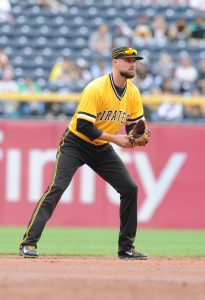 Jordy Mercer and Josh Harrison have spent virtually their entire MLB careers as teammates. That connection will continue for at least part of the 2019 season, as the former Pirates each signed on to form Detroit’s new middle infield duo. The Tigers turned to Mercer to fill the hole left behind by free agent shortstop Jose Iglesias, then later inked Harrison to take over as the everyday second baseman. Such names as Troy Tulowitzki and former Tiger Ian Kinsler were also considered by the team to fill the middle infield gaps.
Mercer and Harrison were inked to relatively inexpensive one-year deals, giving the Tigers flexibility should youngsters such as Dawel Lugo, Isaac Paredes, or Willi Castro force the issue for playing time as early as this summer. By that same token, Mercer and Harrison could both be trade deadline chips if the Tigers find a contending team eager for infield help.
In Harrison’s case, he has particular upside after struggling through an injury-plagued 2018. Harrison also didn’t perform terribly well in 2015 or 2016, though he was an All-Star as recently as 2017. The 31-year-old doesn’t have to do a ton to outplay his $2.5MM contract, however, and Harrison’s overall value could improve if the Tigers shield him from tough right-handed pitching every once in a while. Harrison also could provide extra depth at third base or the corner outfield, though he played almost exclusively as a second baseman last season. That flexibility makes it particularly easy to imagine him as a mid-season trade candidate.
While Harrison himself provides some versatility, his addition moves Niko Goodrum into a superutility role, allowing the Tigers to deploy him all around the diamond as the situation warrants. Veterans Gordon Beckham and Pete Kozma are also at Spring Training on minor league deals, fighting with Ronny Rodriguez to win a utility infield job and potentially pushing Goodrum into seeing more corner outfield time, rather than infield duty. Goodrum could also see substantial action at first base, since Miguel Cabrera is likely to receive the lion’s share of DH at-bats. (Backup catcher John Hicks could again factor at the first base position as well.)
As they did last winter in signing Mike Fiers and Francisco Liriano, the Tigers added a pair of low-cost veteran arms to the rotation in Tyson Ross and Matt Moore. Ross turned in a useful 2018 season with the Padres and Cardinals in 2018, posting a 4.15 ERA and 1.97 K/BB rate over 149 2/3 innings. It’s probably too much to expect that Ross can recapture his mid-decade All-Star form (prior to two lost seasons due to injury), though he should give Detroit some solid innings.
Moore hopes to follow in Ross’ footsteps with a bounce-back season of his own, as Moore has badly struggled in each of the last two seasons, to the point of being relegated to the Rangers’ bullpen last season. It wasn’t long ago that Moore was one of the game’s most vaunted pitching prospects, so the Tigers are hoping the change of scenery can revive Moore’s career.
Questions Remaining
It seemed as if the Tigers were simply ready to move on from Iglesias, as a case could be made that re-signing Iglesias (10 fWAR over 656 career games) would’ve provided more value than adding Mercer (7.8 fWAR through 821 career appearances with Pittsburgh). Mercer is only the slightly better hitter of the two, and Iglesias is the decidedly better fielder. Considering that Iglesias ended up landing only a minor league deal from the Reds, spending $5.25MM on Mercer seems like something of an overpay.
This being said, it could be that the Tigers simply felt Mercer had more future trade value, given that they’d spent much of 2018 unsuccessfully trying to find a trade partner for Iglesias. Plus, when a club is still in the relatively early stages of a rebuilding plan, it’s hard to argue too strenuously about which veteran was or wasn’t signed to a one-year contract. Mercer, Harrison, Ross, and Moore could all very well be playing on different teams by September, and the Tigers’ focus for 2019 will again be on seeing which of its young players can emerge.
To this end, catcher James McCann was non-tendered after a rough campaign, wrapping up his four-year run as the team’s most frequently used backstop and giving the Tigers a chance to see what they have in Grayson Greiner. (Both Greiner and Hicks may ultimately be keeping the catcher’s spot warm for prospect Jake Rogers in a year or two.) The Tigers didn’t add any veteran outfield help, preferring to stick with incumbents JaCoby Jones and Mikie Mahtook in center field, and giving prospect Christin Stewart a full shot as the everyday left fielder.
Perhaps the most notable element of the Tigers’ offseason was what they didn’t do — namely, trade any of their notable veterans. It probably isn’t surprising that Michael Fulmer and Shane Greene weren’t moved in the wake of down years, as the Tigers don’t want to sell low. Swingman Blaine Hardy drew some interest from Oakland, though nothing came together. All three of those pitchers will very likely still be in a Detroit jersey on Opening Day. None of this group can said to be premium trade chips, and the slowed free agent market also undoubtedly hampered Detroit’s trade negotiations. For instance, if you’re the Athletics, why deal for Hardy when you could simply sign a similar type of pitcher in free agency without having to give anything up in return?
This could also explain why the Tigers non-tendered Alex Wilson, who was projected to earn a modest $2.8MM salary in arbitration. It wasn’t a high figure for an unspectacular but solid reliever like Wilson, though since the Tigers considered him expendable, they decided to simply part ways before the arb deadline since no trade interest could be located.
The most prominent figure in Detroit trade rumors, of course, has been slugger Nicholas Castellanos. The Braves, Mets, and Dodgers were all linked to Castellanos at various points this winter, though none were willing to meet the high asking price the Tigers placed on the outfielder. Detroit was looking for a prospect (or prospects) that would top the compensatory first-round sandwich pick they could receive next winter if Castellanos receives and rejects a qualifying offer and then signs elsewhere. Castellanos himself expressed a desire to be moved before the start of camp, but nothing appealing ever came across the desk of GM Al Avila.
As with the Tigers’ lower-level trade candidates, Castellanos’ market was undoubtedly harmed by the presence of so many other outfielders available in free agency (or in other trades). Furthermore, while Castellanos has posted some fine numbers (.285/.336/.495 in 1790 PA, 67 homers) over the last three seasons, his bat isn’t elite enough that teams are willing to overlook his poor right field defense. To this end, it’s interesting that all of Castellanos’ known suitors were NL teams, though it’s fair to assume that some American League clubs also made inquiries.
If Castellanos keeps up his hitting production, he’ll still get some looks at the trade deadline, and his market will only grow if he becomes even borderline passable as a right fielder. Still, it seems like the Tigers will need to lower expectations about what they’ll be able to receive in a Castellanos trade, given how bat-only players have become far less sought-after than they were even only a few years ago. Topping a QO draft pick may not be feasible — if that’s even a reasonable guide to go by. Anthony Fenech of the Detroit Free Press recently observed that the Tigers may not end up issuing Castellanos a qualifying offer in the fall, as he could accept that one-year deal (which will be in excess of $17.9MM) rather than taking his chances on the open market with draft compensation attached.
Castellanos has recently expressed interest in a contract extension to remain in Detroit, a possibility the team has pursued previously. With Cabrera already locked into DH duty through the 2023 season, though, there isn’t much room for the Tigers to carry another bat-only player over the long term. Since Avila has intimated that the Tigers won’t look to really boost payroll until after the 2020 season, keeping Castellanos at a hefty salary doesn’t seem to fit Detroit’s timeline.
2019 Season Outlook
It looks to be another long year for Detroit fans. Even in a weak AL Central, the Tigers aren’t likely to make much noise. Perhaps the club can hope to top the ghastly 64-98 record it has posted in successive seasons, but it’d be hard to expect more than modest improvement given the present state of the roster
How would you grade the Tigers’ offseason moves? (Link for app users.)
How Would You Grade The Tigers' Offseason?
-
C 38% (2,167)
-
D 30% (1,740)
-
F 17% (963)
-
B 13% (764)
-
A 2% (142)
Total votes: 5,776
Photo courtesy of USA Today Sports Images
MLBTR Chat Transcript: Bogaerts, Trout, Rendon
Click here to read the transcript of today’s chat with Tim Dierkes.
MLBTR Chat Transcript: Kimbrel, Padres, Harper, Phillies, Trout
Click here for a transcript of the Sunday night chat, moderated by MLBTR’s Mark Polishuk
Recent History Of March Signings
March is just around the corner. If you hadn’t noticed, a fair number of notable players remain unsigned. The very top of MLBTR’s pre-winter top-fifty free agent list remains well-represented on the open market, with a smattering of other notable players also still unsigned. This represents a continuation of the surge of late signings observed last winter, which was the first offseason conducted under the current collective bargaining agreement.
It’s not hard to see that the market is functioning differently under the new CBA. Here’s a listing of the most notable players who’ve yet to sign this year, alongside the recent history of MLB contracts inked during the month of March:
2019
- Remaining candidates for MLB deals include Bryce Harper, Dallas Keuchel, Craig Kimbrel, Gio Gonzalez, Bud Norris, Adam Jones, Martin Maldonado, Ryan Madson, Clay Buchholz, Adam Warren, Tony Sipp, Denard Span, Logan Morrison, Evan Gattis, Matt Holliday, James Shields, Jim Johnson, Jorge De La Rosa, more
- Jake Arrieta — three years, $75MM
- Alex Cobb — four years, $57MM
- Greg Holland — one year, $14MM
- Lance Lynn — one year, $12MM
- Jonathan Lucroy — one year, $6.5MM
- Mike Moustakas — one year, $6.5MM
- Carlos Gonzalez — one year, $5MM
- Neil Walker — one year, $4MM
- Jon Jay — one year, $3MM
- Others: Peter Bourjos, Trevor Cahill, Ryan Flaherty, Yovani Gallardo, Justin Grimm, Dan Jennings, Wade LeBlanc, Ichiro Suzuki
- Derek Norris — one year, $1.2MM
- Others: Dillon Gee, Jared Hughes, Pete Kozma, Daniel Stumpf
- Pedro Alvarez — one year, $5.75MM
- Austin Jackson — one year, $5MM
- David Freese — one year, $3MM
- Alfredo Simon — one year, $2MM
- Franklin Morales — one year, $2MM
- Others: Ross Ohlendorf, Zach Phillips, Ruben Tejada, Carlos Torres
MLBTR Chat Transcript: Hicks, Harper, Luxury Tax
Click here to read the transcript of today’s chat with Tim Dierkes.
MLBTR Originals
Rounding up the latest original content from the MLBTR staff…
- Given what we now know about the free agent market, Mark Polishuk took this opportunity to see how the Charlie Blackmon extension looks in hindsight in this Transaction Retrospective.
- Jeff Todd gave us all a break from the Manny Machado and Bryce Harper hoopla because there are, in fact, other free agents still available. Take a look at his list of 1o Forgotten Free Agents, featuring nostalgic stars like Denard Span and “Big Game” James Shields. GMs around the league must be reading, because four of these unsung heroes have since signed new contracts.
- Jeff also took a moment to see gauge public opinion about Manny Machado’s new deal with the Padres. Only 2.7% of you thought the $300MM deal was a bargain.
- 2019 is a contract season for Chris Sale, so we attempted a valuation of a potential extension, should Boston explore it with their lefty hurler.
- And of course, ICYMI, be sure to read the transcripts from this week’s chats with Steve, Tim, Jeff and Mark who are typically on hand to chat with MLBTR readers every Monday, Tuesday, Thursday and Sunday.
Transaction Retrospection: The Charlie Blackmon Extension
Throughout the Rockies’ franchise history, the team hasn’t been shy about extending key members of the roster. Colorado’s biggest extension yet could be in the offing, as the Rockies continue to talk with All-Star third baseman Nolan Arenado about a long-term deal that would keep Arenado away from free agency next winter.
If such a contract is worked out, it would easily be the most expensive deal in Rockies’ history, not to mention one of the pricier deals in Major League history. It would also be the second major extension completed by Jeff Bridich in his time as Colorado’s general manager, coming on the heels of the club’s five-year extension with Charlie Blackmon last spring. That deal is worth revisiting now, given what we’ve seen about the free agent outfield market (or, really, just the free agent market in general) after a second consecutive slow offseason of signing activity.
Blackmon was 31 at the time of the extension (he turned 32 last July 1), and, like Arenado is now, also a year away from reaching free agency. Blackmon had posted solid numbers as a part-time player and then as a regular with Colorado in 2013-15, though he stood a big step forward to hit .327/.390/.578 with 66 homers over 1366 plate appearances in 2016-17. That performance saw Blackmon earn a Silver Slugger Award in both seasons, as well as a fifth-place finish in NL MVP voting in 2017.
With the Rockies coming off a postseason appearance in 2017, the team moved to lock up a top performer, agreeing to an extension that guarantees Blackmon at least $94MM from 2019-23. Blackmon earns $21MM in each of the next three seasons, and then has a player option for another $21MM season in 2022. He then has another player option year for 2023 worth $10MM in guaranteed money, though another $8MM is available via escalators based plate-appearance thresholds that seem rather readily achievable, or on MVP finishes. (The deal also technically adjusted Blackmon’s previously agreed-upon $14MM arbitration salary for 2018, turning $2MM of that figure into a signing bonus.) All told, the extension could max out at $102MM in new money for Blackmon once all is said and done.
Even sticking to the guaranteed $94MM figure, however, Blackmon’s contract already looks like an outlier in the wake of how baseball’s free agent marketplace has evolved over the last two winters. Manny Machado and Patrick Corbin are the only 2018-19 free agents who earned more than $94MM in guaranteed money this winter. Bryce Harper will be the third name on this list once he eventually signs, and it’s doubtful that Dallas Keuchel will meet even MLBTR’s four-year/$82MM projected contract, let alone a $94MM deal.
Blackmon’s production also took a bit of a step back in 2018, as he hit .291/.358/.502 with 29 homers over 696 plate appearances. Still strong numbers, to be sure, though more in the vein of a solidly above-average hitter (116 wRC+, 115 OPS+) than his more elite production (137 wRC+, 136 OPS+) in 2016-17. On the defensive side, Blackmon had been a below-average but playable center fielder throughout his career, though his glovework fell off (-28 Defensive Runs Saved, -12.6 UZR.150) to such an extent in 2018 that the Rockies will now deploy him as a right fielder this season.
Had Blackmon been a free agent this winter, his most natural comp was another center fielder, A.J. Pollock. The newly-signed member of the Dodgers outfield lacks Blackmon’s durability and longer track record of production, but Pollock is also 17 months younger, a more stable defender, and more of a sure thing to produce in a new ballpark (Blackmon has a career .970 OPS at Coors Field, and only a .745 OPS on the road). Pollock landed a five-year deal from the Dodgers worth $60MM in guaranteed money, so even if some teams felt that Blackmon was the better free agent bet, the gap between the two players surely wouldn’t have been $34MM.
With all this in mind, it’s fair to say that Blackmon and his representatives at ACES did a good job in landing that extension last spring. As a soon-to-be 33-year-old headed for corner outfield duty, as hard to imagine Blackmon would’ve found five years and $94MM in free agency if he had tested the market this winter.
A win for Blackmon, however, doesn’t at all mean that the deal was a “loss” for the Rockies. As noted, Blackmon was still a very productive hitter in 2019 — drastic home/road splits aren’t as big an issue when you’re the team that plays at Coors Field, naturally. Blackmon also wouldn’t be the first player to improve at the plate after shifting to a less-demanding defensive position, so getting out of center field could help Blackmon’s bat as well as simply drastically elevating his defensive value.
Could Colorado have re-signed Blackmon to a lesser deal as a free agent had they not extended him a year early? Potentially, though such a “what-if” scenario is easy to create with 20/20 hindsight (plus, you never know if another team might’ve been particularly keen on signing Blackmon). As it worked out, the Rockies were able to retain a player they liked both on the field and in the clubhouse, even if it may have been a bit of an overpay.
Let’s also not overlook the big-picture ripple effect of the Blackmon extension as it relates to Arenado. The third baseman now has solid proof that a Bridich-led front office is willing to pay to keep a homegrown star in the fold, and retain members of what has been a winning core group that has reached consecutive postseasons. Money-wise, Blackmon’s long-term contract presents no real obstacle to the Rockies being able to afford Arenado, given that negotiations are already taking place and the organization is cognizant of the $200MM+ it will surely take to keep Arenado in the fold. From a return-on-investment standpoint, Blackmon’s contract also looks like much less of a problem for the Rockies’ payroll than the lack of production they’ve received from recent free agent signings like Ian Desmond, Jake McGee, or Bryan Shaw.
It will also be interesting to see how Blackmon’s extension stands in the wider scope of future extensions for star players a season away from free agency. We’ve already seen some notable extensions this spring, though those deals went to players (Aaron Nola, Luis Severino, Jorge Polanco, etc.) who were still arbitration-controlled for several seasons, rather than pending members of the 2019-20 free agent class. For some of those scheduled free agents who are already in their 30’s, the thought of an extended stint in free agency and/or a lesser contract than expected have surely crossed these players’ minds in the wake of the last two offseasons.
Blackmon’s contract may represent a best-case scenario for such players if they do pursue extensions, as Blackmon and his camp were able to score at what may be the peak of the outfielder’s value and earning potential. Of course, it takes two to tango, and it remains to be seen if teams besides the Rockies are willing to pay a premium in an extension for a player who isn’t either a true elite veteran (like a Nolan Arenado) or a younger, arbitration-controlled star who could prove to be a bargain if locked up early. As a team wanting to both win now and to send an early signal to Arenado that they wanted to win the future, however, the Rockies felt Blackmon’s extension was clearly worth the plunge.
Valuing A Chris Sale Extension
As he closes in on his 30th birthday and the start of his tenth season of action in the big leagues, Chris Sale (through his reps at Jet Sports Management) is engaged in at least some level of discussion with the Red Sox regarding an extension. The upcoming season is the final year of control under the deal Sale originally signed with the White Sox, adding some impetus to discussions.
It’s a fascinating situation to consider, owing to a variety of considerations. From a narrative perspective, the club’s whiff on Jon Lester years ago provides obvious fodder for comparisons. And an otherwise quiet winter from the defending World Series champs also makes for an intriguing backdrop.
The really interesting part, though, is the valuation itself. Starting pitchers have found a fair bit of success at prying monster deals from clubs entering a walk year. Clayton Kershaw‘s original extension (seven years, $215MM plus opt-out) is the largest, but Stephen Strasburg‘s recent $175MM deal also makes for a notable recent data point. Both of those pitchers were more youthful than Sale, but Justin Verlander‘s second extension (which added five years and $140MM to his existing deal) was signed at a comparable age point (and two seasons in advance of his free agency).
That’s not to say that any of those particular deals really looks to be a perfect comp for Sale. Rather, they go to show that Sale can and should be looking for a contract that values his would-be free agent seasons at their anticipated market value.
On the other hand, there’s also no small amount of risk to be priced in here. That was the case with those other contracts, to be sure, but in this case the team will no doubt be particularly wary. After all, Sale missed five starts last year with still-mysterious shoulder issues. Though he’s said not to have exhibited structural problems, he showed some potentially worrisome velocity changes (with a correspondingly wandering release point) last year.
Both the team and Sale himself surely know quite a bit more than we do about his health. Certainly, his overall track record is one of excellent durability. While Sale’s funky delivery and big velocity readings have long led to predictions of physical ailments, he averaged 30 starts and 205 frames annually from 2012 through 2017.
Whatever the health risk may be relative to other pitchers, there’s little denying that Sale’s recent performance track record is quite free of red flags. All told, Sale has a 2.89 ERA in nearly 1500 career MLB innings and currently sits as the all-time leader in K/9 and K/BB ratio.
Importantly, too, he was in top form last year. Sale was deployed judiciously in the 2018 postseason but did record 24 strikeouts in 15 1/3 frames. Before that, he handled 158 regular-season innings, over which he allowed just 37 earned runs on 102 hits and 34 walks while racking up a whopping 237 strikeouts. When you smooth out the ups and downs in the radar readings, Sale threw harder overall last year than he ever has as a starter (95.7 mph average four-seamer). He also generated more swinging strikes than ever before (15.8%).
Those facts seem to distinguish Sale from Kershaw, who recently provided another notable contractual point to consider. The Dodger star’s new deal was hammered out in a near-open-market scenario, in the window before he had to decide whether to opt out of the final two years and $65MM of the aforementioned contract. The sides came up with a rather unique arrangement: three years, $93MM, with $12MM in total incentives that are achievable in full if Kershaw is at full health throughout the deal. Kershaw turns 31 in March, just before his new deal begins, so that contract covers almost the exact same age period as Sale’s next contract will. Not unlike Sale, Kershaw missed a few outings last year but still generated impressive results. Unlike Sale, Kershaw has exhibited more significant and long-lasting concerns in terms of his stuff and peripherals. The Dodger stalwart averaged 162 innings annually in the three seasons preceding his deal, with a series of back issues limiting his availability, tamping down his velocity, and reducing him from the game’s best pitcher to “merely” one of its best.
In the Kershaw scenario, it seems fair to say that the Dodgers mostly took a health discount by limiting the length of the commitment and including a hefty, easily achievable, but health-dependent incentives structure. It’s the kind of contract we might have expected, in the not-so-distant past, for an outstanding pitcher of an older age. That Kershaw took it at a relatively youthful stage is testament both to the level of concern with his long-term outlook and perhaps also the newfound market commitment of many teams to avoid obligating payroll space too far into the future (particularly for players in their mid-30s).
It seems easy to say that Sale won’t need to settle for the Kershaw deal to get something done. The latter has had the more impressive overall career, but his recent red flags are impossible to ignore. Still, it’s an interesting general scenario to contemplate when imagining what a deal could look like.
How’s it look for players who hit free agency under more favorable circumstances? The approach long has been to chase the biggest and lengthiest deal on the open market. David Price ($217MM) and Max Scherzer ($210MM) were each a bit younger when they secured their seven-year mega-deals — both turned 31 during the first seasons of their new contracts — than Sale will be when he hits the open market. Zack Greinke, the only other pitcher to top $200MM, turned 32 just before reaching free agency, so he was a fair bit older. He got six years and $206.5MM, easily setting a Major League record (which he still holds) with an average annual value north of $34MM.
There’s little question that Sale could position himself for massive earnings in the 2019-20 offseason with a performance that mirrors his 2018 in quality and his prior career in durability. Sale could be joined by some big names on the open market, but he almost surely possesses the greatest earning upside of any possible free-agent starter. Price’s total guarantee and Greinke’s AAV marks both seem theoretically achievable, though it’s arguable whether that kind of coin will still be available in today’s market. Even if we could accurately gauge Sale’s true earning ceiling, which would depend upon quite a few market factors, reaching it represents only one of several conceivable scenarios. With something less than full health, or declines in velocity and/or effectiveness, Sale’s earning power would obviously begin to slide.
So, where might we anticipate the price tag landing in extension talks? Sale will earn $15MM in 2019 regardless of any new deal, so we’ll consider only the future seasons. Presumably, the Red Sox will look for some kind of discount (in salary, years, or both) to account for the health uncertainty — both that of any pitcher separated from free agency by a full season and whatever added questions come with Sale. Might the Boston organization seek to cabin the length of the contract? Or would it be amenable to a lengthier deal that spreads the guarantee over a longer span, thus reducing the annual luxury tax hit? And what about Sale’s own preferences?
Supposing the Sox are willing to go to Greinke levels on the AAV but not on the term, it’s possible to imagine a five-year extension in the range of $175MM. That figure would also match the recent Strasburg deal, albeit over a shorter duration (his was for seven years) — arguably a fair result for a more accomplished and consistent, but also less youthful starter. But is that really the most sensible approach? Perhaps the team would rather stretch things out, even if it means committing to additional seasons. Adding six years at $190MM would not greatly expand the Red Sox’ overall commitment. For one thing, it’s reasonable to anticipate that Sale will still be a useful-enough pitcher at the end of that deal to warrant his salary. There’s a risk he won’t be, certainly, but there’s also real upside (see, e.g., Verlander) as well as the promise of continued inflation driving down the effective price.
Interestingly, the club’s luxury tax situation also increases the value of spreading the AAV. Let’s do a bit of math to see how this looks. Sale’s original extension, signed before the 2013 season, will have paid him a total of $59MM over seven seasons, but option years are treated as one-off seasons for purposes of the competitive balance tax calculation. That means that Sale’s hit to the Sox’ books this year will be his current salary of $15MM. Modifying his forward-looking contract rights, though, would change that number by adding the new years and dollars and then re-running the AAV. As MLBTR’s Steve Adams examined recently with regard to a hypothetical re-signing of Craig Kimbrel, any new money added to the Boston luxury ledger is going to be taxed at a hefty rate. A new deal for Sale would not only trigger a drop in draft placement but would also mean a big tax bill increase. You can find the details there; for our purposes, since a new deal would certainly be of sufficient magnitude to push the club into the top tax bracket, the Red Sox would pay 75 cents for every additional dollar of AAV they take on. And that’s just for the 2019 season. If the organization continues to exceed the luxury line, it’ll keep getting hit with bills — every one of which will be impacted by Sale’s AAV.
It’s not hard to see how adding a season or even two at a relatively lesser salary might begin to make sense, particularly when one includes the concept of the time-value of money. Here are a few scenarios to kick around (all dollars in millions):
| Extension Years | Extension Money | Extension AAV | Cumulative AAV | 2019 Tax Increase |
| 5 | $150 | $30.00 | $27.50 | $7.83 |
| 5 | $175 | $35.00 | $31.67 | $10.96 |
| 6 | $160 | $26.67 | $25.00 | $5.96 |
| 6 | $180 | $30.00 | $27.86 | $8.10 |
| 6 | $192 | $32.00 | $29.57 | $9.39 |
| 6 | $207 | $34.42 | $31.64 | $10.94 |
| 7 | $175 | $25.00 | $23.75 | $5.02 |
| 7 | $200 | $28.57 | $26.88 | $7.37 |
| 7 | $217 | $31.00 | $29.00 | $8.96 |
These are, of course, largely random price points (some of which connect to contract comps noted above, others of which are simply round numbers). But they serve to show how much cash the Red Sox could in theory be forced to take on right now if they really want to avoid paying Sale past his mid-30s. That hit, as noted already, would potentially be repeated in future seasons in which the club nears or passes the luxury line. Those considerations may well factor into the organization’s approach, whatever level of health-related discount is deemed necessary to make a contract appealing.
If a lengthier, more spread-out deal might make greater sense for the ballclub, what about Sale? As my colleague Steve Adams reminded me, the southpaw hinted recently that he could go looking to set new high-water marks of some kind. As Sale put it: “You want to do right by the guys who are coming next year, two years, 10 years down the road because you kind of set the bar and the next guy who comes along either gets to that bar or sets it a little more.”
If he intends to raise the bar in an extension scenario, one full season removed from the open market, there’s no realistic way he’s going to top the line set by Price. Breaking the overall guarantee record (seven years, $217MM) would almost certainly mean pitching in 2019 before negotiating his next contract. On the other hand, Sale could take aim at Greinke’s AAV mark. In that case, though, it’s awfully tough to see the Red Sox making a commitment past five additional seasons (if they’re willing to make such a deal in the first place).
Perhaps Sale’s bar-raising sentiments shouldn’t be taken too literally. He no doubt appreciates that an extension situation necessarily involves other considerations (and lacks competitive bidding). A hurler of his age reaching the $200MM mark in new money, say, would represent a notable achievement even if it came with a relatively less-impressive AAV and didn’t really set any recognizable records. In terms of maximizing his own career earnings (without taking the risk of first pitching another season), there’s not a whole lot of downside to going for the biggest total guarantee possible at this stage, even if it effectively means taking a cheaper valuation for the last season or two of the new contract. Even if Sale were to hit the open market on the upswing in his later years — as may well occur next winter for Verlander — the additional earning ceiling at that point would be fairly limited, at least in terms of contract length.
If there’s a deal to be made here, then, the sweet spot could actually be on a longer term than might be anticipated at first glance. As the foregoing discussion shows, though, there’s also quite a lot for both sides to think about — and quite a lot we don’t know. The major wild card, perhaps, is the sides’ respective levels of concern with Sale’s shoulder. It’ll be fascinating to see how things proceed if Sale and the Red Sox end up making a concerted effort over the coming weeks to work out a deal.
Photo courtesy of USA Today Sports Images.
Projecting Payrolls: Houston Astros
Though Spring Training is underway, let’s move on to our 15th team payroll projection. Below find the links to the earlier posts in this series.
Philadelphia Phillies
Los Angeles Dodgers
Los Angeles Angels
Atlanta Braves
New York Yankees
Chicago White Sox
Boston Red Sox
Minnesota Twins
Milwaukee Brewers
San Francisco Giants
St. Louis Cardinals
Chicago Cubs
New York Mets
San Diego Padres
If you have questions about financial information made available to the public and the assumptions used in this series, please refer to the Phillies piece linked above.
Today, we look into a club whose rebuild earned a World Series win, yet who finds itself with a rotation in flux: the Houston Astros.
Team Leadership
The Astros franchise got off to a bit of a rough start, beginning play in 1962 as the Colt .45s, but the team was obtained by GE Credit and Ford Motor Credit just over a decade later in 1975 as a result of crippling debt related to the building of the Astrodome. Thankfully for the future of baseball in Houston, former Yankees minority owner John McMullen purchased the club in 1979 and oversaw a period of relative stability before selling to Drayton McLane in 1993. McLane’s period of ownership was filled was success, from the Killer Bs to the 2005 National League pennant winners, Astros fans became accustomed to winning. Fans could have been understandably concerned when McLane sold the club at the end of 2011 to Houston businessman Jim Crane. While Crane’s ownership tenure got off to a rocky start, losing 218 games over his first two seasons, the results have been stellar over the past four seasons, particularly the team’s 2017 championship.
This year’s team has been assembled by general manager Jeff Luhnow, who took the reins in Houston in December 2011, shortly after Crane’s purchase was finalized, after nearly a decade running the Cardinals’ scouting department. Luhnow utilized his drafting prowess over his first few drafts to add stars like Carlos Correa, Lance McCullers Jr., and Alex Bregman, with others such as Forrest Whitley and Kyle Tucker close to contributing. Infamously, Luhnow also whiffed on a pair of number one overall picks in right-hander Mark Appel and left-hander Brady Aiken, though Luhnow salvaged his losses by flipping Appel to Philadelphia as a minor piece in the Ken Giles trade and recouping a compensation pick for Aiken going unsigned that became Bregman.
On the whole, it’s difficult to argue with the results that Crane and Luhnow have compiled: they tanked their way to a miserable 176-310 (36.2 percent winning percentage) over their first three years followed by a stellar 374-274 (57.7 percent winning percentage) mark over the last four years.
Historical Payrolls
Before hitting the numbers, please recall that we use data from Cot’s Baseball Contracts, we’ll use average annual value (“AAV”) on historical deals but actual cash for 2019 and beyond, and deferrals will be reflected where appropriate. And, of course, the value of examining historical payrolls is twofold: they show us either what type of payroll a team’s market can support or how significantly a given ownership group is willing to spend. In the most useful cases, they show us both. We’ll focus on a 15-year span for the Astros, covering 2005-18 for historical data as a means to understanding year 15: 2019. This period covers the transition from McLane to Crane ownership and includes a tank for the ages with winning teams on either side, so this provides an excellent window into what to expect from the club as they rev up to contend again. We’ll also use Opening Day payrolls as those better approximate expected spending by ownership.
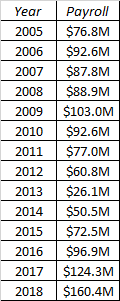
The Astros were in the top half of leaguewide spenders each year from 2005 through 2010 before their 2011 dip. Then Crane tore the whole operation down to the studs, reaching a comical low in 2013. The 2013 Astros began the year with just five players earning north of $1 million — Bud Norris, Carlos Pena, Jose Veras, Erik Bedard, and Wesley Wright — yet Norris, Pena, and Veras were jettisoned in July while Wright was shipped out in mid-August.
The Astros understandably came under fire for their extremely low payroll at the time, but the low spending was justified by the fact that Crane incurred $275 million in debt to purchase the team and by Crane’s own promise that “once our minor league system is filled in, we’ll move up into the top five or 10 in payroll.” It took a few years for the payroll to reach such lofty heights, but by 2018, Houston found themselves with the seventh-highest end-of-season payroll.
Like most teams, the Astros haven’t been that close to the luxury tax threshold, but that changed in 2018 and figures to be a relevant consideration in 2019 as well. While the Astros never blew past their international amateur bonus pools to the extent that some other teams did, they did incur the top penalties and restrictions in 2016, showing a willingness to spend internationally. Nevertheless, their Major League payrolls present a good picture of baseball operations spending.
Future Liabilities
Get ready for Jose Altuve and a whole bunch of soon-to-be free agents.
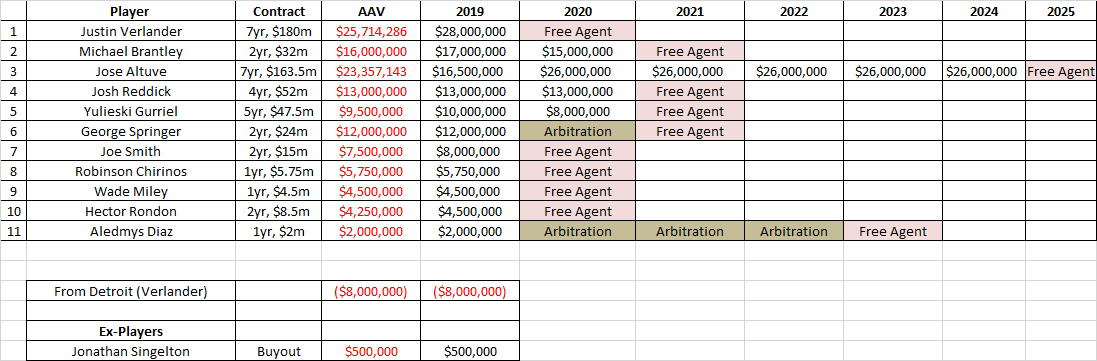
We’ll start with Altuve, the 2017 American League Most Valuable Player and heart and soul of the franchise. His contract features one more discounted year before leaving $130 million on the books from 2020-24. As long as Altuve continues to produce like an MVP, I suspect that Houston won’t complain.
Moving to the top of the list, Houston has just one more year with Justin Verlander under contract. The team’s marquee trade acquisition in August 2017 after a period of struggles with the Tigers, Verlander was reinvigorated and returned to Cy Young caliber form. Owed a net of $20 million thanks to a contribution from Detroit, Verlander represents a good bargain in 2019 in advance of his first-ever walk year. He did originally have a vesting option for the 2020 season, but Verlander waived the option to facilitate the trade.
Next we find a trio of outfielders with two remaining years of control. 2018 provided a great, and timely, reminder of Michael Brantley‘s offensive prowess when healthy, and he figures to set the table near the top of the lineup for the next two seasons. Joining him will be Josh Reddick, whose average power and above-average on-base ability had been a given for years before his BABIP against right-handed pitching surprisingly cratered in 2018. He’s no star, but he’s a good bet to rebound to be an average starter in 2019. Finally, George Springer slipped in the power department in 2019, but his ability to get on base and play a solid defensive outfield kept him valuable. If the power returns, he’ll be a star once again as he nears free agency.
Yuli Gurriel has underwhelmed somewhat since arriving from Cuba, and at 34, there’s not much reason to think he’ll improve dramatically going forward. He’s solid as a regular, though Tyler White‘s offensive prowess could render Gurriel susceptible to losing some playing time.
The majority of the remaining guaranteed contracts are one-year commitments. Smith unfortunately ruptured his Achilles in December 2018, so he won’t be expected back until late summer, if at all. At this point, it’s fair to wonder if he’ll be able to contribute to the 2019 team. Chirinos, Miley, and Rondon should each play a role on the 2019 squadChirinos may get a crack to take the everyday job, but Houston would probably prefer it if Max Stassi‘s 2018 breakout — he posted the second highest framing runs added per Baseball Prospectus despite playing a part-time gig — was a harbinger of things to come. Miley could find himself in the rotation’s fifth spot if Verlander and Gerrit Cole stay healthy while Collin McHugh and Josh James make successful returns to starting. And Rondon remains best-suited for a setup role rather than closing, a job he should stick with provided that Roberto Osuna remains entrenched.
The final contract offers some forward-looking control. New Astro Aledmys Diaz will head to arbitration should the team elect to keep him, although he’ll need to prove his health after spending time on the disabled list in each of his first three Major League seasons.
Houston has done well in avoiding dead money with only the final buyout payment for Singleton allocated to this year’s payroll.
Lest you find yourself wondering why the Astros are such a powerful ball club, let’s take a look at one of the most robust arbitration tables in the game:
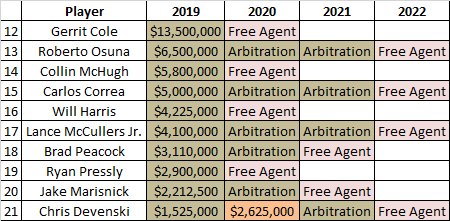
There’s some serious star power here.
We’ll start with the starting pitchers. Much like Verlander before him, Cole appears to have been invigorated by his move to Houston. He pitched like an ace in Pittsburgh in 2015, then pitched well but not nearly as well in 2016-17. With the Astros in 2018, Cole was an ace once again. McHugh lost most of his 2017 to injury, then found his rotation job claimed by Cole last year. With Charlie Morton (surely) and Dallas Keuchel (presumably) out the door, McHugh figures to have first dibs on a starting job after excelling in relief last season. Unfortunately, McCullers won’t help his case in 2019 as he’ll spend the year recovering from November 2018 Tommy John surgery.
The majority of the Houston bullpen is listed in the table above. It all starts with Osuna, who starred after arriving via trade from Toronto at the end of his 75-game suspension for violating Major League Baseball’s policy on domestic violence. His baseball abilities are indisputable. His off-the-field activities present the club with significant risk, both with regards to public relations and roster construction. Even in his mid-30s, Harris represents superb value, especially given his ability to stifle batters of both handedness. He is likely in line for a big contract next offseason. Peacock and Pressly both figure to pitch a lot, with Houston hoping to get a lot of innings out of Peacock and high-leverage innings from Pressly. Finally, Devenski starred in long role in 2016, excelled in 2017 — though to a lesser degree than the prior year — then floundered in 2018. He still has some time to kill before free agency.
We close the arbitration table with the two position players. Correa, the 2015 American League Rookie of the Year, produced three nearly identical excellent seasons from 2015-17 before an injury-marred 2018. Just 24, Correa likely has years of stardom ahead of him. Marisnick, on the other hand, seems destined for a part-time gig that accents his defensive and baserunning skills. Outside of 2017, he hasn’t shown enough with his bat to warrant a more significant share of time, especially against same-sided pitching.
What Does Team Leadership Have to Say?
To Crane’s credit, when he stripped the club down to next to nothing, he promised that he’d spend when it made sense…and then he did. But what about pushing payroll even higher? Crane has shown a willingness here, too, commenting in December that, “I’d say if the right situation came long — certainly we’re not going over [the luxury-tax threshold] — but we could move closer to that. We were pretty high up in the food chain last year. A lot of teams realize the penalty is pretty severe if you go over. We’ll stay within the strike zone.” Luhnow hasn’t been as open about the team’s spending plans, but Crane provided plenty of guidance.
After living through a miserable rebuild, Crane seems keenly aware of the value of contending seasons and willing to spend to supplement his winning teams.
Are the Astros a Player for Bryce Harper?
I think that the Astros could be lurking in the shadows for Harper.
The team is smack in the middle of their window of contention, but having just lost Morton and (presumably) Keuchel from their rotation, they could use a boost. They currently have Brantley and Reddick manning the corner outfield spots, but Reddick is eminently tradeable. And that’s why Harper could fit so easily. If Houston offloaded Reddick and a portion of his $13 million annual salary for 2019 and 2020, the cost of Harper would be mitigated. With Harper likely obtaining a contract with opt-out clauses starting in the early 2020s, signing him allows the team to maximize their current window without seriously jeopardizing their ability to keep Altuve, Correa, and Bregman together for a decade or more.
The luxury tax is a serious consideration, but it should be avoidable. I currently have the team’s luxury tax payroll at $181.2 million. If the Astros followed the blueprint above, jettisoning Reddick and signing Harper for, say, $30 million per year, they still might be able to stay south of the tax line.
The Astros have looming rotation questions with the free agencies of Verlander and Cole coming, but building around an offensive core of Altuve, Correa, Bregman, Brantley, Springer, White, and Harper…whew.
What Will the 2019 Payroll Be?
How high is Crane willing to go?
As of now, I have the Astros at $164.9 million with the aforementioned $181.2 tax number. After sporting a $160.4 million payroll in 2018 and mentioning that the books have room to expand, there’s surely room for more.
Projecting just how high that number goes is tricky. The 2018 payroll was achieved by the age-old formula of 2013 payroll times five plus $4 million. What does that tell us for 2019?
All kidding aside, Houston is primed to take another step. Harper represents approximately three additional wins over what Houston figures to get out of right field in 2019, and if Reddick could be unloaded, it makes tons of sense. However, Houston has made such a move yet, so it stands to reason that perhaps Crane isn’t interest in pushing payroll quite this high.
So let’s split the difference here between what it would take to add Harper and where payroll currently stands. This represents a 9.2 percent increase of 2018 spending, a sensible amount for a team in the midst of their best-ever window of contention.
Projected 2019 Payroll: $175 million
Projected 2019 Payroll Space: $10.1 million