
MLBTR Originals
A look back at the original reporting and analysis found on MLBTR the last seven days:
- Steve Adams issued a Free Agent Stock Watch on Brewers third baseman Aramis Ramirez.
- Zach Links was the first to report outfielder Xavier Paul signed a minor league contract with the Diamondbacks.
- Two days prior to Roberto Hernandez being shipped to the Dodgers, Jeff Todd asked MLBTR readers whether the Phillies will make an August waiver deal. Less than 4% of you correctly predicted the Hernandez swap while nearly 23% of you see GM Ruben Amaro Jr. parting with Marlon Byrd, who, it was reported Friday, was pulled back from revocable waivers after being claimed by an as-yet-unidentified team.
- Brad Johnson asked MLBTR readers whether new Padres GM A.J. Preller will swing a trade this month. More than 69% of you believe he will and it will most likely involve Joaquin Benoit and/or Ian Kennedy.
- Zach gathered the best the baseball corner of the web had to offer in Baseball Blogs Weigh In.
Free Agent Stock Watch: Aramis Ramirez
This season, I’ve looked at the stock of a couple potential free agents that have a mutual option on their deal in the form of Nick Markakis (link) and Adam LaRoche (link). Another such player is Aramis Ramirez, and given the rarity with which mutual options are exercised — if the player is playing well, he almost certainly declines in search of a multi-year deal, and if not, the team declines due to poor production — Ramirez can be very reasonably expected to hit the open market heading into his age-37 season.
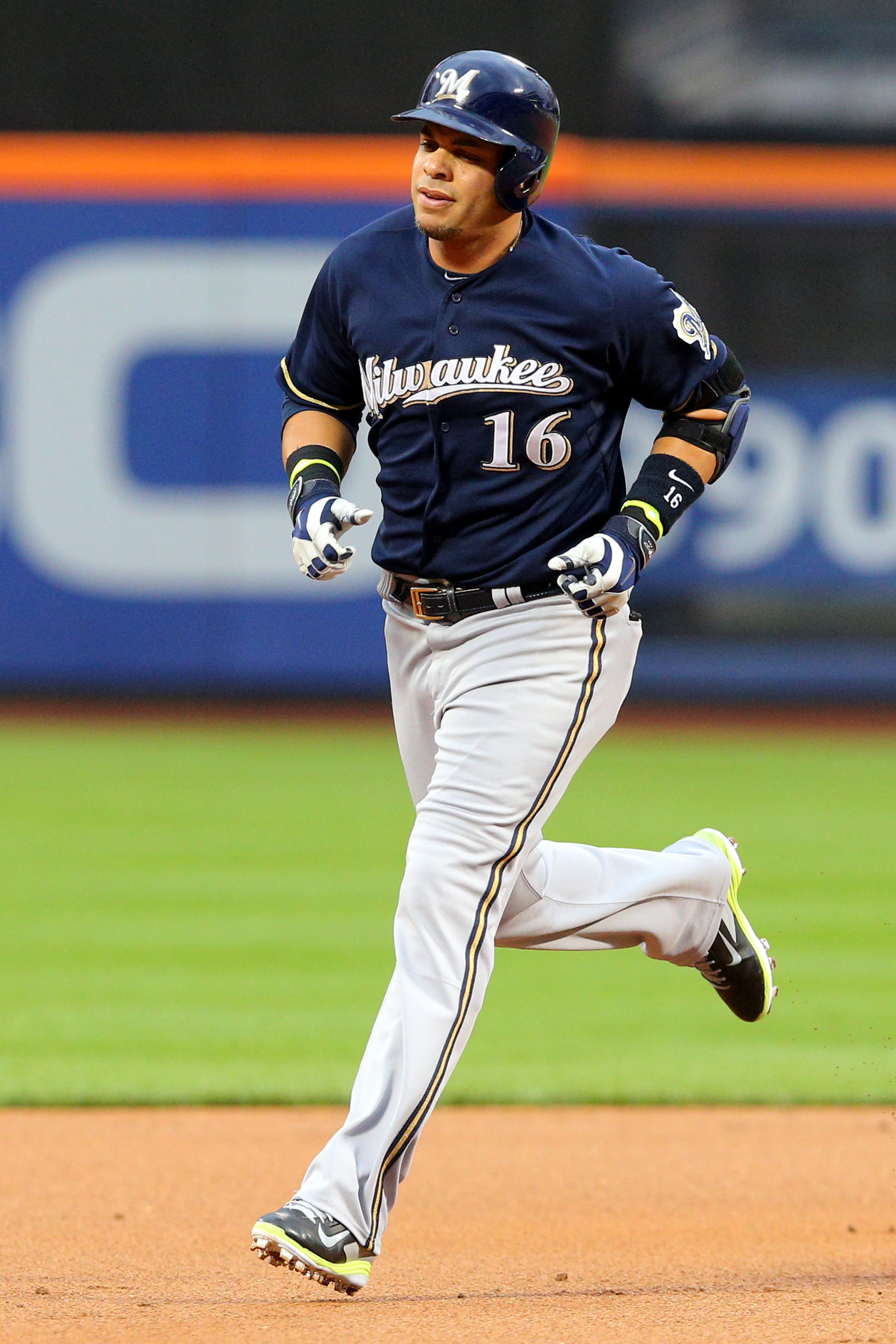
The question then, is whether Ramirez hits the open market because he declines his half of the $14MM option, or whether the Brewers send him on his way and pay a $4MM buyout.
Ramirez is hitting a strong .301/.341/.461 with 13 homers this season — good for an .802 OPS, a 122 OPS+ and a 123 wRC+. He’s been 22 to 23 percent better by park- and league-adjusted metrics like OPS+ and WRC+, and even you’re more partial to traditional statistics, he’s been well above average. The league-average OPS this season for non-pitchers is .716, and the league-average OPS for a third baseman is .714.
Additionally, a look at the market reveals some spotty competition. Two years ago, seeing Ramirez stacked up against Chase Headley, Pablo Sandoval and Hanley Ramirez would’ve seemed much bleaker than it does now. Headley hasn’t hit much this season, and Sandoval has been a slightly weaker hitter than Ramirez (albeit at a younger age and with better defense). He’s outperformed Headley, and his asking price will assuredly be lower than Kung Fu Panda and Hanley, who both rank in the Top 5 of MLBTR’s Free Agent Power Rankings. Ramirez may not be a premier free agent, but he’s an upper-tier bat in a weak crop that will require fewer years than those in the top tier. Teams in need of help at the hot corner (and possibly DH) should show interest.
Of course, Ramirez isn’t a player without his faults. He missed 70 games in 2013, mostly due to a recurring issue in his left knee, and this season he’s already missed 22 games with a left hamstring injury. His defense doesn’t come with a great reputation, and while he’s posted a solid UZR in 2014, a half-season of UZR rarely tells the whole tale of a player’s glovework. Ramirez posted a negative UZR mark (and a negative DRS mark) in all but one season from 2008-13. Beyond that, his walk rate is down to a career-low 3.6 percent, and his solid OBP has been bolstered by an abnormally high HBP total (nine — which is quite a few based on his history).
At the time Ramirez hit the disabled list, he looked like a candidate for a one-year deal, and it was debatable whether or not Milwaukee would even exercise its half of the mutual option (he was hitting .252/.309/.390). Since returning in early June, however, he’s been excellent, hitting .329/.360/.502 with eight homers in 225 plate appearances. The ZiPS projection system forecasts a .285/.339/.469 line from here on out, while Steamer projects a similar .275/.333/.460 (both available on Ramirez’s Fangraphs page).
If he can hit at that pace or better, his option should be a non-factor. With a $4MM buyout on a $14MM option, Ramirez and the Brewers are essentially deciding on a one-year, $10MM deal. Milwaukee would likely jump at that price, but given his overall production, Ramirez will have no trouble topping that as long as he remains healthy. The interesting wrinkle will be whether or not Milwaukee extends a qualifying offer should Ramirez reject his half of the mutual option. At that point, the Brewers would essentially be offering one year at $19MM+ (assuming a $15MM+ qualifying offer value) — which they may be hesitant to do given their typically middle-of-the-road payroll.
Ramirez said last month that he had decided to play beyond this season and would try to reach the 2,500-game plateau (he’d need at least three more seasons to do so). Given his strong production and desire to play for several more seasons, it seems fair to expect the veteran slugger and his agents at Kinzer Management Group to pursue multiple years. There’s no precedent for a third baseman entering his age-37 season to get a significant three-year deal, but we did see aging slugger Carlos Beltran land a three-year pact last offseason as he headed into his age-37 campaign. (Marlon Byrd, another comparable in terms of age, netted a nice two-year deal with a vesting option, albeit at a lower rate than Ramirez would command.)
While Ramirez hasn’t necessarily been a heavily discussed free agent name to this point, a strong finish will position him nicely in a what looks to be a weak crop of free agent position players. His case will be a bit unique, but as long as he can continue at a strong pace, there’s little reason to doubt another multi-year deal for a player that is on pace to post an OPS+ north of 120 for the 10th time in 11 seasons.
Photo courtesy of USA Today Sports Images.
MLBTR Originals
A look back at the original reporting and analysis found on MLBTR this past week, as another non-waiver Trade Deadline has come and gone:
- Jeff Todd and Mark Polishuk recapped the cornucopia of deals completed on the final day of the deadline and summarized every trade made during the month of July by division (AL East, NL East, AL Central, NL Central, AL West, and NL West).
- Jeff asked MLBTR readers which team made the best buy Thursday. Over 45% of you believe the Tigers’ acquisition of David Price was the shrewdest move.
- How is a trade transacted after July 31st? Jeff provided this primer on the rules for August swaps.
- Tim Dierkes was the first to report Andres Torres exercised the opt-out clause in his minor league deal with the Red Sox.
- Steve Adams hosted the MLBTR live chat this week.
- Zach Links put together the best of the baseball blogosphere in Baseball Blogs Weigh In.
MLBTR Originals
A look back at the original reporting and analysis found on MLBTR the last seven days:
- Tim Dierkes updated MLBTR’s 2015 Free Agent Power Rankings and Max Scherzer has retaken the top spot with Jon Lester moving up to second and Hanley Ramirez, last month’s top ranked free agent, falling to third. Also, two players have cracked the top ten for the first time: Yasmani Tomas and Melky Cabrera.
- Tim was the first to report teams with the ten worst records will have their first round draft choice protected, even if compensation picks are slotted within the first ten selections.
- MLBTR completed its look at the 2014 trade market with Steve Adams’ review of rotation reinforcements and Jeff Todd’s break down of bullpen buys (right-handed, left-handed).
- Tigers President/CEO/General Manager Dave Dombrowski told Zach Links he is still working all trade possibilities after acquiring Joakim Soria from the Rangers, even a left-handed reliever. “Our bullpen has struggled at times and we want to have people that put up zeroes out there. We’ve tried a lot of guys at that and we remain open-minded if something makes sense to make us better before the trade deadline.“
- Steve hosted this week’s chat.
- Zach compiled the latest edition of Baseball Blogs Weigh In.
Trade Market For Left-Handed Relievers
Last year’s left-handed relief market was fairly active. Among the players to change hands were Joe Thatcher, Marc Rzepczynski, Scott Downs, Matt Thornton, and Wesley Wright.
Thus far, we’ve already seen one prime target move, as Thatcher once again drew summer trade interest. There have also been several more minor deals involving lefties, including Chris Capuano, Jeff Francis, Nick Maronde, and Rich Hill.
Here’s who else could be available for pen work (and, in some cases, rotation depth) in the week to come:
Long-Term Control
Felix Doubront (Red Sox), Jake McGee (Rays), Mike Dunn (Marlins), Marc Rzepczynski (Indians), Darin Downs (Astros)
- Doubront is an interesting player to watch given his long-term control and ability to throw in the pen or rotation. Of course, he has been unhappy with being moved out of a starting role in Boston, but clubs might like to slot him in the pen while also supplementing their starting depth (and possibly shifting him back to the rotation next year). He is just 26 and will be arb-eligible for the first time next year; that, combined with his buy-low status in a down year, could create a fairly diverse market (if Boston wants to move him).
- Unlike the Sox, the Rays now seem like they could be leaning against selling, and that would seem to remove McGee from consideration. If things change, though, McGee would be quite a desirable piece, as he is coming off a Super Two season in which he earned just $1.45MM and has dominated with a 1.40 ERA, 1.30 FIP, and 11.6 K/9 against 2.0 BB/9. Having slotted into the closer’s role of late, his counting stats will begin to drive up his arb price, but he’ll still be well underpaid compared to his abilities. That, of course, could leave Tampa uninterested in moving him.
- Dunn, likewise, will be building off of a $1.4MM salary in his first year of arbitration (though he was not a Super Two). He only sports a 4.10 ERA, but his 10.4 K/9 against 3.6 BB/9 seems attractive. Of course, the Marlins have indicated in the past that they value him rather highly, and it is far from clear that a contender would be willing to make a strong enough offer to obtain him.
- Rzepczynski, 28, has been solid, if unspectacular, and is earning a mangeable $1.38MM in his first season of arbitration. His inclusion on this list, though, is somewhat speculative, as Cleveland may hope to keep him for the stretch as well as next season.
- Downs has struggled with Houston this season (5.04 ERA), but he’s held left-handed hitters to an impressive .213/.280/.313 batting line in his career and is controlled through 2018. That control might be appealing to the Astros, but GM Jeff Luhnow has shown a willingness to listen on the majority of his players in recent years.
Short-Term Control
Andrew Miller and Craig Breslow (Red Sox), Brian Duensing (Twins), Tony Sipp (Astros), Neal Cotts (Rangers), Dana Eveland (Mets), Antonio Bastardo (Phillies), James Russell and Wesley Wright (Cubs), Oliver Perez (D’backs)
This group includes some fairly high-quality rental options, but Miller appears to be the prize of the class at this point. He has been dominant (2.31 ERA, 1.73 FIP, 14.5 K/9 against 2.8 BB/9), and his pure rental status makes him seem fairly likely to be dealt. Boston looks likely to sell after a recent slide, and Miller should draw enough suitors to drive up a decent return.
Bastardo and Russell have been among the more consistent lefties in the game in recent years, and both come with one more year of team control through arbitration. Duensing, Cotts, Eveland, Sipp, Wright, and Perez have all had solid seasons and should be available for relatively little in return. Breslow has struggled, but has a fairly strong track record and could be a cheap add for a team that believes in him. (He also comes with a $4MM option for next year, though it is somewhat difficult to see a scenario where that gets picked up.)
Trade Market For Right-Handed Relievers
Needless to say, right-handed relief pitching is perhaps the most-moved asset during July. Last year, things got started with a swap of righties Carlos Marmol and Matt Guerrier, with Mitchell Boggs, Francisco Rodriguez, Guillermo Moscoso, Jesse Crain, and Jose Veras also moving in July. The August revocable waiver trade period saw John Axford and Vic Black change hands.
Significant movement has already occurred this year, of course, with Ernesto Frieri and Jason Grilli swapping jerseys. Since that time, quality arms like Joakim Soria, Huston Street, and Jason Frasor have gone to contending clubs. That does not mean that the action is over on this front, however. Let’s see who else might be available:
Current/Former Closers
Koji Uehara (Red Sox), Joaquin Benoit (Padres), Jonathan Papelbon (Phillies), Steve Cishek (Marlins), Brad Ziegler (D’backs), Chad Qualls (Astros), LaTroy Hawkins (Rockies), John Axford (Indians), Grant Balfour (Rays), Jim Johnson (Athletics)
- If the Red Sox decide to market Uehara, rather than holding onto him and either making a qualifying offer or extending him, he would likely be the best arm available. Uehara is the kind of dominating closer that can add huge value down the stretch and in the postseason, and would figure to draw substantial interest from any team with an eye on October. He is owed very little this year, and would be a pure rental.
- Benoit has somewhat quietly been nothing short of dominant over the last two years. He is owed $8MM next year and comes with a $8MM club option ($1.5MM buyout) for 2016. Of course, San Diego has indicated that it will only move its newly-minted closer for a big return, having already dealt away Street.
- Papelbon has actually been quite a bit more effective than one might expect, given all the negativity surrounding his contract and stay in Philadelphia. The 33-year-old’s velocity is down, but so is his ERA (1.91). And while the contract still looks bloated, it no longer seems entirely untradeable. Papelbon’s annual rate is $13MM both this year and next, and he comes with an achievable vesting option for the same price in 2016 (vests with 55 games finished next year or 100 total between 2014-15).
- Cishek is an arb-eligible 28-year-old playing on a $3.8MM Super Two salary. His ERA is at a career-worst 3.32 — he’s allowed less than three earned per nine in every full season of his career — but his FIP is at a career-best 2.06. Though it seems that the Marlins are unwilling to move him, his swiftly rising salary means that you can’t rule out the possibility if the right offer came in.
- Though he has not spent much time in a closing capacity, Ziegler does have some experience there after logging 13 saves last year. More importantly, the 34-year-old has not seen his ERA land above its current 2.84 level since the 2010 season. He is striking out more batters than usual (7.8 K/9), while his walk totals remain in line with his career numbers (3.0 BB/9) and he continues to induce a ridiculous number of ground-balls (66.4%). Owed a reasonable $5MM next year, and coming with a $5.5MM club option ($1MM buyout) for 2016, his contract also looks pretty good — although that is also why Arizona is reportedly inclined to keep him.
- Qualls and Hawkins, both veterans of the league, are currently working as closers but would almost certainly be dropped in the pen hierarchy on a contender. The pair has been effective over the past two seasons, and both play for obvious sellers. But the Astros have indicated that they are hesitant to move the more desirable Qualls (who they control for two more years), while the Rockies could also opt for stability rather than a meager return on Hawkins (who will be a free agent and has struck out just 4.4 batters per nine).
- Then we arrive at the highly-paid, deposed closers: Axford, Balfour, and Johnson. The 31-year-old Axford comes with control, but could be a non-tender candidate again this year. Though he is the only one of this trio that has been reasonably productive this year (3.23 ERA, 11.1 K/9 vs. 6.0 BB/9), little in the way of rumors suggest that he is being asked about or shopped. Meanwhile, Balfour and Johnson are both grossly overpaid and underperforming, and could surely be had for a meager return, with their current teams eating most or all of their salaries. (The latter, of course, is in DFA limbo at the moment and could become freely available at league minimum in short order.)
Set-Up Men
Burke Badenhop and Edward Mujica (Red Sox), Juan Carlos Oviedo (Rays), Scott Atchison (Indians), Ronald Belisario and Javy Guerra (White Sox), Casey Fien and Jared Burton (Twins), Neftali Feliz (Rangers), Jose Veras (Astros), Carlos Torres and Daisuke Matsuzaka (Mets), Carlos Villanueva (Cubs), Tim Stauffer and Blaine Boyer (Padres), Matt Belisle (Rockies)
Among these players, only Belisario, Guerra, Torres, and Fien come with control extending beyond 2015. Neither of the ChiSox hurlers has been that good, however, and the Mets and Twins will probably be in no rush to move Torres and Fien since they come with multiple years of control and should remain fairly inexpensive.
The other arms are purely short-term options who could help with depth down the stretch and (in some cases) next year. Feliz has had his struggles and will not be cheap as a project arm, and probably will get a chance to regain his form in Texas. Otherwise, Badenhop is probably the prize of this group after Fien; he has been steady for the third straight year and shouldn’t be expensive (in dollars or prospects) as he prepares to hit the open market. Belisle could be an intriguing buy-low rental, as his numbers continue to be inflated by pitching at Coors Field, though he has also seen his FIP rise to 4.12 on the back of a troubling dip in his strikeout numbers against recent seasons (6.4 K/9 this year after averaging 7.9 K/9 over prior four campaigns).
Dave Dombrowski On Joakim Soria, Future Moves
Last night, the Tigers landed one of the top available relievers on the trade market in Rangers right-hander Joakim Soria. While Soria should go a long way towards shoring up Detroit’s bullpen, many have wondered if Detroit might continue to work the phones for an additional relief option, particularly given the struggles of left-handers Phil Coke and Ian Krol. I asked Tigers General Manager Dave Dombrowski earlier today if he might go after a southpaw in the next week.
“I don’t know I would get into what we’re specifically addressing, but we’re open-minded to different thought processes. Our bullpen has struggled at times and we want to have people that put up zeroes out there,” Dombrowski said. “We’ve tried a lot of guys at that and we remain open-minded if something makes sense to make us better before the trade deadline.”
The Tigers have been in need of bullpen reinforcements for some time and Dombrowski has been focused on Soria “for a while.” The GM said that he started chatting with Rangers GM Jon Daniels in June and things picked up more and more with time. And while Soria didn’t come cheap — he cost the Tigers promising pitching prospects Jake Thompson and Corey Knebel — he believed that it was a price they could afford to pay thanks to their pitching depth. Soria’s affordable $7MM club option also helped Dombrowski to pull the trigger since he will likely be more than just a rental.
“I don’t think it made the deal, but it was a real plus for us,” the GM said.
Of course, if things went differently for the Tigers this season, they might not have had to make a trade like this at all. Dombrowski acknowledged that he’d be in a “different situation” if Bruce Rondon was with the club. They’re also “not counting” on a 2014 return for Joel Hanrahan and the odds were termed as being “highly unlikely.”
While Soria has a long history as a successful closer, Dombrowski is insistent that Joe Nathan will continue to pitch in the ninth-inning despite his struggles this season. When asked what it might take for Soria to possible leapfrog Nathan and close out games, the Tigers GM declined to speculate or set expectations for the 39-year-old. For now, Soria is there to help build a better bridge to Nathan and the veteran appears to be all for it. Before pulling the trigger on the deal, Tigers manager Brad Ausmus and pitching coach Jeff Jones asked Nathan and Ian Kinsler about how they feel Soria might fit in with the team. One of the replies they got back was, “Why don’t we have him yet?’“
2015 Free Agent Power Rankings
The trade deadline will be upon us next week, but the 2014-15 free agent class still warrants an early look. My June edition of the 2015 Free Agent Power Rankings can be found here, and the full list of 2015 free agents is here.
1. Max Scherzer. Scherzer overcame a midseason hiccup by posting a 1.87 ERA over his last five starts, bringing him back down to 3.34 on the season. He even picked up the win for the American League in the All-Star Game. It’s been a long time since agent Scott Boras has had a starting pitcher of this caliber as a free agent.
2. Jon Lester. Lester isn’t far behind Scherzer, having allowed three earned runs in 38 2/3 innings since our last set of rankings. Lester owns a 2.50 ERA as well as superb timing, and he’s been better than Scherzer this year. Lester hasn’t whiffed this many batters since 2010, and he’s never shown this level of control. Accounting for performance prior to this year, I still give Scherzer the overall edge. Around late June the Red Sox looked to reignite extension talks with Lester, but the pitcher did not receive a new offer and continues to prefer to table discussions until after the season. With the Red Sox slipping in the standings of late, Lester could be traded by the July 31st deadline and freed of a qualifying offer.
3. Hanley Ramirez. Ramirez’s shoulder and calf have been bothering him, and he’s been hit by pitches three times this month. The 30-year-old avoided the DL and continues to hit well. On the other hand, he’s giving back some runs in the field, and defensive question marks are enough to push him down a few spots in the rankings.
4. James Shields. With a 4.39 ERA since May, Shields has failed to keep pace with Lester. Still, Shields’ 2014 peripheral stats are mostly better than last year’s, which led to a 3.15 ERA. The Royals also seem to be hanging around contention enough that they won’t give serious consideration to trading the big righty. With a new contract that will begin with his age-33 season, Shields will be difficult to price in free agency.
5. Pablo Sandoval. As of May 13th, Sandoval’s OPS was down to .554. He’s at .903 since then, with a .335/.370/.533 line in 230 plate appearances. Just 28 in August, Sandoval has age on his side relative to most free agents.
6. Nelson Cruz. Cruz has stumbled since our last set of rankings, hitting .229/.282/.422 in 117 plate appearances. He still ranks second in all of baseball in home runs and RBI, and could top his career-high of 33 longballs at some point in August. Cruz is another tough free agent to price, as teams will be buying into his age 34-36 seasons (and perhaps age 37, if things go well for the slugger).
7. Victor Martinez. V-Mart’s resurgent contract year has continued unabated. Though he’ll be 36 in December, Martinez’s goal might be a three-year pact. On June 29th, Nick Cafardo of the Boston Globe wrote that while there have been no extension discussions, Martinez would love to remain in Detroit. One complication for the Tigers is that Miguel Cabrera is signed through 2023 and will probably need to move to DH at some point.
8. Yasmani Tomas. A new entrant to this list, Tomas is a different kind of potential free agent. As Ben Badler of Baseball America explained on June 20th, Tomas left Cuba to pursue an MLB contract but still has to clear the usual hurdles before he’s free to sign. A 23-year-old corner outfielder, Badler pegs Tomas’ raw power as a 70. It seems possible Tomas’ actual free agency will coincide with the MLB offseason. Jose Abreu‘s dazzling debut has made his $68MM contract look like a bargain, which should help Tomas score big. It’s worth noting that Tomas isn’t said to be as polished as Abreu and likely doesn’t have the same ceiling. He is younger, however, which helps his cause.
9. Melky Cabrera. Cabrera, 29, is hitting .305/.352/.463 on the season. His ties to Biogenesis cloud the picture, but his injury-shortened 2013 might end up being Cabrera’s only poor season in his last four.
10. Russell Martin. Perhaps Martin can’t maintain his .271 batting average, but he’s in the midst of another solid campaign and doesn’t turn 32 until February. Teams are also placing more and more emphasis on catching defense, and Martin has gunned down 37 percent of attempted base-stealers while ranking sixth in extra strikes added via pitch framing, per Baseball Prospectus.
This month’s Kenta Maeda watch: the 26-year-old Japanese righty is down to a 2.08 ERA in 15 starts. Ervin Santana has been decent of late. Jason Hammel was traded to Oakland and has seen his ERA rise from 2.98 to 3.35 after two starts. Josh Beckett returns from a DL stint for a hip injury tonight.
You likely won’t find a reliever cracking the top 10, but closers David Robertson, Francisco Rodriguez, Casey Janssen and Rafael Soriano have been excellent, while Luke Gregerson and Andrew Miller have been lights out in a setup capacity.
Among position players, Chase Headley, who earlier today was traded to the Yankees, is still not showing any power (though perhaps a move to the hitter-friendly parks of the AL East can change that). Colby Rasmus was placed in something of a platoon role earlier this month. Nick Markakis leads MLB in plate appearances and has been useful this year. Aramis Ramirez, who like Markakis has a mutual option on his deal, is having a nice year at the plate as well. Stephen Drew‘s bat has started to come alive this month after his late start to the season, while Kendrys Morales is hitting .295/.319/.432 over an 11-game hitting streak. Neither Boras client has very appealing overall numbers. Both Asdrubal Cabrera and Mike Morse have dropped off the list after sluggish performances since our last edition of the rankings. A strong finish could put either back onto the map.
Steve Adams contributed to this post.
Trade Market For Starting Pitchers
We’ve already looked at the trade markets for catchers, first basemen, second basemen, shortstops, third basemen, corner outfielders and center fielders. Up next is starting pitchers, and there’s never any shortage of starters dealt in the summer trade market. Last year, we saw Scott Feldman, Ricky Nolasco, Bud Norris, Ian Kennedy, Jake Peavy and Matt Garza get dealt to new clubs, and this year, there have already been a few early moves.
The Yankees acquired Brandon McCarthy from the D’Backs in exchange for young southpaw Vidal Nuno, and the A’s pulled off what could end up as the summer’s biggest deal when they landed both Jeff Samardzija and Jason Hammel from the Cubs in exchange for Addison Russell, Billy McKinney and Dan Straily.
Here’s a look at some of the remaining arms that could hear their names mentioned over the next week-plus (and possibly into August)…
Top-of-the-Rotation Arms
David Price (Rays), Cliff Lee (Phillies), Cole Hamels (Phillies), Jon Lester (Red Sox), James Shields (Royals)
- Trade rumors surrounding Price have been plentiful, but the Rays’ recent surge and the declining success of division rivals might convince Tampa to hang onto its ace. He’s controlled through 2015 (and projects to earn $18-20MM next year), meaning that any team will have to gut its farm to acquire Price. Acquiring Price is a win-now move that is going to hurt his new team’s minor league system in a big way. The A’s gave up a Top 5 prospect in Russell; their 2013 first-rounder in McKinney; and a 25-year-old righty with five-plus years of team control left in Straily. Price will command a similar, if not more significant package, though as Peter Gammons reported yesterday, they’ll wait until the final 48 hours prior to the deadline before deciding to sell.
- Lee’s health is up in the air. He struggled in his return from elbow strain and will make at least one more start before the non-waiver deadline. If he’s healthy, Lee is a difference-maker that can lead a rotation for this year and next, though he’s guaranteed roughly $48MM through the end of next season. Part of that is a $12.5MM buyout on a $27.5MM vesting option for 2016 that will trigger with 200 innings pitched next year. A deep-pocketed team could conceivably add Lee for two-and-a-half seasons, but that contract limits his market.
- Hamels is guaranteed just under $100MM from now through 2018, and he has a $20MM vesting option for 2019 as well. He’s among the game’s most consistently excellent pitchers, and at 30 years of age, he still has some prime years remaining. Hamels can block trades to 20 clubs, but among the deep-pocketed teams to which he cannot block a trade are the Dodgers and Yankees. The Cardinals and Red Sox are two teams with a glut of MLB-ready talent that could put together a package for Hamels as well.
- The odds of Lester being dealt are slim, to say the least, but if the two sides realize that no deal is going to happen until free agency, rival clubs will at least inquire on the possibility of renting Lester for August through October. Boston will be in the mix to sign him as a free agent, regardless, and the return would be significant. Lester has a 2.50 ERA with his best strikeout rate since 2010 and the lowest walk rate of his career.
- Shields, like Lester, is unlikely to be dealt as the Royals maintain hope for a strong second half that would propel them into the postseason. It would take something like a 10-game losing streak for the Royals to really entertain the thought of dealing Shields, and even then, the team may prefer to simply hang onto him and make a qualifying offer at season’s end.
Mid-Rotation Arms/Innings Eaters/Back-End Starters
Ian Kennedy (Padres), Bartolo Colon (Mets), Jake Peavy (Red Sox), John Lackey (Red Sox), A.J. Burnett (Phillies), Roberto Hernandez (Phillies), Kyle Kendrick (Phillies), Kevin Correia (Twins), Jorge De La Rosa (Rockies), Scott Feldman (Astros), Erik Bedard (Rays), John Danks (White Sox), Justin Masterson (Indians), Brandon McCarthy (Yankees), Colby Lewis (Rangers), Edwin Jackson (Cubs), Ross Detwiler (Nationals), Daisuke Matsuzaka (Mets), Marco Estrada (Brewers)
- Kennedy has reemerged as a strong starting option, and some may consider him eligible for the previous section of this post based on his strong numbers in 2014. A 3.68 ERA, 2.98 FIP and a career-best strikeout rate (9.5 K/9) combined with team control through 2015 make him an outstanding trade chip for San Diego. The asking price will be lofty, and certainly more than head-scratching package of Joe Thatcher, Matt Stites and a Competitive Balance pick that San Diego sent to Arizona last summer to acquire him.
- Colon is known to be available, and despite his age and body type, he’s having a strong first season in Queens. The Mets might not trade many pieces this summer, but Colon is the most likely to go, and with a 4.12 ERA, 6.8 K/9 and 1.3 BB/9 in 126 2/3 innings, his two-year, $20MM contract looks like a reasonable price. If a team simply needs some above-average innings behind its front-line starters, Colon is a great fit.
- Peavy’s name has been popular lately, and while his velocity is down and most of his stats are declining, he’s a serviceable right-hander that can slot into the back of a rotation — particularly in the NL. He’s owed about $6MM through season’s end, and Boston could sweeten the pot by eating some salary. With ready-made replacements like Rubby De La Rosa in-house, the Sox should be motivated to move him.
- Lackey’s contract has a ridiculously cheap $500K option for 2015 that triggered after he missed a season with Tommy John surgery, and that will be highly appealing to rival clubs. There’s been talk that he could simply retire rather than play for that amount, but that seems unlikely when he clearly has plenty left in the tank.
- Burnett has a limited no-trade clause, and his stats have declined along with his velocity in 2014. Still, he’s posted a 4.08 ERA and would be of interest to teams looking for a mid-rotation piece to bolster the back of a potential playoff rotation. Burnett has a player option on his deal that he doesn’t seem likely to exercise, barring a poor finish to the season.
- Hernandez has walked way too many hitters this season, but control hasn’t been an issue with him since 2010, so a different team might think it can help him get back to his low-walk ways. He gets plenty of ground-balls and has whiffed better than six per nine over the past two seasons. With a cheap price tag, he could have some appeal to another club for a very modest return.
- Kendrick is somewhat similar to Hernandez. He generates fewer grounders and strikeouts but comes with better command, albeit at a higher price tag ($7.7MM in 2014). He’s a free agent at year’s end and won’t be receiving a qualifying offer, so the Phils would seemingly be open to dealing him. Given his down season (4.87 ERA), however, the return wouldn’t be much.
- Correia’s overall numbers don’t look great, but he’s quietly pitched to an excellent 2.87 ERA over his past eight starts, and he has a 3.96 ERA dating back to May 1. However, his K/9 rate is the lowest in baseball among qualified starters, and he comes with limited upside. A team with a need in the fifth spot of its rotation could do worse, and his modest $5.5MM salary isn’t as burdensome as some similar starters (e.g. Kendrick).
- De La Rosa, a free agent at season’s end, is sporting a 4.39 ERA that doesn’t look highly impressive on the surface. However, his fastball velocity, ground-ball rate and strikeout rate are all up this year. A move from Coors Field would be beneficial, and he’s already been connected to the Orioles. Other teams have undoubtedly noticed some of his improvements this year, even if a slight increase in walks and decrease in strand rate have hurt his ERA.
- It’d be a surprise to see Houston deal Feldman just three months into a three-year deal, but the Astros have recently shown a willingness to deal almost anyone. Feldman is having a marginal season, but the Astros did front-load his contract, perhaps making it slightly more appealing in trades.
- Bedard’s strikeout rate this year isn’t what it once was, and he’s recently shifted to the bullpen for the Rays. A move out of the AL East might benefit him some (he’s been rocked by Toronto and Baltimore), but every division has some tough lineups. The asking price figures to be minimal, but the former ace isn’t much more than a No. 5 option at this point.
- The roughly $34MM still owed to Danks through the 2016 season drags down his value, but also figures to substantially lower Chicago’s asking price. Danks has a 3.41 ERA over his past 11 starts as well, suggesting that he may be recovered from shoulder surgery that cost him a calendar year from May 2012 to May 2013.
- Masterson has had a brutal year, thanks in part to a fastball that has dipped by 2.5 mph and a BB/9 rate that has spiked north of 5.00. Currently on the DL for a knee issue, he could possibly be acquired by a team that thinks resting his knee will return him to the form that made him one of the top projected free agents prior to this season. Of course, Cleveland may not be willing to sell low on its former ace.
- McCarthy has been a sabermetric darling this year, as his 4.8063 ERA doesn’t line up with his 2.87 xFIP or 2.98 SIERA. McCarthy has the best strikeout and ground-ball rates of his career to go along with excellent command. If the Yankees decide they can’t recover from Masahiro Tanaka‘s injury, they could flip McCarthy, perhaps for more than they gave up, as Vidal Nuno wasn’t too steep a price to pay.
- Solid strikeout and walk rates have helped Lewis post a reasonable 4.11 FIP, but his 6.37 ERA doesn’t look anywhere near as appealing. Lewis’ .413 BABIP will come down, but a contender might not want to wait for his luck to turn around. Needless to say, the asking price wouldn’t be much for any team looking to buy low.
- Another pitcher whose FIP (4.27), xFIP (3.95) and SIERA (4.13) all suggest that Jackson has been better than his 5.61 ERA, the Cubs would almost certainly be happy to move some of his remaining $26.4MM, but it’s tough to envision too many interested parties, despite a career-best 8.1 K/9.
- Detwiler has been shifted to the bullpen this year following the Doug Fister trade, despite the fact that he performed well as a starter with the Nats over the past few years. He now sports a 3.61 ERA out of the ‘pen, and he’s controllable through next season. Earning just $3MM this season, he won’t be too expensive after his final round of arbitration.
- Matsuzaka hasn’t exactly lit the world on fire in his return to the Mets, but he’s been a solid swingman, making nine starts (4.24 ERA) and 18 relief appearances (2.45 ERA). His strikeout rate is a strong 8.6 per nine innings, but he’s shown his usual control problems (5.5 BB/9).
- Estrada hasn’t pitched particularly well in 2014, as his strikeout rate has dropped while his walk rate has increased substantially. Always homer-prone, he’s averaged more than two long balls per nine innings this season. He’s controlled through 2015, so a team could buy low on him as a rotation option for this year and next, while the Brewers replace him with Jimmy Nelson (of course, that scenario is just speculation).
Controllable/Young Arms with MLB Experience
Randall Delgado (D’Backs), Tyson Ross (Padres), Tommy Milone (A’s), Hector Santiago (Angels), Felix Doubront (Red Sox), Jacob Turner (Marlins), Shelby Miller (Cardinals)
- Delgado’s name was somewhat curiously absent from Arizona’s list of untouchable players. Despite being a key piece to the 2013 Justin Upton trade, he seems to have fallen out of favor with the organization, to an extent. Rather than give him a shot in the rotation, the D’Backs inked Bronson Arroyo in the offseason. And now, even with the rotation in disarray, Delgado is in the bullpen. He’s posted a 3.99 ERA and 11.7 K/9 as a reliever, but some clubs may look at the former Top 50 prospect as a buy-low rotation candidate. He’s controlled through 2018.
- Ross, too, is unlikely to be dealt, as he’s controlled through 2017 as a Super Two player and has broken out over the past calendar year with the Friars. The 27-year-old has the lowest contact rate among all qualified starters (hat tip: Dennis Lin of the San Diego Union-Tribune on Twitter), and he’s posted an even 3.00 ERA since Opening Day 2013.
- Also controlled through 2017, Milone lost his roster spot when Oakland acquired Jeff Samardzija and Jason Hammel. That’s a harsh reality for a southpaw with a career 3.84 ERA, 6.5 K/9 and 2.0 BB/9 in 468 2/3 innings. O.Co Coliseum has no doubt helped his ERA, but Milone profiles as a controllable back-of-the-rotation starter (if not more) and is seemingly without a rotation spot this year or next (when Jarrod Parker and A.J. Griffin will return). Milone’s name will undoubtedly be popular after yesterday’s reports that he asked the A’s to trade him. It’s tough to see the A’s moving him without a pretty strong return, however.
- With a 4.72 ERA in a dozen starts, Santiago hasn’t fortified the rotation as the Angels has hoped. The 26-year-old lefty has a career 3.61 ERA with 8.7 K/9, but poor control (4.3 BB/9) and some good fortune on balls in play have led FIP, xFIP and SIERA to project something in the low to mid-4.00 range. He’s controlled through 2017 as well.
- Doubront has been shuffled back and forth between Boston’s bullpen and rotation over the past few seasons, and the 26-year-old could ultimately benefit from a change of scenery. Doubront has seen his fastball velocity decline rapidly since 2012, and his strikeout rate has fallen accordingly. That might dissuade teams that would’ve been interested a year ago from looking him up now. Like many others on this list, he’s controlled through 2017.
- A former first-rounder and the centerpiece of Miami’s trade of Anibal Sanchez and Omar Infante, Turner may have fallen out of the Marlins’ rotation plans. With Jose Fernandez, Andrew Heaney, Henderson Alvarez and Nathan Eovaldi looking like the future front four, Turner would be competing with a host of other prospects for the fifth slot. He’s posted a 6.22 ERA (3.83 FIP) in 63 2/3 innings in 2014 and has been in the bullpen since mid-June. Turner is controlled through 2018.
- Miller was recently shifted to the bullpen after posting a 5.65 ERA over a 10-start stretch. Overall, his ERA is a seemingly passable 4.25, but a 4.79 FIP and 4.88 xFIP suggest that he’s been fortunate to keep it that low. Miller was once one of baseball’s top prospects and was outstanding for most of 2013, which would make him an excellent buy-low candidate. St. Louis may be hesitant to include him in a deal for an impact player, but he’d still be plenty intriguing to other clubs.
MLBTR Originals
A look back at the original reporting and analysis found on MLBTR this past week:
- MLBTR continued to break down the 2014 trade market position-by-position with Charlie Wilmoth’s look at corner outfielders, Jeff Todd’s survey of first basemen, and Steve Adams’ study of third basemen and center fielders.
- Brad Johnson asked MLBTR readers whether the Phillies will swing a deadline deal. More than 82% of you believe Ruben Amaro Jr. will make a trade before either the non-waiver Trade Deadline (July 31) or during the August waiver trading period.
- Steve hosted this week’s live chat.
- Zach Links assembled the best of the baseball blogosphere for you in Baseball Blogs Weigh In.