
Athletics Extend Jacob Wilson
The A’s have extended another member of their young core, announcing a seven-year contract, plus a club option for an eighth year, for shortstop Jacob Wilson. The PSI Sports Management client will reportedly be guaranteed $70MM, which includes a $3MM signing bonus.
The option year has a base value of $26MM and has escalators depending on Wilson’s MVP finishes in 2030-31. The salaries break down as follows:
- $1MM in 2026
- $2.5MM in ’27
- $4.5MM in ’28
- $9MM in ’29
- $12MM in ’30
- $17MM in ’31
- $19MM in ’32
- $26MM club option ($2MM buyout) in ’33
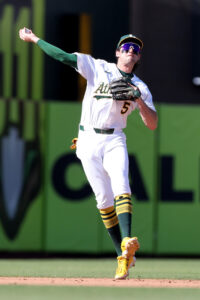
Wilson, 23, was the sixth overall pick in the draft in 2023. He made his big league debut with a late cup of coffee the following season but broke out as an All-Star in 2025. The second-generation star — his father is longtime Pirates infielder Jack Wilson — finished second in American League Rookie of the Year voting behind his own teammate, Nick Kurtz. Wilson slashed .311/.355/.444 with 13 home runs, 26 doubles, five steals and a tiny 7.2% strikeout rate.
Wilson’s pure hit tool is nearly unrivaled. Among the 560 big leaguers who took even 40 plate appearances this past season, his 7.5% strikeout rate was the second-lowest, behind multi-time batting champion Luis Arraez. Like Arraez, the quality of contact when Wilson puts the ball in play is generally not great. He averaged just 84.6 mph off the bat with a paltry 2.2% barrel rate and 24.1% hard-hit rate. That penchant for weak contact hasn’t stopped him from racking up singles. His hitter-friendly home park in West Sacramento probably overstates his modest power, but Wilson did connect on six round-trippers away from Sutter Health Park and could be reasonably projected to hit around 10 homers per season.
Though he doesn’t post off-the-charts chase rates, Wilson does swing more often than the average hitter (both off the plate and within the zone). He’s an aggressive hitter whose preternatural bat-to-ball skills and frequent swings lead to plenty of early contact. That limited Wilson to just a 5.2% walk rate in his first full season, which is pretty well in line with the 5.9% walk rate he’s posted in his limited minor league time thus far. Even if he never posts a high walk rate, though, Wilson figures to continue posting strong on-base percentages simply due to his knack for collecting hits.
Defensive metrics don’t paint him in an especially favorable light at shortstop. He was dinged for minus-10 Defensive Runs Saved and minus-2 Outs Above Average in his first full season of shortstop work at the major league level. Statcast credits him with well above-average arm strength but below-average range.
An eventual move to second or third base might yield better defensive results, but that likely won’t happen until lauded prospect Leo De Vries pushes for a look at shortstop. He’s still only 19 years old with just 21 Double-A games under his belt, so at least for the time being, Wilson will be expected to reprise his role as the Athletics’ shortstop. Questions about his range have persisted since his prospect days, but scouting reports praise his solid hands and he showed a clear knack for flashy, acrobatic plays during his debut campaign.
The A’s already controlled Wilson for another five seasons. Today’s agreement locks in two free-agent years and gives the team an option over what would have been a third. Wilson wouldn’t have been arbitration-eligible until the 2027-28 offseason.
The seven-year, $70MM term aligns closely with but also surpasses recent extensions for Rockies shortstop Ezequiel Tovar (seven years, $63.5MM) and Wilson’s own teammate, Lawrence Butler (seven years, $66.5MM) when both were in the same service bucket in which Wilson currently resides (between one and two years). His $70MM guarantee falls a bit shy of Michael Harris II‘s $72MM deal over in Atlanta, but that was an eight-year pact compared to Wilson’s seven.
As can be seen in MLBTR’s Contract Tracker (available to Trade Rumors Front Office subscribers), Wilson’s extension stands as the eighth-largest guarantee ever made to a player with under two years of big league service. It’s the second-largest deal in Athletics franchise history, trailing only the recent seven-year $86MM extension for teammate Tyler Soderstrom, who scored a larger deal due to the fact that he has an extra year of service time over Wilson.
Wilson’s extension is the latest step in the Athletics’ ongoing effort to lock up their exciting core of position players. Wilson, Soderstrom, Butler and slugger Brent Rooker (five years, $60MM) have all put pen to paper on long-term deals over the past 15 months. The A’s picked up control of multiple free agent years for each of those players.
The A’s have yet to come to terms on a deal with the aforementioned Kurtz, whose price tag will surely be higher. Kurtz played in just 117 games and took 489 plate appearances but still bashed 36 home runs while logging a sensational .290/.383/.619 slash line (170 wRC+). Even if the A’s can’t come to terms on a long-term deal with the 2024 No. 4 overall pick, he’s under control for another five seasons. Plus, this slate of affordable long-term deals for his young teammates will make it easier to stomach what will surely be enormous arbitration paydays if Kurtz continues on his current trajectory.
With several young players now under contract for the long haul, the Athletics shouldn’t have to worry about any potential grievances regarding their use of revenue-sharing funds. The A’s reportedly needed to push their CBT payroll up to $105MM or more last winter or else face potential ramifications, but they’re now at $139MM in that regard, per RosterResource.
Impressive as the Athletics’ collection of young bats is, the team’s pitching still leaves plenty to be desired. They’ll hope to change that this coming season when top prospects like Gage Jump and Jamie Arnold make their climbs through the system. Both rank within the game’s top 50 or so prospects. Jump, a 2024 second-rounder, already reached Double-A this past season. Arnold has yet to throw a professional pitch, but the Florida State standout was one of the top arms in last year’s draft class, coming off the board with the No. 11 pick.
The Athletics still have another two seasons to play in West Sacramento before their targeted 2028 move to their new home on the Las Vegas strip. So long as the group of Wilson, Soderstrom and Butler remain healthy, the A’s should have an exciting young core to market as they look to attract new fans in their new home.
ESPN’s Jeff Passan first reported the agreement and the terms of the contract. Jon Heyman of The New York Post had the specific salary breakdown and escalators.
David Robertson Announces Retirement
Veteran reliever David Robertson has decided to hang up his spikes. He announced the decision on his personal social media pages, issuing the following statement:
“I’ve decided it’s time for me to hang up my spikes and retire from the game I’ve loved for as long as I can remember. Baseball has given me more than I ever dreamed possible over the last 19 seasons. From winning a World Series, to pitching in an All-Star game, to representing the United States and bringing home a World Baseball Classic Gold and Olympic silver. I’ve had the privilege of playing alongside amazing teammates, learning from outstanding coaches, and being welcomed into organizations that felt like family. To the trainers, clubhouse staff, front offices, and everyone behind the scenes, thank you for all that you do. And to the fans who supported me, thank you, your passion fueled me every single day.
Most importantly, thank you to my wife and children. Your love, sacrifice, patience, and dedication made this career possible. As I step away from the game, I’m excited to be home with my family, to focus on our farms, and to continue growing High Socks for Hope. Helping families rebuild after disaster has been one of the most rewarding parts of my life outside baseball.
Saying goodbye isn’t easy, but I do so with deep gratitude for every opportunity, challenge, and memory. I’ll forever be thankful for the game and for everyone who made this journey extraordinary.”
Robertson retires after a two-decade run in professional baseball. He signed an overslot deal as a 17th-round pick of the Yankees in 2006. He was in the big leagues two years later. He began his career in middle relief but impressed with a 3.30 earned run average across 45 appearances in his first full season. Robertson added 5 1/3 scoreless innings and earned a pair of wins as the Yankees went on to win the World Series in 2009.
By the following season, the righty was a fixture in the Yankee bullpen in front of Mariano Rivera. He was exceptionally durable and consistently effective. Robertson reeled off a streak of 10 straight sub-4.00 ERA seasons between 2009-18. He surpassed 60 innings in the final nine of those years.
His most accomplished statistical season came in 2011, when he fired 66 2/3 frames with a career-low 1.08 ERA. Robertson picked up 34 holds against three blown leads. He earned his first and, somewhat surprisingly, only All-Star selection while receiving down-ballot Cy Young and MVP votes. He recorded a personal-best 100 strikeouts. He trailed only Craig Kimbrel and Tyler Clippard among relievers in punchouts, while Atlanta’s Eric O’Flaherty was the only pitcher with a lower earned run average.
Robertson remained in a setup role until Rivera ended his Hall of Fame career after the 2013 season. Robertson, an impending free agent, stepped seamlessly into the closer role. He recorded 39 saves with a 3.08 ERA in his walk year. He hit free agency at age 30 and rejected a qualifying offer before landing a four-year, $46MM deal from the White Sox.
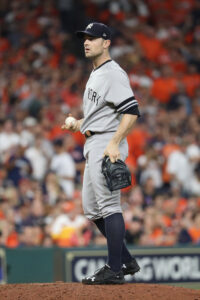
He held up his end of the bargain, topping 30 saves in his two full seasons in Chicago. The Sox weren’t good overall, however, and they embarked on a teardown by 2017. They shipped Robertson back to the Bronx alongside Todd Frazier and Tommy Kahnle. Robertson played out the final season and a half of the contract and helped New York back to the postseason in both years. He was part of the 2017 national team that won the World Baseball Classic, tossing a scoreless inning to close an 8-0 win over Puerto Rico in the final.
A return trip to free agency was never going to be as lucrative as he entered his age-34 season. He signed a two-year, $23MM deal with the Phillies. That was a precursor to the first real setback of his entire career. Robertson’s elbow gave out seven appearances into his first season in Philadelphia. He missed most of the year rehabbing before it was revealed that he needed Tommy John surgery. Robertson lost all of 2020 and most of ’21 before making a comeback with the U.S. National Team at the Tokyo Olympics (which were held in ’21 because of the pandemic).
Robertson carved out an impressive final act after the surgery. He bounced around as a setup man, mostly on contending clubs. Robertson made the playoffs with the Rays in ’21 and returned to the World Series the following year. A $3.5MM free agent deal with the Cubs led to a midseason trade back to Philadelphia, and he wound up tossing 7 2/3 innings of one-run ball in October for the pennant winning Phils. Robertson split the ’23 season between the Mets and Marlins — Miami was a deadline buyer who snuck into the playoffs — and remained an excellent leverage arm with the Rangers in 2024. He worked a career-high 72 innings of 3.00 ERA ball with 99 punchouts for Texas in what would be his final full season in the big leagues.
Despite his continued strong performance, Robertson didn’t find the contract he was seeking last offseason. He waited until July before signing a one-year deal for his third stint with the Phillies. Robertson made 20 regular season appearances and one final playoff outing in the Division Series loss to the Dodgers.
Robertson finishes his playing days with a 2.93 ERA in just shy of 900 regular season innings. Only Kenley Jansen has pitched in more games than his 881 going back to his debut. Robertson recorded nearly 1200 strikeouts. He saved 179 games and recorded 206 holds, ranking top 20 in both stats over his career. He had a 2.88 ERA in his first 10-year peak and came back from elbow surgery to add 230 2/3 frames of 3.00 ERA ball with a 31% strikeout rate from ages 36-40.
It’s a remarkable run of consistency at a position that is generally viewed as the sport’s most volatile. Robertson only had four seasons in which he allowed more than four earned runs per nine: his first and last years and the ’19 and ’21 campaigns that were shortened by the one significant injury he incurred. That’s all before considering his postseason résumé — 47 2/3 innings of 3.47 ERA ball in 10 different trips to October.
Robertson spent the majority of his career in the Bronx. He’ll be best remembered as a Yankee but appeared for eight clubs overall. Although he’s not going to get much consideration for induction into Cooperstown, he’s a lock to appear on the Hall of Fame ballot five years from now and could see his name checked by a few voters who want to honor his longevity and reliability. MLBTR congratulates him on an excellent career and sends our best wishes in whatever comes next.
Image courtesy of Thomas Shea, USA Today Sports.
Giants Sign Harrison Bader
The Giants made a notable upgrade to their outfield defense, signing Harrison Bader to a two-year contract. It’s reportedly a $20.5MM contract for the Vayner Sports client, who can earn an additional $500K in incentives. Bader will collect a $6MM signing bonus and $4.5MM salary this year, followed by a $10MM salary in 2027. San Francisco opened a 40-man spot by trading Kai-Wei Teng to the Astros.
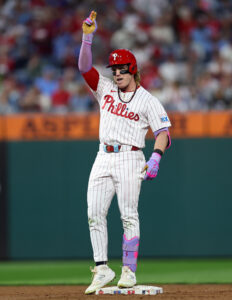
Bader, 31, has been a free agent for three consecutive offseasons but now lands the multi-year deal that’s previously eluded him. He signed one-year deals with the Mets and Twins, respectively, over the past two winters. Bader turned in a career-best performance in Minnesota and was red hot for the Phillies down the stretch after joining them in a deadline swap, and the market has rewarded that strong 2025 performance.
In 501 plate appearances between Minnesota and Philadelphia last year, Bader slashed .277/.347/.449 with 17 homers, 24 doubles, a triple and 11 steals (albeit in 18 attempts). His 7.8% walk rate was the second-best he’s posted in a 162-game season, though 2025’s bloated 27.1% strikeout rate was also his worst full-season mark since 2019. Much of Bader’s success can be attributed to an increase in playing time and a hefty .359 average on balls in play, but it bears mentioning that his 10.2% barrel rate and 40.3% hard-hit rate were personal bests in a full big league season.
Strong as last year’s performance was — 22% better than league-average, by measure of wRC+ — offense has never been Bader’s calling card. He’s been clearly above average in four of his nine MLB campaigns, but on the whole, Bader is a .247/.313/.401 hitter in a bit more than 3000 career plate appearances, which just barely shy of average. His glovework, however, is among the best in all of baseball, regardless of position.
Bader has played 5925 innings of center field defense in his career and been credited with a gaudy 51 Defensive Runs Saved and 67 Outs Above Average. He played more left field than center field in Minnesota, largely in deference to Byron Buxton, and notched positive marks in both DRS (7) and OAA (3) through 496 frames.
Overall, Bader has played 6799 innings of outfield defense in the majors, dating back to his 2017 MLB debut. In that time, only four outfielders — Mookie Betts, Kevin Kiermaier, Daulton Varsho, Michael A. Taylor — have bested his 67 DRS. No outfielder in that time has topped Bader’s 77 OAA. Francisco Lindor, Nick Ahmed, Nolan Arenado and Ke’Bryan Hayes are the only four majors leaguers at any position with a better OAA total in that time.
With Bader turning 32 in June, it’s fair to at least wonder whether he’ll begin to slow down over the next two seasons. However, there’s no reason to think that’ll be the case — at least based on recent history. This past season’s average sprint speed of 28.8 feet per second was actually an improvement over Bader’s 2024 mark of 28.2 ft/sec and right in line with his 2023 mark. He’s no longer covering the flat-out elite 30 ft/sec he did earlier in his career, but Bader’s 2025 sprint speed still landed in the 85th percentile of all big league position players. He’s a clear plus runner.
It’s a near certainty that Bader will take that plus speed and range to Oracle Park as the Giants’ new center fielder. Jung Hoo Lee handled the bulk of center field work in San Francisco this past offseason but ranked as one of the worst defenders in the game along the way (-18 DRS, -5 OAA). Lee’s arm strength sat in the 91st percentile of big league outfielders, per Statcast, but his range was near the bottom of the scale. Lee should have the arm to move to right field, where his lack of range would be better suited. Even if Bader’s bat regresses and checks in a bit shy of average, the defensive upgrade alone will be enormous for the Giants.
Assuming even distribution of that $20.5MM, Bader’s contract bumps San Francisco’s actual cash payroll to a projected $195MM, per RosterResource. Their luxury tax payroll is quite a bit higher, clocking in at about $221.5MM, but that still leaves more than $20MM between their current standing and the $244MM threshold at which luxury penalties begin. San Francisco has paid the tax in the past, but only rarely. They were over the line in 2024, which stands as their only time exceeding the threshold in recent memory.
For the time being, it doesn’t seem likely that the Giants will climb back to that level of spending. San Francisco is in the market for a second baseman but has been looking at the trade market — specifically, affordable targets like CJ Abrams and Brendan Donovan (“affordable” in terms of salary — not necessarily prospect capital). They’ve added Adrian Houser and Tyler Mahle to the rotation and could continue to poke around the rotation and bullpen markets, but ownership has publicly expressed an aversion to signing any free agent pitcher to a long-term deal, making a run at a top free agent like Framber Valdez feel unlikely.
Ken Rosenthal of The Athletic first reported the two-year agreement. Jon Heyman of the New York Post first reported the financial terms. Jon Becker of FanGraphs had the signing bonus and salary breakdown.
White Sox Sign Seranthony Domínguez
January 29th: The Sox officially announced their two-year, $20MM deal with Domínguez today, adding that it includes a $1MM signing bonus and a mutual option for 2028. According to The Associated Press, he’ll make a $7MM salary this year and $10MM in 2027. There’s a $2MM buyout on the option, which is valued at $12MM. Infielder Bryan Ramos was designated for assignment as the corresponding move.
January 23rd: The White Sox and right-hander Seranthony Domínguez are in agreement on a two-year, $20MM deal, reports Jeff Passan of ESPN. Passan adds that the Epitome Sports Management is expected to be the closer for the Sox. Chicago has a full 40-man roster and will need a corresponding move to make this official.
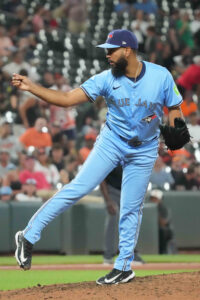
Domínguez, 31, has mostly been an effective setup guy in his career. He debuted with the Phillies in 2018 and tossed 58 innings with a 2.95 earned run average. His 9.5% walk rate was a bit high but he struck out 32% of batters faced while inducing grounders on 55.7% of balls in play.
He missed most of the next three seasons due to injury, including a Tommy John surgery in 2020. Over the past four years, he has been back on track and his production has had a somewhat similar shape to his 2018 season. He has thrown at least 50 innings in each of those four campaigns. Put together, he tossed 222 1/3 innings for the Phillies, Orioles and Blue Jays with a combined ERA of 3.60, a 27% strikeout rate, 10.7% walk rate and 41.9% ground ball rate. He racked up 24 saves and 55 holds.
In 2025, he changed up his arsenal. He still featured a four-seamer and sinker in the upper 90s with a sweeper as one of his breaking balls, but he switched out his changeup and slider for a splitter and a curveball. That led to a career-high walk rate of 13.8% but his 30.3% strikeout rate was his best in a full season since his rookie debut. He became one of the top setup guys in Toronto’s bullpen, making 12 postseason appearances as part of that club’s run to the World Series. He had a 3.18 ERA in those, though with more walks than strikeouts.
It’s a bit of a volatile profile but the stuff is tantalizing and his results have mostly been good. Coming into the winter, there was a clear top tier of free agent closers which included Edwin Díaz, Devin Williams and Robert Suarez. Domínguez was in the next tier of solid setup guys, including Tyler Rogers, Luke Weaver, Brad Keller and others. MLBTR predicted Domínguez for a two-year deal worth $18MM and he has come in just a hair above that.
Domínguez was connected to clubs like the Red Sox and Twins in reported rumors but presumably had interest from other clubs as well. The White Sox are an interesting landing spot for him. The club is clearly in rebuild mode, having just finished their third straight 100-loss season. However, a few of their prospects had nice breakout seasons in 2025, including Colson Montgomery and Kyle Teel.
The Sox have responded with a somewhat active offseason. They bolstered their rotation by giving Anthony Kay $12MM over two years and Sean Newcomb $4.5MM on a one-year deal. Munetaka Murakami seemingly fell into their laps when no one else wanted to give him a long-term deal, so they signed him for $34MM over two years.
They did subtract Luis Robert Jr. this week, trading him to the Mets for Luisangel Acuña and pitching prospect Truman Pauley, but general manager Chris Getz said that the money saved from that deal would be reinvested in the team. Robert was set to make a $20MM salary this year, with a $2MM buyout on his $20MM option for 2027. Assuming the Domínguez deal is equally spread out across the two seasons, then he’ll be taking half of the money that was slated for Robert’s salary in 2026.
No one is likely to pick the White Sox to win the Central this year but the club is at least trying to make the roster more respectable, which is commendable. Perhaps there’s a scenario where things go especially well and they hover in the race for a few months. If not, all of their pickups have been for one or two years, keeping the long-term payroll wide open for whenever they do return to contention. Of the signees, anyone who plays well could be on the trade block this summer if the Sox are behind the pack.
For Domínguez, it’s possible he may have preferred a more surefire contender but landing in Chicago gives him a chance to close. As mentioned earlier, he has picked up a few saves in his career but has mostly been a setup guy. If he fares well in the ninth-inning job, perhaps that will help him land with a contender via trade and it could help his earning power when he returns to the open market two years from now.
He immediately becomes easily the most experienced arm in the bullpen. Newcomb, who will have a chance to earn a rotation job, is the only other pitcher on the roster with even three years of big league service time.
Last year, eight different pitchers recorded a save for the Sox. Jordan Leasure led the pack with seven, followed by Grant Taylor with six. Those two both have live arms but are still pretty inexperienced. They can work setup roles with Domínguez in the ninth. If the younger guys take a step forward or Domínguez ends up traded, then the roles could change over the course of a long season. It’s also possible the Sox make another move if Getz still has some powder dry.
With Domínguez now off the board, the relief market gets a bit more barren. Díaz, Suarez, Williams, Rogers, Weaver, Keller, Ryan Helsley, Emilio Pagán, Kyle Finnegan, Raisel Iglesias, Phil Maton, Pete Fairbanks, Kenley Jansen, Gregory Soto and others have all come off the board. The group of guys still available includes Danny Coulombe, Justin Wilson, Andrew Chafin, Evan Phillips, Scott Barlow and more.
Photo courtesy of Nick Turchiaro, Mitch Stringer, Imagn Images
Rockies Trade Angel Chivilli To Yankees
11:06am: The two teams have formally announced the swap. It’s a straight one-for-one deal. The Yankees designated outfielder Michael Siani for assignment to open a 40-man roster spot.
10:45am: The Yankees and Rockies have agreed to a deal that will send reliever Angel Chivilli from Denver to the Bronx in exchange for minor league first baseman T.J. Rumfield, reports Jack Curry of the YES Network.
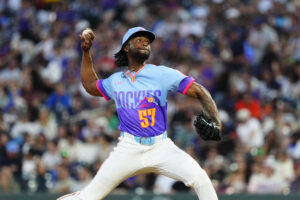
Chivilli is a hard-throwing 23-year-old righty who has shown an aptitude for missing bats and generating grounders but has yet to find consistent success in the majors. He averaged 97.1 mph on his four-seamer this past season and boasts an outstanding 14.4% swinging-strike rate in his young career, and he’s limited walks at a solid 8.1% clip. However, a penchant for serving up the long ball have undercut those swing-and-miss capabilities and otherwise solid command so far; Chivilli has served up an average of 1.99 homers per nine frames in each of his two partial MLB seasons.
Despite that big swinging-strike rate and a healthy 32.3% opponents’ chase rate on pitches off the plate, Chivilli comes to the Yankees with a below-average 17.4% strikeout rate in his career. His opponents have posted an awful 78.4% contact rate against Chivilli’s pitches that fall within the strike zone — league average in 2025 was 85.4% — but he’s put himself at a disadvantage by falling behind in counts far too often. Chivilli’s career 56.9% first-pitch strike rate (55.6% in 2025) is considerably lower than the 62% league average.
It bears mentioning that Chivilli has struggled more at Coors Field than on the road, though his ERA in both settings (7.06 at home, 5.03 on the road) is sub-par. He’s generated enormous swinging-strike rates on both his changeup (26.3%) and slider (23.4%) but struggled to miss bats with his four-seamer he threw in 2025 or the sinker he threw in 2024.
Though the bottom-line results haven’t been there yet, pitchers with Chivilli’s blend of velocity, command, ground-balls and raw bat-missing ability (even if it hasn’t manifested in big strikeout totals yet) are hard to come by. If the Yankees can coax some more swing-and-miss from one of his heaters and/or get him to throw first-pitch strikes with more frequency, there’s potential for Chivilli to develop into a high-quality late-inning option. He also has a minor league option remaining, so he’s someone the Yanks can send to Triple-A Scranton/Wilkes-Barre for further refinement if he doesn’t win a bullpen job in spring training.
Chivilli is controllable for at least five more seasons, which adds to his appeal. If he spends any notable time in the minors this year, the Yankees could push that to six full seasons. Chivilli currently has 1.036 years of big league service time, meaning he’ll need to spend 136 days on New York’s major league roster or injured list to remain on track for free agency following the 2030 season. If he spends about one-third of the season in the minors, that free agency timeline would be pushed back to the 2031-32 offseason, though he’d then project as a Super Two player who’d be arbitration-eligible four times rather than the standard three.
In exchange for that development project, the Rockies will pick up an interesting 25-year-old first baseman. Rumfield was blocked in the Bronx by Ben Rice but has a clear path to regular first base work in Colorado if he hits his way into the job. Based on his recent minor league track record, Rumfield has a good chance to do just that.
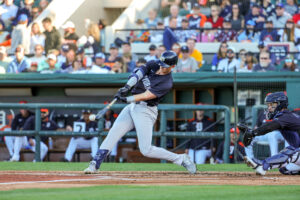
A 12th-round pick by the Phillies in 2021, Rumfield landed with the Yankees by way of the trade that sent righty Nick Nelson and catcher Donny Sands to Philadelphia. He spent the entire 2025 season with the Yankees’ top affiliate in Scranton, slashing .285/.378/.447 with 16 home runs, 31 doubles, a triple, five stolen bases (seven attempts), a huge 11.9% walk rate and an 18.4% strikeout rate that’s comfortably lower than average. The year prior, Rumfield hit .292/.365/.461 with 15 homers and similar rate stats in 114 Triple-A games.
The left-handed-hitting Rumfield is not yet on the 40-man roster. He went unselected in last month’s Rule 5 Draft despite being eligible. Baseball America ranked him 30th among Yankees prospects this offseason, noting that he makes plenty of contact, is adept at pulling the in the air and plays a fine defensive first base. There was no path to regular playing time for him in the majors with the Yankees, and he lacks the defensive versatility to profile as a true bench option for them. With the Rockies, however, Rumfield will head to camp with a legitimate chance to win the first base job this spring.
At the moment, 28-year-old waiver pickup Troy Johnston and perpetually injured veteran Kris Bryant are among the team’s options at first base. Newly hired president of baseball operations Paul DePodesta recently declined to even fully commit to Bryant being in spring training when asked by Patrick Saunders of the Denver Post, however, stating only: “That will be up to our medical people.”
Johnston has plenty of experience in the outfield corners as well, so even if the Rockies want to give him a real chance on the big league roster — he does have a solid Triple-A track record with the Marlins organization — he could fit into a bench/designated hitter role if Rumfield seizes the first base job.
Rumfield may not be a star in the making, but if he can turn in even average offense and glovework at first base, he’d be a seismic upgrade for a Colorado club that had far and away the worst first base output of any team in MLB — on either side of the ball. Colorado first basemen posted an atrocious .211/.268/.372 batting line in 2025. The resulting 62 wRC+ (indicating that was 38% worse than average at the position after weighting for ballpark) was 15 points south of the 29th-ranked Giants. Former first-rounder Michael Toglia paced the Rockies in first base appearances last year but hit just .190/.258/.353 with a mammoth 39.2% strikeout rate, -3 Defensive Runs Saved and -10 Outs Above Average in 88 games.
MLB Sets August 3 Trade Deadline For 2026 Season
Major League Baseball has informed teams that this year’s trade deadline will be Monday, August 3 at 6:00 pm Eastern, reports Robert Murray of FanSided. It’s pushed back a few days relative to last season’s deadline, which was on the final Thursday in July.
MLB prefers to have the deadline on weekdays. They set the cutoff in the evening so there are no ongoing games. That reduces the chances of a player being traded mid-game and “hug watch” scenarios. MLB has at least one day game scheduled for each of July 29-31 of the preceding week. There are getaway games on Wednesday and Thursday, while the Cubs are hosting the Yankees for a standard Wrigley Field day game on Friday, July 31. It seems MLB preferred to push back a few days, as all eight games on August 3 begin at 6:40 Eastern or later.
The flexible deadline is a feature of the 2022 collective bargaining agreement. Under previous CBAs, there was a fixed July 31 deadline. MLB now has the freedom to set the deadline on any date between July 28 and August 3. This is the first time that MLB has chosen the latest available date.
Yankees Re-Sign Cody Bellinger
The Yankees and outfielder/first baseman Cody Bellinger have reunited on a new contract. The Boras Corporation client reportedly gets a five-year deal with a $162.5MM guarantee, with no deferrals. He gets a $20MM signing bonus followed by salaries of $32.5MM in each of the first two years, $25.8MM in each of the next two, then $25.9MM in the final season. Bellinger can opt out after the second or third season, though those opt-outs are pushed by a year if the 2027 season is canceled by a lockout. Bellinger also gets a full no-trade clause. The Yankees have not yet announced a corresponding 40-man roster move.
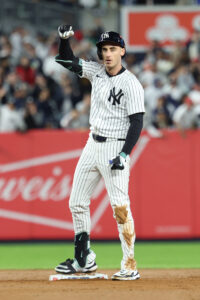
It always seemed like a good bet that Bellinger would return to the Yankees, since their first season together was a success. But there was a standoff recently, as the club and Bellinger’s camp had a bit of a gap. It was reported earlier this month that the Yankees had an offer out to Bellinger. No details on that offer were revealed but it was reported a few days later that they had made a second offer.
Subsequent reporting on the negotiations suggested the Yanks had put forth a five-year offer worth more than $150MM, but with Bellinger’s camp hoping to get the length pushed to seven years. That gap seemingly put things on ice for a moment, with alternative paths available to both parties. The Yankees showed interest in other players, including outfielder Luis Robert Jr., while Bellinger still had potential fits with teams like the Dodgers and Mets.
But the market has changed quite a bit in the past week. The Dodgers and Mets got into a bidding war over Kyle Tucker, with the Dodgers coming out on top. The Mets then pivoted to signing Bo Bichette to bolster their infield, followed by trading infielder Luisangel Acuña to the White Sox as part of their package to land Robert.
Those moves took away some alternate paths from the Yankees but also removed a couple of logical landing spots for Bellinger. He had also been connected to the Blue Jays, Giants and Phillies throughout the winter but none of those clubs seemed to be strongly in the mix. The Yanks seemingly didn’t budge far from where their reported offer was a few weeks ago, though they did add the opt-outs. It was reported a few days ago that they were willing to include those.
Though Bellinger and Boras didn’t quite get the seven years they were looking for, the deal comes in fairly close to expectations from the beginning of the offseason. For instance, MLBTR predicted Bellinger to land a guarantee of $140MM over five years. Bellinger has secured himself a floor just above that. There’s also a path to boosting his future earnings again with more opt-out opportunities down the line.
He is now 30, turning 31 in July, so he will be 32 years old by the end of the 2027 season. Alex Bregman and Kyle Schwarber both just got five-year deals this offseason, with Schwarber going into his age-33 season and Bregman age-32. Schwarber got a $150MM guarantee and Bregman $175MM, though Bregman’s deals had deferrals which pushed the net present value pretty close to Schwarber’s guarantee.
For Bellinger, he can bank $85MM over the next two years, when factoring in the signing bonus and the front-loaded salaries. When his first opt-out decision comes around, he would still have three years and $77.5MM left on this deal. If he continues to be a productive player between now and then, he should be in a good position to opt out. The lockout-specific provision of the opt-outs appears to be a way for the Yankees to get at least two years of Bellinger’s services.
While Bellinger has maintained some future earning potential, he has also secured himself a strong base after a few years of uncertainty. When he first hit the open market, he had shown both huge upside and a massive downside. In 2019, then with the Dodgers, Bellinger was the National League MVP. He hit 47 home runs that year. Offense was up all around the league thanks to some juiced balls but Bellinger also drew walks at a 14.4% clip and only struck out 16.4% of the time. His .305/.406/.629 line led to a 161 wRC+, even in the heightened offensive environment of that season. He stole 15 bases and got strong reviews for his defense. FanGraphs credited him with 7.8 wins above replacement.
But his production backed up a bit in 2020 and he infamously injured his shoulder in the NLCS during a post-homer celebration with teammate Enrique Hernández, as seen in this video from MLB.com.
Bellinger underwent surgery after the season and his performance was awful for two years after. He slashed .193/.256/.355 over 2021 and 2022, getting non-tendered by the Dodgers after the latter campaign. He latched on with the Cubs for 2023, signing a one-year deal worth $17.5MM. He had a strong bounceback season in Wrigley, hitting 26 home runs and slashing .307/.356/.525 for a 135 wRC+.
Going into 2024, Bellinger and his reps at the Boras Corporation were hoping to cash in. He had seemingly put the low points behind him. He was still young, going into his age-28 season, and had shown MVP upside. The previous offseason, Trea Turner and Xander Bogaerts had both secured 11-year deals. This was seemingly a way to lower the competitive balance tax hit of those deals, as a player’s CBT hit is calculated based on a deal’s average annual value.
MLBTR expected this trend to continue with Bellinger, predicting him for a 12-year deal worth $264MM. That seemed to be at least somewhat aligned with what Bellinger and Boras felt he could get, as they reportedly went out looking to top $200MM.
It did not play out that way. Though Bellinger’s 2023 season was a success, there was seemingly some concern about some lackluster batted-ball data. And with the injury-marred seasons still somewhat fresh in the collective memory, his market never quite developed as hoped.
It wasn’t just Bellinger, as several other players lingered unsigned that season. They came to be known as the “Boras Four”, as they were all repped by the same agency. Bellinger, Blake Snell, Matt Chapman and Jordan Montgomery all settled for short-term deals well below expectations. Bellinger returned to the Cubs on a three-year deal with an $80MM guarantee, with chances to opt out after each season.
The first season of that pact wasn’t a roaring success, as Bellinger was good but not great. He hit 18 home runs and slashed .266/.325/.426 for a wRC+ of 108. Bellinger decided to forgo the first opt-out opportunity and stick with the Cubs. The team didn’t hold up their end of the reunion, however, as they shipped Bellinger to the Yankees. It was effectively a salary dump. The Cubs got Cody Poteet in return, whom they designated for assignment a few months later.
The Cubs ate $5MM in the swap, leaving the Yanks theoretically on the hook for $47.5MM over two years, though with Bellinger still having another opt-out remaining. As mentioned earlier, the Yankees and Bellinger turned out to be a great match. He hit 29 home runs on the year and slashed .272/.334/.480 for a 125 wRC+. Yankee Stadium and its short porch in right field seemed to be a good fit for him, as he slashed .302/.365/.544 at home on the year. He stole 13 bases overall and continued to get good grades for his glovework, earning 4.9 fWAR.
Bellinger triggered his opt-out and took another crack at free agency, which led to this pact. As mentioned, it’s possible that Bellinger will return to the open market yet again in the future. For now, though it came about in circuitous fashion, he has pushed his earning floor above the $200MM he was looking for a few years ago.
His three-year deal with the Cubs paid him $27.5MM in each of the first two years. He collected a $5MM buyout when he opted out of the final season, meaning he banked $60MM on the pact. Combined with this deal with the Yankees, he’ll earn $222.5MM even if he doesn’t trigger either of the opt-outs in this deal.
For players taking the short-term route and hoping for more earnings later, this is another example of how the path is viable. It doesn’t always work out, as Montgomery will surely tell you, but the hit rate is pretty decent. Chapman, Snell, Bellinger, Bregman, Carlos Rodón, Pete Alonso and Carlos Correa have all signed two- or three-year deals with opt-outs and then later signed a longer deal worth nine figures.
For the Yankees, this gets their outfield back to its 2025 level. Both Bellinger and Trent Grisham became free agents at the end of last season but both have now re-signed. They project to line up in two outfield spots with Aaron Judge in another and Giancarlo Stanton in the designated hitter slot. Bellinger can also play a bit of first base but the Yanks could give Ben Rice the regular job there after his breakout season. Rice can also catch, so perhaps Bellinger would slide to first base if Rice is needed behind the plate.
It’s possible the Yankees now look to move some outfield depth in the wake of this deal. Jasson Domínguez was once a top prospect but had an underwhelming season in 2025. He was roughly league average at the plate but with poor defensive metrics. The Yankees also have Spencer Jones pushing for a job after he hit 35 home runs in the minors last year but he also struck out in 35.4% of his plate appearances.
Neither Domínguez nor Jones has a great path to playing time right now. That could change as the season goes along. Stanton is 36 years old and has made at least one trip to the injured list in seven straight seasons now. Judge will turn 34 soon. Even if he himself stays healthy, the Yanks may want to put Judge in the DH slot if Stanton is hurt.
Perhaps the Yankees will keep both Domínguez and Jones around as depth for such situations, as both players are still optionable, but either or both could also be trade fodder. Club owner Hal Steinbrenner has previously expressed a desire to keep the payroll beneath $300MM. The Yanks are now a bit over that. RosterResource has them at $304MM in terms of pure payroll, with a $318MM CBT number.
That CBT number is over the top tier, which is $304MM. Since the Yankees have paid the tax in at least three consecutive years, that puts them in the highest possible tax bracket. They were at about $285MM or so before the Bellinger deal, so they paid a 95% tax on the part of the deal pushing them to the top line and then a 110% tax on the part that went beyond it. In the end, they’re adding more than $30MM in taxes to their ledger, on top of what they are paying Bellinger. They still arguably need some pitching help, so perhaps they would trade from their outfield depth instead of adding more money via free agency.
For the other clubs in the league, this further narrows down the list of available options. As of the start of the year, there were still many players available in free agency or in trade, but the dominos have been falling in quick succession lately. The Cubs got a deal done with Bregman, which prompted the Red Sox to sign Ranger Suárez and the Diamondbacks to get Nolan Arenado. The Tucker deal pushed the Mets to Bichette and Robert, which may have helped the Phillies reunite with J.T. Realmuto and pushed Bellinger to get back together with the Yankees. The Realmuto deal seemingly led to Victor Caratini signing with the Twins. All that happened in the past 11 days.
Pitchers and catchers will be reporting to spring training in less than three weeks. With Bellinger now off the board, the top unsigned free agents include Framber Valdez, Zac Gallen, Eugenio Suárez, Harrison Bader, Chris Bassitt and others. There are still a few theoretical trade candidates out there, including Brendan Donovan and MacKenzie Gore.
Jeff Passan of ESPN first reported that the Yanks and Bellinger were in agreement on a deal. Bob Nightengale of USA Today first reported the five-year length and guarantee. Brendan Kuty of The Athletic first reported the lack of deferrals. Passan then reported the opt-outs, signing bonus and no-trade clause. Nightengale then reported the salary for the first two seasons. Jon Heyman of The New York Post reported the full salary breakdown. Nightengale added the detail of the opt-outs being pushed in the event of the 2027 season being canceled. Photos courtesy of Wendell Cruz, Vincent Carchietta, Imagn Images
Is MLB Parity Possible Without A Salary Cap?
Kyle Tucker reached an agreement with the Dodgers last Thursday, and thoughts have been swirling around my brain ever since. Sometimes I have trouble sleeping because I keep writing this post in my head. I’m fortunate enough to have this website as my outlet, so here goes.
It feels almost quaint that a year ago, the Dodgers signing Tanner Scott seemed to be the straw that broke the camel’s back. I ran a poll around that time, asking, “Do you want a salary cap in the next MLB CBA?” 36,589 people responded, and two-thirds said yes. It was later pointed out to me that I should have made clear that a cap comes with a floor.
If I had phrased it as “a salary cap and floor,” the number may have been even higher than 67.2%. I also think that if I run the poll again in the coming weeks, an even higher percentage will vote for a cap, since the last year has seen the Dodgers win a second consecutive World Series and then add Edwin Diaz and Tucker.
The poll had a second question: “Are you willing to lose the entire 2027 MLB season for a salary cap?” 27,629 people responded to the second question, implying about a quarter of those who answered the first question either didn’t see the second just below it or didn’t care to grapple with the consequences of a salary cap.
For those who did respond, the second question was more evenly split: 50.18% said yes, they would lose the entire 2027 season for a salary cap. That was stunning to me, because I view a lost season as a disastrous outcome that must be avoided.
Evan Drellich of The Athletic spoke to a source who made it clear ownership will push for a salary cap during upcoming CBA negotiations. But according to Drellich’s colleague Ken Rosenthal, a salary cap is “considered highly unlikely by many in the sport” and “many player agents and club executives are skeptical games will be lost” in 2027.
Even if this round of negotiations doesn’t result in a cap, I think it’ll happen in my lifetime. If necessary, MLBTR can adapt to that new world and hopefully become experts in explaining salary cap nuances.
The purported goal of ownership is not to get a salary cap, though. It’s said to be parity, or competitive balance. That doesn’t mean every team has an equal chance to win each year or dynasties are impossible. It does mean that all 30 teams have roughly the same ability to sign top free agents and retain their own stars. I think fans want a small market team like the Pirates to have about the same chance as the Dodgers to sign Kyle Tucker, or to be able to keep Paul Skenes. Perhaps they want a world where teams can differentiate from each other based on drafting ability, player development, shrewd trades, and the intelligence of their allotted free agent signings, but not so much on payroll.
At the risk of stating the obvious, I do not think the Pirates can run a $400MM payroll and remain profitable. The Dodgers reportedly reached a billion dollars in revenue in 2024. Many teams, the Pirates included, generated roughly one-third of that. This does not feel fair or good for baseball.
The Dodgers are so profitable that the “dollars per WAR” they’re willing to pay seems to be on another planet. Tucker projects for 4.5 WAR in 2026, and the Dodgers seem to be valuing that at $120MM including taxes. Even if they think he’s a 5 WAR player, they’re paying $24MM per WAR on him in 2026. With the possible exception of the Mets, who are reportedly not profitable, I don’t think any other teams are willing to pay more than $12MM per WAR.
Which brings us to the desire by many for a salary cap. A cynic might say that while owners and fans are aligned on the need for competitive balance, owners also love the salary cap idea because it will depress player salaries long-term, saving them money and increasing franchise valuations.
I consider a true “salary cap no matter what” stance from ownership to be the nuclear option. If the true goal here is parity or competitive balance, then a cap is just a means to an end, and not the only option or factor. That leads me to a series of questions.
Who should bear the financial burden of restoring competitive balance?
There is often an assumption that this whole problem should just be solved by the players making less money. I certainly understand the logic that Tucker would be just fine making $20-30MM a year instead of $60MM.
But the truth is, the average MLB player does not accumulate the six years required to reach free agency (though he may get there with less service time if he’s released). This is admittedly 18 years old, but this New York Times article points to a study suggesting the average MLB career length is 5.6 years.
Though I haven’t run my own study on the average length of ownership, I’ll venture to say it easily exceeds 5.6 years. A case can be made that if one of these parties must be stewards of the game, making financial sacrifices for the greater good of competitive balance, it should be ownership.
I think MLB would argue that they can devise a salary cap/floor system in which players will actually earn more money in total. Drellich reported last summer that commissioner Rob Manfred has suggested just that to players. There’s a trust issue here. Players may not believe Manfred is being forthright on that point or that they have a full picture of team revenue. Furthermore, they may be wary that if they allow for a cap system that grants them a percentage of revenue that is advantageous for them now, owners will eventually chip away at that percentage. Once a cap is in place, it will never be removed.
I believe common sense dictates that a model where players compete for a finite and defined pool of money means they will earn less as a group, though it may be distributed more evenly. If players eventually earn less as a group, then they will be bearing the cost of competitive balance while owners pocket the difference. I think we should at least entertain the opposite: big market teams redistribute more of their profits to smaller markets in the name of competitive balance. More on that at the end of this post.
Why is a cap the default solution for so many people?
Having read the autobiography of MLBPA forefather Marvin Miller, I don’t think there was ever a time that MLB players were winning the PR war over teams. I don’t think Miller cared. Players’ salaries are well-known and huge compared to normal people, and they’ll probably always have an uphill battle getting widespread fan support to protect that.
These days, I doubt Tony Clark has a narrative he can sell to win over a majority of baseball fans. He might say MLB actually does have competitive balance, or talk about attendance records, and World Series ratings, or suggest that some teams don’t try hard enough to win. But Manfred will win the PR battle because he is acknowledging real widespread fan sentiment that the current system is unfair and broken.
I think it’s easiest to default to “baseball needs a salary cap” because the NFL, NBA, and NHL have one. But why do those sports have a cap? Is it because they tried many different approaches toward competitive balance and arrived at a cap? I am admittedly not a labor historian of those sports, but I think it’s mostly that those sports’ players didn’t accidentally fall backwards into a Marvin Miller, and thus their unions caved to ownership demand for a cap.
I won’t speak to the competitive balance of other sports because it’s not my area. But when people ask me whether I think an MLB salary cap would have the desired effect of competitive balance, my answer is yes. If MLB could somehow get players to agree to a cap/floor system with a tight salary range (say, $20MM), I do think the financial advantages of certain teams would be snuffed out and the smartest teams would be in the playoffs every year regardless of market size. I’d be interested to see what the payroll range would be and how small market teams would react to the floor, but the appeal is obvious.
Why does the current system have significant penalties for exceeding various payroll thresholds, but no apparent penalty for running excessively low payrolls?
There are people out there who say the “real problem” is certain MLB owners who won’t spend. I don’t think forcing the Marlins to spend another $25MM on players this winter would solve the inherent unfairness of a competitor having triple their revenue.
Still, in each CBA, MLB has succeeded in increasing the penalties for going over competitive balance tax thresholds – thresholds that sometimes don’t increase even at the rate of inflation. The initial highest tax rate was 35% on the overage; now it’s 110%. I assume that if owners abandon their pursuit of a cap at some point, they’ll at least add a new “Dodgers tier” beyond the current 110% “Cohen tax.”
But in the name of fairness and competitive balance, why is it that no real penalties exist for running extremely low payrolls?
As Rosenthal and Drellich noted in November, “If a team’s final luxury-tax payroll is not one and a half times the amount it receives in a given season from local revenue sharing, it will likely stand a better chance of losing a grievance for not properly using its revenue-sharing money to improve on-field performance, which the CBA requires.” They go on to add that “the Marlins were expected to be among the highest revenue-sharing recipients at roughly $70 million if not more,” which would necessitate a $105MM CBT payroll.
The CBA specifically says, “each Club shall use its revenue sharing receipts (including any distributions from the Commissioner’s Discretionary Fund) in an effort to improve its performance on the field.” If a team falls short of the 1.5x threshold and the MLBPA files a grievance, it’s on the team to demonstrate that it did use its revenue sharing funds to improve on-field performance.
The Marlins ran the game’s lowest CBT payroll in 2025 at about $87MM. Their 2026 CBT payroll is around $80MM right now. The MLBPA’s grievances on this seem to go nowhere, lingering for years and getting settled in CBA negotiations. I’ve seen no evidence a team has been penalized in any way for failing to meet the 1.5x floor called for in the CBA. One can imagine that if low-spender penalties had been added in 1997 when the luxury tax came into being, certain ownership groups would not have purchased teams and other, better ones might have come in.
It’s often said that it’s much easier to tweak something that’s already in the previous CBA than add something entirely new. Players have been agreeable to ever-increasing tax penalties, rather than a sea change to a cap/floor system.
And the game does already have a soft cap, ineffective as it may be against certain clubs. But I’d argue that language is also already in place for a soft floor, at least for revenue sharing recipients (the Diamondbacks, Rockies, Reds, Brewers, Pirates, Marlins, Athletics, Mariners, Tigers, Royals, Twins, Guardians, Orioles, and Rays). The MLBPA should fight for codified penalties for failing to meet the 1.5x floor, such as simply losing a portion of revenue sharing proceeds depending on how far below the team is.
A better-enforced 1.5x floor would not be a panacea. That floor led to the A’s signing Luis Severino, but certainly didn’t keep Blake Snell away from the Dodgers. But I do think that if revenue sharing money is spent well, it is a step in the direction of competitive balance.
Why do we know everything about player contracts, but very little about team revenue, team profitability, the distribution of luxury tax proceeds to teams, and especially revenue sharing?
We spend so much time on MLBTR talking about player contracts and the resulting team payrolls. This information is readily available for just about every signing; some teams put contract terms right into their announcements.
Everyone knows how much players are making, and it often works against them in terms of public perception. Conversely, we have to rely on an annual report from Forbes (or similar outlets) that provides valuations and estimates of operating income for MLB teams.
Forbes explains that the information used in their valuations “primarily came from team and league executives, sports bankers, media consultants and public documents, such as stadium lease agreements and filings related to public bonds.” The valuations, and I assume operating income/loss numbers, exclude things such as “equity stakes in other sports-related assets and mixed-use real estate projects.”
For me, it’s pretty hard to know how profitable each team is. This information is kept under lock and key by MLB. The Braves are an exception because they’re owned by a publicly traded company, and sometimes their financials are used to form guesses about other teams. Still, fans and journalists are left with inadequate information to determine what a team’s player payroll could or should be.
We also don’t know how much revenue sharing payors are paying out each year, or how much recipients receive. Bits and pieces trickle out on rare occasion. I mentioned the reported $70MM-ish received by the Marlins that Rosenthal uncovered. And Sportico suggested that in 2024, the Dodgers paid “roughly $150 million into baseball’s revenue-sharing system.”
How much money in total is paid into revenue sharing each year? We don’t know. How much of that do recipients spend on player payroll? We don’t know that either. How about these huge tax bills teams like the Dodgers, Mets, Yankees, and Phillies have incurred – where does that money go? The luxury tax brought in a record $402.6MM in 2025. Drellich reported in 2024, “MLB and the players have always essentially split luxury-tax proceeds, with half of the money going to clubs in some form, the other half to player retirement funds.” So perhaps $200MM of luxury tax money went to teams – how was that distributed specifically, and are there any rules about how it’s spent?
If you’d like to understand a bit more about how revenue sharing works, start on page 145 of the CBA. The CBA says, “The intent of the Revenue Sharing Plan is to transfer among the Clubs in each Revenue Sharing Year the amount of revenue that would have been transferred in that Year by a 48% straight pool plan, plus such transfers as may result from distributions of the Commissioner’s Discretionary Fund.” We get payors (like the Dodgers) and payees (like the Marlins) because “the Blended Net Local Revenue Pool shall be divided equally among the Clubs, with the difference between each Club’s payment into the Blended Net Local Revenue Pool and its receipt therefrom producing the Club’s net payment or net receipt.”
Does the Shohei Ohtani unicorn theory have any validity?
Let’s talk deferrals for a minute. Many fans think this is a huge part of the problem with the Dodgers.
The Dodgers may be the villains of MLB right now, but agent Scott Boras is right there with them for many fans. Between the contracts, press conferences, puns, and dad jokes, Boras does occasionally speak truth. Boras made a statement to Drellich yesterday suggesting Shohei Ohtani is a unicorn in terms of ability and revenue generation:
“The Dodgers are not a system issue. They are the benefactors of acquiring Shohei Ohtani, MLB’s astatine. Short-lived and rare. No other player offers such past or present. Ohtani is the genius of elite performance and additional revenue streams of near $250 million annually for a short window of history. The process of acquiring Ohtani was one of fairness and equal opportunity throughout the league. A rare, short-lived element is not a reason to alter the required anchored chemistry of MLB. The mandate of stability to gain media rights optimums is the true solution to league success.”
Well, yes. Peak Ohtani is perhaps the best and most unique player the game has ever seen, and he’s from a foreign country. As such, he generates a huge amount of money for the Dodgers, which we likely won’t see again in our lifetimes.
Boras didn’t directly mention the other extremely rare factor with Ohtani: he wanted to defer 97.1% of his contract. As I wrote a year ago, “money is worth more now than it is in the future, so players have not exactly been clamoring to wait until retirement age to receive 97.1% of their contract.”
But Ohtani is unique, and it made sense for him partially because of his endorsement money. His decision did have a negative effect on competitive balance. If deferred money had been outlawed, the Dodgers would have had to pay Ohtani a straight $46MM or so per year. That they’re instead paying him $2MM per year right now means they have $44MM extra to spend because of Ohtani’s choice. That is exactly why Ohtani proposed this structure to multiple teams: he wanted to free up money so his team would use it on other players and have a better chance of winning.
(EDIT: Reading the comments on this post, I realized I didn’t explain this well, because it’s true that the Dodgers have to set Ohtani’s deferred $68MM aside. But my understanding is that they are able to invest that money, and I think having a much lower cash player payroll grants them a good amount of extra flexibility.)
Using Kyle Tucker’s $57.1MM AAV as an example, you could say Ohtani’s extreme deferral choice bought the Dodgers 77% of Tucker, probably good for 3+ wins by itself this year (unless you count Tucker’s tax penalty, in which case it’s more like 37%).
If I was the MLBPA, I’d probably just cave on this issue for the PR benefit. Players like the flexibility of deferred money, but limitations could be added that would only affect the next Ohtani-type player who attempts to defer 97.1% of his contract, which is unlikely to ever exist.
In theory, could the competitive balance issue be solved entirely by ownership?
I have plenty of friends who love baseball and feel that MLB needs a salary cap. Most of them don’t seem excited about canceling a season, though, so I’ve floated the question of whether there might be other ways to get competitive balance.
Revenue sharing is a longstanding effort to level the playing field. As the CBA explains, “The Clubs and the Association recognize that the participation of two Clubs is necessary for the production of the on-field competition that the Clubs sell to the public. The net payments and net receipts required by this Article XXIV reflect a continuation of the amounts paid directly to the visiting Clubs and are in recognition of the principle that visiting Clubs should share, and in fact traditionally have shared, in the economic benefits jointly generated by the Game at another Club’s home field.”
Much like the players and the salary cap, in the last CBA negotiations in 2021-22, when it came to topics such as “getting to free agency and arbitration earlier, in revenue sharing and in service time,” MLB took “hardline stances,” according to Drellich. In February 2022, MLB.com’s Mark Feinsand wrote, “MLB has maintained from the start that reducing revenue sharing and expanding Super 2 eligibility are non-starters for the league.”
It would seem, then, that both sides have at least one “non-starter.” For the players, it’s a salary cap. And for MLB, one of their various non-starters is revenue sharing. Perhaps the players don’t have a seat at the table on how much money is paid into revenue sharing, how much each team receives, and how that money is spent.
We know that 14 teams are receiving revenue sharing, apparently topping out around the Marlins’ $70MM in recent years (that does not include luxury tax distributions). We also know that the Dodgers have a level of revenue and profit that many feel are breaking the game. Fans are very concerned about competitive balance, and the commissioner says he wants to address their concerns.
A salary cap is the widely-discussed solution, but one that could cause the loss of a season. It’s worth noting, too, that regular season games and the World Series could get cancelled and owners still might fail in installing a salary cap, as happened in 1994-95. In that scenario, we get all of the destruction of the game and none of the desired competitive balance.
Another solution, then, is for MLB’s 30 owners to solve competitive balance themselves. On a rudimentary level, this would involve a team like the Dodgers contributing even more money into revenue sharing, and recipients being required to spend most of it on player payroll.
This is all theoretical, but there is an amount of money that Marlins could receive from revenue sharing that would enable them to sign Kyle Tucker for $60MM a year and still be a profitable team (whether that’s a good use of $60MM is a whole other story). The competitive balance goal is for small market teams to be able to compete for top free agents and retain their own stars, I think.
Similarly, there likely is a level of taxation, draft pick loss, and revenue sharing (all basically penalties that form a soft cap) that would make the Dodgers choose not to pay $120MM for one year of Tucker. In the present system, we have clearly not reached that level for the Dodgers, but that’s not to say it doesn’t exist. Perhaps if the Dodgers end up moving from “wildly profitable” to just “profitable,” Guggenheim would decide to sell the team to an outfit that is comfortable with that.
You can guess why we’re not actually going down this path of MLB owners solving competitive balance themselves: they’d never agree to it. Approval would be needed from 23 of the 30 ownership groups. To me, this idea is just the flip side of a salary cap, to which the players have said they will never agree. I believe both approaches to be equally viable toward improving competitive balance, except that neither side wants to be the one paying for it.
For those who read this entire post, thank you. I’ll be interested to read your takes in the comments, and I encourage everyone to be respectful. For Trade Rumors Front Office members, my mailbag will return next week.
Guardians Agree To Extension With Jose Ramirez
Longtime Guardians star Jose Ramirez has agreed to another extension with the team, keeping the third baseman in Cleveland through his age-39 season in 2032. The new deal (which will be official pending a physical) both restructures the three years and $69MM remaining on Ramirez’s previous contract, and adds $106MM in new money covering the 2029-32 seasons. Ramirez is represented by Republik Sports.
The biggest new wrinkle in the extension is $70MM in deferred money. Ramirez will earn $25MM in each of the seven seasons from 2026-32, but with $10MM in deferrals each year. This means that the $69MM Ramirez was initially slated to earn from 2026-28 has now been bumped down to $45MM in upfront money, giving the Guardians some extra flexibility to perhaps make other short-term roster additions. The new deal also includes increased incentive bonuses, such as $500K for an MVP award.
Assuming the extension is finalized, it should ensure that Ramirez remains in a Guards uniform throughout the entirety of his career, only further cementing his place as a Cleveland baseball legend. Ramirez signed with the organization as an international free agent in 2009 at age 17, and has gone on to hit .279/.353/.504 with 285 home runs and 287 steals (out of 349 chances) over 6759 plate appearances. Between his strong offense and impressive glovework at third base, Ramirez has amassed 57.6 bWAR over his career — the fifth-highest total of any player in Indians/Guardians history.
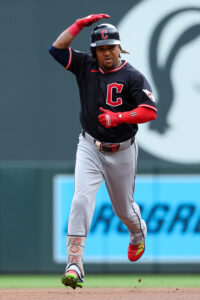 Ramirez turned 33 last September but doesn’t appear to be slowing down, as he hit .283/.360/.503 with 30 homers and a career-best 44 steals over 673 PA. These big numbers and his leading role in the Guardians’ late-season surge to the AL Central title helped Ramirez earn a third-place finish in AL MVP voting. While the MVP trophy continues to elude Ramirez, he has now recorded a second-place finish (in 2020), three thirds, and three other top-six placements during his outstanding career.
While Ramirez continues to deliver elite production, committing $106MM to a player (especially through his age 36-39 seasons) is no small matter for a lower-payroll team like the Guardians. The new money included in Ramirez’s extension represents the third-highest guarantee Cleveland has ever given to a player, behind just Ramirez’s previous extension and their seven-year, $106.5MM extension with the since-traded Andres Gimenez in 2023. That said, the $70MM worth of deferred money will lower the current-day price tag of the extension, and allow some extra payroll flexibility for the front office.
This is the third extension Ramirez has signed with Cleveland, as his first multi-year pact with the team was a five-year, $26MM deal covering the 2017-2021 seasons that included a pair of club options. Obviously Ramirez vastly outperformed his paycheck in that deal, and after exercising their 2022 option to retain Ramirez, the Guardians and the third baseman worked out the second extension that saw five years and $124MM in new money added in April 2022.
It was known that the Guardians explored trade scenarios involving Ramirez prior to that 2022 extension, as it has long been the organization’s habit to trade star players before reaching free agency. While not every deal of a star has worked out, the Guards have hit on enough of these trades to replenish their system with younger (and cheaper) talent while avoiding the higher price tags associated with players nearing the end of their arbitration control.
Ramirez is the exception to the rule. The seven-time All-Star has been open about how much he enjoys playing in Cleveland, and he has backed up that stance by leaving tens of millions of dollars on the table to re-up with the Guards not once, but now twice. Of course, it remains to be seen how productive Ramirez will still be by the end of the 2028 season, yet this added $106MM could be viewed as something of a thank-you to a star player for his years of service, as well an investment in the idea that Ramirez will continue delivering big numbers.
The timing of the extension is interesting, as there was seemingly no huge rush to tack more years onto a deal that already ran through 2028. However, the Guards may have wanted to get something done in advance of the next collective bargaining agreement, as rumors persist that the league (as part of their overall desire to curb playing spending) may at least look into some kinds of restrictions against deferred money in contracts. The Dodgers have most famously included deferrals in many of their high-priced deals in recent years, though Cleveland’s new pact with Ramirez is the latest example of how both big-market and small-market teams frequently use deferred money to complete contracts.
Z101 Digital’s Hector Gomez was the first to report about the agreement and described it as complete, though Jon Heyman of the New York Post added that Ramirez and the Guardians were still “working on” the agreement. Gomez reported the $106MM in new money, Heyman added the detail about the $70MM in deferrals, and The Athletic’s Ken Rosenthal had the year-to-year financial breakdown over the seven years. ESPN’s Jeff Passan reported that the deal had been agreed upon, pending a physical.
Inset image courtesy of Matt Krohn – Imagn Images
Yu Darvish Contemplating Retirement, Has Not Made Final Decision
7:05 pm: Darvish added in another statement that he and the Padres have discussed terminating his contract since last year, although discussions between those parties and the Players’ Association have not been finalized. He maintained that he wants to pitch again if his rehab goes well. “If I can thoroughly complete my rehab and feel confident that I can pitch in games both mentally and physically, I’d like to start over and compete from scratch again. As for this year, I plan to go to Petco Park for rehab as well, and also attend a bit of spring training.”
5:50 pm: Padres starter Yu Darvish is contemplating retirement, but he has not yet made a final decision. An initial report from Kevin Acee of the San Diego Union-Tribune indicated that Darvish was retiring. Darvish’s agent, Joel Wolfe, refuted that, saying, “Yu has not made a final decision yet. This is a complicated matter we are still working through” (link via Alden Gonzalez of ESPN).
Darvish addressed the situation through a statement on his X account. “Although I am leaning towards voiding the contract,” he said, “there’s still a lot that has to be talked over with the Padres so the finer details are yet to be decided. Also I will not be announcing my retirement yet. Right now I am fully focused on my rehab for my elbow, and if I get to a point where I can throw again, I will start from scratch again to compete. If once I get to that point I feel I can’t do that, I will announce my retirement.”
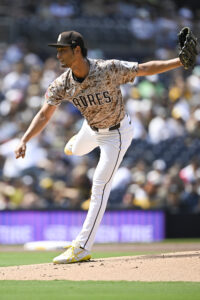
The 39-year-old right-hander is owed $43MM over 2026-28 from the extension he and the Padres signed in 2023. If he retires without reaching a settlement, he would forfeit that money. As Darvish indicated, he and the Padres may be working on a buyout that would see him keep some portion of his salary while giving the team significant cost savings over the next three years.
If he does decide to retire, he’ll be wrapping up an incredible 21-year career across Japan’s Nippon Professional Baseball and MLB. In 2005, Darvish made his debut at age 18 for the Hokkaido Nippon-Ham Fighters in NPB. He pitched 94 1/3 innings over 14 starts as a rookie that year, following it up with a 2.89 ERA in 149 2/3 innings in 2006. The Ham Fighters won the Japan Series in the latter year, with Darvish making his first start in Game 1 and earning the win in the clinching Game 5.
From 2007-11, he was absolutely dominant, totaling 1,024 1/3 innings with a 1.72 ERA and 1,083 strikeouts. Darvish was an NPB All-Star in every season in that span, twice being named the Pacific League MVP (2007 and 2009) and winning the Sawamura Award (NPB’s equivalent of the Cy Young) in 2007. His final NPB season in 2011 was sensational. Darvish posted an 18-6 record in a career-high 232 innings with a microscopic 1.44 ERA, along with 276 strikeouts and just five home runs allowed all season.
Following the season, the Ham Fighters made him available to MLB clubs via the posting system. The Texas Rangers outbid the other suitors with a massive $51.7MM posting fee to the Ham Fighters (proportional posting fees not having been established yet). The team ultimately signed Darvish for a six-year, $56MM guarantee.
In his debut MLB season in 2012, Darvish pitched 191 1/3 innings over 29 starts with a 3.90 ERA, a 27.1% strikeout rate, and a stellar 46.2% groundball rate. He made his first playoff start in the AL Wild Card Game against the Orioles, pitching 6 2/3 innings with seven strikeouts and no walks but earning a tough-luck loss. He was valued at 4.7 WAR that year according to FanGraphs, which stands as the highest mark of his career to date. He also earned the first of five All-Star nods in the majors and finished third in AL Rookie of the Year voting.
His 2013 season was just as dominant. Darvish lowered his ERA to 2.83 in 209 2/3 innings as the Rangers’ ace and upped his strikeout rate to 32.9%. He earned his second All-Star nod and finished as the runner-up to Max Scherzer in the AL Cy Young vote, while his 277 strikeouts that year were the best of his MLB career. He was an All-Star again in 2014, but he was placed on the injured list with elbow inflammation in mid-August and missed the rest of the season. He experienced further soreness during Spring Training the following year and ultimately underwent Tommy John surgery, missing the entire 2015 season.
Darvish returned in May 2016 and picked up where he left off. In 100 1/3 innings over 17 starts that year, he posted a 3.41 ERA with a 31.7% strikeout rate and a 7.5% walk rate. He was a bit less effective the following year, with a 4.01 ERA in 22 starts before being sent to the Dodgers at the trade deadline in exchange for three prospects led by Willie Calhoun. Darvish’s strikeout and walk numbers improved in nine regular-season starts in Los Angeles, but he struggled in the World series against the Astros with subpar starts in Games 3 and 7.
Still, Darvish’s track record as a front-of-the-rotation arm made him a top target in free agency. In February 2018, he signed a six-year, $126MM deal to join the Cubs. He wound up spending 2018-20 on the North Side. He struggled with injuries and ineffectiveness in 2018, pitching just 40 innings over eight starts. He rebounded in 2019 with a 3.98 ERA and a 31.3% strikeout rate in 178 2/3 innings. In 12 starts during the COVID-shortened 2020 season, he was utterly dominant with a 2.01 ERA and just a 4.7% walk rate, finishing second in the NL Cy Young vote.
The Cubs traded Darvish to the Padres that December, and he has been with San Diego ever since. Darvish’s strikeouts began to wane in his mid-30s, but he compensated by improving his control. From 2021-25, his walk rate sat in the 6% range and never topped 7.5% in a season (2023). His best Padres season to date was in 2022, as Darvish made 30 starts with a 3.10 ERA and a 20.8% K-BB rate, the latter being ninth-best among qualified starters.
The club was confident enough in his performance to extend him heading into 2023. The deal was for six years and $108MM, of which five years and $90MM were new money. In the first three years of that deal, Darvish has made 55 starts with a 4.41 ERA while struggling with injuries. He made five trips to the IL from 2024-25, most recently for an internal brace procedure on his throwing elbow this past October. While coming with a shorter recovery period than a second Tommy John surgery, Darvish was still set to miss the entire 2026 season regardless.
In an interview last month, Darvish indicated that he was focused on getting healthy and returning to pitching, though a later report from Acee indicated that retirement was on the table. This latest update suggests that Darvish is contemplating the end of his career, but that he is still open to returning if his rehab goes well. Further details could be made public soon, pending the outcome of his talks with the Padres.
Photo courtesy of David Banks, Imagn Images