
Nationals Rebuffed Interest From Giants In CJ Abrams
The Giants made an unsuccessful push to acquire CJ Abrams from the Nationals, reports Andrew Baggarly of The Athletic. It’s not clear precisely what package San Francisco would have put together, though Baggarly adds that they were open to building the deal around top shortstop prospect Josuar Gonzalez.
Washington traded MacKenzie Gore to the Rangers for a five-player package led by last year’s first-rounder Gavin Fien. The Washington Post reported they’ve been shopping Abrams as well, albeit with potentially a loftier ask than they had on Gore. Abrams is under arbitration control for three seasons compared to Gore’s two.
In each of the past two seasons, Abrams has been an excellent hitter through the All-Star Break before tailing off in the second half. He has been a little better than average overall, hitting .252/.315/.433 in more than 1200 plate appearances over the past two years. Abrams has 39 homers and 62 stolen bases with slightly lower than average strikeout and walk marks in that time. He’s an above-average regular who has an All-Star level ceiling that he has yet to consistently reach.
Abrams gives back some of the value with the glove. He’s one of the weaker shortstops in MLB and trails only Elly De La Cruz with 39 errors over the past two seasons. They’ve mostly been of the throwing variety, yet Statcast hasn’t looked favorably upon his range either. Abrams would project better at second base or potentially in center field. He has been a full-time shortstop on a Washington team that has probably had the worst all-around infield defense in the majors.
Despite the drawbacks, Abrams should have substantial appeal on the trade market. He’s a 25-year-old plus athlete who fits somewhere in the middle of the diamond. He’s a former sixth overall pick and top prospect who has stretches where he’s an excellent table-setter in one of the top two lineup spots. The Giants surely would have moved him to second rather than playing him at shortstop over Willy Adames.
Gonzalez respectively placed 30th and 44th on updated Top 100 prospect lists from Baseball America and MLB Pipeline this week. None of the players whom the Nationals acquired for Gore landed on either list. It seems fair to assume Washington’s evaluators rate Fien more highly than those outlets do. They probably would not have traded two years of Gore’s arbitration window if they didn’t feel they were getting a Top 100 caliber talent.
It’s also possible they’re simply not as high on Gonzalez as some others. It’s common for clubs to have differing opinions on prospects. That’s especially true for someone like Gonzalez, an 18-year-old whose professional experience consists of 52 games in the Dominican Summer League. Teams don’t have much of a statistical track record with which to work, so evaluations for players that far from MLB readiness are weighted very heavily towards their individual scouts.
In any case, Baggarly’s report certainly doesn’t push back against the idea that the Nationals could demand more for Abrams than they had for Gore. The report suggests that while the Giants aren’t interested in trading their top prospect, rookie first baseman Bryce Eldridge, they discussed most of their other high-end talents with Washington. Eldridge and Gonzalez are San Francisco’s only Top 100 prospects at MLB Pipeline. Baseball America had outfielder Bo Davidson and infielder Jhonny Level in the back quarter of their list. Baggarly’s piece has more specifics on the prospects who surfaced in conversations, and Giants fans are encouraged to give it a full read.
Abrams would have been the prize of a quiet San Francisco offseason to date. They opted for floor over ceiling with their rotation signings of Tyler Mahle and Adrian Houser. They’ve done nothing to address a lackluster outfield (especially in right), nor have they come away with their desired upgrade over Casey Schmitt at second base. He’s a passable regular but fits better as a high-end utility infielder. ESPN’s Jeff Passan reported last week that the Giants were looking for a significant second base move on the trade front.
San Francisco has been linked to Brendan Donovan and Nico Hoerner at various points throughout the offseason. Neither player has been traded. Donovan still seems likelier than not to move — certainly before the trade deadline if not by Opening Day — while the Cubs should be reluctant to deal Hoerner. Abrams is still available as well, although it’s not clear if those teams intend to reengage.
Rangers Acquire MacKenzie Gore
The Nationals have sent left-hander MacKenzie Gore to the Rangers for a package of five prospects, per announcements from both clubs. The five players are shortstop Gavin Fien, right-hander Alejandro Rosario, first baseman/outfielder Abimelec Ortiz, infielder Devin Fitz-Gerald and outfielder Yeremy Cabrera. Gore and Ortiz were the only players with 40-man spots, so the deal is 40-man neutral and no corresponding moves were required.
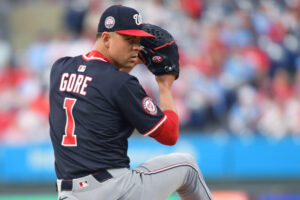 Gore, 27, has been one of the more obvious trade candidates of this offseason. Back at the start of November, MLBTR’s list of the top trade candidates of the winter had him in the #1 spot. That was partly due to Gore’s appeal as a potential budding ace and also the team’s situation.
The Nationals have been stuck in a rebuild for quite a while now. They won the World Series in 2019 but haven’t finished above .500 since then. They traded players like Max Scherzer, Trea Turner, Kyle Schwarber and Juan Soto in 2021 and 2022. It was hoped that Washington could be back to relevance by now but the rebuild stalled out. Things dragged to such a degree that heads rolled. President of baseball operations Mike Rizzo and manager Dave Martinez were both fired during last season.
Paul Toboni, previously an assistant general manager with Boston, was hired to replace Rizzo as the front office leader. The general expectation in the industry is that he will get some time to turn the ship around and get the Nats into contention again, as opposed to having the pressure of trying to win immediately. Gore is only two years away from free agency, making him a trade candidate in those circumstances. As a Boras Corporation client, a contract extension was probably going to be hard to put together.
On top of all that, there’s Gore’s track record and affordability. He was once a top prospect, getting selected third overall by the Pades in 2017. He was flipped to the Nats as part of the aforementioned Soto trade. Gore hasn’t quite lived up to his potential yet, with a 4.19 earned run average in 532 1/3 innings. However, he looked on the verge of a huge breakout for most of 2025.
Last year, Gore made 19 starts for the Nats through the All-Star break. He logged 110 1/3 innings in those with a 3.02 ERA. His 7.7% walk rate was a bit better than average and his 30.5% strikeout rate was quite strong. That strikeout rate was behind just four other qualified pitchers in baseball at that time. Tarik Skubal led the pack at 33.4%, followed by Zack Wheeler, Garrett Crochet and Hunter Brown.
Unfortunately, Gore wasn’t able to stick the landing. He went on the injured list at the end of August due to shoulder inflammation. He was reinstated about two weeks later but then returned to the IL late in September due to a right ankle impingement. Around those IL stints, he tossed 49 1/3 innings with a 6.75 ERA. That bumped his season-long ERA to 4.17.
Despite the poor finish, Gore remained an enticing player. The strong run to the All-Star break showed his ceiling and it’s an appealing arsenal. He averaged over 95 miles per hour with his four-seamer last year while mixing in a curveball, slider, cutter and changeup. He’s also quite affordable. He’s going into his second of three arbitration seasons and will be making $5.6MM this year. He’ll be due another raise in 2027 before he’s slated to reach free agency.
The trade market for starting pitching has been robust this winter. The Orioles sent four prospects and a draft pick to the Rays for three years of Shane Baz. The Cubs sent three players, including their top prospect, to the Marlins for three years of Edward Cabrera. Last night, the Mets sent two of their top prospects to the Brewers for one year of Freddy Peralta.
Gore’s track record of success isn’t quite as long as Peralta’s but Gore offers an extra year of control. Baz and Cabrera offered one extra year compared to Gore but haven’t shown the same kind of ace upside and both have checkered injury histories. Given the difficulty in evaluating the future outcomes of prospects, it’s impossible to say which package will provide the most long-term value.
For the Rangers, it’s understandable that they would prefer the trade route to free agency this winter, as there have been signs that money is tight. The team and manager Bruce Bochy parted ways at the end of last year with the club’s financial uncertainty cited as playing a role in that break-up. Pitching coach Mike Maddux departed for the Angels, with some suggestion that may have been financially motivated as well.
In terms of the roster, the Rangers traded three years of Marcus Semien to get five years of Brandon Nimmo, with Nimmo making less annually. Various reports from December suggested that the club couldn’t even afford mid-market free agents like J.T. Realmuto or Luis Arráez.
But upgrading the rotation was still on the to-do list. The club saw Merrill Kelly, Jon Gray, Patrick Corbin and Tyler Mahle all depart via free agency at season’s end. They went into the winter with a strong one-two of Jacob deGrom and Nathan Eovaldi, but a drop-off after that. Jack Leiter seemed to earn himself a rotation job with a 3.86 ERA last year but his strikeout and walk rates were only average-ish. Jacob Latz had a good season in a swing role but hasn’t been a full-time big league starter yet. Kumar Rocker is a former top prospect but hasn’t put it together in the majors yet.
Gore immediately upgrades the group, especially if he can get back to his first-half performance from 2025. He slots into the front three with deGrom and Eovaldi, bumps Leiter to a back-end role for now and perhaps creates a competition for a fifth spot between Latz, Rocker and others. There is a cliff over the horizon as Eovaldi and Gore are both slated for free agency after 2027. deGrom’s deal has a club option for 2028, with the value conditional on Cy Young voting and inning tallies, though he’ll be 40 by then. But for the next two years, the rotation has a strong core three.

To get that rotation upgrade while avoiding the free agent market, the Rangers have had to part with a notable pile of prospects. Fien appears to be the headliner here. The Rangers just took him 12th overall in the 2025 draft. They gave him a $4.8MM bonus to get him to forgo a commitment to the University of Texas. Still just 18, turning 19 in March, he’s a long-term play.
Baseball America lists him as the #3 prospect in the Texas system. He gets high praise for his offense but with bigger questions about his defense. Most evaluators expect him to be moved off shortstop in the long run, with third base or the outfield corners potential outcomes.
Kiley McDaniel of ESPN writes that the Red Sox really wanted Fien in last year’s draft but they didn’t pick until 15th, three spots behind Texas. Toboni was running Boston’s draft as assistant general manager at the time. Now that he is running his own front office, he apparently made Fien a priority and has used Gore as a means of getting his guy.
Fitz-Gerald, Rosario and Cabrera are a few spots behind Fien on BA’s list, coming in at #8, #13 and #14 respectively. Fitz-Gerald is a 20-year-old infielder who was drafted in the fifth round in 2024. He got into 41 games between the Complex League and Single-A last year, slashing .302/.428/.482. A left shoulder strain prevented him from taking on a bigger workload. He seems to do a decent amount of stuff well without a standout tool. BA suggests a future as a multi-positional player with a bit of pop and speed.
Rosario, 24, was a fifth-round pick in 2023. He had a strong season in 2024, posting a 2.24 ERA between Single-A and High-A, but has been on the shelf since then. He missed 2025 due to an elbow injury and is soon set to undergo Tommy John surgery, so he’ll miss the entire 2026 season as well. His strong 2024 campaign made him a top 100 prospect, with BA having him at #49 going into 2025, but he’ll be a long-term question mark after two entirely missed seasons. He’ll be Rule 5 eligible this coming December.
Cabrera, 20, was an international signing out of the Dominican Republic. He spent last year in Single-A with a strong walk and strikeout profile but only eight home runs. He’s considered a strong defender in the outfield and he stole 43 bases last year.
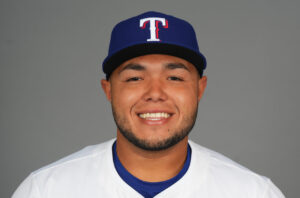
Ortiz, 24 next month, has the least prospect hype of this group but is the one closest to impacting the major league club. He split last year between Double-A and Triple-A, hitting 25 home runs and walking in 11.7% of his plate appearances. He had a combined line of .257/.356/.479 and a 124 wRC+. He was added to the Texas 40-man roster a couple of months ago to keep him out of the Rule 5 draft.
Though his numbers in the minors look good on the surface, he has a propensity to chase breaking balls. Evaluators fear that will limit him to being a platoon bat in the majors. He’s also not a strong defender or baserunner, so he needs to hit to carry the profile. Washington has a pretty wide open first base/designated hitter mix, so he can force his way in there if he hits. He also has three option years and can be kept in the minors if he doesn’t.
With four of the five players being long-term plays, it would appear that Washington is just trying to grab whichever players it considers the most talented, as opposed to trying to rush a move towards contending in the near term. Perhaps that was isolated to this deal of their biggest trade chip but it could perhaps indicate that the club is generally operating with a long lens. For the Rangers, losing most of these players won’t hurt them in the short term but it does cut into the system more broadly. As of August, BA ranked them 26th in the league in terms of overall system talent.
CJ Abrams has also been floated as a trade candidate for Washington but with less certainty than Gore as he has three years of club control remaining. The Nats could now pivot to marketing him but his stock is also down a bit due to a poor finish to his most recent season, and in 2024 as well. Perhaps they will hold him for another season to see if he can raise his trade value.
It is clearly an offseason about loading up on future talent for the Nats. They also traded reliever Jose A. Ferrer to the Mariners for catcher Harry Ford and right-hander Isaac Lyon. This deal adds five more intriguing young players to the pipeline.
It also opens up more rotation chances for their other pitchers. As of now, they project to have Cade Cavalli, Foster Griffin, Josiah Gray, Brad Lord, Jake Irvin and Mitchell Parker in the mix for starts. Arms like Jake Eder, Luis Perales, Riley Cornelio and Andrew Alvarez will be looking to push in there as well. Perhaps the Gore deal with be followed by the Nats signing a veteran to eat some innings but they could also leave space for the guys in that group.
Due to Gore’s appeal, he reportedly drew interest from half the teams in the league. Some of those clubs moved on to other trade candidates or signed free agents. For those still on the hunt for starting pitching, the market is drying up but they may still have options. As mentioned, a lot of the trade candidates have already changed hands. The Red Sox may have enough depth after their Ranger Suárez signing to flip someone else. The Royals may be willing to part with someone. Free agency still has Framber Valdez, Zac Gallen, Chris Bassitt and a few others.
Jon Heyman of The New York Post first reported Gore was headed to Texas. Jeff Passan of ESPN first laid out the five-for-one framework. Evan Grant of the Dallas Morning News first reported Fien’s inclusion. Spencer Nusbaum of The Washington Post first mentioned Rosario. Grant then reported Ortiz and Fitz-Gerald, followed by Andrew Golden of The Washington Post adding Cabrera.
Photos courtesy of Brett Davis, Eric Hartline, Kevin Jairaj, Joe Camporeale, Imagn Images
Brewers Trade Freddy Peralta To Mets
The Mets made another splash, acquiring All-Star starter Freddy Peralta and swingman Tobias Myers from the Brewers for prospects Jett Williams and Brandon Sproat. The teams announced the blockbuster trade on Wednesday night. New York designated right-hander Cooper Criswell for assignment in a corresponding move.
After losing out on Kyle Tucker, the Mets have signed Bo Bichette and traded for Luis Robert Jr. and Peralta. Tonight’s move is arguably the biggest of the three, as Peralta gives them a legitimate #1 starter atop what had been a talented but volatile rotation. He’s coming off a career season that landed him fifth in NL Cy Young balloting.
Peralta set a career mark with 176 2/3 innings while managing a personal-best 2.70 earned run average. He punched out 28.2% of opponents behind a near-13% swinging strike rate while issuing walks at a 9.1% clip. Peralta’s underlying marks have been consistently strong over his five seasons as a full-time starter. He misses bats at a plus rate with solid command. He had been a little susceptible to the longball between 2023-24, which elevated his ERA slightly (3.77) over that span. A dip in homer rate was the biggest factor in last year’s results, but estimators like FIP and SIERA feel he has been more or less the same pitcher five years running.
The 6’0″ righty challenges hitters with his fastball, a 94-95 MPH offering that plays up because of its plus spin and life. He backs that up with a changeup that he’ll throw to hitters of either handedness and a pair of breaking balls (though he only uses his slider against righties). His willingness to attack hitters up in the zone with the fastball leads to a fly-ball approach and the occasional home run, but it’s a worthwhile tradeoff for the few baserunners he’ll allow. Opposing hitters have mustered a .210/.288/.367 batting line over the past three seasons.
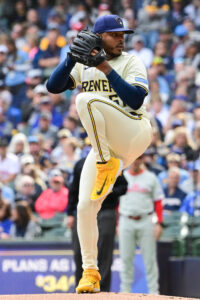
Peralta also brings an excellent durability track record to stabilize a rotation that was light on established innings sources. He hasn’t required a single stint on the injured list in three years. He’s tied for fifth with 95 starts and ranks 15th with 516 innings over that stretch. Only Dylan Cease and Zack Wheeler have more strikeouts in that time. Peralta and Cease are the only pitchers to record 200+ strikeouts in each of the past three seasons. He battled some shoulder issues in 2021-22, including a lat strain that limited him to 18 appearances four years ago, but his recent health record has been clean.
Mets president of baseball operations David Stearns knows Peralta well from his time running baseball operations with Milwaukee. He’s probably the best starting pitcher who’ll get traded this offseason, so the Mets would surely have been involved even without that connection, but the familiarity only made him a more natural fit. Stearns also brought back closer Devin Williams on a three-year free agent contract as his biggest bullpen move of the winter.
The Stearns-led front office wisely locked Peralta up on an extension before his breakout. Peralta had been an unheralded amateur signee by the Mariners whom the Brewers acquired as one of three prospects in an Adam Lind trade when he was in rookie ball. He worked in a swing role with mixed results over his first two seasons. Milwaukee secured him on a $15.5MM guarantee with a pair of $8MM club options over the 2019-20 offseason. It almost immediately became one of the sport’s most team-friendly contracts.
Peralta is headed into the final season of that deal and playing on the second of those $8MM options. The Mets will happily pick up that salary and the associated $8.8MM luxury tax hit. RosterResource projects them for a $365MM competitive balance tax payroll. They ended last season with $347MM in CBT commitments and paid another $91.6MM in taxes.
This is much more affordable from a salary perspective than were the Bichette and Robert acquisitions, though the pitcher is less than a year from a monster payday of his own. He’s on track to hit free agency before his age-31 season and could command the second-largest contract in the class after Tarik Skubal. He’s a lock to reject a qualifying offer barring a major injury. The Mets would receive a compensation pick after the fourth round in ’27 if he walks. As a revenue sharing recipient, Milwaukee would’ve gotten a pick after the first round had they kept him (assuming he signed elsewhere for $50MM+).
The Mets will presumably make an effort to keep him long term, but the main focus is on 2026. Peralta slots ahead of touted rookie Nolan McLean at the top of the staff. Sean Manaea, Clay Holmes, David Peterson and Kodai Senga are also penciled into what could be a six-man rotation — though the latter two have come up in trade rumors this offseason. Jonah Tong didn’t dominate the way McLean did after a late-season promotion, but he’s a top prospect who’ll be in the mix. They’re getting another touted arm, Christian Scott, back from elbow surgery.
Myers projects for a swing role but is likely to make some starts over the course of a 162-game season as well. The 27-year-old righty is more than a throw-in addition, as he has pitched well for Milwaukee over the past two years. Myers held a rotation spot for the majority of the ’24 season. He started 25 of 27 games as a rookie and posted an even 3.00 earned run average through 138 innings. He recorded a solid 22.3% strikeout rate while limiting his walks to a 6.3% clip.
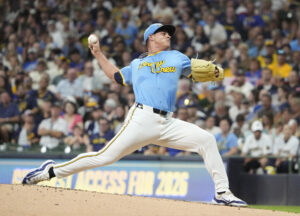
An oblique strain sidelined Myers to open last season. The Brewers activated him in late April but optioned him to Triple-A after a handful of shaky appearances. Myers was up and down in a swing role for the remainder of the season. He was mostly squeezed out of the rotation by Milwaukee’s bigger arms, but he pitched well in the second half and finished the year with a 3.55 ERA across 50 2/3 frames. He had similar numbers over 12 starts with Triple-A Nashville.
Myers works in the 93-94 MPH range with his fastball. He uses a cutter and slider as his breaking balls and tweaked his changeup to more of a splitter midway through last season. The pitch got good results in a small sample, as opponents hit .108 while swinging through it almost 40% of the time. That should give him a better offering against left-handed hitters after he struggled with southpaws as a rookie.
The righty has between one and two years of service time. He won’t reach arbitration for another two seasons and is under club control through 2030. He has a minor league option remaining, which gives the Mets flexibility to move him between MLB and Triple-A Syracuse.
The Brewers deserve credit for helping Myers develop into a serviceable back-end starter. He’d once been a reasonably well-regarded prospect — Cleveland regrettably traded Junior Caminero to the Rays for him when the slugging infielder was in rookie ball — but he’d seemingly hit a wall in the upper minors. Milwaukee added him as a minor league free agent over the 2022-23 offseason, and he’s now a secondary but meaningful part of a trade that netted them a pair of top prospects.
Williams and Sproat each placed on the back half of Baseball America’s Top 100 prospects list, which was released this morning. BA had Williams as the slightly more highly regarded of the two, but they’re essentially within the same tier. Williams is a right-handed hitter whom the Mets took in the first round out of a Dallas-area high school in 2022. He’s on the shorter side at 5’7″ but has plus athleticism and an up-the-middle defensive profile. Scouts credit him with plus speed and a strong arm with more power than one might expect based on his size.
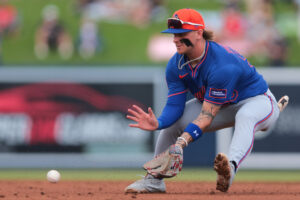
That athleticism was on display in the upper minors. Williams combined for 17 homers and 34 stolen bases while hitting .261/.363/.465 across 572 plate appearances. He looked no worse for wear after a right wrist surgery had cost him a good chunk of the ’24 season. Williams raked at a .281/.390/.477 clip in Double-A. He struggled after a second half promotion to Triple-A, where he hit .209 with a .285 on-base percentage across 34 games. That’s not a huge concern for a 21-year-old who would have been young for the level even if he’d spent the entire season in Double-A.
Williams is a patient hitter who has worked a lot of walks in the minors. Although big league pitchers will be better positioned to attack the smaller strike zone, he has the makings of a potential top-of-the-lineup spark plug. Williams has played mostly shortstop and has experience at second base and in center field. He’s likely to begin the season at Triple-A Nashville and could challenge Joey Ortiz or Garrett Mitchell/Blake Perkins for playing time midway through the season.
Sproat, 25, is a big league ready rotation option. A second-round pick out of the University of Florida in 2023, he debuted as a September call-up. The 6’3″ righty made four starts, giving up 11 runs across 20 2/3 innings. Sproat otherwise spent the season in Triple-A, where he worked to a 4.24 ERA across 121 frames. He fanned 22.1% of opponents while issuing walks at a slightly elevated 10.4% clip. He has a six-pitch mix and works in the 96-97 MPH range on his sinker and four-seam fastball.
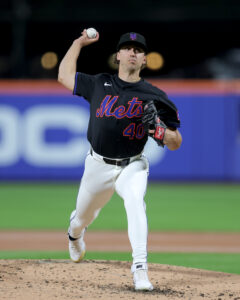
Baseball America’s scouting report credits Sproat with a plus changeup and slider. They write that he has the upside of an average or better starter, albeit with some relief risk based on his average control. He’s not as highly-regarded as McLean or Tong, but it’s not surprising the Mets weren’t willing to part with either of those prospects for a rental. McLean seems categorically untouchable. Michael Marino reported that Milwaukee had tried to involve Tong in discussions on Peralta but were quickly rebuffed. They then turned to a Williams/Sproat framework. It seems they needed to part with Myers to push the deal over the top.
Milwaukee wasn’t going to move Peralta without landing a strong prospect return. His salary was affordable enough that they didn’t need to trade him for salary relief. They certainly weren’t going to re-sign him, though, and it’s their usual operating procedure to hear clubs out on veteran stars who are approaching free agency. It doesn’t make a trade inevitable — they held Willy Adames and let him walk for a compensatory draft pick — but Peralta joins Josh Hader, Corbin Burnes and Williams as recent stars traded within a year or two of reaching the open market.
The Brewers never go into a full rebuild. They’re coming off a 97-win season and advanced to the NLCS. They’ll expect to compete for a fourth consecutive NL Central title. Milwaukee won the division in ’24 after the Burnes trade, which was the most direct parallel for their decision on Peralta. They also landed two prospects in that deal, Ortiz and left-hander DL Hall, who were borderline Top 100 talents who were at the MLB level. Williams and Sproat are probably a little more highly-regarded than the players they got in the Burnes trade, though their deal with Baltimore also included a competitive balance draft pick and didn’t involve the secondary piece in Myers.
Brandon Woodruff will slot atop the rotation after accepting the qualifying offer. Quinn Priester, Jacob Misiorowski, Logan Henderson, Chad Patrick, Robert Gasser and Sproat could all battle for jobs. The Brewers haven’t closed the door on giving Angel Zerpa or Aaron Ashby rotation looks, though they’re each likelier to end up in relief. President of baseball operations Matt Arnold acknowledged that getting Woodruff back made them more comfortable parting with Peralta (relayed by Curt Hogg of The Milwaukee Journal-Sentinel).
There’s a lot of upside with this group, but they’ll probably need to dip into the lower tiers of free agency for a back-end arm to provide innings. RosterResource projects their payroll around $126MM, roughly $11MM north of where they began the ’25 season. They should nevertheless be able to sign a starter for a few million dollars as Spring Training approaches. They wouldn’t have issued the QO to Woodruff if ownership weren’t willing to approve at least a slight payroll bump.
Milwaukee fans are familiar with the churn, but it’s surely a blow to lose another homegrown star and fan favorite. Peralta was third in franchise history in strikeouts and eighth in wins. He’s a two-time All-Star who has been a part of seven playoff teams over the past eight years. He’s out of the division but anchoring the rotation for what looks to be one of their top competitors in the National League.
Michael Marino first reported that the Brewers and Mets were discussing Peralta for Williams and Sproat. Pat Ragazzo of Sports Illustrated indicated talks were accelerating, while Jeff Passan of ESPN first had the agreement. Joel Sherman of The New York Post reported Myers’ inclusion. Respective images courtesy of Benny Sieu, Michael McLoone, Sam Navarro and Brad Penner — Imagn Images.
Angels Re-Sign Yoan Moncada
The Angels are reportedly in agreement with Yoán Moncada on a one-year deal. It’s a $4MM guarantee for the client of The Movement Baseball. The Angels have an opening on the 40-man roster and will not need to make a corresponding move to finalize the contract.
Moncada is back for a second season with the Halos. It’s a similar contract to the $5MM deal that he signed last February. Moncada played reasonably well when healthy but missed a third of the season to a pair of injured list stints. A right thumb sprain and inflammation in his right knee kept him out of action for the majority of the first half. He only played in 36 games before the All-Star Break, though he was available for the entire second half.
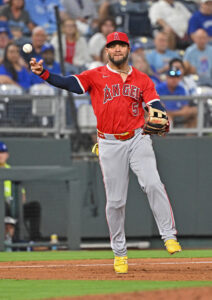
The 30-year-old Moncada put together a .234/.336/.448 showing across 289 plate appearances. He connected on 12 home runs and drew walks at a strong 11.1% rate while striking out a little more than a quarter of the time. It was a typical Moncada season — solid power and on-base skills with lots of strikeouts and a couple injury absences.
Moncada was once the top prospect in MLB. He had a couple star-level performances with the White Sox in 2019 and ’21 but didn’t become the franchise player they expected when they signed him to a $70MM extension in Spring Training 2020. Moncada combined for a .234/.288/.386 batting line between 2022-23. He barely played in ’24 because of a serious adductor (groin) strain, and the White Sox had an easy call to buy him out for $5MM instead of a $25MM club option.
A switch-hitter, Moncada has been better from the left side of the plate over his career. The Angels used mostly in a platoon capacity last year, as he only took 27 plate appearances against southpaws. He’ll get the majority of playing time at third base but could cede some at-bats against lefties, with righty-hitting Vaughn Grissom and Denzer Guzman options for at-bats.
Grissom, acquired from the Red Sox in a buy-low trade at the Winter Meetings, is a better fit at second base. The Angels are likely to give former first-round pick Christian Moore another look at the keystone, but he struggled to a .198/.284/.370 line in his first 53 MLB games. Moore has only 30 games of Triple-A experience and could need more time in the minors. Grissom is out of options and will be on the big league roster in some capacity. Former top prospect Oswald Peraza is also out of options but seems less assured to avoid landing on waivers out of Spring Training.
The Angels have signed five MLB free agent contracts this offseason, all via one-year deals. Kirby Yates, Drew Pomeranz, Jordan Romano and Alek Manoah came aboard for $5MM or less. They’ve spent a combined $16.95MM this offseason without making any moves that extend beyond 2026. RosterResource now calculates their payroll around $180MM, about $13MM south of where they opened the ’25 season. They still need to add at least one starter and would ideally upgrade in center field, where Josh Lowe, Bryce Teodosio and Wade Meckler are the top options.
Francys Romero first reported the agreement. Jon Heyman of The New York Post had the $4MM guarantee. Image courtesy of Peter Aiken, Imagn Images.
Dodgers Sign Kyle Tucker
The two-time defending champions have done it again. The Dodgers officially announced their four-year, $240MM contract with Kyle Tucker on Wednesday afternoon. The deal includes $30MM in deferrals and will come with an approximate $57.1MM annual value for luxury tax purposes. Tucker, a client of Excel Sports Management, receives a $64MM signing bonus — all but $10MM of which is paid upfront — and can opt out after the second or third seasons. Outfielder Michael Siani was designated for assignment in a corresponding move.
Los Angeles will pay the first $54MM signing bonus next month. They’ll owe the remaining $10MM in February 2027, and the signing bonus is guaranteed even in the event of a work stoppage. Tucker will make a $1MM salary this year, followed by a $55MM salary in ’27 and $60MM annually for the final two years if he doesn’t opt out. The team is deferring $10MM annually in the final three years, which will be paid in installments between 2036-45.
Tucker, who turns 29 on Saturday, is the latest superstar addition to what was already MLB’s most feared offense. He slots into a lineup alongside Shohei Ohtani, Freddie Freeman, Mookie Betts, Will Smith, Max Muncy, Teoscar Hernández and Tommy Edman. He’ll join Hernández and Andy Pages as the primary outfielders, with Edman capable of logging center field action when he’s not at second base.
Los Angeles has four outfield prospects who rank prominently near the top of their farm system. They reportedly wanted to avoid locking in long-term commitments as a result. They’ve accomplished that with arguably the biggest annual value in the sport’s history.
It’s a $60MM average on the surface. Without adjusting for deferrals, Tucker’s deal would be the second-highest AAV ever. Ohtani landed a $70MM AAV on his 10-year, $700MM guarantee, though the massive deferrals meant it had a “true” annual value closer to $46MM. One should therefore view the $51MM annual salary on Juan Soto’s 15-year, $765M deal as the more accurate record holder until tonight. Tucker’s adjusted AAV beats that by more than $6MM.
Although Tucker was this offseason’s top free agent, he’s a clear step below the likes of Aaron Judge, Ohtani and Soto of the previous three winters. Tucker has been a consistent All-Star who’s a little outside the top tier of superstars. The fifth overall pick by the Astros in 2015, he broke out in the shortened 2020 season after logging limited big league action in the two preceding years. He connected on 29 or 30 home runs in each of his first three full campaigns, improving his approach along the way.
Tucker was already a great hitter and seemed to be on his way to pulling closer to Judge, Soto and Ohtani with a monster start to the 2024 season. He was out to a .266/.395/.584 slash with more walks than strikeouts through the first two months. He fouled a ball off his right leg and was placed on the injured list with what the Astros initially termed a shin contusion. It turned out to be more serious, as subsequent testing revealed a fracture that kept him out for three months.
The four-time All-Star returned no worse for wear and had a fantastic September. The Astros nevertheless decided to field trade calls after the season. They were never going to meet Tucker’s asking price on an extension and felt they could cash him in for help elsewhere on the roster. They lined up a deal with the Cubs around the Winter Meetings that sent Isaac Paredes, Hayden Wesneski, and prospect Cam Smith to Houston for Tucker’s final year of arbitration.
Tucker’s lone season in Chicago had its ups and downs. He got out to another blistering start, running a .284/.359/.524 slash with 12 homers through the first day of June. He jammed his right thumb diving into second on a stolen base attempt that day. He avoided the injured list, but subsequent testing revealed that he sustained a tiny fracture at the top of his hand between his ring finger and pinky.
The hand injury wasn’t viewed as a serious issue until Tucker’s performance began to suffer. That didn’t occur right away. His next few weeks were the finest of the season, in fact. Tucker slashed .311/.404/.578 across 25 games that month. Things went off the rails in July, as he batted .189/.325/.235 with just one home run over the next six weeks.
The existence of the hairline fracture wasn’t reported until the middle of August. Cubs officials acknowledged that Tucker had been injured in June but said that he was fully healthy by the time the injury was revealed publicly. Maybe the thumb became a retroactive explanation for what was actually a simple slump, though it’s possible he developed some subtle bad habits in June as he tried to mitigate the pain of hitting through the break. Manager Craig Counsell gave Tucker a three-game mental reset towards the end of August before plugging him back into the middle of the order.
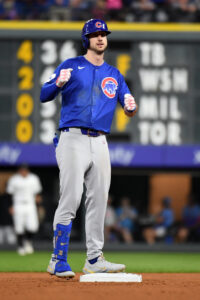
Tucker appeared to be getting back into a groove when he hit another speed bump. He strained his left calf in early September and landed on the injured list, costing him three weeks in the season’s final month. He finished the regular season with a .266/.377/.464 slash line in a little under 600 trips to the plate. He hit .259 with one homer in eight postseason games as the Cubs advanced to the NL Division Series.
The uneven second half soured some Cubs fans on the Tucker acquisition. His overall numbers were in line with his career marks. The offense was 36 percentage points better than league average by wRC+. His lifetime .273/.358/.507 batting line is 38 points above par. Tucker has been in that range in four of the past five seasons. The only exception is his .289/.408/.585 showing over 78 games two years ago.
The ’24 season is probably an outlier, but the Dodgers should feel they’re adding one of the top 10-15 hitters in MLB. He doesn’t expand the strike zone and has a rare blend of plus contact skills and above-average power. Tucker has no issue hitting pitchers of either handedness. He doesn’t have the huge exit velocities of the sport’s premier sluggers, yet he’s a safe bet for 25-30 homers in a healthy season.
Tucker’s glove isn’t as strong at this stage of his career. He won a Gold Glove with Houston in 2022. His defensive grades and sprint speed have declined as he’s gotten into his late-20s. That presumably gave teams pause when considering a long-term investment. Tucker’s defense should remain serviceable in the short term. The Dodgers can comfortably plug him into right field and kick Hernández over to left if they don’t trade him.
The Cubs issued Tucker a qualifying offer but made little effort to retain him. The bidding seemingly came down to the Dodgers, Mets and Blue Jays. New York was similarly hesitant to make a long-term commitment, as they reportedly offered a four-year deal at $55MM per season. Toronto was seemingly willing to entertain a longer term at a lower annual value.
Tucker is L.A.’s second qualified free agent signing of the offseason. They added Edwin Díaz on a three-year, $69MM deal around the Winter Meetings. They surrendered their second- and fifth-round draft choices this summer, plus $1MM from their 2027 international bonus pool, to sign Díaz. They’ll forfeit their third- and sixth-round picks for Tucker. The Cubs receive a compensatory pick between Competitive Balance Round B and the start of the third round (currently slated to land 77th overall).
MLBTR had predicted an 11-year, $400MM deal for Tucker at the beginning of the offseason. It’s unclear if any team would have been willing to go to those lengths. He’s giving up some measure of long-term security in exchange for massive salaries over the next couple seasons and the chance to return to free agency at the tail end of his prime.
He’ll have the option of retesting the market before his age-31 and age-32 campaigns — and without being attached to draft compensation barring a change to the qualifying offer rules in the intervening CBA. A five- or six-year guarantee could be well within range at that point. He’ll collect a huge signing bonus, essentially shatter the record for average annual value, and join the team with the best chance to win the World Series in the interim.
While the specific salary breakdown hasn’t been reported, the Dodgers are reportedly paying $54MM of the signing bonus right away. RosterResource estimates their cash payroll obligations close to $428MM for the upcoming season. Tucker’s $57.1MM AAV will push their competitive balance tax projection north of $395MM.
They’re taxed at a 110% rate on spending above $304MM, so Tucker’s deal comes with a staggering $62.81MM tax hit in the first season. The Dodgers are essentially valuing Tucker’s 2026 season alone at $120MM. L.A. ended last season with a luxury tax payroll of $417MM, costing them another $169.4MM in taxes. Their tax bill alone was higher than the final payroll calculations of 12 teams. They’re trending towards a similar or potentially even greater amount in 2026 depending on what else they do this offseason and at the trade deadline. The aggressiveness continues as they aim for the first three-peat in MLB since the 1998-2000 Yankees.
Tucker’s deal is going to be the latest example for many fans and smaller-market owners who will argue for a salary cap in the upcoming round of collective bargaining negotiations. This level of spending also reaffirms why the MLB Players Association has steadfastly maintained that a cap is a non-starter. Next offseason’s CBA talks are expected to be similarly or even more contentious than those that froze the sport for 99 days during the 2022-23 lockout.
That’s not the concern of the Dodgers or their fans, who’ll be thrilled to add another star as they try to cement their dynastic run. They’ll be heavy favorites in the NL West, and it’s difficult to imagine a scenario in which this team doesn’t make the playoffs. A championship is far from guaranteed, however. The Jays were one swing away from beating them in Games 6 and 7 of last year’s World Series. An extra quarter-second on Isiah Kiner-Falefa’s dash home or another few feet on Ernie Clement’s fly ball in the bottom of the ninth would have flipped the outcome. L.A. ownership and the front office aren’t getting complacent.
After missing on Tucker, the Jays seem likely to reengage with Bo Bichette. Their longtime shortstop is now the top unsigned player. He has reportedly had a productive meeting with the Phillies, but the Jays and Bichette have long expressed mutual interest in a reunion. Bichette wouldn’t be a great fit for the Mets, but they could conceivably pivot to challenging the Yankees for Cody Bellinger. The Mets still don’t have a left fielder after swapping Brandon Nimmo for Marcus Semien. Their reported offer to Tucker demonstrates there’s plenty of room for short-term spending, but president of baseball operations David Stearns has shied away from lengthy commitments this winter.
Jeff Passan of ESPN first reported that Tucker was signing with the Dodgers. Jon Heyman of the New York Post had it as a short-term contract, while Robert Murray of FanSided was first on the four-year, $240MM guarantee. Murray reported the opt-out after the second season, and Passan had the third-year out. Heyman reported the $30MM in deferrals. Ari Alexander of Boston 7 News was first on the $57.1MM post-deferral AAV. ESPN’s Jesse Rogers had the signing bonus details. The Associated Press had the salary breakdown and deferral specifics.
Image courtesy of Christopher Hanewinckel, Imagn Images.
Red Sox Sign Ranger Suárez
The Red Sox officially announced the signing of left-hander Ranger Suárez to a five-year deal Wednesday. He’ll reportedly be guaranteed $130MM in total, and the contract contains a mutual option for the 2031 campaign. It’s a fairly straightforward deal that contains no deferrals, opt-outs or no-trade protection. Boston opened a 40-man spot for the veteran lefty this morning when trading infielder Tristan Gray to the Twins. Suárez is represented by the Boras Corporation.
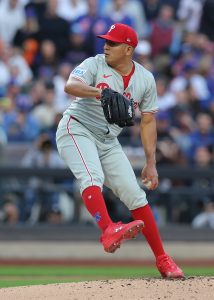
Suárez’s contract is reportedly backloaded in significant fashion, paying him just a $3MM signing bonus and $7MM salary in 2026. He’ll earn $15MM in 2027 before his salary doubles to $30MM in each of the next two years (2028-29). Suárez will be paid $35MM in 2030 and is also guaranteed a $10MM buyout on that mutual option, which is valued at $35MM. Mutual options are never exercised by both parties, so the inclusion of one in this deal is little more than a mechanism to further backload the contract.
The Sox came into the offseason with a rotation headlined by Garrett Crochet, followed by a notable gap to their other starters. They had a lot of options for back-end types and depth but were looking to bolster the front end.
“Because of the depth that we’ve built up over the last couple of years, we feel pretty good about just overall starting pitching, maybe No. 3-ish through No. 10-ish,” was how chief baseball officer Craig Breslow framed the situation in November. “And that’s not to take away from guys who are certainly capable of doing more, and more just to say I don’t think we’re going to spend a ton of time trying to add a No. 4, No. 5 starter.”
Since then, Breslow has made a couple of moves to alter that rotation group. He acquired Sonny Gray from the Cardinals and Johan Oviedo from the Pirates. They subtracted a bit from the depth by including Richard Fitts in the Gray deal and Hunter Dobbins in a separate Cardinals trade that netted first baseman Willson Contreras.
Gray is arguably the kind of No. 2 starter the club was looking for. His 4.28 earned run average in 2025 has some Boston fans disputing that assessment but he has a 3.63 ERA, 27% strikeout rate, 6.1% walk rate and 44.6% ground ball rate in 531 innings dating back to the start of 2023. FanGraphs ranks him fifth in wins above replacement among pitchers in that time, behind only Tarik Skubal, Zack Wheeler, Logan Webb and Cristopher Sánchez.
Since the Gray deal, Boston has seemingly been more focused on upgrading its lineup and position player mix, targeting infielders like Alex Bregman, Bo Bichette, Ketel Marte, Brendan Donovan and Isaac Paredes. Clearly, Boston hit a wall in those efforts. Bregman signed with the Cubs, and Bichette landed with the Mets. The D-backs have reportedly taken Marte off the market. Paredes and Donovan could still be available, though Houston has shown minimal interest in dealing the former. Having come up empty (so far) in that pursuit of a marquee infielder, the Red Sox pivoted to further augment an already strong rotation.
Suárez’s contract is notable on a few fronts. For one, Breslow has generally avoided long-term free agent deals since becoming Boston’s chief baseball officer. Coming into today, his longest deal for a free agent was to give Bregman three years, which turned into a one-year relationship when Bregman opted out. The Sox came into today as the only one of the 30 major league clubs to not have signed a free agent this winter. This deal will be a new benchmark for Breslow in terms of years and guarantee given to a free agent, as well as erasing Boston’s status as the only team not to spend money on free agency this offseason.
It’s also a notable deal for Suárez in a few different ways. For one thing, he was a fairly low-profile international signing of the Phillies at the start of his professional career, securing a bonus of just $25K. As he has become a major leaguer, he has pushed his salary up in arbitration with his strong results but his lack of volume has limited him. He just made $8.8MM in his final year of arbitration, relatively modest by modern standards, but will now be securing a much bigger payday than ever before.
Speaking of his strong results but limited overall workload, that impacted the view of his market coming into this winter. Broadly speaking, Suárez has been really good on a rate basis, but he doesn’t throw especially hard and has dealt with some nagging injuries, impacting the overall quantity of his contributions.
He first became a full-time starter for the Phillies in 2022 and held a rotation job for four years. Over that span, he logged 588 1/3 innings with a 3.59 ERA. His 21.9% strikeout rate was around league average. His 7.5% walk rate was solid and his 50.8% ground ball rate quite good. He also earned a reputation as a cold-blooded playoff contributor, giving the Phils 42 2/3 postseason innings with a 1.48 ERA.
However, Suárez’s velocity has never been huge and has been trending down. His four-seam fastball averaged a bit over 93 miles per hour in 2022 and 2023. That dropped to 91.8 mph in 2024 and 91.3 mph last year. His primary pitch, his sinker, averaged just 90.1 mph in 2025.
Suárez also still hasn’t really pitched a full big league season. He hasn’t had any major injury concerns but has had scattered issues over the years, with lower back problems being a recurring thorn. Thanks to those sporadic health problems, he’s never hit the 30-start mark or the 160-inning plateau in any season as a big leaguer.
Given his clear skills but also his question marks, MLBTR predicted Suárez for a five-year, $115MM deal at the beginning of the offseason, $23MM in terms of average annual value. The top of the free agent starting pitching market has been slow to move this winter. Dylan Cease and the Blue Jays quickly found each other but it’s been a bit tepid otherwise.
Prior to this, no other starter apart from Cease signed a deal longer than than three years or for more than $75MM. Tatsuya Imai settled for three years and $54MM, significantly below the expectations from the outset of the offseason. As Suárez and Framber Valdez lingered unsigned into the new year, it was fair to wonder if they would meet the initial expectations. Suárez has not only met MLBTR’s prediction but surpassed it by a margin of $3MM per season.
Despite some concerns with Suárez, the move gives Boston one of the best rotations in baseball, if not the very best. Crochet is the clear ace. Suárez and Gray will have two spots behind him, followed by Brayan Bello. Oviedo seems to be in a decent position to land the No. 5 spot, but he would also have competition from injury returnees like Patrick Sandoval and Kutter Crawford. It’s possible Tanner Houck jumps into the mix late in the year, as he underwent Tommy John surgery in August.
Prospects Connelly Early and Payton Tolle made big league debuts late in 2025 and could push for jobs as well. Kyle Harrison, David Sandlin, Shane Drohan and Tyler Uberstine are also on the 40-man roster. Those latter six names all have minor league options and either have limited big league experience or none at all, so they could all be sent to the minors as depth. Crawford has a decent amount of big league experience but is still optionable, so it’s possible for him to be squeezed to Worcester as well.
It’s also fair to wonder if this Suárez deal sets the Red Sox up to trade some starting pitching for the infield upgrade they didn’t get when Bregman slipped through their fingers and Bichette signed with the Mets. They have been connected to Donovan many times and have already lined up a few trades with Chaim Bloom, Boston’s former chief baseball officer who is now president of baseball operations with the Cardinals.
Donovan isn’t the only option out there. The Sox were also connected to Marte as strongly as any club in baseball. While the Diamondbacks have reportedly taken him off the market, Breslow could always try to force the issue with an offer headlined by Tolle or Early (in addition to other young pieces). Nico Hoerner‘s name has also come up in some trade rumors after the Cubs signing Bregman. Jake Cronenworth of the Padres has been in a few rumors.
All those players would have varying level of trade value due to their different salaries and years of control, but the same is also true of Boston’s pitchers. Early and Tolle are big prospects and would only be given up for a big return. Sandoval has one year left on his contract and has been injured for most of the past two years, so his trade value is marginal, at best. Bello has even been in some rumors and he would be somewhere in between, as he is owed $50.5MM over the next four years and has been more good than great.
Since it feels likely that at least one more significant move is coming, the club’s financial picture is probably still in flux. For now, RosterResource pegs the club’s payroll at $197.5MM with a competitive balance tax calculation just under $266MM.
The Sox avoided the tax in 2023 and 2024. They went narrowly over the line in 2025, paying a tax bill of just $1.5MM. That will make them second-time payors in 2026, giving them a base tax rate of 30% for going over the first threshold of $244MM. The second threshold is $264MM and the Sox would pay a 42% on further spending above that line. If they go beyond $284MM, the tax rate would jump to 75% for spending above that line and their top pick in the 2027 draft would be dropped by ten spots.
Speaking of the draft, the Sox are going to be impacted by this Suárez signing in 2026. Suárez rejected a qualifying offer from the Phillies, meaning the Sox are subject to the associated penalties for signing him. Since the Sox paid the tax last year, they have to forfeit their second- and fifth-highest draft picks this summer, in addition to losing $1MM in international bonus pool space. The Phillies will receive a compensation pick after the fourth round of the upcoming draft.
Prior to this deal with the Red Sox, Suárez was connected to the Orioles, Astros and Mets, though other clubs presumably had interest even if they weren’t connected to him in public reports. For the teams who missed out on Suárez, there are still some options they can turn to, despite the relatively late stage of the offseason.
Valdez and Zac Gallen are the top two free agents, with Chris Bassitt, Justin Verlander, Lucas Giolito and others still unsigned. The trade market still has some potential options, including MacKenzie Gore and Freddy Peralta. Valdez has to be pleased with Suárez getting a deal beyond expectations even at this part of the calendar. They are fairly similar pitchers as groundballers. Valdez is a bit older but throws harder and has the more impressive track record overall.
Jon Heyman of The New York Post first reported that the Sox would be signing Suárez. Bob Nightengale of USA Today first reported the length and guarantee, as well as the lack of deferrals and opt-outs. Chris Cotillo of MassLive first reported the lack of a no-trade clause, the inclusion of a mutual option, and the annual breakdown of the contract. Photos courtesy of Bill Streicher, Brad Penner, Imagn Images
White Sox Trade Luis Robert Jr. To Mets
The long-awaited Luis Robert Jr. trade has arrived. The Mets announced they’ve acquired the former All-Star center fielder from the White Sox for young infielder/outfielder Luisangel Acuña and minor league right-hander Truman Pauley. There’s no cash involved and no corresponding moves because Robert and Acuña were each on the 40-man roster.
This brings an end to what had been years of Robert trade rumors. The White Sox have held their center fielder through multiple rebuilding seasons. In retrospect, they surely wish they’d moved him over the 2023-24 offseason. Robert was coming off a career year and looked like a budding star entering the prime of his career. The past two seasons have been more challenging, as he has battled injuries and struggled while fielding questions about when he would be traded.
Robert was a high-profile prospect when he signed with the Sox out of Cuba in 2017. He commanded a $26MM bonus, the kind of hefty sum for an international amateur that would subsequently be prohibited in the collective bargaining agreement. Robert’s dominant minor league performance further spurred optimism, and the White Sox signed him to a $50MM extension over the 2019-20 offseason. At the time, it was the largest extension for a player who had to make his MLB debut, and it ensured he’d break camp in 2020 without any kind of service time games.
While that year’s schedule would be shortened by the pandemic, Robert popped 11 homers and won a Gold Glove in center field. He placed second in Rookie of the Year balloting. Robert’s numbers jumped in year two, as he hit .338/.378/.567 across 296 plate appearances. A torn flexor tendon in his right hip cost him three months, however, and the blend of tantalizing talent and frustrating durability would be a recurring theme in his career.
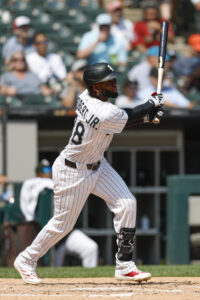
Robert had a trio of injured list stints, albeit all for minor issues, the following season. He stayed healthy for almost all of the ’23 campaign and showed the star-level ceiling he possesses at full strength. Robert drilled 38 homers, 36 doubles and one triple across 595 plate appearances. He hit .264/.315/.542 to win a Silver Slugger Award. FanGraphs and Baseball Reference each valued his season around five wins above replacement after accounting for his excellent center field defense.
The White Sox nevertheless went 61-101 and were outscored by 200 runs. It was clear they were amidst a multi-year teardown, but they elected to hang onto Robert when they had four years of affordable contractual control. They could have netted multiple top prospects if they’d shopped him.
Robert’s production has tanked as the team has slogged through two more terrible seasons. He’s a .223/.288/.372 hitter in 856 plate appearances since the start of 2024. He has struck out at a near-30% rate while continuing to battle injuries. The right hip flared up early in the ’24 season and kept him out for two months. A pair of left hamstring strains were the culprit last summer, with the latter costing him all of September.
The physical tools remain encouraging. Robert is one of the fastest players in the league despite the various lower body injuries. He ranks in the 92nd percentile in bat speed, according to Statcast. He’s an aggressive hitter who is always going to have his share of strikeouts. Teams would happily live with a lower on-base percentage if he’s making the kind of power and defensive impact he did during his best days in Chicago.
It’s largely a change-of-scenery bet from the Mets’ perspective. Robert only turned 28 in August and hasn’t shown signs of physical decline. He has spent the past three seasons on one of the worst teams in MLB, fully aware that he’d be traded at some point. A new environment could help him get back on track, although the durability concerns will persist even if his numbers improve.
Robert will at least upgrade the defense and bring some upside on the bases. He has stolen 20+ bags in three straight seasons and went 33-41 in stolen base attempts last year. He should also bring some juice against left-handed pitching, as he’s a career .293/.367/.505 hitter with the platoon advantage. His production against southpaws tanked in 2024 but rebounded last season.
The biggest risk for the Mets is financial. They’re assuming the entirety of Robert’s $20MM salary and committing to a $2MM buyout on a $20MM club option for the 2027 season. It’s not a small amount to spend on a player who hasn’t produced much over the past two years, and that’s before considering the tax implications.
The Mets pay a 110% tax on spending as a three-time repeat luxury tax payor whose CBT payroll is above $304MM. Robert is guaranteed $22MM for one season — the option buyout is guaranteed money — so they’re tagged with a $24.2MM tax hit. It’s a $46.2MM commitment overall, albeit one that comes with the upside of what could be a bargain option in ’27 if Robert hits his ceiling. RosterResource calculate their CBT number around $357MM, putting them on track to exceed last year’s season-ending $347MM mark — which required a $91.6MM tax payment. There’s a good chance they’ll have a tax bill north of $100MM by the end of the ’26 season.
They’ve taken on $64MM in AAV commitments for the 2026 season between the Robert trade and Bo Bichette signing over the past five days. The Mets haven’t wanted to lock themselves into lengthy deals one offseason after the Juan Soto signing. They’ve compensated with significant short-term investments to chase upside. Robert should be the everyday center fielder as long as he’s healthy. That’d push Tyrone Taylor either into a fourth outfield role or as a stopgap in left field if prospects Carson Benge and Jett Williams open the season in Triple-A. It seems likely to take them out of the running on Cody Bellinger, the top unsigned position player.
Although the White Sox missed their opportunity to trade Robert at the apex of his value, they deserve some credit for exercising this year’s option rather than cutting him loose for nothing in free agency. That at least netted them an intriguing depth piece in Acuña, who felt superfluous on the Mets but is a fine target for a rebuilding team.
The younger brother of Ronald Acuña Jr., Luisangel is a former Rangers signee whom the Mets acquired in the 2023 Max Scherzer deadline deal. His bloodlines and previous inclusion in one marquee trade have made him a more well-known prospect than his production probably warrants, but he’s not yet 24 and provides some multi-positional utility for skipper Will Venable.
Acuña signed as a shortstop and has the arm strength to profile on the left side of the infield. There weren’t many shortstop reps available on a team with Francisco Lindor, leading the Mets to bounce him around in a utility capacity. Acuña has plus-plus speed and could be an option in center field as well. He’s splitting his time between shortstop and center field in the Venezuelan winter league, but the majority of his MLB experience has come as a second baseman.
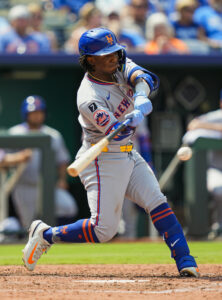
The White Sox shouldn’t have any issue getting Acuña in the lineup even if he’s not expected to push Colson Montgomery off shortstop. He could step into the everyday center field role vacated by the Robert trade or push for second/third base playing time alongside Chase Meidroth, Miguel Vargas and Lenyn Sosa.
The question is whether Acuña will bring enough to the table offensively to warrant playing time once the Sox are better positioned to contend. He’s a .248/.299/.341 hitter in his first 233 MLB plate appearances. Acuña has had a similarly light bat against Triple-A pitching. The right-handed hitter owns a .265/.307/.360 line in more than 700 trips to the plate at the top minor league level. Acuña has solid contact skills but puts a lot of balls on the ground without big exit velocities. He’s a slash-and-dash type hitter whose best current ability is as a runner, where he went 16-17 in stolen base tries over 95 MLB games last year.
Acuña is out of minor league options, so the White Sox will need to keep him on the MLB roster. They wouldn’t have traded Robert for him if they didn’t intend to do so. The lack of roster flexibility was a much bigger hangup for the Mets, who also cannot option Mark Vientos and are unlikely to send Brett Baty back to Triple-A. They knew they’d lose Acuña on waivers but weren’t positioned to offer him the playing time to take a step forward offensively. Chicago can control him through the 2031 season, as Acuña has yet to reach a year of MLB service.
The White Sox also add a low minors arm in Pauley, a 6’2″ righty whom the Mets took in the 12th round of last year’s draft. The Harvard product received an above-slot $400K signing bonus. Baseball America ranked him the #435 prospect in the draft, writing in June that teams like the riding life on his mid-90s fastball and plus spin rates on his breaking ball. Pauley walked more than 15% of opponents with a 4.61 ERA in his draft year. His command will need to take a significant leap if he’s to get to the majors, even as a reliever, but the Sox’s player development team is clearly intrigued by his raw stuff.
From a payroll standpoint, dealing Robert drops Chicago’s projected spending to $67MM. They opened last season around $81MM, so this could free them up for a late-offseason depth addition or two. The Sox could bring in a veteran middle reliever and/or a fourth outfielder whom they’d try to flip for another lottery ticket prospect in the Pauley mold at the deadline.
Jeff Passan of ESPN was first on the trade terms. Jon Heyman of The New York Post reported that the Mets were assuming the full salary. Respective images courtesy of Kamil Krzaczynski, Jay Biggerstaff of Imagn Images.
Carlos Beltran, Andruw Jones Elected To Hall Of Fame
The Baseball Writers Association of America announced that Carlos Beltrán and Andruw Jones have been elected to the Hall of Fame. They’ll be inducted into Cooperstown alongside Jeff Kent, who was elected by the Era Committee, on July 26. Beltrán appeared on 84.2% of ballots, while Jones got to a 78.4% vote share.
Beltrán gets the honor in his fourth year. The switch-hitting outfielder was the only player who fell between 70% and 75% on last year’s ballot. His positive trend lines made it a near lock that he’d surpass the 75% threshold this winter.
The Royals drafted Beltrán, a native of Puerto Rico, in the second round in 1995. He reached the big leagues as a September call-up three years later and ranked as one of the sport’s top prospects going into his first full season in 1999. Scouting reports projected him as a potential five-tool center fielder, and Beltrán lived up to that billing immediately.
He hit .293/.337/.454 with 22 homers and 27 stolen bases during his debut campaign. Beltrán was the runaway choice for American League Rookie of the Year, the first of many accolades he’d accrue over the next two decades. Injuries and a sophomore slump limited his playing time in 2000, but Beltrán reestablished himself as one of the sport’s best outfielders the following year. He’d hit above .300 in two of the next three seasons, earning his first top 10 MVP finish behind a .307/.389/.522 showing in 2003.
The roster around Beltrán was not nearly as strong. A small-market Kansas City franchise was unlikely to re-sign him, making him a top trade chip as he entered his final season of club control. The Royals dealt Beltrán, a first-time All-Star, to the Astros midway through the ’04 season. He appeared on the National League roster — Houston was then an NL team — and finished 12th in MVP balloting despite spending the first three months in the American League. Beltrán hit .258/.368/.559 with 23 homers in 90 regular season games for Houston.
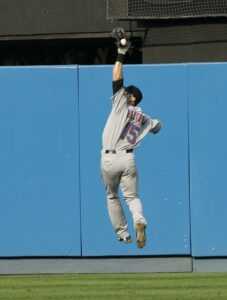
His introduction to the postseason couldn’t have gone any better. Beltrán batted .435 with eight homers in 12 playoff games, helping Houston to within one game of a trip to the World Series. The Astros would go on to win the pennant one year later, but Beltrán had moved on in free agency by that point. He signed what was then a franchise-record deal with the Mets: seven years and $119MM.
Beltrán’s first season in Queens was a bit of a disappointment, but he rebounded with arguably the best season of his career in 2006. He hit a career-best 41 home runs and drove in a personal-high 116 runs with a .275/.388/.594 slash line. Beltrán won his first Gold Glove and Silver Slugger awards while finishing fourth in MVP voting. Baseball Reference credited him with eight wins above replacement, the best mark of his career. He remained a force into the playoffs, batting .278 with a .422 on-base percentage over 10 games.
For the second time in three years, Beltrán’s team lost the seventh game of an NLCS battle with the Cardinals. The ’07 Mets famously melted down in September to squander the NL East title to the Phillies. They wouldn’t return to the playoffs during Beltrán’s tenure, yet there’s no doubt they got their money’s worth from the free agent investment. Beltrán played in 839 games while hitting .280/.369/.500 with 149 homers over six and a half seasons in a Mets uniform.
The club also netted a top pitching prospect named Zack Wheeler when they traded the impending free agent to the Giants in 2011. He raked down the stretch with San Francisco, but they narrowly missed the postseason between their World Series wins in 2010 and ’12. Beltrán signed a two-year deal with the Cardinals the following year. He hit .282/.343/.493 over his time in St. Louis, but his impact again was brightest in the postseason. Beltrán was a stellar playoff performer in both years.
Beltrán signed a three-year contract with the Yankees over the 2013-14 offseason. He remained an above-average hitter over his time in the Bronx, albeit without the defensive value he’d had for the majority of his career. He made it back to the playoffs in 2016 after being dealt to the Rangers at the deadline. Beltrán finished his career on a one-year contract to return to the Astros.
The final season in Houston wound up leaving Beltrán with a complicated legacy. He was an integral part of the team’s sign-stealing operation that wasn’t publicly revealed until a few seasons thereafter. Beltrán wasn’t much of an on-field contributor at age 40, but he collected his first World Series ring when the Astros won their first title in franchise history.
Beltrán’s role in the sign-stealing scandal became public over the 2019-20 offseason. He had just been hired by the Mets as manager a few months earlier. He stepped down and forfeited his salary once the operation became public. Beltrán has remained involved in the game in less prominent roles, working as a television analyst with the YES Network and spending the past few seasons as a special assistant in the Mets’ front office. He’s also in charge of building the roster for the Puerto Rican national team at the upcoming World Baseball Classic.
The sign-stealing scandal probably delayed Beltrán’s entry to Cooperstown. His statistical résumé made him a very strong candidate to get in on the first ballot. He finished his playing days with a .279/.350/.486 batting line. He hit 435 home runs, stole 312 bases, and drove in nearly 1600. Baseball Reference valued his career at 70 WAR, which doesn’t even account for his playoff excellence. Jay Jaffe’s JAWS metric has him as a top 10 center fielder of all time. Whatever trepidation some voters may have had about honoring him within the first couple years on the ballot, the end result is that he’s headed to Cooperstown to cement his legacy as one of the best center fielders to play the game.
That’s also the case for Jones, who ranks 11th among center fielders by the same JAWS calculation. He gets in on his ninth year on the ballot, one season after receiving 66% of the vote. A native of Curacao, Jones signed with the Braves as an international amateur and flew through the minor leagues. He was the #1 prospect in the game when he reached the majors in the second half of the 1996 season. Jones stepped seamlessly onto a loaded Atlanta roster that was midway through their run of dominance in the National League. They were coming off a championship and would head back to the Fall Classic in ’96.
A 19-year-old Jones embraced the big stage, hitting .345 with a trio of home runs in October. That included a two-homer showing in Game 1 against the Yankees, and he remains the youngest player ever to hit a World Series home run. The Braves won the first game but wound up dropping the series in six.
Jones played mostly right field during his first full season. He hit .231 with 18 homers in 153 games and finished fifth in NL Rookie of the Year balloting. He really took off the following year, kicking off a decade-long run as the sport’s best defensive outfielder and a premier power threat. Jones hit 31 homers while batting .271/.321/.515 and earning his first Gold Glove in 1998. That was his first of seven 30-homer campaigns and, more remarkably, the start of a streak of 10 consecutive Gold Glove awards.
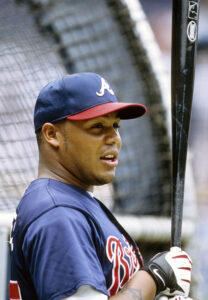
He’d start all 162 games for the Braves in 1999, playing elite defense while batting .275/.365/.483 with 26 homers and 35 doubles. The Braves made it back to the World Series after losing the NLCS in the prior two seasons. They were again knocked off by the Yankees, this time in a sweep. Jones didn’t have great playoff numbers over that stretch but remained one of the league’s best players in the regular season. He hit 36 homers in a 2000 season which Baseball Reference valued at eight wins above replacement, a career high that ranked fourth in MLB among position players.
Jones earned an eighth-place MVP finish in 2000 and very likely would have finished higher had today’s defensive metrics been around at the time. He reeled off another three 30-plus homer seasons after that, narrowly dropping below that cutoff with a 29-homer showing in 2004. He rebounded with his most impressive offensive performance in ’05, as he slugged an MLB-best 51 longballs and led the National League with 128 runs batted in. Jones won a Silver Slugger for the first and only time and finished as the MVP runner-up behind Albert Pujols. It was a narrow split, as Pujols received 18 first-place votes against Jones’ 13. (Third-place finisher Derrek Lee received the other one.)
The righty hitter remained an impact run producer the following season, as he slugged 41 more home runs with a career-high 129 RBI. That was his last impact season, as his rate stats dropped in 2007. The Braves let him depart in free agency at season’s end, and he was essentially finished as an everyday player at age 31. Jones played parts of five more seasons between the Dodgers, Rangers, White Sox and Yankees. He didn’t record more than 64 hits in any of his final five campaigns.
While it was a precipitous decline, Jones had one of the more impressive peaks in baseball history. He hit 368 home runs with a .263/.342/.497 batting line between his debut and the end of his age-30 season. Retroactive defensive metrics come with significant error bars, but FanGraphs estimates he was roughly 134 runs better than an average defender during that stretch. That’s 25 runs clear of the second-place finisher at any position (Adrian Beltré) and certainly aligns with both his impressive accolades and scouting evaluations that consider him among the best outfield defenders in MLB history. Jones is one of six outfielders to win 10 Gold Gloves. He’s alongside Roberto Clemente, Willie Mays, Ken Griffey Jr., Al Kaline and Ichiro in that company and now, in Cooperstown.
Jones finished his career as a .254/.337/.486 hitter. His 434 homers place him one behind Beltrán for sixth among center fielders and tied with Juan González for 49th regardless of position. He nevertheless had a lengthy stay on the ballot as some voters struggled with his lack of production after he left Atlanta. Others may have withheld a vote on moral grounds, as Jones pleaded guilty to domestic battery charges and paid a fine after his wife alleged that he put his hands around her neck in December 2012. That came after the end of Jones’ MLB career, though he subsequently played two seasons in Japan to finish his professional playing days.
While Jones will certainly go into the Hall as a Brave, Beltrán had a nomadic enough career to consider a few options for his plaque. The Hall of Fame has final say but works with the player to choose which cap they’ll don. Beltrán tells Bob Nightengale of USA Today that while no decision has been finalized, he’s likely to go into Cooperstown as a Met.
Looking further down the ballot, Chase Utley’s 59% vote share was the highest among the candidates who were not elected. That’s up 20 points relative to last winter. It puts Utley, who has been on the ballot for three years, on track for eventual enshrinement — with an outside chance that he gets in as soon as next year. No other candidate appeared on more than half the ballots.
Of this year’s first-time candidates, only Cole Hamels (23.8%) received more than the 5% necessary to remain under consideration. All but one player who fell off the ballot was up for consideration for the first time. The lone exception is Manny Ramírez, who drops off after coming up short in his 10th year. Ramírez’s history of performance-enhancing drug use (including a failed test) made him a non-starter for many voters, and he appeared on fewer than 40% of ballots in his final year. His only path to enshrinement is via the Era Committees, and their decision last month on Barry Bonds and Roger Clemens makes it difficult to see a scenario where Ramírez ever gets in.
Next year will be the final consideration for Omar Vizquel, who has no chance of jumping from 18% to induction. Buster Posey and Jon Lester headline a class of first-time candidates that’ll also include Ryan Zimmerman, Kyle Seager, Brett Gardner and Jake Arrieta. Posey seems likely to get serious consideration for first-ballot induction, while Lester should easily have enough support to get more than 5% and remain on the ballot for future seasons.
Full voter breakdown courtesy of BBWAA. Respective images via USA Today Sports.
Mets Sign Bo Bichette
January 20: Bichette’s physical is complete and the Mets have officially announced the signing. They’ll hold a press conference on Wednesday afternoon to introduce their new star.
January 16: The Mets wasted little time in changing gears after missing out on the offseason’s top free agent. They’ve reportedly agreed to a massive three-year, $126MM contract with free agent infielder Bo Bichette. The Vayner Sports client can opt out of the contract after this season and after the 2027 campaign, and if he chooses to do so he’ll pick up an additional $5MM bonus. The contract does not contain any deferred money and affords Bichette a full no-trade clause.
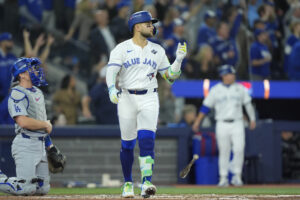
It’s a stunning and near-immediate pivot for a Mets club that is barely 12 hours removed from losing out on Kyle Tucker, who just last night went to the Dodgers. Los Angeles outbid the Mets’ reported four-year, $220MM deal with a four-year, $240MM contract that gives Tucker two opt-out opportunities (post-2027 and post-2028). Having missed on that big swing, the Mets now pivot to the market’s next-best bat and next-best all-around free agent, bringing Bichette in on a $42MM annual value that ties Zack Wheeler for the sixth-largest in MLB history.
In landing Bichette, the Mets are not only pivoting from Tucker in arguably the most notable way possible — they’re also keeping him from a division rival that had emerged as the ostensible frontrunner. Bichette met with the Phillies earlier this week, and made him a seven-year offer worth around $200MM. They believed they were close to a deal last night, but the Tucker decision prompted a pivot from the Mets, who swooped in and stole him from their rivals. Bichette now lands a mammoth annual value that could grow even further (via that $5MM bonus) if he opts out and returns to the market next winter, ahead of what would still be only his age-29 season.
Though the fit isn’t necessarily as clean as Tucker would have been for a Mets club that already had a deep infield and was lacking in outfielders, Bichette adds a clear plus bat to manager Carlos Mendoza’s lineup. The 27-year-old (28 in March) has been a well above-average hitter in all but one of his seven major league campaigns — a 2024 season that was cut short by multiple calf injuries and a broken finger standing as the lone exception.
Bichette hit just .225/.277/.322 in 80 games during that awful 2024 campaign. He not only bounced back in 2025 but turned in arguably the best performance of his career on a rate basis, slashing .311/.357/.483 with 18 home runs in 628 plate appearances. By measure of wRC+ (134), it was Bichette’s best season since his late call-up during the 2019 campaign (MLB’s juiced-ball season).
Even on its surface, Bichette’s 2025 season looks excellent. It doesn’t tell the tale of his finish, though, which had both positives and one very obvious negative. Bichette actually had a tepid start to his 2025 campaign. The underlying batted-ball data through his first month-plus was strong, but he hit just .275/.316/.363 through the first week of May. From that point forth, Bichette caught fire. Over his next 457 plate appearances, he laid waste to opposing pitchers at a .325/.372/.528 clip. That was 50% better than league-average, by measure of wRC+, and even that doesn’t fully do justice to Bichette’s jaw-dropping summer; over his final 238 plate appearances, the second-generation All-Star went supernova with a .381/.437/.591 slash (187 wRC+).
Unfortunately for both Bichette and the Blue Jays, that previously mentioned “very obvious negative” struck in early September when he suffered a sprained posterior cruciate ligament in his knee and missed the remainder of the regular season. He was also inactive for the early rounds of postseason play, only returning in the World Series. Bichette was clearly hobbled during the Fall Classic, limping to first base with ’88 Gibson-esque speed when putting the ball in play and displaying a lack of range at a new position: second base. Bichette’s shortstop glovework has been panned for years, and the Jays took the downtime as an opportunity to shift the defensively superior Andres Gimenez over to shortstop in his absence.
Despite the clearly injured knee, Bichette’s bat didn’t miss a beat in the World Series. He went 8-for-23 with seven singles and a titanic three-run homer off Shohei Ohtani in Game 7 of the World Series. Had the Jays’ bullpen managed to hold the lead, that would-be game-winner would have trailed only Joe Carter’s walk-off blast in franchise lore. Of course, that’s not how the game turned out, but Bichette’s 442-foot bomb still served to further underscore that even at less than 100%, he was a clear impact bat.
Bichette now carries a lifetime .294/.337/.469 batting line with him to Queens. He’s been 20-35% better than an average hitter every season of his career with the exception of that 2024 outlier, and this past season’s 14.5% strikeout rate was a career-low. He couples those plus-plus contact skills with above-average power and high-end batted-ball data; Bichette averaged 91 mph off the bat this past season (72nd percentile), and his 48.8% hard-hit rate sat in the 83rd percentile of big league hitters.
The question for Bichette and the Mets is how well he can handle a move to third base. His shortstop deficiencies were largely due to sub-par range. He doesn’t have a plus throwing arm necessarily, but it’s closer to average — at least in terms of the average velocity on his throws, as measured by Statcast — than was the case with his bottom-of-the-scale lateral movement. Bichette averaged 82.3 mph on his throws across the diamond last year — below par in MLB but still an upgrade (at least in terms of pure arm strength) over the man he’ll be replacing at the hot corner, Brett Baty (81.2 mph). Bichette may not be a plus defender at third, but even average defense coupled with his bat and good health would result in All-Star output.
Baty could now bounce between multiple positions. He’s played second base and left field in the past, and the Mets would surely be open to experimenting with him at first base, too. The designated hitter slot provides more opportunities for all. It’s a similar range of possibilities to the one faced by Jorge Polanco, who inked a two-year, $40MM deal last month. Polanco will reportedly be used extensively at first base and designated hitter despite having virtually no prior first base experience.
For a team that has preached run prevention for much of the offseason, lining up with Bichette at third base and Polanco/Baty at first probably isn’t how they drew things up originally — but the offseason is a layered beast that rarely unfolds in alignment with even the best-laid plans. Even if the Mets’ infield defense (and outfield defense, for that matter) is lacking, it’ll be solid up the middle thanks to Francisco Lindor and Marcus Semien. It should also be a highly productive offensive unit — particularly if Semien’s bat can bounce back at all.
Of course, the addition of Bichette also makes a potential trade of Baty — and several other infielders — more likely. Clubs seeking third base help include the Mariners, Angels and Pirates (as explored at length yesterday), among others. Any could show interest in Baty, Mark Vientos, Luisangel Acuña and/or Ronny Mauricio. Acuña, Vientos and Mauricio have all reportedly been available throughout the offseason anyhow. Some form of move seems likely, especially when considering both Acuña and Vientos are out of minor league options and looking to bounce back from poor seasons.
From a payroll vantage point, the Bichette contract is all the more staggering. Not only is the $42MM annual value the sixth-largest ever, it’s also only a fraction of what the Mets will actually have to pay due to this signing. New York was already on the cusp of the top tier of luxury penalization. Bichette catapults them $33MM north of that final cutoff point, per RosterResource’s estimates. They’ll pay a 95% tax on the first roughly $9MM of his annual value and a full-freight 110% tax on the remaining $33MM. Assuming an even distribution of his $126MM over the three-year term, the Mets would be paying more than $86MM for Bichette in 2026 alone. If he triggers that $5MM bonus upon opting out next winter, that’d also be subject to a 110% tax, bringing the Mets’ total bill on Bichette to about $97MM for just one year.
Moreover, the signing underscores the minimal amount that many big-market, CBT-paying clubs care about paying the 110% tax on short-term deals marquee players. The Dodgers’ signing of Tucker — just as will be the case with Bichette’s deal — has rekindled public outcry for a salary cap, but the players will likely only use these deals to illustrate the discrepancy between the middle and upper class of free agents; the union will surely argue that a cap would only further expand that gap and point out that half the money paid by CBT offenders is redistributed to other teams (in addition to standard revenue-sharing). That won’t fly with small-market owners, who’ll argue that they can’t compete with this type of expenditure. Both sides will dig in their heels.
It’s also fair to wonder whether this is a short-term blip or a burgeoning trend. Even big-market clubs seem increasingly against long-term contracts. For years, it was the Dodgers who tended to prefer short-term, high-AAV deals. But we’ve now seen the Mets limit their Tucker offer to four years and go three super-premium years on Bichette — while also declining to go beyond three years for Pete Alonso or Edwin Diaz. The Red Sox clearly prefer the trade market to free agency and surprised onlookers by even extending to five years to sign Ranger Suárez. The Yankees have reportedly been stuck on five years for their offer to Cody Bellinger while he seeks a seven-year term. Giants ownership publicly voiced an aversion to signing any pitchers to long-term contracts.
If baseball is indeed moving more toward NBA-style contracts — short term, ultra-high annual value — it’d mark a dramatic shift for a sport whose top players have overwhelmingly (albeit not always) preferred the stability of long-term arrangements, even if that means sacrificing some money on an annual basis. Time will tell, but that will all factor into both parties’ approach at the negotiating table next winter in an offseason that is widely expected to be impacted by a lockout and transaction freeze.
Turning back to the teams directly impacted by today’s signing, the Mets will part with their second- and fifth-highest selections in the 2026 draft as well as $1MM of space from next year’s bonus pool for international amateur free agents. That’s due to the fact that Bichette declined a $22.025MM qualifying offer. By that same token, the Blue Jays will be compensated with an extra pick. That selection will come after the fourth round of this summer’s draft — the lowest possible compensation — due to Toronto’s status as a luxury tax payor.
For the Jays, parting with Bichette has at least seemed possible throughout the winter but began to look more certain once they signed star NPB third baseman Kazuma Okamoto and plugged him into an already crowded infield. There was still some room for Bichette to return, but Toronto’s focus has reportedly been on Tucker. With Bichette now formally out of the picture, they’re lined up to go with Ernie Clement at second base, Gimenez at shortstop and Okamoto/Addison Barger at third base.
As for the Phillies, they’ve made their own immediate pivot, upping their offer to give longtime catcher J.T. Realmuto the third year he’s sought. Less than two hours after the Bichette agreement broke, Realmuto and the Phillies had a new deal in place. Philadelphia had reportedly only been comfortable signing one of Bichette or Realmuto, with the recent preference seeming to be the former. A Bichette signing would likely have led to Realmuto going elsewhere and one of Alec Bohm or Bryson Stott being traded. Trading either feels less likely — but certainly not impossible — now that Bichette is in Queens and Realmuto is staying put.
Even Bichette himself will now have major questions to consider in the near-term future. With a big season, he’ll assuredly opt out of his contract, cashing in $47MM (or thereabouts, depending on the division of salary) for one year and re-entering the market as a 28-year-old who can’t receive a qualifying offer. If he can do that and prove himself capable of playing an average or better third base, he could come out hundreds of millions ahead. That’s far from a given, though, and he’ll need to make that decision against the backdrop of a looming work stoppage.
It’s a dizzying sequence of interwoven, high-priced payouts for star players — the ramifications of which will reach further than we can accurately predict at this time. It seems clear that the Mets have at least one move coming with regard to their infield glut, and they’re still in search of help both in the rotation and in the outfield. With Tucker and Bichette coming off the board within a matter of 15 hours, Cody Bellinger suddenly stands as the top position player available — possibly with several clubs now keying in on him and providing more pressure for the incumbent Yankees to bridge the gap between their five-year offer and his seven-year ask. Will Bellinger similarly pivot to a short-term, high-AAV contract? If so, will that be in the Bronx or with a new club?
Questions abound, and there are surely several moves yet to be made, but the Mets are a more talented and more dangerous team now than they were this time yesterday — even if it’s not due to the player they were originally targeting. Their pivot is likely only just beginning, but adding a prime-aged, multi-time All-Star who has twice led the American League in hits is a pretty good first step in a pivot.
Will Sammon of The Athletic first reported the agreement and contract length. The New York Post’s Jon Heyman added the total guarantee and no-trade clause. Ken Rosenthal of The Athletic added details regarding the opt-outs and lack of deferrals. Jon Morosi of the MLB Network reported that Bichette was likely to play third base in Queens.
Ha-Seong Kim Out Four To Five Months Following Hand Surgery
The Braves announced this afternoon that infielder Ha-Seong Kim suffered a hand injury while in South Korea and underwent surgery to repair a torn tendon in his right middle finger. The procedure was performed today in Atlanta and the expected recovery time is 4 to 5 months, per the announcement. MLB.com’s Mark Bowman reports that Kim suffered the injury after falling on ice.
It’s a brutal revelation for the Braves, who claimed Kim off waivers from the Rays back in September in hopes of luring him to Atlanta for the 2026 season as well. While he opted out of his player option for the 2026 campaign, he eventually re-signed with the Braves on a one-year, $20MM deal back in December. Bringing Kim back into the fold was one of their biggest splashes this winter, alongside the addition of Robert Suarez to the back of the bullpen. Kim also figured to address perhaps the biggest weakness of their entire roster; the team’s 54 wRC+ at shortstop last year was dead last in the majors, and their 0.4 fWAR at the position bested only the Guardians and Rockies. When healthy, Kim is a reliable three-to-four win player thanks to his roughly league average bat and phenomenal defense.
Unfortunately, “when healthy” is becoming an increasingly key phrase when discussing Kim’s career. He suffered a torn labrum in his right shoulder in August of 2024 that brought his time with the Padres to an abrupt end, leaving him sidelined for the stretch run and the Padres’ efforts to get past the eventual World Champion Dodgers in a hotly contested NLDS that San Diego ultimately lost in five. The Rays had enough faith in his talent to sign Kim to a two-year guarantee last winter, even knowing that he would miss the first few months of the season while rehabbing from surgery on his aforementioned torn labrum. That gamble did not pay off. Kim didn’t make his Rays debut until after the All-Star break last year as recovery from surgery took longer than expected, and he wound up heading back to the injured list multiple times due to back and calf injuries.
Kim seemed like a lock to pick up his 2026 player option when he was claimed off waivers by Atlanta, but a solid showing in 24 September games with the Braves convinced him to test the market. That proved to be a savvy decision, as the Braves ultimately brought him back on a higher salary than he would’ve made had he simply accepted his $16MM option. While the deal cost Atlanta an extra $4MM, it was easy to see why they’d be willing to make that bet on a player with Kim’s talent, particularly given their needs at shortstop and the thin market around the rest of the roster. Kim could certainly help to rejuvenate what was a sluggish offense last year by providing a massive upgrade over incumbent shortstop Nick Allen, who was traded to Houston earlier this winter.
They’ll now have to wait to feel that impact until near the end of the first half, at the earliest. The early end of Kim’s recovery timeline would put him back on the field in mid-May, but he well might need extra time to ramp up after missing all of Spring Training and spending much of last year on the injured list as well. In the meantime, the Braves have utility man Mauricio Dubon to turn to as their everyday shortstop. Dubon is miscast as an everyday regular but should be a decent enough fill-in option. Losing his versatile glove from the bench puts pressure on the rest of the roster, and an Atlanta offense that looked generally complete this morning could now clearly use another addition, even if that player is just a depth option.
Bringing someone like Isiah Kiner-Falefa into the fold would certainly help stabilize things, but after the Braves scaled their payroll up by nearly $50MM this winter (according to RosterResource) with the additions of Kim, Suarez, and Mike Yastrzemski it’s hard to say if there’s room in the budget for even that sort of mid-level signing. The market for shortstop help is exceedingly thin at this point, but perhaps a depth signing like Jorge Mateo could help fill out the roster until Kim returns. Of course, president of baseball operations Alex Anthopoulos is known for his creativity and could look to explore the trade market for help. Cubs second baseman Nico Hoerner has been widely discussed in trade rumors this winter, particularly after the club’s recent signing of Alex Bregman, and has played shortstop well in the past. The Mets have a cadre of infield talent that’s been squeezed out by the Bo Bichette deal, but it’s unclear if the team would be willing to trade someone like Ronny Mauricio or Luisangel Acuna within the division.