
2024-25 MLB Free Agent Power Rankings
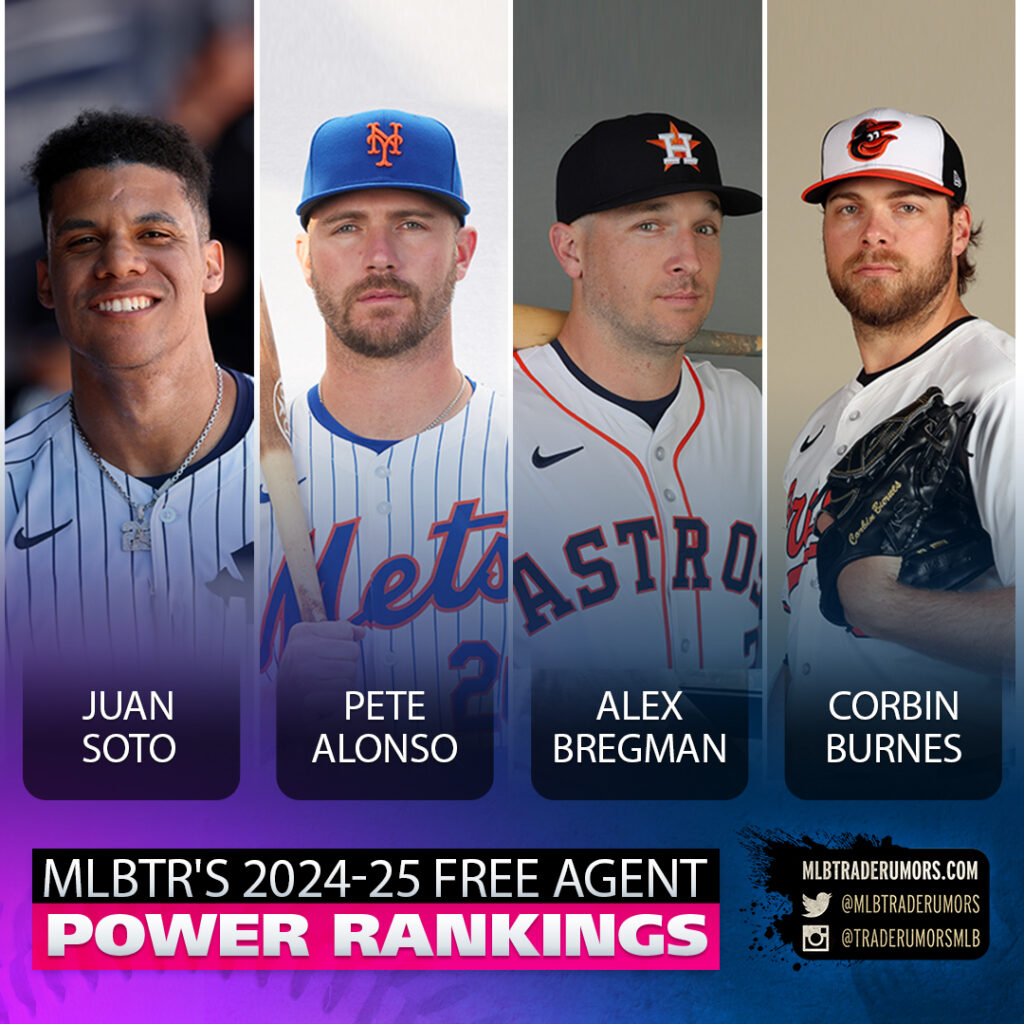
The season is underway, which makes this a good time to look ahead to next winter with the first installment of the 2024-25 MLB Free Agent Power Rankings! It’s an annual series here at MLBTR, wherein we try to rank the upcoming class of free agents by measure of their estimated earning power.
MLBTR will take periodic looks at the top of the class from now through the remainder of the season. Season performance will start to influence these rankings, but two to three weeks into the season, it’s not a huge factor. By the end time the season draws to a close, however, 2024 results will weigh heavily into the rankings. A strong platform year can elevate any player’s status in free agency, just as a poor walk year can tank their stock.
Our power rankings are compiled collaboratively. I worked with colleagues Anthony Franco and Darragh McDonald as well as MLBTR founder and owner Tim Dierkes for the first installment of this year’s rankings. Players with opt-out clauses and player options are included, even if they’ve previously given indications they may forgo the opportunity to return to the market.
Statistics are up-to-date through April 12.
* denotes players who are ineligible for a qualifying offer
1. Juan Soto, OF, Yankees
Were it not for Shohei Ohtani reaching the open market a year sooner, Soto might have a claim to the most coveted free agent ever. Because he skyrocketed through the minor leagues and took MLB by storm beginning at age 19, Soto’s final year of arbitration eligibility comes in just his age-25 campaign. He’ll play the entirety of his first free agent season at 26 years of age. For some context, Aaron Judge — who re-signed on a nine-year, $360MM contract with the Yankees upon reaching free agency — debuted at 24 and had 773 big league plate appearances heading into his own age-26 season.
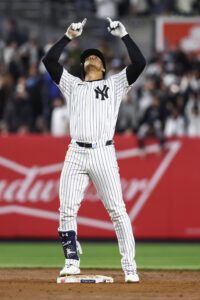
Soto is a freak of nature who was one of MLB’s best hitters at an age when most top prospects are still in college or just entering the low minors. He hit .292/.406/.517 as a teenage rookie in 2018, and his preternatural plate discipline, bat-to-ball skills and raw power have only improved since. Through more than 3400 career plate appearances, Soto has walked at a staggering 18.9% clip and struck out in just 17% of his plate appearances. He entered the current season with 160 home runs, and while he’s never had a 40-homer campaign before, a move to Yankee Stadium and its notorious short porch in right field could help him get to 200 long balls before he turns 26.
Since his 2018 debut, Soto leads qualified big leaguers with a mammoth .422 on-base percentage. Mike Trout‘s .415 mark ranks second, and Freddie Freeman (.402) is the only other hitter north of .400. Soto is “only” 16th in home runs in that time, but his 154 wRC+ — which indicates he’s been 54% better than an average hitter after weighting for home park and league run-scoring environment — is tied with Mookie Betts for fourth-best in baseball, trailing only Trout, Yordan Alvarez and Judge.
If there’s one wart to Soto’s game, it’s that he’s limited to the outfield corners and isn’t regarded as an especially strong defender. He’s had seasons with positive grades from both Defensive Runs Saved and Outs Above Average, but on the whole he has negative marks from both in his career — both in left field and in right field. That said, he’s also only had two truly *bad* seasons per both of those metrics, and taken in totality, he sits around -2 DRS and -4 OAA per season. Obviously, that’s not great, but it’s also not exactly egregious. And given the otherworldly contributions he makes at the plate, playing a slightly below-average left or right field is more than an even trade-off.
Soto famously rejected a 14-year, $440MM extension offer from the Nationals before being traded to the Padres. Rejecting an offer of that magnitude led to plenty of jaws dropping, but when considering that it included his three final arbitration seasons and 11 free agent years, it’s not as jarring as it seems at first blush. Soto wound up earning $71.1MM over those three seasons, meaning he really “only” needs to earn $370MM or so in free agency to come out ahead. There’s already talk of a potential $500MM free-agent deal for Soto. Barring a catastrophic injury, he’ll likely come out ahead in that bet on himself. He’s the clear No. 1 free agent on next year’s market and will be one of the most sought-after free agents not only in baseball history but in all of professional sports.
2. Corbin Burnes, RHP, Orioles
Since his 2020 breakout, Burnes ranks fifth in the majors in innings pitched, eighth in strikeout rate, fourth in K-BB%, second in opponents’ batting average, fifth in ERA, second in FIP and third in SIERA. Put another way — regardless of which metric you prefer to judge pitchers, Burnes ranks in the top-eight in just about any metric. He’s a bona fide No. 1 starter — very arguably one of the five best pitchers the sport has to offer at the moment.
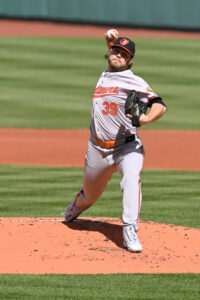
Detractors might point to Burnes’ 2023 numbers as the potential beginning of a decline. His 3.39 ERA, 25.5% strikeout rate and 8.4% walk rate were all more “very good” than elite. Through three starts in Baltimore, he’s trending back in the other direction. Small sample caveats obviously apply, but Burnes has opened his first season with his new club on a tear, tossing 18 2/3 innings of 1.93 ERA ball with a 28.6% strikeout rate and superlative 2.9% walk rate. His velocity is as strong as ever; his devastating cutter is averaging 95.1 mph — an exact match for his career-best mark, set back in 2021 when he won the National League Cy Young Award.
Burnes won’t turn 30 until October. He’s never been on the injured list due to an arm issue. His only IL stints were due to an oblique strain and Covid. Burnes might not be quite as dominant as he was when he was striking out more than 35% of his opponents from 2020-21, but he’s a workhorse ace and former Cy Young winner who still ranks among the game’s elite arms. Gerrit Cole‘s nine-year deal with the Yankees began in his age-29 season. Teams have generally been wary of committing to long-term deals for pitchers that span beyond their age-37 season (though there are exceptions, as evidenced by Jacob deGrom‘s current five-year deal).
Burnes is dominant enough that he could prove to be an exception, but even if he’s limited to eight-year terms, he’ll have a chance at surpassing a $250MM guarantee. With a big enough year, nine years and/or $300MM+ could be on the table.
3. Alex Bregman, 3B, Astros
Bregman would’ve hit free agency in the 2022-23 offseason were it not for a five-year, $100MM extension he signed upon first reaching arbitration. That locked in his first — but very likely not his last — nine-figure contract and still allowed him to hit the open market at a fairly standard point, heading into his age-31 season.
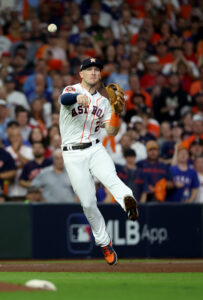
There’s perhaps a perception that Bregman is declining or trending in the wrong direction, as his production has dipped from the MVP-caliber levels he displayed in 2018-19. He also doesn’t have the most appealing batted-ball profile, which we saw work to Cody Bellinger‘s detriment in free agency this offseason. Bregman’s 88.6 mph average exit velocity and 38.2% hard-hit rate in 2023 were both pretty pedestrian marks.
One key difference between Bregman and Bellinger, however, is that Bregman has never had gaudy Statcast numbers — even when he was putting up the type of numbers that led to consecutive All-Star nods and top-five MVP finishes in 2018-19. Bellinger, on the other hand, previously had top-of-the-scale exit velo and hard-hit numbers, leading to more questions about whether his resurgent 2023 showing was truly sustainable.
Bregman has always possessed sensational contact skills. He’s never fanned at higher than a 15.5% clip in a full season. The former No. 2 overall draft pick legitimately possesses one of the best hit tools in all of baseball. He couples that with elite plate discipline, too; Bregman has walked at a 12.6% clip in his career and a 13.7% rate dating back to 2018. He’s walked more than he’s struck out in four individual seasons and in the aggregate from 2018-24. His 41-homer campaign from 2019 looks like a clear outlier in what’s now known as the juiced-ball season, but Bregman still popped 48 homers from 2022-23.
Some may question how much power he can manufacture following a potential change of scenery. Minute Maid Park’s short porch in left field — the Crawford Boxes — seems practically tailor-made for Bregman’s fly-ball heavy, pull-side approach. (Or, perhaps alternatively, he reworked his swing to take advantage of that quirk in his home park.)
There’s little doubting that he’s had some home runs that are Crawford Box specials over the years, but a look at Bregman’s career splits don’t paint the picture of someone who is a product of his hitter-friendly home environment. Bregman’s a career .273/.377/.473 hitter in Houston and a .275/.368/.498 hitter on the road. He’s actually hit nine more homers on the road in his career despite having only 64 more plate appearances away from Minute Maid Park than at home.
Defensively, Bregman isn’t an elite third baseman, but he’s posted average or better marks in DRS and OAA nearly every season of his career. There’s no reason to expect a position change in the near future, but if he does need to move off the hot corner at some point, a shift to second base, left field or first base seems feasible for the former shortstop. And as someone who’s been 36% better than average at the plate in his career — and 25% better dating back to 2020 — he has more than enough bat to profile as a regular anywhere on the diamond.
A seven- or eight-year deal seems plausible in free agency, and there’s always the chance that a luxury-paying team will gauge his interest in a longer-term deal with a non-premium AAV in order to tamp down the CBT hit. A deal north of $200MM seems plausible for Bregman. The Astros have said at multiple points in the past they’ll make an extension offer at some point, but there haven’t been serious talks on that front yet and Bregman can justifiably seek the type of long-term pact that owner Jim Crane has completely avoided over the years.
4. Pete Alonso, 1B, Mets
The Polar Bear is raw personified, bashing 40-plus homers on the regular since his 2019 debut. Alonso has not only established himself as one of baseball’s premier sluggers — he’s done so while maintaining a strikeout rate that’s lower than the league average. At a time when many prodigious sluggers are comfortable selling out for power, Alonso has the type of easy, plus-plus power that doesn’t require him to do so. He’s fanned in just 20.7% of his plate appearances dating back to 2021 and popped the fifth-most long balls in baseball along the way. He trails only Aaron Judge, Matt Olson, Kyle Schwarber and Shohei Ohtani in that span. All four of those sluggers have whiffed at higher rates than Alonso.
Alonso’s extreme fly-ball approach does lead to a glut of pop-ups and some low BABIPs — though last year’s bottom-of-the-barrel .205 average on balls in play (and .217 average overall) were likely outliers. He’s a career .250 hitter who walks at around a 10% clip — enough to boost his OBP into the .340 range most seasons. Paired with his prodigious power, that’s plenty to make Alonso one of the most feared hitters in the National League.
After debuting as a 24-year-old back in 2019, Alonso is on pace to hit the open market heading into his age-30 season. He’s not unusually young like Soto but is reaching free agency at the same point that’s seen plenty of sluggers get paid. He’ll be two years younger than Freddie Freeman and Paul Goldschmidt were when signing their current contracts (Freeman’s in free agency, Goldschmidt’s as an extension). That pair of contracts pays those star first basemen $26-27MM annually.
Alonso isn’t as good a pure hitter as either Freeman or Goldschmidt, nor is he the same defensively. He’s consistently graded out as a sub-par defender, per OAA, and a roughly average first baseman by measure of DRS. But Alonso is younger, has more power than either of those two former MVPs, and has the benefit of Mets owner Steve Cohen likely being extra-motivated to keep his franchise slugger. It wouldn’t be at all surprising to see Alonso follow a similar path to Judge. That’s not to say he’ll sign a $360MM deal — he won’t — but he could reject a qualifying offer, explore what the market has to offer, and then take the top offer back to the Mets and effectively ask that they match it.
A six-year deal would run through Alonso’s age-35 season. Seven years would take him through age-36. Either of those terms feels plausible, as does an AAV in the vicinity of — or even slightly in excess of — the Freeman and Goldschmidt deals.
5. Blake Snell, LHP, Giants*
Will the second time prove to be a charm for Snell? The $200MM+ contract he sought in free agency this past winter never materialized, likely due to a confluence of factors. Beyond the sheer scope of his ask, Snell hit free agency at a time when roughly half the league was experiencing uncertainty regarding its long-term television status. We’re also slated for a record number of CBT payors, including several big spenders — Yankees, Dodgers, Mets — currently paying a 110% tax that made a long-term deal for Snell wholly unpalatable. Further yet, recent high-profile spenders like the Padres, Rangers, Red Sox, Blue Jays and Mets all took steps back in terms of their aggression.
None of that even touches on Snell’s command troubles, though his penchant for issuing free passes hasn’t stopped him from dominating opposing lineups over the past several seasons. Snell is now a two-time Cy Young winner — one of just 22 in MLB history — who’ll spend the 2024 season pitching in an even more spacious home park than he enjoyed in San Diego.
Snell will turn 32 in the coming offseason, so he won’t have age on his side. But he already rejected a qualifying offer from the Padres, meaning he’s ineligible to receive another one at any point in his career. That lack of draft pick compensation will be a bonus, and it’s possible next offseason’s market will bear more favorable circumstances. If the Mets, Red Sox, Rangers or Padres begin spending again and if even a couple of CBT payors are suddenly in position to dip back under the threshold, Snell could find more suitors this time around.
He’s not a lock to hit the market, of course. Snell’s two-year $62MM deal with the Giants allows him to opt out at season’s end, leaving a $30MM player option on the table. So long as he remains healthy and effective, he’ll be a lock to do so. The left-hander ranks 11th in ERA (3.05) and seventh in strikeout rate (31.7%) among qualified big league starters dating back to the 2018 season. He’s had a couple rough seasons along the way, but the broader body of work is genuinely excellent.
As previously mentioned, teams are typically wary of committing beyond a starting pitcher’s age-37 season. For Snell, hitting the market at 32, that’d make it tough to secure a contract lengthier than six years. A six-year deal checking in at $28MM or more would allow Snell to still claim that he topped $200MM in free agent earnings (when combined with his current $32MM in earnings). That type of offer seemingly wasn’t there this time around, but if Snell turns in a third straight dominant season — he had a 2.72 ERA and 31.7% strikeout rate in 2022-23 — someone’s likely going to pony up with a big offer.
6. Max Fried, LHP, Braves
Few starters in baseball have been as consistent as Fried on a year-to-year basis. The former No. 7 overall draft pick has turned in a sub-3.00 ERA in three of the past four seasons, with the lone exception being a 3.04 mark in 2021. Fried’s strikeout rate has fallen between 22.3% and 25.7% for five straight seasons. His walk rates in that time have landed between 4.4% and 8.5% (though that 8.5% came in 2020’s short season and is something of an outlier, he’s been under 7% in every other full season). His ground-ball rate sits between 51.2% and 57.7% each year.
Fried isn’t an overpowering ace in the sense that he hits triple digits with his heater and strikes out a third of his opponents. He has above-average but not elite velocity, leading to average or slightly better strikeout rates. However, Fried has plus command and ground-ball tendencies, and he dodges hard contact at consistently excellent levels.
Prior to the 2023 season, Fried was also quite durable, ranking 19th in the majors in innings pitched and 21st in games started. That doesn’t include his 10 postseason starts (and four relief outings) — a total of 58 2/3 additional innings. A forearm strain suffered in early May last year, however, knocked Fried out of action for about three months. Though he was characteristically excellent when health — 2.55 ERA, 3.14 FIP, 3.38 SIERA — Fried was limited to 14 starts and 77 2/3 innings.
Proving that forearm strain is behind him will be paramount to his free agent platform. Another 30-plus starts won’t completely eliminate any trepidation stemming from last year’s injury, but another season with considerable missed time — particularly due to an arm injury of any nature — would create cause for clear concern.
Fried has been more durable than Carlos Rodon (six years, $162MM with the Yankees) and has a far lengthier track record of success. He and his reps will likely take aim at toppling that mark in free agency. Braves fans would surely like to see an extension, but it hasn’t happened in the past, and Fried is plenty justified in asking for the type of long-term deal and semi-premium AAV that the Braves have steered clear of in recent years. He seems likelier to follow Freddie Freeman and Dansby Swanson out the door than he does to receive an extension offer that’s commensurate with his market value.
7. Cody Bellinger, OF/1B, Cubs*
Bellinger didn’t get the mega-deal he sought this past offseason. Excellent as his 2023 campaign was, there were surely teams wary of his woeful 2021-22 showing on the heels of shoulder surgery. Beyond that, his exit velocity, hard-hit rate and other batted-ball metrics were decidedly pedestrian.
Agent Scott Boras has pointed to Bellinger’s massive decline in strikeout rate as a factor, painting his client as a hitter who adopted a two-strike approach more focused on putting the ball in play than on doing massive damage. There’s surely a blend of truth and garden-variety agent spin woven into that defense.
A repeat of his 2023 production — or anything close to it — would strengthen Bellinger’s case immensely. It’d further distance him from that awful 2021-22 showing, lending further credence to the notion that injuries played a significant role in his perceived decline. And whether Bellinger replicates his numbers by returning to his maximum-damage approach or simply proves that his newer brand of more well-rounded, low-strikeout offense is sustainable, either approach should prove lucrative.
Even though an opt-out would trigger Bellinger’s third trip to free agency, he’ll still be heading into just his age-29 season next year. He can still play a fine center field (or corner outfield, presumably) and remains a good option at first base as well. There’s plenty of defensive and baserunning value to supplement his bat.
Bellinger will pocket $30MM in the first season of his three-year, $80MM deal with the Cubs, meaning he’ll be opting out from two years and $50MM. That seems likely, barring a 2021-22-esque collapse or a massive injury. Because of his age, that immense long-term deal that eluded him this past offseason still feels plausible. That he can no longer be saddled with a qualifying offer — players can only receive one in their career, and he rejected one last offseason — only strengthens his case.
8. Willy Adames, SS, Brewers
Adames joins Javier Baez, Trevor Story and Dansby Swanson as the latest in a line of high-end shortstops to reach free agency heading into his age-29 season. That trio signed for respective guarantees of $140MM (Tigers), $140MM (Red Sox) and $177MM (Cubs). Adames doesn’t have the individual accolades that group possesses. He’s never been an All-Star like each of that trio has. He hasn’t won Gold Gloves like Swanson and Baez. He hasn’t won the Silver Sluggers that Story has.
Yet despite the lack of hardware, Adames has a strong claim to be valued in similar fashion. It’s true that he had a down year at the plate in 2023, but that was in part driven by a career-low .250 average on balls in play. Since 2020, Adames is a .240/.316/.450 hitter. He’s been 8% better than average overall, by measure of wRC+, and he peaked with a 121 wRC+ (21% better than average) from 2020-21. Adames fanned at a sky-high 36.1% back in 2020 but has reduced that mark considerably; over his past 1300 plate appearances he’s punched out at a worse-than-average but far more manageable 26.2% rate. He struggled badly against lefties early in his career (despite being a right-handed hitter) but has improved against them in recent seasons.
From 2021-23, Adames averaged 26.67 homers per season — topping out at 31 round-trippers in 2022. He’s walked at an above-average but not elite 9.4% rate in his career — including a personal-best 11.1% in 2023. Adames has long been touted as having plus defensive tools, but his execution and consistency were lackluster early on, leading to some middling grades. Over the past two seasons he’s been outstanding, tallying 17 DRS and a flat-out elite 26 OAA.
If Adames can bounce back from last year’s .217/.310/.407 line and turn in something closer to the .251/.319/.471 slash he logged from 2020-22, he’ll have an easy case to be paid comparably to Story, Baez and Swanson. He’s likely to hit the market on the heels of four straight 20-homer campaigns. He’s a plus defender. He’s relatively young. He’s not the most consistent hitter on a year-over-year basis, but that was true of Baez, Story and Swanson. They all got paid. Adames will also draw bonus points for his gregarious personality and leadership skills. Both the Rays and Brewers have lauded him in that regard, and the primary reason Tampa Bay traded him — Wander Franco‘s looming emergence — now looks regrettable (even if getting Drew Rasmussen in return for him has yielded plenty of value).
9. Ha-Seong Kim, SS/2B, Padres
Kim came to MLB with great fanfare as a 25-year-old KBO superstar who’d been posted by the Kiwoom Heroes. He signed a four-year, $28MM deal with San Diego that contains a mutual option for a fifth season. Mutual options are generally accounting measures and are almost never exercised by both parties. In Kim’s instance, it’s a no-brainer to decline his end of the option and hit free agency in search of a deal that could pay him three to four times his original MLB guarantee.
While Kim’s rookie season didn’t live up to the hype, he’s since acclimated to MLB quite nicely. Now 28, he posted a .256/.338/.391 batting line (109 wRC+) from 2022-23. His power has increased in each MLB season, resulting in a career-high 17 homers last year, and he swiped a hefty 38 bases in 47 tries for the Friars last season. Kim’s walk rate has climbed every MLB season as well, topping out at a robust 12% in 2023, and after fanning in 23.8% of his plate appearances as a rookie he’s dropped that mark to 18.5% in 2022-23.
Decent power, strong on-base skills and plus speed give Kim plenty of appeal, but his glove is perhaps his greatest selling point. Kim is an elite defensive infielder capable of handling any of second base, shortstop or third base. He won his first Gold Glove for his play at second base last season, though that’s unlikely to be his last. (He also won a Gold Glove in his final three seasons of KBO play.)
There’s no defensive metric that pegs Kim below average at any of those three positions. He’s logged more than 1000 innings at second base, nearly 600 at third base and more than 1600 at shortstop. Defensive Runs Saved, Outs Above Average and Ultimate Zone Rating agree that he’s excellent at all three. The Padres signed Xander Bogaerts to an 11-year contract and moved him to second base just one year later despite Bogaerts posting decent numbers at short in 2023. Kim has racked up 23 DRS and 10 OAA in his 1600+ innings at shortstop. He has fluid infield actions, sure hands and is a regular source of highlight-reel defense.
Kim doesn’t have a strong batted-ball profile, but it’s not out of the question that he could crack 20 homers, walk in more than 10% of his plate appearances, swipe 40 bags and play Gold Glove defense this season. He’ll play all of the 2025 season at 29 years old. A nine-figure contract isn’t out of the question.
10. Jordan Montgomery, LHP, Diamondbacks
As the old adage goes, if at first you don’t succeed — hire a new agent and try again. Montgomery languished in free agency all winter, never landing the six- or seven-year contract he was seeking. He took a one-year, $25MM deal with the D-backs that’ll afford him a player option at $20-25MM basically just for staying healthy. The contract wasn’t finalized before Opening Day, meaning Montgomery can’t receive a qualifying offer this winter. Barring a major injury, he’ll likely decline that player option and return to the market.
Montgomery, 31, has made at least 30 starts in each of the past three seasons. In that time, he’s pitched 524 1/3 innings of 3.48 ERA ball with a 22.5% strikeout rate, a 6.2% walk rate, a 44.5% ground-ball rate and just 1.00 HR/9. His 2023 campaign was the finest of his career, featuring a personal-best 188 2/3 innings of 3.20 ERA ball, plus another 31 innings of 2.90 ERA ball in the postseason — a strong performance that helped push the Rangers to their first-ever World Series title.
Though he doesn’t miss bats at an elite level, Montgomery is better than average in just about every meaningful category for starting pitchers and has been a workhorse since his 2020 return from Tommy John surgery. We at MLBTR erred in thinking a six-year deal was attainable heading into the 2023-24 offseason. Another typical Montgomery season could put him in position for a strong four-year or perhaps a five-year deal at a lighter AAV than we predicted last offseason. He should be able to top teammate Eduardo Rodriguez‘s four-year, $80MM contract — and a deal in the $100-110MM range over five years doesn’t feel out of reach if Monty continues at his recent trajectory.
Honorable Mentions (listed alphabetically): Walker Buehler, Matt Chapman*, Gerrit Cole^, Jack Flaherty, Paul Goldschmidt, Teoscar Hernandez, Rhys Hoskins, Frankie Montas, Tyler O’Neill, Luis Severino, Max Scherzer*, Gleyber Torres, Justin Verlander*, Christian Walker
^=Cole is currently on the 60-day IL and expected to be out into June. He can opt out of the remaining four years and $144MM on his contract at season’s end, though if he signals his intent to do so, the Yankees can override his opt-out by tacking on a tenth year at another $36MM. Because Cole is currently injured and because the Yankees can effectively veto his opt-out, we’re not including him on the initial version of our rankings. If, as the season wears on, he’s pitching well enough to trigger that opt-out and there’s talk of the Yankees allowing him to walk, he could land on future installments of the list.
White Sox, Tommy Pham Agree To Minor League Contract
April 15: MLB.com’s Juan Toribio reports (on X) that the Sox and Pham have indeed reached an agreement. The veteran outfielder will be guaranteed a $3MM base salary for time spent in the majors and can earn an additional $1.5MM in performance bonuses. Pham would be able to request his release if he’s not called to the majors by April 25, tweets Rosenthal. There’s a $500K assignment bonus if Pham gets traded, per Rosenthal.
April 14: The White Sox and Tommy Pham are close to an agreement on a minor league deal, The Athletic’s Ken Rosenthal reports. The non-guaranteed nature of the contract is something of a technicality due to the fact that Pham is out of minor league options. Since Pham will need some time to properly ramp up to the regular season, starting him in the minors gives the White Sox more flexibility to call him up whenever he is ready.
The Padres, Pirates, and Diamondbacks were all linked to Pham at various points during the offseason, and 10 teams reportedly checked in on the veteran outfielder early in November. The White Sox were also known to be interested in Pham’s services, as USA Today’s Bob Nightengale first noted just under a month ago. However, Opening Day came and went without Pham finding a new contract, and Rosenthal notes that Chicago might have been motivated to finally close a deal after losing Eloy Jimenez, Yoan Moncada, and Luis Robert Jr. to the injured list.
Assuming that a deal is finalized and Pham reaches the active roster as planned, the White Sox will be the eighth different team the outfielder has played for over what will be an 11th Major League season. While his production has been inconsistent over the last four of those seasons, Pham hit well just last year, batting .256/.328/.446 over 481 combined plate appearances with the Mets and Diamondbacks. He also ran hot-and-cold during Arizona’s playoff run, but Pham had huge performances for the D’Backs in the NLDS and in the World Series.
Pham turned 36 last month, and some off-the-field issues have perhaps contributed to his semi-journeyman status despite generally solid numbers over the years. That said, Pham was one of many veteran free agents who remained on the market for a long time, and ended up signing for much less than expected. This cold market impacted not just some of the bigger names available (Blake Snell, Cody Bellinger, Jordan Montgomery, etc.), but perhaps hit hardest for more mid-tier players like Pham.
As Brandon Belt described things in a recent interview, interested teams seemed to universally view him as a backup plan this winter, and it is fair to wonder if the same applied to Pham. If other teams found other outfielders, or (perhaps more importantly) outfielders willing to play for lesser salaries, it left fewer and fewer opportunities for Pham to land a suitor. Rosenthal notes that Pham was “waiting for an offer he felt was commensurate with his value,” so price seems to have been a factor.
It could be that Pham’s time in Chicago ends up being pretty short, since if he hits well, he’ll undoubtedly get a lot of attention from contenders at the trade deadline. The White Sox already look like sellers after a dreadful 2-13 start to the season, and moving a short-term veteran bat like Pham could be just one of many trades GM Chris Getz could make before the deadline is over.
Until then, Pham could just slide into a regular role as the right-handed hitting complement to Andrew Benintendi in left field, or with Gavin Sheets at DH. Chicago signed Robbie Grossman to a minors deal in late March and Grossman has already become essentially an everyday player in either corner outfield slot, so Pham could also eat into that playing time.
Spencer Strider Undergoes Season-Ending Internal Brace Surgery
Spencer Strider‘s season is over, as the Braves announced that the right-hander underwent an internal brace surgery on Friday. It was revealed last week that Strider has suffered some UCL damage, and while a brace surgery is somewhat less serious than the worst-case scenario of another Tommy John surgery, the 25-year-old ace will still miss the remainder of the 2024 campaign.
This marks the second major injury absence of Strider’s career, as he already had a TJ procedure in 2019 when he was still pitching at Clemson. Returning to pitch only 12 innings during the 2020 NCAA season that was interrupted by the pandemic, Strider still got selected in the abbreviated five-round 2020 draft, as Atlanta’s decision to take the righty in the fourth round quickly looked like a steal.
Strider performed so well in his first taste of pro ball that he rocketed through the Braves’ farm system and made his MLB debut in October 2021. Strider hasn’t been back to the minors since, as he moved into Atlanta’s rotation in 2022 and quickly established himself as a frontline arm. Over 318 1/3 innings in 2022-23, Strider posted a 3.36 ERA, an eight percent walk rate, and a whopping 37.4% strikeout rate. This performance earned him runner-up in NL Rookie of the Year voting in 2022, an All-Star selection and a fourth-place finish in NL Cy Young Award voting in 2023, and a six-year, $75MM contract extension in October 2022 that cemented Strider as one of Atlanta’s cornerstones.
Unfortunately, Strider’s career will now be put on hold for the next year. Exactly when he’ll return in 2025 is somewhat fluid, as internal brace surgeries are still relatively new enough that the recovery timeline isn’t quite as established as the 13-15 months normally associated to Tommy John rehabs. In general, the shorter timeline for brace surgeries means that Strider could be back in Atlanta’s rotation by Opening Day 2025. (For more on the topic, The Athletic’s Cody Stavenhagen recently wrote a piece detailing the differences between brace procedures, Tommy John surgeries, and UCL revision surgeries.)
Every pitcher’s arm is different, of course, and it is possible Strider’s timeline could be extended because this is already his second UCL-related surgery. The fact that his current UCL damage wasn’t so severe that a full Tommy John surgery was necessary is at least some kind of silver lining, so if all goes well, Strider should be able to cut several months off his rehab.
That fact doesn’t much help a Braves team that is aiming to win the 2024 World Series, and losing Strider is naturally a big hit to these championship aspirations. The remaining starting four of Max Fried, Charlie Morton, Chris Sale, and Reynaldo Lopez is still pretty strong, as Lopez has in particular looked great in his return to a starter’s role. If Lopez can keep up anything close to this form and Sale can remain healthy and effective, the Braves have enough starting pitching depth on paper to perhaps cover for Strider’s absence.
Allan Winans got the start in Strider’s place on Thursday with very shaky (six ER in five innings) results, and Darius Vines has since been called up for what will probably be a longer look in the rotation. Vines made his MLB debut in 2023 with a 3.98 ERA over 20 1/3 innings, and even if Vines isn’t quite ready for prime time, the Braves can turn to Bryce Elder, Dylan Dodd, Huascar Ynoa, AJ Smith-Shawver, Winans, and others down at Triple-A.
Since all of this group are on the 40-man roster and have minor league options remaining, Atlanta could run something of a revolving door through the fifth spot in the rotation, unless someone pitches well enough to seize the job entirely. Given all of these starter candidates on hand, president of baseball operations Alex Anthopoulos might not feel the need to pursue pitching at the deadline, though obviously much can change between now and the end of July. The Braves’ mighty lineup carried the team to 104 wins in 2023 despite several rotation injuries, even if the hope this season was that a healthier pitching staff would be the final piece to carry the team to its second World Series title in four years.
Daniel Bard To Undergo Season-Ending Flexor Tendon Surgery
6:24pm: Bard told the Colorado beat that he’ll rehab from the surgery before deciding next year whether he wants to continue his playing career (X link via Patrick Saunders of the Denver Post).
5:05pm: Rockies right-hander Daniel Bard will require surgery on the flexor tendon in his throwing arm and will miss the rest of the season. Thomas Harding of MLB.com was among those to relay the news. Bard is already on the 15-day injured list after undergoing an arthroscopic knee procedure in February but he’ll now be destined for the 60-day IL whenever the Rockies need his roster spot for someone else.
It’s an incredibly unfortunate development for both the pitcher and the team. Bard, 39 in June, is in the second season of a two-year, $19MM extension he signed with the Rockies, a pact that looks increasingly regrettable. Bard saw his previous anxiety and control problems return last year as he walked 21.1% of batters faced and saw his earned run average balloon to 4.56. He’ll now be on the shelf for the entire second half of that deal.
Hindsight is 20/20, of course, but there were reasons that contract was eyebrow-raising even at the time. Bard pitched for the Red Sox from 2009 to 2013 and looked like a dominant reliever at times before a case of the yips sent him out into the wilderness. He walked 15.5% of batters faced in 2012 then only tossed one inning in the majors in 2013.
From 2014 to 2017, he settled for minor league deals with the Cardinals, Mets and Rangers but the control problems followed him to all those stops. Over that period, he logged 13 innings on the farm but walked a massive 44.7% of batters faced and posted 24.23 ERA.
He signed a minor league deal with the Rockies prior to 2020 and was able to mount an incredible comeback. He got back to the big leagues with Colorado and posted a 3.65 ERA over his 23 appearances, keeping his walk rate down to 9.4% while striking out 25.5% of opponents. His ERA ticked up to 5.21 in 2021 but he dropped it all the way to 1.79 the year after. In that 2022 season, he struck out 28.2% of batters faced, walked 10.2% of them and got grounders on 51.7% of balls in play. He also did that in high-leverage situations, racking up 34 saves for Colorado.
It was right around that year’s trade deadline that the Rockies signed Bard to the aforementioned extension. Given Bard’s volatile career and the fact he was a 37-year-old impending free agent on a non-competitive club, there was an argument for the Rockies to put him on the trading block and grab whatever young talent they could. Instead, they doubled down on their relationship with Bard by extending it for another two seasons. But as mentioned, his struggles returned last year and now 2024 will go down as a total loss. Once transferred to the 60-day IL, he’ll spend the rest of the year there and become a free agent again this coming winter.
Ohtani’s Former Interpreter Charged With Bank Fraud Due To Theft Of Over $16MM
April 12: Mizuhara surrendered to federal authorities this morning, per Alden González of ESPN. González adds that Mizuhara is scheduled to appear in court at 1:00 p.m. Pacific, or 3:00 p.m. Central, with the expected outcome of being let out on bond at some point.
April 11: U.S. attorney Martin Estrada announced today that Shohei Ohtani’s former interpreter Ippei Mizuhara has been charged with bank fraud to finance a “voracious appetite for illegal sports betting,” per Sam Blum of The Athletic. Mizuhara is alleged to have transferred more than $16MM from Ohtani’s account to an illegal sports book, per Alden González of ESPN. The full 37-page complaint against Mizuhara was relayed by Meghann Cuniff of The Washington Post.
Per Blum, Estrada says the account was set up by Mizuhara in 2018 and he began illegal gambling in 2021. “The bets do not appear to have been made on the sport of baseball,” Estrada says. “At this point Mr. Ohtani is considered a victim in this case,” Estrada added, per Fabian Ardaya of The Athletic. “Mr. Mizuhara lied to the bank to access the account … lied to them about being Mr. Ohtani,” Estrada also said, per Bill Shaikin of the Los Angeles Times. When Mizuhara won a bet, the winnings would go into his own account and not Ohtani’s, per Blum. Estrada says investigators have viewed text messages from Mizuhara where he admitted to stealing from Ohtani, as relayed by Ardaya.
Last month, ESPN reported that more than $4.5MM had been wired from an account in Ohtani’s name to a sports gambling ring in California, where betting on sports is illegal. Mizuhara initially told ESPN that he was the one who racked up the debt but that Ohtani wired the money to help him pay it off. He later retracted that story and said Ohtani knew nothing about the gambling or the wire transfers. Ohtani later spoke on the matter, accusing Mizuhara of stealing money from him and lying about it, saying that he didn’t find out any of the details until the reporting had come out.
Both Mizuhara and Ohtani have said that Ohtani did not place any bets. Mizuhara has said that he did not bet on baseball and there’s not yet been any reporting to contradict that. As relayed by Jayson Stark of The Athletic, Mizuhara is alleged to have made about 19,000 wagers from December of 2021 to January of 2024, winning $142.27MM but losing $182.94MM for a net loss of $40.7MM.
It was reported last night that Mizuhara was in negotiations with federal authorities about pleading guilty. As part of that reporting, it was relayed that prosecutors had evidence Mizuhara disabled notifications that Ohtani would have received from his bank about transactions. The details from today go even farther, alleging that Mizuhara called the bank and impersonated Ohtani to access funds, per Britt Ghiroli of The Athletic. He answered security questions related to Ohtani’s biographical information to wire funds to a bookmaker, saying it was for a car loan. Per Shaikin, Ohtani’s agent repeatedly asked about the account but Mizuhara told him it was “private” and that Ohtani didn’t want anyone else to monitor it.
Shaikin relays a text message exchange between Mizuhara and a bookmaker where he admits to the theft: “Technically I did steal from him. it’s all over for me.” The maximum penalty for these charges is 30 years, per Shaikin. Mizuhara will appear in federal court in the coming days, per Blum. Ohtani has cooperated fully in the investigation, per Shaikin, including providing access to digital devices.
MLB issued a statement on the matter, per Jesse Rogers of ESPN and others: “We are aware of the charges filed by the U.S. Attorney’s Office against Mr. Mizuhara for bank fraud after a thorough federal investigation. According to that investigation, Shohei Ohtani is considered a victim of fraud and there is no evidence that he authorized betting with an illegal bookmaker. Further, the investigation did not find any betting on baseball by Mr. Mizuhara. Given the information disclosed today, and other information we have already collected, we will wait until resolution of the criminal proceeding to determine whether further investigation is warranted.” MLB’s Department of Investigations (DOI) opened an investigation into the matter last month after the initial reports came out.
Jeferson Quero To Undergo Season-Ending Shoulder Surgery
Brewers general manager Matt Arnold informed reporters, including Adam McCalvy of MLB.com, that catching prospect Jeferson Quero will undergo surgery for a torn labrum. The recovery time is expected to be nine months, which obviously ends the season for the young backstop.
It was reported last week that Quero, 21, had been diagnosed with a subluxation in his right shoulder. The club didn’t make the next steps known at that time as they were planning to get a second opinion, but it now seems that a determination has been made with surgery required for Quero.
It’s an unfortunate development for the Brewers, both in the short term and in the long term. In the short term, it will put a notable dent in the club’s catching depth. Quero was added to the club”s 40-man roster in November to keep him out of the Rule 5 draft and he was sent to Triple-A to start this year.
The Brewers have William Contreras and Gary Sánchez handling the catching duties at the big league level but Quero could have been in line for his big league debut this year if an injury arose to either of those two. Instead, Quero is the one who is injured, subtracting that option from the club this year. Eric Haase and Francisco Mejia are in Triple-A as non-roster depth options and one of those two will likely be the first up if another catcher is needed at the big league level.
In the long term, it’s an unfortunate loss of a development year for a notable young player in the system. Quero was a consensus top 50 prospect in the league coming into the year and is currently listed #35 in the league by Baseball America, #41 at FanGraphs, #33 at MLB Pipeline, #32 at ESPN and was all the way up at #12 on the list of Keith Law of The Athletic.
Long considered a strong defensive catcher, Quero hit well in the lower levels of the minors but without much power. Over 2021 and 2022, he hit .290/.357/.448 but with just 12 home runs in 488 plate appearances as he climbed to High-A. Last year, he was sent to Double-A and hit 16 homers in just 381 plate appearances while walking in 10% of his plate appearances and striking out just 17.8% of the time. He slashed .262/.339/.440 for a wRC+ of 107 despite being just 20 years old.
That strong showing vaulted him up prospect lists and seemed to have him in place to be pushing for a major league debut, perhaps as soon as this year. But after just one plate appearance at the Triple-A level this year, he suffered this injury and will have to sit out the remainder of the campaign. Quero is still young and will have plenty of time to get back on track but it’s obviously less than ideal for a young player to miss an entire year of reps as he is trying to grow as a player.
Since Quero was in the minor leagues when he suffered his injury, he’ll be placed on the minor league injured list. The Brewers could recall him and place him on the major league injured list if they want to open a 40-man roster spot, but doing so would start Quero’s service time clock.
Yoán Moncada To Miss Three To Six Months Due To Adductor Strain
The White Sox announced that third baseman Yoán Moncada has been placed on the 10-day injured list due to a left adductor strain, with outfielder Oscar Colás recalled in a corresponding move. The club estimates that Moncada will miss three to six months.
Moncada, 29 in May, has been playing through this injury of late. Manager Pedro Grifol said yesterday, per Henry Palattella of MLB.com, that the issue has been nagging Moncada for three or four days but “He’s doing a really good job maintaining it.” That line of thinking blew up last night when Moncada collapsed while running out a groundout and had to be assisted off the field. In hindsight, it looks to have been a poor decision for him to have stayed on the field.
He has occasionally been an excellent player for the White Sox on both sides of the ball, providing strong defense at the hot corner and a quality bat at the plate. He showed that form as recently as the 2021 season when he hit 14 home runs and drew a walk in 13.6% of his plate appearances. His .263/.375/.412 batting line led to a wRC+ of 120 and his glovework earned three Defensive Runs Saved and Outs Above Average considered him to be right at league par.
But injuries have largely gotten in the way since then. He has gone on the IL due to a right oblique strain, a right hamstring strain, a left hamstring strain and lingering lower back issues over 2022 and 2023 and now this left adductor strain has him on the injured list again. He’s played just 207 games since the end of 2021 and has hit .236/.292/.387 in that time for a wRC+ of 88.
He is in the final guaranteed year of the extension he signed with the club prior to 2020, a pact worth $70MM over five years, which would have made him a potential trade candidate on a rebuilding White Sox club this summer. His continued struggles would have tamped down his trade value, especially as he’s making $24MM this year, but this most recent injury may keep him on the IL past the deadline.
It’s now possible that Moncada has played his last game as a member of the White Sox. His contract has a $25MM option for 2025 but the Sox are almost certainly leaning towards the $5MM buyout at this point. If this injury pushes towards the longer end of that projected timeframe, he may not be able to make it back to the club by the end of the season.
In the short term, the outlook will become increasingly grim for the 2024 White Sox. They weren’t expected to compete this year after kicking off a rebuild last season, but it’s still not pretty to see them limp out to a 2-9 start. Some of their most established players have already hit the injured list, with Luis Robert Jr. facing a significant absence due to a Grade 2 hip flexor strain. Eloy Jiménez is on the IL due to an adductor strain and now Moncada joins him with the same ailment.
With Moncada out and the Sox not bringing up another infielder, it’s unclear how they plan to cover Moncada’s absence. They have been using three infielders to cover the two middle infield spots, with Braden Shewmake, Paul DeJong and Nicky Lopez in that rotation. Neither Shewmake nor DeJong have third base experience, but Lopez does. Lenyn Sosa is also on the roster and has experience at the three infield spots to the left of first base. Danny Mendick and Zach Remillard are in Triple-A, each in a non-roster capacity, though Moncada’s injury means he’s destined to be moved to the 60-day IL as part of a future transaction.
Red Sox Extend Ceddanne Rafaela
April 10: The Red Sox have announced Rafaela’s extension. It’s an eight-year deal covering the 2024-31 seasons and also contains a previously unreported club option for a ninth season in 2032.
Alex Speier of the Boston Globe reports the annual breakdown. Rafaela receives a $2MM signing bonus before earning salaries of $1MM in 2024, $1MM in 2025, $2MM in 2026, $3.5MM in 2027, $5.5MM in 2028, $7.5MM in 2029, $10.5MM in 2030 and $13MM in 2031. The club option is valued at $16MM and comes with a $4MM buyout.
April 8: The Red Sox have agreed to an extension with outfielder/second baseman Ceddanne Rafaela, reports Chris Cotillo of MassLive.com. It’s an eight-year, $50MM pact for the MVP Sports Group client, per Mark Feinsand of MLB.com (as relayed by Ian Browne of MLB.com). Rafaela is the second young, core player the team has locked up in the past few weeks; Boston also signed righty Brayan Bello to a six-year, $55MM deal in late March.
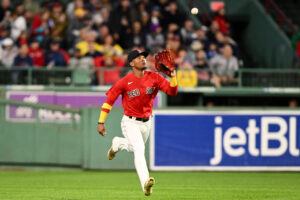
Rafaela, 23, has ranked among the game’s top 100 prospects entering each of the past two seasons. He made his big league debut in 2023 won the center field job in Boston with a strong spring showing in 2024. Through his first 124 big league plate appearances, Rafaela is a .239/.282/.389 hitter, though his minor league track record features far more promising numbers. Rafaela split the majority of the 2023 campaign between Double-A and Triple-A, where he logged a combined .302/.349/.520 slash with 20 homers, 31 doubles, three triples and 36 stolen bases (in 49 tries).
Listed at just 5’9″ and 152 pounds, Rafaela is small in stature but certainly not short on talent. Scouting reports laud him as a potential plus center fielder; Baseball America and MLB.com both call him a Gold Glove-caliber defender there, and The Athletic’s Keith Law wrote that Rafaela “has a chance to be the most valuable outfield defender in baseball” when ranking him 32nd among all MLB prospects this spring. Rafaela couples that defensive upside with plus speed and enough power to project for double-digit home runs in the big leagues, even if he’s more of a gap hitter than a true slugger.
While Rafaela struck out as a generally manageable 21% clip in the upper minors last season, he doesn’t have a particularly patient approach at the plate. He walked in just 5.4% of his plate appearances last season — his second straight minor league campaign with a walk rate around 5%. He’s drawn a free pass in just 4.8% of his big league plate appearances to date. Barring an evolution in his approach at the dish, Rafaela could post middling on-base percentages in the majors, but his defensive prowess, speed and power contributions should offset any potential OBP deficiency.
As shown in MLBTR’s Contract Tracker, the pre-arbitration extensions for Rafalea and Bello mark a notable change in philosophy from a Red Sox club that has eschewed long-term deals for players who are relatively unproven in the big leagues. From 2012 through 2021, the Red Sox didn’t give out a single pre-arb extension. Their 2022 deal with righty Garrett Whitlock (four years, $18.75MM with two club options) was their first extension for a player prior to arbitration eligibility since Clay Buchholz way back in 2011.
The Sox haven’t shied away from extensions entirely, but long-term deals for Rafael Devers, Xander Bogaerts, Chris Sale and Rick Porcello were far more expensive deals that came after those players had solidified themselves as big leaguers worth annual values of $20MM or more. Even the original Bogaerts deal, which was considered wildly club-friendly, was valued at six years and $120MM.
Perhaps the eventual loss of Bogaerts, coupled with high-profile departures of Mookie Betts, Jon Lester and others over the years, pushed Sox ownership to become more aggressive on early-career extensions. Maybe they’ve become increasingly dissatisfied with pricey free-agent deals that haven’t gone to plan (e.g. Trevor Story, David Price, Lucas Giolito). Or perhaps they simply looked at the rising price for young talent around the league and opted to become more proactive. Whatever the reason, they’re beginning to lock up some promising and affordable contributors to join Devers in comprising the long-term core.
Rafaela is just one of several extension candidates on the Red Sox, and with two deals now hammered out, it seems increasingly plausible others could yet follow. Most notably, first baseman Triston Casas and righty Tanner Houck have both spoken about their openness to extensions. Other pre-arb players who could feasibly be considered for long-term deals include left fielder Jarren Duran and righty Kutter Crawford.
Orioles To Promote Jackson Holliday
MLB’s top prospect is set to make his debut. ESPN’s Jeff Passan reports (X link) that the O’s plan to call up Jackson Holliday. The team has yet to announce the move.
Holliday, the #1 overall pick in 2022, has destroyed minor league pitching. Despite being a high school draftee, he reaches the majors after just a year and a half in the minor leagues. The lefty-hitting infielder traversed four levels in his first full professional season. Holliday raked at a .323/.442/.499 clip over 581 plate appearances last season. He spent the majority of that time between High-A and Double-A but made it to the top minor league level late in the year.
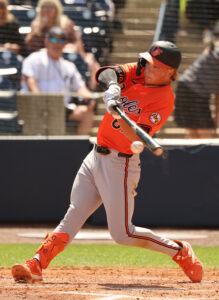
That meteoric rise made it seem that the Oklahoma native had a real chance to break camp. That didn’t happen, as Baltimore reassigned Holliday back to Triple-A Norfolk late in Spring Training. The 20-year-old has opened the year on a tear as part of a loaded Tides lineup. He’d collected 13 hits (including four doubles and a pair of home runs) with 11 walks and eight strikeouts over his first nine games.
The son of seven-time All-Star Matt Holliday, Jackson owns an excellent .321/.452/.497 batting line through 154 minor league games. In addition to his stellar offensive track record, he offers plenty of defensive value as an above-average or better middle infielder. Holliday has primarily played shortstop in the minors, but the O’s used him mostly at second base in Spring Training. Seven of his nine starts in Norfolk this year have come at the keystone, where he seems likely to break into the big leagues.
Holliday’s well-rounded profile has made him an essentially unanimous choice as the game’s best minor league talent. It’s the third straight season in which the O’s entered the year with a player whom most evaluators consider the sport’s top prospect. Holliday will now join Adley Rutschman, Gunnar Henderson and plenty more talented young players at Camden Yards. He should pair with Henderson in what has the chance to be a franchise-defining middle infield.
Baltimore has relied on Jordan Westburg — himself a former first-round pick and highly-regarded prospect — as their primary second baseman in the early going. The Mississippi State product has started slowly, hitting .195/.242/.355 through his first nine games. Westburg could slide over to third base if the O’s want to keep him in the everyday lineup. Ramón Urías and Tony Kemp, each of whom is on the roster as a multi-positional infielder, have struggled (albeit in exceedingly small samples). Westburg still has options remaining and could theoretically be sent back to Norfolk; the Orioles would need to designate Urías or Kemp for assignment to take either player off the big league club.
The O’s will likely reveal the corresponding move tomorrow. Holliday is not yet on the 40-man roster, but Baltimore has two vacancies. Unless they DFA a player who can’t be optioned, they’ll only need to clear active roster space. Whatever the transaction, Holliday will step into the lineup on an everyday basis.
The timing of the promotion surely isn’t coincidental. By calling Holliday up before the end of this week, the O’s are still in position to afford him a full year of service time. A player is credited with a full service year if they’re on an MLB roster or injured list for at least 172 days. Despite his two-week stint in the minors, Holliday will narrowly surpass that mark if he’s in the majors for good.
Promoting a top prospect just before the cutoff for a full service year would’ve been unlikely under the previous collective bargaining agreement. It was more common to see teams hold down their top talents until a bit past that date to secure an extra year of contractual control. The 2022-26 CBA introduced the Prospect Promotion Incentive to reduce the temptation for teams to keep their best young players in the minor leagues.
The PPI allows the Orioles to potentially win a draft choice if Holliday hits the ground running. A top position player prospect who accrues a full service year as a rookie (even if he’s not on the Opening Day roster) would earn his team an extra pick after the first round if he wins Rookie of the Year or finishes in the top three in MVP voting during his pre-arbitration seasons. Holliday still meets that criteria. The O’s already earned an extra pick in the 2024 draft when Henderson won Rookie of the Year last season. If Holliday also pulls off that feat (or hits the more difficult MVP finish within his first three years), Baltimore would get another pick.
Had the Orioles waited beyond this week to promote Holliday, they’d have forfeited the chance at the PPI selection. Keeping him in Triple-A for another few days would’ve prevented him from reaching a full year of service through the traditional method, but a top prospect can also “earn” a full service year with a top-two finish in Rookie of the Year balloting regardless of when he was promoted. If the O’s called Holliday up in May, for instance, he could have played his way to a full service year through his ROY finish without netting the organization the extra pick. That played out in 2022, when Rutschman finished second in AL Rookie of the Year voting despite being called up in late May.
There’s an argument that the Orioles should simply have carried Holliday on the Opening Day roster. GM Mike Elias pointed to the youngster’s limited experience at second base and facing left-handed pitching as reasons for starting him in Norfolk. A combination of Holliday’s torrid start there and middling production from their MLB infielders led the front office to reverse course rather quickly.
If Holliday is in the majors for good, he’d first reach arbitration after the 2026 season. He’d be under team control through the ’29 campaign. Any future assignments to the minor leagues could push that trajectory back, but the O’s and their fans are surely hopeful that won’t be necessary now that Holliday is getting his first look at big league arms.
Image courtesy of USA Today Sports.
Framber Valdez Scratched From Start Due To Elbow Soreness
Astros left-hander Framber Valdez was scratched from today’s start due to soreness on the top of his left elbow after playing catch, with Chandler Rome of The Athletic among those to relay the news. While the club is in Arlington to face the Rangers, Valdez is in Houston to meet with team doctors, manager Joe Espada said.
At this point, it’s not yet clear how significant the injury is and Valdez has not yet been placed on the injured list, but it’s nonetheless a concerning development for a number of reasons. For one thing, there has been an unfortunate streak of pitching injuries of late, with stars like Shane Bieber and Eury Pérez recently requiring season-ending surgeries. Another big name, Spencer Strider, is still trying to discover the severity of his injury but there is concern that he could be set to go under the knife as well. Guys like Shohei Ohtani, Jacob deGrom, Sandy Alcántara, Robbie Ray, Shane McClanahan and many more are each recovery from undergoing surgery last year.
The litany of injuries has led to a recent dispute between the MLBPA and the league, with the players concerned about the effects of the pitch clock while the league believes increased velocity and spin in the modern game are to blame. It’s still not clear that Valdez is going to be following those other pitchers to a significant surgery, with both Espada and general manager Dana Brown downplaying the concern, per Rome. But the fact that another star player is dealing with a possible elbow injury could only add to the ongoing tension.
Beyond the league-wide implications, it’s also a scary development for the Astros, as Valdez has emerged as a huge part of the club’s success in recent years. He has a 3.17 earned run average in 617 innings dating back to the start of the 2020 season. He struck out 23.8% of batters faced in that time, walking just 8% of them while keeping the ball on the ground at a massive 62.8% clip.
Subtracting that kind of quality performance would hurt any rotation but it would be especially noteworthy for the Astros at this moment in time. They are already without Lance McCullers Jr. and Luis Garcia Jr., both of whom underwent elbow surgery last year and each is still working back to health. More recently, each of Justin Verlander, José Urquidy and Shawn Dubin landed on the injured list due to injuries. Verlander is getting close to a return, having begun a rehab assignment over the weekend, but it’s clearly a less than ideal time for another domino to fall so they will obviously be hoping that Valdez isn’t seriously hurt. For now, Blair Henley has been called up to make a start while Cristian Javier, Hunter Brown, J.P. France and Ronel Blanco fill out the rest of the rotation.
For Valdez personally, he’s in his penultimate season of club control, currently slated for free agency after 2025. In the worst-case scenario where he requires Tommy John surgery and misses over a year, it would mean that he would be heading into the open market with hardly any innings pitched in the two seasons prior to becoming a free agent.
It’s worth reiterating that none of that has come to pass yet and Valdez is not even on the injured list. Still, even this small update of some soreness clearly has the potential to set off some ripple effects if it turns to be something serious, given the potential impacts on the Astros, on Valdez himself and the tumultuous situation between MLB and the MLBPA.