
Cardinals Sign Dustin May
December 17th: The Cards officially announced May’s signing today. May will make $12.5MM in 2026 and the mutual option is worth $20MM, per Passan. It’s a $12MM salary and a $500K buyout on the option, per Jeff Jones of the Belleville News-Democrat.
December 13th: The Cardinals are expected to sign right-hander Dustin May, reports Jeff Passan of ESPN. It’s a one-year deal with a mutual option for 2027. May spent last season split between the Dodgers and Red Sox.
May was sent to Boston at the trade deadline for James Tibbs and Zach Ehrhard. After scuffling through 19 appearances with L.A., he battled injuries and poor performance with the Red Sox. May set career highs in innings (132 1/3) and games (25) last season, but posted an unsightly 4.96 ERA with an xFIP and SIERA in the mid-4.00s.
St. Louis was in desperate need of rotation depth after trading Sonny Gray to Boston and watching Miles Mikolas hit free agency. The club also lost swingman Steven Matz, who signed with Tampa Bay. May is set to join holdovers Andre Pallante and Michael McGreevy in the rotation. May’s former teammate on the Red Sox, Richard Fitts, will likely be in the mix after coming over in the Gray trade. The Cardinals are considering converting Kyle Leahy into a starter to round out the staff.
The Dodgers spent a third-round pick on May in 2016. He emerged as one of the top pitching prospects in a system typically stocked with elite arms. May made his MLB debut in 2019, working largely out of the bullpen. He spent the majority of the shortened 2020 campaign in the rotation, making 10 starts. It would be the only time he would reach double-digit starts until this past season. Injuries capped May to just 20 games from 2021 to 2023. He missed all of 2024 due to flexor tendon surgery.
May stayed healthy for the first time in 2025, making 19 appearances for the Dodgers. He stumbled to a 4.85 ERA over 104 innings. Despite the performance, May still netted LA an intriguing prospect in Tibbs, a first-round pick in 2024 (by San Francisco). The veteran righty made just six appearances with the Red Sox before right elbow neuritis cut his season short.
The Cardinals are betting on May pairing the flashes of solid production he’s shown in prior seasons with the improved health from 2025. The 28-year-old recorded a sub-3.00 ERA in 2020, 2022, and 2023, albeit in abbreviated campaigns. While he did go down with the elbow issue in September, he still destroyed his previous career bests in terms of workload. May had totaled 101 innings over four seasons before putting up 132 1/3 frames last year. It was the first time in his six-year career that May showed the ability to stay on the mound for any kind of extended stretch.
May has a perplexing pitching profile. He has a GIF-worthy arsenal headlined by a high-spin sweeper and a fastball in the mid to upper-90s. Oddly, the repertoire hasn’t generated whiffs or strikeouts for much of his career. May spiked a 37.6% strikeout rate over five games in 2021, but he’s been at best an average strikeout pitcher in every other season. He posted a middling 21.1% mark between L.A. and Boston last year. May has a modest 8.8% swinging-strike rate for his career. None of his five pitches has a standout whiff rate.
Jon Heyman of the New York Post was first to report that the contract was for one year. MassLive.com’s Chris Cotillo was first to note the deal included a club option for 2027.
Photo courtesy of Paul Rutherford, Imagn Images
Royals Sign Lane Thomas
December 17th: The Royals have officially announced their signing of Thomas.
December 11th: The Royals and outfielder Lane Thomas are reportedly in agreement on a one-year contract. The Wasserman client receives $5.25MM with another $1MM available via incentives. Kansas City has a couple of open 40-man spots and won’t need to make a corresponding move once the deal is official.
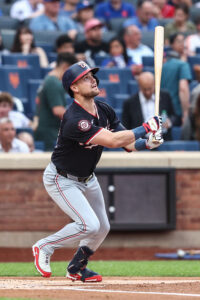
Thomas and the Royals will be looking for a bounceback season, as he just suffered through an injury-marred 2025 campaign with Cleveland. Early in the season, he missed about a month due to a right wrist bone bruise. In the latter months of the season, he went on the injured list a couple of times due to plantar fasciitis in his right foot. He required surgery in September with a projected recovery time of three to four months. Around those IL stints, he got into 39 games and hit just .160/.246/.272.
Prior to that, he had a solid run as a decent regular in the bigs, suiting up for the Cardinals, Nationals and Guardians. From 2021 to 2024, he got into 510 contests, hitting 67 home runs and stealing 66 bases. He produced a .248/.313/.426 line over that four-year span, which translated to a 103 wRC+, indicating he was 3% better than league average.
He was slightly better in the second half of that stretch. Over 2023 and 2024, he hit 43 home runs and stole 52 bases. His combined .255/.312/.439 line in those two seasons translated to a 105 wRC+. FanGraphs credited him with 4.3 wins above replacement, a bit better than two wins per year.
His defense has been more of a question mark. Outs Above Average has given him a minus-16 ranking for his career, but oddly considered him league average in center and subpar in the corners. Defensive Runs Saved has put a minus-18 mark on him, but most of that due to an odd minus-13 grade in 2024 alone.
He clearly has some wheels, as his sprint speed has been ranked in the 93rd percentile or above since he became a regular. With a bit of pop in the bat as well, he has been able to engineer some decent results when healthy.
The Royals have been struggling for years to get production from their outfield. In 2025, they got a collective .225/.285/.348 line from the grass. That resulted in a 73 wRC+, the worst such mark of any team in the majors.
Obviously, upgrading the outfield was going to be a priority this winter. It was recently reported that the club would be looking to add one outfielder via trade and another via free agency, with a right-handed hitter who can play center field being a specific target. The Royals currently project to have an outfield consisting of Jac Caglianone, Kyle Isbel and John Rave. All three hit from the left side. Caglianone was a top prospect coming into 2025 but he didn’t hit at all in his first 232 plate appearances in the big leagues. Rave has just 175 big league plate appearances without much success either. Isbel has more experience but is a glove-first center fielder. They picked up Kameron Misner, another lefty, from the Rays in a trade a few weeks ago.
Thomas has pretty strong platoon splits in his career. He has been punched out in 28.2% of his plate appearances against righties with a .220/.287/.383 line and 84 wRC+. With the platoon advantage, his strikeout rate drops to 19.3%. He has a .292/.359/.500 line against southpaws for a 135 wRC+.
The Royals shouldn’t be done adding to their outfield. As mentioned, they have been looking to make two additions. This at least gives them a short-side platoon guy who can be slotted into any of the three outfield positions, while also perhaps coming off the bench for pinch-running opportunities. His health may be a bit of a question mark with the aforementioned surgery, but the estimated timeline should allow him to be healed up by spring training.
It’s a modest free agent add but the Royals apparently didn’t have much to spend. Owner John Sherman said a couple of months ago that the 2026 payroll would likely be similar to what they had in 2025. RosterResource currently projects them for a $139MM payroll in 2026. That’s already above where they finished in 2025, before even adding Thomas onto the ledger. Perhaps the next move will come on the trade market. There have been plenty of rumors suggesting the club may be looking to deal from its starting depth in order to get another bat.
Will Sammon of The Athletic first reported the Royals were signing Thomas. Mark Feinsand of MLB.com had the $5.25MM guarantee and $1MM in bonuses.
Photos courtesy of David Richard, Wendell Cruz, Imagn Images
Tigers Sign Kenley Jansen
December 17th: The Tigers officially announced Jansen’s signing today. It’s a $9MM salary with a $2MM buyout on a $12MM club option for 2027.
December 13th: The Tigers have agreed to a one-year contract with veteran closer Kenley Jansen, ESPN’s Jeff Passan reports. The deal pays Jansen $11MM, as per USA Today’s Bob Nightengale, and The Athletic’s Cody Stavenhagen adds that the contract contains a club option on Jansen’s services for the 2027 season. Earlier today, MassLive.com’s Chris Cotillo reported that the two sides were “deep in talks” and heading towards the final stages of a deal. Jansen is represented by the Wasserman Agency.
Will Vest is coming off a strong season as Detroit’s primary saves candidate, but Vest will now move back into a high-leverage setup role to accommodate one of baseball’s most experienced closers. Jansen has 476 career saves, and is just three saves away from passing Lee Smith for third place on the all-time list. It certainly seems possible that Jansen can reach the 500-save plateau this season, though catching Trevor Hoffman (601 saves) for the second-highest total in history doesn’t seem possible unless Jansen reaches his goal of pitching until at least through the 2029 season.
For now, however, the 38-year-old Jansen has a one-year commitment from Detroit, with the 2027 option representing a possible continuation into the right-hander’s age-39 campaign. The Tigers entered the offseason looking to reinforce their bullpen, and the team has signed Jansen and re-signed Kyle Finnegan just within the last week. Jansen’s deal probably takes the Tigers out of the running for another target in former Rays closer Pete Fairbanks.
Even after 16 Major League seasons, Jansen still has some gas in the tank, as evidenced by his 2.59 ERA over 59 innings with the Angels in 2025. However, his secondary metrics left something to be desired, as Jansen’s 24.4% strikeout rate and 44.6% hard-hit ball rate were both easily the worst of his career. A .195 BABIP and 85.2% strand rate helped Jansen’s bottom-line numbers remain in check, though his 3.94 SIERA was much higher than his actual ERA.
Jansen did post better numbers as the 2025 season went on, and the Tigers themselves were responsible for a big chunk of the damage on the righty’s ERA. (Of the 17 earned runs charged to Jansen in 2025, Detroit scored six of them in an ugly meltdown for Jansen back on May 2 in a 9-1 Tigers win over the Angels.) The stronger finish to the season provides some hope that Jansen can more fully get on track next year, and he might also be energized by again pitching for a contender after a year with the struggling Halos.
For a team that has thrived on “bullpen chaos” over the last couple of seasons, the Tigers will now move in a different direction by installing a true closer in place for the ninth inning. If Jansen can come close to his 2025 production, that’s a nice plus for the team, as Vest’s move to a set-up role will strengthen things all the way down the depth chart.
More bullpen moves may still be coming, as between Finnegan and Jansen’s 2025 numbers, the Tigers still haven’t solved their primary goal of adding more punchout power to their bullpen. Detroit had the second-lowest bullpen strikeout rate (20.1%) of any team in baseball in 2025, ahead of only the lowly Rockies.
Twins Introduce New Minority Owners; Tom Pohlad Named Team’s New Control Person
Several months after the Pohlad family reversed course on its bid to sell the Twins, instead revealing the forthcoming addition of new minority owners, the Twins have formally announced a trio of new minority stakeholders in the organization — all of whom have been formally approved by Major League Baseball. Craig Leipold, owner of the NHL’s Minnesota Wild; George G. Hicks, founder of Minnesota-based investment firm Varde Partners; and Glick Family Investors are the team’s new limited partners.
The Pohlad family will retain majority ownership of the Twins, but there’s still changes on that front. Joe Pohlad, the team’s executive chair, is ceding oversight of the organization to older brother Tom Pohlad. Per the Twins’ press release, Tom will oversee the organization’s operations and will also succeed his uncle, Jim Pohlad, as the team’s official control person and liaison to the league.
Joe Pohlad had only taken over the executive chair role and day-to-day oversight of the franchise in November of 2022. He called his short time as the team’s executive chair “one of the greatest responsibilities and privileges of my life” before adding that he is “stepping away from my day-to-day role.”
Details of the sale weren’t disclosed by the team, but Dan Hayes of The Athletic reports that the Pohlad family sold more than 20% of the franchise at a valuation of $1.75 billion. The addition of the new minority stakeholders has helped to substantially clear a reported debt of nearly $500MM. Wiping that debt clean could aid the Pohlad family in any subsequent efforts to sell the franchise down the road. It’s not clear at this time whether the family will eventually revisit the idea of selling the team, however.
Back in July, the Twins sold off a stunning 11 players, including the final three-plus seasons of Carlos Correa‘s $200MM contract. Minnesota will pay $10MM of his $33MM salary in each of the next three seasons, but that trade alone trimmed more than $70MM off the books. Trades of Jhoan Duran, Griffin Jax and Danny Coulombe trimmed a few million from the 2025 payroll and also eliminated the need to commit notable arbitration raises to Duran and Jax this winter. Naturally, that fire sale left the Twins with a gutted roster — specifically in the bullpen — and plenty of speculation about continuing that teardown in the offseason.
Instead, it seems the cash infusion from this slate of limited partners has prompted ownership to provide the front office with some modest spending power. They plan to hang onto stars Byron Buxton, Pablo Lopez and Joe Ryan. This week’s signing of veteran first baseman Josh Bell only further supports the notion that there’s room to add to the 2026 roster and take aim at contending in a perennially weak American League Central.
While the Twins aren’t going to return to the $140-155MM payrolls they trotted out from 2023-25, they should have somewhere around $15MM or so (based on prior reporting from Hayes) to add to the budget after adding Bell. Solidifying a patchwork bullpen figures to be the primary focus, but Minnesota could also pursue bench upgrades or another power bat to plug into the mix.
Diamondbacks Showing Interest In Alex Bregman
The D-Backs are among the teams that have expressed interest in Alex Bregman, as Bob Nightengale of USA Today was among those to report. Arizona seems to be a long shot to spend at this level but has a vacancy at third base.
Bregman is known to be a priority for the Red Sox. He opted out of his three-year deal with Boston after hitting .273/.360/.462 over 495 plate appearances. He made his third All-Star team despite suffering a quad strain that sidelined him between late May and the middle of July. That’s a testament to the strength of his first half. Bregman slashed .298/.380/.546 with 11 home runs over 53 games before the Break. His numbers dropped in the second half, as he hit .250/.341/.386 in his final 261 trips to the plate.
While Bregman’s power dropped late in the season, he showed his typically excellent plate discipline. He walked more often than he struck out even in his less impressive final few months. Bregman narrowly established a career mark with a 44.4% hard contact rate and remained the above-average hitter he was throughout his time in Houston. He’s no longer an MVP contender as he was at his 2018-19 peak, but Bregman is an annual threat for 25 homers with a .360 on-base percentage. He remains an above-average defensive third baseman and is revered for his clubhouse presence.
The D-Backs don’t have a clear answer at the hot corner. They traded Eugenio Suárez at the deadline. That theoretically opened the position for top prospect Jordan Lawlar, but his performance down the stretch was concerning. Lawlar hit .182 without a home run in 74 plate appearances. He also committed four errors (three on bad throws) over 76 innings. The D-Backs didn’t trust him defensively and limited him to mostly DH work in September until they’d been eliminated from playoff contention.
Lawlar came up as a shortstop but isn’t going to play there on a team with Geraldo Perdomo. He doesn’t have a path to second base playing time right now, though the D-Backs have fielded plenty of calls on Ketel Marte. They could give Lawlar a look in the outfield or dangle him as a trade chip for a young starter. For now, the likeliest course of action is to keep him at third base and hope that they can iron out his throwing woes in Spring Training.
It’d be very surprising to see Bregman wind up in the desert. The D-Backs are prioritizing the rotation even after agreeing to bring back Merrill Kelly on a two-year contract. Owner Ken Kendrick has already said payroll will come down from the approximate $195MM mark at which they opened the ’25 season.
RosterResource projects them for a $171MM payroll next season, so they’d either need to make an exception for Bregman or offload money in a trade. (They’d save $15MM in 2026 if they trade Marte for players making the league minimum.) The Diamondbacks are only one offseason removed from pulling off a free agent shocker, as almost no one saw them signing Corbin Burnes — who, like Bregman, is a client of the Boras Corporation — to a $210MM contract before it happened.
Burnes, who lives in Arizona, signed with the Diamondbacks largely because of family considerations. Bregman is a New Mexico native who grew up as a Diamondbacks fan, notes Nick Piecoro of The Arizona Republic. As Piecoro points out, the D-Backs (under the previous front office) had an opportunity to draft Bregman with the first pick in 2015. They went with Dansby Swanson instead, allowing the Astros to grab Bregman at #2 overall.
Mets Sign Jorge Polanco
December 16th: The Mets have now officially announced the Polanco deal.
December 13th: The Mets and free agent infielder Jorge Polanco have agreed to a two-year contract, The Athletic’s Will Sammon reports (multiple links). The deal is worth $40MM, according to ESPN’s Jeff Passan. Polanco is represented by the Octagon Agency.
It’s a big strike for a Mets team that lost Pete Alonso and Edwin Diaz to free agency just within the last week, not to mention last month’s trade that sent another longtime Met in Brandon Nimmo to Texas. New York acquired Marcus Semien in the Nimmo deal, and while Polanco also has a long history of playing second base, Passan writes that the Mets will deploy Polanco primarily as a first baseman and DH. Polanco could also potentially chip in at third base, though it looks as it the Mets view Polanco a piece of the puzzle in replacing Alonso at first base.
The 32-year-old Polanco hit .265/.326/.495 with 26 home runs over 524 plate appearances for the Mariners last season, playing a huge role for a Seattle team that won the AL West and fell just short of reaching the World Series. It was a fine bounce-back performance for Polanco after a down year in 2024, which still resulted in a one-year guarantee to return to the Mariners in 2025. That deal paid Polanco $7.75MM in guaranteed money, and he made enough plate appearances to turn an $8MM mutual option for 2026 into a $6MM player option, and Polanco unsurprisingly rejected that player option to re-enter the market after his much improved platform year.
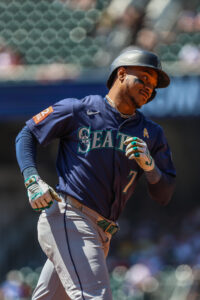
The 132 wRC+ Polanco posted in 2025 was the highest of his career, and he drastically cut back on his strikeouts after seeing his K% balloon in each of the previous four seasons. While Polanco walked less than usual, his 45.8% hard-hit ball rate was a career best. Overall, the advanced metrics suggest that Polanco’s resurgence in 2025 was legitimate, and if anything, his .269 BABIP indicates that he perhaps deserved even better numbers.
One concern within Polanco’s otherwise strong year was that he made 89 appearances as a designated hitter, after amassing only 45 DH days over his 11 previous big league seasons. Polanco sustained an oblique injury early in the 2025 season that wasn’t quite serious enough to merit a trip to the injured list, but the Mariners compensated by using Polanco less frequently in the field, and cut back on the switch-hitter’s usage against left-handed pitching.
While there hasn’t been any concern that Polanco will be similarly limited going forward, the Mets’ plan to use him as a first baseman may also reflect Polanco’s age, his modest defensive numbers as a second or third baseman, and the fact that a stellar fielder like Semien is already in place at the keystone. Throughout his long pro career, Polanco has made exactly one career appearance as a first baseman, and it was just a late-game cameo for a single at-bat in Seattle’s 5-4 loss to the Giants last April 6.
Polanco is an experienced enough infielder that the Mets obviously feel he’ll be able to learn the position in due course. For all of Alonso’s pluses at the plate, he was a poor enough fielder that Polanco will be a defensive upgrade even if he’s just an average first baseman. Because the DH spot is open and because Polanco could also be utilized at third base, this signing also doesn’t necessarily close the door on the Mets’ chances of signing other known targets like Cody Bellinger or even a more first base-specific player like the Cardinals’ Willson Contreras.
Between losing both Alonso and Nimmo, the Mets’ offense has taken a hit by essentially replacing the duo with Polanco and Semien, given how Semien struggled in 2025. Run prevention has been a stated goal for Mets president of operations David Stearns, and upgrading the defense is another way of making the lineup better, even if the team will still need to add some more pop as the offseason develops.
MLB Trade Rumors ranked Polanco 23rd on our list of the offseason’s top 50 free agents, and projected a three-year, $42MM deal for the veteran. Polanco ended up just about matching that dollar figure on a two-year deal, as he opted for the higher average annual value rather than the extra security of the three-plus years he was seeking in his next deal.
The shorter term lines Polanco up for another free agent bid when he’s 34, and some continued production could line him up for another lucrative shorter-term pact. Stearns is known to prefer shorter-term commitments for free agents, so this also aligns with the PBO’s ideal method of roster-building.
The Pirates and Red Sox were known to have interest in Polanco this winter, and the infielder was also drawing a lot of attention from the Mariners about a possible reunion. Adam Jude of the Seattle Times hears from a source that the Mariners’ last offer to Polanco was also a two-year contract, and was “very competitive” price-wise with the Mets’ $40MM offer.
Seattle achieved its top offseason priority of re-signing Josh Naylor, and the team’s plan was then to explore Polanco and Eugenio Suarez as candidates to return. With Polanco now in Queens, the Mariners could turn to Suarez as a DH candidate and part-time third baseman, or explore some other infield options on the free agent or trade fronts. With plenty of internal candidates for third base, the M’s have been primarily looking at second basemen during their infield pursuits this winter.
Inset picture courtesy of Jordan Godfree — Imagn Images
Royals Sign Maikel Garcia To Extension
The Royals signed infielder Maikel Garcia to a five-year extension with a club option for a sixth season. The Wasserman client is reportedly guaranteed $57.5MM with an additional $10MM in escalators.
Garcia receives a $1MM signing bonus, half of which will be paid this offseason. He’ll receive the other $500K in January 2027 regardless of whether there’s a work stoppage. Garcia’s salaries are as follows: $4MM in 2026, $7MM in ’27, $10.1MM in ’28, $13.1MM in ’29 and $19.1MM in 2030. He’s guaranteed a $3.2MM buyout on the option, which is valued at $21MM.
He could push his 2030 and ’31 salaries (if the option is exercised) by up to $5MM annually. They’d each jump $4MM if he finishes in the top 10 in MVP twice in the previous seasons. His 2030 salary would climb $1MM if he reached 525 plate appearances in two of the first four seasons of the deal, while the option value would jump by $1MM if he has four seasons of 525+ PAs within the five guaranteed years.
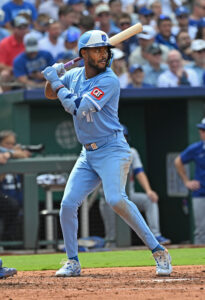
Garcia, who’ll turn 26 in March, had previously been under club control through 2029 but will now be on a guaranteed contract through 2030. Between that 2030 season and the 2031 club option, Kansas City is picking up control over two would-be free-agent seasons. Garcia was arbitration-eligible for the first time this offseason. MLBTR contributor Matt Swartz projected a $4.8MM salary on the heels of a breakout showing in 2025. As a Super Two player, Garcia would have been arb-eligible four times and thus due three more raises in subsequent seasons.
Though Garcia has been a regular with the Royals for three seasons now, the 2025 campaign was the first in which he provided any real value with the bat. He was a valuable player in 2023-24, but that was primarily due to plus speed (combined 60 steals) and quality defense at multiple infield positions.
The 2025 campaign brought a full-fledged breakout. After batting just .249/.300/.344 in 1141 plate appearances from ’23-’24, Garcia erupted with a .286/.351/.449 showing in a career-high 666 plate appearances. He posted career-best tallies in home runs (16) and doubles (39), tied a career-high with five triples, swiped another 23 bags and notched career-best walk and strikeout rates of 9.3% and 12.6%, respectively.
Garcia continued on as a plus, versatile defender this past season. He spent the bulk of his time at third base but also appeared at second base, shortstop and in center field. Third base has been his most frequent and best position, evidenced both by superlative defensive grades (15 Defensive Runs Saved, 18 Outs Above Average in 1144 innings) and the first of what could very well end up being multiple Gold Glove Awards.
Garcia profiles as the Royals’ long-term option at third base. With shortstop Bobby Witt Jr. also signed long-term, Kansas City should have an outstanding left side of the infield, on both sides of the ball, for the better part of the next half decade. It’s always possible that Garcia slides to a different position somewhere down the road, but the Royals tendered Jonathan India a contract this offseason and plan to deploy him regularly at second base after using him at multiple positions in 2025.
That left-side infield duo of Garcia and Witt will now be the Royals’ only players signed beyond the 2027 season, though right-handers Seth Lugo and Michael Wacha can be retained via club options. Kansas City also controls lefty Cole Ragans and first baseman Vinnie Pasquantino — another extension candidate — through the 2028 season. Team captain and franchise icon Salvador Perez is signed through 2027 and seems likely to continue re-signing in Kansas City until he opts to retire. That could increasingly be as a designated hitter, given the emergence of top catching prospect Carter Jensen (with fellow backstop Blake Mitchell not far behind him).
Between his previously projected $4.8MM salary in 2026 and what would have been three arbitration raises, it’s reasonable to think that Garcia’s four arbitration seasons might’ve cost somewhere in the vicinity of $35-40MM. That’s obviously just a rough approximation, but the extension seemingly values the free agent year around $17-22MM, depending on how bullish one is on Garcia’s earning power in free agency. In a best-case scenario, Garcia could have topped $40MM in earnings and hit free agency ahead of his age-30 campaign.
The Royals are clearly buying into him as a perennially productive regular, and if that proves to be the case, they’ll be rewarded handsomely with an extension that could play out like a bargain. For Garcia, this type of contract would’ve been unfathomable just nine months ago. As is the case in any extension scenario, it’s possible he could’ve earned more going year-to-year and reaching free agency at a younger age. However, it’s plenty understandable that a player who signed for under $100K as a 16-year-old back in 2016 and had well below-average offensive output in his first two MLB seasons would jump at the opportunity to lock in a deal that guarantees nearly $60MM and could top $80MM if that option is picked up.
ESPN’s Jeff Passan first reported the Royals were signing Garcia to a five-year extension with a club option. Anne Rogers of MLB.com had the $57.5MM guarantee with a max value around $85MM. Ronald Blum of The Associated Press had the salary/escalator breakdown.
Rays Sign Steven Matz
December 16th: The Rays have now officially announced the Matz signing. Outfielder Tristan Peters has been designated for assignment as the corresponding move. Per Marc Topkin of the Tampa Bay Times, it is indeed a $15MM guarantee, with a $7.5MM salary in each year. There’s also a $500K assignment bonus if he’s traded.
December 9th: The deal is for $7.5MM per year, according to Brittany Ghiroli and Ken Rosenthal of The Athletic. Unless there are other factors such as bonuses or options, it seems to be a $15MM guarantee.
December 8th: The Rays are reportedly in agreement with free agent left-hander Steven Matz on a two-year contract. The signing is pending a physical, and salary terms for the VC Sports Group client have yet to be reported. Marc Topkin of The Tampa Bay Times first reported the sides were closing in on what was likely to be a two-year contract. The Rays’ 40-man roster is full, so they’ll need to designate someone for assignment once the contract is finalized.
Matz spent the 2025 season working out of the bullpen. The 11-year big league veteran split the season between the Cardinals and Red Sox. He combined for 76 2/3 innings of 3.05 ERA ball. Matz has a long background as a starter and worked in a swing role with St. Louis as recently as 2024. He could compete for a rotation spot or work multiple innings out of Kevin Cash’s bullpen.
The 34-year-old just wrapped up a four-year, $44MM free agent deal that he’d signed with St. Louis. That didn’t go as the Cardinals planned. Matz had a difficult time staying healthy. He missed most of the 2022 season to a shoulder impingement. A lat strain shelved him in the second half of the following season, and a lower back injury wiped out much of 2024.

Matz combined for just 197 1/3 innings over the first three seasons. He posted a 4.47 ERA with an average 21.9% strikeout percentage. The Cards only gave him a pair of spot starts this year. He still frequently worked into a second inning out of the bullpen but wasn’t tasked with as significant a workload. Matz managed to stay healthy and turned in arguably his best season since 2021.
Over his first 55 innings, the southpaw turned in a 3.44 earned run average while striking out 20.7% of batters faced. The Cards dealt him to Boston at the deadline. His already middling strikeout rate dropped another six points with the Red Sox, though he managed to outperform his peripherals with a 2.08 ERA through 21 2/3 innings. Matz ranked among the bottom 10 relievers (minimum 50 innings) with a 7.8% swinging strike rate. He succeeded with excellent control, issuing walks at a career-low 3.6% clip. He pitched particularly well as a specialist, holding left-handed batters to a .211/.242/.341 batting line in 129 plate appearances.
Tampa Bay has a pair of power lefty relievers in Garrett Cleavinger and Mason Montgomery. Cleavinger is quietly one of the best in the game. Montgomery has the stuff to be an impact arm in his own right, but his control remains a significant question. He still has a pair of minor league options and can bounce between Tampa Bay and Triple-A Durham. Matz provides a different look as a control specialist but has decent velocity, averaging 94.5 MPH on his sinker.
There’s a decent amount of uncertainty in the rotation behind Drew Rasmussen and Ryan Pepiot. The Rays have Shane McClanahan and Shane Baz lined up for spots. McClanahan will be on an innings limit after consecutive missed seasons. Baz was inconsistent and is at least a theoretical trade candidate. Ian Seymour is probably the in-house favorite to work as the fifth starter, but Tampa Bay is likely to add a veteran innings eater or two. It remains to be seen if the Rays will give Matz an opportunity to compete for a back-end rotation job.
Image courtesy of Vincent Carchietta, Imagn Images.
Pirates Sign Gregory Soto
December 16th: The Bucs have officially announced the Soto signing.
December 9th: Another reliever has come off the board. The Pirates are reportedly in agreement with left-hander Gregory Soto on a one-year, $7.75MM contract. Soto is represented by ISE Baseball. Pittsburgh had an opening on the 40-man roster and will not need to make a corresponding move.
Soto made 70 appearances between the Orioles and Mets last season. A solid first half in Baltimore led to a swap with New York around the trade deadline. Soto began his Mets tenure with nine straight scoreless outings, but stumbled down the stretch. The veteran lefty posted a 7.94 ERA in September as New York fell short of a playoff spot.

Pittsburgh will be Soto’s fifth team in the past five seasons. He debuted for Detroit in 2019 and soon became a crucial part of the team’s late-inning mix. Soto emerged as the Tigers closer by 2021, finishing with 18 saves and an All-Star nod. He racked up 30 saves the following season, earning a return trip to the Midsummer Classic. Detroit shipped him to Philadelphia following the 2022 campaign for a package headlined by Matt Vierling. After a season and a half with a mid-4.00s ERA, Soto was dealt to Baltimore at the 2024 trade deadline.
The Pirates’ bullpen ranked 18th in SIERA and 22nd in xFIP last season. The unit lost longtime closer David Bednar and top lefty Caleb Ferguson at the trade deadline. Dennis Santana performed well in multiple stints as the closer and will likely retain the role in 2026. Pittsburgh has minimal proven options behind him, particularly from the left side. Evan Sisk was the only southpaw penciled into the bullpen prior to the Soto addition.
Soto struggled mightily with free passes while in Detroit, posting a walk rate above 12% in all four seasons with the team. He’s cleaned up those control issues in recent years and recorded a career-low 8.6% walk rate last season. Soto’s upper-90s sinker has typically led to healthy ground ball rates, though he finished with a league-average GB% this past season. The sinker velocity has ticked down in each of the past three years. Opponents hit .314 against Soto’s sinker last season. Most of the damage came during his time with the Mets, and a hefty .392 BABIP is likely to blame. Soto’s slider still got whiffs at an excellent rate, so he can still be effective if the sinker bounces back.
MLBTR had predicted Soto to receive a two-year, $16MM contract. He settles for one year just shy of the $8MM average annual value. The Pirates reportedly had roughly $40MM in payroll space this winter. This won’t impact their pursuit of free agent hitters after their unsuccessful pursuit of Kyle Schwarber.
ESPN’s Jorge Castillo first reported the signing.
Phillies Sign Adolis Garcia To One-Year Deal
December 16th: The Phils officially announced the signing today.
December 15th: The Phillies have agreed to a one-year deal with free agent outfielder Adolis Garcia, reports Francys Romero of BeisbolFR.com. It’s still pending a physical. He’ll earn a guaranteed $10MM on the contract, per the report. Garcia is represented by Octagon.

Garcia was non-tendered by the Rangers last month. He’d been projected for a $12.1MM salary in 2026, his final year of arbitration, per MLBTR contributor Matt Swartz. Texas, looking to cut payroll and reshape an offense that had become to free-swinging and prone to low on-base percentages, moved on from Garcia rather than bring him back at that price.
Back in 2023, Garcia was a focal point in the offense that fueled the Rangers’ first-ever World Series title. He bashed 39 homers while hitting .245/.328/.508 with plus defense in right field. That alone made him one of the shrewdest DFA pickups in recent memory, but it didn’t set the stage for him to emerge as a core piece like many expected at the time. His 2024 numbers took a major step back (.224/.284/.400), and in 2025 he slashed just .227/.271/.394. Increasingly, Garcia became emblematic of the boom-or-bust approach the Rangers were trying to escape.
Garcia, 33 in March, still makes thunderous contact when he connects with the ball, averaging 92.1 mph off the bat and logging a stout 46.7% hard-hit rate. However, his chase rate on pitches off the plate has spiked from 29.5% in 2023 to 35.1% in 2025. His overall contact rate in ’25 sat about five percentage points shy of league-average, and his 79.5% contact rate on pitches within the zone is six percentage points shy of average. Swinging through a bit more than one of every five offerings within the strike zone is nothing new for Garcia, but that flaw has been compounded expanding the percentage of pitches at which he’s willing to swing.
The Phillies will hope for a return to that 2023 form — or at least something closer to that production than Garcia’s 2024-25 numbers. Matt Gelb of The Athletic reports that he’ll slot in as the Phillies’ new primary right fielder. That’s a role previously held by Nick Castellanos, whom the Phils have been hoping to trade throughout the offseason.
One way or another, Castellanos’ time in Philadelphia appears all but finished. He’s expected to be released if no trade comes together. The 33-year-old (34 in March) is owed $20MM next season in the final year of a five-year, $100MM contract that hasn’t at all gone as the Phillies hoped. That was never truer than in 2025, when Castellanos slashed a career-worst .250/.294/.400 and was valued below replacement level per both FanGraphs and Baseball-Reference due to those light rate stats and his poor defense in the outfield.
If nothing else, Garcia represents a massive defensive upgrade over Castellanos, who has long been viewed as a player best suited for DH-only work. Garcia has posted strong defensive grades in every season except 2024. His poor defensive grades that season could be tied to a knee injury suffered late in 2023, when Garcia hit the injured list with a strained patellar tendon. He returned from that injury and was a force at the plate in the postseason, but Garcia’s sprint speed (per Statcast) was a career-low in 2024. It bounced back a bit in 2025, albeit not all the way to its previous levels.
Still, Statcast painted the reason for Garcia’s 2024 downturn in defense as a major loss of range — his arm was still plus — which bounced back considerably in ’25. It’s reasonable to expect the former Gold Glove winner to provide above-average, if not plus defense. Compared to Castellanos, who was dinged for -11 Defensive Runs Saved last year, Garcia’s mark of +16 in that same category is a mammoth improvement.
There’s also still some hope that a change in scenery could bring about a rebound in the batter’s box. Garcia will work with renowned hitting coach Kevin Long in Philadelphia and be surrounded by a slew of veteran hitters, including Kyle Schwarber, Bryce Harper and Trea Turner. He’ll also be playing in a home park that’s friendlier to hitters than the Rangers’ Globe Life Field and have a stronger supporting cast around him in Philadelphia than he had in Arlington.
Adding Garcia to the mix bumps Philadelphia’s payroll north of $266MM, per RosterResource, while pushing the team’s projected luxury tax obligations to more than $297MM. The Phillies were already in the third luxury tier and are now within a few million of hitting the fourth and final bracket. They’ll pay a 95% tax on Garcia’s annual value, meaning he’ll actually cost the Phillies $19.5MM overall. That figure could change if the Phils are able to shed some of the Castellanos contract in a trade or if they move other pieces, but the Phillies also probably aren’t done adding. They’ll likely end up in that top luxury tier — or at the very least in the third tier, where they currently sit.
The Phils will likely have Garcia in right field and Brandon Marsh in left field on most days. They’ve looked into potential center field additions but also have top prospect Justin Crawford on the verge of an MLB look. Johan Rojas could get some time in center if Crawford doesn’t prove ready; Rojas is a light hitter but plus defender who still has a minor league option remaining. He’s a viable fourth outfielder or Triple-A depth, depending on the remaining slate of offseason additions and on how Crawford looks this spring.
Regardless of how center field pans out, this should be a much better defensive unit in 2026, and Garcia’s batted-ball metrics and track record create some hope that he could be a meaningful upgrade in the lineup, too. It’s a relatively pricey one-year gamble when factoring in the associated luxury hit, but Garcia comes with a nice defensive floor and more upside than most players available at this price point.