
Tigers Re-Sign Kyle Finnegan
December 20: Detroit has officially announced the Finnegan deal. He’ll earn $8.75MM in 2026 and $8MM in 2027. The contract also includes a mutual option for 2028 at $10MM, with a $2.25MM buyout. Justyn-Henry Malloy was designated for assignment to make room on the 40-man roster for Finnegan.
December 9: The Tigers are reportedly bringing back veteran reliever Kyle Finnegan on a two-year, $19MM contract. There are also $1MM in bonuses available for the Warner Sports Management client. Detroit’s 40-man roster is full, meaning they’ll need to make a corresponding move once the contract is finalized.
It’s yet another domino to fall in a quick-moving relief market. Detroit initially acquired Finnegan from the Nationals at the trade deadline. He carried a 4.38 earned run average with a sub-20% strikeout rate at the time. It frankly seemed underwhelming for the team’s biggest bullpen pickup. The Tigers correctly identified Finnegan as a player who had another level of upside with a change to his pitch mix, however.
In Washington, Finnegan had thrown his fastball around two-thirds of the time. He used his splitter at a roughly 30% clip and sporadically mixed in a slider. The Tigers encouraged him to dramatically scale up the use of the split-finger offering. It was about a 50-50 divide in August, and he used the splitter more than 55% of the time in September and into the postseason. The impact on his results was immediate.
Finnegan allowed only three runs in 16 regular season innings as a Tiger. He fanned 23 of 66 opponents, almost doubling his early-season strikeout rate. His swinging strike rate jumped by five percentage points. The righty secured four saves and three holds while surrendering just one lead. He missed a couple weeks in September with a groin strain but immediately stepped back into a high-leverage role for skipper A.J. Hinch. Finnegan added 7 1/3 frames of three-run ball in the postseason, albeit with only three strikeouts.

Between the two teams, Finnegan posted a 3.47 ERA with a 24% strikeout percentage across 57 innings. The overall numbers aren’t far off the marks he’d carried over the first five seasons of his career. Finnegan entered 2025 with a 3.56 earned run average and a 23.5% strikeout rate in nearly 300 major league outings.
The altered pitch mix and the strong finish to the season have certainly changed teams’ perceptions of him. At this time last offseason, Finnegan found himself non-tendered by the Nationals in lieu of a projected arbitration salary around $8MM. He waited until a week into Spring Training to return to Washington on a $6MM contract with deferrals. Finnegan commands the first multi-year deal of his career one offseason later. The terms essentially match MLBTR’s prediction of two years and $20MM.
Finnegan will again pair with Will Vest at the back of Hinch’s bullpen. He has plenty of closing experience from his time in Washington and could handle the ninth inning on days when the Tigers use Vest earlier in leverage situations. Detroit could stand to bring in another swing-and-miss arm at the back end. Even after acquiring Finnegan, the Tiger bullpen ranked 25th in strikeout rate. Assuming they build Troy Melton back up as a starter, Finnegan and Vest are their only two projected leverage relievers who sit around 96 MPH on average. They’re a little light from the left side, but Vest and Finnegan each excel against opposite-handed batters. That could allow them to pursue another righty and stick with Tyler Holton and Brant Hurter as their top southpaws.
The specific salary breakdown is unreported. Evenly distributed $9.5MM salaries would push Detroit’s projected payroll to roughly $157MM, according to RosterResource. That’s about $15MM north of where they opened this past season. The long-term books are still wide open. Javier Báez and Colt Keith are the only other players under contract for 2027. Keith’s respective $5MM salaries for 2028-29 and modest option buyout in 2030 are their only commitments after the ’27 campaign.
Edwin Díaz, Gregory Soto and Finnegan came off the board on Tuesday. Robert Suarez, Brad Keller, Luke Weaver, Tyler Rogers, Seranthony Domínguez and Pete Fairbanks are the remaining unsigned relievers who made MLBTR’s Top 50 free agents. Keller and Weaver could get consideration as starters, while Rogers and Domínguez are setup types. Suarez is the best reliever still available. Fairbanks and Kenley Jansen join him as unsigned established closers.
Ken Rosenthal of The Athletic first reported the Tigers and Finnegan were nearing a deal. Robert Murray of FanSided had the two-year, $19MM agreement with $1MM bonus. Image courtesy of Stephen Brashear, Imagn Images.
Astros, Pirates, Rays Finalize Three-Team Trade Sending Brandon Lowe To Pittsburgh, Mike Burrows To Houston, Jacob Melton To Tampa
The Astros, Pirates and Rays have completed a big three-team trade. Each team’s end of the deal breaks down as follows…
- The Pirates send right-hander Mike Burrows to the Astros and receive second baseman Brandon Lowe, outfielder Jake Mangum and left-hander Mason Montgomery from the Rays.
- The Rays send second baseman Brandon Lowe, outfielder Jake Mangum and left-hander Mason Montgomery to the Pirates, receiving outfielder Jacob Melton and right-hander Anderson Brito from the Astros.
- The Astros send Jacob Melton and right-hander Anderson Brito to the Rays and receive right-hander Mike Burrows from the Pirates.
The Bucs have a full 40-man roster and will have to make two corresponding moves, which they have not announced yet.
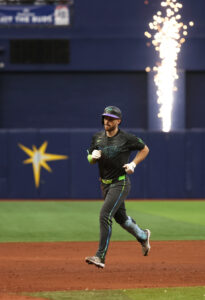
Lowe is the biggest name of the bunch here. The 31-year-old has spent the past eight seasons with the Rays. In that time, he has established himself as one of the better power-hitting second basemen in the sport. Dating back to the start of 2019, he has hit 151 home runs. Among primary second basemen, only Marcus Semien and Jose Altuve are ahead of him in that category, with Semien having 178 homers in that span and Altuve 158.
That power production from Lowe is even more impressive when one considers that he did that in about one thousand fewer plate appearances than Altuve and about 1,600 shy of Semien. But that also demonstrates the main knock on Lowe, which is that he has had trouble staying on the field. Due to various injuries over the years, he has only twice been able to play more than 107 games in a season. Lower back problems have been a frequent issue but he’s also hit the injured list due to a right shin bone bruise, a right triceps contusion, a right patella fracture, a right oblique strain, left oblique tightness and left ankle/foot tendinitis.
Earlier in his career, the Rays moved Lowe between second base and the outfield corners. Presumably because of the injuries, he hasn’t been sent out to the grass since 2022. He has been almost exclusively a second baseman lately, with a few stints at first as well. His second base defense was once around league average but seems to have slipped as he has battled those injuries and pushed into his 30s. He was given a minus-13 grade from Outs Above Average this year and minus-14 from Defensive Runs Saved.
There’s also a bit of concern from his declining plate discipline. He has always had a high strikeout rate but offset that earlier in his career with solid walk rates. That hasn’t been the case lately, as Lowe walked in fewer than 8% of his plate appearances in each of the past two years.
The power has still been enough to carry the profile. Dating back to the start of 2024, he has 52 home runs and a .251/.309/.475 batting line. That translates to a 118 wRC+, indicating his offense has been 18% above league average overall. Despite the defensive shortcomings, FanGraphs credited him with four wins above replacement in 241 games over that two-year span. He is going to make $11.5MM in 2026 before he’s slated to reach free agency.
Though Lowe is an imperfect player, he will be a big upgrade for the Pirates. They had almost no offensive prowess to speak of in 2025. Spencer Horwitz was the only Pirate to produce a wRC+ higher than 101.
While the Bucs had a clear lack of offense, they have a huge pile of pitching talent. Paul Skenes is the clear headliner but they have plenty of other exciting young arms in the mix. After several years struggling to return to contention, the Bucs came into this winter looking to get aggressive in upgrading the offense.
They made some spirited attempts in free agency, making competitive offers to Kyle Schwarber and Josh Naylor before they re-signed with the Phillies and Mariners respectively. Even if the Bucs had succeeded in signing one of those guys or someone else, it always seemed likely that they would use their stockpile of young arms to bolster the offense. This is the second such trade of the offseason for the Bucs. They sent Johan Oviedo to the Red Sox earlier this month as part of a five-player swap, with outfielder Jhostynxon García coming back to Pittsburgh.
Lowe could jump in as the regular second baseman. The Bucs used guys like Jared Triolo, Nick Yorke and Nick Gonzales there in 2025 without anyone taking firm hold of the position. Given Lowe’s age, injury issues and defensive shortcomings, it’s also possible he sees significant time in the designated hitter slot. That would leave open some playing time for those guys, though Triolo and Gonzalez could also factor in at shortstop or third base.
Since Lowe is going into the final year of his deal, he’s just a one-year upgrade for the Pirates, though it’s possible they could make him a qualifying offer at season’s end if he has a healthy and productive campaign.
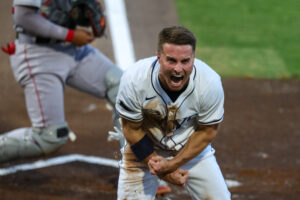
They had added yet another guy to their position player mix with Mangum, though he’s not likely to be a massive lineup boost. He got into 118 games with the Rays this year as a speed-and-defense guy with a contact-based approach. His 15% strikeout rate was lower than league average but he also only drew walks at a 4% clip and hit only three home runs. His .296/.330/.368 batting line translated to a 95 wRC+ but he stole 27 bases and got strong defensive grades in all three outfield slots.
Mangum has exactly one year of service time, meaning he’s at least two years from arbitration and five years from free agency. He also has a full slate of options, so he could be sent to Triple-A to serve as depth. The Bucs should have Oneil Cruz and Bryan Reynolds in two outfield spots. One spot is available with guys like García, Jack Suwinski, Marco Luciano and others in the mix. Mangum could push for a regular role or a gig as a fourth outfielder, or he could end up in Triple-A, as mentioned. A lengthy optional assignment could delay his trajectory to arbitration and/or free agency.
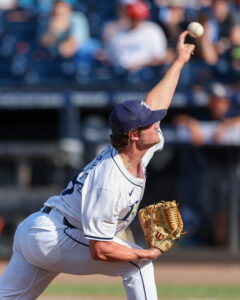
The Bucs also picked up a reliever in Montgomery. The southpaw tossed 55 2/3 innings for the Rays over the past two years, allowing 5.01 earned runs per nine. He struck out 32.5% of batters faced and got grounders on 45% of balls in play but also gave out walks at a big 13% clip. He has a high-90s fastball, as well as a cutter and a slider, but control is clearly an issue.
He is also optionable and can be controlled for five years, so the Bucs can see if they can help him harness his stuff, without having to commit a big league roster spot. Pittsburgh’s southpaw relief contingent is currently headlined by Gregory Soto, with Evan Sisk and now Montgomery also in the mix.
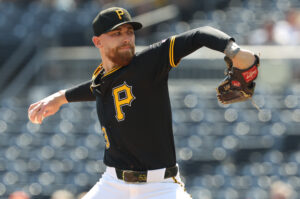
In order to get those players, the Pirates are making a notable subtraction from their rotation. Burrows, 26, was an 11th-round pick and spent many years in the middle range of Pittsburgh’s top 30 prospects. However, he has increased his stock lately. He has thus far tossed 99 1/3 innings in his big league career with a 3.90 ERA, 23.8% strikeout rate, 8.2% walk rate and 41.9% ground ball rate. He has averaged in the mid-90s with his four-seamer and sinker while also throwing a slider, curveball and changeup. He has also thrown 83 2/3 innings in the minors over the past two seasons with a 4.20 ERA, 27.4% strikeout rate and 9.6% walk rate.
The Pirates are hoping that their trades this offseason have bolstered their lineup and bullpen, while the rotation could still be a strength despite the subtractions. Even without Oviedo and Burrows, they still have Skenes, Mitch Keller, Braxton Ashcraft, Bubba Chandler, Hunter Barco, Thomas Harrington and others in the mix. Jared Jones is still recovering from Tommy John surgery but should rejoin that group at some point in 2026.
Burrows is a sensible addition for the Astros. Injuries tore apart their rotation in 2026. Luis Garcia required yet another elbow surgery and was jettisoned from the roster. Ronel Blanco, Hayden Wesneski and Brandon Walter all required Tommy John surgery during the 2025 season and are facing lengthy absences.
In addition to the injury issues, they also lost Framber Valdez to free agency and don’t appear likely to re-sign him. That’s because they are reportedly hoping to avoid the competitive balance tax in 2026. RosterResource pegs them for a CBT number of around $220MM, which is roughly $24MM shy of the $244MM base threshold. That gives them some ability to do things but they also have other needs on the roster and presumably want to keep some powder dry for midseason additions.
Put it all together and the Astros came into the winter with a rotation consisting of Hunter Brown and a series of question marks. Cristian Javier should have a spot next year but he had middling results in 2025 after recovering from his own Tommy John surgery. They can’t count on Lance McCullers Jr. for anything after he posted a 6.51 ERA in his return from a lengthy injury absence. Jason Alexander is in the mix but is a veteran journeyman. Spencer Arrighetti, J.P. France, Colton Gordon, AJ Blubaugh and Miguel Ullola are on the 40-man but they’re all either unestablished at the big league level or struggled with injuries in 2025.
Adding to the rotation was obviously necessary but the budgetary situation has impacted their approach. Instead of going after top free agents, they have given modest deals to reclamation project Nate Pearson and KBO returnee Ryan Weiss.
Burrows also fits into the low-cost mode. He has less than a year of service time, meaning he’s still years away from arbitration and even further from free agency. He also still has an option season remaining, so the Astros can send him to Triple-A throughout the year if other guys push him for a rotation spot.
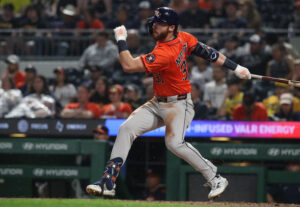
To get that affordable rotation upgrade, they are subtracting from their outfield mix and their long-term pitching pipeline. Melton, now 25, debuted in 2025 but didn’t hit the ground running. He hit just .157/.234/.186 this year, though in a tiny sample of 78 plate appearances. A right ankle sprain cost him a decent chunk of the season, as he only got into 67 games between Triple-A and the majors.
His minor league work is naturally more impressive. Prior to this trade, many outlets considered him the top prospect in Houston’s system. He’s considered a plus outfielder and baserunner. Though his 2025 was shortened by injury, he swiped at least 30 bags in the two previous minor league seasons. In 1,146 minor league plate appearances, he has a 22.6% strikeout rate, 10.1% walk rate, 48 home runs, .255/.334/.462 line and 110 wRC+.
Though Melton had reached the big leagues, he was part of a somewhat jumbled outfield mix consisting of Jake Meyers, Cam Smith, Jesús Sánchez, Zach Cole and Zach Dezenzo, with Yordan Alvarez also in the mix from time to time when he’s not the designated hitter. Meyers has been in some trade rumors but Melton was perhaps more appealing to the Rays. Meyers is down to two years of club control and is projected by MLBTR contributor Matt Swartz for a $3.5MM salary next year.
Melton has less than a year of service time, so he comes with six full years of control. He also has two option seasons remaining, so the Rays can keep him in Triple-A if he hasn’t yet earned a big league job with them. The Rays effectively swap him into their outfield mix for Mangum. He’ll compete for playing time with Chandler Simpson, Josh Lowe, Cedric Mullins, Jake Fraley, Jonny DeLuca, Richie Palacios and others.
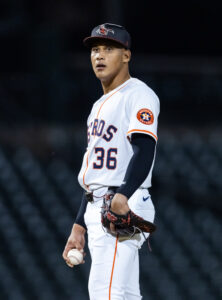
Brito is also an attractive piece but he’s farther away. An amateur signing out of Venezuela, he has limited professional experience, having not yet reached the Double-A level. Thus far, he has shown big strikeout stuff but he’s clearly still working on controlling his stuff. He has thrown 103 minor league innings over 2024 and 2025 with a 2.36 ERA, walking 11.7% of batters faced but also punching them out at a 35% clip. Baseball America had him ranked as the #3 prospect in the Astros’ system before the deal.
The Rays have been busy today, as they have also sent Shane Baz to the Orioles for four prospects and a draft pick. This deal is also future-focused for them, as they have sent out three big leaguers for two prospects. Given the young and controllable talent they acquired, it’s possible this is some kind of setback for a rebuild.
On the other hand, Lowe was already a classic Rays trade candidate, as he is relatively expensive for them and nearing free agency. Baz isn’t quite the same, as he can still be controlled for three more seasons, but he is projected for a $3.1MM salary next year. Maybe the Rays will now pivot to investing in the roster, now that they’ve saved some money and bolstered their farm system.
Given that this deal involves three teams and half a dozen players, most of whom are young and controllable for years to come, it’s going to take quite a while to determine whether it was wise for the clubs involved. For now, it aligns with their immediate needs.
The Astros have bolstered their rotation without having to pay big bucks. They have subtracted one of their top prospects in Melton, but from an area of the roster with some depth. Brito is another notable prospect gone but he’s been replaced by a pitcher who can provide more help in the near term.
The Rays have saved a bit of money by trading Lowe. They also subtracted a couple of other players but one of them was in a crowded outfield mix with some fourth outfielder tendencies, the other a clearly talented but volatile reliever.
The Pirates were widely expected to move starting pitching to try to add to their position player group and this is the second time this winter they have executed a trade with that aim. There’s a bit of risk in giving up a controllable starter for an injury-prone bat with just one year of control and a couple of fringier pieces, but they needed to do something for the lineup and free agency was proving challenging. They have gone the trade route instead and used their area of greatest strength to hopefully patch over weaknesses elsewhere.
Chandler Rome and Ken Rosenthal of The Athletic first reported the elements of the deal. Alex Stumpf of MLB.com and Francys Romero of BeisbolFR.com reported that the deal was done but pending medical reviews. Rome and Jeff Passan of ESPN reported that the deal was done.
Photos courtesy of Patrick Gorski, Kim Klement Neitzel, Nathan Ray Seebeck, Charles LeClaire, Mark J. Rebilas, Imagn Images
Rays Trade Shane Baz To Orioles
The Orioles bolstered their rotation with an intradivision swap netting them right-hander Shane Baz from Tampa Bay, the teams announced Friday. In return, the Rays receive outfielder Slater de Brun, catcher Caden Bodine, right-hander Michael Forret, outfielder Austin Overn and a Competitive Balance Round A draft pick. Baltimore designated lefty Josh Walker for assignment to open a roster spot for Baz (more on that move here).
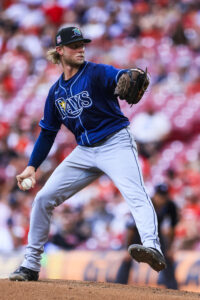
Baz, 26, will step right into Baltimore’s rotation. As is the case with the recently traded Grayson Rodriguez, Baz once ranked as one of the sport’s top pitching prospects. In fact, a look back at Baseball America’s top 100 prospects of the 2022 season shows Rodriguez at No. 6 and Baz right behind him at No. 8.
Baltimore, of course, traded Rodriguez and his remaining four years of club control to the Angels in exchange for the final year of club control over slugging corner outfielder Taylor Ward. Rodriguez hasn’t pitched in a big league game in nearly 18 months due to injuries. Baz has his own lengthy injury history but pitched a career-high 166 1/3 innings across 31 starts for Tampa Bay last season. The two are different pitchers with different skill sets and different levels of risk, and both are projects (to varying extents). But it’s nevertheless notable that the O’s shipped out one former top-10 pitching prospect and just weeks later effectively replaced him by acquiring another.
In 2025, Baz worked to a 4.87 earned run average but drew more favorable reviews from metrics like SIERA (3.95) and FIP (4.37). He fanned 24.8% of his opponents, issued walks at a 9% clip and kept the ball on the ground at a better-than-average 46.7% rate. Home runs were the biggest problem for Baz, who saw 15.6% of the fly-balls against him clear the outfield fence and allowed an overall average of 1.41 homers per nine innings pitched.
Specifically, Baz was homer-prone in right-on-right matchups. The Rays played last year’s “home” games at Tampa’s Steinbrenner Field (the Class-A affiliate for the Yankees) while Tropicana Field was undergoing repairs after significant damage at the hands of Hurricane Milton. Steinbrenner Field played as the second most homer-friendly venue in MLB for right-handed hitters, per Statcast’s Park Factors; Baltimore’s Camden Yards was still homer-friendly to righties, but not nearly to the same extent.
If Baz can rein in the home run woes and continue to stay healthy, he has the makings of a mid-rotation starter. Those aren’t trivial caveats, however — particularly the health one. Baz had arthroscopic elbow surgery prior to the 2022 season, returned to pitch 27 innings that summer, and then went back on the injured list due to an elbow sprain. He underwent Tommy John surgery that September and missed all of the 2023 season and the first half of the 2024 campaign.
Injury concerns notwithstanding, Baz sat 97 mph with his four-seamer this past season and got strong results on a new knuckle curveball that he hadn’t previously used in the majors. Opponents hit just .214 and slugged .321 against that newly implemented breaking pitch. Baz also works off a changeup and a cutter (getting better results with the former in 2025), rounding out a four-pitch arsenal.
The Orioles will control Baz for another three seasons. He’s a Super Two player who’s eligible for the second of his four arbitration raises this offseason. MLBTR contributor Matt Swartz projected an eminently affordable $3.1MM salary for the right-hander. That bumps the Orioles’ projected payroll, per RosterResource, north of $140MM and gives them more than $178MM of luxury tax considerations. They’re still nearly $70MM from the first tax threshold.
Baltimore entered the offseason in clear need of rotation help. Baz adds a capable arm with some yet-untapped upside but isn’t the clear playoff-caliber starter Baltimore has sought (though he has the potential to become that). He joins Trevor Rogers, Kyle Bradish and Dean Kremer as rotation locks. Tyler Wells, Cade Povich, Brandon Young and Chayce McDermott are all candidates for the fifth spot who are already on the 40-man roster.
That’s solid depth, but the Orioles’ rotation still feels like it’s one veteran arm short. The team’s aggressive signing of Pete Alonso (plus acquisitions of Ward and Baz) are clear signals of a win-now mindset as they look to put an ugly 2025 season behind them. Adding a proven starter would go a long way toward realizing that goal. Baltimore has been linked to prominent free agents like Framber Valdez, Ranger Suarez and Tatsuya Imai — all of whom remain unsigned. Even after adding Alonso, Baz, Ward and free agent closer Ryan Helsley, their projected payroll is more than $20MM shy of last season’s Opening Day mark. There should be room to make another splash on the starting pitching front.
In exchange for the final three years of control over Baz, Tampa Bay is getting several of the Orioles’ top-30 prospects and a well-placed pick in the 2026 draft. Baseball America recently re-ranked the top-10 prospects in Baltimore’s system, placing Forret eighth among the bunch and calling him a potential No. 3 or 4 starter. The 21-year-old righty has strong command and a deep repertoire of six pitches, highlighted by a pair of above-average to plus breaking balls (curveball, sweeper). He split the 2025 season between High-A and Double-A, logging a combined 74 innings with a pristine 1.58 ERA, a huge 32.3% strikeout rate and a tidy 7.4% walk rate.
Forret is the only of the four prospects ranked inside BA’s top 10, though both de Brun and Bodine were top-10 names in the system on MLB.com’s midseason re-ranking of the bunch. The 18-year-old de Brun, in particular, is a big addition. He was selected with the No. 37 overall draft pick — coincidentally enough, a Competitive Balance Round A selection — just this past summer. De Brun didn’t play professionally following that lofty selection. He’ll head to the low minors in Tampa Bay’s system and make his professional debut there in 2026.
Baseball America called de Brun the top high school outfielder in last year’s draft class, lauding his plus-plus speed, above-average hit tool, strong throwing arm and good instincts in center field. He’s listed at just 5’9″ and has below-average power. He’ll be a yearslong development project, but if all goes well, the end result could be a table-setting center fielder with plus base-stealing ability and plus defense.
Bodine, 22, was selected seven picks ahead of de Brun in last summer’s draft. The former Coastal Carolina University standout got his feet wet with 11 games for the Orioles’ Class-A affiliate following the draft and hit well in that small sample. He’s a 5’10”, 200-pound, switch-hitting catcher who draws praise for a plus hit tool and good defensive skills. Like de Brun, he has below-average power. And, as one might expect for a catcher, his speed gets below-average ratings as well. Bodine hit .337/.440/.528 with nearly twice as many walks as strikeouts during his three NCAA seasons and began his pro career with a 14-for-43 showing (13 singles, one double), five walks and eight strikeouts in 49 A-ball appearances.
As with both Bodine and de Brun, Overn is another recent, lofty draft pick for the Orioles. Selected out of USC with the No. 97 pick in 2024, he’s a blistering runner with good defensive skills but fringe power and strikeout concerns. Overn hit .249/.355/.399 between Baltimore’s Class-A and Double-A affiliates in 2025, connecting on 13 homers, 13 doubles and four triples. He also went 64-for-72 in stolen base attempts over just 114 minor league games. MLB.com ranked him 30th in Baltimore’s system following this year’s trade deadline, tabbing him as a potential fourth outfielder or, in a best-case scenario, a speed- and defense-oriented regular. He’ll likely need to improve his hit tool and/or add some more power to get to that ceiling.
The Rays also add a notable draft pick. Baltimore won the fifth pick in Competitive Balance Round A during this month’s lottery. The exact draft order isn’t set yet — draft compensation surrounding free agents who rejected qualifying offers could still impact it — but in 2025 that was the No. 37 overall selection. Coincidentally, that’s the very pick that the Rays traded to the O’s in exchange for reliever Bryan Baker. Baltimore used that pick to select de Brun. It now trades de Brun back to Tampa Bay alongside what could very well end up being the No. 37 pick in the subsequent season’s draft. Last year’s No. 37 pick had a $2.63MM slot value, though de Brun signed for an over-slot $4MM. The Rays are likely adding around $2.7MM in pool space to next year’s draft budget with the acquisition of this pick.
Subtracting Baz depletes a Rays rotation that already looked like it might be one arm short. At the moment, Tampa Bay’s rotation figures to include Drew Rasmussen, Ryan Pepiot, Shane McClanahan and Steven Matz. Joe Boyle, Joe Rock, Ian Seymour and top prospect Brody Hopkins are among the internal candidates to step into the five spot. The first three are already on the 40-man roster.
However, the Rays will also surely have McClanahan on an innings limit after he missed the past two full seasons due to UCL and nerve surgeries. They’ll need to add some more innings to this group one way or another. By shipping out Baz and second baseman Brandon Lowe in separate trades this morning, the Rays trimmed more than $14MM off their projected payroll for the upcoming season. Per RosterResource, they now sit at about $78MM. That’s right in line with last year’s Opening Day mark.
Coming off a season in which they missed the playoffs and played their home games in a minor league park, the Rays may not be anxious to add a starter making $10MM+ per year. But Tampa Bay ran an Opening Day payroll of $98MM as recently as 2024 and is now under new ownership. It stands to reason that there could be some room to add a modestly priced starter in free agency. Alternatively, the trades of Baz and Lowe have only revitalized a perennially solid Tampa Bay farm system. The Rays could turn to the trade market to bring in some more help in the weeks ahead.
The Athletic’s Ken Rosenthal first reported that the Orioles were nearing a deal to acquire Baz. ESPN’s Jeff Passan first reported the agreement and the Rays’ return.
Nine Teams Exceeded Luxury Tax Threshold In 2025
Major League Baseball has finalized its calculations of teams’ competitive balance tax payrolls for the 2025 season. As first reported by The Associated Press, nine teams surpassed the $241MM base threshold. In a separate post, The AP lists the finalized CBT numbers for all 30 teams.
The payments are as follows:
- Dodgers: $169.4MM
- Mets: $91.6MM
- Yankees: $61.8MM
- Phillies: $56.1MM
- Blue Jays: $13.6MM
- Padres: $7MM
- Astros: $1.5MM
- Red Sox: $1.5MM
- Rangers: $190K
Teams pay escalating penalties for exceeding the threshold in consecutive seasons. The Dodgers, Mets, Yankees, Phillies and Rangers have all paid the tax in at least three straight years — subjecting them to the highest escalator fees. The Astros went over the line for the second straight season. The Blue Jays, Padres and Red Sox had gotten below in 2024 and are categorized as first-time payors.
This is the second straight year in which nine teams paid the CBT. The Braves, Giants and Cubs had gone over the line in ’24 but dipped below this year, which resets their status going into 2026. Atlanta’s active offseason puts them in position to go back into tax territory next year, when the base threshold climbs to $244MM. San Francisco and Chicago each have projected CBT numbers more than $40MM below that right now.
While public estimates from RosterResource and Cot’s Baseball Contracts offer an excellent approximation of teams’ payroll commitments, the official numbers are not available during the season. It’s not uncommon for rounding errors in those calculations to vary by a few million dollars. That generally isn’t a big deal but can matter for teams that are hovering very close to the tax line. Each of the Red Sox ($249MM payroll), Astros ($246MM) and Rangers ($241.38MM) were believed to have gone narrowly beyond the $241MM cutoff, but that wasn’t 100% established until this evening — particularly in the case of Texas.
The Dodgers ($417MM), Mets ($347MM), Yankees ($320MM), Phillies ($314MM) and Blue Jays ($286MM) all had payrolls above $281MM. That was the third tier of penalization and marked the point at which a team’s top draft pick is dropped by 10 spots. The Mets were the only of those five that didn’t make the playoffs. Their top pick drops from 17th to 27th. The Yankees, Philadelphia, Toronto and L.A. all have their first-round pick dropped to between 35th and 40th.
Teams that paid the CBT are entitled to the lowest level of compensation for losing free agents who declined a qualifying offer. They receive a draft choice after the fourth round for each qualified free agent who walks. They’re charged the heaviest penalty — their second- and fifth-highest picks in 2026 and $1MM from their ’27 international bonus pool — for signing a qualified free agent from another team.
San Diego and the Mets receive a pick after the fourth round for losing Dylan Cease and Edwin Díaz, respectively. Toronto (Bo Bichette), Houston (Framber Valdez) and Philadelphia (Ranger Suárez) would receive the same if their free agents sign elsewhere. The Dodgers surrendered their second- and fifth-round selections for Díaz. Toronto is slated to do the same for Cease, but if Bichette walks, they’d give up that compensatory pick instead and get their fifth-rounder back.
The Dodgers’ combined payroll and tax bill for the 2025 season lands north of $586MM. The two-time defending champions’ tax hit alone is higher than the payrolls of the bottom 12 teams in the league. There were 14 clubs that had a CBT number above $200MM. The Braves, Cubs, Giants, Angels, Diamondbacks and Mariners were the other six teams above the median. All but Seattle spent more than $200MM.
On the other end, the Marlins ($87MM) and White Sox ($92MM) were the two teams with payrolls below $100MM. The Rays ($103MM), Pirates ($109MM) and Athletics ($118MM) rounded out the bottom five — followed by the Guardians, Nationals, Twins, Brewers and Reds.
Overall, the league will collect just under $403MM in taxes. Teams must make the payments by January 21. The first $3.5MM will be used to fund player benefits. Half the remaining money goes to players’ retirement accounts, while the other half is used for revenue sharing distribution from MLB to teams.
Royals Acquire Matt Strahm
The Royals and Phillies announced a one-for-one reliever swap on Friday morning. Left-hander Matt Strahm heads to Kansas City with righty Jonathan Bowlan going to Philadelphia.
It’s a reunion for Strahm and the Royals, as Kansas City drafted the lefty in the 21st round of the 2012 draft. Strahm made his big league debut for the Royals in 2016 and spent parts of two seasons with the club before being shipped to the Padres in a six-player trade alongside Travis Wood and Esteury Ruiz in order to acquire Trevor Cahill, Brandon Maurer, and Ryan Buchter. Strahm had a career 3.81 ERA and 4.12 FIP in 56 2/3 innings at the time of the trade. He’ll now return to Kansas City nearly a decade later with more than 500 MLB innings and an All-Star appearance under his belt.

Much of Strahm’s tenure with the Padres was fraught with injuries and ineffectiveness, but a solid season with Boston back in 2022 convinced the Phillies to bring him into the fold. Since arriving in Philadelphia, the lefty has emerged as one of the league’s most effective relievers. He has a 2.71 ERA in 212 2/3 innings of work over the past three years with a 2.82 FIP and a 3.01 SIERA. That’s the eighth-most innings of any pitcher with ten starts or fewer over the past three seasons, and among qualified relievers his ERA ranks 10th, his FIP ranks 15th, and his SIERA ranks 21st.
That’s an elite combination of quality and quantity that virtually any bullpen would benefit from adding, and the Royals are no exception. Strahm figures to join closer Carlos Estevez and righty Lucas Erceg at the back of the Kansas City bullpen to create the best late-inning trio the Royals have had since the 2015 club’s “three-headed monster” of Greg Holland, Wade Davis, and Kelvin Herrera. With solid arms like Nick Mears, John Schreiber, and Daniel Lynch IV set to cover the middle innings, it’s not hard to imagine the Royals entering 2025 with one of the stronger top-to-bottom bullpens in the American League thanks to this trade. Mears just came over in the same trade that netted Isaac Collins for the Royals but sent lefty Angel Zerpa to the Brewers. Sending out Zerpa cut into Kansas City’s lefty relief group but they have quickly pivoted to Strahm to restock in that department.
The loss of Strahm will surely sting for the Phillies somewhat, but the club remains fairly well set up in terms of their late-inning mix. Jhoan Duran remains one of the league’s top closers, and the recently-acquired Brad Keller was one of the top setup men in the majors last year with the Cubs. From the left side, Jose Alvarado and Tanner Banks should form a quality duo, and Alvarado in particular has offered elite production in the past. Strahm’s name has long been in trade rumors this winter, and clearing his $7.5MM salary off the books could help the Phillies in the pursuit of a reunion with catcher J.T. Realmuto or help them to afford the addition of another outfielder, who could help contribute alongside Brandon Marsh, Adolis Garcia, and top prospect Justin Crawford.
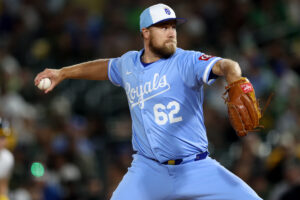
Aside from the financial incentive to make the trade, the Phillies will also receive the services of Bowlan, a 29-year-old righty who made his big league debut in 2023 but just got his first extended look in the majors last year. Bowlan pitched quite well across 44 1/3 innings for Kansas City in 2025, posting a 3.86 ERA with a 3.97 FIP in that time. He struck out 25.6% of his opponents with a 9.4% walk rate and a solid 48.7% ground ball rate.
That ability to generate both strikeouts and grounders should make Bowlan an effective, low-cost addition to a Phillies pen that has plenty of solid options in the late innings but has plenty of spots still fairly unsettled. With less than one year of service time under his belt, Bowlan can be controlled through the end of the 2031 season, affording Philadelphia the opportunity to bring in an arm that could be part of their relief mix for years to come.
Robert Murray of FanSided first reported that Strahm was being traded to Kansas City. MLB.com’s Mark Feinsand had Bowlan going the other way.
Twins Sign Josh Bell
The Twins announced the signing of free agent first baseman Josh Bell to a one-year deal with a mutual option. It’s reportedly a $7MM guarantee for the Boras Corporation client. Bell’s 2026 salary will be $5.5MM. He also receives a $250K signing bonus, and there’s a $1.25MM buyout on the mutual option.
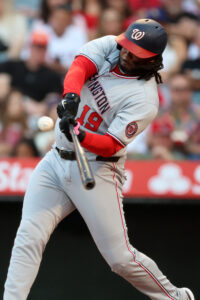
Bell, 33, has been at least an average bat in every season of his decade-long MLB career, with the exception of a poor showing in the shortened 2020 campaign. At times, the former second-round pick and top prospect has looked on the cusp of breaking out as a star-level slugger — most notably in 2019 and 2021 — but he’s never quite produced as the steady power bat one might expect from a hulking 6’3″, 260-pound first baseman.
That’s largely due to the switch-hitting Bell’s penchant for hitting the ball on the ground. Despite his sizable frame and clearly plus raw power, Bell has struggled to maintain a swing path that allows him to elevate the ball. He’s cut his grounder rate in recent seasons, to be fair; last year’s 45.7% mark was actually the second-lowest of his career, ahead of only the 44% mark he posted during a 37-homer campaign back in 2019. However, that 45.7% mark was still well above the 41.8% league average. For a hitter like Bell, whose average sprint speed ranked in just the seventh percentile of big league position players, per Statcast, that much contact on the ground is a clear detriment.
When Bell does elevate the ball, he does so with tremendous authority. Statcast ranked his 96.4 mph average exit velocity on liners/fly-balls 25th among 251 qualified hitters. Bell’s isolated power (slugging percentage minus batting average) of .507 on fly-balls isn’t elite but is well north of the .436 league average. He popped 22 round-trippers this past season and has averaged 26 homers per 162 games over the past seven seasons — despite his proclivity for hitting the ball into the ground. It’s long been thought that if Bell could consistently elevate the ball, he’d be a high-end slugger, but six teams have now tried to get him to do so consistently and been unable to make it happen.
The end result is typically above-average but not elite offense. Bell hit .237/.325/.417 this past season with the Nationals. His 10.7% walk rate was comfortably north of average and roughly in line with his career 11.2% mark. His 16.5% strikeout rate was the second-lowest of his career. Bell had uncharacteristic struggles with his right-handed swing last season but has traditionally been a solid hitter from both sides of the dish (albeit with better production from the left side). His 90.4 mph average exit velocity and 47% hard-hit rate were his best marks since a strong 2021 season (also spent with the Nats).
The Twins and their fans can perhaps find some optimism in the trajectory of Bell’s 2025 season. He was one of the worst hitters in either league through the end of April but busted out of that slump with a huge showing in May. He took a step back in June and then delivered terrific production over the final three months of the year. Setting aside Bell’s awful first 125 plate appearances of the season (when he had a bloated 50% grounder rate, it should be noted), he hit .278/.358/.462 with 17 homers, 16 doubles, an 11.1% walk rate and a 14.6% strikeout rate. In 250 plate appearances from July 2 onward, he slashed .284/.371/.486 (with a ground-ball rate sitting at 42%).
That’ll be the sort of production for which the Twins hope in 2025. Bell figures to be the primary first baseman for new manager Derek Shelton, who briefly overlapped with Bell during his first season as manager in Pittsburgh. Like most teams, the Twins don’t have a set designated hitter, so Bell could get some looks there, too, if the Twins want to free up some first base time to get Edouard Julien or Kody Clemens into the lineup there. Some additional DH reps for Bell would benefit the team defensively; he posted solid grades at first base back in 2021-22, but Bell has been dinged for -20 Defensive Runs Saved and -16 Outs Above Average over his past 1551 innings in the field. He’s not a skilled defender.
Even with those defensive shortcomings, Bell adds a legitimate bat to the middle of Minnesota’s order. He’s a durable veteran, having appeared in 91.5% of his teams’ possible games dating back to his first season as a full-time regular. That’s an average of better than 148 games per year, and it’s reasonable to expect at least 20 home runs based on his track record, with 25 to 30 not out of the question depending on the extent to which he can avoid falling into another grounder-heavy malaise.
Bell joins Byron Buxton, breakout rookie Luke Keaschall and catcher Ryan Jeffers in the top portion of a Twins lineup that’ll hope for better results from talented but inconsistent young hitters like Royce Lewis, Matt Wallner, Brooks Lee and (if he’s not traded) Trevor Larnach. Top prospects Walker Jenkins, Emmanuel Rodriguez and Kaelen Culpepper could force their way into the mix next season. Alan Roden will get another chance to prove his big Triple-A production can play in the majors, too.
The signing of Bell only reinforces the fact that despite a deadline fire sale, the Twins are intent on adding back to the roster in an effort to be as competitive as possible in 2026. President of baseball operations Derek Falvey plans to hold onto stars like Buxton, Joe Ryan and Pablo Lopez rather than trade them. The Twins were reportedly shopping in the middle tiers of the free agent market at first base, and they’ll presumably use some of the modest budgetary space granted by ownership to add some low-cost relievers as well.
Bell adds $5.75MM to the 2026 payroll, boosting the Twins just north of $100MM in the process, per RosterResource. Dan Hayes of The Athletic has previously reported that the front office has about $20MM to spend this winter. That should mean Falvey, GM Jeremy Zoll and the rest of the front office still have a around $15MM to help deepen the bullpen and perhaps the bench. Given that the Twins shipped out a stunning five relievers at July’s deadline, it seems fair to presume they’ll bring in multiple arms (though they already added one with November’s acquisition of Eric Orze from Tampa Bay).
Overall, payroll will still be down considerably from last year’s $142MM Opening Day mark and certainly from 2023’s franchise-record $153MM. Major additions on either side of the ball shouldn’t be expected. If the Twins compete next season, it’ll be due to big steps forward from in-house talents like Lee, Keaschall, Jenkins, Roden, Taj Bradley, Mick Abel and others. If they fall short of contending in a perennially competitive AL Central, then players like Bell and any of the forthcoming bullpen acquisitions could emerge as trade chips alongside Ryan, Lopez, Jeffers and others.
ESPN’s Jeff Passan first reported that the two sides had agreed to a one-year deal with a mutual option. Jon Heyman of the New York Post reported the $7MM guarantee. Bobby Nightengale of The Minnesota Star-Tribune had the salary structure.
Diamondbacks Sign Merrill Kelly
The Diamondbacks officially announced a reunion with Merrill Kelly on a two-year contract with a 2028 vesting option. The Apex Baseball client is reportedly guaranteed $40MM. He receives a $2MM signing bonus and will make successive $17MM and $21MM salaries. If Kelly reaches 170 innings in 2027, he’ll lock in a $12MM salary for the 2028 season. If he reaches 185 innings in ’27, that ’28 guarantee will jump to $14MM. The D-Backs cleared a roster spot earlier by flipping Kyle Backhus to the Phillies.
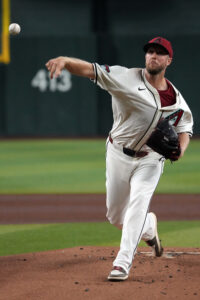
The 37-year-old Kelly returns to the team with which he has spent nearly his entire major league career. Though initially drafted by the Rays in the eighth-round of the 2010 draft, Kelly made his big league debut with the Diamondbacks back in 2019 after a four-season stay in Korea as a member of the KBO’s SK Wyverns (now known as the SSG Landers). After a pedestrian rookie campaign in the majors where he pitched to a league-average ERA in 32 starts, Kelly managed to fashion a role for himself as one of the better mid-rotation arms in the majors.
Since the start of the 2022 campaign, Kelly has pitched to a 3.47 ERA in 108 starts. He’s struck out 23.1% of his opponents while walking 7.7% in that time, leaving him with a 3.81 FIP. Although a 4.03 SIERA and other so-so peripherals cast him as a step down from your prototypical front-end starter, the veteran has managed to remain a durable and productive rotation piece. Kelly particularly endeared himself to Arizona fans when he delivered a brilliant 2.25 ERA over 24 postseason innings during the club’s run to the World Series in 2023.
Amid a disappointing 2025 season where the Diamondbacks were ravaged by injuries to everyone from star closers Justin Martinez and A.J. Puk to newly-signed ace Corbin Burnes, the team engaged in a sell-off at trade deadline and shipped Kelly to the Rangers in exchange for a trio of pitching prospects. Kelly put up fairly pedestrian numbers across ten starts with the Rangers: a 4.23 ERA and near-matching 4.18 FIP across 55 1/3 innings of work.
Even while the veteran was in Texas, an offseason reunion with the Diamondbacks was already being speculated upon. Kelly spoke fondly of Arizona and expressed an openness to re-signing when asked about the possibility while the Rangers were visiting Chase Field in the season’s final few weeks. “Definite” interest in a reunion with Kelly was reported on Arizona’s side shortly before last week’s Winter Meetings, and now the sides have come together on a deal.
Turning to the deal itself, Kelly’s $40MM guarantee clocks in just ahead of the two years and $36MM MLBTR predicted for the right-hander when ranking him as the #25 free agent in this offseason’s Top 50 MLB Free Agents list. The Snakes were aggressive both in their offer and the timing of the deal; while the free agent market for position players and especially relievers has kicked into gear already, Kelly is just the third starting pitcher from MLBTR’s Top 50 to sign a contract this offseason. He joins Dylan Cease and Cody Ponce, both of whom received guarantees that slightly eclipsed MLBTR’s predictions.
Now that he’s set to return to Arizona, Kelly stands as the favorite to start for the Diamondbacks on Opening Day this year. He’ll join a rotation that already added Michael Soroka and will reunite with former teammates Eduardo Rodriguez, Brandon Pfaadt, and Ryne Nelson. Burnes could be a factor later in the season but is not expected to pitch until sometime in the second half after undergoing Tommy John surgery in June. While the team’s rotation certainly looks much more complete with Kelly back in the fold, bringing the right-hander back shouldn’t stop the team from pursuing other rotation additions after the club’s pitching staff finished 19th in the majors with a 4.29 ERA last year.
Of course, adding beyond this could prove to be easier said than done. The Diamondbacks are projected for a payroll just north of $171MM in 2026, according to RosterResource. That rises to north of $205MM for luxury tax purposes. GM Mike Hazen has suggested that, while Arizona’s payroll would likely be moving downward from its 2025 level, that would still leave the team with room to spend. The club spent $188MM on its payroll last season, however, meaning they currently sit less than $17MM from that mark.
Perhaps that leaves enough wiggle room to reunite with Paul Goldschmidt on an affordable one-year deal, a move the Diamondbacks have been said to be contemplating, but Kelly will surely go down as the team’s biggest expenditure unless an increase in payroll is approved or the team makes a trade that clears salary. To that latter point, the hot stove has been burning with Ketel Marte trade buzz in recent weeks. Moving Marte would certainly clear payroll off the books (and simultaneously add some young rotation options as part of the return), though Hazen has consistently downplayed the likelihood of a deal surrounding Marte actually coming together.
Ken Rosenthal of The Athletic first reported the Diamondbacks and Kelly were finalizing a two-year, $40MM deal. Nick Piecoro of The Arizona Republic reported the option specifics. David Brandt of The Associated Press had the salary structure.
Padres Re-Sign Michael King
December 19th: The Padres officially announced their deal with King today.
December 18th: The Padres have an agreement to re-sign Michael King to a three-year contract with opt-outs after the first two seasons. The Excel Sports Management client is reportedly guaranteed $75MM.
He’ll receive a $12MM signing bonus and a $5MM salary for the 2026 season. He’d collect a $5MM buyout if he opts out of the remaining two years and $53MM. King would make $28MM in 2027 if he opts in and would then have a $30MM player option for the ’28 campaign. While the Padres have yet to announce the deal, he has reportedly already passed his physical.
It’s a surprise strike for a San Diego team that had seemed likely to lose King and Dylan Cease in free agency. It wasn’t clear whether they’d have the short-term spending capacity to keep either pitcher. While they were never expected to come close to the $210MM guarantee which Cease received, they’ll bring King back on a short-term deal to help a rotation that was their top priority.
The 2026 season will be the righty’s third in San Diego. The Padres acquired King as the centerpiece of their Juan Soto return over the 2023-24 offseason. He had run with a limited rotation opportunity late in his final season as a Yankee after years of strong work out of the bullpen. San Diego committed to him as a full-time starter and was rewarded with a career season.
King pitched to a 2.95 earned run average with 201 strikeouts over 173 2/3 innings. He finished seventh in NL Cy Young balloting and entered his walk year as a candidate for a nine-figure contract. He looked on his way to a $150MM+ deal after getting out to an even better beginning to the ’25 campaign. He turned in a 2.59 ERA while striking out 28.4% of batters faced over his first 10 starts.
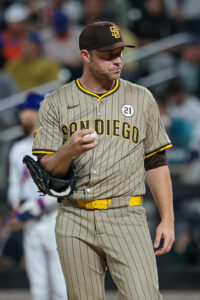
The Padres scratched King from his outing on May 24 with stiffness in his throwing shoulder. Then-manager Mike Shildt initially framed it as a minor issue that arose when the pitcher slept awkwardly. It proved a much bigger problem. King went on the injured list with what the team called inflammation. They subsequently determined it was a nerve injury that came with a nebulous timeline. He wound up missing almost three months.
King made his return on August 9. He made one start before going back down with left knee inflammation. That cost him another month, and he wasn’t as effective when he made it back for good in September. King didn’t get beyond five innings in any of his final four starts. He gave up 10 runs over 15 2/3 innings. Most of the damage came in an eight-run drubbing at the hands of the Mets on September 16. King’s final two appearances were scoreless, but those came with an uninspiring 7:6 strikeout-to-walk ratio.
The Padres didn’t fully trust King going into October. They opted for Nick Pivetta, Cease, and Yu Darvish to start in their Wild Card Series loss to the Cubs. King’s only playoff action was one scoreless inning of relief in the decisive Game 3. He struck out three of four batters while averaging 95.6 MPH on his fastball. That was his highest single game velocity of the season. That’s to be expected during a one-inning appearance with the heightened adrenaline of a must-win game, but it was an encouraging sign for the health of his shoulder.
San Diego issued the $22.025MM qualifying offer. It was an easy call for King to decline in search of a multi-year deal. This arrangement functions as a bit of a pillow contract but with a much higher floor than the one-year QO would have provided. King would make $22MM if he opts out after one year. That result would be the same as if he’d accepted the qualifying offer. The extra two guaranteed seasons afford him a lot more injury protection.
King’s guarantee technically falls just shy of MLBTR’s four-year, $80MM prediction. However, the higher average annual value and the opt-outs make this a stronger overall deal for the player. He’ll have a chance to return to free agency in advance of his age-32 season and cannot be tagged with another qualifying offer. A healthier season could position him for a four- or five-year contract.
Health is no small caveat. The ’24 campaign is the only time King has reached even 105 innings in a season. While that’s in part because the Yankees used him as a reliever, King missed extended stretches in 2021 (finger contusion) and ’22 (elbow fracture) in addition this year’s shoulder woes. The Padres are taking on some injury risk but get the upside of a potential top-of-the-rotation arm on a short-term deal.
King and Pivetta project as their top two starters. San Diego has reportedly discussed the latter in trade conversations but would need a huge return to move him. Joe Musgrove is back from Tommy John surgery and slots into the #3 rotation spot. They’ll be without Darvish for the entire season, so the final two starting jobs are up for grabs. Randy Vásquez and JP Sears lead the internal options, but the Padres could look for a cheaper back-end/swing type later in the winter. They’ll surely kick the tires on controllable arms in trade, as well, as both Pivetta and King can opt out.
San Diego’s projected payroll climbs to $218MM, as calculated by RosterResource. The backloaded nature doesn’t change the $25MM AAV used for luxury tax purposes. They’re up to a projected $259MM in tax commitments. They’ll exceed the $244MM base threshold for the second straight season. Repeat payors are taxed at a 30% rate for their first $20MM in overages. Re-signing King costs around $4.5MM in taxes.
The more significant development is that it moves them closer to the $264MM second tier, at which the rate climbs to 42%. The Padres had nearly $280MM in luxury tax commitments this year, according to Cot’s Baseball Contracts. Their actual salary obligations were around $209MM, though, so it’s unclear how much more flexibility the front office has at its disposal. In addition to the need for a back-end starter, they should acquire another bat to plug in at first base or designated hitter and could use a better utility infielder than Will Wagner and Mason McCoy.
King’s deal is the second-largest of the offseason in what has been a slowly developing market for free agent starting pitchers. Cease is the only other starter who has signed for more than $40MM so far. The rotation market should pick up in the next few weeks. NPB star Tatsuya Imai needs to sign before his 45-day posting window closes on January 2. Framber Valdez, Ranger Suárez and Zac Gallen join Imai as the top unsigned arms.
Mark Feinsand of MLB.com was first on the agreement, contract terms, and the note that the physical is already complete. Image courtesy of Vincent Carchietta, Imagn Images.
Giants Sign Adrian Houser
December 19th: The Giants have officially announced the Houser signing but haven’t yet announced a corresponding move.
December 16th: The Giants and righty Adrian Houser are in agreement on a two-year, $22MM contract, reports ESPN’s Jeff Passan. There’s a club option for a third season. Houser, a client of the BBI Sports Group, will presumably step right into San Francisco’s rotation next season after a rebound showing in 2025. The Giants, who also announced a one-year deal with former Tigers closer Jason Foley less than an hour ago, will need to free up a pair of 40-man roster spots, as they were already at capacity prior to either of those two agreements.

Houser, who’ll turn 33 in February, was a steady presence in the Milwaukee rotation for several years. From 2021-23, Houser started 68 games for the Brewers (in addition to five relief outings) and logged a 3.94 ERA. His 17.6% strikeout rate and 9.4% walk rate were both worse than average, but Houser piled up grounders at a 51.3% rate and managed to consistently avoid the long ball (0.83 HR/9).
The Brewers traded Houser to the Mets in the 2023-24 offseason, ahead of what was set to be his final season of club control. He struggled through his lone year in Queens (5.84 ERA in seven starts and 16 relief outings) before being designated for assignment and cut loose. He wound up settling for a minor league contract with the Rangers in free agency last winter. Texas didn’t bring him up to the big leagues prior to an opt-out date, so Houser returned to the market and signed a big league deal with the White Sox — a decision that now stands as a turning point in his career.
Houser hit the ground running and never looked back. In 11 starts with the ChiSox, he pitched 68 2/3 innings of 2.10 ERA ball. As was the case in Milwaukee, Houser posted a strikeout rate well shy of the 22% league average (17.1%), but he did so with better command (8% walk rate) and even fewer round-trippers (0.39 HR/9). Houser’s home run suppression didn’t seem sustainable; only 4.6% of the fly-balls he surrendered with the Sox turned into homers — miles south of the league-average 11.9% mark and his own career mark of 11.5%.
Following a trade to Tampa Bay, Houser indeed saw his home run luck run out. His homer-to-flyball rate jumped to 11.9%, and he averaged 1.12 homers per nine frames. The resulting 4.79 ERA was pretty closely in line with his 4.62 SIERA with Chicago. Still, Houser proved a durable source of innings down the stretch for the Rays, pitching 56 1/3 frames across 10 starts. Overall, he finished out the season with a 3.31 ERA, 17.8% strikeout rate, 7.3% walk rate, 48.9% ground-ball rate and 0.73 HR/9.
Houser will slot into new skipper Tony Vitello’s rotation behind Logan Webb, Robbie Ray and Landen Roupp. The Giants have a host of candidates for the fifth and final spot on the staff, including (but not limited to) Blade Tidwell, Carson Seymour, Kai-Wei Teng, Trevor McDonald, Hayden Birdsong and well-regarded prospect Carson Whisenhunt.
The Giants have been on the hunt for rotation help this winter, and while they’ve been connected to some of the more prominent names on the market, ownership has publicly expressed a reluctance to commit long-term to a starting pitcher. That’s made fits with pitchers like Tatsuya Imai, Framber Valdez and Ranger Suarez seem unlikely, though it’s at least plausible that the Giants could look to further augment their starting staff via the trade market or another shorter-term deal such as today’s Houser agreement.
Given Houser’s inconsistent track record, lack of missed bats and generally unsustainable level of home run suppression with the White Sox, it’s a fairly steep price for the Giants to pay. Then again, San Francisco’s Oracle Park is one of the most pitcher-friendly venues in the sport. Oracle Park is particularly tough on left-handed home run power, which dovetails nicely with Houser’s skill set. He held right-handers to an awful .249/.293/.320 batting line in 2025 (.234/.296/.339 career) but was tagged by lefties for a .274/.356/.456 batting line last season (and .282/.367/.456 for his career).
The addition of Houser pushes San Francisco to about $203MM of luxury tax obligations, per RosterResource. The Giants are more than $40MM shy of the $244MM first-tier threshold. However, while they’ve paid the tax in the past — doing so as recently as 2024 — it’s not clear whether they’re comfortable doing so in 2026. Ownership comments downplaying the possibility of adding additional long-term deals would suggest at least some trepidation about spending to those heights.
The Giants are still looking for help in the outfield, at second base and/or in the bullpen. While the top-end free agents to whom they were loosely linked earlier in free agency (e.g. Imai, Valdez) don’t seem like realistic targets, barring an about-face from ownership on the team’s stance regarding long-term commitments, there are still various avenues to pursue. Free agency offers no shortage of veteran hitters and relievers available on short-term deals, and San Francisco is reportedly among the teams most aggressively pursuing Cardinals infielder/outfielder Brendan Donovan.
President of baseball operations Buster Posey presumably has several more moves up his sleeve, and while the addition of Houser doesn’t necessarily raise the team’s ceiling much, it does boost the floor of a rotation that was pretty rife with question marks beyond the veteran Webb/Ray tandem up top.
Phillies Sign Brad Keller
December 18th: The Phils have officially announced their signing of Keller. According to The Associated Press, he receives a $4MM signing bonus and a $7MM salary for 2026, followed by an $11MM salary in ’27.
December 17th: The Phillies and right-handed reliever Brad Keller are in agreement on a two-year, $22MM contract, reports ESPN’s Jesse Rogers. The deal is pending a physical. Fansided’s Robert Murray first reported that the two parties were nearing an agreement. Keller, who is represented by Excel Sports Management, received some interest as a starter but will be used as a reliever in Philadelphia, per Joel Sherman of the New York Post.
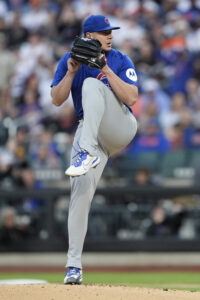
Keller, 30, was a solid starter with the Royals early in his career after being picked up from the D-backs in the 2017 Rule 5 Draft. After a nice run of three seasons, his numbers took a sharp decline, due largely to the complete erosion of his command.
Keller walked a staggering 45 batters in 45 1/3 innings in 2023 and was subsequently diagnosed with thoracic outlet syndrome. He underwent surgery to alleviate the issue. A comeback effort in 2024 didn’t pan out well, as he pitched to a 5.44 ERA in 41 1/3 frames between the Red Sox and White Sox, but Keller completely remade himself as a high-end bullpen weapon with the Cubs in 2025 after signing a minor league contract.
In 69 2/3 innings this past season, Keller was dominant. His 2.07 ERA tied him for 13th-best among 147 qualified relievers. The 6’5″, 255-pound righty set down 27.2% of his opponents on strikes and notched a sharp 8% walk rate. Keller had sat 92-94 mph as a starter and even in bullpen work with the White Sox and Red Sox in ’24, but his sinker averaged a career-best 96.7 mph in 2025 and his four-seamer clocked in even higher at 97.2 mph. His 56.1% ground-ball rate was a career-best mark, and opponents had an extremely rough time squaring up any of his pitches. His 86.7 mph average exit velocity and 30.6% hard-hit rate were far and away the lowest marks of his career.
There are at least some modest red flags with regard to Keller. His 10.8% swinging-strike is actually below the league average and doesn’t support his well above-average strikeout rate. The quality of his stuff clearly improved, just as the quality of his opponents’ contact deteriorated, but it’s still unlikely that he’ll sustain a .243 average on balls in play over the course of a full season. However, even with some regression in terms of BABIP and strikeout rate, Keller still looks the part of a quality bullpen arm who’ll support an improved late-inning relief contingent for the next two seasons.
Keller should operate as a setup man to deadline acquisition Jhoan Duran, who came over from Minnesota in exchange for top prospects Eduardo Tait and Mick Abel. He’ll join righty Orion Kerkering and southpaws Jose Alvarado, Matt Strahm and Tanner Banks in what should be a formidable setup corps for manager Rob Thomson. There’s still room for the Phils to add another reliever if a deal to their liking presents itself, but they’re six-deep in largely established relief arms with Keller now in the fold.
The $11MM annual value of the contract pushes the Phillies from the third tier of luxury tax penalization to the fourth and final bracket, per RosterResource’s projections. They were already paying a 95% tax on subsequent additions and were about $7MM from the top tier. Keller places them about $4MM over that line. They’ll pay about $22MM for him this season (assuming an even $11MM per year distribution) rather than that $11MM surface value. Any subsequent additions to the payroll at this point will be taxed at the maximum 110% rate.
The Phillies have done a fair bit of offseason work already. They added outfielder Adolis Garcia on a one-year contract just yesterday and, prior to that, re-signed slugger Kyle Schwarber on a huge five-year, $150MM contract. The Phils could still poke around the bullpen market or look for a complementary right-handed bat to pair with Brandon Marsh in left field. Rotation depth could be an issue as well, depending on Zack Wheeler‘s recovery from his own thoracic outlet procedure, so some modest depth adds could be on the horizon. The most notable issue for the club, however, is at catcher, where they’re still hoping to retain longtime backstop J.T. Realmuto. That’ll be top of mind until Realmuto signs, be it in Philadelphia or elsewhere.