
Dodgers Designate Trevor Bauer For Assignment
The Dodgers have cut ties with Trevor Bauer. Los Angeles announced this evening he will no longer be part of the organization, shortly after Jeff Passan of ESPN reported (Twitter link) he was being designated for assignment.
“The Dodgers organization believes that allegations of sexual assault or domestic violence should be thoroughly investigated, with due process given to the accused,” the organization said in a statement. “From the beginning, we have cooperated fully with Major League Baseball’s investigation and strictly followed the process stipulated under MLB’s Joint Domestic Violence, Sexual Assault and Child Abuse policy. Two extensive reviews of all the available evidence in this case — one by Commissioner Manfred and another by a neutral arbitrator — concluded that Mr. Bauer’s actions warranted the longest ever active player suspension in our sport for violations of this policy. Now that this process has been completed, and after careful consideration, we have decided that he will no longer be part of our organization.”
Bauer released his own statement this evening, stating that Dodgers brass had suggested as recently as yesterday he’d remain on the team (relayed by Bill Shaikin of the Los Angeles Times). “While we were unable to communicate throughout the administrative leave and arbitration process, my representatives spoke to Dodgers leadership immediately following the arbitration decision. Following two weeks of conversations around my return to the organization, I sat down with Dodgers leadership in Arizona yesterday who told me they wanted me to return and pitch for the team this year. While I am disappointed by the organization’s decision today, I appreciate the wealth of support I’ve received from the Dodgers clubhouse. I wish the players all the best and look forward to competing elsewhere.”
Bauer joined Los Angeles over the 2020-21 offseason on the heels of winning the NL Cy Young award with the Reds. He signed a three-year, $102MM guarantee that afforded him chances to opt out of the deal after each of the first two seasons. Bauer made 17 starts with a 2.59 ERA in his first season in L.A. before reports emerged that a California woman had filed for a restraining order and accused him of assaulting her during sex. He was promptly placed on paid administrative leave while the legal process played out, and he spent the remainder of the 2021 season on administrative leave by mutual agreement of MLB and the Players Association. Two Ohio women subsequently came forth with allegations that Bauer had assaulted them in prior years.
A judge denied the California woman’s request for a long-term restraining order in August 2021, finding he did not pose an ongoing threat to her safety. Bauer never faced criminal charges, with the Los Angeles County District Attorney’s Office declining to proceed with a criminal action after their investigation. “After a thorough review of the available evidence, including the civil restraining order proceedings, witness statements and the physical evidence, the People are unable to prove the relevant charges beyond a reasonable doubt,” the DA’s office said at the time.
Attention then turned to Major League Baseball’s investigation. Even in the absence of criminal charges, MLB is permitted to impose discipline if its investigation finds a player violated the joint Domestic Violence, Sexual Assault and Child Abuse policy. The league did so last April, imposing a 324-game ban that went into effect from the date of the suspension. That would have kept Bauer out for the entire 2022-23 seasons (and a few weeks in 2024); Bauer immediately appealed, becoming the first player to appeal a suspension levied under the domestic violence policy.
The appellate process played out over the following eight months. As per the terms of the policy, the arbitration panel consisted of three individuals — one of whom was selected by the league, one selected by the Players Association, and one independent arbitrator approved by both parties. Two weeks ago, the panel announced its determination. The appellate group reduced Bauer’s suspension to 194 games, which had already been served. He was decreed immediately eligible for reinstatement. The Dodgers were given until tonight to reactivate him on their roster or cut him loose.
As the Dodgers mentioned in their statement, the panel found that Bauer had violated the Domestic Violence policy. His suspension was reduced but not overturned, and even the reduced suspension was the longest handed out to any player since the policy was introduced in August 2015. While the panel determined Bauer violated the policy, it judged MLB’s initial two-year ban to be excessive.
Suspensions under the domestic violence policy are unpaid. Bauer did not collect any salary between the date of his suspension and the end of the 2022 season. The panel also stripped him of his salary for the first 50 games of the 2023 season — a retroactive loss of salary for money he did collect while on paid administrative leave between 2021 and April ’22. After the first 50 games of the season are up, Bauer will be entitled to his remaining salary.
Bauer had been set to make $32MM this year, the final season of his contract. After accounting for the forfeited salary, he’ll be due around $22.5MM. Even with the Dodgers officially moving on, they’ll be on the hook for that money. Los Angeles’ projected payroll sits around $217MM, as calculated by Roster Resource. More meaningfully, that expenditure brings the Dodgers estimated luxury tax number within a rounding error of the base $233MM CBT threshold. Multiple reports in recent months have suggested the Dodgers would like to dip below the tax threshold this year, thereby resetting their tax bracket after two consecutive seasons of overages. Doing so at this point would require finding a way to shed salary and/or not taking on any notable additional expenditures this offseason or at the trade deadline.
As with any player designated for assignment, there’s now a seven-day window for the Dodgers to trade Bauer or place him on waivers. Bob Nightengale of USA Today unsurprisingly tweets the Dodgers didn’t find any trade interest over the past two weeks. The extremely likely outcome is the 31-year-old will be placed on release waivers between now and next Thursday. Any team claiming him would have to take on his lofty salary; that surely won’t happen, and Bauer will become a free agent if/when he officially clears waivers.
At that point, his camp can look for opportunities elsewhere. Any team that signs Bauer after he clears waivers would only be responsible for the $720K league minimum salary, with the Dodgers still on the hook for the rest of the deal. Whether any other team is willing to carry him on their roster remains to be seen.
Giants Sign Michael Conforto
Jan. 6: The Giants have formally announced Conforto’s two-year deal. The opt-out provision in his contract is contingent on plate appearances, Alex Pavlovic of NBC Sports Bay Area reports (Twitter link). Conforto will trigger the ability to opt out upon reaching 350 plate appearances.
Dec. 23: The Giants and outfielder Michael Conforto are in agreement on a two-year, $36MM deal. Conforto will be able to opt out after the first season. The deal is pending a physical. He is represented by the Boras Corporation.
Conforto, 30 in March, was arguably the best upside play remaining on the free agent market based on his excellent run of results from 2017 through 2020. However, it’s not without risk for the Giants, as Conforto had a disappointing season in 2021 and then missed the 2022 season entirely due to shoulder surgery.
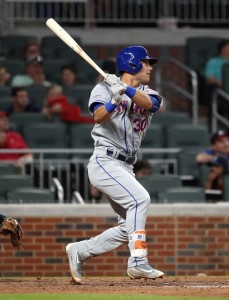 In that 2017-2020 stretch, Conforto got into 467 games for the Mets and launched 97 home runs. His 24.4% strikeout rate was slightly higher than average but his 12.7% walk rate was well beyond par. His overall offensive output resulted in a batting line of .265/.369/.495, which was 33% above league average by measure of wRC+. That 133 wRC+ was in the top 25 among all qualified hitters in baseball during that time.
In 2021, Conforto’s production dipped, most notably in the power department. He only hit 14 home runs in 125 games after hitting 27 or more in the previous three full seasons. He finished the year with a .232/.344/.384 slash, which was still a bit above average as his wRC+ was 106, but a noticeable drop-off from his prior form. Despite that down year, the Mets felt comfortable extending him an $18.4MM qualifying offer and Conforto felt comfortable rejecting.
He went into free agency looking for a lucrative multi-year offer but didn’t secure it prior to the December 1 lockout. He then injured his shoulder while training during that lockout and eventually required surgery. Given his uncertain health status and attachment to draft pick forfeiture from rejecting the qualifying offer, that scrubbed any chance of him securing a significant contract. Once the draft passed and he was no longer tied to any kind of penalties, there were some rumors of teams considering signing him to a short deal while hoping his shoulder could heal enough to aid a stretch run, but that never materialized.
Conforto then entered this offseason as a high-risk, high-reward play. He’s coming off an entire missed season and a poor showing in 2021, but was one of the best hitters in baseball prior to that. MLBTR predicted he would land a one-year, $15MM deal, hoping to prove his health and return to free agency for a more lucrative deal a year from now. Conforto’s agent, Scott Boras, said that his client would be looking for a two-year deal with an opt-out akin to the one he negotiated between Carlos Rodón and the Giants. The situations were somewhat analogous since Rodón was also an extremely talented player with health concerns. However, he was at least coming off a strong 2021 season when he secured that two-year, $44MM deal with the Giants, so it seemed like Conforto would have to settle for something beneath that given his greater uncertainty. He has now indeed secured the deal he was looking for, with the Giants again proving to be the team willing to give out the desired opt-out. Conforto got a lesser guarantee than Rodón, as expected, but has done quite well for himself in getting a higher salary than predicted.
Despite Conforto’s uncertain status, he still proved to be quite popular this offseason. The Rangers, Blue Jays, Mets, Rockies, Cubs, Marlins, Mariners and Astros were all connected to him at various points in the offseason. Some of those clubs ended up addressing their outfields with other players, but those that still have designs on upgrades will find limited options remaining on the open market. Some of the top unsigned free agent outfielders are Jurickson Profar, David Peralta, Trey Mancini and AJ Pollock.
For the Giants, they went into this offseason looking to be aggressive. They followed up their 107-win campaign in 2021 with a disappointing 81-81 finish in 2022. Since their future payroll was fairly wide open and they were looking for significant improvements, they were frequently connected to marquee free agents such as Aaron Judge and the “big four” shortstops: Carlos Correa, Trea Turner, Xander Bogaerts and Dansby Swanson. President of baseball operations Farhan Zaidi did little to temper expectations, telling media at the beginning of the offseason that “from a financial standpoint, there would be nobody that would be out of our capability.”
The early stages of the club’s offseason seemed to orbit around their pursuit of Judge and the club reportedly offered him a contract of $360MM, but he eventually secured that same guarantee from the Yankees and accepted. The Giants then pivoted to Correa and agreed to a 13-year, $350MM deal, though that ended up falling through in unprecedented fashion. The Giants flagged something in Correa’s medical that gave them pause, later reported to be his right leg, postponing the official signing just as it was to be announced. Ron Kroichick of the San Francisco Chronicle reported that Correa had even begun house shopping with his family in the area. But the health concerns were enough that they allowed him to walk away from the pact, freeing him to secure a 12-year, $315MM deal with the Mets shortly thereafter.
Since all of the other top free agents were already off the board, there were no remaining avenues for the Giants to make the big splash that many expected. By turning to Conforto, they arguably did the best they could among the remaining free agents. However, there’s a certain absurdity to the club walking into a public relations nightmare by letting Correa slip away at the last second, only to see their two biggest free agent splashes be Conforto, who missed the entire 2022 season, and Mitch Haniger, who has only twice played 100 games in a season due to various injuries.
Regardless of the optics, the Giants were reportedly looking to add two outfielders this offseason and have accomplished that. Conforto has played center field in the past but not since 2019 and he wasn’t graded well there at that time. The Giants will most likely be looking at Conforto and Haniger in the corners, leaving center field to Mike Yastrzemski and Austin Slater. That will likely push LaMonte Wade Jr. into spending more time at first base, potentially platooning with J.D. Davis, where the club will be facing the loss of Brandon Belt.
Assuming an even distribution of the money, this contract brings the club’s payroll up to $181MM, per Roster Resource. That’s well beyond last year’s Opening Day payroll of $154MM, per Cot’s Baseball Contracts, though they’ve gone above $200MM in the past. Their $197MM competitive balance tax calculation is also well shy of the $233MM luxury tax threshold. That could leave them room to maneuver if they have their eyes on further additions.
Bob Nightengale of USA Today first reported the two sides were in agreement on a two-year, $36MM deal. Buster Olney of ESPN first noted the opt-out provision.
Image courtesy of USA Today Sports.
Diamondbacks Re-Sign Zach Davies
The Diamondbacks are in agreement to bring Zach Davies back to the club on a one-year guarantee with a mutual option for the 2024 season, the team announced. Davies will reportedly be guaranteed $5MM with another $3MM in incentives available. The right-hander is represented by the Boras Corporation.
Davies, 30, has pitched in each of the past eight MLB seasons. Though he’s never been able to perform at the dominant level of an ace, he has been able to provide solid work over that stretch. In 182 career starts, he’s thrown 966 innings with a 4.14 ERA. Outside of the shortened 2020 season, he’s never been able to post a strikeout rate above 20% and has a 17.4% rate for his career overall. That’s a few ticks shy of typical league averages, with MLB starters striking out 21.6% of batters faced in 2022.
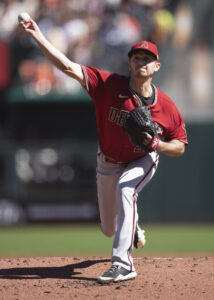
What Davies has been able to do, however, is limit hard contact in order to keep runs off the board. 45% of balls in play he’s allowed in his career have been on the ground. In 2022, Statcast put his average exit velocity allowed in the 75th percentile of qualified pitchers, along with a hard hit rate that’s in the 76th percentile.
The Diamondbacks signed Davies for the 2022 season on a one-year deal. He made 27 starts for the Snakes, logging 134 1/3 innings with a 4.09 ERA. Similar to his career overall, he paired a modest 17.9% strikeout rate with a solid 9.1% walk rate and 42.9% ground ball rate but kept runs off the board with the aforementioned weak contact. His fastball only averaged 89.6 mph but he also mixed in a changeup, cutter, curveball and slider in order to keep hitters off balance.
It may not be an exceptionally exciting move for fans of the Diamondbacks, but it’s one that has some sense to it. Zac Gallen figures to be the club’s ace with Merrill Kelly a pretty reliable bet for a mid-rotation role. Madison Bumgarner has struggled in recent year but will likely be serving as an innings-eating veteran at the back end.
Outside of those three, there’s a group of youngsters who showed promise in 2022 but haven’t cemented themselves at the big league level. Ryne Nelson and Drey Jameson both showed encouraging signs late last year, but Nelson only has three big league starts and Jameson just four. They will both be 25 in the upcoming season and still have options. Tommy Henry is also going into his age-25 season, though his nine-start debut was less impressive and he’s probably ticketed for more minor league development. The Diamondbacks also have a highly-touted pitching prospect in Brandon Pfaadt, who has yet to crack the 40-man roster. However, he did reach Triple-A last year and is generally considered one of the top 100 prospects in the league.
The Diamondbacks started to integrate that young talent into their rotation in 2022 and will surely be looking to continue down that path in 2023. However, prospect development rarely occurs in a strict linear fashion, especially when it comes to pitchers. As they try to figure out what they have in their young arms, Davies gives them a reliable veteran presence who can likely be counted on to provide some steady work when they need it.
Jon Heyman of the New York Post was first to report the agreement and contract terms.
Image courtesy of USA Today Sports.
Cubs In Agreement With Eric Hosmer
January 4: Hosmer and the Cubs are now in agreement, per Jesse Rogers of ESPN.
January 3: The Cubs and first baseman Eric Hosmer are close to a deal, reports Jon Heyman of The New York Post.
Hosmer, 33, had the good fortune of having the best season of his career just as he entered free agency. He hit .318/.385/.498 in 2017, his last season with the Royals, leading to a wRC+ of 135 that indicates he was 35% better than the league average hitter. He was worth 3.8 wins above replacement that year in the eyes of FanGraphs, with that mark and his wRC+ from that season still standing out as his career best.
Prior to the 2018 season, Hosmer signed an eight-year, $144MM deal with the Padres that went beyond most predictions. That overpay became even more stark once Hosmer’s production dipped with his new team. Since signing that deal, he’s hit .265/.325/.409 for a wRC+ of 100, exactly league average. Though he has four Gold Glove awards, advanced defensive metrics are far less enamoured with his work in the field. All of Defensive Runs Saved, Ultimate Zone Rating and Outs Above Average consider him to be a below-average first baseman for his career. Taken all together, he’s essentially been a replacement-level player over the past five seasons, with his fWAR tally at 0.3 in that time.
Given his large contract and diminished performance, Hosmer’s name has popped up in trade talks for years. The Padres weren’t able to line anything up until this summer. They originally included Hoz in the Juan Soto deal but he used his limited no-trade clause to block that from happening. Luke Voit was put into that deal instead but the Friars then flipped him to Boston along with a couple of prospects, with pitching prospect Jay Groome going the other way. San Diego had to agree to eat all of Hosmer’s remaining salary except for the league minimum in order to get that done.
The Sox promoted young prospect Triston Casas down the stretch and were encouraged enough by his debut to release Hosmer after just a couple of months in Fenway. That left Hosmer free to sign with any team for the league minimum, with the Padres still on the hook for the three remaining years of the deal. The Cubs have seemingly stepped up to be that team. The fit is a fairly logical one for the Cubs, since there’s no real risk for them. If he can make any sort of turnaround towards his previous form, it would be a nice bonus. If not, they’ve made no commitment to him and can simply release him again whenever they want.
The Cubs had no real everyday first baseman in 2022, with the playing time scattered between Alfonso Rivas, Frank Schwindel, P.J. Higgins, Patrick Wisdom and some other role players. Aside from Wisdom, who can also play third base, they all had disappointing years and are no longer on the team’s roster. Higgins and Rivas were both designated for assignment last month while Schwindel is heading to Japan this year.
Arguably, the best in-house option the club has is prospect Matt Mervis. An undrafted free agent who had drawn little attention this time a year ago, he shot up prospect rankings with a monster showing in 2022. He began the season in High-A and completely mashed, producing a batting line of .350/.389/.650, wRC+ of 189. He got bumped to Double-A and hit .300/.370/.596 for a wRC+ of 148. After moving to Triple-A, his line was .297/.383/.593, 152 wRC+. Incredibly, his walk rate improved from 4.6% to 8.7% to 10.4% as he moved up the ladder, while his strikeout rate fell from 24.1% to 20% to 14.6%. The Cubs decided to keep the good times rolling by sending him to the Arizona Fall League, where he hit .262/.324/.590 in 17 games.
Though Hosmer’s addition blocks Mervis from the everyday job in a sense, it also shouldn’t prevent Mervis from seizing it at some point. As mentioned, Hosmer can be jettisoned at any time with no real repercussions for the Cubs. If Mervis seems like the better option, either in Spring Training or later, it should be a fairly easy swap to make. If Mervis struggles to carry forward the momentum from his excellent 2022, Hosmer gives the club a passable veteran to hold down the fort.
The Orioles were also connected to Hosmer since his release from Boston, but they will have to look elsewhere, assuming the deal with the Cubs gets finalized. The O’s have been looking for lefty bats to work into their first base/corner outfield/designated hitter mix and seem to be focused on low-cost options. They’ve signed Nomar Mazara and Franchy Cordero to minor league deals and also claimed Lewin Díaz off waivers, though they later designated Díaz for assignment and traded him to the Braves. A similar situation played out with Jake Cave, who was claimed off waivers from the Twins but then lost to the Phillies on a subsequent waiver claim. Earlier today, the O’s acquired Ryan O’Hearn from the Royals, adding another option into the mix.
Phillies Sign Craig Kimbrel
January 4: The Phillies have officially announced Kimbrel’s signing.
December 23: The Phillies are adding an established closer. They’re reportedly in agreement with Craig Kimbrel on a one-year, $10MM pact. Kimbrel is a SportsMeter client.
Philadelphia will be the seventh MLB team for Kimbrel, who is headed into his 14th season. He returns to the NL East, where he was arguably the sport’s best closer from 2011-14 as a member of the Braves. Kimbrel remained excellent after being dealt to the Padres and subsequently to the Red Sox. Dave Dombrowski was running baseball operations in Boston while Kimbrel was there for three straight All-Star seasons between 2016-18. They’re now reunited with Dombrowski leading the charge in Philly.
Since leaving the Red Sox, Kimbrel has had his share of ups and downs. He lingered in free agency until June 2019 before securing a three-year commitment from the Cubs. That deal looked like a misfire after he posted an even 6.00 ERA in 41 appearances through the end of the 2020 campaign. However, he looked good as ever at the start of the third season. The right-hander posted a microscopic 0.57 ERA through 31 2/3 innings in the first half of 2021, securing his eighth All-Star selection in the process. The Cubs flipped him to the crosstown White Sox in a deadline deal that brought back Nick Madrigal.
Kimbrel didn’t finish the season all that well, posting a 5.09 ERA for the Sox. Chicago exercised a $16MM option on his services for the 2022 season but shopped him most of last winter. In the days leading up to Opening Day, they sent him to the Dodgers in a one-for-one swap for AJ Pollock. Kimbrel spent his age-34 campaign in Los Angeles, putting up solid numbers overall but showing some worrisome signs down the stretch.
While his first half ERA was a pedestrian 4.35, he struck out more than a third of opponents in that time. The Dodgers relied upon him as their primary closer early in the year, but he began to fall out of favor as the season pulled along. Kimbrel’s strikeout rate in the second half was a modest 20.7%. His ERA checked in at 3.10 thanks to a meager .227 batting average on balls in play against him. The Dodgers were clearly skeptical of Kimbrel’s ability to maintain that kind of batted ball fortune. They removed him from the ninth inning in September and scratched him from the roster entirely come playoff time.
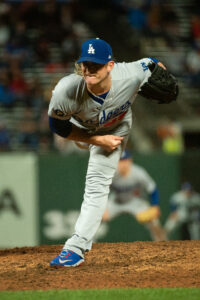
It’s surely not the way either Kimbrel or the team envisioned the season ending, but his 2022 campaign was hardly a disaster. He posted a 3.75 ERA across 60 innings overall. His 27.7% strikeout rate and 12.1% swinging strike percentage were each a bit better than par, and he averaged a quality 95.8 MPH on his fastball. He walked batters at a elevated 10.8% clip and gave up a fair bit of hard contact, but he still showed quality bat-missing stuff. While it wasn’t vintage Kimbrel or even at the level of his 2021 production, he showed enough to believe he’s still capable of solid play.
Kimbrel went 22 of 27 on save attempts this year. He’s now up to 394 saves for his career, most of any active player. Kimbrel should soon become the seventh pitcher in MLB history to reach the 400-save mark, and he’ll have a path back to ninth-inning work in Philadelphia. Players like José Alvarado and Seranthony Domínguez previously stood as the in-house favorites for closing work, though they’re each capable of taking on higher-leverage responsibilities in the seventh or eight inning.
It’s a relatively low-cost gamble for the Phils, matching the $10MM flier they took on Corey Knebel last offseason. They’ll have to tack on a few million extra in taxes, as they’re likely to exceed the luxury tax threshold for a second straight season. Philadelphia’s luxury tax commitments are up to approximately $251MM, as calculated by Roster Resource. They’re subject to a 30% tax on every dollar spent between $233MM and $253MM, so the Kimbrel signing comes with an extra $3MM in fees. It also brings them within a couple million dollars of the second CBT threshold at $253MM. That would come with a 42% tax on overages, with higher penalties in the event they top $273MM.
Precisely where owner John Middleton wants to draw the line isn’t clear, though the Phils have little reason to spare much expense on the heels of a pennant win. Philadelphia has already brought in Trea Turner and Taijuan Walker this winter, and Kimbrel joins Matt Strahm as relief additions. The Phils are set for another battle with the Mets and Braves in a top-heavy NL East, and they’ll hope Kimbrel has plenty of opportunities to lock down wins at the back end of the bullpen.
Ken Rosenthal of the Athletic first reported Kimbrel and the Phillies had agreed to a contract. Jeff Passan of ESPN was first to report the one-year, $10MM guarantee.
Image courtesy of USA Today Sports.
White Sox Sign Andrew Benintendi
January 3: The White Sox have officially announced the Benintendi signing and provided a specific contract breakdown. The outfielder will receive a $3MM signing bonus, followed by an $8MM salary in 2023, $16.5MM for the next three years and then $14.5MM in 2027. The club’s 40-man roster is now at 39.
December 16: The White Sox have agreed to a five-year contract with free-agent outfielder Andrew Benintendi, reports ESPN’s Jesse Rogers (via Twitter). Benintendi, a client of Excel Sports Management, will be guaranteed $75MM on the contract, tweets Ken Rosenthal of The Athletic.
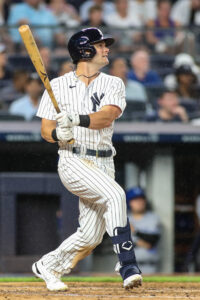
Benintendi, 28, was the No. 7 overall pick in the 2015 draft by the Red Sox and ranked as the sport’s No. 1 prospect at Baseball America, ESPN and MLB.com prior to his big league debut. The runner up to Aaron Judge for American League Rookie of the Year honors in 2017, he turned in a brilliant .290/.366/.465 batting line with 18 home runs and 21 steals a year later in 2018, seemingly setting the stage for him to break out into full blown stardom.
That never really transpired, however. Four full seasons have gone by since that time, and Benintendi has instead settled in as a solid regular in left field but not the perennial All-Star he looked to be early in his big league tenure. He’ll typically hit for average, draw plenty of walks and play good defense — Benintendi won a Gold Glove in 2021 — but he’s never settled in as a consistent power threat. Benintendi’s 20 home runs in 2017 still stand as his career high, and he hit just five home runs in 521 plate appearances between the Royals and Yankees in 2022 before a fractured hamate in his wrist ended his season.
Over the past four seasons, Benintendi has posted a combined .276/.345/.417 batting line with 35 home runs and 27 steals. He’s always been tough to strike out, but never more so than in 2022, when he fanned in just 14.8% of his plate appearances. It’s possible Benintendi took a more conservative, contact-oriented approach that resulted both in him hitting fewer home runs but also putting the ball in play with more frequency. Regardless, the lack of punchouts likely appealed to a White Sox club that posted the seventh-lowest strikeout rate in all of baseball last year and watched as the Guardians won the AL Central with by far the game’s lowest strikeout rate.
A corner outfielder and left-handed bat to help balance out a heavily right-handed club were both clear needs for the South Siders, and Benintendi can check both boxes. He’ll hit at or near the top of the lineup, with Eloy Jimenez like sliding into a primary DH role now that Benintendi is on board. The Sox also bid farewell to stalwart first baseman Jose Abreu this offseason, which cleared the way for Andrew Vaughn to move from right field, where he ranked as one of MLB’s worst defenders at any position, to his natural position of first base.
Removing Vaughn and Jimenez from regular outfield work would’ve improved the outfield defense regardless of the replacements, but plugging Benintendi into the mix provides a substantial upgrade. In 5775 career innings in left field, he’s been credited with 32 Defensive Runs Saved. It’s notable that Statcast’s Outs Above Average feels quite differently, pegging Benintendi at -15 in that same time, although that’s skewed by one -10 season in 2019 (a season that DRS agrees was below average from a defensive standpoint). Benintendi and center fielder Luis Robert give the Sox a pair of above-average defenders in the outfield, although if the plan for right field is to use Gavin Sheets as a bridge to prospect Oscar Colas, at least one of the three outfield spots will still have the potential to be a defensive liability.
The White Sox opened the 2022 season with a club record $193MM payroll, and the addition of Benintendi figures to put them right back into that range again. Benintendi also pushes Chicago’s luxury-tax ledger a bit north of $205MM, per Roster Resource, though that’s still $28MM from the $233MM first tier of penalization. The Sox could still use help at second base and could stand to deepen their bench, so it’s likely that subsequent moves will push the team to a franchise-record payroll for a second season (barring a trade that sheds a current contract).
Somewhat remarkably, the $75MM guarantee gives Benintendi the largest contract in White Sox franchise history, narrowly topping Yasmani Grandal, who’d held the record at $73MM. The ChiSox have offered more than this in some high-profile free agent pursuits in recent years, most notably offering more than $200MM to Manny Machado and more than $100MM to Zack Wheeler. Both players, of course, ultimately signed elsewhere.
Nationals To Sign Dominic Smith To One-Year Deal
The Nationals and first baseman/outfielder Dominic Smith are in agreement on a one-year deal, pending a physical. He will make a $2MM salary with a further $2MM available in performance bonuses. Smith is a client of Roc Nation Sports.
Smith, 28 in June, is a former first round pick, having been selected by the Mets 11th overall in 2013. He went on to earn high praise from prospect evaluators, with Baseball America ranking him one of the top 100 prospects in the game in 2014, 2016 and 2017. He struggled in his first tastes of the majors in 2017 and 2018 but seemed to finally click in 2019. He hit 11 home runs in 89 games and produced a batting line of .282/.355/.525. That production was 34 percent better than league average, as evidenced by his 134 wRC+.
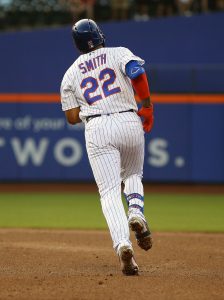 The problem was that 2019 was also the rookie breakout of Pete Alonso, who launched 53 home runs and cemented himself as the first baseman in Queens. That forced Smith to move off first and spend more time in left field, where he’s been ranked as a poor defender. He continued hitting in the shortened 2020 season though, launching 10 home runs in just 50 games and finishing with a line of .316/.377/.616, wRC+ of 166.
The past couple of campaigns have been a struggle, as he played through a partially torn labrum in 2021 and saw his batting line fall to .244/.304/.363 and a wRC+ of 86. In 2022, he struggled at the start of the season while battling J.D. Davis for playing time and was optioned to Triple-A for a time. He finished the year with a batting line of .194/.276/.384 in the majors for a 67 wRC+, but a .284/.367/.472 in the minors for a 122 wRC+.
Smith still could have been retained via arbitration for another couple of seasons, with MLBTR contributor Matt Swartz projecting him for an arbitration salary of $4MM in 2023. Instead, the Mets decided it was time to move on and non-tendered him. Smith will now join the Nats at a slightly lower guarantee but still could get to that $4MM figure via the incentives. If he has a successful campaign, the Nats can retain him for 2024 via arbitration, or use the extra year as a selling point in shopping Smith at the deadline.
Perhaps more importantly, Smith has a chance to get a regular job as a first baseman for the first time in years, with Bob Nightengale of USA Today reporting that’s where Smith will be playing. The rebuilding Nationals had Josh Bell at first for 2021 and the first half of 2022, but he went to the Padres in the Juan Soto trade and is now a free agent. The Nats got Luke Voit back in that deal but non-tendered him at season’s end. After Bell’s departure, 30-year-old rookie Joey Meneses got an extended look and mashed 13 home runs in 56 games. He will likely get plenty more at-bats in 2023 but he can also play the outfield corners, or he and Smith could share first base and the designated hitter slot. Jeimer Candelario could be in the mix as well, though he and Carter Kieboom will be jockeying for the third base job.
Since being non-tendered by the Mets, Smith has also garnered interest from the Rays, Royals, Cubs and Padres. If those clubs are still looking to bolster their first base depth charts in the coming weeks, some of the remaining free agents include Voit, Trey Mancini, Eric Hosmer and Brandon Belt.
Bob Nightengale of USA Today first reported that the two sides were in agreement on a one-year deal. Robert Murray of FanSided first reported the financial breakdown.
Image courtesy of USA Today Sports.
Yankees Appoint Brian Sabean Executive Advisor To Brian Cashman
The Yankees announced today that Brian Sabean has been appointed executive advisor to senior vice president and general manager Brian Cashman.
This is a homecoming for Sabean, as he began his career in Major League Baseball with the Yankees. He was hired as a scout back in 1985, later earning other titles such as director of scouting and vice president of player development/scouting. He was with the organization as they drafted and signed the young players that would later form the core of the club that won four championships from 1996 to 2000. In relaying today’s news, Joel Sherman of The New York Post recalls a statement Cashman made about the teams of the ’90s. “The underrated heroes of the dynasty are Bill Livesey and Brian Sabean,” Cashman said.
However, Sabean was no longer with the Yankees when those trophies were lifted. He joined the Giants in 1993 as assistant to the general manager and vice president of scouting/player personnel. He would later be promoted to general manager in 1996. The Giants finished 68-94 in that year but went on to post winning records in each season from 1997 to 2004. They dipped below .500 for a few years but later returned to success in a big way, winning the World Series in 2010, 2012 and 2014.
After that third title, Sabean was given the new title of executive vice president of baseball operations and seemed to move away from the day-to-day business of running the club. Bobby Evans took over as the general manager and stayed in that role through the 2018 season. At that point, he was reassigned and Farhan Zaidi was hired as president of baseball operations. As those transitions were taking place, Sabean seemed to have moved into an advisory/scouting role.
The Giants released a statement about Sabean’s hiring to reporters, with Alex Pavlovic of NBC Sports Bay Area among those to relay it on Twitter. “The San Francisco Giants would like to extend its deepest gratitude to Brian Sabean for his enormous contributions to our organization and wish him the best of luck in his new position with the New York Yankees.” The statement goes on to list the club’s aforementioned accomplishments during his tenure, before finishing thusly: “We truly believe he’s a Hall of Fame worthy executive in every sense of the word and wish him, his wife Amanda, and his entire family nothing but the best in the future. He will always be a Forever Giant.”
In the past few years, he has been connected to front office jobs with the Marlins and Mets that didn’t come to fruition, but he will now return to where his career began and rejoin the Yankees.
Red Sox, Rafael Devers Avoid Arbitration
12:30pm: The Red Sox formally announced that Devers has signed a one-year deal for the 2023 season.
11:37am: The Red Sox have agreed to a one-year, $17.5MM contract with third baseman Rafael Devers, reports ESPN’s Jeff Passan (via Twitter). That’ll avoid an arbitration hearing for Devers’ final season of eligibility but does not extend the team’s control over the All-Star slugger. He’ll be a free agent next offseason. Devers had been projected by MLBTR contributor Matt Swartz to earn $16.9MM this coming season but will top that mark by $600K. Devers is a client of Rep 1 Baseball.
Devers, 26, has cemented himself as one of the American League’s top hitters over the past several years, hitting at a combined .292/.352/.532 clip with 108 plate appearances in 2228 homers dating back to 2019. Along the way, he’s been named to a pair of All-Star teams and won a Silver Slugger Award.
A long-term extension with Devers has been a priority for Boston’s front office for some time, but a sizable gap between the two parties has remained — and that was before Devers watched several mid-20s free agents ink contracts of 11 or more years in length this offseason. One would imagine that the revitalized trend of contracts reaching or even exceeding ten years in length has only further prompted Devers to ponder what he might be able to earn in an open-market setting.
That said, there’s still ample time for the Red Sox to close the gap in negotiations. The fact that the two parties were able to amicably agree on a one-year compromise without needing to resort to a more contentious arbitration hearing bodes well for the status of talks, to an extent. It also frees the two parties to focus negotiations solely on Devers’ would-be free agent seasons.
Long-term deals of that nature are often left to be discussed in Spring Training, but given Devers’ importance to the Red Sox and the dwindling clock, it’s certainly behoove the front office to take every moment available in order to try to work something out. Boston ostensibly waited until last spring to discuss a long-term pact with Xander Bogaerts but only made an unrealistic one-year extension offer. They broadcast confidence in their ability to ultimately retain Bogaerts up until the final day that he agreed to terms with the Padres on an 11-year, $280MM contract. Certainly, one would imagine Sox brass hopes to avoid a similar sequence with Devers, who’s four years younger than Bogaerts and thus would be positioned all the more favorably in free agency.
However extension talks play out, there’s benefit to the Red Sox in securing this cost certainty on Devers sooner than later. With Devers’ salary locked in, the Sox are now projected for an Opening Day payroll just shy of $187MM, per Roster Resource. Their projected $212.6MM luxury-tax ledger sits more than $20MM shy of the $233MM first tier of penalization. Boston quite arguably still has needs behind the plate, in the rotation and on the bench, and knowing the exact price point on Devers helps chief baseball officer Chaim Bloom and his staff gain a better picture of just how many resources are available before any concerns pertaining to the luxury tax — if they exist at all — need to be considered. Boston would be a second-time luxury offender upon exceeding the tax threshold in 2023.
Diamondbacks To Sign Evan Longoria To One-Year Deal
The Diamondbacks and third baseman Evan Longoria are in agreement on a one-year deal that will guaranteed him $4MM with another $1MM available in incentives. Longoria is a client of TWC Sports.
Longoria, 37, will be joining just the third organization of his long career, having only previously suited up for the Rays and Giants. He broke in with Tampa in 2008 and had his best seasons from there through 2013. In that six-year stretch, he hit 162 home runs and produced a batting line of .275/.357/.512. That production was 35% better than league average, as evidenced by his 135 wRC+, one of the 25 best such marks across the majors for that period. When combined with his quality defensive work, he tallied 34.2 wins above replacement, according to FanGraphs, the fourth-best mark among all position players with only Miguel Cabrera, Brian McCann and Yadier Molina ahead of him.
It was within that time that the Rays twice gave him a lengthy contract extension. The first came in his 2008 rookie season, a $17.5MM guarantee over six years, plus three club options. After the 2012 season, the second extension triggered the three club options and added another six years and $100MM. That deal ran through the 2022 season with a club option for 2023.
Longoria’s offensive production declined over the 2014-2016 period but was still above average. He hit .265/.322/.454 in that stretch for a wRC+ of 112, 12% better than par but a noticeable drop-off from his previous heights. He took an even bigger dip in 2017, hitting .261/.313/.424 for a wRC+ of 97. At the end of that season, Longoria had accrued nine years and 170 days of service time, just two days shy of the 10-year mark. That was a significant gap since getting to ten years would have given him 10-and-5 rights, as all players with 10 years of service time and who have been with their current team for at least five years earn the right to veto any trade. The ever budget-conscious Rays decided they had to move Longoria before he gained those rights and flipped him to the Giants going into 2018.
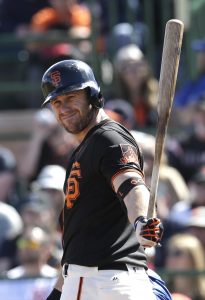 Since moving to California, it’s been a rocky time for Longoria. In his first three seasons as a Giant, he hit .250/.302/.425 for a wRC+ of 93. He bounced back to being an above-average hitter over the last two seasons but injuries limited his overall contributions. He slashed .253/.333/.466 over 2021 and 2022 for a wRC+ of 118, but in just 170 games. A left shoulder sprain and right hand contusion sent him to the injured list in 2021. Finger surgery put him on the shelf for the beginning of the 2022 season and he was later sidelined by a left oblique strain, a right hamstring strain and a thumb fracture.
The Giants had an $8MM decision to make on Longoria, choosing between a $13MM option or a $5MM buyout. Picking up that option and adding the $8MM onto their ledger would have been a defensible decision based on his resurgence at the plate, but there were also reasons for concern. Beyond the injuries, Longoria’s previously excellent defensive grades have slipped, a fairly expected development for a player moving into his late 30s. Also, his metrics like exit velocity and hard hit rate have been trending downward, not shocking for a player his age but something that had to be taken into consideration. In the end, the Giants decided to move on and went for the buyout, sending Longoria into free agency for the first time in his career.
Longoria expressed a preference for either returning to one of his two previous clubs or signing with the Diamondbacks, since he has a home in Arizona. In the end, he will indeed join the team near his home, with the club making for a fairly sensible fit for him. A young up-and-coming team, the D-Backs could surely benefit from having a veteran presence like Longoria in the clubhouse and in the dugout.
In terms of the fit on the roster, third base wasn’t completely secured prior to this deal. Josh Rojas has been serving in a utility capacity over the past few years, spending some time in the outfield corners as well as the three infield positions to the left of first base. In 2022, he spent most of his time at third, getting into 89 games there. While he was above-average offensively, the advanced defensive metrics all considered his glovework to be below average. It’s possible that he could still take a step forward in that department since he didn’t play much third base in the minors and is surely still learning the position, but bringing Longoria’s experience aboard should only help there.
There will also be platoon possibilities since Rojas hits from the left side and Longoria the right. Rojas has fairly even splits for his career but was better against righties in 2022, posting a 114 wRC+ with the advantage and a 92 otherwise. Longoria, meanwhile, has a 132 wRC+ against southpaws in his career with a 113 against righties. That would seem to make them a good pairing, though injuries elsewhere on the roster could potentially require Rojas to move elsewhere on the diamond. The club also doesn’t really have an obvious designated hitter at the moment, which could allow both players to be pencilled into the lineup together with regularity, unless Arizona’s many young outfielders eventually push start crowding into the DH mix. But if Longoria were to act as the DH with some frequency, it could give him an edge in overcoming his recent injury track record.
This deal brings the club’s payroll up to $109MM, according to the calculations of Roster Resource. That’s a big jump from last year’s $91MM figure, per Cot’s Baseball Contracts, but the club has been as high as $132MM in the past.
Jon Heyman of The New York Post. first reported the two sides were in agreement on a one-year deal. Nick Piecoro of the Arizona Republic first reported the financial figures.
Image courtesy USA Today Sports.