
Buster Posey Joins San Francisco Giants’ Ownership Group
The San Francisco Giants announced Wednesday that recently retired Buster Posey has returned to the famed organization, albeit as an owner. The 12-year veteran has purchased an unknown minority share in the Giants’ ownership group, recently valued by Forbes at $3.5B. Moreover, Posey will also serve on the Giants’ board of directors. Tyler Kepner of the New York Times first reported that Posey was joining the ownership group and being added to the board of directors.
When discussing the addition of Posey to the ownership team, Greg Johnson, the Giants’ chairman, told Kepner that the two of them want to bridge “the trust gap that exists because of the structure in baseball,” and that Posey is “somebody there that’s respected by the players and part of our ownership group.”
Posey reiterated this idea saying, “I want to be viewed as, like, pro-baseball … I’m not pro-player, I’m not pro-owner, I just love the game of baseball, and this is another opportunity for me to learn more about the game, more about the business and really commit my time to an organization in a city that I’ve grown to love.” Posey, however, clarified that he’s not “taking on any type of front office role” and that he’s going to take a more “hey, let me know where I can help and I’ll help there” approach with his new position.
Posey was originally drafted by the Los Angeles Angeles of Anaheim in the 50th round of the 2005 MLB Draft but chose not to sign and attended Florida State University. Three years later, Posey would be drafted 5th overall in the 2008 MLB draft by the Giants and never looked back, making his Giants debut in 2009 and winning NL Rookie of the Year in 2010. Over the next 10 seasons, Posey would bring home an NL MVP trophy, three World Series rings, five Silver Slugger awards, a Gold Glove, and appear in 7 All-Star games, before retiring after the 2021 season with a career slash line of .302/.372/.460 for an OPS of .831.
Six Teams Set To Pay Luxury Tax In 2022
Six teams are set to pay penalties under the newly restructured competitive balance/luxury tax for their 2022 payrolls, per a report from the Associated Press. Each of the Mets, Dodgers, Yankees, Phillies, Padres and Red Sox is currently over the threshold. That marks just the second time since the luxury tax’s inception that six teams will pay the tax.
This will be the second straight year paying the tax for both Los Angeles and San Diego. Each of the other four clubs was under the threshold in 2021 and thus counts as a first-time luxury tax offender.
The 2022-26 collective bargaining agreement not only saw the tax thresholds increase by a relatively significant margin — it also implemented a newly created fourth tier of penalization. For a reminder, the new thresholds are as follows:
- Tier One: $230-250MM (teams pay a 20% overage)
- Tier Two: $250-270MM (32%)
- Tier Three: $270-290MM (62.5% for first-time payors; 65% thereafter)
- Tier Four: $290MM+ (80%)
For second-time payors (i.e. Dodgers, Padres), those rates jump to 30%, 42%, 75% and 90%, respectively.
While those sound like substantial penalties at first glance, the actual amounts to be paid by most teams in excess of the luxury tax is relatively minimal. Those clubs are only taxed on dollars over the threshold, leading to often trivial sums of money (by the standards of a Major League franchise, anyhow). The Padres, for instance, are less than $3MM over the threshold, per the AP, so even with an increased 30% tax rate they’re only set to pay a bit more than $800K. The Red Sox are roughly $4.5MM over the threshold, putting them in line to pay about $900K in fees. The Phillies ($2.6MM) and even the Yankees ($9.4MM) are also looking at generally small sums, relative to their annual payroll marks.
The only two teams set to pay substantial sums are the Dodgers, who fall just shy of the fourth tier of penalization, and the Mets, who exceeded that tier by nearly $9MM. The Mets are in line to pay as much as $29.9MM in taxes, per the AP, while the Dodgers check in just slightly behind that sum at $29.4MM.
What the AP’s report does not delve into, however, are the other penalties associated with the luxury tax — which some teams view as more detrimental than the fiscal penalizations. Any club that exceeds the first tax threshold by $40MM or more will see its top pick in the following year’s draft pushed back 10 slots, for instance. With regard to the 2023 draft, that applies to both the Mets and the Dodgers.
Tax payors are also subject to stiffer slaps on the wrist when signing free agents who have rejected a qualifying offer and to diminished returns when losing such free agents. CBT payors who sign a “qualified” free agent stand to lose their second- and fifth-highest selections in the draft as well as $1MM from their league-allotted bonus pool for international free agency (which typically represents anywhere from roughly one-sixth to one-quarter of the total pool). That’s in contrast to revenue-sharing recipients, who forfeit only their third-highest pick, and to non-revenue sharing recipients/non-CBT-paying teams, who lose their second pick and $500K from that international pool.
More interesting with respect to this year’s group of luxury payors is the fact that a CBT-paying club who extends a qualifying offer to a free agent only stands to gain a compensatory pick after the fourth round of the 2023 draft. For a team that does not receive revenue sharing and does not pay the CBT, that pick would fall after Competitive Balance Round B — roughly 60 picks higher.
For a team like the Red Sox, who exceeded the tax by just $4.5MM, that means they’ll see their potential compensation for Xander Bogaerts — a lock to receive and reject a qualifying offer — shrink considerably. It also lessens the incentive to extend a qualifying offer to a more borderline candidate like Nathan Eovaldi, who’s been shelved for more than a month due to shoulder inflammation.
It also further welcomes scrutiny of Boston’s decision to hang onto veterans such as Eovaldi, Rich Hill and J.D. Martinez at the trade deadline. It’s certainly commendable that the club sought to remain in the Wild Card mix, but the Sox sent some mixed signals by trading Christian Vazquez (and to a much lesser extent, Jake Diekman) while simultaneously acquiring Tommy Pham and a paid-down-to-league-minimum Eric Hosmer. The Red Sox didn’t really commit to shattering the threshold in the name of an all-out postseason push in 2022 but also didn’t take the necessary steps to maximize their return in the event that Bogaerts departs in free agency. The result could be that their compensation for losing Bogaerts, a four-time All-Star who’s received MVP votes in four different seasons, will be a single draft pick somewhere in the 135 to 140 vicinity next summer. That’s not necessarily a franchise-altering outcome, but it’s also far from ideal.
At one point, the Padres might have faced similar considerations with regard to their own free agents, although they’ve sorted themselves out more organically. Joe Musgrove‘s extension keeps him in San Diego and renders moot any considerations regarding a qualifying offer, though. Meanwhile, fellow starters Mike Clevinger and Sean Manaea looked like potential QO candidates at the time of the trade deadline but have struggled considerably in the second half, lessening the likelihood they’d receive a QO in the first place.
That diminished draft compensation, while not a deterrent for the Mets with regard to their roster construction, will be a reality they face this winter. With as many as four potential QO recipients — Jacob deGrom, Edwin Diaz, Chris Bassitt and Brandon Nimmo — they stand to see the return for those potential departures undercut in a meaningful way. Ditto the Dodgers, who’ll assuredly make a QO to Trea Turner and could at least ponder one for Tyler Anderson. The Yankees, too, have a slam-dunk QO recipient in their lineup (Aaron Judge) and borderline call in their rotation (Jameson Taillon). The Phillies don’t have much to consider with regard to potential qualifying offers.
All told, the six teams in question will pay a combined total of about $73MM in luxury fees, with the Mets and Dodgers accounting for the vast majority of that sum. The luxury tax will hit the Mets the hardest both in terms of actual dollars paid and in terms of return for recipients of the qualifying offer. Both the Padres and Dodgers were content to pay the tax in consecutive seasons, and given the extent by which the Mets exceeded the threshold this year, that’ll likely be the case for them in 2023 as well. Time will tell whether San Diego and Los Angeles are willing to incur an even steeper set of tax penalties as a third-time offender, and it’s certainly plausible that any of the Red Sox, Yankees and/or Phillies could look to dip back under the first tier of penalization next season, when the first-tier threshold increases to $233MM.
Tigers To Hire Scott Harris As President Of Baseball Operations
The Tigers’ search for a new front office leader has reached its conclusion, as they’re set to hire Giants general manager Scott Harris as their new president of baseball operations, per ESPN’s Jeff Passan (Twitter link). Tigers owner Chris Ilitch fired Al Avila from his post as general manager back on Aug. 10.
Harris spent three seasons as the Giants’ general manager, working in that role under San Francisco president of baseball operations Farhan Zaidi. He’d previously spent eight seasons with the Cubs (2012-19), rising from director of baseball operations to the title of assistant general manager. Prior to that, he worked for Major League Baseball as the league’s coordinator of Major League operations. Harris, who graduated from UCLA with a Bachelor’s Degree in Economics in 2009 and got his MBA from Northwestern’s Kellogg School of Management in 2015, has also spent time with the Nationals (2008) and Reds (2010).
A key lieutenant to baseball ops leaders Theo Epstein and Jed Hoyer during the Cubs’ most recent run of prominence, Harris was hired away by San Francisco in Nov. 2019 and played an even larger role with the Giants as they authored an MLB-best 107-win season in 2021. The Giants nonetheless fell to the archrival Dodgers in the National League Division Series, however, and the 2022 season has been every bit as disappointing as the 2021 campaign was heartening in San Francisco. This year’s Giants have, to date, faceplanted with a 69-77 record and have been out of the postseason picture for the majority of the summer. They’ll look to reload for the 2023 season, but they may be in the market for a new general manager to work under Zaidi.
Harris will now step into the spotlight for an organization that’s had an even more disheartening 2022 season than the one he’s leaving behind. The Tigers, encouraged by a 69-66 post-April showing in 2021, expected 2022 to be a turning point at the end of a nearly half-decade rebuilding effort. Detroit had gone to great lengths to build out its research and analytics department, and the hiring of A.J. Hinch as manager prior to the 2021 season represented a clear “win-now” mindset. Heading into 2022, top prospects Spencer Torkelson and Riley Greene were on the cusp of joining touted young pitchers Casey Mize, Tarik Skubal and Matt Manning on the big league roster, and Detroit had enjoyed strong 2021 showings from Jeimer Candelario, Rule 5 pickup Akil Baddoo and veteran second baseman Jonathan Schoop, among others.
An active offseason brought free agents Javier Baez, Eduardo Rodriguez and Andrew Chafin to Detroit, where they were joined by trade acquisitions Austin Meadows and Tucker Barnhart. Unfortunately, nearly every single one of those acquisitions (save for Chafin) has flopped to date, owing to a combination of poor health, off-the-field issues and simple poor performance. Their lack of production has been compounded by an overwhelming rash of injuries, most notably Mize requiring Tommy John surgery and Skubal undergoing flexor surgery. Manning is healthy now but missed most of the year due to shoulder trouble. Beyond that, key 2021 performers like Baddoo, Schoop and Candelario have struggled immensely.
It was a catastrophic season that cost Avila his job and now places Harris squarely in the midst of his own conundrum. The Tigers have Rodriguez signed for another four years and Baez for another five, pending future opt-out clauses that, at present, appear unlikely to be exercised. Meanwhile, Torkelson and Greene, expected to be key cogs that drive the engine of a more competitive lineup, have often looked overmatched in their debut efforts. Mize will miss a substantial portion of the 2023 season, and the same could be true of Skubal. The young core that served as such a source of optimism is at least temporarily in tatters.
Enough went wrong in 2022 that the Tigers reportedly at least pondered listening to offers on Skubal at the trade deadline, before his injury troubles flared up. A swap always seemed unlikely, but the very fact that such a possibility even merited consideration is emblematic of the stalled rebuilding efforts and the challenges that Harris will now face.
It seems unlikely that ownership will green-light yet another arduous rebuilding effort, but at the same time, there’s no easy fix in store. The Tigers appear further from contending than they did a year ago at this time — certainly more than just one or two acquisitions away from righting the ship. Meanwhile, last winter’s additions of Baez and Rodriguez have added some notable heft to future payrolls, and injuries have at least temporarily thinned out the promising young core.
There are some parallels between the current Tigers and the 2020-22 Giants that Harris helped to overhaul. No one pegged the Giants as anywhere close to the best team in baseball heading into the 2021 season, and even the 29-31 showing by the 2020 Giants exceeded some expectations after a run of three seasons that saw the club play at a 214-272 pace. Both play in cavernous home parks that could appeal to pitchers looking to rebuild their stock after tough seasons and/or injuries.
The Giants, under Harris and Zaidi, developed a reputation as one of the best teams in baseball (if not the best team) at revitalizing the careers of pitchers. Kevin Gausman, Anthony DeSclafani, Alex Wood, Drew Smyly, Tyler Anderson and Jakob Junis are just some of the names who’ve gone to San Francisco in the past few years and significantly improved their stock. They also showed a knack for unearthing quality hitters in little-noticed moves (e.g. Mike Yastrzemski, Donovan Solano, Darin Ruf). Surely, Ilitch hopes that Harris can bring some of that success to his new home in Detroit.
Harris is jumping into a situation that’s less common — albeit certainly not unheard of — for newly hired baseball ops leaders. Many owners cut bait on a GM or president and bring in a new voice and perspective to help guide the club through a rebuild, but what was supposed to be the heavy lifting of the rebuild has already been performed in Detroit. It’ll now be incumbent upon Harris to find a way to further build out the organization’s infrastructure, add some new faces to the roster and get more out of current underperformers (e.g. Baez, Torkelson) without completely tearing things back down to the studs.
If there’s a small silver lining, it’s perhaps that the Tigers play in a fairly weak American League Central division. There’s no Dodgers-esque juggernaut looming atop the standings. That bodes well for a return to contention sooner than some critics may expect, but a lot will need to go right for the Tigers to prevent their current eight-year playoff drought from ballooning to a decade.
Ozzie Albies Suffers Fractured Right Pinky Finger
3:07PM: Albies will be in a cast for three weeks but he won’t require surgery. The Braves will continue to evaluate the second baseman for his health and possible readiness for the playoffs. (MLB.com’s Mark Bowman was among those to report the news.)
8:20AM: The Braves have officially placed Albies back on the injured list, albeit the 10-day IL. To fill the vacant 28-man roster spot, Rylan Bannon has been called up from Triple-A Gwinnett. Bannon has bounced around this season, having begun the year with the Orioles before being placed on waivers and claimed by the Dodgers and then the Braves in mid-August. In 81 at-bats at the Braves’ top-level affiliate, the righty has slashed .323/.432/.477, good for a .909 OPS.
SEPTEMBER 17TH: In just his second game back since being activated off the 60-day injured list, Braves second baseman Ozzie Albies suffered a fractured right pinky finger in tonight’s game against the Phillies. The injury occurred during a slide into second base in the fourth inning, and Albies was replaced by Vaughn Grissom at second base for the top of the fifth.
The severity of the injury isn’t yet known, though the fact that initial x-rays determined the problem before the game was over could indicate more than just a small fracture. It would seem like Albies’ 2022 season could be over, perhaps even if Atlanta made another run to the World Series.
Albies was a big contributor to last year’s championship team, earning his second career All-Star and Silver Slugger honors while also finishing 13th in NL MVP voting. However, Albies was off to a relatively slow start over the 2022 campaign’s first two months before he suffered a left foot fracture on June 13 and had to undergo surgery. As noted, Albies was sidelined until just yesterday, when he went 1-for-4 with two RBI in Atlanta’s 7-2 win over Philadelphia.
The Braves have managed to thrive even without Albies for much of the season, and Grissom has somewhat unexpectedly stepped up as an immediate contributor after being promoted from Double-A a little over a month ago. Grissom has hit .304/.355/.482 over his first 121 plate appearances in the majors, leading to some speculation that the Braves would try Grissom in left field in order to keep his hot bat in the lineup. However, it seems as though opposing pitchers have started to adjust to Grissom, as the rookie has only a .607 OPS over his last 67 PA.
Nevertheless, in the wake of Albies’ injury, it would seem like Grissom will now again be the top choice at second base for the remainder of the regular season and postseason. Orlando Arcia is also on hand to provide depth, and Ehire Adrianza is also on hand, but currently on the IL himself due to a quad strain. Pat Valaika, Hernan Perez, and Ryan Goins are some of the Triple-A options with MLB experience, though Atlanta could have to add any of those players to the 40-man roster.
It was less than a year ago that the Braves overcame the odds by winning the World Series despite losing a star player (Acuna) to injury for much of the season and throughout the playoffs. While the book isn’t yet closed on Albies’ possible availability in the postseason, his absence for at least a few weeks will make it harder for the Braves to overtake the Mets in the NL East, and potentially capture a first-round bye. The NL East runner-up is all but guaranteed to be the NL’s top wild card team and thus is set to host all three games (if necessary) of the Wild Card Series, yet Atlanta would obviously love to avoid those extra games and an extra chance of elimination.
Mariners Place Eugenio Suarez On 10-Day Injured List
The Mariners have placed third baseman Eugenio Suarez on the 10-day injured list due to a fracture in the tip of his right index finger, manager Scott Servais told reporters (including The Athletic’s Corey Brock, The Seattle Times’ Ryan Divish, and MLB.com’s Daniel Kramer). Utilityman Dylan Moore has been activated from the 10-day IL to take Suarez’s roster spot, with Moore returning after about three weeks missed due to an oblique strain.
More will likely be known about Suarez’s timeline after he visits a specialist on Monday, but for now, there is optimism that the fracture is minor enough that he’ll be able to return before the regular season is over. However, he might be limited to designated hitter work if he is able to come back, as throwing is the biggest question mark for the right-handed Suarez.
Losing Suarez is a big setback for a Mariners team that has been on a dream run for the last few months, positioning themselves to win a wild card and reach the postseason for the first time since 2001. Beyond just making the playoffs, the M’s were looking to make a deep run into October, yet that will be a lot more difficult if Suarez is limited or perhaps unable to play whatsoever.
After struggling in both the 2020 and 2021 seasons, Suarez became an expendable piece for the cost-cutting Reds, who dealt Suarez and Jesse Winker to Seattle in March for a package of four younger players. Ironically, Winker was seen as the big get at the time, as Suarez’s inclusion in the deal was largely seen as a contract the Mariners had to absorb in order to pry Winker out of Cincinnati.
As it has turned out, Winker has delivered roughly league-average offense in 2022, while Suarez has bounced back to become one of the Mariners’ top bats. The third baseman has hit .235/.335/.470 with 31 home runs over 594 plate appearances, translating to a 133 OPS+/135 wRC+. Though Suarez has a league-high 183 strikeouts, he has been crushing the ball when he has made contact, and his 12% walk rate is in the 90th percentile of all players. Beyond the offensive production, Suarez has also been something of an unexpected benefit at third base, with positive grades (+1 Outs Above Average, +3 Defensive Runs Saved, +2.1 UZR/150) from several public defensive metrics.
Only 25 position players have a higher fWAR than Suarez’s 4.4 number, making him a difficult player for the Mariners to feasibly replace. If he is able to return as a DH and keep on hitting, the M’s would be more than pleased with that outcome — given how Carlos Santana has been inconsistent as the team’s regular designated hitter, Suarez might even be an upgrade in the role.
Third base is another story, as Moore and Abraham Toro figure to be the top options in the short term. Servais said that Jake Lamb will also get some work at the hot corner, and regular first baseman Ty France also took some grounders at third base today. France has past experience as a third baseman but he hasn’t played the position at all this season, and made only 11 appearances at third base in 2020-21.
Braves Activate Ozzie Albies, Designate Jay Jackson For Assignment
The Braves announced Friday that second baseman Ozzie Albies has been reinstated from the 60-day injured list. Fellow infielder Ehire Adrianza was placed on the 10-day injured list with a strained quadriceps to open a spot on the active roster, while righty Jay Jackson was designated for assignment in order to clear a 40-man spot for Albies.
Albies, still just 25 years old, hasn’t appeared in a game since June 13 thanks to a broken left foot that ultimately required surgery. The Braves, at one point, were hopeful of a mid-August return for the two-time All-Star and Silver Slugger winner, but Albies’ recovery took a bit longer than that best-case scenario. Even without Albies’ all-around excellence, however, the Braves have been one of MLB’s hottest teams. Since his injury, Atlanta has played at a sweltering 52-28 pace, surging to just one game back of the NL East lead.
Inserting Albies back into the lineup will only make the Braves all the more dangerous. He is, after all, a .270/.321/.470 career hitter whose most recent full-season, 2021, was also the first 30-homer campaign of his impressive young career.
In Albies’ absence, the Braves have cycled through several options at the keystone. None of Orlando Arcia, Phil Gosselin or the aforementioned Adrianza hit particularly well in limited action at the position, however, and the organization eventually made the decision to call top prospect Vaughn Grissom up directly from Double-A in an effort to get more production from second base. Grissom has flashed all the tools that make him such a ballyhooed prospect in his initial look at the MLB level, but his bat has also cooled after a blistering start to the his career. Grissom slashed .420/.463/.660 through his first 14 games (54 plate appearances), but he’s batting just .210/.269/.333 in 17 games since and is has only one hit in his past five games.
For now, Grissom will stay on the big league roster despite the fact that Albies will step back into a full-time role at second base. There’s been talk of giving Grissom some time in left field, where neither Eddie Rosario nor Marcell Ozuna has provided much value to the lineup this season. There are also DH at-bats to go around, of course, so it’s possible for both Albies and Grissom to be in the lineup — which would come at the expense of playing time for some combination of Rosario, Ozuna and deadline acquisition Robbie Grossman.
The 34-year-old Jackson wasn’t on the active roster prior to today’s move but had been occupying a 40-man spot while pitching with Triple-A Gwinnett. He’s handled himself quite nicely there, to put things mildly; in 17 2/3 frames with Gwinnett, Jackson allowed just three runs on 13 hits and three walks with 20 strikeouts — good for a 1.53 ERA.
Jackson’s DFA is largely a case of poor timing and unfortunate (for him) circumstances. He missed the first several months of the season due to a lat strain and never really got much of a look in Atlanta thanks to an already loaded bullpen. The Braves are deep in quality veteran options, with Kenley Jansen, Raisel Iglesias, A.J. Minter, Tyler Matzek, Collin McHugh and Kirby Yates all under contract and pitching well. Rookie left-hander Dylan Lee has quietly been dominant for Atlanta, and the only other spot in the bullpen is currently occupied by out-of-options righty Jackson Stephens, who has pitched to a solid 3.74 ERA in a multi-inning role there.
The Braves could’ve opted to jettison Stephens and go with Jackson, but doing so would have required them to place Stephens on waivers, given his lack of minor league options. Jackson, who returned to the Majors in 2021 after spending the 2020 season in Japan, can become a free agent at season’s end under the terms of the contract he inked, MLBTR has confirmed. As such, the choice effectively boils down to four more years of Stephens versus a few more weeks of Jackson.
Given that Jackson is still owed the balance of a $1.5MM Major League salary, wouldn’t be playoff-eligible for a new team and is a free agent after the season, there’s a good chance he’ll clear waivers even in spite of his big showing in Gwinnett. If that’s the case, he could remain on hand as a depth option who could be summoned in the event of a late injury. Either way, he’ll reach the open market again this winter on the heels of a solid 2021-22 showing in Triple-A and having posted a combined 3.52 ERA with a 30.5% strikeout rate and 12.6% walk rate in 23 big league innings between San Francisco (21 2/3) and Atlanta (1 1/3) over the past two seasons.
Mets Conducting Interviews For Team President; Sandy Alderson To Eventually Transition To Advisory Role
The Mets announced Thursday afternoon they’ve begun a hiring process for a new team president. Sandy Alderson will remain in the role until a new hire is finalized, at which point he’ll become a “special advisor” to ownership. Andy Martino of SNY reported the development shortly before the team announcement.
Mets owner Steve Cohen settled on Alderson as team president in the fall of 2020, a couple months before his purchase of the franchise from the Wilpon family was even finalized. As soon as that sales process closed, the club parted ways with then-general manager Brodie Van Wagenen and much of his high-ranking staff and announced Alderson’s hiring.
“When I asked Sandy to come back to the team, it was for a defined period of time and with a specific mandate — revive our culture and this iconic franchise for our fans, partners and employees,” Cohen said today in the press release announcing the news. “Sandy has done those very things and more and we have begun a search for his successor. When we find that person, I have asked Sandy to continue in a new role as special advisor to me and the senior leadership team.”
Alderson originally signed a two-year contract, which Martino reports is set to expire at the end of December. According to Martino, Alderson and Cohen mutually agreed it was time to bring in a new team president. None of the specific candidates are yet known, although Martino adds the people currently under consideration primarily come from business backgrounds as opposed to baseball operations careers. No hiring appears imminent, and Alderson is expected to remain team president until a new hire is found, even if that process stretches past the official expiration of his contract.
The team president role is an overhead position, with that individual responsible for impacting both the baseball and business operations of the organization. Alderson is not the team’s day-to-day baseball ops decision-maker, and the incoming hire is not expected to take that role either. Daily baseball operations tasks fall to general manager Billy Eppler, who signed a four-year contract last November. There’s no indication that Alderson’s change will have any impact on Eppler’s job status; Martino writes that Mets ownership has been “pleased” with Eppler’s work thus far, hardly a surprise considering the team is a lock to reach the playoffs and is battling the defending World Series champion Braves for the NL East title.
Alderson had been the Mets daily baseball operations decision-maker in the past, serving as GM from 2010-18. He stepped away in the summer of 2018 after being diagnosed with cancer. He returned to the organization a year and a half later but has seemingly never had any interest in reassuming his old responsibilities. The 74-year-old was pressed into temporarily running the baseball operations department late last season, but Jon Heyman reported at the time that Alderson had no interest in taking the role permanently.
The Mets hired Eppler this past offseason, with Alderson sliding back into his team president position for the second year of his deal. Martino adds that he and Cohen always planned to limit his time in that capacity to two years; his forthcoming move into a less demanding advisory role isn’t tied to any new health concerns, fortunately.
Alderson’s time as team president was not without a notable misfire. Not long after returning to the organization, Alderson helped orchestrate a GM search process that culminated in the hiring of former Diamondbacks executive Jared Porter. Hired in December 2020, Porter held the position for around one month, before ESPN reported he had sexually harassed a reporter four years prior. The Mets promptly dismissed Porter, who was eventually banned by Major League Baseball through at least the end of the 2022 season.
A few months thereafter, The Athletic reported allegations of sexual misconduct against former Mets manager Mickey Callaway, whom Alderson had hired during his stint as the club’s general manager. Callaway, who was working for the Angels at the time those allegations were made public, was ultimately dismissed and likewise declared ineligible by MLB through at least 2022.
In the wake of the Porter debacle, the Mets promoted assistant GM Zack Scott to acting general manager. Scott appeared a strong candidate to take that role permanently, but he was arrested and charged with driving under the influence in September 2021. The Mets placed him on administrative leave and thrust Alderson into control of baseball operations for a few months.
New York parted ways with Scott after the season while his criminal case was still pending. Scott was acquitted this January, with the trial court judge writing that he “performed (field sobriety) tests in a manner in which no neutral observer would conclude he was drunk, especially to the point of intoxication.” Scott hasn’t returned to baseball operations with an MLB team, although Tim Healey of Newsday reported in April that he’d turned down front office jobs to work with a private consulting firm.
In the wake of Scott’s departure, the Mets conducted a highly-publicized search process for their baseball operations leader last offseason. The Mets reportedly made runs at Theo Epstein, Billy Beane and David Stearns (among others) before tabbing Eppler. While the Mets have consistently maintained they’ve been happy with Eppler’s performance, some fans and outside observers have speculated about the possibility of the club making another run at one of those notable executives this winter. Alderson stepping down may add some fuel to that fire, but it’s worth reiterating the team president vacancy is a more overarching position than the jobs that Epstein, Beane and Stearns have held in recent years.
Beane and Stearns remain with the A’s and Brewers, respectively, with both working as their clubs’ president of baseball operations. Milwaukee owner Mark Attanasio blocked the Mets efforts to interview Stearns last winter. He remains under contract with the Brewers through 2023, although a deep postseason run this year (either to the NLCS or the World Series) would reportedly allow him to opt out of that deal at the end of this season. Milwaukee is currently 1 1/2 games out of the final Wild Card spot in the National League. Epstein and Beane were permitted to speak with the Mets last fall, but both eventually took themselves out of consideration for the job.
At this point, the most likely course of action is that the Mets eventually bring in a business-oriented team president while continuing to delegate baseball operations to Eppler. Even if the incoming president isn’t brought aboard to take over daily baseball decisions, it marks a notable hire for Cohen and his staff. For the third straight winter, there’ll be some key changes in the Mets executive hierarchy.
MLBPA Representation Of Minor Leaguers Becomes Official
The MLBPA’s efforts to represent minor leaguers have officially paid off, according to Evan Drellich of The Athletic and Jeff Passan of ESPN.
Just over two weeks ago, it was reported that the MLBPA had taken initial steps towards unionizing minor leaguers, with those players being asked to vote on designating the MLBPA as their collective bargaining representatives. About a week later, the MLBPA announced that a “significant” majority of minor leaguers have signed authorization cards in favor of the MLBPA creating a minor league bargaining unit, with the MLBPA requested that MLB recognize this effort. A few days later, MLB commissioner Rob Manfred announced that the league would indeed recognize as the bargaining representatives for minor leaguers. Today, an arbiter validated the card count with MLB then voluntarily recognizing the union.
MLBPA executive director Tony Clark released a statement on Twitter, which reads:
“I applaud this extraordinary group of young Players and welcome them to the MLBPA. This historic achievement required the right group of Players at the right moment to succeed. Minor leaguers have courageously seized that moment, and we look forward to improving their terms and conditions of employment through the process of good faith collective bargaining. I also want to acknowledge the tireless efforts of Harry Marino and the dedicated group he led at Advocates for Minor Leaguers, without whom this historic organizing campaign would not have been possible.”
Recent reporting revealed that every member of the Advocates for Minor Leaguers staff resigned and took on new jobs with the MLBPA. Membership in the union will now grow from 1200 to more than 5,000, though an MLBPA official told MLBTR last week the proposed unionization efforts would give minor leaguers their own separate bargaining unit under the MLBPA umbrella, adding that any minor league CBA would be negotiated independently of the Major League CBA that was completed earlier this year. Players in the rookie level Dominican Summer League will not automatically be included because it’s based outside the United States, but the MLBPA plans to bargain over DSL working conditions despite those players not officially joining the Association.
Congresspeople from both parties recently expressed an interest in reconsidering MLB’s antitrust exemption. Low rates of pay for minor leaguers has been one of many legislators’ critiques, but recognition of a union and signing a collective bargaining agreement with minor leaguers would take that issue outside the realm of antitrust law and into labor law territory.
Today’s news brings minor leaguers officially into a union for the first time in history, setting the stage for them to also negotiate the first ever CBA for minor leaguers. The various substandard working conditions of minor leaguers have become increasingly highlighted in recent years, with a focus on the low rates of pay and poor housing. There had been some small progress, with reporting in October of last year revealing that MLB was requiring teams to begin to provide housing for all MiLB players, something they were not previously required to do. In July, MLB paid $185MM to settle a lawsuit that began in 2014 related to low wages and minor league players not being paid for Spring Training. These issues, and any other issues minor leaguers may have, will now be addressed through collective bargaining between the union and the league. The MLBPA also recently joined the American Federation of Labor and Congress of Industrial Organizations (AFL-CIO), which will likely impact minor leaguers more than their major league counterparts since the benefits of AFL-CIO programs are in areas such as mortgages and car purchases.
All told, it seems like significant changes for Minor League Baseball and its players could be coming over the horizon, though the exact nature of those changes won’t be known until the bargaining process begins in earnest.
Astros Targeting Friday Return For Justin Verlander
The Astros appear to be on the cusp of getting Cy Young frontrunner Justin Verlander back. Manager Dusty Baker tells reporters that while nothing is finalized yet, the organization’s tentative plan is for Verlander to return on Friday (Twitter link via Chandler Rome of the Houston Chronicle). Verlander hasn’t pitched since departing his Aug. 29 start after three innings due to what would eventually be diagnosed as “fascial disruption” in his calf.
If he indeed returns Friday, it’ll go down as an 18-day absence for Verlander — a near-best case scenario for an injury that, as acknowledged by the pitcher himself in the wake of his IL placement, could have sidelined him through a portion of the postseason had it been even marginally more severe.
[Related: The Changing Landscape of the American League Cy Young Race]
The 39-year-old Verlander has had nothing short of a remarkable season in his return from 2020 Tommy John surgery — not only reestablishing himself as a high-quality starter but resurfacing as a bona fide ace with a legitimate chance at his third Cy Young Award. Missing even a couple of starts could prove a deciding factor, particularly with Dylan Cease and Alek Manoah surging late in the season, but Verlander’s 1.84 ERA still tops American League pitchers. He’s now fallen to 18th in the league in innings pitched, however, narrowing any lead he might have previously held over the field. He’s also returning without a minor league rehab stint, so it’s at least possible the ‘Stros will be a little more cautious than usual with his workload in his first outing.
The extent to which Verlander is able to bounce back from this calf issue will be telling with regard to the Cy Young race, though the team focus is surely just on having him built up to full strength for their now-inevitable postseason run. With 20 games left to play and a 12.5-game lead in the AL West, Houston hasn’t mathematically clinched the division crown, but that’s a fait accompli at this juncture. The Astros have the best record in the American League and the second-best record in baseball, trailing only the Dodgers, positioning them for a first-round bye in this year’s newly expanded 12-team playoff format.
That will give Houston the luxury of lining up the rotation however the team deems fit. Assuming he’s at full strength, Verlander would be the obvious choice to take the ball in Game 1 of the American League Division Series, likely to be followed by lefty Framber Valdez, who figures to get some down-ballot recognition in this year’s Cy Young voting himself. With Lance McCullers Jr. back on the active roster and 25-year-old righties Cristian Javier and Luis Garcia each pitching well (Javier, in particular) — the Astros are deep in options for their postseason rotation.
Giants Sign Wilmer Flores To Extension
The Giants are keeping around one of their impending free agents, announcing agreement with infielder Wilmer Flores on a multi-year deal. The contract reportedly pays Flores $6.5MM in each of the next two seasons and contains a player/club option for 2025. That season, Flores will first have to decide on a $3.5MM player option; if he declines, the team can keep him in the fold by triggering an $8.5MM club option. Between his salaries over the next two seasons and the value of the player option, Flores is technically guaranteed $16.5MM over three years.
Flores, 31, played six seasons with the Mets and one with the Diamondbacks to begin his career. Prior to the 2020 season, he signed with the Giants on a two-year deal with a $6.25MM guarantee. That came in the form of a $3MM salary in 2020 and 2021, with a $250K buyout $3.5MM club option for 2022.
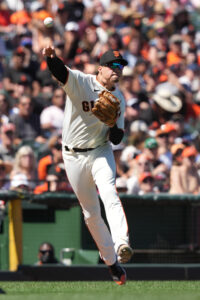
Although he’s never been an All-Star, Flores has been steadily above-average at the plate for years and that’s been true of his time in San Fran as well. In 2020, he hit 12 home runs in the shortened season and produced a batting line of .268/.315/.515. That production was 19% above league average, as evidenced by his 119 wRC+. He followed that up with 18 homers in 2021 and a line of .262/.335/.447, 112 wRC+. The Giants made the easy call of exercising their option for 2022 and were rewarded with another solid Flores season. He’s added another 18 homers already this year, with an overall slash line of .235/.319/.414, wRC+ of 107. This is the seventh consecutive season in which Flores has registered a wRC+ between 102 and 119. Instead of returning to the open market, he will stick in San Francisco for another couple seasons.
He has produced that consistently solid work at the plate while also giving the Giants defensive versatility, something they clearly value highly in players. In all three of his seasons with the Giants, he has bounced between first base, second base and third base as needed. That’s been especially important for a club that features some older or injury-prone regulars like Evan Longoria, Brandon Belt and Tommy La Stella. Going forward, La Stella has one more year on his contract but he hasn’t played much defense this year, taking the field for just 66 innings so far. It’s also possible Longoria and Belt won’t be around next year. Belt is heading to free agency after this year and faces an uncertain road ahead, having just undergone surgery on his oft-injured knee. Longoria could be retained for next year via a $13MM club option with a $5MM buyout, though he told Susan Slusser of the San Francisco Chronicle that he has at least given some thought to retirement.
Given the uncertainty surrounding those infielders, it makes sense to lock up a reliable and versatile contributor like Flores. He can now be penciled into an infield mix that includes La Stella, rookie David Villar, Thairo Estrada, Brandon Crawford, J.D. Davis, with LaMonte Wade Jr. perhaps playing some first base or returning to strictly outfield work. Crawford and La Stella are both slated to become free agents after 2023, which will further thin out this group for the second year of Flores’ deal.
The Giants ran an Opening Day payroll of $155MM here in 2022, according to Cot’s Contracts. Flores’ deal pushes the team’s 2023 payroll commitments to around $95MM, in the estimation of Jason Martinez of Roster Resource. That doesn’t include arbitration raises for players like Mike Yastrzemski or Logan Webb, but it does include Carlos Rodón‘s $22.5MM. As long as Rodón finishes the season healthy, he will exercise the opt out on his deal and return to free agency in search of a larger payday.
It’s been a disappointing season for the Giants, as they followed up their 107-win campaign in 2021 with a 67-73 record so far in 2022. It figures to be a very interesting offseason, as the club will head into the winter with many holes that need to be filled but lots of payroll space available for addressing them. Anthony DeSclafani is the only player under contract for 2024 and the slate is completely clean beyond that, giving the Giants the ability to make a sizable commitment, or commitments, before Spring Training. But for now, they’ve retained one of their most stable and dependable guys to bolster their infield mix, giving them one less thing to worry about over the winter.
Joel Sherman of the New York Post first reported the Giants and Flores were in agreement on a two-year deal with an option for 2025. Daniel Álvarez-Montes of ElExtrabase was first to report the matching $6.5MM salaries over the next two seasons.
Image courtesy of USA Today Sports.