
Raisel Iglesias To Reject Qualifying Offer
Closer Raisel Iglesias will reject the Angels’ one-year, $18.4MM qualifying offer, tweets Ken Rosenthal of The Athletic. He’s still free to negotiate with the Angels on a new contract, of course, but will continue to pursue a multi-year arrangement in free agency.

That Iglesias would reject the qualifying offer comes as no surprise. The 31-year-old righty (32 in January) is coming off arguably the best season of his career and is the clear top reliever on this year’s market. MLBTR projected Iglesias to secure a four-year pact worth $56MM on our recent ranking of the offseason’s top 50 free agents, and a strong three-year deal, at minimum, seems quite likely even with draft compensation now attached to the righty.
A look at virtually any relief pitching leaderboard will show Iglesias among the leaders in most key numbers. The former Reds stopper finished eighth among 144 qualified relievers with a 37.7% strikeout rate and also posted the ninth-best walk rate at 4.4%. Only two qualified relievers, Josh Hader and Liam Hendriks, topped Iglesias’ huge 33.3 K-BB%. Beyond that, Iglesias’ 20.6% swinging-strike rate trailed only Hader, and his 2.06 SIERA was second only to Hendriks. No reliever in baseball posted a better swinging-plus-called-strike rate than Iglesias’ 36.8% mark.
Statcast finds Igleisas similarly dominant, rating him in the 85th percentile or better in terms of hard-hit percentage, average exit velocity and expected opponents’ batting average, slugging percentage and wOBA.
In terms of more traditional numbers, Iglesias tied for the fourth-most saves in Major League Baseball at 34 and finished 23rd among relievers with 70 innings pitched. That’s due largely to the Halos using him as a one-inning option, but Iglesias showed during his time with Cincinnati that he’s plenty capable of recording four-, five- and six-out saves when needed. His 2.57 ERA ranked “only” 29th among 144 qualified relievers, but as evidenced by the aforementioned SIERA, most fielding-independent marks feel he was better than that baseline ERA.
Simply put, Iglesias is a workhorse reliever who misses bats and limits walks at levels that place him alongside elite names like Hader and Hendriks. He’s appeared in at least 65 games and tallied at least 67 innings in each of his four full seasons as a reliever, dating back to 2017. Iglesias had a pair of month-long stays on the injured list due to minor shoulder troubles back in 2015-16, when the Reds were still debating whether he fit best as a starter or reliever, but since moving to the ‘pen full time, he’s had only a single 10-day stint on the IL for a minor biceps issue.
If there’s one flaw in Iglesias’ game, it’s the occasional home run. His average of 1.41 homers per nine frames this year was surely higher than the Angels would’ve hoped, but his minuscule walk rate and paltry .207 opponents’ batting average and .243 opponents’ OBP meant that the majority of those round-trippers came with the bases empty. It’s not exactly a career-long issue, either, as Iglesias yielded just one homer in 23 frames during the shortened 2020 season (0.39 HR/9) and has averaged a more manageable 1.10 homers per nine innings in his seven-year MLB career.
Iglesias is the only reliever on this year’s market to receive a qualifying offer, but he’s superior enough in terms of age, track record and strikeout-to-walk profile that it shouldn’t prove to be a major hindrance to his market. Kenley Jansen, Kendall Graveman and Corey Knebel are among the names in the next tier, but Iglesias should be a lock to score the biggest contract of any relief pitcher this offseason.
Photo courtesy of Imagn/USA Today Sports.
Angels Sign Noah Syndergaard
The first of what Angels fans hope will be multiple rotation additions is in the books, as the Halos announced a one-year agreement with free-agent righty Noah Syndergaard. The 29-year-old will reportedly collect a $21MM salary in 2022 before re-testing the free agent market next offseason.
Syndergaard received an $18.4MM qualifying offer from the Mets last week, and his agreement with the Angels effectively amounts to rejecting that offer. As such, the Angels will forfeit their second-highest selection in next year’s draft. The Mets, meanwhile, will receive a compensatory draft pick after the completion of Competitive Balance Round B (typically in the No. 75 overall range).

Syndergaard has scarcely pitched since the completion of the 2019 season thanks to 2020 Tommy John surgery and a series of setbacks in his recovery this year. He did make it back to the mound for two innings of bullpen work with the Mets late in the 2021 campaign, at least demonstrating that he was healthy enough to pitch in a big league game.
The general hope had been that he’d be recovered from surgery and rejoin the Mets’ rotation around June, but Syndergaard’s recovery was shut down on May 27 due to inflammation in his surgically repaired elbow. He resumed throwing about six weeks later but was again set back — this time by a positive Covid-19 test.
When healthy, Syndergaard has proven to be one of the more dynamic pitchers in the game. The 6’6″, 242-pound righty is one of the more physically imposing pitchers in MLB and, at his peak, boasted the velocity to match that frame. Syndergaard averaged a blistering 98.1 mph on his heater from 2015-19, pitching to a combined 3.31 ERA and 3.37 SIERA along the way. The big righty finished fourth in NL Rookie of the Year voting in ’15 and finished eighth in Cy Young voting during an All-Star 2016 season.
At his best, Syndergaard combines that elite velocity with high-end strikeout rates and plus walk rates. He’s fanned a hearty 26.4% of career opponents against just a 5.6% walk rate — including a career-best 29.3% strikeout rate in that All-Star 2016 season. Syndergaard has never walked more than 6.1% of his opponents in a given season, and he’s also kept the ball on the ground at an above-average 49% clip in 718 career innings.
It’s that lack of innings, of course, that is the primary red flag on Syndergaard at present. In addition to the 2020 Tommy John surgery and series of 2021 setbacks, Syndergaard was limited to just seven starts in 2017, owing to a torn lat muscle. He also missed time in 2018 due to some ligament damage in his pitching hand.
With that context in mind, Syndergaard falls in line with some recent rotation additions by the Angels: high-upside, high-risk arms on a one-year deal (e.g. Matt Harvey, Julio Teheran). That comes in spite of a new general manager — Perry Minasian replaced Billy Eppler to begin the 2020-21 offseason — though one would imagine that this is the first of multiple pieces Minasian and his staff will add this winter. It remains possible that the Angels will add a starter on a multi-year deal. Still, the Angels have had longstanding rotation issues but nevertheless repeatedly eschewed long-term deals for pitchers, suggesting at least some aversion to such deals on owner Arte Moreno’s behalf.
To be fair, none of the short-term rotation additions the Angels have made in recent years carry the same upside as Syndergaard on a one-year contract. Minasian has vowed to “significantly” improve his team’s starting staff in 2022, and a healthy Syndergaard would be a clear step in that direction. He’ll join Shohei Ohtani atop the rotation for the time being, but that duo would require greater workload management than most top-of-the-rotation pairs throughout the league. As such, it wouldn’t be a surprise to see the Angels also target some more reliable bulk innings with their next addition — be it on the free-agent market or via the trade market.
Beyond Ohtani and Syndergaard, the Angels have plenty of promising arms but little in the way of established MLB hurlers. Young lefties Patrick Sandoval and Jose Suarez both showed well in 2021 but tallied fewer than 100 frames apiece. Fellow southpaw Reid Detmers was a first-round pick in 2020 and is viewed as one of baseball’s top pitching prospects, but he was hit hard in his 2021 MLB debut. Former top prospect Griffin Canning ought to get another look after some injuries and struggles have deflated his stock, and righty Jaime Barria gives the Angels a solid back-of-the-rotation option as well.
With a return to form by Syndergaard and another healthy season of Ohtani, it’s easy to see this staff being the best the Angels have had in recent memory. At the same time, that’s a lot to bank on. Given the injury risk strewn throughout this group and the general attrition rate of young pitchers, it’s equally plausible that the Angels could again find themselves scrambling to piece things together. Syndergaard is quite arguably as great an upside play as there is on this offseason’s market, but the Angels still have some heavy lifting to do on the rotation front if they hope to finally piece together the reliable staff that has eluded them in recent years.
The Syndergaard signing gives the Angels six guaranteed contracts on next year’s books, totaling a hefty $129.95MM just among that group. A small arbitration class works in their favor and brings the team’s projected payroll into the $150MM range, however, even after accounting for a slate of pre-arbitration players to round out the roster. That should leave room for at least one more significant addition on the starting staff (perhaps two, if one comes via trade).
As for the Mets, the loss of Syndergaard and the potential loss of fellow free agent Marcus Stroman — another reported Angels target — leaves them with ample questions in their own rotation. Jacob deGrom is the game’s best pitcher but missed significant time due to injury in 2021. Carlos Carrasco‘s brief Mets tenure has been punctuated by injury troubles, and Taijuan Walker wilted after a terrific first half. The Mets have younger options in the rotation themselves (e.g. David Peterson, Tylor Megill), but they’ll surely be on the hunt for upgrades after being spurned by Syndergaard.
Jon Morosi of MLB.com reported the sides were nearing agreement on a contract. Jeff Passan of ESPN reported the sides had agreed on a one-year, $21MM deal.
Photo courtesy of Imagn/USA Today Sports.
Sixth Year Still A Sticking Point In Talks Between Freddie Freeman, Braves
Though the consensus around the game remains that a reunion between Freddie Freeman and the Braves is something of a fait accompli, Jon Heyman of MLB Network reports that the two sides are still hung up on the length of the deal. USA Today’s Bob Nightengale had previously reported that the 2020 NL MVP had already rejected the Braves’ best offer ($135MM over five years), though it’s unclear if that’s the same offer the club had made when Heyman reported a “gap” between the two sides in September.
Freeman, who has played the entirety of his twelve-year big-league career in Atlanta, is reportedly looking for a deal that would pay him something closer to $200MM over six years. Whether or not the Braves have bumped up their dollar offer is unclear, but the first baseman, who cemented his place in the annals of Braves history during the club’s 2021 World Series run, appears set on receiving a deal that would take him through at least his age-37 season. It’s quite clear that a carbon-copy of the five-year, $130MM deal Paul Goldschmidt signed with the Cardinals ahead of the 2019 season won’t get it done. MLBTR projects that Freeman will ultimately sign for six years and $180MM.
Braves GM Alex Anthopoulos has already confirmed the club will run a higher payroll in 2022. To keep Freeman around, they’ll have to; following yesterday’s signing of Manny Piña, Cot’s Baseball Contracts estimates (including arbitration salary projections) that the Braves have already committed just shy of $133MM to their 2022 roster. This figure could decrease with a suspension of Marcell Ozuna (who’s slated to earn $16MM next year) or if the club chooses to non-tender a few of its arbitration-eligible players (Johan Camargo, Sean Newcomb, and Orlando Arcia are all non-tender candidates), but not by enough to accommodate the roughly $30MM Freeman will command on an annual basis without a significant payroll bump.
Beyond Freeman’s importance as the face of the franchise (a role he inherited from Chipper Jones), his career numbers justify a significant investment. Since debuting as a September call-up in 2010, Freeman has put together the numbers of a likely future Hall 0f Famer, compiling a .295/.384/.509 career slash-line while mashing 271 homers. His best year came in the abbreviated 2020 season, when he put together a monstrous .341/.462/.640 line across 60 games and won his first career MVP. A pillar of consistency, Freeman hasn’t posted an OPS+ below 132 since 2012 (his age-22 season) and has played in at least 147 games in all but two of his eleven full seasons. He’s not yet shown any signs of regression, as he followed up his MVP year with a .300/.393/.503 line (basically identical to his career marks) and an OPS north of 1.000 in the playoffs.
Among the many interesting wrinkles in the surprisingly drawn-out process of a reigning World Champion attempting to hold on to its best player is the Braves’ ownership structure. Because Liberty Media, the club’s owner since a complicated stock swap deal with Time Warner in 2007, is a publicly traded company, it must disclose a detailed account of its earnings on a quarterly basis, giving fans and followers of the industry a unique look into the team’s internal financial workings. Maury Brown of Forbes reports that the club posted baseball-related revenues of $222MM in the third quarter of 2021 (roughly the second half of the season) alone.
Heyman reported yesterday that the Yankees, who beat the Braves in both the ’96 and ’99 Fall Classics, have at least kicked the tires on Freeman — a development likely to send shivers down the spines of Braves fans. Though hardly surprising — every team with money and a need at first base is likely to at least check in — the news will only put further pressure on Anthopoulos to re-sign his team’s most consistent and recognizable player. Travis d’Arnaud, Ozzie Albies, and Atlanta-area native Dansby Swanson (an infant when the Braves last won a title) have already joined the chorus of fans demanding a speedy deal, calling on club management to “re-sign Freddie” during their speeches at Truist Park following the team’s championship parade.
Even if the Braves do wrap up a deal to keep Freeman in Atlanta into his elder years, Anthopoulos’ offseason business is unlikely to be done. Three of the four outfielders the club acquired in July (Joc Pederson, NLCS MVP Eddie Rosario, and World Series MVP Jorge Soler) are also free agents, and the fourth (Adam Duvall) is arbitration-eligible after turning down his half of a $7MM mutual option. With Ozuna’s future in Atlanta uncertain, Ronald Acuña Jr. still recovering from a major knee injury, and top prospect Cristian Pache a major question mark with the bat, the reigning champ’s outfield situation remains up in the air. They may also wish to add a veteran starter to a mix that includes Max Fried, Ian Anderson, Charlie Morton, and a stable of promising-but-unproven arms (including Huascar Ynoa, Kyle Wright, Tucker Davidson, Kyle Muller, and Touki Toussaint) with mixed records in the big leagues.
Trevor Story To Reject Qualifying Offer
Confirming a widely expected development, Patrick Saunders of the Denver Post reports that Trevor Story will not accept the Rockies’ qualifying offer ahead of tomorrow’s deadline. As such, he’ll forego the one-year, $18.4MM deal and test the open market as part of a historic class of high-end free agent shortstops.
Assuming Story does not ultimately re-sign with Colorado, the Rox will receive a compensation pick between the first round and Competitive Balance Round A presuming Story signs for $50MM or more, or a pick between the second round and Competitive Balance Round B should he sign for less than $50MM. The former is, of course, more likely; MLBTR has him pegged for six years and $126MM.
Perhaps the more intriguing news in Saunders’ report is that the list of teams who’ve checked in with the shortstop (Saunders counts 8) does not include the Rockies. While Story is widely expected to leave the Mile High City this winter, news that Colorado hasn’t even checked in with their longtime star’s camp is noteworthy — and makes their decision not to trade him at this year’s trade deadline all the more puzzling. Per a June report from Saunders, Story made it clear to Rockies’ management he had little interest in engaging in extension talks (perhaps related to the club’s handling of Nolan Arenado following his extension), and letting him walk without at least the appearance of a fight may not endear new GM Bill Schmidt to the Colorado fanbase.
Though Story’s walk-year numbers (.251/.329/.471, with an OPS+ of 103) hardly represent his strongest showing, his career baseline of .272/.340/.523 (112 OPS+) tells a different tale, particularly given Story’s consistently stellar glovework (69 DRS across six seasons) at a premium position. The relative mediocrity of Story’s 2021 may also have been driven by an elbow injury that sent him to the 10-day IL in late May. An MRI at the time revealed no structural damage, and the shortstop looked much more like his old self in the second half, posting an .843 OPS (just below his career .863 mark).
Story’s OPS+ numbers take the effect of Coors Field into account, but it is worth noting that his home/road splits are significant; his career OPS at Coors (.972) dwarfs his career mark (.752) closer to sea level. This may give teams pause in offering Story the sort of mega-deal that Carlos Correa and Corey Seager (and possibly Marcus Semien) are likely to receive, but he remains a fairly safe bet to at least push nine figures of guaranteed money.
Presuming Story ultimately departs, the Rockies do have an in-house replacement at the ready in former top prospect Brendan Rodgers, who mostly played second base in 2021 but also served as Story’s deputy at short. The versatility of Ryan McMahon (who played second and third in his breakout 2021) and speedster Garrett Hampson (who’s seen time at five positions in the bigs) gives the club a chance to get creative in putting its infield together. It may also open a space for power-hitting corner infielder Elehuris Montero, the Rox’ number-four prospect per MLB.com, to make it to Denver in 2022.
Tigers Sign Eduardo Rodriguez
The Tigers have made the biggest move of the 2021-22 offseason to date, formally announcing a five-year contract with free agent starter Eduardo Rodríguez. The deal comes with a $77MM guarantee and can max out at $80MM, depending upon incentives.
The contract also affords Rodriguez the opportunity to opt out of the after the second season of the deal. MLBTR’s Tim Dierkes reports that Rodriguez will earn a combined $28MM total from 2022-23 (Twitter link), meaning he’ll be faced with the decision of whether to opt out of the remaining three years and $49MM on his contract after the 2023 campaign. Rodríguez, who recently rejected a qualifying offer from the Red Sox, is represented by Mato Sports Management.
Rodríguez was seemingly in strong demand — his contract tops MLBTR’s projected five-year, $70MM estimate — drawing varying levels of interest from the Blue Jays, Angels and incumbent Red Sox. (Boston presented him with a multi-year offer in addition to the one-year qualifying offer.) Detroit will wind up topping the bidding, in the process installing a mid-rotation arm to its fairly young starting staff. That was known to be a priority for the Tigers’ front office, with general manager Al Avila frankly telling reporters after the season that adding an established starter “would be a necessity” for the club.
Detroit has also been tied to right-handers Jon Gray and Anthony DeSclafani, but it seems Rodríguez will be the Tigers’ big rotation add of the offseason. He’ll serve as the veteran anchor in a starting group that also includes young, highly-touted arms like Casey Mize, Tarik Skubal and Matt Manning. With Spencer Turnbull expected to miss most or all of 2022 after undergoing July Tommy John surgery and Matthew Boyd looking likely to be non-tendered after undergoing a flexor procedure, it’s possible Detroit looks to add additional rotation depth later in the offseason. It’s unlikely any subsequent pick-up will be as impactful or as costly as Rodríguez, whose reported contract terms are quite strong.
Not only does he beat MLBTR’s projected guarantee by $7MM, he picks up the freedom to re-test the market two years from now. The southpaw won’t turn 29 years old until April 2022, meaning he’ll only be entering his age-31 campaign over the 2023-24 offseason. If he pitches well over the next couple seasons, it’s easy to envision Rodríguez opting out and hitting free agency in search of another long-term deal during a winter without any sort of uncertainty about the collective bargaining agreement. Yet the contract’s five-year guarantee also gives him solid stability to guard against injuries or underperformance that could crop up over the next two years.
That Rodríguez generated such strong interest and landed this kind of commitment from the Tigers serves as the latest reminder of teams’ changing methods of player evaluation. On the surface, Rodríguez wouldn’t appear to be coming off a particularly impressive season. He racked up 157 2/3 innings over 32 appearances (31 starts), but he did so with a career-worst 4.74 ERA. Not long ago, a five-year guarantee for a pitcher coming off a platform season in which his ERA was pushing 5.00 would’ve been inconceivable.
Teams are going far beyond ERA to evaluate pitchers in 2021, though, and Rodríguez’s underlying numbers were very strong. He struck out 27.4% of opponents this past season, a mark that’s nearly five percentage points above the league average for starters. Rodríguez’s 11.7% swinging strike rate is also a bit north of the 10.9% league mark, his fourth consecutive healthy season generating whiffs at greater than an 11% clip.
Rodríguez also has solid control, with his walk percentages typically hovering right around the league average. He doled out free passes at just a 7% rate in 2021, the lowest mark of his career. And despite pitching in one of the game’s most hitter-friendly home parks and divisions, he’s never really had issues preventing home runs.
More than anything, Rodríguez’s poor run prevention numbers in 2021 were the result of what happened when batters put the ball into play. Opponents had a .363 batting average on balls in play this past season, the second-highest mark among the 129 pitchers with 100+ frames. It’s not as if Rodríguez was simply getting battered night in and night out, though; opposing hitters’ 86.5 MPH average exit velocity was in the bottom ten percent leaguewide, while their 33.6% hard contact rate was in the worst fifteen percent.
Between his combination of swing-and-miss stuff, control and soft contact, Rodríguez fared quite well in the eyes of ERA estimators. While his actual ERA ranked 100th of that group of 129 hurlers, his FIP (3.32) and SIERA (3.64) checked in 21st and 24th, respectively. The Tigers are clearly of the belief that those metrics better reflect Rodríguez’s true talent level, with his ghastly 2021 run prevention attributable mostly to some combination of poor luck and a Boston defense that was the league’s worst at turning balls in play into outs. In prior seasons, Rodríguez’s peripherals and ERA aligned a lot more closely, and he posted a cumulative 3.92 ERA/3.84 FIP between 2017-19.
A deeper dive into Rodríguez’s underlying numbers explains why the Tigers were willing to put forth this kind of financial outlay, but that’s not to say the move is without risk. Long-term investments in pitchers are inherently a gamble, considering the rate of pitcher injuries throughout the league. And while Rodríguez has been a durable workhorse for the bulk of his career, he didn’t pitch at all in 2020 after a scary bout with myocarditis (essentially inflammation of the heart) that arose from a case of COVID-19.
Rodríguez was open about the toll the disease took on his body, with doctors forbidding seemingly mundane tasks like walking his dog and playing video games for months — to say nothing of a strenuous activity like pitching (link via James Wagner of the New York Times). In that context, his return to the field in 2021 was remarkable, and he didn’t look worse for wear once he could return to the diamond. Detroit’s medical staff no doubt did due diligence on evaluating how likely that unfortunate circumstance would be of affecting Rodríguez over the long term.
It’s not yet clear precisely how Rodríguez will be paid over the coming seasons. If he’s paid a flat $15.4MM sum annually, that’d push Detroit’s 2022 payroll just above $125MM, in the estimation of Jason Martinez of Roster Resource. Non-tendering a few arbitration eligible players like Boyd, Niko Goodrum and Dustin Garneau could knock $10MM+ off that tally. The Tigers would still be far above the approximate $81MM payroll with which they entered the 2021 season (via Cot’s Baseball Contracts), but the franchise has spent nearly $200MM on players in seasons past.
The Tigers’ biggest spending days came during the tenure of late owner Mike Ilitch. The franchise drastically reduced payroll after he passed away and left primary control of the team to his son Christopher Ilitch. Detroit has been amidst a massive rebuild for essentially all of the latter’s ownership tenure, however, and Ilitch suggested in August that he’d be prepared to spend for “high-impact” players. Rodríguez certainly qualifies, and it’s generally expected the Tigers will be among the primary suitors in this offseason’s star-studded free agent shortstop class as well. Indeed, the Detroit front office has had at least cursory conversations with representatives for Carlos Correa, Corey Seager and Trevor Story, among others.
As for the Red Sox, they’ll now have to replace a player who’s been a valuable rotation member for the past six seasons. Rodríguez broke in with Boston in 2015 and has been a fixture on the starting staff ever since (excluding his missed 2020 campaign). He was a key member of the Sox’s World Series-winning 2018 team, finished sixth in 2019 AL Cy Young Award voting and pitched in the postseason for Boston in each of 2017, 2018 and 2021.
Because the Red Sox made him a qualifying offer, they will pick up a compensatory pick in next summer’s amateur draft. As a team that neither received revenue sharing nor exceeded the luxury tax threshold in 2021, Boston receives a pick after Competitive Balance Round B (typically in the 70-75 overall range).
The Tigers, meanwhile, will forfeit a pick as a penalty for signing away a qualified free agent. Detroit received revenue sharing in 2021, meaning they’ll only lose their third-highest draft choice next year. Were the Tigers to sign another qualified free agent this offseason, they’d surrender their fourth-highest pick as well.
Cody Stavenhagen of the Athletic first reported that Rodríguez was nearing agreement on a multi-year deal with the Tigers. Jon Heyman of the MLB Network reported Rodríguez and the Tigers were in agreement on a five-year contract. Jeff Passan of ESPN reported the guarantee to land within the $77MM – $80MM range. Joel Sherman of the New York Post reported the presence of an opt-out clause. Heyman reported the guarantee to be $77MM, that Rodríguez’s opt-out possibility came after the 2023 season, and the possibility of incentives. Evan Petzold of the Detroit Free Press pegged those possible incentives at $3MM and reported the presence of no-trade protection.
Image courtesy of USA TODAY Sports.
Jonathan India, Randy Arozarena Win Rookie Of The Year Awards
Reds second baseman Jonathan India and Rays outfielder Randy Arozarena have been voted the 2021 Rookie of the Year in the National League and American League, respectively, the Baseball Writers’ Association of America announced Monday evening.
India, 24, won in near-unanimous fashion, securing 29 of 30 first-place votes. Marlins lefty Trevor Rogers took the lone other first-place vote, as well as 26 second-place votes. Arozarena, meanwhile, received 22 of 30 first-place votes, securing a decisive victory of his own.
The No. 5 overall draft pick in the 2018 MLB Draft, India had actually seen his prospect stock slide a bit coming into the 2021 season, as he’d dropped off the majority of Top 100 rankings of note. He apparently didn’t get that memo, however, as the former Florida Gators standout took the second base job in Cincinnati and ran with it.
The Reds deserve some credit for sticking with India early on, as he scuffled through a rough first month of the season, hitting just .239/.316/.358 in April. He improved those numbers across the board in May but still checked in below the league average in terms of overall offensive output. With a couple months of big league reps under his belt, however, India found his stride and never looked back.
India slashed .303/.425/.455 in the month of June and was considerably above the league average with the bat in each of the season’s three subsequent months. From June 1 through season’s end, India raked at a .281/.390/.493 pace with a huge 11.9% walk rate and a 22.5% strikeout rate. On the whole, he ended the year with a hearty .269/.376/.459 batting line, adding in 21 home runs, 34 doubles, two triples and a dozen steals (in 15 tries). With the glove, both Defensive Runs Saved and Ultimate Zone Rating pegged him as average at second base. Statcast’s Outs Above Average was much more bearish, grading him at minus-7, but both Baseball-Reference and FanGraphs alike graded him out at 3.9 Wins Above Replacement. Cincinnati can now control India through 2026.
Arozarena, 26, burst onto the scene with one of the most impressive postseason showings in recent memory during the Rays’ 2020 World Series run and retained his rookie eligibility into 2021. While he didn’t dominate at quite those same levels this season, the former Cardinals farmhand turned in a robust .274/.356/.459 batting line with 20 home runs, 32 doubles, three triples and 20 steals (in 30 tries) through 604 plate appearances. Baseball-Reference valued him at 4.1 wins above replacement, while FanGraphs pegged him at 3.3.
Acquired alongside Jose Martinez in the trade that sent top pitching prospect Matthew Liberatore to St. Louis, Arozarena has cemented himself as an everyday outfielder and a building block in the Tampa Bay lineup for the next few seasons. In addition to his strong blend of power and speed at the plate, Arozarena drew positive defensive marks in both Defensive Runs Saved (3) and Outs Above Average (1). Like India, he can be controlled all the way through the 2026 season.
India, Rogers and Cardinals outfielder Dylan Carlson took home the overwhelming majority of votes in National League balloting. Also receiving some stray third-place votes were Cubs infielders Patrick Wisdom and Frank Schwindel; Braves right-hander Ian Anderson; Pirates closer David Bednar; and India’s teammates Tyler Stephenson and Vladimir Gutierrez.
In the American League, it was Astros right-hander Luis Garcia taking second place on the strength of two first-place votes and 15 second-place votes. Arozarena’s teammate, Wander Franco, finished third place and garnered a pair of first-place votes. Rangers center fielder Adolis Garcia received three first-place votes but landed fourth overall, while Cleveland closer Emmanuel Clase received the other first-place vote. Ryan Mountcastle of the Orioles, Shane McClanahan of the Rays and Alek Manoah of the Blue Jays all landed some second- and/or third-place votes as well.
A full breakdown of the National League voting and full breakdown of American League voting are available at the BBWAA’s web site.
Chris Taylor To Reject Qualifying Offer
Utilityman Chris Taylor will reject the Dodgers’ one-year, $18.4MM qualifying offer and test the open market, reports Jon Heyman of the MLB Network (Twitter link). The Meister Sports Management client will presumably set out in search of a multi-year pact, be it with the Dodgers or another club.
That’s not at all surprising, since Taylor should be in plenty of demand. Even with draft pick compensation attached, MLBTR placed the 31-year-old sixteenth on this offseason’s list of top free agents, projecting him to land a four-year deal worth $64MM. Taylor’s ability to play essentially any non-catcher position on the diamond should make him a highly coveted player, with teams seeing him as a potential solution for weaknesses on their current roster at various positions.
While Taylor’s best known for his defensive versatility, he pairs that with strong work at the plate. The right-handed hitter strikes out a fair amount, but he also draws walks and hits for power at high clips despite spending his past few years in one of the game’s more pitcher-friendly home parks. By measure of wRC+, Taylor has been an above-average bat in each of the past five seasons. He slowed down in the second half of the 2021 campaign, but Taylor was scorching hot during the postseason to hit free agency on a high note.
If Taylor doesn’t re-sign with the Dodgers, they’ll stand to receive a compensatory draft choice. As a team that exceeded the luxury tax threshold in 2021, they’ll only add a pick after the end of the fourth round. Teams that sign Taylor (or any other qualified free agent), will surrender draft and potentially international signing bonus capital, with the extent of the forfeiture dependent on the signing club’s market size. MLBTR’s Tim Dierkes broke down which picks each team would forfeit last month.
Giants Sign Manager Gabe Kapler To Contract Extension
The Giants have signed manager Gabe Kapler to a contract extension that runs through the end of the 2024 season, the club announced. His original deal ran through next year, so the sides are extending their relationship by an additional two years.
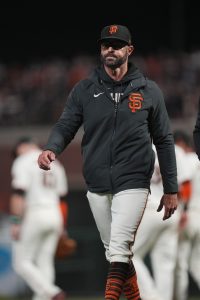
It’s no surprise the San Francisco front office kicked off the offseason by hammering out an extension with their skipper. It’s fairly common for teams to avoid heading into the season with a manager in the final year of his contract — if for no other reason than to ward off speculation about their long-term future.
Of course, no one would’ve expected Kapler’s job to be in any jeopardy anyways. Signed to replace Bruce Bochy over the 2019-20 offseason, Kapler led the club to a roughly average showing in his first season. The Giants went 29-31 during the 2020 truncated schedule, finishing just outside an expanded playoff field. If anything, that roughly .500 showing looked to be an optimistic expectation heading into 2021. FanGraphs’ preseason projections gave the Giants just a 5.7% chance of reaching the playoffs, while Baseball Prospectus forecasted them at 75-87 with less than a 1% shot of winning a loaded NL West.
Instead, the Giants played one of the best seasons in the history of the more than century-old franchise. No other Giants’ team had won more than the 107 regular games claimed by this year’s squad, while their .660 winning percentage was the organization’s fifth-highest mark since 1900 (and highest since moving to San Francisco in 1958). The Giants led all teams in wins, narrowly holding off the Dodgers to claim an improbable division crown.
The team didn’t have the postseason success they no doubt desired, dropping a tight five-game Division Series against their archrivals from L.A. The front office surely isn’t holding the vagaries of a five-game sample against Kapler, though, and today’s extension reflects that.
It’s always hard to apportion credit or blame for a team’s success to a manager from the outside. Giants’ players no doubt deserve plenty of acclaim, with Buster Posey, Brandon Crawford, Brandon Belt and Evan Longoria playing as well as ever despite being into their mid-30s. That group has been effusive in their praise for the front office and Kapler’s coaching staff in helping orchestrate their turnarounds, though. Kapler and his staff also drew plaudits for their leveraging of San Francisco’s role players, with previously unheralded performers like Darin Ruf and LaMonte Wade Jr. thriving in platoon capacities.
The Giants’ marvelous campaign has massively raised expectations for the franchise heading into 2022. Facing the potential free agent departures of four-fifths of their primary rotation, president of baseball operations Farhan Zaidi and his front office have plenty of work to do this offseason. They’ve checked off one box early, keeping Kapler in the Bay Area for what they hope to be another few great seasons.
MLB Proposes Replacing Arbitration With Salaries Based Off Player WAR Totals
In August, Major League Baseball made its first core economics proposal to the MLB Players Association. That would’ve involved a radical restructuring of the game’s economic system, first granting players free agency at age 29 1/2 (as opposed to after six years of MLB service) and replacing the current arbitration structure with a pool-based system attached to revenues.
This week, the league proposed an unexpected wrinkle in CBA talks. While the new proposal contains the same age threshold for free agency qualification, Evan Drellich, Ken Rosenthal and Eno Sarris of the Athletic report that this offer would tie pre-free agency pay directly to a player’s Wins Above Replacement tally. Under this structure, a player’s service time and career WAR marks (weighted to emphasize the most recent seasons more heavily) would set the player’s salary. While multiple websites calculate WAR totals in different ways, MLB’s proposal would base salaries on FanGraphs’ WAR tabulations.
Earlier this afternoon, Ben Nicholson-Smith of Sportsnet reported (on Twitter) that MLB had offered to replace the arbitration system with salaries based on an algorithm. Nicholson-Smith added that the MLBPA was not enamored with that idea, and the Athletic trio quotes one player representative as saying that such an offer has “zero chance” of being approved.
That’s not at all surprising. MLB’s proposal to set free agency at 29 1/2 years has always looked to be a non-starter for the players. The league’s top prospects typically reach the majors in their early-mid 20’s. Those who live up to their promise will often pass six years of service and hit free agency in advance of their age-28 or age-29 seasons. Marketing as many prime-aged seasons as possible is what often allows players to land contracts that push free agency forward, and the league’s proposal could tether that elite group to their original teams for longer than the current system does. (For example, neither of this offseason’s top two free agents — Carlos Correa and Corey Seager — would be eligible for free agency were the age set at 29 1/2).
Certainly, the age threshold would impact some players positively as well. Players like Aaron Judge and Willson Contreras would’ve reached free agency this winter as opposed to going into their final year of arbitration. A late bloomer like Cubs third baseman Patrick Wisdom would’ve been on the open market instead of making the league minimum salary, and he’d have likely made a few million dollars in 2022 coming off a 28-homer showing over just 375 plate appearances. Overall, though, the union likely sees the 29 1/2 year age threshold as too old to be more desirable than the current service structure.
Fixing player salaries to a statistical formula comes with its own challenges. Past performance will, of course, always be relevant to player pay. The existing arbitration system awards players salaries based on their combination of service time and prior salaries of statistically-comparable players. There’s a case to be made that MLB’s proposal would modernize that process.
Arbitration can lean a little more heavily than most modern teams do on traditional box score statistics like pitcher wins, saves, and hitters’ home runs and RBI totals. While arbitrators will also consider newer, WAR-like metrics, their comparative reliance on old-school stats has led to arb salaries for closers and defensively-limited sluggers tending to skew higher than teams have been willing to pay. On the other hand, arbitrators haven’t generally placed as much value as clubs have on glove-first players and high-leverage setup relievers. Basing pre-free agency salaries off WAR would probably help to close that gap.
That said, the MLBPA seems likely to take issue with tying salaries to WAR directly. As the Athletic scribes write, using that metric is particularly challenging with regards to relievers. Both the free agent and arbitration markets have valued bullpen arms more highly than WAR totals typically do. Advanced defensive metrics — a key component in WAR calculations — can be unstable on a yearly basis. Over the long run, those metrics tend to align with general evaluations of a player’s defensive acumen. Fixing salaries weighted heavily on single-season defensive metrics, though, seems suboptimal.
WAR naturally involves making imprecise adjustments for different parks, which could pose problems when teams adjust playing field dimensions. And WAR metrics differ on how to separate a pitcher’s contributions from those of his defense; FanGraphs, upon which MLB’s proposal would be based, evaluates pitchers essentially off their strikeout, walk and home run rates. That strips out ball in play luck but also creates some seemingly odd results. For instance, Aaron Nola — who threw 180 2/3 innings of 4.63 ERA/3.37 FIP ball — had a higher 2021 fWAR than Robbie Ray, who tossed 193 1/3 frames of 2.84 ERA/3.69 FIP pitching.
None of this is meant as an indictment of WAR models generally or of FanGraphs’ choices specifically. Most or all MLB teams rely on similar calculations in making player evaluations. That’s with good reason, since advanced metrics of that nature can offer insights into players not found by typical box score stats. Still, these limitations highlight the potential pitfalls of tying player salaries directly to this one statistic.
MLB’s proposal looks unlikely to make much headway ultimately, and both sides will continue negotiations as we near the expiration of the current CBA on December 1. Nicholson-Smith reports that the two sides are scheduled to meet next on Monday.
Joakim Soria Retires
Right-handed pitcher Joakim Soria is retiring, according to Ken Rosenthal of The Athletic, relaying word from Soria’s agent. The 37-year-old pitched for nine different teams over 14 MLB seasons.
Soria made his MLB debut for the Kansas City Royals back in 2007, throwing 69 innings with an ERA of 2.48 and notching 17 saves. He became a mainstay of the Royals’ bullpen through the 2011 campaign. In those five seasons, he pitched 315 1/3 innings with an ERA of 2.40 and racked up 160 saves. He was an All-Star twice, in 2008 and 2010.
That would prove to be the best stretch of Soria’s career, although he continued to be an effective reliever for another decade, pitching for the Rangers, Tigers and Pirates, returning to the Royals, and then stints with White Sox, Brewers and Athletics. In 2021, he started the season with the Diamondbacks and was later traded to the Blue Jays.
Over his entire career, he threw 763 innings with an ERA of 3.11, along with 831 strikeouts and 229 saves. MLBTR congratulates Soria on a fine career and wishes him all the best in his future endeavors.